Vue normale

  • ✇Coda Story
  • As Iran burns, a new age of nuclear proliferation begins
    As the Iran war pushes oil prices over $100 a barrel, and ships are attacked and mines are being laid in the Strait of Hormuz, a taboo has been broken and nuclear energy is back in fashion. European Commission president Ursula von der Leyen acknowledged that “the current Middle East crisis is a stark reminder” that it was “a strategic mistake for Europe to turn its back on” nuclear energy.  She was speaking at an International Atomic Agency summit hosted by France. Just days before the summit
     

As Iran burns, a new age of nuclear proliferation begins

13 mars 2026 à 09:04

As the Iran war pushes oil prices over $100 a barrel, and ships are attacked and mines are being laid in the Strait of Hormuz, a taboo has been broken and nuclear energy is back in fashion. European Commission president Ursula von der Leyen acknowledged that “the current Middle East crisis is a stark reminder” that it was “a strategic mistake for Europe to turn its back on” nuclear energy. 

She was speaking at an International Atomic Agency summit hosted by France. Just days before the summit, French president Emanuel Macron spoke — a nuclear submarine looming behind him — of the need to increase the country’s stockpile of nuclear warheads for the first time in several decades. “In this dangerous and uncertain world,” Macron said, “you have to be feared if you want to be free.” 

In February, the ‘New START treaty’, a mutual agreement between Russia and the U.S. to reduce and limit their nuclear arsenal, officially expired. The U.S. said China had conducted secret tests and that Beijing had to be part of any future non-proliferation agreement. For its part, the Chinese accused the U.S. government of seeking to mask its own expansionist ambitions. In the wake of the Iran war, started apparently because the Iranian regime was just days away from securing a bomb, other countries have spoken openly of their nuclear ambitions. After the start of the Iran war, North Korean leader Kim Jong Un spoke pointedly about preparing a nuclear-ready navy while inspecting a new destroyer and observing the testing of nuclear-capable cruise missiles. Even Polish prime minister Donald Tusk said Poland “will not want to be passive when it comes to nuclear security in a military context.”

On X, Tusk posted that Poland is in talks with France about joining its nuclear deterrence program. “We are arming together with our friends,” he wrote, “so that our enemies will never dare to attack us.” France is the only nuclear-capable European country, its systems (unlike the UK’s) completely independent of the U.S. and its new deterrence framework will include collaborations with Germany, Poland, Greece, Sweden, Denmark, the Netherlands and Belgium. Macron is calling France’s new strategy “advance deterrence,” a willingness to spread French nuclear armaments across the continent. A senior Pentagon official said the U.S. would “obviously at a minimum strenuously oppose” European countries seeking to acquire nuclear weapons. The U.S., as part of a NATO agreement, already deploys over 100 nuclear weapons in Europe — in Germany, Belgium, Italy, the Netherlands, and Turkey. 

Europe’s anti-nuclear tradition grew out of grassroots movements in the 1970s. In West Germany, protests against a planned nuclear plant in the small wine-growing town of Wyhl began when local farmers feared pollution would destroy their land and crops. By the 1980s, millions of Europeans were protesting nuclear weapons and the deployment of NATO missiles across the continent, bringing nuclear security debates into the public arena and pushing governments toward disarmament efforts. The political impact of those protests were long-lasting. Across Europe, nuclear energy programs were curtailed or abandoned entirely. Denmark banned nuclear power plants in 1985, Germany shut down its last nuclear reactors in 2023, and several countries imposed strict limits on nuclear development. Nuclear technology, whether for energy or weapons, remained politically toxic in much of Europe. But, as Denmark’s Mette Frederiksen said European deterrence “is necessary because the military threat from Russia is expected to increase,” and its reliance on U.S. military support can arguably no longer be taken for granted.

At the Paris summit, China, Brazil, Belgium and Italy all signed up to a pledge to triple global nuclear capacity by 2050. South Africa signed the pledge earlier this month. The war in Iran has once again made clear that the world must wean itself off fossil fuels. The U.S. — which imposed additional tariffs on India for buying Russian oil and thus helping to finance the continuation of the war in Ukraine — has, since the start of the attack on Iran, told India it can continue to buy Russian oil. Delhi promptly bought 30 million barrels of Russian crude oil. But this month India also signed a deal with Canada to receive uranium to expand its nuclear energy program. But in 1974, Canada provided India with nuclear technology for peaceful uses that were promptly put towards the building of nuclear weapons. Nuclear collaborations between the two countries were suspended for decades. It’s not a coincidence that those ties are once again being revived in the current geopolitical context. A growing clamor for nuclear energy has clear proliferation risks.

While France has been talking about greater nuclear deterrence, most European states are speaking about a revival of nuclear energy as an alternative to fossil fuels and as a means to achieve climate goals. The vast energy requirements of AI and data centres is also prompting nations to adopt an “atoms for algorithms” strategy, to be, as Macron said, “at the ​heart ​of ⁠the artificial intelligence challenge.” But to talk about energy alone is to ignore the appeal nuclear deterrence has for nation states trying to navigate dangerous geopolitical straits. Iran was attacked ostensibly because it was on the verge of having a bomb. Favored nations such as Saudi Arabia are able to sign nuclear pacts that remove non-proliferation guardrails, but the actions of the U.S. and Israel in Iran will make the bomb attractive to many more as a national security strategy.

A version of this story was published in this week’s Coda Currents newsletter. Sign up here.

The post As Iran burns, a new age of nuclear proliferation begins appeared first on Coda Story.

  • ✇Coda Story
  • Europe vs Big Tech: A battle for democracy?
    “The impunity of the giants must end,” posted Spanish prime minister Pedro Sánchez on X. His government has instructed the public prosecutor to “investigate the crimes that X, Meta and TikTok may be committing through the creation and dissemination of child pornography by means of their AI.” Sánchez has said the state “cannot allow” platforms to affect the “mental health, dignity and rights of our sons and daughters.” But Republican legislators, seemingly in response, released Part II of a repor
     

Europe vs Big Tech: A battle for democracy?

20 février 2026 à 09:14

“The impunity of the giants must end,” posted Spanish prime minister Pedro Sánchez on X. His government has instructed the public prosecutor to “investigate the crimes that X, Meta and TikTok may be committing through the creation and dissemination of child pornography by means of their AI.” Sánchez has said the state “cannot allow” platforms to affect the “mental health, dignity and rights of our sons and daughters.” But Republican legislators, seemingly in response, released Part II of a report, titled ‘The Foreign Censorship Threat’, in which it accuses the European Commission of “directly infringing on Americans’ online speech.”

Almost simultaneously, Ireland’s Data Protection Commission launched an investigation into Grok, X’s generative AI chatbot, for producing sexualized deepfakes which might have included personal data of Europeans, including children. Even British prime minister Keir Starmer, who has signed a sweeping “Technology Prosperity Deal” with the U.S. has, spoken about the need to “protect children’s wellbeing” from Grok. And earlier this month, French police searched the Paris offices of X as part of a process that X described as a “politicized criminal investigation.” 

With Australia having set a precedent for “age-gating” the Internet through legislation, France’s under-15 ban is now due to come into force in September. The UK already requires age verification for certain content via the Online Safety Act, and Spain, Slovenia, Denmark, Germany, and Greece are among those considering similar measures. ​​The social and political consensus is striking. A 30-country Ipsos survey found strong majorities in every country supporting bans for under-14s.

Elon Musk responded to the Spanish prime minister’s comments about social media being essentially a failed state, rife with criminality and a disregard for law, by calling him “a tyrant and traitor to the people of Spain.” The U.S. government has only been marginally more restrained. The House Judiciary Committee’s report accused Europe of mounting a decade-long campaign to “censor the global internet.” 

The involvement of the U.S. government, and its consistent defence of U.S. tech companies, means the battle is increasingly less about European regulators and Silicon Valley and more about what appears to be a profound ideological mismatch. “Though often framed as combating so-called ‘hate speech’ or ‘disinformation’,” said the Republican legislators’ report, the EU was working to “censor true information and political speech about some of the most important policy debates in recent history — including the Covid-19 pandemic, mass migration, and transgender issues.” Meanwhile, a recently published report in Europe shows how Silicon Valley companies spent 151 million euros lobbying far right European parliamentarians in 2025 to water down regulations. 

Big Tech forging links to the European far right dovetails with a Trump administration in which senior figures, including Donald Trump himself, endorse certain candidates in elections and routinely repeat far right talking points as part of an “unapologetic defense of Western civilization.” And now the U.S. State Department has openly touted the building of a “freedom.gov” portal that enables people to access restricted content, even if it contravenes local laws in sovereign countries.

But European regulations are not the only challenge to the impunity with which social media platforms seem to be able to act. As momentum builds to hold social media platforms to account in Europe, in the U.S. Meta owner Mark Zuckerberg has been defending Instagram in a Los Angeles courtroom. He was testifying in a lawsuit, one of several hundred filed in U.S. civil courts, alleging that social media platforms are addictive, harm the mental health of children and that platforms are aware of these effects but do little to safeguard teenage users from harm. 

The lawsuits have the effect of making the Australian, European, and perhaps global attempt to ban teens from setting up social media accounts appear necessary. But Paige Collings, a digital policy expert at the Electronic Frontier Foundation and board member at European Digital Rights, said that bans are politically attractive precisely because they are simple. “Complex problems require complex solutions,” she said. “It’s more expensive. It’s longer-term. It can’t just be implemented overnight. But blocking under-16s from social media — that is something you can implement overnight.” 

Collings is among a growing chorus of experts that are cautious about embracing bans as a comprehensive solution. For instance, she explains, to ban children, platforms first need to know who is a child. This relies on national digital ID systems, facial recognition, and third-party age verification. In all scenarios, Collings said, “we are trusting that these services and platforms are not storing this information, not selling the information,” often without meaningful guardrails to ensure that is the case. 

When the UK introduced age restrictions last summer, searches for VPNs surged as users of all ages tried to avoid giving away personal information. Now the government has floated expanding restrictions to VPN usage to plug enforcement gaps. The purpose of a VPN itself is to preserve the privacy of its user, however imperfectly. VPNs are essential tools for businesses to secure communications, for journalists to protect sources, and for citizens in restrictive environments to access independent information. Forcing identification to use them fundamentally undermines their purpose. And when the argument for banning them is framed around the protection of children, it reinstates the urgency of an entire infrastructure required to keep children off the internet and risks normalizing identity checks as conditions for access to online spaces. In a digital economy where personal data is highly valuable, such measures raise the question of who ultimately benefits.Beyond privacy concerns, Collings points out that age-gating can become “a fantastic tool for censorship with no accountability or remedy.” It does, in fact, do in part what the U.S. government and Silicon Valley companies say it does, which is restrict speech. At an AI summit in Delhi, French president Emmanuel Macron dismissed Silicon Valley’s invocation of censorship as a defense against European regulation. “Free speech,” he said, “is pure bullshit if nobody knows how you are guided through this… having no clue about how the algorithm is made, how it is tested and where it will guide you — the democratic biases of this could be huge.” But, forcing accountability and improving safety would perhaps be better than a blanket ban where the cutoff is 14 or 16, leaving everyone else to take cover as best they can in a “digital Wild West,” to borrow the Spanish prime minister’s phrase.

currents

Subscribe to our coda currents newsletter

Insights from the Coda newsroom on the global forces that shape local crises.

The post Europe vs Big Tech: A battle for democracy? appeared first on Coda Story.

  • ✇Coda Story
  • A Trump corridor through the Caucasus
    After a trip to the Winter Olympics in Italy, already marred by anger and protests at the presence of ICE agents at the games, JD Vance will embark on a victory lap of Armenia and Azerbaijan. It will be the first ever visit by a U.S. vice president to the Armenian capital Yerevan and the first to Baku since Dick Cheney’s brief 2008 whistlestop tour of the region. At war for decades, Armenia and Azerbaijan agreed to make peace in Washington, DC in August last year. The deal included the building
     

A Trump corridor through the Caucasus

6 février 2026 à 08:55

After a trip to the Winter Olympics in Italy, already marred by anger and protests at the presence of ICE agents at the games, JD Vance will embark on a victory lap of Armenia and Azerbaijan. It will be the first ever visit by a U.S. vice president to the Armenian capital Yerevan and the first to Baku since Dick Cheney’s brief 2008 whistlestop tour of the region. At war for decades, Armenia and Azerbaijan agreed to make peace in Washington, DC in August last year. The deal included the building of a “Trump Route for International Peace and Prosperity” (TRIPP), a 21st century version of a Panama-style “canal zone” — a narrow strip of land that decides who moves energy, freight, and data between continents, and who gets paid for the privilege. And, vitally, a U.S.-backed counter to infrastructure being built by China. 

TRIPP is more than a photo-op or a vanity project. The South Caucasus, particularly since Russia’s full-scale invasion of Ukraine, has become an area of critical strategic value as a corridor between East and West and a new arena of superpower competition. “Vance is not well known for flying around the world just for fun,” said Svante Cornell, Research Director of the Central Asia-Caucasus Institute in Stockholm. “The U.S. is serious about the TRIPP Corridor and they want everybody in the region to know that.” 

Armenia and Azerbaijan have fought two wars over disputed Nagorno-Karabakh since the late-1980s, as the Soviet Union collapsed. It has been a brutal, society-shaping conflict, followed in 2023 by Azerbaijan’s rapid takeover of Nagorno-Karabakh and the flight of nearly the entire ethnic Armenian population.

Russia, though formally cast as a mediator, spent years manipulating the conflict: arming both sides, managing ceasefires and preventing resolution in a familiar imperial tactic later perfected in Ukraine: manufacturing and freezing instability until it could be turned into full-scale war on Moscow’s terms. But Trump changed the narrative by brokering a peace that has continued to hold. In December, officials from both countries discussed “lasting peace” and a “joint future” at a summit in the Qatari capital Doha. Armenia and Azerbaijan are also deep in discussion about integrating their energy systems. And Washington is now trying to lock that peace into concrete: rails, roads, and fiber that physically re-route the region away from Russian and Iranian gatekeeping.

This, wrote Trump on Truth Social recently, “was a nasty War… but now we have peace and prosperity.” For once, the self-congratulation isn’t entirely empty. Trump – who has confused Armenia for Albania and talked about settling its war with “Aber-baijan” in Davos just weeks ago – can legitimately take credit for making geopolitical gains in what Russia considered its backyard. 

The US president has repeatedly quoted Vladimir Putin as telling him: “‘I cannot believe you got this war settled’... cause it’s his territory.” That line matters because the South Caucasus is to Russia what the Caribbean Basin and the Panama “backyard” once was to the United States: a strategic near-abroad where outside powers aren’t supposed to build permanent leverage. 

Hemispheric defense, the Trump administration has made clear when it comes to Latin America, is at the heart of its defense strategy and that it expects other superpowers to be similarly focused on their spheres of influence. Thus, Russia’s inability to be a reliable ally to Armenia will be seen as weakness to be preyed upon by rival powers. Armenia is now even talking to Turkey, a historical adversary, about opening their shared border and establishing diplomatic relations.

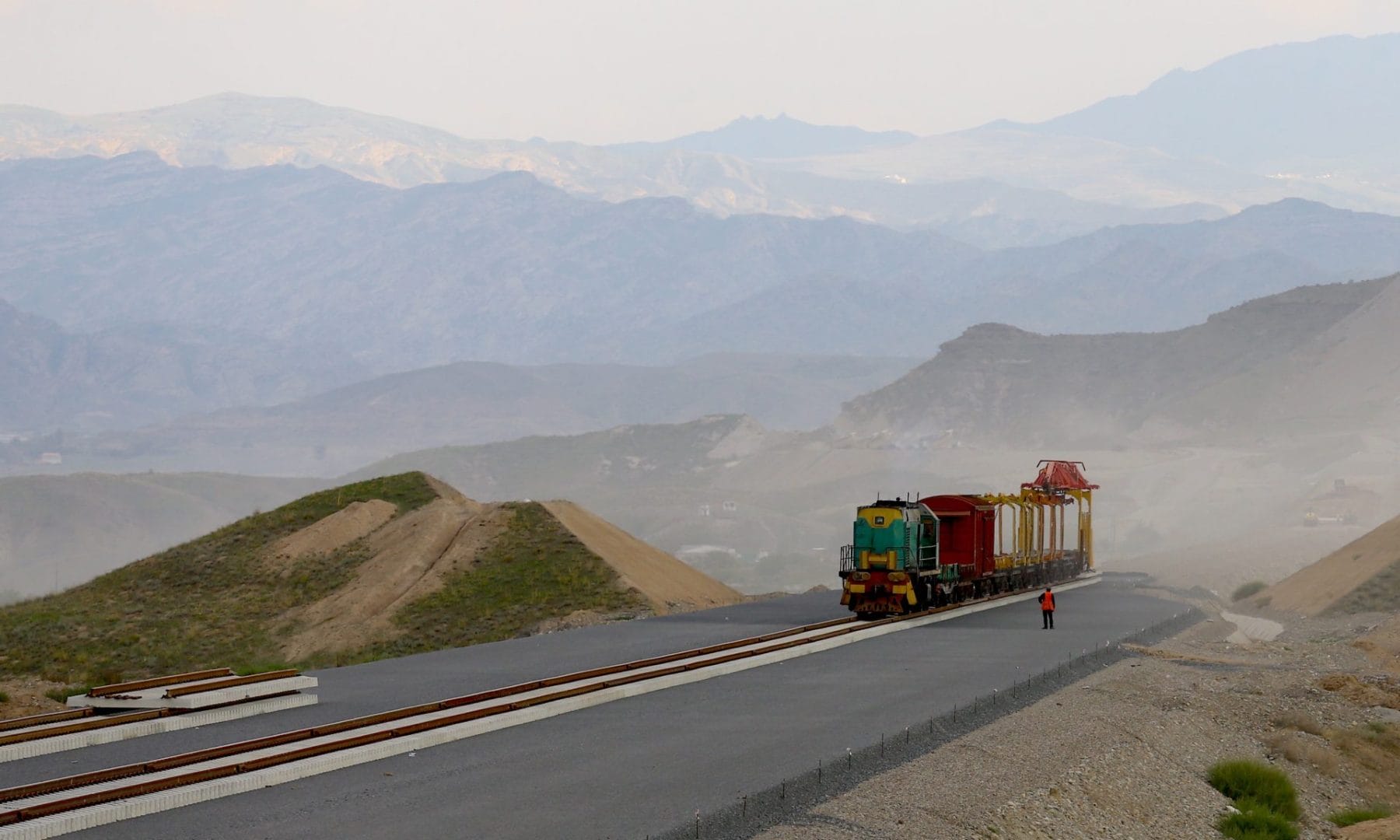
Construction of roads and railways is underway through the Zangezur Corridor, one of the routes extending from China to Central Asia. Resul Rehimov/Anadolu via Getty Images.

Still, Armenia remains a member of the Russian-led Eurasian Economic Union and has its railway networks handled by Russia’s RZhD national rail operator — a factor Russia tried to use in an attempt to get involved with TRIPP. “Regarding the 'Trump Road' project, as it's being called, we confirm our readiness to explore possible options for our involvement,” Russian Foreign Ministry spokeswoman, Maria Zakharova said in January. Armenia’s Parliament Speaker shot down the possibility as “absurd.”

As for Azerbaijan, Trump said on Truth Social that part of Vance’s visit to Baku would be dedicated to “the sale of Made in the U.S.A. Defense Equipment,” a prospect that won’t please Moscow.

Georgia, once considered Washington's closest partner in the South Caucasus, is notably absent from JD Vance’s itinerary and being left behind is as consequential as being included.

For two decades, Georgia’s power and growing prosperity came from being the corridor: the place where pipelines, highways, and rail lines had to pass if Europe wanted Caspian energy without Russian control. The Baku–Tbilisi–Ceyhan pipeline was the signature project of that era, an “East–West energy corridor” literally running through Georgia. TRIPP threatens to redraw that map. A corridor through southern Armenia that becomes the new headline route doesn’t just “leave Georgia behind” — it means Georgia loses its most significant geopolitical bargaining chip because transit was the card it could play with Washington, Brussels, Ankara and Baku.

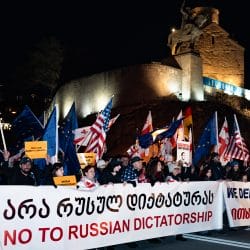
Now, as Washington invests in a new flagship corridor, countries like Georgia that fall outside it are forced to hedge. Over the past decade, Georgia has deepened ties with China through trade deals, cultural exchanges, and visa-free travel, while simultaneously sliding back toward Russia despite Moscow’s 2008 invasion of South Ossetia and Abkhazia. Under the Georgian Dream government, repressive legislation and violent crackdowns on protest have widened the gap with the EU and the U.S. Georgian prime minister Irakli Kobakhidze has appealed directly to Trump for a reset, but TRIPP makes clear where Washington’s priorities now lie. With Azerbaijan and Armenia at the heart of a new U.S.-backed route, influence in the South Caucasus is reorganizing around infrastructure — and power is flowing along it.

TRIPP, even if it exists just on paper for now, indirectly challenges the Chinese Belt and Road Initiative, a network of railways, ports, pipelines, and trade corridors aimed at boosting international trade under Beijing’s leadership. It enables the moving of goods while bypassing Russia and, where possible, Iran — an approach that became more urgent after 2022. And it undermines China, which has been busy paving routes to Iran. Both countries have been in intense contact with Central Asian countries and last summer inaugurated a railway route that connects China and Iran through Kazakhstan, Turkmenistan, and Uzbekistan. 

The South Caucasus is just a small piece in a puzzle that fits together over 140 Belt and Road countries — and Cornell is skeptical about the scale of China’s ambition versus its actual investment. “Belt and Road maps include a lot of infrastructure in this part of the world that has nothing to do with China,” he told me. “Most everything that's been built in the region has been built as a result of the funding from the countries in the region, not by Chinese funds.“  In keeping with this strategy, a fully operational TRIPP might be seen by China as a benefit, a way to trade while avoiding unreliable maritime routes. But researchers in China say that the problem will be if TRIPP “becomes securitized or if Washington leverages its control for geopolitical influence.” And with U.S. foreign policy increasingly waged as a battle with China for resources and global influence, TRIPP could become a threat to Chinese influence in the region. 

Vice President Vance’s visit is a sign of sustained U.S. engagement in the region and a sign that Trump’s attention has not waned after a ceremonial peace agreement in Washington.

The simplest way to read TRIPP is as a 27-mile project with an outsized consequence: it reorders who controls the “land bridge” between Europe and Central Asia and it tells every capital nearby who Washington thinks matters. 

And China will have to prepare for an economic standoff in terrain it once assumed was ripe for Chinese dominance. Russia, meanwhile, finds itself on slippery ground, no longer the indispensable broker it once was in its immediate neighborhood. TRIPP also adds an unexpected edge to the Ukraine-shaped narrative of a Trump administration willing to accommodate Moscow at every turn, suggesting instead a relationship that is less uniform and more selectively disruptive than it first appears.

currents

Subscribe to our coda currents newsletter

Insights from the Coda newsroom on the global forces that shape local crises.

The post A Trump corridor through the Caucasus appeared first on Coda Story.

❌