Vue normale

Moldova halves grain-transit fees for Ukraine as its own farmers threaten protests

18 août 2026 à 04:52

Moldovan President Maia Sandu in Kyiv on the anniversary of the Chernobyl nuclear disaster, 26 April 2026. Photo: Ukrainian President's Office

Moldova will now carry Ukraine’s grain to Romania at half price, and President Maia Sandu is defending that choice against Moldovan farmers who stand to lose from it. What Kyiv was still negotiating a week earlier is now a signed tariff cut, and the growers left to absorb it have threatened mass protests.
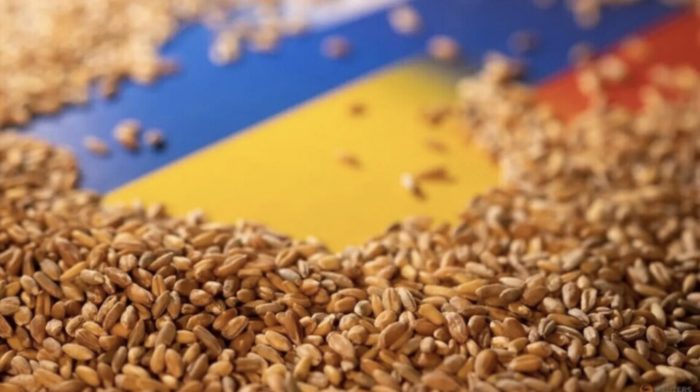
Ukrainian grain
Explore further

Ukraine and Moldova discuss rail corridor for grain amid Russian Black Sea attacks

Sandu ties Ukraine’s harvest to Moldova’s security

Speaking on Radio Moldova, Sandu argued that helping a wartime neighbor keep its export income is worth the strain at home, NewsMaker reported.

“If Ukraine cannot sell its products and has no money to defend itself, then we will have bigger problems than we do today,” she said. “We cannot turn our backs on Ukrainians who are bombed every night and every day wake up, grow grain, and resist. Through their resistance, they protect our peace too.”

She set Moldova’s role against that of larger backers: “Other states help them much more—with financial aid, with military aid. Here we can help them, with these transit routes.”

Through their resistance, they protect our peace too.

Maia Sandu

Farmers set a 21 August deadline

Moldova has halved rail transit tariffs on Ukrainian goods from 10 August to 31 December 2026, a move that could earn Moldovan Railways several million euros and route around 10% of Ukraine’s expected six million tons of 2026 cargo through its territory, Curs de Guvernare reported.

The cut has unsettled local growers. The association Forța Fermierilor (Farmers’ Force) says they face real risks and wants a seat in overseeing the transit. After meeting Prime Minister Vasile Tofan on 17 August, it warned of “massive” protests unless the government shows progress by 21 August.

Russian strikes push grain onto the rails

Ukraine wants the overland route because Russia’s strikes have made the sea route unreliable. Odesa’s ports handle about 90% of Ukraine’s grain, and an overnight strike on Odesa on 17 August damaged another foreign civilian ship.

In July alone, Russian attacks damaged 28 vessels at Greater Odesa’s ports and killed 21 sailors, monitor Andrii Klymenko reported. The rail line to Romania’s Constanța port is the safer alternative. Even in 2023, when Moldova moved to shield its market from Ukrainian grain, it kept transit open.

  • ✇Euromaidan Press
  • India’s cooking-oil imports jump for festival season—but not war-hit sunflower
    India, the world’s biggest edible-oil importer, bought a 10-month high of about 1.5 million tons of vegetable oil in July, up roughly a third from June, as refiners restocked for the August-to-November festival season.The jump was led by palm oil, up by half, and soybean oil, up about a third, data compiled by UkrAgroConsult. Sunflower oil rose just 4%, the weakest of the three, and India buys most of it from Ukraine and Russia, the world’s leading exporters. Vegetable
     

India’s cooking-oil imports jump for festival season—but not war-hit sunflower

18 août 2026 à 03:44

modi and zelenskyy during the g7 meeting in france, 17 june 2026

India, the world’s biggest edible-oil importer, bought a 10-month high of about 1.5 million tons of vegetable oil in July, up roughly a third from June, as refiners restocked for the August-to-November festival season.

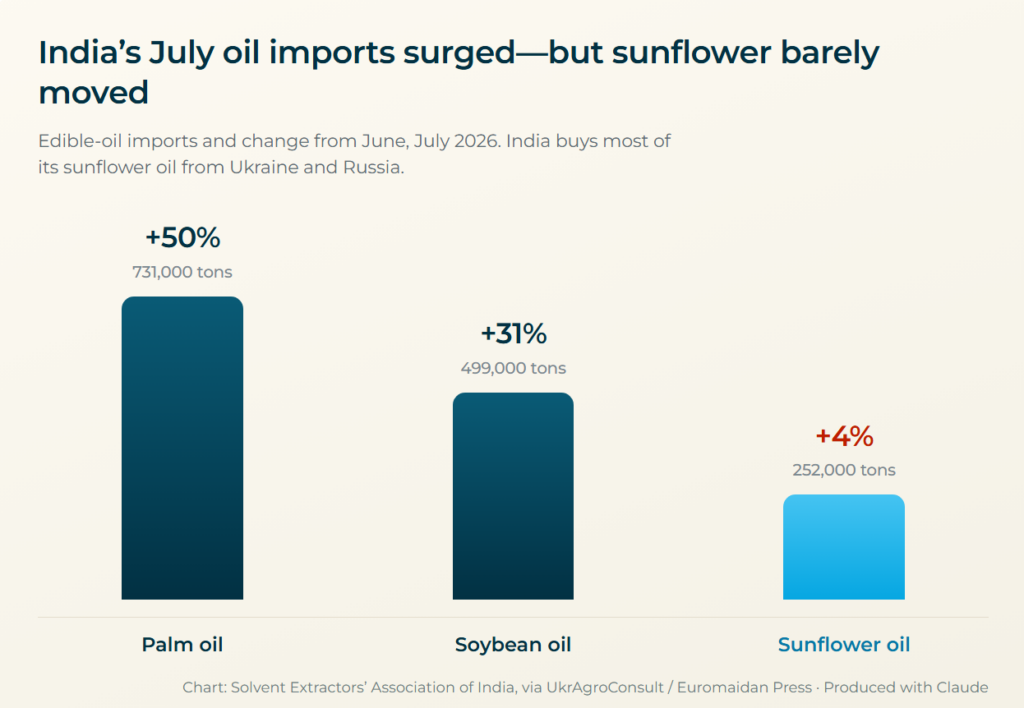
The jump was led by palm oil, up by half, and soybean oil, up about a third, data compiled by UkrAgroConsult. Sunflower oil rose just 4%, the weakest of the three, and India buys most of it from Ukraine and Russia, the world’s leading exporters.

Vegetable oil and meal earn more than 15% of Ukraine’s foreign currency.

Now the sunflower supply is the one going into reverse. India’s sunflower-oil imports are set to fall in August to their lowest since February, with about 150,000 tons of cargo delayed at Black Sea ports and buyers in the south switching to soybean, four traders told Reuters.

The switch is only partly about the war. Soybean and palm oil are cheap, and India’s own mills are pressing less oil from a smaller domestic harvest, leaving refiners leaning on imports, Rajesh Patel told OFI. The GGN Research partner expects soybean oil imports to top 500,000 tons a month into the autumn.

edible oil imports of india, july 2026
India’s edible-oil imports hit a 10-month high in July 2026 as refiners stocked up for the festival season, but the surge went to palm and soybean oil while sunflower barely moved. Chart: Solvent Extractors’ Association of India, via UkrAgroConsult / Euromaidan Press · Made with Claude

Russia’s strikes close Ukraine’s window

Ukraine is in no position to capture that demand. Russian strikes on Chornomorsk in mid-July forced Kernel, its largest exporter, to halt its terminals there, and the country’s farmers’ union reckons the summer attacks have cost a third of its capacity to ship grain by sea.

ukraine grain
Explore further

Russia’s port strikes leave Ukraine’s grain with almost nowhere else to go

Vegetable oil and meal earn more than 15% of Ukraine’s foreign currency, among its largest sources of the hard cash that funds the war, the industry association Ukroliyaprom has said.

The squeeze runs through geography Ukraine cannot change: almost all its farm exports leave by sea, through a handful of Odesa ports now under regular fire, with no land route at anything near the scale.

Kyiv now expects to export barely half the harvest it had planned to sell abroad this season, and is arranging emergency loans so farmers can plant the next crop. Since the start of August, grain leaving by rail has dropped by more than three-quarters year-on-year, according to Ukrzaliznytsia data.

❌