Après des tentatives avortées à New York et à Londres, Shein sera coté à la Bourse de Hong Kong à partir du 1er septembre, ce qui devrait lui permettre de lever jusqu'à 1,5 milliard d'euros. Le géant de l'ultra-fast-fashion, critiqué pour son impact environnemental, espère ainsi financer ses capacités technologiques et renforcer sa présence internationale.
Après des tentatives avortées à New York et à Londres, Shein sera coté à la Bourse de Hong Kong à partir du 1er septembre, ce qui devrait lui permettre de lever jusqu'à 1,5 milliard d'euros. Le géant de l'ultra-fast-fashion, critiqué pour son impact environnemental, espère ainsi financer ses capacités technologiques et renforcer sa présence internationale.
Russia's TOS-1A thermobaric rocket launcher is uniquely devastating, but also uniquely vulnerable
Its flame-spreading rockets reach just 6,000 m, which puts a launcher inside the reach of Ukraine's tiny explosive drones
Ukrainian forces have destroyed, damaged or captured 36 TOS-1As—and Russia is now building them with factory anti-drone armor
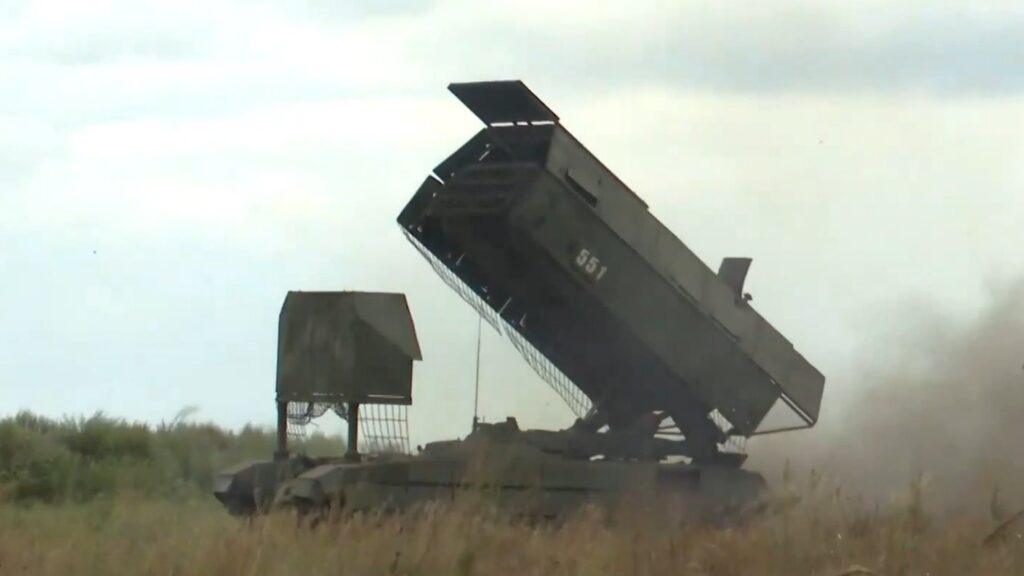
Russia is now building its TOS-1A thermobaric rocket launchers with factory armor wrapped around the rocket tubes. The
Russia's TOS-1A thermobaric rocket launcher is uniquely devastating, but also uniquely vulnerable
Its flame-spreading rockets reach just 6,000 m, which puts a launcher inside the reach of Ukraine's tiny explosive drones
Ukrainian forces have destroyed, damaged or captured 36 TOS-1As—and Russia is now building them with factory anti-drone armor
Russia is now building its TOS-1A thermobaric rocket launchers with factory armor wrapped around the rocket tubes. The tracked TOS-1A and its flame-producing 220-mm rockets are a powerful and terrifying weapon. But the launcher is also extremely vulnerable to Ukraine's drones and artillery. The add-on armor may be the only way the launchers can survive.
The TOS-1A is a T-72 with the turret swapped out for 24 thermobaric rockets, and the newest ones arrive inside a welded steel shell that lifts open when the tubes elevate. Russia is armoring the launcher the way it armors the tanks it's built from. What happens when the armor fails is not the same.
The TOS-1A adds a 24-round launcher onto the hull of a T-72 tank. The system's MO.1.01.04M rocket travels as far as 6,000 m with a payload of fuel that, once ignited, burns as hot as 3,000 degrees Celsius. The fuel can spread across the ground and into buildings and bunkers, allowing even a single TOS-1A to scorch a wide area.
It's not for no reason that the TOS-1A is one of Russia's preferred siege weapons. TOS-1As rolled into action early in Russia's wider war on Ukraine. In one of their first actions, in May 2022, TOS-1As staged on hilltops overlooking the city of Lyman, in eastern Ukraine's Donetsk Oblast, rained fire down on the front-line city. A few days later, Russian troops temporarily occupied Lyman.
Thinking back to May 2022. Watching Russian TOS-1 heavy thermobaric artillery devastate Lyman from the hill across the Siversky Donets. May 23 - the full assault would be launched a day or two later. pic.twitter.com/PPEyMukZGO
The best day the TOS-1A ever had came at Bakhmut. In early April 2023, Russian crews fired across the Bakhmutka River at entrenched Ukrainian positions and opened a 300-m gap in the line, US Army analysts later reconstructed. Wagner mercenaries poured through and covered 1.25 km in a single day. At Pavlivka, thermobaric fire breached the Ukrainian line and the settlement eventually fell—though it took five months and cost Russia two wrecked naval infantry brigades.
With its origins firmly in the 1970s, the TOS-1A was designed for a different era, however. An era where rocket launchers could, with a little support, safely approach to within a few kilometers of the enemy. Artillery is an ever-present danger, of course. But artillery can be suppressed—usually by other artillery.
The era of relative safety for the TOS-1A ended as tiny explosive drones began filling the sky over Ukraine in 2023. Even the tiniest of these tiny drones has the range to hit a TOS-1A before the TOS-1A can get into position to fire its rockets. Worse, the TOS-1A's thermobaric rockets are extremely volatile—and tend to explode in massive fireballs when struck.
"Nasty weapons—and also great targets" for anti-tank missiles and other munitions, is how Czech analyst Jakub Janovsky described the TOS-1A in the war's opening days, before the drones even arrived.
The launcher has a weather problem, too. Its rockets carry an oxidizer premix, which means crews can't fire them in the rain or from high ground.
A Russian TOS-1 thermobaric rocket launcher was completely destroyed by the Unmanned Systems Forces today. After getting hit, the TOS-1 cooked off and burnt down. pic.twitter.com/zQievlm5Vx
The Russians started losing TOS-1As almost immediately. Retreating from Kyiv Oblast on 1 April 2022, they left behind at least three launchers—two of them knocked out by Ukrainian Stugna-P missiles, one captured intact. Then the losses began piling up.
Today, 54 months into the wider war, the Ukrainians have destroyed, damaged or captured no fewer than 36 TOS-1As. 27 of them burned. Ukrainian crews turned at least one captured launcher on its former operators, firing it near Kreminna during the 2023 counteroffensive.
The losses are a problem for the Russians. US Army analysts estimated Russia's prewar TOS-1A fleet at 48 launchers, only a portion of which ever went to Ukraine. Documented losses now stand at 36, and Oryx counts only what it can see in a photograph. How much of that gap Russian factories have refilled isn't public.
What the losses did not do was change the war. For all its ferocity, the TOS-1A has had little to no effect on the conflict's outcome, US Army analysts concluded—and they name the short reach as the reason. A weapon that has to park within 6,000 m of the enemy is a weapon the enemy can find.
Armor, not range
The Russians got to work improving the TOS-1A and building more copies. The Omsk transport machinery plant, Omsktransmash, has turned out fresh batches for the defense ministry in September 2022, November 2022, November 2024 and again in November 2025, its parent concern Uralvagonzavod announcing each handover. It's unclear just how many replacement launchers the Russians acquired, but it's safe to assume they number in the dozens.
They also changed how they use the thing. Russian units now move single launchers up to the line under covering artillery fire rather than travelling in groups, reducing the likelihood of detection, the same US Army analysts reported. And the latest copies are up-armored against drones, with a shell of additional armor protecting the 24 launch tubes and their highly flammable rockets.
That isn't a brand-new idea. An earlier drone-protection variant was showcased in April 2024, and a different, serially produced kit went onto the batch shipped in November 2025. What circulated this month is fresh footage of the up-armored TOS-1As working out at a training range in Russia's Saratov Oblast.
Footage of Multiple Russian TOS-1A Obr.2022 at a Training Ground in the Saratov Region - Summer 2026 pic.twitter.com/LAOAVraai1
The add-on armor is apparently factory-standard at this point, and it's a purpose-built enclosure rather than the improvised slat and mesh Russian regiments tend to weld onto their tanks before sending them across the drone-patrolled gray zone. The function is the same: put something between the drone and the thing that matters.
The best up-armored "turtle tanks" have been known to absorb dozens or even scores of drone impacts. A TOS-1A crew should hope the launcher's new armor is equally tough. After all, the consequence of a turtle tank losing its shell and taking a direct drone hit is often immobilization: the tank throws a wheel or a track or loses power and simply can't move anymore.
Explore further
Russia has thousands of tanks it can’t risk. One drone shield decides whether they roll
Armor is the cheap answer, and it isn't the real one. The real one is a launcher that doesn't have to park 6,000 m from a Ukrainian drone operator.
Uralvagonzavod says a modernized TOS-1A on a T-80 chassis is nearing the end of trials, with better accuracy, more automation and a longer reach. How much longer, the company hasn't said. Analyst Alexey Tarasov expects a new launch module able to take longer-range rockets, perhaps carrying the system to roughly the 15 to 20 km of the wheeled TOS-2. Until then, the crews get a steel box.
It had better hold. The earlier, cruder answer didn't: a TOS-1A wearing a field-built metal cage burned anyway when a Ukrainian FPV drone found it. And if a TOS-1A's armor fails, the next drone hit could trigger 24 rockets each weighing 217 kg and packed with concentrated fuel that's primed to explode.
The Ukrainian military from the 92nd separate assault brigade destroyed the Russian 220-mm heavy flamethrower system TOS-1A "Solntsepek" using an FPV kamikaze drone pic.twitter.com/wEBz2H1T5y
Un robot chinois a battu samedi le record du 100 mètres de la légende jamaïcaine Usain Bolt, lors de la cérémonie d'ouverture des World Robot Gams à Pékin. Des dizaines d'humanoïdes sans visages et leurs opérateurs humains ont participé à des épreuves allant de l'athlétisme à la boxe, en passant par le football et les arts martiaux.
Un robot chinois a battu samedi le record du 100 mètres de la légende jamaïcaine Usain Bolt, lors de la cérémonie d'ouverture des World Robot Gams à Pékin. Des dizaines d'humanoïdes sans visages et leurs opérateurs humains ont participé à des épreuves allant de l'athlétisme à la boxe, en passant par le football et les arts martiaux.
Retour sur les temps forts de l'actualité de la semaine et les images les plus marquantes : des frappes de drones russes mortelles en Ukraine, la spationaute Sophie Adenot réalise une sortie dans l'espace, des incendies en Belgique et en Europe, ou le retour triomphal au Cameroun des championnes d'Afrique.
Retour sur les temps forts de l'actualité de la semaine et les images les plus marquantes : des frappes de drones russes mortelles en Ukraine, la spationaute Sophie Adenot réalise une sortie dans l'espace, des incendies en Belgique et en Europe, ou le retour triomphal au Cameroun des championnes d'Afrique.
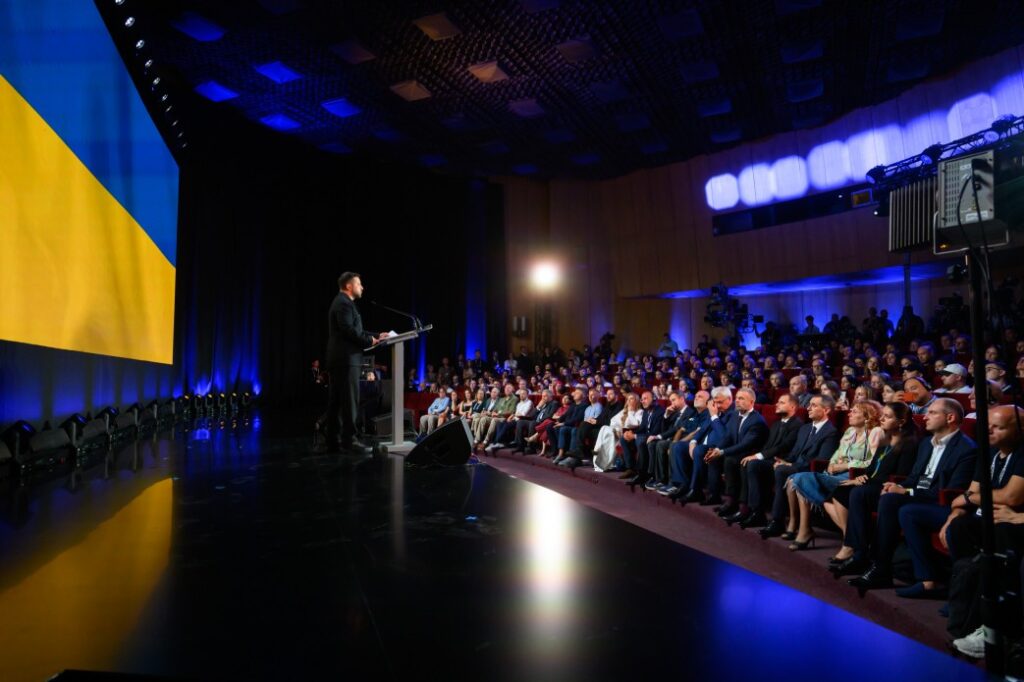
Kyiv held the UNITED24 MODE Summit 2026, dedicated to the results of four years of work by UNITED24, the president’s fundraising platform. The event came two days before Ukraine's Independence Day.
Since its launch in 2022, the initiative has raised nearly $4 billion to support Ukraine. The platform has become an important fundraising tool, bringing together millions of donors from 145 countries.
The largest contributions through UNITED24 have come from the US, Germ
Kyiv held the UNITED24 MODE Summit 2026, dedicated to the results of four years of work by UNITED24, the president’s fundraising platform. The event came two days before Ukraine's Independence Day.
Since its launch in 2022, the initiative has raised nearly $4 billion to support Ukraine. The platform has become an important fundraising tool, bringing together millions of donors from 145 countries.
The largest contributions through UNITED24 have come from the US, Germany, France, Canada, Australia, Switzerland, Sweden, the Netherlands, Finland, Denmark, Austria, Italy, Norway, Belgium, Ireland, Japan, Poland, Lithuania, Türkiye, Singapore, Paraguay, El Salvador, and Guinea-Bissau.
Zelenskyy awarded Vikings star
During the event, Ukrainian President Volodymyr Zelenskyy awarded several prominent UNITED24 ambassadors, volunteers, and philanthropists for their significant support of Ukraine.
Liev Schreiber, the American actor and director, received the Order of Merit. Katheryn Winnick, the Canadian actress best known for Vikings, received the Order of Princess Olga, 3rd Class. Both of them are UNITED24 ambassadors, according to Ukraine's Presidential Office.
Ballistic missile developer attended event
The main topic of the summit was the further development of Ukrainian defense technologies — from creating new solutions to serial production, scaling, and international cooperation, ArmyInform reports.
The discussion featured Fire Point CEO Iryna Terekh, STARK Ukraine COO Maksym Cherkis, and Brave1 head Andrii Hrytseniuk.
Fire Point is the company that is working on the development of the first Ukrainian ballistic missiles.
Behind buying military equipment, platform helped healing Ukrainians
Overall, donors and philanthropists have also contributed to the purchase of medical equipment.
During this period, more than 117,000 medical devices and pieces of equipment were purchased for a total of more than $51.6 million, according to Ukraine's Health Ministry. These included:
Ambulances: 247 vehicles worth $15.0 million.
Armored evacuation vehicles for military medics: 43 vehicles worth $10.6 million.
Anesthesia machines: 83 units worth $2.6 million.
Neurosurgical microscopes: 10 units worth $2.1 million.
C-arm X-ray systems: 39 units worth $3.1 million.
What are platform's next tasks
The panel was moderated by Hanna Hvozdiar, an adviser to Ukraine’s defense minister, who outlined the state’s key priorities for developing Ukraine’s defense technology sector. She said Ukrainian Defense Tech had already demonstrated its ability to respond extremely quickly to the challenges of war.
Over the past several years, a new industry has effectively emerged in Ukraine, in which a battlefield need can be turned into a technological solution several times faster than in the traditional defense industry.
“The next task is to preserve this speed, scale up the strongest developments, and turn the technological advantage Ukraine is creating today into a long-term strength of the state,” she said.
Particular attention was also paid to Ukraine’s technological independence, including the development of its own critical technologies and component base alongside deeper international partnerships.
“Ukraine continues to develop cooperation with Ukrainian manufacturers, the technology community, and international partners so that promising developments can be scaled up faster,” the Defense Ministry said.
Participants left message to Russians on wings of drone
At the summit, Fire Point presented its FP-1 long-range drone, whose wings were signed with messages to Russians by summit participants, according to UNN.
Foreign Minister Andrii Sybiha also left his message to Russians on the wings of the FP-1.
“The farther our special long-range ‘sanctions’ fly, the closer peace and our victory come,” he wrote.

 Connexion


 The
The  Ukrainian military from the 92nd separate assault brigade destroyed the
  Russian 220-mm heavy flamethrower system TOS-1A "Solntsepek" using an FPV kamikaze drone
  MilitaryNewsUA