
 Connexion

Russia is building Starlink no foreign company can switch off. Ukraine names 49 firms behind it, and 23 face no sanctions from Kyiv’s allies at all
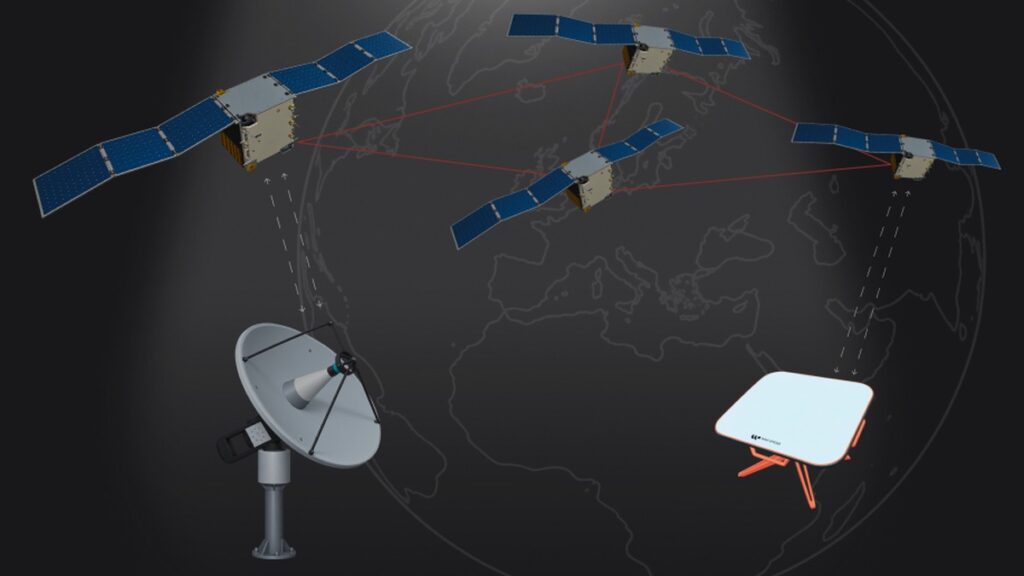
Ukraine’s Military Intelligence (HUR) has published the names of 49 Russian and Belarusian companies and institutions building Rassvet, Russia’s low-orbit satellite internet system, on its War&Sanctions portal, the agency said on 28 October. It needs it for its military purposes.
Russian troops ran front-line communications and long-range strike drones on smuggled Starlink terminals until SpaceX blocked them on 1 February 2026. Ukraine still flies on Musk’s network, and on 24 October it got back to full speed after a ten-day cap imposed abroad. Rassvet is meant to give Russia’s army satellite links under its own control.
HUR has said Moscow may struggle to obtain components for more satellites, and its list names the suppliers that sanctions would need to target while the network is still being built.
Terminals for Iskander-M command vehicles
Rassvet is first of all a military communications system. Russia plans to use it for command and control, strike platforms, and drones, and to install terminals in the command-and-staff vehicles of Iskander-M missile systems, HUR says.
The Central Research Institute of Automation and Hydraulics is involved in integrating Rassvet into army communications, including fitting command vehicles, Iskander ones among them, with terminals once 292 satellites are in orbit, according to the portal. The same institute produces guidance components for the Iskander-M and Kinzhal missiles.
Planned coverage takes in Ukraine and the EU first, and once it is wide enough, Russia could use the system in hybrid attacks on other countries. That is why partners should block Rassvet’s access to components, equipment, and software now, the agency said.
Roscosmos launches it, a Belarusian missile maker signs on
The lead company is Bureau 1440, part of the IKS Holding tech group. According to the portal, it is linking its flight control center to systems of the Russian Defense Ministry. Roscosmos launches the satellites into orbit, and its head, Dmitry Bakanov, personally oversees Rassvet.
Meanwhile, Belintersat, Belarus’s national satellite operator, signed a partnership with Bureau 1440 in May 2026 to bring Rassvet into Belarus’s telecom network. It is a branch of the Plant of Precision Electromechanics, Belarus’s lead missile developer and maker of the Polonez rocket launcher.
Another Belarusian firm, Aerospace Instruments, prototypes components for the system.
23 of 49 not sanctioned by Kyiv’s allies
Of the 49, 23, Roscosmos among them, are not under sanctions by any country in the sanctions coalition. The companies involved “must be included in all blacklists” of countries, banks, and businesses, the agency wrote.
32 satellites launched, seven launches to go
Russia launched its first 16 Rassvet satellites earlier this year. Stable communications would need 200–250 in orbit, Serhii “Flash” Beskrestnov, then adviser to Ukraine’s defense minister, said in May.
By August, Russia had launched 32 Rassvet satellites and planned seven more launches by the end of 2026, a HUR official told Janes. Only 12 of them, all from the first batch, had reached a sustainable altitude by the end of August, ISW reported.
Read also
-
After SpaceX cuts off Starlink access, Russia launches first 16 satellites of its own “Rassvet” alternative
-
Ukraine wants to aim Starlink at Russian targets—and build a version Elon Musk can’t switch off
-
Poland, Bulgaria, now Lithuania: Russia’s suspected arson campaign reaches a third Starlink site serving Ukraine


