Vue normale

  • ✇Euromaidan Press
  • How Russia built a jam-proof drone force—and the Chinese supply chain that could still break it
    Ukrainian jamming worked too well: it compelled Russian drone developers to innovate Now many Russian drones communicate via unjammable optical fiber or jam-resistant mesh radio But the Russians can't make all the hardware themselves Instead, they rely on Chinese imports Frustrated by Ukrainian electronic warfare, Russia transformed its drone arsenal to be harder—or impossible—to jam. Most of Russia's tiny first-person-view drones now send and receive s
     

How Russia built a jam-proof drone force—and the Chinese supply chain that could still break it

Par : David Axe
6 août 2026 à 15:51

ukraine develops fiber-optic module fitting all drones integrates inertial navigation silkworm fiber optic drone unmanned systems forces shovkopryad ukraine’s testing universal designed types while firm installs its optical technology have

  • Ukrainian jamming worked too well: it compelled Russian drone developers to innovate
  • Now many Russian drones communicate via unjammable optical fiber or jam-resistant mesh radio
  • But the Russians can't make all the hardware themselves
  • Instead, they rely on Chinese imports

Frustrated by Ukrainian electronic warfare, Russia transformed its drone arsenal to be harder—or impossible—to jam.

Most of Russia's tiny first-person-view drones now send and receive signals via jam-proof fiber optic cable instead of wireless radio. For heavier one-way attack drones that travel too far for fiber optics, the Russians have mostly switched to jam-resistant mesh radio networks made up of many interconnected senders and receivers.

In both cases, China is key. Chinese companies sell Russian companies the optical fibers and mesh modems that the Russians install in their drones. In other words, Beijing is the critical enabler in Moscow's ongoing aerial aggression.

That's the unsurprising yet sobering conclusion that Tatarigami, the founder of the Ukrainian Frontelligence Insight analysis group, reached in a recent investigation.

It's not enough for Ukrainian forces to shoot down or otherwise defend against Russian drones, or to fight back with their own drones. To win the drone war, Ukraine and its allies must "step up pressure on Chinese manufacturers," Tatarigami wrote.

Russia's response to electronic warfare wasn't a single solution. It evolved along two major paths: fiber-optic drones and mesh networks. This thread summarizes Frontelligence Insight analysis based on OSINT data and a report by the Center for Defense Reforms. Thread🧵 pic.twitter.com/k0v0ZeWKYB

— Tatarigami_UA (@Tatarigami_UA) July 30, 2026

As the drone war over Ukraine ramped up in 2022 and 2023, most Russian FPVs were wireless models. And most heavier one-way attack drones navigated via satellite. Both classes of drone could be jammed. A cottage industry of Ukrainian electronic warfare producers sprung up. Each firm offered some variation of a radio noisemaker that can ground or misdirect wireless and satellite-guided drones.

The jamming worked. Combined with kinetic defenses—guns and missiles—and add-on protections such as mesh, cages and netting, the jamming blunted the impact of Russia's drone arsenal. But the Russians adapted. The turning point came in the spring of 2025, when Russia's elite Rubicon Center drone group led the counterattack against Ukrainian troops occupying parts of Kursk Oblast in western Russia.

Rubicon's fiber optic FPVs wreaked havoc on Ukrainian forces in the Kursk salient, damaging or destroying hundreds of trucks and other vehicles in the span of a few weeks. Starving for supplies and in danger of being cut off, the Ukrainians retreated.

But the Russian adaptation was just beginning. The Russians are now launching 10,000 FPVs a day. And in certain key sectors, 60% of the FPVs were fiber optic models, according to Tatarigami. The Ukrainians can shoot down these drones and block them with armor, nets and earthworks. They can also strike at the Russian FPV teams before the Russians can launch their FPVs.

But there's one thing the Ukrainians can't do: they can't jam the drones.

Over the past six months, SBS has been able to narrow the drone usage gap. They started at 1 for every 3 Russian drones in February, after russia spiked to 9K strikes and are running at 1 for every 2 by August. pic.twitter.com/9GWrU0fx4W

— Vitaly (@M0nstas) August 4, 2026

Unjammable drones

Jamming continued to work against many one-way attack drones that must travel hundreds or even thousands of kilometers—too far for optical fiber. Another turning point came in February, when Elon Musk's Starlink bricked Russia's thousands of smuggled and stolen satellite terminals, some of which Russian forces used to control the approximately 5,000 Geran attack drones they launch every month.

The Starlink shutdown compelled Russian developers to accelerate the transformation of the one-way attack drone force. "Russia's second adaptation was mesh networking, routing data through mesh modems to keep communications alive across both short and long-range drones," Tatarigami explained.

It's possible to jam a mesh radio network, but it's hard. Every drone in a given network is a node. It's not enough to jam a few of them; you have to jam all of them.
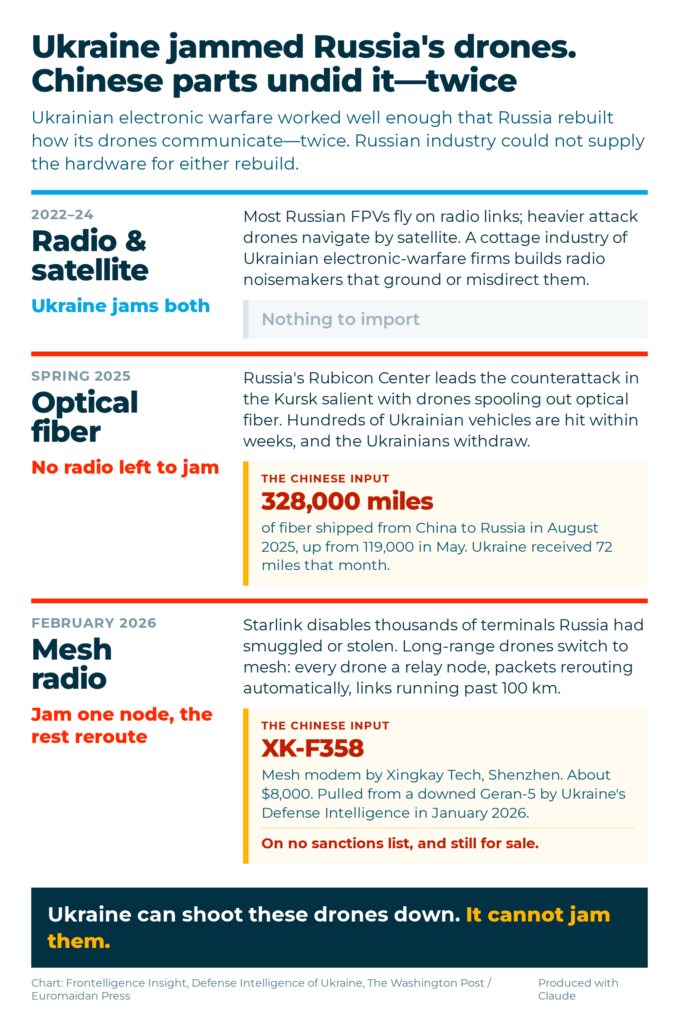
Chart tracking how Russian drones became resistant to Ukrainian jamming in three stages. From 2022 to 2024, Russian FPVs flew on radio links and heavier attack drones navigated by satellite, and Ukrainian electronic warfare could jam both. In spring 2025, Russia's Rubicon Center attacked the Kursk salient with fiber-optic drones that carry no radio signal to jam; China shipped Russia 328,000 miles of optical fiber in August 2025 against 72 miles to Ukraine. In February 2026, after Starlink disabled Russia's smuggled terminals, long-range drones switched to Chinese XK-F358 mesh modems, which carry no sanctions and remain on sale.
Chart: Euromaidan Press

If there's a constraint on Russia's switch to fiber optics and mesh networks, it's that Russian industry can't produce all the necessary hardware. "Unable to meet domestic demand, Russia turned to China," Tatarigami wrote.

The Washington Post reported Chinese optical fiber shipments to Russia growing from 119,000 miles in May 2025 to 328,000 miles that August. China sent Ukraine 72 miles the same month. For mesh networking, the Russians came to depend on XK-F358 modems from China's Shenzhen Xingkai Technology.

Ukraine's overstretched air defenses can't shoot down every Russian attack drone. Ukrainian troops and vehicle crews can't hide from 10,000 Russian FPVs a day. To defeat Russia's jam-proof drones, Ukraine and its allies must cut off the supply of Chinese parts, Tatarigami stressed.

They should extend export controls to modem-makers and producers of optical fiber, reels for the fiber and equipment associated with fiber production. "The recommendation is to expand sanctions beyond individual firms to the entire supply chain," Tatarigami advised.
All-robot air assault.
Explore further

Some Ukrainian bomber drones aren’t carrying bombs anymore. They’re carrying robots.

  • ✇Euromaidan Press
  • Ukraine’s new drone is a cousin to America’s stealth bombers. It reaches Ufa in three hours.
    Ukraine has a new deep strike drone The Bravo has an unusual shape for a drone, with a blended wing and body The shape confers greater efficiency, and thus greater range and payload, at certain speeds Ukraine's latest deep strike drone is one of a kind. The Triada Robotics Bravo features a "blended wing body" design that's rarely seen on a drone. The special platform maximizes lift and minimizes drag, helping the drone fly farther for a given speed and payload
     

Ukraine’s new drone is a cousin to America’s stealth bombers. It reaches Ufa in three hours.

Par : David Axe
6 août 2026 à 14:48

Triada Robotics Bravo

  • Ukraine has a new deep strike drone
  • The Bravo has an unusual shape for a drone, with a blended wing and body
  • The shape confers greater efficiency, and thus greater range and payload, at certain speeds

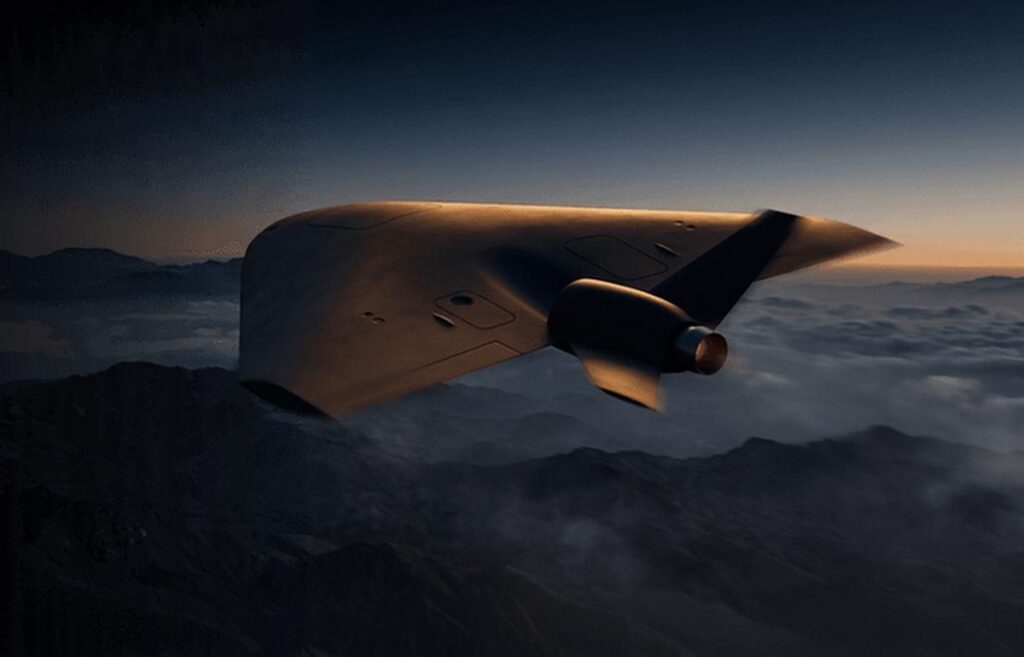
Ukraine's latest deep strike drone is one of a kind. The Triada Robotics Bravo features a "blended wing body" design that's rarely seen on a drone. The special platform maximizes lift and minimizes drag, helping the drone fly farther for a given speed and payload than a conventional "tube and wing" drone can do.

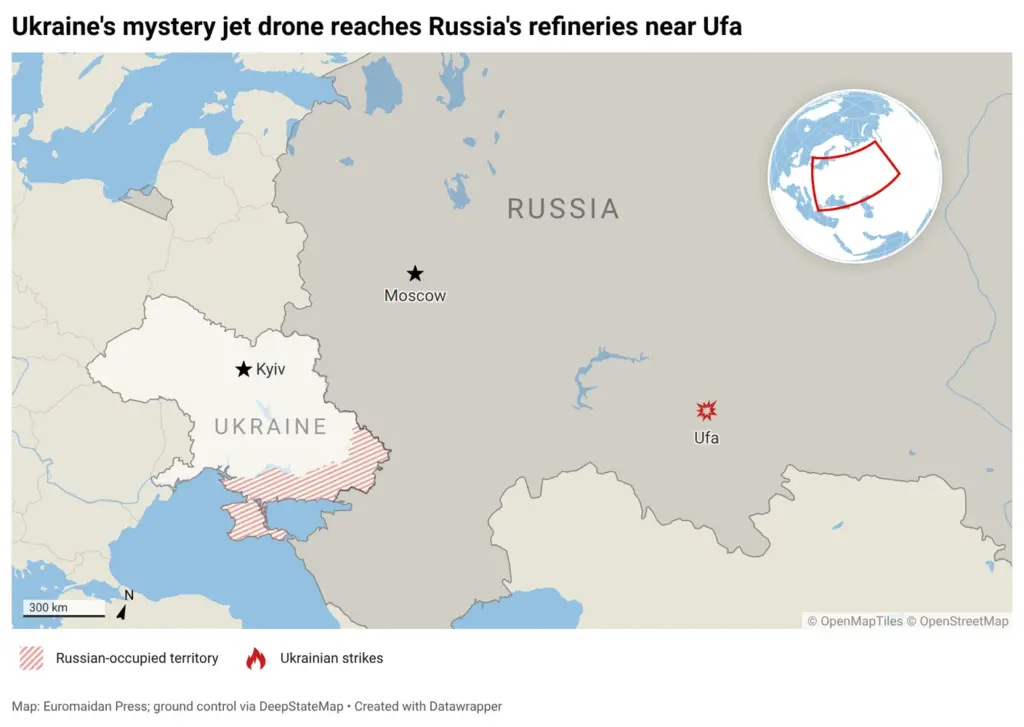
A stubby jet drone appeared fleetingly in a video shot from the ground during a strike on the Ufa refinery cluster in Bashkortostan on 2 August, more than 1,700 km from the Ukrainian border. Ukrainian forces hit the three Bashneft plants at Ufa on 1, 2, and 5 August.

Ukraine's drones hit Bashneft refineris in Ufa
Ukraine's drones hit Bashneft refineries in Ufa. Map: Euromaidan Press

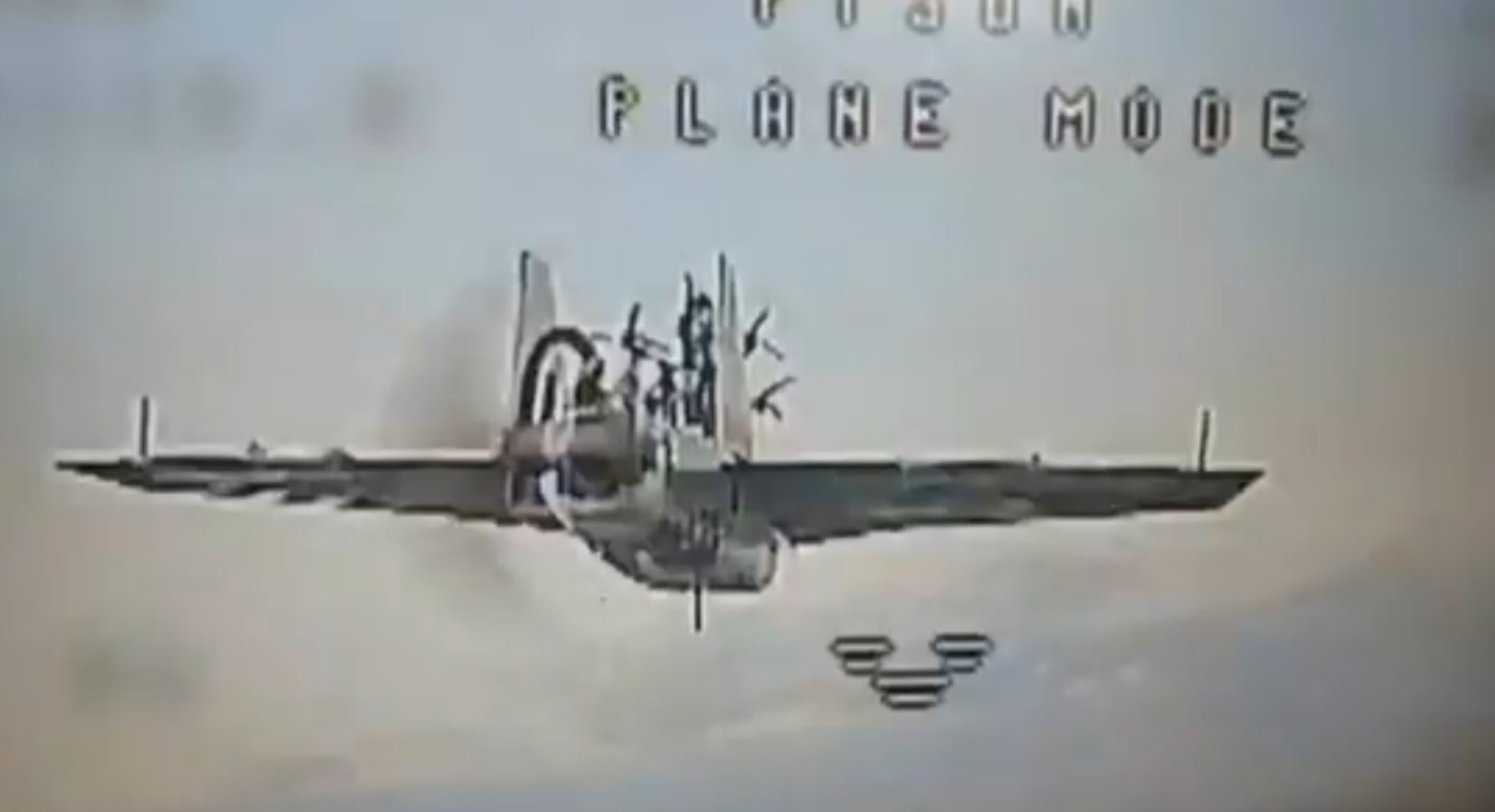
No official body has identified the aircraft in the footage. Online observers compared the silhouette to the American F-117 Nighthawk; the outline is also consistent with the renders Triada publishes of the Bravo. The clip runs a few tenths of a second.

Everything that has reached that deep into Russia until now has been propeller-driven, plodding along at less than 200 km/hr. A jet Bravo cruising at 600 km/hr covers the same 1,700 km in under three hours instead of nine and a half. That is the difference between an air defense network with all morning to work out where a drone is going and one with a couple of hours.

Exactly what the drone in the video was aiming for, and whether it struck its target, is unclear. But that's not stopping Russian observers from panicking. "Shooting down a drone is practically impossible," one Russian blogger moaned.

It's untrue. Motoring along at 600 km/hr—Triada claims around 800 km/hr in the final phase of flight—the jet-propelled Bravo is neither the fastest Ukrainian deep strike munition nor the slowest. If Russian air defenses can take down 950 km/hr Fire Point FP-5 Flamingo cruise missiles, they can take down Bravos, too. Detecting one is a separate question: Triada says the Bravo's composite airframe reduces its radar cross-section.

Arming a Russian gunship with interceptor drones.
Explore further

Russia just copied Ukraine’s cleverest drone hunter

But invulnerability surely wasn't the main goal when Kyiv-based Triada Robotics designed the Bravo over the past couple of years. Efficiency was the objective. Which is probably why the firm chose the blended-wing-body arrangement for the one-way explosive drone, which it lists at around 174,000 euros—roughly $200,000.

The blended shape "provides many different aerodynamic benefits over conventional aircraft design," Oliver Johnson and Sam Dakka wrote in a 2019 article in International Journal of Aviation, Aeronautics and Aerospace.

Most drones, like most manned aircraft, have the same layout: a tube-shaped body and separate wings jutting from the body. These tube-and-wing aircraft are the easiest to conceptualize and the most straightforward to assemble, as the fuselage and wing can be built independently and attached during production.

The problem is drag, especially at the junctures between body and wing. A draggier airframe suffers a range and speed penalty compared to a less draggy airframe.

An unidentified Ukrainian jet-powered drone was filmed during yesterday's attack on Russian territory.

It is believed to be either the Bravo drone developed by Triada Robotics, which reportedly has a range of up to 2,000 km, a 100–200 kg warhead, and a top speed of 650–700 km/h,… pic.twitter.com/3ZtweKwR6t

— OSINTWarfare (@OSINTWarfare) August 3, 2026

Alternative shapes

There are alternatives to tubes and wings. Flying wing aircraft such as the US Air Force's B-2 and B-21 stealth bombers, both built by Northrop Grumman, are all wing—and have neither an identifiable fuselage nor horizontal or vertical stabilizers. They look like boomerangs.

At subsonic speed, that shape is less draggy than a tube and wing shape is, and thus more efficient for long-range flight. At the same time, a flying wing's lack of sharp angles reduces its radar reflectivity. In short, it can be very stealthy and hard to detect on radar.

The downside of a flying wing is that it's unstable and requires sophisticated flight controls to keep it in the air.

A blended wing body shape is a kind of compromise between a flying wing design and a tube and wing design. There's a fuselage and a wing and stabilizers, but the fuselage and wing blend into each other. A blended wing body isn't as stealthy as a flying wing is, but it's easier to control.

A Gerbara in mid-air.
Explore further

Ukraine’s AI drones hammer Russian supply lines. Russia’s $10,000 drone just got the same kit

And it's still less draggy than a tube-and-wing type. "The improvements increase the overall lift to drag ratio providing a higher performance aircraft saving 27% fuel burn per passenger mile that of the modern conventional configuration," Johnson and Dakka wrote.

That benefit is apparent in the Bravo's performance specifications. The drone reportedly ranges 2,000 km with a warhead of 100 to 200 kg and AI-assisted targeting, flying as high as 5,000 m. It's unclear how the Bravo navigates, but it's probably via some combination of satellite and inertial systems.

It's an impressive set of stats. A $50,000, propeller-driven Fire Point FP-1 ranges slightly farther—2,300 km—but the FP-1 cruises at just 180 km/hr and packs a 60-kg warhead. The Bravo is more than three times as fast and carries at least half again as much explosive, and possibly triple, while still flying far enough to reach deep inside Russia.

Yes, the Bravo costs four times as much as the FP-1 does, probably in part because of the jet propulsion, but that could change if Triada Robotics can scale up production. Co-founder Artem Veselov has said the company aims for a first pre-series batch of 100 by the end of the year. For now, the Bravo is a rarity. But it may become much more common in the sky over Russia in the coming months.

  • ✇#MonCarnet
  • 120 secondes de Tech / 6 aout 2026 
    🎧 Édition du 6 aout 2026 :– Google Assistant disparaît d’Android le 4 septembre– BMW affiche une publicité dans ses véhicules– OnePlus n’a plus de téléphones à vendre en Amérique du Nord– Disney ouvre ses personnages aux créateurs TikTok– Mauvais conseil pour refroidir les téléphones « 120 secondes de Tech », un regard sur le quotidien de l’actualité […]
     

120 secondes de Tech / 6 aout 2026 

6 août 2026 à 00:30
🎧 Édition du 6 aout 2026 :– Google Assistant disparaît d’Android le 4 septembre– BMW affiche une publicité dans ses véhicules– OnePlus n’a plus de téléphones à vendre en Amérique du Nord– Disney ouvre ses personnages aux créateurs TikTok– Mauvais conseil pour refroidir les téléphones « 120 secondes de Tech », un regard sur le quotidien de l’actualité […]
❌