Kiev et Moscou ont annoncé avoir commencé une trêve mardi matin à Olechky, ville du sud de l'Ukraine sous occupation russe. Objectif : mener une opération humanitaire dans cette localité isolée, où les habitants manquent de tout.
Kiev et Moscou ont annoncé avoir commencé une trêve mardi matin à Olechky, ville du sud de l'Ukraine sous occupation russe. Objectif : mener une opération humanitaire dans cette localité isolée, où les habitants manquent de tout.
Réunis à Paris, les ministres de la Défense de la France, de l’Allemagne, de l’Italie, de la Pologne et du Royaume-Uni ont affirmé lundi que l’Europe devait prendre en charge davantage sa propre sécurité, tout en jugeant les États-Unis "indispensables" à l’Alliance.
Réunis à Paris, les ministres de la Défense de la France, de l’Allemagne, de l’Italie, de la Pologne et du Royaume-Uni ont affirmé lundi que l’Europe devait prendre en charge davantage sa propre sécurité, tout en jugeant les États-Unis "indispensables" à l’Alliance.
Un satellite militaire russe, Cosmos-2612, a effectué une approche contre un satellite commercial Iceye-X36 utilisé par les forces armées ukrainiennes, qui a été considérée comme "menaçante" par le département d'État américain. La manœuvre serait une première entre un satellite militaire et commercial, estime Norbert Pouzin, analyste orbital chez Aldoria.
Un satellite militaire russe, Cosmos-2612, a effectué une approche contre un satellite commercial Iceye-X36 utilisé par les forces armées ukrainiennes, qui a été considérée comme "menaçante" par le département d'État américain. La manœuvre serait une première entre un satellite militaire et commercial, estime Norbert Pouzin, analyste orbital chez Aldoria.
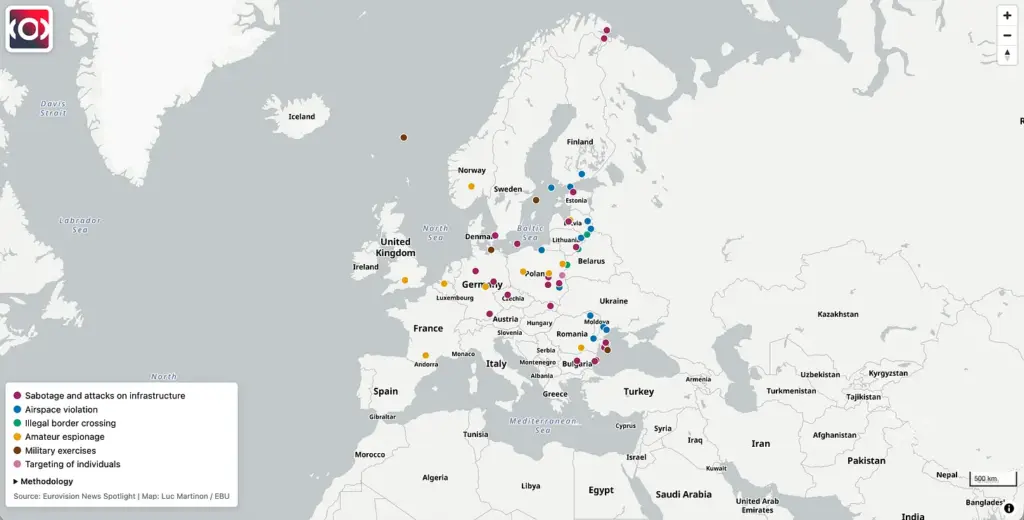
Journalists from 17 European public service broadcasters, coordinated by the European Broadcasting Union’s (EBU) Eurovision News Spotlight network, published an interactive map on 23 October 2026. It documents hybrid incidents linked to Russia across 17 European countries between 1 April and 15 October. Journalists compiled a database of hundreds of reported incidents, categorizing each by type and the source and strength of its alleged links to Russia, then verifying them through open-sou
Journalists from 17 European public service broadcasters, coordinated by the European Broadcasting Union’s (EBU) Eurovision News Spotlight network, published an interactive map on 23 October 2026. It documents hybrid incidents linked to Russia across 17 European countries between 1 April and 15 October. Journalists compiled a database of hundreds of reported incidents, categorizing each by type and the source and strength of its alleged links to Russia, then verifying them through open-source research.
The map comes as officials warn the campaign is growing. On 28 September, EU foreign policy chief Kaja Kallas said in Brussels that Russia was planning more acts of sabotage to divide societies and intimidate them into abandoning their support for Ukraine. The points on the map represent an incomplete list of publicly known cases attributed to Russia or suspected of being linked to it, the report states.
The map covers airspace violations, sabotage attempts, “disposable” agents with no formal intelligence training, migration used as a weapon, and Russian military activity near or across European borders. It excludes cyberattacks, influence operations, and espionage by trained intelligence officers.
The EBU calls the result a very conservative estimate, not an official tally. Russia has consistently denied responsibility for the incidents. Many single points represent several incidents of the same type in one area or in quick succession. In Moldova, for example, Defense Minister Anatolie Nosatîi said on 30 September that the government had recorded 84 drone incursions.
Four German incidents are on the map, out of many more
The map shows four incidents in Germany, according to BR.
The four incidents in Germany on the EBU hybrid war map, 2 August to 14 September 2026. Other dots mark Russia-linked incidents in neighboring countries. Map: Luc Martinon/EBU, Eurovision News Spotlight; edited by Euromaidan Press
On 2 August, German authorities arrested a 33-year-old Ukrainian man in Thuringia on suspicion of photographing a Bavarian weapons manufacturer for a foreign intelligence service as part of an alleged sabotage plot.
On 4 August, a drone carrying explosives and a detonator struck the wing of a Ukrainian An-124 cargo plane at Leipzig/Halle Airport but failed to explode.
On 3 September, attackers threw firebombs from a car onto a construction site next to defense firms in Munich, and German security authorities suspect Russian intelligence.
On 14 September, investigators learned of a crashed drone found near the Bundeswehr’s Wunstorf air base.
Internal papers from the new Joint Hybrid Defense Center, seen by Correctiv, record 163 suspected sabotage cases in 2026 up to 19 August. The targets included rail lines, military facilities, substations, and radio masts. The same papers record 1,034 drone overflights of critical infrastructure, military sites, and defense companies, and 25 espionage investigations. The papers cover possible attacks by Russia, China, and Iran, and media did not report a breakdown of the sabotage cases by country.
European leaders sound the alarm over Russian hybrid attacks
On 15 April, Swedish civil defense minister Carl-Oskar Bohlin said pro-Russian groups had moved from denial-of-service attacks to attempts at destructive cyberattacks, including one on a Swedish power plant in 2025. On 1 September, German Foreign Minister Johann Wadephul named Russia as the perpetrator of the Leipzig attack and accused Moscow of “blatant hostility” toward Germany.
On 18 September, French President Emmanuel Macron said Russia’s hybrid attacks would not go unanswered and ordered a plan to protect France’s critical infrastructure. On 1 October, German Chancellor Friedrich Merz said Germany was preparing for new hybrid attacks, “including serious ones.” NATO Secretary General Mark Rutte on 14 October called the attacks a sign of Russian weakness at a press conference in Tallinn and said NATO would react where needed without being “rattled.”
La victoire de la liste du mouvement étudiant et surtout la reconnaissance par le nationaliste Aleksandar Vucic de sa défaite aux législatives anticipées a provoqué une explosion de joie dans les rues de Belgrade et d'autres villes serbes. "Plus jamais nous n'aurons de tyran dans ce pays", a déclaré Ilija Srdanovic, représentant la liste des étudiants.
La victoire de la liste du mouvement étudiant et surtout la reconnaissance par le nationaliste Aleksandar Vucic de sa défaite aux législatives anticipées a provoqué une explosion de joie dans les rues de Belgrade et d'autres villes serbes. "Plus jamais nous n'aurons de tyran dans ce pays", a déclaré Ilija Srdanovic, représentant la liste des étudiants.

 Connexion