Immigration and Customs Enforcement (ICE) plans to spend tens of millions of dollars on buying specialized gloves that pulse with electrical energy, which make it easier for agents to subdue people, the Associated Press reported on Tuesday.
A user manual for G.L.O.V.E, or Generated Low Output Voltage Emitter, sold by a company called Compliant Technologies, provides more specifics on how the gloves are supposed to work and allegedly be used.
💡
Do you know anything else about this device? I would love to hear from you. Using a non-work device, you can message me securely on Signal at joseph.404 or send me an email at joseph@404media.co.
Twitch is going to train Amazon’s AI models on streamers’ content unless they deliberately go into their settings and opt out, potentially sweeping up a wealth of streamers who either don’t hear about the announcement or follow steps stop it.
On Wednesday Twitch announced a new setting that lets streamers opt-out of the training. The announcement confirms rumors that have percolated over the last week: It is using streamers to train Amazon’s AI models.
The new toggle says, "Allow your channel content to train generative AI content models at Amazon." All users are opted in by default. It's located at the bottom of users' security settings page.
We start this week with Jason’s article about Mark Zuckerberg’s plan for Meta’s AI agents. They don't sound fun at all. After the break, Emanuel tells us how a company offering “100% human-written” medical research is actually all AI. In the subscribers-only section, Joseph explains why some cities are ditching Flock then immediately replacing those cameras with Axon ones.
Listen to the weekly podcast on Apple Podcasts,Spotify, or YouTube. Become a paid subscriber for access to this episode's bonus content and to power our journalism. If you become a paid subscriber, check your inbox for an email from our podcast host Transistor for a link to the subscribers-only version! You can also add that subscribers feed to your podcast app of choice and never miss an episode that way. The email should also contain the subscribers-only unlisted YouTube link for the extended video version too. It will also be in the show notes in your podcast player.
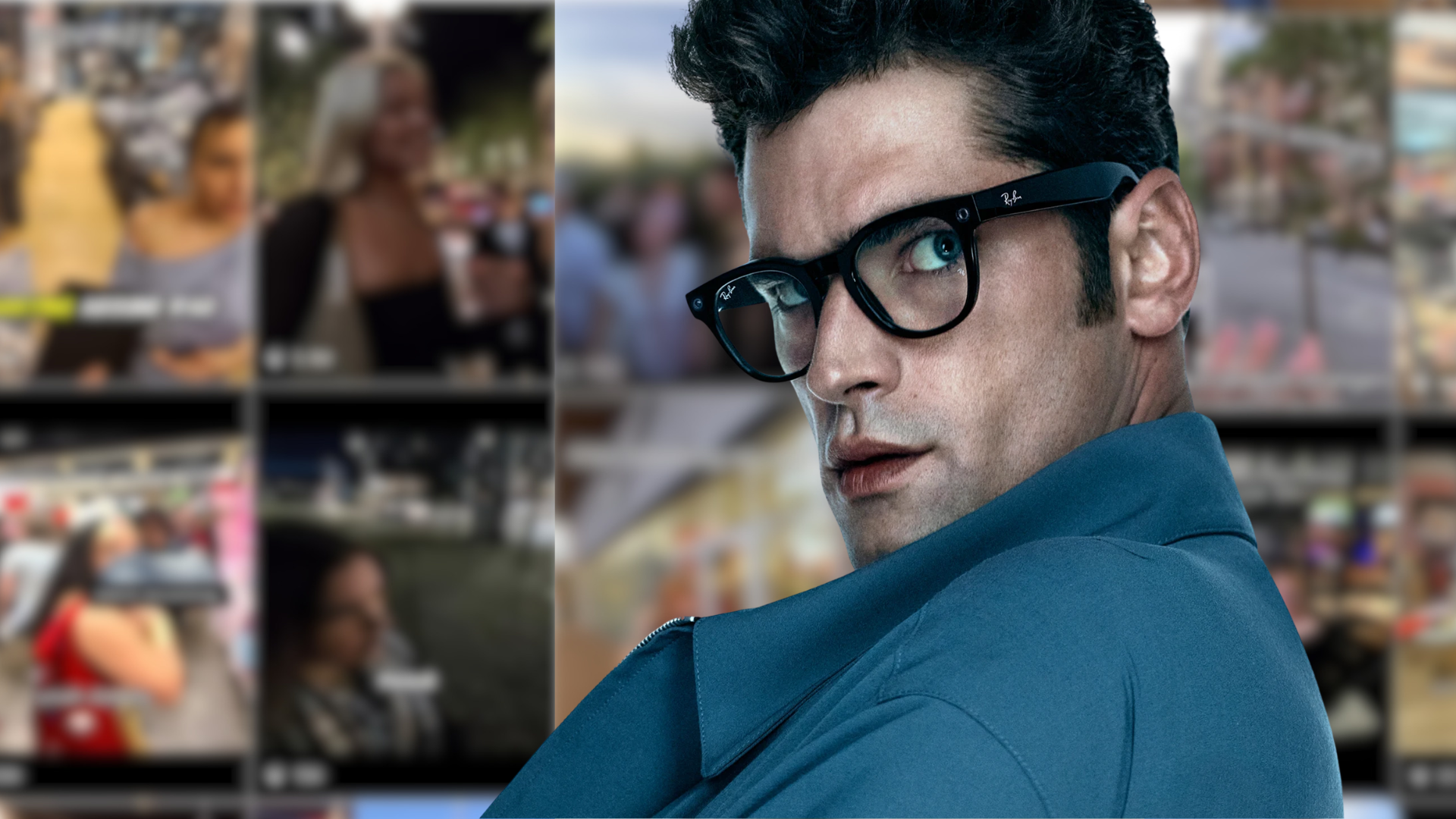
Instagram is full of first-person videos of men harassing women in public. They follow a similar script: A man walks up to a woman or group of women in a store, sitting outside a cafe, or walking home from a bar, and delivers a pickup line. The women almost always nervously laugh, react with barely-veiled disgust, or say "fuck off" while he stalks her or refuses to walk away. The men recording these videos capture them with Meta's smart glasses, which are designed to discreetly capture interactions like these and upload the videos to Meta's platforms where the women in the videos are turned into content for "pickup artist" accounts.
New research reveals this ecosystem works, and how pickup artists (PUA) influencers are using Meta's products, including its smart glasses and social media platforms, to perpetuate a culture of harassment against women.
University of Sydney researchers Joanne Gray, Milica Stilinovic, Marcus Carter, and Ben Egliston watched hundreds of these videos to learn how pickup artist content creators use smart glasses, and what specific forms of gendered harms these recordings cause. They published their research paper, "Harm Through the '#RizzCam': Smart Glasses, Ambient Capture and Invisible Harassment," online this week as a preprint article.
CGTrader, an online marketplace for 3D assets, found that one in six models uploaded to the site these days is AI generated, but that AI generated assets account for only $1 out of $90 in revenue on the site. These numbers show that AI generated assets are quickly flooding the marketplace, but that most people are not interested in paying for them.
“Buyers are voting with their wallets, and AI-generated content is struggling to compete,” CGTrader said in a press release about its 2026 market trends reports. The company says the gap between the surging supply of AI generated 3D models and the middling demand points to “a gap that undercuts the assumption that AI-made content is repricing the market.”
“The upload numbers alone would suggest a takeover,” CGTrader said. “The revenue numbers say otherwise, and buyers refusing to pay for AI-generated models is saying something bigger than no thanks: it is a signal of how far they trust AI generation itself. Which leaves the question the industry has been avoiding: an AI model may be cheaper to produce, but what is it actually worth?”
Like the Unreal and Unity asset stores, CGTrader is a marketplace where people can buy more than two million 3D models to use in their videos, games, or 3D printing projects, and has been around since 2011. The report it published is based on marketplace data collected between June 2025 and May 2026 and surveys of buyers.
Alexander Spivak, a 3D artist who sells his assets on CGTrader, told me that he’s not against AI, but that “as an artist, I haven't yet found a way to seamlessly collaborate with AI.
Because in creativity, the most important thing is the process of creation, which I enjoy.
The result is a completely different story. And I haven't yet been able to integrate AI into my workflow in a way that allows me to continue enjoying [the process.]”
Buyers told CGTrader that the reason they weren’t buying as many AI generated assets their quantity might suggest is simple: they’re not as good as human made 3D models. Buyers said that quality was the number one factor in choosing what they buy, even more than the price. This was especially important to buyers who wanted models for 3D printing, where a bad model could break or not print correctly. Only 4 percent of those buyers said AI “works well.” The survey also found that most people who bought AI generated assets weren’t satisfied with them. 20 percent of buyers found it not good enough, and 7 percent used it only with heavy editing. 5 percent said it worked well.
CGTrader’s findings come months after the company announced it was partnering with Tencent on an AI powered 3D model creation workflow. CGTrader CEO Dalia Lašaitė told me that the workflow doesn’t just generate assets from scratch, but that designers can use it to refine topology and textures, segment parts, create variations and prepare models for production.
“AI can accelerate the more mechanical parts of the process, while the designer retains creative direction and control over the final result,” she told me. “For that reason, we think of this work as AI-accelerated rather than simply AI-generated. Our goal isn't to increase the volume of AI-made assets on the marketplace. It's to give designers better tools to work faster and focus more of their time on creative work. Ultimately, buyers will choose the assets that best meet their needs. The distinction that matters most isn't whether an asset is AI- or human-generated, but whether it meets the required quality standard.”
AI generated content is creating a discoverability problem across the internet. On Instagram, porn sites, YouTube, and music streamers, human creators are being drowned out by a flood of AI generated slop. Lašaitė acknowledged that, despite the current discrepancy between how many AI generated models are uploaded to CGTrader and how many people are buying them, the increase in uploads alone could make it more difficult to find human artists.
“AI uploads are currently growing faster than AI purchases, which makes effective discovery and ranking increasingly important,” she said. “Our approach is to prioritize quality and performance signals rather than raw volume, including how an asset performs commercially, how buyers rate it and other indicators of quality.”
Government surveillance centers are monitoring viral anti-Flock Instagram posts, warning local police about upcoming DeFlock events including one scheduled to start next week, and have told cops to “increase patrols around ALPR [automatic license plate readers]” as backlash to Flock grows, according to government intelligence bulletins obtained using public records requests. The documents also warn about devices “that could be used to identify the locations of Flock cameras.”
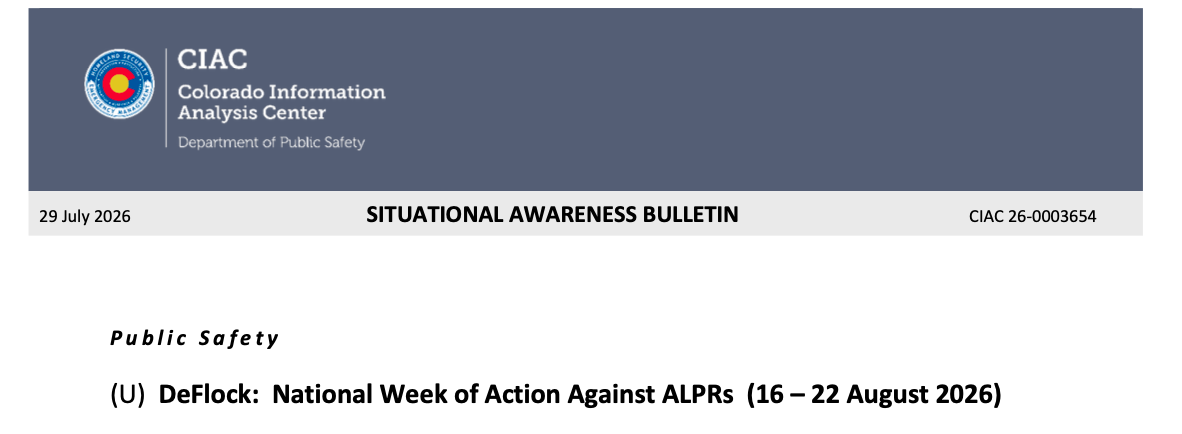
Investigative journalist Dan Boguslaw first published several fusion center bulletins about DeFlock, a crowdsourced map of ALPR cameras. 404 Media has now obtained four more recent law enforcement briefings warning police to surveil or beef up patrols of areas where Flock cameras are located (the documents are embedded below). These briefings document instances of Flock vandalism and warn, specifically, about the DeFlock “National Week of Action Against Automated License Plate Readers,” which is essentially a series of public meetings and protests about the dangers of mass surveillance.
In sum, the documents show that local, state, and federal law enforcement are monitoring anti-Flock activists and are trying to tie together people who politically oppose mass surveillance with vigilantes who destroy Flock cameras. 404 Media obtained the documents through a public records act request.
Fusion centers are information-sharing partnerships between local, state, and federal government law enforcement agencies. The documents Boguslaw and 404 Media obtained are “intelligence bulletins,” which are briefings to law enforcement about specific threats. The data is compiled by individual fusion centers in a state and then shared more widely. Many of the documents are marked “Law Enforcement Sensitive.”
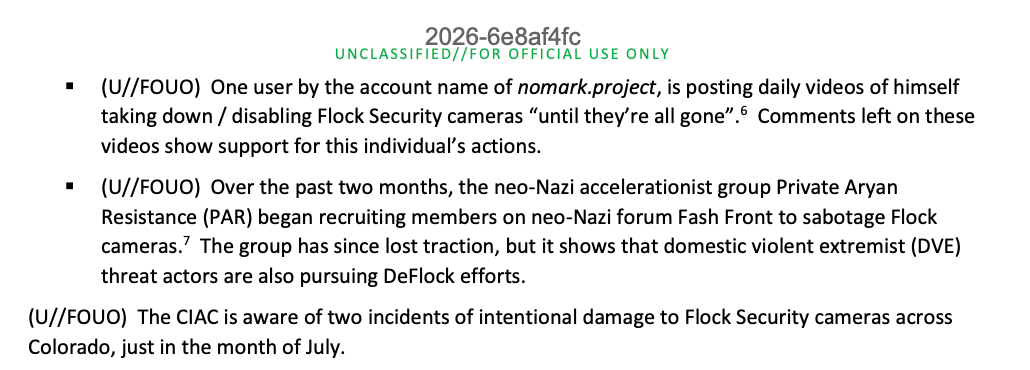
A new fusion center warning from the Colorado Information Analysis Center notes “people have begun utilizing the [DeFlock] app to locate and then destroy or disable the ALPRs. Multiple public accounts are posting videos of individuals vandalizing these cameras, adding momentum to the online discourse and influencing others to do the same.” That bulletin highlights a specific Instagrammer, called Nomark.Project, that is “posting daily videos of himself taking down/disabling Flock Security cameras ‘until they’re all gone.’ Comments on these videos show support for this individual’s actions.” That same bulletin also says neo-Nazi accelerationists encouraged the destruction of Flock cameras, but the call to action seems to have quickly dissipated: “Over the past two months, the neo-Nazi accelerations group Private Aryan Resistance began recruiting members on neo-Nazi forum Fash Front to sabotage Flock cameras. The group has since lost traction, but it shows that domestic violent extremist threat actors are also pursuing DeFlock efforts.” There is no indication in the document that neo-Nazis actually did target Flock cameras.
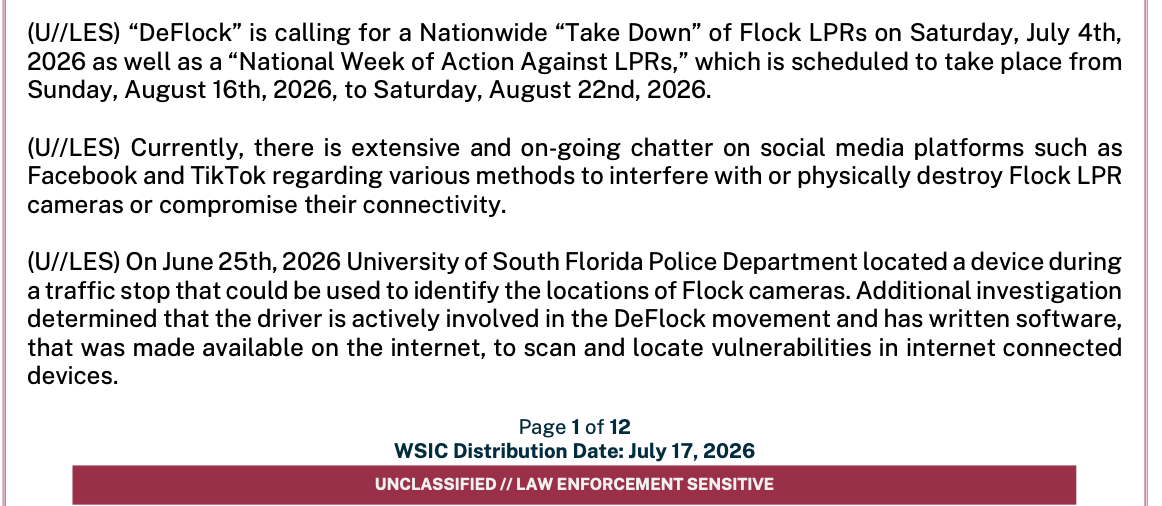
Another bulletin, from the Wisconsin Statewide Intelligence Center via the Northeast Florida Fusion Center, notes, “there is extensive and ongoing chatter on social media platforms such as Facebook and TikTok regarding various methods to interfere with or physically destroy Flock LPR cameras or compromise their connectivity.” In particular, it adds that “On June 25th, 2026 University of South Florida Police Department located a device during a traffic stop that could be used to identify the locations of Flock cameras. Additional investigation determined that the driver is actively involved in the DeFlock movement and has written software, that was made available on the internet, to scan and locate vulnerabilities in internet connected devices.”
DeFlock is an open source, crowdsourced map of ALPR cameras created by a man named Will Freeman. DeFlock was created to show how widespread ALPR cameras are in the United States, and the “DeFlock movement” is a very loose term for a series of local community activists who have educated themselves about Flock surveillance and have asked their local politicians to consider ending their contracts with Flock.
DeFlock has organized a “National Week of Action Against Automated License Plate Readers” for August 16-22. This Week of Action is political in nature, and includes information sessions, marches, and talking points for people who are asking their local communities to consider ending surveillance contracts. DeFlock describes the event as “a variety of public meetings, townhalls, and other events intended to raise awareness about the use of ALPRs in their communities, the harms of these cameras, and how we can work together to end their use.”
The fusion center documents also list specific cities that have signed up for the DeFlock Week of Action; for example, a July 28 bulletin from the North Florida Fusion eXchange notes 11 cities in Florida that “have already signed up to participate.”
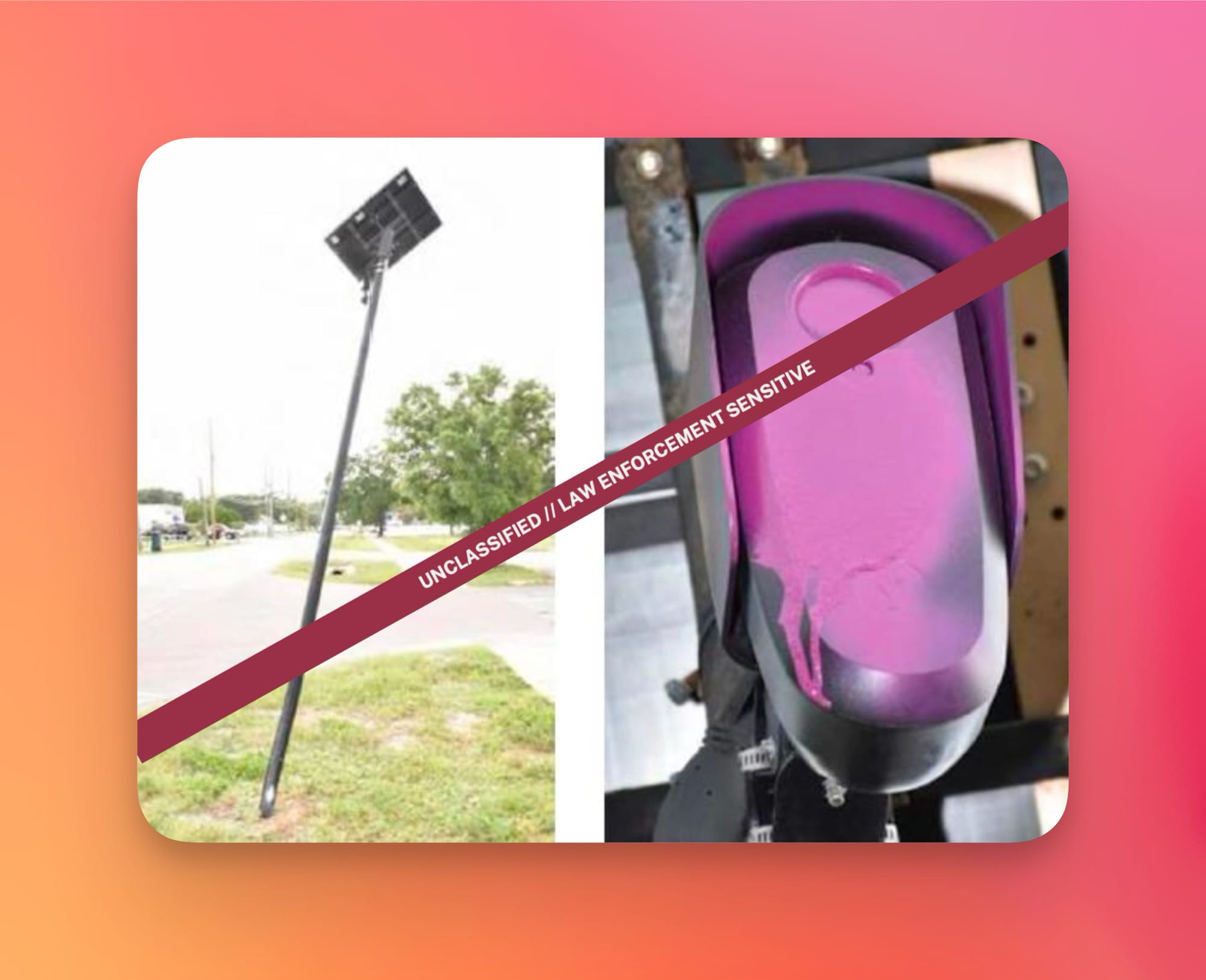
“In addition to DeFlock’s call to action, other online groups and individuals are encouraging the destruction of ALPRs and are sharing tactics and techniques through social media by providing detailed instructions on how to damage or disable ALPR cameras, poles, and solar panels,” the bulletin reads.
Freeman told 404 Media that DeFlock has never called for vandalism of Flock cameras.
“DeFlock has never called for disabling cameras or covering license plates, contrary to what recent law enforcement bulletins claim. DeFlock is a grassroots project that started in 2024, focused on maintaining a public map of surveillance infrastructure and encouraging civic engagement such as contacting local representatives, hosting public awareness events like scavenger hunts, and educational outreach. This has worked for nearly 2 years, with over 100 contracts canceled through legitimate public engagement,” Freeman said. “Some of the activity referenced in these bulletins originates from accounts using the DeFlock name without our authorization.”
Vandalizing Flock cameras “wasn’t much of a thing until like a month ago once it became popular,” Freeman added. “Definitely caused by people on social media who aren’t us. I think it just shows that people are independently upset at the installation of these without their knowledge or consent. I try to be as neutral as possible with DeFlock and let people come to their own conclusions. I even changed the language on the site from ‘You’re being tracked!’ to ‘an open source project mapping ALPRs.’ For the most part, the idea of these upsets almost everyone.”
There have been around a few dozen instances of Flock cameras being destroyed, vandalized, disabled, or having their poles cut down. The North Florida Fusion eXchange bulletin adds: “On July 25, 2026, an individual using the Instagram name ‘Thepatrioticgoy’ posted a video where he claims to be a former Flock Safety employee and gives detailed instruction on how to disable Flock cameras and avoid detection at the same time.” In the video itself, the man describes himself as a “Former Flock Safety field tech.”
The bulletin then lists seven instances of Flock cameras being damaged or removed in Florida. “As online calls for the destruction of ALPRs continue to increase, it is likely that [northern Florida] could experience an increase in the vandalization of ALPR cameras, poles, and solar panels. This bulletin is being provided for situational awareness and to encourage law enforcement to remain vigilant when observing or responding to suspicious activity near ALPR sites.”
Boguslaw’s earlier report showed that fusion centers were warning police about “calls for vandalism to ALPRs nationwide” from “the DeFlock movement, an online grassroots group opposing ALPR, [which] utilizes social media platforms to encourage supporters to disable or evade these systems by destroying cameras and covering license plates.”
404 Media obtained documents from the Central Florida Intelligence Exchange, the Wisconsin Statewide Intelligence Center, the New Jersey State Police, the Colorado Information Analysis Center, the North Florida Fusion eXchange, and a summary of a 404 Media article about DeFlock that was sent to a listserv of FBI headquarters employees. We obtained the documents from the New Mexico All Source Intelligence Center, meaning the warnings are circulating widely within law enforcement in the United States; the New Jersey document, for example, was disseminated to a “nationwide ALPR working group and state fusion centers.”
A Flock Safety spokesperson told 404 Media “Damaging public safety equipment is illegal and puts communities at risk, which is why we strongly condemn this type of behavior.”
“Overall, we have seen few reports of vandalism against Flock equipment. When it does happen, we work directly with law enforcement to investigate damaged or stolen cameras,” they added. “People have every right to make their voices heard, but criminal acts should never be part of that process. Damaging public safety equipment ultimately hurts the very communities this technology is there to help protect.”
It's usually very difficult to investigate the advertising industry. A new tool called DecryptAds aims to make it much easier with a massive dataset anyone can query.

 Connexion