Garrett Langley, the CEO of automatic license plate reader company Flock, told an audience of police chiefs at a private police conference Sunday that anti-Flock protests around the country are not real, according to leaked audio obtained by 404 Media.He also said his wife advised him to never apologize, said he would prefer to never do interviews with the press again, and claimed without evidence that the social media opposition to Flock is driven mostly by Russian bots.“Somebody was paying
Garrett Langley, the CEO of automatic license plate reader company Flock, told an audience of police chiefs at a private police conference Sunday that anti-Flock protests around the country are not real, according to leaked audio obtained by 404 Media.
He also said his wife advised him to never apologize, said he would prefer to never do interviews with the press again, and claimed without evidence that the social media opposition to Flock is driven mostly by Russian bots.
“Somebody was paying for [the social media posts and] stopped paying for it,” Langley said about the many viral posts criticizing his company’s technology. “Social media chatter on Flock is down about 95 percent from July. It went down 50 percent last week when Ukraine bombed a Russian data center with a drone. Literally 50 percent overnight. And so look, I’m the last person, my wife as well, she’s like ‘This is crazy, these people are getting paid to say these things,’” he added, repeating a disproven theory that Ukraine’s strikes on Russian data centers had a significant impact on internet bot activity.
A federal intelligence center warned police that city council meetings about Flock “may be viewed by extremists as a desirable target,” and told them to be on the lookout for “emotional confrontations” between people who oppose surveillance and government officials, according to a copy of the warning obtained by 404 Media.The warning, obtained by 404 Media, was issued by the Orange County Intelligence Assessment Center (OCIAC)—a government fusion center—in July to police in California. 404 Me
A federal intelligence center warned police that city council meetings about Flock “may be viewed by extremists as a desirable target,” and told them to be on the lookout for “emotional confrontations” between people who oppose surveillance and government officials, according to a copy of the warning obtained by 404 Media.
The warning, obtained by 404 Media, was issued by the Orange County Intelligence Assessment Center (OCIAC)—a government fusion center—in July to police in California. 404 Media recently obtained the bulletin using a Freedom of Information Act request.
This surveillance bulletin to cops is the latest evidence that police around the country have been told to be on edge during public meetings where people are participating in democracy and utilizing their First Amendment rights about unpopular things the government is doing. We have reported on a spate of people being illegally arrested for extremely minor procedural violations or for cursing at city council meetings about Flock and data centers while participating in constitutionally protected activities.
The warning is similar to others obtained by 404 Media and other journalists about the broader DeFlock movement and vandalism of Flock surveillance cameras. But this warning specifically tells police that there have been “no specific and credible threats found” related to city council meetings about Flock, but warns they should be on the lookout anyway. The warning noted that anti surveillance organizers could have been emboldened by the news that the Los Angeles Police Department ended its Flock contract, and may expect other local governments to do the same. The LAPD’s decision was “providing organizers and participants with a high-profile local example that could increase turnout and place additional public pressure on City Council members” to end their Flock contracts, the bulletin claims.
“City-hosted events (i.e., city council meetings) may be viewed by extremists as a desirable target. Partners are encouraged to review for signs of suspicious activity,” the warning reads. This suspicious activity includes “excessive clothing,” “unusual questions or behavior,” people loitering,” or “unattended bags or packages.”
The warning goes on to say that genuine interest in ending mass surveillance at a city council meeting “may present public safety risks,” which includes “large turnout exceeding room capacity,” “emotional confrontations,” counterdemonstrations,” “media presence,” “social media amplification,” and “disruption of council proceedings.”
Here is a full excerpt of the portion of the warning about protected activities that could apparently “present public safety risks:”
_
Large turnout exceeding room capacity: If organizers mobilize significantly more attendees than the council chambers can accommodate, this can lead to long lines, frustrated attendees, overflow areas, or delays in the meeting.
Emotional confrontations: Because the issue involves surveillance, privacy, immigration concerns, and public safety, speakers and attendees may have strong emotions. Verbal confrontations between supporters and opponents are more likely than at routine council meetings.
Counterdemonstrations: Individuals who support the Flock camera program or emphasize its crime-fighting benefits may attend and express opposing views, increasing the potential for verbal conflict.
Traffic and parking impacts: A well-attended meeting can create localized congestion around City Hall before and after the meeting.
Media presence: Local television, newspapers, livestreamers, and independent journalists may attend because the issue has recently received regional media coverage.
Social media amplification. Attendees may livestream or record interactions. Minor disputes can quickly spread online, increasing public attention.
Disruption of council proceedings. Possible issues include:
Interrupting speakers
Shouting from the audience
Refusing to yield the podium after time limits
Coordinated chanting inside the chambers
Attempts to delay or prevent the meeting from continuing
Physical altercations: Heated disagreements between attendees with opposing viewpoints could escalate into minor physical altercations, particularly during emotionally charged interactions before, during, or after the meeting.
Targeted threats or intimidation: Any credible threats, harassment, or intimidation directed toward elected officials, city staff, organizers, or attendees should be treated as a significant public safety concern and evaluated promptly.
Extremist-related activity: Although there is no publicly available information indicating extremist involvement, politically contentious events may attract isolated individuals seeking to promote unrelated ideological causes.
“The OCIAC recognizes that Americans have constitutionally protected rights to assemble, speak, and petition the government,” the warning ends. “The OCIAC safeguards these rights and only reports on First Amendment protected activities for operational planning in the interest of assuring the safety and security of the demonstrators and the public.”
In response to a 404 Media investigation, Sen. Ron Wyden is demanding more information about how a federal license plate reader camera program works.Last month, we reported on the High Intensity Drug Trafficking Area program’s license plate reader database, which mirrors data from city license plate reader programs onto federal databases. The HIDTA program falls under the White House’s Office of National Drug Control Policy, which infamously ran a secretive cell phone data surveillance project c
In response to a 404 Media investigation, Sen. Ron Wyden is demanding more information about how a federal license plate reader camera program works.
Last month, we reported on the High Intensity Drug Trafficking Area program’s license plate reader database, which mirrors data from city license plate reader programs onto federal databases. The HIDTA program falls under the White House’s Office of National Drug Control Policy, which infamously ran a secretive cell phone data surveillance project called Hemisphere. We reported that HIDTA has now created a complex system for the federal government to obtain license plate data from companies like Flock, Axon, and Motorola via a series of agreements with cities and towns across the country.
In a letter to Sara Carter, director of the Office of National Drug Control Policy, Wyden said that the office needs to publish a report it commissioned into the privacy practices of several of its surveillance programs, including the license plate reader database.
“404 Media has reported that the HIDTA program is being used to aggregate location data on Americans derived from Flock, Axon, and other vendors’ ALPRs,” Wyden wrote. “There is currently limited transparency into these HIDTA-funded surveillance programs, but ONDCP has commissioned an assessment into the privacy practices of these programs that should be released to the public.”
Wyden said that the nonprofit contractor MITRE conducted a privacy review of HIDTA’s surveillance programs, including its cell phone data collection project and its ALPR program, in 2024. That report has never been made public. Wyden demanded the release of that study, as well as a separate “analysis of automated license plate reader systems and practices.”
“There is currently limited transparency into these HIDTA-funded surveillance programs, but ONDCP has commissioned an assessment into the privacy practices of these programs that should be released to the public,” he wrote. “This review was conducted by MITRE and completed in 2024, but ONDCP refused to provide it to my office and has subsequently not made that report public. I urge you to make this review public.”
Body camera footage obtained by 404 Media reveals the first Flock camera searches ruled unconstitutional by a federal judge, and highlights how the system has turned otherwise mundane traffic stops into interrogations for drivers.On Friday, we reported that a federal judge ruled the use of license plate reader systems in the arrest of a woman named Melissa Kyle to be an “unconstitutional warrantless search,” “indiscriminate mass surveillance,” and a violation of the driver’s Fourth Amendment
Body camera footage obtained by 404 Media reveals the first Flock camera searches ruled unconstitutional by a federal judge, and highlights how the system has turned otherwise mundane traffic stops into interrogations for drivers.
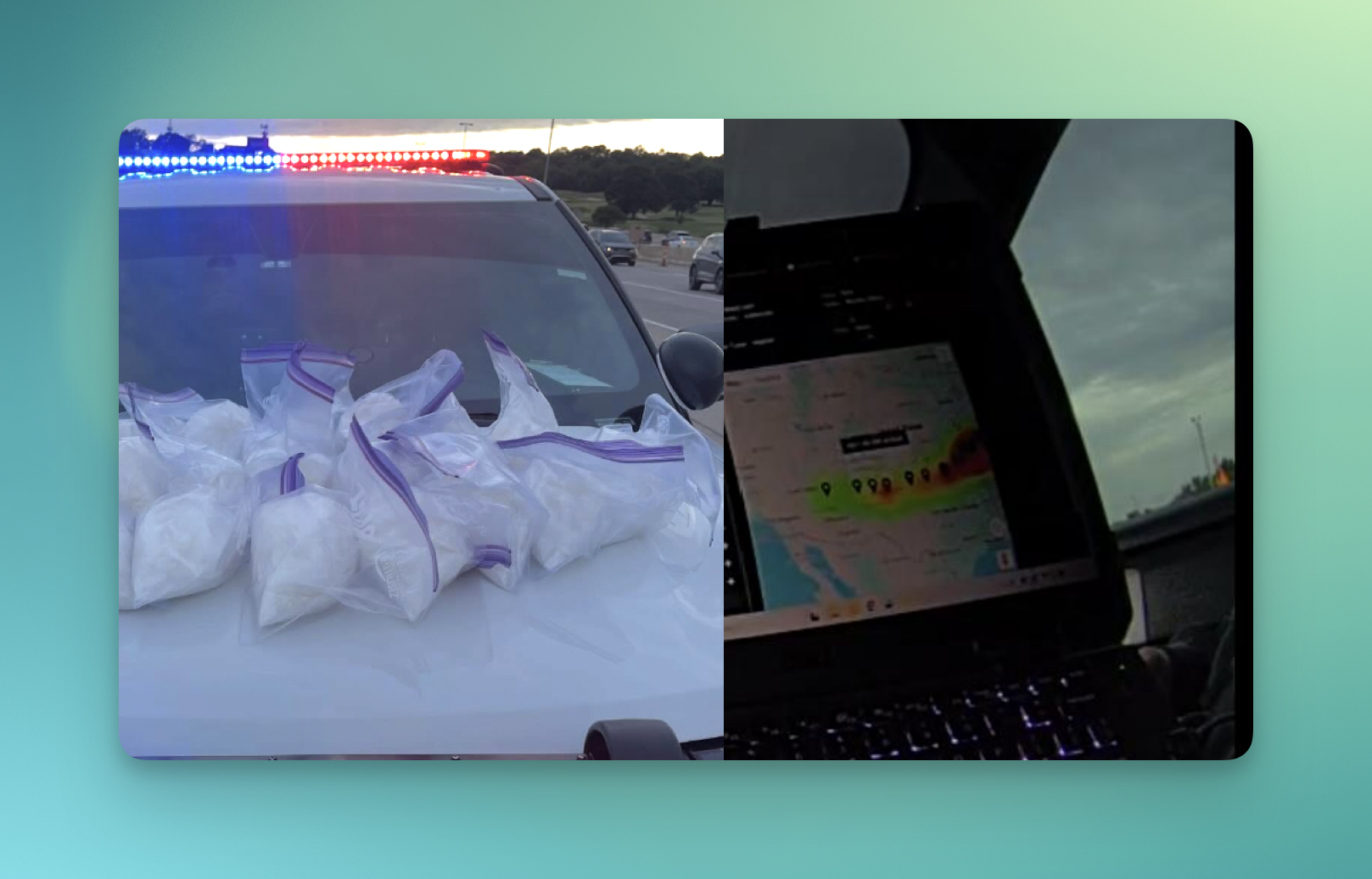
On Friday, we reported that a federal judge ruled the use of license plate reader systems in the arrest of a woman named Melissa Kyle to be an “unconstitutional warrantless search,” “indiscriminate mass surveillance,” and a violation of the driver’s Fourth Amendment rights. The judge in that case ruled that, even though Kyle had more than 91 pounds of meth in her vehicle, the police had no justifiable reason to search Flock for her license plate and no reason to suspect that her travel as shown on Flock’s system was suspicious. Therefore, all of the evidence from Flock and the search of her vehicle must be thrown out.
The body camera and in-vehicle footage, alongside records from Flock and the Motorola ALPR system obtained by 404 Media shows how the use of license plate reader systems is being used to create probable cause where a person’s driving patterns are suspicious enough to pull them over.
404 Media obtained the footage with the help of one of our readers, who agreed to go to the U.S. District courthouse in Tulsa and purchase it from the clerk; the court did not make the footage available online even though it was entered as evidence in the case.
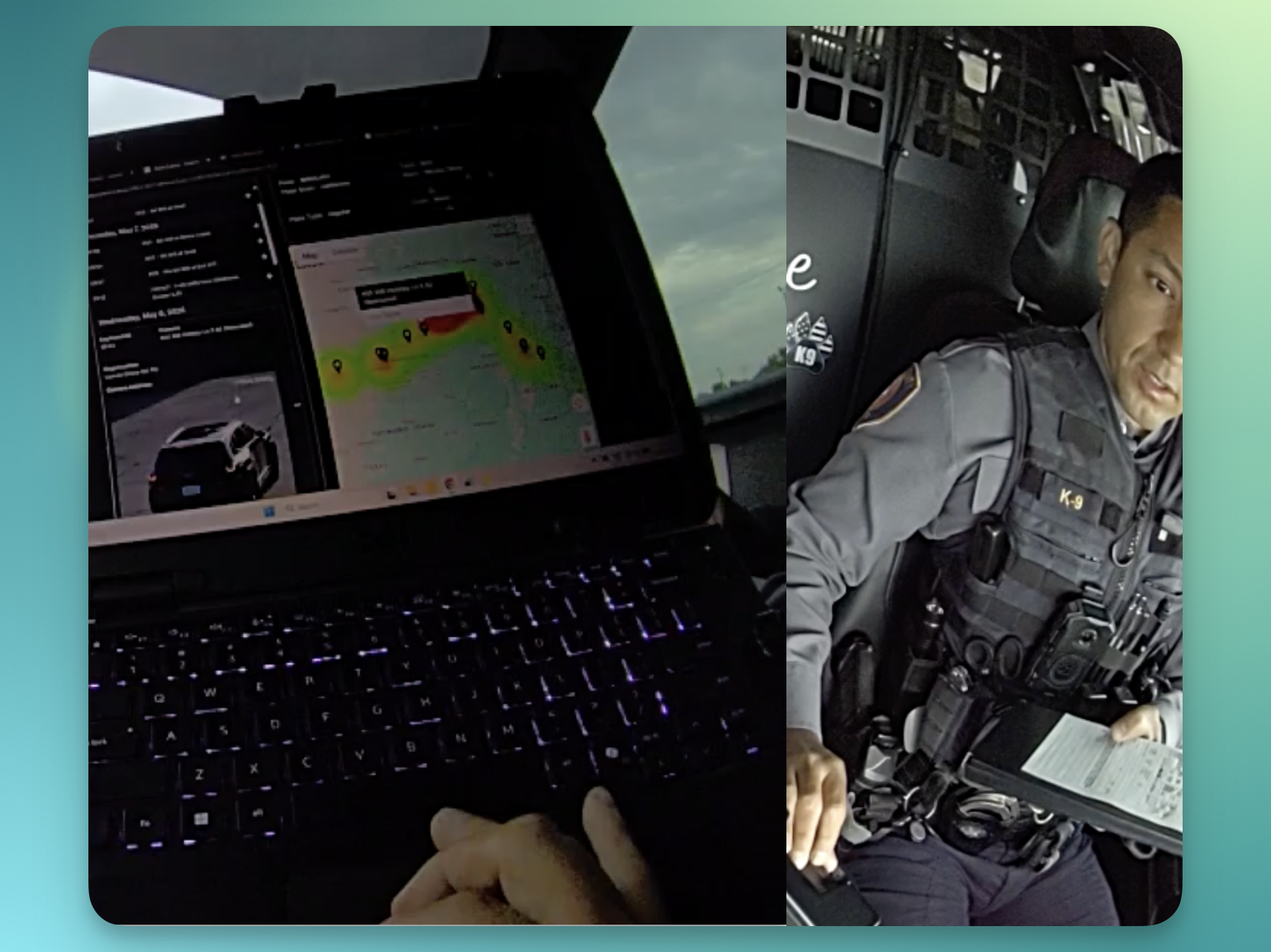
In the footage, which is from Tulsa County deputy sheriff Freddie Alaniz’s body camera, Alaniz is seen driving 60 miles per hour, one hand on the steering wheel, one hand on his laptop, searching Flock before he had even fully pulled over Alaniz. Alaniz had seen the car Kyle was driving had California license plates, and decided to pull it over for no reason other than it was from California, the court determined. The video shows that Alaniz told his colleagues that he was sitting on the highway and “saw her go by, and I just started running her info on Flock and Vigilant [Motorola’s ALPR system].”
“She actually didn’t have any [Flock] hits until just west of Amarillo, [Texas], so I thought I’d drive up,” he said, suggesting that he thought it was odd she was driving back from California. “I got her for a lane violation.”
In the footage, Alaniz tells Kyle he pulled her over ostensibly for changing lanes without a turn signal. Kyle tells Alaniz that the car is a rental, and he asks her to step out of the vehicle and get into his car while she looks up the rental information. While she is looking up the rental information, he tells her she is only going to get a warning, but proceeds to interrogate her about the travel while going through the car’s driving history on his in-car laptop.
Body camera footage obtained from the court
In-car footage obtained from the court
Kyle told Alaniz she had been visiting family in California from Missouri for a few days after separating from her husband. As she’s telling him this, Alaniz scrolls through a record of her travel history on his in-car laptop, which documents every time the car passed a Flock or Motorola automated license plate reader camera over the last 30 days. Visible on the screen, there are a total of 79 hits, and roughly 50 during the few-day period Kyle was renting it. The ALPR hits show the car leaving Missouri, driving through Oklahoma, Texas, New Mexico, Arizona, and entering California when she passed a Motorola ALPR camera in Topock, Arizona, on the border with California. They then show her essentially reversing the route, and driving back through Oklahoma. (Alaniz did not have access to ALPR hits from California; this may be because Flock drastically limited nationwide sharing from California ALPR cameras following illegal searches for immigration violators and a woman who had an abortion.)
Alaniz asks Kyle where she’s been and where she stayed, and compares it to the license plate camera records. He begins quizzing her: “Do you remember what day you left Missouri?,” he asks.
Alaniz clicks different ALPR hits on his map, each bringing up a photo of her car, a geographic location, and a timestamp of when she drove by the camera. The government’s lawyers later argued in court that minor discrepancies between what Kyle told Alaniz and what the ALPR data showed meant she was lying about where she’d been on which specific days and therefore gave Alaniz probable cause to search her vehicle.
Alaniz tells Kyle that he is giving her a warning for changing lanes without a turn signal, closes his laptop, then says he wants to ask her a few questions.
“Your short trip to California, I feel like. I don’t feel, I know from my training and my experience that people who do very short trips to California and come right back are transporting large amounts of drugs,” he says. “People who do that—not everybody, but some people do. With my training and experience, I feel that may be something going on here. May I search your car?”
She says no. Alaniz calls for backup, and says “You are being detained. You are not free to go.” In the footage, Alaniz tells a colleague that “she went to California for two days, kind of making stuff up when I ask her where she stayed at.”
He used Alaniz’s travel history, her “nervousness,” and the fact that she doesn’t recall every detail of her travel precisely as probable cause to search her vehicle, where he and his colleagues found 91 pounds of meth. Alaniz described this in the footage as “a motherlode,” and “a shit-ton of meth.”
But the way that he came to this conclusion was unconstitutional, U.S. District Court Judge Sara Hill ruled last week, and all of the evidence—including the car’s travel history and everything the police found during the search of the vehicle—must be disregarded in court as “fruit of the poisonous tree.”
It is often the case that unconstitutional, privacy-violating searches that are regularly done on everyday people doing nothing wrong are discovered in court cases in which serious crimes have occurred. In this particular case, Alaniz discovered what appeared to be meth trafficking, but he did so only after suggesting that an ordinary interstate travel pattern was somehow suspicious, and only after using the Flock and Motorola systems to show an incredibly detailed history of a person’s travel and to interrogate her about it.
Hill wrote “The factors that the government relies upon [to search Kyle’s vehicle] are the same type of circumstances that everyday Americans encounter on long road trips for many legitimate reasons. Many of us drive longer than we want to get to a desired destination, or to no destination at all other than the road and sights ahead. Many of us lose track of what exact day of the week it is when we are traveling, even if it is for just a moment. Many of us travel for myriad reasons (some better than others), cross state lines, pack too much, buy too much, smoke cigarettes, and rent cars. And many of us even get a bit nervous when talking to law enforcement.”
One of the problems with automated license plate reader systems is that they allow police to recreate not just a single person’s movements and travel history, but any driver’s movements and travel history. Documents filed with the court show the totality of both the Flock and Motorola records, and show timestamped, geographically mapped images of the vehicle multiple times per day, driving throughout the entire country. The records also highlight just how many jurisdictions and businesses have Flock and Motorola ALPR cameras, and how that data forms a nationwide network.
For example, Alaniz had access to a photo of the rental vehicle taken by a Lowe’s hardware store-owned camera in Missouri, various Texas state police-owned cameras, by the New Mexico State police, the Kingman police department. In a five-day period, the car was scanned more than 50 times by 11 different law enforcement agencies.
“Alaniz’s search in just the ALPR system provided him with more than 50 individual records of Kyle’s whereabouts across the country for an entire month,” Hill wrote. “The Court finds that because the ALPR systems Alaniz used to search Kyle’s historical location information intruded on her reasonable expectation of privacy in the whole of her physical movements, it was a search under the Fourth Amendment. Based on the information in the record, the only reason Alaniz conducted that search was because he saw her license plate was from California. That search was not supported by probable cause, and it was done without a warrant in violation of Kyle’s Fourth Amendment rights.”
The Motorola ALPR report shows that, after the car was impounded, it was scanned two more times on the back of a tow truck later that day.
A federal judge in Oklahoma ruled Thursday that a police officer violated the Fourth Amendment rights of a woman accused of meth trafficking when he searched her license plate in Flock’s automated license plate reader system simply because her license plate was from California, then used her travel history as part of the reason to search her car. The judge’s opinion is one of the first times a federal judge has decided Flock searches can be unconstitutional, and suggested that Flock’s network is
A federal judge in Oklahoma ruled Thursday that a police officer violated the Fourth Amendment rights of a woman accused of meth trafficking when he searched her license plate in Flock’s automated license plate reader system simply because her license plate was from California, then used her travel history as part of the reason to search her car. The judge’s opinion is one of the first times a federal judge has decided Flock searches can be unconstitutional, and suggested that Flock’s network is “a type of indiscriminate mass surveillance.”
The officer’s “use of the ALPR Systems was an Unconstitutional Warrantless Search,” and “was not supported by probable cause, and it was done without a warrant in violation of [the defendant’s] Fourth Amendment rights,” the judge, Sara Hill, wrote, implying that the law enforcement officer should have obtained a warrant before searching for the vehicle in Flock’s system. There are currently more than a hundred thousand warrantless searches of the Flock system every month, according to audit logs viewed by 404 Media. Hill's decision will not set a binding precedent and there are several other cases throughout the nation considering the legality of warrantless ALPR searches.
Hill argued that previous judge opinions saying Flock searches were not a Fourth Amendment violation because they track cars in public do not consider the context that Flock’s nationwide network is quickly “approaching dragnet-type law enforcement practice,” and that courts should update their understanding of the technology moving forward.
The circumstances of the court case are really interesting and highlight how commonplace Flock searches have become for police, and the depth of the information they can reveal. In May, a Tulsa County Deputy Sheriff named Freddie Alaniz was parked along the side of the highway in Oklahoma when he saw a Mazda SUV driven by a woman named Melisa Kyle with a California license plate pass by. “Alaniz then pulled his vehicle on the highway to follow the Mazda for no apparent reason other than the fact that it had a California license plate. Alaniz also ran a query on the Flock system for the California license plate number on the Mazda SUV,” Hill wrote. Alaniz then ostensibly pulled Kyle over for changing lanes without a turn signal.
Alaniz interrogated Kyle about her travel “while he continued to review the ALPR systems for the car she was driving,” the judge wrote. Alaniz made Kyle recount everything she had done in the last several days, and compared it to the Flock data. He told her that because she was only in California for a short period of time, he suspected her of trafficking drugs. He used her travel history as seen in the Flock system as part of the justification to search her car; she was found to have 91 pounds of meth in the vehicle. Hill ruled that all Flock evidence and all evidence from Alaniz’s search of the car must be thrown out.
“The Fourth Amendment requires courts to draw a line when the cost is too great. Alaniz’s search in just the ALPR system provided him with more than 50 individual records of Kyle’s whereabouts across the country for an entire month,” Hill wrote. “The Court finds that because the ALPR systems Alaniz used to search Kyle’s historical location information intruded on her reasonable expectation of privacy in the whole of her physical movements, it was a search under the Fourth Amendment. Based on the information in the record, the only reason Alaniz conducted that search was because he saw her license plate was from California.”
“The factors that the government relies upon are the same type of circumstances that everyday Americans encounter on long road trips for many legitimate reasons. Many of us drive longer than we want to get to a desired destination, or to no destination at all other than the road and sights ahead,” she added.
The decision is a landmark one, and comes in the aftermath of the Supreme Court’s Chatrie v United States decision that found police accessing a person’s digital data, including cell phone location data, constituted a search.
“The opinion is pretty amazing. It recognizes one thing that courts ignore which is the sheer breadth of these systems, that they collect so much information about so many people in a way that sets them apart. This decision ascribes appropriate weight to the fact police are building out this massive database that can reveal incredibly intimate details of people’s lives,” Michael Soyfer, a lawyer at the Institute for Justice, which has studied Flock camera abuse and is litigating several cases on Fourth Amendment grounds, told 404 Media. “It’s extremely important. The way courts have resolved these cases previously has been way too myopic and has ignored the depths of these systems and the sweeping modes of surveillance that allow police to reconstruct the movements of anyone in the country.”
The new decision also immediately invalidates the core argument that Flock’s CEO Garrett Langley has made saying that Flock was not a constitutional issue. “You and I don’t get to pick what’s a constitutional violation and what’s not. We have judges, we have elected officials, there’s a process for that. We follow the law, we follow the Constitution. So far, in our belief and what will be for a long time, the courts have deemed this is not a warrantless search; this is a valid product as it relates to the Fourth Amendment. So I don’t see any change there,” Langley told The Drive in July, adding the issue was “pretty cut and dry.”
Notably, Hill suggested that other courts that have ruled Flock searches do not constitute a Fourth Amendment search were likely wrong to do so, and that they have not considered the widespread and automated context of the AI-powered surveillance system.
Previous decisions that ruled ALPR searches do not require a warrant have leaned on a Supreme Court case called United States v Knotts, in which police put a tracking device in a chemical container after being tipped off that an employee of a chemical plant was stealing from their employer. That case was decided in 1983 and found, “[a] person travelling in an automobile on public thoroughfares has no reasonable expectation of privacy in his movements from one place to another.” But Hill wrote, “that language exists in the context of the facts presented in the case. Rather than a large-scale, dragnet-type surveillance system like the ALPR technology in this case, the Court in Knotts was confronted with much less sophisticated technology.”
“The Court acknowledges that people, in at least a broad sense, do not have a reasonable expectation of privacy in their movements on a public roadway,” Hill wrote. “But by virtue of how ALPR technology works, Alaniz and other officers using these systems have access to a continuously updated location history for all vehicles caught on ALPR cameras within the network. This is a type of indiscriminate mass surveillance. It is not targeted on a single individual, as in Carpenter [another Supreme Court case about phone data specifically]. It is a tool that collects information about all vehicles that pass by any network-connected camera at all times, and it serves up the information to law enforcement on demand.”
We have seen several cases in which cops have used Flock data to pull people over because they have crossed state lines, then have worked backward to justify their travel patterns as a reason to search their vehicles.
“We’re seeing that repeatedly with police flagging whatever they’ll call suspicious patterns of movement. Federal agents were using ALPRs to monitor cars making day trips across the border and back to manufacture a basis to stop them, interrogate the drivers and search them,” Soyfer said. “I think Flock is going to automate that using AI where cops can set alerts for those kinds of travel patterns. When we’re arguing these systems are very powerful and can show a lot about people’s movements, cops dismiss this as speculative or not possible, but then they deploy this strategy against people who they stop all the time.”
A Flock spokesperson told 404 Media, "Flock was not a party to this case. The ruling goes against the overwhelming weight of authority in similar cases across the country, including multiple recent decisions in Oklahoma, and we expect it will be appealed and ultimately overturned. This ruling is limited to the specific facts of this case. It does not set controlling precedent and does not affect law enforcement agencies’ continued use of these important public safety technologies."
This article has been updated with comment from Flock Safety.
The Trump administration is using an anti-drug trafficking grant program from the 1980s to force cities around the country to funnel their ongoing collection of automated license plate reader data into large federal surveillance centers that fall under the White House’s jurisdiction, according to public records and court documents reviewed by 404 Media.The records show the workings of a complex system in which the federal government is using the “High Intensity Drug Trafficking Area” (HIDTA)
The Trump administration is using an anti-drug trafficking grant program from the 1980s to force cities around the country to funnel their ongoing collection of automated license plate reader data into large federal surveillance centers that fall under the White House’s jurisdiction, according to public records and court documents reviewed by 404 Media.
The records show the workings of a complex system in which the federal government is using the “High Intensity Drug Trafficking Area” (HIDTA) program to obtain data from local cops’ Flock, Axon, and other ALPR cameras and aggregate it on federal government servers, where it is then accessible to other federal, state, and local law enforcement agencies. In some cases, data that goes to HIDTA is then also shared to a larger program run by the Drug Enforcement Agency called the “National License Plate Reader Program” (NLPRP).
Through HIDTA systems, local license plate data can be accessed by various federal agencies, including those who may not have contracts themselves with the ALPR companies. The program raises significant privacy and transparency concerns; as cities begin to place restrictions on how their Flock data can be used, it represents an end-around for federal law enforcement to access data that it might not normally be able to, and to do so without any obvious oversight body. HIDTA falls under the jurisdiction of the White House’s Office of National Drug Control Policy (ONDCP), and it recently won an award from the Trump White House for “managing an automated license plate reader platform that brings together all levels of law enforcement.”
Many of the documents used in this article were obtained using public records requests by Cris van Pelt, the creator of the website HaveIBeenFlocked.com and its associated investigative blog, Footnote4a. “When local police and private vendors promise community control over surveillance, they obscure a broader agenda. The DEA and ONDCP are already aggregating local data behind the scenes,” van Pelt said. “This bypasses democratic processes entirely. The public has made it clear that mass surveillance violates fundamental rights, even when it is laundered through fragmented systems, private companies, and regional task forces.”
A complex setup and a quasi-government program
The ONDCP, which oversees the HIDTA program, is sometimes known as the “drug czar” and has funded a series of law enforcement and overarching surveillance programs, including a call records database called Hemisphere that collected phone records and location data on more than a trillion AT&T calls.
HIDTA is a “multi-jurisdictional public safety program” that funds a series of different HIDTA intelligence centers and other drug enforcement efforts throughout the country. There are a total of 33 HIDTA programs, which cover all 50 states. HIDTA’s intelligence centers are similar to — but separate from — government fusion centers, in which surveillance data is shared between local, state, and federal law enforcement. Individual HIDTA intelligence centers are managed by “executive boards,” and are usually made up of law enforcement officials and government lawyers, but this setup can also lead to confusion about who is actually in charge of the data that any HIDTA collects.
“The White House Office of National Drug Control Policy, which notoriously funded a centralized call record database that exceeded a trillion records that was used by HIDTA participants, has apparently done a similar thing for license plate reader data,” Jeramie Scott, director of the Electronic Privacy Information Center’s Surveillance Oversight Center, told 404 Media. “The whole scheme adds another layer of obfuscation of how license plate reader data is being used and who is using it. If you’re pissed about Flock then you should be pissed about this. No doubt this database contains license plate reader data from Flock as well as from other providers of license plate reader technology. The government went to great lengths to keep the Hemisphere Project out of the public’s eye, and I wouldn’t be surprised if they have tried to keep this program from the public too.”
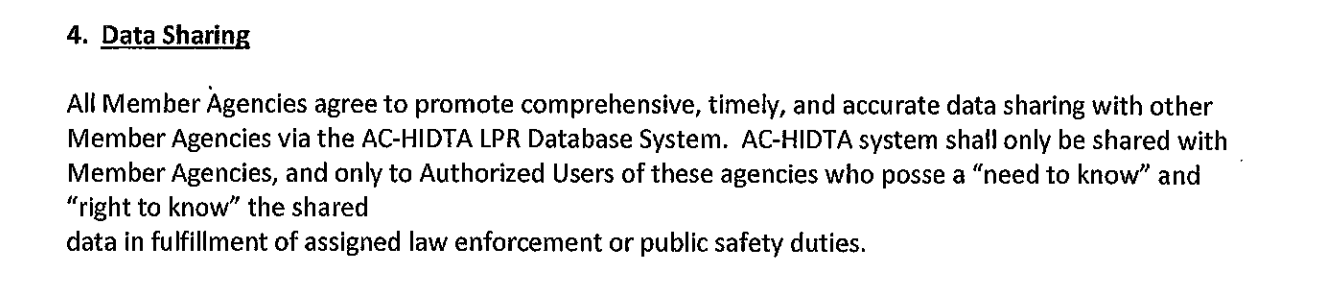
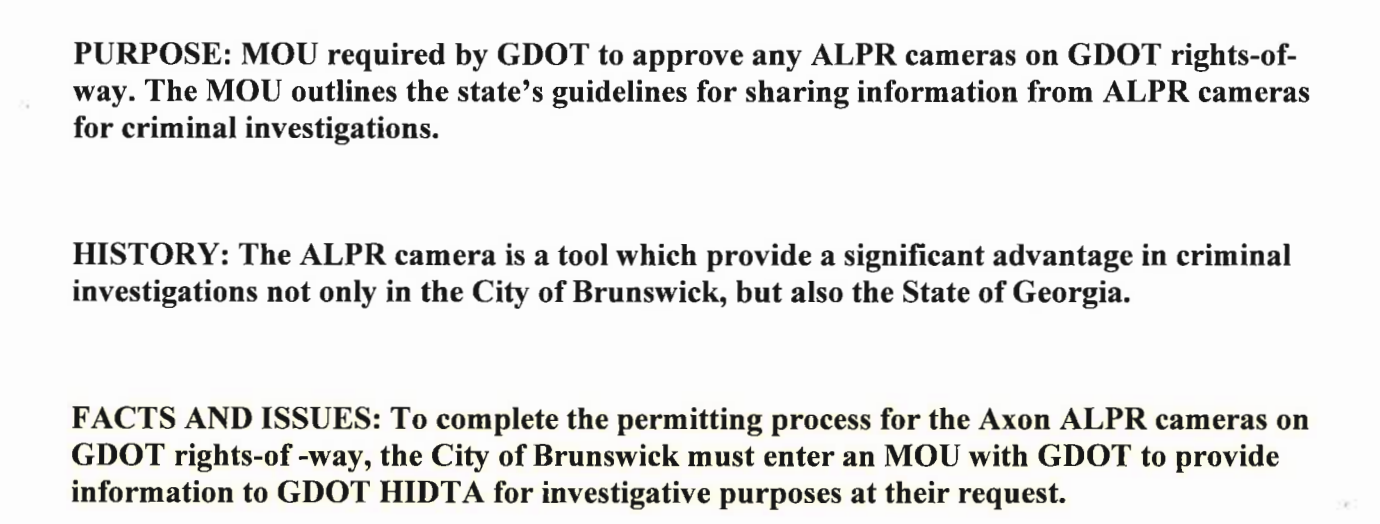
HIDTA’s setup is complicated, but important. Over the last several years, the White House and several states have taken steps to ensure local ALPR systems are fed into HIDTA; for example, cities in Georgia are not allowed to operate ALPR systems on state rights of way without signing a “memorandum of understanding” (MOU) in which they promise to send their data to a HIDTA, according to copies of the agreement seen by 404 Media.
A screenshot from a presentation made by the Kansas Highway Patrol
This MOU highlights how convoluted this program is. Earlier this month, the city of Brunswick, Georgia, realized that it could not deploy Axon license plate cameras without signing an agreement with the Atlanta-area HIDTA to “facilitate the sharing of information contained within their electronic data systems, including but not limited to: Automated License Plate Readers and Law Enforcement Data Sharing Systems—which may include aggregated information collected from multiple individual or regional sources—into commercially available and custom developed data integration systems.” The MOU essentially states that ALPR data collected by the city must be funneled to HIDTA, where it can be accessed by various other law enforcement agencies through aggregation software that brings in data from multiple different companies.
From a City of Brunswick city council meeting information packetFrom Flock's website for Georgia agencies
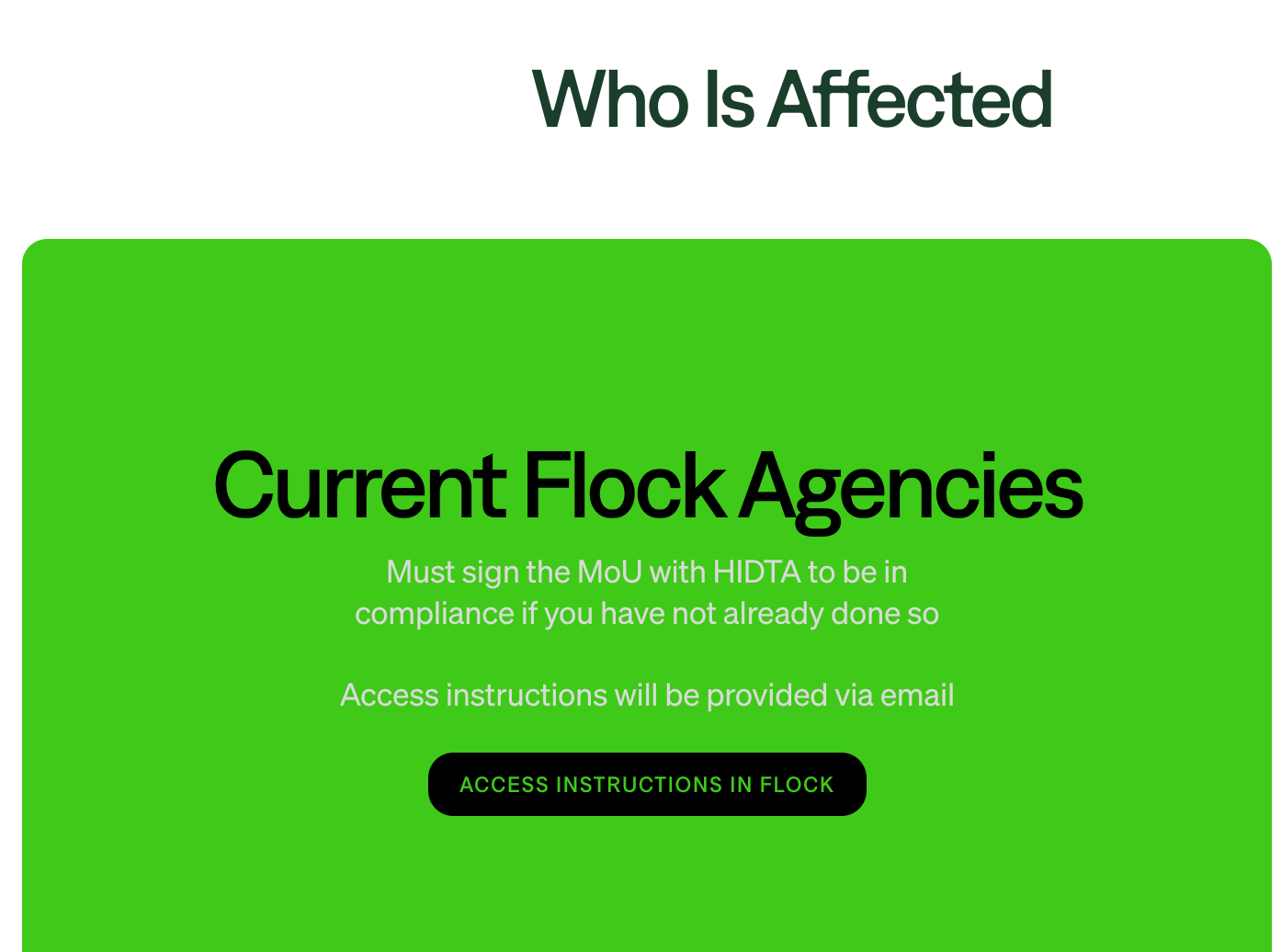
A page on Flock’s website set up for Georgia law enforcement agencies says, “if your agency installs or operates cameras in the Georgia Department of Transportation Right of Way, you must sign a memorandum of understanding with HIDTA to remain in compliance with the new Georgia State Police policy […] LPR reads from GDOT ROW cameras will be accessible to Georgia users of the HIDTA National LPR system through the Flock interface.” Because there are dozens of HIDTAs across the country, it is not clear how many jurisdictions across the country are actively funneling data into HIDTA’s databases. A login portal for the national HIDTA system seen by 404 Media runs through the Houston HIDTA .
“As we learn more about ALPRs and the extensive ALPR data-sharing infrastructure, it’s clear that we've only scratched the surface regarding the danger of these tools,” Ed of Southerners Against Surveillance Systems and Infrastructure told 404 Media. “As we learn more, it's clear that the outrage against this surveillance is justified. We need all of these cameras removed.”
ONE PROGRAM INTO ANOTHER
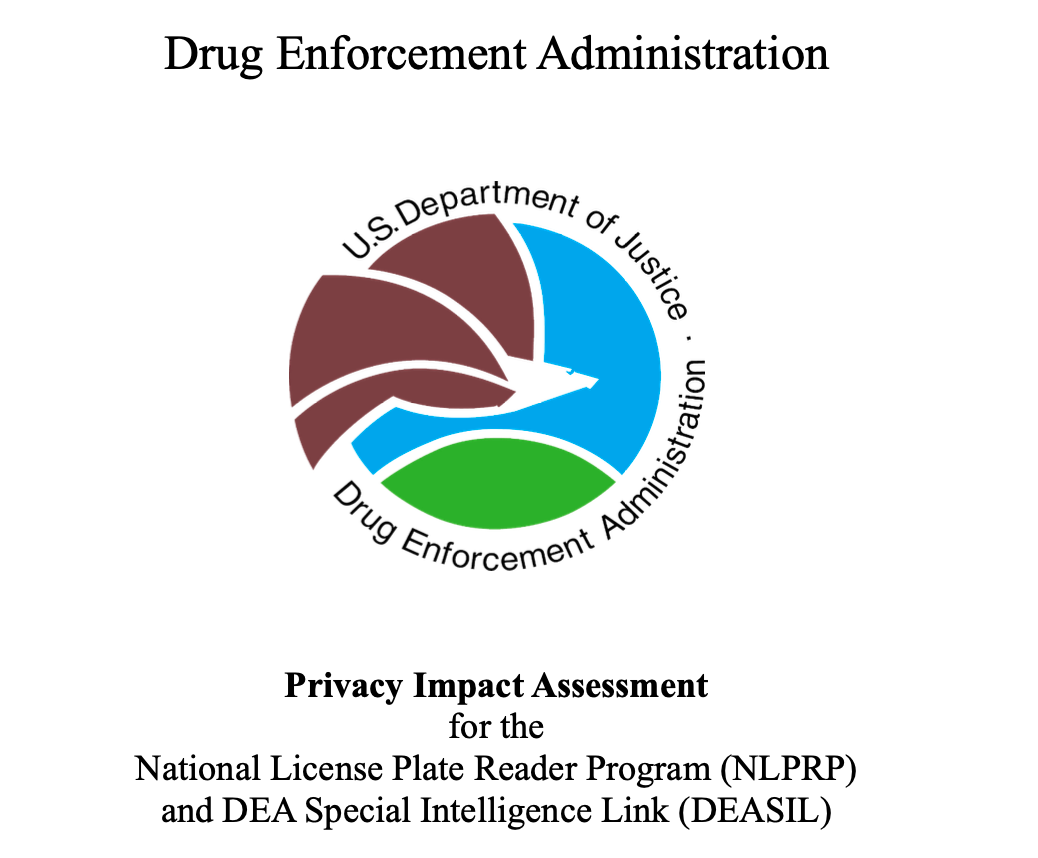
A December 2024 privacy impact assessment by the DEA about its National License Plate Reader Program explained that the DEA operates its own license plate readers but also gets access to “non-DEA equipment” through HIDTA and other “contributing law enforcement agencies.”
“These contributing agencies transmit their LPR data to servers maintained by regional hubs pursuant to their individual MOUs, which stipulate that this data may be shared with the NLPRP system,” the DEA wrote in the impact assessment, and added that the DEA has been seeking to integrate itself with a Customs and Border Protection (CBP) license plate camera system. It noted that the system “may incorporate such large numbers of other governmental LPR network cameras and/or may acquire commercial LPR cameras system data in a large enough quantity in the future to effectively permit on-going tracking of individual’s travels posing a risk to individual privacy,” and that it “risks an over-collection of the personally identifiable information of every license plate passing each LPR camera location, including a large number of images of travel of law-abiding drivers not relevant to criminal investigations.”
Atlanta is not the only HIDTA aggregating ALPR data. For example, Houston’s HIDTA paid $306,800 to a company called Recruitful LLC “for creating and maintaining an LPR database” that is a search tool for data collected by multiple ALPR companies.
A statement of work for that contract explained that the system being built was designed to combine “third party” data into one database, meaning they were creating a database for ALPR data, and that this database would “migrate” or duplicate data from local entities into the centralized database. This means that data from various ALPR cameras — including those made by Flock, Axon, ELSAG, and Vigilant — would all be searchable in this separate database. One of the criteria for this project was “All APIs and third-party integrations (Unification Platform, FLOCK) function seamlessly in the new environment.”
Flock and Axon did not respond to a request for comment. The DEA said that it did not have jurisdiction over HIDTA and refused to comment, even on how its own license plate system interacts with HIDTA. CBP did not respond to a request for comment. The White House’s Office of National Drug Control Policy did not respond to a request for comment.
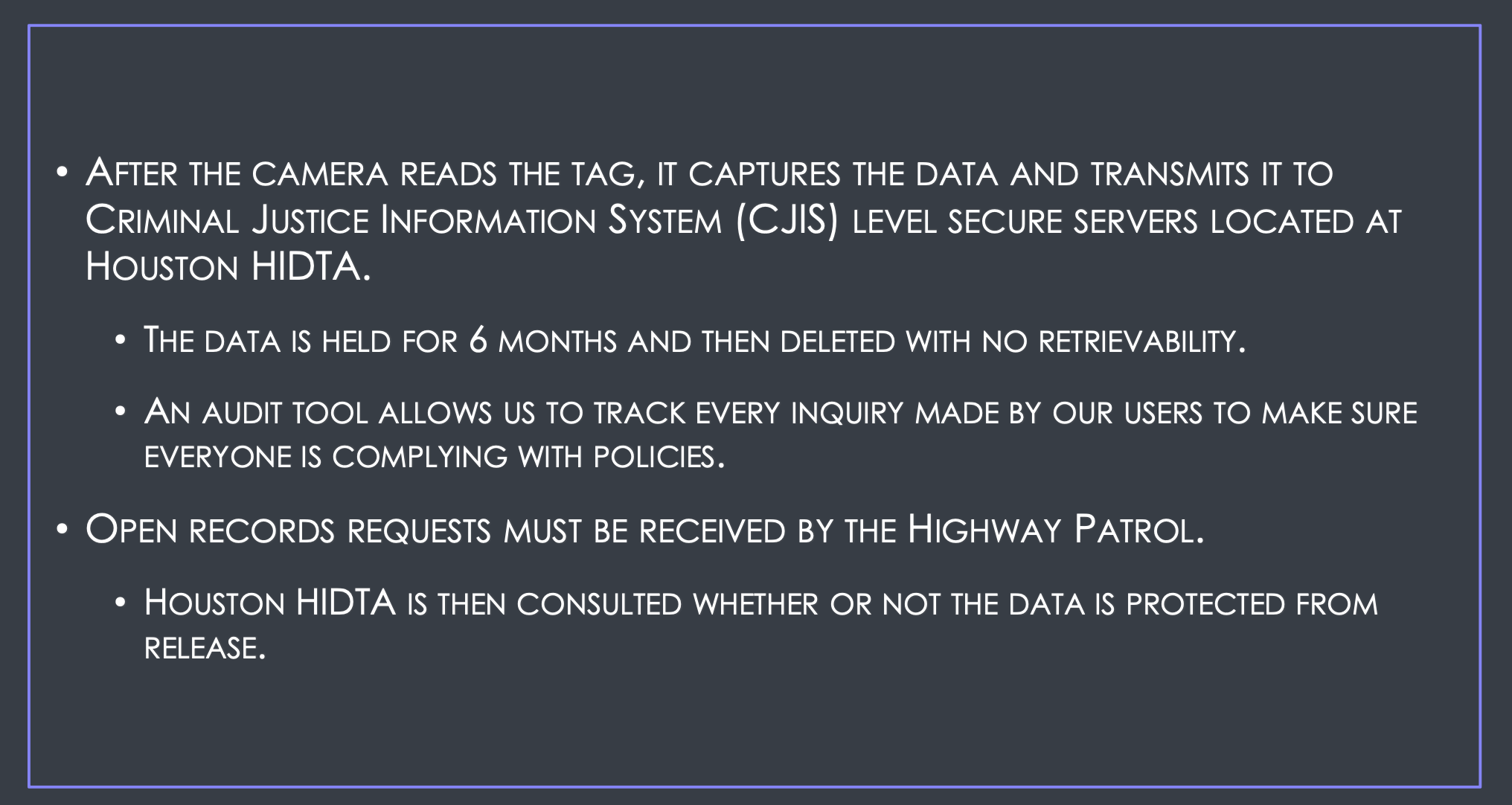
This system raises all sorts of questions about where local ALPR data is ultimately going and what it is being used for, how long it is being retained, and how the public can audit the data. Much of the misuse and abuse that has fueled the backlash against Flock has been uncovered by journalists and local activists working through public records obtained from Flock’s network audits and shared on websites like Have I Been Flocked. Some local jurisdictions have also argued that their data goes directly to HIDTAs, which are not queryable by the Freedom of Information Act (FOIA); the Randolph County Sheriff’s Office in North Carolina said, for example, that “all data is kept on the Federal Houston-HIDTA database,” and could not be shared with the public.
The DEA has argued in court that HIDTA records are not subject to public records laws because they are complicated entities governed by an “executive board” made up of state, local, and federal law enforcement. The Obama White House described HIDTA not as an entity at all, but a “grant program” made up of “law enforcement members” (this does not change the fact that HIDTAs themselves are signing memoranda of understanding with local entities).
“At the local level, the HIDTAs are directed and guided by Executive Boards composed of an equal number of regional Federal and non-Federal (state, local, and tribal) law enforcement leaders,” the DEA’s attorneys argued in a recent court filing in a case in which a man was seeking HIDTA records held about him. “Accordingly, DEA does not create, possess, maintain, or control HIDTA program records, nor does it store such records in any of its systems of records. Since DEA has no custody or control of HIDTA records, no HIDTA records responsive to Plaintiff’s request exist within DEA.”
As Flock continues to be the center of a nationwide conversation about automatic license plate reading cameras, the company has said that it doesn’t, and won’t, do facial recognition: “We will not add facial recognition to our devices,” Flock CEO Garrett Langley said in a recent video. But other, third-party companies are telling cops that they are willing to add facial recognition to data gathered by Flock cameras in order to “close that gap.” A company called VIDIZMO is advertising the capa
As Flock continues to be the center of a nationwide conversation about automatic license plate reading cameras, the company has said that it doesn’t, and won’t, do facial recognition: “We will not add facial recognition to our devices,” Flock CEO Garrett Langley said in a recent video. But other, third-party companies are telling cops that they are willing to add facial recognition to data gathered by Flock cameras in order to “close that gap.”
A company called VIDIZMO is advertising the capability to export footage from FlockOS to its own platforms that do facial recognition, behavior prediction, and racial and gender analysis on live camera feeds. VIDIZMO is a several decades-old video analysis and database company that has started offering facial recognition technology to cops within the last six months. In a May email to Johnson City, Tennessee, deputy police chief Michael Adams, a salesperson from VIDIZMO wrote that the company’s product could do facial recognition on both Flock and Axon data in “one searchable platform.”
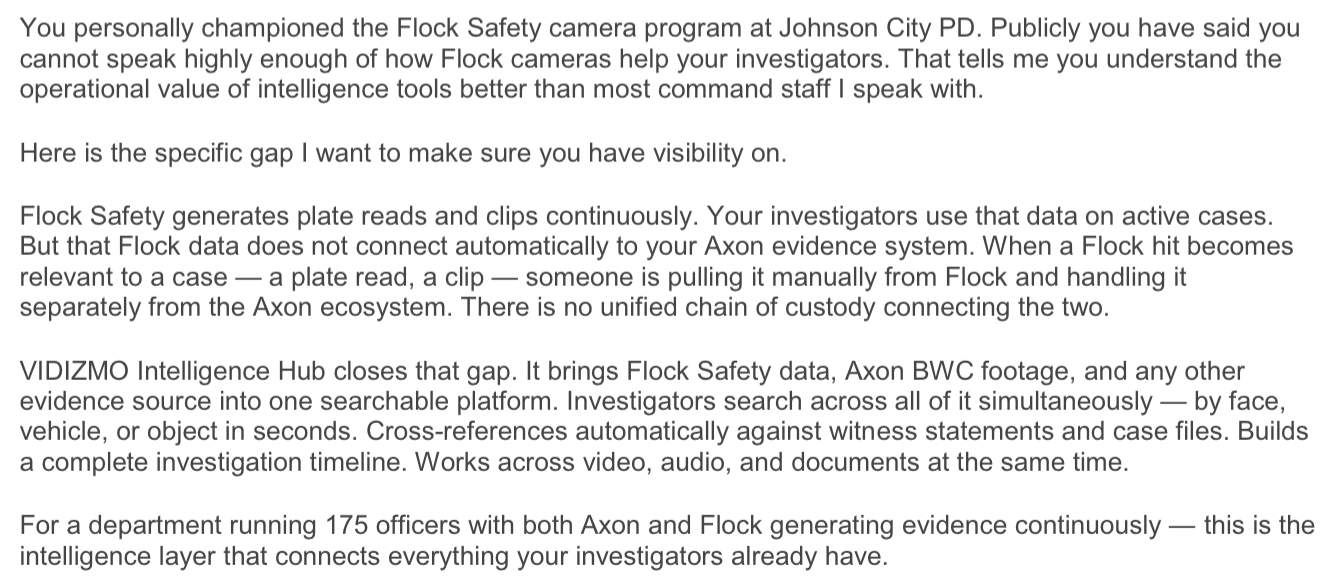
“Flock Safety generates plate reads and clips continuously. Your investigators use that data on active cases. But that Flock data does not connect automatically to your Axon evidence system,” the salesperson wrote. “VIDIZMO Intelligence Hub closes that gap. It brings Flock Safety data, Axon body worn camera footage, and any other evidence source into one searchable platform. Investigators search across all of it simultaneously — by face, vehicle, or object in seconds.” The email was obtained using a public records request by DeFlock Johnson City and was shared with 404 Media. The Johnson City PD told 404 Media in a statement that it did not take a call with the company.
An excerpt from the email. Full email embedded below
VIDIZMO’s CEO, Nadeem Khan, told 404 Media on a video call that the company has not yet started running facial recognition tech on footage from Flock cameras, and that it has not actually built the specific tool that would export data from Flock’s system to its own platform (though the company advertises this capability online, and the company already sells other facial recognition products). But Khan said VIDIZMO “would love to do the integration,” and that he believes facial recognition “is the way the world is going, the way the world will have to be,” and that he thinks Flock should offer the capability itself in a way that “balances privacy, security, and the freedom that we enjoy in this country.”
“It is completely in line with what we want to do,” Khan said. “All of these technologies are already implemented [in the real world]. I think Flock is trying to get out of the way rather than trying to implement the technology right [correctly] by saying they will not do recognition. But this is the way the world is going, it is the way the world will have to be, but with the right sort of technologies where privacy and security are balanced.”
In marketing material and technical documentation available online, VIDIZMO does claim that it can ingest data from Flock’s automatic license plate reader (ALPR) and livestream cameras into several of its own products, which do further AI analysis on the data. “An agency can import plate reads or clips that it has exported under its own authorized access,” Khan said in an email. “Flock has not been involved in or informed of this.” VIDIZMO’s online documentation for customers has extensive information about its facial recognition and AI analysis products, and contains a page about integrating data from FlockOS — Flock’s “real time crime center” product — into AI Live Insight, Nexus, and AI Intelligence Hub, which are three different VIDIZMO products.
“Detection tells you a person is in frame,” VIDIZMO says. “Face recognition tells you which person. It is the capability that takes a face seen on a live camera and matches it against the people you enrolled in the Object Library, so the moment someone on your watchlist walks past a camera, the system names them, on the video, in the event feed, and in the recording, without an operator having to recognize the face themselves.”
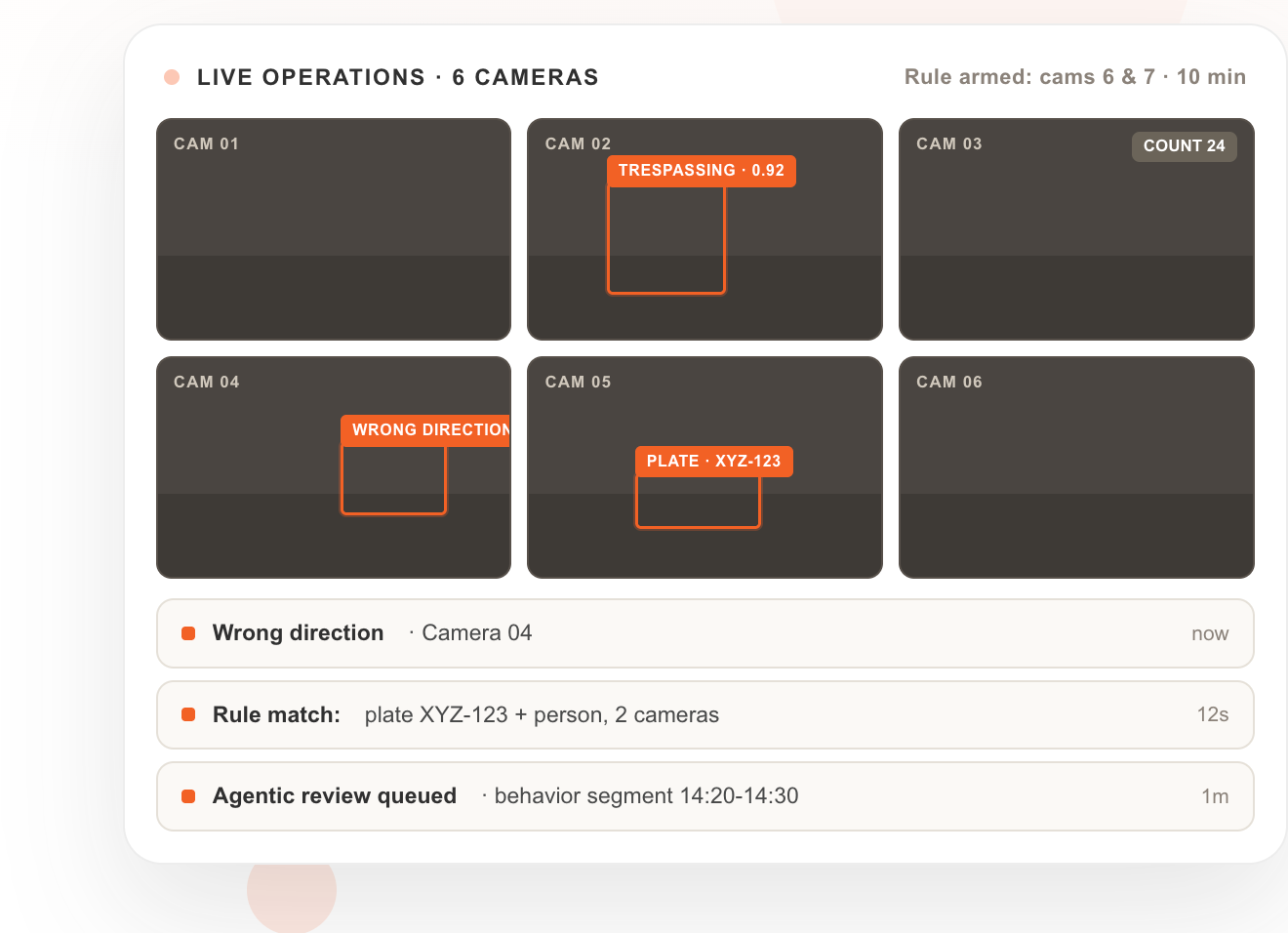
The company’s “AI Live Insight” page also claims that it can detect “situations” such as trespassing, or “behavior” by individual people, “turning raw video into behavioral and situational understanding.”
“Instant alerts fire from the live pipeline with snapshots attached. A second layer runs your queries over recorded events: a plate and a person together,” VIDIZMO’s website says. “Enrolled people and objects recognized on live feeds, with named alerts and snapshots for review.”
VIDIZMO already works with several police departments and government agencies, according to its website. The company’s documentation says that police departments need to upload individual faces as “objects” in the software’s library, which can be added to a “watchlist” that automatically triggers tracking and recording when they are detected by a camera. “With faces enrolled and recognition on, the camera starts naming people as they appear,” the documentation says. “The recognized person’s name appears on the bounding box around their face […] if you turned on Create Recording, a clip is captured around each recognition.” The company says that police can set a “Match Threshold,” which is a numerical confidence score about the person’s identity.
“By running face detection, you can search for and identify specific individuals in your media or evidence via attribute filters […] You can identify individuals from seven races: White, Black, Indian, East Asian, Southeast Asian, Middle Eastern, and Latino Hispanic,” VIDIZMO says on its website. The company adds, “Law enforcement agencies can save time analyzing security, CCTV, or dashcam footage. If they have a description of the suspect, such as their supposed age, gender, or race, they can utilize attribute filters to yield effective results.”
VIDIZMO says that in other contexts, cities or stores can also use its products to quietly do “demographic analysis,” for marketing purposes, by determining which races or ages of people are showing up to specific events or to specific stores: “By analyzing the activity in their store, sellers can determine which group spends the most time and makes the most purchases of their products. Getting insights such as these can aid them in tuning their marketing strategy.”
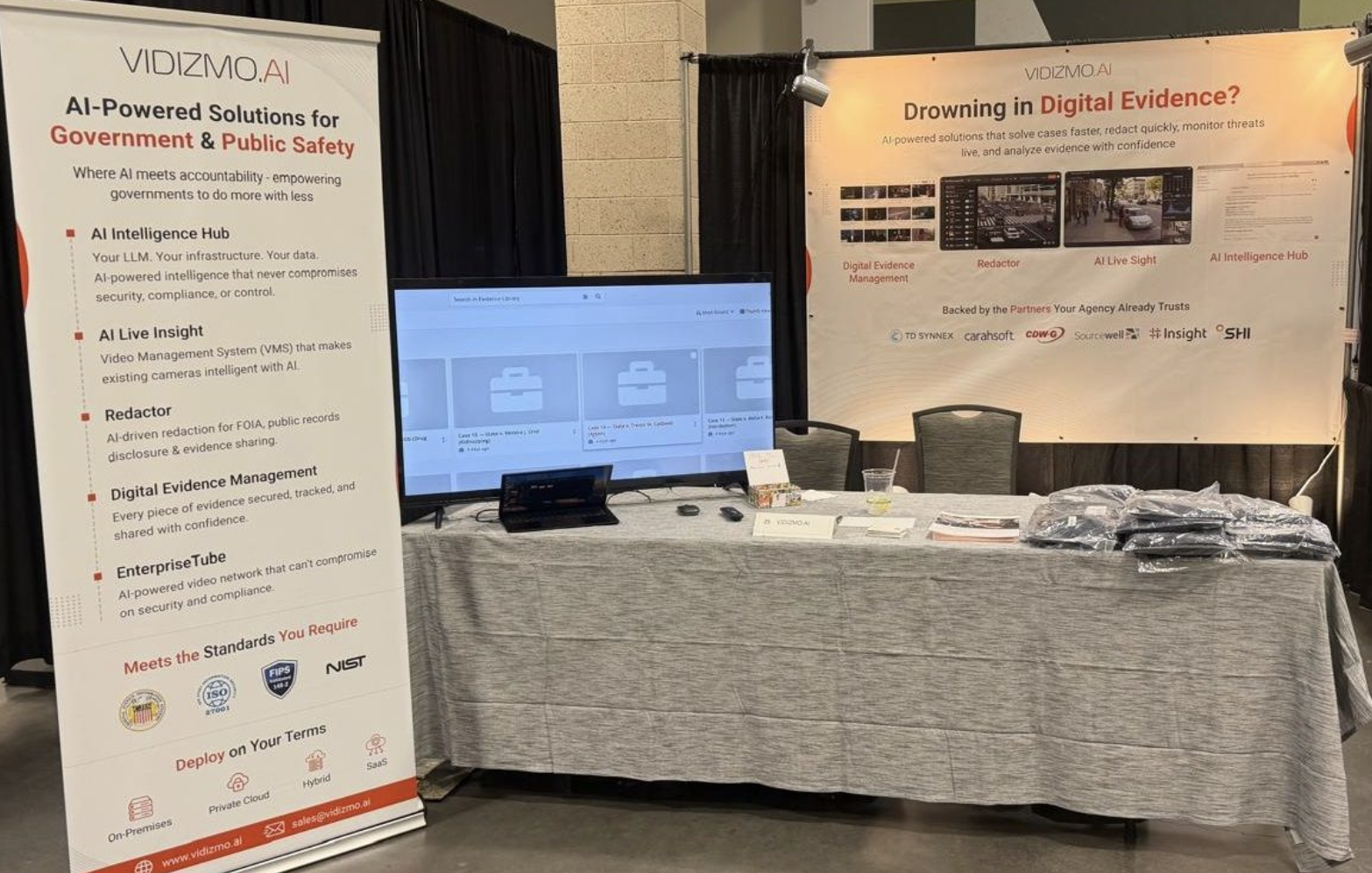
A VIDIZMO booth at a conference. Image: VIDIZMO
The facial recognition product it offers is “appalling,” according to Chris Gilliard, a privacy expert and author of the upcoming book Luxury Surveillance.
“I’m appalled at the willingness of VIDIZMO to tout their capabilities to filter along the lines of race, age, and gender. There’s decades of scholarship that show why this is not possible, and even more so not desirable,” he told 404 Media. “Particularly in the case of race and gender, which are not static categories to be determined by a computer.”
The fact that a third-party company is advertising that it wants to do facial recognition on Flock data highlights a common trend in the surveillance space. When one company draws a line in the sand, saying they are unwilling to do a certain type of surveillance, other lesser-known startups try to differentiate themselves by offering that functionality. Because of this recurring phenomenon, it is exceedingly difficult to build and scale a surveillance apparatus and then have companies themselves, in this case Flock, dictate what it can be used for. VIDIZMO’s Khan said, “As a small company who is running without a VC, we have to provide alternatives to the industry. What we are doing is providing that alternative.”
Khan claimed that his technology could also be used to preserve privacy; facial recognition, he said, can be used to redact bystanders faces from footage automatically. He said that cops cannot use the system without a specific case number, that all of their actions in the system are recorded for potential audits, and that VIDIZMO collects no data itself. "Much of the harm your reporting has documented comes from implementation choices, not from the technology itself," Khan said. "Those choices include pooling data into a nationwide network, allowing searches without a case, keeping audit logs no one can meaningfully inspect, and treating an AI match as an answer."
Gilliard said that the fact that facial recognition and other AI analysis can be added to existing surveillance cameras highlights the importance of not building such systems in the first place.
“What Flock says about their capabilities is to some degree irrelevant because they have built the infrastructure for mass surveillance. Their entire existence provides the foundation for other perhaps even more invasive technologies to be built on top of it,” Gilliard said. “Flock itself needs to be understood as part of the surveillance ecosystem that exists in this country. This is why discussions of guardrails for a particular system are inadequate because another company can (and will) come along to assemble another layer of surveillance on what has already been established.”
Flock and Axon did not respond to a request for comment.
Mia Hyder had never attended a public meeting before when she showed up to the city council meeting in Springfield, Missouri. After briefly speaking at a podium during a public comment period, she was arrested and dragged away in handcuffs. “Hello, my name is Mylie Hyder. I’m a Springfield, Missouri constituent, and I’m here to oppose the usage of ALPR cameras, most commonly made by Flock Safety. These cameras are not just surveillance,” Hyder started.“I’m sorry ma’am,” Springfield Mayor Jef
Mia Hyder had never attended a public meeting before when she showed up to the city council meeting in Springfield, Missouri. After briefly speaking at a podium during a public comment period, she was arrested and dragged away in handcuffs.
“Hello, my name is Mylie Hyder. I’m a Springfield, Missouri constituent, and I’m here to oppose the usage of ALPR cameras, most commonly made by Flock Safety. These cameras are not just surveillance,” Hyder started.
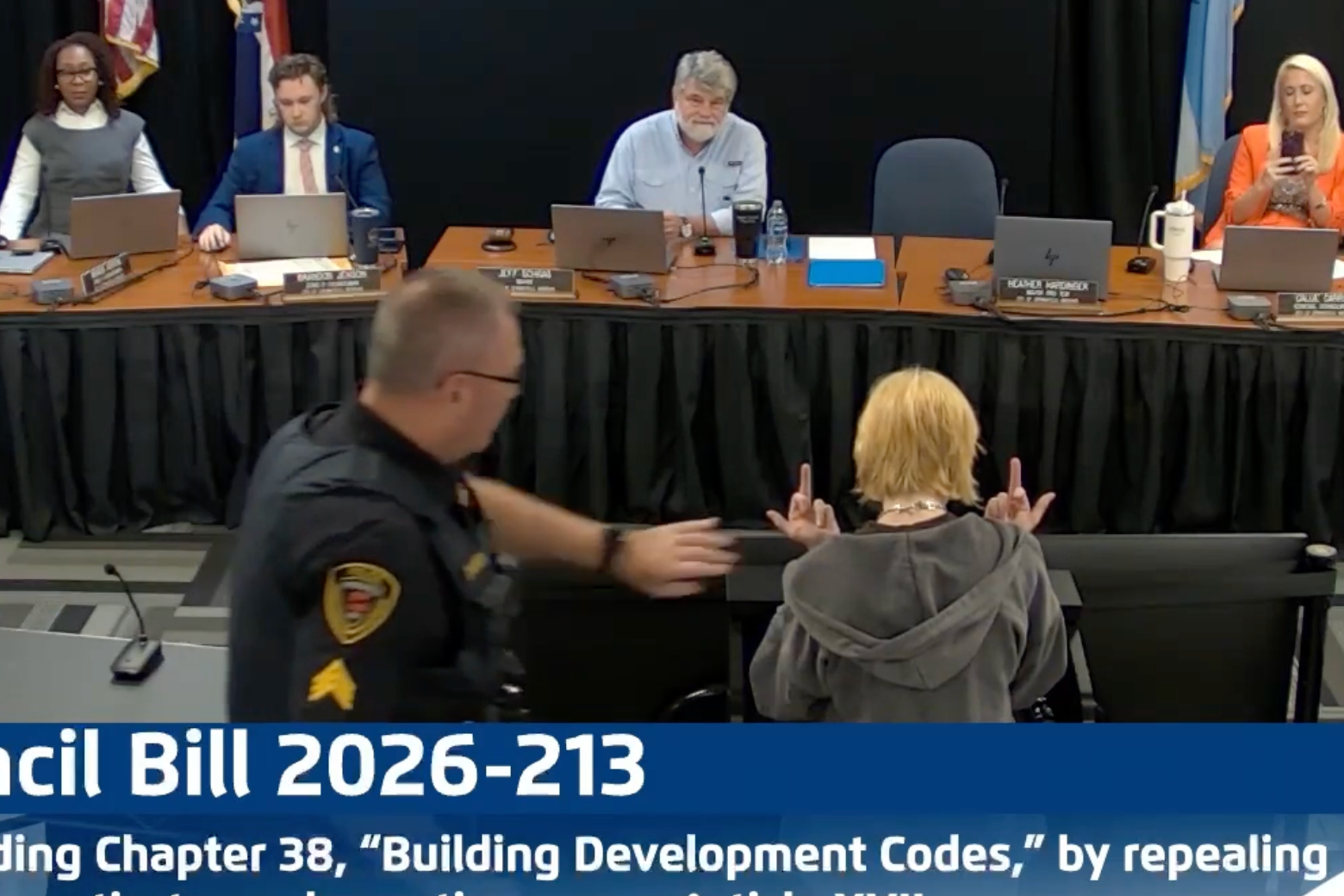
“I’m sorry ma’am,” Springfield Mayor Jeff Schrag said. Her mic was cut. A cop approached her at the podium.
Hyder held up both of her middle fingers while continuing to speak: “They are an invasion of our privacy,” she said.
The cop said, “You’re under arrest,” grabbed her arms, and pulled her out of the room. “I can do this all night. I get paid by the hour,” the cop added.
“Does this conclude the public hearing,” Schrag said.
“Yes sir,” a council member responded. The meeting continued with a city employee talking about sidewalk code.
Hyder was one of two people arrested in Springfield, Missouri on Monday during a city council meeting where tensions rose after the council stalled a review of the city’s Flock cameras.
Dozens of people showed up to the Springfield City Council Meeting on September 22 with plans to let city leaders know how they felt about the city’s use of automated license plate readers. There was a resolution before the council that would trigger a review of the controversial camera systems, but Schrag moved to send the resolution to committee and prevent public comment on the issue.
The move passed 5 - 3, the crowd shouted at city leaders, and Schrag ordered citizens to clear the room and shut off cameras recording the event. As people left, police detained and ticketed Noah Powell. Later in the evening Mia Hyder tried to speak out about Flock during public comments about a housing issue. Police arrested her while Schrag looked on. “Sorry ma’m,” the mayor said as police led Hyder away in handcuffs.
Springfield has 41 Flock cameras, according to the Flock Transparency Portal. City councilor Brandon Jenson had proposed a resolution to “conduct a comprehensive review of all relevant contracts” related to the ALPR cameras. The council was set to vote on Jensons’ proposed review on Monday and hear comments from the community. But when the resolution came up during the meeting, Mayor Schrag immediately pushed to send it to a committee and avoid public comment.
Jenson spoke before the vote to push the resolution to a committee. “All I’m trying to do is get people answers to some real questions that they’ve brought to us for months. And it’s a shame that it comes to this sort of, I guess, theater that I’m a part of to try to get those answers,” he said. “This isn’t how government is supposed to run. It’s just disappointing. And we’re not even allowing folks to speak who clearly came out to share their voices tonight.”
When the council voted to send the bill to committee, someone in the crowd shouted “Bullshit!” Schrag tried to move on to the next agenda item, but the crowd booed and yelled. The mayor then paused the meeting, turned off the cameras, and cleared the room.
Police detained Powell, a freelance photographer in Springfield, as people filed out of the room. “I don’t have a lot of experience getting tickets or being detained,” Powell told 404 Media. “So this is kind of new for me.”
Footage obtained by 404 Media showed several people leaving the city council meeting and yelling at city leaders. Powell said he was the only person put in handcuffs, detained, and ticketed at that moment. The Springfield Police Department did not return 404 Media’s request for comment.
“Well, I said: ‘Jeff Schrag is a cuck.’ I said: ‘Fuck you Jeff.’ I said: ‘Worthless’ and then, also, the final thing I said was: ‘Jeff Schrag has a tiny, stinky, cock,’” Powell explained. “I just let myself get handcuffed and let them do whatever power trip they wanted to do. Got my ticket and left.”
Powell said he was only in handcuffs for five minutes. “They just wanted to put on a show,” he explained. Powell added that he planned to fight the charge in court. “I’ve already sought legal representation, so we’re going to see where it gets […] I don’t think I should have been put in cuffs. I read the law, the city ordinance, and it said that I should have just been asked to leave.”
Hyder told 404 Media that she’d just moved to the area and thought that the city council meeting would be a good place to get involved in the community. She said that she’d stayed behind when Schrag cleared the room earlier in the evening.“I don’t know why I stayed. I just felt like not staying was giving up,” she said. Hyder explained that she waited until the public comment period for a different issue, filled out a form to talk, and then got up to deliver a written statement about Flock cameras. She said she didn’t flip off the city council until she saw the police officer approaching.
“After I saw the police officer out of the corner of my eye and everyone was kind of yelling at me, and there was a lot of ruckus, that’s when I pulled out the double birds,” she said.
💡
Seen something at a city council meeting? I would love to hear from you. Using a non-work device, you can message me securely on Signal at +1 347 762-9212 or send me an email at matthew@404media.co.
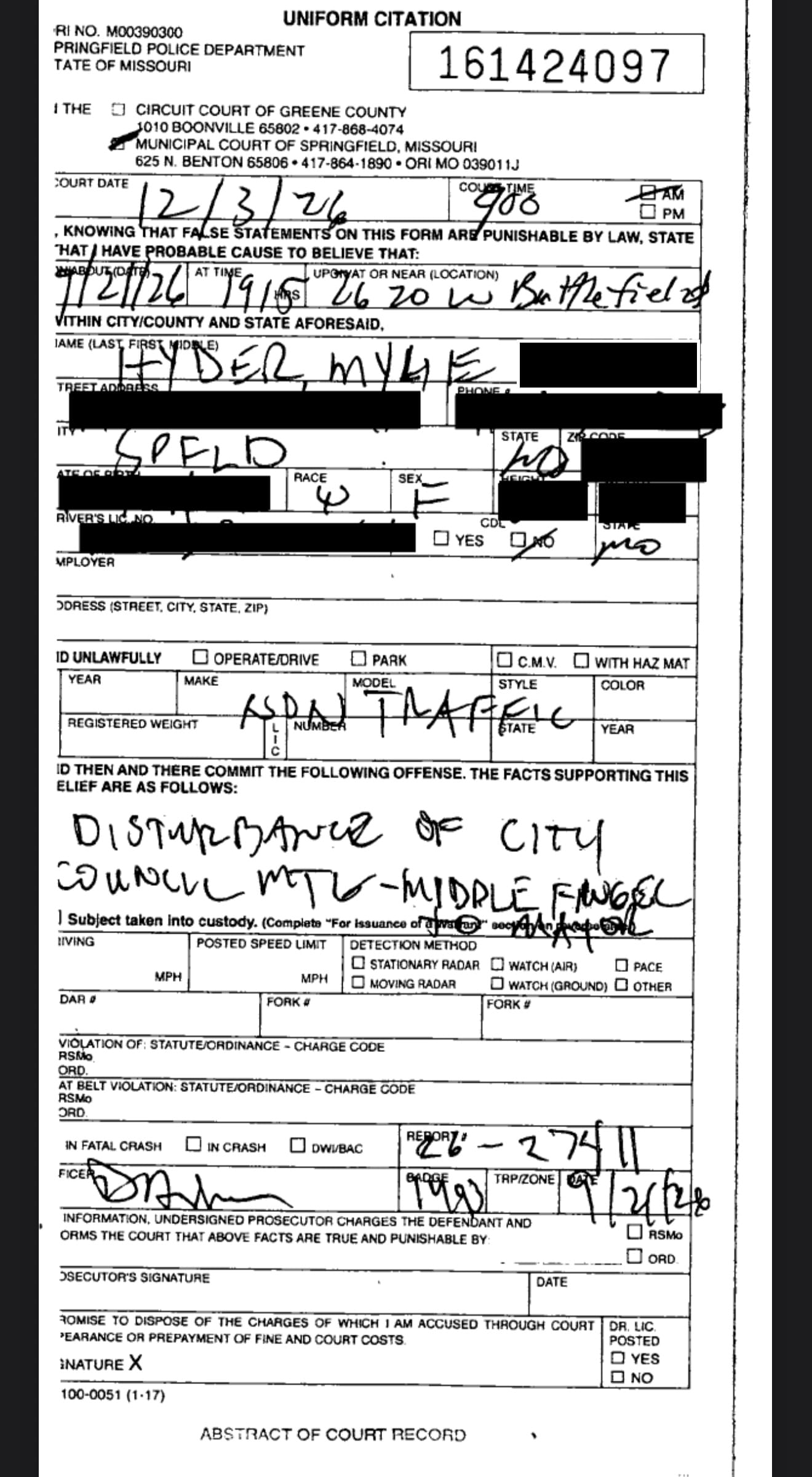
The police officer who arrested her said Hyder was being charged with disrupting the peace. He took her into the hallway outside of the meeting and held her in handcuffs for around five minutes before issuing her a ticket and letting her go.
Hyder told 404 Media she didn’t regret it. “I feel like being silent would have been like being complicit,” she said. “I felt like it was kind of stupid that I disturbed the peace. Okay, yeah, I did flip them off. That wasn’t a shining moment, but I did that when I was about to be arrested. When I knew my time was up.”
Hyder added she’d continue to attend city council meetings.
A copy of Hyder's ticket.
Flock Out SGF, a local group that’s lobbying against ALPRs in Springfield, told 404 Media that the resolution was meant as a compromise. “Many people came out to the council meeting and had carefully prepared statements for public comment, but no citizens were heard,” they said. “The two individuals who were arrested for voicing their concerns in the face of being silenced were not unreasonable, and we stand by their actions.”
Powell and Hyder are just the two latest American citizens detained or arrested this year for their behavior during a city council meeting. In February a farmer was arrested in Oklahoma for going over his time during a data center meeting. In Kansas, police arrested a high school teacher for clapping during public comments. In Texas, cops arrested a man in his driveway for public disturbance a week after he said “bullshit” during a county meeting.
Springfield did not return 404 Media’s request for comment.

 Connexion