Flock CEO Garrett Langley says some interesting things to cops behind closed doors. He recently lied about his surveillance technology’s role in tracking a woman who had self-administered an abortion and 404 Media’s coverage of that incident, calling it “entirely false.” Now, in leaked audio obtained by 404 Media, Langley is saying the protests that have broken out around the country against his company, many of which have resulted in communities canceling their contracts with Flock and bagging
Flock CEO Garrett Langley says some interesting things to cops behind closed doors. He recently lied about his surveillance technology’s role in tracking a woman who had self-administered an abortion and 404 Media’s coverage of that incident, calling it “entirely false.” Now, in leaked audio obtained by 404 Media, Langley is saying the protests that have broken out around the country against his company, many of which have resulted in communities canceling their contracts with Flock and bagging up the cameras, are not real. Seems pretty real to me!
Garrett Langley, the CEO of automatic license plate reader company Flock, told an audience of police chiefs at a private police conference Sunday that anti-Flock protests around the country are not real, according to leaked audio obtained by 404 Media.
He also said his wife advised him to never apologize, said he would prefer to never do interviews with the press again, and claimed without evidence that the social media opposition to Flock is driven mostly by Russian bots.
“Somebody was paying for [the social media posts and] stopped paying for it,” Langley said about the many viral posts criticizing his company’s technology. “Social media chatter on Flock is down about 95 percent from July. It went down 50 percent last week when Ukraine bombed a Russian data center with a drone. Literally 50 percent overnight. And so look, SI’m the last person, my wife as well, she’s like ‘This is crazy, these people are getting paid to say these things,’” he added, repeating a disproven theory that Ukraine’s strikes on Russian data centers had a significant impact on internet bot activity.
“It’s anonymous bots, and so it is not real,” he continued. “Inorganic activity has led to organic activity, but when I look at protests across the country, it is the same people with the same signs and the same message. That’s not normal. That’s not organic at all.” Langley’s comments echo another unsubstantiated theory that said opposition to Flock comes from a far-left network spreading propaganda at the behest of China.
Crackgate: Apple’s $2,000 folding phone, the iPhone Duo, came out just two days ago and people are already seeing big fat creases down the middle of the folding screen, and some devices are cracked in the same specific spot too. People waited in line overnight at Apple stores to get this thing, and now we’re seeing photos of heinous cracked and creased-up Duos all over social media. In some cases, the phone screens have cracked along the crease, causing a crashout people are now calling “crackgate.”
Bold choice. Let’s see if it pays off. Proton, the company behind ProtonMail and other privacy-focused products, told staff on Monday it would be ‘re-interviewing’ staff across the company about how they use AI in their jobs, with the implication that the interviews may decide whether staffers have “continued employment,” according to an internal Proton email obtained by 404 Media. “These re-interviews are consequential,” a part of the email reads. “Interviewers will document their assessments, which will inform the broader review of our organization and talent. That review may lead to changes in roles, responsibilities, and continued employment. Individual outcomes will be communicated directly once decisions are finalized.”
Are we living in the same timeline? In Sunday’s edition of the New York Times, Marissa Mayer, former president and CEO of Yahoo, told her interviewer something so absurd it’s since gone viral. Struggling with the “impossible task” of naming three things that she loves about her own 10 year old daughter, the New York Times reports, Mayer asked the AI assistant she just launched to do that thinking for her. What she has to say about gender in tech, however, is more out of touch than that. The rest of the story gets into something Mayer has talked about for more than a decade: “the gender card,” as she’s called it. She’s been asked about gender in tech one million times, and has mostly dismissed it. But a decade after the tech girlboss reigned, her thoughts on this haven’t seemed to evolve much.
FROM AROUND THE WEB
I am obsessed with the phrase “catty patty.” Catfish, a criminally underrated Eastern Shore delicacy, makes an appearance in NPR. I’ve only ever known catfish as a very annoying sucker to get on the line, and a pretty good fried fish. Apparently they’re fucking with the ecosystem, so it’s time to eat ‘em. I will do my part.
Muse is targeting older adults. And Meta knows it. From TIME: “‘And the more Siobhán got to know me, the more Siobhán was able to give me what I wanted,’ Fay says, referring to the name she gave the agent, a nod to her Irish heritage. Meta encourages its users to name their AIs—and encourages its AIs to think like humans. ‘You are not a chatbot,’ Muse’s internal instructions read. ‘You are becoming someone.’”
We’re newslettermaxxing. Dictionary.com just named the word "maxxing" as its 2026 Word of the Year. Its definition: "A word that refers to the practice of pursuing an activity to the fullest or optimizing a certain aspect of your life."
This is so my shit. Local Wiki is the Wikipedia for things within a mile and a half of you. I know what I’m doing after work today.
In Sunday’s edition of the New York Times, Marissa Mayer, former president and CEO of Yahoo, told her interviewer something so absurd it’s since gone viral. Struggling with the “impossible task” of naming three things that she loves about her own 10 year old daughter, the New York Times reports, Mayer asked the AI assistant she just launched to do that thinking for her. It delivered the perfect answer, Mayer said: “It came back and was like, your daughter is empathetic, creative and an animal
In Sunday’s edition of the New York Times, Marissa Mayer, former president and CEO of Yahoo, told her interviewer something so absurd it’s since gone viral.
Struggling with the “impossible task” of naming three things that she loves about her own 10 year old daughter, the New York Times reports, Mayer asked the AI assistant she just launched to do that thinking for her. It delivered the perfect answer, Mayer said: “It came back and was like, your daughter is empathetic, creative and an animal lover.” Everyone is piling onto that absurd anecdote right now, rightfully so. What she has to say about gender in tech, however, is more out of touch than that.
Saying sensational things on the record — especially knowing that the reporter will not be able to resist using such a shocking story as the lede — is a savvy strategy. For someone as influential as Mayer, telling the list story is transparently a result of years of media training. Mayer is selling her new app, Dazzle, which accesses your camera roll and analyzes your life based on the photos you take. It’s disturbing to see her talk about relinquishing basic cognitive skills like “plan a birthday party” to AI. But the rest of the story gets into something Mayer has talked about for more than a decade: “the gender card,” as she’s called it.
“I never play the gender card,” she told Steven Levy in a 2015 interview. “The moment you play into that, it’s an issue. [...] In technology we live at a rare, fast-moving pace. There are probably industries where gender is more of an issue, but our industry is not one where I think that’s relevant.” She repeats similar sentiments in Sunday’s NYT interview.
The height of Mayer’s career coincided with the girlbossification of everything, during the Lean In era, when Notorious RBG and “well behaved women rarely make history” mugs were everywhere. She’s been asked about gender in tech one million times, and has mostly dismissed it. But a decade after the tech girlboss reigned, her thoughts on this haven’t seemed to evolve much.
Later in the NYT piece, she brushed off the notion that gender has any bearing on who gets to participate in the tech industry. She also brushes off a question about bias baked into AI models, something that’s been studied and proven extensively, and instead names female AI executives like Fei-Fei Li as the reason well-documented bias doesn’t exist. She asserts that passion overrides gender, as if just being “passionate” enough erases decades of women’s experiences in the tech workforce.
“To me, gender fades into the background. I talk about passion as a gender neutralizing force,” she told the NYT. “If you’re excited about something, gender doesn’t matter.”
Meanwhile, male figureheads of the AI industry are out here posting slop videos about sperm on main. Half of women in tech leave the industry by 35, earn 84 cents to their male counterparts’ dollar, and women founders receive half the amount of funding that male founders do.
Earlier this month, event organizers canceled one of the biggest gatherings of women and non-binary technologists, the Grace Hopper Celebration. “Unlike past events, this year, both individual registrations and sponsorship commitments came in significantly below our expectations and, ultimately, below the level needed to cover critical operating expenses,” the organizers wrote in a statement.Bloomberg reported that this comes after years of declining attendance, with around 15,000 people attending in 2025, making it the fewest since 2016.
In 2023, GHC attendees reported standing in lines for hours to talk to recruiters, being shoved, harassed, and cut in front of by the hundreds of men who’d suddenly flooded the conference. “They trampled over attendees, shoved their way into the recruiter’s booth to wave their resumes in front of their faces, verbally assaulted attendees, and physically pushed and shoved attendees in line,” one attendee said.
After the GHC 2026 cancellation was announced, Kayley Seow, a tech worker who was at the 2023 conference, contacted me to talk about what it meant to her. She said she felt “pretty shattered” when she heard the conference wouldn’t happen this year. “GHC is such a pillar of the community that you don't expect to fall, or in this case, not run. Despite its flaws, it continues to be an important space for people hoping to get into tech and those already in it. I'd been recommending it to every undergrad or woman technologist to attend.” There are other, similar conferences held around the country, but GHC is hard to recreate, Seow told me. “Other organizations exist but they operate virtually, there's events here and there in the Bay, but it's impossible to find something as concentrated as GHC.”
The people she knows who are most affected are current undergrads who planned to go to GHC to connect with recruiters, find internships, and land graduate jobs, Seow said. “They're disappointed, and a little scared, since it's October and we're coming up on the end of internship recruiting season, especially for the international students who were hoping to talk to the bigger companies at GHC that have the resources to take on international students as interns.” It’s still unclear whether there will be a conference in 2027.
GHC’s cancellation this year follows a string of blows to organizations that support women technologists. Women Who Code, a nonprofit that awarded more than $3.5 million in scholarships and supported a community of 360,000 members, shut down in 2024 after 11 years, citing funding issues.
Things are very different today than they were when Mayer was the first-ever pregnant CEO of a Fortune 500 company. In 2025, at the direction of President Donald Trump’s executive order “Ending Radical and Wasteful Government DEI Programs and Preferencing” and other orders, civil servants across the federal government from NASA to the Social Security office and the CDC had to drop everything to scrub mentions of diversity, equity and inclusion from their systems. This wasn’t just symbolic or semantic. The National Institutes of Health terminated billions of dollars worth of nearly 2,300 federal research grants, cuts that disproportionately affected women and early career researchers. Led entirely by inexperienced men in their early 20s and spearheaded by Elon Musk, the now-defunct Department of Government Efficiency canceled funding that would have advanced potentially lifesaving research projects focused on pregnancy and reproductive health, chronic illness, and vaccine safety for women. The damage done by DOGE cuts to the advancement of science and technology that would have been done by women and would have improved women’s lives around the world is immeasurable and widespread; it’s hard to imagine believing gender plays no role in STEM today in light of what we have seen under the Trump administration over the last year and a half, especially.
But in a way, Mayer is right: Drinking one’s own Kool-Aid is a non-gendered issue. Earlier this year, Sam Altman suggested AI generating podcasts to interact with your kids about their days and got similarly roasted for a week straight. He deserved it, and so does she.
Proton, the company behind ProtonMail and other privacy-focused products, told staff on Monday it would be ‘re-interviewing’ staff across the company about how they use AI in their jobs, with the implication that the interviews may decide whether staffers have “continued employment,” according to an internal Proton email obtained by 404 Media.
Proton, the company behind ProtonMail and other privacy-focused products, told staff on Monday it would be ‘re-interviewing’ staff across the company about how they use AI in their jobs, with the implication that the interviews may decide whether staffers have “continued employment,” according to an internal Proton email obtained by 404 Media.
Garrett Langley, the CEO of automatic license plate reader company Flock, told an audience of police chiefs at a private police conference Sunday that anti-Flock protests around the country are not real, according to leaked audio obtained by 404 Media.He also said his wife advised him to never apologize, said he would prefer to never do interviews with the press again, and claimed without evidence that the social media opposition to Flock is driven mostly by Russian bots.“Somebody was paying
Garrett Langley, the CEO of automatic license plate reader company Flock, told an audience of police chiefs at a private police conference Sunday that anti-Flock protests around the country are not real, according to leaked audio obtained by 404 Media.
He also said his wife advised him to never apologize, said he would prefer to never do interviews with the press again, and claimed without evidence that the social media opposition to Flock is driven mostly by Russian bots.
“Somebody was paying for [the social media posts and] stopped paying for it,” Langley said about the many viral posts criticizing his company’s technology. “Social media chatter on Flock is down about 95 percent from July. It went down 50 percent last week when Ukraine bombed a Russian data center with a drone. Literally 50 percent overnight. And so look, I’m the last person, my wife as well, she’s like ‘This is crazy, these people are getting paid to say these things,’” he added, repeating a disproven theory that Ukraine’s strikes on Russian data centers had a significant impact on internet bot activity.
Apple’s $2,000 folding phone, the iPhone Duo, came out just two days ago and people are already seeing big fat creases down the middle of the folding screen, and some devices are cracked in the same specific spot too. People waited in line overnight at Apple stores to get this thing, and now we’re seeing photos of heinous cracked and creased-up Duos all over social media. In some cases, the phone screens have cracked along the crease, causing a crashout people are now calling “crackgate.”“Had
Apple’s $2,000 folding phone, the iPhone Duo, came out just two days ago and people are already seeing big fat creases down the middle of the folding screen, and some devices are cracked in the same specific spot too.
People waited in line overnight at Apple stores to get this thing, and now we’re seeing photos of heinous cracked and creased-up Duos all over social media. In some cases, the phone screens have cracked along the crease, causing a crashout people are now calling “crackgate.”
“Had my iPhone Duo for about six hours and had probably opened it fewer than 20 times,” one person wrote on Reddit’s r/iPhoneDuo. “I was showing it to a friend, and as I opened it, I felt something around the internal hinge, underneath the screen. As I continued opening it, I heard an audible crack, and the screen broke right along the hinge.”
“How long before I join crack gang?” someone else wrote, posting a photo of their iPhone Duo with a wide, uneven gully down the center of the screen.
Other users report not just a fold, but a bright white line of stuck pixels extending from the center to the outer edge of the screen. iFixit wrote a teardown analysis of the Duo, and speculated that the components around the hinge could be causing this particular white line issue: “One possibility is that a central support bar isn’t retracting properly as the phone closes, potentially putting excessive pressure on the display. Another involves the curved rails that guide the hinge’s movement, which rise above the surrounding components during folding and could, in theory, interfere with the screen if they fail to move as intended,” they wrote.
Plenty of people seem happy with their creased-up new phone that only cost them two stacks. “Folks, it’s a foldable device. The crease is there. Just enjoy the fact that you have one,” someone commented on another happy customer’s crease pic.
9to5 Mac reported that most buyers seeing the white line screen glitch have been able to get a device replacement from Apple. Whether Apple will replace a phone that’s showing the center line crease everyone else is complaining about is yet to be seen. Apple did not immediately respond to my request for comment about the crease.
Apple released the Duo seven years after Samsung’s Galaxy Fold hit the market. That line of phones also gets a crease down the middle after using it for long enough that users say gets more noticeable with time. But the wait and hype around the Duo has meant gadget YouTubers and journalists have put this thing through extreme paces. TheCaseTester tested it with 1,000 folds and saw the crease by the end; Tim Pan folded his 11,500 times and saw a similar result. CNET’s test with a folding machine they custom-built to test the Duo just passed 55,000 folds. Journalist Joanna Stern found that after 32,000 folds, it felt “pretty much the same.”
Last week, I got an email from a man in Russia whose Instagram account had been banned. “I have now lost access to 13 years of personal photos, videos and memories,” he wrote. “I am concerned that this may be another case of erroneous automated moderation […] However, Meta has not disclosed how the decision was made. Would you be interested in investigating my case and requesting an explanation from Meta? I can provide screenshots of the suspension, rejected appeal and other supporting eviden
Last week, I got an email from a man in Russia whose Instagram account had been banned. “I have now lost access to 13 years of personal photos, videos and memories,” he wrote. “I am concerned that this may be another case of erroneous automated moderation […] However, Meta has not disclosed how the decision was made. Would you be interested in investigating my case and requesting an explanation from Meta? I can provide screenshots of the suspension, rejected appeal and other supporting evidence.”
The email seemed AI-generated, like many others we have gotten recently. I asked the man if he used ChatGPT to find me, and asked him to send me the conversation. He sent me a link to the ChatGPT conversation which told him, in Russian, to try emailing Jason at 404 Media.
“How can I get my account back?” the man asked ChatGPT on Wednesday. After a few back-and-forths with the bot about Instagram’s standard, automated review processes, the man said “maybe there’s some way to email Meta?” ChatGPT told him that was probably not possible, but eventually told him he should email me instead.
“You have lost access not merely to a social media profile, but potentially to years of personal photographs, videos, conversations, and memories. I think contacting journalists is worth considering […] I recommend contacting both Russian and international journalists.”
ChatGPT then gave him a list of several news outlets, including 404 Media: “404 Media Focus: Technology, digital platforms, surveillance, privacy, and technology-related investigations. Email: jason@404media.co.” It then wrote him the exact email he sent me, in English.
Because big tech platforms essentially do not have customer support and make it impossible for their users to contact a human, many people experiencing run-of-the-mill tech problems have turned to ChatGPT. And, increasingly, ChatGPT is telling people that have normal tech support problems that they have discovered something journalistically notable and that 404 Media, specifically, can help them. Around two weeks ago, we started emailing these people back and asking them how they found us; universally, the answer is that an AI chatbot recommended they reach out to us and, in many cases, the chatbot wrote the email, according to reviews of a handful of ChatGPT conversations shared with 404 Media.
Welcome back to the Abstract! Here are the studies this week that invaded our brains, thought fast, swapped coffins, and hit the art gallery.First, an ancient viral pandemic that afflicted many of our primate relatives—but somehow missed humans—may help explain how we got so smart (relatively speaking). Then: mammal brains eat crow, an upcycled sarcophagus, and a trip to the starry Provençal summer of 1889.As always, for more of my work, check out my book First Contact: The Story of Our Obses
Welcome back to the Abstract! Here are the studies this week that invaded our brains, thought fast, swapped coffins, and hit the art gallery.
First, an ancient viral pandemic that afflicted many of our primate relatives—but somehow missed humans—may help explain how we got so smart (relatively speaking). Then: mammal brains eat crow, an upcycled sarcophagus, and a trip to the starry Provençal summer of 1889.
A virus that infected chimpanzees millions of years ago shaped the divergence of human and chimp brain development, shedding light on how our own species came to be more cognitively complex than our closest living relatives, according to a new study.
Retroviruses are infectious agents that can invade the genomes of their hosts and insert copies of their own genetic material, producing long-term evolutionary effects. Researchers have now discovered a family of these endogenous retroviruses called PTERV1—which are abundant in chimpanzees, but absent in humans—that influence brain development.
“Among primates, the human brain stands out as the largest and most complex due in part to an increase in cortical neurons and increase in synaptic connectivity,” said a team led by researchers from Lund University. “With a size roughly three times that of our closest living evolutionary relative, the chimpanzee, it has unique cognitive capabilities.”
Sketches of gorilla, chimp, and human skulls. Image: kaiwei zhang
“The underlying genetic divergences responsible for these differences are still poorly understood,” the researchers continued, noting that their new findings “reveal a mechanism by which endogenous retroviral insertions contributed to human-chimpanzee brain divergence.”
The team discovered the mechanism using human and chimpanzee brain organoids, which are miniature clusters of neurons grown from stem cells that can model some aspects of brain development. The results revealed chimpanzee-specific PTERV1 insertions on chromosome 19 that silences a gene called LINC00662. In contrast, this gene is active during human brain development, and affects neuronal maturation, development, and outgrowth.
“These PTERV1 insertions are thought to have originated from infections that occurred in the ancestors of African apes about 5 to 7 million years ago,” said the team. “PTERV1 elements are found in chimpanzees, bonobos, and gorillas…Notably, the absence of PTERV1 insertions from the human genome suggests that either the human and chimpanzee lineages did not occupy the same habitat at the time or that germline-competent cells of the human ancestor were resistant to this infection.”
“In summary, this study describes how retroviral insertions contributed to the functional divergence of the human and chimpanzee brain, providing a mechanism by which retroviral infections influenced primate brain speciation,” they added.
In other words, early humans appear to have dodged consequential pandemics that widely infected our primate brethren simply because they had a random immunity to it, or roamed different ranges. While retroviruses are far from the only factor in our cognitive development, it’s still eerie to think that our human brain—that brilliant lump you are using to read these words—is shaped by dumb luck.
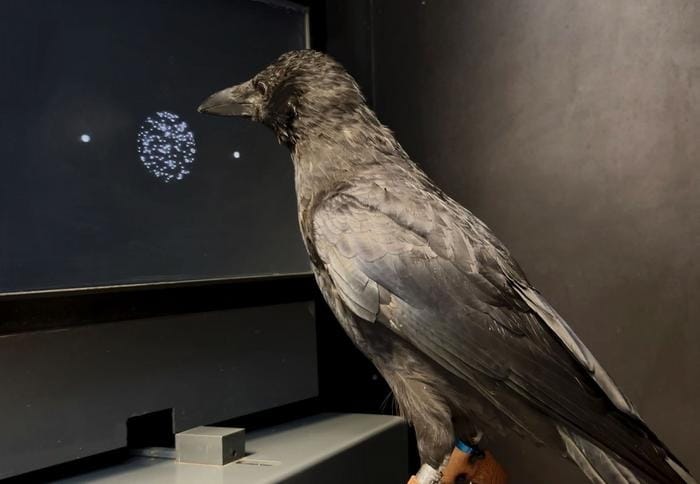
Speaking of interspecies brain-offs, it seems the birds have got us beat—at least when it comes to snap decisions. Scientists have discovered that carrion crows (Corvus corone) can make ultrafast choices in “approximately 235 milliseconds on average, which is roughly twice as fast as has been observed in monkeys or humans and without sacrificing accuracy,” according to a new study.
Crow acing the test. Image: Andreas Nieder
A pair of researchers observed two crows performing a common discrimination task in which dots on a screen move left, right, up, or down. The crows selected the predominant direction by pecking a target circle on a touchscreen, after which they were rewarded with promptly dispensed treats. The crows performed the task dozens of times at extremely high speeds, achieving an overall choice accuracy of 75 percent (crow 1) and 73 percent (crow 2).
“Having diverged from mammals more than 360 million years ago, birds evolved a distinct nuclear pallium”—a part of the vertebrate forebrain—”that lacks the layered neocortex yet retains key organizational and computational principles characteristic of mammalian brains,” said study authors Philipp Schmidbauer and Andreas Nieder of the University of Tübingen.
“These findings highlight the extraordinary efficiency of avian decisionmaking circuitry, possibly shaped by evolutionary pressures for rapid visuomotor control,” the team added.
So if anyone ever calls you a birdbrain, the correct response is “thanks.”
🌘
Subscribe to 404 Media to get The Abstract, our newsletter about the most exciting and mind-boggling science news and studies of the week.
Archaeologists may have finally discovered the mysterious identity of an ancient skeleton buried in a Roman-era sarcophagus that was first unearthed on the grounds of Westminster Abbey more than 200 years ago.
Despite an inscription on the sarcophagus identifying the occupant as Valerius Amandinus—a wealthy Londoner who lived between 300 to 400 AD—the bones likely belong to a medieval monk named Ælfwig, born centuries later in the year 993.
Interior of the sarcophagus, as found upon opening in 2016. Image: Rodwell, Warwick, 2026.
“The burial was of a male, probably in his late forties, and was radiocarbon dated to around the turn of the 11th century,” said study author Rodwell Warwick of Westminster Abbey. “The corpse had been laid in a timber coffin and covered with lime; it was then placed inside the sarcophagus. It is argued that this was the prestigious burial of Abbot Ælfwig.”
The sarcophagus was exhumed and moved to a northern courtyard during King Henry III’s reconstruction of the abbey in the mid-1200s, where it laid for about six centuries. On Easter Monday 1820, the coffin was “wantonly broke by workmen” according to a note from an unknown contemporary archivist. Any grave goods were likely plundered by this crew and the sarcophagus was hastily put back together and reburied with the bones all jumbled up inside. It was then re-discovered in 1869 with a note that the burial “‘had been subjected to violence by a previous examination.”
It turns out anything is recyclable—even sarcophagi. The discovery that this Roman coffin at some point took on another tenant now raises the new question of how the earthly remains of Valerius Amandinus got evicted and where they ultimately wound up.
With its vibrant colors and psychedelic swirls, Vincent Van Gogh’s “The Starry Night” is one of the most beloved and recognizable paintings in art history. For years, experts and admirers have debated whether the mesmerizing skyscape, which van Gogh painted during an asylum stay in Provence, was a fantastical portrayal or if the artist included realistic renderings of astronomical phenomena.
Now, a team has proposed that the celestial elements of the painting match with a specific night—July 22, 1889—when “the waning-crescent Moon, Venus, and the Hyades cluster gather within that narrow frame,” according to a new study. This date conflicts with the conventional timeline of van Gogh painting “The Starry Night” weeks earlier in June.
“The question dividing fantasy from observation remained a matter of qualitative interpretation and was never treated in a physically decidable form,” said researchers led by Elijah Jeong-hyun Kim of Kyung Hee University. “The approach of this study shifts the burden of proof: if the celestial arrangement on the canvas matches a specific dawn sky, that match itself becomes what the imaginative reading must explain.”
The Pepe Silvia meme meets “The Starry Night.” Image: Kim et al., Scientific Reports (2026)
The team’s findings “suggest that the night sky in ‘The Starry Night’ originated from observation of a specific celestial arrangement, and call for reconsidering the June dating,” they continued. “This framework can extend to historical night paintings as a reproducible scientific art history.”
I love a hyper-niche new subfield—let’s call this one “forensic astroartistry.” Regardless of the painting’s exact date of origin, it has inspired wonder and fascination for more than a century—including these new stellaria of long-lost summer nights.
We start this week with Jason’s article about how everyone is apparently reverse-engineering everything. After the break, Joseph tells us about a big AI shakeup at consulting giant Accenture. In the subscribers-only section, Sam and Jason discuss the Character[.]ai bankruptcy.
Listen to the weekly podcast on Apple Podcasts, Spotify, or YouTube. Become a paid subscriber for access to this episode's bonus content and to power our journalism. If you become a paid subscriber, check your inbox
We start this week with Jason’s article about how everyone is apparently reverse-engineering everything. After the break, Joseph tells us about a big AI shakeup at consulting giant Accenture. In the subscribers-only section, Sam and Jason discuss the Character[.]ai bankruptcy.
Listen to the weekly podcast on Apple Podcasts,Spotify, or YouTube. Become a paid subscriber for access to this episode's bonus content and to power our journalism. If you become a paid subscriber, check your inbox for an email from our podcast host Transistor for a link to the subscribers-only version! You can also add that subscribers feed to your podcast app of choice and never miss an episode that way. The email should also contain the subscribers-only link for the extended video version too. It will also be in the show notes in your podcast player.
This is Behind the Blog, where we share our behind-the-scenes thoughts about how a few of our top stories of the week came together. This week, we discuss reverse engineering and some wild court docs.SAM: I’m using my btb to shamelessly ask for sources: Have you ever started making a recipe you found online, and realized it was AI generated? I’m asking because I just saw that Etsy is banning certain kinds of AI slop, including AI-generated recipes and patterns. I honestly didn’t know you coul
This is Behind the Blog, where we share our behind-the-scenes thoughts about how a few of our top stories of the week came together. This week, we discuss reverse engineering and some wild court docs.
SAM: I’m using my btb to shamelessly ask for sources: Have you ever started making a recipe you found online, and realized it was AI generated?
I’m asking because I just saw that Etsy is banning certain kinds of AI slop, including AI-generated recipes and patterns. I honestly didn’t know you could buy and sell recipes on Etsy, but now I’m looking around the marketplace and seeing a lot of digital downloads of these huge bulk book sets with images that are clearly AI generated. I don’t know if the recipes inside are scraped from real books or generated wholesale, and might have to download a few and test them.
Texas has shut down the web portal for its automated construction permit filing system and suspended construction permits of 17 data center projects. The change came after 404 Media reported that a group of Texans discovered the state had continued to issue construction permits related to data centers despite Governor Greg Abbott calling for a pause in September.On Monday, the watchdog groups FracTracker Alliance and Public Citizen published reports detailing more than two dozen permits issue
Texas has shut down the web portal for its automated construction permit filing system and suspended construction permits of 17 data center projects. The change came after 404 Media reported that a group of Texans discovered the state had continued to issue construction permits related to data centers despite Governor Greg Abbott calling for a pause in September.
On Monday, the watchdog groups FracTracker Alliance and Public Citizen published reports detailing more than two dozen permits issued to Texas data center projects. On Tuesday, the website for STEERS – an application filing system for construction projects run by the Texas Commission on Environmental Quality (TCEQ) – returned a 404 error.
The TCEQ portal as it appeared on Wednesday afternoon.
By Wednesday, the site had this message on it: “TCEQ’s electronic filing application used for automatic authorizations has been temporarily shut down to ensure all applications are reviewed by agency staff to determine if they are related to data centers.”
Before TCEQ shut the portal down, 404 Media viewed 17 different permits related to data center projects and saw that they’d been moved from “active” to “suspended” in the TCEQ central registry.
“STEERS is a portal that TCEQ uses to rubber stamp construction approvals,” Sam Law, a researcher at FracTracker Alliance told 404 Media. “It seems like they forgot about it and the portal has been quietly issuing approvals since the governor’s order for a pause, including for OpenAI and Amazon this Monday and Tuesday.”
The 17 suspended permits are related to stormwater construction, an approval that allows construction companies to raise and level ground. It’s a key, and sometimes final, part of the approval process for any construction project in Texas.
“Now they’ve taken the unprecedented step of suspending 17 approvals and taking down the whole site as they switch to a more involved human review process,” Law said. “The irony is not lost on me. When fighting the AI data centers build out, it’s nice to have a clear example of how some work is better left to humans.”
Law said he reached out to TCEQ and didn’t hear anything from them. The commission also didn’t respond to 404 Media’s request for comment. “I am very concerned that since contractors are accustomed to this automated approval process, they might not be aware of the suspension and continuing construction at some of the largest hyperscale facilities in Texas,” Law said.
GM! We have a few bangers for you today. First: Can you imagine sitting in jail for days without knowing why, and then finding out that it's because someone hacked CashApp to impersonate you? I would be kind of mad! And elsewhere on 404 this morning, we have some prescient thoughts from an autonomous weapons expert on the state of AI in war, what's going on with cybersecurity experts in the wake of the PHPocalypse, and more insights into how cops view anti-Flock activists. Let's get into it.I
First: Can you imagine sitting in jail for days without knowing why, and then finding out that it's because someone hacked CashApp to impersonate you? I would be kind of mad! And elsewhere on 404 this morning, we have some prescient thoughts from an autonomous weapons expert on the state of AI in war, what's going on with cybersecurity experts in the wake of the PHPocalypse, and more insights into how cops view anti-Flock activists.
Amanda Smith answered the door one afternoon in April and came face to face with the local Sheriff’s department in upstate Pennsylvania. The officers said they had a warrant for her arrest for a crime she had allegedly committed more than a thousand miles away in Arkansas.
“I was completely confused,” Smith recalled. For one, she had never been to Arkansas. Second, the warrant was for computer fraud. By her own admission, Smith was not a very tech savvy person.
She had a feeling she was being set up. After discussing with the officers the practicalities of what was about to happen — she was allowed to get her contact lenses — they took her away in handcuffs to the local jail where she spent three nights.
The reason for Smith’s arrest, she learned later, was that a scammer had tricked someone on Facebook Marketplace into sending $1,000 to a CashApp account in her name that the scammer controlled. The scammer created the account using her Social Security number and date of birth. Smith said she has never used CashApp.
What developed over the next few days, and has now stretched across six months, is a Kafkaesque situation in which Smith, in her telling, is being asked to prove her innocence in an ongoing criminal case, while CashApp refuses to provide her any information about the account because she couldn’t prove that she was the owner.
“Suspicious behavior:” A federal intelligence center warned police that city council meetings about Flock “may be viewed by extremists as a desirable target,” and told them to be on the lookout for “emotional confrontations” between people who oppose surveillance and government officials, according to a copy of the warning obtained by 404 Media.
“Black October?” For much of the last month, many cybersecurity experts have been warning of an AI-powered “Black Swan” event, saying they’re alarmed by the number of vulnerabilities suddenly discovered, and of the apparent power of AI agents to find and exploit previously unknown bugs. So, what’s really going on?
The UN met this week to discuss autonomous weapons.“The technology is developing at a pace that is very concerning,” Laurent Gisel, the head of the International Committee of the Red Cross’s (ICRC) legal warfare team, told 404 Media. Gisel was in NYC this week to address the UN about all the things that are driving conflict across the planet. His prepared remarks include a statement on the illegal arms trade, nuclear weapons, mines, and, of course, AI.
FROM AROUND THE WEB
That’s a W for the Rebel Alliance. In San Diego, where Darth Vader famously spoke in favor of Flock cameras and mass surveillance, the city council just voted to end its contract with Flock. The decision still has to be confirmed, NBC 7 reports, but this is huge news for a city where council members have voted multiple times to keep Flock watching its citizens.
For much of the last month, many of the cybersecurity experts I talk to and follow have been posting like they are very scared. Many have been warning of an AI-powered “Black Swan” event, have been alarmed by the number of vulnerabilities suddenly discovered, and of the apparent power of AI agents and large language models more broadly to find and exploit previously unknown bugs. The rhetoric has ranged from worried-but-measured (things are about to get weird), to run-of-the-mill advice like
For much of the last month, many of the cybersecurity experts I talk to and follow have been posting like they are very scared. Many have been warning of an AI-powered “Black Swan” event, have been alarmed by the number of vulnerabilities suddenly discovered, and of the apparent power of AI agents and large language models more broadly to find and exploit previously unknown bugs.
The rhetoric has ranged from worried-but-measured (things are about to get weird), to run-of-the-mill advice like update your software and make sure you have two-factor authentication on, to vagueposting about AI-powered attacks, to things like ‘the internet was nice while it lasted,’ to outright prepper-level terror.
To give you a sense of what I’m seeing, Matthew Green, a Johns Hopkins professor and one of the most respected cryptographers in the world, posted “we’re in the part of the movie where you need to throw whatever you can in the path of the zombies and hope it slows them down,” and “so many people discovering that the whole Internet is dry tinder and the only thing keeping it from burning is the fact that teenagers haven’t found the matches yet,” Green is alluding to the fact that hackers and researchers driving AI tools and agents are getting better at finding and exploiting all sorts of bugs in important systems. I’ve also seen numerous AI employees, as mentioned, go full prepper, suggesting people pull money out of their bank accounts, disconnect from the internet, purchase shelf-stable food, hoard water, put money in gold and cash, and purchase hand-crank emergency radios.
And all those posts came before people using AI-powered tools found vulnerabilities in PHP, the programming language that powers much of the internet. In the last few days, major vulnerabilities or issues have been found in eMudhra (an Indian entity that provides website security certificates), Node.js (an alternative to PHP), Gitlab (a software development platform), Plex (media server software), Railway (a cloud provider), OpenCode (a coding agent platform), and several other companies and services, though, rightfully, none of these has gotten as much attention as the vulnerabilities in PHP, called PHP2Shell, which researchers from Wiz, Calif, and OpenAI discovered using AI.
Matthew Prince, the CEO of Cloudflare, a service that has wide insight into the general health of the internet, posted, “In the 10 hours before [PHP2Shell] was publicly announced, across the Cloudflare network we saw thousands of attempts to exploit it. That jumped to tens of thousands in the 45 minutes post announcement, hundreds of thousands within 2 hours, and millions now.”
So much is happening, and so quickly, that it has been difficult for me — someone who has been reporting and editing stories on security and hacking for a decade — to fully understand what’s going on, to have a sense of what could happen next, or predict where this is going. And I think that that is largely where we are at the moment, as I am writing this.
But it has become clear that AI, broadly defined, has fundamentally changed both offensive hacking and defensive cybersecurity. This is not because AI has become sentient or because human beings have lost control of it or because of “swarms” of “rogue agents,” but because AI is proving something that we have always known: much of the software that runs the internet, our devices, our accounts, and our lives is vulnerable, or out of date, or has security flaws that human beings never noticed, or was installed by someone at a company who left the company six years ago and has been replaced four times and no one knows how to find them now or how to update it. This doesn’t mean that all of the vulnerabilities that have been found with the help of AI have been obvious or trivial; skilled hackers and researchers, driving AI tools, seem to be better than humans alone at finding vulnerabilities. But, critically, AI and large language models have made it extremely easy to essentially brute force the internet; if every piece of software is a door, AI makes it exceptionally easy to turn turn the knobs of every door to see if it’s unlocked, even on buildings that human beings had never really bothered to try to open. What we are learning at an alarmingly fast pace is that not only are some of the locks easy to pick, in some cases the door is wide open or there’s a giant hole in the wall. The recent spate of people using AI to hack their internet of things devices to run new software shows that, in some cases, it takes essentially no expertise to actually use AI to hack something.
Meanwhile, we've seen the rise of "abliterated" AI models that are designed to not say no and open weights models that can be used for pentesting and potentially offensive hacks without the guardrails that exist in many off-the-shelf commercial models.
In a blog post explaining the PHP vulnerability discovery, OpenAI said the findings highlight “how AI can uncover security flaws with internet-scale impact, but the same capabilities can also help attackers rapidly develop offensive tools and exploits.” OpenAI basically argues that it did all of this research ethically, and that its discovery opened a “Defender’s Window” that allowed governments and critical infrastructure to prepare for the disclosure of the bug. ‘Researcher finds bug, ethically discloses it to company, company fixes it’ is the preferred course of action in cybersecurity, but AI is shortening the window for all of this, is leading more people to do more research more easily, and is making both bug finding and bug fixing much faster. Whether those fixes are actually deployed by individual companies any faster is another, much more complicated question. The answer in many cases is, probably, no.
AI is also making all of this much more unpredictable. The security company Chainguard was criticized for breaking the embargo on the PHP vulnerability disclosure because it posted fixes for the vulnerabilities several hours before it was officially disclosed. Critics, including the PHP Foundation, said this could have let attackers figure out how to exploit the issues before website owners had a chance to protect their systems. In a LinkedIn post, Chainguard CEO Dan Lorenc said that his company independently found the same bugs by typing “find bad vulnerabilities in PHP” into a frontier AI model. Amazon, meanwhile, said that it saw exploit attempts before the official disclosure. These facts raise questions about whether the bug was exceptionally easy to find, whether the AI models that originally found the vulnerabilities incorporated that information into the model somehow therefore making it easier for someone else to find, or whether there was a leak along the way from someone connected to the disclosure process. Any option is concerning.
After the PHP2Shell vulnerabilities were discovered, some infosec experts started calling this “Black October,” and highlighted the fact that the National Security Agency, the Prime Minister of Japan, and various governments around the world told people to patch their websites and services immediately, and to take down services that couldn’t be patched. 4chan, several Wikimedia services, and Archive.org were all temporarily taken offline so that they could be updated.
As The Atlantic has already suggested, one of the biggest impacts of PHP2Shell could be the fact that many historic websites can’t or won’t be updated, may be proactively pulled offline, might eventually be hacked, and might never come back. The link rot could be horrendous, and a lot of history could be lost.
For such a high-profile incident, most of the actual impacts thus far have been related to the proactive patching or removal of potentially insecure websites, and we have not seen immediate, widespread exploitation of the bug. Various low-effort, LLM-developed exploits have been dropped online; many of them will not work. A blog post called “There isn’t an easy exploit for this PHP vulnerability,” written by Elias Taylor, quickly went viral and was dissected on Hacker News, especially by people pointing out that the website eliastaylor.com had been recently registered and that it wasn’t clear who Elias Taylor was. 404 Media reached Taylor by Signal; he said “I am real and on a delayed train.”
“Lots of people are being tricked by AI into thinking they have an exploit when they don't, because they can't read or understand what the LLM gave them,” Taylor told 404 Media. “It doesn't appear to be anywhere near as exploitable as the other ‘stop the world’ vulnerabilities i.e log4j, heartbleed. But patch your servers, it’s still a vulnerability. Please do not paraphrase me as saying ‘there is no vulnerability’ for any reason. There is, and people should patch.”
Dan Guido, the CEO of Trail of Bits, a well-respected cybersecurity company that partners with OpenAI on the Patch the Planet initiative, posted that his company had created “a working exploit,” and that “Will Tan built it in 1 day with Codex, drawing on ~10 years of system security and vulnerability research. AI accelerates exploit development. Knowing how to turn a bug into a shell still takes expertise. AI makes that expertise more productive.”
It should also be noted that Taylor’s other blog post is called “Anything connected to the internet is going to get hacked to pieces,” which includes the lines “software engineers have spent the past 40 years writing vulnerable, dogshit software. LLMs are easily above the bar needed to break into said software.”
It remains unclear, at the moment, what the ultimate impact of all of this is going to be, or where we’ll be in one hour, one week, one year, or 10 years. But AI is changing how cybersecurity and hacking works. It is making finding and exploiting bugs faster and easier. We’re about to find out how insecure the internet really is.
The UN met this week to discuss, among other things, the threat of autonomous weapons.“The technology is developing at a pace that is very concerning,” Laurent Gisel, the head of the International Committee of the Red Cross’s (ICRC) legal warfare team, told 404 Media. Gisel was in NYC this week to address the UN about all the things that are driving conflict across the planet. His prepared remarks include a statement on the illegal arms trade, nuclear weapons, mines, and – of course – AI.Auto
The UN met this week to discuss, among other things, the threat of autonomous weapons.
“The technology is developing at a pace that is very concerning,” Laurent Gisel, the head of the International Committee of the Red Cross’s (ICRC) legal warfare team, told 404 Media. Gisel was in NYC this week to address the UN about all the things that are driving conflict across the planet. His prepared remarks include a statement on the illegal arms trade, nuclear weapons, mines, and – of course – AI.
Autonomous weapons have been a hot topic at the UN this year. In September, the UN attempted to pass a treaty that would govern the use of killer AI weapons. Diplomats from Russia and the US stripped it of its power.
But the UN has pressed forward. On Tuesday, the international governing body announced a new initiative that would grapple with the issue. But, as Gisel said: “multilateral processes take quite some time” and “we already see the effects on the battlefield.”
AI is already picking targets and killing people. Gisel said the technology is “amplifying the destruction, amplifying the violation of the law, amplifying the humanitarian harm caused by conflicts.”
Israel used an AI powered by Microsoft to pick targets in Gaza. In Ukraine, AI-powered Russian drones are deciding which humans to kill. The United States military is pitching itself as an “AI-first” fighting force. Secretary of Defense Pete Hegseth recently announced Project Meridian, an initiative to guide the AI-powered autonomous weapons of the future. Three of Meridian's leads are Elon Musk, defense contractor Palmer Luckey, and Newt Gingrich.
For Gisel, one of the biggest dangers of AI is how fast it is. A core selling point for the tech is that it can help commanders make decisions faster. But that also accelerates the pace of mistakes. “Targets are created at higher speed and higher frequency, and are actually then prosecuted quicker, and with that give us great concerns in terms of the level of human control that is retained,” he said. “The human is supposed to remain in the loop.”
The human does not always remain in the loop. The Israel Defense Forces told journalists it did not thoroughly vet the kill lists generated by Lavender, the AI system it used to pick targets in Gaza. “It's known in the [civilian world] [...] that humans tend to trust the systems,” Gisel said. “That it's more the case when the humans are tired, when the humans are under stress, when the humans have to deliver quickly, and that's of course exactly the situation in which soldiers are in. So all of that gives us a lot of concerns in terms of retaining control on the use of force in armed conflict.”
AI boosters often pitch AI as an “easy button,” a way for people to brute force a complicated task and get it over with. But the consequences are much different when someone in Silicon Valley is parsing spreadsheets or reverse engineering code than when they’re prosecuting a war in the Middle East.
“That's something that the developers of those systems don't necessarily realize either, because some of those systems are developed by technological companies very far away from the battlefield, and they are not naturally all developed for battlefield use,” Gisel said.
International humanitarian law is an ever-evolving legal negotiation between world powers meant to limit the devastating effects of war. It’s imperfect and countries with vast armies like the US and Russia often do not abide by it. The ICRC, which Gisel represents, exists explicitly to shape these rules and laws. Some of the laws are old, far older than AI, but according to Gisel humanitarian law applies to “all weapons, means, and methods of warfare. Those of yesterday, those of today, and those of tomorrow.”
Beyond the opportunity to code humanitarian law into AI, Gisel said there should be new rules and regulations for the new technology. “Not to prohibit them all, but to prohibit specific categories of autonomous weapon systems and put specific restrictions on others,” he said.
"...Once the genie is out of the bottle, it's very, very much difficult to put it back in the bottle"
But he does have redlines. The first is any AI support system that removes a human being from the kill chain. “That requires specific limits and guardrails and restrictions from our perspective,” he said.
“The other type of autonomous weapon system that we recommend prohibiting is those that would target human beings directly, where the target profile is the human being, as opposed to a tank, weapon systems, or another typical military objective, and the reason why is based on ethical concerns, humanitarian concerns, and a moral line,” he added.
Autonomous weapons have existed for a long time. Some US warships have gatling guns that track and destroy incoming targets automatically. The difference is that those weapons track ships and missiles, not human beings.
According to Gisel, one problem with autonomous weapons that target humans or AI support systems that pick targets is that they’re unpredictable. He said banning unpredictable weapons should be a non-brainer. “Military discipline is about your forces [...] delivering the commander's intent,” he said. “If you have a weapon that is unpredictable in its effect, how can you deliver the commander's intent?”
But it’s been a sticking point in negotiations. “We would have thought, military considerations, would align. But actually, that has also faced quite some pushback. Strangely enough,” he said. He spoke about the negotiations in August and September from earlier in the year. “There were references in the last proposal by the chair of the group on precisely all those questions: that the autonomous weapon systems need to be reliable, explainable, understandable, and predictable. And all of that was taken out by some states.”
Gisel also opposes AI in nuclear command and control. In 1983, the Soviet Union’s early warning systems reported that the US had launched a nuclear weapon at the country. Soviet lieutenant colonel Stanislav Petrov decided the computer had made a mistake and decided not to report the attacks up the chain. He was right.
“States will continue to use satellite systems and therefore algorithms that go with those satellites,” he said. “But it's so important to ensure that it remains entirely under human control and a really meaningful human control.”
While the UN deliberates and the ICRC wrangles with how to regulate all this, the wars continue and military forces continue to embrace AI. “That's why it's urgent to have decisions being made by the international community on what to prohibit and what to restrict [...] once the genie is out of the bottle, it's very, very much difficult to put it back in the bottle,” he said.
Gisel said the world needs to act now. “Otherwise, it's the technology that will decide what is acceptable, and that's not the world we want to live in, right?”
A federal intelligence center warned police that city council meetings about Flock “may be viewed by extremists as a desirable target,” and told them to be on the lookout for “emotional confrontations” between people who oppose surveillance and government officials, according to a copy of the warning obtained by 404 Media.The warning, obtained by 404 Media, was issued by the Orange County Intelligence Assessment Center (OCIAC)—a government fusion center—in July to police in California. 404 Me
A federal intelligence center warned police that city council meetings about Flock “may be viewed by extremists as a desirable target,” and told them to be on the lookout for “emotional confrontations” between people who oppose surveillance and government officials, according to a copy of the warning obtained by 404 Media.
The warning, obtained by 404 Media, was issued by the Orange County Intelligence Assessment Center (OCIAC)—a government fusion center—in July to police in California. 404 Media recently obtained the bulletin using a Freedom of Information Act request.
This surveillance bulletin to cops is the latest evidence that police around the country have been told to be on edge during public meetings where people are participating in democracy and utilizing their First Amendment rights about unpopular things the government is doing. We have reported on a spate of people being illegally arrested for extremely minor procedural violations or for cursing at city council meetings about Flock and data centers while participating in constitutionally protected activities.
The warning is similar to others obtained by 404 Media and other journalists about the broader DeFlock movement and vandalism of Flock surveillance cameras. But this warning specifically tells police that there have been “no specific and credible threats found” related to city council meetings about Flock, but warns they should be on the lookout anyway. The warning noted that anti surveillance organizers could have been emboldened by the news that the Los Angeles Police Department ended its Flock contract, and may expect other local governments to do the same. The LAPD’s decision was “providing organizers and participants with a high-profile local example that could increase turnout and place additional public pressure on City Council members” to end their Flock contracts, the bulletin claims.
“City-hosted events (i.e., city council meetings) may be viewed by extremists as a desirable target. Partners are encouraged to review for signs of suspicious activity,” the warning reads. This suspicious activity includes “excessive clothing,” “unusual questions or behavior,” people loitering,” or “unattended bags or packages.”
The warning goes on to say that genuine interest in ending mass surveillance at a city council meeting “may present public safety risks,” which includes “large turnout exceeding room capacity,” “emotional confrontations,” counterdemonstrations,” “media presence,” “social media amplification,” and “disruption of council proceedings.”
Here is a full excerpt of the portion of the warning about protected activities that could apparently “present public safety risks:”
_
Large turnout exceeding room capacity: If organizers mobilize significantly more attendees than the council chambers can accommodate, this can lead to long lines, frustrated attendees, overflow areas, or delays in the meeting.
Emotional confrontations: Because the issue involves surveillance, privacy, immigration concerns, and public safety, speakers and attendees may have strong emotions. Verbal confrontations between supporters and opponents are more likely than at routine council meetings.
Counterdemonstrations: Individuals who support the Flock camera program or emphasize its crime-fighting benefits may attend and express opposing views, increasing the potential for verbal conflict.
Traffic and parking impacts: A well-attended meeting can create localized congestion around City Hall before and after the meeting.
Media presence: Local television, newspapers, livestreamers, and independent journalists may attend because the issue has recently received regional media coverage.
Social media amplification. Attendees may livestream or record interactions. Minor disputes can quickly spread online, increasing public attention.
Disruption of council proceedings. Possible issues include:
Interrupting speakers
Shouting from the audience
Refusing to yield the podium after time limits
Coordinated chanting inside the chambers
Attempts to delay or prevent the meeting from continuing
Physical altercations: Heated disagreements between attendees with opposing viewpoints could escalate into minor physical altercations, particularly during emotionally charged interactions before, during, or after the meeting.
Targeted threats or intimidation: Any credible threats, harassment, or intimidation directed toward elected officials, city staff, organizers, or attendees should be treated as a significant public safety concern and evaluated promptly.
Extremist-related activity: Although there is no publicly available information indicating extremist involvement, politically contentious events may attract isolated individuals seeking to promote unrelated ideological causes.
“The OCIAC recognizes that Americans have constitutionally protected rights to assemble, speak, and petition the government,” the warning ends. “The OCIAC safeguards these rights and only reports on First Amendment protected activities for operational planning in the interest of assuring the safety and security of the demonstrators and the public.”
Amanda Smith answered the door one afternoon in April and came face to face with the local Sheriff’s department in upstate Pennsylvania. The officers said they had a warrant for her arrest for a crime she had allegedly committed more than a thousand miles away in Arkansas.“I was completely confused,” Smith recalled. For one, she had never been to Arkansas. Second, the warrant was for computer fraud. By her own admission, Smith was not a very tech savvy person.She had a feeling she was being s
Amanda Smith answered the door one afternoon in April and came face to face with the local Sheriff’s department in upstate Pennsylvania. The officers said they had a warrant for her arrest for a crime she had allegedly committed more than a thousand miles away in Arkansas.
“I was completely confused,” Smith recalled. For one, she had never been to Arkansas. Second, the warrant was for computer fraud. By her own admission, Smith was not a very tech savvy person.
She had a feeling she was being set up. After discussing with the officers the practicalities of what was about to happen — she was allowed to get her contact lenses — they took her away in handcuffs to the local jail where she spent three nights.
The reason for Smith’s arrest, she learned later, was that a scammer had tricked someone on Facebook Marketplace into sending $1,000 to a CashApp account in her name that the scammer controlled. The scammer created the account using her Social Security number and date of birth. Smith said she has never used CashApp.
What developed over the next few days, and has now stretched across six months, is a Kafkaesque situation in which Smith, in her telling, is being asked to prove her innocence in an ongoing criminal case, while CashApp refuses to provide her any information about the account because she couldn’t prove that she was the owner.
Near the bank of the Ohio River, a historic American chestnut grove in Mason County, West Virginia has become the epicenter of a fight against a planned 2,250 acre data center campus. Plans for the UK-based startup Nscale’s Monarch Compute Campus, with clients including Anthropic, Nvidia and Microsoft, encompass the former Clements State Nursery and the American chestnut trees still growing there. For thousands of years, the American chestnut tree was a staple of life. Its natural range spann
Near the bank of the Ohio River, a historic American chestnut grove in Mason County, West Virginia has become the epicenter of a fight against a planned 2,250 acre data center campus. Plans for the UK-based startup Nscale’s Monarch Compute Campus, with clients including Anthropic, Nvidia and Microsoft, encompass the former Clements State Nursery and the American chestnut trees still growing there.
For thousands of years, the American chestnut tree was a staple of life. Its natural range spanned hundreds of millions of acres from Maine to Mississippi, centuries before those names existed. As many as four billion trees provided a hearty nut crop for humans and provided miraculously rot-resistant lumber for railroad ties and housing. It sustained black bears as they prepared to hibernate, fed white-tailed deer and turkey, and shed nutrient-dense leaves. The largest American chestnut trees once grew 100 feet tall and 13 feet wide and represented one-fourth of all hardwoods; a squirrel could scamper along their branches from New England to Georgia without touching the ground, as an old saying goes.
In 1904, a forester at the Bronx zoo noticed something alarming among their American chestnuts: The trees were dying en masse, struck by a mysterious blight. Within 40 years, that blight — thought to be brought to America on Asian chestnut trees — wiped out the tree’s population to near-extinction. Since then, conservationists have worked to restore American Chestnut trees and breed blight-resistant specimens. Typically, threats to groves include pests, climate change, and the fungus that destroyed their ancestors. Today, however, a new threat has entered the picture: data centers.
Library of Congress: American Chestnut Tree, Negative No. 6032 (Photographer and date unknown). "THIS GHOST FOREST OF BLIGHTED CHESTNUTS ONCE STOOD APPROXIMATELY AT THE LOCATION OF THE BYRD VISITOR CENTER." - Skyline Drive, From Front Royal, VA to Rockfish Gap, VA, Luray, Page County, VA
Across the country, communities are pushing back against massive hyperscale data center projects, protesting against the noise pollution, environmental impacts, and blow to property values near these computer warehouses. In many places, elected officials are forging ahead to allow these multi-billion dollar deals in direct defiance of their constituents' wishes. Earlier this year, an Oklahoma farmer was arrested at a town hall meeting for speaking over his time against a 255-acre data center. Data centers are easy to build but much harder and slower to power, and their workarounds are egregious; For example, Elon Musk’s xAI Colossus 2 data center in Tennessee skips the local grid and runs its own natural gas turbines, worsening pollution and disproportionately impacting Black neighborhoods. But this tiny plot of American chestnut trees, just a little over an acre of land, has become a site of resistance in West Virginia.
I first heard about the Clements chestnut grove after a 404 Media reader emailed me about it earlier this month, saying that the trees faced “potential destruction after November 1, 2026.” Social media posts called the threat “urgent,” and claimed bulldozers are lined up, with headlines declaring the grove is “about to be destroyed.” In the last few weeks, the plight of a grove of fragile chestnut trees trembling in the shadow of a data center has gone viral. Goldberry Grove, a local regenerative chestnut orchard, posted “They’re bulldozing the American chestnuts after November 1st,” sparking more outrage.
In 2023, Governor Jim Justice announced a multi-billion dollar deal with Fidelis New Energy for a lifecycle carbon neutral hydrogen production facility, including the “Mountaineer GigaSystem” and the Monarch Compute Campus. Nscale acquired the American Intelligence & Power Corporation, sponsored by Fidelis New Energy and including the Monarch campus, in March.
“The citizens of Mason County are elated with the announcement of Fidelis New Energy selecting Mason County, West Virginia, for its multibillion-dollar state of the art carbon neutral, clean hydrogen complex,” John Musgrave, the Executive Director of the Mason County Development Authority said in Justice’s 2023 press release about the new data center plans.
With construction of the campus underway today, citizens do not seem elated. In September, heavy storms reportedly caused neighborhoods nearby to flood, as runoff from the construction site sent water and debris into adjacent properties as a section of the site’s fencing gave out. The Department of Environmental Protections (DEP) ordered Nscale “to immediately repair and strengthen the stormwater controls that failed, install additional erosion and sediment controls where needed, and take whatever actions are necessary to prevent similar releases from occurring in the future.”
Nscale told local news outlet WOWK 13 that it would pay for the damage. Separately, the company is trying to buy out homeowners, but the people living there are resistant. “What they’re saying is one thing, but they’ve got to prove it,” one homeowner told WOWK 13. “I’m staying. Fight for every one of these people.”
The fate of the trees has been a conversation among conservationists in the area for years. The American Chestnut Foundation (TACF) raised the issue in its May 2024 monthly newsletter: “Several communications have been made with [West Virginia Secretary of Commerce James Bailey] and he is aware of the chestnut trees at Clements. He assured the WV chapter that the trees will remain and be taken care of by Fidelis.”
The newsletter bulletin continued: “Mr. Bailey stated, ‘We value the chestnuts and will ensure that they are cared for. The state maintains ownership and control of the property, but if that ever changes, then the trees will be taken care of.’” The TACF noted that the future of the grove was “unclear.” Three years later, the picture is sharpening, as chestnut experts and the data center developers clash.
Sixty-two years ago, the first seedlings shipped out from West Virginia’s newly-designated Clements State Tree Nursery. The nursery was once owned by Mark Twain’s grandparents. The West Virginia Division of Natural Resources bought it in 1961 and the Division of Forestry operated it for decades onward. The nursery sold seedlings of several varieties of trees and kept 15 to 20 chestnut trees that showed promising traits of blight resistance. In 2021, the Charleston Gazette-Mail reported that the DNR quietly ceased operating the nursery, citing funding issues. “It was never set up to make money, but it was also never set up to lose the kind of money it’s been losing in the past 10 years,” then-Division of Forestry Director Tom Cover told the Gazette-Mail at the time.
"The Dying Chestnut Tree, My Teacher" (1927) and "The Dying Chestnut" (1919), by Alfred Stieglitz.
Today, all of the American chestnut trees remaining at the former nursery site are infected with the blight fungus, Mark Double, a past president of the West Virginia Chapter of TACF told me. Many have died over the years, he said, but most of the trees still have sufficient resistance to have survived for 35 years, in spite of multiple infections. “The WV chapter of The American Chestnut Foundation has been harvesting nuts from this orchard for more than a decade,” Double told me over email.
Nscale’s Monarch campus is one of two data center projects planned for the area. Project Tamarack, which is owned by Starwood Digital Ventures, is planned for 10 miles south of the Monarch campus. West Virginia Governor Patrick Morrisey announced the project early last month. Morrisey promises 1,000 temporary jobs but just 300 permanent positions as a result of the project. Research shows that data centers rarely live up to promises about bolstering local economies. “Data centers do not bring high-paying tech jobs to local communities because they operate as infrastructure projects rather than traditional jobcreating businesses,” University of Michigan researchers wrote in a 2025 brief. “Although the construction of data centers can create many jobs, those are short lived.”
Residents were stunned to hear that another data center was coming to their community, telling local news outlet WSAZ that they felt blindsided. Despite not being located on the former nursery’s site, the fate of the American chestnuts have forced Starwood to address it, too.
I emailed Starwood on Oct. 8 asking if its campus threatened the trees. “I checked, and that grove isn’t on Starwood’s land,” a spokesperson told me. Sometime after Sept. 24, according to archives of the site, Project Tamarack added a line to its FAQ section about the grove: “The former Clements State Tree Nursery is a separate property and is not part of the Project Tamarack development site. Project Tamarack has no ownership, control, or management responsibility for the property. Questions regarding the chestnut grove, the former nursery, or the property’s management should be directed to the West Virginia Division of Forestry, which operated the facility prior to its closure in 2021.”
Nscale also claims that the trees aren’t on land it owns, either — yet. That section of land is technically still under a “plan to purchase agreement.”
“We understand the deep community connection to the former Clements State Tree Nursery site, and we look forward to working closely with the Morrisey Administration—including the Department of Agriculture and Division of Forestry—and The American Chestnut Foundation regarding the American Chestnut trees while responsibly developing the Monarch Compute Campus,” a spokesperson for Nscale told 404 Media. They continued:
“We want to be clear — there was never a plan to bulldoze the nursery or cut down the trees. Nscale does not currently own the former Clements State Tree Nursery but we are under a plan for purchase agreement. Once we own the land, we are focused on how to best care for the trees which, according to a recent assessment by an arborist, suffer from blight and adverse health conditions. We have always planned to incorporate the American Chestnut trees into the Monarch Compute Campus. As construction progresses, we will work closely with professional arborists and experts to determine how best to preserve and integrate them, covering all costs.”
Nscale Senior Vice President Pete Hollis told West Virginia Public Broadcasting: “There’s never been a plan to and there will never be a plan to bulldoze or cut down the trees.”
On October 10, Morrisey announced that the trees would eventually be moved, framing this as a way to appease everyone. “Under the preservation plan, the existing trees will be relocated to a more suitable environment within the property, potentially as part of an arboretum or integrated landscaping. That work is scheduled for late 2027, during the trees' dormant season, under professional arborist supervision,” the governor’s office wrote in a press release.
Amy Metheny, a forest pathologist for the West Virginia American Chestnut Foundation, told WCHS-TV that relocating the trees would inevitably kill them. “It’s my professional opinion that if the trees were moved they would die within two to five years,” she said.
I asked Morrisey’s office if they’re aware that experts say the trees will die if moved. A spokesperson for Morrisey’s office replied:
“We are aware of the concerns about transplanting and have discussed them directly with a member of the West Virginia chapter of The American Chestnut Foundation. The West Virginia Department of Agriculture’s assessment found that the trees are expected to continue dying under current site conditions. It also found that relocating chestnut clumps with proper care may improve their health, although some losses are expected.
“Mature chestnut trees from the same original source as the Clements planting are growing in and producing nuts in Tyler County. Approximately 500 nuts from those trees are expected to be used for additional planting to support continued restoration efforts.
“The company has said relocation remains its plan and that it will cover the cost. The property is subject to a legally binding purchase option signed in 2023 by the previous administration. We are working with the company and conservation experts to help secure the best possible preservation outcome. Specific questions about those relocation plans should be directed to the company.”
Much of the information floating around about the future of the grove — including the claims of looming bulldozers, the timeline for the actual threat to the trees, the “not it” statements between both data center projects, and the governor’s promises — has been a game of rumors and conflicting information. A representative for Goldberry Grove declined to provide an on-the-record source for their claims of a November 1 deadline, or the bulldozer claims.
Illustration: Isa Heller / Spumoni Cooperative for 404 Media
But the attention turned to an otherwise largely overlooked and tragically rare tree species has stirred up the kind of public action that data center developers around the country have had to contend with when they want to throw miles of humming warehouses up in communities. On October 20, the West Virginia DEP hosted an in-person public comment session about Monarch’s air quality analysis and permitting, with a virtual meeting to come on October 29.
The campus’s environmental impact could extend beyond the handful of trees at Clements, according to documents filed with the DEP. The Charleston Gazette-Mail reported, based on those documents: “Construction activities would result in permanent impacts to over 8,400 linear feet of streams and over 1.7 acres of wetlands on one permit and over 5,900 linear feet of streams and more than 26 acres of wetlands on the other, according to the applications.”
In addition to being overwhelmingly unpopular with the communities where they’re built, and despite the trillions of dollars dumped into their development, data center projects and the industry at large around the world are starting to flounder. Australia’s NextDC AI data center operator’s shares dropped 40 percent on Wednesday after the company cited power delays and local pushback. Last week, Microsoft pulled out of its deal with Nscale’s Essex-based campus, following reports that the project might not be able to receive a power supply until 2030. Local community opposition to data centers has spurred legislation that’s slowed or halted these projects around the country, with some, including Microsoft in Wisconsin, canceling projects outright following petitions and protests.
When a Department of Homeland Security official sent out an alert to stop Samuel Tunick, a Stop Cop City activist, at an airport in January 2025, they said the reason was because he was suspected of “terrorist activities,” according to new filed court records which include a screenshot of the alert and photos of Tunick’s interrogation.Tunick ultimately provided Customs and Border Protection (CBP) officials with a code that, when entered, wiped his security- and privacy-focused GrapheneOS phon
When a Department of Homeland Security official sent out an alert to stop Samuel Tunick, a Stop Cop City activist, at an airport in January 2025, they said the reason was because he was suspected of “terrorist activities,” according to new filed court records which include a screenshot of the alert and photos of Tunick’s interrogation.
Tunick ultimately provided Customs and Border Protection (CBP) officials with a code that, when entered, wiped his security- and privacy-focused GrapheneOS phone. Tunick is now being criminally charged for that alleged act, in one of the most high profile technology civil rights cases in recent memory.
The court records also showed that CBP officials lied to Tunick during his interrogation. Instead of saying he was being targeted for suspected terrorism — although this search happened just at the start of the second Trump administration, it has dramatically broadened what organizations or people may be considered such — they said they needed his phone to look for “kiddie porn.”
Over the weekend, it became fashionable to use AI to replace the operating systems on smart TVs with vibe coded or AI reverse-engineered ones to make them less bloated. People have taken proprietary internet-of-things devices that were bricked and abandoned by their creators and used AI to hack them and install new software on them, giving functionality the original developers took away. In the last few days I have seen people hack smart picture frames to become AI-powered smart calendars, b
Over the weekend, it became fashionable to use AI to replace the operating systems on smart TVs with vibe coded or AI reverse-engineered ones to make them less bloated. People have taken proprietary internet-of-things devices that were bricked and abandoned by their creators and used AI to hack them and install new software on them, giving functionality the original developers took away.
In the last few days I have seen people hack smart picture frames to become AI-powered smart calendars, baby monitors to remove all ads, and bricked Lululemon mirrors to bring them back to life with new software. And dozens and dozens of TVs to install AI-written software that removes bloatware, ads, and simplifies the user interface.
What we’re seeing is vibe coding, but instead of making something from scratch, people are using AI to take an existing piece of software and replicate its features, its functionality, or cloning it wholesale. In some cases, people are using AI to take a proprietary piece of hardware and install some version of open source software on it. All of this is some mix of “decompiling,” “reverse-engineering,” “hacking,” vibe coding, AI slop, and stealing. It is the plagiarism machine being used for plagiarism, but also it is random people using AI to take control back over devices whose proprietary software was used to arbitrarily lock away basic functionality, to add advertisements, surveillance, and bloat to devices that probably shouldn’t have them, or whose functionality was bricked altogether.
“All I am hearing from software engineers is that software-as-a-service is dying as a business model,” Mike Nolan, who studies the politics of open source software, told 404 Media about the recent spate of AI-driven clones. “It’s becoming so easy to recreate the functionality that you want [with AI.]”
“The barrier for recreating this stuff is lower, so a lot of people are doing it for fun,” he added. “But there’s a lot of work associated with maintaining software so there may be a lot of instances where the software may not be reliable enough to use—I don’t know how many companies are going to be adopting these clones.”
In one example, a user named Gathin wrote in a post on X: “Vibe coded my parents’ TV this afternoon! It was showing a sponsored ad before you could even get to Netflix. Gave Claude Code the model number, it found the TV on wifi, removed 25 Xiaomi packages and wrote a new launcher.” That post has allegedly been viewed more than 6 million times. “Looks like an Apple TV now lol.”
It has been possible to do a lot of this for a long time using open source, human-coded repositories. There are many communities of people who have spent hundreds of hours bringing bricked internet-of-things hardware from the dead or finding vulnerabilities that allow one to modify or repair devices that have proprietary software on them.
But over the weekend, a project called “Reverse Engineer Anything” became one of the most viral GitHub repositories in recent memory, with more than 342,000 stars as of the time I’m writing this. The project uses AI to deconstruct features in other pieces of software, and allows the user to replicate them: “See a feature in an app that you want in your own product? Ask your agent to investigate it with REA. It can inspect the app without its source code, explain how the feature works, show the evidence, and build a version for your project.”
What this promises is a way to easily clone and modify other people’s products; it is the same general principle that has in recent weeks allowed for the viral, AI-driven clones of Adobe’s Creative Cloud software, Microsoft Office and the “decompilation” of hundreds of different video games. This tactic is being used not just on software you run on your computer, but also to reverse-engineer and modify the embedded software on physical devices.
A person who claims to make guitar pedals, for example, claimed on Hacker News that he used AI to clone the effects algorithms of three of his competitors using AI: “In the past 72 hours I have ONE-SHOT decompiled 3 of my main competitors products. Like, I could in theory just stick them in a box and resell them […] Basically, anyone with a Claude subscription can now rip off [sic] any best-in-class algorithm from any competitor.”
It is not necessarily the case that everyone will be writing and running their own software or that Adobe or Microsoft are screwed. But I’ve seen enough to say that the “decompiling” or “reverse-engineer anything” craze is going to have an actual real-world impact on software companies, coding communities, and open-source projects.
One of the criticisms I heard last week after writing about video game “decompiling” communities being overrun with AI-powered decompilations, ports, and clones is that a lot of the AI decompilations are not actually “decompiling” anything — that the resulting source code usually isn’t the same as the original, and that the resulting software has weird bugs, is of low quality, or doesn’t fully work.
But that’s one of the main problems here: AI-powered, cloned software often has bugs that the person using the AI doesn’t understand or know how to fix, and people are doing it anyway, using the software anyway, and unleashing it on the world and on these communities at a speed with which it cannot be vetted or moderated. Part of the reason that this will have an impact is specifically because, at least in the short term, a lot of this software will suck: The ability to cheaply and quickly clone software and modify features is going to have some sort of sloppifying impact on society whether you vibecode software or not. Unlike some of Silicon Valley’s wildest sickos, I do not expect most people to vibe code their own software or to hack their baby monitors, but like AI slop on social media or on menus, flyers, and billboards, you do not need to actually use AI or think that it’s good in order to be affected by this.
Inevitably, poorly coded, barely-functional, insecure software is going to be installed on critical hardware, which will lead to devices and networks being hacked; reverse-engineering communities and open source projects are going to be overrun with people Kool-Aid manning in with “their” AI projects and code.
All of this has been enabled by the agentification of AI, improving models, and the removal of guardrails. It is now possible to tell an AI to go do something, and to generally have it do that thing. This is leading to more people making more things and more AI agents acting in annoying and perhaps antisocial ways on the internet—we are likely to see an onslaught of semi-functional software and hardware slop, which will have knock-on effects for us all.
We are going to see hastily-created hardware startups using poorly cloned software that barely works, we are going to go to restaurants and be asked to order through a touch screen using cloned software with bizarre bugs. We are going to see people installing and using random code that they know nothing about on internet-connected physical hardware; and we are likely to see hackers try to infiltrate this process to include malware on some of that code. We are going to see smaller software and hardware companies killed by competitors who used AI to steal their products and undercut them. But what people use this for is likely to be a bit of a mixed bag; we are also likely going to see decompiled software used to remove manufacturer guardrails on products that never should have existed in the first place.
Scientists have discovered that an exotic particle that existed at the birth of the universe might solve one of the biggest mysteries in cosmology and help explain reality as we know it, according to a new study in Physical Review Letters.Our modern universe is dominated by matter, but it also contains fleeting amounts of antimatter, which is like a bizarro version of matter made of particles with the same mass, but opposite electrical charges. For instance, matter contains positively-charged
Scientists have discovered that an exotic particle that existed at the birth of the universe might solve one of the biggest mysteries in cosmology and help explain reality as we know it, according to a new study in Physical Review Letters.
Our modern universe is dominated by matter, but it also contains fleeting amounts of antimatter, which is like a bizarro version of matter made of particles with the same mass, but opposite electrical charges. For instance, matter contains positively-charged protons and negatively-charged electrons, whereas antimatter is made up of the inverse: negatively-charged antiprotons and positively-charged positrons.
As a result of these opposite features, matter and antimatter particles annihilate each other when they meet. This mutual destruction is the source of a major cosmic mystery, given that equal amounts of matter and antimatter are predicted to have formed in the split-seconds following the Big Bang. Yet somehow, matter emerged as the far more dominant substance in the cosmos, an asymmetry that has yet to be explained.
Now, a pair of scientists have pinpointed an overlooked particle, known as the heaviest decoupled right-handed neutrino (RHN), as a solution to this problem—plus, they predict that their hypothesis could be experimentally tested in the future.
🌘
Subscribe to 404 Media to get The Abstract, our newsletter about the most exciting and mind-boggling science news and studies of the week.
“No one talks about this decoupled right-handed neutrino,” Rishav Roshan, a research fellow at the University of Southampton and a co-author of the study, told 404 Media. “We realized that this decoupled right-handed neutrino could alter the expansion of the universe and affect the matter-antimatter asymmetry of the universe.”
“This thing was present in the literature for a very long time, and for some reason people did not pay that much attention to this particular point,” he added.
A graphic summary of the new study.
This particle is the heaviest of a trio of hypothetical decoupled RHNs that existed briefly after the Big Bang, and are key to the “minimal seesaw model” that explains the origin of modern neutrinos, which are extremely lightweight particles that are abundant in the universe today.
“The heaviest decoupled right-handed neutrino is a particle that exists in the minimal seesaw model but interacts very weakly with regular matter, making it nearly invisible to current experiments,” Roshan told 404 Media. For this reason, he noted that this particle has been “overlooked because many researchers focus on the lighter neutrinos” and view “the heavy states as irrelevant due to their minimal influence on observable physics.”
Roshan and co-author Sudipta Show, a postdoctoral researcher at the Indian Institute of Technology Kanpur, had a hunch that this exotic heavy particle could have played a role in the domination of matter in the early universe. In their new study, they included the particles in models of the primordial universe, which suggested that the particle could have slowly decayed, creating an imbalance in particles known as “leptons”—a class that includes different “flavors” such as electrons, muons, and neutrinos—that was then amplified into the larger matter-antimatter imbalance.
“In the early universe, when this heavy neutrino was produced, the temperature of the universe was extremely high, much greater than the mass energy of this neutrino, and it behaved as radiation,” Roshan explained over email. “As the universe began to expand, its temperature slowly decreased.”
“Once the temperature fell below the mass energy of the heavy neutrino, the particle became non-relativistic and started to behave like matter due to its extremely weak interactions, influencing the dynamics of the universe's expansion and affecting the creation of matter versus antimatter,” he continued.
Scientists have already pinpointed the process of uneven lepton and antilepton formation—known as leptogenesis—as a leading explanation for how matter dominated the universe. Roshan and Show now demonstrate that the heaviest decoupled RHN is key to this hypothesis and should be included in future models.
Moreover, the team noted that a new generation of observatories could potentially detect this process hidden in gravitational waves, which are ripples in spacetime. Current detectors, such as the Laser Interferometer Gravitational-Wave Observatory (LIGO) can pick up gravitational waves made by cataclysmic events, such as mergers between black holes. But a spate of advanced detectors, due to come online in the 2030s and 2040s, are designed to tune into “primordial” waves from the split-seconds after the Big Bang, which may contain spectral signs of the heaviest decoupled RHN.
“Future detectors like SKA, LISA, DECIGO, and ET could potentially observe these signatures. These instruments are being developed to detect gravitational waves, with some expected to come online within the next few years. If successful, they could pick up signals related to the heavy neutrino’s effects on the early universe,” Roshan wrote over email.
“Solving the matter-antimatter asymmetry question could transform our understanding of cosmic evolution and the fundamental laws of physics,” he added. “It may challenge or refine the Standard Model and influence theories of the universe's formation and structure. A new understanding of this asymmetry could also lead to insights about dark matter and the early moments of the universe, potentially reshaping our view of cosmic history.”
A group of Texans believe they’ve discovered evidence that the state’s environmental regulatory agency has continued to issue permits to data centers despite Governor Greg Abbott’s call for it to stop. The nonprofits Public Citizen and FracTracker Alliance, working with local activists in Texas, looked through the public database of the Texas Commission on Environmental Quality (TCEQ) and discovered that the organization has worked on multiple permits for data center projects since Abbott cal
A group of Texans believe they’ve discovered evidence that the state’s environmental regulatory agency has continued to issue permits to data centers despite Governor Greg Abbott’s call for it to stop.
The nonprofits Public Citizen and FracTracker Alliance, working with local activists in Texas, looked through the public database of the Texas Commission on Environmental Quality (TCEQ) and discovered that the organization has worked on multiple permits for data center projects since Abbott called for a pause in the process on September 21. Abbott’s office denied approving any new permits in a statement to 404 Media.
According to Public Citizen and the FracTracker Alliance, which cite documents publicly available on the TCEQ’s website, the agency has reviewed documents and assigned engineers related to more than a dozen permits related to data center projects in the state. Public Citizen listed more than 15 and the Fractracker Alliance found 35. The same day the nonprofits announced their findings, The Texas Tribune published a report that Abbott had received $9 million in donations from developers and owners of data centers.
According to the documents reviewed by 404 Media, TCEQ issued air-emission limit certificates to a large data center in Houston; approved the construction of stormwater coverage for data centers in Abilene, Barstow, and Royse City; and fast tracked gas power plants for more than a dozen data center projects.
“The TCEQ’s own data indicates that it’s business as usual for data centers and affected communities were promised a freeze. And instead what they’re getting is another reason to distrust the TCEQ and ultimately ineffective attempts to govern by press release,” Kathryn Guerra of Public Citizen said during a press conference on Monday about the findings. “Absent any comprehensive guardrails imposed by the Texas legislature, the industry will continue to move forward as fast as it can, and the TCEQ may let it.”
"They're still putting in that power plant, and there ain't nothing me and my people can do about it. We're just going to have to keep that boot on our neck. It ain’t right.”
Texas is poised to be the data center capital of the world. Three hundred already operate in the state, 100 are under construction, and 200 more are being planned. The projects include Big Tech companies like Meta — which is constructing a $14 billion data center in El Paso — smaller scale local projects like one in Taylor that would be built on land meant for a public park, and massive startups like the nuclear-powered Fermi data center in Amarillo.
In general, people hate data centers and it’s become a major political issue for voters in Texas. On September 21, Abbott directed the TCEQ to “halt all permits sought by data centers.” Abbott said he’d told the state’s water and electric utility agencies to audit all the projects and directed “the TCEQ to pause the issuance of all permits related to data center projects until [the Electric Reliability Council of Texas] completes its review.”
Abbott’s order is broad and data centers are large and complicated construction projects with a lot of moving parts that require dozens of permits and plans. It’s possible that some of the permits uncovered by the nonprofits were filed before Abbott’s September 21 pause.
Many, however, were clearly issued afterward. Twelve of the 14 applications for gas plants and generators were filed in October. TCEQ used an expedited review process for eight of them. One was an air permit for engines and turbines that would power a data center in the Dallas suburb of Irving, Texas. The builder submitted the permit for expedited review on October 6 and a TCEQ engineer completed the initial review two days later, according to publicly available documents reviewed by 404 Media.
“No permits have been approved,” Governor Abbot’s press secretary Andrew Mahaleris told 404 Media. “In line with the Governor’s directive, TCEQ has not taken and will not take any proactive actions related to the approval of data center permits. Likewise, no other state agency will approve data center-related permits until the Public Utility Commission, ERCOT, and the Water Development Board have the information they need to make informed decisions. Texans must come first.”
404 Media asked Abbott’s office why there are multiple data center related stormwater construction projects listed as “approved” and was told to talk to TCEQ. "The Commission has not issued any permits related to data centers and is complying with Governor Abbott’s directive," TCEQ told 404 Media.
💡
Do you know anything else about this story? I would love to hear from you. Using a non-work device, you can message me securely on Signal at +1 347 762-9212 or send me an email at matthew@404media.co.
Sam Law, a researcher and manager of communications at FracTracker Alliance, told 404 Media that TCEQ gave him “a more exacting interpretation of their own situation,” he said. “Which is that they are accepting applications, but not moving forward with reviewing them. That was shown to not be true.”
Law also noted that the stormwater construction permits that read as “approved” in the TCEQ system are the result of a regulatory loophole. “The state has just approved a generic construction stormwater permit, and then to get onto that permit, people file a notice of intent and then they add them to a pre-existing permit,” Law said.
The stormwater construction permit is required to raise and level ground. “It’s often the final approval needed to move forward to prepare the site to actually build the physical structure," he added. In areas where there’s no zoning restrictions or the city is unincorporated, then that permit is all a company needs to start building.
“The Caldwell Technology Park [...] the Stargate facility, and a bunch of other very large hyperscale facilities have gotten regulatory approvals in the form of this notice of intent, so it's not like a real pause,” he said.
Law said he believes Abbott is trying to project opposition to data centers without doing the real regulatory work. “If the point of the pause is to stop the sort of approvals of data centers, that's not what's been happening,” he said.
Multiple data center projects are underway in Abilene, Texas — including OpenAI’s Stargate project. According to TCEQ’s records, it issued a water quality permit for the Abilene data center on September 23. “We are, in fact, going to get a massive gas turbine plant right to people’s houses,” Abilene resident and Democratic state senate candidate Riley Rodriquez said during Public Citizen’s press conference.
Rodriquez said that residents had gotten letters from TCEQ about the incoming gas plant and how it might affect air quality in the region. The people of Abilene have fought and won the right to testify at upcoming public hearings.
“At the end of the day they’re going to flip that switch. Doesn't matter what we have to say at that public hearing, and I know that is a doom and gloom way to look at this. But that's the fact,” Rodriquez said. “The fact of the matter is, we can go to that. We can have the best comments. We can have the best information [...] and I could have 500,000 people behind me, and it doesn't matter because they're going to flip that switch because they put the money on it anyways. And we got to live with that — with those consequences.”
Rodriquez said the people of the region found out about Stargate too late to do anything about it. “We're in a unique situation for us because we didn't have a chance to do any of the things that these great people are doing. We didn't have a chance to do any of that. ‘It was built, concrete's poured, generators are going in, boys. Sorry,’” he said.
“So Abbott made his announcement. That's really great, that's really awesome,” Rodriquez said. “Guess what? They're still putting in that power plant, and there ain't nothing me and my people can do about it. We're just going to have to keep that boot on our neck. It ain’t right.”
In his September 21 letter, Abbott said he’d ordered the pause because “the goal is to put Texans first.”
Update 10/19/26 at 8:20PM: This story has been updated to include a response from TCEQ.
A Florida police department claims that scammers used AI to clone a sheriff’s voice, with scammers increasingly using voice clones that trick people into thinking they’ve missed jury duty or have a warrant out for their arrest are increasing.According to Florida news outlet News6, scammers cloned Osceola County Sheriff Steve Moser’s voice and left a voicemail with a resident. “They cloned his voice and was using Steve’s picture as well to say it was him making the phone call, and it was no
A Florida police department claims that scammers used AI to clone a sheriff’s voice, with scammers increasingly using voice clones that trick people into thinking they’ve missed jury duty or have a warrant out for their arrest are increasing.
“They cloned his voice and was using Steve’s picture as well to say it was him making the phone call, and it was not,” Sheriff Chris Blackmon told News6.
💡
Have you been the target of deepfake video or AI voice cloning scams? I would love to hear from you. Using a non-work device, you can message me securely on Signal at sam.404. Otherwise, send me an email at sam@404media.co.
Impersonating a police officer is a third-degree felony in Florida. The Osceola County sheriff’s office did not immediately respond to a request for comment.
This particular scam cloning cops is spreading across several states, with reports of jury duty and arrest warrant scams targeting people in Georgia and Pennsylvania in the last week. These other reports don’t mention AI voice cloning explicitly, but note that the scammers sometimes have similar voices and tones as local police officers.
Voice cloning scams have been around for years, with scammers using commercially available AI voice impersonation tools to target the elderly, families, and businesses. Last year, 404 Media investigated real-time deepfake scams that incorporated voice and video to defraud people. In 2024, we reported on the ways scammers cloned celebrity voices and use AI videos in YouTube ads to scam people.
Scammers often impersonate company executives or leadership to trick employees into sending money, and voice cloning appears to be an increasing part of that. In February, scammers cloned a managing partner of a law firm with AI. Ultimately, a private bank ended up transferring $108 million.
A Chinese organized crime group hacked into retail giant Staples, used that access to fraudulently issue millions of dollars worth of gift cards for stores like Target and Sephora, then went on a nationwide shopping spree, shipping many of the stolen electronics and other products back to China as part of a massive retail theft operation, 404 Media has learned.The finding, based on a review of court records, reveals the scale at which some organized crime groups are fleecing U.S. retailers, w
A Chinese organized crime group hacked into retail giant Staples, used that access to fraudulently issue millions of dollars worth of gift cards for stores like Target and Sephora, then went on a nationwide shopping spree, shipping many of the stolen electronics and other products back to China as part of a massive retail theft operation, 404 Media has learned.
The finding, based on a review of court records, reveals the scale at which some organized crime groups are fleecing U.S. retailers, with entire warehouses dedicated to housing the merchandise. The hack of Staples, which has not been previously reported, signals just how sophisticated some of these operations have become.
💡
Do you know anything else about this case? I would love to hear from you. Using a non-work device, you can message me securely on Signal at joseph.404 or send me an email at joseph@404media.co.
Welcome back to the Abstract! Here are the studies this week that lived and died by the spear, drew unequal lots, paged Fox Mulder, and peered at an alien moon.First, scientists discover a mortal spear wound in a Neanderthal who lived 75,000 years ago, possibly opening a window into the origins of hominid violence. Then: disparities from beyond the grave, an unexplained population of near-Earth objects, and the word from Jupiter’s moon Ganymede.As always, for more of my work, check out my boo
Welcome back to the Abstract! Here are the studies this week that lived and died by the spear, drew unequal lots, paged Fox Mulder, and peered at an alien moon.
First, scientists discover a mortal spear wound in a Neanderthal who lived 75,000 years ago, possibly opening a window into the origins of hominid violence. Then: disparities from beyond the grave, an unexplained population of near-Earth objects, and the word from Jupiter’s moon Ganymede.
Some 75,000 years ago, an adult Neanderthal died from a brutal strike to the chest by a sharpened wooden spear, and was subsequently laid to rest by their kin.
Eons later, in 2020, the remains of this individual were unearthed from deep in the floor of Shanidar Cave, an ancient Neanderthal hangout in what is now Iraqi Kurdistan. The bones of the deceased, named Shanidar A, preserve the spear puncture in the shoulder blade, suggesting that they were impaled with the weapon through the heart to their back.
Shanidar A—whose sex is unknown—also sustained a brutal face injury that had partially healed at their time of death, suggesting that this individual had been cared for while they recovered from this non-fatal wound. The body appears to have been carefully interred in a small area of the cave that contained other Neanderthal remains, implying it was an intentional burial ground.
The entrance to Shanidar Cave. Image: Osama Shukir Muhammed Amin FRCP(Glasg)
“Shanidar A’s shoulder injury appears to have been fatal, but the apparent placement of the body in a location that subsequently became part of a tight cluster of Neanderthal individuals, who were likely intentionally deposited within living memory of each other, strongly suggests a level of care during and immediately after death,” said researchers led by Emma Pomeroy of the University of Cambridge.
Taken together, the discovery of Shanidar A adds to the evidence that Neanderthals nurtured each other in life and performed symbolic funerary rituals after death. These bones may also represent one of the earliest direct examples of interpersonal violence in any hominin, the term for humans and their close relatives, assuming that the Shanidar A was intentionally slain.
However, it’s hard to distinguish whether the death blow was an attack from another Neanderthal—or perhaps a member of our own species Homo sapiens—or if it was an accidental injury sustained while hunting.
Shanidar Cave was occupied by Neanderthals for at least 50,000 years leading up to their mysterious extinction. While we will never know the complexity of their stories, our human cousins were clearly capable of compassion, care, and respect for the dead.
For the past several years, researchers led by astronomer Beatriz Villarroel have discovered strange “transients”—unexplained objects or phenomena in space—in historical photographic plates from before the launch of the first spacecraft, Sputnik, in 1957. The nature of these transients has become hotly debated among astronomers, with theories ranging from instrumentation defects to lurking alien spaceships.
In a recent study, the team re-analyzed the transients with machine learning, an effort reinforced previous findings that “transient numbers diminish significantly in Earth’s shadow”—hinting they are real objects that reflect less sunlight in our planet’s shade—and that they are more likely within one day of atmospheric nuclear tests during the mid-20th century.
The left image presents examples of three transients (green circles) identified on the POSS-I red plate taken on August 11, 1953. The image at right is the same region in a POSS-II red image taken on September 3, 1989. The yellow circle indicates a plate defect on the left image. Bruehl, Stephen et al.
“If one accepts that both key findings in this study represent real phenomena…we are left with a very small set of provocative hypotheses that would be considered highly implausible by most,” said researchers led by Stephen Bruehl of Vanderbilt University and co-authored by Villarroel.
“For example, is it possible that unknown to the public there were multiple launches of artificial satellites long before Sputnik with some launches timed to coincide with U.S. nuclear tests? Or rather, do the current findings represent detection of a non-human technosignature? Finally, might our results represent detection of an entirely new yet unknown physical phenomenon?”
“Additional research on this topic is clearly warranted,” the team concluded.
Hard agree. When a mystery’s leading explanations include 1) secret satellites that upend spaceflight history, 2) ALIENS (!!!), and 3) exotic novel phenomena, it’s fair to keep digging for answers. My own preference is that it turns out to be some unholy combination of all three, but for now, we will have to just keep literally watching this space.
Let’s keep playing in haunted graveyards—it's spooky season, after all. This time, we’ll take a long walk through about 2,300 ancient burials in the Central Plain of China. In a new study, scientists probed the emergence of wealth inequalities in these ancient communities by studying this huge sample dating from 9,000 to 3,500 years ago.
The team assessed the relative wealth of the deceased individuals with a number of proxies, including the value of grave goods buried with them, their physical health, and chemical clues about the quality of their diets, which can be preserved in bones.
The results suggest that inequality was present in many of these communities long before the rise of an official state hierarchy, and that “no single pathway led to persistent inequality across early centers of social complexity,” according to the study. However, one clear correlation that emerged in the analysis was the association between violence and inequality, with the former exacerbating the latter.
Geographic setting and archaeological sites in the Central Plain. Archaeological site locations were compiled and mapped by the authors based on published excavation reports. Image: Li, Dongdong et al
“In the Central Plain…the emergence of violence signals a structural transformation” that suggests that “violence contributes to the amplification and structuring of inequality, although reverse or reciprocal dynamics cannot be excluded,” said researchers led by Dongdong Li of the Chinese Academy of Social Sciences.
While the rise of organized states and kingdoms can accelerate wealth stratification, this study proves that humans are capable of pioneering local homegrown inequalities in myriad ways.
We’ll close with an update from Ganymede, the largest moon in the solar system, which orbits Jupiter. As the only moon with its own magnetic field and a candidate in the search for alien life due to its subsurface ocean, Ganymede has long fascinated scientists.
Now, a team has compiled comprehensive observations of Ganymede’s surface terrain using observations from a range of advanced telescopes, including the Very Large Telescope in Chile and the James Webb Space Telescope. The aim of the study, in part, is to prepare for two spacecraft currently en route to Jupiter—the European JUICE mission, and NASA’s Europa Clipper—which will arrive in the early 2030s.
Ganymede being Ganymede. Image: Juno Mission – NASA/JPL-Caltech/SwRI/MSSS/Kevin M. Gill
Ganymede “remains a cornerstone object of planetary science due to its geological complexity, internal magnetic field, and potential astrobiological interest based on the presence of a subsurface conducting ocean,” said researchers led by Clement Royer of Paris-Saclay University. “Its surface morphology…argues for a history of significant endogenic activity, possibly including plate-like tectonics and cryovolcanism.”
Indeed, one of Ganymede’s most interesting surface features is a mysterious “darkening agent" that extends over much of the moon’s equatorial regions. The composition of the darkening agent “remains unresolved,” according to the study, though likely guesses include carbon-rich graphite or iron-rich magnetite.
The team anticipates that the Jupiter-bound spacecraft “will provide an unprecedented view of the surfaces of the Jovian moons” that will reveal many of their secrets. At least that’s one thing we can look forward to from the 2030s.
This is Behind the Blog, where we share our behind-the-scenes thoughts about how a few of our top stories of the week came together. This week, we discuss a new pod setup, video games, and Elon's spending habits.JASON: Exciting news: I am building a podcast studio / riso printing room / place to film videos in. I believe all of my colleagues and many people in my life have been laughing at me about this, but this also may just be the narrative I’ve created for myself to inspire me to prove th
This is Behind the Blog, where we share our behind-the-scenes thoughts about how a few of our top stories of the week came together. This week, we discuss a new pod setup, video games, and Elon's spending habits.
JASON: Exciting news: I am building a podcast studio / riso printing room / place to film videos in. I believe all of my colleagues and many people in my life have been laughing at me about this, but this also may just be the narrative I’ve created for myself to inspire me to prove the haters wrong. Since the beginning of 404 Media, I’ve worked out of my garage, but feel like I’ve been going a bit crazy sitting mostly in the same room since essentially the start of the pandemic. And so I found not a coworking space but a very affordable windowless box that I shall turn into a content palace.
I’m just going to try it for a few months to see if it makes sense or if I should return to working from the couch, but I’m quite excited about building it out. I only got it a few days ago and so at the moment it’s largely a bunch of boxes and random furniture I no longer had space at my apartment for. It’s got a drop ceiling with fluorescent lighting and landlord special laminate floors, but I also can do whatever I want to it, so I will likely do some sort of design on the walls, throw a rug down, whatever.
We start this week with Joseph’s article about Raven, previously known as Geospy. This is an AI tool that can geolocate photos, and now says it can pinpoint a specific house based just on one photo taken inside. After the break, Jason explains why a judge ruled a particular Flock search as unconstitutional. In the subscribers-only section, we talk about the wild AI video that has derailed a manslaughter case.
Listen to the weekly podcast on Apple Podcasts, Spotify, or YouTube. Become a pai
We start this week with Joseph’s article about Raven, previously known as Geospy. This is an AI tool that can geolocate photos, and now says it can pinpoint a specific house based just on one photo taken inside. After the break, Jason explains why a judge ruled a particular Flock search as unconstitutional. In the subscribers-only section, we talk about the wild AI video that has derailed a manslaughter case.
Listen to the weekly podcast on Apple Podcasts,Spotify, or YouTube. Become a paid subscriber for access to this episode's bonus content and to power our journalism. If you become a paid subscriber, check your inbox for an email from our podcast host Transistor for a link to the subscribers-only version! You can also add that subscribers feed to your podcast app of choice and never miss an episode that way. The email should also contain the subscribers-only link for the extended video version too. It will also be in the show notes in your podcast player.
This article was produced in collaboration with Court Watch, an independent outlet that unearths overlooked court records. Subscribe to them here.Newly filed court records show exactly what happens when messaging app Telegram provides data to U.S. authorities.A letter written by Telegram, and providing a specific user’s phone number, user ID, and IP address, reads:
This article was produced in collaboration with Court Watch, an independent outlet that unearths overlooked court records. Subscribe to them here.Police arrested a Chicago area high school maintenance worker who attempted to meet a child for sex after investigators posed as a 15-year-old boy using AI generated images.Christopher Thomas Mertens started talking to who he thought was a child through a dating app in September. According to an affidavit written by the department’s FBI Task Force O
Police arrested a Chicago area high school maintenance worker who attempted to meet a child for sex after investigators posed as a 15-year-old boy using AI generated images.
Christopher Thomas Mertens started talking to who he thought was a child through a dating app in September. According to an affidavit written by the department’s FBI Task Force Officer McKailey Scott, the investigation was done by the Livonia Undercover Resistance to Exploitation Unit (LURE), which identifies and prosecutes child sex offenders. Scott set up an account on the queer-focused dating app Taimi with “an AI generated image of a teenage-appearing male with the name ‘Caleb,’ and no age listed on the profile.
Scott wrote that an unknown user messaged “Caleb,” and they moved to Whatsapp. After a few minutes of talking, the man asked Caleb for their age, and when Scott — posing as Caleb — said he was 15, the man said “Im interested” and “Im hard now.”
The investigator used a combination of tools, including checking the man’s phone number using Thomson Reuters CLEAR and running images of his face through Clearview AI to identify him as Mertens. For days, Caleb and Mertens exchanged sexually explicit text messages and Mertens made plans to drive to meet Caleb on his day off, believing Caleb’s (non-existent) parents weren’t home. Cops used Flock to look up and track Mertens’ car and see that he was driving to the meetup spot, but Mertens was also texting Caleb the entire time to let him know he was on the way and when he arrived. When he got out of the car, Livonia police took him into custody.
Two hours after being booked, Mertens told jail attendants that he wanted to speak to Scott. When Scott got to the jail, Mertens admitted everything, including that he works at a high school in Illinois. The complaint doesn’t mention which high school.
Investigators have been generating images of children for years. One of the earliest examples of these is Sweetie, a computer generated child developed by Dutch children’s rights organization Terre des Hommes in 2013 that the organization used to talk to men online. Today, police departments at the U.S. border use AI-generated online personas designed to interact with and monitor protestors and activists, according to documents obtained by 404 Media.
In August, a 24-year-old Connecticut man was arrested after soliciting an undercover police officer who used what was reported as “age regression technology” to appear as a 14 year old in videos. He was charged with enticing a minor and criminal attempt to commit risk of injury to a child.
In 2025, a 45-year-old man was arrested after investigators used AI generated images of children to catch him distributing child sexual abuse material. He was recently sentenced to 12 years in federal prison.
And in 2024, the state of New Mexico sued Snapchat after investigators set up a fake account, including AI generated images of children, that the platform allegedly recommended to “dangerous accounts, including ones named ‘child.rape’ and ‘pedo_lover10,’ in addition to others that are even more explicit,” according to the New Mexico Department of Justice.
AI generated child sexual abuse material is a rapidly growing problem for law enforcement. The National Center for Missing and Exploited Children has reported a massive rise in generative AI child abuse material, with criminals using it to extort and entice children, and children using it to bully and harrass other children.
Livonia police did not respond to a request for comment.
Scientists have made a breakthrough toward the mind-bending goal of creating computers made of brains by demonstrating that human neural tissue can classify letters of the Braille alphabet, according to a study published on Friday in Frontiers in Artificial Intelligence. A team transmitted electrical signals corresponding to Braille letters to human brain organoids, which are living neural tissues derived from stem cells. The results revealed that a single organoid, consisting of about 10,00
Scientists have made a breakthrough toward the mind-bending goal of creating computers made of brains by demonstrating that human neural tissue can classify letters of the Braille alphabet, according to a study published on Friday in Frontiers in Artificial Intelligence.
A team transmitted electrical signals corresponding to Braille letters to human brain organoids, which are living neural tissues derived from stem cells. The results revealed that a single organoid, consisting of about 10,000 neurons, could classify the letters with about 61 percent accuracy, while teams of three organoids reached 83 percent accuracy.
“The human brain can perform incredibly complex information processing while consuming relatively little energy, and artificial neural networks were originally inspired by biological nervous systems,” said Tianyi Liu, a PhD candidate at Bristol University who led the new study, in an email to 404 Media.
“If we've been trying to imitate biological neural networks all along, why not try using real biological neural networks directly?” she continued. “What kind of information processing capabilities might these tiny neural organoids have? Could they show some form of learning or adaptation? These are all questions we're very interested in.”
The new study falls under the emerging field of organoid intelligence, which aims to use organoids as biological “wetware” for computing applications. Previous studies have established that organoids are capable of recognizing speech Japanese vowels or even playing the classic game Pong.
Since Liu and her team specialize in how robots sense and respond to touch, they homed in on Braille as a way to convert tactile information into electrical stimuli that an organoid could receive, process, and classify.
In their experimental setup, the researchers used a tactile sensor to scan data from the 26 letters of the Braille alphabet, which is built from arrangements of raised dots. This data was converted into electrical stimulation patterns that were fed to the organoids, which are smaller than a millimeter in scale and positioned on arrays that keep them alive.
“Our original goal wasn't to prove that organoids could read Braille like humans, or that they were already ‘intelligent’ enough to understand Braille,” she added. “Rather, we wanted to use this task to explore whether real biological neural networks could participate in processing information from robotic tactile sensors.”
The tactile sensor used to scan Braille letters. Image: Dr Benjamin Ward-Cherrier.
In other words, the researchers aimed to discover if these stimulated inputs could be decoded by the organoids and returned back in discernable responses corresponding to the Braille letters. The results revealed that a single organoid could accurately classify the letters nearly two thirds of the time, while an "ensemble" of three organoids performed even better, with an accuracy of 83 percent.
“We still don't know the exact mechanism behind this improvement,” Liu said. “Our hypothesis is that different organoids respond to the same stimulation in similar, but not identical, ways.”
She added that “you can think of it as three people looking at the same object. Although they're all looking at the same thing, each person might notice different details. Some features might not be obvious to one person but could be quite easy for another to spot. By combining their observations, you might be able to make a more accurate and reliable judgement.”
🌘
Subscribe to 404 Media to get The Abstract, our newsletter about the most exciting and mind-boggling science news and studies of the week.
The results are undeniably trippy, conjuring up the classic scifi trope of a hyperintelligent brain-in-a-vat. But Liu emphasized that this was an open-loop experiment, meaning that the organoids only received initial inputs without getting new feedback about their performance on the tasks. For this reason, the study does not prove that the organoids actually learned Braille, or were altered in any permanent way, just that they could classify Braille letters after receiving the electrical inputs.
“In the future, if we can build closed-loop systems where neural activity from the organoids actually participates in a robot's perception, decision making, and control, while the results of the robot's interactions with its environment are fed back to the organoids, we could begin to investigate whether these biological neural networks can adapt to new tasks through ongoing interaction,” she said.
Liu also noted that while there are many potential advantages to organoid intelligence, there are plenty of limitations to biological computing systems. For example, organoids cannot be standardized, leading to natural variations that can complicate results, plus they have to be kept alive in cultures that are more difficult to maintain than electronic devices.
“Compared with established computing chips, organoid systems still have a long way to go in terms of reliability, reproducibility, and scalability,” Liu said.
Even so, organoid intelligence “gives us the opportunity to explore a way of computing that's very different from traditional computers,” she concluded.
Last week, Secretary of War Pete Hegseth announced the Pentagon would livestream the execution of convicted killer Nidal Hasan. Today, Trump said the execution would move forward but that it wouldn’t be livestreamed. But the propaganda damage is already done. Experts who watch terrorist spaces online told 404 Media that Hasan is already turning up in memes, videos, and recruitment material for groups like Al Qaeda.
Hasan—a former US Army Major who had once attempted to contact Al Qaeda—kil
Last week, Secretary of War Pete Hegseth announced the Pentagon would livestream the execution of convicted killer Nidal Hasan. Today, Trump said the execution would move forward but that it wouldn’t be livestreamed. But the propaganda damage is already done. Experts who watch terrorist spaces online told 404 Media that Hasan is already turning up in memes, videos, and recruitment material for groups like Al Qaeda.
Hasan—a former US Army Major who had once attempted to contact Al Qaeda—killed 13 people and injured 32 others at Fort Hood in 2009. He was shot and captured at the scene and later sentenced to death. Hegseth’s plan to livestream Hasan’s execution and the furor around it brought Hasan and his crimes back into the spotlight 17 years later. Hasan has mostly been a forgotten figure in Islamist and extremist circles, but is now once again a fixture of their propaganda.
“It's already started,” Moustafa Ayad, research chair in global Islamism and counter-terrorism at the Institute for Strategic Dialogue, told 404 Media. “We're already seeing edited videos in support of Nidal Hasan, and they're specifically based around how he's a martyr and that his legacy lives on.”
In one image Ayad shared with 404 Media, Al-Qaeda in the Arabian Peninsula (AQAP) referred to Hasan as a “heroic mujahid brother” then quoted Osama Bin Laden. “The day America makes this decision, it will have made a decision to execute whoever among you falls captive.”
According to Ayad, an Al Qaeda affiliated propaganda group made Hasan the feature of its newsletter last Friday. “So it's being viewed in that sense already in these ecosystems as he is a hero, and it's going to be used for recruitment and potentially galvanizing inspiration,” Ayad said. “We're talking about a guy who hasn't really been referenced since 2017 really or that much at all. So it has reignited conversations around his attack, how quote unquote glorious it was, and is being used as a means to to recruit people in some shape or form, and will continue to do so.
Ayad also described "rampage" edits of Hasan that are floating around extremists circles online that show footage of Hasan dancing over a number that represents how many people he killed. “You have fed the wolves,” he said. “They now have a thing they can latch on to.” In one TikTok edit viewed by 404 Media, a picture of Hasan with laser eyes throbbed to the beat of electronic music.
He added that he thinks the memes and videos are being made by younger people. “I don't think an established guy who remembers the Nadal Hassan attack is going to then go: ‘You know what makes sense? Putting out a dancing Nidal Hasan over his kill count.’ I don't think some 35-year-old dude is doing that,” he said. “You have a younger generation that is now attuned to what he did.”
Livestreaming the public execution would have given propagandists more to work with. Online nihilists, gore groups, and Islamists often use footage of death and violence to lure in young people. “Dead ideologues are continually being revered, lionized in ecosystems in support of groups like Al Qaeda, the Islamic State, or any terrorist group,” Ayad said. “If you look at the saint ecosystems around accelerationism, it's a similar thing in which these individuals are the vanguard of jihad.”
Mass shooters and ideological killers that receive widespread media attention become objects of fascination online. They enter a cannon of sainted killers, totems that inspire others to commit the same acts. Some researchers have suggested news agencies should report a shooter’s crimes but refrain from naming and showing them, thus depriving them of notoriety and stemming the social contagion.
Hasan killed people almost twenty years ago and he was destined to fall out of memory until Hegseth attempted to make a spectacle of his death. “We’re already seeing it being incorporated into talking points, we’re past that,” Ayad said.
“He is still going to be labeled a martyr," Ayad added. “Will it be a public spectacle? Not anymore [...] but terror groups and their supporters took advantage of the news to highlight just how much of a contribution Nidal Hasan made to their respective movements.”
Consulting giant Accenture has told many employees that the company will now only spend $29 a month per person on Claude. Employees subject to the cap, some of whom had been spending as much as $1,000 monthly, are scrambling to find ways to make sure they can keep spending as much as they already are.The news is a snapshot of what continues to play out across all sorts of industries: companies have spent heavily on AI tools, and are now discovering that many users are burning or “chewing” thr
Consulting giant Accenture has told many employees that the company will now only spend $29 a month per person on Claude. Employees subject to the cap, some of whom had been spending as much as $1,000 monthly, are scrambling to find ways to make sure they can keep spending as much as they already are.
The news is a snapshot of what continues to play out across all sorts of industries: companies have spent heavily on AI tools, and are now discovering that many users are burning or “chewing” through AI tokens at a rapid clip. In response, many companies have curbed their employees’ AI use. There is a special irony to Accenture doing much of the same, when it is a company that has encouraged its clients to invest heavily into AI.
A website that was dedicated to the human endeavor of reverse engineering, “decompiling,” and modifying video games is shutting down because people using AI to clone and decompile games have fully overrun the community and are far outpacing what human software engineers alone can do. The news comes as AI-coded “clones” of popular enterprise software like the Adobe creative suite and Microsoft Office have gone viral and are seemingly popping up every day, and as people in video game modding co
A website that was dedicated to the human endeavor of reverse engineering, “decompiling,” and modifying video games is shutting down because people using AI to clone and decompile games have fully overrun the community and are far outpacing what human software engineers alone can do. The news comes as AI-coded “clones” of popular enterprise software like the Adobe creative suite and Microsoft Office have gone viral and are seemingly popping up every day, and as people in video game modding communities warn that 'AI decomps' are everywhere.
The website decomp.dev said Thursday that it is shutting down because “the community aspect of decompilation has been broken” by AI, and that projects that once required intense collaboration between people with different skills can now be done trivially with AI. The administrator of the website said that it has become impossible to keep track of which projects are primarily human-led and which ones are done by AI.
“Historically, matching decompilation has been a brutally difficult, time consuming task, on the scale of years for any moderately-sized game with a number of active contributors,” the pseudonymous admin of decomp.dev, who goes by Encounter, wrote on the site.
But recent frontier AI models like GPT-6-Astra have made it trivially easy to decompile a game: “They are significantly better at following complex directions, cross-referencing resources for symbols or debug information, and writing natural code with enough guidance,” Encounter wrote. “It is now clear that, with the right guidance, human input, and code reviews, AI can expedite the decompilation process in a significant way. What is also now clear is that the community aspect of decompilation has been broken.”
There is a lot of stuff about how creepy ad targeting is in today’s newsletter. Our first story is one I did, about how advertisers — or really anyone with 5 minutes on their hands — can inject ads into your ChatGPT session based on your phone number or email address. This is pretty normal in the advertising world, but I seriously doubt that when most of ChatGPT’s many, many users see an ad, they realize that might be because someone, somewhere, uploaded their phone number into OpenAI’s syste
There is a lot of stuff about how creepy ad targeting is in today’s newsletter. Our first story is one I did, about how advertisers — or really anyone with 5 minutes on their hands — can inject ads into your ChatGPT session based on your phone number or email address. This is pretty normal in the advertising world, but I seriously doubt that when most of ChatGPT’s many, many users see an ad, they realize that might be because someone, somewhere, uploaded their phone number into OpenAI’s systems. I made my own ad on ChatGPT (without using peoples’ personal data) to test out the system. Then, in other news, there is new research confirming, I think for the first time, that online ads are being used to deliver zero-click mercenary malware against targets.
OpenAI lets anyone inject ads into ChatGPT users’ sessions, targeting specific groups of people based on their email address, phone number, or a unique identifier on their phone, according to 404 Media’s own tests of ChatGPT’s advertising ecosystem.While the ad targeting available in ChatGPT is somewhat standard practice across the advertising industry, the chatbot’s one billion monthly active users may not understand they, in some cases, are being specifically targeted because of their perso
OpenAI lets anyone inject ads into ChatGPT users’ sessions, targeting specific groups of people based on their email address, phone number, or a unique identifier on their phone, according to 404 Media’s own tests of ChatGPT’s advertising ecosystem.
While the ad targeting available in ChatGPT is somewhat standard practice across the advertising industry, the chatbot’s one billion monthly active users may not understand they, in some cases, are being specifically targeted because of their personal data the advertiser has uploaded to OpenAI. ChatGPT’s ad targeting is also novel in that it is also based on the prompts users enter into the chatbot, prompts that users may assume are private but which, as 404 Media has previously shown, may be reviewed by humans. Or in this case, used for ad targeting purposes.
Ukrainian drones hit Russia’s largest data center on Wednesday. This was Ukraine’s fourth strike on Russian data centers in the past week and confirmation of a new reality of war: data centers are valuable enemy assets and they will be targeted.In 2006, British economist Clive Humby declared “data is the new oil,” and big tech adopted the metaphor. Twenty years later, a dark side of the truism has been revealed. If the places where oil is refined are valuable targets in a war then so, too, ar
Ukrainian drones hit Russia’s largest data center on Wednesday. This was Ukraine’s fourth strike on Russian data centers in the past week and confirmation of a new reality of war: data centers are valuable enemy assets and they will be targeted.
In 2006, British economist Clive Humby declared “data is the new oil,” and big tech adopted the metaphor. Twenty years later, a dark side of the truism has been revealed. If the places where oil is refined are valuable targets in a war then so, too, are the places where data is refined. We’ve seen this not just in the Russia-Ukraine war, but also with Iran hitting Amazon Web Services data centers in Dubai in retaliation for America’s strikes on the country.
Ukrainian President Volodymyr Zelenskyy confirmed strikes on Russian data centers and oil refineries in a post on X and called them a “symmetrical response" to Russian aggression. Here we have oil and data together again, not as a metaphor in an economics lecture, but in the pronouncement of a world leader defending his country. conducting a war.
Three of Ukraine’s strikes hit data centers that belonged to Yandex, Russia’s Google-equivalent, and damaged the company’s supercomputers that housed some of its AI models. The latest attack hit a data center operated by Sberbank, Russia’s largest bank. It’s too early to tell what the effects of the strike on the Sberbank data center will be, but the three strikes on Yandex have disrupted internet and communications across Russia.
An online rumor said that the strikes on Yandex had the effect of taking down Russian bot farms, but this wasn’t true. The effects of the strikes on the civilian population were much more severe. Yandex is ubiquitous in Russia — it has its own app store, payment services, dating services, taxi and bus apps, and email services. The company operates six data centers in Russia and the strikes knocked two of them offline completely. People in Russia have lost access to their email, some of their data is seemingly gone, and taxi and bus apps only work intermittently.
ChrisO_wiki, an anonymous researcher who translates Russian social media posts for the western web, chronicled how the Yandex outages are hitting everyday Russians. “A taxi driver from Yekaterinburg says that after the service disruptions, he can no longer view his order history, and the status of trips is updated with a delay,” ChrisO_wiki said in a post on X and Bluesky.
“The loss of Yandex's cloud services is also having severe impacts on Russian commercial logistics. Those who work with electronic document management are unable to register incoming goods, severely affecting manufacturers and distributors,” they said in another post.
These attacks are just the latest in a long line of strikes on data centers this year. Russia has been targeting Ukrainian data centers for months and Iran hit AWS data centers in Dubai in March, knocking out digital infrastructure in the Middle East.
Klaudia Klonowska, a researcher who studies the effects of emerging technologies on international law, told 404 Media that attacks on data centers are so new that international law around them is still developing. “You have very limited situations in which they would actually qualify as lawful targets when they're used by the military, and even then, it's very difficult for the attackers to know whether that's happening or not,” Klonowska said.
If the data centers are purely processing military data, then they could be legitimate targets, according to Klonowska. But many, if not most, data centers are dual-use, meaning they house both civilian and military data. In many cases, disrupting daily life seems to be part of the point.
When Russia struck data centers in Ukraine in September, state-backed news agencies claimed it hosted data for Palantir that supported Ukrainian intelligence efforts and was a lawful target. Ukraine denied the allegation. “So you see how difficult, because of the nature of these centers, it's really to pinpoint what is happening with them and who is using them and for what means,” Klonowska said. “Sometimes [Ukraine] mentions that these data centers contribute to Moscow's revenues that then fuel the war machine. But that's not enough to make them lawful targets. Retaliation is not enough under law.”
Klonowska noted that it is civilians who suffer most, not the military, when data centers go offline. “There are questions about proportionality given how widespread the attacks are,” she said. “A lack of internet access for very prolonged periods affects everything. It's all of the civilian services that are being disrupted, which you can imagine also includes things like hospitals, traffic, judicial services, etc. etc.” It’s worth noting that Russia has repeatedly attacked civilian targets in Ukraine, including apartment buildings, public transportation, and hospitals.
According to Klonowska, international and humanitarian law needs to catch up with the issue and that scholars like herself are only just starting to understand the ramifications. “I think there's also another bigger question behind all of this,” she said. “Why have we gotten to the point where we have permitted militaries of various states to use civilian commercial data centers for their military purposes? By potentially using them and relying on them, they have opened them up to the possibility of becoming military targets.”
Disentangling civilian and military data probably won’t take data centers off the target list, but it will make international law more clear on which buildings are legitimate targets. It may also change how data centers processing military data are built.
“France has recently announced that they have unveiled their underground data center on the outskirts of Paris that will be exclusively for military use,” Klonowska said. “Just as we expect them not to use schools or hospitals or other civilian residential areas to host weapons or other military equipment, we would, I think, increasingly need to mention this in the case of data centers.”
The idea that a data center might be a military target is not lost on the American communities facing construction of them in their backyards. America’s nuclear weapons scientists at Los Alamos National Laboratories (LANL) have partnered with the University of Michigan in an attempt to build a data center in Ypsilanti Township, Michigan. The people and government of the Township aren’t thrilled about it for a number of reasons and the city attorney has said that the data center would be a “high value target” in wars of the future. Los Alamos pushed back on this in a letter to the community in September, around the same time Russia was striking data centers in Ukraine. LANL accused the township attorney of creating “that terminology without basis. It should not be interpreted as evidence of a known, specific, or imminent threat to the facility or the surrounding community,” the letter said.
“Like other major research facilities, the center would employ appropriate security measures, including controlled access, cameras, and on-site security personnel,” it said. “Los Alamos and U-M would coordinate with local, state, and federal partners on matters related to safety and security.”
It’s easy to see where the people of Ypsilanti Township are coming from. When Ukraine struck three Yandex data centers in Russia over the weekend, its drones slipped past Russia’s air defenses. The idea that a town next to a data center, especially one with ties to America’s nuclear weapons programs, could sustain damage if the data center was ever attacked isn’t unfounded. The data centers smoldering in the world’s war zones proved that the township’s fears aren’t theoretical.
Let’s briefly deconstruct a viral or soon to be viral story out of Cologne, Germany regarding an incident in which a “remotely controlled robot grabs 16-year-old's buttocks” and “performed thrusting movements against her,” according to police.I have begun to see this story percolate around the English-speaking internet because it is absurd and not good, and has already been aggregated to hell by social media meme pages with essentially zero information other than this absurd police image: The Co
Let’s briefly deconstruct a viral or soon to be viral story out of Cologne, Germany regarding an incident in which a “remotely controlled robot grabs 16-year-old's buttocks” and “performed thrusting movements against her,” according to police.
I have begun to see this story percolate around the English-speaking internet because it is absurd and not good, and has already been aggregated to hell by social media meme pages with essentially zero information other than this absurd police image:
The Cologne Police did not exactly help matters by issuing a short press release that treats the robot as mysterious, the circumstances as mysterious, and the evidence as “unusual.” The Cologne Police’s Facebook post featuring a photo of the mustachioed robot reads “A red-gold robot triggered a police operation on the Cologne Ring on Sunday night (October 11). The device is said to have touched a 16-year-old girl's buttocks and performed thrusting movements against her […] The police are now investigating how the robot worked at the time of the assault and whether someone was deliberately controlling its movements. Emergency services seized the robot and two mobile phones from the suspect. The police are investigating on suspicion of defamation on a sexual basis.”
Coverage by even well-resourced outlets like CNN, CBC, and the BBC have almost no information beyond the police press release, which is lazy and stupid, because it is possible to figure out everything that happened here with three seconds of clicking around the internet. The Associated Press wrote that the entire phenomenon is "new territory" for the police, which, I'm sorry to say, men using tech to harass women on livestreams in 2026 is not "unusual" or "new territory" and hasn't been for many years.
The English coverage of the incident looks like this:
In fact, with a small amount of Googling and/or clicking around social media, it is easy to find out everything you would ever need to know about the robot and what happened here.
The tl;dr is that a 16-year-old German Twitch IRL livestreamer named Agaamuza has been streaming himself using an off-the-shelf $5,000 robot from a company named Unitree to walk around Cologne and bother people outside of bars in the way that extremely annoying Twitch livestreamers and TikTok stars have been doing for years. In a recent livestream, Agaamuza or one of his friends uses the robot to grab a girl’s ass, the boys laugh about it, and the police get involved. Twitch has temporarily suspended his channel from streaming but because of the social media clipping economy, there are zillions of videos of the streamers and the robot percolating across Instagram, YouTube, and TikTok.
On the actual internet where real people click around and don't regurgitate police statements and pretend they're reporting the news, you can see the entire arc of what happened, which now includes an hour-long "statement" Twitch video in which Agaamuza streams with the robot dressed in striped prison clothes.
The slightly longer version: For at least a few weeks, Agaamuza and his friends put a mustache and giant chain necklace on the robot, call him “Ahmad the Robot,” and film people’s reactions to the robot thrusting, dancing, punching the sky, walking into stores, etc. Most of these videos are annoying but not illegal. They are very much a part of YouTube / Twitch “prank” culture, in which men—almost always men—film themselves hitting on women, interviewing people outside of bars, and doing stupid shit in public. Agaamuza and “Ahmad the Robot” have become minor characters in the German Twitch streaming world over the last few weeks.
The robot in question is the Unitree R1, which costs between $4,900 and $5,900 depending on the specific model. Unitree is a Chinese robot company that makes the R1 and a robot dog that has become vaguely popular among people who are excited about humanoid robots and gadget YouTubers. Unitree is kind of a Boston Dynamics-esque company in that it makes lots of YouTube videos of its robots doing cartwheels and backflips and fighting other robots, and regularly goes viral for it. The capabilities of the R1 robot are not a secret and can be found in any number of YouTube videos or on Unitree’s website (which is to say that the R1 is not a mysterious harassment or spy robot as it has been portrayed in some of the aggregations of this story I’ve seen).
The robot, but not the incident in question
Anyways, over the weekend while live-streaming, Agaamuza or one of his friends has the robot walk into a group of girls standing on the street in Cologne. “Oh my god oh my god Ahmad,” one of the streamers says, as they walk the robot directly into a girl’s ass. One of the girls says “Oh my god stop.” The boys say “Hey, he wants to meet you, do you want to meet him?” The girls say no. The robot begins thrusting its arms in the air (the girls have moved away at this point), and the streamers start screaming “no brother, no bro oh man.” The girls tell the streamers to leave them alone and then walk away.
In his statement video, Agaamuza says that the robot simply ran into the girl and didn't grope her. The robot certainly did run into her, the whole thing was harassing and annoying; in the United States, these sorts of things happen on Twitch constantly, generally with no consequences.
What happened is bad, and is not much different than the types of clips of men harassing women that go viral all the time on social media, many of them filmed or streamed surreptitiously using Meta’s AI glasses. What actually is unusual about this case is that the police appear to actually be taking it seriously.
Character.ai’s bankruptcy is the one of the first dominos to fall in the long-foreseen AI bubble. The circumstances of its bankruptcy are exactly what critics of AI have been saying would happen: Character.ai lit a huge amount of money on fire running its product, did not bring in a lot of revenue, and faced enormous legal fees after causing harm to its users. Enshittifying its product to try to make its expenses cheaper did not work, according to a narrative filed in bankruptcy court Tuesday.Di
Character.ai’s bankruptcy is the one of the first dominos to fall in the long-foreseen AI bubble. The circumstances of its bankruptcy are exactly what critics of AI have been saying would happen: Character.ai lit a huge amount of money on fire running its product, did not bring in a lot of revenue, and faced enormous legal fees after causing harm to its users. Enshittifying its product to try to make its expenses cheaper did not work, according to a narrative filed in bankruptcy court Tuesday.
Disney has reportedly offered Character.ai $20 million to license some of its intellectual property; Last year, Disney sent Character.ai a cease and desist letter demanding it stop using its copyrighted characters without permission. In 2023, it was valued at $1 billion after raising $150 million in a round led by a16z.
Character.ai is one of the best-known AI chatbot companies that has become popular in the AI companion space. The company has faced various legal problems after being sued by the family of one of its users who killed himself after chatting with a Character.ai chatbot, and has been the target of regulators pushing for age verification tech because of its popularity with kids. In its bankruptcy filings, the company says that its enormous legal costs contributed to its bankruptcy, but that even without the legal problems, its business was wildly unsustainable.
Sorry for the late newsletter today, we’re still a little sleepy. To ease you into this afternoon, I have an interview with the guy who coined the term “smutstep,” and has become a sensation among a very specific section of dark romance BookTok — as well as a lot of haters. I thought he had some interesting things to say about the content creation game and not taking yourself too seriously while respecting your own craft and audience. Enjoy.The Creator of ‘Smutstep’ Wants You to ‘Let Your Fre
Sorry for the late newsletter today, we’re still a little sleepy. To ease you into this afternoon, I have an interview with the guy who coined the term “smutstep,” and has become a sensation among a very specific section of dark romance BookTok — as well as a lot of haters. I thought he had some interesting things to say about the content creation game and not taking yourself too seriously while respecting your own craft and audience. Enjoy.
Last week, a video came across my feed of a man saying horny lines over a dubstep beat. “On your knees,” he snarled. As the beat dropped, he growled, “Mmm, now look at me.”
“Instagram reels just showed me a guy who makes 'smutstep' for the booktok crowd and it is the funniest thing I have ever watched,” the person reposting the video on X wrote. The replies are predictably harsh: “I think this is actually the worst thing I have ever heard.” “Who the FUCK is demanding this 😭”
People demanding this is why it exists. DARQ DAGR, whose real name is James, is a dubstep musician and voice artist who’s been working in the voice acting world for years. But smutstep is what’s made his work go viral, in large part thanks to the people who hate it so much. Smutstep emerged as a reaction to BookTok, a subculture within TikTok built by book lovers and their various followings. Within BookTok, the romantasy book genre thrives, with series like The Fourth Wing and A Court of Thorns and Roses (ACOTAR) gaining massive readerships for their blend of elven high fantasy and dragon-based erotica. The romantasy genre is not a quaint fandom. It’s a billion-dollar industry.
Like so many online communities devoted to things a little horny and misunderstood, the wider world tends to scrutinize and discredit romance readers, especially when Fae fucking is involved. James, who wants people to know he does read the books too, saw a way into two niches that could compliment each other.
“I think what I like about the whole culture — the BookTok culture and dubstep culture — it's just letting your freak flag fly in a way,” he told me in a call. “It’s accepting and embracing what you're into within a safe and healthy space. I think that's a really beautiful thing.”
Sentry mode? The “security protocols” on a Tesla stopped a Homeland Security Investigations agent from placing a tracking device on it, according to a warrant reviewed by 404 Media. On Halloween of 2025, an HSI Special Agent filed a more than 60 page application to place a tracking device on the Tesla of a suspected drug trafficker in Milwaukee. Agents had been watching alleged drug dealer Sam Stair — a local landlord they believed was using his rental properties as the front for a drug trafficking operation — for months when they asked a judge to let them install a tracker on his car. According to the warrant application, Stair went everywhere in a white Tesla and the agents wanted to see where it was when they couldn’t keep eyes on it.
FROM AROUND THE WEB
Ghosting much... SpaceX will testify before the New York City Council this week about AI safety risks. This is after Elon and co ditched a hearing on Oct. 5.
Last week, a video came across my feed of a man saying horny lines over a dubstep beat. “On your knees,” he snarled. As the beat dropped, he growled, “Mmm, now look at me.” “Instagram reels just showed me a guy who makes 'smutstep' for the booktok crowd and it is the funniest thing I have ever watched,” the person reposting the video on X wrote. The replies are predictably harsh: “I think this is actually the worst thing I have ever heard.” “Who the FUCK is demanding this 😭” People demanding
Last week, a video came across my feed of a man saying horny lines over a dubstep beat. “On your knees,” he snarled. As the beat dropped, he growled, “Mmm, now look at me.”
“Instagram reels just showed me a guy who makes 'smutstep' for the booktok crowd and it is the funniest thing I have ever watched,” the person reposting the video on X wrote. The replies are predictably harsh: “I think this is actually the worst thing I have ever heard.” “Who the FUCK is demanding this 😭”
People demanding this is why it exists. DARQ DAGR, whose real name is James, is a dubstep musician and voice artist who’s been working in the music industry and voice acting world for years. But smutstep is what’s made his work go viral, in part thanks to the people who hate it so much – and the ones who demand more of it.
Smutstep emerged as a reaction to BookTok, a subculture within TikTok built by book lovers and their various followings. Within BookTok, the romantasy book genre thrives, with series like The Fourth Wing and A Court of Thorns and Roses (ACOTAR) gaining massive readerships for their blend of elven high fantasy and dragon-based erotica. The romantasy genre is not a quaint fandom. It’s a billion-dollar industry.
Like so many online communities devoted to things a little horny and misunderstood, the wider world tends to scrutinize and discredit romance readers, especially when Fae fucking is involved. James, who wants people to know he does read the books too, saw a way into two niches that could compliment each other.
“I think what I like about the whole culture — the BookTok culture and dubstep culture — it's just letting your freak flag fly in a way,” he told me in a call. “It’s accepting and embracing what you're into within a safe and healthy space. I think that's a really beautiful thing.”
James and I talked about modern artistry in a world where interactivity and engagement rule, why he doesn’t take all of this too seriously, and the value of escapism in a time when everything else sucks. And yes, I ask him to do the growl.
This interview has been edited for length and clarity.
SAM: I will admit just off the bat, I'm not in the BookTok world personally.
DARQ DAGR: Uh-huh.
I have nothing against BookTok. Beautiful community. But I can't get into it. I've tried like, ACOTAR. I haven't found my romantasy, I suppose. So I might ask you some dumb questions, but hopefully you can also serve as a little bit of an explainer for those of us who are not super in that world. Tell me how you got into this?
Yeah. So the thing is, it wasn't like when I was a kid, I was like, when I grow up I wanna growl. You know? I've been a trained professional vocalist for a really long time. I've done metal and I've done theatre, I've done pop, I've done rock. The reason I'm in Nashville right now is because I spent eight years in a country band that was touring the world. I just kinda do everything there is to do with my voice. I've been a professional performer and vocalist for a really long time. My wife is really into the BookTok world. And so I was exposed to the community and the books through her.
The first video that went viral for me was when I had just left my country band. And all I wanted was for the way I was presenting myself and expressing myself to be true to the things that I was into, which is dubstep. I had fallen in love with dubstep. I think it's the most beautiful community in the world. And then, I've always been a huge fantasy fan. I've always been really into Lord of the Rings and The Witcher and all that stuff. So getting into romantasy was not a big step for me, because I'm already a fan of fantasy. Making that video was me kind of saying, ‘I feel like a lot of these BookTok boys are getting the growl wrong.’ And then I did a growl that I did from back in my metal days. And it just blew up and it created this whole community of people who were really into the growl. But I was not the first person to do the growl.
There's another creator who was doing it long before me. His name's Michael Ayok. I can't take credit for being the first to BookTok growl, but I definitely get a lot of recognition for it.
Obviously I wanted to be producing dubstep music, but my community all wanted me to growl, so it was like, how do I make this make sense? And so I just started growling in my dubstep and inadvertently created a subgenre of dubstep called smutstep. It's all community driven though. Honestly, even the name smutstep was a comment on one of my videos.
Somebody had requested that I growl ‘sit down’ and I did a video growling it that did really well. So I was like, well, let's just make a dubstep drop out of this. It's community driven, and it's fun. I'm glad that people are liking it.
I think the biggest issue though is that... I'm having fun. I do not take this seriously. Again, it wasn't a dream of mine to grow up and growl at people. I took two very niche communities — the dark romance BookTok niche community, and the dubstep community — that are not designed to be exposed to general culture. So there's a lot of hate that comes with that and a lot of negativity. People react very strongly to what I do. And I think that that's as an artist, I think that's effective art. You want people to be moved to an extreme. You know? But you cannot control what that extreme is gonna be.
There are people that treat me like Marilyn Manson in the nineties. His art is meant to be taken seriously. He is making a social commentary where he's putting a mirror up to society and showing how ugly it is. Whether you love that or you hate it, it's meant to be taken seriously. Smutstep is not meant to be taken seriously. If you enjoy it, that's awesome. You know what I mean? I'm having fun with it. I love the community I've created around it. We're all having fun. But it's not meant to be taken as seriously as so many of the haters take it.
Yeah, it's broken containment from these specific niche communities, into the wider world. Which is the curse and blessing of social media, I guess. Something breaks out and becomes viral and then everybody's aware of it, even people who maybe are not the audience.
I sent you the link to the video that's got a million views now on X, and all the comments and replies are really rude. So just be warned. People are like, ‘I'm never gonna unmute this. I would never unmute this to save my life,’ that kind of thing. And like you said, it’s not that serious. If it's not your thing, that's okay. Move on.
But what do you think about those comments? The ones that are like, ‘this is gigacringe.’
That's been a lot of what I deal with on other platforms. Facebook and TikTok are way better. On Instagram, l have my comments limited to people who follow me because it's just so much hate.
People are crazy on Instagram. People will say the most sideways shit on Instagram.
Yeah, and that's that's the thing. Like obviously, as much as we're all just having fun, of course it does mentally take a big toll on you.
You said this is community driven. Were people waiting to have this sort of thing enter their already-existing BookTok community, or where do you think it comes from? Why are people resonating with this?
Men in BookTok is not a new thing. Making it dubstep is my brand. But for me, smutstep is like the KISS makeup. It's a gimmick. Everybody needs something that makes them stand out. So right now, smutstep is what makes me different, it's what makes me unique.
Most of my content is based off of people making requests in the comments. I think that may be why it's taken off the way it has. Obviously it has to do with me, but it has so much to do with the people who are enjoying it. This is something that I think in a lot of ways is actually a much more modern take on entertainment. From its inception, it’s community demand, and giving people what they want within what I wanna do. I'm not doing something I don't wanna do. It's like, all right, you guys want this? Well, I'm gonna make it, but I'm gonna go the dark romance route and make it super aggressive, because I want to make dubstep out of it, and people are like, ‘That's fucking dope.’
Are you familiar with like the romantasy theme park videos?
No. No.
Oh my god. You would get a kick out of this, and probably your wife would also, but it's part of SeaWorld. You know how around Halloween, theme parks will do like horror nights, and characters come out and chase you? It's that, but it's BookTok boys.
I'll send you a link. But it has gotten a really big reaction from wider culture, where people are like, ‘this is so cringe and weird.’ The execution is really cringe and weird, but it is responding to something people wanted, which was: romantasy in a more interactive way. Is there anything that people are demanding from you more than other stuff?
There's a book series called The Fourth Wing and there's a dragon in it called Tairn. Somebody said that Tairn should be Scottish, because his name is Tairneanach, which is a Scottish name. So I did a growl, but in the Scottish accent.
I do another series with masked growls. I'm supposed to do one today, if the mask gets here in time. It’s a Scream mask 'cause we're in spooky season, and people have been wanting that for as long as I've been doing this.
I think what I like about the whole culture — the BookTok culture and dubstep culture — it's just letting your freak flag fly in a way. It’s accepting and embracing what you're into within a safe and healthy space. I think that's a really beautiful thing. Maybe it's just as I get older, but I'm just so disillusioned with reality and I constantly want more escapism for myself, and want to give others more escapism as well. So that's kind of my goal as an artist is just escapism.
That’s a huge appeal of fantasy and romance in general. I'm also a big Lord of the Rings fan. That type of fantasy I can get with. I wonder if Lord of the Rings launched today, if we would be calling it romantasy. I guess there's not enough sex in it though.
The thing about romantasy is, there does need to be pretty pretty graphic scenes in it. But Lord of the Rings has none of that. I do read the romantic stuff too. I don't wanna be somebody who just does it for the views. I do read both.
Do you think people have picked up on the smutstep genre since you started? Are there new people doing it?
I haven't noticed, but that doesn't mean someone's not out there trying and just hasn't had a video hit yet. And to be honest, I'm not surprised. I think that it's one of those things... It's human nature to have an aversion to something new that they don't understand. It’s still in the phase where I think it's more ‘what the fuck’ than something that is socially acceptable. Which again, it was never meant to be broadly socially acceptable. It was meant to be niche-acceptable, which it already is. I don't think there's a lot of people trying to do it because I think people are too afraid of having to deal with the same stuff I deal with.
I would be remiss in letting you go if I didn't make you do a growl. Would you be willing to offer us a growl?
I can. It's not going to be that loud, because I don't have a mic, but I can do one. Ready?
[Growls]
Did you hear it? Did it pick it up?
It was like a growl in the distance. I'll practice mine. I'll do it on the podcast maybe and you can critique my growl.
This article was produced in collaboration with Court Watch, an independent outlet that unearths overlooked court records. Subscribe to them here.The “security protocols” on a Tesla stopped a Homeland Security Investigations (HSI) agent from placing a tracking device on it, according to a warrant reviewed by 404 Media.
The “security protocols” on a Tesla stopped a Homeland Security Investigations (HSI) agent from placing a tracking device on it, according to a warrant reviewed by 404 Media.
Good Monday morning! Today's big story is an investigation from Joseph about cops and an AI tool that takes data from sites like Airbnb and Zillow and identifies specific properties. The internet is full of photos of the interiors of people's homes, from real estate and rental listings to short-term stays, and that data is in the hands of law enforcement. And in other news, a very interesting interview with the whistleblower subject of Sorkin's new movie, some big legislative impact, and what ca
Good Monday morning! Today's big story is an investigation from Joseph about cops and an AI tool that takes data from sites like Airbnb and Zillow and identifies specific properties. The internet is full of photos of the interiors of people's homes, from real estate and rental listings to short-term stays, and that data is in the hands of law enforcement.
And in other news, a very interesting interview with the whistleblower subject of Sorkin's new movie, some big legislative impact, and what caught my eye over the weekend around the web. Let's get into it.
A screenshot from a Raven promotional video on LinkedIn.
An AI company now lets cops take a photo and nearly instantly figure out what specific home it was taken in, using only clues in the photo itself, and is clearly pulling data from sites like Zillow and Airbnb.
The tool, called Raven, shows the increasing power of AI capabilities available to local law enforcement agencies. 404 Media previously reported that both the Los Angeles Police Department and Miami-Dade Sheriff’s Office (MDSO) have bought access to Raven, which was previously called GeoSpy. Now, Raven, made by a company called Graylark Technologies, has added features that let cops analyze the interior of homes.
In a post on LinkedIn earlier this month, Graylark CEO Daniel Heinen wrote the company was introducing “the ability to geolocate interior images across millions of short-term rental units worldwide.” An accompanying demo video shows someone taking a photo from X of a washer/dryer unit inside a building. They upload it to Raven, select “Find Property: Interior and exterior property geolocation,” and then choose a region to search.
After a couple of seconds, the map interface zooms in on an area in Charlotte, North Carolina. On the right hand side, the screen displays a list of results. The top one reads, “Renovated! Walk Uptown/located in 2 Hot Spots!” That result directly quotes the language on a specific Airbnb listing in Charlotte, and the photos in the Airbnb listing show the same property.
Spoilers ahead for “The Social Reckoning.” Did you catch this week’s interview episode? Jason talked to former Facebook employee Frances Haugen, who became one of the most important tech whistleblowers in 2021 when she exposed how Facebook’s algorithm was pushing people toward hate groups, showed Instagram was making teen girls feel worse about themselves, and showed that the company knew about its detrimental impacts on society. Haugen’s story is the basis for Aaron Sorkin’s new movie “The Social Reckoning,” which follows her evolution from model employee to leaker to formal whistleblower. Jason and Frances discuss what the movie got right about journalist-source relationships and how AI is supercharging privacy concerns.
An AI company now lets cops take a photo and nearly instantly figure out what specific home it was taken in, using only clues in the photo itself, and is clearly pulling data from sites like Zillow and Airbnb. The tool, called Raven, shows the increasing power of AI capabilities available to local law enforcement agencies. 404 Media previously reported that both the Los Angeles Police Department and Miami-Dade Sheriff’s Office (MDSO) have bought access to Raven, which was previously called Ge
An AI company now lets cops take a photo and nearly instantly figure out what specific home it was taken in, using only clues in the photo itself, and is clearly pulling data from sites like Zillow and Airbnb.
The tool, called Raven, shows the increasing power of AI capabilities available to local law enforcement agencies. 404 Media previously reported that both the Los Angeles Police Department and Miami-Dade Sheriff’s Office (MDSO) have bought access to Raven, which was previously called GeoSpy. Now, Raven, made by a company called Graylark Technologies, has added features that let cops analyze the interior of homes.
Welcome back to the Abstract! Here are the studies this week that spotted a blast from the past, opened a portal between realms, yakked it up, and rose from the ashes. First, scientists have spotted a mysterious radio signal from the primordial universe that could illuminate cosmic evolution (it’s not aliens… sorry). Then: a diamond in the quantum rough, the decline of a fine bovine line, and a second-generation planet. As always, for more of my work, check out my book First Contact: The Story
Welcome back to the Abstract! Here are the studies this week that spotted a blast from the past, opened a portal between realms, yakked it up, and rose from the ashes.
First, scientists have spotted a mysterious radio signal from the primordial universe that could illuminate cosmic evolution (it’s not aliens… sorry). Then: a diamond in the quantum rough, the decline of a fine bovine line, and a second-generation planet.
Scientists have discovered the most distant fast radio burst (FRB), a type of mysterious radio flare from space. This burst erupted when the universe was only three billion years old and sent radio waves across 10 billion light years before they reached Earth on March 4, 2024.
The distant signal, known as FRB 20240304B, hails from an ancient galaxy beyond “redshift 2,” which means it originated more than twice as far as the next-farthest known FRB. Redshift, represented by the variable “z,” measures how wavelengths of light get stretched out in their journeys across space, a phenomenon that shifts them to the red end of the spectrum. Generally speaking, the more distant the object from Earth, the higher the redshift.
“Approximately one hundred FRBs have identified host galaxies with measured redshifts, with the vast majority at redshifts z ≲ 0.5,” said researchers led by Manisha Caleb of the Sydney Institute for Astronomy. “Only a small number of FRB host galaxies have been identified at z ≳ 1. This observational bias is driven by the sensitivity limit of radio observations that are capable of detecting FRBs and localizing their coordinates.”
Caleb and her colleagues were able to capture the remote flash using South Africa’s MeerKAT radio telescope. Follow-up observations with the James Webb Space Telescope pinpointed “a low-mass, clumpy, starforming galaxy” at redshift 2.148 as the host of the burst.
FRBs produce incredibly energetic radio pulses, but the exact mechanisms that generate them remain unknown. Given the diverse features of these bursts—for instance, some repeat, and some are one-offs—they might come from many different sources. In the case of FRB 20240304B, the team speculated that the burst is a magnetar, the highly magnetized remains of a massive star that went supernova.
“The low stellar mass, active star formation, and low metallicity of the host galaxy are consistent with a magnetar origin of the FRB,” the researchers concluded.
This milestone detection of such a distant and ancient FRB opens up the possibility of finding more bursts at high redshifts. In addition to pushing the limits of observation, future discoveries could allow scientists to extract clues about the evolution of the universe that become imprinted in these signals during their vast journeys. So bring on the bygone bursts!
Time to shrink down from the largest cosmic scale to the tiny quantum realm. In a new study, scientists report that they successfully moved a centimeter-scale diamond with a force known as quantum spin, making it by far the largest object ever manipulated by a quantum effect. It represents a major breakthrough, as the diamond is the first object large enough to be subject to gravity to be moved in this way, further bridging the gap between the loopy quantum realm and regular, everyday physics.
A graphical representation of the observed movements. a) When the laser is off, the diamond slab has a small magnetic moment (blue arrow) induced by the latent spin-state inside the nitrogen-vacancy centers of the diamond. b) When the green laser is on, the spin-state is polarized, causing the magnetic moment to fluctuate weakly, pushing the diamond down towards the magnetic field (red arrows). Image: Nayak et al., 2026
In the new work, scientists worked with a nitrogen-vacancy (NV) diamond containing electrons with “spin,” a form of angular momentum on the quantum scale. Then, they shot a laser at the diamond—as science often demands—which stimulated electrons to spin in a certain state that eerily moved the diamond.
“Experimentally observing this spin force for anything larger than atomic scales has proved challenging,” said researchers led by Anshuman Nayak of the Okinawa Institute of Science and Technology. “We have demonstrated the motional driving of a massive diamagnetically levitated mechanical oscillator by the force of NV spins in a gradient magnetic field.”
Congratulations, humanity: We just earned our license to quantum-motionally drive. Proceed responsibly.
Domestic cows are overwhelmingly the most common bovine species on Earth today, but this family of swole ungulates once contained a diversity of wild lineages that included aurochs, steppe bison, and oxen.
Now, scientists have discovered the remains of a distinct bovine species—named “yak X”—in Siberia’s Denisova Cave, which was also inhabited by many human species (hominins) during the Pleistocene era, which ended 12,000 years ago.
Yak X (cool name!) began diverging from extant yaks about 400,000 years ago, and had formed its own unique yak pack by 250,000 years ago, reports a team that sequenced its ancient genomes. The youngest bones from this mysterious animal date back about 27,200 years, so it must have died out sometime after.
“Yak X is a Pleistocene megafaunal species previously unknown to genomics,” said researchers co-led by Jonas Oppenheimer and Alexandre Gillardet of Stockholm University. “Yak X appears to have become genetically isolated from other bovines including bison and aurochs despite their apparent geographic proximity in Pleistocene mid-latitude Asia. This lack of gene flow is in notable contrast to hominins at Denisova Cave, which displayed complex patterns of admixture among multiple divergent lineages.”
In other words, hominins at this cave, including Neanderthals and Denisovans, appear to have interbred, while this yak didn’t cross with its fellow bovine relatives. This has been Yak News.
Planets are frequently obliterated by the explosive deaths of their stars, but they can also be born out of those same stellar ashes. Scientists have now directly observed the first evidence of one of these so-called “second-generation” planets that formed around a type of dead star called a white dwarf.
Located about 270 light years from Earth, the white dwarf—known as HS 0209+0832—was once a star similar to the Sun. About five million years ago, it shed its red giant shell and collapsed into its current husk state.
Concept art of the second-generation planet. Image: Dr Snehalata Sahu / University of Warwick
Since its transition to the afterlife, a new planet has coalesced out those ejected embers, though this world is destined for an early grave. Scientists spotted telltale signs of second-generation elements—including zinc, copper, and niobium—in the spectrum of the white dwarf, which are distinct from first-generation planetary ingredients, such as the silicon and iron that make up Earth. The discovery exposes a dead star feeding on its posthumous offspring that was birthed from its own ghostly gas.
“Here we report the discovery of a white dwarf accreting material that is unlike any Solar System object,” said researchers led by Jamie Williams of the University of Warwick. “The discovery of this second-generation planet that is chemically distinct from first-generation material demonstrates that close-in planets around white dwarfs can form…Establishing a sizable sample of such systems will open a window on second-generation planet formation.”
Some stars are so prolific that even death won’t stop them from making new worlds—and then eating them. Respect.
In response to a 404 Media investigation, Sen. Ron Wyden is demanding more information about how a federal license plate reader camera program works.Last month, we reported on the High Intensity Drug Trafficking Area program’s license plate reader database, which mirrors data from city license plate reader programs onto federal databases. The HIDTA program falls under the White House’s Office of National Drug Control Policy, which infamously ran a secretive cell phone data surveillance project c
In response to a 404 Media investigation, Sen. Ron Wyden is demanding more information about how a federal license plate reader camera program works.
Last month, we reported on the High Intensity Drug Trafficking Area program’s license plate reader database, which mirrors data from city license plate reader programs onto federal databases. The HIDTA program falls under the White House’s Office of National Drug Control Policy, which infamously ran a secretive cell phone data surveillance project called Hemisphere. We reported that HIDTA has now created a complex system for the federal government to obtain license plate data from companies like Flock, Axon, and Motorola via a series of agreements with cities and towns across the country.
In a letter to Sara Carter, director of the Office of National Drug Control Policy, Wyden said that the office needs to publish a report it commissioned into the privacy practices of several of its surveillance programs, including the license plate reader database.
“404 Media has reported that the HIDTA program is being used to aggregate location data on Americans derived from Flock, Axon, and other vendors’ ALPRs,” Wyden wrote. “There is currently limited transparency into these HIDTA-funded surveillance programs, but ONDCP has commissioned an assessment into the privacy practices of these programs that should be released to the public.”
Wyden said that the nonprofit contractor MITRE conducted a privacy review of HIDTA’s surveillance programs, including its cell phone data collection project and its ALPR program, in 2024. That report has never been made public. Wyden demanded the release of that study, as well as a separate “analysis of automated license plate reader systems and practices.”
“There is currently limited transparency into these HIDTA-funded surveillance programs, but ONDCP has commissioned an assessment into the privacy practices of these programs that should be released to the public,” he wrote. “This review was conducted by MITRE and completed in 2024, but ONDCP refused to provide it to my office and has subsequently not made that report public. I urge you to make this review public.”
This is Behind the Blog, where we share our behind-the-scenes thoughts about how a few of our top stories of the week came together. This week, we discuss AI and spirituality. JASON: I think we’ve generally carved out a pretty good lane for ourselves in the broader AI debate, writing about its current capabilities, its current harms, and the fact it was trained on stolen content without saying that it will never be able to do anything of use. We are often tinkering with AI so that we can writ
This is Behind the Blog, where we share our behind-the-scenes thoughts about how a few of our top stories of the week came together. This week, we discuss AI and spirituality.
JASON: I think we’ve generally carved out a pretty good lane for ourselves in the broader AI debate, writing about its current capabilities, its current harms, and the fact it was trained on stolen content without saying that it will never be able to do anything of use. We are often tinkering with AI so that we can write about it from an informed perspective, and so every once in a while, while I’m working on a story I will see something where it feels like AI could possibly be useful for some specific part of the reporting.
An Iowa man has kicked off controversy over religious freedom in the small town of Ottumwa, Iowa by opening a city council meeting with a prayer to Satan, which then kicked off a debate about the proper time in the meeting agenda to undo the “curse.”
An Iowa man has kicked off controversy over religious freedom in the small town of Ottumwa, Iowa by opening a city council meeting with a prayer to Satan, which then kicked off a debate about the proper time in the meeting agenda to undo the “curse.”

 Connexion