❌

Vue lecture

Russia kept sneaking troops through gas pipes behind Ukrainian lines. Now Ukraine has gone more than 15 km underground to do the same to Russia

Russian troops captured during Operation Veles, October 2026. Screenshot from a video by the 2nd Corps of Ukraine’s National Guard

Ukraine's Defense Forces advanced more than 15 km through underground utility tunnels into Russia's rear on the Kupiansk axis in Kharkiv Oblast, the Khartiia Corps of Ukraine's National Guard reported on 22 October. The corps called it Operation Veles. The underground advance was paired with attacks on the surface and drone strikes, hitting Russian forces from two directions, the corps told Militarnyi.

Russian troops have repeatedly crawled through gas pipelines around Kupiansk to get behind Ukrainian lines, even after Ukraine reported confident control of the city in February. This time, Ukraine went underground itself. The operation took away Russia's chance to get into Kupiansk's rear, the corps said.

The corps reported more than 30 Russian soldiers captured and Russian losses of more than 100. Militarnyi, citing the unit, put the number of Russian troops killed at over 100.

Khartiia studied how Russian troops moved through pipes before going underground itself, the corps commander, Brigadier General Ihor Obolenskyi, said.

"We watched how the enemy works underground and studied how they do it. The Russians intended to use gas pipelines to get into the rear of our troops. So we went underground ourselves. We anticipated the enemy's actions and mastered the tactics of underground combat," he said.

Boots under ground!

Asymmetric breakthrough in the Kharkiv Region: Khartiia Corps conducts the subterranean counteroffensive Operation VELES, advancing 15 km underground.

Corps Commander General Ihor Obolenskyi explains a unique operation. pic.twitter.com/qRQ93kckpK

— Khartiia Corps in English (@khartiia_eng) October 22, 2026

For the operation, troops trained physically and psychologically to fight in confined spaces, sappers and engineers prepared the underground route, and special communications, navigation, silent logistics, and life-support systems were put in place, Khartiia told Militarnyi. The operation was named after Veles, the Slavic pagan god of the underworld.

Khartiia's brigade, the R.U.H. assault regiment, the Lava drone regiment, the Achilles drone brigade, and units of Ukraine's military intelligence, including the Freedom of Russia Legion and the Russian Volunteer Corps, took part, the corps said.

Russia has used pipelines to infiltrate before

By September 2025, Russian forces had used pipelines to move troops behind Ukrainian lines three times, Ukrainian monitoring project DeepState reported on 12 September 2025. The first was in Avdiivka, the second near Sudzha, and the third near Kupiansk, where groups crossed the Oskil River through a gas pipe.

Near Sudzha in March 2025, Russian special forces walked through a pipeline that until recently had carried Russian gas to Europe, the Associated Press reported. A pro-Kremlin blogger claimed they covered about 15 km and that some spent several days inside.

Russian troops kept using the pipeline near Kupiansk this year. On 27 September, Khartiia's reconnaissance drones recorded Russian forces leading nine civilians, including children, elderly people, and a person on crutches, through the gas pipeline out of the Kupiansk community. Men of military age in civilian clothes walked alongside them, and the corps believes they were Russian soldiers using the group as cover to withdraw. Ukrainian troops held fire because of the civilians, the corps said, adding that the case has been documented for a war crimes investigation.
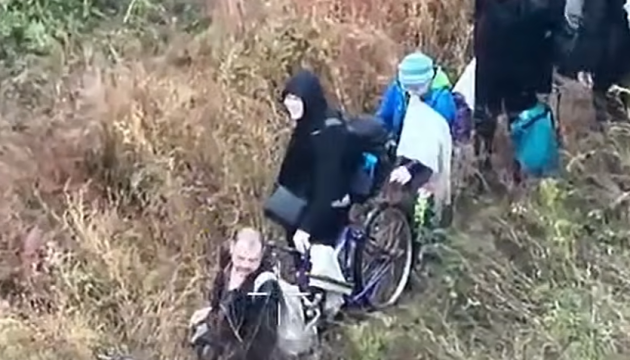
Civilians led through a gas pipeline out of the Kupiansk community, Kharkiv Oblast, by people the Khartiia Corps identifies as Russian forces, 27 September 2026
Civilians led through a gas pipeline out of the Kupiansk community, Kharkiv Oblast, by people the Khartiia Corps identifies as Russian forces, 27 September 2026. Screenshot: Khartiia Corps

Why the war is moving underground

Drones, constant surveillance, and AI-assisted targeting have made the battlefield surface transparent and deadly, argue John Spencer, chair of urban warfare studies at West Point's Modern War Institute, and Col. Drew Craig, principal military engineering staff officer at NATO's Allied Rapid Reaction Corps. In an August analysis, they write that soldiers in Ukraine describe a "death zone" of some 30 km, where moving above ground can draw an attack within minutes. When firepower makes the surface too dangerous, armies have historically gone underground, as they did in World War I and Vietnam, and more recently in Gaza and Lebanon.

"Armies that cannot survive above ground must adapt below it," the authors write.

Fighting in tunnels brings its own requirements, the authors write: detecting the enemy by sound and vibration, and specialized unmanned systems that cannot rely on GPS or stable radio links. Long stretches underground also take a severe psychological and physical toll on soldiers.

Western militaries are not ready for this, Spencer and Craig write. No NATO partner maintains even general capabilities for large-scale underground warfare, and US and British efforts focused mainly on detecting and clearing tunnels rather than occupying and operating in them.

  •  

Ukraine cannot be forced to surrender, says commander whose brigade destroyed 57,000 Russian targets, as US pressure and Russian missiles test its will

Yurii Fedorenko, commander of Ukraine’s 429th separate unmanned systems regiment “Achilles”.

Ending the war by forcing Ukraine to capitulate is impossible, the commander of the 429th “Achilles” Unmanned Systems Brigade, Yurii Fedorenko, said in an interview with 24 Kanal.

His statements came as Ukraine absorbed the fallout from the US-Russia diesel deal that saw its Starlink throttled and US intelligence lapse, a gap tied to a strike that killed three in Kyiv.

Achilles is a volunteer unit formed in the first days of the full-scale invasion, built around aerial reconnaissance and drone strikes and credited with more than 57,000 strikes. Fedorenko, its commander, was named a Hero of Ukraine in January 2026.

Fedorenko says he believes that there would be no “miraculous de-escalation,” and now argues that neither pressure from Washington nor Russian missiles can break the country’s will to fight for its liberty.

Russia will keep terrorizing Ukrainians with ballistic missiles, jet drones and Shaheds, and no near-term shift in US policy will stop it, Fedorenko stresses, so Ukraine will keep defending itself and striking back. A lasting energy ceasefire, he added, will not hold.

“Ukrainian society is ready to defend itself and to uphold its right to life by force,” he says, arguing that the Kremlin’s mouthpieces, and those working for third countries, have misjudged the mood in Ukraine.

No measure, he insists, could force Ukraine to capitulate in the short term.

Why the US election could swing the pendulum back

Fedorenko sees the political balance shifting after the US vote. President Donald Trump will probably not hold the majority he once had, making it harder for him to take domestic decisions alone, he notes. Even foreign policy, a presidential prerogative, will have to reckon with that balance.

If Trump must bargain with Democrats to pass domestic measures, that will shape the wider picture, Fedorenko argues. He stopped short of predicting impeachment, calling that the wrong framing, but cautioned that decisions already taken could be reviewed, challenged and overturned in the courts.

“I am firmly convinced we will get through the difficulties dictated by circumstances, including those arising across the ocean,” he says.

A cold shower for Europe that could help Ukraine

The US turn toward Moscow has jolted Europe, in Fedorenko’s view. American threats to leave NATO or rewrite how it shares the burden landed on European leaders like a cold waterfall, he recounts, pushing each state to ask how it would stand if the US walked away and to treat the Russian threat as one standing at its own borders, no longer a problem confined to Ukraine.

That alarm can work in Kyiv’s favor, drawing more weapons, defense financing and economic support from European partners, Fedorenko argues.

The same logic drives the satellite question. Ukraine cannot build a Starlink alternative alone, lacking its own space program, so the answer is collective, with NATO states pooling launches into a shared network, he explains. Russia is taking the other path with its “Rassvet” system, much of it, in fact, built by China, and if Moscow and Beijing get there first, he warns, the fallout would reach far beyond Ukraine.

  •  

Mavic vs Slavic: Ukrainian developers adapt reconnaissance drones to the modern battlefield

Slavic drone by Vyriy Industries. Photo: Vyriy Industries

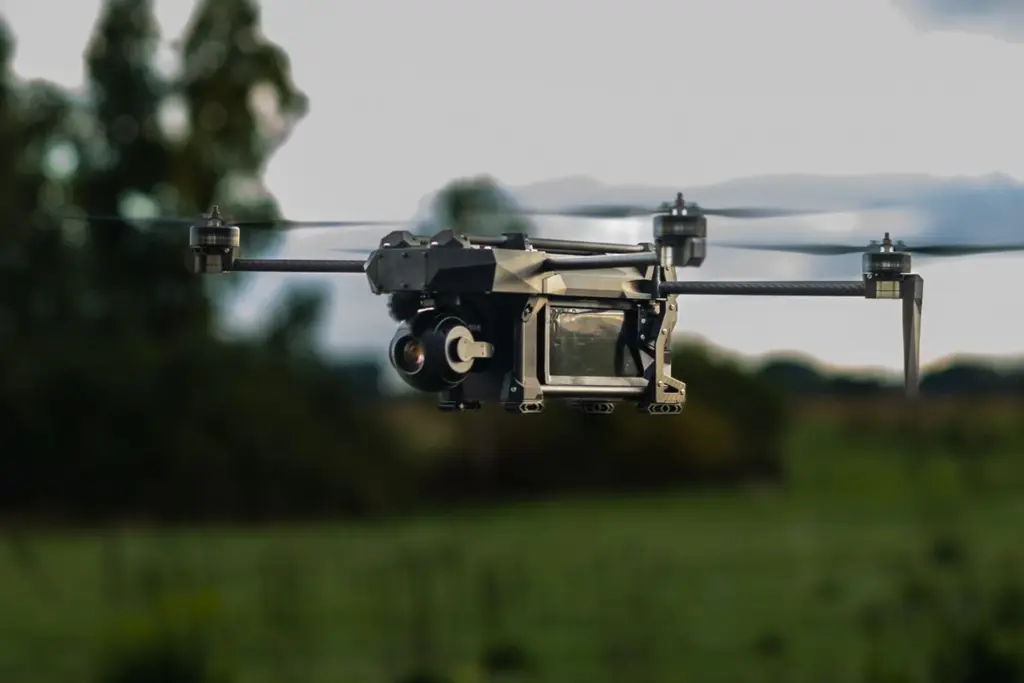
Ukrainian company Vyriy Industries is bringing a new tactical reconnaissance drone, Slavic, to the market, Oboronka reports, citing information from the manufacturer. The control system of the new drone will be familiar to DJI Mavic operators, the company also said.

Mavic has long been one of the main reconnaissance tools used by Ukrainian forces, with Ukraine relying heavily on supplies of these drones from abroad. After Ukrainian President Volodymyr Zelenskyy said China had stopped selling drones to Ukraine, the country began seeking alternatives. Slavic is one of these domestic alternatives, designed not only to replace Mavic but also to adapt its capabilities to current battlefield conditions, allowing reconnaissance crews to operate farther from the line of contact and reducing risks to personnel.

Slavic has a tactical range of up to 30 kilometers without GPS

Slavic can remain airborne for up to 1.5 hours because it is equipped with a 40,000 mAh solid-state battery, the media outlet notes. The drone has a tactical range of up to 30 kilometers, the report says.

Illustration showing the positions of the Slavic pilot (left) and Mavic pilot (farther to the right), as well as the drones’ flight ranges relative to enemy positions (shown in red). Illustration: Vyriy Industries

The aircraft can operate without GPS, as Slavic uses optical positioning for navigation. The pilot can also select a less congested channel and operate more effectively in difficult terrain because the communications system operates across a wide range of channels.

The manufacturer notes that for surveillance, Slavic is equipped with a daytime 2K digital camera mounted on a three-axis stabilized gimbal, with 10x optical and 30x hybrid zoom.

Part of the drone with the camera. Photo: Vyriy Industries

The system is supplied as a ready-to-use package “out of the box,” with all the equipment needed for operation without additional field modifications.

The drone is designed to keep crews farther from the front line

The company said its new drone has successfully completed initial combat trials with seven units of the Ukrainian Defense Forces and is preparing for scale-up, the media outlet notes.

“The war has changed, and so have the working conditions for crews. The kill zone has expanded, while available commercial drones have a limited tactical range. The main task now is to provide the military with a specialized platform that can fly longer and farther, so crews can operate farther from the line of contact. This is exactly why we began developing Slavic,” said Oleksii Babenko, founder and CEO of Vyriy Industries.

At the same time, the team is working on new Slavic configurations, including testing thermal imaging modules for nighttime reconnaissance. The manufacturer is also preparing the platform for scaled-up production and deliveries to the Ukrainian Defense Forces, the company told the media.

“Frankensteins” and Ukrainian-made drones are among the options for replacing scarce Mavics

The Ukrainian military had widely used Chinese DJI Mavic 3 drones, including to adjust artillery fire, monitor infantry positions and conduct surveillance, prompting Ukraine to seek ways to replace the shortage. More than five alternatives to the Chinese drone had already been developed in Ukraine, the Ministry of Strategic Industries of Ukraine confirmed to RBC-Ukraine in July 2025.

DJI Mavic 3 in use by a Ukrainian servicemember. Photo: Ministry of Defense of Ukraine

There are also other options for replacing them. The main work in military units is being done with “Frankensteins,” drones assembled from two or three damaged aircraft, Mavic UAV pilot instructor “Dobryi” said in an interview with Militarnyi in July this year. At the same time, such drones are less reliable than new ones, he added.

  •  

Ukrainian soldiers solve drone-delivery problem US military has chased for three decades

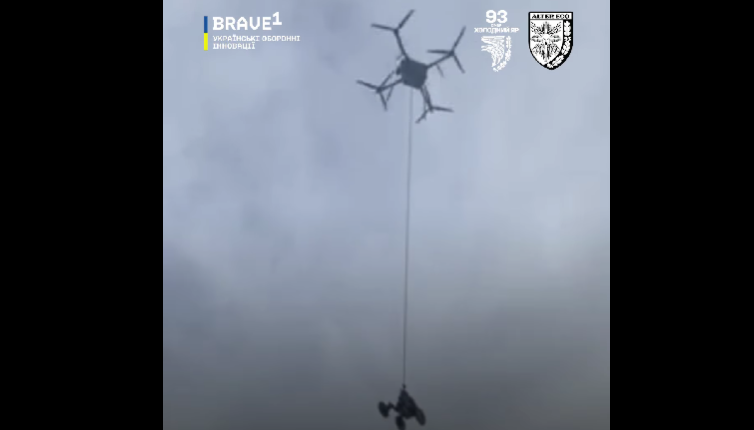
The purpose-built robot Desantnyk. Source: Brave1

Ukrainian soldiers have built a drone that carries a combat ground robot into battle and drops it where needed, a trick the US has pursued but never fielded. The Alter Ego battalion of the 93rd Mechanized Brigade has paired a bomber drone with a purpose-built robot, the Desantnyk, and took it from idea to combat in 10 days, the Brave1 defense cluster said.

The system answers a problem that has long hobbled ground robots: getting them to the fight over mined, cratered terrain they cannot cross on their own.

A drone carries the robot dozens of kilometers behind the lines and drops it precisely, in a pairing engineers call a "marsupial", one carrier delivering another. The US worked on such systems for more than 30 years, Brave1 said.

And it is not alone: the 3rd Army Corps has been air-dropping robots behind Russian lines in its Vivaldi offensive.

A drone carries the robot in

The Desantnyk is a compact wheeled platform. Alter Ego built a way to release it accurately from a heavy bomber drone, dropping it well beyond the range a ground robot could reach on its own. It lands deep in the enemy rear and drives on to its target. The point is to spare the robot the most dangerous, exposed leg of the journey.

Confirmed kills follow fast

According to Brave1, just 10 days passed from the idea to its first combat use, and the Desantnyk has already carried out confirmed strikes: the unit used it to destroy Russian shelters and troops. Only a handful of Ukrainian units have mastered the tactic so far.

Brave1 moves it to production

The defense cluster, a state platform for scaling battlefield inventions, said it took notice of the Desantnyk and helped the battalion find a manufacturer to move it from prototypes to serial production and out to other units.

  •  
❌