
 Connexion
Ukraine’s quiet counteroffensive took 745 square km. Russia’s dead Starlink is how

- In six months of unheralded advances, Ukrainian forces liberated a wide stretch of the southeast
- The collapse of Russian communications turned a local push into a six-month advance
- Now the Russians may mobilize yet again, so the Ukrainians are digging in and consolidating their gains
The scale of Ukrainian forces' counteroffensive in southeastern Ukraine early this year is finally becoming clear. In six months of maneuver starting on 29 January, a clutch of Ukrainian units, including the 78th, 79th, 80th, 82nd, and 95th Air Assault Brigades and the 1st and 425th Assault Regiments—tens of thousands of troops, in all—marched through gaps in Russian defenses and, according to Ukrainian officials, liberated around 745 square km and 26 settlements. Mostly in Dnipropetrovsk Oblast but also in neighboring Zaporizhzhia and Donetsk Oblasts.
That is Kyiv's own accounting, and it is the high end. The Institute for the Study of War, which maps control from geolocated imagery, put the figure at roughly 627 square km across the Oleksandrivka direction and the northern Hulyaipole direction—while noting its own conservative method probably undercounts. Either number describes the largest Ukrainian territorial gain since 2023.
The Ukrainian gains helped to offset Russian gains around the last few free cities in eastern Ukraine's Donetsk Oblast. Between the start of February and the end of July, Russian regiments captured a net total of just 260 square km of Ukrainian soil, according to a tally by the Black Bird Group. It would've been more than 1,000 square km if those air assault and assault units hadn't been busy clearing the Russians from a wide swathe of the southeast.
According to our data, in July the net gains of the Russian armed forces in Ukraine were approximately 106km².
— Black Bird Group (@Black_BirdGroup) August 4, 2026
This is the fastest Russian advance since January, but their gains remain extremely limited. In July of 2025 the Russians captured nearly 5 times as much territory.
1/ pic.twitter.com/02931eDLk0
The Ukrainian counteroffensive kicked off on 29 January. Three days later, Elon Musk's Starlink bricked Russia's thousands of smuggled and stolen satellite terminals. Practically overnight, the Russians lost their best method for controlling small drones and guiding assault units across the disputed gray zone. Drones couldn't fly. Troops couldn't navigate.
Ukrainian commanders surely knew their communications advantage wouldn't last: the Russians would eventually adapt with new methods of command and control. Seizing the opportunity, Ukrainian paratroopers and assault troops pressed the attack. And in stark contrast to the usual assault tactics for both sides, the Ukrainians attacked in tanks and other armored vehicles, counting on the Russians' connectivity problems to clear a path for heavy forces.
The blackout was not the only thing working in Ukraine's favor. ISW credits the gains to five reinforcing factors: better operational planning, a campaign to suppress and destroy Russian air defenses, deeper strikes on Russian logistics, Ukrainian drone superiority at the tactical level—and the Starlink cutoff. But the cutoff is the one that arrived all at once, and it arrived just as Ukrainian armor was starting to move.
As expected, @Deepstate_UA and other Ukrainian
— Clément Molin (@clement_molin) August 12, 2026media outlets followed on the liberation of multiple villages
Despite many "analysts" doubting OPSEC, not too much information filtered from this offensive. Thus, let's get back inside to understand what happenedTHREAD
pic.twitter.com/Sy2cYxiZy3
Mechanized assaults
Not all the vehicles got through. The assault troops lost one up-armored M-1 Abrams tank in early February. But by March, other assault forces M-1s were engaging Russian troops at point-blank range with their 120-mm main guns. After clearing a few disputed villages along a 45-km front between Dobropillya and Zelenyi Hai, the Ukrainians focused their maneuver and firepower on Komar, 12 km southeast of Zelenyi Hai.
The Ukrainians "started a slow and quiet offensive, with very few videos and small teams, during April and May," mapper Clément Molin recalled. The strict information security obscured the Ukrainian moves for all but the closest observers, allowing Ukrainian commanders to press their attacks without drawing too much attention—and risking a Russian countercounteroffensive.
By summer, the Ukrainians were within mortar range of Komar. Embarrassed Russian commanders resorted to sending out small teams on virtual suicide missions to plant Russian flags in disputed territory. The flags could create the impression of Russian control on terrain that, in fact, neither side controlled. "Russia is trying to intoxicate us with flag videos, which are meant to hide the real situation to both us and their command," Molin wrote.
The reality was that the Ukrainians had gained ground. A lot of it.
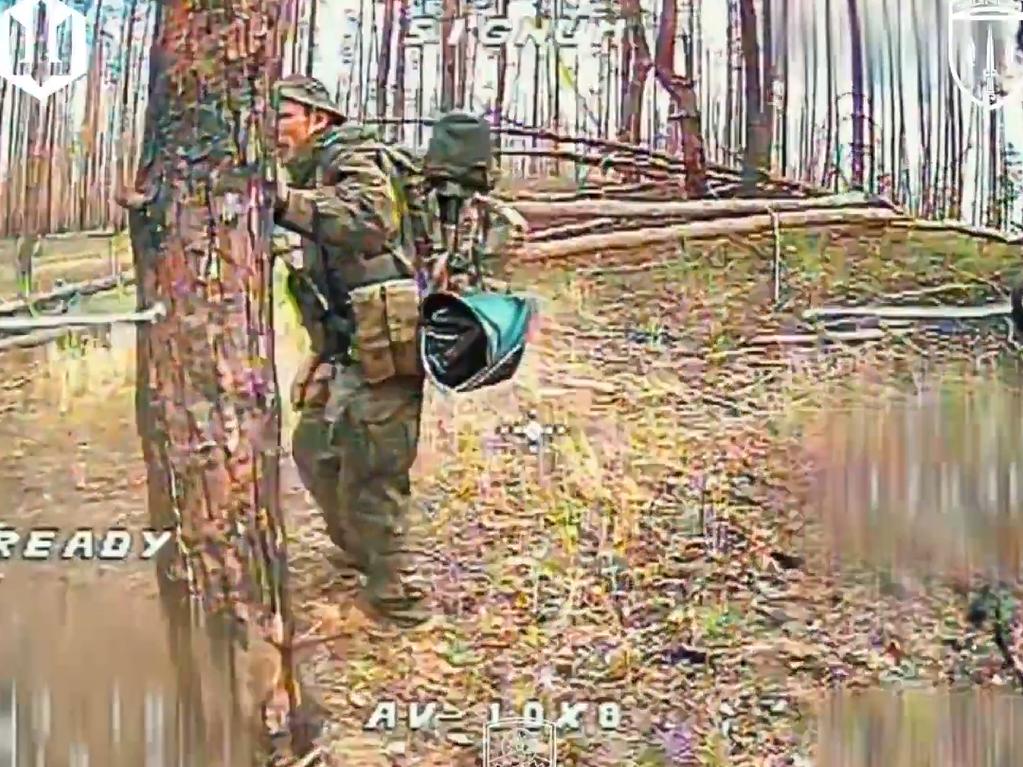
Announcing the results on 12 August, Ukrainian officials also claimed 9,550 Russian troops killed and more than 6,600 wounded—figures no independent body has verified. Former commander in chief Oleksandr Syrskyi, who planned the operation, said it proved the Ukrainian army "is capable not only of steadfastly holding its defences, but also of launching offensives, seizing the initiative, and liberating Ukrainian land."
But the momentum was unsustainable. As the Russians gradually restored command and control through the summer, the Ukrainians encountered more resistance. Now the gray zone is stabilizing again. Observer Moklasen predicted new Ukrainian commander in chief Maj. Gen. Mykhailo Drapatyi will order his corps and brigade commanders "to dig in positions, consolidate and strengthen more army corps" instead of continuing to attack.
After all, the Russians are pushing hard in Donetsk, and the resources the Ukrainians had devoted to the southeastern counteroffensive could boost the defensive effort in the east. Moreover, there are worrying signs the Kremlin may attempt another mobilization soon, potentially surging hundreds of thousands of fresh troops into Ukraine.
The Ukrainians may soon prioritize holding over attacking.
