This article was published on Friday, before the Serbian election on Sunday. The conditions it describes led to the unseating of Aleksandar Vučic who has been at the center of power in Belgrade since 2014. Student List, a leaderless party borne out of Serbia's student movement, won a decisive victory, claiming over 52% of votes compared to 39% for Vučic's party. At nearly 69%, voter turnout was the highest in 30 years.
On his last morning as a professor, Vladimir Mihić taught both an
This article was published on Friday, before the Serbian election on Sunday. The conditions it describes led to the unseating of Aleksandar Vučic who has been at the center of power in Belgrade since 2014. Student List, a leaderless party borne out of Serbia's student movement, won a decisive victory, claiming over 52% of votes compared to 39% for Vučic's party. At nearly 69%, voter turnout was the highest in 30 years.
On his last morning as a professor, Vladimir Mihić taught both an ordinary and quite unique class.
It was early June, the final day of the academic year at the Faculty of Philosophy in Novi Sad, Serbia's second biggest city, and Mihić had recently celebrated his 24th year in its classrooms.
The day before, the University Senate had voted — in a secret ballot he and his lawyers say was unlawful — not to reappoint him.
A student asked him to give one more lecture, in public, in front of the Rectorate.
Hundreds attended. There were tears, hugs and gifts.
But it was the quiet morning class with his students, Mihić says, that nearly broke him.
“If you went to the same local tavern for 24 years and it closed down, that would be hard,” he says. “Now imagine walking into a faculty with thousands of students you have taught behind you, and someone tells you: ‘You can't do this anymore’.”
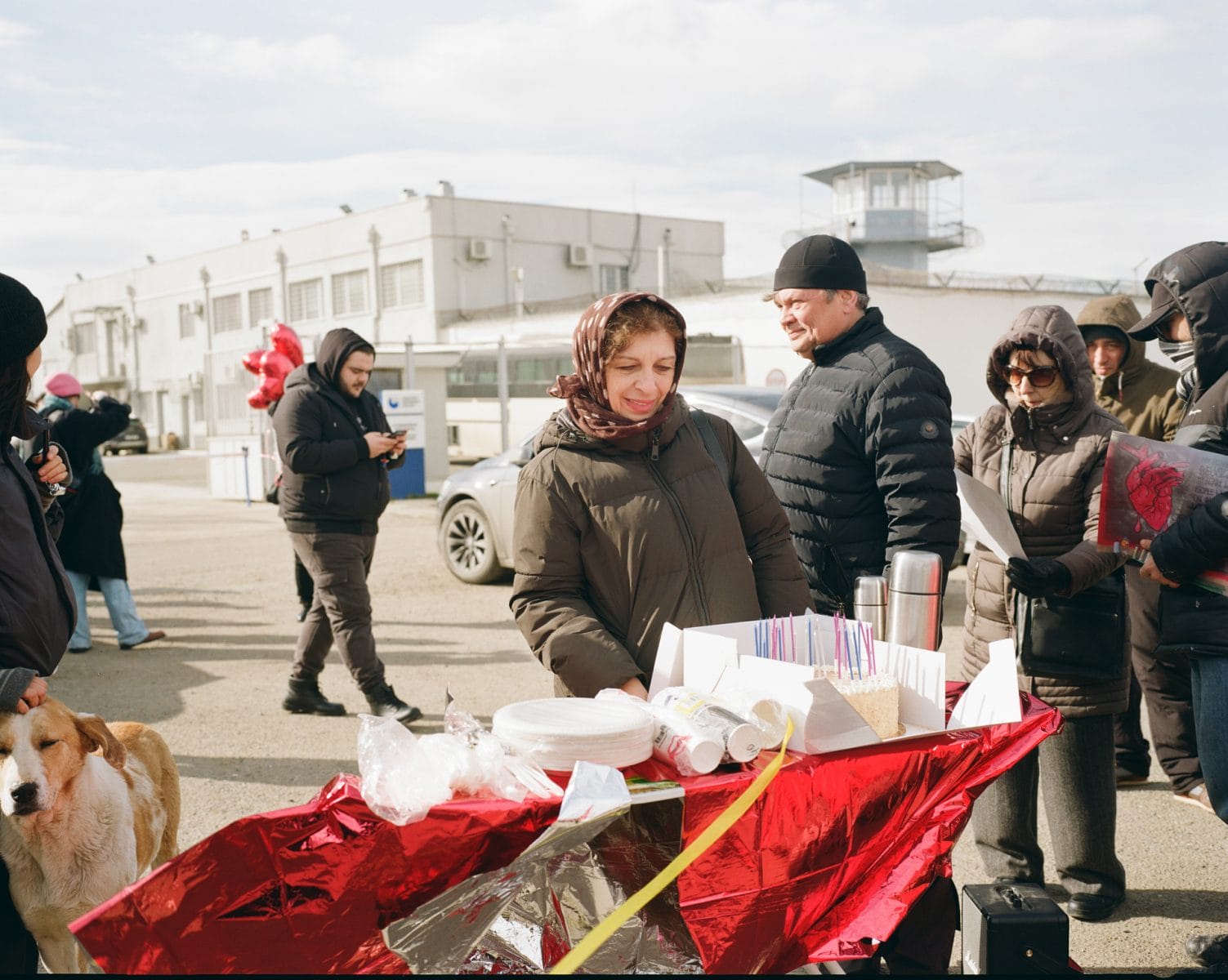
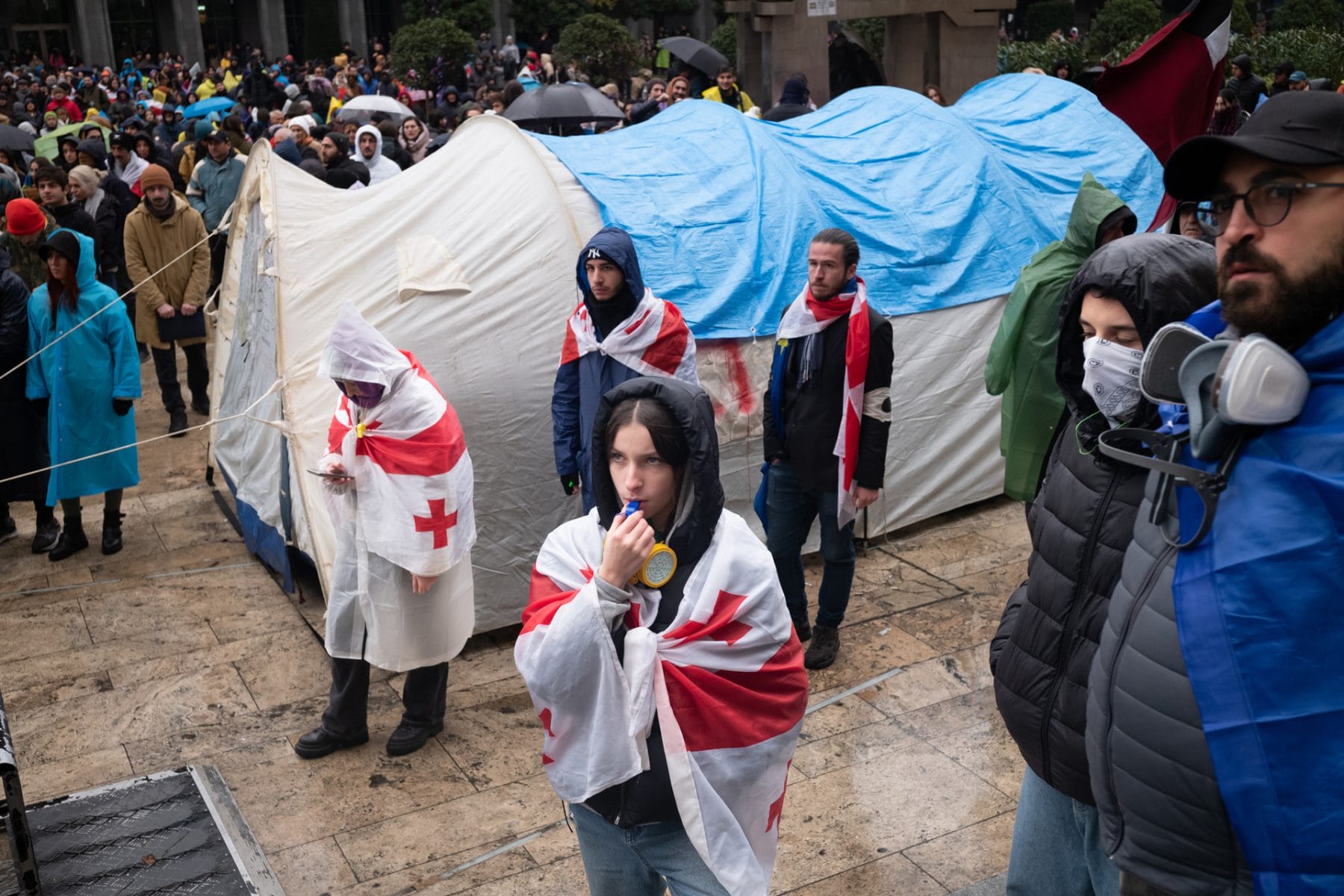
Mihić is one of hundreds of Serbian citizens who have paid for supporting the country's student-led protest movement with their livelihoods.
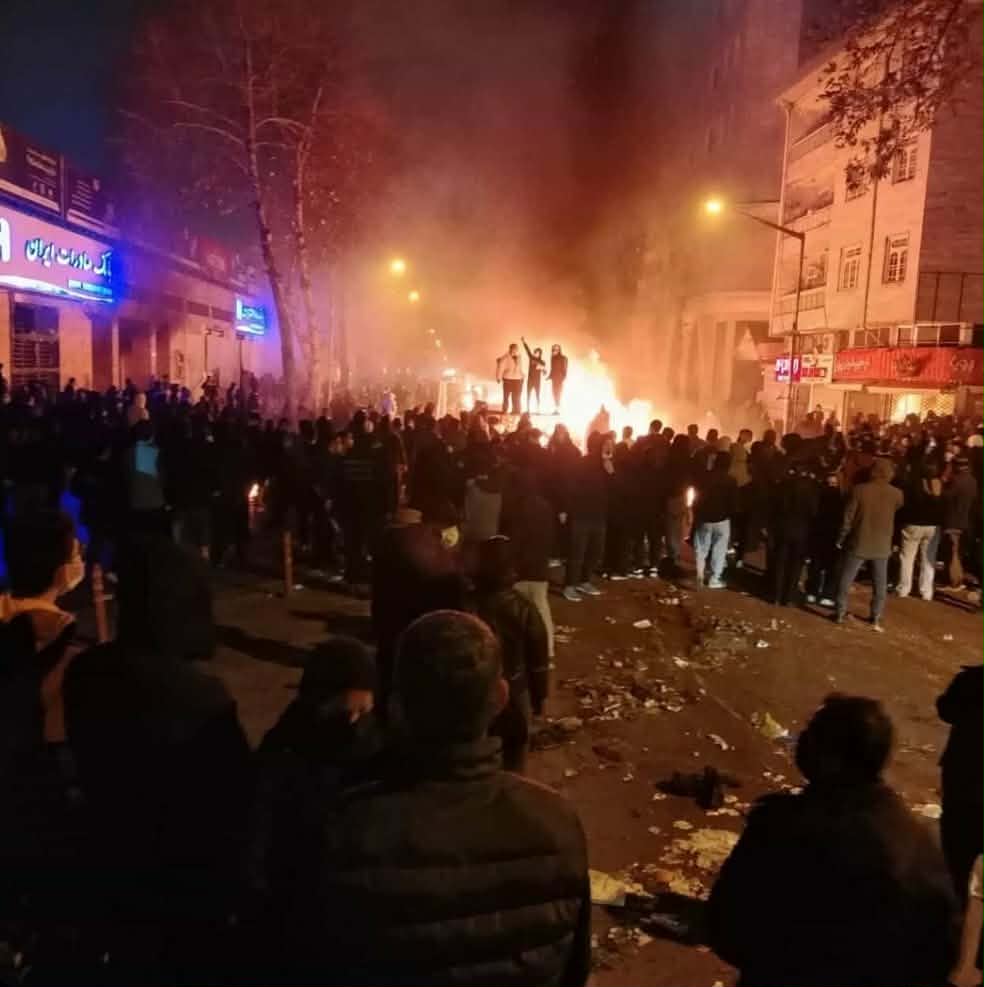
The movement started on November 1, 2024, when the concrete canopy of the recently renovated railway station in Novi Sad collapsed, killing 16 people — a disaster protesters blamed on corruption, and which ignited the largest demonstrations in Serbia's history.
Nearly two years on, the movement has firmly reshaped Serbian politics. Prime Minister Miloš Vučević resigned all the way back in January 2025. After originally just reshuffling the government, Serbian President Aleksandar Vučić called for snap parliamentary elections — the protesters’ main demand for more than a year at this point — which are finally taking place on Sunday, October 25.
A month before the election, on September 27, Vučić stepped down from the presidency to lead his Serbian Progressive Party’s election campaign and run for prime minister, a job he held between 2014 and 2017. Vučić, who has been President since 2017, resigned eight months before his term was due to end in May 2027. He would have been barred from running for a third term, while no such Constitutional barrier exists for prime ministerial terms. Critics argue Vučić, by looking to remain in power, is behaving in the manner of other Eastern European strongmen.
But, for the first time in his reign, Vučić’s grip on power might slip. His main rival is the so-called Student List, a leaderless movement born out of the protests, and the polls constantly disagree on whether it or Vučić is ahead in the race.
Opposition to Vučić has not been confined to just students, however – and nor has the crackdown against it.
In the wake of the student protests, supportive teachers, professors, civil servants, doctors and workers at state-owned companies have been dismissed, demoted, transferred or pushed out. Officially, trade union and civil society groups say, the reasons for dismissal are almost never stated to be support for the students.
But more than 100 school employees alone lost their jobs or had their contracts not renewed in the 2024/2025 school year, according to the Independent Trade Union of Education Workers. The number now far exceeds that, says Civic Initiatives, a prominent local civil rights organization.
Serbia's Commissioner for Protection of Equality keeps no separate tally for “political discrimination,” but on the two grounds that fit — union or political membership, and political convictions — complaints more than doubled in a year, from 31 and 25 in 2024 to 70 and 76 in 2025.
These complaints about discrimination rarely yield redress: of eight formal recommendations made in last year's 85 employment-related cases, only two employers complied, the office said in an email response to Coda’s questions.
Dismissals are only one of the tools of repression the government has used. Since the start of 2026, at least 14 students, activists and opposition politicians have been targeted with advanced spyware, says digital rights group SHARE Foundation. And some of that spyware was installed while they were in police custody, says Amnesty International. Additionally, Serbia recorded 209 press freedom violations in 2025, compared to 84 in the year before. Protesters have been charged with attacking the constitutional order, civil society groups have been branded foreign mercenaries, and university teachers have had their pay cut over the blockades.
Ana Brnabić, currently the acting president of Serbia, was leader of the National Assembly at the time of the student protests and claimed that state institutions had no information that spyware was used against students. Vučić, for his part, has claimed, without evidence, that the Student List is being financed by foreign agents, its political ascent part of a plot to undermine Serbia.
Student List — whose lead candidate (not quite the same thing, the group insists, as a figurehead or party leader) is cardiologist Ilija Srdanović – claims to represent voters fatigued by traditional politics and politicians. It is a posture acknowledged by several opposition parties which have chosen to sit out the elections and endorse Student List instead.
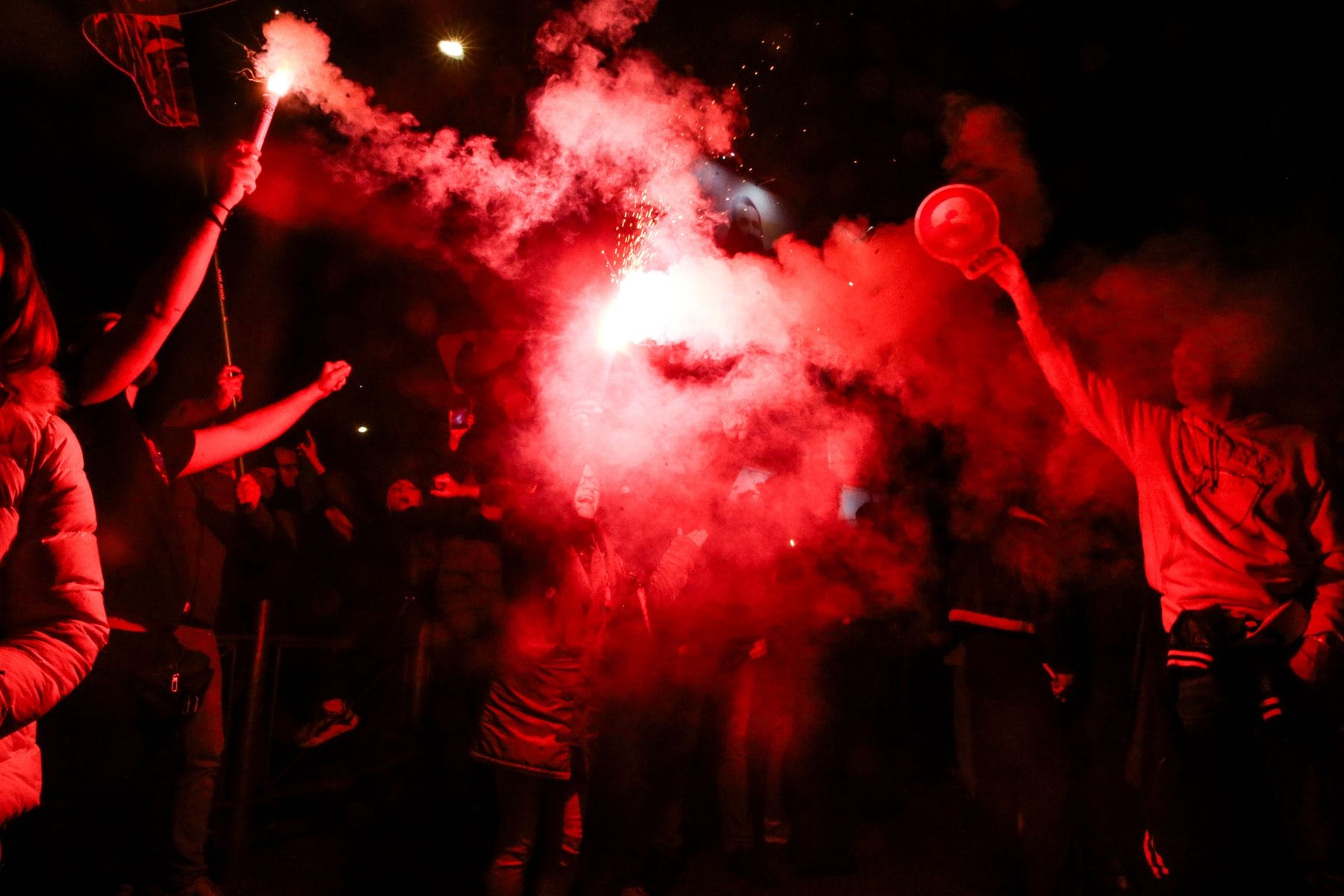
On Sunday, as in so many recent elections around the world, a deeply divided electorate will go to the polls, with watchdogs already warning about intimidation and alleging surveillance and possible electoral manipulation.
Professors on the front lines
But back to June, and Vladimir Mihić’s last day as a professor in Novi Sad. The purge at the Faculty of Philosophy was already underway before Mihić became a national topic.
The first to go was Jelena Kleut, a media studies professor and one of the most visible academic supporters of the protests: in January 2026, the University Senate refused, by secret ballot, to promote her to full professor, thus ending her employment even though expert bodies had approved her promotion and more than 1,200 professors signed a letter of support.
“Sadly, we have indication that this is just the beginning,” Kleut warned, referring to a colleague whose reappointment was also in question.
That colleague was Mihić.
The social psychologist, a tall man with a few grey hairs in his beard and a calm voice, had been, like Kleut, an active supporter of the student protests.
“I could not watch it on television while just sitting around,” he says.
On paper, his reappointment was beyond dispute, his file reviewed by a committee that included two of the most cited psychologists in the world.
"It was not just that my file was not disputable,” Mihić says, “it exceeded the standards several times over.”
What his unimpeachable file could not survive, though, was an objection lodged twice by Patrik Drid, the dean of the Faculty of Sport and Physical Education and a vocal opponent of the protests.
Drid claims his complaint concerned what he described as Mihić's active political organizing. The chief example of which, Drid said, was a social media call for students to gather in front of Drid's own faculty, “blocking access to those who wished to work and study.” Mihić maintains he organized nothing of the kind, and that Drid’s objections were personal.
On June 4, the University Senate voted, again in secret, which Mihić said the university’s own legal department warned was against the rules. Eight members voted for his reappointment, four against and six abstained. Under the current rules, the abstentions counted against him.
Trade unions from ten faculties called the outcome a brutal attack on university autonomy, but no explanation was given for why Mihić had lost his job.
He appealed, but the expanded Senate confirmed its decision. Now he plans to take his case to the Administrative Court, a legal battle he says could take years.
Filip Stevanovic/Anadolu via Getty Images
Fired for standing still
The unjust dismissals extended beyond university campuses.
Biljana Hrnčić spent 21 years working for the government of Vojvodina, Serbia's northern autonomous province, most recently as head of its press department. She says she had never once faced a disciplinary measure.
That changed after the protests.
Every Friday at exactly 11:52 a.m., the exact time the roof caved in at the Novi Sad station in 2024, Serbians would leave their desks and head out to the streets to honor the dead in silence. Managers walked the halls, watching.
“They went around the offices to see who took part and who didn’t,” Hrnčić said. “At one point they were so malicious that they simply locked people out of the building.”
For Hrnčić, joining in the protests was unavoidable. Both her children are students. “My children are in the streets,” she said. “It is more than natural that I would walk out onto that same street.”
In September 2025, with street demonstrations still ongoing, Hrnčić and six colleagues were moved into a new department at work. Two months later, the government abolished the department and its entire staff became “unassigned.”
The provincial government of Vojvodina did not respond to Coda’s questions for this story.
“It is a horrifying feeling,” says Hrnčić, who still looks harrowed by her ordeal. “20 years of daily work, never a single disciplinary problem, and you find yourself on the street asking what just happened.”
She and her colleagues are living off their severance pay and their savings while they wait for their cases to be heard in the Administrative Court.
For every few hundred dismissals, one court victory
Many of those dismissed have taken their case to Administrative Court, but even winning there guarantees little.
Dragoslav Ljubičić was chief steward of the Nezavisnost union at the Serbian state’s largest thermal power plant. Five years short of retirement, he was a marked man even before the student protests as a rare insider willing, in his words, to call out the mismanagement of the utility.
When the roof fell, he joined the protests immediately, holding 16-minute silences at the plant — one minute for each victim — and organized the first joint rally of students and workers in front of the state-owned electricity company EPS’s Belgrade headquarters.
In January 2025, he received a formal warning citing his Facebook posts. On February 12, managers tried to hand him a dismissal letter at work. He refused to sign it. Six days later, he signed and then sued.
EPS has publicly denied he was dismissed over the protests or his union activity. It said Ljubičić broke its code of conduct, without specifying how. EPS did not respond to questions for this story.
A judge ordered EPS to reinstate Ljubičić until his case could be heard, a decision it could not appeal. But, he said, “they did not give me back my job. They gave me a fixed-term contract and a post that did not match my qualifications at nearly half my previous pay.”
For continuing to complain about his treatment, EPS transferred him to a job that included an exhausting commute from his home.
Ljubičić’s lawyer, Ivan Ninić, who represents a string of dismissed workers, says this is the EPS playbook. Every ruling against the company is automatically appealed, at the expense of the public budget. “We took you back because the law says so,” Ninić said, describing EPS’s attitude. “Now we will make your life hell until you quit on your own.”
Serbian law, he says, is largely on the side of workers; the problem, though, is that the process takes years.
Still, Ljubičić has little patience for the slogan his supporters chant.
“The message ‘Justice for Ljubičić’ misses the point,” he says. “The real message is: stop the dismissals. Mine was the first. And then there came a wave of dismissals across Serbia, most of which the public never heard about.”
Despite the professional and financial hardship, neither Ljubičić, Mihić or Hrnčić expressed any regret. “There has not been a fraction of a second in which I have thought, ‘why did I need to do this.’I could never forgive myself if I hadn't done what I did,” says Mihić.
On Sunday, Serbians will have a long-awaited chance to exorcise their feelings of injustice. The answer to the question of whether it will be enough for a student movement to unseat the populist, autocratic Vučić will reverberate around an embattled Europe.
In May, William Tharien, a 19-year-old student, made his second attempt at passing NEET, India’s national entrance exam for would-be medical students. Passing the test was the only way William would be eligible to study to be a doctor, surgeon, dentist or vet and he was competing with about 2.2 million other students for one of about 130,000 places in medical schools around the country. What makes the test even more nerve-wracking is that only half of these places are available at heavily subsid
In May, William Tharien, a 19-year-old student, made his second attempt at passing NEET, India’s national entrance exam for would-be medical students. Passing the test was the only way William would be eligible to study to be a doctor, surgeon, dentist or vet and he was competing with about 2.2 million other students for one of about 130,000 places in medical schools around the country. What makes the test even more nerve-wracking is that only half of these places are available at heavily subsidized state-run colleges, rather than expensive private institutions.
It can take students up to two years to prepare for these exams, with parents going into debt to pay fees at tuition centers entirely devoted to cracking the test. Days after William, and millions of others, took the test on May 3, authorities discovered that the paper had likely been leaked and circulated on social media platforms like Telegram. The results were voided.
Around the same time, the Chief Justice of India’s Supreme Court compared young people “who don’t get any employment and don’t have any place in a profession” to cockroaches and parasites. In a country with the largest population of 15- to 29-year-olds in the world (nearly 370 million people) and high levels of youth unemployment, particularly amongst the educated, the judge’s remarks struck a raw nerve.
It led to the formation of the Cockroach Janta Party — a mocking reference to India’s governing Bharatiya Janata Party, led by prime minister Narendra Modi — initially as a satirical meme. But the cancellation of NEET gave the Cockroach Janta Party real-life relevance and made it an outlet to channel the extensive frustration and anger of India’s youth.
In neighboring Nepal, Bangladesh and Sri Lanka, so-called Gen Z protests between 2022 and 2025 had toppled governments.
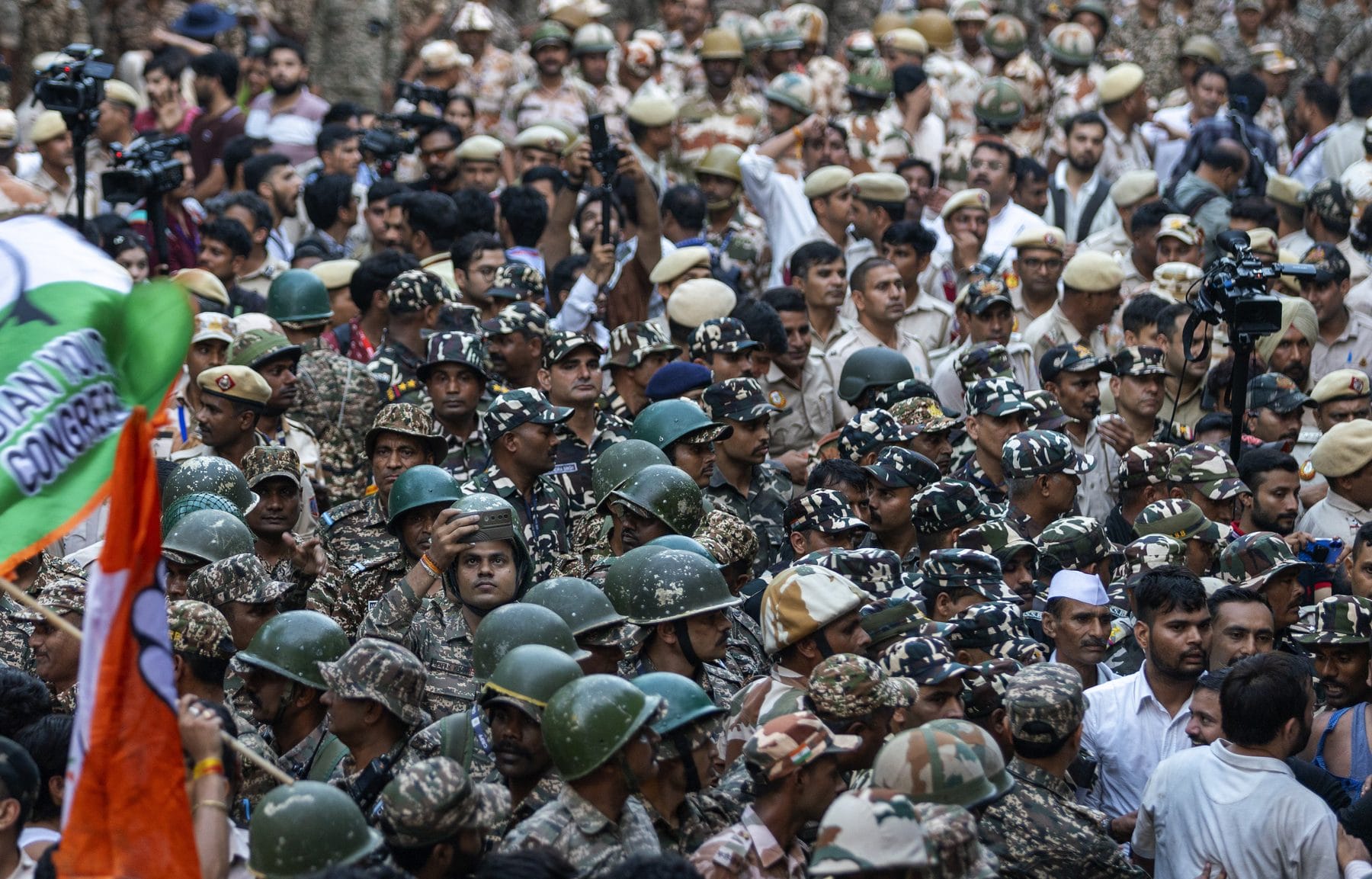
In June, William joined tens of thousands of students in Jantar Mantar, an iconic venue for public protest in the Indian capital Delhi, to call for the resignation of Minister of Education Dharmendra Pradhan over the NEET debacle. The demonstrations lasted for weeks, even as the Delhi Police resorted to tear gas, pellet guns, electric shock devices, and lathis (nearly six-foot-long bamboo sticks) to disperse the crowds. William was a regular.
“I always felt watched,” he told us. At metro stations, on his way to the protests, he said he repeatedly encountered the police. “They made sure that we saw them and that we should feel intimidated by their presence and their numbers.”
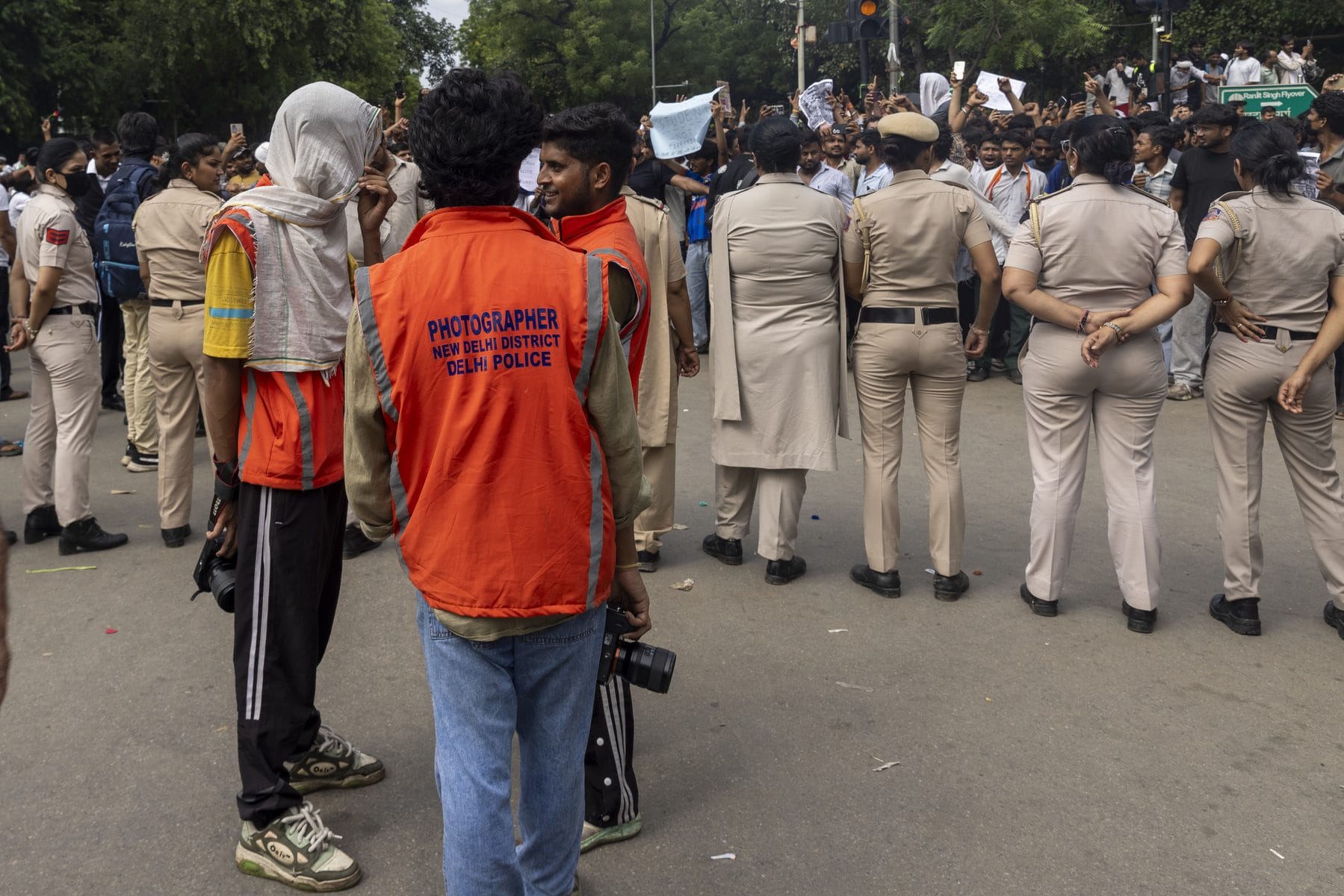
As journalists, we covered the June-July protests, including on July 20 when the police brutality reached an ugly peak as protesters marched towards the Indian parliament. Artificial intelligence-enabled CCTV cameras installed under Delhi’s “Safe City” project lined the streets in and around Jantar Mantar. A permanent surveillance tower stood at the center of the protest site, recording around the clock. Multiple drones circled overhead. Photographers hired by the police moved through the crowd. Some officers carried body cameras, and at least one police officer was seen wearing Ray-Ban Meta smart glasses.
Two police surveillance vehicles were parked just outside the entrance to Jantar Mantar. One was Ikshana (the Sanskrit for, literally, the act of seeing), an AI-powered police van with eight cameras that used facial recognition technology to match faces to police databases in real time. The other was a mobile command center.
According to William, the surveillance was not limited to the protest site. “I saw police detaining students at the metro station,” he said. “They were recognizing students from footage, identifying them by their bags, or style of mask or sunglasses.”
Even after the protests stopped, with the July 25 resignation of Pradhan, the education minister, William said the police paid visits to students in their neighborhoods. They were tracking down protesters. On August 3, he said, two police officers showed up at his lodgings. He was alone. “We have photos of you,” the police told him, “in colour. You’ve been seen going to the protest site on multiple days and also seen at the metro station.” Insisting that attending protests was a democratic right, William refused to let the police into his room without a warrant.
According to the Indian Express, the Delhi Police used surveillance footage accrued during the NEET protests in the summer to identify at least “2,800 people with a criminal background” who would be be prevented from protesting against Gyanesh Kumar.
Aishe Ghosh, a prominent student activist and national office holder at the left-wing Students’ Federation of India, has challenged the Indian government and the Delhi Police in court over the indiscriminate use of surveillance technology. Not only were the authorities documenting the protests, she alleges, they were using the footage to threaten protesters with public exposure.
Long an object of surveillance, Ghosh, who was a leader of the NEET protests, said the police entered the Communist Party of India (Marxist) headquarters in Delhi to arrest her in August on the basis of protests she had attended five years earlier in 2021. Describing the attempt to arrest Ghosh as a “continuing witch hunt against student protesters,” the CPI(M) added that it was evidence of “the Modi government’s escalating assault on democratic rights.”
Ishan Tankha
Modi’s surveillance state
Hearing Ghosh’s litigation, the Delhi High Court appeared to suggest that the urgency to examine her specific allegations had dissipated since the NEET protests had concluded. The judges suggested that she file a more general petition.
The NEET protests proved only to be the start of the Cockroach Janta Party’s precipitous rise as serious, youth-led opposition to the Modi government, in power since 2014 and seemingly determined to use every arrow in its quiver, from opaque sources of funds to the takeover of independent institutions to the use of surveillance technology, to stifle dissent. In October, the “cockroaches” poured into Delhi’s streets again.
This time, they wanted the resignation of Gyanesh Kumar, India’s Chief Election Commissioner, a constitutional role meant to be entirely independent, apolitical and focused on maintaining the integrity of the Indian electoral process. An investigation by the Indian Express newspaper revealed that despite 14 objections in the last 10 months from the two other members of the election commission, Kumar had allegedly illegally taken unilateral decisions that resulted in voters being left off electoral rolls. India is currently undertaking an extensive revision of its voter lists that has controversially already disenfranchised 130 million people and potentially swayed state elections in favour of the governing BJP.
Kumar has not directly addressed the Indian Express’s findings. And while Modi too has remained typically silent — in his 12 years as prime minister, he has yet to call a single press conference — the Delhi Police has once again used violence and arbitrary arrests to crack down on still ongoing protests. Jantar Mantar, the de facto site of protests in Delhi since 1993, has been officially shut down. Prominent protesters, including Aishe Ghosh and the founders of the Cockroach Janta Party, have been detained. The opposition led by Congress Party scion Rahul Gandhi — the son, grandson and great-grandson of former Indian prime ministers — has been galvanized.
But India’s next general election is not until 2029 and the next major state legislative election is not until February 2027 at the earliest. Maintaining momentum is a task Gandhi has yet to show he can manage.
Meanwhile, the BJP continues to use friendly mainstream television media, alongside its heavy-handed policing, to argue that the protests are marginal, paid for by foreign sources and disliked by the large majority of Indians.
Fallible facial recognition tech
Technology researcher Srinivas Kodali told Coda that India’s efforts to modernise its policing system were stepped up after terrorist attacks in Mumbai in November 2008. Police stations across the country were connected, with access to criminal records and a tracking database. If someone attends a protest somewhere in India, Kodali explained, and has a police report filed against them, that information will be available to every police department in the country. He described the approach as “360-degree profiling,” pulling data together from facial recognition technology, surveillance towers, phone records, social media activity, and government databases including electoral records.
Delhi Police has said its use of technology and AI is meant to maintain law and order and identify people who already have a criminal record and not to randomly profile protesters. However, privacy researchers and lawyers warn that sophisticated surveillance systems can make participation in protests traceable long after the crowds have dispersed.
Much of the technology for this work is supplied by a growing group of private companies. Ikshana, the AI-powered police van used to monitor protesters in Jantar Mantar back in July, is one example. Rahul Bhardwaj, the Chief Growth Officer at analytics firm Intozi based in Gurugram, a tech hub on the outskirts of Delhi, said the company provides the software layer behind Ikshana’s system. Intozi processes video feeds through AI applications designed for tasks including crowd monitoring, detecting weapons and identifying people against police databases.
Intozi has previously deployed its facial-recognition technology for government security operations at high profile international summits in Delhi. Asked specifically whether its technology was used at Jantar Mantar this summer, though, Bhardwaj cited confidentiality obligations.
The company said that its role ends after its system is installed on police infrastructure, and that it does not retain the database or continue to access the system once it has been handed over to the police. “Images of people who are not in the police database,” Bhardwaj said, “are automatically blurred within seconds, while records associated with people already registered in police databases are retained by the police.”
That places responsibility for the technology and its subsequent use with the police.
Innefu Labs, whose AI Vision facial-recognition software has been used by Delhi Police in criminal investigations, declined to answer questions about data retention, legal safeguards or its operational relationship with police.
Another company, AjnaLens, confirmed its direct role in live policing. Kuldeep Pathak, Associate Director at AjnaLens said the company had supplied AI-enabled smart glasses to Delhi Police, first used in January 2026 in security operations during India’s Republic Day celebrations. The company confirmed that its glasses were used again during the NEET protests in Jantar Mantar. According to Pathak, their system was given access to a police database containing around 65,000 people with criminal records. He said 14 people were arrested after being recognized through the glasses.
Experts we spoke to questioned what authorises private vendors to access and process police databases, or whether an independent authority audits the system.
Ishan Tankha
Surveillance without accountability
“What statutory regime operates in this context?” asked Menaka Guruswamy, a senior lawyer who is involved in litigation in the Supreme Court over the use of facial recognition technology at Jantar Mantar. “Where is this information hosted? Is it hosted by the private vendor, the state or the police? We know nothing.”
Guruswamy said tenders and contracts between the state and private companies should make it possible to establish what data each party is permitted to access and retain.
Disha Verma, AI researcher at Tech Global Institute and Ashoka University, claims these private vendors get access to police datasets that help them train their AI systems. “They (vendors) did not need to buy training datasets from anywhere,” she says. “They didn’t need to test their product anywhere else. They ended up with a curated, very accurate facial-recognition system.” The data provided by the police, she added, would help vendors sell their product for profit to other companies that want to make use of surveillance technology.
“What I am most concerned about is how much impunity and data and power this gives the private vendors,” Verma said, calling it a “parallel police state.”
And then there’s the accuracy of the technology, little of which has been subject to question or scrutiny.
In response to Right to Information requests made by the digital rights group Internet Freedom Foundation (IFF) in 2022, the police said it considered facial-recognition results with an accuracy score of 80 percent or above as a positive match. Only results below the 80 percent threshold were “subject to further verification using corroborative evidence.”
But the distinction between technical facial recognition matches and actual verified identifications became harder to ignore after the NEET protests in Jantar Mantar in the summer. Delhi Police said its facial recognition system identified 2,873 people with previous criminal records at the protest between July 20 and 26. But at least 25 of those people were actually in jail at the time they were supposed to be protesting.
Intozi’s own description shows why that distinction is not always straightforward. Bhardwaj told us that the company’s recognition threshold is “generally kept above 70 to 80%” and once that threshold is crossed, “it is a 100 percent match for us.” This is why, argues Guruswamy, the Supreme Court lawyer, a statutory framework is necessary. “There is no foolproof system,” she said. “That is why you need accountability, a legal regime, data protection and safeguards governing how these interactions take place.”
Nearly six years ago, Ahmed* (name changed on request) experienced the pitfalls of the Delhi Police’s then fledgling facial recognition technology and surveillance system. He was identified by AI-assisted video analysis as being present during deadly communal violence in northeast Delhi in 2020. Ahmed spent around 18 months in jail, accused of killing a police official during the riots. He insisted that the man seen in the footage used as clinching evidence was someone else.
“My hair was cropped short, and I had different shoes. Only the white shirt and dark trousers matched. But that does not make anyone wearing those clothes me,” Ahmed told us. He said he had shut his shop around noon on the day of the violence and gone home. Footage from one security camera showed him near the lane where he lived. But police later said it had used Amped FIVE, a video and image analysis tool, and AI Vision, facial recognition software made by Indian company Innefu Labs, to place Ahmed at the scene of the crime.
In September 2021, Ahmed was released on bail. The court noted that several people in the area wore similar clothes to those shown in the footage and that the video analysis identifying Ahmed across different recordings would have to be tested at trial.
By then, though, the damage to Ahmed’s life had already been done. Before his arrest, Ahmed ran a garments shop and employed a couple of workers. The shop did not survive his incarceration and, while on bail, he now works at a street stall, barely surviving on his meagre income.
Facial recognition systems turn facial features into numerical data and compare them with stored images, producing a similarity score or a list of possible matches. In a one-to-many search, a single face from a protest can be compared against an entire database.
“It's able to recognize a face the way an iPhone camera might,” Disha Verma, the Ashoka University researcher said. An iPhone's front camera works because everyone looks at it from roughly the same angle in consistent light, she added; but a police station is often dimly lit, angles vary, and the camera used to take the photo might be old and pixelated. "The system the police are using usually has a very large error rate, just inherently," Verma said.
Katie Kinsey, Chief of Staff and Tech Policy Counsel at the New York University School of Law’s Policing Project, told us that broad accuracy claims tell little about how a facial recognition system might work once it leaves controlled testing conditions. “A model tested on one dataset may behave differently when the cameras, lighting, image quality and population change,” she said.
Live video presents an additional difficulty because the images are less controlled and officers may be acting on alerts as events unfold. Kinsey said systems should be tested under the actual conditions in which police intend to use them.
Verma also raised concerns about biases affecting facial recognition systems. “If the police think a criminal looks like a dark-skinned bearded young man,” Verma said, “that is the data they will collect and that is what will train the AI.” It would, she added, create a feedback loop in which technology does not remove police prejudice but reproduce and legitimise it instead.
India has constitutional privacy protections and general data protection legislation, but no dedicated law for the use of facial recognition technology. Basically, “you won’t know you are on a watch list,” researcher Srinivas Kodali told us.
We reached out to the Delhi Police Cyber Cell with questions about the use of live facial recognition technology and other surveillance systems during protests, but did not receive a response.
Some jurisdictions have tried to place clearer limits on this type of power. For example, under the European Union’s AI Act, real-time remote biometric identification by law enforcement in public spaces is generally prohibited, with narrow exceptions. Even then, its exceptional use is subject to necessity and proportionality requirements and generally requires prior judicial or independent authorization.
Police in India have long maintained categories of people they consider suspects or potential troublemakers. For instance, in the south Indian state of Telangana, police have a category called “rowdy sheets” for people considered habitual offenders or threats to public order. With facial recognition technology, these categories have only widened.
Lawyer Menaka Guruswamy wondered what might happen when someone photographed at one protest is then seen at another protest. “Are we being criminalized simply for attending protests?”
Verma said that one of the significant shifts that she has witnessed over the years is how the technologies once associated with borders and the military have moved to civilian policing. The militarization of the Delhi Police has been evident as paramilitary personnel dressed in camouflage have been assaulting and detaining protesters.
Still, the protesters come.
William Tharien told us that despite being a known face to the Delhi police, despite his fears and struggles with his mental health, despite the monitoring of his social media, he is not going to stop protesting.
And with Delhi’s cockroaches still calling for the resignation of India’s chief election commissioner, still warning of the danger posed to Indian democracy by the Modi government’s authoritarian tendencies, how, William said, could he give up the fight now?
Thomas Sankara had a signature look: a natty red beret, worn with military fatigues. A striking figure, Sankara was a military officer and the radical, anti-imperialist prime minister of the Republic of Upper Volta. His arrest in 1983 led to demonstrations, followed by a coup, after which Sankara was released and installed as president. By the following year Sankara had given the country he now led its new name — Burkina Faso. He fashioned a Burkinabè identity in his own anti-imperialist image,
Thomas Sankara had a signature look: a natty red beret, worn with military fatigues. A striking figure, Sankara was a military officer and the radical, anti-imperialist prime minister of the Republic of Upper Volta. His arrest in 1983 led to demonstrations, followed by a coup, after which Sankara was released and installed as president. By the following year Sankara had given the country he now led its new name — Burkina Faso. He fashioned a Burkinabè identity in his own anti-imperialist image, eschewing French for local languages, promoting economic self-reliance and national pride.
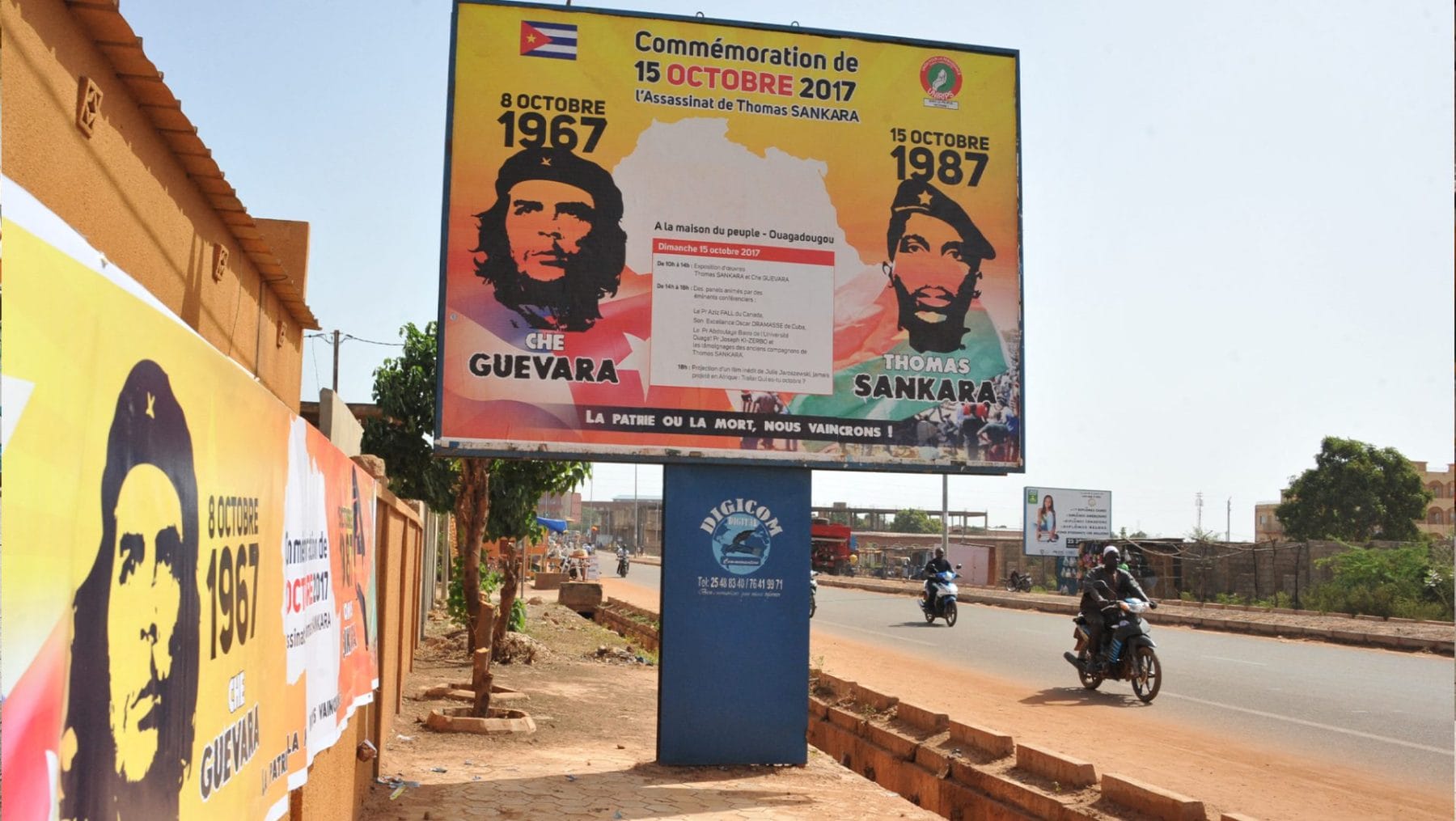
In 1986, he famously took the then French president François Mitterrand to task in a fiery speech broadcast both in Burkina Faso and France. Sankara’s dashing uniform played an outsized role in how his words were interpreted. Here was Africa’s own Che Guevara. But by October 1987, Sankara was dead, killed during a military coup led by his former friend and ally Blaise Compaoré.
France, the old colonial power, backed Compaoré. Soon after the coup, French officials once again flocked to Ouagadougou, helping to prop up Compaoré for decades.
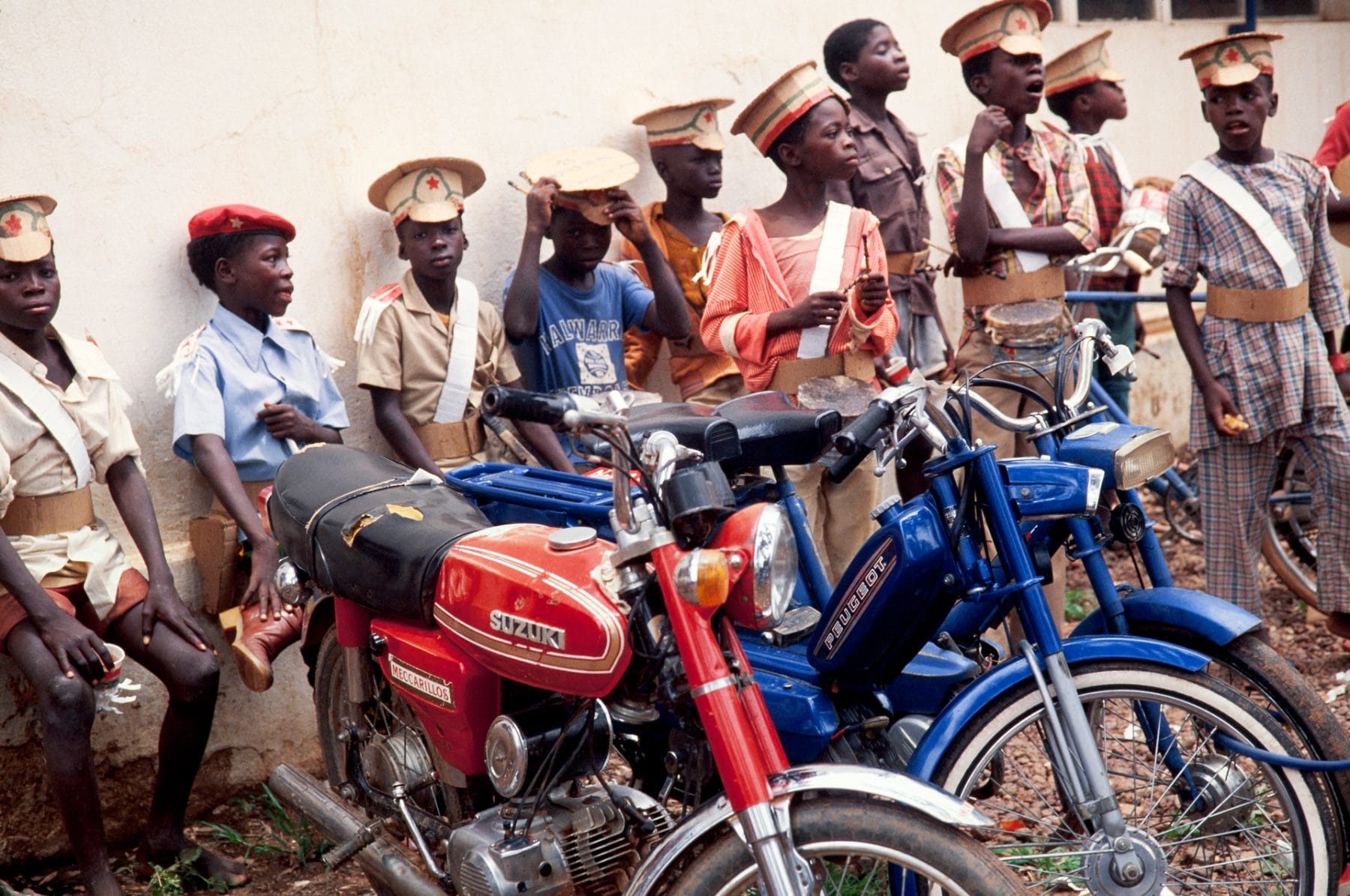
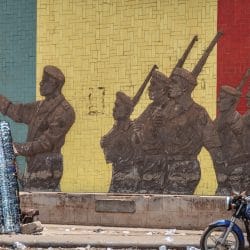
Burkinabè children wearing false kepis during the military parade in Ouagadougou to commemorate the second anniversary of the revolution of the Burkina Faso. August 4, 1985. Daniel LAINE / AFP via Getty Images.
This potted history is important to understanding the phenomenon of Ibrahim Traoré, Burkina Faso’s current president, an authoritarian head of state who in his charisma and self-presentation so deliberately echoes Sankara.
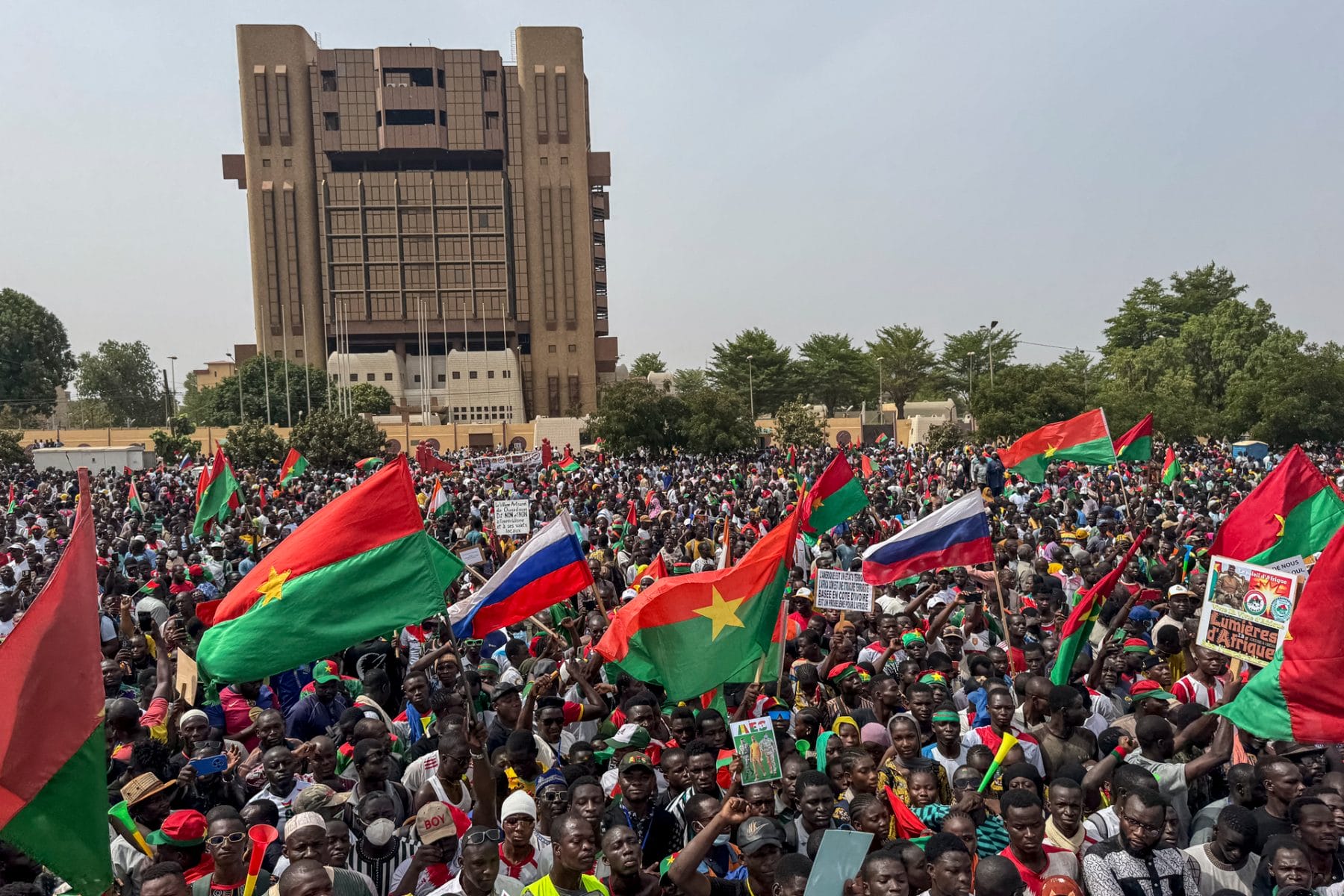
On September 30, thousands of Burkinabè gathered in Ouagadougou’s Place de la Révolution to hail Traoré on the fourth anniversary of the coup that brought him to power. As the second coming of Sankara, Traoré — whatever their entirely different political ideologies – is arguably the face of contemporary African anti-imperialism. It is a meticulously cultivated image that has almost nothing to do with Traoré’s actual record, or his achievements in Burkina Faso.
Traoré is a pan-African leader for a digital age, an autocrat who has suspended his country’s constitution, dismantled its admittedly fledgling democratic institutions and been accused of crimes against humanity, but who has used artificial intelligence, particularly deepfakes, to bury that record beneath a highly effective cyber cult of personality.
How do Burkinabè reconcile the man with the persona? And is Traoré a triumph of the algorithm, the kind of politician increasingly familiar from Ouagadougou to Delhi, Berlin, Buenos Aires, and of course Washington, DC?
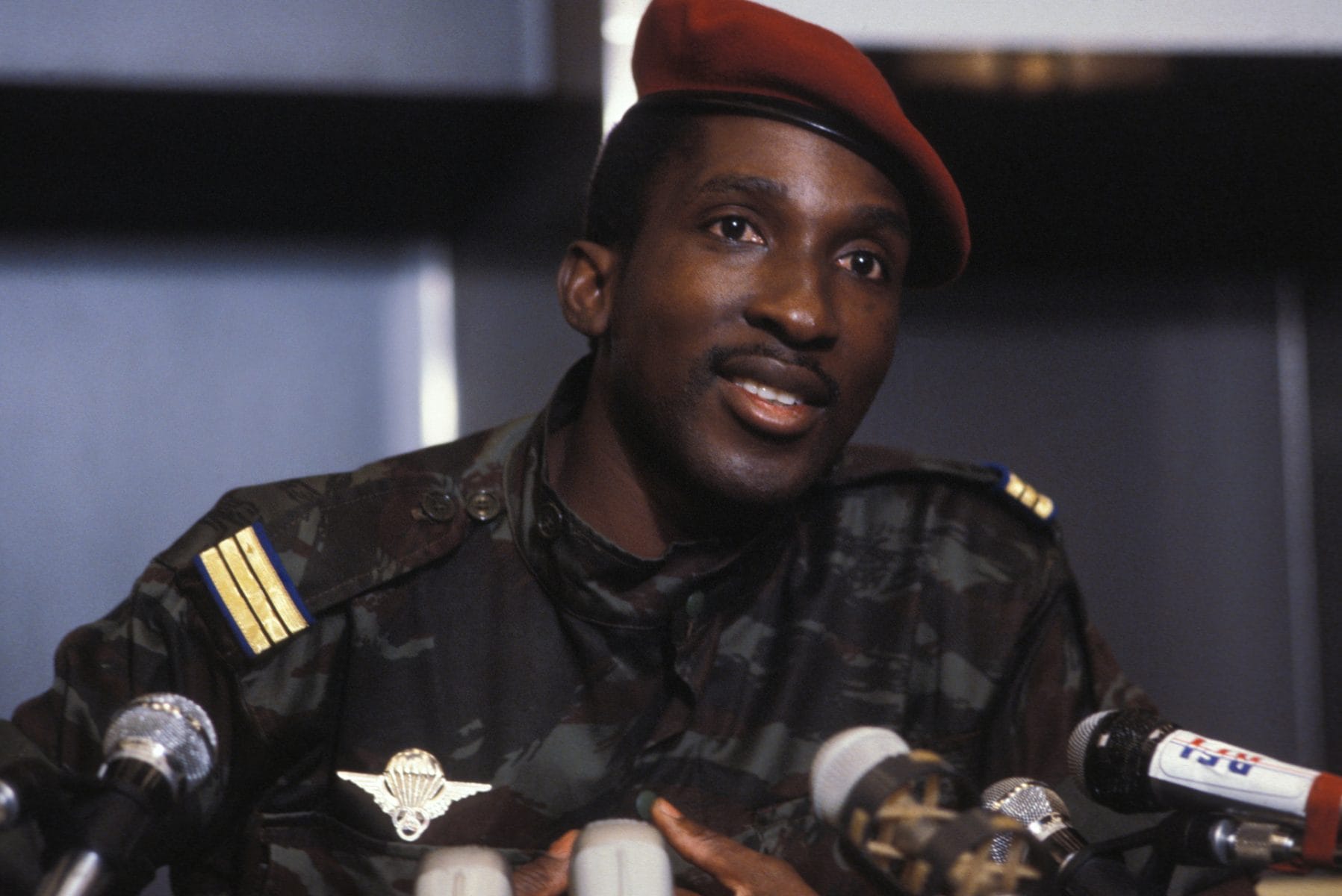
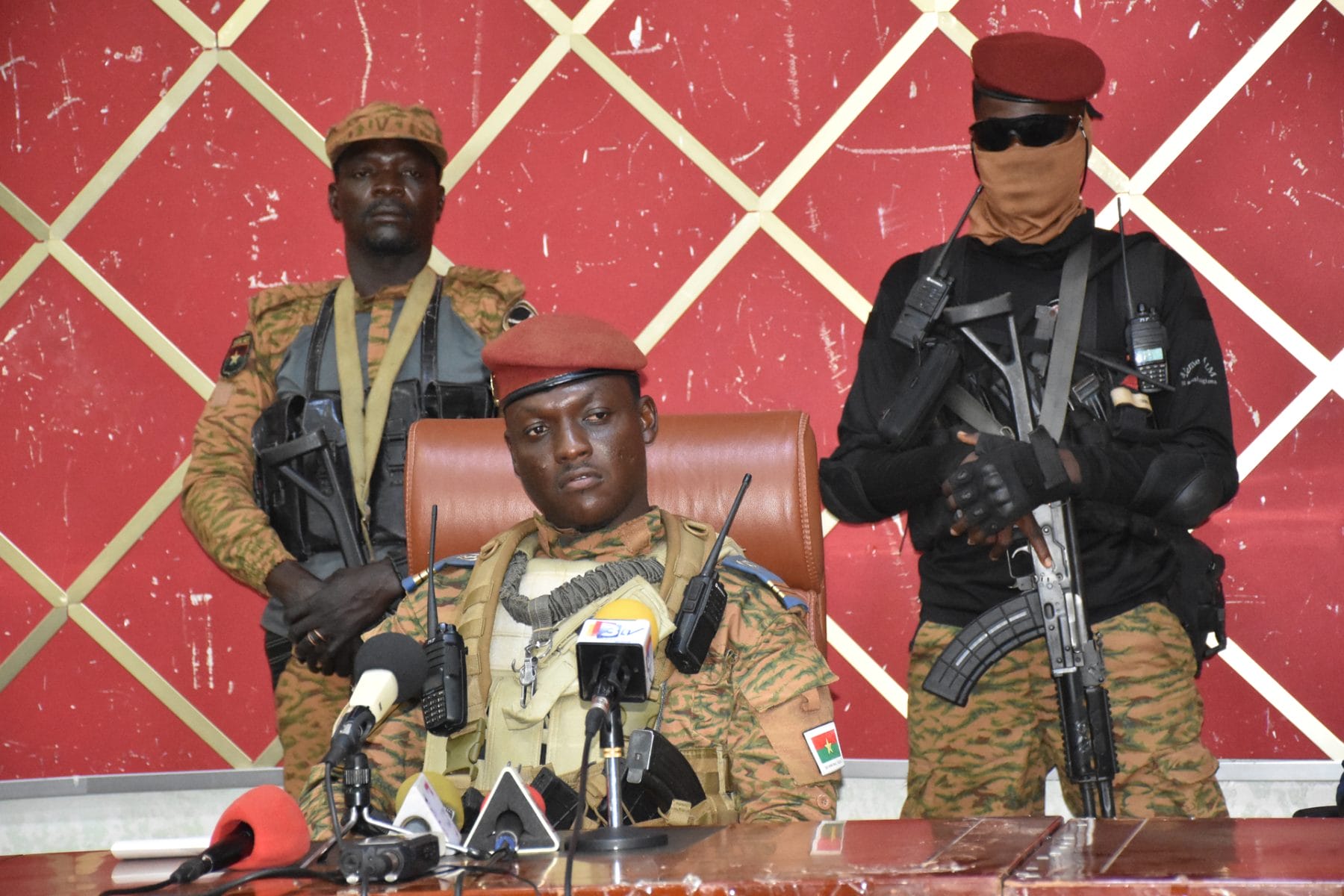
Left: Burkina Faso President Thomas Sankara during a speech on October 5, 1983, in Paris, France. Alain MINGAM/Gamma-Rapho via Getty Images. Right: New coup leader Captain Ibrahim Traoré at a news conference on October 2, 2022 in Ouagadougou, Burkina Faso. Stringer/Anadolu Agency via Getty Images.
The man, the myth, the algorithm
Ibrahim Traoré came to power in September 2022. In his own telling, while Sankara was installed as president, Traoré led the putsch himself. By January 2023, Burkina Faso terminated its military accord with France, giving French special forces one month to leave the country. In June this year, Burkina Faso ended all diplomatic relations with France.
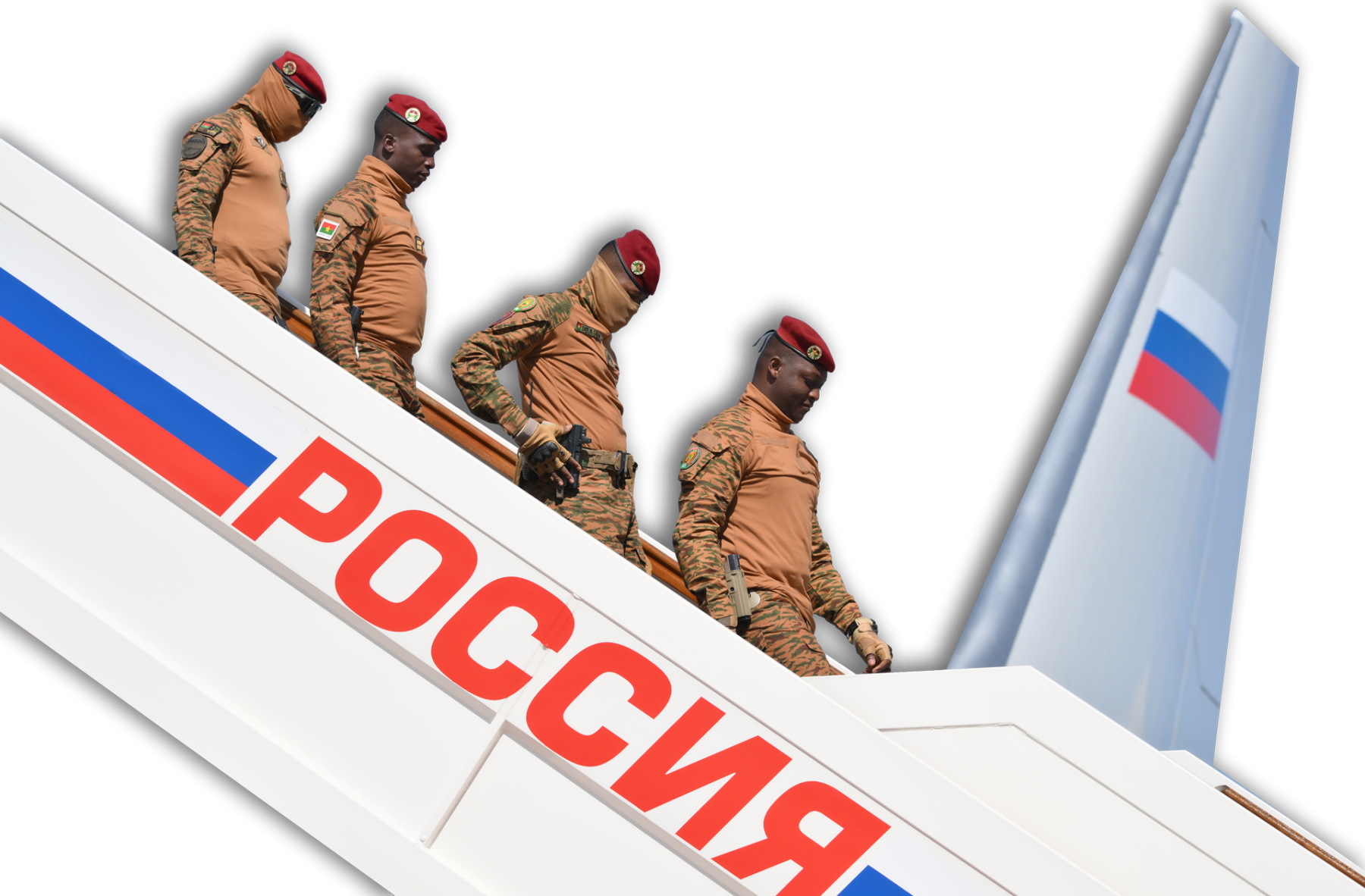
As Traoré turned away from France, he strengthened relations with Moscow. It’s in keeping with the pattern across the countries of the Sahel — Burkina Faso and its neighbours Mali and Niger — as the region’s colonial history with France has been swept clean by a broom held first by the mercenaries of the Wagner Group and latterly the Russian state itself, represented by the Africa Corps.
But in April and May 2026, Africa Corps forces were dealt a humiliating defeat in northern Mali by a combination of Tuareg separatists and allegedly Al-Qaeda linked Islamists. The Malian defence minister was assassinated in a suicide bombing at his home near the capital Bamako. With Russia so involved militarily in the Sahel countries, Ukraine has admitted to assisting rebel forces. Both Mali and Niger have cut diplomatic ties with Kyiv. And Burkina Faso has described Kyiv as a destabilising force in the region, making the Sahel effectively a front in Russia’s war with Ukraine. As recently as September, Traoré named Ukraine as a part of Burkina Faso’s “map of enemies” for which, he added menacingly, “we need to prepare.”
Russia, as Coda Story has reportedforyears, has used everything from weapons sales to mercenaries to paying African influencers to both spread Russian narratives and hold Moscow up as the alternative to continuing to rely on exploitative economic relationships with the West, particularly erstwhile European colonialists.
Despite the extent of Russian attempts to influence the Sahel, it’s not Moscow that is signing the most consequential deals with the military juntas it helps prop up. It’s Beijing. And the deals being signed with China to mine the region’s extensive mineral wealth — the lithium, gold, copper, zinc, bauxite and uranium — have served as a reminder to the United States that it too should resume stalled relationships in the Sahel. Early in 2026, Burkina Faso signed a near $150 million healthcare deal with the U.S. in exchange, it appeared, for favourable access to minerals. Both Zambia and Zimbabwe backed away from similar deals, expressing concern about U.S. demands for data and minerals that amounted to an infringement of sovereignty.
Burkina Faso's President Ibrahim Traoré arrives in Moscow, Russia on May 8, 2025. Grigory Sysoev / RIA Novosti/Anadolu via Getty Images.
The deals with China and the United States are being negotiated alongside a drive to reduce reliance on foreign loans and grants and ramp up domestic production, particularly of gold. Traoré claims his economic policies emphasise nationalisation and self-reliance. His government has taken over major mining operations and increased state stakes in other industries. In early 2024, his administration suspended export permits for small-scale gold production to crack down on smuggling and keep mineral wealth inside the country. Last month, he inaugurated Burkina Faso’s first gold refinery.
Some of this has had positive economic effects. The World Bank, in a June 2026 update, said the country had an estimated 5.3% growth in 2025, up from 4.8% in 2024, and its fiscal deficit narrowed from 5.8% of GDP to 1.8%. Inflation was also negative, 0.5%, compared to 4.2% in 2024. Reports by the World Bank and IMF have ascribed these growth to external factors such as the gold rally, climate-driven increase in agricultural outputs, and reduction in energy prices.
Economic growth, though, is part of a larger story that includes a crackdown on the press, particularly critical coverage of alleged human rights violations. Human Rights Watch documented 1,840 civilian deaths between January 2023 and April 2025, over 1,200 of which were directly attributed to government forces. Even as the report acknowledged widespread violations by Islamist groups, the actions of the Burkina Faso military, it said, “amounted to war crimes and crimes against humanity.” At the same time, Traoré has clamped down on Burkinabè civil society, banning over 100 human rights organizations and dissolving all political parties.
None of it appears to have affected his carefully-honed image in certain online spaces.
Street of Ouagadougou shows a poster celebrating former President Thomas Sankara, known as "Africa's Che Guevara" and the portrait of the Argentine-born guerrilla leader Ernesto Che Guevara. Ahmed Ouobaa/AFP via Getty Images.
Streets of Accra, Ghana, May 9, 2026. Olatunji Olaigbe.
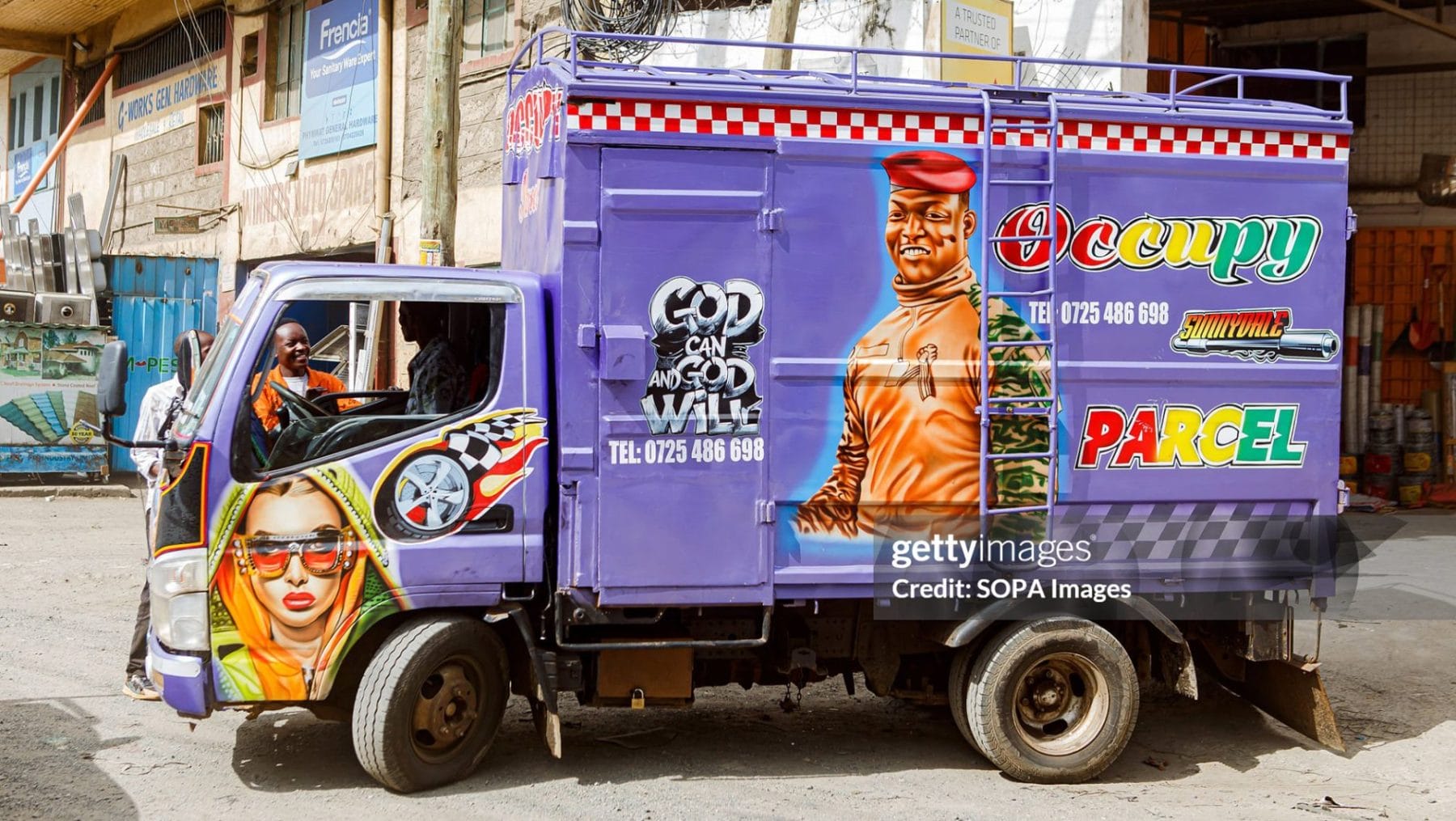
A graffiti portrait of the president of Burkina Faso Ibrahim Traoré. Boniface Muthoni/SOPA Images/LightRocket via Getty Images.
A pan-African hero
Traoré is everywhere. In Accra, the capital of Ghana, his image is pasted onto buses and in parks. In January 2025, at the swearing-in of the Ghanaian president John Mahama, it was Traoré who the crowd responded to, cheering for a rockstar rather than a head of state. Even Mahama joked that Traoré had stolen the show. Artwork celebrating Traoré is frequently posted online. The commentary that accompanies the art is gushing. “Through this artwork,” reads one Facebook tribute, “I celebrate the spirit of a man who stands for sovereignty, truth, and the rise of a self-determined Africa.”
Meanwhile, the Ivory Coast government has granted refugee status to at least 69,000 Burkinabè fleeing Burkina Faso.
In May, when I travelled to Ghana and Ivory Coast to talk to people displaced from Burkina Faso, at least five sources decided they no longer wanted to speak. Guaranteeing anonymity didn’t seem to matter. A Burkinabè journalist who was helping me find people to speak to, stopped responding to my messages the day after I arrived in Accra. Those who did speak to me refused to be quoted for fear that harm would come to family and friends left behind in Burkina Faso.
Reporters have been intimidated into silence. “Today, any journalist living in the country is forced to practice self-censorship to avoid being arrested,” says Harouna Simbo Drabo, disinformation analyst and Director of Programs & Partnerships of Faso Check. “Burkinabé journalists have two options,” he told me, “either practice self-censorship or go into exile.” After threats to his life, Drabo has left Burkina Faso.
He’s one of the luckier journalists. Since 2022, at least seven Burkinabè reporters have been forcibly conscripted into the army after criticizing the Traoré junta's crackdown on the press. Guezouma Sanogo, Boukari Ouoba, and Luc Pagbelguem were abducted days after their union denounced state media as "instruments of propaganda." Atiana Serge Oulon, editor-in-chief of L'Événement, is among the disappeared. Many, like Drabo, have either left Burkina Faso or quit their jobs.
As conditions deteriorate, what information is becoming available is government propaganda amplified by social media linked to Russian misinformation. In the absence of accurate, verified information, there is inevitably only disinformation. For instance, one of the most persistent pieces of disinformation is the story that Traoré — a supposedly avowed anti-imperialist despite his kowtowing to Moscow, Beijing and Washington — rejected billions of dollars in International Monetary Fund handouts because he believes, à la Thomas Sankara, in economic self-reliance. It is a story that has been debunked but was repeatedly told to me by Traoré supporters, including at least one journalist.
The claim was cited more than 700 times in a single three-day window in January 2025 alone, racking up millions of views across Facebook, X, and TikTok. Dubawa fact-checked the story and found that rather than rejecting money from the IMF, the Burkina Faso government had negotiated a 48-month IMF loan program in September 2023 and drew on World Bank financing in 2024.
By mid-2025. Code for Africa's analysis found social media in sub-Saharan Africa flooded with AI-generated videos casting Traoré alongside Beyoncé, Rihanna, and, in one particularly unhinged iteration, Pope Leo XIV, all of whom supposedly endorsed him as a Pan-African hero holding the line against the West. After US AFRICOM commander Michael Langley criticized Traoré's handling of Burkina Faso’s gold reserves in a Senate hearing, a network of 165 Facebook accounts began posting identical language claiming Putin had deployed special forces to protect Traoré from an American assasination plot. In ten days it pulled 10.9 million views.
In Accra, I caught a bus with a picture of Traoré emblazoned on the side. The driver, who only identified himself as Kofi, insisted that before we spoke I should tell him what I thought of Traoré. I say I am not Burkinabè, that I have not visited Burkina Faso but that I have spoken to many people whose lives have been upended by Traoré’s strongman politics. I told him about Burkinabè journalists in exile, forced to join the army, or even disappeared. I told him that when asked about a transition to democracy, Traoré said it was important for Burkinabè to “forget” about democracy. “We have to tell the truth,” Traoré said, “democracy isn’t for us.” I told him about the Burkinabè refugees I met in Treichville, a district in Abidjan, the Ivory Coast capital.
Kofi listened and then told me that “good things take sacrifice,” including the death of a free press. When I asked what he meant by good things, he showed me AI-generated videos of a smart city Traoré had supposedly built.
African identity is tightly wound around the belief that the continent has more potential than it has achieved. The deficit can be attributed to a lot of issues, but chiefly to Western exploitation and the complicity of African leaders. “African countries have also fallen into autocratic democracy,” Sanusi Sanusi, Research Analyst at the Digital Tech, AI & Information Disorder Analysis Centre, DAIDAC, tells me. “There is an election every couple of years but it isn't free or fair.”
Supporters of Traoré wave Burkina Faso and Russian flags during a rally at Place de la Nation Ouagadougou on April 30, 2025. AFP via Getty Images.
Neil Postman, in Amusing Ourselves to Death, writes that “disinformation does not mean false information. It means misleading information — misplaced, irrelevant, fragmented or superficial information — information that creates the illusion of knowing something but which in fact leads one away from knowing.”
Many Traoré supporters I spoke with, most of whom were men, were convinced they knew things I did not. They told me to educate myself more on Western hypocrisy in Africa. They said they did not have faith in those who appointed themselves arbiters of what was fact and what was disinformation. In Lagos I met Lemi Ghariokwu, who designed album covers for the iconic Nigerian musician Fela Kuti, a revolutionary figure. Ghariokwu, who has a portrait of Ibrahim Traoré hanging in his studio, told me that “Western education and propaganda has made our elite class toothless bulldogs.” Listening to them, it seemed as if a successful Africa needed strongmen, needed autocrats.
In Abidjan, the last person I spoke to about Traoré was Oumar, a Burkinabè taxi driver who had moved to the Ivorian capital in 2021. He told me he “supports Traoré with all my heart.” But as we talked, he admitted he had not been back home because “things are only getting worse.” Three Burkinabè refugees I spoke to told me they thought I might be a government agent planted among them to find out what they really thought about Traoré and that I would then report those thoughts back to Ouagadougou.
Many of the Traoré supporters I spoke with thought I was brainwashed by Western media or, worse, too docile to participate in an African revolution. For my part, I thought they were ill-informed and unable or, worse, unwilling to see through propaganda.
The fundamental curse of the age of information and connection is that we rarely confront how the mediums meant to unite us have fractured us. An unprecedented flood of data has shattered shared reality into millions of customized, mutually hostile subcultures.
With the help of AI and social media, Traoré has managed to decouple national and anti-imperial pride from government performance. By the middle of next year, Burkina Faso will no longer be part of the International Criminal Court, denounced by Traoré as an “instrument of neocolonial oppression”, and thus no longer accountable in any international forum. His government has said it is “decolonizing” the school curriculum. Cheered on by social media, Traoré has used anti-imperial grievances and resentments to argue that authoritarian military rule is the only safeguard for sovereignty.
As some Burkinabè exiles told me ironically, they thought both I, so sceptical of Traoré, and the Traoré die-hards in the African diaspora could use a few months living in Burkina Faso. We should, they said, experience the country Traoré has made IRL. See past the carefully curated myth of the man himself, the largely online fantasy of the pan-African, anti-imperial revolutionary who needs to break a few eggs to make the omelet, and assess the country he runs unchallenged.
In Denmark, the sea can’t breathe
For more than four months, Brian, a commercial fisherman in his late 40s, had been waiting for the weather conditions to be right for us to go fishing outside Bagenkop, a small harbor town on the southern tip of the Danish island of Langeland.
“One more problem has come up,” Brian told me over the phone in early May. “I have lost my fishing license." He was no longer allowed to sell fish for a living. Instead of preparing his boat to go out to sea and to
For more than four months, Brian, a commercial fisherman in his late 40s, had been waiting for the weather conditions to be right for us to go fishing outside Bagenkop, a small harbor town on the southern tip of the Danish island of Langeland.
“One more problem has come up,” Brian told me over the phone in early May. “I have lost my fishing license." He was no longer allowed to sell fish for a living. Instead of preparing his boat to go out to sea and to show me how fishing in Denmark had changed over his lifetime, Brian was now removing the registration number from its hull.
Across Denmark, coastal fishing communities are shrinking as catches decline. At the same time, warming seas, overfishing and pollution are putting increasing pressure on marine ecosystems.
“Plenty of fish in the sea”? Not anymore, say UN experts, with 35% of the world’s marine fish stocks being fished faster than they can be biologically replaced. Today, more than half of the fish we consume worldwide comes from fish farms.
This summer, sea temperatures along Denmark’s beaches reached 28 degrees Celsius, a record high. On September 2, the UN Environment Program warned that the world is likely to cross 1.5 C of warming above pre-industrial levels within the next few years. As the climate warms, the pressure on marine ecosystems grows.
In August, Iceland voted not to restart accession talks with the European Union, in part because of concern that it would lose sovereign control of its fishing industry. While fishing is not as major a part of Denmark’s GDP as it is Iceland’s, the EU’s impact has meant independent Danish fishermen have struggled to survive in the face of corporate competition.
For Brian, though, it’s about more than regulations. It is about watching the ocean he grew up with slowly disappear.
Nets covered in black slime
His story reflects a larger shift happening along the Danish coastline. Coastal fishermen, once a central part of the country’s history, are a vanishing breed.
For Brian, it was never about the money. Even when he was a teenager and he told his father he wanted to be a fisherman, his father said it was a bad idea. But the pull of the sea was irresistible. His life as a fisherman began as a hobby, accumulating experience and knowledge just by spending as much time as possible on water. He learned how to read the currents, the weather, and fish movements through experience rather than education. In 2019, despite the uncertainty surrounding the industry, he bought a commercial fishing boat. “When I started as a teenager, there were fish everywhere,” he said. But over the years, the numbers have dwindled starkly. Every few years, another Danish harbor became economically unsustainable. First Bogense, then Kerteminde, later Nyborg and Spodsbjerg. Each one of them followed the same pattern: fewer fish, declining landings, and growing questions about whether it was possible for small fisheries to continue their operations.
While working on this story, I spoke to ten small-scale Danish fisheries across the country. Half of them said they do not expect to still be fishing five years from now. In 2019, they said, ten nets could bring in between 150-200 kilos of plaice on a single trip. Two years later, the same nets would return with only two kilos. As the catches became smaller, so did the possibility of keeping a commercial license. Brian no longer caught and sold enough fish to keep his permit.
One day still stands out to him as perhaps the single worst he has experienced at sea. He had three nets in the water. The first one he hauled in looked normal. The second held fewer fish than expected. Then he started pulling in the third — the net was completely empty and covered in thick, black slime.
Marine biologist Stiig Markager told me that what Brian saw was a tell-tale sign of oxygen depletion. In 2025, around 40% of Danish marine areas were affected by low oxygen levels. Oxygen depletion happens when too many nutrients, mainly nitrogen and phosphorus from agriculture and wastewater, enter the sea. These nutrients fuel large algae blooms.
When the algae die and sink to the seabed, bacteria begin decomposing them, consuming enormous amounts of oxygen in the process. Climate change exacerbates the problem. “Warmer water contains less oxygen. At the same time, biological processes speed up when temperatures rise.” In practice that means algae grow faster, oxygen is consumed more quickly, and deep waters struggle to recover. Together, these processes reinforce each other. “When oxygen disappears, it damages the seabed ecosystem,” Markager said.
A new global study argues that aquatic deoxygenation is approaching an “unsafe space” and should be considered a potential tenth planetary boundary. The global ocean has lost around 2% of its oxygen over the past 50 years. The consequences for marine life are catastrophic, forcing either flight or suffocation.
Marine biologists have studied oxygen depletion in the Danish seas for decades. But, Brian says, “fishers are often the first people to see the effects of that depletion, directly in their nets.” It is a first-hand experience, fishers say, that is often discounted or ignored. Many independent coastal fishers say they feel increasingly excluded from political conversations about the ocean, despite spending their working lives at sea.
Source: DCE – Danish Centre for Environment and Energy, Aarhus University, Oxygen depletion in Danish waters, 2014–2025.
“It feels like we’re not really welcome anymore,” Brian said. He believes small-scale fisheries like his are being pushed out while decisions about the seas are increasingly made by those on land. “I think they don’t want so many people out there seeing what’s actually happening.”
For years, debates about oxygen depletion in Denmark have become deeply political. Marine scientist Stiig Markager says that the results of environmental research have repeatedly clashed with agricultural and political interests. “There is complete opposition from agriculture and from Venstre (a major center-right political party) to making research publicly available,” he said. “There is a clear political strategy from Venstre that there must be no interference with agriculture.”
According to Markager, tensions between environmental researchers and agricultural interests intensified during the early 2000s, as scientists linked nitrogen runoff from farming to oxygen depletion in Danish waters. Despite decades of plans and political promises, Markager says, the recovery many researchers hoped for never fully arrived.
For this story, I also contacted both the Minister of Environment and the Minister for Food, Agriculture and Fisheries to ask for an interview about the state of Danish waters and the future of small-scale fishing. Neither had time to answer questions.
“When I started as a teenager, there were fish everywhere.” Brian said in BK Kar“Fishers are often the first people to discover oxygen depletion, directly in their nets,” Brian explained."I have lost my fishing license," Brian said on a phone call.
What remains is behind glass
One harbor that has felt the impact of the changing nature of Danish waters is Bønnerup Strand, which has transformed from a fishing town into a tourist destination. The harbor now features an ice cream shop, a hot dog kiosk, a seafood restaurant, and a mini golf course. The iconic blue Danish fishing boats are conspicuous only by their absence. Instead, boats built for leisure, not commercial fishing, are docked at the harbor.
Along the quay, an outdoor exhibition has been installed behind glass panels. It started last year, created by a local group of volunteers trying to preserve what Bønnerup Strand used to be. The pictures show fishing nets piled high, men in blue overalls, boats unloading their catch, and fish laid out in crates.
Movement. Noise. Purpose. It was a harbor bustling with life. Hans, in his 60s now, was once a fisherman in Bønnerup Strand. He walks past the diorama and tells me that twenty years ago “there were 60 or 70 fishing boats here, now there are two.” Some of the independent fishers chose to leave, their lives no longer making economic sense. Others lost their licenses. The rest have disappeared, not all at once, but gradually. Some left before it was too late, others had their boats seized by the bank when their revenue became too low. “Quite a lot of my colleagues had their boats taken by them," says Hans, referring to banks who repossessed boats because independent fishermen no longer made enough money to pay for them.
You could say that the gradual suffocation of the Danish seas began in 1909 with the invention of the artificial nitrogen fertilizer that transformed global agriculture. Artificial fertilizer rapidly became central to modern-day farming. By 1959, nearly 75% of farms were using fertilizer to increase crop production. At first, the growing amounts of nitrogen entering the sea did not appear harmful. During the 1960s and 70s, the extra nutrients actually increased algae and plankton growth, creating more food for some fish species. “There were actually more fish,” says Markager, the marine scientist, “but by the mid-1980s, the consequences had become impossible to ignore.”
Fish auction hall, Esbjerg, 1968. Tonny Sørensen. Esbjerg harbor, 1972. Knud Rasmussen.Fish auction, Esbjerg, 1934. Gustav Bjerknæs .
On October 8, 1986, on Danish television fishermen in Gilleleje were seen pulling dead lobsters from the sea. The images became the subject of alarmed national conversation. For the first time, the public saw what oxygen depletion meant for life beneath the surface of the sea.
Hans, the fisherman from Bønnerup Strand, told me he was part of the television coverage himself. “Fishers had talked about pollution long before the dead lobsters,” he said. “But suddenly people started paying attention.” The public outrage pushed Denmark to act. In 1987, the country introduced its first Water Environment Plan, aiming to reduce phosphorus emissions from wastewater by 80% and nitrogen emissions by 50% within five years. For many fishers and marine scientists, it became the first real sign that the environmental crisis in Danish waters was finally being taken seriously. During the 1990s, nitrogen and phosphorus pollution declined significantly. Water in several fjords and coastal areas became clearer, and conditions slowly began improving. For a moment, it appeared the damage could still be reversed.
But by the early 2000s, many coastal fisheries were once again experiencing declining catches and, with it, a growing uncertainty about the future. Hans was one of those affected. Coming from a family that had fished for five generations, the harbor was never a tourist destination for Hans. It was a way of life. But on a sunny Friday in April back 2005, he sailed out to Kattegat for plaice. He knew it was over. “I said to my employee: “this is the last trip. I start working on land from Monday.”” He had made the decision months earlier, as the numbers of fish dwindled and regulations tightened.
It wasn’t an easy choice, but he had four children to think of. Climate change had taken away his livelihood. “You can’t do anything about it,” he said. “If you think too much about it, you go crazy.” Researchers describe this kind of environmental grief as solastalgia, the distress caused by watching a familiar environment change beyond recognition. Unlike homesickness, solastalgia happens while still remaining in the same place. For coastal fishers, the sea remains physically present, but the ecosystem they once knew and depended on, is disappearing.
Adapting has always been part of the job, says Hans. “There has always been a species that disappeared and then another one came.” But eventually, nothing was replacing what was lost anymore.
Hans in his shop, Møllefisk.
In 2002, marine scientists Stiig Markager and Peter Bondo Christensen from DMU, the Danish Environmental Research Institute, published research showing that around 75% of Denmark’s nitrogen emissions originated from agriculture through waterways and atmospheric pollution. The findings intensified tensions between marine scientists, politicians, and agricultural organizations about who was responsible for the declining marine environment.
In response to the worsening marine crisis, Denmark established DMU in 1989 to monitor oxygen depletion, nutrient pollution, and ecological changes beneath the surface. But their findings were inconvenient. By 2007, after nearly two decades as an independent institution, DMU was folded into Aarhus University as part of a wider restructuring of Denmark’s research sector. The decision sparked criticism from several environmental researchers and organizations, who feared the changes could weaken the independence of Danish environmental monitoring.
“Agriculture succeeded in closing DMU,” former researcher Bo Normander told the media. “Nature has lost.” In 2015, the Danish government introduced the controversial Landbrugspakke, easing environmental regulations on fertilizer use in an effort to increase agricultural production.
Critics warned that the policy could worsen nitrogen pollution in Danish waters at a time when oxygen depletion remained a recurring problem. In the years that followed, researchers from Aarhus University reported rising nitrogen emissions instead of the reductions politicians had promised. Markager argues that despite decades of environmental warnings, nitrogen pollution reductions largely stalled. While nitrogen pollution in Danish waters declined significantly after the first Danish Water Environment Plans in the 1980s and 1990s, researchers say the reductions have largely stagnated over the last 20-25 years.
Now, Denmark is trying to reverse that trend. In the first week of September, the country passed a historic new law changing how agricultural nitrogen is regulated. The law will take effect in 2027 and represents a significant tightening of the rules introduced in 2015.
Under the system introduced in 2015, farmers were allowed to fertilize closer to what was considered the agronomic optimum for their crops, while still operating within nationally defined nitrogen quotas and other rules. The new system moves in the opposite direction. Instead of relying primarily on broad national rules, nitrogen regulation will increasingly take the environmental sensitivity of individual areas into account.
Where a farm is located will thus matter much more. The requirements will vary depending on factors such as whether fields drain towards vulnerable rivers or coastal waters, and whether they lie above areas important for groundwater and drinking-water protection. For farmers, this means that the amount of nitrogen they can use will become more restricted in areas where the surrounding environment is particularly vulnerable.
For fishermen like Brian and Hans, the law represents a change they have long been asking for: an attempt to redress the damage done to Danish seas.
“I don’t think we’ll have fish out here ever again.” said Hans Fisker, owner Møllefisk at Bønnerup Strand“Quite a lot of my colleagues had their boats taken by them." Boat on land, Bønnerup Strand.
But understanding how the water became polluted is more complicated than it first appears. Much of the pollution data commonly referred to in public debates focuses on point-source pollution, which emanates from identifiable sources like wastewater treatment plants, industrial discharge, and fish farms, and is generally easier to measure. But most nitrogen pollution in Danish waters actually comes from diffuse sources, mainly agricultural runoff carried from fields through rainwater, rivers, groundwater, and the atmosphere. Unlike point sources, diffuse pollution is far harder to measure directly and comes with greater uncertainty in the data. As a result, wastewater pollution can often appear to be the biggest issue, even though agriculture remains the dominant source of nitrogen input into Danish waters.
For Hans, the consequences appear almost irreversible. These days, the fish often do not return. “There are still plaice here, but they’re too thin. They don’t gain weight.” Scientists point to several overlapping causes, and the suggested solutions are just as diverse. Activists call for stricter rules, fishers say there are already too many. Farmers reject blame, and governments insist wastewater is already being purified. Plenty of fingers are being pointed, but the problem remains.
Hans doesn’t expect it to change. “I don’t think we’ll have fish out here ever again.” These days, he’s on the other side of the industry, buying catch from fisheries and selling it to customers. “People have to get used to the fact that we don’t always have everything available on demand. With a changing climate, fish shops may no longer offer cod, salmon, or plaice like we’ve been used to.” Instead, he says, squid is becoming the new normal.
Still, while independent fisheries disappear, the demand for fish continues to grow. Instead of restoring the ocean, parts of the fishing industry are increasingly moving onto land.
In northern Denmark, companies like Skagen Salmon are now raising fish entirely inside closed artificial systems, where the water, oxygen, and temperature are carefully controlled. Outside, Skagen Salmon looks like a factory. No windows, just a large grey box near the coastline.
If the building had windows, the fish inside could look out at the sea. But these fish will never see, taste, or feel those waters. Instead, they are raised in artificial tanks until they reach market size. They are then slaughtered and sold to supermarkets and fish shops across the country.
https://youtu.be/XKDIe7PXMCw
Video from Skagen Salmon recirculating aquaculture system (RAS), by Victoria Jensen.
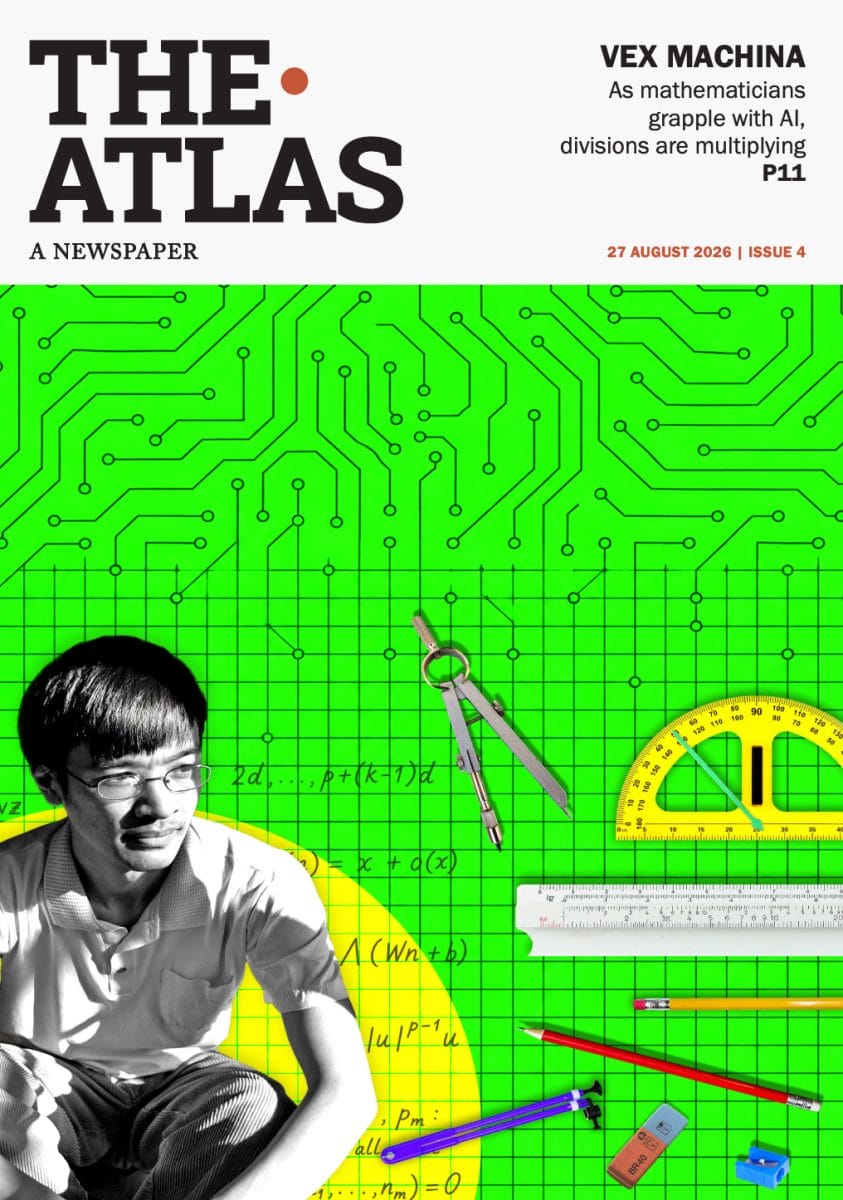
This story first appeared as the cover story in Issue 4 of The Atlas, a new global publication by Coda Story and The Continent. Sign up to the newspaper here.
In late July, at the International Congress of Mathematicians (ICM) in Philadelphia, the mathematician Jacob Tsimerman was awarded one of four Fields Medals – the highest honour in mathematics.
A few hours later, Tsimerman announced that he was joining OpenAI.
Tsimerman’s departure from theoretical mathematics, while at the absolu
This story first appeared as the cover story in Issue 4 of The Atlas, a new global publication by Coda Story and The Continent. Sign up to the newspaper here.
In late July, at the International Congress of Mathematicians (ICM) in Philadelphia, the mathematician Jacob Tsimerman was awarded one of four Fields Medals – the highest honour in mathematics.
A few hours later, Tsimerman announced that he was joining OpenAI.
Tsimerman’s departure from theoretical mathematics, while at the absolute peak of his powers, highlights the fault line in a debate that is upending the normally quiet world of higher mathematics. “What a dick move,” said one mathematics professor, speaking to The Atlas off the record.
Tsimerman, who has written extensively about his fear of “omnicidal futures involving artificial intelligence” – a fear that AI could wipe out humanity, closely associated with the AI “doomer” community – has said he will work on OpenAI’s safety team.
Tsimerman and OpenAI did not respond to a request for comment.
In recent months, OpenAI has announced proofs of various longstanding mathematical problems, solved with one of the company’s latest large language models. Other companies have also made advancements: RedNote, a Chinese AI model, obtained a perfect score at the International Mathematical Olympiad in Shanghai in July.
Human mathematicians, at all levels of the profession, are reeling from the implications. Tim Gowers, a professor at the University of Cambridge who helped to verify one of OpenAI’s proofs, has written that even if AI models fail to progress further, “we have still probably entered an era where it will become very difficult for humans to compete with AI at solving mathematical problems”.
This is a startling assessment – and a marketing coup for the likes of OpenAI.
“Mathematicians actually have a special role in this,” said Joshua Grochow, an associate professor in Computer Science and (by courtesy)Mathematics at the University of Colorado Boulder. “The AI companies’ PR pitch is essentially to say, ‘Look, we have solved math. the intellectually hardest thing ever, therefore we can solve everything.’ ”
LLMs have not solved math – far from it. Nonetheless, Grochow added, recently some capabilities have improved. “They are legitimately able to produce real math, new math that they had not produced before. So you can’t deny that utility. You can deny the extent of that utility, but you can’t say it’s all BS.”
Miek Messerschmidt, a senior lecturer in mathematics at the University of the Witwatersrand in Johannesburg, recently used Anthropic’s Claude to take a crack at a problem that had stumped him. Claude solved it within 30 minutes. “How did I feel? You mean emotionally? I was relieved, because I didn’t have to go down this dead end any more. But I was also disconcerted by what this entity could do in such a short amount of time.”
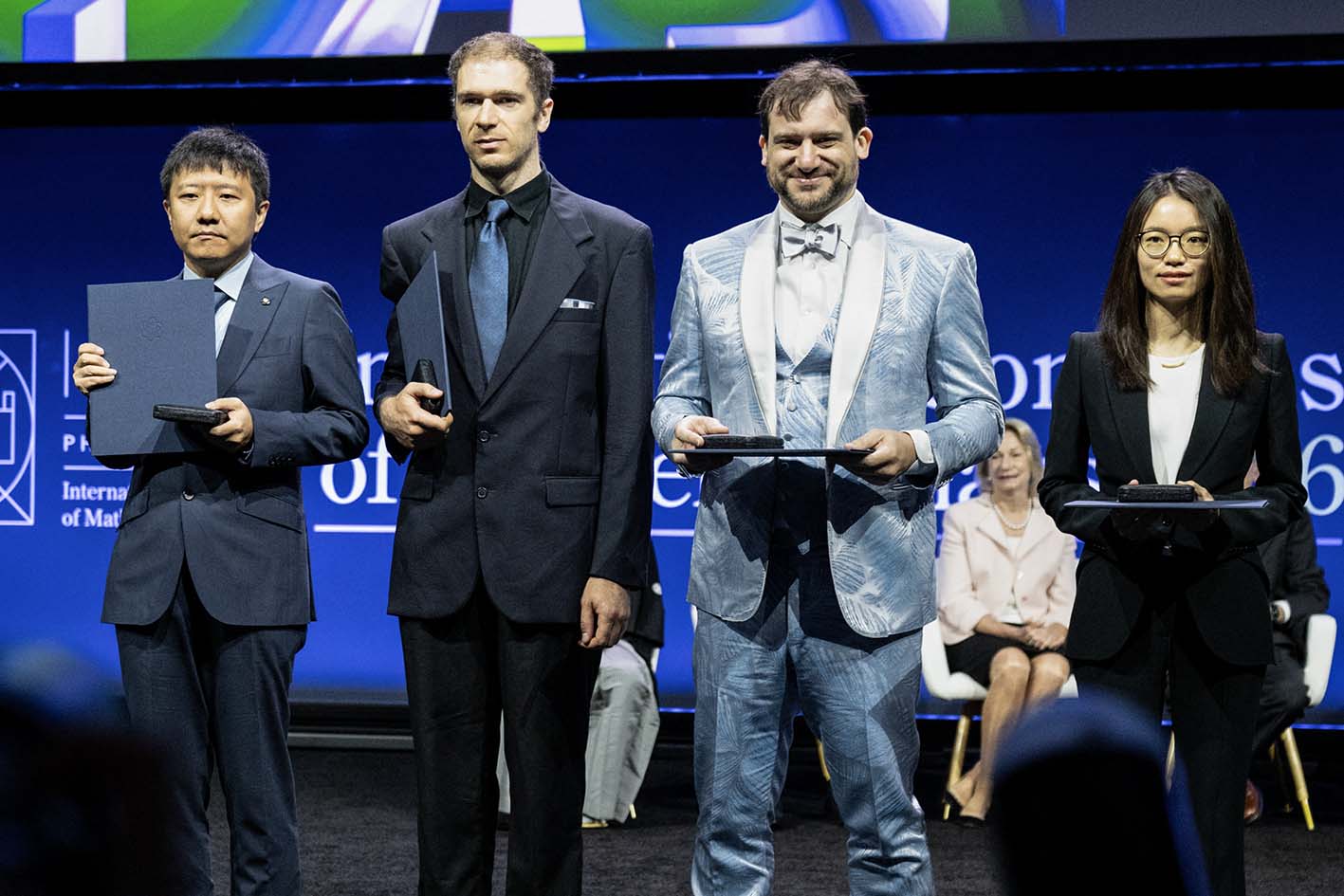
This year’s Fields medallists: mathematicians Yu Deng (China), John Pardon (US), Jacob Tsimerman (Canada) and Hong Wang (China). Photo: Erin Blewett / AFP.
NEW VARIABLES
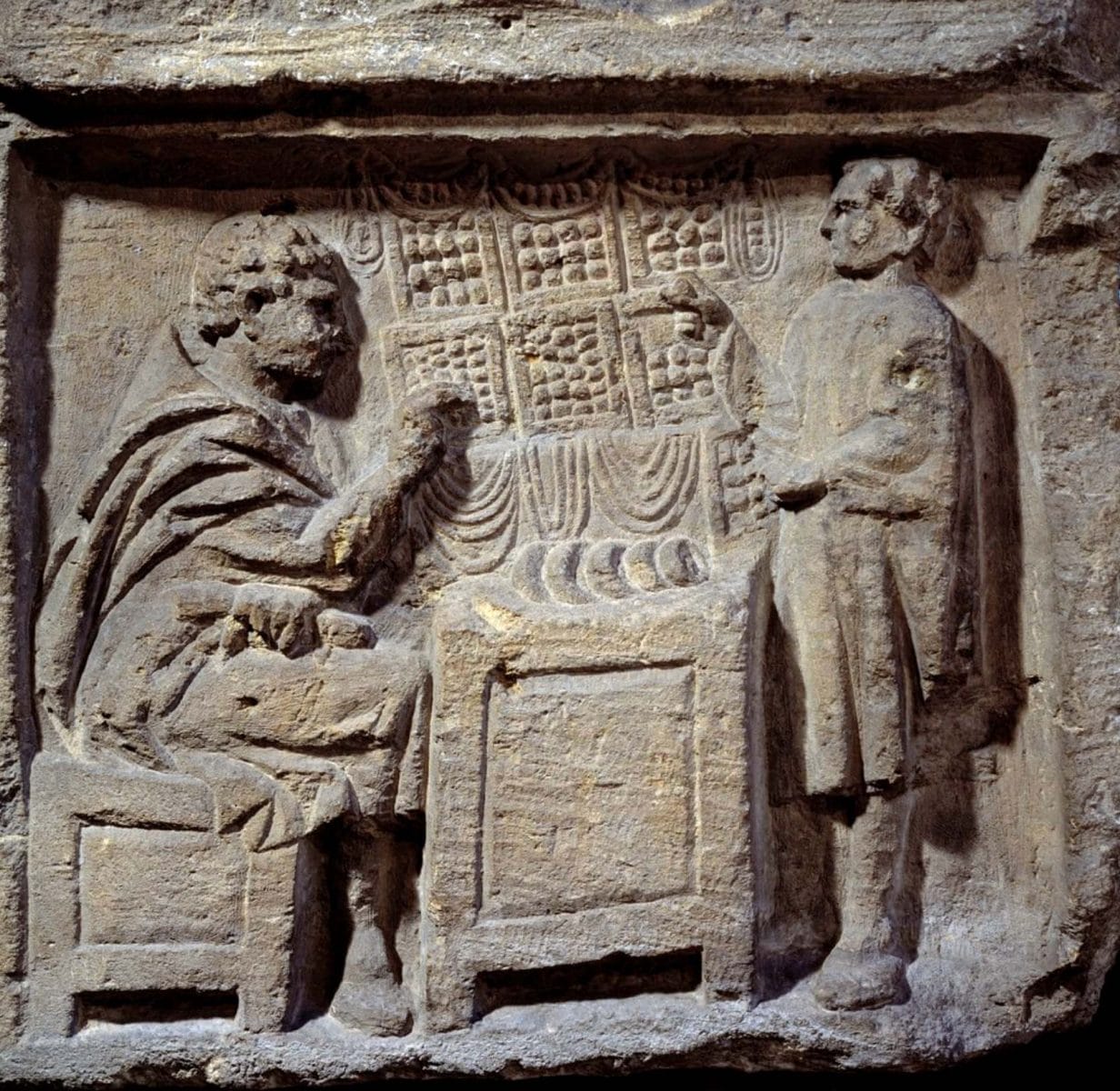
Mathematics has been disrupted by technological leaps before. The abacus. The mechanical calculator. The blackboard, even, which played an instrumental role in standardising training and mathematical notation (“It’s hard to research, because most of what’s written on blackboards doesn’t stay there very long,” said mathematics historian Michael Barany).
But AI is a different kind of disruption. Where previous advances helped mathematicians expand the frontiers of their knowledge, large language models threaten the livelihoods, and purpose, of mathematicians themselves.
“Our place in society at developing new ideas has been quite unthreatened for quite some time,” said Tim Chartier, a Professor in the Department of Mathematics and Computer Science at Davidson College. “For a long time, the frontier of mathematics could only be expired by the mathematicians themselves. There were no tools that could push into that boundary, except the research mathematician…At this current time, it’s not like we don’t need research mathematicians – but the landscape has changed so quickly, it’s hard to know what that will look like a year from now, two years from now.”
This matters for everyone: for thousands of years, mathematics has been considered to be the foundation of scientific knowledge. There is no physics without mathematics. No astronomy without mathematics. And there is no computer science – or AI – without mathematics. What happens if there are cracks in the foundation?
“I think that LLMs pose an existential threat to the mathematical community,” wrote Tasmin Chu, a PhD student at the California Institute of Technology, in an essay published on 2 August – the day after OpenAI released a set of ten new mathematical results, resolving or making progress on various problems.
“This is a polemic, not a press release,” Chu continued. “I know that others feel the same way; I have spent today crashing out and learning that top mathematicians I know are crashing out.”
Some of what mathematicians are worried about is the same as what everyone else is worried about: that AI will take their jobs; that AI companies have absorbed everyone’s work, and are reproducing it without attribution or compensation; that students aren’t learning properly any more; and that there won’t be jobs for them when they graduate.
But some worries are more specific to the field. Like the fear that, if mathematics becomes too reliant on particular AI models, then AI companies will have the power to restrict access to a select few – or make it prohibitively expensive. That promising young mathematicians, instead of turning to research, will use their talents instead to refine proprietary algorithms, which may or may not be used for the common good. That there will be no one left to understand, let alone vouch for, the mathematics produced by the machines. That objective truth, or anything close to it, is going to be much harder to prove – a fear shared with journalists, incidentally, who find it increasingly difficult to verify whether a photograph is real or fake.
2nd Century relief of a merchant using an abacus. Photo: Musée de La Cour d’Or - Metz Métropole.
MATHEMATICIAN IN THE LOOP
After speaking with more than a dozen leading mathematicians from around the world, The Atlas can confirm that Chu is not alone with her fears: it’s all anyone is talking about. The crisis is existential – and mathematicians are looking to one man in particular to guide them through it.
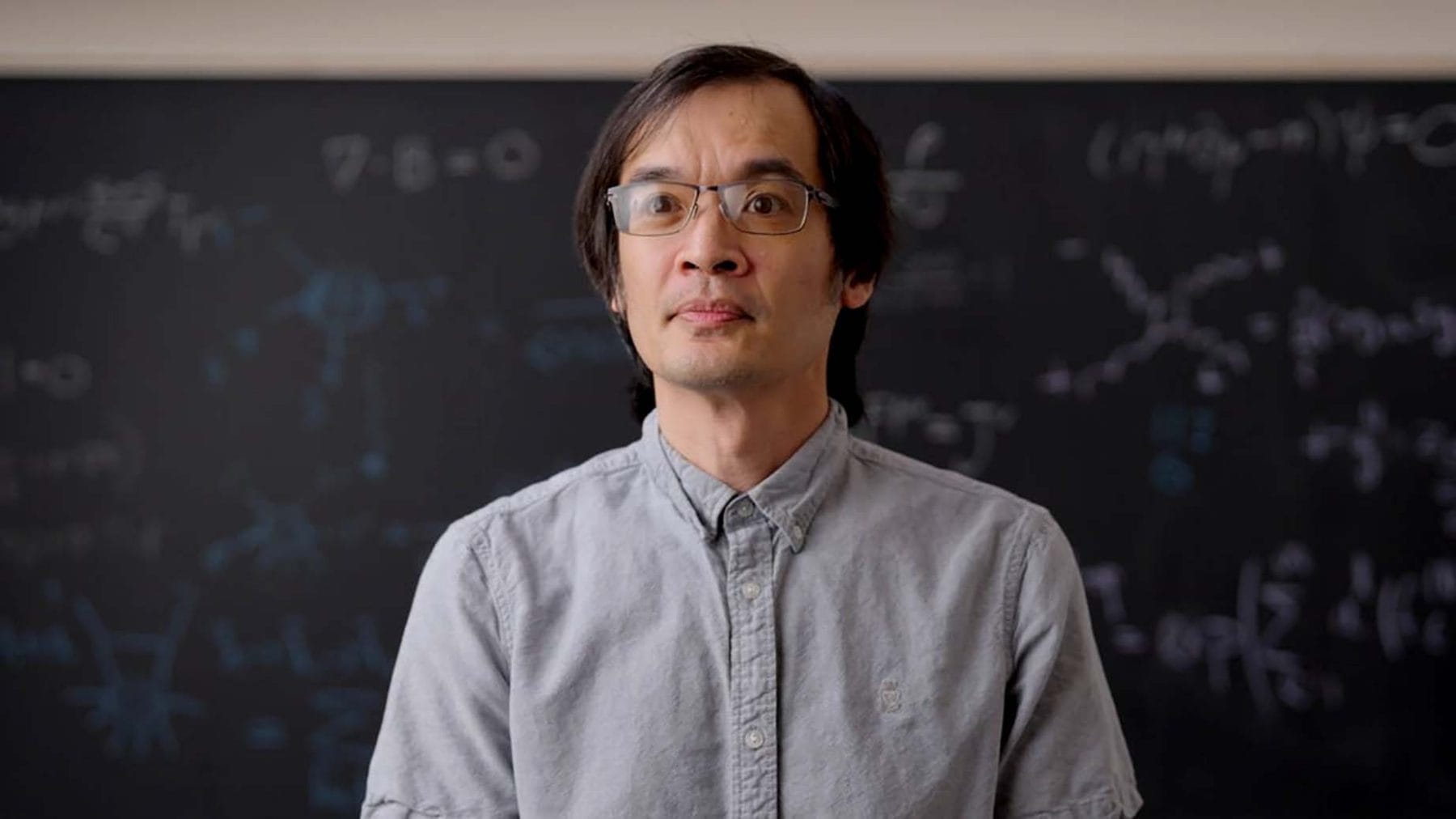
There are no working mathematicians who are truly famous. The closest anyone gets is Terence Tao, a professor at UCLA, who is often referred to as the world’s greatest living mathematician. A prodigy, Tao skipped five grades of school, receiving his masters degree at age 16. By 21, he had earned a PhD from Princeton, and was awarded the Fields Medal just ten years later, in 2006, for his pioneering work with Ben Green on prime number theory.
But what sets Tao apart, in a field infamously incomprehensible to outsiders, is his ability to communicate to both mathematicians and laypeople alike. This has made him a de facto spokesperson for the mathematics community – and extremely influential in setting its norms. “From all accounts he’s a lovely man,” said one researcher, speaking anonymously.
“But the social pressure to agree with Terry Tao is really strong.”
On July 24, the day after Jacob Tsimerman joined OpenAI, Tao gave a public lecture at the ICM titled “Mathematics in the Age of AI”. In it, he presents his “working hypothesis”: that AI tools for mathematics, which he already uses in his own research, will keep getting better. This will allow for collaboration on a vastly greater scale than has ever been possible before, Tao argues, and speed up the pace of research – revealing new, previously unimagined frontiers.
But it will also change, fundamentally, the role of human mathematicians. There will be little point in problem-solving – the computers will handle that. But the humans will still have to do the really hard work: understanding why AI-generated proofs are correct, and explaining this to others. The sooner they embrace this and plan accordingly, Tao concludes, the better.
The Atlas reached out to Terence Tao to request an interview. His human assistant, UCLA media relations officer Holly Ober, declined the request, making a referral instead to a “living document” which is maintained by Tao’s Claude AI assistant, on his website. This document synthesises Tao’s current thinking on AI, based on his public writings and talks, even “interviewing” Tao with follow-up questions.
As per his AI assistant, Tao believes that the topic of AI in mathematics is too important to be left to just a small number of spokespeople – and that his own “influence on this discussion should diminish as the rest of the community steps up.”
Terence Tao, often referred to as the world’s greatest living mathematician. Photo: OpenAI Academy.
AN UNSOLVED EQUATION
Not everyone believes in the inevitability of AI defining the future of mathematics. According to several sources, both organisers and funders were disappointed with the turnout at the ICM in Philadelphia. Despite the gravity of the occasion, the congress was not at capacity.
Ila Varma and Tarik Aougab, associate professors at the University of Toronto and Haverford College respectively, may have had something to do with that. In March, they launched a petition to boycott the ICM due to the ongoing war in Iran, increasing authoritarianism in the United States and the risks faced by visiting academics – if they were even allowed in. “AI companies were invited, but most African mathematicians who tried to attend couldn’t get visas,” Varma said.
More than 2,600 people signed the petition. For Varma, this is evidence that mathematicians may yet use their status to resist the influence – and the cash – of the big AI companies.
“There’s an idea that the positionality of mathematics in society is to decide who’s smart, who’s worthy of the most lucrative career opportunities and the privileges that go along with it. And now we are being asked to take this technology that is likely to be extremely unhealthy for users, that’s bad for the environment, this thing built on unethical labour, and our discipline is being used against many of our wishes to tell society that this thing is intelligent, and that you should let it do your thinking for you.”
Michael Harris, a professor at the Institut de Mathématiques de Jussieu in Paris, was at the ICM in Philadelphia. “The talks I attended on AI, starting with Tao’s public lecture, took pains to insist on the need for human mathematicians to make sense of anything produced in the name of the discipline, by machines or by humans,” he said. “There is a growing resistance to any use of AI whatsoever in mathematics, especially among young people, and this will become evident over the next few months.”
One of the clearest voices of dissent belongs to Max Weinreich, Assistant Professor of Mathematics at the City University of New York.
In an essay published earlier this month, Weinreich makes the case against what he describes as “artificial mathematics”: “Mathematicians do not need to use AI, nor should we use AI; soon, I argue, you will not want to have your name associated with AI. Instead, we should use our intellectual authority to oppose its development.”
His opposition is about more than mathematics, he told The Atlas. In his view, the environmental and financial implications of the AI boom pose major societal risks – and mathematicians, given their privileged position, are one of the few groups of people who can do anything about it.
As John Fletcher, a theoretical physicist and mathematician, observed: “There is a lot of power in being perceived as the smartest people in the world.”
Po-Shen Loh, a professor at Carnegie Mellon and former coach of the US International Mathematical Olympiad team, backs mathematicians to figure it out – by treating it like a maths problem. “AI is making mathematicians engage with the real world. They are smart enough to realise they have an existential crisis. They’re quickly racing down to discover all the dead ends, to see what works and what doesn’t.”
And when they figure it out, maybe they’ll let the rest of us know.
A version of this story, edited for length, first appeared in The Atlas newspaper. Additional reporting by: Shougat Dasgupta, Masho Lomashvilli, Irina Matchavariani.
We’re inching forwards through the thick smog that has cloaked Tbilisi for days. At first, I thought it was a kind of blueish, pink winter mist that makes the city feel like it’s in an ongoing sunset, until a friend who smokes told me they’d been having trouble breathing in it.
It’s Black Friday. A journey that should only take a few minutes is stretching past an hour and for the most part, Tsaro and I are sitting in silence, occasionally passing a phone between us to translate the few wo
We’re inching forwards through the thick smog that has cloaked Tbilisi for days. At first, I thought it was a kind of blueish, pink winter mist that makes the city feel like it’s in an ongoing sunset, until a friend who smokes told me they’d been having trouble breathing in it.
It’s Black Friday. A journey that should only take a few minutes is stretching past an hour and for the most part, Tsaro and I are sitting in silence, occasionally passing a phone between us to translate the few words we do speak. Both sides of the road are jammed. People are rushing for the deals at CarreFour, she sighs.
This November day is also the 365th day of continuous protests in Georgia against a government Georgians believe is steering the country back into the Kremlin’s orbit after years of moving towards Europe. Dozens of Georgians are languishing in prison, often in pre-trial detention, for participating. The protests themselves don’t make news outside the country so much anymore. Unless, that is, there is some kind of significant development, like the discovery of toxic WWI-era chemicals used by police in water cannons, the same cannons I watched the police turn on young Georgians for hours last winter.
It was while covering one of these still ongoing nightly protests that I met Tsaro Oshakmashvili, a 62-year-old widow with wayward orange curls. And it was through deciding to remain after the October 2024 election, the one international observers say was marred by serious irregularities, that I found myself reflecting upon what authoritarianism can do to how we relate to one another and the duality of Tbilisi. Georgia now has more political prisoners than Russia per capita, and still regularly features as an upcoming destination amongst many UK newspapers.
Since our meeting, Tsaro has become a public figure after her de-facto adoption of Archil Museliantsi, currently in jail for allegedly damaging property during the protests. Archil is a 30-year-old-law student who was orphaned at six months old. When the pair first met on Rustaveli Avenue, at the height of Georgia’s protests, he turned to Tsaro and told her he was ready to die for his country.
Just a few days after we met, Tsaro and I were accosted by police. I’d been taking photographs outside the gates of a Tbilisi prison. With some effort, she calmed them down and we walked away with my memory card wiped. We got back into her car and sat in silence. She then turned to me and, even though my knowledge of Georgian is small, I saw the glint in her eye and knew what she was saying; “You didn’t delete them all, did you?”
Archil is serving four years for allegedly setting fire to one of the new CCTV cameras used to identify protesters through facial recognition technology. The video used to sentence him doesn’t contain any trace of his face, though. Just a man in a balaclava and a burning piece of paper. His lawyers argued it wasn’t enough to identify him, but he was found guilty anyway. After receiving his verdict, Archil was told he could request a presidential pardon. His reply: “What President? Do we have one?”
Tsaro now spends her days campaigning around the country in Archil’s name, encourages him to make use of his sentence by pursuing his law degree, and brings him supplies in Gldani Prison. The three books and the tracksuit bottoms on the backseat of the car are for him.
When we finally arrive, I get out of the car and notice the huge sky and the quiet. Tsaro points towards an empty field with a mesh of electric poles running through it, the city a hazy silhouette in the distance. "That's Archil’s view," she says, and pauses for a moment.
We go through security, stepping over a sleeping dog, and enter a room divided by large steel bars with an x-ray scanner running through. Archil’s things can go forward, but we cannot. As a non-blood relative, Tsaro has no visitation rights. So we watch on in silence as the items slowly travel through the scanner. It will be three more years until Tsaro and Archil can be in the same room again. It will also be the fourth time they’ve met.
Later that night, a crowd gathers at Tbilisi State University. An explosion of flares and music signals for the protest to begin. Tsaro marches at the forefront behind a huge banner. She smiles and waves at the camera, her way of signaling to Archil that she's watching him.
I walk with the crowd, face hidden by sunglasses and a cap: enough to not be picked up by facial recognition, but hopefully not too much to violate recent laws that prohibit concealing your face.
Afterwards, I meet a group of friends who have gathered at a nearby bar. A man who is visiting from Argentina is wondering about whether to move to Tbilisi permanently, telling me what a fantastic place it seems to be. I tell him he should, then step into a sideroom, and watch on in silence as two men make use of the empty space to dance.
Tsaro. Gldani Prison.
It’s strange to arrive in a place at such a high-stakes moment and only realize what that means as it happens. From the beginning, Georgia asked little of me and gave everything back in return, operating on such frictionlessness that meant I barely had to ask what it was that I was doing there. Perhaps the same reasons I first started to love it were the same reasons vacationing Russians had during the Soviet Union; myths of the eternal host and a perceived openness to strangers, though that "warm welcome" had started to wear thin. But this wasn’t something I initially stopped to ask myself — this question of Russia’s colonial relationship with Georgia, its occupation of Georgian land, and the influx in 2022 of tens of thousands of Russians fleeing mobilization and war with Ukraine.
Shortly after arriving, I found myself in a reality that held little regard for tomorrow; people of all nationalities — Georgian, Russian, Ukrainian, Belarussian, European, and others — turning to the present moment as a form of coping. But although I sensed that people were escaping, avoiding, I was still doing the math on who was fleeing what, exactly. It would still be many more months until I learnt the difference between what it means to confront oneself versus one’s oppressor and what we owe to the places that receive us.
But the thing that provoked me to start wondering about such things wasn’t Georgia’s existential fight against Moscow. It was a relationship with somebody who was fleeing themselves.
A friend had suggested I come to Tbilisi, proposing that Georgia could make a good follow up to a story I had recently finished about Ukrainians starting a new life in the UK. I spent the first days in the company of international correspondents focused on the upcoming election and what it would mean for the country. Drink in hand; the conversation usually concluded with how much they loved it here and when they were flying out again. I listened, sheepishly, unable to venture an opinion and not clear about what a return to an authoritarian past would look like in practice.
As the days crept forward, I couldn't have said how long I would stay, but my neighbor never asked anyway. Iskra was my age. Her dog, Riri, liked to nap on my bed. Ours was the last of a remote cluster of homes with balconies fashioned from old scraps of wood and living room furniture arranged haphazardly on the street. It was one of the highest points in the city before it gave way to rugged mountainside. The only traffic that went by here was the funicular and the tourists who gawped out of its windows.
Without saying too much, Iskra and I were getting to know each other, sitting on our shared patio with the city, a dark twinkling pit, below. Between us, a favorite topic was emerging; Georgia, its unpredictability, and a feeling of being at odds with the places we had left behind. Iskra was born in the Uzbek Soviet Socialist Republic and had moved to Amderma, Russia's northern coastline, where her mother had worked as a geologist. The war had made it clear to her that she would not be returning. I was still ambivalent about what it was I carried with me from my own homeland, what that counted for in Georgia, and the idea of returning. It was Iskra who first explained to me the origins of Georgia’s resentment towards the Russians that had moved here after the war. That I was learning it from a person who had spent most of their life in Russia might have felt more ironic, had she not said it with such conviction.
After February 2022, Tbilisi was flooded with people coming over Georgia’s northern border, their arrival enabled by the ease of remote work which muddied the water between dissidents, draft dodgers, those looking for an easier life, and plain wartime tourists.
In the early days, more than 10,000 people might have arrived in a single day, a rate that wouldn't go unnoticed in Tbilisi, a city with a population of 1.3 million. Some pursued anti-war activism, others opened bars catering, at times, to an exclusively Russian clientele. As rents jumped and Russian echoed through the streets, local resentment simmered.
When Russia launched its full-scale invasion, many Georgians recognized themselves in Ukraine. And now, with so many Russians in the city, could Putin use their presence to justify another special military operation and "liberate" Tbilisi, too? Or, would the Georgian government align itself so closely with the Kremlin that he wouldn’t have to?
Georgian Ministers debated what to do. Should they restrict entry, like they had in the Baltic states, or allow people in, fearing that turning them away would simply deliver them back to Putin's army. Meanwhile, locals took matters into their own hands, some venues insisting you could only enter if you recognized Russia as an occupier, requesting that people sign a physical declaration. But attempts to sort so-called "good Russians’" from "bad Russians" amplified hatred, with one venue who employed such policies undergoing cyber attacks from a far-right Russian group as a result. Eventually, some gave up and went home, tired of having to prove themselves the "good" kind, while Georgians endured a crushing gentrification from the very same country whose legacy they had been fighting since the Red Army invasion of 1921.
Old TbilisiGraffiti depicting Georgians' sentiments towards Russia
Arriving abruptly from the UK put me in an unusual position — naive enough to move between worlds without being in the firing line, and outside the divide enough that, in time, I would start to see the particularities of it clearly.
One evening, I was on my way out, looking for something to eat. Iskra was smoking on the patio.
“I’ll join you,” she said.
We descended into the city, the street lights casting a deep amber glow over its surface like dark honey, and arrived outside an Italian place. Amid the chatter, there was one man sitting alone, an untouched plate in front of him. Iskra knew him from somewhere, and the two of us slipped into the empty chairs beside him.
After a few short words between the two, the man turned to ask me where I was from. When I told him London, his eyes widened “Oh, London? I love this culture,” proceeding to talk endlessly about the 2008 electronic music scene, naming bands I thought I had forgotten, reviving a curiosity I hadn’t felt in some time.
“OK,” he announced, standing up as abruptly as our conversation began. “I will go to The Creek. I hope you will join me there for a drink.” And we did, entering through the double doors, passing the bar, to find him sitting in the courtyard beneath a fig tree. There we spent the remains of the evening listening to him talk about growing up in a remote Siberian town, the concentration of wealth in Russia, and the challenges of throwing parties in homes that can only fit 20 people. Iskra's eyes glazed over. Not mine.
Two nights later, I met Kostya again. From the beginning, I had questions. What was he really doing in Georgia? Did he leave Russia because he was against the war, or because he didn’t want to be sent to the front? Should he be actively helping Ukraine? What does he owe Georgia now that he is here? But I didn't ask them outright, waiting to see instead of hearing it and resonating with a person who, like me, was fueled by restlessness.
We spent the evening moving from place to place — first a wine bar, next a red-lit basement. He was unable to stay in the same spot for more than 45 minutes. Each time we took a seat somewhere new, he began talking with the same fervor as when we first met; telling me about his childhood pets, cleaning toilets throughout his military service, a brief employment stint doing social media for a local environmental ministry, before realizing “what it really was,” being cheated on by his childhood love, and cheating on all his loves since. Each of his stories is a portal into a parallel world, where words make sense, but the context they operate within does not.
It’s not until we’re sitting on the pavement outside an overspilling bar that I really start to notice him; his box shaped jaw, his eyes that stare upwards from the way he tilts his head forward when he speaks. His accent makes each syllable heavy, like a thud, when suddenly he asks if I want to go somewhere else. We do. And when I announce that I’m done for the evening, he walks me home, to the very top of the city, to a final and precarious footpath that weaves over the mountain side before landing outside mine. We hug, awkwardly. Kostya has already started to walk away when I realise how much I’ve enjoyed his company.
“Thanks for a great night,” I shout.
“Pfff - thank me?” he replies, turning to address me and walking backwards as he does.
The following few days run like a strange clockwork. We meet most evenings, at the same time, in one of a handful of places. This, I never questioned. Instead, I relished in feeling like I had found a side door into a place I was still figuring out – meeting people of multiple nationalities in a single night, unable to tell who lived here and who was passing through; though it didn't seem to matter, and no one thought to ask.
A car in Old Tbilisi
“Let’s go to Pith,” says Kostya.
His friend, Artur, a Russian guy of Chinese descent is standing behind the bar dressed, as he usually is, in an oversized checked shirt. The place is empty aside from the three of us and it’s gone closing time.
“I would like to go to Thailand,” says Artur, drink in hand.
“Pfff. Thailand? Really? Come on man,” replies Kostya.
“Yes - really. I’ve had enough of this city,” says Artur, slamming his glass on the table. “We’re fucking three hours away from Russia right now. In October, this place is going down. Georgian Dream is gonna get re-elected and Putin will use the country as his playground. I don’t want to be here when that happens.”
“So, what do you want to go to Thailand for?” asks Kostya.
“Bro, I’m Asian. I just want to go somewhere people aren’t gonna look at me twice, where I can start a business and live in peace. Plus, I can’t be dealing with the situation between China and Taiwan. I’ve just left a war. I don’t want to be anywhere near the firing line when China invades and the US starts sending over nukes. I want to be sitting on the beach smoking a huge, fucking joint.”
A few days later, a friend learnt I was in Tbilisi and insisted I meet his friend. I went without Kostya and found myself sitting around a table in the company of Georgian women, many of whom had recently moved abroad, making idle chit-chat over a table of food. A woman to my side gave me a list of things I had to see and do, telling me how often people fell in love with her country and decided to move here permanently. I asked why she left and she went stiff; “it’s different if you’re from here.”
Another woman turned to me; “So, tell me where you’re staying.”
When my attempts to explain to her were unsuccessful, she pulled out a map on her phone and handed it over. I looked at the screen. Half of Tbilisi was covered in red crosses.
"Don’t worry," she told me, seeing my eyebrows furrow. “Those are just the businesses owned by Russians we avoid,” before telling me that I must get the same app myself.
I took a closer look. Half the places Kostya and I went were each marked with a red cross. I imagined myself trailing around that map, Kostya at my side, a red cross following us everywhere we go.
After that night, the writing on the walls, that's become as staple as the buildings themselves, took on a new immediacy.
“Fuck Russia.”
“Russia is a terrorist state.”
“Russian’s go home.”
“You’re not refugees.”
Another graffiti in Tbilisi
The city starts to slow as the weather gets hotter. So hot, that even the crickets give up their ceaseless chirping and the smell of trash cooking inside their bags waiting to be collected taints the air.
Iskra and I are sitting in the patio eating watermelon until she suggests heading to a party being held at a nearby dog shelter, the intention being for dogs to leave with new owners. As we approach the fence dividing our place from the sloped wasteland, we’re hit by a smell so rancid that it stops us in our tracks. We cover our mouths, struggling to catch our breath between the chokes and sputters.
“I can't,” Iskra says, shaking her head, her voice muffled.
Then I glance up and see it: a black cockerel, lifeless, hanging from a tree, a shoestring knotted tightly around its pale foot. Its head tilts to one side, its wings splayed open, motionless in the breezeless air.
The two of us stand there, before Iskra whispers
“It’s a curse.”
Soon after the black cockerel appears, Iskra moves out, opting for a house on the other side of town that she shares with a Georgian family. We continue to meet. One night, we’re sharing a meal, when she announces she’s leaving. I message Kostya who is at Pith.
As I walk across town, the night is indistinguishable from any other. The city's old stone buildings and cracked pavements are dimly lit by the same amber streetlights. The same hum of nightlife whirls in the background, as people move onto their second, or third, venue for the evening. But tonight, it feels muted, like a party winding down before ever really beginning. Clusters of people stand outside bars, their mouths moving, but faces vacant.
I can’t tell if anything has really changed, or if I’m just imagining it. Earlier that day, a piece of legislation had come into effect. The Foreign Agents Bill meant any organization receiving more than 20% of its funding from overseas would have to register as “pursuing the interests of a foreign power.” It’s a clever, simple law, lifted from the Kremlin, giving the ruling party power to shut down media, evacuate NGOs, and silence activists. Violent protests to reverse the bill in March 2023 were successful, only for the bill to resurface. This time, the bill passed. This was not just a law. It was a signal that Georgia’s government was importing the Kremlin’s operating system.
A few days later, Kostya is staring at me from across the table, hardly blinking as he smokes. I stare back, not really seeing him, half wondering if the past few weeks are just something I made up in my head. I’m leaving tomorrow.
“You know, I really don’t know where I am going next, or what I am going to do. Sometimes I think I also want to go to Thailand,” says Kostya out of the silence.
“I’ve been accused so many times of being some kind of bad guy here. The amount of times I’ve been made to say "Putin is a dickhead," just so that I can order a beer. I know what's happening in Russia is a lie, but still, I can’t just abandon it. I have to protect it.”
“Why, though?”
“Because,” he says. “I have nothing else.”
A man walks dogs outside a yard gate in old Tbilisi
“They were cold winter days. I put on a coat, and went to the rallies, for the sake of the children”
— Tsaro Oshakmashvili.
As Election Day, October 26, 2024, approached, Georgia’s State Security Services went on Facebook to warn of an impending Western coup, and a plot to assassinate the billionaire founder of Georgian Dream and former prime minister Bidzina Ivanshvili. A pro-Western elite was supposedly preparing to topple the government and drag Georgia into war with Russia. Outlets that spread Kremlin narratives picked up the story, adding one detail: only Russia — and Putin himself — could prevent such a coup from occurring. I had been back in the UK during the run-up to the elections, and when my flight touched down in the city of Kutaisi on the night Georgia went to the polls, I turned on my phone to find both Georgian Dream and the opposition coalition claiming victory.
As we shuffled off the plane, a man asked where I was headed. I say Tbilisi and he asks if I wanted a ride with his friends: a motley crew of Georgian and Australian men, each dressed in a version of a navy puffer jacket. When it turned out there were no buses this time of night, I said yes.
I sat up front next to a man called Tornike. I had him pegged as 45 and Iwas shocked to learn he was actually my age. I ask who he voted for.
“Please” he said in a low, nasally voice. “I didn’t bother.”
“Why?” I ask.
“It’s lose-lose either way. Politicians just want money. I’m 31. I’ve got - what? Forty, fifty, years left. I’d rather just enjoy my life.”
I stepped out of their car and into the bitter wind on Rustaveli. Tbilisi was quiet. Somehow the lights felt more grey than amber. A lone car was driving up and down the broad central drag, blaring its horn, a Georgian flag billowing from its window. A group of men loitered on the empty street and cheered each time a car passed and then returned to standing in silence.
The next day, I go for a walk. Everywhere I look, I see a city void of life, of people. I message friends. The only person who wants to meet is Dato, a sparky 24-year-old I got to know over the summer. He picks me up in his car. We tear through the city.
“This government doesn’t give a fuck,” he says, barely breathing between his words. “There is no other way but to do another Maidan. But I really hope I’m wrong.” referring to the 92-day-long pro-European protests in Kyiv’s central square which led to the fall of the then government, the annexation of Crimea just weeks later, and the death of 103 protesters.
In just over a month's time, Dato will be arrested as he leaves a friend’s house and, later, flee the country.
We go to meet his friend, a successful restaurant owner who tells me he’s ready to pack it all in and leave Georgia for good. It’s not about fighting, it’s about making an exit.
“Will you come back?” I ask him.
“There will be nothing to come back to.”
Kostya, who’s hosting me, returns at 4 A.M. from a trip to Istanbul. He changes into his pajamas and gets into bed beside me. It’s now been 48 hours since the election result. Evidence of voter intimidation and ballot stuffing starts to mount. Increasingly, it appears the election was stolen. A demonstration organized by opposition leaders is being held outside parliament that evening. I ask Kostya if he’s coming, but he’s going to Pith to see friends. “For my welcome home party,” he says.
That night, the news coverage shows men holding banners stating “Georgia is not Russia.” Young women embrace amid a riot of EU and Georgian flags; people clutch their hearts as the national anthem sounds. But when the opposition finally unveils their grand plan to fight, the mood changes.
“Our plan,” they say, “is you.”
Later that evening, I sit on Kostya’s bed while he smokes on the balcony, the cold slipping in through the open door. The harsh overhead light glares above. I tell him about the deflated protest, the sense of hopelessness settling over the city, and the stories of young Georgians planning to leave the country for good.
“I’m sorry, but these people killed my empathy,” he says, stepping in from the balcony.
I remind him why he came here in the first place, but Kostya waves off my concerns, insisting that life here could never compare to Russia, recounting the stories of people sentenced to years in prison for holding up blank protest placards, for reposting anti-war content online, for replacing price tags at a supermarket with messages to stop the war, or throwing plastic water bottles at police. As if a protest like tonight's would even get the chance to happen in Russia, he says. They'd arrest you the moment you gathered. The police would know before you even start. “Maybe now,” he says, “they will understand what it’s like to be us.”
An arrest happening on Rustaveli Avenue
I spend successive evenings attending protests, interviewing people and taking photographs. I pitch news outlets. One story I have is about members of the LGBT+ community fleeing the country. Only the month before, the Family Values Bill passed which prohibited all pride events and public displays of the rainbow flag, banned gender transition, adoption for same sex couples, and allowed censorship of films and books. The law is an almost direct copy of Russia’s anti-LGBT law. One man told me how he was stripped and beaten by police when they found LGBT content on his phone. Editors express only vague interest. In Tbilisi, history is accelerating. In the rest of the world, Georgia barely registers
I go out with Dato and his friends. All anyone can talk about is the election. “If we lose this, we lose our identity,” says Dato, standing to his feet in an impromptu speech. “Where are the Russians who fled here because of the war? If they came here because of Putin, why don’t they join us in the fight?”
I put the question directly to Kostya the next day, asking him if he thinks it's his duty to join. But, really, I just want him to admit what’s really at stake; that the stories he has been told are a lie, that the same stories are used to justify wars that he can escape, that protecting those stories isn’t really escaping at all, it’s remaining trapped in the same narratives that people on the streets outside are now fighting.
But the answers I want aren’t the answers I get.
“My country?” he asks, indignantly. “What about Europe? They are the ones making problems here.”
How would I feel, he asks, if Russia started creating bases on the UK’s borders? Just as NATO is doing in Ukraine. It’s strategic, he says, the EU flags at Georgia’s airport, the funding, the way EU leaders ferry themselves in and out of the country and address crowds at opposition rallies, painting themselves as Georgia’s savior. Europe has created this situation, not Russia.
“Anyway, whatever. I just want to live my life. I’m OK with being here and them hating me.”
“But this is the crux of the hate.”
“Let them hate,” he says. “I’m tired of all the fucking hate.”
When I return, he tells me not to speak, and that we should end it. I glance at the cigarette trembling in his hand and ask for ten minutes alone to pack my things.
The bleakest day yet comes on November 25, a month after the election and the day Georgian Dream members are sworn in. The city is cloaked in wet fog. The protesters’ plan is to block the legislators from entering parliament, but with hundreds of masked policemen forming a wall around the building there is little that can be done. Within minutes, the plastic grinning faces of parliamentarians are projected from live screens, signing their oaths of office. The crowd stands motionless in the rain, wet Georgian flags hung around their shoulders.
Suddenly, people surge towards the iron fence erected around the building, pounding their fists against it. The desperate hammering brings relief. For a moment, it feels as though something, anything, might finally happen. But hours later, as I file photos from a cafe across the street, people are still banging on the fence, and Georgian Dream has long left the building.
On November 28, the news arrives that Georgian Dream will be suspending EU accession talks, suspending the only future that isn’t linked to Moscow. The response is immediate. Rustaveli floods with tens of thousands of people for a bitter standoff with the police who chase and beat individual protestors into the following morning. They begin to pick protesters off one by one while walking their dogs or collecting their children from school. Each evening, the crowd rejuvenates and the cycle repeats.
Somewhere in the crowd, Archil meets Tsaro for the first time. Together, they endure the cold, the tear gas, the water cannons, the indiscriminate arrests, the raids, the beatings by police. And despite having only just met, what they experience erases the distance between them. "We went through such terrible days… that, of course, there was no difference anymore,” Tsaro later told me. “This was my son. He was a son of the same Georgia.”
By the start of 2025, all major opposition leaders will be arrested; while attempts to legally ban all opposition remain underway today, effectively creating a one party rule. Obstructing the road is enforced with fines or detention, while obstructing the pavement becomes listed as a new offence. A man is charged for insulting the police online. Another is charged with throwing a water bottle at police and sentenced to two years. I think of Kostya's words, that Georgia will never be anything compared to Russia, and don’t feel so sure.
Day Georgian Dream members were sworn in.
Where does Georgia go from here? Czech MEP Marketa Gregorova recently said Georgia was undeserving of its EU candidacy status and that, with Viktor Orbán gone, there would be no one left to oppose targeted sanctions against officials. Meanwhile, Russia has deepened ties with South Ossetia. Part of the new agreement grants Russian citizens the right to take up official positions in the occupied region. One month after declaring the new partnership, South Ossetia’s Prime Minister stepped down. His replacement; Marat Kambolov, a Kremlin-appointed Regional Administrator. In May, Georgian Dream launched a new unit for monitoring online “hate speech” against officials, with 60 cases already being filed.
People still stand outside parliament as 118 prisoners of conscience serve out their sentences. Some who continue to protest ask where the younger generation have gone; others say it's the sheer scale of the crackdown and the extended power police have that keeps them away. Just a few weeks ago, a friend told me he was leaving. "Society here is broken," he said. Sitting on our shared terrace, I recently asked my neighbor, in his sixties, if he attended the protests back in 2024. He just laughed. “This is nothing new for Georgia.”
The other day, I passed Kostya in the street. It was the unmistakable sound of British English from the woman he was with that made me turn his way. Two years later, the irony is that perhaps he was right; the younger generation, the ones who haven’t left, say they do have a deeper understanding of what it is like to live beneath authoritarianism — the main difference being that it didn’t cost them their empathy.
When I visit Tsaro at home, she shows me pictures of Archil on her phone, cooing how cute he is, joking that he makes her own children jealous. But I also know that she feels the full weight of this moment from the times that I have seen her cry while reading his letters.
There was something else Tsaro said that day we were intercepted by police, something that surprised me more than her small hope that I’d somehow defied the police.
“You know, not all police are bad. Some are really good people,” she said, using my phone to translate. “I felt sorry for them. They told me we have families, too. If they don’t do something, they’ll be fired and unemployed. That’s why they are afraid.” Then, smiling once again, said she was looking forward to telling Archil the story later and that he would certainly find it very funny.
Tsaro has now spent many weekends campaigning across the country with the Mothers of Conscience, a collective of mothers whose children have been imprisoned for protest-related charges since 2024. One member, Marina Terishvili, whose son is serving two years, lost her other son on the 9th April 1989, the day Georgian demands for independence from Moscow were met with shovels, tanks, and toxic gas at the hands of the Soviet authorities. Many people’s names did not make it into the official tally of the dead that day. They died months after exposure to the gas.
The Mothers often deliver newspapers written by their children from behind bars. I've joined them on these newspaper runs, and recently took a copy with me to translate back home. In it, I found a note from Archil:
“Stand by a stranger, this is what gives me strength and motivation to fight, fight when I see how people care for each other, fight when I see how they support and stand by me, a stranger to them.”
The collective responsibility people take for others, standing by strangers, is something I still see in Tbilisi, even if that community is now confined to the patches of pavement where it is still legally permitted to protest, or to the contents of a package delivered behind bars, or to the sofa in Tsaro's living room, the one that Archil is planning to sleep on when he is released. Such acts of solidarity exist in a space authoritarianism cannot so easily reach: the space between people, another homeland.
The Age of Exile
This story is part of our Age of Exile series, which explores how displacement has evolved from historical punishment into a defining condition of our time—one that reveals profound transformations in how we construct identity, maintain community, and exercise power across borders. In an era where digital connection enables presence without physical proximity, exile has become more complex, more global, and more central to understanding our world. Explore The Age of Exile series
After kilometers of flat, orange desert, the bus dives down through an increasingly lunar landscape as it reaches San Pedro de Atacama. Amidst the sea of red rocks, patchy vegetation and distant high plains known as altiplanos, a small sign appears on the side of the road. The entry marker has been tagged in graffiti. “Se vendió los salares.” “They sold the salt flats.”
The town of San Pedro, located in the north of Chile not far from the borders with Argentina and Bolivia, then appears like
After kilometers of flat, orange desert, the bus dives down through an increasingly lunar landscape as it reaches San Pedro de Atacama. Amidst the sea of red rocks, patchy vegetation and distant high plains known as altiplanos, a small sign appears on the side of the road. The entry marker has been tagged in graffiti. “Se vendió los salares.” “They sold the salt flats.”
The town of San Pedro, located in the north of Chile not far from the borders with Argentina and Bolivia, then appears like an oasis. In this hub for international tourism, small buses packed with visitors make trips from the dusty, bustling center to explore the region’s various geysers, sand dunes and volcanoes. Night sky tourism ventures offer a unique look at the southern stars. But it is the vast white salt flats, formed between 100 and 10 million years ago, that people come from around the world to see.
As tectonic plates slowly shifted, water flowing from the Andes mountains lost access to the sea and settled into a natural drainage area known as an endorheic basin. Here, water evaporated quickly, leaving a white crust of salt on top and below, a rich mélange of minerals – lithium, potassium, magnesium, and boron — encased in brine. The Salar de Atacama is one of the biggest salt flats in the world — and one of the most important.
On March 11, Jose Antonio Kast, Chile’s new president took office. Kast, a conservative ostentatiously close to Donald Trump, has long been a critic of Chile’s national lithium strategy. One of his first actions as president was to sign an exploratory deal with the United States to extract rare earths and essential mirals. Chile, the world’s largest producer of copper and second largest of lithium, is central to the Trump administration’s plans to reduce its reliance on China as a source of the rare earths and metals that are fundamental to modern industry, from semiconductors to electric vehicles to batteries to defense technology.
Even before Kast took office, he attended Trump’s “Shield of the Americas” summit in Miami, an ostensibly security-related alliance that is also an attempt led by the U.S. to curb China’s growing influence in Latin America. Under the previous Chilean government, China had become a dominant player in the national lithium industry, as it had in Argentina. With Javier Milei, a Trump ally, in office in Buenos Aires, having another ally ensconced in Santiago has been a significant boost to U.S. plans to reclaim its role as the overwhelming regional hegemon. It was intervention from Washington, for instance, that led to Chile abandoning a $500 million Chinese telecom deal to link the two countries via undersea fiber optic cables.
Amidst the geopolitical wrangling, though, is the question of who benefits from Chile’s national resources and what impact the relentless drive to extract those resources has on the country and its people.
Sonia Ramos Chocobar sweeps kibble from the small kitchen table of her home on the outskirts of San Pedro and shoos her five dogs and three cats into the yard. Chocobar has just returned home after several days in neighboring Calama – where she was attending the first-ever Salt Flats Conference – and the house is a mess. The climate activist has made time between her afternoon grocery shopping and an evening community gathering to meet with me.
Activist Sonia Ramos Chocobar.
Chocobar, in her 70s, is a bit of a local legend. In 2009, she made national news when she and another environmental activist (Amelia Mamani, since deceased) silently walked from San Pedro to Santiago, a distance of 1,534 kilometers, to raise awareness about the environmental risks of geothermal exploration near a geyser known as El Tatio — sacred to the Lickanantay indigenous community she comes from. The “march of the grandmothers” was followed by other environmental actions. Most recently, Chocobar walked to Antofagasta, the gritty port town that exports much of the copper, lithium and other resources mined out of the vast expanses of land in what’s known as Chile’s Gran Norte (“Greater North”) region.
This time her message was different: save the Atacama salt flats.
The broader area where the borders of Chile, Argentina and Bolivia converge is often referred to as the world’s “lithium triangle.” This lost corner of South America is believed to hold 68% of the world’s lithium reserves — a key element in the production of the lithium-ion batteries that fuel not only electric vehicles, but, increasingly, data centers and other large “green” infrastructure projects. San Pedro, roughly in the middle of the triangle, is sitting on a modern gold mine — and a faultline for the future of renewable energy.
Map showing the "lithium triangle" comprising deposits of the key metal in Chile, Bolivia and Argentina. Graphic by AFP via Getty Images.
The town of 2,500 full-time residents has long been at the center of a tug-of-war between different actors, all of whom claim sovereignty – dominion – over the salt flats surrounding it: the indigenous communities who have called this environment home for centuries, the Chilean state and the international markets salivating over the “white gold” extracted from it. Over the years, and through much negotiation on local, national and international levels, a sort of entente had been reached: the state owns the resource, private companies exploit it and some of the profits kick back to local communities. Lithium was even granted a special status under a dictatorship-era decree: a “strategic” mineral, only to be mined with the express agreement of the State. The election of Kast has already disrupted this tenuous equilibrium. The Chilean president has removed environmental protections from roughly 40 different types of natural resources — reopening the tap that has long fueled extractivism and inequality in Chile after four years of left-wing, protectionist policies.
With counter space cleared and the tape recorder set, Chocobar begins to speak, choosing her words carefully and pausing regularly for emphasis. She sounds tired, but steely. “We are always in a constant effort to protect our water, our land,” she tells me. “We have the misfortune of the Pacific. And we have the misfortune that the Salar de Atacama is one of the greatest lithium sources in the world.”
It wasn’t always this way — in fact, the “resource curse” is relatively new, she explains. For a long time, the Atacama desert was viewed by most Chileans as a no man’s land. Growing up as a member of the Lickanantay indigenous community — also known as the Atacameño people — Chocobar learned how to coexist with the harsh environment, rather than to dominate it. How to extract groundwater, which plants to grow, when and where to shuffle crops. “If we are millenary people, it is because we have found many ways to survive here,” she says. “People think the desert is lifeless, but it’s the exact opposite.”
Over her many years, Chocobar has seen these techniques slowly disappear: dried-up streams, dying flora and fauna, water rerouted from communities to corporations. The natural richness of the desert lands she calls home has been converted into a monocrop for export. The culprit? The world’s increasingly rapacious appetite for rare earths and metals.
Flamingos drink from a pool on the salt flats of the lithium-rich Atacama desert. But numbers are falling, with studies linking it to mining activity in the area.
Lithium demands huge amounts of water. To extract the resource through a process called brine evaporation, mineral-rich groundwater is pumped from beneath the salt flats at a rate of thousands of liters per second into vast open-air ponds. Then, the water is evaporated to reveal the lithium. 95% of this groundwater — which once belonged to the smattering of 18 indigenous communities that inhabit the region — quite literally disappears into thin air.
For local communities, the strain is already noticeable. In San Pedro, an estimated 49% of residents don’t have access to running water, says journalist Ernesto Picco. In one town — the ironically named Santiago del Rio Grande — Picco has reported, 100% of residents have no access to water.
It's not only humans who are being affected. The water scarcity has modified the breeding and feeding habits of alpaca populations, a local llama herder in neighboring Toconao, Hugo Flores, told me. A river used to run through San Pedro. On one of my days in town, I climbed down a ladder and walked across the dried up stream to get a better view of the distant Licancabur Volcano. The caked ground chipped under my sandals.
“We’re sitting on a watershed, and yet there is water scarcity,” Chocobar explains. “We’re being conquered, in a sense — commercially, economically. It is a natural laboratory that is being destroyed.”
Lithium hasn’t always been so coveted.
When it comes to minerals, in Chile, copper was for a long time — and still is, to a certain extent —king. Since its discovery in the 1880s, the South American country has been one of the world’s largest exporters of copper, which is drilled out of open pit mines in the Gran Norte region. From the window of a taxi in the port city of Antofagasta the day before, I had admired the massive telescopic loading chutes that transport the mineral directly into the hull of boats, releasing brown-gold particles into the air that settles on surfaces — park benches, balconies, cars — across the city.
It wasn't until the 1960s that the Chilean government began to recognize the benefits of lithium after accidentally discovering it buried in salt brine during an exploration aimed at identifying additional water sources for copper mining. The timing couldn’t have been better. “After World War II, there was a lot of speculative value in lithium as a nuclear material,” James J. A. Blair, a professor at Cal Poly Pomona who has published several papers on lithium mining in Chile, explained over a recent video call.
In 1979, about six years into his 17-year iron reign and following the lead of the United States, which had done the same, Chilean dictator Augusto Pinochet declared lithium a “strategic resource” reserved exclusively for the state — not on account of its economic potential, which was at the time unknown, but as a national security stockpile.
This seemingly small linguistic tweak has had long-lasting effects.
After Pinochet’s decree, lithium extraction came under the auspices of Chile’s State Development Agency, CORFO, which started to ink contracts with private firms for further exploration. A year later, CORFO partnered with U.S.-based Foote Minerals to form the Chilean Lithium Company (SCL), in which the state held a 45% stake.
What began as a Cold War precaution would quietly harden into one of the most unusual resource regimes in the world. By carving lithium out from the standard mining code, written in the 1930s, the Chilean state created a hybrid model. Lithium was not exactly nationalized, but neither was it fully privatized. “Lithium sits in a legal gray zone in Chile,” Blair told me. “It’s formally non-concessionable — meaning private actors can’t just stake a claim the way they would for copper — but in practice, the state has delegated extraction through long-term agreements that are incredibly favorable to a small number of firms.”
During the dictatorship’s wave of privatizations in the 1980s, control over key lithium assets was transferred to a small circle of politically connected actors. Among them: Julio Ponce Lerou, Pinochet’s son-in-law, who would go on to run SQM, now one of the world’s dominant lithium producers.
“Decisions were made in a highly centralized and opaque way,” researcher Gonzalo Gutiérrez told me over cafeteria food at the University of Chile, in Santiago. “By the time lithium became economically important, the institutional framework was already locked in.”
That framework has proven to be remarkably durable. Even as Chile transitioned back to democracy in the 1990s and expanded its role as a global mining powerhouse, lithium remained an exception — governed not through open concessions but through a handful of contracts administered by CORFO.
In her 2025 book “Extraction,” researcher Thea Riofrancos notes that even today, two firms — SQM and Albemarle — effectively operate as a “a legally sanctioned private duopoly.” Control over lithium, she writes, is a tightrope between “the palpable potential of public control and the reality of corporate dominance.”
For Ramón Balcázar, the founder of the San Pedro-based nonprofit, Fundacion Tantí, this legal exceptionalism has had profound consequences on the ground. “The state claims ownership, but the impacts are local,” he said. “Communities were never meaningfully included in the design of these contracts, yet they are the ones living with the depletion of water and the transformation of their ecosystems.”
Balcazar’s nonprofit sits on a side street in San Pedro, across from a trendy French bakery called La Franchuteria that sells iced lattes at European prices.
Since its founding in 2016, Fundacion Tanti’s small team of researchers has studied the effects of lithium mining on indigenous communities in the Atacama desert. The period has coincided with nothing less than an explosion in the demand for Chilean lithium.
The growth has mostly been tied to a dramatic rise in demand for electric vehicle batteries. Between 2015 and 2024, global lithium demand grew roughly sixfold, largely driven by EV batteries. The boom has fundamentally reshaped lithium markets: whereas EV batteries accounted for only about 15% of lithium demand in 2017, they made up roughly 85% by 2023. In Chile, arguably the world’s lithium breadbasket, raw materials are mined for export but rarely do its benefits trickle back down to communities.
Left: Brine ponds and processing areas of the lithium mine of the Chilean company SQM, in the Atacama Desert, Calama, Chile. Right: A worker displays 9% lithium from a sample pool at Chilean company SQM's lithium mine in the Atacama Desert, Calama, Chile. Martin Bernetti/AFP via Getty Images.
“Where is the lithium going? To Elon Musk?” Daniela Rodriguez, a local journalist and activist I spoke with in San Pedro, asked. “To send rockets into space, to power electric cars that you never even see around here?”
In 2021, Balcazar and fellow researchers came up with a neat term for this phenomenon: “green extractivism.” “What we are seeing is not an energy transition — it’s an expansion of the extractive frontier under a green label,” he told me.
Faced with increasing demand for lithium to fuel the “green revolution,” the Chilean state has tried to thread the needle. In 2019, after a wave of mass protests against neoliberal inequality known as “el estallido social” (the social uprising), Chileans elected Gabriel Boric, a young, tattooed reformer who promised to, among other things, reassert state control over the lithium supply chain to redistribute its value.
“Lithium is the mineral of the future,” Boric said on the campaign trail. “Chile can’t make the historic mistake of privatizing resources again.” His government promised a paradigm shift: more community involvement, more protection of wetlands, greener methods of extraction. Lithium, he seemed to say, would benefit Chileans across the whole supply chain and not just a select few at the top.
In April 2023, the government announced its National Lithium Strategy. The policy sought to expand production while increasing state control through public-private partnerships, renegotiate the contract with SQM (the same private company once headed by Pinochet’s son-in-law) and include community and indigenous participation in future lithium exploration decisions.
A Chilean flag next to a black flag symbolizing indigenous resistance.
In all, Boric’s government identified 68 salt flats that could be opened to mining exploration, but also 27 wetlands to be protected, Riofrancos, the author of “Extraction,” notes in her book.
“The national lithium strategy is Boric's most successful policy,” Nicolas Grau, Boric’s former finance minister, told me over the phone. “It will allow Chile to industrialize through lithium — growing the economy while also protecting the environment.” After years of passive control, the state would finally take a more “protagonistic role” in managing the resource, Grau said, without nationalizing it.
To Riofrancos, the juggling act under Boric was typical of what happens when a state tries to pry some space in a market where extractivism has long been left unchecked. “Boric’s blueprint cited Allende as an inspiration, but his approach was more conciliatory toward extractive capital than anything Allende had proposed,” she writes.
Local communities in San Pedro felt similarly. “The only thing politicians care about is being in power,” Chocobar said in San Pedro. “For all intents and purposes, we might as well not exist.”
Boric’s successor, Kast has quickly rolled back environmental protections, fulfilling his campaign promises of commercializing mining and partnering with the U.S. regardless of the environmental impacts on the salt flats.
Jorge Heine, a former Chilean diplomat and expert on international relations, argues that Kast is more constrained than it might appear. “People tend to overestimate how much a single administration can reshape lithium policy,” Heine explained. “This is a sector governed by long-term contracts, by international commitments, and by a legal framework that has proven remarkably resilient. Kast can tweak, accelerate, or slow things down, but dismantling the model entirely would come at a significant political and economic cost.”
But huge costs are already being paid, costs that communities in San Pedro have been living with for decades. Could Kast’s attempts to liberalize lithium mining and potentially exacerbate inequalities and environmental damage galvanize resistance?
For now, the signs of that resistance are still weak: graffiti scrawled on the side of the road, a grandmother walking along a highway with a cardboard sign, four panels of wood hung in a town square. But like lithium itself, transformations tend to take place very slowly at first — millennia of build-up in the brine — until suddenly they happen very fast. From Santiago to Atacama, protesters have been taking to the streets. In June, broader protests against Kast’s dismantling of social programs and services turned violent.
At some point, austerity for the people contrasted with largesse for mining companies, technology companies and acquisitive foreign powers becomes hard for even a government elected in a landslide to defend.
It starts with a simple search term in the Department of Justice’s Epstein Library. “Blue eyes.” Hundreds of results. Jeffrey Epstein’s international trafficking agents send him pictures and descriptions of blue-eyed young girls: potential victims to be dispatched to his various homes. “I spotted two skinny blond blue eyes 21 years old ladies in Monaco last weekend and asked them for CVs,” one agent, whose name has been redacted, wrote. “Trying her best to move from her small town to Moscow;
It starts with a simple search term in the Department of Justice’s Epstein Library. “Blue eyes.” Hundreds of results. Jeffrey Epstein’s international trafficking agents send him pictures and descriptions of blue-eyed young girls: potential victims to be dispatched to his various homes. “I spotted two skinny blond blue eyes 21 years old ladies in Monaco last weekend and asked them for CVs,” one agent, whose name has been redacted, wrote. “Trying her best to move from her small town to Moscow; English isn't great. Could be fun for Paris, blue eyes,” wrote another. “Can't understand if her breast is real. Otherwise very pretty and sweet…Very blue eyes as we like.”
One of Epstein’s victims wrote of being chosen for her eye color in a journal entry later shared with federal prosecutors. "Superior gene pool?!? Why me?" she wrote, describing Epstein's worldview as "Nazi like." "It makes no sense. Why my hair color and eye color?"
Epstein — himself blue-eyed — seemed to prefer both his victims, and the people he bankrolled, to have blue eyes. “All of my fundees have blue eyes,” he boasted in one email. In the entryway of his Manhattan townhouse, he displayed dozens of prosthetic eyeballs in a frame. Epstein made notes and sent article links to his contacts asking if having blue eyes meant you were more intelligent or a “genius”. He even had a list of scientists and tech leaders with blue eyes — including Elon Musk, Peter Thiel, and Google’s Ray Kurzweil. “Total — 70 people Blue eyes — 41 Unclear (might be blue, but not 100% sure)” the list says. Appearing in the files — whether on this list or elsewhere in Epstein's records — does not connote legal wrongdoing.
Going deeper into the files, Epstein and his network of contacts discussed beliefs about how physical characteristics and race might denote intelligence. They exchanged emails about population control. They spoke of engineering women’s sex drives, building designer babies, and living in a world full of superintelligent humans that could merge with robots. They spoke of getting rid of the elderly, the infirm, and the poor.
The files offer a glimpse into a world where ideas about eugenics and race science have never gone away. On the contrary, they run through our elite universities, through the most powerful companies in Silicon Valley, and through the tech industry itself. Epstein’s was an exclusive club that counted among its members people who harbor dreams of re-engineering human minds and bodies, seizing control of our collective future, and building technology that, they hope, will one day merge with — or even replace — all of us.
Jeffrey Epstein, 27. Jeffrey Epstein's mansion El Brillo Way in Palm Beach. U.S. Virgin Islands, Department of Justice, Sexual Offender Registry Photograph.
In 2002, two decades before the launch of ChatGPT, Epstein hosted an Artificial Intelligence summit on his Caribbean island. In the years that followed, he cultivated close, regular contact with a network of (predominantly male) scientists, researchers, academics and tech leaders working at the vanguard of AI, biotech, genetics and cognitive science, meeting them at universities like Harvard and at his various homes.
In August 2018, a year before Epstein was found dead in his jail cell, he was in email correspondence with software consultant and bitcoin investor Bryan Bishop about funding a project to create “designer babies” — children with genes cherrypicked for their looks, health, strength, immune systems, sleep needs and even, in Bishop’s imaginings, abilities to live on a different planet.
“Attached is the doc you requested, it's the "use of funds" spreadsheet for the designer baby and human cloning company,” Bishop wrote to Epstein. “This gets us out of our self-funded ‘garage biology’ phase to the first live birth of a human designer baby, and possibly a human clone, within 5 years. Once we reach the first birth, everything changes and the world will never be the same again.”
Bishop went on to discuss how his ultimate ambition was to make “practically unlimited modifications to the cells before generating an embryo.”
In response to a request for comment, Bishop sent Coda a publicly available set of answers to frequently asked questions about designer babies.
“The reason people have an aversion to eugenics, and rightfully so, is because countries used genocide and sterilization to prevent reproduction by populations that they didn’t like. We have no intention of doing anything of the sort,” Bishop writes in the public FAQ. “‘Designer baby’ simply describes a child whose genome has been intentionally altered or chosen by their parents, rather than left entirely to the genetic lottery of natural conception.”
“It’s such a great subject,” Epstein responded after he read Bishop’s proposal. “We need to get a read on legal. Can’t do anything where US rules apply to US citizens regardless of where [they are].”
Building a super-race of humans, and parachuting humanity into a different evolutionary era — or even obsoleting the human race as we know it — is a running theme in the Epstein files, and an increasingly prominent ambition for tech evangelists today.
“It’s eugenics all the way down,” said Jacob Metcalf, a founding partner at Ethical Resolve, a consulting firm working with tech companies to develop their ethics protocols. A common fantasy in tech circles, he said, is “to essentially control human destiny. And a lot of the times that human destiny is for humans to be replaced. That's the really bleak thing here. What could be more eugenic than getting rid of humans.”
In 2008, Epstein began conversations with the computer scientist Ben Goertzel. Over the years, Epstein would send Goertzel more than $360,000 to fund the researcher’s plans to build towards Artificial General Intelligence (AGI), a term Goertzel himself popularized.
“I remain eager to move forward on working together to accelerate progress toward a human-obsoleting thinking machine,” Goertzel wrote to Epstein in May 2008. Eighteen years on, and the idea of obsoleting humans with artificial intelligence is widely discussed in the tech world.
When asked to comment on his exchange with Epstein, Goertzel told Coda: “I do think we will create forms of transhuman intelligence going beyond the scope of humanity as we know it, but I also very much hope and envision a strong role for humans even after this happens.”
Goertzel went on to describe a future where the world reaches the “Singularity” — a Silicon Valley buzzword signifying a tipping point where AI surpasses human intelligence. “I do think AI will eventually gain its own superhuman autonomy, but I think this can happen in a way that respects and nourishes human life rather than being harmful to it,” he said. “Epstein and I discussed this face to face a few times and indeed I was a bigger fan of the human species than he was, and more optimistic about its flourishing post-Singularity.”
In an email to Epstein, Goertzel laid out a scenario where AI systems would start running their own economic activity. He envisioned this Artificial Intelligence economy acting as a “parasite to overcome the regular human economy” that would eventually “gain its own superhuman autonomy.” The ideas Epstein and Goertzel exchanged mirror a broader conversation unfolding in the tech world that imagines a future where ultimately, human labour could be rendered superfluous, and ultimately be replaced by artificial intelligence and robots.
Together, Goertzel and Epstein also discussed modifying human brains — a concept popular in Silicon Valley today, where numerous brain-computer projects are researching ways to cognitively enhance the human brain, and alter human personality, memory, and mental capabilities.
In 2008, when Epstein told Goertzel he was “off to jail” for a year, after he was convicted of soliciting a minor for prostitution, Goertzel suggested the solution to his problems might one day be solved if human brains could be re-programmed.
Ben Goertzel with Desdemona the robot, at a tech event in Portugal in November. Sam Barnes/Sportsfile for Web Summit via Getty Images.
“According to my understanding, the girls you were involved with were old enough to know what they were doing, so society really has no ‘moral right’ to lock you up,” Goertzel wrote to Epstein. “This is a fucked-up society we live in. But past ones have really been no better -- the fault is really w/ the human brain architecture, which is precisely what I'm aiming to supercede in my AGI work.”
When asked to comment on these remarks — and in particular the implication that Epstein’s problems might be solved if his accusers' brains were one day re-engineered — Goertzel told Coda: “This was a general observation that the messed-up nature of our society generally is rooted in the way our brains have evolved... and that advanced tech will let us modify our brains to make ourselves and thus our society better. There was no implication intended (nor stated) that women’s brains are any more or less messed up or in need of improvement than men’s.”
Goertzel reflected that his comments on Epstein’s victims being “old enough” were “regrettable and unfortunate in hindsight,” adding that his impression was that Epstein had been involved with adult women, not “disgustingly curating high school students for sexual purposes. I should have paid more attention.”
In 2013, three and a half years after Epstein was released from jail, Goertzel approached Epstein for funding to build a “toddler robot”. Given Epstein’s criminal history of abusing minors, this has inevitably attracted attention online. “When we were discussing measuring the IQ of robot toddlers, the topic was never sexualized in any way,” Goertzel told Coda when asked about the project. “While I had nothing to do with Epstein's perverse sexual tastes or abuse of women, what I have read about his awful doings in the newspapers relates to his interest in teenage girls not toddlers.”
Epstein was particularly interested in funding projects that built — like Goertzel’s –- on transhumanist theories. Transhumanism is a worldview that captivates many of the most prominent tech leaders in Silicon Valley today. It believes in a future when the human body can be endlessly altered, genetically engineered, and ultimately fused with artificial intelligence.
“Transhumanism is a much more radical concept than eugenics,” explained Timnit Gebru, a computer scientist and researcher who has written extensively about eugenicist ideas within artificial intelligence. “In eugenics, you're trying to create a more superior human by breeding humans through generations. In transhumanism, you're trying to get rid of humans altogether.”
For transhumanists, she added, “their idea is to get rid of any undesirable properties they see with humans."
Perhaps the most well-known proponent of transhumanism in the Epstein files is Peter Thiel.
“I think you would prefer the human race to endure, right?” New York Times journalist Ross Douthat asked Thiel last year. “Uh—,” Thiel said. “This is a long hesitation!” Douthat said. “Should the human race survive?” “Yes, but I would like us to radically solve these problems,” Thiel said. “We want you to be able to change your heart and change your mind and change your whole body.”
Peter Thiel. Creative Commons (CC BY 2.0) /Gage Skidmore.
Thiel’s name appears in the files more than 2000 times, and Epstein reportedly invested some $40 million into Valar Ventures, a firm co-founded by Thiel. The two spoke of building secret societies and shared an interest in transhumanism and cryogenics — Epstein wanted to freeze his brain and penis when he died, so that one day he could be revived, while Thiel has also stated his body will be frozen after his death.
They also appeared to share an interest in bringing an end to the democratic systems of today, imagining a different system altogether. Epstein, for his part, spent his life puppeteering the most powerful people in the world and undermining democratic systems. Thiel, meanwhile, first expressed his own anti-democratic views in 2009 when he wrote: “I no longer believe that freedom and democracy are compatible,” adding that since women were allowed to vote, the notion of a capitalist democracy became impossible. When the Brexit vote came through, Epstein wrote to Thiel: “Brexit, just the beginning.” Thiel asked — “of what”; Epstein said – “Return to tribalism, counter to globalization, amazing new alliances.”
Globalization — and the idea of internationally powerful governing bodies — is a worldview that both Epstein and Thiel seemed to distrust. In March, in a palazzo in Rome, a stone’s throw from the Vatican, Thiel gave one of his infamous lectures in which he espoused his views about an “antichrist” that gets in the way of technological progress. This antichrist, he suggested, could be an internationally powerful body; the product of globalization. I stood outside the palace as attendees — priests, students, researchers — mutely hurried out, refusing to speak to the cluster of reporters waiting for Thiel’s black Mercedes.
“He has a totally irrational side, which lives on fear, of what danger might happen,” one audience member told me of Thiel on condition of anonymity, recalling how, up close, Thiel looked haunted and ill. “His head is full of future scenarios, which is what’s killing him. I think he’s scared.”
Thiel did not respond to multiple requests for comment.
Epstein didn’t confine himself to lofty conversations about a future collapse of the global order or re-engineering humanity. He also had ambitions for his own personal eugenics project. In 2019, it emerged that he wanted to seed the world with his DNA — and reportedly have 20 women impregnated at a time at Zorro ranch, his New Mexico property.
Epstein tried to recruit Virginia Giuffre for this very project. He “fantasized about improving the human race by fathering children who carried his superior genes,” she recounted in her memoir, published posthumously late last year. “He’d talk about using his Zorro ranch as a literal breeding ground to propagate babies.” When Giuffre was 18 years old, she recalled, Epstein asked if she would carry his child and hand over all legal rights to it – “like a modern-day handmaid.”
Zorro Ranch, New Mexico. Diary of Epstein's victim.
In a haunting diary entry from another Epstein victim, written between the ages of 16 and 17 and shared with federal prosecutors, a girl describes being told she will be sent to Zorro ranch — possibly to participate in the very same project. “Go to New Mexico? What in the hell? This makes no sense. What about school?” she writes, describing how Epstein chose her for her hair color and eye color, and tried to convince her she would create “perfect offspring.”
The teenager chronicles her pregnancy, pasting a sonogram into the scrapbook, before giving a traumatic account of giving birth with Ghislaine Maxwell beside her. “Ghislaine said to push all the pain away. I don't understand. Blood and water all over the bed.” As the baby was born, she writes, Maxwell covered her eyes. “I saw between her fingers this tiny head and body in the doctors hands.”
The girl describes hearing the baby’s “tiny cries” before “they took her.”
“I’m nothing but your property and incubator,” the teenager writes of Epstein. The diary is a terrifying piece of evidence that appears to link to Epstein’s longstanding fixation with creating genetically bespoke humans. The diary author’s lawyers, Wigdor LLP, declined to comment.
Epstein’s fever-dreams of creating an army of children carrying specific genes reflect a broader trend of “pronatalism” — a movement historically tied to eugenics — that’s thriving in Silicon Valley.
Millions of dollars of funding are currently being poured into projects creating “superbabies,” while billionaire tech oligarchs including Elon Musk — whose name appears more than 1000 times in the files — reportedly want to use surrogates “to reach legion-level before the apocalypse.” Musk did not respond to requests for comment.
In the files, women appear either as victims, as objects, or as vessels for genetic engineering experiments. They are an inconvenient reality, people to be controlled and re-booted. Epstein wrote a 2013 email implying that women “are like shrimp. You throw away the head and keep the body.”
“The obsession with "artificial" life appears tied to a masculine desire to try control the production of life – ultimately ridding themselves of their dependency on women," said Gabriella Razzano, Co-Founder of OpenUp, a social impact tech lab based in Cape Town, who is also a senior advisor at the African AI Observatory. “I think there is important work to be done on tying the narratives that are very revealing in the Epstein files to understand how, and why, technology is being developed as it is.”
The trading of ideas about intelligence — both artificial and human — takes a particularly sinister turn in a 2016 exchange between Epstein and the cognitive scientist and AI researcher Joscha Bach, whose research Epstein funded to the tune of $300,000.
Bach writes to Epstein about a study claiming that “black children outperform white children in motor development, even in very poor and socially disadvantaged households, but they lag behind (and never catch up) in cognitive development even after controlling for family income.”
Epstein responds with racist ideas about his notion of how to “make blacks smarter”, adding — “maybe climate change is a good way of dealing with overpopulation. The Earth’s forest fire. Potentially a good thing for the species,” before contemplating a world with “too many people,” where “many mass executions of the elderly and infirm make sense.”
Bronze sculpture of a female torso Jeffrey Epstein's Manhattan residence.
Epstein then imagines creating a future “Übermensch” — a superior human with cherry-picked attributes. “What I like is the idea that ubermensch could be the melding of humans, put together in one brain,” Epstein writes. This bespoke human, he suggests, would include traits from marginalized groups, who he appears to believe have a stronger awareness of how to navigate power structures because of their historical exclusion. “An increased motor system, an increased awareness, an increased status calculator (Blacks, jews, women). Ubermensch could be the combination of the best of humans, not the best of a specific race or gender. Fun idea.”
Bach told Coda in a statement: “I was summarizing a scientific study in a private email. Studies like this get often abused in ideological discourse to justify discrimination, which I strongly oppose and condemn.”
“I am firmly opposed to any form of racial discrimination, and I reject the use of group-level statistical claims to make judgments about individuals or to justify unequal treatment.”
He continued: “It goes without saying that if global warming were to lead to a reduction in the human population, it would be accompanied by immeasurable suffering. Our civilization would break down, leading to a return to dark ages, in which the elderly and infirm were often killed, because people could not support them, and often did not care about supporting them. Every reasonable person understands that this is horrible and not desirable in any way.”
Epstein “was often callous about human suffering in a way that I found disturbing but worth understanding, as a window into the perspectives of the rich and powerful,” Bach added.
Alongside Epstein’s conversations about mass executions for the old and and the sick, he was also interested in Silicon Valley’s dream concept of living forever — he had numerous email conversations with the longevity guru Peter Attia about prolonging his own lifespan, and funded a Harvard project geared towards “the end of aging.” In an email to Attia, Epstein mused: “I’m not sure why women live past reproductive age at all.” Attia, who published a statement about his relationship to Epstein, did not respond to requests for comment.
This interest in “longevity” — living for as long as possible, even living forever, is popular among the elite precisely because they find themselves in an elite class, says David Robert Grimes, a scientist and disinformation expert who has written about longevity and race science in Silicon Valley. “They're both sides of the same coin — the Silicon Valley eugenics, and also the longevity stuff. They promote an idea that ‘we are exclusive and we are special',” he said. "It helps them to justify deep social inequality."
The tech elite did not inherit this ideology by accident. Stanford University, the intellectual heart of Silicon Valley, was once a major hub for the American eugenics movement, which later helped to inspire Nazi race laws. Stanford’s founding president, David Starr Jordan, was a prominent eugenicist, campaigning for forced sterilization of people with undesirable genetic traits. The university removed his name from its buildings in 2020 — but in Palo Alto, his beliefs did not disappear with the nameplate.
"Instead of eugenics we just call it longevity or biohacking," Christopher Wylie, the Cambridge Analytica whistleblower who has spent years investigating Silicon Valley's belief systems, said on a panel with me at a journalism conference last year. "It's the same."
The ideology Epstein bankrolled in private is being built in public. It’s a vision of the future in which a select few get to upgrade and extend their lives, while tightening their grip on the systems that determine which humans are worth investing in — and which are not.
It sounds like a dark sci-fi fantasy, except, as the files show, that fantasy is being funded and pushed into reality. Most of us will never be in the rooms where these ideas are discussed. All of us will live with the results.
An endless purgatory: How an exiled Iranian waits and watches
“They’re shooting smoke at protesters.”
“They broke doors.”
“They brought an armored vehicle.”
In Aarhus, Denmark, Hemad Nazari lay in bed, refreshing his phone.
It was early evening in Iran on January 8, when the messages began arriving from Rasht, the northern city where he grew up.
Nearly two hours later, another message appeared: “We are trapped in our home.”
Then the messages stopped.
For the next eight da
An endless purgatory: How an exiled Iranian waits and watches
“They’re shooting smoke at protesters.”
“They broke doors.”
“They brought an armored vehicle.”
In Aarhus, Denmark, Hemad Nazari lay in bed, refreshing his phone.
It was early evening in Iran on January 8, when the messages began arriving from Rasht, the northern city where he grew up.
Nearly two hours later, another message appeared: “We are trapped in our home.”
Then the messages stopped.
For the next eight days, Hemad heard nothing from his family.
He wasn’t the only one. Several million Iranians are part of an educated, relatively prosperous diaspora spread across the world, particularly North America and Europe, a diaspora that grew from the mass emigration of professionals and intellectuals after the 1979 Iranian revolution.
Nazari lives in Aarhus, Denmark’s second-largest city. He works for a real estate company. He’s a photographer, an active part of the local climbing community, and over the past year, he has been cycling across the world with his girlfriend.
It looks and feels like freedom. And in many ways, it is.
But Nazari hasn’t set foot in Iran for eight years. In that time, he has met his parents three times — twice in Turkey, once in Nepal.
As for now, with a nationwide internet blackout still in effect amid a flickering, faltering peace process, he can, like everyone else around the world, only watch — and wait.
A large plume of smoke rises over Tehran after explosions were reported in the city during the night on March 07, 2026 in Tehran. Contributor/Getty Images.
Hemad Nazari left Iran in 2016, at 27. He was not at the time a political exile. He was a civil engineer with a steady job and a passport that made most borders difficult to cross. He wanted to travel. To see the world. To live somewhere else for a while.
The sanction-ridden Iranian economy was in a state of collapse. Nazari’s salary, once worth a few hundred dollars a month, shrank rapidly as the currency fell. Saving money became meaningless. Planning a future felt abstract — a concept more than a tangible goal.
So he left. He went to Vietnam first. Then Nepal, Georgia, Turkey. What began as travel, slowly turned into something more permanent.
“I didn’t leave because I thought Iran would change,” he told me. “I left because I could see that it wouldn’t.”
And it wasn’t because people were satisfied, or afraid of change. The January protests, in which many thousands of Iranians were killed, were no eruption, no sudden flaring of anger.
Since 2019, Iran has experienced three major waves of mass protest. That year, demonstrations sparked by a sudden rise in fuel prices spread rapidly across the country. The response was immediate. There was, typically, a near-total internet shutdown and, according to a Reuters investigation, as many as 1,500 people may have been killed during the crackdown. Human rights groups said more than 10,000 people were arrested during and after the protests, with many of them held incommunicado and at risk of being tortured or facing capital punishment.
The demonstrations ultimately collapsed under isolation and fear.
For Nazari, whose travels had enabled him to put distance between himself and his homeland, the 2019 protests made it apparent that Iran was no longer an option for him, no longer a place he wanted to call home. He was not a persona non grata. There was no letter. No summons. No official declaration. Nothing that could be quoted or appealed.
Instead, he had changed.
When the internet inside Iran is shut down, information can only escape through fragments: phone calls, short videos, people with rare access still intact. From abroad, Iranians like Nazari become intermediaries by default. He translated. Shared. Verified. Some of his posts were picked up by Persian-language television channels broadcasting from outside Iran, including BBC Persian and Iran International. Channels watched closely by the authorities.
Nazari did not think much of it at first. He was not an activist by profession. He did not belong to an organization. He was simply using his name, his language, his access. But others who had said less had been detained on arrival in Iran. Cartoonists. Writers. Ordinary social media users. Some disappeared into prison for years. Some emerged broken. Some did not emerge at all.
“You don’t need to be told,” Hemad says about knowing he couldn’t go back. “You understand.”
In early 2020, after Iranian forces shot down a Ukrainian passenger plane and initially denied responsibility, crowds returned to the streets. Once again, arrests followed. So did the silence.
Hemad Nazari’s activity increased again. His real name was public. His face was visible; he didn’t hide. It was a choice he made despite the risk not just to himself, but to his family. “If they can’t get to you,” he told me, “they get to the people around you.”
Since then, eight years have passed.
“It’s not that I chose not to go to Iran,” he says. “It’s that every time I tried, the door closed again.” He does not refer to it as exile. But, in a manner of speaking, he had been made stateless, effectively stopped from going home, from seeing his family, from resuming the life he knew.
Iranian protesters rally amid burning tires during a demonstration against an increase in gasoline prices, in the central city of Isfahan on November 16, 2019. AFP via Getty Images.
By late December 2025, daily life in Iran once again became untenable. Food prices surged, paychecks were worth less every day, and families thought only about short term survival, unable to think even a month ahead.
According to Nazari, official inflation figures — though already extremely high — failed to capture the reality on the ground. By February, he told me, the cost of basic goods rivaled those in Denmark. Wages, he said, stagnated “at around $110 or $120 a month, with many people earning much less than that.” The minimum wage, the official figures from Iran’s Supreme Labor Council show, increased by 45% and still only reached $110 per month.
“The protests were fuelled by the economy,” Hemad says. “When shopkeepers and traders joined, it was a sign that frustration had reached a boiling point. But people don’t just want better prices. They want freedom. They want new leadership.”
In Rasht, his hometown in northern Iran, even families with children took to the streets in protest. “In my city, a lot of mosques are gone,” he says. “They burned them down. That tells you something.” What struck Nazari most, though, was not only who was protesting, but what they were saying, what they appeared to want.
“For the first time, the main chant on the street was the name of the prince,” he told me. “The son of the former shah: Reza Pahlavi.” Nazari is quick to stress that he himself is “principally a believer in democracy.” But the chants were telling.
“For 40 years, only loyalists dared utter the name Pahlavi. Now it’s spoken openly across all layers of society,” It was not about restoring the past. Instead, suggests Nazari, “for the first time, we had a plan.” People, he says, “were asking, ‘what happens if the regime collapses?’ And for the first time, there was an answer.”
A person holds images of Reza Pahlavi during the demonstration supporting American-Israeli intervention in Iran, at Main Square in Krakow, Poland on March 8, 2026. Jakub Porzycki/NurPhoto via Getty Images.
In January, there was, as Nazari describes it, a rare sense of readiness among people he knew inside Iran. Friends who had never protested before were sending messages saying they would go. Family members spoke with a kind of cautious hope. This time, it felt different. It felt like change was possible.
Two days earlier, the son of the former shah had issued a public call for people to take to the streets on January 8 and 9 — not to follow a detailed program, but to say openly what they had long been afraid to say.
From Denmark, Nazari watched the buildup hour by hour. On January 8, as protests reached their peak, the internet went dark. The blackout was not unprecedented. Iran’s authorities had used these tactics before. Inevitably, as access disappeared, reports of mass arrests and the use of live ammunition to dispel crowds spread through the few remaining channels still connected to the outside world.
In Rasht, Nazari’s close friends sent him a video from their apartment window. Smoke drifted through the street. Shouting echoed between buildings. Gunfire cut through the noise.
Protest in Rasht. From the personal archive of Hemad Nazari.
During the blackout, Nazari continued to receive fragments of information — through people with Starlink terminals, through friends who still had limited access. By January 10, the informal network of activists and diaspora Iranians he was part of believed that at least 2,000 people had been killed.
Eventually, his mother managed to call him. “We’ve been trying to reach you,” she said. With international charges for calls piling up every second, they had been trying to call him for days. Since that brief call, contact has been sporadic. A snatched few minutes. And then silence again.
“People showed everything they had,” Nazari says of the protests. “They did what they could do.” He’s trying not to romanticize what happened in January, he tells me. He’s not saying, he insists, that the protests were heroic. “Iranians,” he says, “are just desperate.” As for Nazari, he tells me up until the U.S. and Israel attacked Iran, he was “constantly debating whether to go home.” Right now, he adds, “it could have severe consequences, potentially a death sentence.” But, he pauses, “if it comes to civil war, I will go. My life doesn’t matter.”
For years, Nazari believed — as many Iranians did — that pressure, negotiations, sanctions, or appeals to international institutions might eventually force the regime to change. Over time, that belief had eroded. By January, he says, “it was gone.” It’s why he supported the attacks on Iran by Israel and the U.S., the execution of Ayatollah Khamenei and key regime figures.
“I’ve been saying for years that they are not going to leave peacefully,” he says. “They will fight. If the choice is that many people die, including me and my family, but the country becomes free — and then in 10 years we are back as a people, it will be worth it.”
He stops himself.
“I don’t say this because I like death, I say it because I don’t see another way. There is no peaceful path left.”
Protest in Tehran. From the personal archive of Hemad Nazari
But the hope Nazari felt when Donald Trump said the United States would respond forcefully if Iranian authorities continued killing their own people, has also now died.
On February 28, when U.S. and Israeli strikes on Iranian leadership and critical infrastructure began, some diaspora Iranians gathered to celebrate what they saw as the fall of a regime figurehead they had opposed for decades. Others responded with shock, caution, or grief, warning of what might follow.
In Denmark, where roughly 25,000 people of Iranian origin live, that divide played out in public. In Aarhus, several hundred Iranian Danes gathered in the city center with flags, music and open calls for regime change. Some thanked the U.S. and Israel for the strikes. At the same time, a pro-regime memorial for Ayatollah Khamenei in Copenhagen drew around 200 participants.
Their response to U.S. actions were playing out in a country where the broad view of the U.S. as a friend and force for good in the world had shifted sharply. In Denmark, as war in Iran broke out, people were still thinking of Greenland and Trump’s threats to annex the territory. In a January 2026 poll, 60% of Danes said they now see the U.S. as an opponent rather than an ally, while just 17% still considered it an ally.
Among Iranians, inside Denmark as in the wider diaspora, this ambivalence towards the U.S. is all too familiar. In a recent article in the Dagbladet Information, Iranian-born activist Nahid Riazi warned against celebrating a war that seemed to have little to do with emancipation for Iranians.
“Who says that war brings freedom?” she wrote. “It is us who are being hit. It is our children who are being destroyed.”
Nezari says he has heard this argument. He does not dismiss it. But, he asks, “what is the alternative?” If the war stops, he says, “and the regime stays, how do you guarantee they won’t keep killing people like they have since 1979? How do you guarantee they won’t start the street executions again?”
Trump, despite the failure of the first 21 hours of peace talks in Pakistan, continues to say the war is “very close to over,” that the Iranian government wants to make a deal. A deal, presumably, that enables them to stay in power.
The Islamic Republic may have been dealt a devastating blow, but it remains intact. Its leadership structure has shifted but not collapsed. To Nazari, that does not show resilience so much as the nature of the system itself.
He rejects the idea that the Islamic Republic functions like a government in any conventional sense. It behaves, he says, more like a cartel or an armed network — something held together not by institutions, but by force and succession. Too many powerful men remain alive, still able to operate. And a system like this, he argues, does not surrender because its center has been hit. It keeps going until every center is removed.
“Not until all the heads are cut off,” he says.
But U.S. attempts to bully the world into joining a war where the goals remain so varied and nebulous have been unsuccessful. The popularity of the war inside the U.S., even among Trump supporters, is low. The uncomfortable question now is what comes next — and whether anything has truly changed.
Still, Nazari argues that the current state of purgatory, in which the war is neither ongoing nor over, is not evidence of failure, but of what was always going to happen.
“We were not living in Iran,” he says. “We were living in a military compound with cities in between.” Even if negotiations resume, he believes something irreversible has already happened. The fact that the regime’s leaders now have to hide underground means, to him, that there is no real return to the old order.
“There’s no going back to how it was,” he says. But for now, Nazari is still in Denmark. His family is still in Iran. He still holds his phone close, hoping for news. Any news. Like Iranian exiles everywhere, and like the war itself, he is trapped in stasis, caught between distance and a sense of responsibility to his homeland — deeply involved, fundamentally powerless, yet unable to look away.
The Age of Exile
This story is part of our Age of Exile series, which explores how displacement has evolved from historical punishment into a defining condition of our time—one that reveals profound transformations in how we construct identity, maintain community, and exercise power across borders. In an era where digital connection enables presence without physical proximity, exile has become more complex, more global, and more central to understanding our world. Explore The Age of Exile series
On the night of January 16, 2024, Egana Djabbarova was awoken by her wife and told that she needed to leave the country immediately. Djabbarova, her wife said, had been denounced by pro-war activists and framed as an enemy of the country. She had recently published her novel, “My Dreadful Body,” with a small, indie press that had been praised by mainstream critics, unexpectedly propelling her into the public eye. One of the book's central themes is surveillance: growing up in a community with st
On the night of January 16, 2024, Egana Djabbarova was awoken by her wife and told that she needed to leave the country immediately. Djabbarova, her wife said, had been denounced by pro-war activists and framed as an enemy of the country. She had recently published her novel, “My Dreadful Body,” with a small, indie press that had been praised by mainstream critics, unexpectedly propelling her into the public eye. One of the book's central themes is surveillance: growing up in a community with strict behavioural codes, the protagonist's every move is under scrutiny.
In a dark echo of her work, Djabbarova was now under online surveillance herself. “I was just the perfect enemy,” she tells me, “because I’m queer, I’m not Slavic, I worked on decolonial and feminist projects… So boom, it happened.”
She is speaking to me from Hamburg, where she now lives. Djabbarova is part of the so-called fifth wave of writers exiled from Russia, alongside Maria Stepanova, Lyudmila Ulitskaya, and Maxim Osipov to name a few. Her upbeat tone during our call gives little indication of the arduous journey she has endured since fleeing Russia. Upon receiving a humanitarian visa from Germany, she spent months in a refugee camp. She lived, she says, “in a container house, literally a shipping container. You feel like you're not a subject, not a human being.”
More permanent accommodation has provided a degree of safety and stability, but a sense of precariousness lingers. She describes her position as an exile as “strange” — on the one hand she has been welcomed into Germany’s cultural elite in winning the Hamburger Literaturpreis; on the other, she feels like a “ghost,” unable to express herself in German and often bewildered by the unfamiliarity of everyday tasks in a new country, and in a new city which, she tells me jokingly, is quaint and polite like the well-behaved boy next door.
But there’s a deeper, historical layer to Djabbarova’s story of exile. Her father was a refugee from the region of Nagorno-Karabakh, while her mother was forced out of her family home. “Homelessness and exile — this is my heritage,” she says. Being othered became a common theme of Djabbarova’s childhood, as a child of Azeri parents living in Yekaterinburg. “In Russia you are constantly reminded that you're not Russian,” she says. “Then during the summer you visit your relatives in Azerbaijan and they laugh because you cannot speak Azerbaijani properly.”
This sense of double estrangement is mirrored in “My Dreadful Body”(published in Russian in 2023 and recently translated into English by Lisa Hayden). At only a touch over 100 pages, it is a slim but powerful account of the pressures on one woman growing up among the strict codes of an Azerbaijani family living in Russia. A sense of surveillance and conditional belonging defines the narrator’s upbringing: “In the world where I grew up,” she writes, “gazes penetrated every little corner. The evil eye, the neighbors’ eyes, the relatives’ eyes, the random pedestrian’s eyes, the unscrupulous men’s eyes, the women’s unhappy eyes. Life in the community was reminiscent of a reality show with constant video surveillance: no action, word, or undertaking went unnoticed.”
The story is based on Djabbarova’s own life. “Maybe 70-80% of this story is absolutely true”, she confirms. The narrator is named Egana, she grows up in an Azerbaijani family in Russia, too Russian for the family, not Russian enough for her friends at school. She also, like Djabbarova, suffers from a debilitating autoimmune disorder that is eventually diagnosed as dystonia, a neurological disorder that causes involuntary muscle contractions. During one episode, she describes her body as resembling “willow branches gone mad from a strong wind” — a potent image of struggle against external forces. Djabbarova describes the book as a way to reclaim her body through language. “I was trying to tell this story in a poetic way. I wanted to change my body into poetry.”
Each chapter of “My Dreadful Body”begins with a different body part (“Eyebrows,” “Eyes,” “Hair” and so on), like the poetic blazons spun by Renaissance poets. Where those poems encouraged an idealized, sensationalized reading of each body part, Djabbarova’s chapters are more sober explorations of the physical limits — and personal and cultural stories — these body parts contain.
In one of many poignant scenes, the narrator’s head is shaved in preparation for a procedure. She cries on seeing her “shorn scalp,” but the sadness is not aesthetic, it’s ancestral; the act marks a symbolic rupture with her lineage. “My past,” she writes, “the past of all the women in my family, the memory of my ancestors, the history of a single body — all that now lay on the cold floor.” After this scene, her grandmother’s dictum that only long hair was considered beautiful, rings even more sharply.
Illness then emerges as another form of exile, from one’s sense of self, from what’s perceived as “normal” in society, from the culture and community one belongs to. “They do not see you as a subject, as a human being, and they do not recognize your existence… I realized if I wanted to be seen as a subject, I needed to do it myself.” Djabbarova is talking about the plight to be believed about her symptoms here, but she could easily be talking about the often dehumanizing experience of exile. In both instances there is something fundamental under question, or as Djabbarova puts it, “You’re trying to prove that you have the right of being. You’re trying not to be erased.”
We often talk about exile in the context of loss, but how might exile liberate? Paradoxically, Djabbarova tells me, her diagnosis became a form of liberation. “I always felt I had so many expectations on me as a girl, as a woman, so when I was finally diagnosed it was a liberation because my parents realized I would never be this type of girl.” Exile breeds a particular creative liberation, too, evidenced by the fact Djabbrova wrote the novel from Taiwan where she was briefly teaching Russian. “Here I had enough distance from my own life and my own experience,” she says. “Maybe it’s easier to write about your story being on an island in the Pacific Ocean.”
Writing is arguably the real heroine of Djabbarova's novel. For the narrator Egana, it is a place free from surveillance and a source of protection, “like an invisible amulet.” Poetry, she told me “was the only safe space for me because nobody was asking anything of me. It's the only place where I don't feel judged. I don’t feel ashamed. I don’t feel questioned.”
The chapter “Hands” opens: “The most important parts of a woman’s body were her hands: they prepared food, rocked children, did laundry, ironed men’s shirts, sewed clothes, swept, washed the floor, and dusted.… Any woman in our family knew that her hands were not given to her for writing.” To use her hands, then, to write becomes both a symbolic and quite literal form of resistance against such gendered codes.
Notably, Djabbarova is not alone in invoking the body as a space to explore the upheavals of exile. In Maria Stepanova’s autofictional work “The Disappearing Act” — recently translated into English by Sasha Dugdale — the narrator attempts to purge herself by volunteering to be cut in half as part of a circus trick. Djabbarova’s approach to reclaim identity and agency through the body is less literal, and more personal, but through this specificity she has landed somewhere indisputably universal.
“I realized the only way I can write this novel is through my body,” she says. “Because the only way I can rehabilitate my being, my agency, my subjectivity is through my body. And that's why I wanted every reader to feel my body… It's really important for all of us not to forget that this right of being is basic. It's not given. It's something you have from birth."
At the end of our conversation, Djabbarova (who has been speaking in English) struggles to recall a word and jokes that learning German is slowly pushing her English out. “Certain words I only remember in German!” she laughs. Is this the beginnings of a kind of homemaking for Djabbarova, a sign that the seeds she has scattered in her new country are taking root? Like her protagonist, who finds solace and safety in words, it seems that Djabbarova’s most trusted tool for survival, for managing the condition of exile, is language.
The Age of Exile
This story is part of our Age of Exile series, which explores how displacement has evolved from historical punishment into a defining condition of our time—one that reveals profound transformations in how we construct identity, maintain community, and exercise power across borders. In an era where digital connection enables presence without physical proximity, exile has become more complex, more global, and more central to understanding our world. Explore The Age of Exile series
In the flatlands of Italy’s Po Valley, the decommissioned Caorso nuclear power plant can be seen for miles, the reactor looming into the sky. When Alessandro Maffini, now an assistant professor at the Polytechnic University of Milan, was growing up in the 1990s, the plant's distant silhouette captured his imagination. “The physical presence of that thing was so significant to me as a child. It was a very visible, tangible, concrete presence,” Maffini remembers. “It was like a white Duomo, there
In the flatlands of Italy’s Po Valley, the decommissioned Caorso nuclear power plant can be seen for miles, the reactor looming into the sky. When Alessandro Maffini, now an assistant professor at the Polytechnic University of Milan, was growing up in the 1990s, the plant's distant silhouette captured his imagination. “The physical presence of that thing was so significant to me as a child. It was a very visible, tangible, concrete presence,” Maffini remembers. “It was like a white Duomo, there on the horizon, always in the background.” For many others, though, it was a specter of disaster, a ghost nuclear plant — shuttered, alongside all of Italy’s nuclear power stations, in the wake of the Chernobyl accident.
“If that plant explodes, we’re all dead,” Maffini’s mother used to intone, looking out at the defunct Caorso station, once the largest in Italy. As Maffini rode his bike six miles across the countryside to get a closer look at the plant from a nearby overpass, his mother’s doom-laden words rang in his ears. Her warning scared him. It also made him want to learn more. When he left home to go to university, Maffini decided to work in nuclear physics. “Radioactivity is a strange thing,” he says. “You can’t see it, you can't hear it, you can't smell it. It leaves a lot of room for imagination, for speculation, for fear.”
Four decades on from Chernobyl, and Italy has some of the highest energy bills in Europe. The country is scrambling to disentangle itself from its dependence on Russian gas in the wake of Russia’s invasion of Ukraine, and build out its energy sovereignty. War in Iran, and a growing European consensus that turning away from nuclear power was, in the words of European Commission president Ursula von der Leyen, a “strategic mistake,” has given more impetus to the Italian government’s argument that the country needs to move past its qualms.
Last year, the Italian cabinet approved a new draft law reintroducing the prospect of returning to nuclear power. “The government has approved another important measure to ensure clean, safe, low-cost energy that can guarantee energy security and strategic independence,” the Prime Minister Giorgia Meloni announced.
Italy is already surrounded on all sides by nuclear power plants: Slovenia’s Krsko plant is 90 miles away from the border, and there are four French nuclear power plants within 110 miles. Italy is the world’s second-largest importer of electricity, with nuclear power, largely imported from France, making up 5% of its energy basket. Italy also plays host to more U.S. nuclear warheads than any other European country. An estimated 35 thermonuclear gravity bombs are stored at two NATO airbases in northern Italy, according to the Nuclear Threat Initiative.
Now, as data centers spring up in Italy’s industrial north, the country’s energy needs are expected to increase exponentially and the government is turning, albeit cautiously, to a long-held Italian taboo. Since the spring of 1986, when the most serious accident in nuclear history unfolded in Unit 4 of the Chernobyl Nuclear Power Plant in northern Ukraine, the Italian population has lived in fear of nuclear energy. It voted to shutter its once-burgeoning nuclear industry in 1987, and in 2011, after the Fukushima nuclear accident, when 94% of voters rejected government plans to revive the industry.
It is a fear that has transformed Italy’s energy fortunes, making it reliant on imports and vulnerable to volatility and price shocks.
The Latina nuclear power plant during its construction in the late '50s and early '60s. Photos courtesy of SOGIN.
“The international crises of recent years have clearly demonstrated the risk of excessive dependence on imported fossil fuels or vulnerable supply chains,” said Fiorella Corrado, communications chief at Italy’s environment and energy ministry. “The government approaches this issue with great respect for the country's history and the democratic choices expressed by citizens. The 1987 and 2011 referendums profoundly impacted the national energy strategy at very different historical moments. Precisely for this reason, the point is not to ignore those choices, but to acknowledge that today's technological, climatic, industrial, and geopolitical context has radically changed.”
For Meloni’s government, the argument is not so much whether Italy needs to revive its nuclear industry, it’s whether the country is ready to shake its demons, to shake the cultural memory of what happened at Chernobyl forty years ago, a thousand miles away from Rome.
In the early hours of April 28, 1986, in the control room of the Latina nuclear power plant south of Rome, a young technician called Ruggero Dell’Aquila was working the night shift. “Everything was perfectly quiet,” he recalled. As morning broke, teletype messages from Northern Europe began to rattle in. A clerk came down from the control room with reports from the Forsmark Nuclear Power Plant in Sweden. Their monitoring stations were registering radiation spikes far above background levels, and no one knew why.
Inside the control room of the Latina power plant, 1963. Photo courtesy of Pionieri Del Nucleare.jpg
That evening, nuclear physicist Sergio Malossi, a director at the Latina plant responsible for monitoring radioactive risk, drove home. His mind was turning over what the clerks had been reporting. “He came in extremely agitated,” remembers his daughter, Roberta Malossi, who was 16 at the time. “We knew he was worried about something going wrong at the facility, but we didn’t understand.” Malossi says that her father’s first paranoid thought was that there had been a malfunction in his own plant, that radiation was leaching into the air, and that it was somehow his fault.
At 9 p.m. Moscow time — aperitivo hour in Latina — the Soviet Union announced there had been an accident at the Chernobyl nuclear plant. In the ensuing days, Italian news was full of dire warnings.
On April 30, 1986, Soviet television aired this image of the Chernobyl plant, claiming there was “no destruction, no major fires, and no mass casualties.” AFP via Getty Images.
“Television was showing these clouds that would soon reach Italy. Everyone was terrified. The only information we got was from state TV, and the news was shocking,” said Monica Tommasi, President of Friends of the Earth Italy, who was a child at the time. Radiation, the news said, would rain down on the population. “The fear from the sky,” ran one La Repubblica headline. “The cloud above us, the doubt within us,” ran another.
On the night of April 30, 1986, Italy’s nuclear monitoring stations began recording increases in radioactivity. The cloud moved over the Valley of the Po, and while the government called for calm, the country began to descend into panic. In the minds of the Italian people, the worst had happened, explained Luca Romano, a writer and activist campaigning for the return of nuclear power in Italy. “Nuclear annihilation, death by radiation, the radioactive cloud and the nuclear holocaust, had arrived,” he said. Nuclear armageddon was a fear that had gripped the West for decades. This was not a nuclear war, but in the Italian collective consciousness, that didn’t make a difference.
The reality was, says Barbara Curli, Professor of Contemporary History at the University of Turin, that “Italy was only marginally affected by the cloud.”
The cloud in northern Italy meant radioactivity levels peaked briefly, but ten days later they had fallen dramatically back down. Because this spike was short-lived, the total radiation exposure remained low. A United Nations committee report recorded that northern Italy received an additional radiation dose of about 380 microsieverts in the year following Chernobyl — less than a fifth of the normal background radiation humans absorb in a year; equivalent to taking about six transatlantic flights. It was much smaller than the doses received by neighboring countries like Bulgaria, Austria and Greece, and in the south of Italy the dose was lower still.
Nuclear Physicist Sergio Malossi, Long-time Director of the Department of Medical Physics at the Latina Nuclear plant. Photo courtesy of Pionieri del Nucleare di Latina.
Down by the Latina power plant, though, the community was shaken by events in Chernobyl, and rumors and misinformation began to spread about the fallout. The friends and family of the technician, Ruggero Dell’Aquila, started asking him if a Chernobyl-style disaster could happen at Latina, too. “Everyone was afraid, asking — ‘can it explode, can it explode?’” he recalled.
The reality was, a Chernobyl-style explosion was not possible at Latina, because its reactor lacked the unstable characteristics of the Soviet design. But this was not such an easy concept to explain.
“The problem was that a slew of journalists took over, telling lies,” Malossi said, recalling paranoid rumours about radioactivity causing mutations in nature. People started telling stories, Malossi said, about “frogs with three heads, animals and fish with four tails. Strange things. When in fact absolutely nothing like that was happening.”
The government advised people to avoid fresh vegetables and dairy products, particularly for children. Farmers destroyed crops and poured away milk. Sergio Malossi ignored the warnings, having measured radiation levels in the air himself. “My father and others from the plant brought the vegetables home and we ate them,” his daughter recalled.
It was these warnings — delivered amid a lack of clear information — that shifted public attitudes toward nuclear energy, said Renzo Colombo, 65, who was just beginning a career in nuclear engineering when the explosion happened. Now a member of Nucleare e Ragione, a nonprofit that promotes a rational approach to nuclear energy in Italy, he recalls how quickly fear took hold. “A real phobia was born, a panic about radioactivity,” he said. “And this panic marked the next 25 years.”
The months after the accident were a shadowy, uncertain period for Italians working in the nuclear industry. “I have to be honest, I felt a little guilty,” said Colombo. “As a nuclear engineer, I thought ‘what have we done?’ My colleagues and I always thought we were designing something useful for humanity. And at that moment we felt betrayed by our own profession.”
Workers at Latina nuclear plant during its construction in 1961. Photo courtesy Pionieri del Nucleare di Latina.
Outside Italy’s nuclear plants, crowds began to gather. A coalition of environmental groups and political parties started pushing for people to vote against nuclear power in an upcoming referendum.
This movement was not new. “Many years before Chernobyl, an environmentalist culture was born — and it didn’t just concern nuclear power, but risky industry in general,” explained Curli, the Turin historian. The anti-nuclear environmental movement, which spread across Europe in the 1970s, was particularly potent in Italy — a country rocked by violent political turmoil, organized crime, and corruption scandals. Public fears, explained Curli, were sharpened by the Seveso disaster, an accident at an industrial plant in the north of Italy in 1976 that exposed tens of thousands of people to a toxic cloud of chemicals. Nuclear power, she said, “was not perceived by public opinion as a credible policy because there's this underlying distrust in institutions.”
Workers in protective suits clean up the land and homes contaminated by the industrial accident at Seveso chemical manufacturing plant in 1976. Alberto Roveri/Archivio Alberto Roveri/Mondadori Portfolio via Getty Images.
In 1977, almost a decade before Chernobyl, a 10,000-strong crowd of protesters showed up at Montalto di Castro, to protest against a large new nuclear plant that was planned. A Time magazine correspondent described the activists as “an improbable mix of elegant members of the Italian nobility, radical students in American Indian garb, middle-class citizens and Christian Democratic and Communist politicians.”
Demonstrators taking part in an anti-nuclear demonstration. Turin, 1980s. Alberto RoveriMondadori via Getty Images.Anti-nuclear protest, Milan, 1980s. Universal Archive / Universal Images Group via Getty Images.Anti-nuclear protest, Rome, 1980s. Universal Archive / Universal Images Group via Getty Images.
In the wake of Chernobyl, Renzo Colombo was working at that very same plant, helping to build the thermohydraulic cycle. By then, the station was nearly complete. “It was a beautiful plant,” Colombo said. “I loved working there.”
In November 1987, 18 months after the Chernobyl accident, the Italian government held a referendum on nuclear energy. Nearly 80% of Italians voted in favor of measures that would end the country’s use of atomic energy.
One morning, following the referendum, the Montalto di Castro plant’s director called the workers to a meeting. Colombo remembers him saying: “‘Ragazzi, gather round, I need to talk to you. I’ve just been to the ministry, and Italy has decided that we are closing all nuclear activity and will focus on coal and gas instead.’” The room went silent. “I was young,” said Colombo. “But there were people there who were older and had devoted years of their life to the nuclear field. There was just this urge to cry.”
The effect of the referendum was all-encompassing: construction was halted, and over the next three years Italy’s nuclear plants were shut down for good; its nuclear engineers scattered — many going to work abroad, or, like Colombo, re-training to work in other industries.
It was hailed as a victory for Italian environmentalism, says Curli. But the result was that there was a push to “gasify” Italy. That is, she says, “to choose the gas route — less expensive, and less demanding than nuclear power. But this made Italy almost completely dependent on Russian gas, Libyan gas, Algerian gas.” The Montalto di Castro site was converted into a fossil-fuel powered plant, running on gas and fuel oil.
Decades on from that post-Chernobyl referendum — and a second referendum in the wake of the Fukushima nuclear accident in 2011 — Italy remains in the process of dismantling its nuclear power stations, even as it now contemplates a return to nuclear power.
In the vast, cavernous belly of the Latina nuclear power plant, three workers in hazmat suits hammer away at pieces of the shielding cylinders that once protected the rest of the plant from radiation emitted from the reactor. From the viewing gallery, they look tiny in the enormous space, and the vastness of their task feels Sisyphean.
Watching them work is Enrico Bastianini, director of operations at the Latina plant. As I walk with Bastianini through the plant, we come to the old control room. When it first opened in 1963, the Latina plant was the largest nuclear power station in Europe — a feat of Italian and British engineering (the reactor was of UK design) and a symbol of Italy’s post-war industrial growth.
“We were emerging from the destruction of the war, and this was progress. And it was what allowed us to escape the economic hardships of war, and have low-cost energy,” Bastianini says.
Now, over 60 years on from when the plant opened, more than half of its existence has been spent being taken apart. Critics of nuclear power often focus on precisely this point: the long and complex process of dismantling nuclear plants, and the problem of managing radioactive waste, some of which takes millennia to decay.
There are two phases to the process of taking apart the plant. “The first phase allows us to dismantle everything that’s nuclear except the reactor. That’s because the reactor contains a huge amount of graphite,” Bastianini explains. “When we have a national repository, it can be removed. But for now, it’s safest if it stays in the first phase.”
Bastianini leads me into a deposit room where radioactive material is being stored in steel containers, inside an earthquake-resistant facility. These containers are only for temporary storage.
There were attempts in the early 2000s to establish a national nuclear waste repository at a salt mine in Basilicata in southern Italy, but huge protests forced the government to abandon its plans. Today, SOGIN, the state-owned Italian company in charge of decommissioning nuclear sites, is still actively searching for a suitable location for a permanent repository and faces considerable opposition.
Rumours and anxiety swirl around the Latina plant itself — just as they did in the 1980s, when Malossi heard stories of radioactive fish with four tails. Last April, an article by the Italian magazine L’Espresso published claims that the Latina plant could leach radioactive material into the soil. The plant vigorously denies these claims — a spokesperson for SOGIN said the company periodically checks the quality of vegetables, milk and fodder as well as air, soil and groundwater for radiation and that “as always, the results of the analyses confirm radiologically negligible environmental impacts.”
The old control room of the Latina nuclear plant. Photos courtesy of SOGIN
In the gloaming of a summer evening in Umbria, Monica Tommasi drives me through the twilight-darkened hills surrounding the medieval city of Orvieto. This land is rich in archeological and ecological heritage — filled with ancient tunnels, Etruscan caves, untapped archeological sites, wild places where wolves and boar roam. Tommasi is the President of Amici Della Terra — "Friends of the Earth" in Italian — an organization that was once the Italian chapter of the international Friends of the Earth network before breaking away in 2014. "We left, because we argued a lot," she said of the split, describing how the network "wanted to put turbines and panels everywhere, and we couldn't be in favour of that approach."
The International Friends of the Earth association was born from the anti-nuclear movement in America, where the group successfully lobbied to shut down two reactors, and has since 1969 made anti-nuclear campaigning a core part of its identity.
But Tommasi remembers precisely when she first began to reconsider nuclear power. “I started thinking about it in 2011, when I began to see that the government was investing heavily in solar and wind power, which would invade and industrialize the natural landscape,” she recalled. Many of these green transition projects have been fraught with problems in Italy — wind farm companies accused of corruption and profiteering, of erecting wind farms in areas where there’s little wind, and laying waste to nature.
For the first time, Tommasi began to think about ways to decarbonize “that don’t destroy the environment where people live and the landscape around them.”. She became intrigued by the nuclear option. “We needed to start reasoning and changing our minds,” she said.
Tommasi now advocates for a national conversation about nuclear power. “This choice must be accompanied by a public debate,” she told me, “but it isn’t happening because everyone is still afraid.”
“The future of Italy's energy sector must lie in nuclear,” she said, adding that if Italy was to continue pursuing solar and wind energy alone, “it means destroying all the natural areas that are still left.”
I asked the government to respond to allegations about how criminality, speculation and land-grabs in the renewable energy sector might be affecting Italians’ opinions on nuclear power.
“We do not believe it is appropriate to frame the energy debate by ideologically pitting nuclear power against renewables, nor should we use any administrative or criminal issues in certain sectors to discredit a technology as a whole,” said Fiorella Corrado, communications chief at Italy’s environment and energy ministry. “Nuclear power is not an alternative to renewables, but their best ally,” she said.
Wind turbines and solar panels near Cagliari, Sardinia, 2024. The island relies largely on coal but must phase it out by 2028 as Italy transitions to cleaner energy. Giovanni Grezzi / AFP via Getty Images.
On a warm autumn day in Rome, several thousand people gathered for an annual “climate pride” march. They brandished homemade cardboard wind turbines that spun in the breeze. Vincenzo Migliucci, 83, was among them. He worked for more than three decades for ENEL, Italy’s energy corporation, and he’s been anti-nuclear for much of his life. After the Chernobyl accident, he protested outside the nuclear plant under construction in Montalto di Castro almost every day, picketing the workers as they went through the gates.
“The wrath of God happened,” he said, referring to Chernobyl. “And when a true estimate is made, we’ll one day see how many disasters Chernobyl caused.”
Migliucci is against nuclear power plants of all types — arguing for solar panels instead — and is particularly concerned about what happens to the plants after they become obsolete and must, like the Latina plant, be slowly dismantled over decades. “The decommissioning costs a fortune; the nuclear waste repositories cost a fortune,” he said.
Subscribe to our coda currents newsletter
Insights from the Coda newsroom on the global forces that shape local crises.
He began telling me some of the stories that surround Italy’s shuttered nuclear plants. “Near the Garigliano power plant,” he told me, “a child was born with only one eye.” His own eyes widened as he pressed a finger into the middle of my forehead. “Sheep and cattle,” he said, “were born with six legs, or entirely red in colour. It’s not a myth, it’s real.”
Younger generations of Italians don’t have the same collective impressions around nuclear power, nor around Chernobyl or its aftermath, explained Luca Romano, a young pro-nuclear influencer with a quarter of a million followers on Instagram. Romano makes videos with his partner, Luiza Munteanu, about the advantages of nuclear power. The main problem he runs up against, he says, is that “we have a very low scientific literacy, the level of debate is abysmal.” And culturally, he adds, “Italy has always been a country that looks backwards rather than forwards.”
In May, the director general of the International Atomic Energy Agency visited Italy’s Lombardy region, and signed a Memorandum of Understanding with the governor to cooperate on applying nuclear science for development across the region. The choice of Lombardy was significant. It is home to Milan, and is at the heart of Italy’s digital infrastructure. Speckled with no fewer than 60 data centers, with more cropping up, Lombardy has opened itself up to Silicon Valley. Microsoft is investing billions in the area to boost its AI and cloud computing infrastructure. Amazon Web Services has committed to spending over $1 billion to expand its data center operations around Milan.
How northern Italy’s growing AI infrastructure will be powered, though, is still a problem to be solved — one that cuts to the heart of Italy’s energy dependence. Since Giorgia Meloni became prime minister in October 2022 — which coincided with the launch of ChatGPT a month later — the Italian government has been broaching the topic of nuclear power as essential to Italy's energy future. “World population and economic growth will significantly increase energy demand,” Meloni said at a sustainability summit in Abu Dhabi. “Not least due to the growing requirements arising from the development of generative artificial intelligence.”
Artificial intelligence is a “highly relevant topic,” said Corrado, the communications chief at Italy’s environment and energy ministry. “As more things run on electricity, the economy goes digital, and data centers and AI expand, demand for steady, low-emissions power will rise. Nuclear energy can help as a reliable, controllable source that works alongside renewables.”
In August, it emerged that the government had set aside €7.5 million purely for pro-nuclear communication and information campaigns directed at regions where new plants may be built. One focus of the Meloni administration is on the prospect of building small modular reactors, sometimes called “mini nukes.” They are compact fission plants, a fraction of the size of the traditional, cathedral-like nuclear power stations. They have a smaller core, and proponents argue their safety features mean there’s minimal chance of an epic, Chernobyl-scale nuclear disaster, something the government is keen to get across to voters.
Currently, only China and Russia have these small reactors up and running, but mini nuclear plants have attracted significant attention in Silicon Valley. OpenAI’s Sam Altman was chairman of Oklo, a nuclear startup focused on SMRs, while U.S. nuclear startup Kairos has signed an agreement with Google to develop these reactors to power its data centers. This month, the European Commission unveiled a strategy for rolling out small modular reactors and bringing them “online” by the 2030s.
Soon, Italy may take the first steps towards the reconstruction of a nuclear industry that has been abandoned for decades. “I believe it won't be easy to relaunch nuclear energy,” said Barbara Curli, the Turin historian. “Knowing a little about the history of nuclear power in Italy and its political dimension, I'd be quite skeptical about the possibility of relaunching nuclear power here in Italy — but let’s see.”
A little under 1,500 miles away, in the Chernobyl exclusion zone, among wild boar, birds, and deer, radiation levels in some areas have dipped below around 0.3 microsieverts per hour, lower than background radiation levels in many European cities. Not least the eternal city of Rome.
Why Did We Write This Story?
As the U.S.-Israel war against Iran enters its second month, strikes on nuclear facilities have raised the stakes of an already catastrophic conflict. The WHO is now openly preparing for a nuclear incident it hopes will never come. Whether or not this escalates further, the fear already has a life of its own.
That is something we follow closely at Coda: how fear settles into collective memory and shapes policy long after the original crisis has passed, or even when the disaster people dreaded never fully arrived.
Isobel Cockerell takes us to Italy, one of the only industrialized nations to have dismantled its entire nuclear energy program after Chernobyl, despite being barely touched by the fallout.
This story is about nuclear power, but it is also about how fear can shape the world more than the event that caused it.
Julia E, an 18-year-old influencer from Germany, was hanging out with her family on the Palm Jumeirah beach when she heard a blast and saw a fireball erupt into the sky. She knew tension was mounting following the U.S.-Israeli attack on Iran the previous day, but she didn’t imagine Dubai would be on the frontline. “I was a little scared,” she says. “Usually you just read about it in the newspapers, you see it online, but when you see it in front of you, it’s a different feeling — like your heart
Julia E, an 18-year-old influencer from Germany, was hanging out with her family on the Palm Jumeirah beach when she heard a blast and saw a fireball erupt into the sky. She knew tension was mounting following the U.S.-Israeli attack on Iran the previous day, but she didn’t imagine Dubai would be on the frontline. “I was a little scared,” she says. “Usually you just read about it in the newspapers, you see it online, but when you see it in front of you, it’s a different feeling — like your heart just drops.”
The fear was not an emotion she expressed on Instagram. Julia’s family moved to Dubai from Germany in 2024, tempted by the business potential of an emirate that aggressively marketed itself as the influencer capital of the world — a digital utopia carved out of the desert, with its gleaming skyscrapers and Insta-ready waterfronts. Dubai’s state-backed Creator HQ offers content creators long-term residencies, legal support, networking opportunities, training and an environment geared towards digital entrepreneurship. Influencers need a permit to legally operate in Dubai but taxes are negligible — 5% VAT on taxable income from clients in the UAE over AED 375,000 (about $102,000), and a flat 9% corporate tax on income exceeding AED 1,000,000 (about $272,000). It has attracted over 50,000 content creators to Dubai, which has a population of about 4 million.
With 60,000 followers on TikTok and Instagram, Julia is looking to build her own marketing company in Dubai. In an effort, she says, to comfort her younger brother, she recorded a video shortly after witnessing the explosion. It showed Julia, a palm tree and the glittering night skyline behind her, with the caption: “You live in Dubai, aren’t you scared?” The video cuts to a montage of Mohamed bin Zayed Al Nahyan and other Emirati sheikhs: “No, because I know who protects us.” The short video is set to an AI-generated rendition of the Belgian singer Stromae’s ‘Papaoutai’, a song that laments the loss of a father.
According to Julia, she was the first content creator to post an ‘Are you safe?’-style video, a now viral trend across the Gulf as influencers counter the narrative of a region in turmoil.
“I decided to make that video,” she says, “because I did feel safe. And I wanted to spread some positivity and my perspective that we are still being protected and we still have someone behind us here.” As Iranian drones hit the Gulf, including luxury tourist hotels destinations like Fairmont, The Palm hotel and the Burj Al Arab hotel, there was a wave of schadenfreude online. Some users outside Dubai could not contain their glee that the city’s glossy surface, its influencer-curated image of sunkissed luxury, had been ripped apart. The distress of those who spend their working hours flaunting luxury and throwing shade at the cities they come from, were, it has to be admitted, amusing to many.
But Dubai’s influencers doubled down, as the war spiralled and airports shut down, stressing the city’s safety, walking around in crowded public spaces, praising “the best air defense systems” and the men behind it: a reaction so seemingly choreographed that people questioned whether it was part of a government PR campaign.
On March 3, the UAE’s president and crown prince were conspicuously filmed on a stroll through a Dubai mall, reassuring bewildered shoppers. It was eerily reminiscent of Volodymyr Zelensky’s “The President is here” video from four years ago, when Russia invaded Ukraine. Vogue Arabia, headquartered in the UAE, praised Gulf leaders and wrote about the influencer campaigns and the people’s “unwavering faith in their nation’s leadership and its steadfast commitment to protecting those who call it home.”
As inviting as Dubai is to influencers, they must acquire advertiser permits that can cost up to $4,000 and are told to respect the state and avoid circulating rumors and unverified information or any content that can harm the UAE’s foreign relations or “offend or compromise national unity or social cohesion.” In the wake of Iran’s strikes, the UAE’s Public Prosecution announced that "anyone who shares or republishes content from unknown sources may face legal accountability under the country’s applicable laws, even if they are not the original creator of the content.”
There is a sense of vulnerability among Dubai’s influencers, says Zoe Hurley, associate professor of media at the American University of Sharjah and author of the 2023 book ‘Social Media Influencing in the City of Likes: Dubai and the Postdigital Condition’. “They haven't necessarily been trained professionally. They don't have institutional guardrails protecting them, or any formal buffer zones that might have protected people who are putting themselves out there.” she said. Hurley made a distinction between “influencers who are here on holiday who don't live here and who are followed by, say, people in the UK” and homegrown ones, representing diasporas in Dubai — from South Asia, the Levant and Europe — “who people are turning to because they're the thought leaders in their communities.”
None of the influencers we contacted in Dubai or across the Gulf confirmed ever being prompted or paid to post positive content. The German NTV network, however, reported concerns voiced by German influencers: "I don't know what I'm allowed to say and what I'm not allowed to say," one posted, "We're not allowed to post anything!” said another. These stories and reels have since been deleted.
Julia recorded a second video in response to the backlash she faced.
Julia made another video, responding to the accusations that influencers were essentially providing a PR service for Dubai. “I will tell you exactly how much I got paid,” she says. “Dubai pays me in business… in safety… in connections… with weather.” She adds that, unlike in Dubai, she would never venture outside alone in her native Germany after 8 at night.
This point about Dubai’s safety — leaving things in the car without being scared to be robbed, or walking alone at night — is echoed widely among European expatriates in the Emirates and Saudi Arabia who compare it to the relative anxiety they feel in Europe. Telegram’s CEO, Pavel Durov recently made the same point: “Unfortunately, I had to leave Dubai for Europe a week ago — so I’m not only missing the free fireworks from Iran, but also exposing myself to greater risk. Given Europe’s crime rates, Dubai is statistically safer even with missiles flying.” Elon Musk shared the sentiment, writing that “No country is perfect, but Dubai and UAE broadly are objectively safer and better run than many areas of Europe.” Notorius influencer and ‘manosphere’ icon, Andrew Tate, still facing human trafficking and rape charges in Romania, posted a video of himself dancing on a yacht “as bombs fall.” His brother Tristan Tate chimed in, comparing air attacks in Dubai to stabbings in London.
What these influencers don’t discuss is Dubai’s underbelly, an invisible city occupied by an underpaid migrant workforce, their treatment explained away on the grounds that they make more money in Dubai than they would in the poor countries in South Asia and Africa that they come from. While the influencers enjoy government-sponsored benefits and status, these other migrant workers remain bound under the kafala (sponsorship) system that binds their residency status to their employer. Despite reforms, under the system their status remains uncertain, their earnings precarious, and imprisonment or fines for relatively minor offences is common. There are no golden visas for laborers and maids, never mind darkerreports about human trafficking and sexual and physical abuse.
London-based barrister Caoilfhionn Gallagher described the UAE’s exploitation of migrant workers as a “grubby reality, with rampant human rights abuses.” She said she had “acted for people prosecuted and jailed in the UAE for daring to work with human rights organisations or criticise the authorities,” referring to the mass trial in 2024, when 43 people, among them human rights activists, had been “subjected to enforced disappearance, solitary confinement and incommunicado detention.”
The contrast between the city that influencers show their followers and the city built on the abuse of migrant labor is one that governments across the Gulf want to bury. The UAE’s 2031 vision sees creative industries contributing up to 5% of the country’s GDP.
For decades now, the UAE has been trying to diversify its economy, to pivot away from its reliance on hydrocarbons. It is betting on the digital economy and tourism to be the cornerstones of economic growth.
But for all the bravado on display, rich people and Western influencers are fleeing the Gulf, as war with Iran continues. Influencers unable or unwilling to leave, must keep grinding. Narcissus could not stop staring at his reflection even as he was dying. Will Dubai’s influencers be allowed to look away from their reflections in the city’s famous mirrored skyscrapers?
When the United States and Israel started blitzing Iran last weekend, eyes turned to the Chagos Islands in the Indian Ocean. The British-administered archipelago is home to a strategically vital US air base on the island of Diego Garcia. Would US President Donald Trump be using it in his “Operation Epic Fury”?
It's fair to say Trump probably didn't give a damn about Misley Mandarin’s opinion. But the self-styled “interim first minister” of Chagos, who recently upped sticks from Britain in a “
When the United States and Israel started blitzing Iran last weekend, eyes turned to the Chagos Islands in the Indian Ocean. The British-administered archipelago is home to a strategically vital US air base on the island of Diego Garcia. Would US President Donald Trump be using it in his “Operation Epic Fury”?
It's fair to say Trump probably didn't give a damn about Misley Mandarin’s opinion. But the self-styled “interim first minister” of Chagos, who recently upped sticks from Britain in a “super, super secret” mission to take up residence on the long-deserted Peros Banhos atoll, gave Washington his official “blessing” anyway.
I spoke via WhatsApp to the 47-year-old Chagossian in his base camp: basically a few tents, with a solar generator and a Starlink satellite connection enabling him to beam reels to his 10,000 Facebook followers. He quit his job as a bus driver in London to come here, determined to halt Britain’s plan to hand over what he considers to be his land to Mauritius after a long-running decolonization battle.
“We’re British citizens here. We’re not moving,” he said.
Mandarin wants the land of his forebears to remain under the rule of Britain, the former colonial ruler that booted out about 1,500 native Chagossians, including his own father, to make room for the U.S. military base in the late 1960s. The removal consigned Chagossians to a miserable fate in newly independent Mauritius.
Now on home turf, Mandarin, his 72-year-old dad, and two other Chagossians have dodged immediate deportation: they’ve obtained an injunction from a British court allowing them to stay until a hearing on March 13. Since their arrival, two more Chagossians have joined them. “We can do self-determination right now. We don't want to cut any links with Britain. We're not looking for independence,” Mandarin says.
“The next generation will decide on independence.”
Marriage of convenience
Life on Île du Coin, the largest island on Peros Banhos, is simple. The daily routine revolves around catching fish and finding a supply of fresh water. The new residents collect overnight rainfall in tarpaulin sheets to drink. Bathing involves a dip in the sea to wash off dirt, followed by a splash of precious rainwater to rinse.
Mandarin appears to be relishing the experience. Soon after his arrival, the former army cook, who has bags of swagger, posted a video of himself cooking up “naan fromaaz”, or cheese naan, in a skillet on a makeshift stove. “Pa bizin madam isi mwa!” he jokes. I don't need a wife here!
The Chagossians arrived on the island on 16 February, accompanied by former army officer Adam Holloway, a former Conservative MP who recently defected to the radical right Reform UK party.
Reform, which is surging in the polls, is leading opposition to a bilateral treaty that would see Britain cede sovereignty of Chagos to Mauritius, while paying an average of £101-million ($135-million) per year to maintain a lease on Diego Garcia over the coming century. Negotiations began after the International Court of Justice ruled in 2019 that Britain should transfer sovereignty of Chagos to Mauritius “as rapidly as possible.”
The sleek yacht that brought the group on the five-day journey from Sri Lanka and travels back and forth with supplies was paid for by British-Thai businessman Christopher Harborne, a mega-donor to Reform. Its name is No Excuse – as in, “no excuse for us not to stay on Chagos,” says Mandarin.
Reform UK and the Chagossians make for curious bedfellows. On the one hand, there's a political party that has floated plans to create a Trump-inspired, ICE-style agency to carry out mass deportations in Britain.
On the other, there’s Mandarin’s dad, finally back home after being brutally evicted from his atoll at the age of 14. “I will not go back to England. I want to die here,” said Michel Mandarin, as he set foot on his cherished Chagossian soil.
The unlikely pairing has had cause for joint celebration. Two days after they arrived, Trump withdrew his approval for the UK-Mauritius transfer treaty, which was supposed to provide legal certainty for the base in a hypothetical world governed by the rules-based international order.
It turned out the president was annoyed at British Prime Minister Keir Starmer’s refusal to sanction the use of Diego Garcia for the Iran offensive. “DO NOT GIVE AWAY DIEGO GARCIA!” he told the British prime minister. The treaty was paused. Then war broke out and a beleaguered Starmer agreed to “defensive” strikes from Diego Garcia.
On Île du Coin, war seems like a distant prospect, even if it is potentially less than 200km (about 125 miles) away in Diego Garcia. As Tuesday drew to a close, there had so far been neither sight nor sound of the US’s deadly B-52, B-1, and B-2 bombers in the slightly overcast skies.
Wynona Mutisi/The Continent
Kicking the can
Mandarin left Mauritius at age 22. He joined the British army in a bid to improve his lot and later became a bus driver in south London. He says he always felt like a second-class citizen in Mauritius, with “no opportunity to progress”.
Rights groups have charted how evictees from Chagos struggled to cope in Mauritius, many of them ending up trapped in an urban nightmare of poverty, mental illness, and addiction — with little sympathy from their hosts. Many Chagossians left for Britain after securing citizenship rights.
Now the fate of their homeland is being decided by a treaty negotiated over their heads. Last year, a UN committee on racial discrimination warned that the treaty could perpetuate “long-standing violations” of Chagossian rights.
The treaty says Mauritius is “free” to resettle islanders on any of the Chagos islands — except Diego Garcia. But there is no binding obligation for it to do so and the exclusion of Diego Garcia rankles. The deal also includes a £40-million trust fund to be managed by Mauritius, which has been criticised as a ruse by Britain to avoid paying proper compensation.
“People talk about decolonisation, but if Britain did the wrongs, Britain should have to repair the wrongs — not kick the can to Mauritius,” says Mandarin. “Or they will get away with it.”
One of the reels he has filmed on Île du Coin features an industrial oven that was used by colonial officials to burn the islanders’ dogs before they were evicted. Officials threatened the islanders with the same fate if they refused to leave. Britain must pay compensation, he says.
'Belongers'
Mandarin’s joint odyssey with Reform UK has provoked mixed feelings among the Chagossian diaspora in Britain, Seychelles, and Mauritius.
“He’s put us back in the centre of the story, but will we be overshadowed by Reform’s agenda?” asked one Chagossian in the English town of Crawley – home to a 3,500-strong Chagossian community — who is also opposed to the deal.
As the treaty was being negotiated, Chagossians’ concerns were largely swept under the carpet as a complicating factor in a pragmatic decolonization drive.
The hard right has capitalized on the deal’s major flaw, positioning itself as the main champion of Chagossians, just as their ancestral land finds itself embroiled in a conflict that could upend the global order.
One video recently posted by Reform leader Nigel Farage saw him express outrage after being “denied access” to Île du Coin for the delivery of “humanitarian” supplies to Mandarin and his men, racking up a cool 4.7 million views on X.
Asked whether he is being used by Reform and its supporters, Mandarin is sanguine. He says he also contacted the left-wing Green Party for support, but it never replied. “Only Reform responded. At the end of the day, it’s politics. You have to make your own judgements for the sake of your people,” he says.
He views the upcoming hearing as a potential “turning point in our fight”. The injunction barring their removal was granted on the basis that their location was too far from the base to pose a security threat. “If the court says they can’t remove us, then maybe more people will come,” he says. “This is our people. This is our time. We’re not visitors — we’re belongers.”
The Age of Exile
This story is part of our Age of Exile series, which explores how displacement has evolved from historical punishment into a defining condition of our time—one that reveals profound transformations in how we construct identity, maintain community, and exercise power across borders. In an era where digital connection enables presence without physical proximity, exile has become more complex, more global, and more central to understanding our world. Explore The Age of Exile series

 Connexion