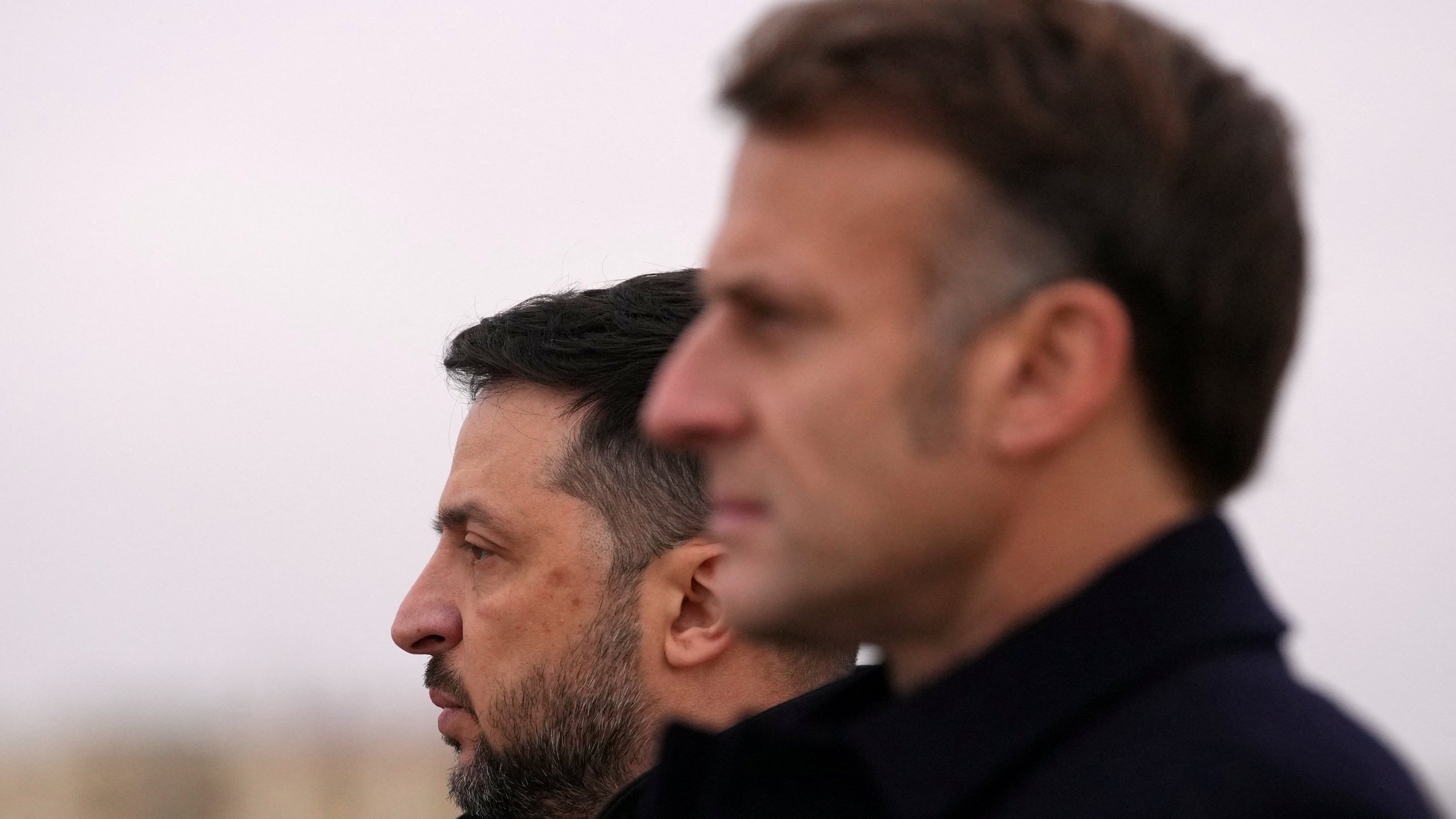
On 18 October, President Zelenskyy accused Donald Trump of trying to pressure Ukraine into capitulating to Russia.
Asked by NBC whether Ukraine could win the war without the US, he answered: "Without United States support it's very difficult. But if United States will support Putin, it's historic mistake and big tragedy.... If the United States officially will take the side of Russia, if these two countries will be together, of course we will not prevail and we will not be able to stand."
He said Ukraine hopes Trump will be on its side, or at least "in the middle," and that he will "change his decisions" on Russia, as "it's all mistakes, it will not help us, and it will not help United States." In an interview with NBC's Meet the Press, when asked whether Trump is still an ally of Ukraine, Zelenskyy said: "I hope so." Not a definitive yes, but a weak maybe.
As diplomacy goes, statements do not come much stronger than this. What triggered them?
Probably the sum of all things. We all remember Trump and Vance humiliating Zelenskyy in the White House on 28 February 2025. Trump told the Ukrainian President that he was "gambling with" a third world war. Zelenskyy was told to come back "when he is ready for peace". Most will also remember that the USA enacted the decision to halt its aid to Ukraine across two separate, sweeping actions taken during the first months of the second Trump administration in early 2025. Presently, it is only delivering military aid decided by former President Biden.
Some might have forgotten that Trump called Zelenskyy a "dictator without elections," suggested Ukraine started the war, and pushed a "peace plan" whose original 28-point draft gave Russia terms more favorable than what Moscow sought at the 2022 Istanbul talks.
After 640 days in office, Trump's disdain for Ukraine and admiration for Russia seem to grow by the day, and his kakistocracy—government by the least qualified—keeps undermining Ukraine's defense. In less than two weeks:
- 9 October: the administration imposed new sanctions on the International Criminal Court (ICC), an institution crucial for holding Putin and the Kremlin accountable for their atrocities in Ukraine.
- The same day, Trump lifted sanctions on Russian diesel exports, effectively helping fund Russia's wars.
- 10 October: Trump said of the elected president of a country fighting off Russia's full-scale invasion: "It's time for Ukraine to get a new president."
- 11 October: Trump declared on Truth Social an "energy ceasefire" between Russia and Ukraine that bound only Ukraine. Zelenskyy said it was "news to him."
- 14 October: SpaceX restricted Starshield, the classified, military-grade version of Starlink; Reuters reported on 15 October that the order came from the White House, undermining Ukraine's ability to defend itself against Russian jet-powered drones and strike Russian forces in occupied territory.
- 15 October: the US suspended critical intelligence sharing for three days, Zelenskyy said on 18 October, leaving Ukraine without warnings of Russian ballistic missile launches against its citizens and energy infrastructure.
- 16 October: two days before they were due to take effect, Trump waived the sanctions, restrictions and tariffs on Russia required by the Graham Act, calling it in the US national interest, and put nearly all of the congressional sanctions package on hold.
- 18 October: the administration reportedly proposed that Europe resume buying Russian gas to help "entice Russia to end the war in Ukraine." Europe balked.
- 19 October: it emerged that the US is delaying Patriots procured by allies under NATO's Prioritized Ukraine Requirements List (PURL), leaving Ukraine short of defenses against Russian ballistic missiles. Ukrainian officials say the shipment is stalled because Defense Secretary Pete Hegseth has not signed the transfer documents on his desk.
- 19 October: Trump said that "Xi Jinping has been very fair on Ukraine. He hasn't been very much involved. Same with Russia. They haven't been nearly what they could've been," ignoring that Russia is waging an unjust, unprovoked and genocidal war against Ukraine.
- The same day, Trump claimed Zelenskyy targets Russian refineries knowing the attacks are seriously hurting world diesel markets, including in the US, and that he "doesn't want to end this war, and probably never did."
- Talking to reporters outside the White House, Trump said Zelenskyy should get someone else to negotiate on Ukraine's behalf, and that he is willing to meet Putin and Xi to discuss the war, without the Ukrainian president. Kyiv fears Washington might decide Ukraine's future without it.
- 20 October: Vice President JD Vance said Ukraine should not join NATO and should stop striking Russian energy. He refused to call Ukraine a US "ally," downgrading it to a "partner": "We don't have a formal alliance... they're not in NATO... we're going to work together on some things, but also we're going to be opposite on some things, too."
- 21 October: after four and a half years of genocidal full-scale war and amid persistent Russian air strikes on Ukrainians, US special envoy Steve Witkoff praised Putin as a "humanitarian," echoing Trump's claim that Russia had restrained itself.
- The same day, Trump said the end of the war is closer than ever. He may step up efforts to coerce Ukraine into a deal by the end of 2026, The Atlantic reports, with Ukraine's prospects shaped by the US midterms and possible Trump-Putin-Xi talks in November.
Less than two weeks, summarized.
Explore further
Europe now faces two strategic adversaries: Russia and the United States
This is how Trump's administration talks about, and acts towards, the victim of an unjustified, unprovoked and horrendous war. Trump's USA (TUSA) is siding with autocracy against democracy and the rules-based world order. It talks about America's former allies in a similar manner: derogatory and disrespectful. None of the above is the word or deed of an ally.
When one chooses to see the world as it is, Zelenskyy's statements become both necessary and important. This is not only about Ukraine's self-respect and survival. Once we acknowledge the realities—that Europe is in an undeclared war with Russia at a moment when the USA has chosen to become a strategic adversary—we stand better prepared to defend ourselves: to accept that our present security system does not work and new solutions are urgently needed, and that diplomacy alone does not work and military force is essential to protect freedom, democracy and international law.
More than a year ago, German Chancellor Friedrich Merz warned that Europe is "not at war, but no longer at peace either" with Russia. Other heads of state have echoed him. NATO has since shifted from a peacetime alliance to one focused on urgent wartime readiness. Unfortunately, the process started years too late.
By seeing the world as it is, European leaders might reach the long-overdue conclusion that Russia's wars in Ukraine and Europe can only be stopped by a demonstration of strength: an alliance willing and capable of using military force to stop Russia. The alliance Russia fears isn't NATO. It's a coalition that will actually fight.
Explore further
The alliance Russia fears isn’t NATO. It’s a coalition that will actually fight.
European courage and action are urgently needed. Ukraine is exposed to a two-front war, defending itself against both Russia and TUSA, and their attacks are increasing in scale and scope. Both Moscow and Washington want to end the war this year and are ramping up their assaults on Ukraine accordingly.
Irrespective of one's view of Ukraine, it is commonly understood that it is stopping Russia from advancing and increasing its border with NATO and the EU. Ukraine is defending European values and principles, ensuring the rest of us can continue living in something resembling peace. The consequences of its defeat would be truly devastating.
There can be no European strategic autonomy without Ukraine. There can be no European security and stability without Ukraine. Europe can never become a Great Power without Ukraine. And neither Russia nor the USA want Europe to achieve any of the above.
It is time to act according to the present-day realities and face down Europe's two strategic adversaries. In the worst case, Ukraine's destiny might be decided in November already.
Hans Petter Midttun, independent analyst on hybrid warfare, Non-Resident Fellow at the Centre for Defense Strategies, board member of the Ukrainian Institute for Security and Law of the Sea, former Defense Attaché of Norway to Ukraine, and officer (R) of the Norwegian Armed Forces.
Editor's note. The opinions expressed in our Opinion section belong to their authors. Euromaidan Press' editorial team may or may not share them.
Submit an opinion to Euromaidan Press

 Connexion