The Wikimedia Foundation waited until the days following its largest worldwide conference to issue a statement saying it would not voluntarily recognize a union of its workers.Last week, Wiki Workers United, which is organized through the Communication Workers Union and represents U.S. workers at the nonprofit Wikimedia Foundation, requested voluntary recognition of their union. Wiki Workers United said that it had secured a “supermajority of union-eligible workers who have signed union authoriz
The Wikimedia Foundation waited until the days following its largest worldwide conference to issue a statement saying it would not voluntarily recognize a union of its workers.
Last week, Wiki Workers United, which is organized through the Communication Workers Union and represents U.S. workers at the nonprofit Wikimedia Foundation, requested voluntary recognition of their union. Wiki Workers United said that it had secured a “supermajority of union-eligible workers who have signed union authorization cards.” A group of more than 1,100 Wikipedia editors have also signed a letter of support for the union.
On Monday, just days after the massive Wikimania Conference concluded in Paris, the Wikimedia Foundation announced it would not voluntarily recognize the union and said the union would have to conduct a vote as overseen by the National Labor Relations Board.
“The Foundation’s responsibility is to ensure that they can make their own choice freely,” the foundation wrote in the statement. “So that every eligible employee has an equal voice, we believe a secret-ballot election conducted by the National Labor Relations Board is the appropriate path forward.”
“We have heard a range of views from staff, including concerns from those who have felt pressured to support union efforts and those who are confused by the unionization process,” the foundation added in a frequently asked questions section. “We have also seen a misunderstanding around what the union can do for global staff and Wikimedia movement communities.”
The Wikimedia Foundation’s statement and its frequently asked questions section is full of very carefully-worded language that is common among companies and organizations that have fought against unionization. For example, the FAQ includes a long section about the benefits that Wikimedia Foundation already offers its staff, and the statement suggests that there is a “wide range of views on unionization” among employees.
Wikipedians immediately took issue with the timing of the statement and the language of it. On a talk page discussing the statement, the Wikimedia Foundation is getting hammered for the timing of the statement and the statement itself.
“What a shameful decision to tie the process to the willingness of Trump-controlled NLRB. Everyone involved in denying the voluntary recognition should resign in disgrace or be driven out,” one editor wrote.
“The fact that this response came exactly 1 day after Wikimania shows that you are afraid of being confronted,” another wrote.
“This is an extremely disappointing statement. It says that ‘Foundation leadership respects the right of staff to unionize, if they choose to do so. That decision rests with them.’ But that decision has been made - by a supermajority of US-based staff. The only thing standing between the US WWU and recognition is WMF executive leadership, who could recognize the union today if they cared to,” a third wrote.
“As a U.S. trained labor lawyer and past organizer with WWU, this statement, alongside the WMF’s public facing community post reek of union-busting disinformation. What’s critical for the community to know is that a supermajority of the workers already did vote by signing a card. This ‘extra step’ is just a delay tactic that employers are advised to do when they don’t want a union,” a fourth wrote. “These WMF workers have already been extremely brave by expressly affirming their commitment to a union. Years of efforts to get this accomplished. This is not some rash decision by them. Moreover, the community supports their union too! It literally makes no sense as to why WMF thought this was the right decision here in this critical moment.”
At Wikimania in Paris, the Wikimedia Foundation’s Chief Executive Officer Bernadette Meehan was asked about voluntarily recognizing the union. Meehan said “our focus is on executing and helping the core organizing team execute a great event. We will respond to that particular request when we have a chance to review it.”
“We are supportive and we support employees’ right to unionize. The context is complicated because we operate in multiple different places,” she added. “We respect the right if it is the majority will of eligible staffers to unionize.”
The Wikimedia Foundation did not immediately respond to a request for comment.
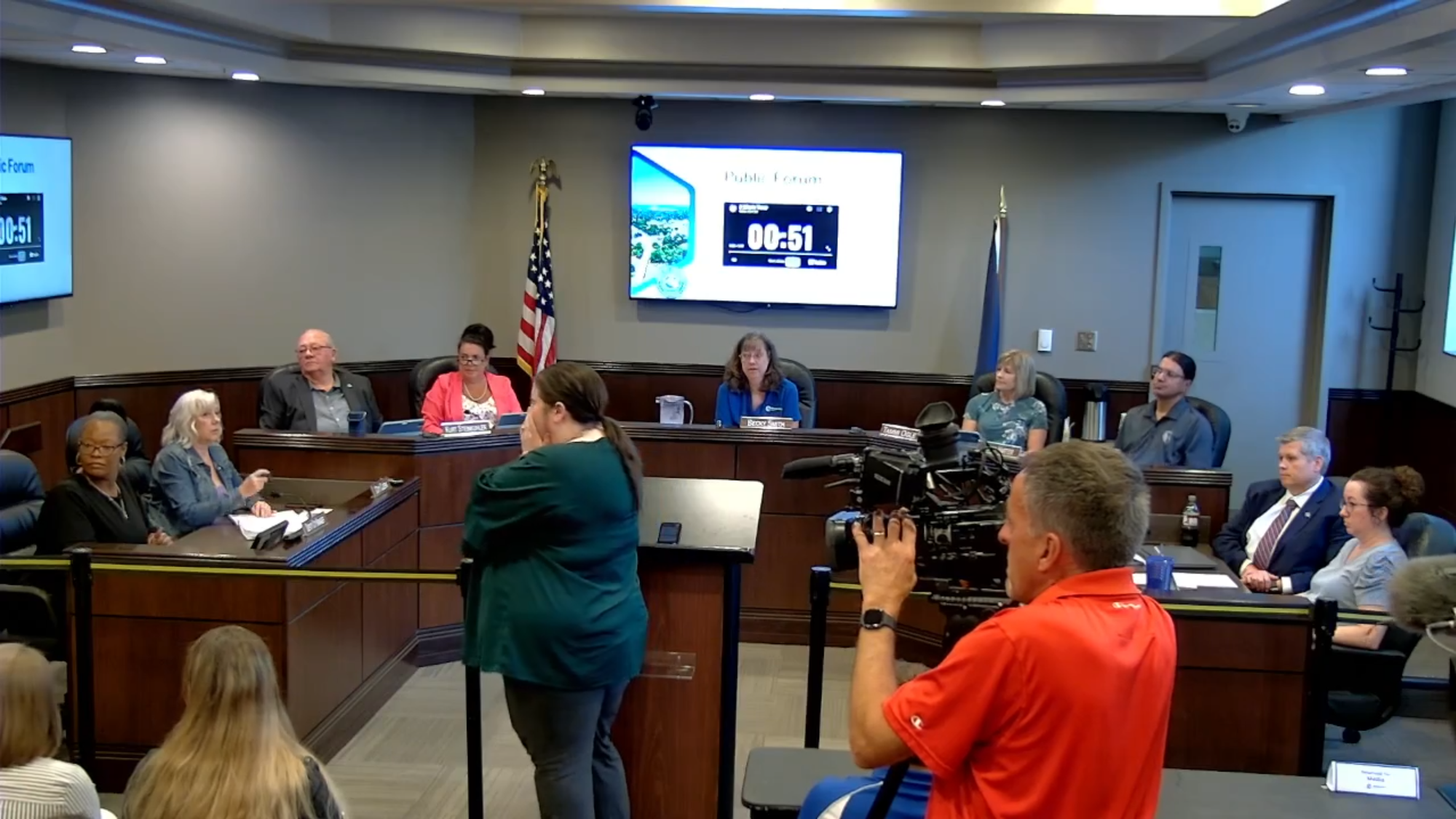
Police arrested a high school physics teacher for clapping during a city council meeting last Wednesday. Teacher Lux Claridge went to a meeting of the Emporia, Kansas City Commission on July 22 with their spouse and brother. All three were there to speak out against a proposed hyperscale data center that would sit on 1,000 acres of rural land in Emporia. They left the meeting in handcuffs, dragged out by police on the orders of a city commissioner.
Police arrested a high school physics teacher for clapping during a city council meeting last Wednesday. Teacher Lux Claridge went to a meeting of the Emporia, Kansas City Commission on July 22 with their spouse and brother. All three were there to speak out against a proposed hyperscale data center that would sit on 1,000 acres of rural land in Emporia. They left the meeting in handcuffs, dragged out by police on the orders of a city commissioner.
This week Joseph talks to Mike Yeagley. As you’ll hear, he is a very interesting guy. He introduced parts of the government to the whole idea of commercially sourced location data. He spent hundreds of thousands of dollars buying the data, and showing what could be done with it. It’s a fascinating conversation.
Listen to the weekly podcast on Apple Podcasts, Spotify, or YouTube. Become a paid subscriber for access to this episode's bonus content and to power our journalism. If you become a
This week Joseph talks to Mike Yeagley. As you’ll hear, he is a very interesting guy. He introduced parts of the government to the whole idea of commercially sourced location data. He spent hundreds of thousands of dollars buying the data, and showing what could be done with it. It’s a fascinating conversation.
Listen to the weekly podcast on Apple Podcasts,Spotify, or YouTube. Become a paid subscriber for access to this episode's bonus content and to power our journalism. If you become a paid subscriber, check your inbox for an email from our podcast host Transistor for a link to the subscribers-only version! You can also add that subscribers feed to your podcast app of choice and never miss an episode that way. The email should also contain the subscribers-only unlisted YouTube link for the extended video version too. It will also be in the show notes in your podcast player.
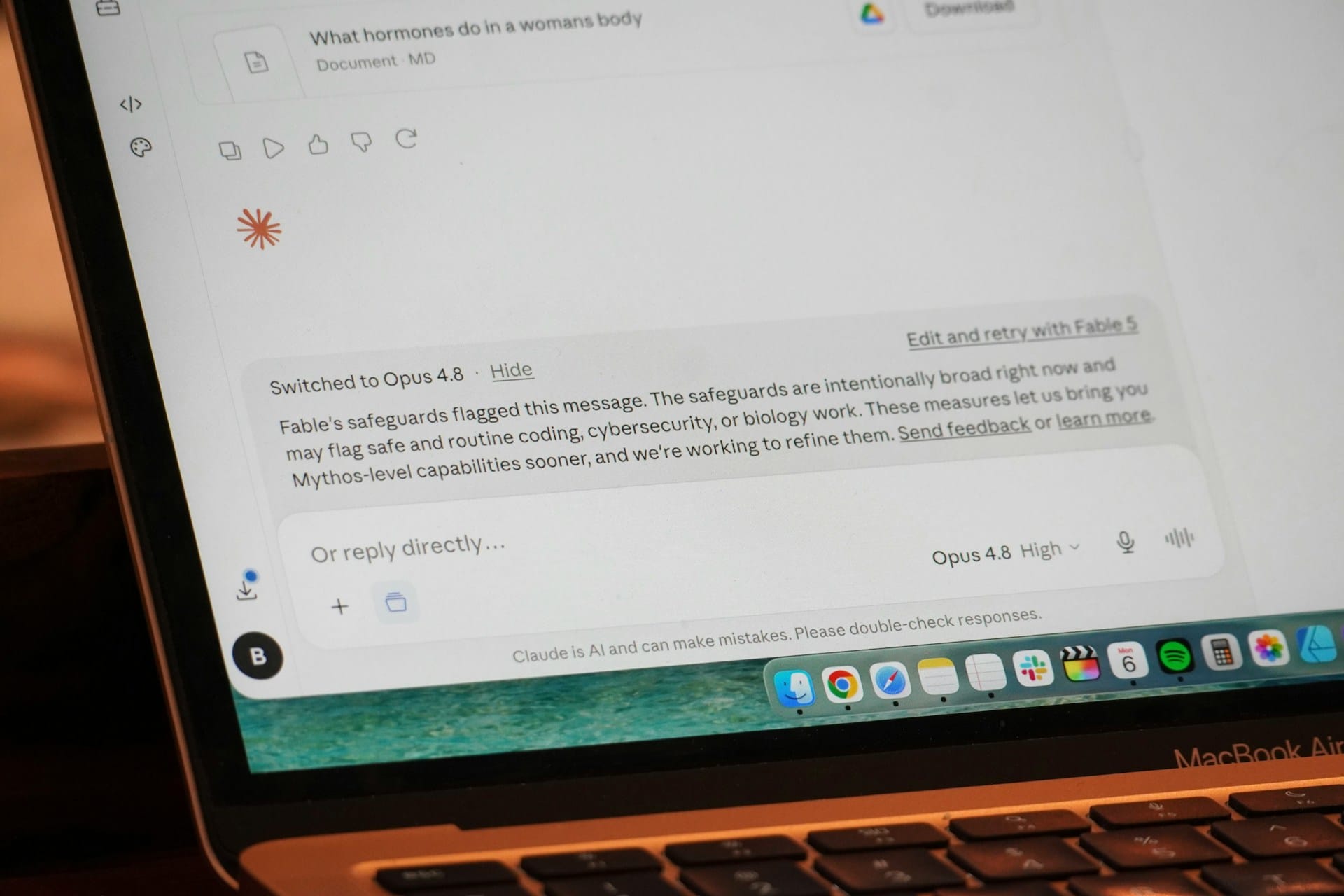
Claude is exposing a wealth of users’ chats and creations in Google search results, meaning anyone can dig through conversations or other material that people used Claude to make but may not have realized were publicly available for strangers to see.
Claude is exposing a wealth of users’ chats and creations in Google search results, meaning anyone can dig through conversations or other material that people used Claude to make but may not have realized were publicly available for strangers to see.
Slime Dot, a young R&B artist from Las Vegas, currently has over 100,000 monthly listeners on Spotify. In an interview with GQ in May, after sharing an image of herself posing with Drake on Instagram, Slime Dot directly denied accusations that she was an “AI artist,” saying “The truth doesn’t matter these days. People are always gonna try to explain something they don’t fully understand and believe what they want.” GQ originally credulously published the interview and said it was “debunki
Slime Dot, a young R&B artist from Las Vegas, currently has over 100,000 monthly listeners on Spotify. In an interview with GQ in May, after sharing an image of herself posing with Drake on Instagram, Slime Dot directly denied accusations that she was an “AI artist,” saying “The truth doesn’t matter these days. People are always gonna try to explain something they don’t fully understand and believe what they want.” GQ originally credulously published the interview and said it was “debunking the AI rumors.” Eventually, GQ added a note to the end of the article conceding Slime Dot was an AI avatar, but said the “talent behind the music remains undeniable.”
This confusion could have been avoided if Spotify had done what many of its users and critics have been begging it to do since AI music generators like Suno and Udio made it trivial to flood the internet with AI music. Spotify could flag Slime Dot and other AI-generated music on its platform as such. Other platforms, like YouTube, already do this.
Since Spotify doesn’t do that, users can visit SoullessMusic.com, a database for “AI artists hiding on Spotify. No bands, no studios, no soul, just machines and melody.” There, Slime Dot is listed as “almost certainly AI” based on an analysis of three of the tracks and the fact that Slime Dot released such a large number of tracks in a short period of time. Alternatively, users could go to SlopTracker, where they can upload files or copy/paste links to Spotify tracks to run them through a tool which will tell them, with varying degrees of confidence, whether a song was AI-generated or not. SlopTracker found that Slime Dot’s track “Fully” was 95 percent likely to be AI generated by Suno.
“I didn't know what's AI and what's not,” Graeme Fulton, who created SoullessMusic, told me. “And then I'm on Instagram Reels and I see loads of artists unhappy saying some artist has popped up with their song and just copied it. And there's loads of different cases where they [AI artists] would copy an artist's look and appearance […] sort of just stealing from artists.”
Last year, I wrote a story about an exceptionally bad example of what Fulton is talking about. A scammer used Spotify to publish AI-generated music under the name of a real, dead musician, seemingly in an attempt to syphon money from his popularity via streams. After I published that story I heard from several (living) artists who said the same thing happened to them. A similar case involving a Danish jazz musician was covered by Danish publications in April.
Another reader recently told me about a popular Spotify artist that was publishing hours of Iranian jazz every week. The channel, Qajar Jazz, which popped up in December of last year, has 29,579 monthly listeners, gained more popularity after the start of the U.S. war with Iran and the channel making vague allusions to resilience and preserving culture in video descriptions and comments on YouTube. Unlike Spotify, Qajar Jazz videos on YouTube are labeled as being AI-generated in the fine print, though it’s unclear if the channel tagged itself as such or if YouTube did. Both SoullessMusic and SlopTracker detect it as being AI generated.
Qajar Jazz did not respond to a request for comment.
Fulton said he started looking around on GitHub for open source AI music detection tools, and ended up building a new, open source detector that relies on open source models called SONICS, the lofcz vocoder fakeprint detector, and other open data sets. SoullessMusic also scans a track’s metadata for any tags that might tie it back to a specific AI music generator, and Fulton says he also has a script that scans Wikipedia for existing entries on an artist. Users can submit tracks from Spotify to the site they suspect are AI generated, and Fulton reviews them manually before adding them to the database. Despite all of this, he admits the system is not perfect.
Both Soulless Music and SlopTracker use AI and other automated tools to detect AI music. As we’ve written previously, using AI detectors to detect AI content is an inherently flawed process that can lead to false positives. When I asked him how he handles cases of false positives, Fulton said “it's not ideal when that happens, but it's going to happen because it's still quite tricky to check what's AI and what’s not.”
Spotify’s lack of transparency and unwillingness to label AI-generated music makes it impossible to track how much money its making on the platform. Last year, the company announced that it would it would AI disclosures on AI generated music, but I haven’t seen it on any of the dozens of tracks I reviewed for this story. Udio and Sudo both include inaudible digital watermarking in their generation, which in theory could make it easy for Spotify to tag these tracks.
"We're employing a layered approach that combines enforcement, artist controls and greater transparency," a Spotify spokesperson told me after this article was first published. "Over the past year, we've introduced policies targeting harmful AI-related behaviors like spam, impersonation and deceptive content, alongside new tools that give artists more control and listeners more context. These include Verified by Spotify, which helps listeners identify authentic artist profiles; AI Credits, where artists disclose when and how AI was used in creating their music, with tens of thousands of AI credit disclosures now being submitted each day; and Artist Profile Protection, which gives artists more control over what appears on their profiles. We are continuing to build on these efforts.”
Spotify also pointed me to several tracks it had flagged as AI on the mobile app, like Better Times by Mike Mana.
Soulless music attempts to quantify that number based on publicly available streaming data. The small number of AI artists tracked on SoullessMusic generate an estimated $5.7 million a year, with the most popular AI artist, mikeeysmind, generating $1.5 million annually alone. In April, Deezer, a Spotify competitor that attempts to tag all AI-generated music on its platform, said 44 percent of all new music uploaded to its platform is now AI generated. SlopTracker, which attempts to track AI generated music on Spotify that is featured on official Spotify-curated playlists, that those artists are “draining” $0.1188 per second from real artists who could be making the music instead.
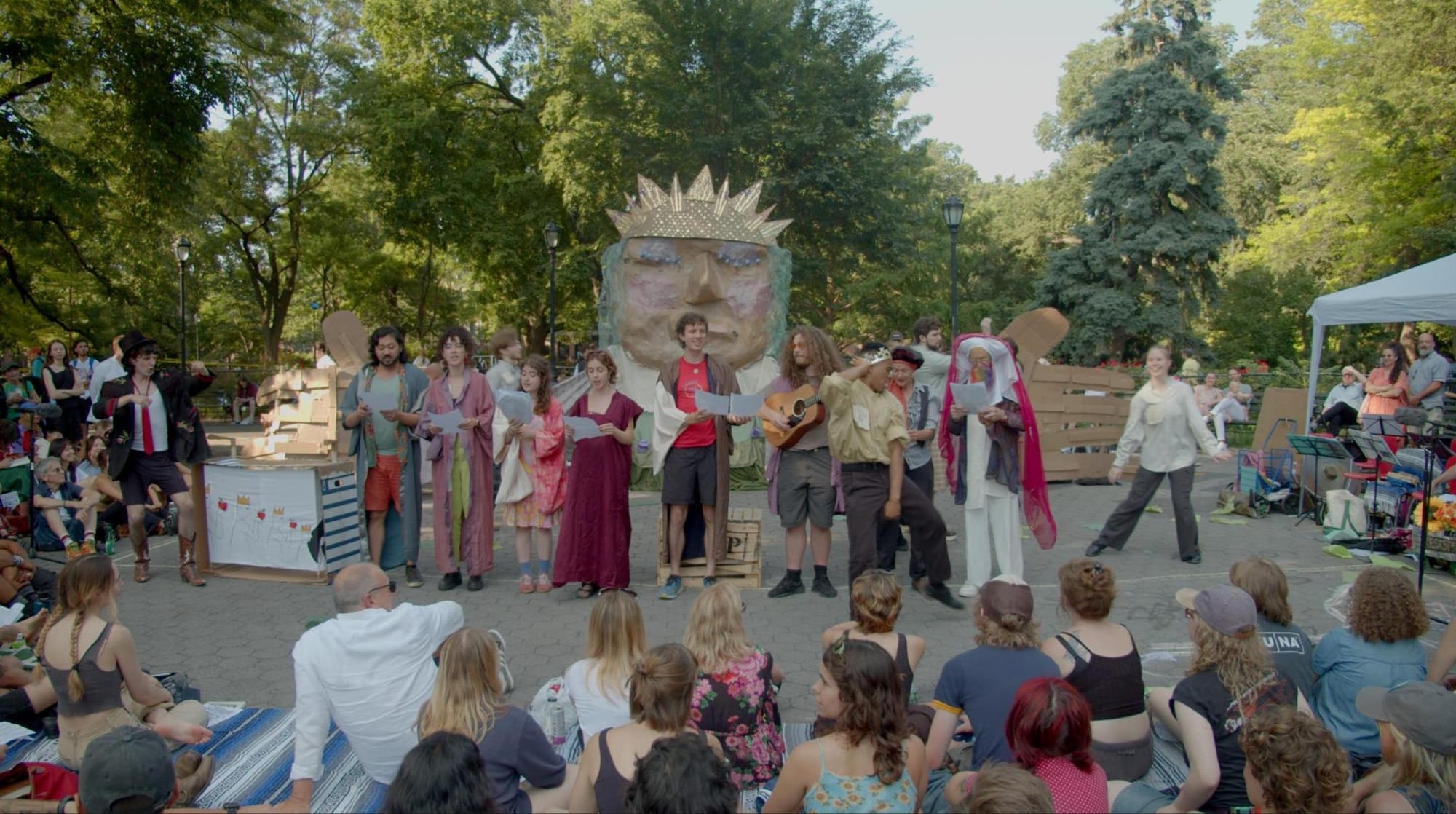
I’m marching across Lower Manhattan in the middle of a heatwave with a friendly mob of Luddite gnomes, and there isn’t a phone in sight.It’s Fourth of July weekend in New York City, and the brutal temperatures haven’t stopped a hundred-or-so people from donning pointy hats and dancing in the streets while chanting anti-Big Tech slogans. “Fuck, fuck, fuck AI,” the Luddite gnomes – people in colorful, pointy homemade hats – chant as we march, urging the confused spectators recording us to put a
I’m marching across Lower Manhattan in the middle of a heatwave with a friendly mob of Luddite gnomes, and there isn’t a phone in sight.
It’s Fourth of July weekend in New York City, and the brutal temperatures haven’t stopped a hundred-or-so people from donning pointy hats and dancing in the streets while chanting anti-Big Tech slogans. “Fuck, fuck, fuck AI,” the Luddite gnomes – people in colorful, pointy homemade hats – chant as we march, urging the confused spectators recording us to put away their pocket rectangles and join us in our sweaty, phone-less revelry. The gnomes are headed West, towards Washington Square Park, where they plan to carry out a public show trial for OpenAI and its CEO, Sam Altman. It’s the fourth iteration of a theatrical protest event they call “S.H.I.T.P.H.O.N.E,” which stands for “Scathing Hatred of Information Technology and the Passionate Hemorrhaging of Our Neo-liberal Experience.”
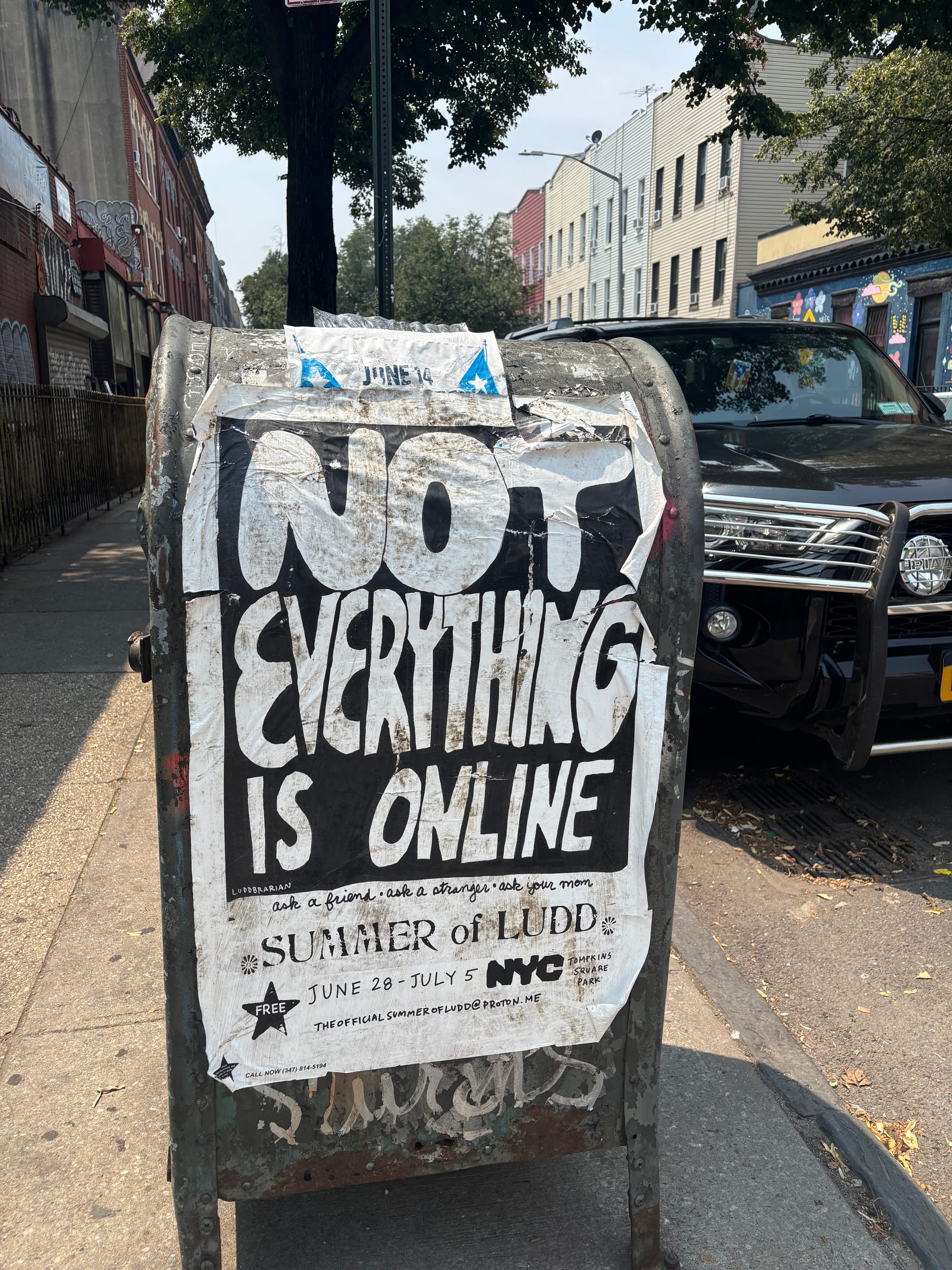
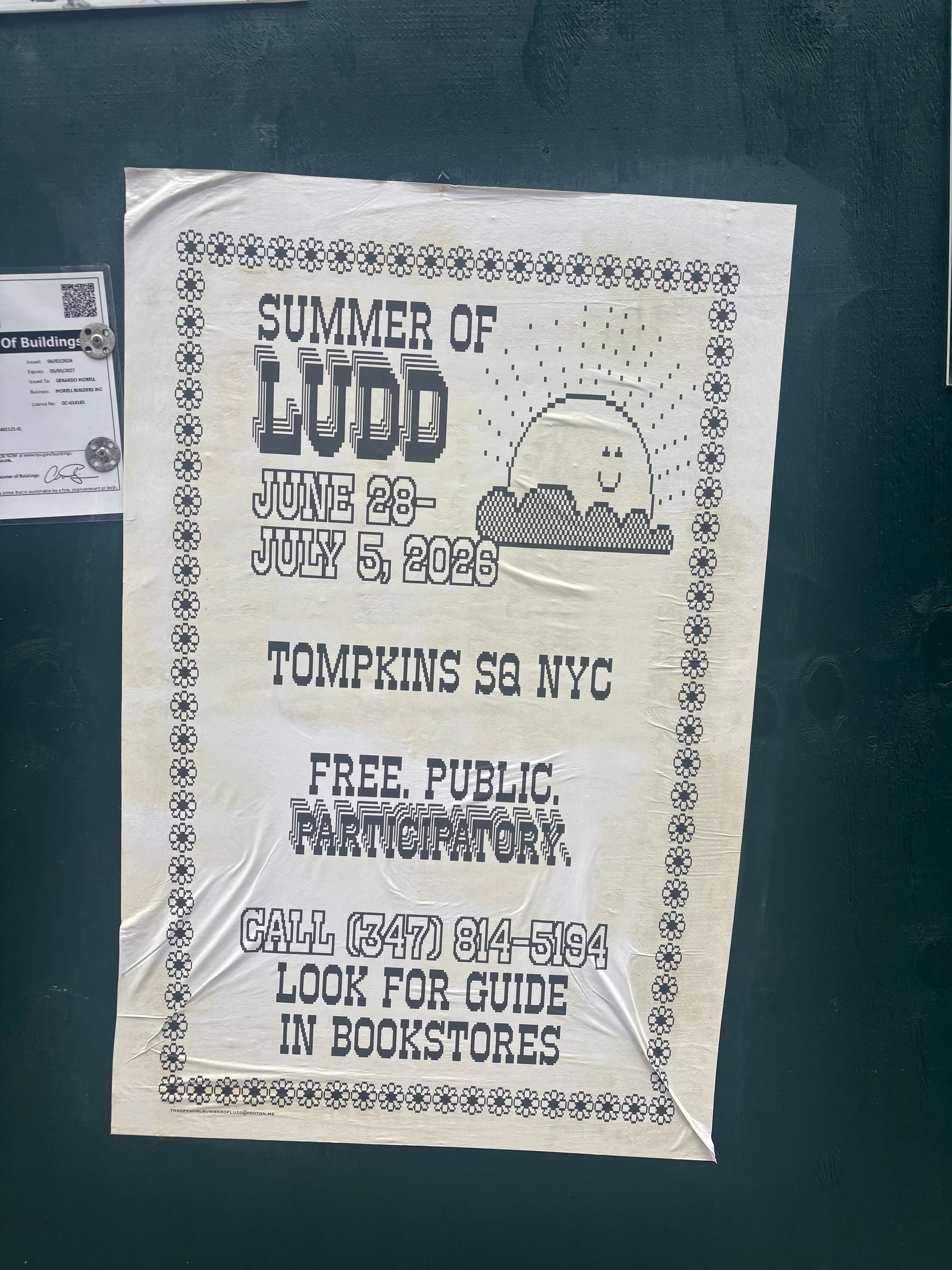
This time, the protest isn’t a one-off. It’s part of the “Summer of Ludd,” a week-long festival of free public events organized and advertised entirely off of tech platforms and social media. The Summer of Ludd doesn’t have a website, but you can call a phone number to get a run-down of the events happening each day around the city. The schedule includes everything from an “offline rizz” workshop designed to help you ditch dating apps, a phone-free rave called “Let’s Get Off Together,” internet piracy 101 skill-shares, and an outdoor play that retells the story of the original Luddites. I found out about the Summer of Ludd from a local event mailing list calledNYC Off Tech, but other folks I met throughout the week learned about it from posters wheat-pasted around their neighborhoods, paper event guides distributed to bookstores and coffee shops, or just word-of-mouth from friends.
Basically, the whole thing is an experiment designed to prove a single point: You don’t need social media and extractive tech platforms to meet people and have fun.
“Google knows next to nothing / My mom knows everything!” the gnomes chant as they hand out gnome hats to random bystanders and implore them to put away their phones. The hats, I’m told, are a reference to aDutch anarchist group from the 1970s known for their impish culture-jamming and absurd carnival humor. It’s also “just kinda silly,” one of the organizer gnomes explains to me.
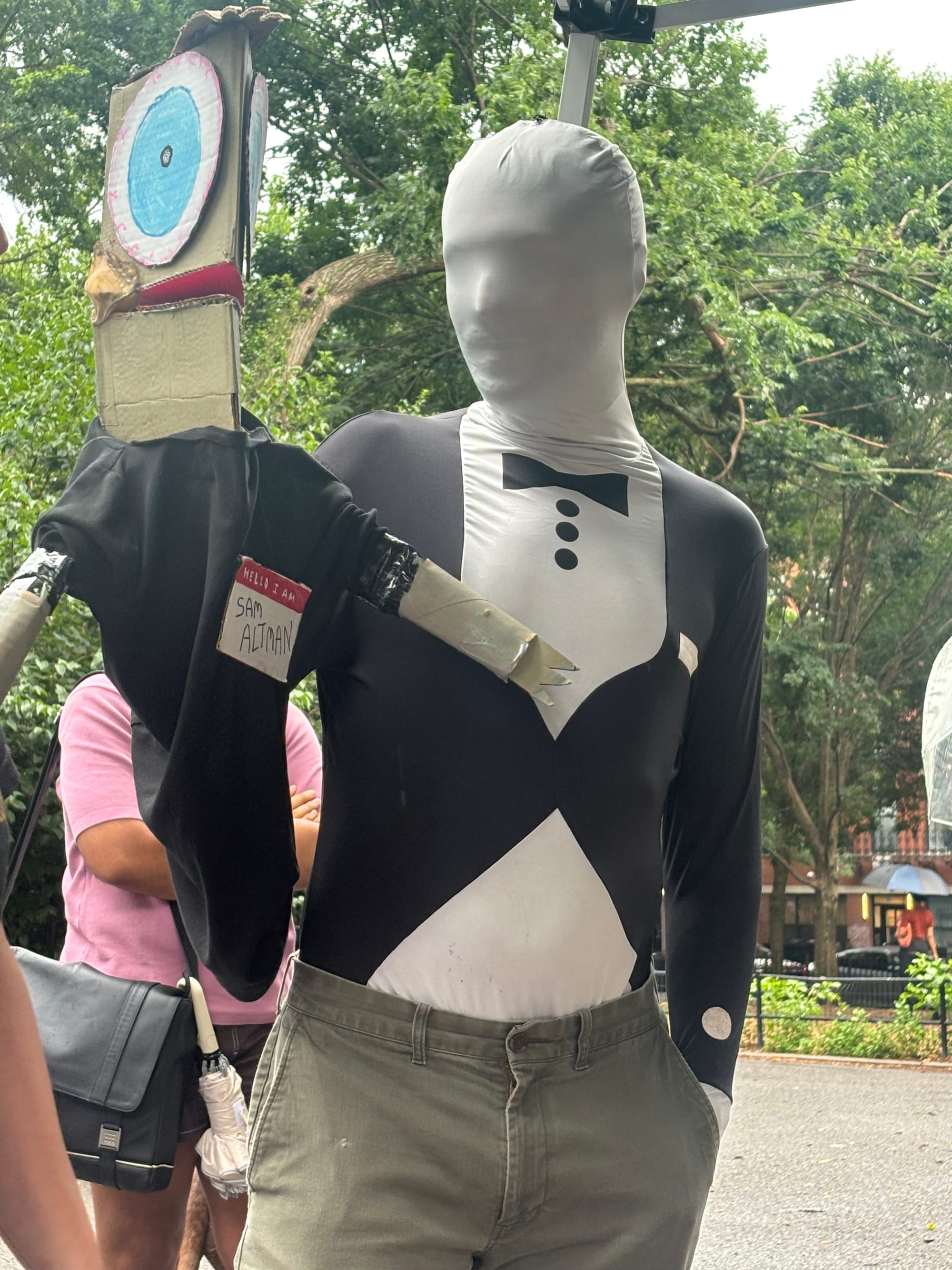
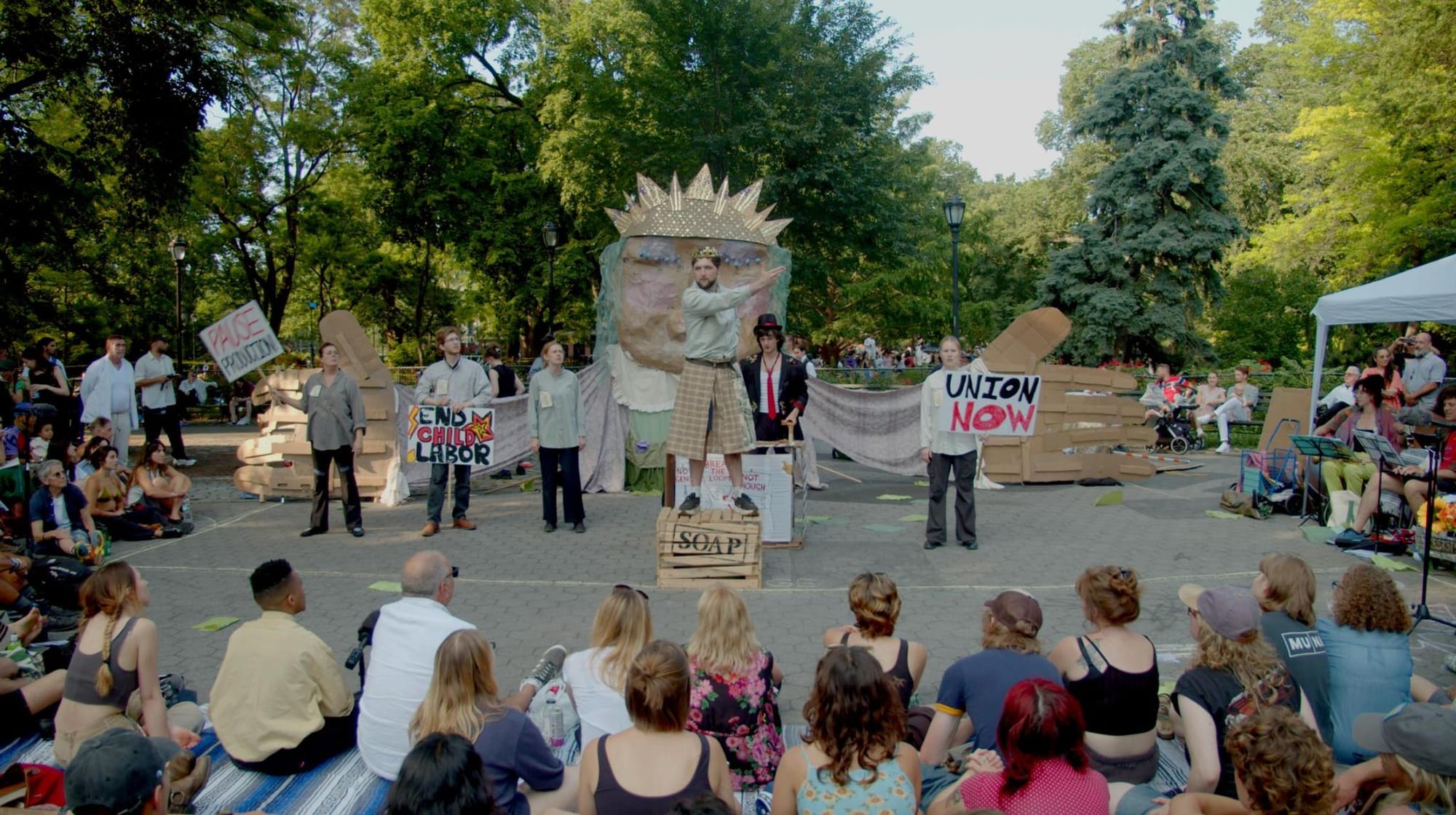
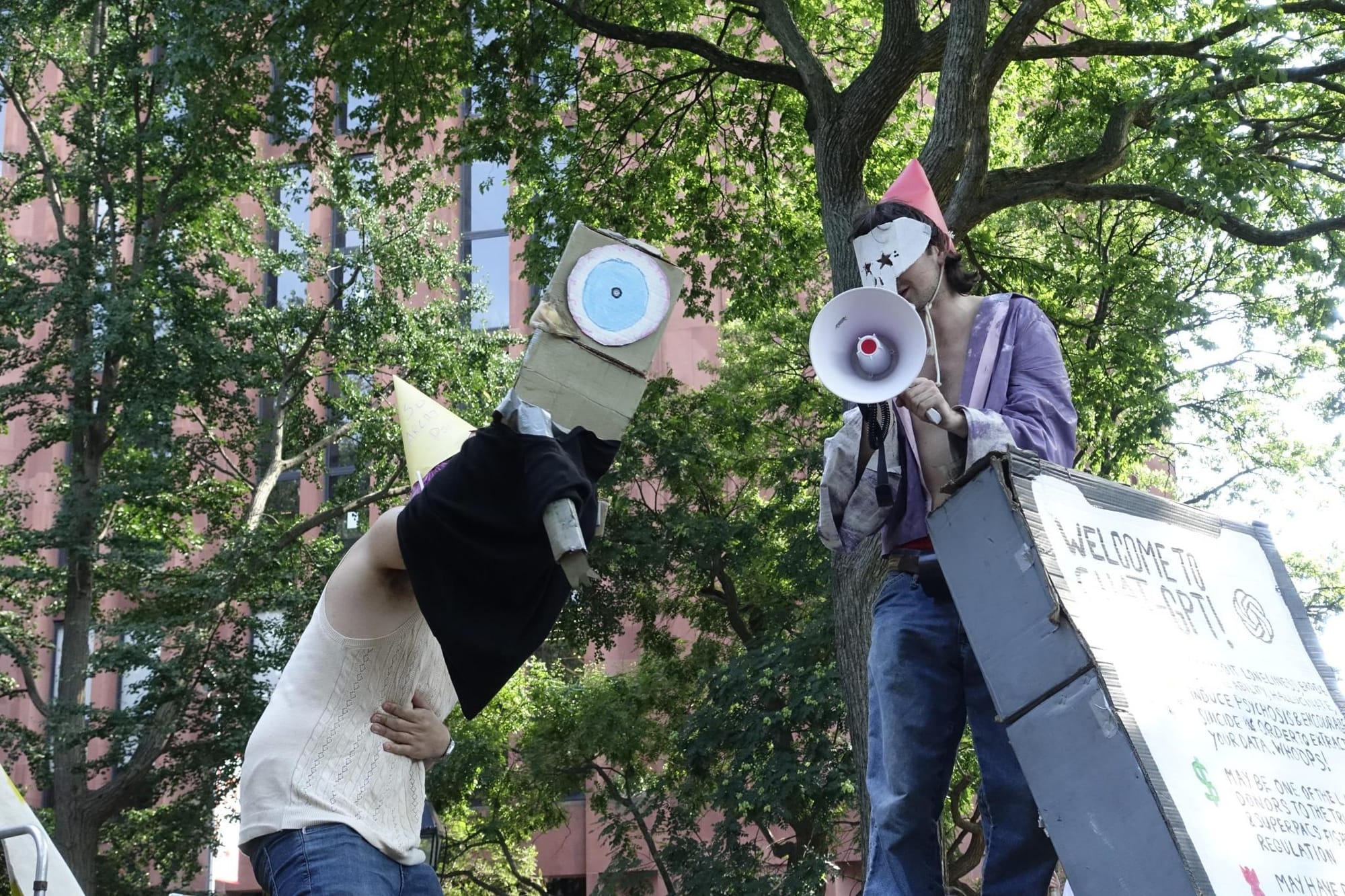
At the front of the march, two gnomes carry a giant cardboard smartphone labeled “ChatGPT,” which lists off thevariouswell-documentedsocial ills caused by chatbot tools. “Even if it gives us rabies / we will free the iPad babies,” the gnomes continue chanting as they set the smartphone effigy down on a grassy knoll, next to a soapbox that will be used as a witness stand. The crowd is all-ages, but skews heavily Gen-Z — consistent with recent polls showing thatyoung people have become some of Big Tech’s fiercest critics.
Images courtesy Janus Rose
One by one, witnesses take the stand to accuse Altman of numerous crimes perpetrated by OpenAI — from training models on artists’ work, to inducing AI psychosis, to accelerating the climate crisis with polluting and power-hungry AI datacenters. “I used AI to write one of my essays and got in trouble. Now I’m starting a war on AI,” one young person says from atop the soapbox, receiving cheers of approval. “These companies want you to think that you’re dumb, but that is a lie. Everyone here is smart. Everyone here is creative,” says another witness, describing how tech companies design AI tools and social media apps to make people dependent on them — making them feel helpless, alienated, and addicted to the endless scroll. The crowd roars its unanimous verdict in unison (“GUILTY!”) and everyone begins joyfully stomping on the giant cardboard GPT phone. Leading them is a gnome “executioner” holding a hammer that bears the phrase “Enoch Made Them / Enoch Shall Break Them” — an homage to the original 19th Century Luddites, who named the hammers they famously used to smash factory machines after the guy who made both the machines and the hammers.
It’s tempting to compare the spectacle to something from the days of Occupy Wall Street. But what sets the Summer of Ludd apart from what one might expect of a Luddite protest is its lack of cynicism and an overwhelming abundance of raw, anarchic joy. Far from the distorted caricature of Luddites as curmudgeonly, puritanical tsk-tsk’ers, the new Luddites attract people to their movement through playfulness and participation. Instead of shaming others for too much screen time, they use public events to make their points for them, demonstrating organically and in real-time that the “indispensable” tech we’ve organized our lives around is not so indispensable after all.
I first met the Luddites a week earlier in Tompkins Square Park, for a press conference hosted by their official spokesperson: a puppet made of garbage.
I joined a small group of journalists sitting in plastic chairs and directing questions at the puppet, who is named Gowanus, after the famously putrid Brooklyn canal where the parts of its patchwork body were found. Gowanus is the Luddites’ “media spokespuppet,” a stand-in created to maintain the organizers’ anonymity while interfacing with digital media platforms and their operatives—including me.
As one might imagine, the Luddites are very averse to any kind of social media. Smartphones are verboten, and they ask every journalist present to sign a “Terms of Service” agreement on a comically long brown paper scroll, which states that nothing we capture may be used to make “short-form video content” like TikToks or Instagram Reels. In keeping with the spirit of the event, I kept my phone stowed away and used nothing but my Hobonichi notebook, a pen, and a small voice memo recorder to do my reporting for this article.
“We are interested in building alternative social infrastructure that allows us to be no longer reliant on Big Tech,” Gowanus told the group of journalists as they dutifully scribbled notes. “All our events are free, and defy any sort of transactionalism or consumption. We’re trying to dispel that transactional element and get people to participate and create the events themselves. That is what the Summer of Ludd is all about.”
On my train ride home, I pondered the irony of being a journalist covering an event series designed to resist digital capture and consumption. When I reached my subway stop, I noticed an ad for the second-hand online marketplace Backmarket, showing a pink Nintendo Game Boy with the text “AB > AI.” Someone drew a heart next to it in black sharpie marker—an anonymous mark of approval that felt like the opposite of the subway ads for the “Friend” AI device that were widely and virally defaced last year.
Almost reflexively, I took a picture of the ad with my phone and posted it to BlueSky with the caption: “Hatred of AI now reaching the level of cultural consensus that becomes attractive to advertisers.” I woke up the next morning to thousands and thousands of interactions, many from people delighted to see their anti-AI sentiment vaguely reflected in a subway ad for overpriced second-hand goods. This made me think about the classic political trap, where capitalists co-opt social movements by channeling their radical potential into harmless forms of aesthetic consumption and feckless identity politics.
How can the neo-Luddites resist these inevitable attempts at co-optation? Can Luddism generate mass-appeal beyond Y2K aesthetic Tiktok trends, where Gen-Z’ers marvel at flip phones, iPods, and other retro tech as a kind of performative false-nostalgia? And how do you build a successful movement while eschewing the most common (albeit flawed) tools of mass-communication?
Members of the Luddite Renaissance—as the loose-knit, anonymous collective that organized the Summer of Ludd refer to themselves—attempt to answer these questions in “The Event is the Medium,” a zine manifesto referencing the famous Marshall McLuhan quote which, naturally, is only available in physical paper format (The Luddites humbly request that none of their work be uploaded to social media). The central idea is utilizing public space to run events that get people to experience—and directly participate in—what Luddism has to offer in 2026, instead of just yelling at people on a street corner.
What should these Events entail? This is where the Luddites become intentionally vague—not for lack of answers, but as a defense mechanism designed to make the Event unpredictable and unmonetizable. If social media’s role is to consume and metabolize human existence into an endless scroll of bite-sized, short-form video content, then the Event’s purpose is to bring people together in ways that defy categorization and documentation. Like the “Happenings” of 1960s performance artist Allan Kaprow, they can be anything and everything—as long as they are free, participatory, and never, ever boring.
“The Event may seem nebulous and surreal to you; this is on purpose,” the Luddites write in their zine manifesto. “DIY shows, teach-ins, art fairs, all come with a preconceived notion of what will happen. This causes people to act in a ritualized or transactional way. Any way that you can break through the monotony of ‘coolness’ to facilitate earnestness and urgency is paramount.”
In other words: If the event is the medium, the message is that being a Luddite is fun again.
I returned to Tompkins Square several times over the next week. Throughout the Summer of Ludd festivities, the Luddites had transformed the formerly-bohemian Lower East Side hangout into a kind of town square. They camped out at the park each day, providing free food, zines, and plenty of ways to plug in to the various happenings throughout the city. Basically, if you wanted to find out what the Luddites are all about, you had to meet them here, in person.
Images courtesy Summer of Ludd
Somewhere in the large crowd that had gathered for the gnome protest, I ran into Motherboard founder and fellow low-tech appreciator Alex Pasternak, along with “extremely online” journalist Taylor Lorenz, whorecently told WIRED that her screen time averages 17 hours a day. Also present was Reverend Billy, leader of the Church of Stop Shopping, whose corporate exorcisms and culture-jamming theatrics have been a staple of NYC protests since the 90s.
“Chronically online culture has become something we’re attached to, even as activists,” Bucky, one of the Luddite organizers, told a crowd of gnomes in the park, just prior to the million-gnome march. “Our consumer habits are tracked, analyzed, and sold back to us. Every time we seek fun in our little light-boxes, we feed a beast which surveils us, which exploits our time and our imagination, and which lines the pockets of big psycho assholes like Elon Musk, Peter Thiel, Mark Zuckerberg, Marc Andreesson, and Tim Cook.”
“I want my attention back!” someone shouts in response. The crowd cheers in agreement.
Bucky mentions the 2012 Arab Spring uprisings as a pivotal example of how Silicon Valley extended this capture to the realm of activism. In the heyday of Twitter, tech companies and most of the Western press pushed a narrative that social media platforms were helping liberate people around the world from oppressive regimes. Thanks to these platforms and their beneficent corporate overlords, the argument went, the techno-utopian dream of the 90s internet would be realized, and dictators would crumble under the power of free information and free markets.
Others likeEvgeny Morozov argued that this framing was not only naïve and wrong, but allowed companies like Twitter and Facebook to advance their ambitions and establish themselves as centralized social infrastructure under the guise of do-gooder tech saviorism. At the same time, the ad-powered surveillance networks built by social media enabled governments to crack down on dissidents like never before, paving the way for things like facial recognition, algorithmic manipulation, and discriminatory digital ID laws.
But there was another explanation for the revolutions in Egypt and elsewhere that had little to do with tech.
“The reason hundreds of thousands of people went to Tahrir Square is because a million people lived within ten miles of it. That is public space, and public space is where politics happens,” said Bucky. “Public space is the new social media. Running an event is the new activist infographic on an Instagram story.”
With hatred of big tech and AI hitting the mainstream, it makes a lot of sense that something like the Summer of Ludd would emerge in this particular moment. Everywhere I go, there is an overwhelming sense that the Silicon Valley experiment is on its last legs. The companies that once aimed to make good products and postured as democracy-loving and progressive now open ally themselves with fascists, actively enshittify the internet with slop, and force-feed us annoying AI features that nobody wants. In response, the new Luddites seek not to abandon technology entirely, but build new infrastructure that embraces proximity and in-person human relationships, instead of alienation and doom-scrolling.
“This is an activism of the moment,” internet culture theorist and media professor Douglas Rushkoff, who was also present for the Luddite gnome march, told 404 Media. “Even if the whole thing is ending, even if we’ve already lost, we’re gonna go and party. We’re gonna go down having fun. And if we can have a good enough party in face-to-face, non-technological, non-digital interaction, we will seduce the world like Abby Hoffman never could.”
As the person who coined the rise of “viral” media back in the 90s, Rushkoff has been paying attention to tech backlash trends longer than most. His 2016 book “Throwing Rocks at the Google Bus” captures a pivotal moment where public sentiment toward Silicon Valley began to sour, as companies like Google and Facebook disrupted public infrastructure and reshaped the San Francisco Bay Area in their image.
Over the next decade, the tech companies did away with their vaguely progressive, ‘Don’t Be Evil’ public image, and young people who came of age in the aftermath increasingly found themselves attracted to tech backlash and the neo-Luddite movement as a reflection of their lived reality.
“The extent of the skinner box that this generation is living in is more extreme. We adapted to it as best we could, but they were born inside of it,” said Rushkoff. “Their hearts and their somatic sensibilities have been intentionally disrupted and stymied since they were born. And so they’re a good case study to show that whatever that part of us is, it will seek expression eventually.”
Bleak job prospects and a visibly collapsing climate further explain why some of the biggest moments of Big Tech backlash in recent months have come from Gen-Z—like the series of viral videos showing graduates booing tech CEOs for praising AI during their commencement speeches. But the Luddites are quick to point out that their movement is multi-generational, and their goals for the Summer of Ludd can’t be realized through the medium of news headlines and viral online attention.
So, what am I doing here? Why am I writing this article, attempting to capture the essence of a movement and an event that—by its very nature and stated intention—refuses to be captured? Maybe it’s because journalism is best when it acts as a cultural placeholder, a blurry indication that something happened here, and perhaps will keep happening in the future. It’s also a kind of beacon for others to find—an indication that the “inevitable” future tech companies keep threatening us with is perhaps not so inevitable, and that humans aren’t so hopeless at finding each other and creating new ways to live.
“Part of the concept is: You had to be there,” Rushkoff told me. “It’s like oh, Earth? You had to be there. Life? You had to be there.”
Welcome back to the Abstract! Here are the studies this week that spoke in tongues, sought forbidden love, orbited an orbiter, and performed ritual magic.First, scientists have uncovered a “golden age” of languages that flourished for millennia before fading into our dark age of linguistic extinction. Then, Alan Turing’s erotica, the search for the first exomoon, and the cave of the Old Ancestors.As always, for more of my work, check out my book First Contact: The Story of Our Obsession with Ali
Welcome back to the Abstract! Here are the studies this week that spoke in tongues, sought forbidden love, orbited an orbiter, and performed ritual magic.
First, scientists have uncovered a “golden age” of languages that flourished for millennia before fading into our dark age of linguistic extinction. Then, Alan Turing’s erotica, the search for the first exomoon, and the cave of the Old Ancestors.
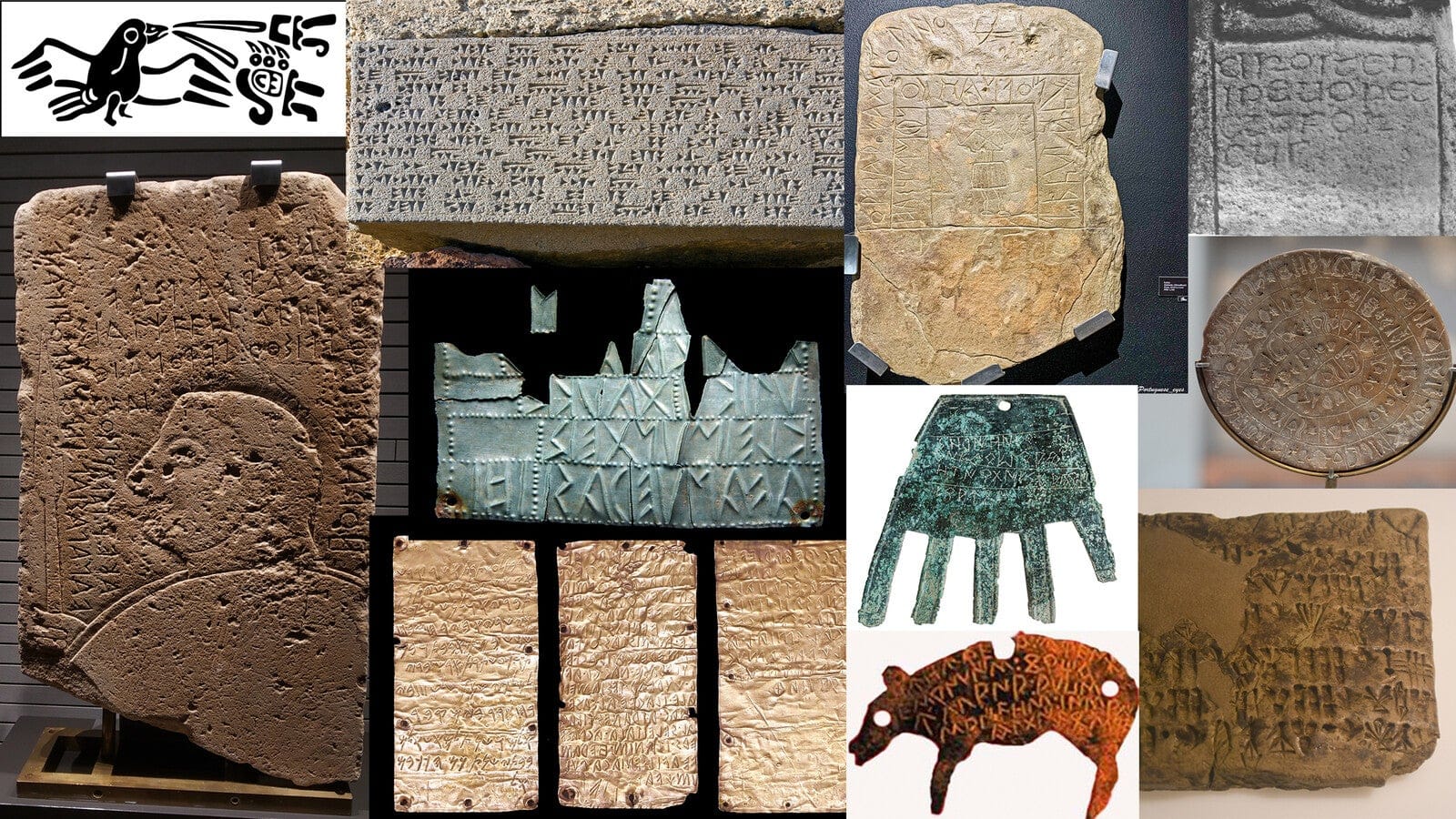
Some 3,000 years ago, a “golden age” of languages dawned around the world, resulting in the proliferation of tens of thousands of tongues over the next 2,000 years. But over the past millennia, we have entered a dark age of linguistic diversity, driven by the rise of “behemoth languages” that have pushed others into extinction.
That’s the conclusion of a new study that reconstructed humanity’s linguistic diversity since the dawn of agriculture, which emerged about 12,000 years ago at the end of the Ice Age.
The global human population before agriculture is estimated to have been between 4.4 and seven million people. Modern hunter-gatherer societies can act as rough proxies for the likely distribution, sizes, and linguistic diversity of these preagricultural populations. With that in mind, researchers led by Damián Blasi of Pompeu Fabra University in Barcelona developed a model based on 171 hunter-gatherer groups, which suggested that humans spoke about 4,500 to 6,000 languages before the dawn of agriculture. That’s fewer than the 7,500 that are spoken today, but still a lot considering how few people there were on Earth at the time.
The team then ran thousands of models predicting how languages diversified and evolved as humans adopted plant and animal domestication, a process that radically increased populations and complexified cultures. The predictions converged around a scenario in which linguistic diversity peaked around 2,000 years ago with possibly as many 75,000 tongues spoken worldwide.
“We uncovered a linguistic ‘golden age’ with tens of thousands of languages 3,000 to 1,000 years ago,” Blasi’s team said in the study.”In our model, this “golden age” was followed by an extremely rapid decrease in linguistic diversity, especially over the last two millennia.”
The spread of colonialism over the past 500 years has accelerated language loss due to the ascent of behemoth languages such as English, Spanish, Mandarin, and Hindi. But the new study suggests that linguistic diversity was already in decline starting at least 1,000 years ago due to the formation of smaller-scale multinational empires. Sadly, this trend of linguistic impoverishment has far-reaching consequences beyond language itself.
“Languages (and their histories) are regularly utilized as proxies for other units of culture because language is often transmitted and acquired along with other cultural traits, including marriage patterns, religious practices, kinship systems, or modes of social organization,” the team concluded. “Therefore, cultural variants with transmission dynamics similar to those of languages have also undergone a recent mass extinction.”
Alan Turing, the famed British mathematician who helped break the Nazi enigma code, packed a mind-boggling list of accomplishments into his short life. A foundational figure in the fields of computer science and artificial intelligence, Turing died at just 41 of cyanide poisoning in the wake of horrific persecution from the British government for what was then the crime of being a gay man.
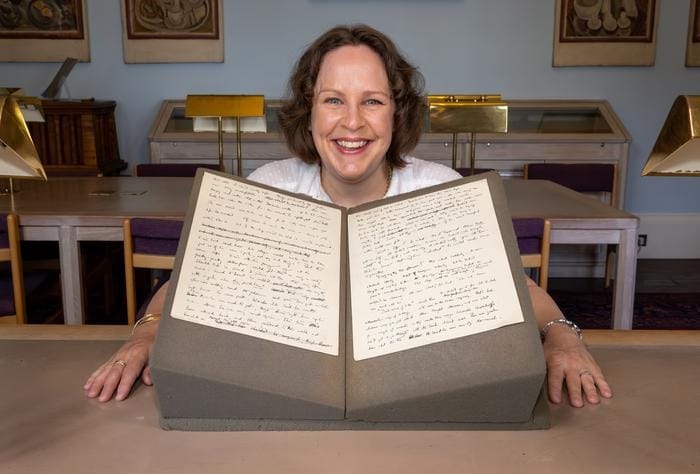
In his spare time from dramatically changing the course of history, Turing also tried his hand at writing fiction, according to a new study about his erotic short story “Pryce’s Buoy.” The draft is an autofictional account of Turing’s affair with his young lover Arnold Murray, a relationship that ultimately forced Turing to endure a sentence of chemical castration to avoid prison in the 1950s.
The draft is cut short before any sexual encounter between the characters—perhaps because Turing’s family censored it, or perhaps because Turing left it unfinished—though the tale is very clearly headed to the bedroom. Sarah Dillon of the University of Cambridge revisits the story in a new study that contextualizes it in the final years of Turing's life and links it directly to the works of gay writer Sir Angus Wilson by revealing that Turing copied many of Wilson’s stylistic choices.
“Wilson braved…dangers—he did not hide his homosexuality, and he did publish his work,” said Dillon in the study. “Turing did not hide his sexuality either, and although he did not publish his story, we cannot say whether this was through choice or because of the abrupt end to his life in June 1954.”
Turing’s life story is heartbreaking, but Dillon emphasized that “Pryce’s Buoy” is an expression of his playful, cheeky side, which persisted even in the midst of the immense injustice to which he was subjected.
Astronomers have discovered thousands of exoplanets, which are worlds that orbit other stars, but nobody has clearly spotted an “exomoon” orbiting one of these exoplanets. Now, a team reports the discovery of a Jupiter-sized world that is orbiting a massive object called a brown dwarf that is, in turn, orbiting a star called CD-35 2722, which is about 73 light years from Earth.
Concept art of the CD-35 2722 system, with the brown dwarf in the foreground, orbited by an exosatellite. Image: ESO/M. Kornmesser
This might be the first known exomoon, but the system is so weird and novel that researchers aren’t quite sure that’s the right term. Brown dwarfs are sometimes called “failed stars” because they are about as big as a gas planet can get without igniting nuclear fusion in their cores and transforming into stars. Moons orbit planets, and brown dwarfs are somewhere in between a planet and a star, so the team went with the term “exosatellite.”
“Exoplanet satellites can be easily described as exomoons, but it is not clear if satellites of brown dwarf companions can be called the same, as the term lacks a formal definition,” said researchers led by Kevin Hoy of Diego Portales University. “Perhaps we are approaching the limit of language invented to describe the Solar System, which is entirely unlike CD-35 2722.”
This is why you should always bring a poet! Whether or not the giant exosatellite gets minted as the first exomoon, the discovery is an exciting example of how diverse star systems are increasingly coming into focus.
For at least 25,000 years, the “Old Ancestors” of Aboriginal Australians gathered to burn grass and perform magic rituals within Cloggs Cave, a cavernous site several hundred miles east of Melbourne.
While the immense significance of the cave is well-known to the GunaiKurnai people of the region, as well as to generations of archaeologists, a new study has confirmed the deep roots of the site as a ritual setting for the Old Ancestors. Researchers led by Elle Grono of the Australian National University unearthed layers of “phytoliths,” which are mineral structures found in plant cells, to corroborate that the cave has been a site of magic and healing for 25,000 years.
GunaiKurnai Elder Uncle Russell Mullett at the cave entrance of Cloggs Cave. Image: Jess Shapiro, courtesy of GunaiKurnai Land and Waters Corporation
“Taken together, the archaeological features and multiple lines of archaeobotanical evidence at Cloggs Cave corroborates traditional GunaiKurnai knowledge and nineteenth century ethnography of ritual practices involving the use of plant resources, indicating that the cave was a special, secluded place used by mulla-mullung, powerful learned men and women, for the practice of magic, healing, cursing and spiritual practices,” said the team in their new study.
In our disorienting time of ephemeral reels and shortened attention spans, there’s inspiration in the incredible continuity of this storied cave, which has witnessed thousands of generations seeking solace in its confines.
This is Behind the Blog, where we share our behind-the-scenes thoughts about how a few of our top stories of the week came together. This week, we discuss astrology, Flock on the brain, The Odyssey, and more.JASON: This week I wrote pretty much exclusively about Flock, and I am working on a few more articles about automated license plate readers that will probably go in the next week or so. I am well aware that there are other topics in the world, but, basically, there is now so much interest
This is Behind the Blog, where we share our behind-the-scenes thoughts about how a few of our top stories of the week came together. This week, we discuss astrology, Flock on the brain, The Odyssey, and more.
JASON: This week I wrote pretty much exclusively about Flock, and I am working on a few more articles about automated license plate readers that will probably go in the next week or so. I am well aware that there are other topics in the world, but, basically, there is now so much interest in the company and its practices that I am getting inundated with tips, story ideas, and sources, and it feels like I have to chase many of the leads I’m getting. There are only so many hours in the day, so this means some other things I want to cover are either falling by the wayside or will have to wait.
A judge caught a court reporter making AI-generated errors in a court transcript, and put court reporters everywhere on notice for their use of AI. In a memorandum decision concerning a case about a man who sold drugs to another man who overdosed and died, filed on July 23, Judge Paul Felix wrote in a footnote of the decision that a transcript contained errors that looked a lot like generative AI. The footnote was spotted by attorney Rob Freund on X.
A judge caught a court reporter making AI-generated errors in a court transcript, and put court reporters everywhere on notice for their use of AI.
In a memorandum decision concerning a case about a man who sold drugs to another man who overdosed and died, filed on July 23, Judge Paul Felix wrote in a footnote of the decision that a transcript contained errors that looked a lot like generative AI. The footnote was spotted by attorney Rob Freund on X.
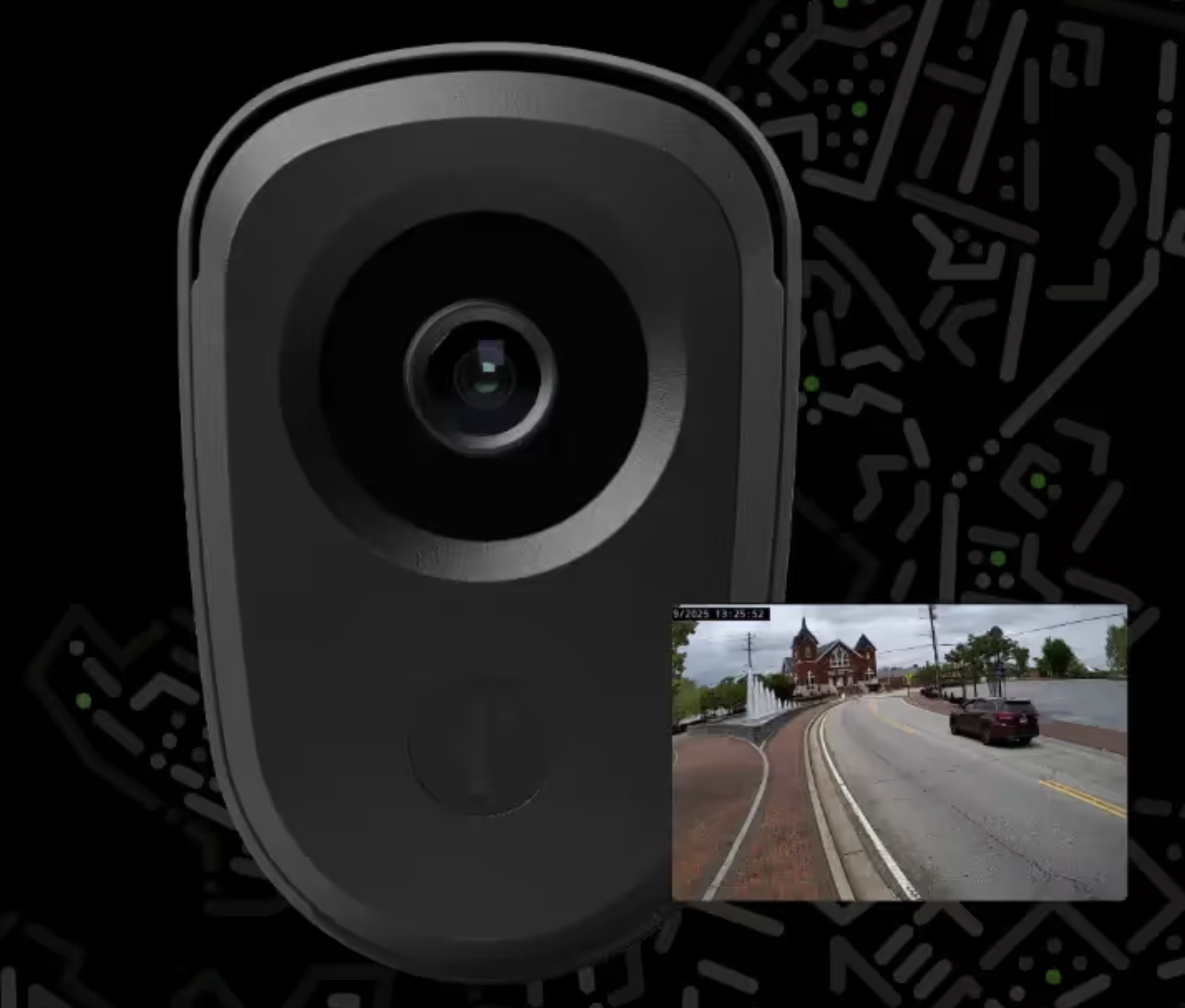
After the Los Angeles Police Department allowed its contract with Flock to expire, the surveillance company’s CEO, Garrett Langley, told local news that people don’t understand how its technology works, and that its automated license plate readers (ALPR) only take a “static picture” of a car. “The technology is really simple,” he told ABC7. "A car drives by, we take a picture. It's a static picture of a car, and then we read the license plate. That's what the technology is—it's actually not t
After the Los Angeles Police Department allowed its contract with Flock to expire, the surveillance company’s CEO, Garrett Langley, told local news that people don’t understand how its technology works, and that its automated license plate readers (ALPR) only take a “static picture” of a car. “The technology is really simple,” he told ABC7. "A car drives by, we take a picture. It's a static picture of a car, and then we read the license plate. That's what the technology is—it's actually not that complicated, it's pretty simple."
But for the last year, Flock has been marketing a new upgrade that allows “all” of its ALPRs to record live video. Langley is either dramatically underselling what Flock’s technology can do while saying that people don’t understand it, or Flock has quietly rolled back a major product feature without telling anyone. (Update: after the publication of this piece, a Flock spokesperson said Flock has discontinued the feature for law enforcement agencies.)
Flock has not been quiet about this live video upgrade; its salespeople have pitched the upgrade to cities, and the company has mentioned it in numerous blog posts (though it recently deleted one of them), and Langley even spoke about the capabilities with Forbes last year, suggesting cops could pull video in real time from its ALPR cameras: “We will just open up the five nearest cameras in real time and say, here's what's happening right now,” Langley said.
In June of last year, a Flock blog post called “Why video is the missing link in your LPR program,” the company wrote “All existing Flock LPRs will soon stream live video and capture clips with a free, optional software update. No new hardware, no permits, no extra cost. Same lens, same angle and field-of-view as the LPR. See basic video clips for every plate read. Zero lift for your team. Free and optional to opt in.”
The blog post describes several potential use cases, and different setups that police officers could use, which include adding a separate video camera to the poles that Flock cameras are installed on but also, crucially, includes the fact that all Flock ALPR cameras are capable of taking video: “Fixed live video is coming to all LPR cameras, free by end of 2025.”
And, in a now-deleted product launch blog, Flock wrote “LPR Cameras Can Become Video Cameras,” and added it was a “move that will transform the largest network of LPR cameras in the nation.”
“Flock customers don’t have to do a thing or pay a thing,” said Flock’s Chief Strategy Officer Bailey Quintrell in the blog post. “This will be a no-cost software update we push over the cloud.”
Text messages obtained using a public records request by Jason Hunyar, an activist in Dunwoody, Georgia, show that cops in Dunwoody turned on this feature. The text messages are between John Watson, a Flock employee, and a Dunwoody police officer from January of this year.
“Are y’all able to live stream LPR video yet?,” Watson asks.
“Yes,” the officer says.
“When did they turn that on and how has it been. And who turned it on?” Watson responds.
“It’s been about a month and it’s pretty cool feature,” the officer says. “Small angles but cool for incidents if needed. I’ve been working with Vijay [Dhamija, Flock’s Director of Product] on it.”
“Gotcha. Any stability issues?,” Watson asks.
“Not that I have noticed,” the officer responds.
The Flock spokesperson said, “This was not a broad rollout. Five law enforcement agencies participated in a limited pilot to test live video on select LPR devices; the LAPD was not among them.”
“In March, Flock discontinued the feature for law enforcement agencies, and it is no longer active at any of the five participating agencies. The pilot provided live video only and did not include recording or stored-video playback,” the spokesperson added.
Update: this piece has been updated to include comment from Flock.
Patreon laid off 93 employees, totaling 20 percent of its workforce on Thursday morning, according to an email to creators and staff from CEO Jack Conte.In a message sent to everyone on the platform signed up as a creator, and posted to the site, with the subject line “A Painful Update about our Team,” Conte wrote that the business is “healthy and strong” and that the core business of Patreon is not changing. Conte included the email sent to Patreon employees in the message. In the email, he
Patreon laid off 93 employees, totaling 20 percent of its workforce on Thursday morning, according to an email to creators and staff from CEO Jack Conte.
In a message sent to everyone on the platform signed up as a creator, and posted to the site, with the subject line “A Painful Update about our Team,” Conte wrote that the business is “healthy and strong” and that the core business of Patreon is not changing.
Conte included the email sent to Patreon employees in the message. In the email, he wrote that the company is undergoing both a “workforce reduction” and is “changing our organizational structure and how we work.” Specifically, he wrote, this means “we’re flattening the organization, refocusing teams on our top priorities, and evolving key aspects of our operations to make us faster at adapting to change.”
Conte is careful in this email to both express that he doesn’t view AI as a replacement for the human creativity the platform is built on and profits from — devoting a section of the email to saying as much — and also that AI is fundamentally “transforming” the tech industry, noting that it has an impact on how the company operates.
“To be clear about the impact of AI on today’s decision: we are not making the above changes because we believe AI replaces humans,” Conte wrote. “The more we have learned to use these new tools, the clearer it has become that they are not substitutes for the creativity, judgment, detail orientation, or craftsmanship that our teammates have in spades, nor do they replace the desire for human connection that all of us cherish so deeply. That’s my personal opinion, but more importantly, it’s the foundation of Patreon’s strategy: our product vision and business are both predicated on the value of human creativity and human connection. AI has fundamentally transformed the tech industry, though, including how we work, how we build products, how we communicate, and more. That does have an impact on how we operate and organize.”
Earlier this month, Patreon announced that it’s partnering with Cloudflare to block crawlers from stealing creators’ work to train AI models. “I HAVE A KICKASS PRODUCT UPDATE FOR YOU ALL!” Conte wrote in a post on Instagram. “This is live and happening at the network level on all posts published on Patreon.” The company later elaborated on the partnership in a blog post.
Included in the internal email shared publicly are severance details for laid-off workers, including 16 weeks of pay, remaining on payroll through the company’s August 20 vesting date, one additional week of pay for every full year worked at the company, additional cash payments for recent hires who haven’t reached their one-year cliff, healthcare coverage through the end of the year for eligible employees and families, and a $1,500 stipend to replace their company laptops.

 Connexion