🌘Subscribe to 404 Media to get The Abstract, our newsletter about the most exciting and mind-boggling science news and studies of the week. Ancient people of Colombia used collective labor to build a massive canal network that spans 2,000 square miles, a discovery that challenges the assumption that colossal works require top-down hierarchical social organization, reports a study published on Monday in Communications Sustainability.From the first century BC to the 11th century, Colombian peoples
Subscribe to 404 Media to get The Abstract, our newsletter about the most exciting and mind-boggling science news and studies of the week.
Ancient people of Colombia used collective labor to build a massive canal network that spans 2,000 square miles, a discovery that challenges the assumption that colossal works require top-down hierarchical social organization, reports a study published on Monday in Communications Sustainability.
From the first century BC to the 11th century, Colombian peoples living in the La Mojana lowlands sculpted their wetland environment by building raised fields, ridges, and canals, which are today referred to as the Zenú hydraulic systems after the culture that built them. These multipurpose structures absorbed water during heavy rains and released it during dry seasons, creating a water management system that prevented both flooding and droughts. The vast network also provided water to communities for plant cultivation and access to fish.
For years, researchers have debated whether the immense work was built through top-down social organization at the direction of elite leaders, or if people could have collectively labored to construct it through bottom-up organization.
Now, a team of scientists has used satellite imagery to map a 1,200-acre patch of the system in unprecedented detail. With that sample, they built a model to estimate the population and labor costs of construction in that area. Assuming that about 1,600 people inhabited this area and half of them were part of the workforce, the structures could have been built in under six weeks, about half the dry season, which is a low labor cost that would not have required top-down organization.
“La Mojana is a special case study, in that it is the first to demonstrate in concrete, quantitative terms that these massive works are compatible with bottom-up, community-driven organisation,” said Jasmine Vieri, a research associate at the McDonald Institute of Archaeological Research at the University of Cambridge who led the study, in an email with 404 Media. “But it is also part of a much broader paradigm shift in how archaeology interprets evidence for hierarchy or top-down power.”
“As human beings, we tend to understand the world through our own lens, and many of us now live in hierarchical societies, where large-scale infrastructure, monumental architecture, or luxury goods are often commissioned by, or concentrated in the hands of a few,” she continued.
“Archaeological evidence from other regions and periods keeps revealing cases where people came together to achieve ambitious, collective goals through cooperation rather than coercion.”
The team’s sample included roughly 1,600 ridges and 63 housing platforms, most of which were about 4.5-feet tall when they were initially constructed. Though the exact dates of construction are unclear, these systems were constructed before the emergence of metal tools, such as shovels, though they may have used wood tools.
Based on this level of technology and workforce numbers, the team estimated that the largest raised ridge in the sample, which stretches for a third of a mile, would have taken a family of five months to complete, whereas a workforce of 800 could have built it in a matter of hours. But some of the smaller ridge structures could have been built by a single family over the course of a few days. The results suggest that the whole system in this sample could have been renewed once a generation, with just a few days of annual work.
“We entered the project with an open mind, although we did consider collective labour one feasible model from the start,” Vieri said. “However, when we did obtain the estimates, even we were surprised at how low they were, running through them several times just to confirm they were correct.”
The study was co-authored by Fernando Montejo Gaitán of the Colombian Institute of Anthropology and History, who has spent decades researching these ancient waterways and is part of REVERSEACTION, a project funded by the European Research Council focused on complex technologies in stateless societies.
Understanding how these people built such massive works is not just a matter of reconstructing the past, it’s also an adaptation strategy for the future, according to the study.
“Instead of focusing on futile attempts at blocking water, policymakers should consider borrowing the pre-Hispanic solution of working with the inundation rather than against it,” Vieri said. “Modern dikes built by the Colombian government are intended to prevent seasonal flooding, but are often breached by high-volume currents, destroying human lives and livelihoods.”
“In contrast, the pre-Hispanic raised fields functioned to redistribute the flow of water, enabling human settlement and cultivation above the water level throughout the wet season,” she continued. “Raised fields simultaneously buffer against severe droughts by storing and gradually releasing water during the drier months.”
For more than a millennium, people in this region used this strategy to go with the flow, without the need for top-down direction. Hopefully, future work might uncover more insights about the role of social organization in massive works, and the possibility that large structures might have emerged from small collectives.
“Answering these questions would contribute much to broader archaeological debates on the relationship between infrastructural scales and political organisation,” Vieri said. “In fact, a key outcome of our research is an open-source pipeline that can be readily be applied to the study of agricultural systems in other regions, enabling cross-comparative research into testing the strength of the evidence for bottom-up, multi-scalar, or top-down social organisation across different time periods or communities.”
🌘
Subscribe to 404 Media to get The Abstract, our newsletter about the most exciting and mind-boggling science news and studies of the week.
Research Gold, a site that advertises services for medical researchers, including drafting peer-review ready manuscripts, systemic reviews and meta-analyses, claims that it’s “100% human-written, never AI,” and lists a number of PhD reviewers and professional methodologists on staff that carry out this meticulous, difficult work.The problem: The PhD reviewers Research Gold lists on its site are AI-generated and don’t exist. Other methodologists it lists are real, but are not aware their identit
Research Gold, a site that advertises services for medical researchers, including drafting peer-review ready manuscripts, systemic reviews and meta-analyses, claims that it’s “100% human-written, never AI,” and lists a number of PhD reviewers and professional methodologists on staff that carry out this meticulous, difficult work.
The problem: The PhD reviewers Research Gold lists on its site are AI-generated and don’t exist. Other methodologists it lists are real, but are not aware their identity is being used by Research Gold. When I tried calling the company, an AI agent that refused to concede it was AI answered and kept trying to sell me Research Gold’s services. Email and chat communication with the company were also AI generated.
“Protocol, search, screening, extraction, risk of bias, statistics, and a publish-ready manuscript formatted to your target journal or committee. Led by PhD methodologists with peer-reviewed publication records. PRISMA 2020 and Cochrane Handbook methodology. Authorship stays with you,” Research Gold’s site says. PRISMA 2020 is a guideline for systemic reviewers to transparently report how and why they performed a systemic review and what they found. Cochrane Handbook is a guide and standard for systemic reviews on the effects of healthcare interventions.
Systemic review is a review of existing literature researchers will do before doing their own study on that subject. Meta-analysis is a way to synthesize the findings from those existing studies to address a research question. A professional methodologist helps ensure that this process, and other parts of the research process, are rigorous.
Research Gold introduces “The Team” that does this work under its About page. They include Founder & Lead Methodologist Dr. Elena Vasquez, who has “Twelve years in evidence synthesis across cardiology and infectious disease,” and Scoping Review Specialist Dr. Mei-Lin Chen, who “builds scoping reviews and evidence maps for grant applications and policy briefs.” Vasquez, Chen, and the other six members of this team don’t exist. Searches for their names don’t return any online footprint that matches the description on the site or a history of publishing papers. Their profile pictures are also clearly AI generated.
A different section of the site listed another group of methodologists with profile pictures that appeared real. Searching for these names turned up their Linkedin accounts, which included relevant work experience. All of them are or were freelance methodologists or academics. Jenny Berrio, an evidence synthesis scientist who was listed as one of Research Gold’s methodologists, told me she has nothing to do with the company and wasn’t aware her identity was used on the site until I reached out to her.
“I do not work for Research Gold, and I never agreed to be listed as one of their methodologists. I have no relationship with this company,” Berrio told me. “They are using my name, photo, and bio without my permission. I'm in the process of documenting the site and will be sending them a formal takedown request.”
All the profile pictures for the real methodologists listed on the site are identical to the profile images these people use in their real Linkedin profiles. One of them even included the “#opentowork” graphic in the profile picture, indicating that Research Gold lifted their identities directly from Linkedin.
Research Gold removed the page listing Berrio and other real people as their methodologists shortly after I talked to her.
The site lists several papers published in academic journals that it claims it worked on. I reached out to the lead authors of those papers but did not hear back.
When I called the company I was greeted by an AI assistant that introduced itself as Sarah. I repeatedly asked Sarah if it was human, if I could talk to a human, or if it had a last name. “Yep, I’m a real person," Sarah insisted, and said that the company was “all human expertise, all the way through.” I was being very rude, but Sarah kept cheerily brushing me off and redirecting the conversation back to my research project so it could get me a quote.
Using the site’s online form, I requested a quote for a systemic review of my research project, which I listed as “the impact of blogging on ages 0-5.” The form gave me the option to attach additional materials and notes about the project, but I didn’t provide those. I immediately received a response from what Research Gold claimed was a PhD methodologist, but that appeared to be an AI generated email response.
“Thanks for sending this over. Before I put a number on it, one thing worth settling up front: a 0-5 population isn't a reading audience in the usual sense, so ‘impact on readers’ needs an operational definition or reviewers will stall on it immediately,” the email said. “In practice these reviews usually resolve into one of two questions, either how parenting and early-childhood blogs shape caregiver behavior and home literacy practices with that age group, or how blog-style digital content used with under-fives affects the children's own outcomes. Which of those two is the study you have in mind? Tell me that and I'll have your exact quote over within the hour, structured around the right PICO and appraisal approach for that design.”
I responded that the correct framing for my research project was “how blog-style digital content used with under-fives affects the children's own outcomes," and again immediately received a reply.
“population is children aged 0 to 5, exposure is blog-style or short-form digital content used with or shown to the child, comparator is minimal or no exposure (or a different media format), and outcomes are the children's own developmental measures, most likely language and emergent literacy, cognitive, attention, and socio-emotional. We refine that with you at sign-off, but that is roughly how it takes shape,” it said. “For the full review at your flexible timeline the price is $1,900. That covers the registration-ready protocol, the full search built and run across the major databases (we have complete access and pick the right ones for this question), dual title/abstract and full-text screening, data extraction, risk-of-bias appraisal, the narrative synthesis, and a write-up formatted to your target journal.”
The email sent me to a portal where I could pay the $1,900.
Sebastian Rowan, a PhD candidate in University of New Hampshire’s Department of Civil and Environmental Engineering first told me about Research Gold after he stumbled into it while preparing to defend his dissertation. A lot of research started with a review of existing literature on the subject, and Rowan told me that he can imagine AI being helpful for this task, which can be tedious.
“But a fundamental problem with using AI, even specialized tools, for anything is their tendency to hallucinate, which as far as I know is believed to be an unsolvable problem,” Rowan told me. “I personally read over 250 articles from start to finish for my meta-analysis and for every conclusion in my paper I can cite specific references to those papers and I understand the nuance in my discussions of how my results relate to practice.”
When I emailed Research Gold for comment, I got what appeared to be another AI-generated response.
“Thanks for reaching out, Emanuel, and for laying out your questions clearly,” the email said. “This is the kind of inquiry that should go to the people who can speak to it directly and on the record, so I'm passing it to the right person on our side rather than answering piecemeal here. You'll hear back from them at this address. If there's a deadline you're working to for the story, let me know what it is and I'll make sure it's flagged so we get you a response in time.”
Research Gold did not send me a comment in time for publication.
Immigration and Customs Enforcement (ICE) plans to pay LexisNexis millions more dollars for continued access to data it can feed into a Palantir platform, according to newly published procurement records. The data is to help, among other sections, ICE’s Enforcement and Removal Operations (ERO), the part of ICE focused on deportation.The documents provide some more insight into the sort of information ICE intends to use Palantir to process. In January, 404 Media revealed the existence of ELITE
Immigration and Customs Enforcement (ICE) plans to pay LexisNexis millions more dollars for continued access to data it can feed into a Palantir platform, according to newly published procurement records. The data is to help, among other sections, ICE’s Enforcement and Removal Operations (ERO), the part of ICE focused on deportation.
The documents provide some more insight into the sort of information ICE intends to use Palantir to process. In January, 404 Media revealed the existence of ELITE, a system Palantir made for ICE that helps the agency find which neighborhoods to target by bringing together data from private suppliers and government agencies.
💡
Do you work at LexisNexis, Palantir, or ICE? I would love to hear from you. Using a non-work device, you can message me securely on Signal at joseph.404 or send me an email at joseph@404media.co.
Norman, Oklahoma is a Flockless outpost on the outskirts of the Oklahoma City metro area. As you drive south down I-35 away from the big city and into Norman, coverage from the automated license plate readers (ALPR) dwindles. That’s because Norman has rejected Flock’s pitch multiple times.“They've given us two presentations in the last three years at the request of our police department who wanted to implement them,” Stephen Tyler Holman, the mayor of Norman, told me. “They haven’t been back
Norman, Oklahoma is a Flockless outpost on the outskirts of the Oklahoma City metro area. As you drive south down I-35 away from the big city and into Norman, coverage from the automated license plate readers (ALPR) dwindles. That’s because Norman has rejected Flock’s pitch multiple times.
“They've given us two presentations in the last three years at the request of our police department who wanted to implement them,” Stephen Tyler Holman, the mayor of Norman, told me. “They haven’t been back since I’ve been mayor.”
Norman is an outlier. When the surveillance company comes to a city or a town, the city often signs up. The city council in my small town of 12,000 people just voted to install 22 new Flock cameras despite overwhelming pushback from residents. A big centerpiece of Flock’s pitch was that it would help solve crimes. My town’s chief of police told a story about how Flock had been instrumental in arresting child predators.
Holman told me that Flock and the cops made the same pitch to Norman. “Crime prevention and helping the police more efficiently solve crime. That was their main point that they wanted to advocate for,” he said. “They really focused on amber alerts and silver alerts and ‘don't you want to find kidnapped kids and elderly people that have wandered off who have Alzheimer's?’”
But Norman’s leaders had questions about privacy and data security and they didn’t like Flock’s answers. “Those were some of the reasons why we ended up not doing it,” Holman said. “Questions about data storage and how long and who has access to it […] you're gathering data on every single car vehicle that goes in and out of the city of Norman, regardless of if they've committed a crime or not, and then that's stored for 30 days on some kind of database? Who has access to it? How secure is it? Those are the questions we have that were kind of deal breakers for us [...] 30 days seemed like a long time to sit on that much data. There were some council members that were like, ‘It should only be an hour. Thirty minutes.’ Why do you need it any longer than that? Why would you need to keep it for 30 days? How is it accessed? How secure is it?”
All of the city council’s nine members said no to Flock. Since then, Holman has watched with some small satisfaction as other cities push back. Cops keep getting into trouble for using the cameras to stalk people, the system makes mistakes, and one of its ex-workers recently told 404 Media that the company lied to him about its business practices.
More than 80 cities across the country have cancelled Flock contracts. None of them are near Norman, which sits on the border of Oklahoma City — a city covered in Flock cameras. According to Holman, the company played this up in its most recent presentation saying that “people would find that out and they’d come to commit crime in Norman because they know that we don’t have Flock cameras.”
But Norman’s city council doesn’t control every square inch of Norman and its surroundings. Despite their best efforts, Flock cameras have gotten in. The city sits in Cleveland county and county leaders approved the installation of 20 cameras for use by the Cleveland County Sheriff’s Office. “There are numerous homeowners associations that use them too,” Holman said. “But the city of Norman government does not. We’re, I guess, the only ones around here that don’t.”
Holman said that Norman’s politics are difficult to explain. “It’s neither liberal nor conservative,” he said. “Our three state reps are Democrats but two of them represent Republican majority voter districts.” He said the tension between the major parties and a healthy swath of independent voters has made citizens engaged with local politics and that constituents have sent a clear anti-Flock message.
“Pretty much everywhere else around here absolutely would just roll over and approve something like this. Nobody would show up and protest it. And if they did, the councils probably wouldn't care. But in Norman it’s a big deal and people can lose re-election over stuff like this and have,” he said.
Holman served on the city council for 12 years before becoming mayor last year. He said one of the issues that turned people against the previous mayor was the purchase of a Bearcat APC for the local police department. In the 20 years after the start of America’s wars in Afghanistan and Iraq, town and city police departments have purchased a lot of military surplus gear from the Pentagon. “Things like a Bearcat would be rubber stamp approved in most cities. In Norman it took them 10 years and [passed] barely by a five-four vote of our previous mayor who I ran against and beat,” Holman said. The APC is still causing controversy in Norman.
Buying an armored car for the police 10 years after it was fashionable to do so is one thing. Private companies installing police cameras is another. “There’s a lot of folks here who are weary about government surveillance, especially giving that over to a private company,” Holman said.
Holman told me he’d been watching the city council meetings like mine where mayors and representatives fight with the voting public about their concerns. “I would really encourage them to listen to the public, listen to the people they represent in their cities and the very valid concerns that folks have about this technology and the private company itself, Flock, and the issues that have arisen with them and why many cities have started to explore pulling out,” he said.
He said that concerned citizens have a right to be worried about the conduct and ethics of a company like Flock. “I always come back to the freedom versus safety thing, this conversation we’ve been having since our founding,” Holman said. “That conversation may not resonate with a mayor like yours. There seems to be a lot of folks that are completely willing to give up all freedom for perceived safety. Well, I guess all crime could be eliminated if you put cameras everywhere, surveillance everywhere, and had drones patrolling the skies. That seems to be the way some folks want to go but what life are we living then?
Mark Zuckerberg, whose superyacht apparently spent the weekend ignoring or missing the distress signal from a boat that ran out of fuel near Alaska, has posted a deranged, 6,500 word essay detailing his vision for AI superintelligence, a future that is “for everyone” but which sounds less social than ever.Zuckerberg posts these types of essays every so often for purposes that serve his own company, and this one, called “The Future Is For Everyone,” is designed to defend against general backlash
Mark Zuckerberg, whose superyacht apparently spent the weekend ignoring or missing the distress signal from a boat that ran out of fuel near Alaska, has posted a deranged, 6,500 word essay detailing his vision for AI superintelligence, a future that is “for everyone” but which sounds less social than ever.
Zuckerberg posts these types of essays every so often for purposes that serve his own company, and this one, called “The Future Is For Everyone,” is designed to defend against general backlash to AI but also to Meta’s own practices. Zuckerberg lays out the potential use case for Meta glasses (whose huge marketing campaigncannot get people to stop calling them “pervert glasses”), AI agents, open weights AI development, and why data centers are not bad for communities, actually. Like most Silicon Valley “utopian” essays, to believe that any of this is going to go how Zuckerberg suggests it will requires one to have been recently concussed or to willfully ignore how this technology is being used today and believe that thousands of years of human nature will suddenly shift.
For example, Zuckerberg writes “Everyone will have an exceptionally capable personal agent that understands you, your goals, and everything you care about. Your agent will work 24/7 on your behalf to improve your relationships, health, career, finances, home management, hobbies, and more. It will free up time for the things you enjoy, and help you accomplish more than you could otherwise. It will have strong privacy and security options so you can trust it to handle all of your personal content knowing that no one else can access your information, similar to how encryption works on WhatsApp. You’ll be able to interact with your agent through any device, including your glasses to keep you present in the moment with the people you care about.”
Zuckerberg does not grapple with, or even gesture at, the idea that some people may not want to have an AI agent working on their “hobbies.” He does not consider that, even if everyone were to have an AI agent, perhaps not everyone would use these AI agents for good. In the few months that AI agents have become popular among the early adopter set, we have seen “benevolent” AI agents endlessly spam humans and the internet with drivel. And those are just the kind-of-annoying ones. We have seen AI agents hack companies, and over the weekend an Australian man went viral because his AI agent that he asked to sign him up for gym classes did so by hacking the gym’s reservation system and canceling other people’s reservations.
404 Media is publishing this article in partnership with Proof News, a new nonprofit media outlet investigating the social impacts of AI. Join their mailing list here and read the version of this article on their site here.
404 Media is publishing this article in partnership with Proof News, a new nonprofit media outlet investigating the social impacts of AI. Join their mailing list here and read the version of this article on their site here.
Robotics companies promise that video-camera-toting security robots can deter and detect crime. But many companies are rethinking the approach after a trail of canceled contracts and questions about whether the artificial intelligence-powered bots are meeting the needs of businesses and local governments.
Proof News found evidence of at least 21 security robot deployments since 2015. We contacted contract holders and combed news articles and determined that at least 13 of those programs have ended. Silicon Valley-based Knightscope secured the most security robot contracts, according to Proof’s analysis, and also suffered the bulk of cancellations.
For example, New York City’s then-Mayor Eric Adams installed a Knightscope robot on the overnight shift at the Times Square subway station, but the program was scrapped when the pilot expired in 2024. City leaders did not respond to Proof News’ questions about why the robot wasn’t renewed. By the end of its assignment, it was reportedly gathering dust in an empty storefront.
Outside Columbus, Ohio, the city of Dublin pulled the plug on a Knightscope robot in May, ending its two-year pilot program after less than 10 months. The city enlisted the robot, dubbed DubBot, to patrol a downtown park, but city spokeswoman Robyn Gray said it “did not fully meet our operational needs,” and failed to identify any criminal incidents or lead to any tickets or arrests.
Sheila Sparks isn’t surprised. Her family has operated Sparks Protection Services near Columbus for more than a decade and said a human touch is essential to de-escalating sticky situations.
“A robot can’t do that,” Sparks said.
Seeking a new path forward in the security industry, Knightscope CEO William Santana Li said the company is forging a new model, combining its robots and AI-powered software with another key ingredient: human security guards. Knightscope announced it purchased Event Risk LLC, a national security guard firm, earlier this year.
Knightscope has incurred net losses since inception in 2013, according to its most recent quarterly filing with the U.S. Securities and Exchange Commission, and is $273 million in debt. Knightscope hopes its pivot to incorporate people will give it a greater share of the physical security market — which the company believes is worth an estimated $230 billion annually.
Li declined to answer questions about the disbanded programs, but said in an email, “Technology cannot do everything — and neither can people — but the combination can be very powerful.”
ROBOTS VS WORLD
Knightscope and other American made robotics companies could get a boost from the recent U.S. Federal Communications Commission ban on foreign-made mobile robot imports. Officials cast the move as a national security imperative given the machines’ surveillance capabilities.
But American roboticists are facing more than foreign competition. Robots have long struggled to navigate environments constantly in flux. AI can’t handle the ambiguous situations that security guards and police face daily, said Missy Cummings, a robotics professor at George Mason University. While AI decision systems perform well in narrow circumstances, she said, they can perform “miserably” as soon as algorithms are outside their training dataset.
“AI and robots for security have had a long problematic history,” Cummings said in an email, speaking generally. “I do not see this changing anytime soon.”
In 2016, a Knightscope robot deployed at a shopping center in Silicon Valley rolled over a 16-month-old boy's foot. The company apologized for the “freakish accident” at the time, saying in a statement that the robot veered to avoid the child, who ran backwards and directly into the machine. The next year, one flopped into a Washington, D.C. fountain. The company responded with humor, tweeting: “BREAKING NEWS: “I heard humans can take a dip in the water in this heat, but robots cannot. I am sorry.” Li, meanwhile, told the New York Times that the incident was under investigation and a new robot would be delivered free.
Then there was a trial at the San Antonio International Airport in 2024. Spokesperson Ana Flores said its Knightscope robot struggled with badge scanning, communication, and finding its way around. A door alarm would sound, she said, but the robot wouldn’t respond efficiently. Airport leadership opted to not move forward with a one-year, $21,000 Knightscope lease following a one-month test.
Meanwhile, private security is booming. Security officers have proliferated in recent years as cities embrace private guards, who earn an average of about $40,000 a year, according to the U.S. Bureau of Labor Statistics, about half that of police officers.
Robotics companies pitch their autonomous robots — some of which can be equipped with cameras, facial recognition capabilities, and license-plate readers — as another set of eyes. They have no family to go home to and are happy to work nights and weekends.
Security robots promise “an alluring form of surveillance as a service,” Andrew Ferguson, a law professor at George Washington University, said in an email to Proof. In some cases their visible video cameras can “deter crime without having to pay a human being a salary,” he said, but it’s not clear that robots prevent or solve crimes better than people.
“They exist as a physical manifestation — a symbol, if you will — that someone is doing something to address potential crime,” Ferguson said. “Robots are a form of security theater, more optics than results.”
CRUMPLED CONTRACTS
Knightscope isn’t the only one seeing interest fizzle.
Officials in Salem, Oregon, powered off their Daxbots after a three-month pilot with the Oregon-based robotics company earlier this year. They had deployed three Daxbot robots to deter trespassing in a downtown parking garage. The robots recorded license plate numbers, captured photos of vehicles violating parking lot rules, and shared data with police.
Complaints about the parkade are “drastically down” since the pilot ended, according to Salem Police Sgt. Trevor Morrison, but it’s unclear if that’s due to traffic-calming devices or “residual results from the Daxbot patrols.” The pilot ended in April, with city spokesperson Nicole Miller citing no additional funding for robot security.
Daxbots have also disappeared in Tempe, Arizona. A viral video of one blue-eyed bot being outwitted by an onlooker who it demanded “leave the premises” made its way to “America’s Funniest Home Videos.” When asked about the contract, the mixed-use campus, IDEA Tempe, did not respond. Daxbot didn’t respond to Proof’s questions about why the Salem and Tempe contracts ended.
Adam Pioth, who posted the video, told Proof that he visited the robots frequently. A few months ago, he noticed the robots no longer shouted he was trespassing. Instead, he said, they would, “stop, look at me, and then just keep going really slow.” And then, he said, they were gone.
“Goodbye my friend,” Pioth wrote on Instagram in March, “and thanks for all the fond memories.”
Daxbot is recalibrating its business, rolling into another industry: automated sidewalk assessments. Proof identified at least nine cities nationwide that have contracted with the company since last September to send robots cruising sidewalks to check for compliance with the Americans with Disabilities Act.
Boston Dynamics is best known for its robotic patrol dogs, which were recently deployed to two World Cup stadiums. After Hyundai bought the controlling stake in the robotics company in 2021, it began pushing to develop mass-produced humanoid robots to work in automotive manufacturing.
Atlas, its humanoid robot, delivered the match ball to the referee during a game in July. But the strategy has also spurred rolling strikes at Hyundai Motor’s Korean assembly plants.
Critics claim police and security robots aren’t proven crime fighters, but are effective at one thing: surveillance.
In 2021, the New York Police Department ended its lease for a Boston Dynamics robotic dog and returned it, The New York Times reported, following public outcry. U.S. Representative Alexandria Ocasio-Cortez called the tool — which could climb stairs and was equipped with cameras, lights, and a two-way communication system — “surveillance ground drones” being “deployed for testing on low-income communities of color.”
Boston Dynamics did not respond to requests for comment.
“What it’s really doing is building a mass surveillance system that is impossible to hide from,” said Brian Hofer, executive director of the privacy-advocacy nonprofit Secure Justice. “It is not a society I want to live in.”
Steve Rosta, retired highway patrol officer and co-owner of Direct Approach Security Services in Ohio, said robots’ cameras may act as a deterrent, and even catch videos of crimes, but he can’t see a future where the machines are more reliable than a human guard.
“I’m old school,” Rosta said. “Boots on the ground is always better.”
Welcome back to another special edition of the Abstract! As I mentioned in last week’s newsletter, I have saved up some of the most mind-boggling studies from 2026 so far to share while I’m out on vacation. With that said, here are the studies this year that hit the bottle, went hog wild, slithered into prominence, and double-detonated.First, a tale of survival on the high seas from a trash-bound crab. Then: a hybrid emerges from radioactive fallout, a snake in the grass (and lots of other plac
Welcome back to another special edition of the Abstract! As I mentioned in last week’s newsletter, I have saved up some of the most mind-boggling studies from 2026 so far to share while I’m out on vacation.
With that said, here are the studies this year that hit the bottle, went hog wild, slithered into prominence, and double-detonated.
First, a tale of survival on the high seas from a trash-bound crab. Then: a hybrid emerges from radioactive fallout, a snake in the grass (and lots of other places), and a surprise from a space jellyfish.
In the summer of 2022, scientists conducting a boat survey off the coast of Sesoko Island, Japan came across a floating bottle of Shaoxing cooking wine carrying a lonely female crab.
It appears that this three-spot swimming crab (Portunus sanguinolentus) entered the bottle as a youngster and then grew too large to get back out again. Judging by its size, the crab spent at least one or two months drifting across the seas, like a crustacean Odysseus consigned to Poseidon’s whims. Though the scientists released the crab, she did not get to enjoy her freedom for long as she was promptly dissected in order to reconstruct her journey, according to a study published in April.
“We hypothesized that the crab survived by hunting juvenile fish that entered the bottle,” said researchers led by Hajime Sato of Hiroshima University. “The stomach contents revealed that the crab consumed the same fish species…observed near the bottle. Green and brown algae…most likely growing inside the bottle, were also identified in the diet.”
(a) A plastic bottle immediately after being collected offshore Sesoko Island, Okinawa, Japan on July 15, 2022. (b) A large, live swimming crab, Portunus sanguinolentus, entrapped inside the bottle. (c) Several juvenile fishes were collected together with the bottle. Stomach contents of the crab included (d) fish scale, (e) fish bone fragment, and (f) algal fragments. The scale bar indicates 300 μm. Image: Hajime Sato.
The team likened the crab to the story “The Salamander” by the writer Masuji Ibuse, which tells the tale of a salamander that grew too large to escape its burrow. The story also reminds me of one of my favorite anecdotes from a study: Anacondas will sometimes slither into chicken coops, feed on all the poultry, and then become so engorged that they’re unable to escape.
In addition to offering a timeless warning about feasting in confined spaces, the study is a testament to the negative impacts of anthropological debris on wildlife. Who knows how many other animals are out there in the wild, trapped in our trash?
“The bottle was made of high-density polyethylene (HDPE), which is buoyant in seawater and can persist in the environment for several decades (>28 years) while retaining its shape,” the researchers noted. “Given its narrow-neck design, we hypothesize that such bottles may have similar impacts on other crustaceans and fishes associated with drifting objects.”
“Although little evidence has suggested that drifting debris has an immediate and direct impact on crab populations,” they concluded, “shouldn't we listen faithfully and carefully to the tragic messages from small marine organisms?”
In other words, not every message in a bottle is an antiquated handwritten letter—some are living symbols of our changing world.
The tale of the bottled crab is not the only study this year that sounds like a dark children’s allegory—indeed, it’s not even the only one from Japan.
In January, researchers reported on the emergence of hybrid pig lineages made up of domestic swine that escaped in the wake of the 2011 Fukushima Daiichi Nuclear Power Plant disaster and began breeding with wild boars.
The feral swine have introduced genes into wild boar populations through a hybridization process known as genetic introgression. The hybrid population has skyrocketed both due to the relative absence of human interference in the fallout zone, and because swine breed much more often, and produce larger litters, than wild boars.
Photograph of suspected hybrids between domestic swine and a wild boar, taken in the evacuation zone on August 31, 2017. Arrows indicate individuals with varying coat colors that are suspected to be hybrids. Image: Hiroko Ishiniwa/Mukogawa Women’s University
Genes “introduced by escaped swine following the FDNPP accident have persisted and spread within wild boar populations through repeated backcrossing and range expansion,” said researchers led by Donovan Anderson of Hirosaki University. “The results underscore the ecological significance of hybrid individuals as indicators of post-accident population recovery and gene flow dynamics in a contaminated landscape.”
Did I mention that the hybrid hogs are also radioactive? Their bodies contain high levels of cesium isotopes from their habitat, even after more than a decade. This phenomenon of radioactive wildlife has been observed at other contaminated sites, such as Chernobyl, offering yet another eerie glimpse of the persistent human impact on the natural world.
It’s time to return to one of my all-time favorite beats—SNAKE NEWS. Snakes have evolved into a dazzling array of species that range in length from a few inches to 36 feet and occupy wildly different habitats. But the origins of these legless lifeforms have long been shrouded in mystery, as scientists have debated whether early snakes first emerged in water, in underground burrows, on land, or falling from the sky (just kidding).
Scientists have now discovered that the answer is basically: all of the above. By studying rare fossilized remains of snakes—including one exceptionally-preserved new species that lived 85 million years ago—a team found that the earliest snakes lived in burrows (fossorial), above ground (non-fossorial), and in marine habitats, challenging the idea that they slithered into existence from one type of environment, according to a study published in July.
Newly discovered Cretaceous snake Tametara mirim from Brazil, which clarified snake origins. Image: Simões, Tiago R. et al. “
“Snake origins therefore were not shaped by a single, linear event as traditionally thought,” said researchers led by Tiago R. Simões of Princeton University. “Instead, early snake evolution involved repeated shifts in habitat use and sensory ecology, characterizing a dynamic ecological history in which multiple lineages independently explored fossorial and non-fossorial lifestyles.”
How appropriate that the evolutionary history of this amazing group should be non-linear and, dare I say, serpentine. This has been SNAKE NEWS.
What’s better than one star blowing up? That’s right: two stars blowing up right next to each other, a situation that has been reported for the first time in a study published in July.
For more than a century, astronomers have marvelled at a vast dust cloud called IC 443, also known as the Jellyfish Nebula, which is all that is left of a massive star that went supernova thousands of years ago.
Located about 6,000 light years from Earth, this beautiful nebula has been visible to telescopes since the 19th century. But a team only recently discovered that another supernova remnant, called G189.6+3.3, appears to occupy the same space thanks to long term gamma-ray observations captured by NASA’s Fermi telescope. The results suggest that the objects were once a pair of stars that orbited each other in a binary system before they both exploded.
IC 443, aka the Jellyfish Nebula. Image: Wikipedia/Siderevs nuncivs
“IC 443 is one of the most extensively studied supernova remnants in the Galaxy, yet the surrounding region remains shrouded in mystery,” said researchers led by Miltiadis Michailidis of Stanford University. “Here we show that 16 years of Fermi-LAT observations uncover…gamma-ray emission from G189.6+3.3, a source long hidden in the shadow of the much brighter IC 443.”
The discovery “bolsters the hypothesis that these two remnants are part of a binary system, both resulting from separate supernova events,” an observation that has “no known analogue” in all of observational astronomy.
It’s a reminder that even the most famous and well-observed celestial objects can still contain amazing hidden surprises for those patient enough to look.
This is Behind the Blog, where we share our behind-the-scenes thoughts about how a few of our top stories of the week came together. This week, we discuss Flock blogging, "rare" books, and Jesus Christ.EMANUEL: I was out last Friday so I want to talk about the story I published two weeks ago about AI companies buying printed books so they can scan them for training data. The story has gone mega viral on X, but mostly in the form of a post from an engagement farming account that both misrepres
This is Behind the Blog, where we share our behind-the-scenes thoughts about how a few of our top stories of the week came together. This week, we discuss Flock blogging, "rare" books, and Jesus Christ.
The story has gone mega viral on X, but mostly in the form of a post from an engagement farming account that both misrepresented my article and didn’t properly link back to our website. This is frustrating because it means a lot of other people siphoned traffic from our site and also because it caused a fair bit of confusion about what is happening.
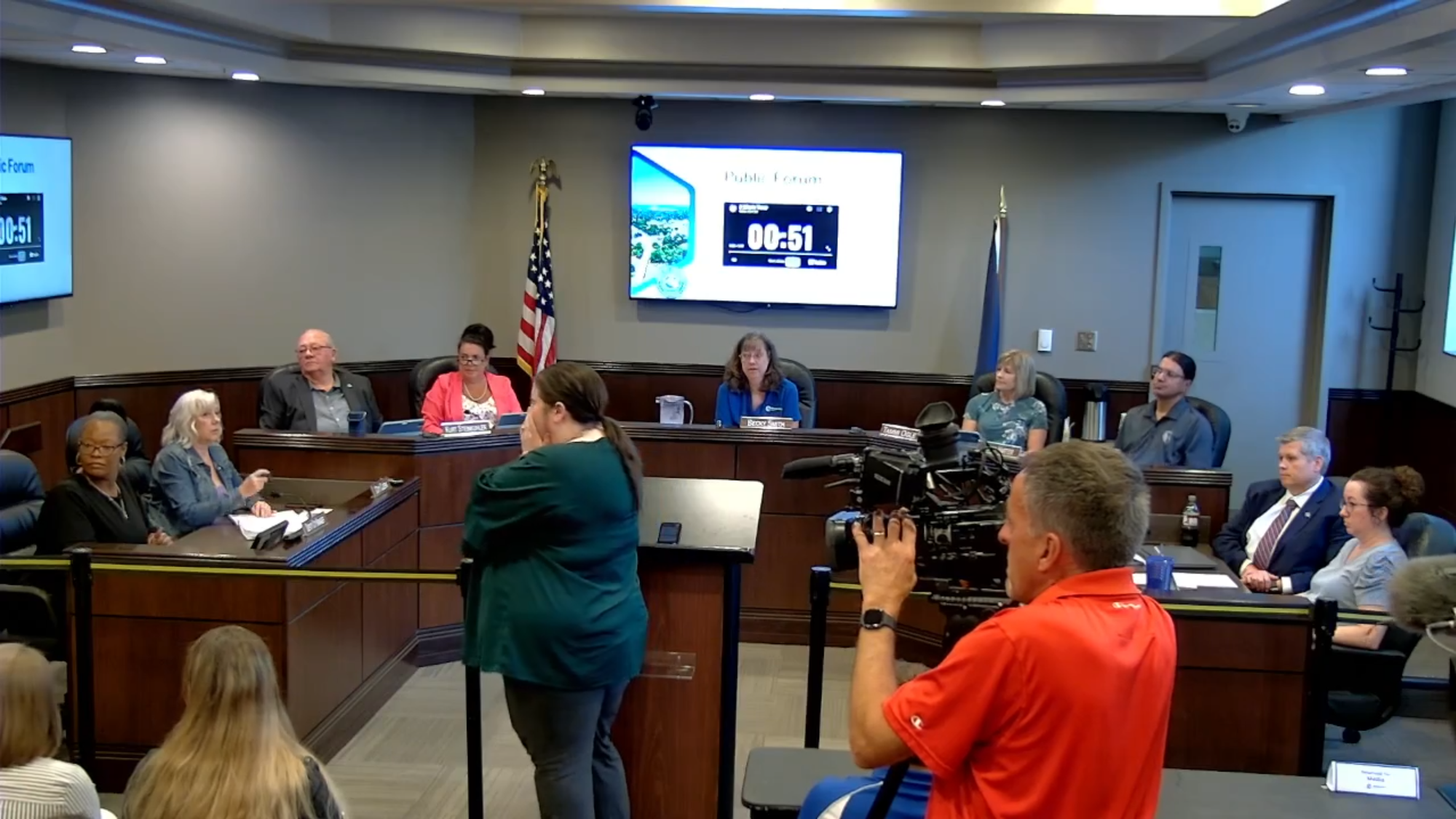
The small town that arrested a person who clapped during a city council meeting about a hyperscale data center held its meeting on Wednesday virtually and had no public comment period in the name of “public safety.” It says it will do the same for another meeting later this month.The city, Emporia, Kansas, announced the change just two days before the meeting. “In the interest of public safety, the Emporia City Commission meetings scheduled for Wednesday, August 5, 2026, and Wednesday, August
The city, Emporia, Kansas, announced the change just two days before the meeting.
“In the interest of public safety, the Emporia City Commission meetings scheduled for Wednesday, August 5, 2026, and Wednesday, August 19, 2026, will be conducted virtually,” Emporia said in a post about the change on Facebook. “No public comment period will be provided during either meeting.” Then it shared the city’s email and phone number for citizens who wanted to voice concerns privately. Emporia’s police chief told KVOE News that city leaders had received death threats.
“The City remains committed to conducting the public’s business in an open and transparent manner while taking reasonable measures to protect the safety of elected officials, City staff, and members of the public,” the post said. “The City appreciates the public's understanding and cooperation as it implements these temporary measures while ensuring the continuity of City business.”
Citizens upset about the data center and no longer allowed to make a public comment gathered outside Emporia’s municipal auditorium to protest on Wednesday. Lux Claridge, the person arrested for clapping, attended the protest and told 404 Media that both the protest and the virtual city commission meeting went well. “The commissioners voted unanimously to get our petition on the ballot measure to ban high-impact data centers to a judge. They said that doing otherwise could open up the city to a lawsuit but didn't really elaborate on who, why, or how,” they said.
Some citizens in Emporia are upset about a proposed gigawatt data center called the Flint Hills Digital Campus that would sit on 1,000 acres of prairie land. Zoning and city commission meetings have been held about the project, during which citizens have pushed back during the public comment periods of meetings. During a July 22 meeting, a city leader ordered Claridge to be arrested for clapping. Police charged Claridge with disorderly conduct and interference with police.
On Wednesday, the city commission streamed its meeting on the city website. Residents could watch, but not participate. The commission voted 5 - 0 to send the petition to a judge to see if Kansas law would allow that kind of restriction.
“I would like to see it go to the courts, that way it has an outside decision, so that we don't get ourselves entangled in something that could come back later and we'd be sued over,” Emporia mayor Becky Smith said.
“I think if you accept it or decline it, you’re opening yourself up to a legal battle either way so let’s just send it straight to a judge,” commissioner Erren Harter said.
Claridge said the reason the commission meetings had gone virtual and closed public comment was that members of the commission had reported receiving death threats. “This was also happening days leading up to my arrest, but the threats seem to have ramped up. While I don't doubt that there are credible threats, my big question is on how many there are and from where they are coming,” they said. “Mayor Smith did mention in yesterday's meeting that the threats don't seem to really be coming from locals but ‘it only takes one’ to ruin a meeting so they went virtual. I feel like we're being punished for the actions of outsiders.”
“I'm not so upset about going virtual, it makes sense, but back it up with examples of these threats. I'm more upset that they opted to close public comment and I don't understand why,” Claridge added.
The commissioners will meet, virtually, again on August 19 but they have not yet published the agenda on the city’s website. The commission did not return 404 Media’s request for comment.
Flock planned to use dashcams installed in hundreds of thousands Uber, Lyft, and delivery drivers’ vehicles to scan license plates those drivers travelled passed, essentially turning Uber and Lyft drivers into roaming surveillance vehicles, according to a Flock presentation shared with 404 Media.The document provides more details on Flock’s planned partnership with Nexar, a popular dashcam company. 404 Media first revealed the intended partnership last August when multiple sources provided in
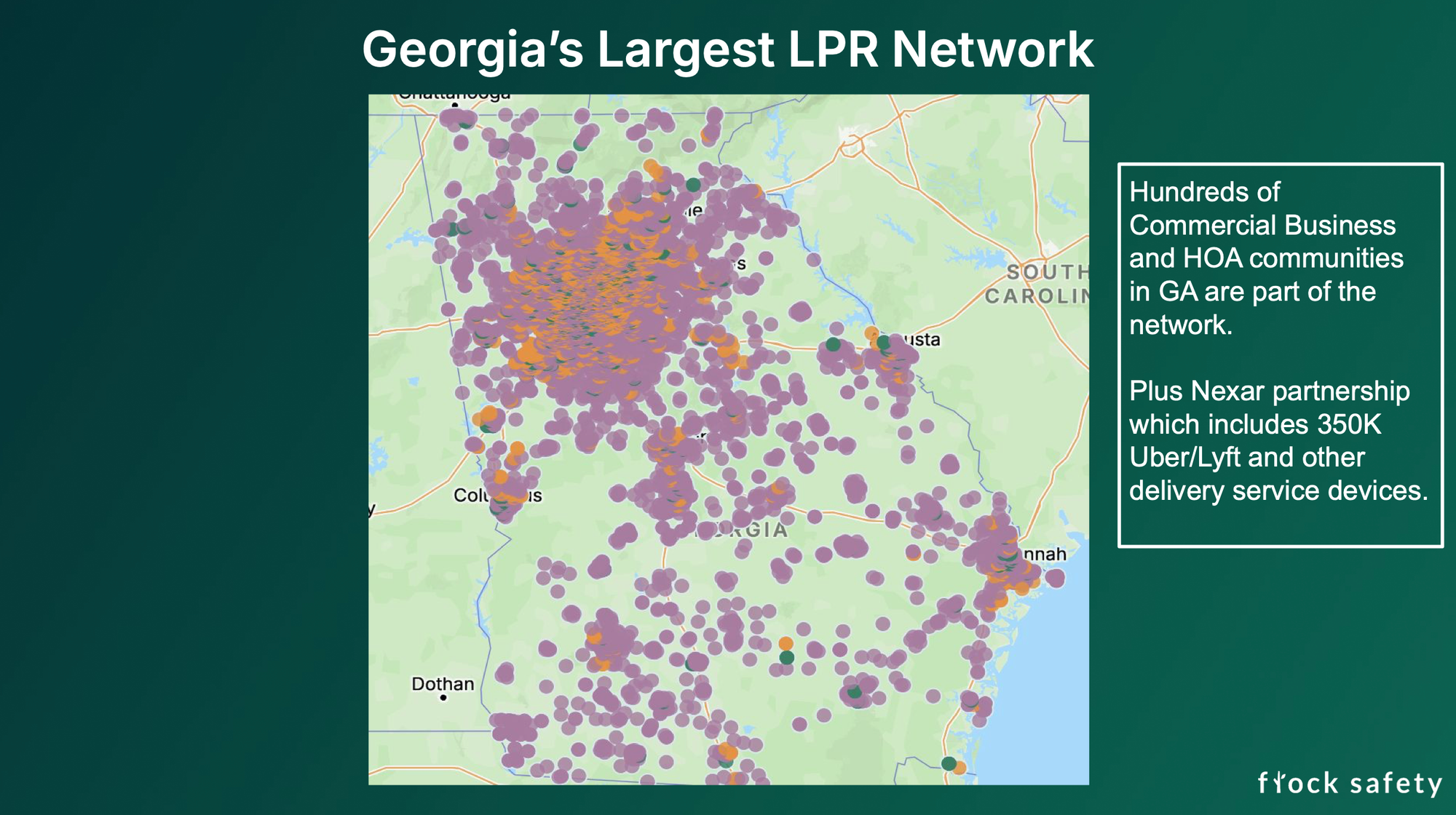
Flock planned to use dashcams installed in hundreds of thousands Uber, Lyft, and delivery drivers’ vehicles to scan license plates those drivers travelled passed, essentially turning Uber and Lyft drivers into roaming surveillance vehicles, according to a Flock presentation shared with 404 Media.
The document provides more details on Flock’s planned partnership with Nexar, a popular dashcam company. 404 Media first revealed the intended partnership last August when multiple sources provided information on the plan. The presentation shows Flock was actively pitching this partnership, and its use of Uber and Lyft drivers, to potential customers right around the time 404 Media reported on it.
💡
Do you work for Flock, Axon, or a similar company? I would love to hear from you. Using a non-work device, you can message me securely on Signal at joseph.404 or send me an email at joseph@404media.co.
Flock told 404 Media in an email it never executed the partnership with Nexar. But the presentation still shows Flock’s ambitious plan to conscript rideshare and delivery drivers to collect license plate data for its network. It is not clear whether Uber or Lyft, or drivers working for those apps, would have been aware of the data collection.
“Hundreds of Commercial Business and HOA [home owners associations] in GA [Georgia] are part of the network,” the presentation, written by Flock to present to the Georgia Office of the Attorney General last August, reads. “Plus Nexar partnership which includes 350k Uber/Lyft and other delivery service devices.”
Jason Hunyar, a Dunwoody, Georgia, resident who obtained the presentation through a public records request, shared the document with 404 Media.
Image: screenshot of the presentation.
Flock’s automatic license plate reader (ALPR) cameras are usually stationary cameras installed on tall poles that constantly scan the license plate, color, make, and brand of every vehicle that drives past. The Nexar partnership would have made those data collection efforts mobile. Axon, the law enforcement contracting giant that also sells ALPR cameras, sells some of its cameras to be installed in police officers’ roaming cars. Vigilant Solutions and the Digital Recognition Network (DRN), two ALPR companies now owned by Motorola, perform similar license plate data collection through cameras in vehicles belonging to repossession agencies.
Nexar sells various different models of dashcams providing front, cabin, and rear views, and already can provide “clear license plate capture with Full HD video,” according to its website. Nexar markets the cameras to rideshare drivers and also “commuters,” “long-distance drivers,” and “casual drivers.”
In September, 404 Media reported that a hacker broke into Nexar and accessed a database of terabytes of video recordings taken by customers’ cameras. Those included footage of people driving around sensitive Department of Defense locations.
Flock has explored obtaining other unusual datasets too. Last May, 404 Media reported Flock was building a massive people lookup tool that would use hacked data to “jump from LPR to person,” according to leaked audio. Flock scrapped those plans after 404 Media’s coverage and internal pressure.
Neither Uber nor Lyft responded to a request for comment. Neither did Nexar.
In May, 404 Media reported a company called BusPatrol, that has cameras installed in tens of thousands of school buses, plans to turn those cameras into ALPRs and give access to that data to law enforcement.
SAP, one of the world’s biggest software companies, suspended most travel and hiring last month because of AI’s soaring cost, with exceptions only being made for AI-related travel or hires, according to an internal SAP email obtained by 404 Media. Bloomberg reported on the email and the freezes in July, but a current SAP employee said the bans are still in effect. The employee said the company had a global employee meeting recently where this was brought up again. They added SAP is currently
SAP, one of the world’s biggest software companies, suspended most travel and hiring last month because of AI’s soaring cost, with exceptions only being made for AI-related travel or hires, according to an internal SAP email obtained by 404 Media.
Bloomberg reported on the email and the freezes in July, but a current SAP employee said the bans are still in effect. The employee said the company had a global employee meeting recently where this was brought up again. They added SAP is currently rolling out a newly created AI tool to the entire company “which I can only imagine massively increases the costs.” 404 Media granted the source anonymity to protect them from retaliation.
The email highlights how companies both big and small are coming to grips with the reality of AI’s cost. Rather than being a massive cost saver, in some cases companies are throttling employees’ AI use as it spirals out of control, and scrambling to find other ways to keep costs down.
💡
Do you work at a company dealing with AI's costs? I would love to hear from you. Using a non-work device, you can message me securely on Signal at joseph.404 or send me an email at joseph@404media.co.
🌘Subscribe to 404 Media to get The Abstract, our newsletter about the most exciting and mind-boggling science news and studies of the week. Scientists have designed a virtual model of an alien cell and dropped it onto a hypothetical exoplanet to see how it behaves, an approach that could help astronomers recognize signs of extraterrestrial life on distant worlds, according to a recent study published in Monthly Notices of the Royal Astronomical Society.The results revealed new insights about how
Subscribe to 404 Media to get The Abstract, our newsletter about the most exciting and mind-boggling science news and studies of the week.
Scientists have designed a virtual model of an alien cell and dropped it onto a hypothetical exoplanet to see how it behaves, an approach that could help astronomers recognize signs of extraterrestrial life on distant worlds, according to a recent study published in Monthly Notices of the Royal Astronomical Society.
The results revealed new insights about how microbes that produce methane gas, known as methanogens, might evolve on different exoplanets, such as Earth-sized ocean worlds or a class of hypothetical giant “Hycean planets” that host global oceans and hydrogen-rich atmospheres.
Predicting the impacts that methanogens might have on their environments could help scientists recognize potential signs of life, known as biosignatures, in the skies of worlds outside of our solar system.
Whereas many past studies have speculated about what forms of life might evolve on a particular type of exoplanet, this approach flips the idea on its head by starting with a general cell model and then considering how it might evolve in different biospheres.
“This is a kind of plausible life that's very unconstrained by Earth-based conditions,” said Arwen Nicholson, an astrophysicist at Exeter University who led the study, in a call with 404 Media. “We can put it into different environments, and then see: What other effects does it have?”
The idea, she explained, is to simplify one aspect of the hugely complex search for alien life .
“This is a generalized idea of what biology would roughly do that we can then put in different places to try and start getting biosignature predictions ideally for different planets, or to understand what we're seeing from the telescopes,” said Nicholson.
It’s possible that the first lifeforms to emerge on Earth were methanogens that thrived some four billion years ago when our planet was far more depleted in oxygen. These microbes still exist in a wide variety of ecological niches today. Unlike photosynthetic life, which requires sunlight for energy, methanogens can run on chemical energy in a process known as chemosynthesis. As a result, methanogens are adaptable and provide a useful model for considering the emergence of life in a diverse array of habitats, including dark regions that receive no direct starlight.
“We do know that the Earth's early biosphere did have this big component of it that was producing methane and consuming methane,” Nicholson said. “That gives us a starting point to look at other planets. It's a reaction we know works. It works on Earth, and it's something that is thought to work in environments that are very different to Earth.”
To that end, the team developed a baseline model of a spherical methanogen microbial cell and tinkered with different cell sizes, life cycles, and environmental effects that might evolve in various alien biospheres.
The results revealed a host of insights, including that a planet’s levels of hydrogen and methane are sensitive to the microbe’s particular features. In this way, “life will act to ‘erase’ abiotic aspects of their environment” by transforming the composition of gasses in the atmosphere in ways that could be detectable to astronomers, according to the study.
The team also speculated that resource competition on alien worlds would likely favor methanogens that are smaller and longer-lived, which could outcompete similar species that are shorter-lived, larger, or require more energy. But while these clues may help scientists spot likely biosignatures in the future, it will be a challenge to actually predict what sort of lifeform is producing those signals.
“You could have different life forms in your ocean and they would look the same in terms of a biosignature,” Nicholson said. “You could have a single film of some algae covering the whole ocean, or a little amoeba, or maybe something else. I thought that was quite interesting. It almost frees us up from making too many assumptions of what alien life would look like, because how are we going to know?”
“We can use spherical microbes as a representation, but even if we found a biosignature, even if it all made sense, and we found life, we still wouldn't actually know what they look like,” she added.
Nicholson and her colleagues plan to continue this line of research by modeling simplified cells of photosynthetic life and predicting their impact on different exoplanet environments. Ultimately, these studies will help scientists distinguish between genuine biosignatures and complex atmospheric chemistry that arises from geological activity.
It’s also worth preparing for the rather excruciating possibility that we find clear biosignatures on some farflung exoplanet and are never able to learn much more about them. In science fiction, we are used to aliens showing up on Earth or sending us obviously artificial messages. But it’s more likely that we would discover gassy signs of life in a distant world’s skies and then have to accept that we might never learn its specific nature.
“We don't live in sci-fi,” said Nicholson. “Sci-fi is super cool. I love it too. But the reality is, we're looking at a habitable planet like our own. If we find anything, they will be life forms embedded in their world, just like we're embedded in our world.”
“It's a super exciting time to be in astrobiology again with all of this data, and it's super neat that people are so interested in it as well,” she concluded.
🌘
Subscribe to 404 Media to get The Abstract, our newsletter about the most exciting and mind-boggling science news and studies of the week.
A handful of cities across the U.S. have ditched Flock’s automatic license plate reader (ALPR) cameras and immediately replaced them with equivalent systems from law enforcement contracting giant Axon, according to local media reports and government documents from around the country. Axon, for example, advertises AI-powered cameras that attach to an existing streetlamp and are designed to completely blend in with their surroundings, and also collects license plate data with cameras installed
A handful of cities across the U.S. have ditched Flock’s automatic license plate reader (ALPR) cameras and immediately replaced them with equivalent systems from law enforcement contracting giant Axon, according to local media reports and government documents from around the country. Axon, for example, advertises AI-powered cameras that attach to an existing streetlamp and are designed to completely blend in with their surroundings, and also collects license plate data with cameras installed inside police officers’ patrol vehicles.
💡
Do you work at Axon? Do you know anything else about its technology or expansion? I would love to hear from you. Using a non-work device, you can message me securely on Signal at joseph.404 or send me an email at joseph@404media.co.
Police in Wisconsin used Flock to determine that a man “travels to Michigan frequently,” where marijuana is legal, then back to Wisconsin, where it is illegal. They then used his travel across state lines as tracked by Flock as part of the probable cause justification to search his car for weed; he was eventually arrested on marijuana possession charges, according to court records reviewed by 404 Media. The searches came to light in a Wisconsin criminal complaint against Edward Abrams-Phillips,
Police in Wisconsin used Flock to determine that a man “travels to Michigan frequently,” where marijuana is legal, then back to Wisconsin, where it is illegal. They then used his travel across state lines as tracked by Flock as part of the probable cause justification to search his car for weed; he was eventually arrested on marijuana possession charges, according to court records reviewed by 404 Media.
The searches came to light in a Wisconsin criminal complaint against Edward Abrams-Phillips, who was wanted for bail jumping on domestic violence charges. But the criminal complaint makes clear that beyond the bail jumping and domestic violence charges, police specifically studied Abrams-Phillips’ interstate travel to create the pretext for searching his car for marijuana. The bail jumping charge was dismissed; Abrams-Phillips was found guilty only of weed possession in the case, according to the court records.
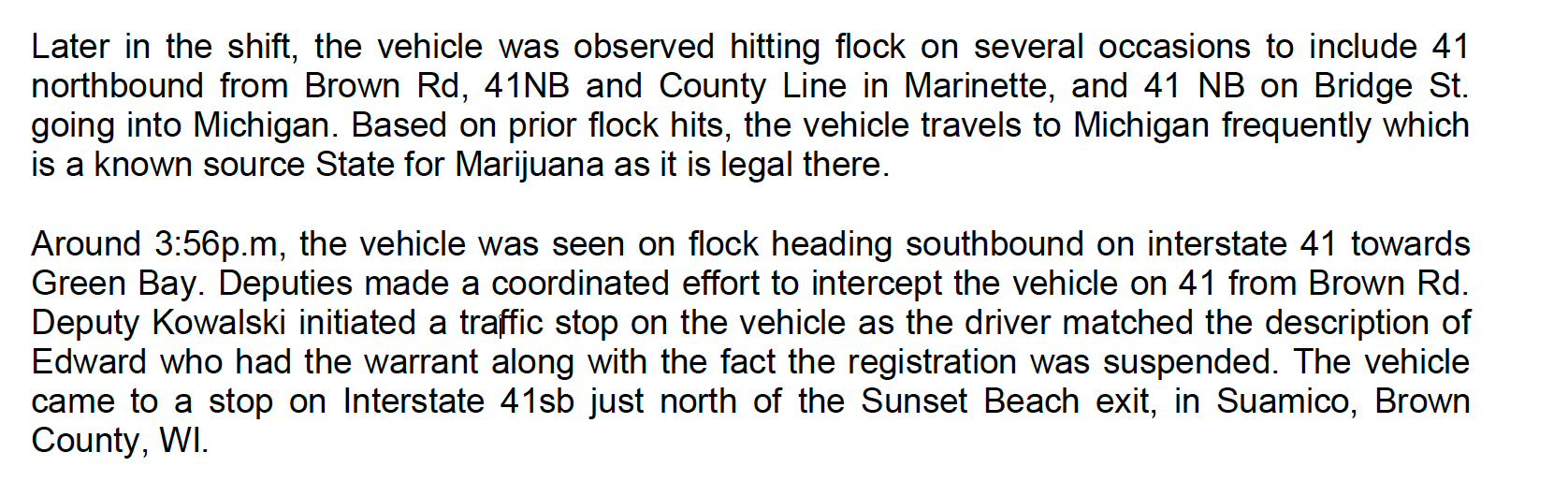
An excerpt from the "Probable Cause" section of the court records.
The complaint explains that Abrams-Phillips was tracked via Flock’s network over the course of the day to determine that he drove from Wisconsin to Michigan, a “known source state for marijuana as it is legal there,” the complaint states, adding that previous Flock hits indicated that he “travels to Michigan frequently.” Police note that, using Flock, they were able to track Abrams-Phillips driving from Wisconsin to Michigan, then back to Wisconsin over the course of several hours, where he was pulled over and arrested. The Flock searches and arrests happened in April 2025.
“The vehicle was observed hitting flock on several occasions to include 41 northbound from Brown Rd, 41NB and County Line in Marinette [Wisconsin], and 41 NB on Bridge St. going into Michigan. Based on prior flock hits, the vehicle travels to Michigan frequently which is a known source State for Marijuana as it is legal there,” the charging document notes. “Around 3:56 p.m., the vehicle was seen on Flock heading southbound on interstate 41 towards Green Bay [Wisconsin]. Deputies made a coordinated effort to intercept the vehicle on 41 from Brown Rd. Deputy Kowalski initiated a traffic stop on the vehicle as the driver matched the description of Edward.”
We start this week with Joseph’s article about Samuel Tunick, the man charged with allegedly wiping his phone before DHS officials could search it. It’s a wild case with a lot to unpack. After the break, Jason tells us all about a TikTok Shop scheme powered by AI. In the subscribers-only section, we talk about possibly the dumbest AI tool ever made.
Listen to the weekly podcast on Apple Podcasts, Spotify, or YouTube. Become a paid subscriber for access to this episode's bonus content and t
We start this week with Joseph’s article about Samuel Tunick, the man charged with allegedly wiping his phone before DHS officials could search it. It’s a wild case with a lot to unpack. After the break, Jason tells us all about a TikTok Shop scheme powered by AI. In the subscribers-only section, we talk about possibly the dumbest AI tool ever made.
Listen to the weekly podcast on Apple Podcasts,Spotify, or YouTube. Become a paid subscriber for access to this episode's bonus content and to power our journalism. If you become a paid subscriber, check your inbox for an email from our podcast host Transistor for a link to the subscribers-only version! You can also add that subscribers feed to your podcast app of choice and never miss an episode that way. The email should also contain the subscribers-only unlisted YouTube link for the extended video version too. It will also be in the show notes in your podcast player.
A series of issues in Apple’s web browser engine — the tech underlying all browsers on iOS — means that Apple’s iCloud Private Relay tool, which is supposed to hide a user’s IP address, in many cases doesn’t actually work. Instead, the issues mean a malicious attacker can set up a website to learn a Private Relay user’s real IP address, or that many websites have also already collected this information incidentally. The issues also impact OnionBrowser, an iOS app for browsing the web through
A series of issues in Apple’s web browser engine — the tech underlying all browsers on iOS — means that Apple’s iCloud Private Relay tool, which is supposed to hide a user’s IP address, in many cases doesn’t actually work. Instead, the issues mean a malicious attacker can set up a website to learn a Private Relay user’s real IP address, or that many websites have also already collected this information incidentally. The issues also impact OnionBrowser, an iOS app for browsing the web through the Tor anonymity network, the researchers who discovered the issues say.
The Private Relay leak is the second issue to recently impact Apple’s paid-for privacy products. Last month 404 Media reported a bug in Apple’s Hide My Email feature was actually revealing peoples’ real email addresses. Apple knew about that issue for more than a year before fixing it.
On Wednesday morning, Ted Cruz’s Senate Commerce Committee will convene on five bills aimed at age verification and “child safety.” The bills each have their own issues when it comes to privacy, data collection, parental rights, and free speech. But one bill, the partisan Republican SCREEN Act, is a Christian nationalist nightmare.Utah Senator Mike Lee introduced the Shielding Children's Retinas from Egregious Exposure on the Net (SCREEN) Act in February 2025, alongside exclusively Republican
On Wednesday morning, Ted Cruz’s Senate Commerce Committee will convene on five bills aimed at age verification and “child safety.” The bills each have their own issues when it comes to privacy, data collection, parental rights, and free speech. But one bill, the partisan Republican SCREEN Act, is a Christian nationalist nightmare.
Utah Senator Mike Lee introduced the Shielding Children's Retinas from Egregious Exposure on the Net (SCREEN) Act in February 2025, alongside exclusively Republican cosponsors and supporters Senators John Curtis, Jim Banks, and Representative Mary Miller.
The SCREEN Act would require every website that includes even one piece of what the legislation describes as “harmful to minors” to verify visitors’ ages. It defines “harmful to minors” as content that “depicts, describes, or represents, in a patently offensive way with respect to what is suitable for minors, an actual or simulated sexual act or sexual contact, actual or simulated normal or perverted sexual acts, or lewd exhibition of the genitals;” is “obscene” or “child pornography;” or “appeals to the prurient interest in nudity, sex, or excretion.”
Unlike the many laws now in place around the U.S. that apply to sites made up of at least one third adult content, like porn sites and some social media platforms, SCREEN would place the burden and risk of verifying users’ ages to every website on the internet that falls under the law, which would be most sites with user-generated content and also mainstream entertainment platforms like Netflix. It also attacks virtual private networks (VPNs) by requiring sites to verify based on IP addresses; many people in states that have age verification laws in place use VPNs to get around submitting sensitive personal data like ID and biometrics to a smattering of third-party websites in use today. Critics say the SCREEN Act would be a privacy and free speech disaster.
And the agenda of its sponsors is clear: “Internet pornography has infected our culture and corroded the vulnerable minds of America’s kids, with the average age of initial exposure being 12 years old. That’s appalling,” Banks said in Lee’s press release.
A number of religious, conservative, Christian nationalist, and anti-pornography groups are in support of the bill, according to the press release from Lee’s office. They include the National Center on Sexual Exploitation (which recently represented a Kansas mother who sued multiple porn sites because her son found her old laptop and used it to watch Chaturbate), the National Decency Coalition, the Ethics and Public Policy Center (which is “working to apply the riches of the Jewish and Christian traditions to contemporary questions of law, culture, and politics,” according to its website), the Family Policy Alliance (whose stated mission is to “advance biblical values through civic engagement”), the Family Research Council (whose “mission is to serve in the kingdom of God by championing faith, family, and freedom in public policy and the culture from a biblical worldview”), and many more.
Heritage Action, a conservative lobbying group and one of the organizations Lee lists in support of the SCREEN Act, is a sister organization to the Heritage Foundation, which authored Project 2025. Heritage Action “works with lawmakers to implement Heritage Foundation solutions,” according to the Heritage Foundation website. This is important because of how Project 2025, the playbook for right-wing and extremist conservative leadership, has influenced policies and lawmaking in America in the last few years of the Trump Administration. That stretches from attacks on programs that promote diversity, equity and inclusion, to attacks on trans and queer people, to turning the FBI into a political entity.
One of Project 2025’s stated goals is to redefine and eradicate pornography: “Pornography, manifested today in the omnipresent propagation of transgender ideology and sexualization of children, for instance, is not a political Gordian knot inextricably binding up disparate claims about free speech, property rights, sexual liberation, and child welfare. It has no claim to First Amendment protection,” the playbook says, calling for imprisonment of pornographers but also educators and librarians. “And telecommunications and technology firms that facilitate its spread should be shuttered.”
The Senate Commerce Committee will also debate and mark up the text of the Youth AI Privacy Act which would require chatbots to disclose they’re not human among other features like limiting data retention; the CHATBOT Act which would require AI companies to build “family account” systems where parents can monitor kids’ activity; the Children’s Artificial Intelligence Toy Safety Act which would create a federal study into toys that include AI components; and the Kids Online Safety Act (KOSA).
KOSA would impose a legal “duty of care” on social media platforms to prevent and mitigate promotion of suicide, eating disorders, substance abuse, sexual exploitation, and advertisements for products like tobacco. KOSA has been introduced, and failed, multiple times since its first introduction in 2022; it has bipartisan lawmaker support but is extremely unpopular across all sides of the political spectrum among groups that care about freedom of speech because of its potential to increase censorship.
“Whatever disclaimers and exceptions the bill includes, the practical effect is unchanged,” the Electronic Freedom Foundation recently wrote about KOSA. “When platforms face liability for content that someone later claims contributed to harms like anxiety, eating disorders, or substance use, the safest response is to remove lawful speech or shut down forums discussing those topics altogether.”
Unlike KOSA and many of the other age verification laws that have spread across the country, the SCREEN Act does not have bipartisan support. It’s the latest in Lee’s repeated attempts to criminalize content he and his co-sponsors personally consider immoral. Last year, Lee introduced the now-stalled Interstate Obscenity Definition Act (IODA) for the third time. IODA would change the 1973 “Miller Test” for determining what qualifies as obscene, and seeks to make all pornography illegal at the federal level. “Obscenity isn’t protected by the First Amendment, but hazy and unenforceable legal definitions have allowed extreme pornography to saturate American society and reach countless children,” Lee said in a press release. “Our bill updates the legal definition of obscenity for the internet age so this content can be taken down and its peddlers prosecuted.”
Microsoft has introduced new limits to how much its engineers can spend on AI tools at work and told employees that maximizing AI use internally is not the company’s goal. This makes Microsoft one of the last major companies to rein in its employees’ expensive AI use. Scaling back maximalist AI use, or what some companies have called “tokenmaxxing,” is a trend we’ve covered in recent months as the price for using AI has increased while not always delivering commensurate productivity gains.
Microsoft has introduced new limits to how much its engineers can spend on AI tools at work and told employees that maximizing AI use internally is not the company’s goal.
When cops use Flock to arrest someone in Wapello County, Iowa, they don’t want them to know. A usage policy for the automated license plate reader cameras in the county tells police, in no uncertain terms, to keep them a secret: “DO NOT MENTION ALPR USAGE TO THE OCCUPANTS OF THE VEHICLE,” the policy document reads. “DO NOT MENTION ALPR USAGE IN YOUR REPORT OR COMPLAINT UNLESS ABSOLUTELY NECESSARY.” The police guidance document is unusual in how clearly it tells police not to mention their Flock
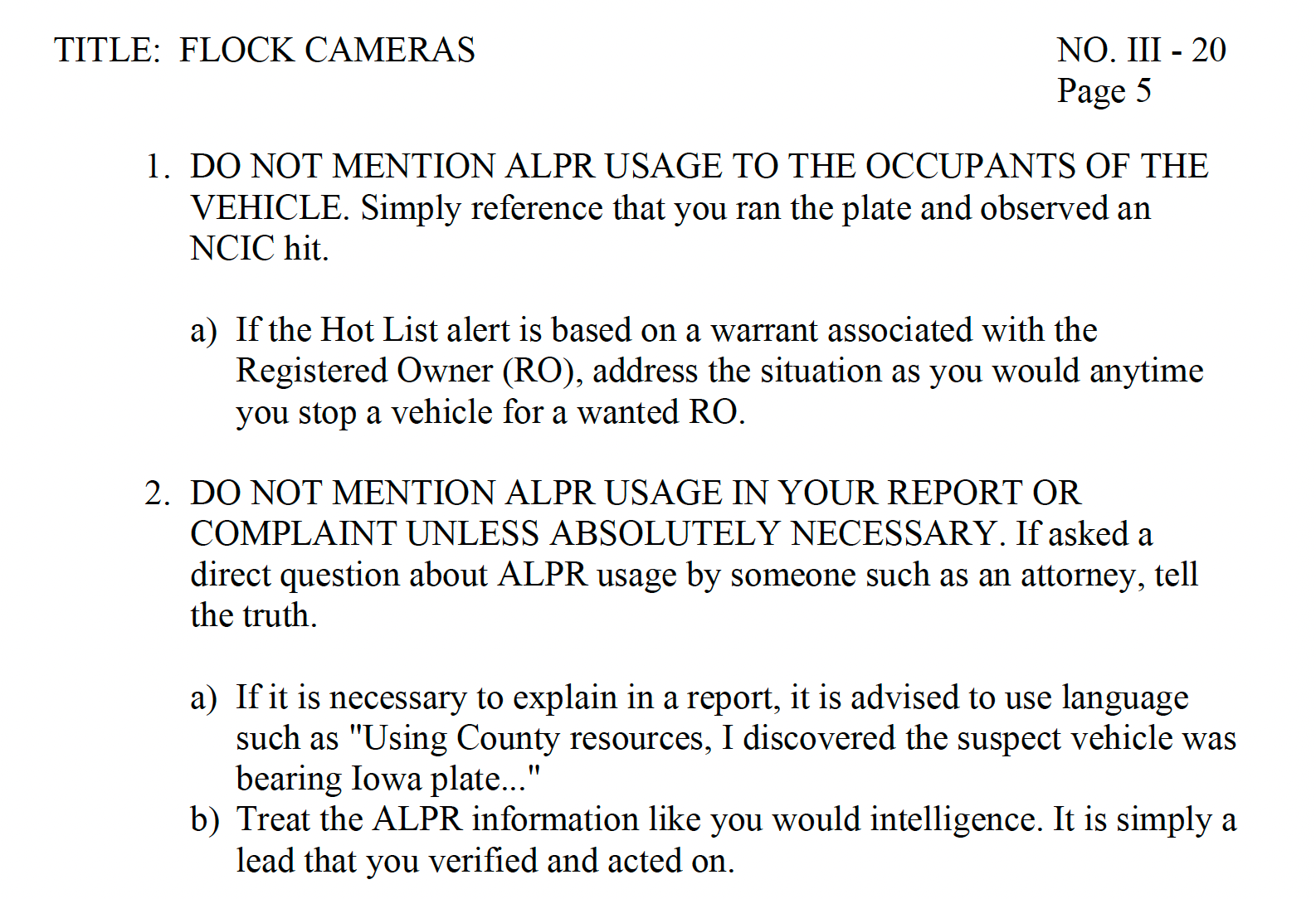
When cops use Flock to arrest someone in Wapello County, Iowa, they don’t want them to know. A usage policy for the automated license plate reader cameras in the county tells police, in no uncertain terms, to keep them a secret: “DO NOT MENTION ALPR USAGE TO THE OCCUPANTS OF THE VEHICLE,” the policy document reads. “DO NOT MENTION ALPR USAGE IN YOUR REPORT OR COMPLAINT UNLESS ABSOLUTELY NECESSARY.”
The police guidance document is unusual in how clearly it tells police not to mention their Flock use, but it also highlights several important things in the Flock debate. While Flock likes to say that it is a transparent surveillance company and that it cares about “accountability” and “governance,” some of its customers believe its use should be kept secret. Flock is now operating in thousands of cities and towns, and when, how, and why police use the system is wildly inconsistent. Even though Flock does have various auditing and transparency tools, police have their own opinions about what Flock can and should be used for and what the policies for it should be.
It is not just local police in small communities who are creating policies designed to obfuscate Flock usage. Earlier this year, we reported that police in multiple states were being told to be “as vague as permissible” about why they were using Flock because their searches could be obtained using public records requests, and that warning was being shared by the FBI and Department of Justice. Residents of many towns using Flock also say that their cities entered into contracts with Flock with little public oversight, essentially quietly opting them into a nationwide surveillance network without robust public debate.
Wapello County’s “standard operating procedures” document for Flock cameras was created in November of 2025 and was obtained by a 404 Media reader using a public records request and was shared with us. Coincidentally, Wapello County’s largest city is Ottumwa, Iowa, where 404 Media ran a Super Bowl commercial earlier this year. The county has four Flock cameras via a contract it signed with the company in late 2024. The policy further instructs police to be vague in any arrest report, suggesting that they simply call the Flock system “county resources.”
“DO NOT MENTION ALPR USAGE IN YOUR REPORT OR COMPLAINT UNLESS ABSOLUTELY NECESSARY. If asked a direct question about ALPR usage by someone such as an attorney, tell the truth,” it says. “If it is necessary to explain in a report, it is advised to use language such as ‘Using county resources, I discovered the suspect vehicle was bearing an Iowa plate.’ Treat the ALPR information like you would intelligence. It is simply a lead that you verified and acted on.”
The guidance to keep Flock use secret is reminiscent—but less extreme—than guidance on some other secretive police technologies. For years, police tried to hide the existence of cell site simulators (popularly known as Stingrays), going as far as to drop criminal cases where it was likely that a judge would expose information about them. Stingrays are essentially fake cell phone towers that can be used to identify the phones of people in a specific area.
In the public records request, Sheriff Don Phillips said “there is no need” to tell people about the use of Flock.
“Our policy requires deputies to check the license plate to make sure the correct plate is accurate and the information as to an arrest warrant, stolen vehicle, stolen plate or missing person is correct,” he said. “There is no need to tell them about our investigative methods or sources, such as the camera system, because the information is verified by the deputy running the license plate. It is common practice for law enforcement to refrain from disclosing investigative methods and sources to prevent criminals from learning how to circumvent them.”
Phillips did not respond to a request for comment.
📄This article was primarily reported using public records requests. We are making it available to all readers as a public service. FOIA reporting can be expensive, please consider subscribing to 404 Media to support this work. Or send us a one time donation via our tip jar here.The Securities and Exchange Commission (SEC) bought access to what it described as more than a billion airline ticketing records, related to not just U.S. domestic flights or those landing in the country, but also flig
This article was primarily reported using public records requests. We are making it available to all readers as a public service. FOIA reporting can be expensive, please consider subscribing to 404 Media to support this work. Or send us a one time donation via our tip jar here.
The Securities and Exchange Commission (SEC) bought access to what it described as more than a billion airline ticketing records, related to not just U.S. domestic flights or those landing in the country, but also flights between foreign countries, according to SEC documents obtained by 404 Media. A group of the world’s airlines, including Delta, United, and American, previously sold the data under the company name ARC; that is where the SEC bought the data from.
ARC, or the Airlines Reporting Corporation, stopped selling airline ticketing records after repeated coverage from 404 Media and pressure from lawmakers last year. But the newly obtained records provide additional insight into the breadth of data that airlines were selling without their customers' knowledge, and that law enforcement agencies were tapping into, likely without a warrant.
404 Media has obtained a coaching guide that Flock surveillance gives to police about “how to speak to city councils about public safety technology.” The handbook highlights how Flock and police team up to convince cities to buy and keep its automated license plate reader technology, even when there is widespread public opposition to it, and encourages police to “own the narrative before someone else does” by championing the technology before citizens can oppose it during public comment periods.
404 Media has obtained a coaching guide that Flock surveillance gives to police about “how to speak to city councils about public safety technology.” The handbook highlights how Flock and police team up to convince cities to buy and keep its automated license plate reader technology, even when there is widespread public opposition to it, and encourages police to “own the narrative before someone else does” by championing the technology before citizens can oppose it during public comment periods.
The PDF guide notes that the general public and cities now “increasingly expect transparency, oversight, and accountability alongside public safety outcomes,” and tells police to not argue with people who believe that Flock’s license plate readers are “mass surveillance.”
“One of the most common questions agencies hear today is whether license plate recognition (LPR) technology constitutes mass surveillance. Many leaders instinctively respond by attempting to refute the claim. Flock's Jamie Hudson recommends a different approach,” the guide reads.
“Don’t avoid the concept of mass surveillance because you’re not going to convince opponents that it’s not,” the company recommends. Flock tells law enforcement agencies they need to try to convince city council and city managers that the technology is worthwhile before meetings with the public occur; that they need to have a “carefully scripted presentation” ready to go; and that police need to say they want Flock because they want to keep the community safe: “You care about your community. That’s why you’re bringing this in.”
Flock began offering this guide as part of a broader attempt to coach police on how to push back against criticism of its policies and security practices, many of which 404 Media has investigated and shed light on. These include the fact that Flock data was regularly making its way to Immigrations and Customs Enforcement (ICE), often in violation of sanctuary city and state laws; that Flock was used to search 83,000 cameras nationwide for a woman who had an abortion in Texas; and that Flock has been used by police to stalk people and surveil protesters. These investigations and broader concern over the surveillance state have led many cities to hold city council meetings to reconsider their Flock contracts, and this Flock-produced guide is an attempt to help police shape the narrative in a way that will either convince cities to buy Flock or to keep their contracts.
“The recent headlines about our company are largely a result of this environment,” the company told cities.
“Opponents have a very carefully scripted narrative. They come prepared. You should also have a carefully scripted presentation that addresses those concerns ahead of time,” the guide says. “The agencies that navigate these conversations successfully rarely wait until a council meeting to educate stakeholders. They brief city managers early. They meet with council members before votes occur. They share policies proactively and answer questions before public comment periods become the first introduction to the program.”
The guide also tells police that they can convince city councils that Flock is worth the monetary cost by conveniently not focusing on how much the cameras cost, but by “reframing the financial discussion itself” to focus on “the cost of unresolved crime.” Flock also writes that much of the opposition to its technology is happening because people “do not understand how it works or how it is governed.” This idea is one that has been regularly repeated by Langley over the last several months.
Surveillance companies regularly try to get police to act as quasi salespeople and spokespeople for their companies, pitting a private company and taxpayer-funded law enforcement on one side and citizens on the other. “For years, surveillance vendors like Flock Safety have shaped policy debates cities are supposed to run independently — staging council ‘prep calls’ and exploiting a basic asymmetry: the vendor controls the facts, and city staff are rarely positioned to challenge them,” Sarah T. Hamid, director of strategic campaigns at the Electronic Frontier Foundation told 404 Media after reviewing the guide. “The financial interest is obvious. Flock isn’t just selling surveillance, it’s scripting the public case for buying it. Because Flock treats public trust as a messaging problem rather than a governance outcome, that script keeps officials focused on ‘accountability’ in the abstract instead of the concrete harms and documented abuses its network has already enabled.”
404 Media has watched numerous city council meetings around the country where police talk about how Flock is a critical law enforcement system for them; in many cases, a police chief will speak about Flock and then introduce a Flock employee to give a presentation about the surveillance system. On Monday, 404 Media published an interview with a former Flock government affairs manager who regularly pitched the technology to cities at public meetings. An activist who has been pushing back against Flock in their community and who shared the guide document with 404 Media said that they have regularly seen the strategies suggested by Flock deployed in city council meetings they have attended and watched. 404 Media agreed to keep the activist anonymous to protect them from retaliation.
“I think this document shows a coordinated effort from Flock Safety to compel law enforcement agencies to convince our elected leaders to represent their interests as a company rather than the interests of concerned citizens,” they said. “I have watched many meetings locally in my city and my state and across the country, and you can see the techniques used in this ebook in the presentations given by law enforcement. Pivoting conversations away from concerns about mass surveillance and directing them towards procedure and governance is a vehicle that's used to downplay the concerns of privacy-minded citizens. We have every right to expect our elected leaders to listen to us, and it's very common to see city councils vote with a supermajority in favor of approving Flock contracts despite standing-room only attendance at city council meetings with little to no public support for this product.”
The guide specifically highlights several supposed success stories in which communities had very real concerns about Flock but ultimately decided not to get rid of the technology. For example, it highlights how Flock was able to get a vote in favor of its technology in Oakland, California, despite it being “one of the most scrutinized public safety technology debates in the state,” with “more than 140 public comments” and opposition from the city’s Privacy Advisory Commission: “The conversation shifted when officials stopped asking the public to trust the technology and started showing how the technology could be audited, reviewed, and held accountable.”
It also tells the story of Richmond, California, which allowed its Flock contract to temporarily lapse after the city’s cameras were included in the company’s national lookup tool. City officials there worried that their cameras’ data would be accessed by ICE, in violation of California and local law. “After concerns emerged around data sharing and sanctuary city policies, the city's program was paused and subjected to intense public scrutiny,” the Flock guide says. “Rather than relying on generalized claims about effectiveness, department leadership presented two and a half years of local results, including 274 arrests and 259 vehicle recoveries connected to the program. The council ultimately voted 4-3 to reinstate the system.”
Flock did not immediately respond to a request for comment.
This is an adaption of a podcast interview 404 Media recorded with Jonathan Paz, a former Flock employee who is now running running for Congress in Massachusetts’ 5th District. Check out the whole thing here on YouTube.
This is an adaption of a podcast interview 404 Media recorded with Jonathan Paz, a former Flock employee who is now running running for Congress in Massachusetts’ 5th District. Check out the whole thing here on YouTube.
Jonathan Paz was initially nervous when he started working at the surveillance company Flock. It was his first tech job. But he was interested in the company’s mission. Flock’s cameras, which constantly scan the license plate of every vehicle driving past, were for finding missing people. Staff at the company were able to solve real issues.
In his job as a government affairs manager a couple of years ago, Paz represented Flock in public hearings, with the goal of getting a city to purchase Flock cameras. These sorts of hearings are happening on a near constant basis all across the country, as cities and towns participate in a national conversation about whether they want Flock cameras in their community or not.
Welcome to a special edition of the Abstract! I’m out on vacation for the next two weeks, which means it’s time to break out all of the weird and wild studies that have come out so far in 2026, but that slipped through the cracks for one reason or another. I’ve been saving these gems up for a special occasion and hope you enjoy the roundups this week and next!So without further delay, here are the studies this year that put aliens on lockdown, bedazzled their axes, undulated spermily, and captur
Welcome to a special edition of the Abstract! I’m out on vacation for the next two weeks, which means it’s time to break out all of the weird and wild studies that have come out so far in 2026, but that slipped through the cracks for one reason or another. I’ve been saving these gems up for a special occasion and hope you enjoy the roundups this week and next!
So without further delay, here are the studies this year that put aliens on lockdown, bedazzled their axes, undulated spermily, and captured shooting stars.
First, scientists come up with a game plan to protect Earth from invasive extraterrestrial species. Then: a trove of rare decorative tools, GIGANTIC SPERM, and a long-sought solution to a Venusian mystery.
Well, folks: It’s finally time to build a quarantine on the Moon for aliens.
That’s the upshot of a study published in May that argues for the establishment of “a lunar biocontainment facility” to house extraterrestrial samples en route to Earth until they are deemed safe.
The U.S. and China's space programs both aim to bring back samples from the surface of Mars in the coming years, and many missions have already delivered rocks from asteroids. The new study anticipates a disastrous scenario in which samples from nearby celestial bodies might contain dangerous extraterrestrial life.
“If samples from Mars or other celestial bodies harbor dormant or active biological entities, then Earth’s biosphere could become exposed to a potentially invasive novel organism with unpredictable pathogenicity or ecological effects,” said Frederick I. Moxley of Strategic Threat and Analysis Research Laboratories, LLC, and Anthony Ricciardi of McGill University.
“For example, if extraterrestrial life exists, its molecular architecture could reflect atypical biochemistry (such as chirality reversal or alternative nucleic acid analogs) that is hazardous to Earth’s ecosystems and even to human biology,” the team added.
The team pointed to earthly analogs, such as viral strains that have broken containment or species that thrive in habitats that are completely different from the ones in which they originally evolved. If life on Earth can be this adaptable and unpredictable, why should we expect anything different from life elsewhere?
“The Moon must not merely serve as a stepping stone for exploration, but also as a preemptive shield between Earth and potential forms of extraterrestrial contamination…ensuring that exploration does not come at the expense of Earth’s biosphere” the team said. “The formalization of such precautionary lunar quarantine protocols will not only safeguard our planet, but also affirm humanity’s maturity as an interplanetary civilization.”
Moreover, “the economic cost for a lunar biocontainment facility is negligible compared to the potential ecological devastation of an invasive extraterrestrial organism.”
There you have it: We can’t afford not to build an alien Moon quarantine.
Some 500,000 years ago, early humans collected fossils and geodes and crafted them into handaxes, according to a study published in March that suggested these decorative tools had symbolic significance to their makers.
From 2024 to 2025, archaeologists discovered an unprecedented trove of ten fossil-bearing handaxes in what is today the Sakhnin Valley in Israel, which were made by the influential early human Homo erectus. While previous digs have unearthed the occasional handaxe containing fossils, this is the first site to yield a whole hoard of them.
“To our knowledge, no other archaeological context besides Sakhnin Valley has yielded more than a single extraordinary specimen,” said authors Ran Barkai of Tel Aviv University and Muataz Shalala, a local independent researcher who found the site.
“We propose that these handaxes served as tools and mediators between humans and the cosmos, conceived as objects of potency enhanced by the primeval fossil imprints and unique geological features within the stone,” the team said. “The richly embellished rocky landscape of Sakhnin Valley, particularly with its abundant geodes, may have encouraged early humans to express their profound and extraordinary relationships with the cosmos via stones.”
The human appreciation for cool rocks knows no bounds. Given that there’s no obvious functional advantage to the fossil-bearing stones beyond aesthetics, It’s tantalizing to imagine what these geological rarities meant to the bygone humans who selected them.
Here’s a fun fact to share at a party: Fruit flies have the longest sperm in nature. Measuring anywhere from several millimeters to more than two inches depending on the species, these bugs offer an extreme example of “sperm gigantism,” a phenomenon seen across many animal species.
Now, scientists have probed the mystery of how these “ultralong sperm” avoid getting all tangled up in their journey through the female reproductive tract, according to a study published in June.
Using in vivo imagery and mathematical models, researchers revealed how two-millimeter-long sperm from the fruit fly Drosophila melanogaster autonomously organizes themselves en route to prospective fertilization.
Illustration of collective flows of fruit fly sperm. Image: Lucy Reading-Ikkanda/Simons Foundation
“Giant sperm have evolved in several animal taxa for >100 million years—a testament to the enduring success of sperm gigantism as a sexual strategy,” said researchers co-led by Jasmin Imran Alsous of the Flatiron Institute and Brato Chakrabarti of International Centre for Theoretical Sciences in India.
Fruit fly sperm seamlessly forms “collective flows” that are “primarily associated with the dense packing of sperm, rather than the specific geometry of the confining organs,” the team found.
Who knew fruit fly sperm could be so mesmerizing? Nature continues to astonish in the most unexpected places.
For more than a half-century, scientists have pondered the origin of the so-called “lower haze” on Venus, a particle-rich layer of clouds at about 20 to 30 miles of altitude that was first detected by spacecraft in the 1970s.
In April, a team finally solved the mystery; turns out it’s just a light sprinkling of cosmic dust from bygone shooting stars that broke up and dispersed in the Venusian skies. In addition to providing an ethereal explanation for the phenomenon on Venus, the new results may also inform our understanding of exoplanet atmospheres.
“On planets like Earth, where surface liquid water exists, rain constantly scavenges involatile particles from the air,” said researchers led by Hiroki Karyu of Tohoku University. “However, as observed in our Solar System, planets with surface liquid water are truly unique; most planets possess dry atmospheres where liquid droplets evaporate before reaching the surface.”
“In such worlds, the lower haze originating from cosmic dust can accumulate in the hot lower atmosphere, enhancing cloud formation” and “substantially [impacting] the planet’s climate,” the team added. “These effects establish cosmic dust as an essential component of planetary climates, a role that is also likely to be important for exoplanets.”
No big deal, Venus is just marinating in cosmic crumbs that can shed light on alien skies. Go on with your day.
This is Behind the Blog, where we share our behind-the-scenes thoughts about how a few of our top stories of the week came together. This week, we discuss going into the woods, a "he admit it" moment, and a tofu sandwich.JOSEPH: Thank you to everyone who came to Thursday’s FOIA Forum. It was a great turnout with a ton of really good questions. We spoke mostly about mining city council meetings for tips or context you can then use to fuel your public records requests. I’ll upload the video soo
This is Behind the Blog, where we share our behind-the-scenes thoughts about how a few of our top stories of the week came together. This week, we discuss going into the woods, a "he admit it" moment, and a tofu sandwich.
JOSEPH: Thank you to everyone who came to Thursday’s FOIA Forum. It was a great turnout with a ton of really good questions. We spoke mostly about mining city council meetings for tips or context you can then use to fuel your public records requests. I’ll upload the video soon and put it on the site for everyone to watch.
The other 404 Media co-founders have been writing in Behind The Blog about disconnecting recently. I’m doing something related to that shortly: going to an Airbnb in the woods to do a makeshift ‘silent retreat’.
On Thursday, Google introduced a new AI feature into Google Earth which lets anyone fabricate all sorts of misleading or straight up inaccurate satellite imagery, from making it look like a specific place has suffered a drone strike to manifesting a nuclear plant in Iran.Usually, Google Earth is an exceptionally useful tool for open source intelligence (OSINT) analysts to digitally monitor areas of interest and see how they change over time, say, during a conflict or disaster. Now, Google Ear
On Thursday, Google introduced a new AI feature into Google Earth which lets anyone fabricate all sorts of misleading or straight up inaccurate satellite imagery, from making it look like a specific place has suffered a drone strike to manifesting a nuclear plant in Iran.
Usually, Google Earth is an exceptionally useful tool for open source intelligence (OSINT) analysts to digitally monitor areas of interest and see how they change over time, say, during a conflict or disaster. Now, Google Earth can easily be used as a tool for disinformation.
💡
Do you work at Google? I would love to hear from you. Using a non-work device, you can message me securely on Signal at joseph.404 or send me an email at joseph@404media.co.
YouTube banned a wave of ASMR artists this week for violating the platforms’ rules against “sexually gratifying” content, leaving creators confused and angry.Several creators received the same notice from YouTube about their channels being removed on Wednesday and Thursday. “We have reviewed your content and found severe or repeated violations of our sex and nudity policy. Because of this, we have removed your channel from YouTube,” the email said. So far, YouTube creators affected by the wav
YouTube banned a wave of ASMR artists this week for violating the platforms’ rules against “sexually gratifying” content, leaving creators confused and angry.
Several creators received the same notice from YouTube about their channels being removed on Wednesday and Thursday. “We have reviewed your content and found severe or repeated violations of our sex and nudity policy. Because of this, we have removed your channel from YouTube,” the email said.
So far, YouTube creators affected by the wave of bans who’ve spoken publicly about YouTube removing their channels include ItsBunniiASMR, Slight Sounds, Nananightray, Roseasmr, Simoneasmr, and Janina Wilhelmsen, all of whom had significant followings on the platform. There are still many ASMR creators on YouTube, making the bans even more confusing.
ASMR, or Autonomous Sensory Meridian Response, describes the tingling feeling that some people get when hearing certain sounds; it’s become shorthand for a genre of content where ASMR artists whisper, brush, tap or make other sounds near a microphone. A lot of ASMR content is meant for relaxation, mindfulness, and sleep.
“YouTube deciding to ban my account and many others feels like they are siding with gross sexualization of ASMR from people outside the community."
"We terminated these channels for linking to content that violates our nudity and sexual content policy," a spokesperson for YouTube told 404 Media in a statement. "Our external link policies apply equally to all creators across YouTube, and this action was taken in accordance with our long-standing policies, not as a change in policy or targeting of ASMR content."
Following 404 Media’s reporting that book database company ISBNdb claimed to source printed books to then sell to AI companies for AI training, the company deleted the part of its website offering the service and walked back claims that it would train AI models, and instead called it “a test of market interest.” On July 30, nine days after 404 Media’s reporting, ISBNdb added a note to its homepage and an update on its news page about the change. “We've seen the recent coverage about a marketi
Following 404 Media’s reporting that book database company ISBNdb claimed to source printed books to then sell to AI companies for AI training, the company deleted the part of its website offering the service and walked back claims that it would train AI models, and instead called it “a test of market interest.”
On July 30, nine days after 404 Media’s reporting, ISBNdb added a note to its homepage and an update on its news page about the change. “We've seen the recent coverage about a marketing landing page on our site, and we understand the concern it raised. The facts: ISBNdb has never purchased, scanned, or sold a book — for AI training or anything else,” ISBNdb wrote. “We don't train AI models, and we never have. The page was a test of market interest; no such service was ever brought to life. We've taken the page down. Our job is helping people find books. For more than two decades, ISBNdb has been the card catalog of the book world — the data behind how bookstores, libraries, and reading apps connect readers with titles. Data about books, not the books themselves. That hasn't changed.”
Scientists have proposed the existence of a fifth “dark dimension” that governs the behavior of both dark energy and dark matter—and which may be observationally detected in the near future, according to a recent preprint study. The dark dimension hypothesis could potentially provide an elegant solution to some of the biggest mysteries in science, including the nature of dark matter, an unidentified substance that makes up most mass in the universe, and dark energy, the term for whatever is c
Scientists have proposed the existence of a fifth “dark dimension” that governs the behavior of both dark energy and dark matter—and which may be observationally detected in the near future, according to a recent preprint study.
The dark dimension hypothesis could potentially provide an elegant solution to some of the biggest mysteries in science, including the nature of dark matter, an unidentified substance that makes up most mass in the universe, and dark energy, the term for whatever is causing the universe to expand at an accelerating rate.
The idea arose from string theory, a decades-old framework that suggests the universe contains many dimensions beyond the four dimensions that we can perceive as humans—time, and three-dimensional space. In a series of studies published over the past several years, a group of string theory experts have suggested that one of these dimensions could simultaneously govern dark matter and dark energy, and that this dimension changes over time.
“The question was whether or not this extra dimension is frozen or can evolve,” said Cumrun Vafa, the Timken University Professor in the physics department at Harvard University and an author on these studies, including the newest preprint, in a call with 404 Media. “The fifth dimension is somehow related to the value of dark energy, so it's natural that when the value of the extra dimension changes, the value of dark energy also changes.”
When Vafa and his colleagues started to develop this idea, the conventional wisdom was that dark energy had a fixed value, according to the standard model of cosmology, a well-corroborated set of assumptions that explains most laws and phenomena in the universe.
“We were scrutinized by our colleagues for predicting that string theory requires dark energy to change, whereas dark energy looks constant,” said Vafa. “This is not good for our field because you are predicting string theory is inconsistent with observation.”
But the assumption that dark energy has a fixed value, a central tenet of the standard model, has been challenged by the Dark Energy Spectroscopic Instrument (DESI), a major survey of the universe based at the Kitt Peak National Observatory in Arizona, which released its first results in 2025.
To the surprise of many scientists, the DESI release hinted that the value of dark energy may shift over time, a discovery that was in line with predictions of a dark dimension put forward by Vafa’s team.
“We didn't write a model to fit the data, but rather we had a model based on theory,” said Vafa. “Now that fits the data automatically. That is why I believe in it. It's easy to write a model after you know the data to try to fit it somehow. This is not what we did.”
“Our model is still the best model, as far as I know, that fits the DESI results,” he added.
In their newest preprint, which is currently in the process of peer review, Vafa and his colleagues expand on the workings of this possible dark dimension in light of the DESI data. According to string theory, the universe has many dimensions that are “compactified” into subatomic scales that are not detectable by current instruments, which is why we have not discovered them. The hypothetical dark dimension, however, may be enlarged to a micron scale range.
This would allow gravitons, which are the hypothetical particles that mediate the force of gravity, to spill over into the dark dimension, where they would become dark matter particles. In this view, dark matter is not made of some new form of exotic particle. Instead, it’s made up of gravitons that also exist in our familiar universe and have traversed into the dark dimension.
“We are using the extra dimension to our benefit to explain what dark matter is,” Vafa said. “We don't need to introduce a new particle or particles. We are just saying it's the usual gravity.”
As this dark dimension evolves, so does the mass of these dark matter particles in that realm; Vafa’s team predicts they are becoming lighter. Likewise, the value of dark energy weakens over time. In this way, dark matter and dark energy—long thought to be likely unrelated—arise from the properties of the same extra dark dimension.
It’s a trippy and esoteric concept, and it may soon be put to the test. If a dark dimension does exist, then it should manifest as tiny deviations in Newton's gravitational force at micrometer scales. A team at the Institute for Quantum Optics and Quantum Information in Vienna is currently designing an experiment to test this idea, which could yield results in the coming years.
Moreover, if dark matter particles are just gravitons that wandered into a dark dimension, then there should be some subtle observational hints of “a fifth force” in the dark sector. For example, scientists plan to test the hypothesis by closely watching the movements of stars in interacting galaxies, which are held together by dark matter halos, to search for a dark fifth force.
When the galaxies come near each other, “the visible matter attracts the visible matter of the other galaxy, and dark matter of one also attracts the dark matter of the other galaxy as well,” Vafa explained. “But there's extra force between the dark matter compared to the visible matter because of this fifth force, so you get a more attractive force pulling the dark matter towards each other more than the visible part.”
“There are multiple fronts where things can come together,” he concluded. “Of course, the most exciting would be the confluence of all of these together, that somehow they agree. That would be really remarkable.”
In February, a content creator from New Zealand named Harry Chang posted a YouTube video called “This AI TikTok Shop Video Made Me $67,420 (Here’s How).” In the video, Chang and another YouTuber, Jimmy Farley, describe how Chang created a viral marketing video for a supplement company called Rosabella called the “Nigerian SECRET to CLEAN LIVER!!”Chang explains that he copy-pasted the script from a video posted by an account called “liverboosthub11” and tweaked it to suggest the supplement he was
In February, a content creator from New Zealand named Harry Chang posted a YouTube video called “This AI TikTok Shop Video Made Me $67,420 (Here’s How).” In the video, Chang and another YouTuber, Jimmy Farley, describe how Chang created a viral marketing video for a supplement company called Rosabella called the “Nigerian SECRET to CLEAN LIVER!!”
Chang explains that he copy-pasted the script from a video posted by an account called “liverboosthub11” and tweaked it to suggest the supplement he was marketing is “something that’s been used in Asia or Africa for a long time that a lot of people don’t know about in America.”. In Google’s VEO 3, he created an AI-generated Black woman wearing a surgical mask in the foreground of the video, pointing up at another AI-generated Black woman (created in a tool called HeyGen) wearing a pink dress and standing on a stage. He directed the woman in the foreground to have a “strong African American accent,” and to say, “Why is nobody talking about what this hoe said?! If you’ve got issues with that belly, must watch!”
“Builds curiosity, builds intrigue,” Chang says about his creation. “People want to know, ‘damn, what did she say? What did that ho say?’” To make the AI-generated woman on stage read the script he took from liverboosthub11, he pulls up the popular AI voice generator ElevenLabs. He scrolls through a list of voices that he had created, including “African American Woman Organic,” “Black Man 1,” “ORGANIC White Southern Woman,” and “Sad Black Woman in Car.” He settles on a voice called “Latisha 1.” He syncs the voice with the AI-generated videos he created in the video editing software CapCut. This AI video goes on to get 1.3 million views on TikTok and apparently earned him tens of thousands of dollars in affiliate sales.
In another video, Chang explains how he has made tens of thousands of dollars using AI influencers. “I’ve even had my clients buy me Rolexes for selling so much of their products,” he says.
A new lawsuit argues that the strategy is, indeed, illegal. (After 404 Media asked for comment for this story, several of the YouTube videos mentioned in this article were deleted).
In February, a supplement company called Humann sued a competitor called Ambrosia Brands because Ambrosia, through the supplement company called Rosabella, allegedly directed and influenced the creation of hundreds of TikTok Shop videos and ads featuring AI-generated “doctors” that oversold the supposed benefits of Rosabella’s products. Rosabella’s AI marketing practices have previously been written about by 404 Media and The New York Times, but were most thoroughly explored in an excellent episode of the podcast Conspirituality.
The lawsuit reveals new details about how this group of 20-something YouTubers built their army of AI-generated influencers. In practice, Rosabella is more of a social media AI content hustle and AI marketing exercise than a supplement company. What happened in this case is the same type of spam and buy-my-course to get-rich-quick strategy that we have repeatedly written about, only this time the slop is being used to shill supplements largely to the elderly. Rather than payouts coming from the number of views a video gets on social media, the payouts are commissions on products sold. The lawsuit was spotted by the lawyer Rob Freund on X.
“All these guys are ex-dropshipping guys,” Mallory DeMille, who studies the wellness and supplements industry and who reported the episode of Conspirituality, told 404 Media. “They could have chosen anything to sell to make AI content out of, but they chose supplements, and it’s interesting they chose supplements because it’s such an unregulated market where [they] can basically pump out whatever product they wanted to with very little oversight. On the marketing side, it’s also pretty unregulated and there’s a lot of real [human] influencers making unfounded health claims without there being many consequences. In terms of ease of making money — wellness, they chose this industry for a reason. I think it’s pretty seamless, has proven to be seamless and now they’ve sold a fuckton because of how easy it is.”
The lawsuit highlights a series of TikTok videos—like the ones I described above, and most of which are still online—featuring AI-generated doctors, TED Talk-style speakers, and videos that are essentially identical to the ones Chang has repeatedly taught people on YouTube how to make. And hundreds of additional videos promoting Rosabella that are not highlighted in the lawsuit are trivial to find on TikTok. Many of them have hundreds of thousands or millions of views and seem to make wild promises about what Rosabella supplements can do.
In another video, Chang explains why his favorite products to sell fall into the “elderly health” category: “It’s an extremely profitable niche, especially in the U.S., guys.”
“In the U.S., they have very high demand for health products,” he says. “They don’t have any free healthcare, right? People over 35 literally are very concerned about their health […] You have moms who buy 100 supplements and put them all in their cupboard. It is crazy. It’s crazy.”
“When you have such a high, problem-solving niche, it’s very easy to write scripts for, very easy to innovate, and just continuously make money,” he says, adding that he usually generates AI influencers who themselves look old.
“They’re relatable and credible,” he says of three older-looking AI people he shows on screen, one of which is shilling beetroot powder from Rosabella. “Why? Because they are old. People are more willing to listen to old people only because they see them as more wise and intelligent […] and look how credible they look. They’re speaking on stage like TED Talk-type style and they’re more relatable because they’re more similar to the age we want to target. If you’re trying to sell health products to a 50-year-old, well, make your avatar 50 years old.”
On TikTok, Rosabella used a mix of paid influencers and AI-generated characters to make unfounded medical claims about its products and about beetroot more generally, the lawsuit alleges. “In several TikTok Posts, the post purports to show a doctor, medical professional, or other medical authority espousing the health benefits of Defendant’s products. All or nearly all of the ‘doctors’ featured in the TikTok Posts are AI-generated and fictitious, making the claims in the advertisement false and/or misleading,” the lawsuit notes. “For example, in a June 14, 2025 TikTok post, influencer ‘poormaninla’ purports to depict a doctor in a whitecoat that promotes the alleged health benefits of Defendant’s products. Before the ‘doctor’ begins speaking, a separate speaker is imposed on the screen in a surgeon’s or nurse’s scrubs.”
The “poormaninla” account is still up on TikTok and its videos are almost entirely AI-generated. Several of the videos have hundreds of thousands of views. “The best food for Black women to eat if they want a slim stomach is not turmeric, it’s not ginger, and it’s definitely not blueberries. Just one teaspoon of this food reduces gut inflammation,” an AI-generated man in a lab coat says in one.
You can see some of the videos promoting Rosabella here:
The lawsuit argues that Rosabella is “orchestrating a misinformation campaign on TikTok through its network of influencers,” who “make various misrepresentations about the health and wellness benefits of Defendant’s beetroot products, which are entirely unfounded.” The lawsuit alleges that Rosabella, through a private Discord channel, offered extensive coaching to content creators on how to make AI-generated TikTok ads; that many of these ads featured fake doctors and other AI-generated people who were made to look authoritative; that some of these videos were racist; and that when people bought Rosabella products through TikTok Shop links on those videos, the creator of those videos would earn a commission. Humann’s argument is that Rosabella’s “false and misleading representations undermine public confidence in other beet products, like Humann’s SUPERBEETS products.”
Ambrosia says, essentially, there is no evidence it told people what to do in the Discord channel. In court filings, Ambrosia claims that Humann “fails to allege any facts that plausibly show Ambrosia induced or materially contributed to the third-party conduct it complains of.” It remains unclear whether what Rosabella was doing is illegal in the unregulated world of supplements in the U.S., or whether a competitor could win a false advertising lawsuit like this. But there is no doubt about Rosabella’s strategy, what their motivations are, and the incredibly close connection between Rosabella and the network of content creators who made, conservatively, hundreds of AI-generated videos.
The lawsuit highlights how common fully AI-generated marketing has become on platforms like Instagram and TikTok, and nods at, but does not dive into, the complicated web of YouTube hustlebros that have largely given rise to this practice, and the social media platforms that have incentivized and promoted AI-generated spam and fly-by-night supplement companies. Rosabella is a company that has already been subject to an “extensively drug-resistant salmonella” recall by the Food and Drug Administration. But it is maybe better understood not so much as a supplement company but more as a branding exercise and vertical video content hustle by the same types of AI spammers and buy-my-course bros we’ve written about numerous times over the last few years.
In a video about “why you need to be working with Rosabella” qposted by an account called “Luca Washenko” on the online course sales platform Whop, a man brags “we paid out over $400,000 last month to creators.” He says that individual people have made more than $300,000, and shows “proof and dates of our creators getting tons of views consistently. Got 55 million right there […] I am one of the lead coaches in the Rosabella server.”
But Washenko isn’t just a creator helping to advertise Rosabella. He is the company’s founder. A YouTube video repeatedly alludes to this, and mentions how much money he and his army of affiliate creators have made selling Rosabella products on TikTok Shop. Washenko is also listed as the cofounder of Rosabella on several trademark filings I found, and his LinkedIn lists him as the founder of “MNY Ventures,” a company that has the Rosabella logo on LinkedIn. Clicking through “MNY Ventures” goes to a LinkedIn page for “Rosabella,” which has several job listings for AI video editors: “MNY Ventures is home to one of the fastest-growing supplement brands in the world, built on the back of a high-performance, results-obsessed culture. We don't just create ads; we create market-leading campaigns that generate massive revenue,” one of the LinkedIn job listings reads. “Your mission is to lead the production of our high-converting AI videos quickly and at high quality. You will be responsible for consistently creating on-brand and compliant video content based on proven formulas designed to maximize reach, ensuring MNY Ventures maintains its position as the #1 leader in AI video marketing for e-commerce.” The listing adds the person will need to produce “10 high-quality AI videos per day, following our preset scripts and styles.”
In a video called “Inside a TikTok Shop Meetup with Million Dollar Creators,” there is no doubt about Rosabella’s strategy, Washenko’s motivations, or Rosabella’s close relationships with the people spamming AI-generated content shilling its products. Rosabella is just the latest of Washenko’s creations. His previous claim-to-fame was selling caffeine vapes on TikTok.
“There have been creators that are now millionaires from working with Rosabella,” Washenko says in the meetup video. “It’s one thing if you make money, it’s another thing if you can help everybody around you make money. An event like this where you can go face-to-face and shake hands with people and they say, ‘You’ve changed my life.’ And I’m like ‘You’ve changed mine.’ Those are the moments that are so special, especially when everything is remote. It’s online. It’s Discord, that’s one thing. You look them in the eye and they say, ‘I was able to pay my mortgage when I lost my job because I was making videos for you.’ That’s a different feeling.”
Washenko explains there are two reasons why people should make content promoting Rosabella: “If you want to be the Tiger Woods of creator, if you want to be the Caitlin Clark, you want to be the Michael Phelps, you want the golden rings you want to be the greatest, to be the number one, that’s what we’re all about. That’s the Rosabella family,” he says. “Along the way, you’ll make a ton of money.”
Later in the video, Washenko stands on stage addressing a crowd, shouting out “all the people I’ve been talking to on Discord from day one, from 18 months, I started Rosabella in my mom’s basement.” He shouts out all the creators who he’s helped make rich and who helped make him rich. He then says there’s one other “person I want to shout out today.” He calls up Harry Chang, the YouTuber who made the video “How I print $51,000/month profit with AI influencers (feels illegal).” Washenko presents him with a Rolex. “I cannot be any more proud to be working on a brand with you,” and for that, I want to give you this watch today. It’s a Rolex, by the way.”
After 404 Media asked for comment on the video, it was deleted from YouTube.
DeMille, who reported the episode of Conspirituality diving into Rosabella, Washenko, and Chang, told me the men are “just actively bragging about it online. I can’t believe they’re openly talking about it like this.”
“A lot of the videos of these AI slopfluencers, they’re using narratives that real-life wellness influencers have seen success using, but they’re taking these narratives and inputting them into whatever AI systems they’re using and making people look whatever age they want,” DeMille said. “There’s no thought behind it. There’s no anything behind the content that they’re turning out. These videos they’re replicating in their AI machines are also being used to sell something, but it’s being generated into something else to sell something else. It’s this inception of bad information by people who don’t actually care.”
“These guys behind these AI slopfluencers have proven that they don’t care, and they obviously care more about money and wealth than they do about health,” she added.
Washenko did not respond to a request for comment. Ambrosia Brands did not respond to a request for comment.
A request sent to Rosabella was returned by someone named Emmanuel Obonga. The response said, “We don’t currently have an active affiliate program. However, we’d be glad to keep your information on file and reach out if we revisit or launch one in the future.” In the course of reporting an earlier story about the AI influencer company Doublespeed, Rosabella previously told 404 Media that it “does not use Doublespeed or any AI-generated accounts to promote our products on TikTok or any other platform. We are committed to authentic engagement and building genuine connections with our community. Regarding the claim about being viral on TikTok, this is based on organic content created by real customers and creators who love our product. We’ve seen a lot of positive buzz and user-generated videos that have helped spread the word naturally.”
Daniel Martens, a lawyer representing Humann, told 404 Media Rosabella’s strategy “makes [the] whole supplement industry look bad. If you’re masquerading as a doctor telling consumers how promising all these benefits that don’t exist [are], that’s harmful.
LinkedIn, a social network awash with long AI-generated posts from executives and other corporate workers, has introduced a new button that users can click to flag if a post “seems like AI slop,” according to 404 Media’s own tests.If you have been anywhere near LinkedIn in the past couple of years, you have undoubtedly seen users posting blatantly AI-generated missives. Often these posts take some sort of news event, and opine on how this relates to thought leadership, or some other LinkedIn
LinkedIn, a social network awash with long AI-generated posts from executives and other corporate workers, has introduced a new button that users can click to flag if a post “seems like AI slop,” according to 404 Media’s own tests.
If you have been anywhere near LinkedIn in the past couple of years, you have undoubtedly seen users posting blatantly AI-generated missives. Often these posts take some sort of news event, and opine on how this relates to thought leadership, or some other LinkedIn brainrot term. It’s also pretty wild the button specifically uses the term “AI slop” and not, say, “It seems this was generated with AI.”
Last Wednesday, Lux Claridge planned to speak out against a proposed 1,000 acre data center in their town of Emporia, Kansas. They left in handcuffs after a city commissioner ordered them arrested for clapping.
Last Wednesday, Lux Claridge planned to speak out against a proposed 1,000 acre data center in their town of Emporia, Kansas. They left in handcuffs after a city commissioner ordered them arrested for clapping.
We start this week with Matthew’s experience of what happened when Flock came to his small town. It’s a microcosm of what is happening all across the United States. After the break, Sam tells us about a bunch of no phone Luddite events. In the subscribers-only section, Jason explains why anti-Flock influencers making up BS are bad, actually.
Listen to the weekly podcast on Apple Podcasts, Spotify, or YouTube. Become a paid subscriber for access to this episode's bonus content and to power
We start this week with Matthew’s experience of what happened when Flock came to his small town. It’s a microcosm of what is happening all across the United States. After the break, Sam tells us about a bunch of no phone Luddite events. In the subscribers-only section, Jason explains why anti-Flock influencers making up BS are bad, actually.
Listen to the weekly podcast on Apple Podcasts,Spotify, or YouTube. Become a paid subscriber for access to this episode's bonus content and to power our journalism. If you become a paid subscriber, check your inbox for an email from our podcast host Transistor for a link to the subscribers-only version! You can also add that subscribers feed to your podcast app of choice and never miss an episode that way. The email should also contain the subscribers-only unlisted YouTube link for the extended video version too. It will also be in the show notes in your podcast player.
On Wednesday the power flickered in homes from Washington DC to Chicago. The cause was a data center disconnecting from PJM — a massive power grid that connects 13 states including North Carolina, Virginia, New Jersey, and Michigan, a span that covers 67 million customers. The incident points to a larger problem with the compute warehouses fueling the AI boom: It’s physically and economically impossible to build power infrastructure fast enough to meet the demands of AI data centers and when
On Wednesday the power flickered in homes from Washington DC to Chicago. The cause was a data center disconnecting from PJM — a massive power grid that connects 13 states including North Carolina, Virginia, New Jersey, and Michigan, a span that covers 67 million customers. The incident points to a larger problem with the compute warehouses fueling the AI boom: It’s physically and economically impossible to build power infrastructure fast enough to meet the demands of AI data centers and when problems occur, everyone will pay the price.
AI requires massive amounts of computer hardware to scale. That hardware is housed in data centers, and data centers demand shocking amounts of electricity. More data centers mean more demand on the grid which raises the costs of energy for everyone. This is one of the reasons people hate data centers and have begun to fight their construction.
To bypass the issue of grid demand, many data center builders have promised to power the buildings themselves. The problem with that plan is that it’s easy to build a warehouse full of GPUs. Building power plants and transmission lines to power those warehouses will take years and cost billions more than the data centers. A skilled and efficient builder can complete a data center construction in under a year. Building new energy generation to meet that data center's power needs could take a decade.
In charging a man for allegedly typing in a duress password which wiped his privacy-focused GrapheneOS phone, the U.S. government is trying to intimidate other activists from protecting their data and participating in social movements, Samuel Tunick, the man charged, told 404 Media in an interview on Tuesday.The case of Tunick, who participated in the Stop Cop City movement in Atlanta, has resonated across privacy and civil liberties circles. 404 Media first broke news of the case in December
In charging a man for allegedly typing in a duress password which wiped his privacy-focused GrapheneOS phone, the U.S. government is trying to intimidate other activists from protecting their data and participating in social movements, Samuel Tunick, the man charged, told 404 Media in an interview on Tuesday.
The case of Tunick, who participated in the Stop Cop City movement in Atlanta, has resonated across privacy and civil liberties circles. 404 Media first broke news of the case in December. Last week, The Guardian reported additional details including from a court hearing in the case. The maximum sentence for the alleged crime is five years in federal prison.
On July 20, Jacob Petrosky stood in front of the Casa Grande, Arizona City Council during a public comment session and made an announcement. “I've spent the last several months talking to people all over Casa Grande, and one thing keeps coming up: Safety. So, today I'm excited to announce a new company called Shepherd Safety,” he said. “Our mission is simple. Keep government officials and their families safe.” It would be no different than how the city monitors its citizens using Flock camera
On July 20, Jacob Petrosky stood in front of the Casa Grande, Arizona City Council during a public comment session and made an announcement.
“I've spent the last several months talking to people all over Casa Grande, and one thing keeps coming up: Safety. So, today I'm excited to announce a new company called Shepherd Safety,” he said. “Our mission is simple. Keep government officials and their families safe.” It would be no different than how the city monitors its citizens using Flock cameras, he said; he planned to launch satellites that would use AI to monitor “where government officials go, where they stop, who they meet with, and when they return home.”
He said he’d already started compiling profiles on their vehicles, spouses vehicles, children's vehicles, and planned to combine that data with Bluetooth signals, advertising IDs, and commercial data sources, “so our authorized users can replay the movements of every government official and their immediate family,” he said. Local businesses would be invited to join the network, to “protect” officials while they shop, eat at restaurants, and move around the city.
Substack contributors are rejecting the company’s decision to flag AI generated writing on the newsletter publishing platform, with several creators saying the new AI detection features are a “witch hunt.” Some Substack users who use AI to help them write or edit articles say the new policy unfairly discriminates against them, while other users who don’t use AI in their writing at all are worried that Substack will mistakenly flag their writing as being AI generated and tarnish their reputation.
Substack contributors are rejecting the company’s decision to flag AI generated writing on the newsletter publishing platform, with several creators saying the new AI detection features are a “witch hunt.” Some Substack users who use AI to help them write or edit articles say the new policy unfairly discriminates against them, while other users who don’t use AI in their writing at all are worried that Substack will mistakenly flag their writing as being AI generated and tarnish their reputation.
“I’m not going to apologize for using AI in the creation process. I wrote for 20 years without AI, I could do it again if I wanted to,” Mack Collier, who has a small Substack called Backstage Pass, wrote. “My output would fall, my posts would be less structured, and it would be more obvious that they needed a good editor. Using AI improves the overall quality of my writing. That’s why I use it.”
“These detectors are notoriously, wildly inaccurate,” Alice Lemee, a ghostwriter and digital writing coach, said in a video she made about Substack’s new AI detection features. “All it takes is one false accusation for a writer to have their reputation almost irreversibly tarnished.”
Substack announced the AI detection features on Tuesday in a post from CEO Christ Best, who said that “It’s getting harder to tell what’s real on the internet” and that “when content made by no one takes over parts of the internet that are supposed to be human, it pollutes the commons and makes it hard to discover and hear human voices.”
Best explained that Substack has partnered with the AI detection tool Pangram, which is now built in to Substack and allows any user to scan a piece of writing. Pangram then produces a percentage-based score determining how much of the writing was AI or human generated. (Disclosure: Pangram previously bought an ad on 404 Media). We’ve covered research from Pangram, or research that relies on its AI detector before, showing how AI generated writing is flooding every corner of the internet.
As we’ve previously reported, AI detectors are not perfect, and Pangram itself is not immune to labeling human content as being AI, and labeling AI as human. Max Spero, the CEO of Pangram, recently told us that the company is constantly working on minimizing errors, and that it estimates its false positive rate at roughly one in 10,000.
“We have now built the mirror image. Pangram is a real machine, trained on vast amounts of text to make a probabilistic guess, and we have pointed it at your writing to work out whether a person is hidden inside,” Sam Illingworth, a professor and the author of Slow AI, said on his Substack in a post titled “Substack’s AI Detector and the Return of the Witch Hunt.” “To decide if there is a human on the other end, Substack asks a machine.”
Substack also added a way for users to add a “How I make this” statement, where they can explain their writing process and disclose if they use AI.
“We’re not against people using AI to assist their work, and we think people should be free to choose which tools they use to express themselves,” Best said. “Some on the platform are human-writing maximalists, others are publicly exploring the frontier of using AI tools while sweating the details to make work they stand behind. We use AI all the time at Substack to write software, do research, and build product features like clipping, translations, and more. But people should know what they’re getting.”
“I think the best way for Substack to address this is to invite further dialogue,” Illingworth told me. “I actually really like the new feature that lets authors tell their readers how they construct their newsletters using AI, and this is the kind of dialogue they should encourage rather than ascribing a score that we know to be incorrect. My worry is that not only do these AI detectors generate false flags for non-native English speakers and neurodiverse writers, but they also remove any opportunity for dialogue because they start from a position of suspicion. Whereas what we need to be doing is developing opportunities for trust between readers and authors.”
"The tools we've introduced today are intended to increase transparency and give readers more context, not to prohibit or penalize AI-assisted writing. They do not impact discovery on the platform,” a Substack spokesperson told me. “We're also encouraging Substack publishers to add a ‘How I make this’ statement, where they can explain their process directly, including how they use (or don't use) AI, and set expectations for readers. Creators can disable detection on their posts pre- and post-publication, as well as report and remove scans on their own work that they believe are mistaken. Find more information on how the features work here.”
Substack’s attempt to detect and label AI generated content was also celebrated by many readers who are exhausted by AI slop and other internet platforms that can’t or don’t want to label it. I just published story about how there is so much unlabeled AI slop on Spotify that people are now creating their own sites to detect and label it without the company’s help.
But the backlash from some Substack users shows that companies can’t just flip a switch if they want to ban or give users the ability to filter out AI content from their feeds. As the flood of AI writing and images we see online and the real world every day makes clear, generating slop is easy. What we’re going to do about it is still an unsolved problem.
In a video my friend’s dog is laying on her back, her little paws in the air, while my friend rubs the dog’s chest. You can see most of the dog — who I’m not naming for very important privacy reasons — from her head to her belly. On closer inspection, you’ll notice the picture includes some dog nipples. Apple’s iMessage thought this video was so inappropriate that it flagged the video as potentially containing nudity and blurred it. When someone else received the video over iMessage, the app
In a video my friend’s dog is laying on her back, her little paws in the air, while my friend rubs the dog’s chest. You can see most of the dog — who I’m not naming for very important privacy reasons — from her head to her belly. On closer inspection, you’ll notice the picture includes some dog nipples.
Apple’s iMessage thought this video was so inappropriate that it flagged the video as potentially containing nudity and blurred it. When someone else received the video over iMessage, the app displayed the message “This may be sensitive.” They had to purposefully tap to reveal the video of a dog laying on her back being petted.
The Wikimedia Foundation waited until the days following its largest worldwide conference to issue a statement saying it would not voluntarily recognize a union of its workers.Last week, Wiki Workers United, which is organized through the Communication Workers Union and represents U.S. workers at the nonprofit Wikimedia Foundation, requested voluntary recognition of their union. Wiki Workers United said that it had secured a “supermajority of union-eligible workers who have signed union authoriz
The Wikimedia Foundation waited until the days following its largest worldwide conference to issue a statement saying it would not voluntarily recognize a union of its workers.
Last week, Wiki Workers United, which is organized through the Communication Workers Union and represents U.S. workers at the nonprofit Wikimedia Foundation, requested voluntary recognition of their union. Wiki Workers United said that it had secured a “supermajority of union-eligible workers who have signed union authorization cards.” A group of more than 1,100 Wikipedia editors have also signed a letter of support for the union.
On Monday, just days after the massive Wikimania Conference concluded in Paris, the Wikimedia Foundation announced it would not voluntarily recognize the union and said the union would have to conduct a vote as overseen by the National Labor Relations Board.
“The Foundation’s responsibility is to ensure that they can make their own choice freely,” the foundation wrote in the statement. “So that every eligible employee has an equal voice, we believe a secret-ballot election conducted by the National Labor Relations Board is the appropriate path forward.”
“We have heard a range of views from staff, including concerns from those who have felt pressured to support union efforts and those who are confused by the unionization process,” the foundation added in a frequently asked questions section. “We have also seen a misunderstanding around what the union can do for global staff and Wikimedia movement communities.”
The Wikimedia Foundation’s statement and its frequently asked questions section is full of very carefully-worded language that is common among companies and organizations that have fought against unionization. For example, the FAQ includes a long section about the benefits that Wikimedia Foundation already offers its staff, and the statement suggests that there is a “wide range of views on unionization” among employees.
Wikipedians immediately took issue with the timing of the statement and the language of it. On a talk page discussing the statement, the Wikimedia Foundation is getting hammered for the timing of the statement and the statement itself.
“What a shameful decision to tie the process to the willingness of Trump-controlled NLRB. Everyone involved in denying the voluntary recognition should resign in disgrace or be driven out,” one editor wrote.
“The fact that this response came exactly 1 day after Wikimania shows that you are afraid of being confronted,” another wrote.
“This is an extremely disappointing statement. It says that ‘Foundation leadership respects the right of staff to unionize, if they choose to do so. That decision rests with them.’ But that decision has been made - by a supermajority of US-based staff. The only thing standing between the US WWU and recognition is WMF executive leadership, who could recognize the union today if they cared to,” a third wrote.
“As a U.S. trained labor lawyer and past organizer with WWU, this statement, alongside the WMF’s public facing community post reek of union-busting disinformation. What’s critical for the community to know is that a supermajority of the workers already did vote by signing a card. This ‘extra step’ is just a delay tactic that employers are advised to do when they don’t want a union,” a fourth wrote. “These WMF workers have already been extremely brave by expressly affirming their commitment to a union. Years of efforts to get this accomplished. This is not some rash decision by them. Moreover, the community supports their union too! It literally makes no sense as to why WMF thought this was the right decision here in this critical moment.”
At Wikimania in Paris, the Wikimedia Foundation’s Chief Executive Officer Bernadette Meehan was asked about voluntarily recognizing the union. Meehan said “our focus is on executing and helping the core organizing team execute a great event. We will respond to that particular request when we have a chance to review it.”
“We are supportive and we support employees’ right to unionize. The context is complicated because we operate in multiple different places,” she added. “We respect the right if it is the majority will of eligible staffers to unionize.”
The Wikimedia Foundation did not immediately respond to a request for comment.
Police arrested a high school physics teacher for clapping during a city council meeting last Wednesday. Teacher Lux Claridge went to a meeting of the Emporia, Kansas City Commission on July 22 with their spouse and brother. All three were there to speak out against a proposed hyperscale data center that would sit on 1,000 acres of rural land in Emporia. They left the meeting in handcuffs, dragged out by police on the orders of a city commissioner.
Police arrested a high school physics teacher for clapping during a city council meeting last Wednesday. Teacher Lux Claridge went to a meeting of the Emporia, Kansas City Commission on July 22 with their spouse and brother. All three were there to speak out against a proposed hyperscale data center that would sit on 1,000 acres of rural land in Emporia. They left the meeting in handcuffs, dragged out by police on the orders of a city commissioner.
This week Joseph talks to Mike Yeagley. As you’ll hear, he is a very interesting guy. He introduced parts of the government to the whole idea of commercially sourced location data. He spent hundreds of thousands of dollars buying the data, and showing what could be done with it. It’s a fascinating conversation.
Listen to the weekly podcast on Apple Podcasts, Spotify, or YouTube. Become a paid subscriber for access to this episode's bonus content and to power our journalism. If you become a
This week Joseph talks to Mike Yeagley. As you’ll hear, he is a very interesting guy. He introduced parts of the government to the whole idea of commercially sourced location data. He spent hundreds of thousands of dollars buying the data, and showing what could be done with it. It’s a fascinating conversation.
Listen to the weekly podcast on Apple Podcasts,Spotify, or YouTube. Become a paid subscriber for access to this episode's bonus content and to power our journalism. If you become a paid subscriber, check your inbox for an email from our podcast host Transistor for a link to the subscribers-only version! You can also add that subscribers feed to your podcast app of choice and never miss an episode that way. The email should also contain the subscribers-only unlisted YouTube link for the extended video version too. It will also be in the show notes in your podcast player.
Claude is exposing a wealth of users’ chats and creations in Google search results, meaning anyone can dig through conversations or other material that people used Claude to make but may not have realized were publicly available for strangers to see.
Claude is exposing a wealth of users’ chats and creations in Google search results, meaning anyone can dig through conversations or other material that people used Claude to make but may not have realized were publicly available for strangers to see.
Slime Dot, a young R&B artist from Las Vegas, currently has over 100,000 monthly listeners on Spotify. In an interview with GQ in May, after sharing an image of herself posing with Drake on Instagram, Slime Dot directly denied accusations that she was an “AI artist,” saying “The truth doesn’t matter these days. People are always gonna try to explain something they don’t fully understand and believe what they want.” GQ originally credulously published the interview and said it was “debunki
Slime Dot, a young R&B artist from Las Vegas, currently has over 100,000 monthly listeners on Spotify. In an interview with GQ in May, after sharing an image of herself posing with Drake on Instagram, Slime Dot directly denied accusations that she was an “AI artist,” saying “The truth doesn’t matter these days. People are always gonna try to explain something they don’t fully understand and believe what they want.” GQ originally credulously published the interview and said it was “debunking the AI rumors.” Eventually, GQ added a note to the end of the article conceding Slime Dot was an AI avatar, but said the “talent behind the music remains undeniable.”
This confusion could have been avoided if Spotify had done what many of its users and critics have been begging it to do since AI music generators like Suno and Udio made it trivial to flood the internet with AI music. Spotify could flag Slime Dot and other AI-generated music on its platform as such. Other platforms, like YouTube, already do this.
Since Spotify doesn’t do that, users can visit SoullessMusic.com, a database for “AI artists hiding on Spotify. No bands, no studios, no soul, just machines and melody.” There, Slime Dot is listed as “almost certainly AI” based on an analysis of three of the tracks and the fact that Slime Dot released such a large number of tracks in a short period of time. Alternatively, users could go to SlopTracker, where they can upload files or copy/paste links to Spotify tracks to run them through a tool which will tell them, with varying degrees of confidence, whether a song was AI-generated or not. SlopTracker found that Slime Dot’s track “Fully” was 95 percent likely to be AI generated by Suno.
“I didn't know what's AI and what's not,” Graeme Fulton, who created SoullessMusic, told me. “And then I'm on Instagram Reels and I see loads of artists unhappy saying some artist has popped up with their song and just copied it. And there's loads of different cases where they [AI artists] would copy an artist's look and appearance […] sort of just stealing from artists.”
Last year, I wrote a story about an exceptionally bad example of what Fulton is talking about. A scammer used Spotify to publish AI-generated music under the name of a real, dead musician, seemingly in an attempt to syphon money from his popularity via streams. After I published that story I heard from several (living) artists who said the same thing happened to them. A similar case involving a Danish jazz musician was covered by Danish publications in April.
Another reader recently told me about a popular Spotify artist that was publishing hours of Iranian jazz every week. The channel, Qajar Jazz, which popped up in December of last year, has 29,579 monthly listeners, gained more popularity after the start of the U.S. war with Iran and the channel making vague allusions to resilience and preserving culture in video descriptions and comments on YouTube. Unlike Spotify, Qajar Jazz videos on YouTube are labeled as being AI-generated in the fine print, though it’s unclear if the channel tagged itself as such or if YouTube did. Both SoullessMusic and SlopTracker detect it as being AI generated.
Qajar Jazz did not respond to a request for comment.
Fulton said he started looking around on GitHub for open source AI music detection tools, and ended up building a new, open source detector that relies on open source models called SONICS, the lofcz vocoder fakeprint detector, and other open data sets. SoullessMusic also scans a track’s metadata for any tags that might tie it back to a specific AI music generator, and Fulton says he also has a script that scans Wikipedia for existing entries on an artist. Users can submit tracks from Spotify to the site they suspect are AI generated, and Fulton reviews them manually before adding them to the database. Despite all of this, he admits the system is not perfect.
Both Soulless Music and SlopTracker use AI and other automated tools to detect AI music. As we’ve written previously, using AI detectors to detect AI content is an inherently flawed process that can lead to false positives. When I asked him how he handles cases of false positives, Fulton said “it's not ideal when that happens, but it's going to happen because it's still quite tricky to check what's AI and what’s not.”
Spotify’s lack of transparency and unwillingness to label AI-generated music makes it impossible to track how much money its making on the platform. Last year, the company announced that it would it would AI disclosures on AI generated music, but I haven’t seen it on any of the dozens of tracks I reviewed for this story. Udio and Sudo both include inaudible digital watermarking in their generation, which in theory could make it easy for Spotify to tag these tracks.
"We're employing a layered approach that combines enforcement, artist controls and greater transparency," a Spotify spokesperson told me after this article was first published. "Over the past year, we've introduced policies targeting harmful AI-related behaviors like spam, impersonation and deceptive content, alongside new tools that give artists more control and listeners more context. These include Verified by Spotify, which helps listeners identify authentic artist profiles; AI Credits, where artists disclose when and how AI was used in creating their music, with tens of thousands of AI credit disclosures now being submitted each day; and Artist Profile Protection, which gives artists more control over what appears on their profiles. We are continuing to build on these efforts.”
Spotify also pointed me to several tracks it had flagged as AI on the mobile app, like Better Times by Mike Mana.
Soulless music attempts to quantify that number based on publicly available streaming data. The small number of AI artists tracked on SoullessMusic generate an estimated $5.7 million a year, with the most popular AI artist, mikeeysmind, generating $1.5 million annually alone. In April, Deezer, a Spotify competitor that attempts to tag all AI-generated music on its platform, said 44 percent of all new music uploaded to its platform is now AI generated. SlopTracker, which attempts to track AI generated music on Spotify that is featured on official Spotify-curated playlists, that those artists are “draining” $0.1188 per second from real artists who could be making the music instead.
I’m marching across Lower Manhattan in the middle of a heatwave with a friendly mob of Luddite gnomes, and there isn’t a phone in sight.It’s Fourth of July weekend in New York City, and the brutal temperatures haven’t stopped a hundred-or-so people from donning pointy hats and dancing in the streets while chanting anti-Big Tech slogans. “Fuck, fuck, fuck AI,” the Luddite gnomes – people in colorful, pointy homemade hats – chant as we march, urging the confused spectators recording us to put a
I’m marching across Lower Manhattan in the middle of a heatwave with a friendly mob of Luddite gnomes, and there isn’t a phone in sight.
It’s Fourth of July weekend in New York City, and the brutal temperatures haven’t stopped a hundred-or-so people from donning pointy hats and dancing in the streets while chanting anti-Big Tech slogans. “Fuck, fuck, fuck AI,” the Luddite gnomes – people in colorful, pointy homemade hats – chant as we march, urging the confused spectators recording us to put away their pocket rectangles and join us in our sweaty, phone-less revelry. The gnomes are headed West, towards Washington Square Park, where they plan to carry out a public show trial for OpenAI and its CEO, Sam Altman. It’s the fourth iteration of a theatrical protest event they call “S.H.I.T.P.H.O.N.E,” which stands for “Scathing Hatred of Information Technology and the Passionate Hemorrhaging of Our Neo-liberal Experience.”
This time, the protest isn’t a one-off. It’s part of the “Summer of Ludd,” a week-long festival of free public events organized and advertised entirely off of tech platforms and social media. The Summer of Ludd doesn’t have a website, but you can call a phone number to get a run-down of the events happening each day around the city. The schedule includes everything from an “offline rizz” workshop designed to help you ditch dating apps, a phone-free rave called “Let’s Get Off Together,” internet piracy 101 skill-shares, and an outdoor play that retells the story of the original Luddites. I found out about the Summer of Ludd from a local event mailing list calledNYC Off Tech, but other folks I met throughout the week learned about it from posters wheat-pasted around their neighborhoods, paper event guides distributed to bookstores and coffee shops, or just word-of-mouth from friends.
Basically, the whole thing is an experiment designed to prove a single point: You don’t need social media and extractive tech platforms to meet people and have fun.
“Google knows next to nothing / My mom knows everything!” the gnomes chant as they hand out gnome hats to random bystanders and implore them to put away their phones. The hats, I’m told, are a reference to aDutch anarchist group from the 1970s known for their impish culture-jamming and absurd carnival humor. It’s also “just kinda silly,” one of the organizer gnomes explains to me.
At the front of the march, two gnomes carry a giant cardboard smartphone labeled “ChatGPT,” which lists off thevariouswell-documentedsocial ills caused by chatbot tools. “Even if it gives us rabies / we will free the iPad babies,” the gnomes continue chanting as they set the smartphone effigy down on a grassy knoll, next to a soapbox that will be used as a witness stand. The crowd is all-ages, but skews heavily Gen-Z — consistent with recent polls showing thatyoung people have become some of Big Tech’s fiercest critics.
Images courtesy Janus Rose
One by one, witnesses take the stand to accuse Altman of numerous crimes perpetrated by OpenAI — from training models on artists’ work, to inducing AI psychosis, to accelerating the climate crisis with polluting and power-hungry AI datacenters. “I used AI to write one of my essays and got in trouble. Now I’m starting a war on AI,” one young person says from atop the soapbox, receiving cheers of approval. “These companies want you to think that you’re dumb, but that is a lie. Everyone here is smart. Everyone here is creative,” says another witness, describing how tech companies design AI tools and social media apps to make people dependent on them — making them feel helpless, alienated, and addicted to the endless scroll. The crowd roars its unanimous verdict in unison (“GUILTY!”) and everyone begins joyfully stomping on the giant cardboard GPT phone. Leading them is a gnome “executioner” holding a hammer that bears the phrase “Enoch Made Them / Enoch Shall Break Them” — an homage to the original 19th Century Luddites, who named the hammers they famously used to smash factory machines after the guy who made both the machines and the hammers.
It’s tempting to compare the spectacle to something from the days of Occupy Wall Street. But what sets the Summer of Ludd apart from what one might expect of a Luddite protest is its lack of cynicism and an overwhelming abundance of raw, anarchic joy. Far from the distorted caricature of Luddites as curmudgeonly, puritanical tsk-tsk’ers, the new Luddites attract people to their movement through playfulness and participation. Instead of shaming others for too much screen time, they use public events to make their points for them, demonstrating organically and in real-time that the “indispensable” tech we’ve organized our lives around is not so indispensable after all.
I first met the Luddites a week earlier in Tompkins Square Park, for a press conference hosted by their official spokesperson: a puppet made of garbage.
I joined a small group of journalists sitting in plastic chairs and directing questions at the puppet, who is named Gowanus, after the famously putrid Brooklyn canal where the parts of its patchwork body were found. Gowanus is the Luddites’ “media spokespuppet,” a stand-in created to maintain the organizers’ anonymity while interfacing with digital media platforms and their operatives—including me.
As one might imagine, the Luddites are very averse to any kind of social media. Smartphones are verboten, and they ask every journalist present to sign a “Terms of Service” agreement on a comically long brown paper scroll, which states that nothing we capture may be used to make “short-form video content” like TikToks or Instagram Reels. In keeping with the spirit of the event, I kept my phone stowed away and used nothing but my Hobonichi notebook, a pen, and a small voice memo recorder to do my reporting for this article.
“We are interested in building alternative social infrastructure that allows us to be no longer reliant on Big Tech,” Gowanus told the group of journalists as they dutifully scribbled notes. “All our events are free, and defy any sort of transactionalism or consumption. We’re trying to dispel that transactional element and get people to participate and create the events themselves. That is what the Summer of Ludd is all about.”
On my train ride home, I pondered the irony of being a journalist covering an event series designed to resist digital capture and consumption. When I reached my subway stop, I noticed an ad for the second-hand online marketplace Backmarket, showing a pink Nintendo Game Boy with the text “AB > AI.” Someone drew a heart next to it in black sharpie marker—an anonymous mark of approval that felt like the opposite of the subway ads for the “Friend” AI device that were widely and virally defaced last year.
Almost reflexively, I took a picture of the ad with my phone and posted it to BlueSky with the caption: “Hatred of AI now reaching the level of cultural consensus that becomes attractive to advertisers.” I woke up the next morning to thousands and thousands of interactions, many from people delighted to see their anti-AI sentiment vaguely reflected in a subway ad for overpriced second-hand goods. This made me think about the classic political trap, where capitalists co-opt social movements by channeling their radical potential into harmless forms of aesthetic consumption and feckless identity politics.
How can the neo-Luddites resist these inevitable attempts at co-optation? Can Luddism generate mass-appeal beyond Y2K aesthetic Tiktok trends, where Gen-Z’ers marvel at flip phones, iPods, and other retro tech as a kind of performative false-nostalgia? And how do you build a successful movement while eschewing the most common (albeit flawed) tools of mass-communication?
Members of the Luddite Renaissance—as the loose-knit, anonymous collective that organized the Summer of Ludd refer to themselves—attempt to answer these questions in “The Event is the Medium,” a zine manifesto referencing the famous Marshall McLuhan quote which, naturally, is only available in physical paper format (The Luddites humbly request that none of their work be uploaded to social media). The central idea is utilizing public space to run events that get people to experience—and directly participate in—what Luddism has to offer in 2026, instead of just yelling at people on a street corner.
What should these Events entail? This is where the Luddites become intentionally vague—not for lack of answers, but as a defense mechanism designed to make the Event unpredictable and unmonetizable. If social media’s role is to consume and metabolize human existence into an endless scroll of bite-sized, short-form video content, then the Event’s purpose is to bring people together in ways that defy categorization and documentation. Like the “Happenings” of 1960s performance artist Allan Kaprow, they can be anything and everything—as long as they are free, participatory, and never, ever boring.
“The Event may seem nebulous and surreal to you; this is on purpose,” the Luddites write in their zine manifesto. “DIY shows, teach-ins, art fairs, all come with a preconceived notion of what will happen. This causes people to act in a ritualized or transactional way. Any way that you can break through the monotony of ‘coolness’ to facilitate earnestness and urgency is paramount.”
In other words: If the event is the medium, the message is that being a Luddite is fun again.
I returned to Tompkins Square several times over the next week. Throughout the Summer of Ludd festivities, the Luddites had transformed the formerly-bohemian Lower East Side hangout into a kind of town square. They camped out at the park each day, providing free food, zines, and plenty of ways to plug in to the various happenings throughout the city. Basically, if you wanted to find out what the Luddites are all about, you had to meet them here, in person.
Images courtesy Summer of Ludd
Somewhere in the large crowd that had gathered for the gnome protest, I ran into Motherboard founder and fellow low-tech appreciator Alex Pasternak, along with “extremely online” journalist Taylor Lorenz, whorecently told WIRED that her screen time averages 17 hours a day. Also present was Reverend Billy, leader of the Church of Stop Shopping, whose corporate exorcisms and culture-jamming theatrics have been a staple of NYC protests since the 90s.
“Chronically online culture has become something we’re attached to, even as activists,” Bucky, one of the Luddite organizers, told a crowd of gnomes in the park, just prior to the million-gnome march. “Our consumer habits are tracked, analyzed, and sold back to us. Every time we seek fun in our little light-boxes, we feed a beast which surveils us, which exploits our time and our imagination, and which lines the pockets of big psycho assholes like Elon Musk, Peter Thiel, Mark Zuckerberg, Marc Andreesson, and Tim Cook.”
“I want my attention back!” someone shouts in response. The crowd cheers in agreement.
Bucky mentions the 2012 Arab Spring uprisings as a pivotal example of how Silicon Valley extended this capture to the realm of activism. In the heyday of Twitter, tech companies and most of the Western press pushed a narrative that social media platforms were helping liberate people around the world from oppressive regimes. Thanks to these platforms and their beneficent corporate overlords, the argument went, the techno-utopian dream of the 90s internet would be realized, and dictators would crumble under the power of free information and free markets.
Others likeEvgeny Morozov argued that this framing was not only naïve and wrong, but allowed companies like Twitter and Facebook to advance their ambitions and establish themselves as centralized social infrastructure under the guise of do-gooder tech saviorism. At the same time, the ad-powered surveillance networks built by social media enabled governments to crack down on dissidents like never before, paving the way for things like facial recognition, algorithmic manipulation, and discriminatory digital ID laws.
But there was another explanation for the revolutions in Egypt and elsewhere that had little to do with tech.
“The reason hundreds of thousands of people went to Tahrir Square is because a million people lived within ten miles of it. That is public space, and public space is where politics happens,” said Bucky. “Public space is the new social media. Running an event is the new activist infographic on an Instagram story.”
With hatred of big tech and AI hitting the mainstream, it makes a lot of sense that something like the Summer of Ludd would emerge in this particular moment. Everywhere I go, there is an overwhelming sense that the Silicon Valley experiment is on its last legs. The companies that once aimed to make good products and postured as democracy-loving and progressive now open ally themselves with fascists, actively enshittify the internet with slop, and force-feed us annoying AI features that nobody wants. In response, the new Luddites seek not to abandon technology entirely, but build new infrastructure that embraces proximity and in-person human relationships, instead of alienation and doom-scrolling.
“This is an activism of the moment,” internet culture theorist and media professor Douglas Rushkoff, who was also present for the Luddite gnome march, told 404 Media. “Even if the whole thing is ending, even if we’ve already lost, we’re gonna go and party. We’re gonna go down having fun. And if we can have a good enough party in face-to-face, non-technological, non-digital interaction, we will seduce the world like Abby Hoffman never could.”
As the person who coined the rise of “viral” media back in the 90s, Rushkoff has been paying attention to tech backlash trends longer than most. His 2016 book “Throwing Rocks at the Google Bus” captures a pivotal moment where public sentiment toward Silicon Valley began to sour, as companies like Google and Facebook disrupted public infrastructure and reshaped the San Francisco Bay Area in their image.
Over the next decade, the tech companies did away with their vaguely progressive, ‘Don’t Be Evil’ public image, and young people who came of age in the aftermath increasingly found themselves attracted to tech backlash and the neo-Luddite movement as a reflection of their lived reality.
“The extent of the skinner box that this generation is living in is more extreme. We adapted to it as best we could, but they were born inside of it,” said Rushkoff. “Their hearts and their somatic sensibilities have been intentionally disrupted and stymied since they were born. And so they’re a good case study to show that whatever that part of us is, it will seek expression eventually.”
Bleak job prospects and a visibly collapsing climate further explain why some of the biggest moments of Big Tech backlash in recent months have come from Gen-Z—like the series of viral videos showing graduates booing tech CEOs for praising AI during their commencement speeches. But the Luddites are quick to point out that their movement is multi-generational, and their goals for the Summer of Ludd can’t be realized through the medium of news headlines and viral online attention.
So, what am I doing here? Why am I writing this article, attempting to capture the essence of a movement and an event that—by its very nature and stated intention—refuses to be captured? Maybe it’s because journalism is best when it acts as a cultural placeholder, a blurry indication that something happened here, and perhaps will keep happening in the future. It’s also a kind of beacon for others to find—an indication that the “inevitable” future tech companies keep threatening us with is perhaps not so inevitable, and that humans aren’t so hopeless at finding each other and creating new ways to live.
“Part of the concept is: You had to be there,” Rushkoff told me. “It’s like oh, Earth? You had to be there. Life? You had to be there.”
Welcome back to the Abstract! Here are the studies this week that spoke in tongues, sought forbidden love, orbited an orbiter, and performed ritual magic.First, scientists have uncovered a “golden age” of languages that flourished for millennia before fading into our dark age of linguistic extinction. Then, Alan Turing’s erotica, the search for the first exomoon, and the cave of the Old Ancestors.As always, for more of my work, check out my book First Contact: The Story of Our Obsession with Ali
Welcome back to the Abstract! Here are the studies this week that spoke in tongues, sought forbidden love, orbited an orbiter, and performed ritual magic.
First, scientists have uncovered a “golden age” of languages that flourished for millennia before fading into our dark age of linguistic extinction. Then, Alan Turing’s erotica, the search for the first exomoon, and the cave of the Old Ancestors.
Some 3,000 years ago, a “golden age” of languages dawned around the world, resulting in the proliferation of tens of thousands of tongues over the next 2,000 years. But over the past millennia, we have entered a dark age of linguistic diversity, driven by the rise of “behemoth languages” that have pushed others into extinction.
That’s the conclusion of a new study that reconstructed humanity’s linguistic diversity since the dawn of agriculture, which emerged about 12,000 years ago at the end of the Ice Age.
The global human population before agriculture is estimated to have been between 4.4 and seven million people. Modern hunter-gatherer societies can act as rough proxies for the likely distribution, sizes, and linguistic diversity of these preagricultural populations. With that in mind, researchers led by Damián Blasi of Pompeu Fabra University in Barcelona developed a model based on 171 hunter-gatherer groups, which suggested that humans spoke about 4,500 to 6,000 languages before the dawn of agriculture. That’s fewer than the 7,500 that are spoken today, but still a lot considering how few people there were on Earth at the time.
The team then ran thousands of models predicting how languages diversified and evolved as humans adopted plant and animal domestication, a process that radically increased populations and complexified cultures. The predictions converged around a scenario in which linguistic diversity peaked around 2,000 years ago with possibly as many 75,000 tongues spoken worldwide.
“We uncovered a linguistic ‘golden age’ with tens of thousands of languages 3,000 to 1,000 years ago,” Blasi’s team said in the study.”In our model, this “golden age” was followed by an extremely rapid decrease in linguistic diversity, especially over the last two millennia.”
The spread of colonialism over the past 500 years has accelerated language loss due to the ascent of behemoth languages such as English, Spanish, Mandarin, and Hindi. But the new study suggests that linguistic diversity was already in decline starting at least 1,000 years ago due to the formation of smaller-scale multinational empires. Sadly, this trend of linguistic impoverishment has far-reaching consequences beyond language itself.
“Languages (and their histories) are regularly utilized as proxies for other units of culture because language is often transmitted and acquired along with other cultural traits, including marriage patterns, religious practices, kinship systems, or modes of social organization,” the team concluded. “Therefore, cultural variants with transmission dynamics similar to those of languages have also undergone a recent mass extinction.”
Alan Turing, the famed British mathematician who helped break the Nazi enigma code, packed a mind-boggling list of accomplishments into his short life. A foundational figure in the fields of computer science and artificial intelligence, Turing died at just 41 of cyanide poisoning in the wake of horrific persecution from the British government for what was then the crime of being a gay man.
In his spare time from dramatically changing the course of history, Turing also tried his hand at writing fiction, according to a new study about his erotic short story “Pryce’s Buoy.” The draft is an autofictional account of Turing’s affair with his young lover Arnold Murray, a relationship that ultimately forced Turing to endure a sentence of chemical castration to avoid prison in the 1950s.
The draft is cut short before any sexual encounter between the characters—perhaps because Turing’s family censored it, or perhaps because Turing left it unfinished—though the tale is very clearly headed to the bedroom. Sarah Dillon of the University of Cambridge revisits the story in a new study that contextualizes it in the final years of Turing's life and links it directly to the works of gay writer Sir Angus Wilson by revealing that Turing copied many of Wilson’s stylistic choices.
“Wilson braved…dangers—he did not hide his homosexuality, and he did publish his work,” said Dillon in the study. “Turing did not hide his sexuality either, and although he did not publish his story, we cannot say whether this was through choice or because of the abrupt end to his life in June 1954.”
Turing’s life story is heartbreaking, but Dillon emphasized that “Pryce’s Buoy” is an expression of his playful, cheeky side, which persisted even in the midst of the immense injustice to which he was subjected.
Astronomers have discovered thousands of exoplanets, which are worlds that orbit other stars, but nobody has clearly spotted an “exomoon” orbiting one of these exoplanets. Now, a team reports the discovery of a Jupiter-sized world that is orbiting a massive object called a brown dwarf that is, in turn, orbiting a star called CD-35 2722, which is about 73 light years from Earth.
Concept art of the CD-35 2722 system, with the brown dwarf in the foreground, orbited by an exosatellite. Image: ESO/M. Kornmesser
This might be the first known exomoon, but the system is so weird and novel that researchers aren’t quite sure that’s the right term. Brown dwarfs are sometimes called “failed stars” because they are about as big as a gas planet can get without igniting nuclear fusion in their cores and transforming into stars. Moons orbit planets, and brown dwarfs are somewhere in between a planet and a star, so the team went with the term “exosatellite.”
“Exoplanet satellites can be easily described as exomoons, but it is not clear if satellites of brown dwarf companions can be called the same, as the term lacks a formal definition,” said researchers led by Kevin Hoy of Diego Portales University. “Perhaps we are approaching the limit of language invented to describe the Solar System, which is entirely unlike CD-35 2722.”
This is why you should always bring a poet! Whether or not the giant exosatellite gets minted as the first exomoon, the discovery is an exciting example of how diverse star systems are increasingly coming into focus.
For at least 25,000 years, the “Old Ancestors” of Aboriginal Australians gathered to burn grass and perform magic rituals within Cloggs Cave, a cavernous site several hundred miles east of Melbourne.
While the immense significance of the cave is well-known to the GunaiKurnai people of the region, as well as to generations of archaeologists, a new study has confirmed the deep roots of the site as a ritual setting for the Old Ancestors. Researchers led by Elle Grono of the Australian National University unearthed layers of “phytoliths,” which are mineral structures found in plant cells, to corroborate that the cave has been a site of magic and healing for 25,000 years.
GunaiKurnai Elder Uncle Russell Mullett at the cave entrance of Cloggs Cave. Image: Jess Shapiro, courtesy of GunaiKurnai Land and Waters Corporation
“Taken together, the archaeological features and multiple lines of archaeobotanical evidence at Cloggs Cave corroborates traditional GunaiKurnai knowledge and nineteenth century ethnography of ritual practices involving the use of plant resources, indicating that the cave was a special, secluded place used by mulla-mullung, powerful learned men and women, for the practice of magic, healing, cursing and spiritual practices,” said the team in their new study.
In our disorienting time of ephemeral reels and shortened attention spans, there’s inspiration in the incredible continuity of this storied cave, which has witnessed thousands of generations seeking solace in its confines.
This is Behind the Blog, where we share our behind-the-scenes thoughts about how a few of our top stories of the week came together. This week, we discuss astrology, Flock on the brain, The Odyssey, and more.JASON: This week I wrote pretty much exclusively about Flock, and I am working on a few more articles about automated license plate readers that will probably go in the next week or so. I am well aware that there are other topics in the world, but, basically, there is now so much interest
This is Behind the Blog, where we share our behind-the-scenes thoughts about how a few of our top stories of the week came together. This week, we discuss astrology, Flock on the brain, The Odyssey, and more.
JASON: This week I wrote pretty much exclusively about Flock, and I am working on a few more articles about automated license plate readers that will probably go in the next week or so. I am well aware that there are other topics in the world, but, basically, there is now so much interest in the company and its practices that I am getting inundated with tips, story ideas, and sources, and it feels like I have to chase many of the leads I’m getting. There are only so many hours in the day, so this means some other things I want to cover are either falling by the wayside or will have to wait.
A judge caught a court reporter making AI-generated errors in a court transcript, and put court reporters everywhere on notice for their use of AI. In a memorandum decision concerning a case about a man who sold drugs to another man who overdosed and died, filed on July 23, Judge Paul Felix wrote in a footnote of the decision that a transcript contained errors that looked a lot like generative AI. The footnote was spotted by attorney Rob Freund on X.
A judge caught a court reporter making AI-generated errors in a court transcript, and put court reporters everywhere on notice for their use of AI.
In a memorandum decision concerning a case about a man who sold drugs to another man who overdosed and died, filed on July 23, Judge Paul Felix wrote in a footnote of the decision that a transcript contained errors that looked a lot like generative AI. The footnote was spotted by attorney Rob Freund on X.
After the Los Angeles Police Department allowed its contract with Flock to expire, the surveillance company’s CEO, Garrett Langley, told local news that people don’t understand how its technology works, and that its automated license plate readers (ALPR) only take a “static picture” of a car. “The technology is really simple,” he told ABC7. "A car drives by, we take a picture. It's a static picture of a car, and then we read the license plate. That's what the technology is—it's actually not t
After the Los Angeles Police Department allowed its contract with Flock to expire, the surveillance company’s CEO, Garrett Langley, told local news that people don’t understand how its technology works, and that its automated license plate readers (ALPR) only take a “static picture” of a car. “The technology is really simple,” he told ABC7. "A car drives by, we take a picture. It's a static picture of a car, and then we read the license plate. That's what the technology is—it's actually not that complicated, it's pretty simple."
But for the last year, Flock has been marketing a new upgrade that allows “all” of its ALPRs to record live video. Langley is either dramatically underselling what Flock’s technology can do while saying that people don’t understand it, or Flock has quietly rolled back a major product feature without telling anyone. (Update: after the publication of this piece, a Flock spokesperson said Flock has discontinued the feature for law enforcement agencies.)
Flock has not been quiet about this live video upgrade; its salespeople have pitched the upgrade to cities, and the company has mentioned it in numerous blog posts (though it recently deleted one of them), and Langley even spoke about the capabilities with Forbes last year, suggesting cops could pull video in real time from its ALPR cameras: “We will just open up the five nearest cameras in real time and say, here's what's happening right now,” Langley said.
In June of last year, a Flock blog post called “Why video is the missing link in your LPR program,” the company wrote “All existing Flock LPRs will soon stream live video and capture clips with a free, optional software update. No new hardware, no permits, no extra cost. Same lens, same angle and field-of-view as the LPR. See basic video clips for every plate read. Zero lift for your team. Free and optional to opt in.”
The blog post describes several potential use cases, and different setups that police officers could use, which include adding a separate video camera to the poles that Flock cameras are installed on but also, crucially, includes the fact that all Flock ALPR cameras are capable of taking video: “Fixed live video is coming to all LPR cameras, free by end of 2025.”
And, in a now-deleted product launch blog, Flock wrote “LPR Cameras Can Become Video Cameras,” and added it was a “move that will transform the largest network of LPR cameras in the nation.”
“Flock customers don’t have to do a thing or pay a thing,” said Flock’s Chief Strategy Officer Bailey Quintrell in the blog post. “This will be a no-cost software update we push over the cloud.”
Text messages obtained using a public records request by Jason Hunyar, an activist in Dunwoody, Georgia, show that cops in Dunwoody turned on this feature. The text messages are between John Watson, a Flock employee, and a Dunwoody police officer from January of this year.
“Are y’all able to live stream LPR video yet?,” Watson asks.
“Yes,” the officer says.
“When did they turn that on and how has it been. And who turned it on?” Watson responds.
“It’s been about a month and it’s pretty cool feature,” the officer says. “Small angles but cool for incidents if needed. I’ve been working with Vijay [Dhamija, Flock’s Director of Product] on it.”
“Gotcha. Any stability issues?,” Watson asks.
“Not that I have noticed,” the officer responds.
The Flock spokesperson said, “This was not a broad rollout. Five law enforcement agencies participated in a limited pilot to test live video on select LPR devices; the LAPD was not among them.”
“In March, Flock discontinued the feature for law enforcement agencies, and it is no longer active at any of the five participating agencies. The pilot provided live video only and did not include recording or stored-video playback,” the spokesperson added.
Update: this piece has been updated to include comment from Flock.
Patreon laid off 93 employees, totaling 20 percent of its workforce on Thursday morning, according to an email to creators and staff from CEO Jack Conte.In a message sent to everyone on the platform signed up as a creator, and posted to the site, with the subject line “A Painful Update about our Team,” Conte wrote that the business is “healthy and strong” and that the core business of Patreon is not changing. Conte included the email sent to Patreon employees in the message. In the email, he
Patreon laid off 93 employees, totaling 20 percent of its workforce on Thursday morning, according to an email to creators and staff from CEO Jack Conte.
In a message sent to everyone on the platform signed up as a creator, and posted to the site, with the subject line “A Painful Update about our Team,” Conte wrote that the business is “healthy and strong” and that the core business of Patreon is not changing.
Conte included the email sent to Patreon employees in the message. In the email, he wrote that the company is undergoing both a “workforce reduction” and is “changing our organizational structure and how we work.” Specifically, he wrote, this means “we’re flattening the organization, refocusing teams on our top priorities, and evolving key aspects of our operations to make us faster at adapting to change.”
Conte is careful in this email to both express that he doesn’t view AI as a replacement for the human creativity the platform is built on and profits from — devoting a section of the email to saying as much — and also that AI is fundamentally “transforming” the tech industry, noting that it has an impact on how the company operates.
“To be clear about the impact of AI on today’s decision: we are not making the above changes because we believe AI replaces humans,” Conte wrote. “The more we have learned to use these new tools, the clearer it has become that they are not substitutes for the creativity, judgment, detail orientation, or craftsmanship that our teammates have in spades, nor do they replace the desire for human connection that all of us cherish so deeply. That’s my personal opinion, but more importantly, it’s the foundation of Patreon’s strategy: our product vision and business are both predicated on the value of human creativity and human connection. AI has fundamentally transformed the tech industry, though, including how we work, how we build products, how we communicate, and more. That does have an impact on how we operate and organize.”
Earlier this month, Patreon announced that it’s partnering with Cloudflare to block crawlers from stealing creators’ work to train AI models. “I HAVE A KICKASS PRODUCT UPDATE FOR YOU ALL!” Conte wrote in a post on Instagram. “This is live and happening at the network level on all posts published on Patreon.” The company later elaborated on the partnership in a blog post.
Included in the internal email shared publicly are severance details for laid-off workers, including 16 weeks of pay, remaining on payroll through the company’s August 20 vesting date, one additional week of pay for every full year worked at the company, additional cash payments for recent hires who haven’t reached their one-year cliff, healthcare coverage through the end of the year for eligible employees and families, and a $1,500 stipend to replace their company laptops.
A little over a month ago, the former American Idol contestant, country musician, and Instagram influencer Noah Orion appears to have learned about the surveillance company Flock. “Cities are now covering Flock cameras with trash bags,” Orion narrated over an Instagram post aggregating a 404 Media report. “It’s also pretty wild that we’ve just dropped stickers that say ‘Fuck Flock’ on them and it’s pretty cool that it’s coincidental that the sticker’s outside diameter is the same size as the ave
A little over a month ago, the former American Idol contestant, country musician, and Instagram influencer Noah Orion appears to have learned about the surveillance company Flock. “Cities are now covering Flock cameras with trash bags,” Orion narrated over an Instagram post aggregating a 404 Media report. “It’s also pretty wild that we’ve just dropped stickers that say ‘Fuck Flock’ on them and it’s pretty cool that it’s coincidental that the sticker’s outside diameter is the same size as the average camera lens on a Flock camera,” he adds, showing a mockup of an AI-generated sticker featuring a surveillance camera that is not a Flock camera.
Orion had never posted on Instagram about Flock before then. But, since that post, Orion has posted dozens of reels about Flock, apparently at great personal risk to himself. A July 8 post features an image of a printed out “CEASE AND DESIST” letter purportedly sent to Orion by Dan Haley, Flock’s head of legal affairs. “It has come to the attention of Flock Group Inc. that you have engaged in conduct involving the unauthorized dissemination of photographs, videos, memes, screenshots, or other visual materials in a manner that encourages your fans to claim and place stickers that constitute a rude and unusual manner towards our company and association. You are hereby instructed to immediately cease and desist from any further use of such materials […] any further demeaning actions or posts will result in legal action. Failure to comply with this demand may result in Flock Group inc. [sic] to persecute you and your organization to the fullest extent of the law.”
The post has 73,000 likes and has been viewed millions of times. Since that post, Orion has posted the same letter 16 separate times on Instagram, and is now posting about almost nothing besides Flock. On Tuesday, he posted a reel stating “I could go to jail soon, and I am not afraid of that. I am pushing a movement against Flock cameras.” In that video, he said he’s starting a “bail fund” in case he’s arrested and goes to jail. Collectively, these posts and videos have hundreds of thousands of likes and millions of views.
But the cease-and-desist is not real; it is a wholesale fabrication created by the influencer for attention, likes, and clout. He is at zero risk of persecution or arrest for speaking out about Flock (though he may be at risk for forging a fake cease-and-desist letter.) In the meantime, Orion has gotten more than 30,000 new followers in the last month according to the Instagram tracking website NotJustAnalytics, a period in which he has posted essentially only about Flock and, primarily, about his stickers and his cease-and-desist letter.
This constant focus on his apparent legal trouble is a relatively typical pattern for Orion; before Flock, he was posting endlessly about how his modified bus with massive speakers was going to be impounded by the authorities. Before that, he was talking about how he was going to be evicted from the space in which he modified the bus.
Over the last few months, we have seen the rise of various anti-Flock influencers and activists, and increased scrutiny from journalists, YouTubers, and independent researchers. Content about Flock has become quite popular on social media, and the vast majority of posts are from well-meaning people who are amplifying real reporting and real — if occasionally exaggerated or slightly misconstrued — information about one of the most invasive mass surveillance companies in the country. Alongside this has come lots of viral posts that either slightly misunderstand or oversell what Flock is doing or is capable of, or get, for example, the exact mechanics of how ICE may obtain Flock data wrong.
On balance, most of these posts are at least directionally correct. There is room in the movement against mass surveillance for hyperbole, satire, comedy, stunts, and misunderstandings done by well-meaning people, especially if there is a broader point.
That is not what Orion and some of his copycats are doing, however. Most charitably, Orion is making people aware of Flock and could be making people more likely to do more research into the company or is making them more likely to take political or direct action to prevent surveillance. He’s a bro spreading the word, and perhaps his heart is in the right place. But, basically, he is making shit up to make himself and his country music career more famous by creating and sowing disinformation in a space where there are dozens of journalists and influencers working hard for more transparency, and positioning himself as being somehow at legal or criminal risk when people who are doing actual needle-moving work struggle to stand out or are actually being threatened. On every post, Orion tries to give away stickers and tells people to comment “Fuck Flock” in order to get them. This is a tactic to game the Instagram algorithm with engagement; Orion has set up a bot to automatically message anyone who comments on his posts with links to his online store which has a variety of free stickers, paid merch, and a “bail fund in case I go to jail.”
Flock and its lawyers have sent real cease-and-desist letters or otherwise threatened the creators of both DeFlock, an open-source project to map Flock cameras, and HaveIBeenFlocked, a database of Flock searches done by cops around the country. Alongside reporting by 404 Media and local journalists, DeFlock has led directly to the massive, decentralized, grassroots movement of residents in small towns and big cities pressuring their city councils to end their Flock contracts. Activists and journalists using HaveIBeenFlocked have uncovered numerous cases of police abuse and ICE surveillance that has led directly to firings and arrests, policy changes, and canceled contracts. The strategies deployed by Flock against these sites are far more sophisticated and scary than the obviously bullshit cease-and-desist letter fabricated by Orion.
Flock went after Cris van Pelt, the creator of HaveIBeenFlocked, by repeatedly trying to get his web hosting revoked by its provider by claiming the site both violated the company’s intellectual property rights and by saying that the site “poses an immediate threat to public safety and exposes law enforcement officers to danger.” Flock directly warned police about this website, which led different divisions of the FBI to warn law enforcement about the site, squarely putting a target on the site. Through a third-party law firm, Flock separately threatened DeFlock by sending a cease-and-desist to Will Freeman, the creator of the site. To fend off that cease-and-desist, Freeman had to get representation from the Electronic Frontier Foundation. Flock’s CEO, Garrett Langley, called DeFlock a “terroristic organization” in an on-camera interview with Forbes. After that interview repeatedly went viral, Langley finally apologized in a second interview with Forbes earlier this month. These are actual threats, against people actually doing the work.
It is hard to see how Orion shouting nonsense into a camera to his 800,000 followers benefits anyone but himself; after his first few viral posts, various other Instagram accounts began posting fake Flock cease-and-desist letters to promote, for example, “The Saturday Salon,” an event series in Orange County, California that largely promotes its events via AI-generated posters (Saturday Salon also created a fake Palantir cease-and-desist in January).
Benn Jordan, a researcher and YouTuber who has uncovered various Flock security flaws and has become one of the most important voices speaking out against Flock, made a video about Orion’s fake cease-and-desists in which he said “Can y'all just eat Tide Pods or something and stop making this fight even harder than it already is?”
“If you get sued for doing this, I have absolutely no sympathy for you, because if somebody made a fake cease-and-desist or lawsuit letter from me and forged my name and posted it online for attention making me look bad, I would sue the fuck out of them,” Jordan said. “More importantly, Flock frames me like Jake Paul, like a hyperbolic YouTuber who’s just doing magic tricks and making things up to make the company look bad for my own personal gain, and by doing so, they’re able to squash and make it seem risky to read real reports about security vulnerabilities, or Fourth Amendment right violations. And I can guaran-fuckin-tee you that they will use these fake letters as an example to lump in with actual, meaningful critical research about police surveillance.”
Haley, Flock’s chief legal officer, told me in a LinkedIn message that “of course they are fake.” Haley added via a spokesperson that “We’re aware of at least two forged letters circulating on the internet, including this one [referring to Orion’s], that purport to be cease-and-desist letters from our legal department. To be clear: these letters did not come from me or from anyone at Flock. Flock welcomes and encourages public debate about our technology. We have not and would not seek to discourage, prevent, or prohibit such discussion and debate. In fact, we would be happy to participate in any such discussions the group in question might host in the future."
Orion did not respond to an Instagram message I sent him asking about the fake cease-and-desist letter.
From phone location data, to social media monitoring, to online undercover tools, a document obtained by 404 Media lays out the surveillance tech available across ICE agency wide.
From phone location data, to social media monitoring, to online undercover tools, a document obtained by 404 Media lays out the surveillance tech available across ICE agency wide.

 Connexion