Vue normale

  • ✇404 Media
  • ICE to Pay LexisNexis Millions for Data to Feed to Palantir
    Immigration and Customs Enforcement (ICE) plans to pay LexisNexis millions more dollars for continued access to data it can feed into a Palantir platform, according to newly published procurement records. The data is to help, among other sections, ICE’s Enforcement and Removal Operations (ERO), the part of ICE focused on deportation.The documents provide some more insight into the sort of information ICE intends to use Palantir to process. In January, 404 Media revealed the existence of ELITE
     

ICE to Pay LexisNexis Millions for Data to Feed to Palantir

10 août 2026 à 19:25
ICE to Pay LexisNexis Millions for Data to Feed to Palantir

Immigration and Customs Enforcement (ICE) plans to pay LexisNexis millions more dollars for continued access to data it can feed into a Palantir platform, according to newly published procurement records. The data is to help, among other sections, ICE’s Enforcement and Removal Operations (ERO), the part of ICE focused on deportation.

The documents provide some more insight into the sort of information ICE intends to use Palantir to process. In January, 404 Media revealed the existence of ELITE, a system Palantir made for ICE that helps the agency find which neighborhoods to target by bringing together data from private suppliers and government agencies.

💡
Do you work at LexisNexis, Palantir, or ICE? I would love to hear from you. Using a non-work device, you can message me securely on Signal at joseph.404 or send me an email at joseph@404media.co.

The news comes as ICE arrested more than 51,000 people in July, many of those at airports.

  • ✇404 Media
  • The Mayor Who Said 'No' When Flock Came to Town
    Norman, Oklahoma is a Flockless outpost on the outskirts of the Oklahoma City metro area. As you drive south down I-35 away from the big city and into Norman, coverage from the automated license plate readers (ALPR) dwindles. That’s because Norman has rejected Flock’s pitch multiple times.“They've given us two presentations in the last three years at the request of our police department who wanted to implement them,” Stephen Tyler Holman, the mayor of Norman, told me. “They haven’t been back
     

The Mayor Who Said 'No' When Flock Came to Town

10 août 2026 à 10:41
The Mayor Who Said 'No' When Flock Came to Town

Norman, Oklahoma is a Flockless outpost on the outskirts of the Oklahoma City metro area. As you drive south down I-35 away from the big city and into Norman, coverage from the automated license plate readers (ALPR) dwindles. That’s because Norman has rejected Flock’s pitch multiple times.

“They've given us two presentations in the last three years at the request of our police department who wanted to implement them,” Stephen Tyler Holman, the mayor of Norman, told me. “They haven’t been back since I’ve been mayor.”

Norman is an outlier. When the surveillance company comes to a city or a town, the city often signs up. The city council in my small town of 12,000 people just voted to install 22 new Flock cameras despite overwhelming pushback from residents. A big centerpiece of Flock’s pitch was that it would help solve crimes. My town’s chief of police told a story about how Flock had been instrumental in arresting child predators.

Holman told me that Flock and the cops made the same pitch to Norman. “Crime prevention and helping the police more efficiently solve crime. That was their main point that they wanted to advocate for,” he said. “They really focused on amber alerts and silver alerts and ‘don't you want to find kidnapped kids and elderly people that have wandered off who have Alzheimer's?’”

But Norman’s leaders had questions about privacy and data security and they didn’t like Flock’s answers. “Those were some of the reasons why we ended up not doing it,” Holman said. “Questions about data storage and how long and who has access to it […] you're gathering data on every single car vehicle that goes in and out of the city of Norman, regardless of if they've committed a crime or not, and then that's stored for 30 days on some kind of database? Who has access to it? How secure is it? Those are the questions we have that were kind of deal breakers for us [...] 30 days seemed like a long time to sit on that much data. There were some council members that were like, ‘It should only be an hour. Thirty minutes.’ Why do you need it any longer than that? Why would you need to keep it for 30 days? How is it accessed? How secure is it?”

All of the city council’s nine members said no to Flock. Since then, Holman has watched with some small satisfaction as other cities push back. Cops keep getting into trouble for using the cameras to stalk people, the system makes mistakes, and one of its ex-workers recently told 404 Media that the company lied to him about its business practices

More than 80 cities across the country have cancelled Flock contracts. None of them are near Norman, which sits on the border of Oklahoma City — a city covered in Flock cameras. According to Holman, the company played this up in its most recent presentation saying that “people would find that out and they’d come to commit crime in Norman because they know that we don’t have Flock cameras.”

But Norman’s city council doesn’t control every square inch of Norman and its surroundings. Despite their best efforts, Flock cameras have gotten in. The city sits in Cleveland county and county leaders approved the installation of 20 cameras for use by the Cleveland County Sheriff’s Office. “There are numerous homeowners associations that use them too,” Holman said. “But the city of Norman government does not. We’re, I guess, the only ones around here that don’t.”

Holman said that Norman’s politics are difficult to explain. “It’s neither liberal nor conservative,” he said. “Our three state reps are Democrats but two of them represent Republican majority voter districts.” He said the tension between the major parties and a healthy swath of independent voters has made citizens engaged with local politics and that constituents have sent a clear anti-Flock message. 

“Pretty much everywhere else around here absolutely would just roll over and approve something like this. Nobody would show up and protest it. And if they did, the councils probably wouldn't care. But in Norman it’s a big deal and people can lose re-election over stuff like this and have,” he said.

Holman served on the city council for 12 years before becoming mayor last year. He said one of the issues that turned people against the previous mayor was the purchase of a Bearcat APC for the local police department. In the 20 years after the start of America’s wars in Afghanistan and Iraq, town and city police departments have purchased a lot of military surplus gear from the Pentagon. “Things like a Bearcat would be rubber stamp approved in most cities. In Norman it took them 10 years and [passed] barely by a five-four vote of our previous mayor who I ran against and beat,” Holman said. The APC is still causing controversy in Norman.

Buying an armored car for the police 10 years after it was fashionable to do so is one thing. Private companies installing police cameras is another. “There’s a lot of folks here who are weary about government surveillance, especially giving that over to a private company,” Holman said.

Holman told me he’d been watching the city council meetings like mine where mayors and representatives fight with the voting public about their concerns. “I would really encourage them to listen to the public, listen to the people they represent in their cities and the very valid concerns that folks have about this technology and the private company itself, Flock, and the issues that have arisen with them and why many cities have started to explore pulling out,” he said.

He said that concerned citizens have a right to be worried about the conduct and ethics of a company like Flock. “I always come back to the freedom versus safety thing, this conversation we’ve been having since our founding,” Holman said. “That conversation may not resonate with a mayor like yours. There seems to be a lot of folks that are completely willing to give up all freedom for perceived safety. Well, I guess all crime could be eliminated if you put cameras everywhere, surveillance everywhere, and had drones patrolling the skies. That seems to be the way some folks want to go but what life are we living then?

  • ✇404 Media
  • Mark Zuckerberg Posts Deranged 6,500-Word Essay About Giving Everyone AI Superintelligence
    Mark Zuckerberg, whose superyacht apparently spent the weekend ignoring or missing the distress signal from a boat that ran out of fuel near Alaska, has posted a deranged, 6,500 word essay detailing his vision for AI superintelligence, a future that is “for everyone” but which sounds less social than ever.Zuckerberg posts these types of essays every so often for purposes that serve his own company, and this one, called “The Future Is For Everyone,” is designed to defend against general backlash
     

Mark Zuckerberg Posts Deranged 6,500-Word Essay About Giving Everyone AI Superintelligence

10 août 2026 à 10:13
Mark Zuckerberg Posts Deranged 6,500-Word Essay About Giving Everyone AI Superintelligence

Mark Zuckerberg, whose superyacht apparently spent the weekend ignoring or missing the distress signal from a boat that ran out of fuel near Alaska, has posted a deranged, 6,500 word essay detailing his vision for AI superintelligence, a future that is “for everyone” but which sounds less social than ever.

Zuckerberg posts these types of essays every so often for purposes that serve his own company, and this one, called “The Future Is For Everyone,” is designed to defend against general backlash to AI but also to Meta’s own practices. Zuckerberg lays out the potential use case for Meta glasses (whose huge marketing campaign cannot get people to stop calling them “pervert glasses”), AI agents, open weights AI development, and why data centers are not bad for communities, actually. Like most Silicon Valley “utopian” essays, to believe that any of this is going to go how Zuckerberg suggests it will requires one to have been recently concussed or to willfully ignore how this technology is being used today and believe that thousands of years of human nature will suddenly shift. 

For example, Zuckerberg writes “Everyone will have an exceptionally capable personal agent that understands you, your goals, and everything you care about. Your agent will work 24/7 on your behalf to improve your relationships, health, career, finances, home management, hobbies, and more. It will free up time for the things you enjoy, and help you accomplish more than you could otherwise. It will have strong privacy and security options so you can trust it to handle all of your personal content knowing that no one else can access your information, similar to how encryption works on WhatsApp. You’ll be able to interact with your agent through any device, including your glasses to keep you present in the moment with the people you care about.” 

Zuckerberg does not grapple with, or even gesture at, the idea that some people may not want to have an AI agent working on their “hobbies.” He does not consider that, even if everyone were to have an AI agent, perhaps not everyone would use these AI agents for good. In the few months that AI agents have become popular among the early adopter set, we have seen “benevolent” AI agents endlessly spam humans and the internet with drivel. And those are just the kind-of-annoying ones. We have seen AI agents hack companies, and over the weekend an Australian man went viral because his AI agent that he asked to sign him up for gym classes did so by hacking the gym’s reservation system and canceling other people’s reservations. 

  • ✇404 Media
  • The Roboguard Revolution is Short-Circuiting
    404 Media is publishing this article in partnership with Proof News, a new nonprofit media outlet investigating the social impacts of AI. Join their mailing list here and read the version of this article on their site here.
     

The Roboguard Revolution is Short-Circuiting

10 août 2026 à 09:00
The Roboguard Revolution is Short-Circuiting

404 Media is publishing this article in partnership with Proof News, a new nonprofit media outlet investigating the social impacts of AI. Join their mailing list here and read the version of this article on their site here.

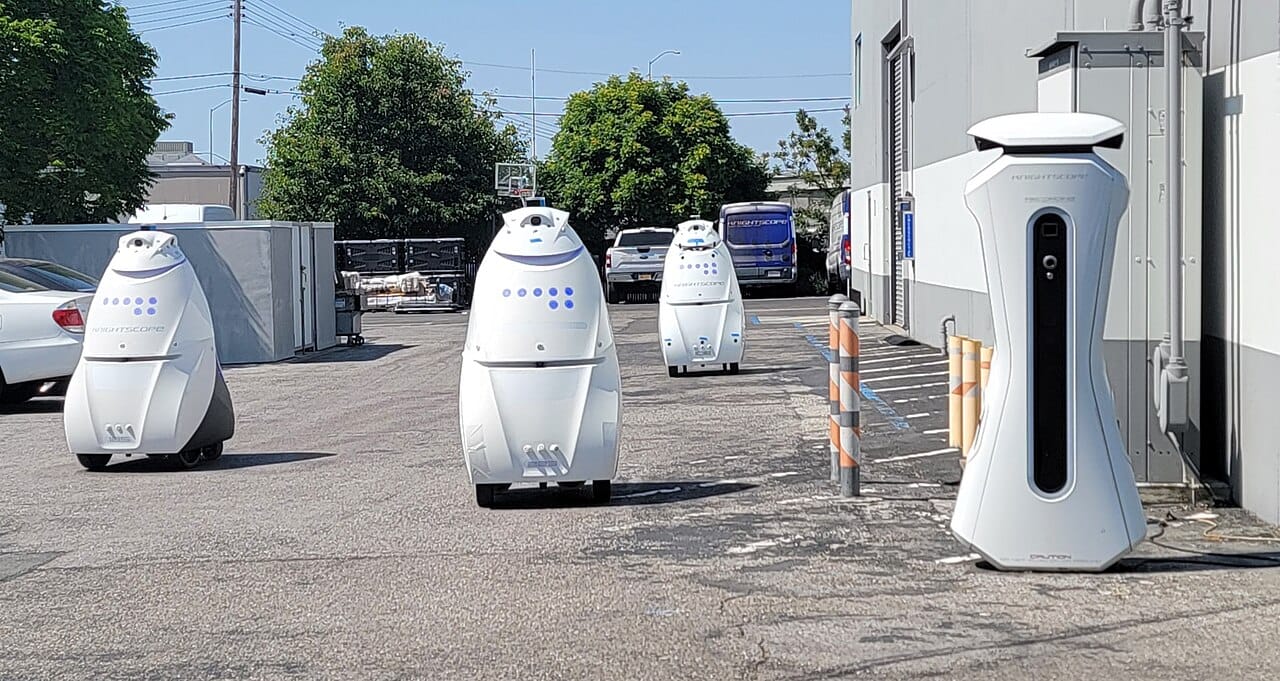
Robotics companies promise that video-camera-toting security robots can deter and detect crime. But many companies are rethinking the approach after a trail of canceled contracts and questions about whether the artificial intelligence-powered bots are meeting the needs of businesses and local governments.

Proof News found evidence of at least 21 security robot deployments since 2015. We contacted contract holders and combed news articles and determined that at least 13 of those programs have ended. Silicon Valley-based Knightscope secured the most security robot contracts, according to Proof’s analysis, and also suffered the bulk of cancellations.

For example, New York City’s then-Mayor Eric Adams installed a Knightscope robot on the overnight shift at the Times Square subway station, but the program was scrapped when the pilot expired in 2024. City leaders did not respond to Proof News’ questions about why the robot wasn’t renewed. By the end of its assignment, it was reportedly gathering dust in an empty storefront. 

Outside Columbus, Ohio, the city of Dublin pulled the plug on a Knightscope robot in May, ending its two-year pilot program after less than 10 months. The city enlisted the robot, dubbed DubBot, to patrol a downtown park, but city spokeswoman Robyn Gray said it “did not fully meet our operational needs,” and failed to identify any criminal incidents or lead to any tickets or arrests.

Sheila Sparks isn’t surprised. Her family has operated Sparks Protection Services near Columbus for more than a decade and said a human touch is essential to de-escalating sticky situations. 

“A robot can’t do that,” Sparks said. 

Seeking a new path forward in the security industry, Knightscope CEO William Santana Li said the company is forging a new model, combining its robots and AI-powered software with another key ingredient: human security guards. Knightscope announced it purchased Event Risk LLC, a national security guard firm, earlier this year.

Knightscope has incurred net losses since inception in 2013, according to its most recent quarterly filing with the U.S. Securities and Exchange Commission, and is $273 million in debt. Knightscope hopes its pivot to incorporate people will give it a greater share of the physical security market — which the company believes is worth an estimated $230 billion annually.

Li declined to answer questions about the disbanded programs, but said in an email, “Technology cannot do everything — and neither can people — but the combination can be very powerful.” 

ROBOTS VS WORLD

Knightscope and other American made robotics companies could get a boost from the recent U.S. Federal Communications Commission ban on foreign-made mobile robot imports. Officials cast the move as a national security imperative given the machines’ surveillance capabilities. 

But American roboticists are facing more than foreign competition. Robots have long struggled to navigate environments constantly in flux. AI can’t handle the ambiguous situations that security guards and police face daily, said Missy Cummings, a robotics professor at George Mason University. While AI decision systems perform well in narrow circumstances, she said, they can perform “miserably” as soon as algorithms are outside their training dataset.

“AI and robots for security have had a long problematic history,” Cummings said in an email, speaking generally. “I do not see this changing anytime soon.” 

In 2016, a Knightscope robot deployed at a shopping center in Silicon Valley rolled over a 16-month-old boy's foot. The company apologized for the “freakish accident” at the time, saying in a statement that the robot veered to avoid the child, who ran backwards and directly into the machine. The next year, one flopped into a Washington, D.C. fountain. The company responded with humor, tweeting: “BREAKING NEWS: “I heard humans can take a dip in the water in this heat, but robots cannot. I am sorry.” Li, meanwhile, told the New York Times that the incident was under investigation and a new robot would be delivered free.

When asked about whether contracts remained active, representatives from neither property  responded.

Then there was a trial at the San Antonio International Airport in 2024. Spokesperson Ana Flores said its Knightscope robot struggled with badge scanning, communication, and finding its way around. A door alarm would sound, she said, but the robot wouldn’t respond efficiently. Airport leadership opted to not move forward with a one-year, $21,000 Knightscope lease following a one-month test.

Meanwhile, private security is booming. Security officers have proliferated in recent years as cities embrace private guards, who earn an average of about $40,000 a year, according to the U.S. Bureau of Labor Statistics, about half that of police officers. 

Robotics companies pitch their autonomous robots — some of which can be equipped with cameras, facial recognition capabilities, and license-plate readers — as another set of eyes. They have no family to go home to and are happy to work nights and weekends.

Security robots promise “an alluring form of surveillance as a service,” Andrew Ferguson, a law professor at George Washington University, said in an email to Proof. In some cases their visible video cameras can “deter crime without having to pay a human being a salary,” he said, but it’s not clear that robots prevent or solve crimes better than people.

“They exist as a physical manifestation — a symbol, if you will — that someone is doing something to address potential crime,” Ferguson said. “Robots are a form of security theater, more optics than results.”

CRUMPLED CONTRACTS

Knightscope isn’t the only one seeing interest fizzle.

Officials in Salem, Oregon, powered off their Daxbots after a three-month pilot with the Oregon-based robotics company earlier this year. They had deployed three Daxbot robots to deter trespassing in a downtown parking garage. The robots recorded license plate numbers, captured photos of vehicles violating parking lot rules, and shared data with police.

Complaints about the parkade are “drastically down” since the pilot ended, according to Salem Police Sgt. Trevor Morrison, but it’s unclear if that’s due to traffic-calming devices or “residual results from the Daxbot patrols.” The pilot ended in April, with city spokesperson Nicole Miller citing no additional funding for robot security. 

Daxbots have also disappeared in Tempe, Arizona. A viral video of one blue-eyed bot being outwitted by an onlooker who it demanded “leave the premises” made its way to “America’s Funniest Home Videos.” When asked about the contract, the mixed-use campus, IDEA Tempe, did not respond. Daxbot didn’t respond to Proof’s questions about why the Salem and Tempe contracts ended. 

Adam Pioth, who posted the video, told Proof that he visited the robots frequently. A few months ago, he noticed the robots no longer shouted he was trespassing. Instead, he said, they would, “stop, look at me, and then just keep going really slow.” And then, he said, they were gone.

Goodbye my friend,” Pioth wrote on Instagram in March, “and thanks for all the fond memories.”

Daxbot is recalibrating its business, rolling into another industry: automated sidewalk assessments. Proof identified at least nine cities nationwide that have contracted with the company since last September to send robots cruising sidewalks to check for compliance with the Americans with Disabilities Act.

Boston Dynamics is best known for its robotic patrol dogs, which were recently deployed to two World Cup stadiums. After Hyundai bought the controlling stake in the robotics company in 2021, it began pushing to develop mass-produced humanoid robots to work in automotive manufacturing.

Atlas, its humanoid robot, delivered the match ball to the referee during a game in July. But the strategy has also spurred rolling strikes at Hyundai Motor’s Korean assembly plants. 

Critics claim police and security robots aren’t proven crime fighters, but are effective at one thing: surveillance.

In 2021, the New York Police Department ended its lease for a Boston Dynamics robotic dog and returned it, The New York Times reported, following public outcry. U.S. Representative Alexandria Ocasio-Cortez called the tool — which could climb stairs and was equipped with cameras, lights, and a two-way communication system — “surveillance ground drones” being “deployed for testing on low-income communities of color.”

Boston Dynamics did not respond to requests for comment. 

“What it’s really doing is building a mass surveillance system that is impossible to hide from,” said Brian Hofer, executive director of the privacy-advocacy nonprofit Secure Justice. “It is not a society I want to live in.”

Steve Rosta, retired highway patrol officer and co-owner of Direct Approach Security Services in Ohio, said robots’ cameras may act as a deterrent, and even catch videos of crimes, but he can’t see a future where the machines are more reliable than a human guard. 

“I’m old school,” Rosta said. “Boots on the ground is always better.”

❌