Vue normale

  • ✇404 Media
  • The Mayor Who Said 'No' When Flock Came to Town
    Norman, Oklahoma is a Flockless outpost on the outskirts of the Oklahoma City metro area. As you drive south down I-35 away from the big city and into Norman, coverage from the automated license plate readers (ALPR) dwindles. That’s because Norman has rejected Flock’s pitch multiple times.“They've given us two presentations in the last three years at the request of our police department who wanted to implement them,” Stephen Tyler Holman, the mayor of Norman, told me. “They haven’t been back
     

The Mayor Who Said 'No' When Flock Came to Town

10 août 2026 à 10:41
The Mayor Who Said 'No' When Flock Came to Town

Norman, Oklahoma is a Flockless outpost on the outskirts of the Oklahoma City metro area. As you drive south down I-35 away from the big city and into Norman, coverage from the automated license plate readers (ALPR) dwindles. That’s because Norman has rejected Flock’s pitch multiple times.

“They've given us two presentations in the last three years at the request of our police department who wanted to implement them,” Stephen Tyler Holman, the mayor of Norman, told me. “They haven’t been back since I’ve been mayor.”

Norman is an outlier. When the surveillance company comes to a city or a town, the city often signs up. The city council in my small town of 12,000 people just voted to install 22 new Flock cameras despite overwhelming pushback from residents. A big centerpiece of Flock’s pitch was that it would help solve crimes. My town’s chief of police told a story about how Flock had been instrumental in arresting child predators.

Holman told me that Flock and the cops made the same pitch to Norman. “Crime prevention and helping the police more efficiently solve crime. That was their main point that they wanted to advocate for,” he said. “They really focused on amber alerts and silver alerts and ‘don't you want to find kidnapped kids and elderly people that have wandered off who have Alzheimer's?’”

But Norman’s leaders had questions about privacy and data security and they didn’t like Flock’s answers. “Those were some of the reasons why we ended up not doing it,” Holman said. “Questions about data storage and how long and who has access to it […] you're gathering data on every single car vehicle that goes in and out of the city of Norman, regardless of if they've committed a crime or not, and then that's stored for 30 days on some kind of database? Who has access to it? How secure is it? Those are the questions we have that were kind of deal breakers for us [...] 30 days seemed like a long time to sit on that much data. There were some council members that were like, ‘It should only be an hour. Thirty minutes.’ Why do you need it any longer than that? Why would you need to keep it for 30 days? How is it accessed? How secure is it?”

All of the city council’s nine members said no to Flock. Since then, Holman has watched with some small satisfaction as other cities push back. Cops keep getting into trouble for using the cameras to stalk people, the system makes mistakes, and one of its ex-workers recently told 404 Media that the company lied to him about its business practices

More than 80 cities across the country have cancelled Flock contracts. None of them are near Norman, which sits on the border of Oklahoma City — a city covered in Flock cameras. According to Holman, the company played this up in its most recent presentation saying that “people would find that out and they’d come to commit crime in Norman because they know that we don’t have Flock cameras.”

But Norman’s city council doesn’t control every square inch of Norman and its surroundings. Despite their best efforts, Flock cameras have gotten in. The city sits in Cleveland county and county leaders approved the installation of 20 cameras for use by the Cleveland County Sheriff’s Office. “There are numerous homeowners associations that use them too,” Holman said. “But the city of Norman government does not. We’re, I guess, the only ones around here that don’t.”

Holman said that Norman’s politics are difficult to explain. “It’s neither liberal nor conservative,” he said. “Our three state reps are Democrats but two of them represent Republican majority voter districts.” He said the tension between the major parties and a healthy swath of independent voters has made citizens engaged with local politics and that constituents have sent a clear anti-Flock message. 

“Pretty much everywhere else around here absolutely would just roll over and approve something like this. Nobody would show up and protest it. And if they did, the councils probably wouldn't care. But in Norman it’s a big deal and people can lose re-election over stuff like this and have,” he said.

Holman served on the city council for 12 years before becoming mayor last year. He said one of the issues that turned people against the previous mayor was the purchase of a Bearcat APC for the local police department. In the 20 years after the start of America’s wars in Afghanistan and Iraq, town and city police departments have purchased a lot of military surplus gear from the Pentagon. “Things like a Bearcat would be rubber stamp approved in most cities. In Norman it took them 10 years and [passed] barely by a five-four vote of our previous mayor who I ran against and beat,” Holman said. The APC is still causing controversy in Norman.

Buying an armored car for the police 10 years after it was fashionable to do so is one thing. Private companies installing police cameras is another. “There’s a lot of folks here who are weary about government surveillance, especially giving that over to a private company,” Holman said.

Holman told me he’d been watching the city council meetings like mine where mayors and representatives fight with the voting public about their concerns. “I would really encourage them to listen to the public, listen to the people they represent in their cities and the very valid concerns that folks have about this technology and the private company itself, Flock, and the issues that have arisen with them and why many cities have started to explore pulling out,” he said.

He said that concerned citizens have a right to be worried about the conduct and ethics of a company like Flock. “I always come back to the freedom versus safety thing, this conversation we’ve been having since our founding,” Holman said. “That conversation may not resonate with a mayor like yours. There seems to be a lot of folks that are completely willing to give up all freedom for perceived safety. Well, I guess all crime could be eliminated if you put cameras everywhere, surveillance everywhere, and had drones patrolling the skies. That seems to be the way some folks want to go but what life are we living then?

  • ✇404 Media
  • Flock Pitched a Plan To Turn Uber and Lyft Drivers Into Roaming Surveillance Vehicles
    Flock planned to use dashcams installed in hundreds of thousands Uber, Lyft, and delivery drivers’ vehicles to scan license plates those drivers travelled passed, essentially turning Uber and Lyft drivers into roaming surveillance vehicles, according to a Flock presentation shared with 404 Media.The document provides more details on Flock’s planned partnership with Nexar, a popular dashcam company. 404 Media first revealed the intended partnership last August when multiple sources provided in
     

Flock Pitched a Plan To Turn Uber and Lyft Drivers Into Roaming Surveillance Vehicles

7 août 2026 à 08:00
Flock Pitched a Plan To Turn Uber and Lyft Drivers Into Roaming Surveillance Vehicles

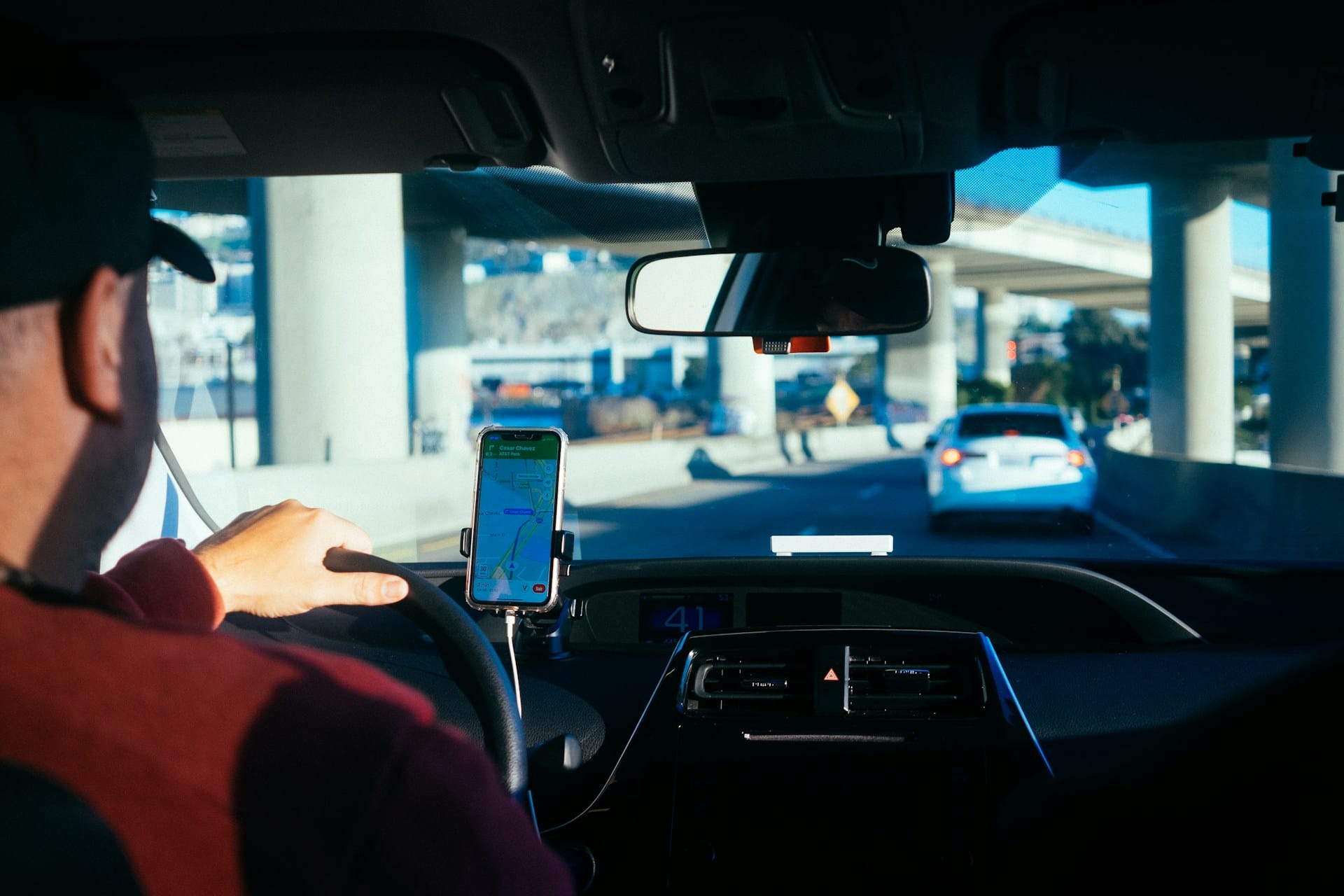
Flock planned to use dashcams installed in hundreds of thousands Uber, Lyft, and delivery drivers’ vehicles to scan license plates those drivers travelled passed, essentially turning Uber and Lyft drivers into roaming surveillance vehicles, according to a Flock presentation shared with 404 Media.

The document provides more details on Flock’s planned partnership with Nexar, a popular dashcam company. 404 Media first revealed the intended partnership last August when multiple sources provided information on the plan. The presentation shows Flock was actively pitching this partnership, and its use of Uber and Lyft drivers, to potential customers right around the time 404 Media reported on it.

💡
Do you work for Flock, Axon, or a similar company? I would love to hear from you. Using a non-work device, you can message me securely on Signal at joseph.404 or send me an email at joseph@404media.co.

Flock told 404 Media in an email it never executed the partnership with Nexar. But the presentation still shows Flock’s ambitious plan to conscript rideshare and delivery drivers to collect license plate data for its network. It is not clear whether Uber or Lyft, or drivers working for those apps, would have been aware of the data collection.

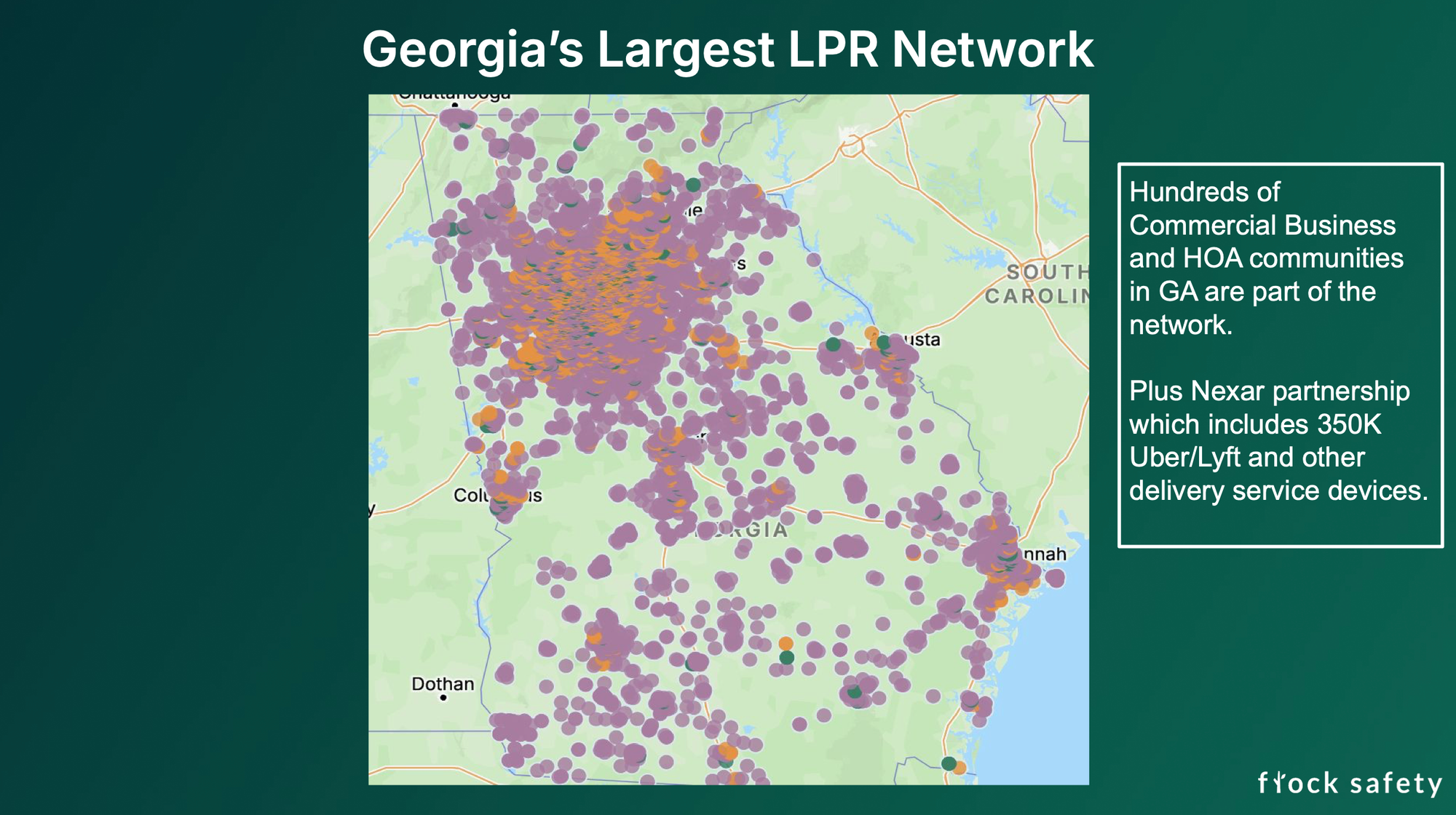
“Hundreds of Commercial Business and HOA [home owners associations] in GA [Georgia] are part of the network,” the presentation, written by Flock to present to the Georgia Office of the Attorney General last August, reads. “Plus Nexar partnership which includes 350k Uber/Lyft and other delivery service devices.”

Jason Hunyar, a Dunwoody, Georgia, resident who obtained the presentation through a public records request, shared the document with 404 Media.

Flock Pitched a Plan To Turn Uber and Lyft Drivers Into Roaming Surveillance Vehicles
Image: screenshot of the presentation.

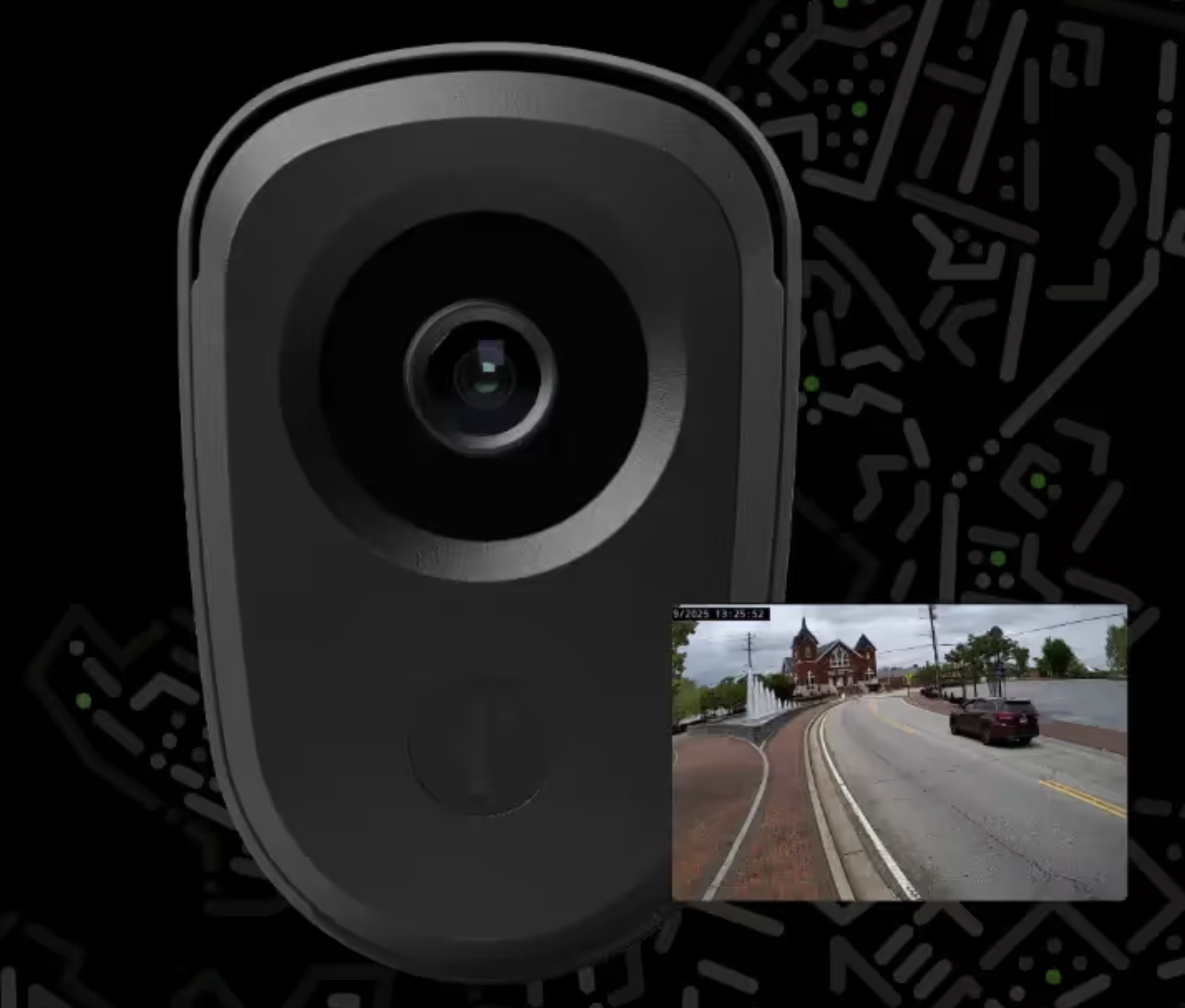
Flock’s automatic license plate reader (ALPR) cameras are usually stationary cameras installed on tall poles that constantly scan the license plate, color, make, and brand of every vehicle that drives past. The Nexar partnership would have made those data collection efforts mobile. Axon, the law enforcement contracting giant that also sells ALPR cameras, sells some of its cameras to be installed in police officers’ roaming cars. Vigilant Solutions and the Digital Recognition Network (DRN), two ALPR companies now owned by Motorola, perform similar license plate data collection through cameras in vehicles belonging to repossession agencies.

Nexar sells various different models of dashcams providing front, cabin, and rear views, and already can provide “clear license plate capture with Full HD video,” according to its website. Nexar markets the cameras to rideshare drivers and also “commuters,” “long-distance drivers,” and “casual drivers.”

In September, 404 Media reported that a hacker broke into Nexar and accessed a database of terabytes of video recordings taken by customers’ cameras. Those included footage of people driving around sensitive Department of Defense locations.

Flock has explored obtaining other unusual datasets too. Last May, 404 Media reported Flock was building a massive people lookup tool that would use hacked data to “jump from LPR to person,” according to leaked audio. Flock scrapped those plans after 404 Media’s coverage and internal pressure.

Neither Uber nor Lyft responded to a request for comment. Neither did Nexar.

In May, 404 Media reported a company called BusPatrol, that has cameras installed in tens of thousands of school buses, plans to turn those cameras into ALPRs and give access to that data to law enforcement.

  • ✇404 Media
  • Cities Are Ditching Flock, Immediately Replacing It With Axon License Plate Readers
    A handful of cities across the U.S. have ditched Flock’s automatic license plate reader (ALPR) cameras and immediately replaced them with equivalent systems from law enforcement contracting giant Axon, according to local media reports and government documents from around the country. Axon, for example, advertises AI-powered cameras that attach to an existing streetlamp and are designed to completely blend in with their surroundings, and also collects license plate data with cameras installed
     

Cities Are Ditching Flock, Immediately Replacing It With Axon License Plate Readers

6 août 2026 à 09:14
Cities Are Ditching Flock, Immediately Replacing It With Axon License Plate Readers

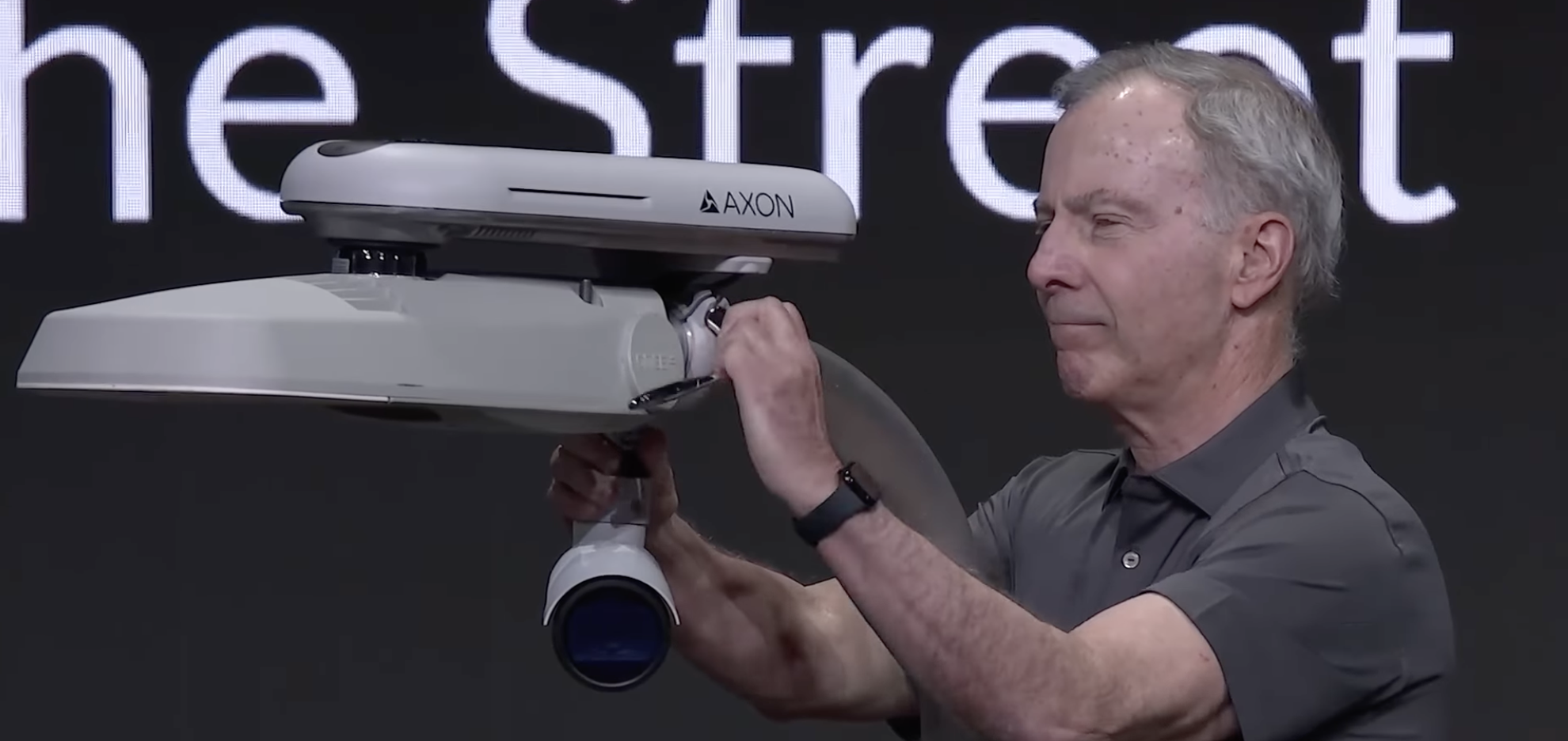
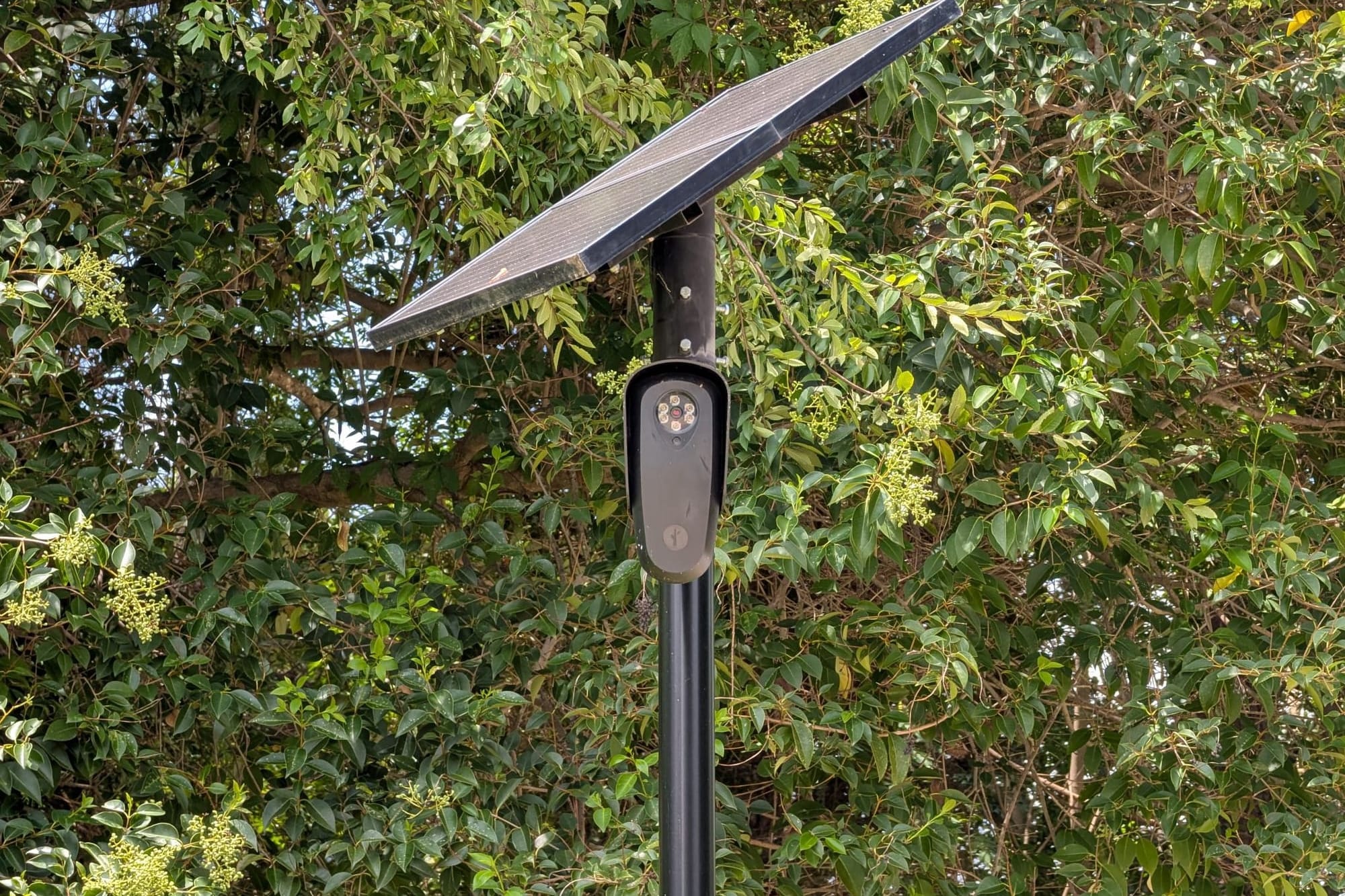
A handful of cities across the U.S. have ditched Flock’s automatic license plate reader (ALPR) cameras and immediately replaced them with equivalent systems from law enforcement contracting giant Axon, according to local media reports and government documents from around the country. Axon, for example, advertises AI-powered cameras that attach to an existing streetlamp and are designed to completely blend in with their surroundings, and also collects license plate data with cameras installed inside police officers’ patrol vehicles.

💡
Do you work at Axon? Do you know anything else about its technology or expansion? I would love to hear from you. Using a non-work device, you can message me securely on Signal at joseph.404 or send me an email at joseph@404media.co.
  • ✇404 Media
  • Cops Used Flock to Track a Man Across State Lines to Create Pretext to Search His Car for Weed
    Police in Wisconsin used Flock to determine that a man “travels to Michigan frequently,” where marijuana is legal, then back to Wisconsin, where it is illegal. They then used his travel across state lines as tracked by Flock as part of the probable cause justification to search his car for weed; he was eventually arrested on marijuana possession charges, according to court records reviewed by 404 Media. The searches came to light in a Wisconsin criminal complaint against Edward Abrams-Phillips,
     

Cops Used Flock to Track a Man Across State Lines to Create Pretext to Search His Car for Weed

5 août 2026 à 10:50
Cops Used Flock to Track a Man Across State Lines to Create Pretext to Search His Car for Weed

Police in Wisconsin used Flock to determine that a man “travels to Michigan frequently,” where marijuana is legal, then back to Wisconsin, where it is illegal. They then used his travel across state lines as tracked by Flock as part of the probable cause justification to search his car for weed; he was eventually arrested on marijuana possession charges, according to court records reviewed by 404 Media. 

The searches came to light in a Wisconsin criminal complaint against Edward Abrams-Phillips, who was wanted for bail jumping on domestic violence charges. But the criminal complaint makes clear that beyond the bail jumping and domestic violence charges, police specifically studied Abrams-Phillips’ interstate travel to create the pretext for searching his car for marijuana. The bail jumping charge was dismissed; Abrams-Phillips was found guilty only of weed possession in the case, according to the court records.

Cops Used Flock to Track a Man Across State Lines to Create Pretext to Search His Car for Weed
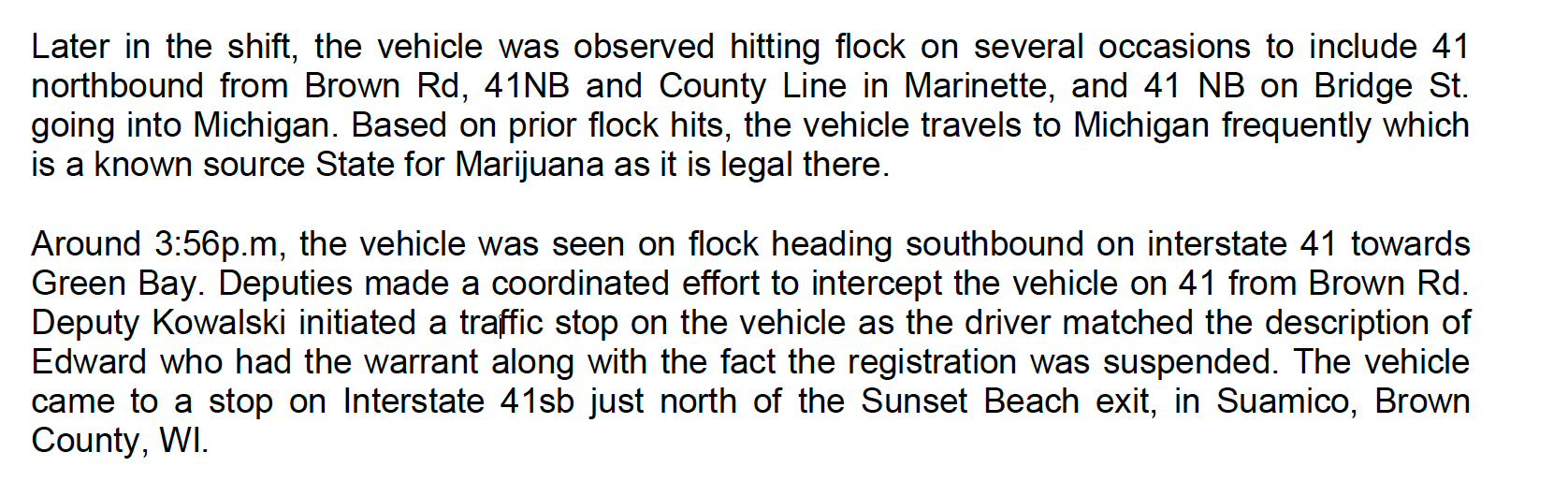
An excerpt from the "Probable Cause" section of the court records.

The complaint explains that Abrams-Phillips was tracked via Flock’s network over the course of the day to determine that he drove from Wisconsin to Michigan, a “known source state for marijuana as it is legal there,” the complaint states, adding that previous Flock hits indicated that he “travels to Michigan frequently.” Police note that, using Flock, they were able to track Abrams-Phillips driving from Wisconsin to Michigan, then back to Wisconsin over the course of several hours, where he was pulled over and arrested. The Flock searches and arrests happened in April 2025.

“The vehicle was observed hitting flock on several occasions to include 41 northbound from Brown Rd, 41NB and County Line in Marinette [Wisconsin], and 41 NB on Bridge St. going into Michigan. Based on prior flock hits, the vehicle travels to Michigan frequently which is a known source State for Marijuana as it is legal there,” the charging document notes. “Around 3:56 p.m., the vehicle was seen on Flock heading southbound on interstate 41 towards Green Bay [Wisconsin]. Deputies made a coordinated effort to intercept the vehicle on 41 from Brown Rd. Deputy Kowalski initiated a traffic stop on the vehicle as the driver matched the description of Edward.”

  • ✇404 Media
  • ‘DO NOT MENTION ALPR USAGE’: How Cops Are Trying to Hide Their Use of Flock
    When cops use Flock to arrest someone in Wapello County, Iowa, they don’t want them to know. A usage policy for the automated license plate reader cameras in the county tells police, in no uncertain terms, to keep them a secret: “DO NOT MENTION ALPR USAGE TO THE OCCUPANTS OF THE VEHICLE,” the policy document reads. “DO NOT MENTION ALPR USAGE IN YOUR REPORT OR COMPLAINT UNLESS ABSOLUTELY NECESSARY.” The police guidance document is unusual in how clearly it tells police not to mention their Flock
     

‘DO NOT MENTION ALPR USAGE’: How Cops Are Trying to Hide Their Use of Flock

4 août 2026 à 10:23
‘DO NOT MENTION ALPR USAGE’: How Cops Are Trying to Hide Their Use of Flock

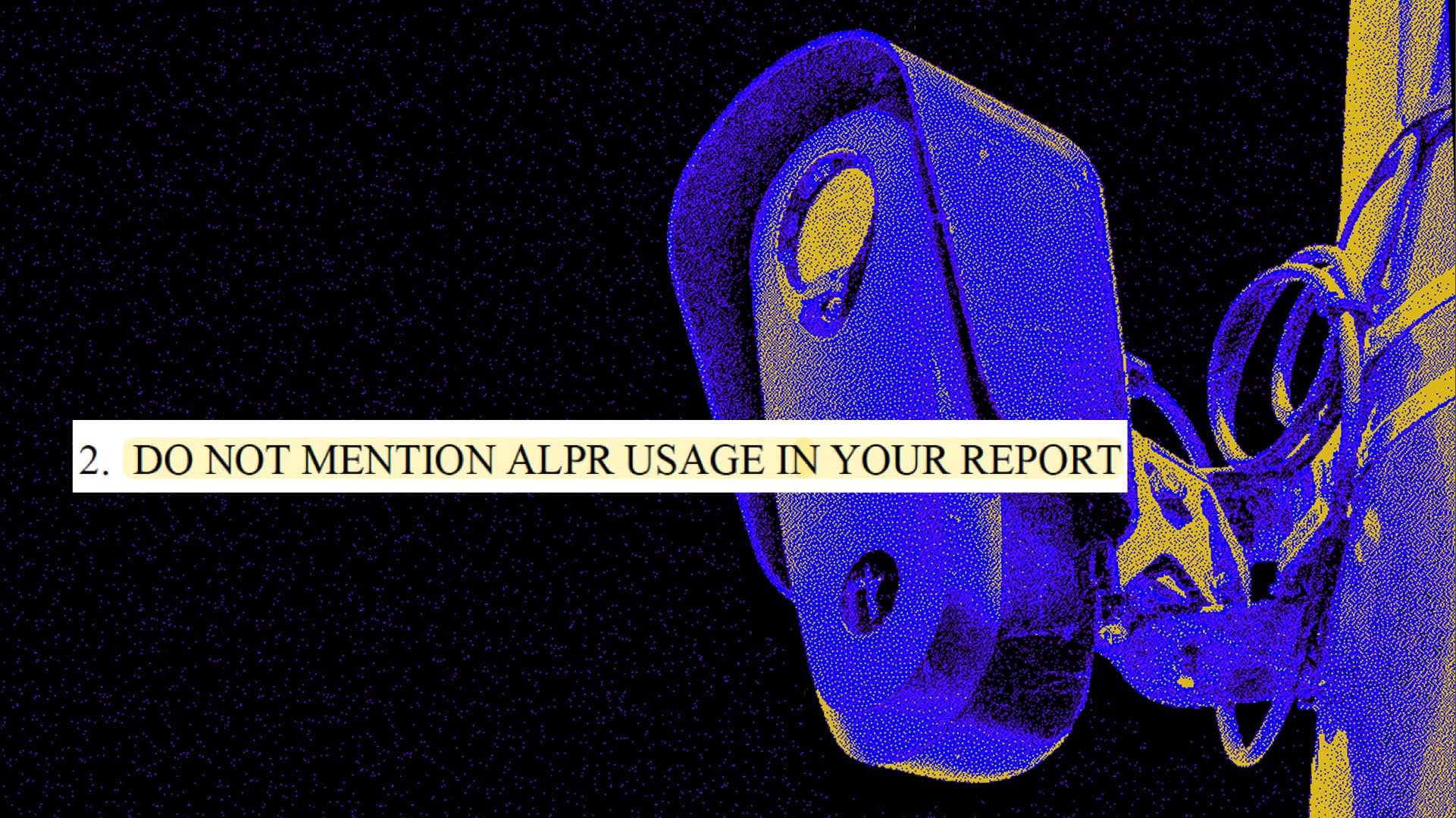
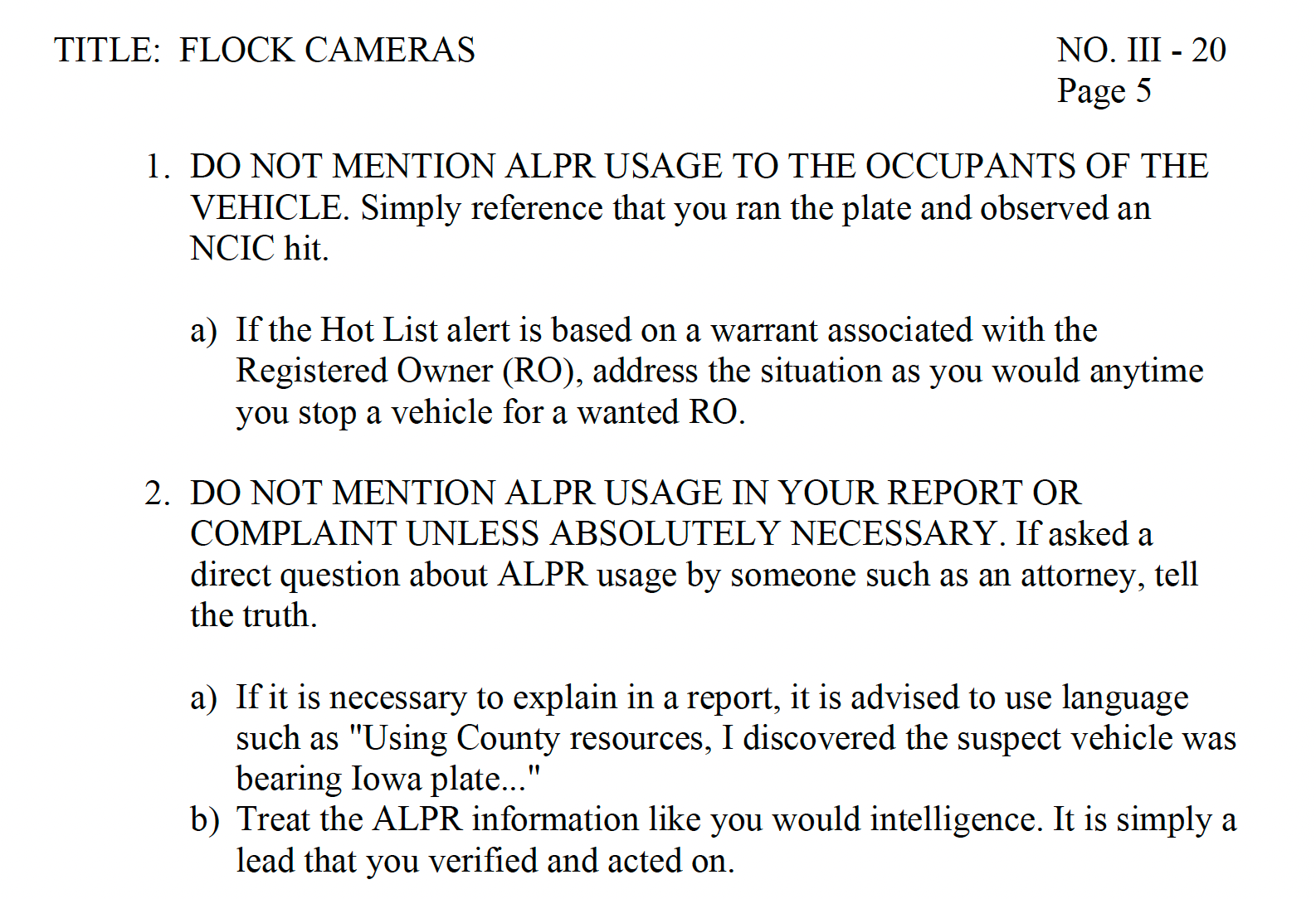
When cops use Flock to arrest someone in Wapello County, Iowa, they don’t want them to know. A usage policy for the automated license plate reader cameras in the county tells police, in no uncertain terms, to keep them a secret: “DO NOT MENTION ALPR USAGE TO THE OCCUPANTS OF THE VEHICLE,” the policy document reads. “DO NOT MENTION ALPR USAGE IN YOUR REPORT OR COMPLAINT UNLESS ABSOLUTELY NECESSARY.” 

The police guidance document is unusual in how clearly it tells police not to mention their Flock use, but it also highlights several important things in the Flock debate. While Flock likes to say that it is a transparent surveillance company and that it cares about “accountability” and “governance,” some of its customers believe its use should be kept secret. Flock is now operating in thousands of cities and towns, and when, how, and why police use the system is wildly inconsistent. Even though Flock does have various auditing and transparency tools, police have their own opinions about what Flock can and should be used for and what the policies for it should be. 

‘DO NOT MENTION ALPR USAGE’: How Cops Are Trying to Hide Their Use of Flock

It is not just local police in small communities who are creating policies designed to obfuscate Flock usage. Earlier this year, we reported that police in multiple states were being told to be “as vague as permissible” about why they were using Flock because their searches could be obtained using public records requests, and that warning was being shared by the FBI and Department of Justice. Residents of many towns using Flock also say that their cities entered into contracts with Flock with little public oversight, essentially quietly opting them into a nationwide surveillance network without robust public debate. 

Wapello County’s “standard operating procedures” document for Flock cameras was created in November of 2025 and was obtained by a 404 Media reader using a public records request and was shared with us. Coincidentally, Wapello County’s largest city is Ottumwa, Iowa, where 404 Media ran a Super Bowl commercial earlier this year. The county has four Flock cameras via a contract it signed with the company in late 2024. The policy further instructs police to be vague in any arrest report, suggesting that they simply call the Flock system “county resources.” 

“DO NOT MENTION ALPR USAGE IN YOUR REPORT OR COMPLAINT UNLESS ABSOLUTELY NECESSARY. If asked a direct question about ALPR usage by someone such as an attorney, tell the truth,” it says. “If it is necessary to explain in a report, it is advised to use language such as ‘Using county resources, I discovered the suspect vehicle was bearing an Iowa plate.’ Treat the ALPR information like you would intelligence. It is simply a lead that you verified and acted on.”

The guidance to keep Flock use secret is reminiscent—but less extreme—than guidance on some other secretive police technologies. For years, police tried to hide the existence of cell site simulators (popularly known as Stingrays), going as far as to drop criminal cases where it was likely that a judge would expose information about them. Stingrays are essentially fake cell phone towers that can be used to identify the phones of people in a specific area.

In the public records request, Sheriff Don Phillips said “there is no need” to tell people about the use of Flock.

“Our policy requires deputies to check the license plate to make sure the correct plate is accurate and the information as to an arrest warrant, stolen vehicle, stolen plate or missing person is correct,” he said. “There is no need to tell them about our investigative methods or sources, such as the camera system, because the information is verified by the deputy running the license plate. It is common practice for law enforcement to refrain from disclosing investigative methods and sources to prevent criminals from learning how to circumvent them.”

Phillips did not respond to a request for comment.

  • ✇404 Media
  • ‘Own the Narrative’: Leaked Flock Guide Shows How It Teaches Cops to Promote Its Tech
    404 Media has obtained a coaching guide that Flock surveillance gives to police about “how to speak to city councils about public safety technology.” The handbook highlights how Flock and police team up to convince cities to buy and keep its automated license plate reader technology, even when there is widespread public opposition to it, and encourages police to “own the narrative before someone else does” by championing the technology before citizens can oppose it during public comment periods.
     

‘Own the Narrative’: Leaked Flock Guide Shows How It Teaches Cops to Promote Its Tech

3 août 2026 à 13:13
‘Own the Narrative’: Leaked Flock Guide Shows How It Teaches Cops to Promote Its Tech

404 Media has obtained a coaching guide that Flock surveillance gives to police about “how to speak to city councils about public safety technology.” The handbook highlights how Flock and police team up to convince cities to buy and keep its automated license plate reader technology, even when there is widespread public opposition to it, and encourages police to “own the narrative before someone else does” by championing the technology before citizens can oppose it during public comment periods.

The PDF guide notes that the general public and cities now “increasingly expect transparency, oversight, and accountability alongside public safety outcomes,” and tells police to not argue with people who believe that Flock’s license plate readers are “mass surveillance.”

“One of the most common questions agencies hear today is whether license plate recognition (LPR) technology constitutes mass surveillance. Many leaders instinctively respond by attempting to refute the claim. Flock's Jamie Hudson recommends a different approach,” the guide reads.

‘Own the Narrative’: Leaked Flock Guide Shows How It Teaches Cops to Promote Its Tech

“Don’t avoid the concept of mass surveillance because you’re not going to convince opponents that it’s not,” the company recommends. Flock tells law enforcement agencies they need to try to convince city council and city managers that the technology is worthwhile before meetings with the public occur; that they need to have a “carefully scripted presentation” ready to go; and that police need to say they want Flock because they want to keep the community safe: “You care about your community. That’s why you’re bringing this in.” 

Flock began offering this guide as part of a broader attempt to coach police on how to push back against criticism of its policies and security practices, many of which 404 Media has investigated and shed light on. These include the fact that Flock data was regularly making its way to Immigrations and Customs Enforcement (ICE), often in violation of sanctuary city and state laws; that Flock was used to search 83,000 cameras nationwide for a woman who had an abortion in Texas; and that Flock has been used by police to stalk people and surveil protesters. These investigations and broader concern over the surveillance state have led many cities to hold city council meetings to reconsider their Flock contracts, and this Flock-produced guide is an attempt to help police shape the narrative in a way that will either convince cities to buy Flock or to keep their contracts. 

The guide is associated with a Flock webinar for police called “How to Speak to City Councils: Meeting the Moment with Confidence,” which included modules on “how to address misinformation with clarity.” After public opposition late last year, the company began to offer Q&A sessions with its CEO, Garrett Langley, for city council members, police, and mayors to address what Flock described as an “era of unprecedented misinformation.” 

“The recent headlines about our company are largely a result of this environment,” the company told cities. 

“Opponents have a very carefully scripted narrative. They come prepared. You should also have a carefully scripted presentation that addresses those concerns ahead of time,” the guide says. “The agencies that navigate these conversations successfully rarely wait until a council meeting to educate stakeholders. They brief city managers early. They meet with council members before votes occur. They share policies proactively and answer questions before public comment periods become the first introduction to the program.” 

‘Own the Narrative’: Leaked Flock Guide Shows How It Teaches Cops to Promote Its Tech

The guide also tells police that they can convince city councils that Flock is worth the monetary cost by conveniently not focusing on how much the cameras cost, but by “reframing the financial discussion itself” to focus on “the cost of unresolved crime.” Flock also writes that much of the opposition to its technology is happening because people “do not understand how it works or how it is governed.” This idea is one that has been regularly repeated by Langley over the last several months. 

Surveillance companies regularly try to get police to act as quasi salespeople and spokespeople for their companies, pitting a private company and taxpayer-funded law enforcement on one side and citizens on the other. “For years, surveillance vendors like Flock Safety have shaped policy debates cities are supposed to run independently — staging council ‘prep calls’ and exploiting a basic asymmetry: the vendor controls the facts, and city staff are rarely positioned to challenge them,” Sarah T. Hamid, director of strategic campaigns at the Electronic Frontier Foundation told 404 Media after reviewing the guide. “The financial interest is obvious. Flock isn’t just selling surveillance, it’s scripting the public case for buying it. Because Flock treats public trust as a messaging problem rather than a governance outcome, that script keeps officials focused on ‘accountability’ in the abstract instead of the concrete harms and documented abuses its network has already enabled.”

404 Media has watched numerous city council meetings around the country where police talk about how Flock is a critical law enforcement system for them; in many cases, a police chief will speak about Flock and then introduce a Flock employee to give a presentation about the surveillance system. On Monday, 404 Media published an interview with a former Flock government affairs manager who regularly pitched the technology to cities at public meetings. An activist who has been pushing back against Flock in their community and who shared the guide document with 404 Media said that they have regularly seen the strategies suggested by Flock deployed in city council meetings they have attended and watched. 404 Media agreed to keep the activist anonymous to protect them from retaliation.

“I think this document shows a coordinated effort from Flock Safety to compel law enforcement agencies to convince our elected leaders to represent their interests as a company rather than the interests of concerned citizens,” they said. “I have watched many meetings locally in my city and my state and across the country, and you can see the techniques used in this ebook in the presentations given by law enforcement. Pivoting conversations away from concerns about mass surveillance and directing them towards procedure and governance is a vehicle that's used to downplay the concerns of privacy-minded citizens. We have every right to expect our elected leaders to listen to us, and it's very common to see city councils vote with a supermajority in favor of approving Flock contracts despite standing-room only attendance at city council meetings with little to no public support for this product.”

The guide specifically highlights several supposed success stories in which communities had very real concerns about Flock but ultimately decided not to get rid of the technology. For example, it highlights how Flock was able to get a vote in favor of its technology in Oakland, California, despite it being “one of the most scrutinized public safety technology debates in the state,” with “more than 140 public comments” and opposition from the city’s Privacy Advisory Commission: “The conversation shifted when officials stopped asking the public to trust the technology and started showing how the technology could be audited, reviewed, and held accountable.” 

It also tells the story of Richmond, California, which allowed its Flock contract to temporarily lapse after the city’s cameras were included in the company’s national lookup tool. City officials there worried that their cameras’ data would be accessed by ICE, in violation of California and local law. “After concerns emerged around data sharing and sanctuary city policies, the city's program was paused and subjected to intense public scrutiny,” the Flock guide says. “Rather than relying on generalized claims about effectiveness, department leadership presented two and a half years of local results, including 274 arrests and 259 vehicle recoveries connected to the program. The council ultimately voted 4-3 to reinstate the system.”

Flock did not immediately respond to a request for comment. 

  • ✇404 Media
  • Why a Flock Worker Quit: ‘They Lied’
    This is an adaption of a podcast interview 404 Media recorded with Jonathan Paz, a former Flock employee who is now running running for Congress in Massachusetts’ 5th District. Check out the whole thing here on YouTube.
     

Why a Flock Worker Quit: ‘They Lied’

3 août 2026 à 10:02
Why a Flock Worker Quit: ‘They Lied’

This is an adaption of a podcast interview 404 Media recorded with Jonathan Paz, a former Flock employee who is now running running for Congress in Massachusetts’ 5th District. Check out the whole thing here on YouTube.

Jonathan Paz was initially nervous when he started working at the surveillance company Flock. It was his first tech job. But he was interested in the company’s mission. Flock’s cameras, which constantly scan the license plate of every vehicle driving past, were for finding missing people. Staff at the company were able to solve real issues.

In his job as a government affairs manager a couple of years ago, Paz represented Flock in public hearings, with the goal of getting a city to purchase Flock cameras. These sorts of hearings are happening on a near constant basis all across the country, as cities and towns participate in a national conversation about whether they want Flock cameras in their community or not.

  • ✇404 Media
  • 'I Would Never Do This To You:' Protesting Flock, Arizona Man Presents Plan to Surveil Government Officials
    On July 20, Jacob Petrosky stood in front of the Casa Grande, Arizona City Council during a public comment session and made an announcement. “I've spent the last several months talking to people all over Casa Grande, and one thing keeps coming up: Safety. So, today I'm excited to announce a new company called Shepherd Safety,” he said. “Our mission is simple. Keep government officials and their families safe.” It would be no different than how the city monitors its citizens using Flock camera
     

'I Would Never Do This To You:' Protesting Flock, Arizona Man Presents Plan to Surveil Government Officials

28 juillet 2026 à 12:07
'I Would Never Do This To You:' Protesting Flock, Arizona Man Presents Plan to Surveil Government Officials

On July 20, Jacob Petrosky stood in front of the Casa Grande, Arizona City Council during a public comment session and made an announcement.

“I've spent the last several months talking to people all over Casa Grande, and one thing keeps coming up: Safety. So, today I'm excited to announce a new company called Shepherd Safety,” he said. “Our mission is simple. Keep government officials and their families safe.” It would be no different than how the city monitors its citizens using Flock cameras, he said; he planned to launch satellites that would use AI to monitor “where government officials go, where they stop, who they meet with, and when they return home.” 

He said he’d already started compiling profiles on their vehicles, spouses vehicles, children's vehicles, and planned to combine that data with Bluetooth signals, advertising IDs, and commercial data sources, “so our authorized users can replay the movements of every government official and their immediate family,” he said. Local businesses would be invited to join the network, to “protect” officials while they shop, eat at restaurants, and move around the city. 

  • ✇404 Media
  • Flock's CEO Says its ALPRs Don't Do Video After Repeatedly Announcing They Can
    After the Los Angeles Police Department allowed its contract with Flock to expire, the surveillance company’s CEO, Garrett Langley, told local news that people don’t understand how its technology works, and that its automated license plate readers (ALPR) only take a “static picture” of a car. “The technology is really simple,” he told ABC7. "A car drives by, we take a picture. It's a static picture of a car, and then we read the license plate. That's what the technology is—it's actually not t
     

Flock's CEO Says its ALPRs Don't Do Video After Repeatedly Announcing They Can

23 juillet 2026 à 16:12
Flock's CEO Says its ALPRs Don't Do Video After Repeatedly Announcing They Can

After the Los Angeles Police Department allowed its contract with Flock to expire, the surveillance company’s CEO, Garrett Langley, told local news that people don’t understand how its technology works, and that its automated license plate readers (ALPR) only take a “static picture” of a car. “The technology is really simple,” he told ABC7. "A car drives by, we take a picture. It's a static picture of a car, and then we read the license plate. That's what the technology is—it's actually not that complicated, it's pretty simple." 

But for the last year, Flock has been marketing a new upgrade that allows “all” of its ALPRs to record live video. Langley is either dramatically underselling what Flock’s technology can do while saying that people don’t understand it, or Flock has quietly rolled back a major product feature without telling anyone. (Update: after the publication of this piece, a Flock spokesperson said Flock has discontinued the feature for law enforcement agencies.)

Flock has not been quiet about this live video upgrade; its salespeople have pitched the upgrade to cities, and the company has mentioned it in numerous blog posts (though it recently deleted one of them), and Langley even spoke about the capabilities with Forbes last year, suggesting cops could pull video in real time from its ALPR cameras: “We will just open up the five nearest cameras in real time and say, here's what's happening right now,” Langley said. 

In June of last year, a Flock blog post called “Why video is the missing link in your LPR program,” the company wrote “All existing Flock LPRs will soon stream live video and capture clips with a free, optional software update. No new hardware, no permits, no extra cost. Same lens, same angle and field-of-view as the LPR. See basic video clips for every plate read. Zero lift for your team. Free and optional to opt in.”

The blog post describes several potential use cases, and different setups that police officers could use, which include adding a separate video camera to the poles that Flock cameras are installed on but also, crucially, includes the fact that all Flock ALPR cameras are capable of taking video: “Fixed live video is coming to all LPR cameras, free by end of 2025.”

And, in a now-deleted product launch blog, Flock wrote “LPR Cameras Can Become Video Cameras,” and added it was a “move that will transform the largest network of LPR cameras in the nation.” 

“Flock customers don’t have to do a thing or pay a thing,” said Flock’s Chief Strategy Officer Bailey Quintrell in the blog post. “This will be a no-cost software update we push over the cloud.”

Text messages obtained using a public records request by Jason Hunyar, an activist in Dunwoody, Georgia, show that cops in Dunwoody turned on this feature. The text messages are between John Watson, a Flock employee, and a Dunwoody police officer from January of this year.

“Are y’all able to live stream LPR video yet?,” Watson asks.

“Yes,” the officer says.

“When did they turn that on and how has it been. And who turned it on?” Watson responds.

“It’s been about a month and it’s pretty cool feature,” the officer says. “Small angles but cool for incidents if needed. I’ve been working with Vijay [Dhamija, Flock’s Director of Product] on it.” 

“Gotcha. Any stability issues?,” Watson asks.

“Not that I have noticed,” the officer responds.

The Flock spokesperson said, “This was not a broad rollout. Five law enforcement agencies participated in a limited pilot to test live video on select LPR devices; the LAPD was not among them.”

“In March, Flock discontinued the feature for law enforcement agencies, and it is no longer active at any of the five participating agencies. The pilot provided live video only and did not include recording or stored-video playback,” the spokesperson added.

Update: this piece has been updated to include comment from Flock.

  • ✇404 Media
  • The Rise of Anti-Flock Influencers Who Make Things Up for Clout
    A little over a month ago, the former American Idol contestant, country musician, and Instagram influencer Noah Orion appears to have learned about the surveillance company Flock. “Cities are now covering Flock cameras with trash bags,” Orion narrated over an Instagram post aggregating a 404 Media report. “It’s also pretty wild that we’ve just dropped stickers that say ‘Fuck Flock’ on them and it’s pretty cool that it’s coincidental that the sticker’s outside diameter is the same size as the ave
     

The Rise of Anti-Flock Influencers Who Make Things Up for Clout

23 juillet 2026 à 10:51
The Rise of Anti-Flock Influencers Who Make Things Up for Clout

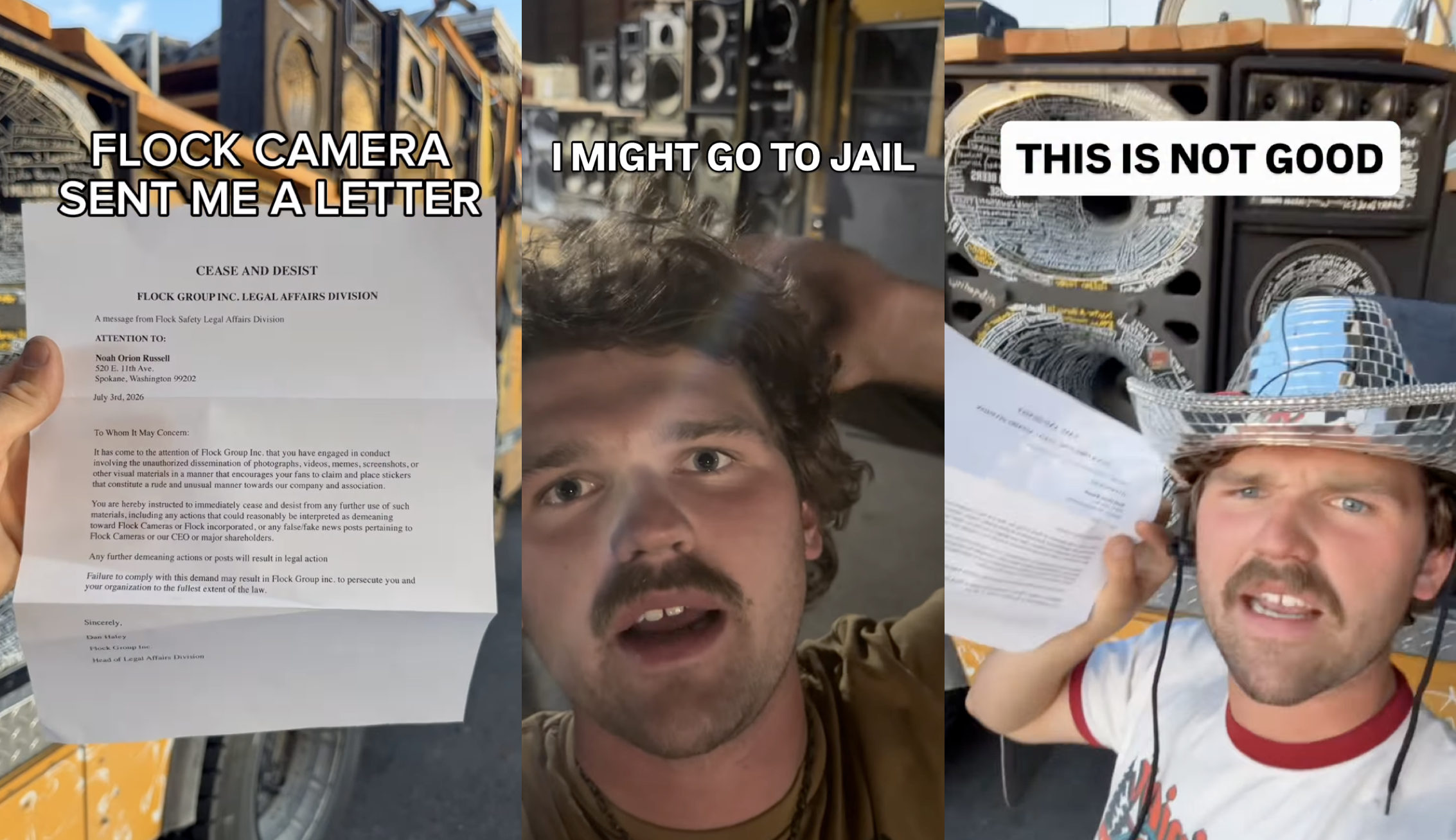
A little over a month ago, the former American Idol contestant, country musician, and Instagram influencer Noah Orion appears to have learned about the surveillance company Flock. “Cities are now covering Flock cameras with trash bags,” Orion narrated over an Instagram post aggregating a 404 Media report. “It’s also pretty wild that we’ve just dropped stickers that say ‘Fuck Flock’ on them and it’s pretty cool that it’s coincidental that the sticker’s outside diameter is the same size as the average camera lens on a Flock camera,” he adds, showing a mockup of an AI-generated sticker featuring a surveillance camera that is not a Flock camera.

Orion had never posted on Instagram about Flock before then. But, since that post, Orion has posted dozens of reels about Flock, apparently at great personal risk to himself. A July 8 post features an image of a printed out “CEASE AND DESIST” letter purportedly sent to Orion by Dan Haley, Flock’s head of legal affairs. “It has come to the attention of Flock Group Inc. that you have engaged in conduct involving the unauthorized dissemination of photographs, videos, memes, screenshots, or other visual materials in a manner that encourages your fans to claim and place stickers that constitute a rude and unusual manner towards our company and association. You are hereby instructed to immediately cease and desist from any further use of such materials […] any further demeaning actions or posts will result in legal action. Failure to comply with this demand may result in Flock Group inc. [sic] to persecute you and your organization to the fullest extent of the law.” 

The post has 73,000 likes and has been viewed millions of times. Since that post, Orion has posted the same letter 16 separate times on Instagram, and is now posting about almost nothing besides Flock. On Tuesday, he posted a reel stating “I could go to jail soon, and I am not afraid of that. I am pushing a movement against Flock cameras.” In that video, he said he’s starting a “bail fund” in case he’s arrested and goes to jail. Collectively, these posts and videos have hundreds of thousands of likes and millions of views. 

But the cease-and-desist is not real; it is a wholesale fabrication created by the influencer for attention, likes, and clout. He is at zero risk of persecution or arrest for speaking out about Flock (though he may be at risk for forging a fake cease-and-desist letter.) In the meantime, Orion has gotten more than 30,000 new followers in the last month according to the Instagram tracking website NotJustAnalytics, a period in which he has posted essentially only about Flock and, primarily, about his stickers and his cease-and-desist letter. 

This constant focus on his apparent legal trouble is a relatively typical pattern for Orion; before Flock, he was posting endlessly about how his modified bus with massive speakers was going to be impounded by the authorities. Before that, he was talking about how he was going to be evicted from the space in which he modified the bus.

Over the last few months, we have seen the rise of various anti-Flock influencers and activists, and increased scrutiny from journalists, YouTubers, and independent researchers. Content about Flock has become quite popular on social media, and the vast majority of posts are from well-meaning people who are amplifying real reporting and real — if occasionally exaggerated or slightly misconstrued — information about one of the most invasive mass surveillance companies in the country. Alongside this has come lots of viral posts that either slightly misunderstand or oversell what Flock is doing or is capable of, or get, for example, the exact mechanics of how ICE may obtain Flock data wrong. 

On balance, most of these posts are at least directionally correct. There is room in the movement against mass surveillance for hyperbole, satire, comedy, stunts, and misunderstandings done by well-meaning people, especially if there is a broader point.

That is not what Orion and some of his copycats are doing, however. Most charitably, Orion is making people aware of Flock and could be making people more likely to do more research into the company or is making them more likely to take political or direct action to prevent surveillance. He’s a bro spreading the word, and perhaps his heart is in the right place. But, basically, he is making shit up to make himself and his country music career more famous by creating and sowing disinformation in a space where there are dozens of journalists and influencers working hard for more transparency, and positioning himself as being somehow at legal or criminal risk when people who are doing actual needle-moving work struggle to stand out or are actually being threatened. On every post, Orion tries to give away stickers and tells people to comment “Fuck Flock” in order to get them. This is a tactic to game the Instagram algorithm with engagement; Orion has set up a bot to automatically message anyone who comments on his posts with links to his online store which has a variety of free stickers, paid merch, and a “bail fund in case I go to jail.” 

Flock and its lawyers have sent real cease-and-desist letters or otherwise threatened the creators of both DeFlock, an open-source project to map Flock cameras, and HaveIBeenFlocked, a database of Flock searches done by cops around the country. Alongside reporting by 404 Media and local journalists, DeFlock has led directly to the massive, decentralized, grassroots movement of residents in small towns and big cities pressuring their city councils to end their Flock contracts. Activists and journalists using HaveIBeenFlocked have uncovered numerous cases of police abuse and ICE surveillance that has led directly to firings and arrests, policy changes, and canceled contracts. The strategies deployed by Flock against these sites are far more sophisticated and scary than the obviously bullshit cease-and-desist letter fabricated by Orion. 

Flock went after Cris van Pelt, the creator of HaveIBeenFlocked, by repeatedly trying to get his web hosting revoked by its provider by claiming the site both violated the company’s intellectual property rights and by saying that the site “poses an immediate threat to public safety and exposes law enforcement officers to danger.” Flock directly warned police about this website, which led different divisions of the FBI to warn law enforcement about the site, squarely putting a target on the site. Through a third-party law firm, Flock separately threatened DeFlock by sending a cease-and-desist to Will Freeman, the creator of the site. To fend off that cease-and-desist, Freeman had to get representation from the Electronic Frontier Foundation. Flock’s CEO, Garrett Langley, called DeFlock a “terroristic organization” in an on-camera interview with Forbes. After that interview repeatedly went viral, Langley finally apologized in a second interview with Forbes earlier this month. These are actual threats, against people actually doing the work.

It is hard to see how Orion shouting nonsense into a camera to his 800,000 followers benefits anyone but himself; after his first few viral posts, various other Instagram accounts began posting fake Flock cease-and-desist letters to promote, for example, “The Saturday Salon,” an event series in Orange County, California that largely promotes its events via AI-generated posters (Saturday Salon also created a fake Palantir cease-and-desist in January). 

Benn Jordan, a researcher and YouTuber who has uncovered various Flock security flaws and has become one of the most important voices speaking out against Flock, made a video about Orion’s fake cease-and-desists in which he said “Can y'all just eat Tide Pods or something and stop making this fight even harder than it already is?”

“If you get sued for doing this, I have absolutely no sympathy for you, because if somebody made a fake cease-and-desist or lawsuit letter from me and forged my name and posted it online for attention making me look bad, I would sue the fuck out of them,” Jordan said. “More importantly, Flock frames me like Jake Paul, like a hyperbolic YouTuber who’s just doing magic tricks and making things up to make the company look bad for my own personal gain, and by doing so, they’re able to squash and make it seem risky to read real reports about security vulnerabilities, or Fourth Amendment right violations. And I can guaran-fuckin-tee you that they will use these fake letters as an example to lump in with actual, meaningful critical research about police surveillance.”

Haley, Flock’s chief legal officer, told me in a LinkedIn message that “of course they are fake.” Haley added via a spokesperson that “We’re aware of at least two forged letters circulating on the internet, including this one [referring to Orion’s], that purport to be cease-and-desist letters from our legal department. To be clear: these letters did not come from me or from anyone at Flock. Flock welcomes and encourages public debate about our technology. We have not and would not seek to discourage, prevent, or prohibit such discussion and debate. In fact, we would be happy to participate in any such discussions the group in question might host in the future."

Orion did not respond to an Instagram message I sent him asking about the fake cease-and-desist letter.

  • ✇404 Media
  • What Happened When Flock Came to My Town
    On Tuesday night, the city council of my small town of Irmo, South Carolina, voted to install 22 new Flock cameras. That’ll bring the total up to 33. With a population of only 12,000 or so, it means there’ll be one Flock camera for every 300 residents. That means there will be more Flock cameras in my town than police officers. The city council — the governing body consisting of the mayor and 4 councilpersons — voted for Flock expansion despite presentations from residents about the dangers o
     

What Happened When Flock Came to My Town

22 juillet 2026 à 14:33
What Happened When Flock Came to My Town

On Tuesday night, the city council of my small town of Irmo, South Carolina, voted to install 22 new Flock cameras. That’ll bring the total up to 33. With a population of only 12,000 or so, it means there’ll be one Flock camera for every 300 residents. That means there will be more Flock cameras in my town than police officers. The city council — the governing body consisting of the mayor and 4 councilpersons — voted for Flock expansion despite presentations from residents about the dangers of what they described as the creeping surveillance state.

The vote for the cameras was a hot topic in local news and South Carolina social media. The city council expected a lot of people to show and asked folks to sign up early if they wanted to talk. Since I work for a publication that has been on the cutting edge of reporting on the myriad problems with Flock cameras, I decided I should probably speak. I spent Tuesday refreshing myself on 404 Media’s reporting and wrote a presentation for the council.

Meetings like this are happening in hundreds of communities across the country and I want to give 404 Media readers a snapshot of what they’re like. There’s a nationwide debate on whether cities and towns want Flock cameras or not and this was my experience speaking at one of the small ones.

There was a hard 3-minute time limit and I had written three pages. I found details about Irmo’s Flock searches in the logs of other states, talked about the specific data security concerns with the cameras, and attempted to explain all the mistakes and false arrests Flock had caused. Three minutes goes by fast, and I ran out of time before I could say everything I had planned.

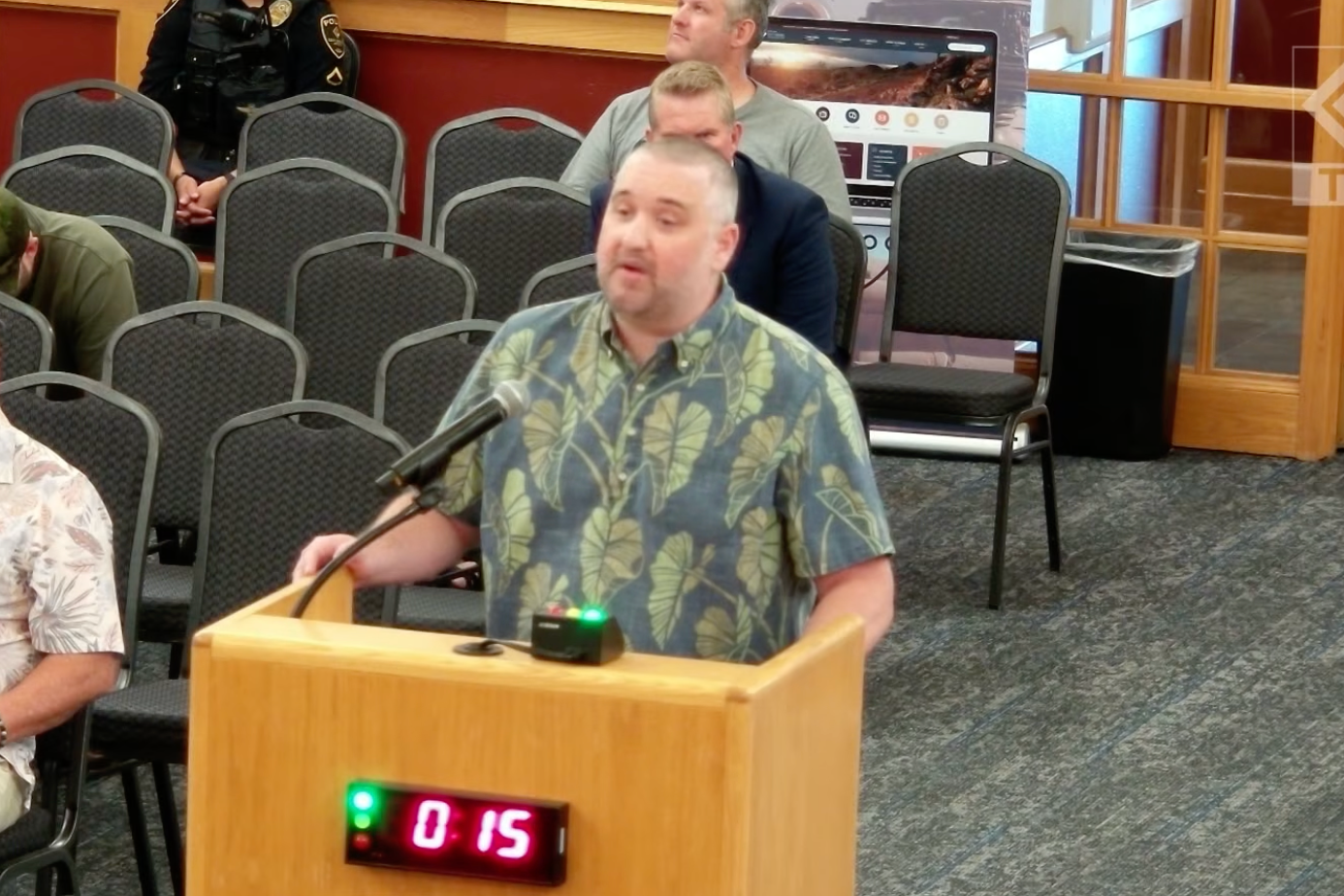
I wasn’t the only person who decided to speak. More than 10 other citizens went to the podium and spoke out against the cameras. “Is Irmo such a dangerous place that current law enforcement tools are not sufficient to keep the citizens safe without the use of this dangerous and controversial technology?” one guy said.

“I’m pretty enthralled by all the pushback you’re getting on the cameras you installed without asking a single member of the community if they wanted them installed,” said another resident, a man in a T-shirt and shorts. “If you give the government a tool, they will misuse it. Period. End of story. Get rid of them or we will get rid of them for you.”

The city council members looked its residents in the face. They maintained eye contact and appeared shocked when citizens talked about their concerns. For a bit, I thought it was possible that the town might not install these cameras. Then the police chief stood up and explained how he’d used Flock to capture pedophiles and I knew that was probably the end of it.

Police chief Bobby Dale has long been an advocate for the expansion of Flock in town. He told local outlet News19 that 33 cameras will allow him to see all the entrances and exits. “That would ultimately cover pretty much every nook and cranny, every entry point into the town,” he said. “That's what we want. As the chief of police, I've got to make sure our town is safe. I'm learning that with these cameras, with these license plate readers, we're solving crimes and solving them quicker.”

During the city council meeting, Dale explained that Flock cameras had been instrumental in a To Catch a Predator style sting operation Irmo PD conducted. “During an internet crimes against children operation hosted by a department, 15 adults traveled to our community believing they were coming to meet children for sexual activity," Dale said. “Fourteen of those 15 suspects were not from our jurisdiction.”

“So you lured them here. Into our town. Genius,” the T-shirt and shorts guy shouted from the back of the room. This was the guy who’d said the community would remove the Flock cameras if the city didn’t. The mayor had police escort him from the meeting. He left without a fight and Dale finished his speech praising Flock.

After a brief question and answer period with the police chief, the mayor spoke. The city’s leaders had just returned from the Municipal Association of South Carolina annual meeting — a yearly conference of local officials in the state. Mayor Bill Danielson opened his portion of the Flock discussion by talking about how he’d recently commiserated with other mayors at the conference about how mean people were on Facebook.

“I came back with a renewed vigor to be the mayor of this town,” he said. “And knowing that I’m not the only one being abused on Facebook, social media, by some people in this room. It’s going to take a whole lot more than that to sway any position I may or may not have on behalf of these citizens.”

The other thing the mayor learned is that everyone loves Flock. “There was not a mayor at that conference that I touched bases with […] that did not use Flock, did not use Motorola license plate readers,” he said, referring to another company that sells similar technology (we’ve reported ICE is offering demos to its agents to use a Motorola license plate reader app). “Every one of those mayors either wanted Flock, was trying to figure out how to budget for Flock, or had Flock and was figuring out how to increase their presence.”

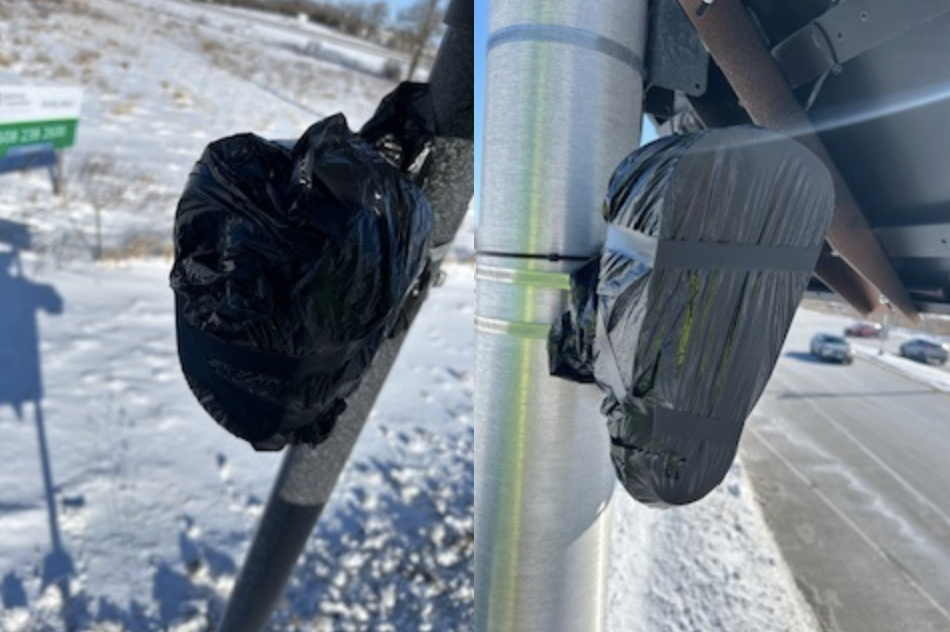
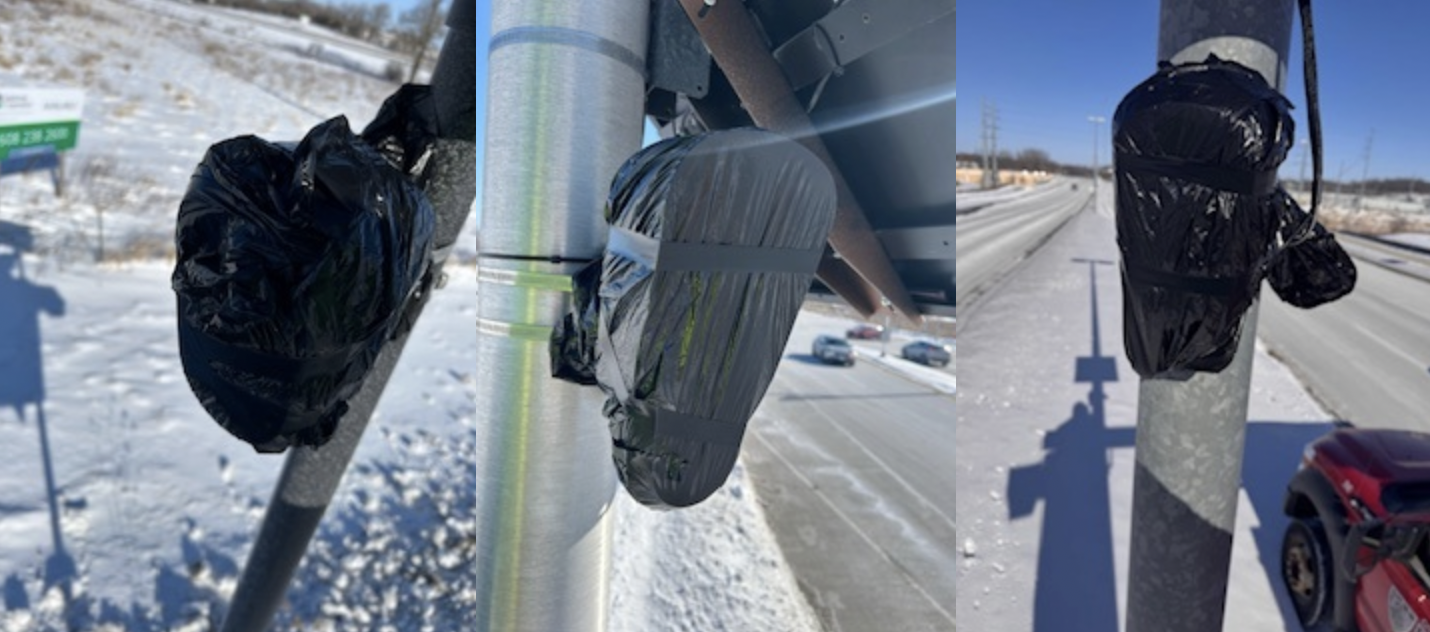
Flock is not, in fact, universally popular among state and local officials. The Los Angeles Police Department just announced it wouldn’t renew its contact with the company after an internal audit found it led to 161 false accusations of car theft and “eroded public trust.” Bandera, Texas, voted to remove its cameras after months of outrage from its citizens. Dayton, Ohio wants their cameras gone but isn’t sure how to cancel the contract so it's covering the cameras with black trash bags. Flock seems unable to remotely disable its own cameras so cities that no longer want them have to find their own solutions.

Cops also often misuse Flock. There are dozens of cases around the country of cops using the system to stalk people. In nearby Greer, South Carolina, two police officers were just fired by the town after they were discovered using Flock to track people around town

Mayor Danielson said he’d met a leader from Greer at the conference. “I even spoke to a councilmember from Greer, the dreaded Greer […] whose two cops abused it,” Danielson said. “And I told him point blank, if that happened in the town of Irmo they would not only be fired they would never be a cop again and face charges.”

My city council voted 4 to 1 to increase the presence of Flock in this small town of 12,000 people. Police chief Dale will soon have more cameras than officers. And, if they can get money from the state, they may also purchase a drone from Flock to use as part of the company’s “drones as first responder” program

People weren’t happy. The mood in the room was sour. I’ve attached my entire speech to this story so you can see what I planned to say.

My Flock speech for the city council

Hello.

My name is Matthew Gault and I’m here today to talk about Flock cameras.

I’m a resident of Irmo and I am also an investigative journalist. I work at a publication called 404 Media that focuses on technology.

Over the past few years, my colleagues at 404 Media have written a number of stories about Flock cameras and, before you vote to install 22 more of them in our small town, I want to share the results of some of those investigations with you.

Mr. Ward, I understand you’re concerned about cyber security around the data these cameras collect.

Last month, 404 Media found Flock had accidentally exposed some of the searches performed by law enforcement in its automatic license plate readers. The searches were cached in search engine results. This meant that anyone was able to see what police were looking for. 404 Media conducted some of its own searches and found that Flock had exposed people’s license plate numbers and various search terms like “investigation” and “GTA,” which is short for Grand Theft Auto.

In December of last year, 404 Media found a different and more severe security issue in Flock’s systems. The company had left 60 of its AI-enabled Condor cameras exposed on the open internet.

That meant that anyone could watch them, download 30 days worth of video archives, change settings, see log files, and run diagnostics. My colleagues were able to access Flock’s cameras simply by typing a website into a browser. They did not need a username or a password. There was no great trick to it. Once inside the system they could see playgrounds, parking lots, and people doing their shopping.

These are just two of the security issues we know about. 

It’s also worth telling the council how, exactly, Flock’s systems work.

Many of Flock’s license plate reading cameras are connected to local, state, and national networks. When an Irmo police officer runs a search for a specific license place, they may not just be searching the cameras in their jurisdiction. The search can run through the national network of Flock cameras, if configured to do so. This works two ways. Meaning law enforcement officers at a state and federal level searching Flock cameras may have access to Irmo’s data too.

In fact, because many of these cameras are networked and interconnected, I have access to some of the current records about how Irmo, PD is using them.

I know that Irmo, PD has conducted at least 7,576 searches of Flock’s networks since 2023. If you were curious, most of the searches are conducted around 5 PM. Most of the searches happen on Monday. I know that, for some reason, Irmo PD ran 489 searches on December 21, 2025. 

I know that on June 30 at 4:36 PM, the Irmo PD ran a search of the Flock system related to a stalking case.

Two days before, on June 28 at 6:45 PM, the police searched Flock in relation to a case of property damage.

On May 22, just before noon, police searched Flock in relation to a financial crime, something that was marked as “embezzlement or fraud” in the system. For this search in particular, Irmo PD accessed cameras outside of its jurisdiction — it widened the search to footage recorded by cameras nation-wide.

Why do I know all this? How is this possible? Because some police departments in the Flock network conduct routine audits of Flock’s search logs. All three of the searches I just noted were in an audit conducted by the city of Twin Falls, Idaho, a city on the other side of the country. I found information about Irmo’s historical Flock use in audits conducted by police in Georgia, Connecticut, Pennsylvania, and California. 

Calling Flock’s cameras “license plate readers” is technically true, but can sell the system short. The basic model is recording the license plate of vehicles, automatically logging information about the make and model of the car as well as stickers and any other distinguishing features. Much of this information is recorded by an AI system. It makes mistakes.

This system has led to false arrests or traffic stops. Earlier this month, a journalist for a car magazine was pulled over by police in Minnesota. The cops said they’d been tracking him for days and that the car he was driving was stolen. The tip came from Flock’s systems, which had been alerted to the theft of a car in California. But the AI system had transcribed the license plate incorrectly.

In Colorado, a woman was accused of stealing packages off people’s porches.The police’s evidence that she’d committed the crime was footage pulled from Flock cameras. Bodycam footage published by 404 Media showed how confident officers were that they had their thief.

“I have you on camera doing this […] I get that this is a shock to you, but I am telling you, this is a lock, 100 percent no doubt she did this,” an officer in Colorado said.

The woman had not committed the crime. She had ample evidence she had not committed the crime, but the police in Colorado insisted that Flock cameras do not lie and do not make mistakes. But they had. Her own dashcam exonerated her and police dropped the charges.

Last week, the Los Angeles Police Department announced it would not renew its contract with Flock. In a two month period, LAPD pulled over 161 innocent people acting on tips from Flock cameras.

“Subsequent investigations determined the vehicles were not stolen,” LAPD said in an investigation into its Flock cameras. “In addition to creating an inconvenience for vehicle owners, these inaccuracies can affect individual liberties, erode public trust, and potentially create substantial legal and financial liability concerns.”

These stories are just a small selection of the issues with Flock and I hope the council will consider them before its vote today.

  • ✇404 Media
  • Flock ‘Objects to Our Removing Their Equipment’: Emails Reveal Why a Town Put Bags Over Its Flock Cameras
    🎉YOU'RE INVITED! 404 Media is turning three, and we're throwing TWO separate events in NYC to celebrate: A live taping of the podcast with a special night of talks on Sept. 3, and an open-bar bash on Sept. 4. Subscribers at the Supporter level get free and discounted access to both events. Not a 404 Media Supporter yet? Sign up, and get all the party details here.For weeks, Verona, Wisconsin tried to get Flock to remove the three automated license plate cameras that its city council had voted
     

Flock ‘Objects to Our Removing Their Equipment’: Emails Reveal Why a Town Put Bags Over Its Flock Cameras

22 juillet 2026 à 10:03
🎉
YOU'RE INVITED! 404 Media is turning three, and we're throwing TWO separate events in NYC to celebrate: A live taping of the podcast with a special night of talks on Sept. 3, and an open-bar bash on Sept. 4. Subscribers at the Supporter level get free and discounted access to both events. Not a 404 Media Supporter yet? Sign up, and get all the party details here.
Flock ‘Objects to Our Removing Their Equipment’: Emails Reveal Why a Town Put Bags Over Its Flock Cameras

For weeks, Verona, Wisconsin tried to get Flock to remove the three automated license plate cameras that its city council had voted to stop using. Flock told city employees not to remove the cameras, and a Flock employee told city officials that they were unsure whether the cameras could be remotely disabled, which led the town to decide to put black plastic trash bags over them until Flock eventually removed the cameras itself, according to emails obtained using a public records request by 404 Media.

The emails give insight into the process cities face while deFlocking themselves after voting not to renew a contract with the AI surveillance company. As we’ve previously reported, multiple cities around the country have decided to put black trash bags over their Flock cameras while they wait for them to be removed; this is in part because, until the cameras are physically removed by Flock, cities are unsure whether they have the legal right to remove the cameras themselves and are not sure whether they can disable their recording operations. The emails show Verona city officials telling each other that they had made multiple requests to Flock to have the cameras removed, and show a work order from Flock in which the cameras were set to have maintenance performed on them rather than being removed. 

Flock ‘Objects to Our Removing Their Equipment’: Emails Reveal Why a Town Put Bags Over Its Flock Cameras

In February, Verona mayor Luke Diaz told the Wisconsin Examiner that Flock didn’t remove the cameras even after several requests: “They weren’t removing them,” he said. “We kind of looked at the contract, talked it over amongst staff, and the thing we felt most comfortable with was just covering them so they could stop spying on people … I’m 100% certain that they were still working,” even after the contract ended, he said. The emails obtained by 404 Media give more insight into what was happening behind the scenes, and why it took so long to get Flock to remove the cameras.

A Flock spokesperson told 404 Media that the discrepancy occurred because Verona voted to not renew its contract rather than outright canceling it mid-term. It is clear from emails obtained by 404 Media, however, that Verona city officials wanted the cameras to come down as quickly as possible.

❌