❌

Vue normale

Ukraine’s former defense minister, dismissed suddenly, has announced Army of Robots. He says target is $10,000 per unit and need is tens of thousands
1 octobre 2026 à 19:38

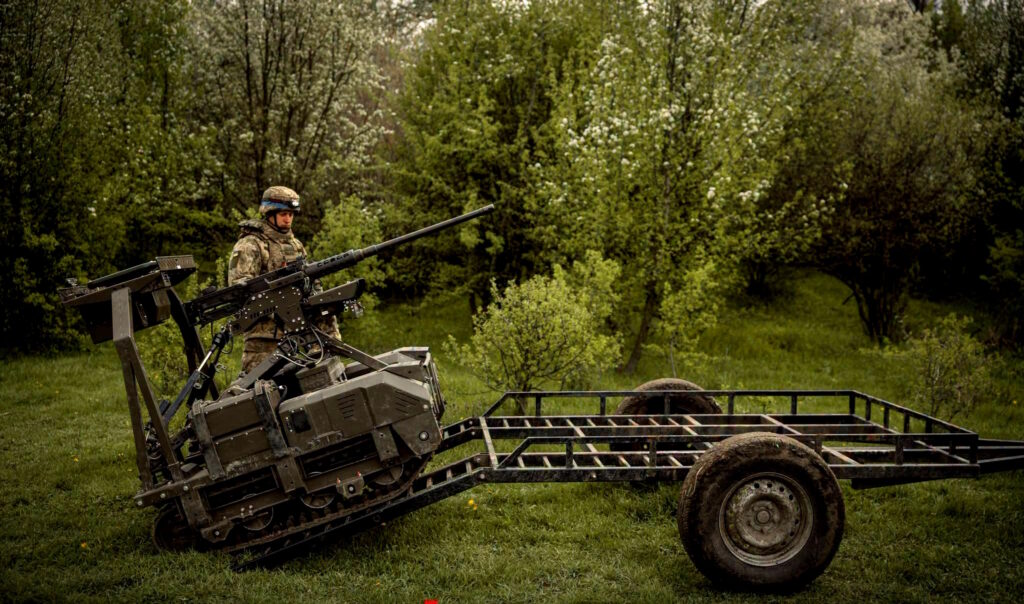
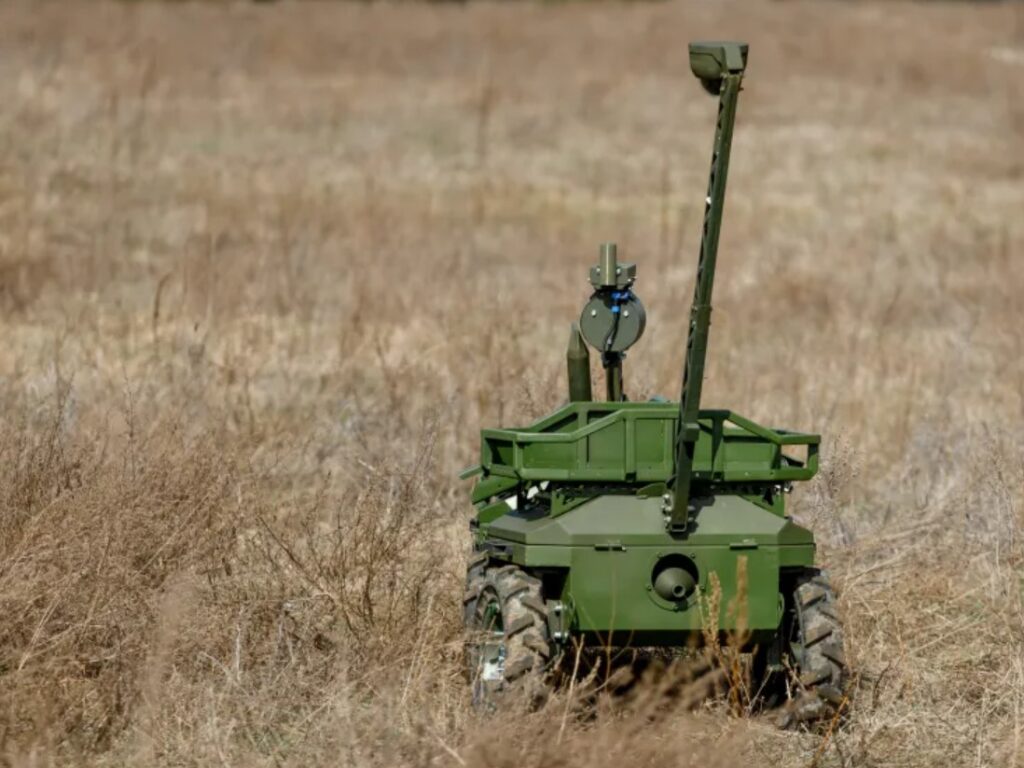
An armed ground robot. Photo: 93rd Brigade

The robots Ukraine wants to throw into its deadliest fights should cost as little as $10,000 each, Mykhailo Fedorov says. The former defense minister has set out the first stage of his Army of Robots: cheap, simple humanoid-like machines that would take over an infantry's most dangerous jobs, with tens of thousands needed, he said on Telegram, citing his own interview with Forbes.

On 26 September, Fedorov, who continues to work on military tech reforms despite his sudden and unexpected dismissal, announced the creation of the Army of Robots.

Humanoid robots would carry ammunition and pull out the wounded, lay and clear minefields, scout, hold positions, and strike, taking the roles that today cost soldiers their lives.

Potential need amounts to thousands

"Our main goal is to save lives. A human should not take risks where a machine can do the job," Fedorov says.

At the first stage, it will not be a classic humanoid but a simpler humanoid-like robot that can be produced quickly and scaled up, he adds.

Such a machine should perform some of an infantryman's tasks directly on the battlefield.

Today, such platforms cost $40–70 thousand on average. For mass use in war, Ukraine needs something much cheaper: the target is $10–20 thousand per unit, he believes.

"The potential need is tens of thousands of such machines," Fedorov continues.

Next come prototypes

The former defense minister adds that he and his team are already working with teams that have ready-made MVPs and are designing solutions.

"Next come prototypes, simulations, model training, and finding the right combination of hardware and software," he explains.

The Army of Robots is not a single product but an ecosystem that will unite companies, startups, engineers, R&D, and capital around the robotization of the front.

"Our task is to get from prototype to mass product as quickly as possible," he adds.
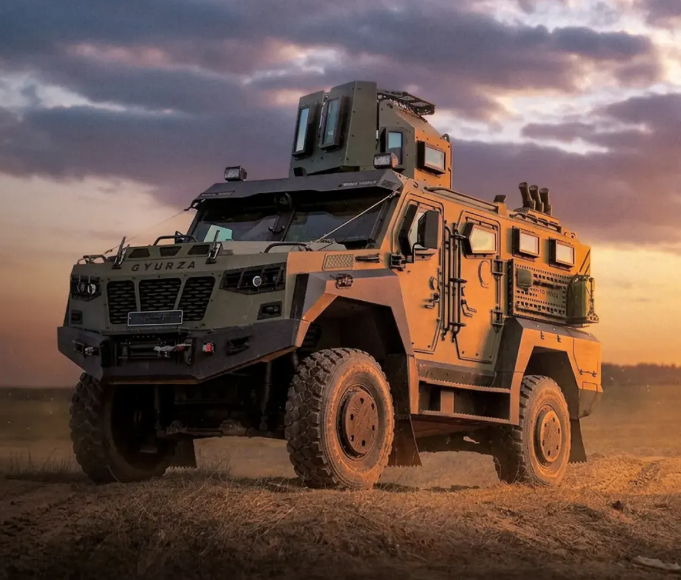
Robots won’t replace armored vehicles, says Ukrainian company that builds both. It reveals one job they can’t do

30 septembre 2026 à 17:48

Ukraine's Gyurza-2 armored vehicle. Source: The Ukrainian Defense Ministry

Robots will not replace armored vehicles on the battlefield, says a company that builds both. Ground robots are a new tool that lets Ukraine distribute risk more smartly, but they cannot do everything a crewed armored vehicle can, above all pulling wounded soldiers out under fire, says Ukr Armo Tech's chief executive Hennadii Khirhii, in an interview with RBC-Ukraine.

Ukraine has a serious shortage of armored vehicles, from evacuation carriers to tracked fighting vehicles, with the focus shifting to hulls that offer heavy mine protection and built-in electronic warfare. For medical-evacuation armor alone, Khirhii says, the deficit is often put at 80 percent.

Robots can ease some of that, hauling ammunition and supplies to the front without risking a crew, but they are a complement, not a substitute, a view frontline commanders also confirm.

Robots share the load, not replace it

Where a robot can do the job, Khirhii says, there is no sense sending in heavy armor and the people inside it to face danger. For carrying ammunition or food, unmanned ground vehicles are useful. But evacuating the wounded is different: that usually needs, at least for the second leg, a protected medical vehicle in which care can begin on the move, with room for transfusions and resuscitation that a robot's capsule cannot provide.

"A UGV doesn't cancel the armored vehicle, just as the drone didn't cancel artillery," he says.

The limits show at evacuation

Ukraine has leaned hard into robotic logistics and casualty evacuation, running more than 100,000 such missions this year to keep medics and crews off exposed roads, but the robots themselves now draw Russian drone and artillery fire, and they cannot replace medical personnel.

One commander has called ground robots too slow for evacuation and easy targets, arguing brigades still need staffed evacuation teams and light-armored vehicles.

Commanders want both

The lesson from the front is not robots instead of armor, but robots alongside it. What matters, Khirhii says, is a smart combination of machines for each mission, with people's safety and the task's practicality first. The front today needs both armored vehicles and ground robots, he continues, and it needs a great amount of both.

Ukraine’s new ground robot switches from land to water in seconds. It just ran its first supply mission, 40 kilometers to positions others can’t reach

30 septembre 2026 à 10:55

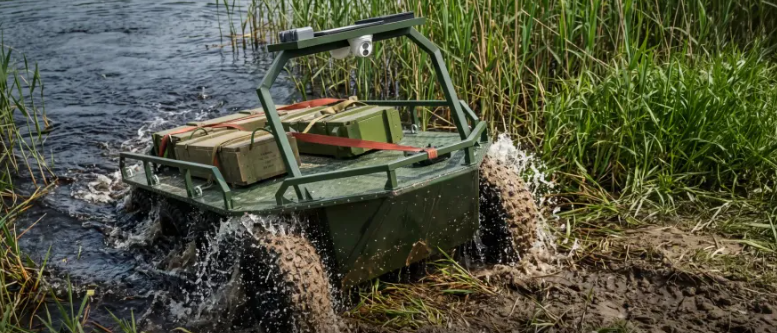
Ukraine's new amphibious ground drone. Source: Ukraine's Defense Ministry

A Ukrainian ground robot drove toward the front, reached the water in its path, and kept going, swimming across with ammunition and food aboard and no soldier at risk. It ran the first logistics mission with an amphibious ground robot, covering more than 40 kilometers over land and water to resupply positions, the Defense Ministry said.

Water is one of the front's quiet chokepoints: rivers, canals, and marshes that stop ground robots and force risky detours, and that air resupply cannot always solve. The amphibious robot drives like a normal ground vehicle, then switches to swimming in seconds, letting one machine cross terrain that halts the rest.

It is the latest of Ukraine's battlefield-robot firsts, which this year have included air-dropping robots behind Russian lines.

Water stops the others

The robot was developed through Brave1, Ukraine's state-backed defense-innovation cluster, which links developers with the military and government.

The one such robot gains additional capabilities to carry out missions across different terrains.

A first-ever logistics mission on an amphibious UGV: the robot covered 40 kilometers across land and water.

Operators of the "Alter Ego" unit (93rd Brigade) deployed the robotic system across mixed terrain. Facing water obstacles, the UGV seamlessly switched to swimming mode to… pic.twitter.com/rH8waq04a4

— BRAVE1 (@BRAVE1ua) September 29, 2026

For this operation, the system was refined over several months in close cooperation with the military, taking into account real tasks, operational experience, and the specifics of frontline terrain. The Brave1 defense innovation cluster provided grant support for the system, helping bring the solution to practical use.

The ministry says it is "expanding the capabilities of robotic systems" so soldiers have more tools for the fight.

Robots with grenade launchers

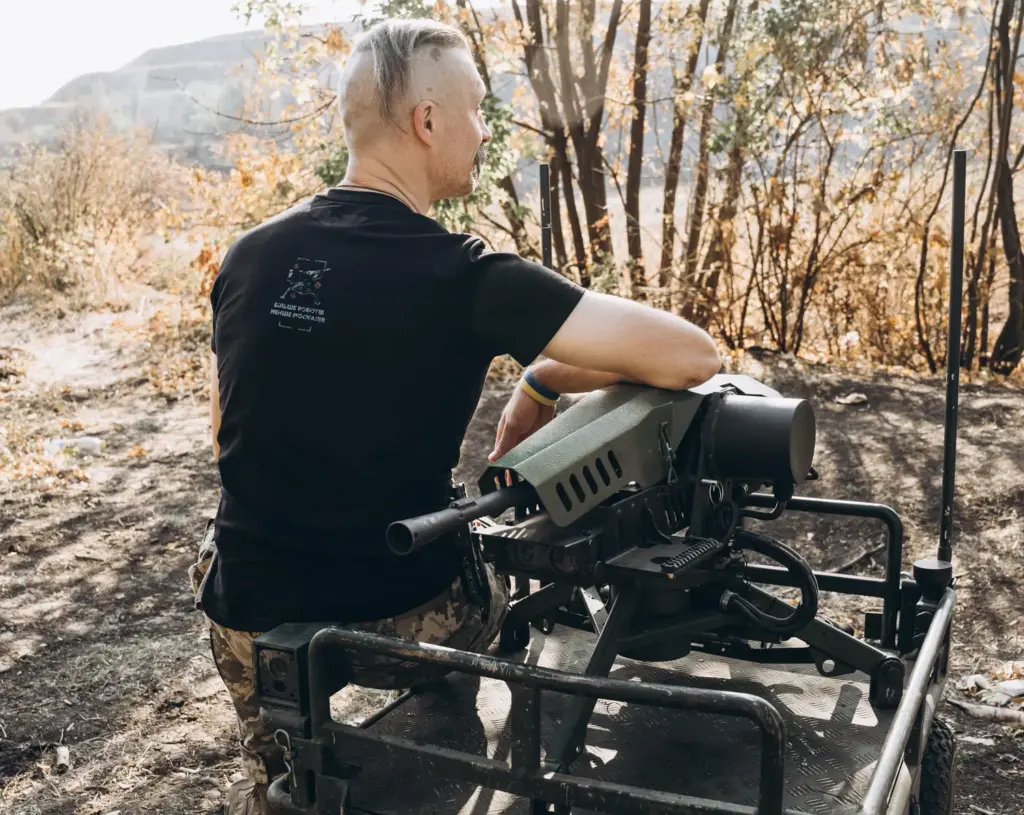
Earlier, Ukraine employed a new tactic during its major Operation Vivaldi in Donetsk Oblast. During the 3rd Army Corps' offensive, fighters from the world's first experimental unit of unmanned ground-strike vehicles, "NC13", upgraded their kamikaze ground drones with grenade launchers.

During the operation, UGVs equipped with two Bullspike grenade launchers attacked Russian positions, then detonated directly inside their shelters. The occupiers believed they were being attacked by an entire assault group. In reality, they were being torn apart by robots from the 3rd Assault Corps.

New Vivaldi tactic: Ukraine’s ground robots, each carrying two Bullspike grenade launchers, attack Russian positions and then detonate inside their shelters

27 septembre 2026 à 10:43

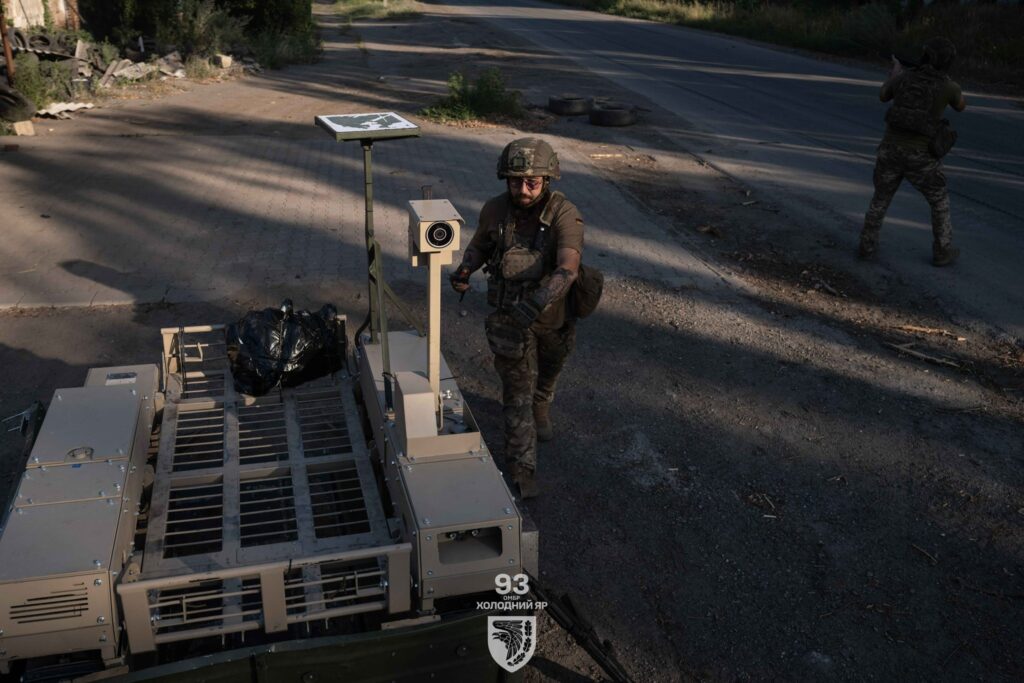
The image shows a Ukrainian soldier standing next to an unmanned ground robotic vehicle. Source: The General Staff

Ukraine has employed a new tactic during its major Operation Vivaldi in Donetsk Oblast. During the 3rd Army Corps' offensive, fighters from the world's first experimental unit of unmanned ground-strike vehicles, "NC13", have upgraded their kamikaze ground drones with grenade launchers.

Vivaldi is the counteroffensive the corps is running near Lyman in northern Donetsk Oblast. Over its first two "seasons," the 3rd Army Corps and attached units have retaken more than 125 square kilometers, half of it de-occupied outright, and inflicted more than 3,000 casualties on Russian forces.

Through this offensive operation, the 3rd Army Corps, commanded by Brigadier General Andrii Biletsky, disrupted Russian forces' plans to encircle the fortress-belt cities in Donetsk Oblast from the north and south. Among them are Sloviansk, Kramatorsk, Druzhkivka, and Kostiantynivka. These cities have helped hold back Russian forces since 2014.

From intensive training to the world-first operations

The NC13 unit has been through Bakhmut, Avdiivka, and other of the toughest sections of the front.

Among its achievements: the world's first robotic assault carried out without infantry involvement, resulting in the capture of two Russian soldiers, a sabotage operation in the enemy's rear — blowing up a crossing and disrupting an offensive — using UGVs alone, and Ukraine's first fully robotic defense of a position for 45 days without involving infantry.

"No one in the history of warfare has used this kind of tactic before," the soldiers commented on the offensive.

The defenders say that a lack of combat experience is no barrier to joining the unit. Every recruit goes through an intensive training course led by experienced instructors.

Grenade launchers were developed based on the Soviet RPG-22

During the operation, UGVs equipped with two Bullspike grenade launchers attacked Russian positions, then detonated directly inside their shelters. The occupiers believed they were being attacked by an entire assault group. In reality, they were being torn apart by robots from the 3rd Assault Corps.

Ukrainian troops armed ground robots with grenade launchers and sent them to storm Russian positions during Operation Vivaldi near Lyman

The robots fired into Russian shelters at close range, then detonated inside them
🎥 3rd Army Corps, NC13 Unit pic.twitter.com/rjekIYxPbA

— Euromaidan Press (@EuromaidanPress) September 27, 2026

"Yes, the UGVs carry out three tasks at once: they strike, they exert psychological pressure, and they clear the position. And most importantly, this happens without risk to our infantry," the force says.

The Bullspike grenade launchers were developed based on the Soviet RPG-22 anti-tank grenade launcher, which was previously manufactured under license by a Bulgarian defense company.

According to data from the manufacturer's website, the Bullspike RPG has a maximum aimed firing range of 350 meters, a direct-fire range of 150 meters, and armor penetration of 400 mm, Militarnyi reports.

The total weight of the launch unit, together with the 72.5 mm PG-22 grenade, is 3.4 kg. The length of the launcher is 780 mm.

The manufacturer states that the Bullspike-AT round is designed to destroy tanks, self-propelled artillery, and other armored vehicles, as well as to target enemy personnel located in bunkers, field fortifications, and urban-type brick fortifications.

The robots were controlled by operators from a safe shelter dozens of kilometers from the line of contact.

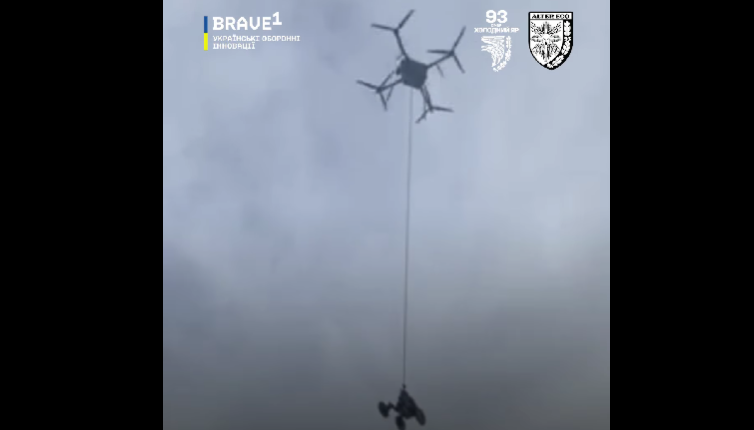
Earlier, for the first time in the world's history, the 3rd Army Corps dropped ground robots behind Russian lines from the air. The soldiers behind the mission say their heavy drones delivered kamikaze unmanned ground vehicles more than 10 kilometers into the Russian rear during the "second season" of Operation Vivaldi, letting Ukrainian troops flank them and clear another 40 square kilometers.

War’s next tech leap: Former Ukraine’s defense minister behind “Army of Drones” is now creating new “Army of Robots”

26 septembre 2026 à 08:33

The person who built Ukraine's "Army of Drones" is now building an "Army of Robots". Myhailo Fedorov, the former defense minister, has launched a private-sector push to robotize the war, wanting machines to take the deadliest jobs, evacuating the wounded, laying and clearing mines, and fighting, so soldiers come home, he wrote, announcing the effort at the IT Arena conference in Lviv.

The pitch rests on a track record. Fedorov's Army of Drones, launched in 2022, helped make drones the weapon behind more than 95 percent of Ukraine's battlefield hits. Over 700 makers now building them, and he is betting robotization is the next such leap.

Army of Robots is meant to be an ecosystem, not a company: investing in defense-tech firms, standing up R&D, testing with troops, and scaling fast, whatever works. Fedorov is running it from outside government, having left the defense ministry in July and started building a defense-tech company backed by Palantir chief Alex Karp.

Robots take the deadliest jobs

Fedorov's vision is a battlefield where machines go first. A sensor spots a threat, then a robot enters the danger zone, he says. Humanoid robots would carry ammunition and pull out the wounded, lay and clear minefields, scout, hold positions, and strike, taking the roles that today cost soldiers their lives. For now, it is a vision more than a fielded capability: Fedorov is describing where he wants the battlefield to go, not a robot force already in the fight.

The Army of Drones sets the model

The aim, Fedorov says, is to gather the best engineers, combat experience, and capital and point them at one goal: making robots fight instead of people. The obstacle is Russia, which he said has learned to quickly copy and scale military technology, so Ukraine must keep inventing the next cycle before the enemy does.

"Russia will stop only when we can break its backbone," he says, arguing that it will take Western capital, world-class engineers, and private initiative.

  • ✇Euromaidan Press
  • Ukrainian soldiers solve drone-delivery problem US military has chased for three decades
    Ukrainian soldiers have built a drone that carries a combat ground robot into battle and drops it where needed, a trick the US has pursued but never fielded. The Alter Ego battalion of the 93rd Mechanized Brigade has paired a bomber drone with a purpose-built robot, the Desantnyk, and took it from idea to combat in 10 days, the Brave1 defense cluster said. The system answers a problem that has long hobbled ground robots: getting them to the fight over mined, cratered terrain they cannot
     

Ukrainian soldiers solve drone-delivery problem US military has chased for three decades

25 septembre 2026 à 16:29

The purpose-built robot Desantnyk. Source: Brave1

Ukrainian soldiers have built a drone that carries a combat ground robot into battle and drops it where needed, a trick the US has pursued but never fielded. The Alter Ego battalion of the 93rd Mechanized Brigade has paired a bomber drone with a purpose-built robot, the Desantnyk, and took it from idea to combat in 10 days, the Brave1 defense cluster said.

The system answers a problem that has long hobbled ground robots: getting them to the fight over mined, cratered terrain they cannot cross on their own.

A drone carries the robot dozens of kilometers behind the lines and drops it precisely, in a pairing engineers call a "marsupial", one carrier delivering another. The US worked on such systems for more than 30 years, Brave1 said.

And it is not alone: the 3rd Army Corps has been air-dropping robots behind Russian lines in its Vivaldi offensive.

A drone carries the robot in

The Desantnyk is a compact wheeled platform. Alter Ego built a way to release it accurately from a heavy bomber drone, dropping it well beyond the range a ground robot could reach on its own. It lands deep in the enemy rear and drives on to its target. The point is to spare the robot the most dangerous, exposed leg of the journey.

Confirmed kills follow fast

According to Brave1, just 10 days passed from the idea to its first combat use, and the Desantnyk has already carried out confirmed strikes: the unit used it to destroy Russian shelters and troops. Only a handful of Ukrainian units have mastered the tactic so far.

Brave1 moves it to production

The defense cluster, a state platform for scaling battlefield inventions, said it took notice of the Desantnyk and helped the battalion find a manufacturer to move it from prototypes to serial production and out to other units.

  • ✇Euromaidan Press
  • Ukraine put robots where its soldiers used to die clearing mines—and lost none
    Ukraine's Third Army Corps says it became the first military unit in the world to use ground robots for mine clearance inside a live offensive, sending the machines ahead of its infantry into the deadliest sectors to keep soldiers out of the line of fire, Censor.NET reported. The corps built the capability from nothing during its Operation Vivaldi counteroffensive in Donetsk Oblast. Keeping soldiers alive has become the organizing principle of how Ukraine fights, and handing the jobs mo
     

Ukraine put robots where its soldiers used to die clearing mines—and lost none

24 septembre 2026 à 14:04

One of Ukraine's fiber optic-controlled UGVs.

Ukraine's Third Army Corps says it became the first military unit in the world to use ground robots for mine clearance inside a live offensive, sending the machines ahead of its infantry into the deadliest sectors to keep soldiers out of the line of fire, Censor.NET reported. The corps built the capability from nothing during its Operation Vivaldi counteroffensive in Donetsk Oblast.

Keeping soldiers alive has become the organizing principle of how Ukraine fights, and handing the jobs most likely to kill them to ground robots is how an army that refuses to treat its people as expendable defends the line.

Robots cleared 30 km of routes in two nights

On the Shandryholove axis, the robots cleared 30 kilometers of routes in two nights—work that two companies of sappers would have needed a full week to finish. The corps reported no losses among its sappers there. Announcing the operation's second phase, corps commander Brigadier General Andrii Biletskyi said protecting personnel drives how his troops plan and fight:

"People often ask, but what about our losses? My answer: we minimize them by every possible means. In assault operations, drones and ground robots always move ahead of the infantry," he said.

Robots clear most of the mines and mine Russian routes in return

The corps says it built the system from scratch and scaled it from a single squad up to the entire corps, arguing that manual clearing would be impossible across open terrain swept by fire. Ground robots now lift roughly 60% of the anti-personnel mines in its area of responsibility. They also work in reverse, remotely mining Russian advance routes—one crew can lay up to 200 meters a day, cutting off enemy reserves. The same machines carry frontline logistics, evacuating the wounded and hauling in provisions and equipment.

Operation Vivaldi continues in Donetsk Oblast, where the corps recently air-dropped robots behind Russian lines. Its advance has disrupted Russia's plan to encircle the fortified belt of Donetsk cities. In the second phase, the Third Army Corps liberated Shandryholove and Derylove and took full control of Drobysheve. Across the operation's first two phases, it has retaken 125 square kilometers.

  • ✇The Kyiv Independent
  • Ukraine approves new 'Murakha' ground robot for combat use
    The Defense Ministry has approved the Ukrainian-made ground-based robotics complex "Murakha" ("Ant") for combat operations, the ministry announced on June 28. Since 2024, Ukraine has been scaling up robotics development in hopes that mass production of unmanned ground vehicles (UGVs) will "minimize human involvement on the battlefield." The Murakha is a tracked robotic platform designed to support front-line units working under challenging conditions, such as under enemy artillery and in heavily
     

Ukraine approves new 'Murakha' ground robot for combat use

29 juin 2025 à 00:58
Ukraine approves new 'Murakha' ground robot for combat use

The Defense Ministry has approved the Ukrainian-made ground-based robotics complex "Murakha" ("Ant") for combat operations, the ministry announced on June 28.

Since 2024, Ukraine has been scaling up robotics development in hopes that mass production of unmanned ground vehicles (UGVs) will "minimize human involvement on the battlefield."

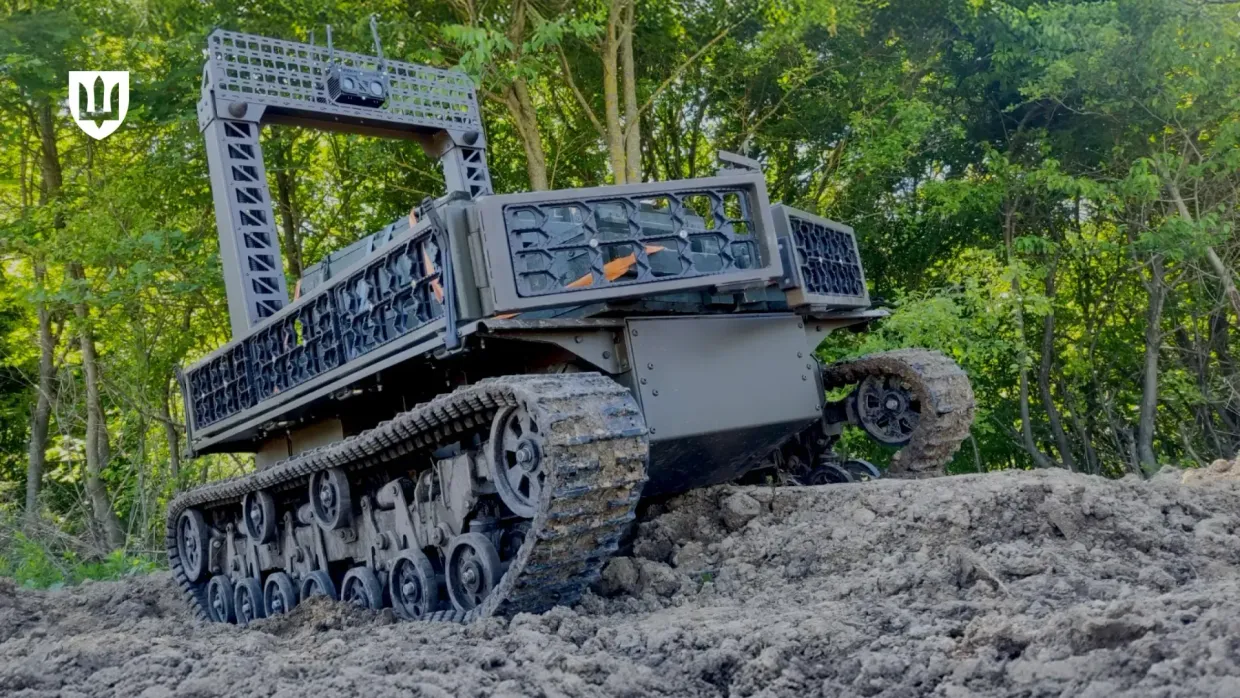
The Murakha is a tracked robotic platform designed to support front-line units working under challenging conditions, such as under enemy artillery and in heavily mined terrain, the Defense Ministry said.

Its larger size makes it one of Ukraine's leading UGVs in terms of load capacity. The Murakha can reportedly carry over half a ton of weight across dozens of kilometers. It can also cross difficult terrain and shallow water.

According to the Defense Ministry, the Murakha's multiple control channels allow it to function successfully even in areas of the battlefield where Russian electronic warfare (EW) systems are operating.

Mobile robots are capable of performing several tasks on the battlefield, including offensive and defensive activities, evacuation of the wounded, logistical support for units, and mining and demining.

In April, the Defense Ministry unveiled the D-21-12R UGV, a ground-based robot equipped with a machine gun.

Ukrainian drones strike missile, drone arsenal in Russia’s Bryansk Oblast
Ukraine’s military intelligence (HUR) struck on June 28 the 1060th Material-Technical Support Center in the city of Bryansk, Ukraine’s General Staff said. The facilities store a Russian missile and drone arsenal, Ukrainska Pravda reported, citing a source in HUR.
Ukraine approves new 'Murakha' ground robot for combat useThe Kyiv IndependentDmytro Basmat
Ukraine approves new 'Murakha' ground robot for combat use
❌