Attacker in FlyDubai Flight Meant to Crash Into Israeli Airport, Emiratis Say

© Ammar Awad/Reuters


© Ammar Awad/Reuters


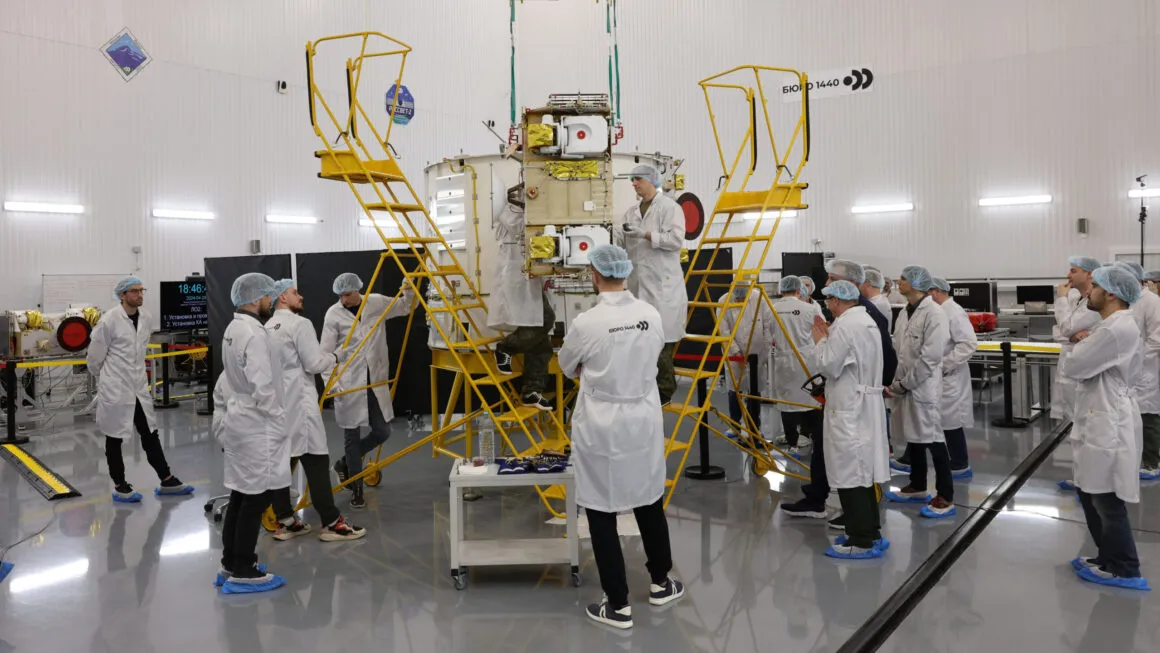
Ukraine is working on a satellite system of its own, something similar to SpaceX's Starlink, Ukrainian President Volodymyr Zelenskyy said on 4 October, Interfax-Ukraine reported. He argued Kyiv should be free to turn Starlink on Russian military targets, warning that China and other states will share comparable satellite technology with Moscow within months. Ukraine's battlefield communications still ride on a network owned by Elon Musk, who has clashed with Kyiv and once limited its wartime use.
Low-orbit satellite internet has turned into a frontline utility that a single company or government can switch on or off, and both armies are now racing to own that link instead of renting it. Control of the network decides whose drones can see the battlefield and fly through the jamming to strike it—leverage Kyiv has gone without while its connection rode on hardware it does not run.
Zelenskyy said there was groundwork in place and that Ukraine was working on a system similar to Starlink. He called it fair for Ukraine to aim Starlink at military sites inside Russia. The timing is the reason, he said: some states will share the technology with Russia late this year or early next, and the Chinese are among them. Moscow is already fielding its own Starlink-style constellation, Rassvet, though for now it reaches Ukraine only in brief passes.
Ukraine's troops and drones lean heavily on Starlink, a network Kyiv neither owns nor controls. Musk has used that control against Kyiv before: in 2022 SpaceX refused a Ukrainian request to extend Starlink over occupied Crimea for a drone strike on Russia's warships, and it has since restricted the network's use for drone operations.
Zelenskyy has asked US President Donald Trump several times to sanction the Russian and Chinese companies building Russia's Rassvet network, most recently at the UN General Assembly in New York, he said in a recent Financial Times interview.
Denys Shtilerman, co-founder and chief designer at Ukrainian defense company Fire Point, told the Financial Times in May that the firm had launched two satellites this year and planned dozens more in 2027, aiming to reduce reliance on the US government and Western tech companies. To strike deep inside Russia and gather intelligence, he has said, Ukraine needs its own constellation covering all of Russia.


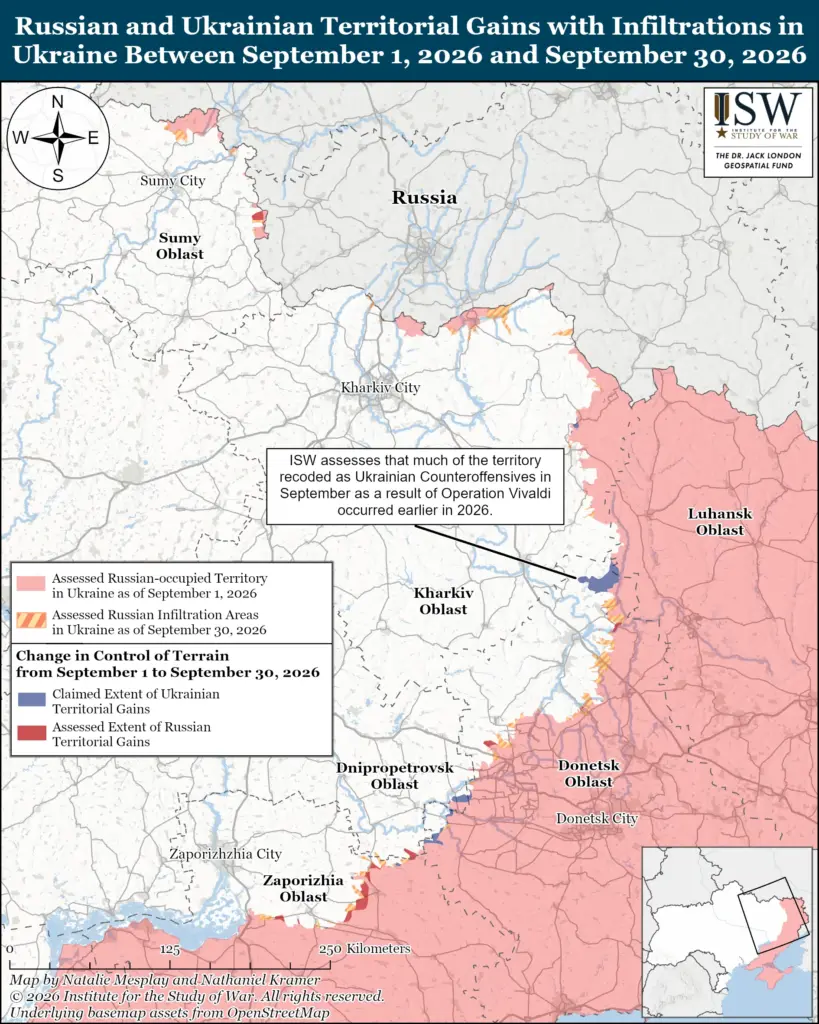
Russia lost almost 300 km² of Ukrainian territory on net between March and September 2026, and it likely gained no ground in September despite its heaviest casualties of the year, the Institute for the Study of War (ISW) assessed. Ukraine's Operation Vivaldi accounts for much of the swing. The think tank notes that Ukraine's secrecy around such counterattacks makes exact monthly tallies hard.
Russia has pressed attacks along the entire front through 2026, accepting mass casualties for marginal ground, and its battlefield year has already been called its worst since 2023. Its losses have been outpacing its recruitment for months.
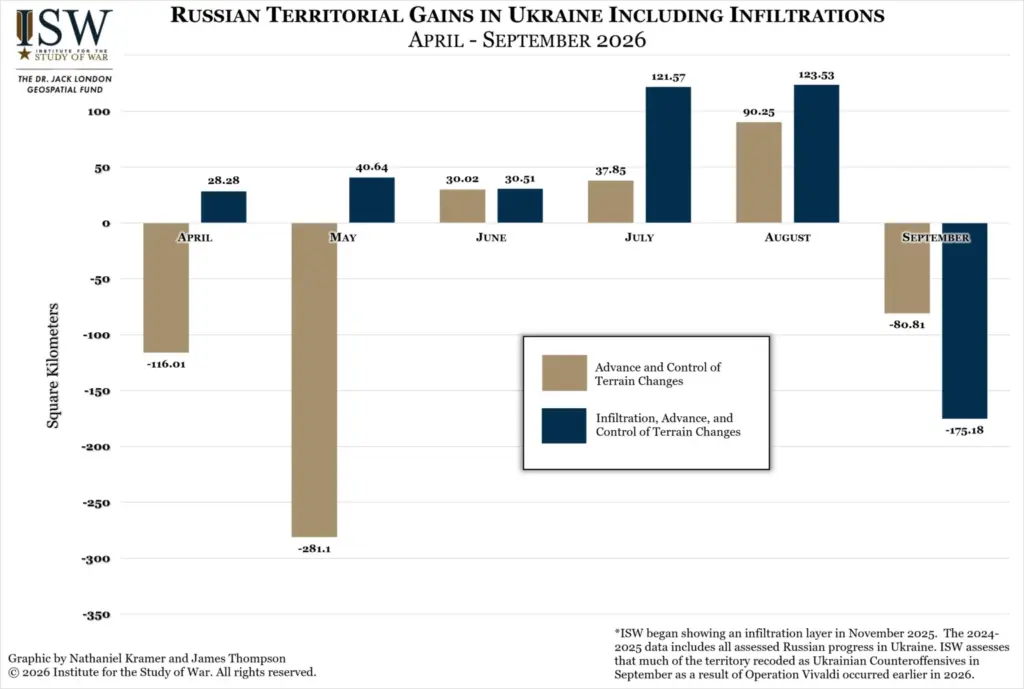
Russian forces seized 175.54 km² in September but lost 256.35 km², a net loss of 80.81 km², or minus 2.69 km² a day, ISW calculated. The balance stayed negative when Russian infiltrations into areas Russia does not control are counted: Russia seized or infiltrated 143.2 km² but lost 318.38 km², a net loss of 175.18 km².

The September figures include at least 147 km² near Lyman that Ukraine liberated over earlier months, but that ISW recorded only once details of Operation Vivaldi emerged in September. The operation already disrupted Russia's plan to encircle the Fortress Belt cities from the Lyman and Dobropillia directions.
Russia's rate of seizing territory dropped sharply in March 2026 and has stayed low, or even negative, since, ISW found. After controlling for the gains Ukraine made during Vivaldi, Russia lost control of 293.59 km² net across the front since March. Counting infiltrations, it gained a presence in only 174.44 km² over the same period.
ISW's monthly chart shows net Russian losses of 116.01 km² in April and 281.1 km² in May, modest gains in June, July, and August, and a net loss again in September. Oleksandr Syrskyi, then Ukraine's commander-in-chief, reported in June that Ukrainian forces had recaptured 100 km² in May.

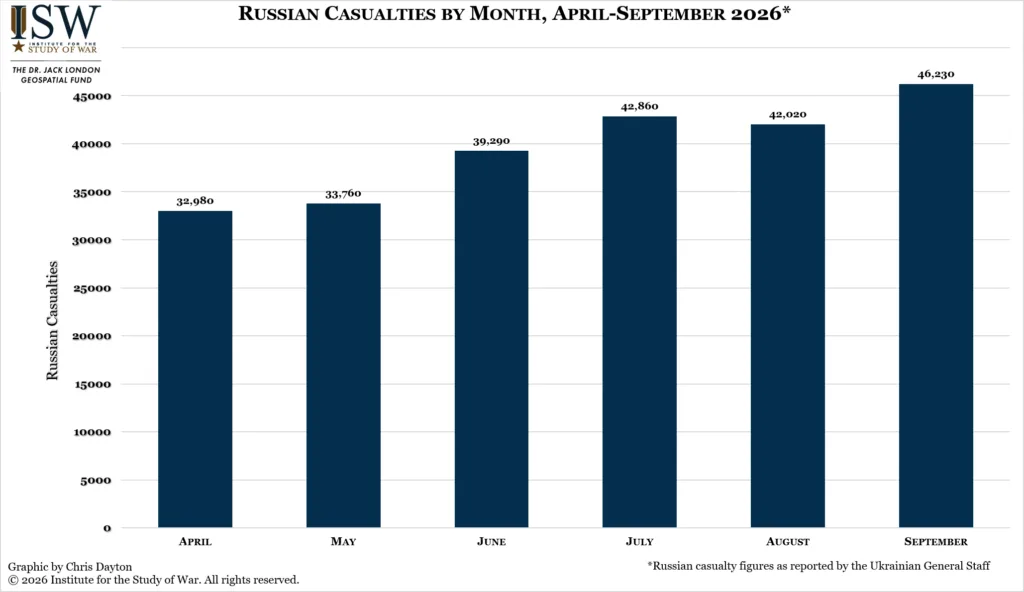
Russian forces suffered 46,230 casualties in September, Ukraine's General Staff reported. It is the third straight month above 40,000 and the highest monthly toll of 2026, by Kyiv's count. Monthly Russian casualties have climbed from 32,980 in April to 42,860 in July and 42,020 in August, ISW's chart shows.
Russia keeps suffering heavy personnel losses while making extremely limited or even net-negative territorial gains, ISW said, and its current force generation system still recruits fewer soldiers than it needs to replace them.
Ukraine's effective operational security around Vivaldi, likely to continue in future counterattacks, will make meaningful month-to-month assessments of Russian gains and losses hard, the think tank added.


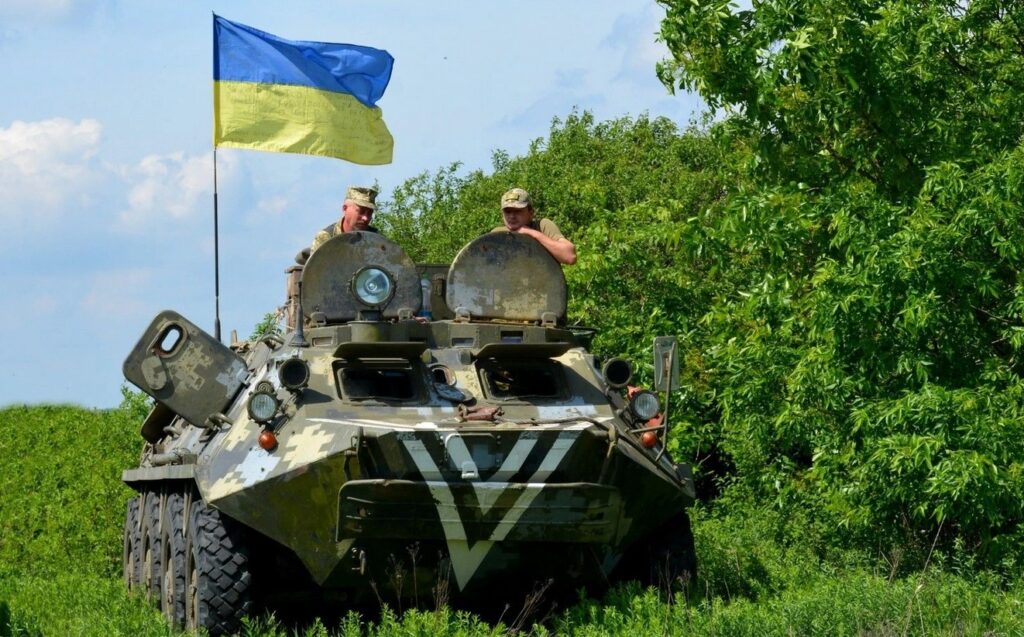
Bulgaria gave Ukraine 110 BTR-60 armored personnel carriers. They are 1960s vehicles, too thinly armored to carry infantry anywhere near a front line patrolled by explosive drones. So Ukraine's 3rd Army Corps found another use for them during Operation Vivaldi, its counteroffensive north of Lyman. Fill one with anti-tank mines, rig it for remote control, drive it at a Russian bunker, and set it off.
Packing potentially dozens of TM-62 anti-tank mines, the speedy BTR-60s become what's called vehicle-borne improvised explosive devices, or VBIEDs. Once a favorite weapon of insurgents battling US forces in Iraq and Afghanistan, VBIEDs have found a new niche in Russia's wider war on Ukraine as unmanned demolition systems.
"To break through the enemy's defenses, the 3rd Army Corps employed its own invention, Soviet BTR-60s converted into robotic kamikaze complexes," the corps stated. "They were used to demolish the enemy's strongest fortifications." If an enemy strongpoint is too heavily protected to bomb from the air but exposed to attack from the ground, send in a VBIED.
Білецький: «Противник був введений в оману і проспав справжній удар»
— Третій армійський корпус (@ab3army) September 28, 2026
Третій армійський корпус звільнив Нове, Рідкодуб і Катеринівку та відновив контроль над Карпівкою і Новомихайлівкою. Втрати противника — 2000 живою силою, понад 250 росіян захоплені в полон. Так закінчився… pic.twitter.com/GSV4LFG3gj
The Russians were the first to deploy vehicular IEDs in the current war, but the Ukrainians may have mastered the tactic. It's one thing to rig an explosives-filled MT-LB tractor or T-55 tank to roll straight forward without direct human control, as the Russians once did. It's another to rig an explosive BTR-60 to maneuver before going off, as the 3rd Army Corps' VBIEDs clearly did.
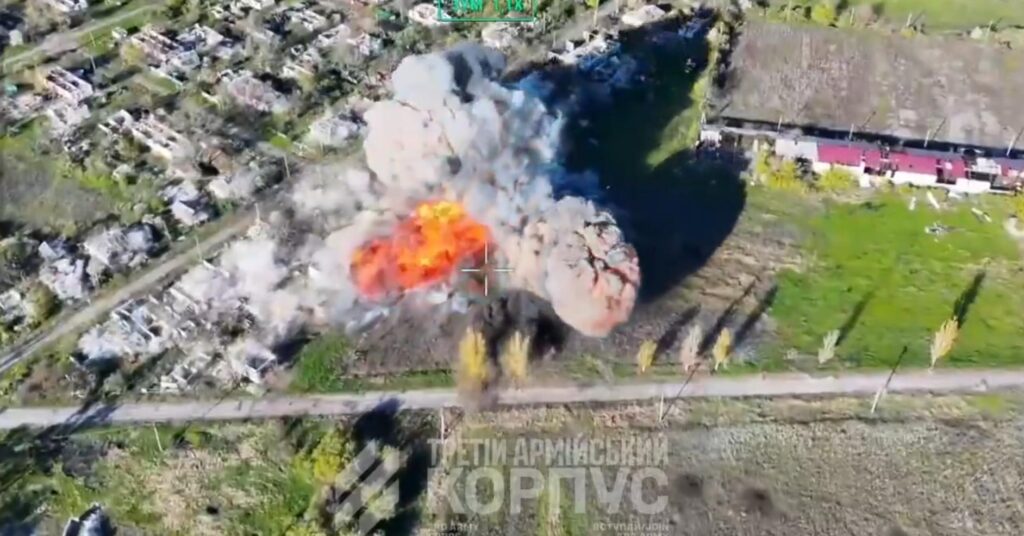
On 28 September, announcing the close of Vivaldi's third phase, the 3rd Army Corps released drone footage depicting one of the explosive BTRs blasting a Russian strongpoint north of the town of Lyman. The sheer scale of the explosion is testimony to the VBIED's destructive potential. And the trail the BTR leaves in the grass in the heavily edited video indicates the Ukrainians can steer their VBIEDs around obstacles and guide them to precision strikes.

A slow wheeled vehicle crossing open ground toward a fortified position should not survive the trip. In most sectors it would not. What makes the tactic work north of Lyman is a condition the 3rd Army Corps built into Vivaldi before its assault groups moved: Ukrainian air defense and electronic warfare threw a protective dome over the battle area, blinding Russian drones so they could not read the operation's design or strike what was moving through it.

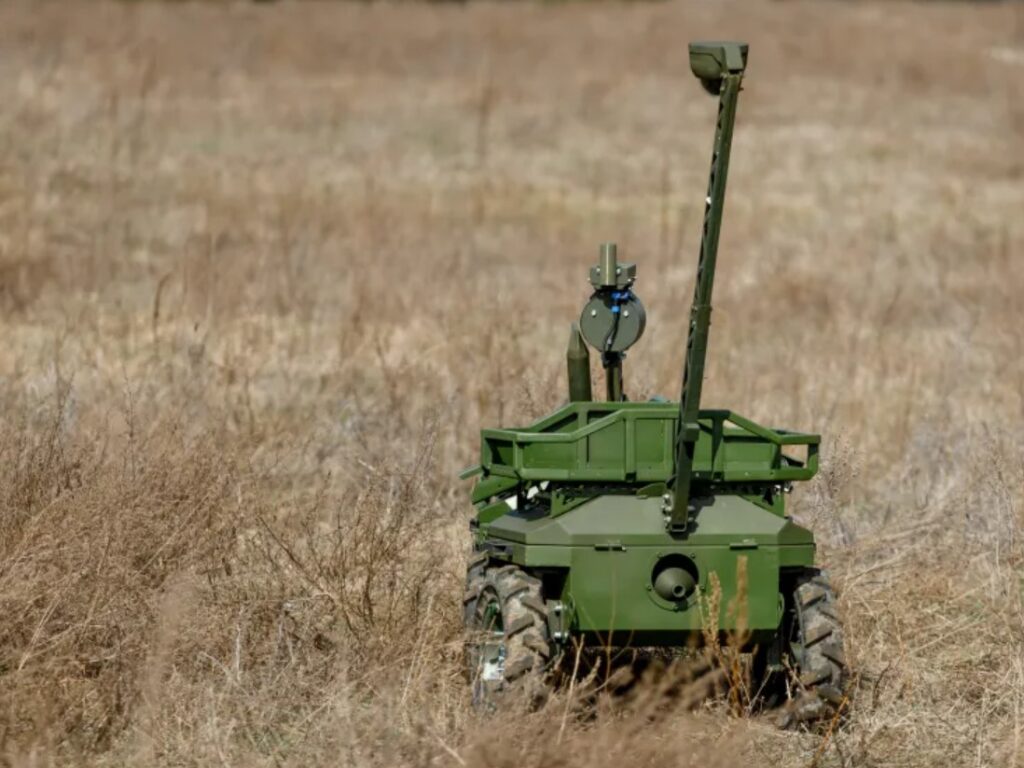
Robots have played critical roles in each phase of Vivaldi. Surveillance drones have watched from overhead. One-way attack drones have pummeled Russian positions and supply lines. Heavy bomber drones have not only dropped bombs, they've also airlifted explosive unmanned ground vehicles into position so the UGVs can roll right through the front doors of Russian bunkers.
The self-exploding BTR-60s are too big to airlift, but that's the point. A small UGV might carry a few tens of kilograms of explosives. A remote-controlled BTR-60 can easily haul hundreds of kilograms.
It's not impossible to take out a VBIED before it strikes, of course. Mines, anti-tank missiles, and even concentrated gunfire can stop a vehicular bomb in its tracks. But losing one of the aged BTR-60s costs Ukraine very little. The vehicles are too thinly armored for use as front-line infantry transports anyway. You might as well convert them into bombs.
That is the whole case for the tactic. A manned fighter jet lobbing a precision glide bomb is the preferred approach to bunker-busting. But it costs tens of thousands of dollars an hour to keep a jet in the air, and a single glide bomb can cost tens of thousands or even hundreds of thousands of dollars. It's unclear how much it costs to convert a BTR into a VBIED. It could be just a few thousand.
And it reduces Russian fortifications without risking any Ukrainian lives. That's the philosophy underpinning all of the 3rd Army Corps' robot-first tactics. "This is exactly the direction of the corps' development set by Brig. Gen. Andrii Biletskyi," the corps stated, "to reduce the number of fighters in the most dangerous areas and replace them with robots."
Vivaldi began in mid-April under an information blackout that held for five months. The corps says it has regained control of 176 sq km across three of a planned four phases, around half of that de-occupied outright, and taken more than 250 Russian prisoners. Those figures are the corps' own and have not been independently verified.
Sometimes the robots doing that work are 60-year-old APCs modified for an explosive one-way mission.


Ukraine likely neutralized Russia's drone defenses north of Lyman before sending armor into the third phase of its Vivaldi counteroffensive, the Institute for the Study of War (ISW) assessed. An intermediate-range strike campaign against Russian logistics and electronic warfare paved the way, the think tank said.
Drones have made this front so deadly that armor now mostly fights from kilometers back. That is what makes Ukraine's armored push onto fortified positions near Lyman stand out. Russia has already shifted its effort south toward Sloviansk after losing the Lyman pincer.
To break the strongest Russian fortifications, Ukraine used old Soviet BTR-60 armored personnel carriers rebuilt as remote-controlled explosive vehicles, the 3rd Army Corps says.
Ukrainian forces drove them up to heavy Russian fortifications without coming under Russian drone strikes, ISW noted. The think tank said this indicates Ukraine neutralized or otherwise negated Russia's drone defenses in the area.
Ukraine achieved tactical drone overmatch through extensive shaping operations and an intermediate-range strike campaign, ISW said. Those strikes targeted the Russian drones and electronic warfare (EW) systems that would otherwise have hunted the advancing vehicles.
The 3rd Army Corps reported on 17 September that strikes on Russian logistics in occupied Luhansk Oblast had degraded Russian fuel supplies to the front, ISW wrote that day. The corps said that strained Russia's ability to use drones and EW against Ukrainian drones. EW systems consume a lot of power, and Russian troops run them on diesel generators, ISW explained.
Deputy corps commander Maksym Zhorin credited strict information silence and a "Protective Drone" system of EW assets, according to the same assessment. He said it helped neutralize around 20,000 Russian drones. The corps had earlier described mapping Russian command posts and striking them to sow panic.
The corps liberated Nove, Ridkodub, and Katerynivka and restored control over Karpivka and Novomykhailivka, it said on 28 September. The phase added 51 km², bringing the total since the offensive began to 176 km².
Russian losses reached 2,000 personnel, and more than 250 Russians were taken prisoner, according to the corps. Corps commander Andrii Biletskyi said a feint from Shandryholove toward Zelena Dolyna drew Russian reserves away from the real target, Nove.
The first two phases had reportedly cleared more than 125 km² north of Lyman.


Ukraine's 3rd Army Corps has defeated Russia at the key settlement of Nove in Donetsk Oblast by pointing it the wrong way. Russia has poured its reserves into counterattacks on a feint axis and "slept through" the real strike, which took the important hub in the village and closed the decisive third season of the Vivaldi offensive, commander Andrii Biletskyi said.
Vivaldi is Ukraine's counteroffensive aimed at disrupting Russian forces' plans to encircle the fortress-belt cities in Donetsk Oblast from the north and south. Among them are Sloviansk, Kramatorsk, Druzhkivka, and Kostiantynivka. These cities have helped hold back Russian forces since 2014.
Over its first two "seasons," the 3rd Army Corps and attached units have retaken more than 125 square kilometers, half of it de-occupied outright, and inflicted more than 3,000 casualties on Russian forces.
The operation in Nove was its "third season," Biletskyi said, the turning point of the whole operation. The corps liberated Nove, Ridkodub, and Katerynivka and restored control of Karpivka and Novomykhailivka, adding 51 square kilometers, bringing the total liberated since the offensive began to 176. Ukrainian forces have taken 250 Russians captive.
The victory, by Biletskyi's account, was won by deception.
"The enemy was convinced the main direction of the strike was Shandryholove–Zelena Dolyna," he revealed, and it burned its reserves counterattacking there.
He added that the Russians slept through the real strike, which was concentrated on taking Nove. The village was the prize, a key Russian hub on the bridgehead, ringed by heights that command the surrounding ground.
"Who controls the heights holds the initiative," Biletskyi said.
By spending its reserves on the wrong axis, he suggested, Russia had little left to hold Nove when the real assault arrived.
Old APCs crack the defense
To break the strongest fortifications, the corps said, it used a homemade weapon: Soviet BTR-60 armored carriers converted into remote-controlled kamikaze robots, driven into Russia's toughest positions and detonated.
In 2024, the Ukrainian forces received another local upgrade of the post-Soviet BTR-60 wheeled armored personnel carrier. This time it was fitted with the BM-7 "Parus" turret, known from the BTR-4 "Bucephalus" The main armament consisted of a 30 mm ZTM-1 automatic cannon paired with a 7.62 mm KT-7.62 universal machine gun.
Additional armament might include a set of four anti-tank guided missile launchers mounted on the sides, or two launchers and a 30 mm KBA-117 automatic grenade launcher. As a result, this upgraded BTR-60 saw a significant improvement in firepower, although the vehicle still has very weak armor and less-than-optimal access to the troop compartment.
It was the latest of the corps' robotic improvisations in Vivaldi, which have included air-dropped ground drones and Bullspike grenade-launcher-armed UGVs. They are Bulgarian hand-held, rocket-propelled anti-tank grenade launchers based on the Soviet RPG-22, which the Bulgarian defense industry previously produced under license.
The corps has leaned on such machines throughout the operation to keep its infantry out of the deadliest fights.
Whole units surrender
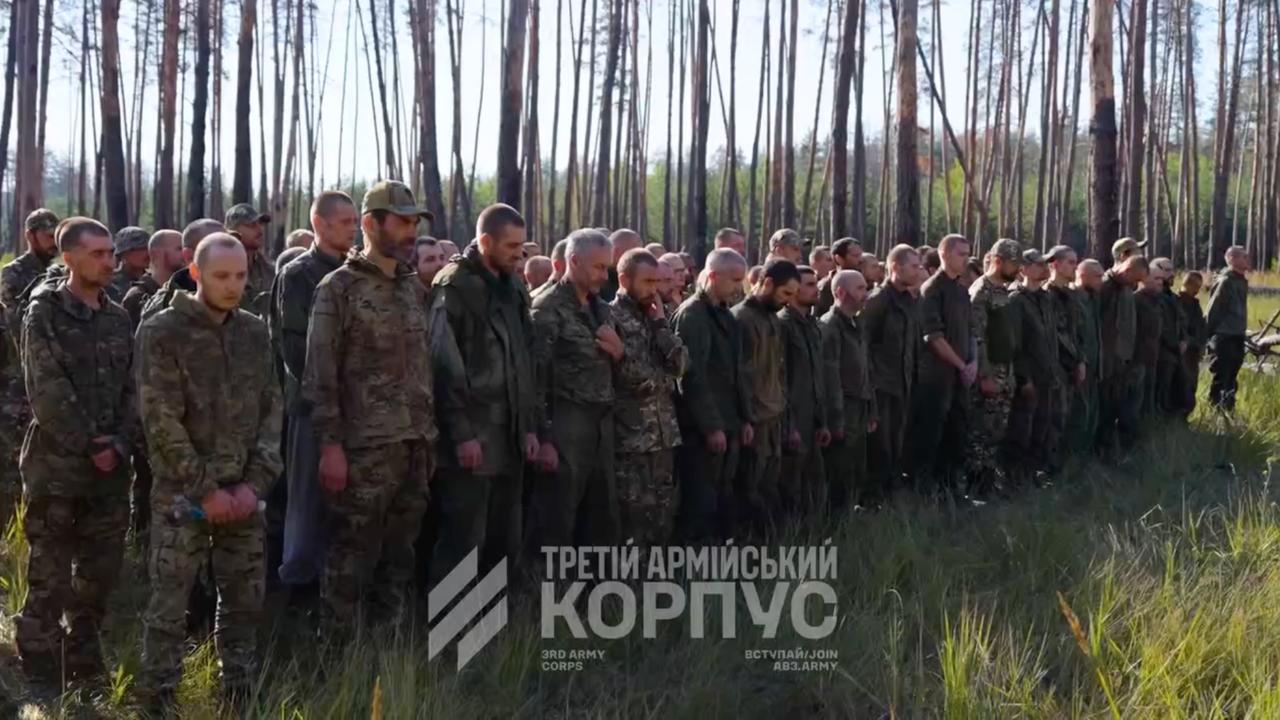
As the defense broke down, Russians gave up in groups, including officers, pilots, and artillery soldiers, the corps said. The 3rd Assault Brigade carried much of the fighting, while the 3rd Border Guard Detachment, named for the fallen Colonel Yevhen Pikus, retook Ridkodub and dug in on the new line, with the 10th Mobile Border Guard Detachment "DOZOR" taking an active part in the assault.


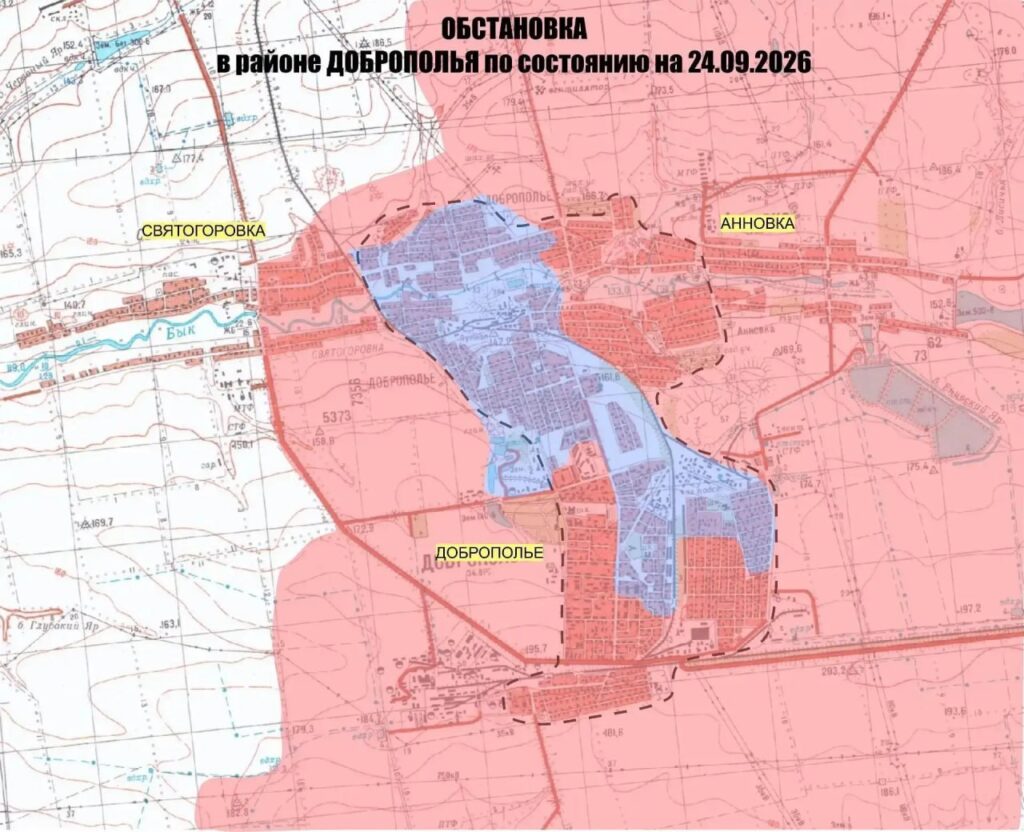
The Institute for the Study of War (ISW) published a map in its analytical report on 24 September that contrasts the claimed Russian encirclement with the location of Russian forces as assessed by the experts. Based on the evidence observed by ISW, the nearest area where Russian forces are present is 10.2 kilometers from the southeastern outskirts of Dobropillia.
Russia has been spreading disinformation about its successes around Dobropillia as part of what ISW calls a cognitive warfare effort to portray Ukrainian defenses as on the verge of collapse. Russia's Defense Ministry published a map claiming the city was surrounded. ISW's own map challenges it. The Ukrainian military says the city remains under its control.
Units of Russia's Center Grouping of Forces continue combat operations against encircled Ukrainian forces in the Dobropillia area of Donetsk Oblast while simultaneously advancing toward Oleksandrivka, the Russian Defense Ministry claimed. ISW analysts, meanwhile, said they have not observed evidence supporting Russia's claim that the city is encircled. They also noted that Ukrainian officials "directly refute" the claim.

ISW observed evidence that Russian infiltrators, small groups, were operating east and northeast of Dobropillia on 19 and 20 September. The institute did not assess that these infiltrators had consolidated their positions.
Ukrainian forces maintain positions south and northeast of Dobropillia, military observer Kostiantyn Mashovets said on 20 September, according to ISW.
Russian forces have not made major gains in the Dobropillia direction, the chief of staff of an artillery reconnaissance battalion said on 22 September, according to the institute. On the same day, a Russian milblogger described the "alleged Russian encirclement of Dobropillia" as potentially meaning not the direct presence of infantry, but only the establishment of fire control over Ukrainian logistics, including roads west of Dobropillia and toward Sviatohorivka, according to ISW.
ISW noted that Russia's pervasive military culture of lying—what Russian milbloggers themselves call "beautiful reports"—has degraded the Defense Ministry's own ability to understand the battlefield and enabled inflated claims like the Dobropillia encirclement.
In its statement, the Russian Defense Ministry itself described Dobropillia as a "strongly fortified settlement" whose seizure would threaten key Ukrainian supply lines running from Dnipropetrovsk Oblast toward the Fortress Belt—the Sloviansk-Kramatorsk-Druzhkivka urban agglomeration.
Russia has recently renewed its attempts to break through toward Dobropillia.
Third Army Corps Commander Andrii Biletskyi said that Russian forces sought to bypass the fortified cities through Dobropillia and link up with troops advancing from north of Lyman, rather than launch a direct assault. ISW noted on 16 September that the Vivaldi operation disrupted Russia's two-pronged plan. In its 24 September report, ISW said Russia's claims about Dobropillia were partly intended to divert attention from Ukraine's elimination of the Russian salient north of Lyman, which has likely forced Russia's command to rethink its wider encirclement plans.


Ukraine's Third Army Corps says it became the first military unit in the world to use ground robots for mine clearance inside a live offensive, sending the machines ahead of its infantry into the deadliest sectors to keep soldiers out of the line of fire, Censor.NET reported. The corps built the capability from nothing during its Operation Vivaldi counteroffensive in Donetsk Oblast.
Keeping soldiers alive has become the organizing principle of how Ukraine fights, and handing the jobs most likely to kill them to ground robots is how an army that refuses to treat its people as expendable defends the line.
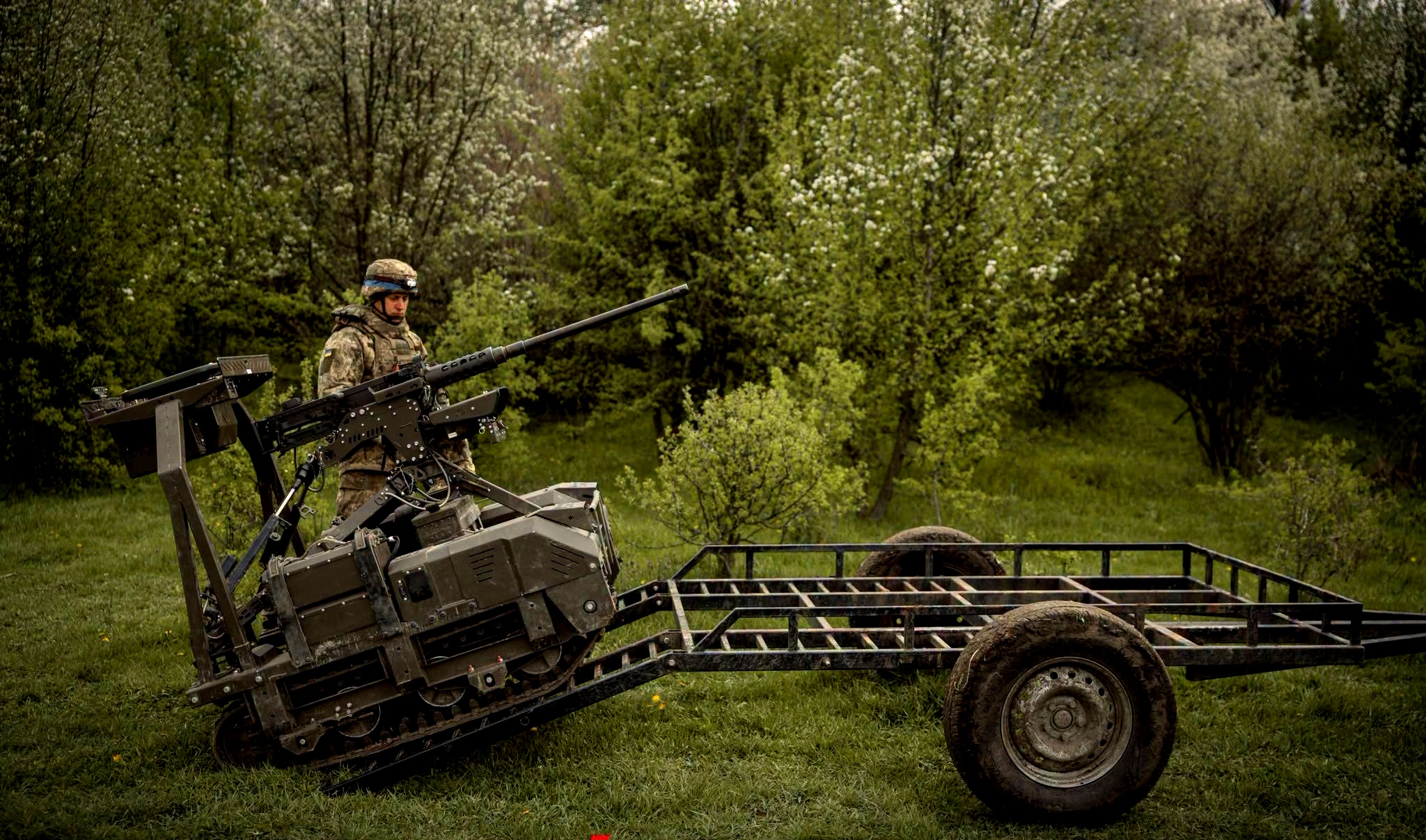
On the Shandryholove axis, the robots cleared 30 kilometers of routes in two nights—work that two companies of sappers would have needed a full week to finish. The corps reported no losses among its sappers there. Announcing the operation's second phase, corps commander Brigadier General Andrii Biletskyi said protecting personnel drives how his troops plan and fight:
"People often ask, but what about our losses? My answer: we minimize them by every possible means. In assault operations, drones and ground robots always move ahead of the infantry," he said.
The corps says it built the system from scratch and scaled it from a single squad up to the entire corps, arguing that manual clearing would be impossible across open terrain swept by fire. Ground robots now lift roughly 60% of the anti-personnel mines in its area of responsibility. They also work in reverse, remotely mining Russian advance routes—one crew can lay up to 200 meters a day, cutting off enemy reserves. The same machines carry frontline logistics, evacuating the wounded and hauling in provisions and equipment.
Operation Vivaldi continues in Donetsk Oblast, where the corps recently air-dropped robots behind Russian lines. Its advance has disrupted Russia's plan to encircle the fortified belt of Donetsk cities. In the second phase, the Third Army Corps liberated Shandryholove and Derylove and took full control of Drobysheve. Across the operation's first two phases, it has retaken 125 square kilometers.