❌

Vue lecture

Sharp drops for AI stocks overwhelm markets worldwide as oil prices jump

Datacenter and chip costs fueled sharp decrease in AI sector although non-AI stocks still had a strong showing

The latest shudder for stocks in the AI industry pulled markets lower worldwide on Thursday, while oil prices hit their highest levels since May on worries about the war with Iran.

The S&P 500 fell 1.2% for its worst day since July, while the Nasdaq composite tumbled 2.6%. The weakness for tech stocks was so overwhelming that it masked strength for the rest of the US market, in which the majority of stocks actually rose. The Dow Jones Industrial Average added 11 points, or less than 0.1%.

Continue reading...

© Photograph: Richard Drew/AP

© Photograph: Richard Drew/AP

© Photograph: Richard Drew/AP

  •  

How tech became the villain of the US midterms

Datacenters, AI and distaste for the billionaires developing it has soured Americans on big tech

The campaign ad begins with a clear, idyllic stream that suddenly turns sludge-brown as two concrete datacenters slam onto its banks. Another facility thuds down on a peaceful suburban park, and two more crush-green pastures as an ominous soundtrack to a disaster movie blares overtop.

“They’re coming for our rivers. Our neighborhoods. Our farmland,” a deep-voiced narrator says. “Because Brent Taylor wrote the law allowing datacenters to take over Tennessee.”

Continue reading...

© Illustration: Guardian Design / Getty Images

© Illustration: Guardian Design / Getty Images

© Illustration: Guardian Design / Getty Images

  •  

Americans, this is your chance to slap down the tech broligarchs

The midterms will be a referendum on the GOP’s alignment with tech overlords over the public they’re meant to serve

Welcome back to How We Win, a Guardian opinion series with leading thinkers, offering bold ideas for America’s political future. Last week, Robert Reich highlighted the link between corruption and affordability. Today’s edition was written by Guardian US columnist Rebecca Solnit. Sign up for future editions here.

“The world should accept some bad things happening,” Sam Altman, the head of OpenAI, said recently, “for the benefits of this technology and people having the agency.” Like so many things tech oligarchs say, it’s incoherent, since Altman would like to deny the world and the people in it the agency to decide whether or not we should accept his bad things. Surveys show that most Americans would like to pause AI; opposition to AI datacenters is a factor in many races in the midterm elections. People are outraged and anxious about what tech hath wrought, mad enough to fight back in what is coming to seem like a human v machine battle.

Continue reading...

© Photograph: Evelyn Hockstein/Reuters

© Photograph: Evelyn Hockstein/Reuters

© Photograph: Evelyn Hockstein/Reuters

  •  

From Iran to AI: the six key voter issues shaping the US midterm elections

Much of Donald Trump’s unpopularity in polls stems from dissatisfaction over the economy and war on Iran

***

Continue reading...

© Illustration: Guardian Design

© Illustration: Guardian Design

© Illustration: Guardian Design

  •  

US bans use of China’s DeepSeek AI tools by government agencies

Use of tools ‘may result in the transfer of sensitive data’ to China, defense department says

The US government on Monday ordered its agencies to stop using artificial intelligence (AI) tools from the Chinese startup DeepSeek, as the countries race for dominance in the fast-moving sector.

A notice from the Department of Homeland Security (DHS) announced the ban on products developed by DeepSeek – and tools created using DeepSeek by third parties – saying they must be removed from IT devices.

Continue reading...

© Photograph: Andy Wong/AP

© Photograph: Andy Wong/AP

© Photograph: Andy Wong/AP

  •  

I’m a CTO. AI still needs your human expertise | Madhu Shashanka

AI is increasingly getting good at doing some tasks, but it can never replace human workers’ judgment

Autonomous cars, which may be the safest we have built, keep getting easily avoidable parking tickets. While Waymos crash far less often than human drivers over tens of millions of miles, they’re still terrible at performing basic tasks – keeping out of disabled parking spots and tow-away zones, or steering clear of a church garage during Sunday service, according to the Wall Street Journal.

That is the state of AI today: impressively capable at something complex, yet embarrassingly clumsy at something easy. And it has implications for what work will remain human and what will be automated by AI.

Madhu Shashanka is co-founder, chief scientist and chief technology officer at Concentric AI, a data security software company

Continue reading...

© Illustration: Guardian Design/Westend61/Getty Images

© Illustration: Guardian Design/Westend61/Getty Images

© Illustration: Guardian Design/Westend61/Getty Images

  •  

Inside the long, bitter fight over one man’s quest to build the biggest AI datacenter in California

A modern-day prospector promised rural Imperial thousands of jobs and millions in tax revenue – but his plan has set off a firestorm of resistance

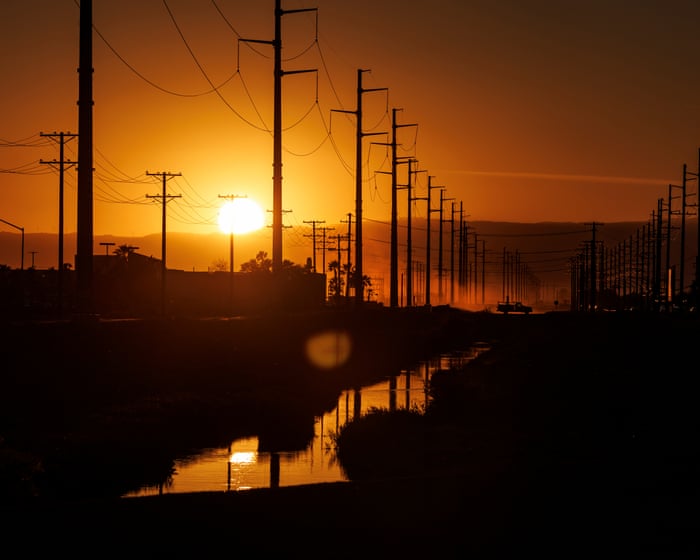
Sebastian Rucci zoomed in on a map in late 2024, looking closely at a large block of brown earth. The barren plot sandwiched between sprawling alfalfa fields and sleepy desert suburbs was exactly what he’d been searching for – the perfect place to realize his dream of building the largest artificial intelligence datacenter in California.

The dusty expanse wasn’t an obvious location. It was in the Sonoran desert, just north of the Mexican border, where temperatures regularly rose past 100F (37.8C). Water was scarce in the once-booming agricultural area, which gets its supply from the beleaguered Colorado River. And then, there was the city of Imperial – population 22,000 – to win over. As controversial datacenter projects have sprung up across the US, residents were naturally skeptical of a new, energy-guzzling neighbor.

Continue reading...

© Photograph: Gina Ferazzi/Los Angeles Times/Getty Images

© Photograph: Gina Ferazzi/Los Angeles Times/Getty Images

© Photograph: Gina Ferazzi/Los Angeles Times/Getty Images

  •  

Tech market sell-off deepens amid fears over US inflation and AI debt

Chip makers and tech investors such as Samsung and SoftBank plunge as potential interest rate hikes spook markets

An accelerating sell-off of AI-linked shares has hit global markets, as fears over rising inflation and future interest rate hikes spooked traders already wary of the heavily indebted sector.

South Korea’s benchmark Kospi 200 index, which is heavily skewed towards the companies that make memory chips, fell more than 8% overnight to a six-month closing low, triggering circuit breakers that brought trading to a halt at various points.

Continue reading...

© Photograph: Lee Jin-man/AP

© Photograph: Lee Jin-man/AP

© Photograph: Lee Jin-man/AP

  •  

The global economy is muddling through against the odds. But a storm is coming | Larry Elliott

Finance ministers gathering for the IMF annual meeting know the need for multilateral cooperation to deal with many crises. There is little chance of that

Not much has gone right for the global economy this year, and plenty has gone wrong. Two big regional wars are destabilising prices and supply chains everywhere. Businesses and consumers are feeling the effects of a serious energy shock. Rising inflation has made it a lot more expensive for governments to finance their debts. China and the US are at loggerheads over trade.

Yet, so far, the impact has been modest. It is something of a miracle that the finance ministers and central bank governors gathered for this year’s annual meeting of the International Monetary Fund (IMF) in Bangkok are not having to deal with a full-blown crisis. This is not like the autumn of 2008, when the meetings took place during the worst of the global banking meltdown.

Larry Elliott is a Guardian columnist

Continue reading...

© Illustration: Sébastien Thibault/The Guardian

© Illustration: Sébastien Thibault/The Guardian

© Illustration: Sébastien Thibault/The Guardian

  •  

AI overlords say they want to democratise their technology. Here’s how | Richard Wilson and Clara Long

A fight over a datacentre in Utah has been a testing ground for citizens’ assemblies, paving the way to oversight

What’s your “(p)doom” – the percentage chance that rogue AI will create an existential catastrophe? Judging by their recent warnings, it is rising among tech bosses.

On 25 September, OpenAI paused training of its latest frontier models as reports of AI agents going rogue mounted. A day later, Australia’s Senate asked the bosses of OpenAI and Anthropic to appear before an inquiry after rogue OpenAI agents broke into US government websites and an Australian health portal. Both declined.

Richard Wilson is the CEO of Iswe Foundation and Clara Long is the co-executive director of the Bloom Project

Continue reading...

© Photograph: Erik Isakson/Getty Images/Tetra images RF

© Photograph: Erik Isakson/Getty Images/Tetra images RF

© Photograph: Erik Isakson/Getty Images/Tetra images RF

  •  
❌