Vue normale

Fix for Ukraine’s interceptors is radar seeker head, and American firm is selling one for $4,000, says president’s tech adviser

28 août 2026 à 16:45

russia steers its long-range drones ground towers—kyiv says hit one occupied crimea · post russia’s new “geran-4 seeker” shahed variant uses machine-vision ai targeting geran 4 ukraine news ukrainian reports

Ukraine's drone interceptors work until the weather turns. On 28 July, Presidential advisor Serhii "Flash" Beskrestnov wrote that fog and cloud in fall, winter, and spring can leave an interceptor pilot unable to see more than a dozen meters, and that success rates fall as soon as winter begins, a problem that is especially severe over the sea.

Cheap interceptor drones have become one of Ukraine's main answers to Shahed saturation. But nearly every system shares the flaw Beskrestnov names: it depends on a pilot or camera seeing the target. Ukrainian and foreign teams are all racing toward the same fix, an onboard seeker head.

The method started simple

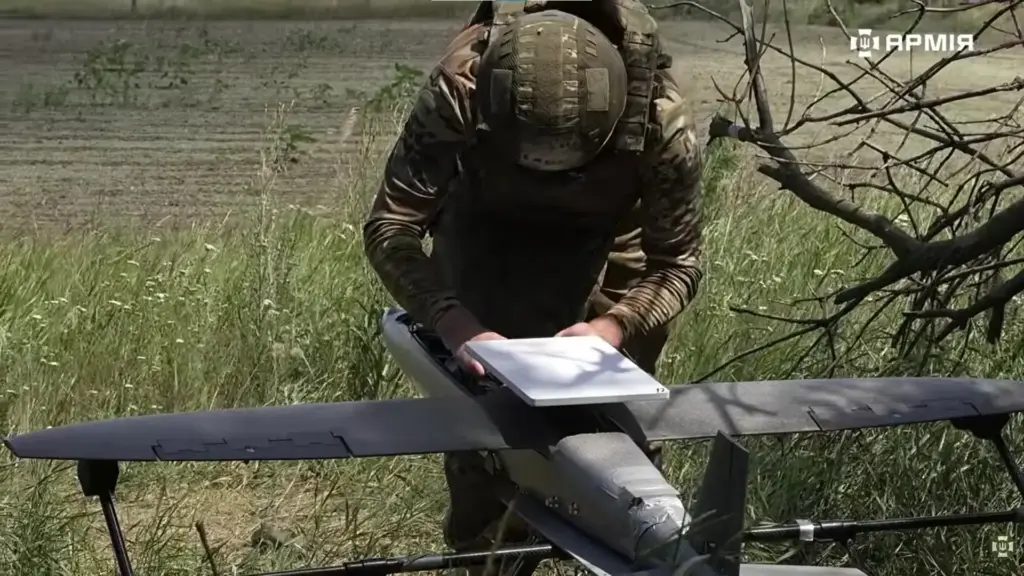
The earliest approach was primitive but cheap and effective, Beskrestnov said. A pilot flies the interceptor to the right point using the radar network, then finds the target by eye, chases it, and attacks.

Russia answered not only with jet Shaheds but with onboard electronic warfare, evasion systems, in-flight maneuvers, and rear-facing cameras to watch the sky behind, he explained. Ukraine replied with machine-vision target capture and guidance.

Bad weather remains unsolved

None of that fixes visibility, Beskrestnov wrote, and the problem hits both ordinary and jet interceptors. The way out, he argued, is an autonomous seeker head, acoustic, thermal, or radar, mounted on the interceptor itself.

A radar seeker is the ideal, in his view, because it opens the door to a fully autonomous system with no human in the loop: the network sees the target, launches the nearest interceptor, guides it by tactical radar, and the seeker locks on for the kill.

A US firm has put a price on it

Building a radar small enough for an interceptor has proven hard, and teams in Ukraine and abroad are working on it, Beskrestnov said, adding that he would not discuss the Ukrainian efforts because the subject is sensitive.

He pointed to the American company Archimedes, which he said announced a radar days ago, operating at 24 gigahertz with a 25-by-14-degree field of view and a one-kilometer lock-on range, shown in a promotional video mounted on several Ukrainian interceptors, at about $4,000 per unit. Whether it works remains to be seen, he added, given how hard the problem is.

  • ✇Euromaidan Press
  • Second Russian MiG-29 in two days: Ukraine’s drones worked over Millerovo airbase
    Ukrainian drones worked over dozens of Russian military and industrial sites overnight on 24 August, reaching from occupied Ukraine and the Black Sea to southern Russia, the commander of Ukraine's Unmanned Systems Forces (SBS) reported. The night's targets included a fighter jet at a Russian airbase, air-defense radars, fuel and propellant facilities, and vessels of Russia's sanctions-evading shadow fleet. A fuller breakdown released later in the day named the site of e
     

Second Russian MiG-29 in two days: Ukraine’s drones worked over Millerovo airbase

24 août 2026 à 14:36

second russian mig-29 two days ukraine's drones worked over millerovo airbase · post fighter jet beside shelter rostov oblast russia ukrainian drone's sights 24 2026 telegram madyar ukraine news reports

Ukrainian drones worked over dozens of Russian military and industrial sites overnight on 24 August, reaching from occupied Ukraine and the Black Sea to southern Russia, the commander of Ukraine's Unmanned Systems Forces (SBS) reportedThe night's targets included a fighter jet at a Russian airbase, air-defense radars, fuel and propellant facilities, and vessels of Russia's sanctions-evading shadow fleet. A fuller breakdown released later in the day named the site of each strike and the unit that carried it out. Footage released with the breakdown shows the strikes.

Ukraine has been running mid-range strikes across the belt from occupied Crimea to Rostov Oblast for months, taking out the radars, missile batteries, and the aircraft that fly air-defense patrols over it — a rolling effort to thin the cover that meets every deeper Ukrainian strike.

A fighter jet and a decoy at the same airbase

Robert Brovdi, callsign Madyar, said his crews hit 66 targets in the operational depth of the Russian rear. Among them was a MiG-29 at Dolotinka, on the grounds of the Millerovo airbase in Rostov Oblast. The 1st Separate Center of the SBS carried out that strike.

second russian mig-29 two days ukraine's drones worked over millerovo airbase · post ka-52 helicopter mockup rostov oblast russia ukrainian drone's sights 24 2026 heli ukraine news reports
A Ka-52 helicopter mockup at Millerovo airbase in Rostov Oblast, Russia, in a Ukrainian drone's sights, 24 August 2026. Photo: Telegram/Robert Brovdi

The same unit hit a mockup of a Ka-52 Alligator attack helicopter at the same location. Russia uses such decoys to draw drones away from real aircraft.

two russian fighters one spy drone hit kranodar radars anti-air systems elsewhere—ukraine forces · post combat aircraft ukrainian drone's sights vityazevo airfield krasnodar krai russia 23 2026 su-33 video sbs
Explore further

Ukraine’s drones hit two Russian fighters and a spy drone—and blinded radars from occupied Crimea to Rostov

It was the third Russian fighter jet Ukrainian drones reached in two days. Crews struck another MiG-29, a jet SBS identified as a Su-33 and Militarnyi assessed as a Su-30SM, and an Orion strike-reconnaissance drone at Vityazevo in Krasnodar Krai on 23 August. Ukrainian drones have caught a MiG-29 on a Russian airfield before, at Kursk in July.

Four radars, from Rostov Oblast to occupied Crimea

Crews hit four radar systems overnight. Two Kasta-2E2 sets went down at Geraskin and Karaichev in Rostov Oblast, and a Nebo-SV at Gukovo in the same oblast. All three fell to the 1st Separate Center.

The fourth, an ST-68, stood at Rozdolne in occupied Crimea. The 9th Kairos battalion of the 414th Madyar's Birds brigade struck it.

The radar work is part of a campaign against Russian sensors and launchers that has run for months without a pause.

Rocket propellant, fuel, and two ships

The 1st Separate Center struck the Kamensky Combine at Kamensk-Shakhtinsky in Rostov Oblast, a plant producing solid rocket fuel, according to SBS. The 9th Kairos battalion hit a fuel tank at Yeysk in Krasnodar Krai. In occupied Luhansk Oblast, the 20th K-2 brigade struck a fuel depot belonging to the 106th material support brigade of Russia's 41st Army at Dovzhansk. 

Brovdi also said his crews hit and destroyed two shadow-fleet vessels, a tanker and a bulk carrier, in the Black Sea. No independent account of either loss has appeared.

A drone school, relays, and a base in occupied Kherson Oblast

In occupied Kherson Oblast, Ukrainian crews destroyed the quarters of a Russian National Guard rapid-response unit and hit two relay stations for Geran attack drones, according to the SBS breakdown.

second russian mig-29 two days ukraine's drones worked over millerovo airbase · post explosions base national guard rapid-response unit strilkove occupied kherson oblast 24 2026 - seen ukraine news ukrainian
Explosions at the base of a Russian National Guard rapid-response unit in Strilkove, occupied Kherson Oblast, 24 August 2026. Photo: Telegram/Robert Brovdi

They also struck a shelter for a Zala reconnaissance drone crew in occupied Crimea, a drone school in occupied Zaporizhzhia Oblast, and a drone laboratory in occupied Donetsk Oblast.

Brovdi also reported 11 Russian rear deployment points burning across occupied Zaporizhzhia, Donetsk, and Luhansk oblasts, along with strikes on energy nodes in occupied territory.

Ukraine’s drones hit two Russian fighters and a spy drone—and blinded radars from occupied Crimea to Rostov

23 août 2026 à 12:36

two russian fighters one spy drone hit kranodar radars anti-air systems elsewhere—ukraine forces · post combat aircraft ukrainian drone's sights vityazevo airfield krasnodar krai russia 23 2026 su-33 video sbs

Ukraine's drones hit three Russian aircraft and eleven air-defense targets in one day, its Unmanned Systems Forces reported on 23 August. The strikes reached from occupied Crimea to airbases hundreds of kilometers inside Russia. They pushed the force's August count of struck Russian air-defense assets to 20, the latest run in a Ukrainian campaign against Russia's radars and launchers that has not paused for months.

Russia leans on a layered net of radars and mobile launchers to keep Ukrainian drones and missiles away from its airfields, fuel plants, and occupied land, so every set burned off that net widens the corridors its long-range weapons fly through. With its S-400 battery caught in the open again and jets chased off Crimea still within reach, Russia has shrinking safe ground for the aircraft and air defenses covering its south — a squeeze already visible when Ukraine caught a fighter and its protecting launcher on the same airfield weeks earlier.

A one-day sweep of 14 targets

The Unmanned Systems Forces (SBS) commander, Robert Brovdi, callsign Madyar, put the 23 August haul at 14 targets. They included two fighter jets, a strike-reconnaissance drone, eight radar systems, a Tor and a Pantsir short-range launcher, and a position of an S-400 — a Russian long-range air-defense system.

Eleven of the 14 fell in Rostov Oblast and Krasnodar Krai in southern Russia. The other three were in occupied Crimea. 

two russian fighters one spy drone hit kranodar radars anti-air systems elsewhere—ukraine forces · post aftermath strike combat aircraft seen another ukrainian vityazevo airfield krasnodar krai russia 23 2026 дорозвідка
Aftermath of the strike on a Russian combat aircraft as seen from another Ukrainian drone at Vityazevo airfield in Krasnodar Krai, Russia, 23 August 2026. Screenshot: SBS

Jets that fled Crimea, caught on the mainland

The three aircraft were struck at Vityazevo, a Krasnodar Krai airfield about 300 km from the front line, the 1st Separate Center of the Unmanned Systems Forces said. Militarnyi assessed that the jet SBS called a Su-33 was likely a two-seat Su-30SM, judging by its cockpit hump.

two russian fighters one spy drone hit kranodar radars anti-air systems elsewhere—ukraine forces · post ukrainian strikes su-30sm fighter mig-29 orion strike-reconnaissance vityazevo airfield krasnodar krai russia 23 2026 airfield's
Ukrainian drone strikes on a Su-30SM fighter, a MiG-29 fighter, and an Orion strike-reconnaissance drone at the Vityazevo airfield in Krasnodar Krai, Russia, 23 August 2026, with the airfield's location marked on the map. Collage: Militarnyi

Russia flies the Su-30 from its southern bases to attack Odesa and Mykolaiv oblasts, to hunt Ukrainian sea drones, and to patrol occupied territory. The struck jet likely belonged to a naval aviation regiment pushed off Crimea by repeated Ukrainian strikes on the peninsula.

two russian fighters one spy drone hit kranodar radars anti-air systems elsewhere—ukraine forces · post strike podlyot radar holovativka rostov oblast russia 23 2026 sbs ukraine news ukrainian reports
A strike on a Russian Podlyot radar at Holovativka in Rostov Oblast, Russia, 23 August 2026. Screenshot: SBS

Based on the SBS footage, Militarnyi says one drone could not hit the fighter cleanly. It exploded beside the aircraft and set off a fire that Russian crews tried to put out — a near miss, but enough to sideline the jet for a long stretch. A second drone then found the MiG-29 fighter jet and scored a direct hit, starting a large fire. A third caught the Orion, a strike-reconnaissance drone Russia uses to launch small cruise missiles and to track Ukrainian naval drones in the Black Sea.

Radars, launchers, and an S-400 on the coast

The air-defense targets ran across three regions. In occupied Crimea, crews hit a Nebo-U long-range radar at Sevastopol, the ST-68 at Yevpatoria some 30 km from the front, and a 36D6M at Uiutne. In Rostov Oblast and Krasnodar Krai they knocked out more radars, including two Kasta-2E2 sets and two Podlyot radars, plus the Tor at Pudovy and the Pantsir at Yeysk.

The 413th Reid regiment of the SBS reported hitting the S-400 position near Gelendzhik on the Krasnodar coast — the same stretch where drone crews have caught the system out in the open before.

two russian fighters one spy drone hit kranodar radars anti-air systems elsewhere—ukraine forces · post enhanced colorized frame thermal footage view ukrainian closing st-68 radar moments before impact yevpatoria occupied
Enhanced and colorized frame from the drone thermal footage showing the view from a Ukrainian drone closing on a Russian ST-68 radar moments before impact at Yevpatoria in occupied Crimea, 23 August 2026. Screenshot: Ukraine's Unmanned Systems Forces (SBS)

An August of hunting Russia's air shield

A battlefield video counter run by the force reached 20 Russian air-defense assets struck through August. The month's work extended a campaign that has steadily burned through the sensors and launchers guarding Russian airfields and occupied territory. 

❌