❌

Vue normale

  • ✇404 Media
  • AI Is Changing Everything About Hacking. No One Knows What Happens Next

    For much of the last month, many of the cybersecurity experts I talk to and follow have been posting like they are very scared. Many have been warning of an AI-powered “Black Swan” event, have been alarmed by the number of vulnerabilities suddenly discovered, and of the apparent power of AI agents and large language models more broadly to find and exploit previously unknown bugs. The rhetoric has ranged from worried-but-measured (things are about to get weird), to run-of-the-mill advice like
     

AI Is Changing Everything About Hacking. No One Knows What Happens Next

22 octobre 2026 à 10:23
AI Is Changing Everything About Hacking. No One Knows What Happens Next

For much of the last month, many of the cybersecurity experts I talk to and follow have been posting like they are very scared. Many have been warning of an AI-powered “Black Swan” event, have been alarmed by the number of vulnerabilities suddenly discovered, and of the apparent power of AI agents and large language models more broadly to find and exploit previously unknown bugs. 

The rhetoric has ranged from worried-but-measured (things are about to get weird), to run-of-the-mill advice like update your software and make sure you have two-factor authentication on, to vagueposting about AI-powered attacks, to things like ‘the internet was nice while it lasted,’ to outright prepper-level terror. 

To give you a sense of what I’m seeing, Matthew Green, a Johns Hopkins professor and one of the most respected cryptographers in the world, posted  “we’re in the part of the movie where you need to throw whatever you can in the path of the zombies and hope it slows them down,” and “so many people discovering that the whole Internet is dry tinder and the only thing keeping it from burning is the fact that teenagers haven’t found the matches yet,” Green is alluding to the fact that hackers and researchers driving AI tools and agents are getting better at finding and exploiting all sorts of bugs in important systems. I’ve also seen numerous AI employees, as mentioned, go full prepper, suggesting people pull money out of their bank accounts, disconnect from the internet, purchase shelf-stable food, hoard water, put money in gold and cash, and purchase hand-crank emergency radios.

And all those posts came before people using AI-powered tools found vulnerabilities in PHP, the programming language that powers much of the internet. In the last few days, major vulnerabilities or issues have been found in eMudhra (an Indian entity that provides website security certificates), Node.js (an alternative to PHP), Gitlab (a software development platform), Plex (media server software), Railway (a cloud provider), OpenCode (a coding agent platform), and several other companies and services, though, rightfully, none of these has gotten as much attention as the vulnerabilities in PHP, called PHP2Shell, which researchers from Wiz, Calif, and OpenAI discovered using AI. 

Matthew Prince, the CEO of Cloudflare, a service that has wide insight into the general health of the internet, posted, “In the 10 hours before [PHP2Shell] was publicly announced, across the Cloudflare network we saw thousands of attempts to exploit it. That jumped to tens of thousands in the 45 minutes post announcement, hundreds of thousands within 2 hours, and millions now.” 

So much is happening, and so quickly, that it has been difficult for me — someone who has been reporting and editing stories on security and hacking for a decade — to fully understand what’s going on, to have a sense of what could happen next, or predict where this is going. And I think that that is largely where we are at the moment, as I am writing this. 

But it has become clear that AI, broadly defined, has fundamentally changed both offensive hacking and defensive cybersecurity. This is not because AI has become sentient or because human beings have lost control of it or because of “swarms” of “rogue agents,” but because AI is proving something that we have always known: much of the software that runs the internet, our devices, our accounts, and our lives is vulnerable, or out of date, or has security flaws that human beings never noticed, or was installed by someone at a company who left the company six years ago and has been replaced four times and no one knows how to find them now or how to update it. This doesn’t mean that all of the vulnerabilities that have been found with the help of AI have been obvious or trivial; skilled hackers and researchers, driving AI tools, seem to be better than humans alone at finding vulnerabilities. But, critically, AI and large language models have made it extremely easy to essentially brute force the internet; if every piece of software is a door, AI makes it exceptionally easy to turn turn the knobs of every door to see if it’s unlocked, even on buildings that human beings had never really bothered to try to open. What we are learning at an alarmingly fast pace is that not only are some of the locks easy to pick, in some cases the door is wide open or there’s a giant hole in the wall. The recent spate of people using AI to hack their internet of things devices to run new software shows that, in some cases, it takes essentially no expertise to actually use AI to hack something.

Meanwhile, we've seen the rise of "abliterated" AI models that are designed to not say no and open weights models that can be used for pentesting and potentially offensive hacks without the guardrails that exist in many off-the-shelf commercial models.

In a blog post explaining the PHP vulnerability discovery, OpenAI said the findings highlight “how AI can uncover security flaws with internet-scale impact, but the same capabilities can also help attackers rapidly develop offensive tools and exploits.” OpenAI basically argues that it did all of this research ethically, and that its discovery opened a “Defender’s Window” that allowed governments and critical infrastructure to prepare for the disclosure of the bug. ‘Researcher finds bug, ethically discloses it to company, company fixes it’ is the preferred course of action in cybersecurity, but AI is shortening the window for all of this, is leading more people to do more research more easily, and is making both bug finding and bug fixing much faster. Whether those fixes are actually deployed by individual companies any faster is another, much more complicated question. The answer in many cases is, probably, no. 

AI is also making all of this much more unpredictable. The security company Chainguard was criticized for breaking the embargo on the PHP vulnerability disclosure because it posted fixes for the vulnerabilities several hours before it was officially disclosed. Critics, including the PHP Foundation, said this could have let attackers figure out how to exploit the issues before website owners had a chance to protect their systems. In a LinkedIn post, Chainguard CEO Dan Lorenc said that his company independently found the same bugs by typing “find bad vulnerabilities in PHP” into a frontier AI model. Amazon, meanwhile, said that it saw exploit attempts before the official disclosure. These facts raise questions about whether the bug was exceptionally easy to find, whether the AI models that originally found the vulnerabilities incorporated that information into the model somehow therefore making it easier for someone else to find, or whether there was a leak along the way from someone connected to the disclosure process. Any option is concerning.

After the PHP2Shell vulnerabilities were discovered, some infosec experts started calling this “Black October,” and highlighted the fact that the National Security Agency, the Prime Minister of Japan, and various governments around the world told people to patch their websites and services immediately, and to take down services that couldn’t be patched. 4chan, several Wikimedia services, and Archive.org were all temporarily taken offline so that they could be updated. 

As The Atlantic has already suggested, one of the biggest impacts of PHP2Shell could be the fact that many historic websites can’t or won’t be updated, may be proactively pulled offline, might eventually be hacked, and might never come back. The link rot could be horrendous, and a lot of history could be lost. 

For such a high-profile incident, most of the actual impacts thus far have been related to the proactive patching or removal of potentially insecure websites, and we have not seen immediate, widespread exploitation of the bug. Various low-effort, LLM-developed exploits have been dropped online; many of them will not work. A blog post called “There isn’t an easy exploit for this PHP vulnerability,” written by Elias Taylor, quickly went viral and was dissected on Hacker News, especially by people pointing out that the website eliastaylor.com had been recently registered and that it wasn’t clear who Elias Taylor was. 404 Media reached Taylor by Signal; he said “I am real and on a delayed train.” 

“Lots of people are being tricked by AI into thinking they have an exploit when they don't, because they can't read or understand what the LLM gave them,” Taylor told 404 Media. “It doesn't appear to be anywhere near as exploitable as the other ‘stop the world’ vulnerabilities i.e log4j, heartbleed. But patch your servers, it’s still a vulnerability. Please do not paraphrase me as saying ‘there is no vulnerability’ for any reason. There is, and people should patch.” 

Dan Guido, the CEO of Trail of Bits, a well-respected cybersecurity company that partners with OpenAI on the Patch the Planet initiative, posted that his company had created “a working exploit,” and that “Will Tan built it in 1 day with Codex, drawing on ~10 years of system security and vulnerability research. AI accelerates exploit development. Knowing how to turn a bug into a shell still takes expertise. AI makes that expertise more productive.” 

It should also be noted that Taylor’s other blog post is called “Anything connected to the internet is going to get hacked to pieces,” which includes the lines “software engineers have spent the past 40 years writing vulnerable, dogshit software. LLMs are easily above the bar needed to break into said software.” 

It remains unclear, at the moment, what the ultimate impact of all of this is going to be, or where we’ll be in one hour, one week, one year, or 10 years. But AI is changing how cybersecurity and hacking works. It is making finding and exploiting bugs faster and easier. We’re about to find out how insecure the internet really is. 

Russia is stepping up fake Ukrainian government pages as bait for recruiting agents, Ukraine’s security service says

29 septembre 2026 à 04:38

fake ukrainian government pages russia's newest bait recruiting agents ukraine's security service says · post man suspected collaborating fsb detained kharkiv oblast 2026 sbu untitled ukraine news reports

Russian intelligence services have sharply stepped up building websites and social media pages that impersonate Ukrainian state bodies and media, the Security Service of Ukraine (SBU) warned. Moscow uses the fakes to spread disinformation and to steal personal data it can turn into spy recruitment. The SBU says it has already blocked dozens of clones of its own brand.

Counterfeit pages built for propaganda and data theft

The fake sources serve Russian psychological operations and disinformation campaigns, the SBU said on 28 September. Their aim is to destabilize the situation inside Ukraine and damage its position abroad. Russian intelligence also uses them to extract Ukrainians' personal data, the agency said.

Alongside its full-scale invasion, Russia wages war on Ukraine in the cyber domain and through espionage and sabotage. Every agent Russia recruits inside Ukraine can help steer missiles and drones onto targets, and the SBU keeps catching such recruits.

Hacked accounts become recruitment leads

Russians often hack the accounts of users who subscribe to the fake pages and messenger channels, the SBU found. They then use the stolen information for recruitment operations and to collect confidential data.

Moscow is most interested in the combat and operational work of Ukraine's defense and security forces, the agency said. The SBU's cybersecurity department found and blocked more than 50 resources that copied the agency's own branding and positioning.

The fake pages are not Russia's only digital tool. Earlier in September, Anthropic said it had caught Russian spies running a campaign against Kyiv on its Claude AI chatbot.

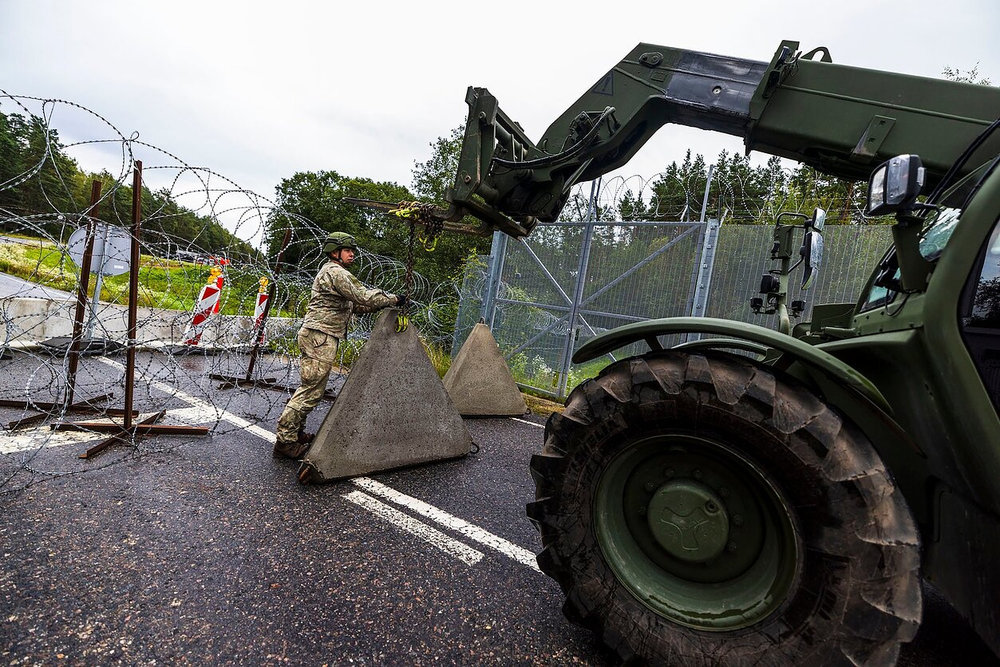
Lithuanian soldier installs concrete barriers and razor wire across a road during a civil defense exercise.
Explore further

Poland and the Baltics risk Russian sabotage for backing Ukraine, Bloomberg says

How Ukrainians can protect themselves

The SBU urged citizens not to follow suspicious links and to rely only on official sources. Anyone who sees a dubious web address, or gets a message from someone posing as an SBU officer, should call the 1516 hotline, the agency said.

What Russia's recruits are sent to do

The SBU's own reports from the past week show what Russia's recruits are tasked with. A mobilized soldier allegedly recruited by the FSB, Russia's Federal Security Service, tried to direct a Russian missile strike on his own unit in Kharkiv Oblast, the SBU said. His repair battalion restores Ukrainian drones.

A Lviv Oblast resident who worked at a drone production site in western Ukraine was allegedly recruited to guide a missile strike on it, the agency reported. The strike was meant to disrupt the steady supply of strike and reconnaissance drones to Ukrainian troops, the SBU said.

A court also sentenced a 17-year-old agent of Russia's military intelligence (GRU), exposed in November 2024, to 10 years in prison, the SBU announced. She tracked Ukrainian air defenses in Chernihiv Oblast under the cover of taxi rides. She talked to her GRU handler through an anonymous messenger chat.

  • ✇The Kyiv Independent
  • US sanctions Russian IT company Aeza Group over ransomware operations
    The U.S. Treasury Department's Office of Foreign Assets Control (OFAC) has imposed sanctions on the Russian IT company Aeza Group for hosting infostealers and ransomware operations, according to a press release published on July 1.Restrictions were imposed on two subsidiaries and four members of the Aeza Group's management as well, the statement read.The U.S. Treasury Department characterized Aeza as a "bulletproof hosting service" that provided services to the Meduza and Lumma infostealers, as
     

US sanctions Russian IT company Aeza Group over ransomware operations

1 juillet 2025 à 12:48
US sanctions Russian IT company Aeza Group over ransomware operations

The U.S. Treasury Department's Office of Foreign Assets Control (OFAC) has imposed sanctions on the Russian IT company Aeza Group for hosting infostealers and ransomware operations, according to a press release published on July 1.

Restrictions were imposed on two subsidiaries and four members of the Aeza Group's management as well, the statement read.

The U.S. Treasury Department characterized Aeza as a "bulletproof hosting service" that provided services to the Meduza and Lumma infostealers, as well as to the BianLian and RedLine ransomware groups.

Aeza Group also hosted the Russian-language darknet marketplace for illegal drugs, BlackSprut.

According to the U.S. Treasury Department, Aeza Group sells access to specialized servers that help cybercriminals avoid detection and resist attempts by law enforcement agencies to suppress their criminal activities.

Sanctions against the company involve blocking all assets of the named individuals located in the U.S. Any legal entities that are owned, directly or indirectly, individually or in the aggregate, by 50% or more by one or more of the mentioned individuals are also blocked.

Violation of the U.S. sanctions may result in civil or criminal penalties.

The news comes as Ukraine continues to call on the U.S. to strengthen sanctions against Russia. Despite Russia's refusal to accept the ceasefire proposal and its army's ongoing advance across Ukrainian territory, the Trump administration has not yet imposed new restrictions.

Meanwhile, Senators Lindsey Graham (R) and Richard Blumenthal (D) introduced a bill to impose a 500% tariff on imports from countries that continue to buy Russian oil and raw materials.

The legislation currently has broad bipartisan support, with 82 out of 100 U.S. senators backing it. U.S. House Speaker Mike Johnson also voiced his support for the bill.

Ukraine’s new interceptor UAVs are starting to knock Russia’s long-range Shahed drones out of the sky
Russia’s Shahed drone swarms are pummeling Ukraine on a nightly basis, inflicting ever more death and destruction in cities that had managed to carve out some sense of normalcy amid wartime. Civilian alarm has grown. With traditional air defense stockpiles running low, the government is banking on newly created
US sanctions Russian IT company Aeza Group over ransomware operationsThe Kyiv IndependentKollen Post
US sanctions Russian IT company Aeza Group over ransomware operations
  • ✇The Kyiv Independent
  • Ukraine's security service is teaching teenagers how to avoid recruitment by Russian intelligence
    Ukraine's security service (SBU) is teaching teenagers how to avoid recruitment by Russian intelligence online, the New York Times (NYT) reported on June 21."Maybe not all of these special operations are reported in the media — but believe me, the enemy is not sleeping... They are working actively and carrying out illegal activities, as strange as it may sound, directly inside your phones," SBU spokesperson Roksolana Yavorska-Isaienko told students.Approximately 22% of Ukrainians recruited by Ru
     

Ukraine's security service is teaching teenagers how to avoid recruitment by Russian intelligence

22 juin 2025 à 01:00
Ukraine's security service is teaching teenagers how to avoid recruitment by Russian intelligence

Ukraine's security service (SBU) is teaching teenagers how to avoid recruitment by Russian intelligence online, the New York Times (NYT) reported on June 21.

"Maybe not all of these special operations are reported in the media — but believe me, the enemy is not sleeping... They are working actively and carrying out illegal activities, as strange as it may sound, directly inside your phones," SBU spokesperson Roksolana Yavorska-Isaienko told students.

Approximately 22% of Ukrainians recruited by Russian intelligence to conduct sabotage or terrorist attacks are minors, Artem Dekhtiarenko, SBU spokesperson, said on April 2.

Russian intelligence attempts to recruit Ukrainian civilians online, offering easy money in return for sharing sensitive data or preparing sabotage or terrorist acts.

Russian intelligence finds its recruits using social platforms, including Telegram, Discord, and TikTok.

Unsuspecting teenagers are often offered hundreds or even thousands of dollars to conduct simpler tasks such as delivering packages or taking photos of energy sites, the NYT reports.

More serious tasks are commonly assigned to teenagers once they have been blackmailed for conducting less serious operations beforehand or when their phones are hacked to reveal compromising photos.

Russian intelligence is actively attempting to recruit Ukrainian nationals for illegal operations across the EU, Ukraine's military intelligence agency (HUR) said on June 2.

"The recruitment of Ukrainians for hostile operations in Europe is yet another tool of hybrid aggression that the Russian Federation is waging against Ukraine and the entire European community," HUR said.

The SBU caught a Russian agent as he was filming a military airfield in preparation for a Russian strike, the agency reported on June 15.

The Russian Federal Security Service (FSB) recruited the unemployed 24-year-old via the Telegram messaging app to collect coordinates for air attacks on airfields and logistic depots, the SBU said.

The Russian FSB allegedly offered "easy money" and instructed the recruit to find military facilities and carry out reconnaissance on the ground.

Love, sex, survival — Ukrainian author on how war shapes intimacy in Ukraine
In Ukraine, Russia’s war of aggression has upended not just borders but the country’s cultural landscape. Conversations about identity, gender, and sexuality have gained new urgency. Women are increasingly stepping into combat roles once dominated by men, while relationships can dissolve as quickly as they form. Many people
Ukraine's security service is teaching teenagers how to avoid recruitment by Russian intelligenceThe Kyiv IndependentKate Tsurkan
Ukraine's security service is teaching teenagers how to avoid recruitment by Russian intelligence
❌