Vue normale

Russia covered its Pantsir-S1 in camouflage. Ukraine’s naval platforms delivered the drones that burned it

7 août 2026 à 06:29

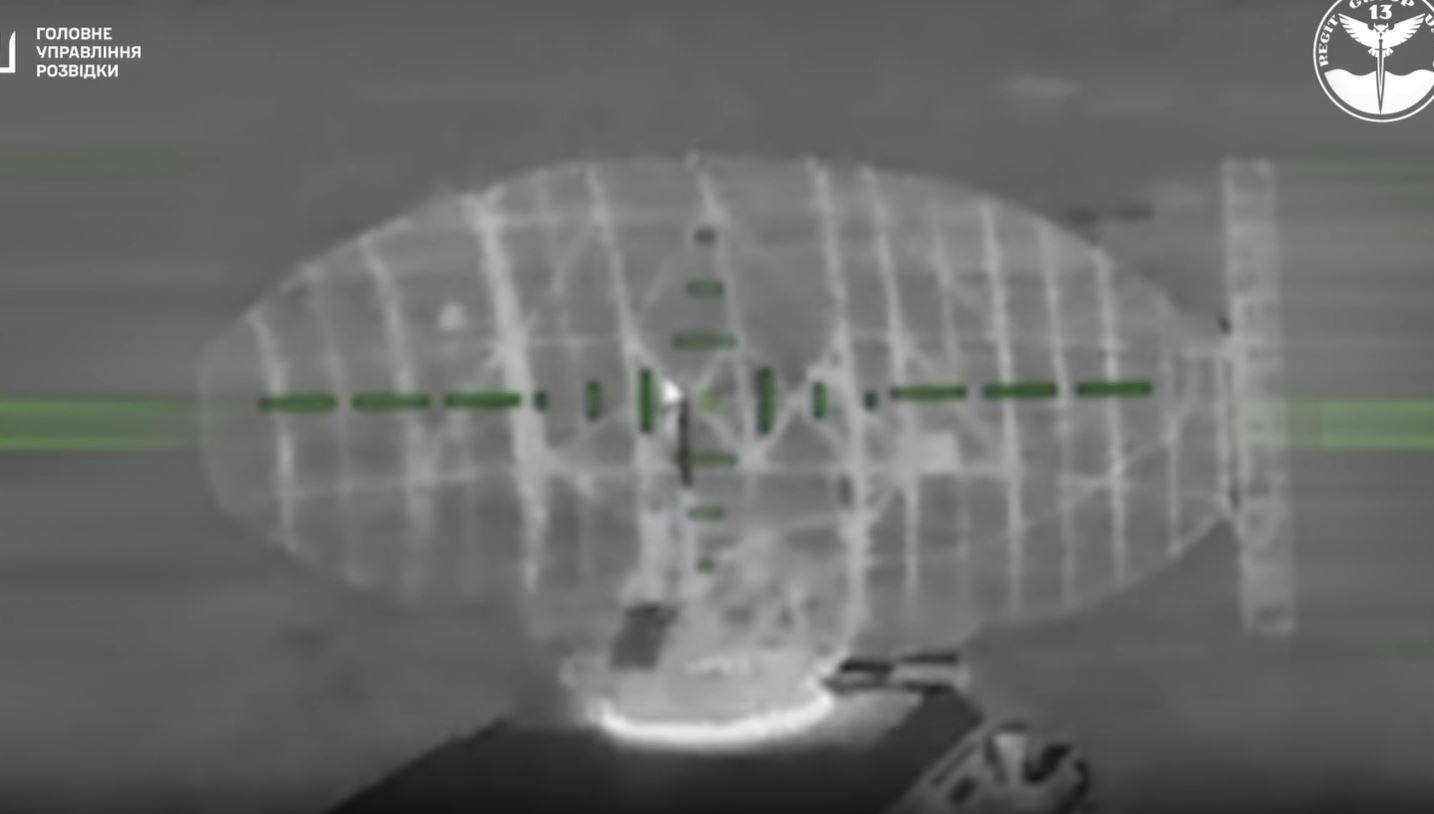
russia hid its pantsir under camouflage nets crimea · post russian pantsir-s1 air defense system covered occupied seen through drone targeting crosshairs moments before strike hur's group 13 early 2026

Ukraine's Main Directorate of Intelligence (HUR) destroyed a Pantsir-S1 air defense system worth an estimated $15 million and a military crane in occupied Crimea, HUR reported. The agency's Group 13 used maritime drones as drone carriers to deliver the strikes on ground targets. Separately, monitoring channels reported explosions across the peninsula from Kerch to Sevastopol overnight on 7 August, hitting the airfield Russia uses to launch Shaheds at Ukrainian cities.

The strikes on air defense run alongside a broader isolation campaign. Ukraine's drones have hit 201 shadow fleet vessels in three weeks, the Kerch Strait supply route is blocked indefinitely, and Ukraine's defense minister said the drone campaign is turning Crimea into an island. Earlier this week, the SBU damaged two FSB coast guard ships in Kerch that had been guarding the Crimean Bridge.

FPV drones launched from Magura platforms destroy air defense

HUR's Group 13 used Magura naval platforms as floating carriers for FPV drones. The drones flew from the platforms to strike a camouflaged Pantsir-S1 and a military crane on land, the agency's video shows. HUR estimated the destroyed air defense system at $15 million.

HUR did not specify the exact location but said the operation took place in early August 2026. The Pantsir-S1 is a short-range gun-and-missile system Russia deploys to protect higher-value assets such as S-400 batteries and command posts. Each one destroyed leaves a gap in the layered coverage Russia relies on over the peninsula.

The agency noted that Group 13 operators recently struck a Podlyot radar control vehicle and a Parol-4 radar interrogator in Crimea as well.

The Pantsir kill adds to a months-long campaign that has destroyed nearly 200 Russian air defense assets in the first half of 2026 alone by the Unmanned Systems Forces.

Overnight strikes sweep peninsula from Kerch to Sevastopol

Separately, overnight on 7 August, Ukraine struck at least six locations across occupied Crimea.

Monitoring Telegram channel Krymsky Veter reported explosions and gunfire in Kerch at 02:38. Near Alushta, four strong explosions were heard in the village of Malorichenske close to a large power substation. In Sevastopol, mobile fire groups engaged targets without an air-raid alert, and residents reported a powerful explosion near Cape Fiolent.
two russian radars destroyed crimea one ukrainian sea drone never touched shore · post parol-4 radar interrogator part friend-or-foe identification system seen fpv moments before strike occupied late 2026 video
Explore further

Ukraine’s sea drone that never touched the shore struck two Russian radars in occupied Crimea

The heaviest strikes hit the Hvardiiske military airfield, which Russia uses to launch Shahed attack drones against Ukrainian cities. Hits landed in two waves, from 03:30 to 03:39 and from 04:34 to 04:47. A fuel and lubricants depot caught fire, and small-arms ammunition began detonating, Krymsky Veter reported. Residents described two fire sites visible for kilometers. The Crimean Bridge was temporarily closed during the strikes.
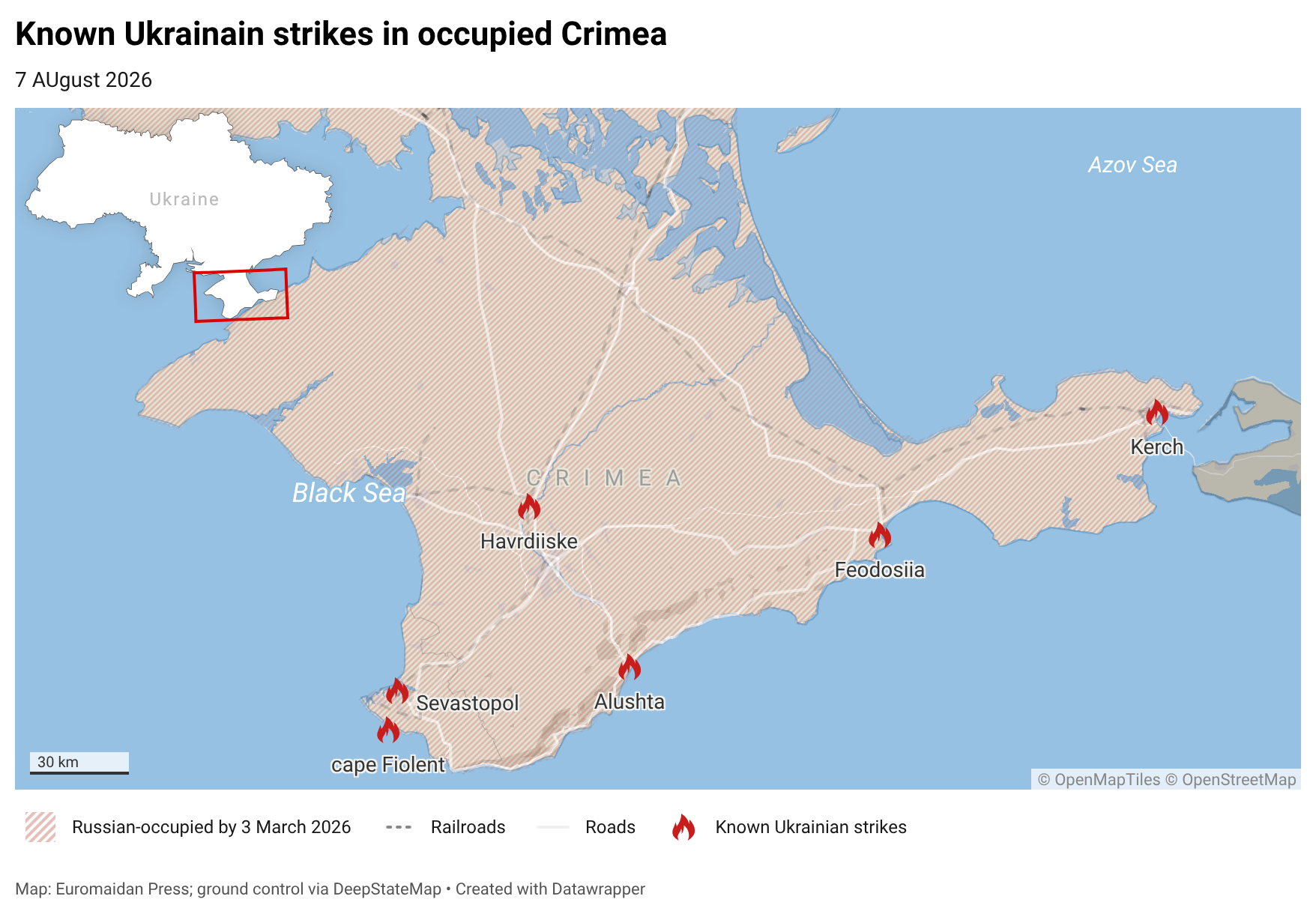
In Feodosia, initial reports of a strike on the oil depot were corrected: the hit likely landed on a concentration of Russian military equipment at the former 13th military compound on the Kerch Highway. Krymsky Veter noted the same compound was struck on 22 June. A vessel also burned at sea off Gelendzhik overnight.

No official confirmation of the strikes' results has been issued. 

The wreckage Russia collects from Ukrainian drone strikes may have a second life—aimed at NATO, Lithuania warns

7 août 2026 à 03:46

title · post lithuanian defense minister robertas kaunas lrt/e blažys lithuania defence ukraine news ukrainian reports

Lithuania's military intelligence warned that Russia is considering using captured Ukrainian drones for false flag attacks on critical infrastructure in the Baltic regionLRT reported. Defense Minister Robertas Kaunas confirmed the assessment and called the scenario "probably the most realistic" form of Russian provocation against the region. Lithuania has reinforced security at key infrastructure sites and deployed military forces since June.

Russia has waged a years-long hybrid campaign against NATO's eastern flank, combining drone incursions, undersea cable sabotage, rail crossing closures, and disinformation while simultaneously directing its full military force against Ukraine.

Russia's false flag playbook with captured drone parts

Moscow could reassemble crashed and intercepted Ukrainian drone wreckage into functioning devices and launch them at targets in the Baltic states, Kaunas told reporters on 6 August. The goal: create confusion about who launched the strike and avoid accountability for hitting NATO territory.

"We have data that Russia is considering conducting unconventional kinetic attacks against critical infrastructure in the Baltic region," Kaunas said. "It is likely that Russia could use Ukrainian-made drones for this purpose."


The Baltic region. Map: Euromaidan Press
finland confirms ukrainian drone its airspace kyiv's baltic strike campaign pushes deeper north – helsinki alert · post preparing launch long-range an-196 liutyi one-way attack photo_5224400079031496980_y (1) ukraine news reports
Preparing to launch Ukrainian long-range AN-196 Liutyi long-range one-way attack drone. Illustrative image. Photo: 14th UAS Regiment

The mechanism exploits a byproduct of Ukraine's drone war against Russia. As Ukrainian long-range drones hit oil infrastructure and military targets deep inside Russia, some are intercepted or crash. Russia collects the wreckage. 

"Russia possesses some of those parts and drone fragments and is capable of assembling them into a functioning device," Kaunas said. "The theoretical possibility that such drones could be used in a false flag operation exists."

lithuania signs full drone deal latvia receives ukrainian air defense experts · post lithuanian president gitanas nausėda (left) volodymyr zelenskyy exchange signed agreement copies bucharest nine summit 13 2026 presidentgovua
Explore further

Lithuania moves to produce Ukrainian drones locally under bilateral defense pact

Kaunas emphasized no decision to launch such an operation had been detected. 

"We are talking about a false flag operation in which a fake Ukrainian drone could be used. At this point, that is probably the most realistic scenario."

The false flag warning follows a pattern of Ukrainian drones entering Baltic airspace after being diverted by Russian electronic warfare. NATO fighter jets shot down such drones over Latvia and Estonia this spring, and Lithuania shut Vilnius airport after detecting a drone crossing from Belarus.

baltic nation boosts security dam gas storage facility due russian threat · post andris kulbergs 2023 ukraine news ukrainian reports
Explore further

Baltic nation boosts security at dam, gas storage facility due to Russian threat

Multiple NATO allies see the same intelligence

Lithuanian President Gitanas Nausėda had earlier raised concerns about possible conventional and sabotage strikes targeting the country's transport and energy networks. Kaunas echoed that message and pointed to a broader pattern across the alliance's eastern flank.

"Other NATO countries have repeatedly made it very clear that they see it, hear it, know about it, and have warned Russia not to do it," Kaunas said. He did not identify specific targets or a timeline for any potential attack.

Russia claimed the Baltic states open air corridors for Ukrainian drone strikes—without producing evidence. Russia also threatened NATO member Latvia with retaliation over the accusations. Nausėda publicly rejected Moscow's claims.

NATO upgraded its Baltic Air Policing rules of engagement in July, giving fighter jets authority to shoot down objects that pose a threat. Russia's military aircraft probed NATO's eastern flank so aggressively in July that scrambles jumped more than 250%.

❌