Vue normale

  • ✇Euromaidan Press
  • Russia’s blockade could halve Ukraine’s grain exports. Kyiv is asking the EU for €220 million
    Ukraine's Ministry of Agrarian Policy and Food has asked the European Commission for €220 million ($253 million) in grants to keep its small and medium farmers afloat, after Russian strikes on the Greater Odesa ports severed the sea route that carries most of the country's agricultural exports. The money would cover interest on loans issued under the state "Affordable Loans 5-7-9%" program, the ministry's press service said. The request marks the point where Russia's Bl
     

Russia’s blockade could halve Ukraine’s grain exports. Kyiv is asking the EU for €220 million

7 août 2026 à 11:38

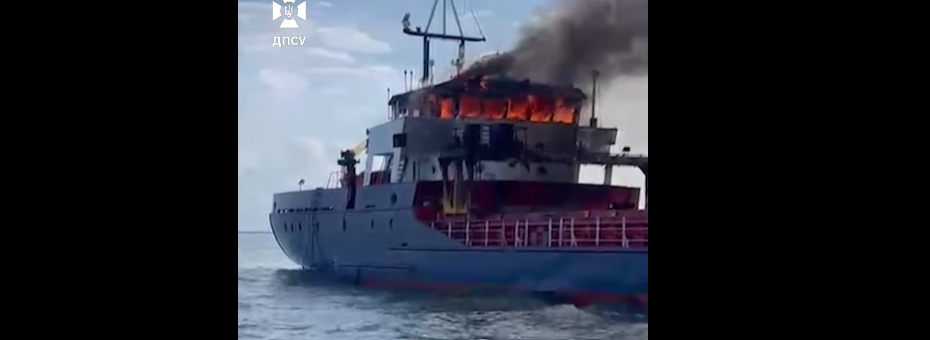
A Russian Shahed drone struck a Palau-flagged vessel carrying corn twice as it left a port in Odesa Oblast, setting it on fire. Source: Ukraine's State Border Guard Service

Ukraine's Ministry of Agrarian Policy and Food has asked the European Commission for €220 million ($253 million) in grants to keep its small and medium farmers afloat, after Russian strikes on the Greater Odesa ports severed the sea route that carries most of the country's agricultural exports. The money would cover interest on loans issued under the state "Affordable Loans 5-7-9%" program, the ministry's press service said.

The request marks the point where Russia's Black Sea campaign stopped being a shipping story and became a farm-finance one. With the corridor all but stalled, the ministry projects exports for the 2026/2027 season could fall by almost half, from 64.4 million to about 29.6 million tonnes. Grain the farmers have already harvested is piling up in silos the ministry expects to be full by October, and without cash from those sales, producers cannot finance the autumn sowing that plants next year's crop.

How €220 million turns into €4 billion in loans

The grant is small next to the hole it is meant to plug. Ukraine estimates its farm sector will take in roughly €6.4 billion this season against €11.2 billion in operating costs, and will need about €4 billion in working capital just to keep running. The €220 million would not cover that gap directly. Instead, by subsidizing interest, it is designed to unlock a credit portfolio of up to €4 billion ($4.6 billion) at a rate to farmers of no more than 10%, open to small and medium producers that meet the program's environmental and social criteria. Wheat exports alone could otherwise drop from 17.6 million to 8.3 million tonnes.

The blockade behind the request

Through July, Russia intensified strikes on civilian cargo ships in the Black Sea corridor, killing crew members and, on 22 July, halting traffic entirely — not a single vessel passed that day, at the height of the harvest. Ukraine's government called it "deliberate economic and humanitarian terror." Around 90% of Ukraine's farm exports normally move through three Odesa Oblast ports, and Agriculture Minister Taras Vysotskyi has said the rail, road, and Danube routes that remain can carry only about half the lost volume.

The squeeze is already reaching the fields. Oilseed and grain prices have fallen about 30% as unsold stock backs up inside the country, and the ministry puts direct losses to the sector this year at between $1.5 billion and $3 billion. The government has lowered minimum export prices on some products to keep trade moving, and Prime Minister Serhii Koretskyi has said it is expanding a separate program of grain-backed loans so farmers can borrow against stored crops rather than sell them cheap.

Whether Brussels funds the €220 million request, and how fast, will help decide how much of this year's harvest gets planted — and how much stays stranded in silos while the ports stay shut.

  • ✇Euromaidan Press
  • Ukraine’s missile, Europe’s sensors—FREYJA enters active development on an early-2027 clock
    Ukraine expects the joint European FREYJA interceptor program to deliver "concrete results" by the turn of 2026–2027, President Volodymyr Zelenskyy said on 6 August. The program "is already actively underway," he added.  Under the program, Ukraine would manufacture the interceptor and launcher, while European partners would provide radars, sensors, and other critical components. Zelenskyy said FREYJA is intended to intercept ballistic missiles and would benefit coun
     

Ukraine’s missile, Europe’s sensors—FREYJA enters active development on an early-2027 clock

7 août 2026 à 10:55

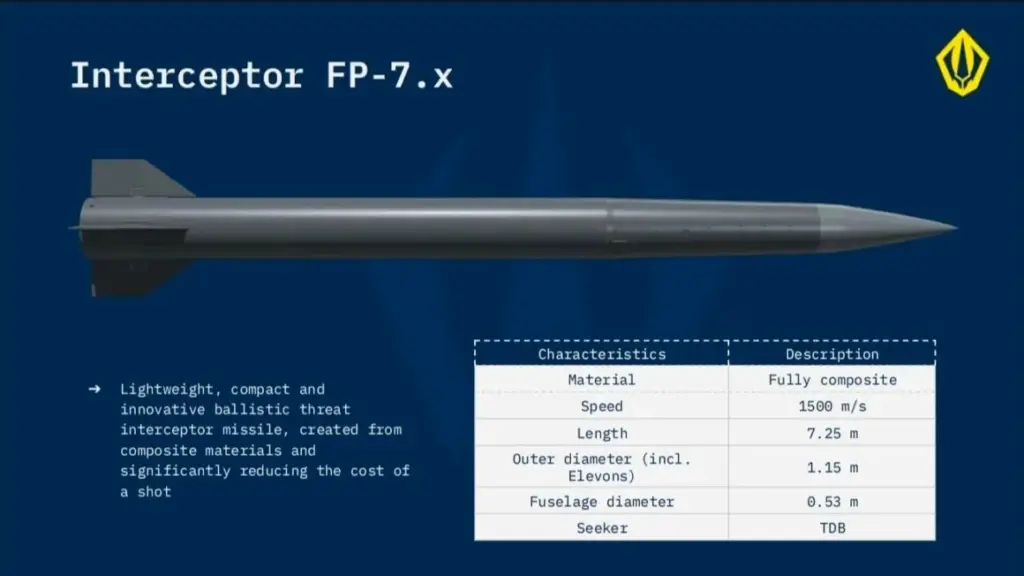
Fire Point concept graphic showing the FP-7.x interceptor missile beside a table of proposed specifications.

Ukraine expects the joint European FREYJA interceptor program to deliver "concrete results" by the turn of 2026–2027, President Volodymyr Zelenskyy said on 6 August. The program "is already actively underway," he added. 

Under the program, Ukraine would manufacture the interceptor and launcher, while European partners would provide radars, sensors, and other critical components.

Zelenskyy said FREYJA is intended to intercept ballistic missiles and would benefit countries across Europe. He said its successful development would place Ukraine among the few countries with an anti-ballistic system of their own.

The FREYJA project seeks to address Ukraine's growing shortage of interceptors capable of stopping Russian ballistic missiles. FREYJA will not solve the immediate shortage, but it could reduce Europe's long-term reliance on scarce US-made Patriot interceptors. Recent Russian attacks have shown the consequences of that shortage.

How the FREYJA interceptor would help Ukraine

Ten countries are involved in FREYJA, and Zelenskyy said more partners had agreed to join the effort. Leading European defense companies will contribute the radars, sensors, and other technology the system requires, he said.

This joint venture connects Ukraine's wartime missile production with technologies held by established European manufacturers. Earlier Euromaidan Press reporting described the project as pairing a Ukrainian Fire Point interceptor with European radar, guidance, and sensor technology.

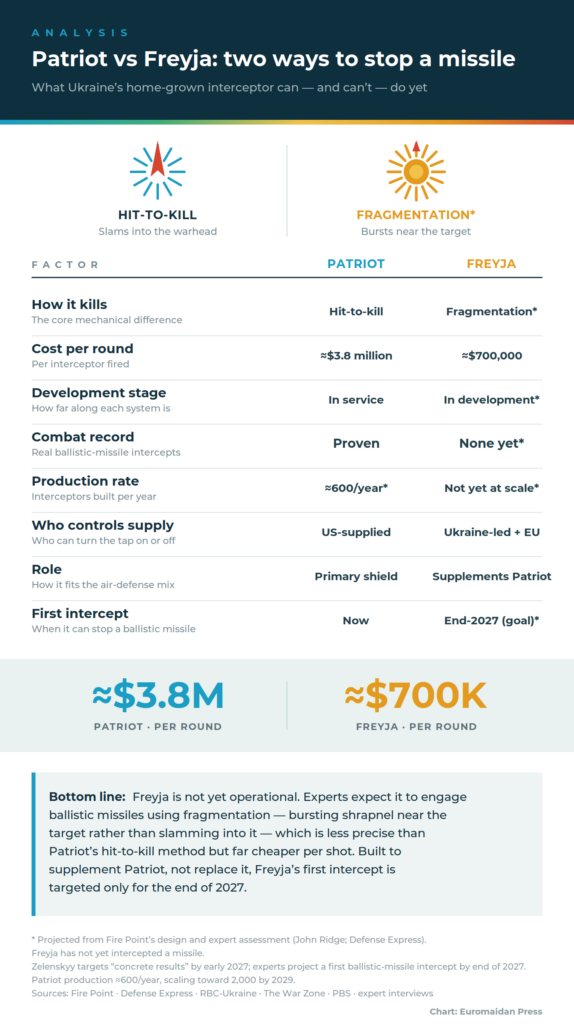
Image: Euromaidan Press

Euromaidan Press noted that each FREYJA round cost about $700,000, compared with roughly $4 million for a PAC-3 interceptor. However, FREYJA is not a one-for-one Patriot equivalent and has not yet demonstrated a ballistic-missile interception. The lower price could matter if Ukraine can manufacture it at scale.

Zelenskyy's timetable concerns "concrete results," not a fully operational or mass-produced system.

Ukraine needs FREYJA amid growing interceptor shortage

The need for FREYJA was on display during Russia's overnight attack on 5 August. Moscow launched 24 ballistic and four anti-ship missiles, and Ukraine reported intercepting none of them. Air defenders neutralized 98 of 115 drones, but missiles and drones still struck 26 locations. 17 people were killed.

July 2026 had already shown the same deterioration. Ukraine only downed two of 36 ballistic missiles in two major attacks, roughly one in eighteen, as Patriot stocks ran low.

Washington offers no quick relief. Trump's July promise of a Patriot production license remains in its early stages, according to the system's manufacturers. Asked about more Patriot interceptors on 6 August, Trump replied that the United States also needed missiles.

The mismatch leaves Ukraine pursuing two tracks: pressing partners for scarce Patriots now while building FREYJA for a less dependent European defense later.

  • ✇Euromaidan Press
  • Nawrocki: where “Muscovites are beaten,” Poland helps. Russian Foreign ministry hits back
    Polish President Karol Nawrocki used a speech marking his first year in office to restate that Poland will keep backing Ukraine's war against Russia—and to frame that backing as cold strategic interest rather than solidarity, warning in the same speech that continued help does not extend to tolerating Ukrainian nationalist symbols" on Polish soil. He spoke on 6 August at a ceremony in the courtyard of the Presidential Palace in Warsaw, reported by RMF FM. The remarks la
     

Nawrocki: where “Muscovites are beaten,” Poland helps. Russian Foreign ministry hits back

7 août 2026 à 10:39

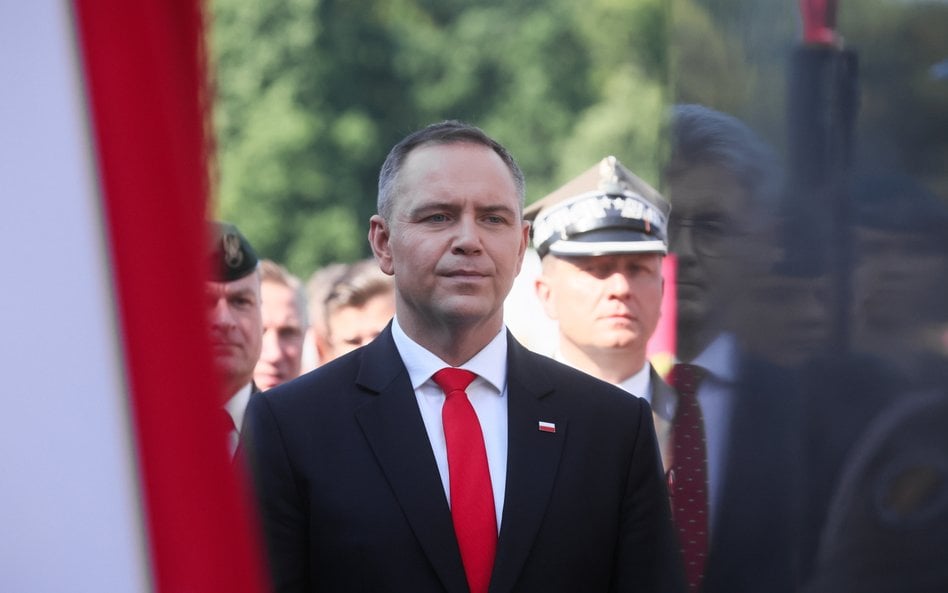
rzeczpospolita fourth year russia-ukraine war poland’s leader sides aggressor polish president karol nawrocki pap/leszek szymański 1699304a7cc0b825fd6ed95fba7ddad5 (1) editorial published 27 stated russia’s all-out against ukraine has taken position aligns commentary

Polish President Karol Nawrocki used a speech marking his first year in office to restate that Poland will keep backing Ukraine's war against Russia—and to frame that backing as cold strategic interest rather than solidarity, warning in the same speech that continued help does not extend to tolerating Ukrainian nationalist symbols" on Polish soil. He spoke on 6 August at a ceremony in the courtyard of the Presidential Palace in Warsaw, reported by RMF FM.

The remarks land at the hottest point yet in a Polish-Ukrainian memory row that has stripped Kyiv of much goodwill from its most important frontline ally. Poland's interest, Nawrocki said, is that Ukrainians fight "as long as possible and as effectively as possible" against Russia, keeping it far from Poland—help offered not out of shared cause but because a Ukraine that bleeds Russia serves Warsaw. Coming from the country most vital to Ukraine's supply lines, it is a statement of support recast as conditional self-interest.

Support as strategy, not solidarity

"Poland's interest is that Ukraine and Ukrainian soldiers cope as well as possible with the post-Soviet Russian Federation and keep it as far from Poland as possible. That is obvious; that is the Polish state's strategy," Nawrocki said. "Let them kill the Soviets who attacked them—it does not hurt us Poles at all. In this they can always count on our help, because where a Muscovite is beaten, Poland helps, even if it does not take part directly in this war."

The register was deliberate. Nawrocki, a historian who ran the Institute of National Remembrance before winning the presidency, used the pejoratives "Soviets" and "Muscovites" for Russians throughout, casting Polish aid as a matter of keeping the fight on the far side of the border.

The red line: no Bandera flags

The support came fenced. "It is also Poland's strategic interest that Bandera flags do not fly in Warsaw or anywhere in Poland," Nawrocki said, promising to help "but always saying: Poland first, Poles first"—not, he added, "thoughtlessly sending fleet after fleet without analysis, on phone calls and smiles."

The condition points straight at the dispute that has consumed the relationship since May, when Zelenskyy signed a decree granting a special-forces unit the honorary title "Heroes of the UPA," the insurgent army Poland's parliament holds responsible for the Volhynia killings of tens of thousands of Poles and has declared a genocide. Nawrocki stripped Zelenskyy of the Order of the White Eagle in response; in July he pressed parliament to ban the UPA's red-and-black flag by law.

Moscow moves to widen the gap

Russia moved to pry the crack open within hours. Foreign ministry spokeswoman Maria Zakharova derided Nawrocki as a former Gdansk war-museum director whose "clinical Russophobia," she claimed, was affecting his judgment, and reminded him that Russia and Poland share a border "with no Ukraine and no Ukrainians between us"—the erasure of Ukraine stated plainly, from Moscow's own podium.

That is the move Warsaw itself has warned about. Polish officials have cautioned that Russia would seek to exploit the Ukraine tensions, and Polish services recently detained a group accused of recruiting Ukrainians for paid anti-Ukrainian rallies on Russian instructions. The memory feud, as one Polish advocate for Ukraine told Euromaidan Press in June, is theater that serves only one audience—the one in the Kremlin.

  • ✇Euromaidan Press
  • Ukraine’s Soviet S-300 air defenses ran low—now the US and Ukraine are working to revive their missiles
    The United States and Ukraine are working together to put fresh missiles into Ukraine's aging Soviet-era S-300 air defenses, retired US Army colonel Robert Hamilton told PBS NewsHour. These long-range systems shoot down aircraft, but the missiles that feed them have been depleted. The effort—retrofitting old rounds or building a newer variant—would revive launchers Ukraine already owns. Ukraine's air defense runs on a shrinking supply of interceptors, with Russian b
     

Ukraine’s Soviet S-300 air defenses ran low—now the US and Ukraine are working to revive their missiles

7 août 2026 à 09:20

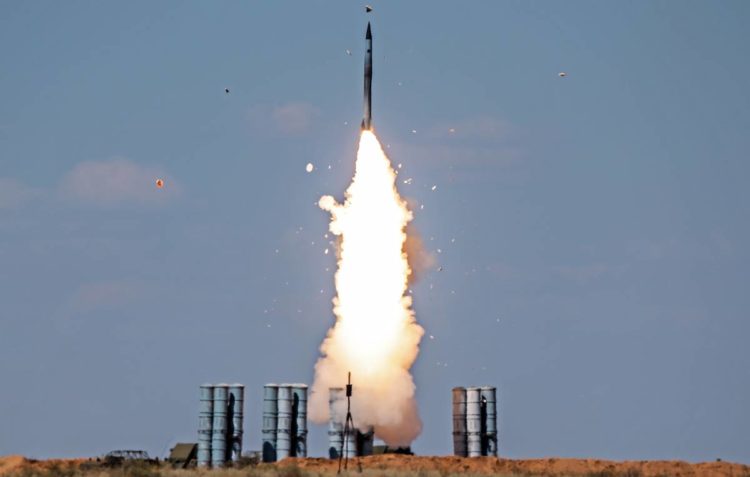
s-300 missile launch ground battery

The United States and Ukraine are working together to put fresh missiles into Ukraine's aging Soviet-era S-300 air defenses, retired US Army colonel Robert Hamilton told PBS NewsHour. These long-range systems shoot down aircraft, but the missiles that feed them have been depleted. The effort—retrofitting old rounds or building a newer variant—would revive launchers Ukraine already owns.

Ukraine's air defense runs on a shrinking supply of interceptors, with Russian ballistic and drone strikes outpacing what allies can ship. The chokepoint is production capacity, not willingness—and Hamilton frames the S-300 rebuild as one of the slower-burn fixes that ease the strain on scarce Western systems rather than replace them.

A working system near the end of 2026

Hamilton, who heads the Delphi Global Research Center, said the joint effort should come online near the end of 2026 and could turn out "100 or a couple of hundred" anti-aircraft missiles a year. He described the work as an effort to "essentially retrofit or upgrade the old S-300 missiles or a newer variant of the S-300" and give the system better capabilities.

blackouts donetsk
Explore further

Ukraine drones hit Crimea’s S-300/S-400 near Kerch—and knocked out power across four occupied territories overnight

In September 2024, then-US Defense Secretary Lloyd Austin announced at the Ramstein contact group that Washington, in partnership with several European companies, was working with Ukraine to "design and build a substitute" for the Soviet S-300 and the R-27 air-to-air missile used by fighter jets. He never spelled out what that substitute would be.

Why Ukraine's S-300s ran law

When Russia launched its full-scale invasion in 2022, Ukraine held roughly 25-30 S-300PT/PS battalions in varying states of readiness. As the missiles ran out, Kyiv came to lean on Western air defense systems and interceptors while Russia keeps launching mass strikes.

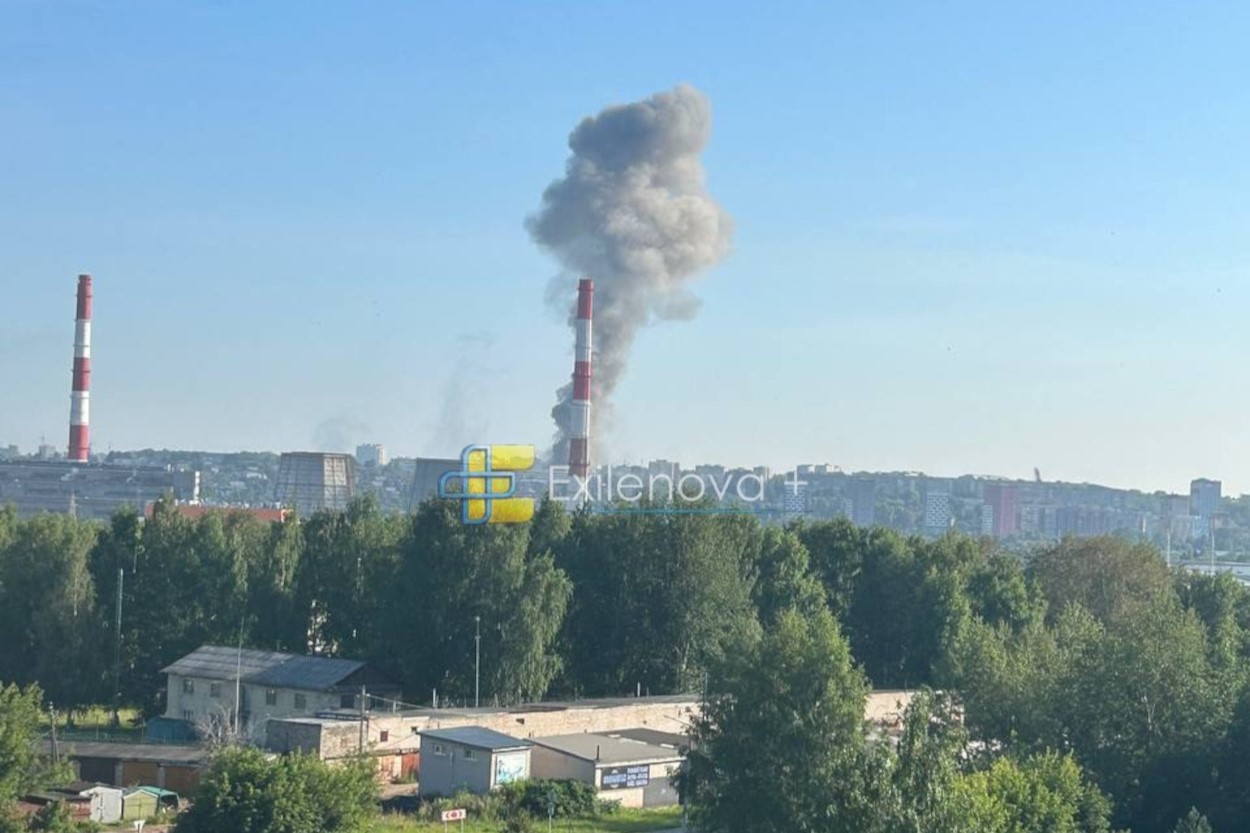
Smoke billows over Kirov, Russia, following a reported Ukrainian strike on the Avitek defense plant, 25 July 2026. Photo: Exilenova+
Explore further

“Very good results” – Wave of Ukrainian strikes across Russia and Caspian Sea overnight target warships, air defenses, logistics

Anything Ukraine can build or rebuild on its own soil is a supply that no foreign stockpile or political fight can cut off.

That same logic is pushing Kyiv toward co-producing Patriots with US firms and fielding its own ballistic interceptor—a race to turn air defense into a domestic industry before the next winter of strikes.

Russia covered its Pantsir-S1 in camouflage. Ukraine’s naval platforms delivered the drones that burned it

7 août 2026 à 06:29

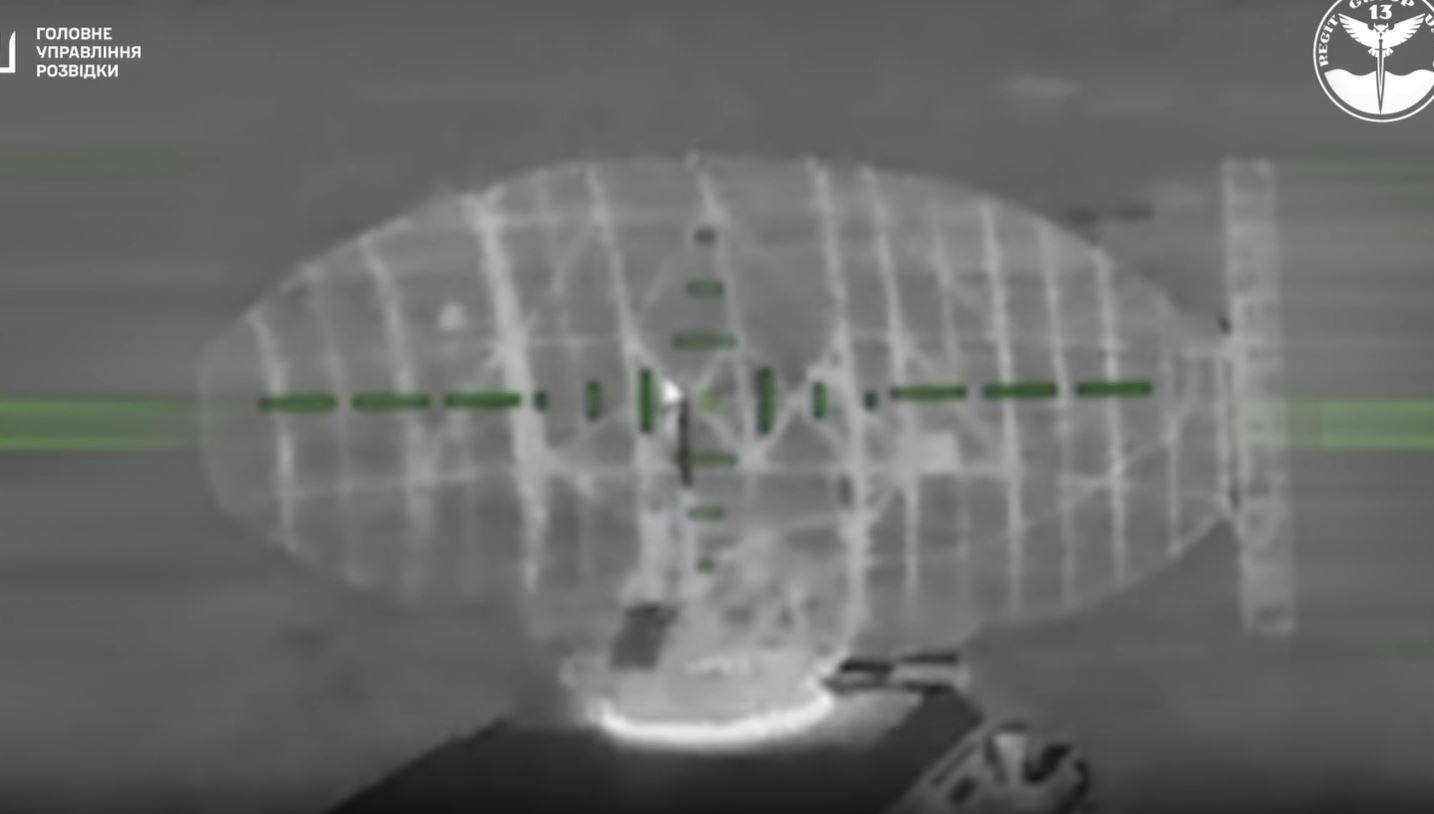
russia hid its pantsir under camouflage nets crimea · post russian pantsir-s1 air defense system covered occupied seen through drone targeting crosshairs moments before strike hur's group 13 early 2026

Ukraine's Main Directorate of Intelligence (HUR) destroyed a Pantsir-S1 air defense system worth an estimated $15 million and a military crane in occupied Crimea, HUR reported. The agency's Group 13 used maritime drones as drone carriers to deliver the strikes on ground targets. Separately, monitoring channels reported explosions across the peninsula from Kerch to Sevastopol overnight on 7 August, hitting the airfield Russia uses to launch Shaheds at Ukrainian cities.

The strikes on air defense run alongside a broader isolation campaign. Ukraine's drones have hit 201 shadow fleet vessels in three weeks, the Kerch Strait supply route is blocked indefinitely, and Ukraine's defense minister said the drone campaign is turning Crimea into an island. Earlier this week, the SBU damaged two FSB coast guard ships in Kerch that had been guarding the Crimean Bridge.

FPV drones launched from Magura platforms destroy air defense

HUR's Group 13 used Magura naval platforms as floating carriers for FPV drones. The drones flew from the platforms to strike a camouflaged Pantsir-S1 and a military crane on land, the agency's video shows. HUR estimated the destroyed air defense system at $15 million.

HUR did not specify the exact location but said the operation took place in early August 2026. The Pantsir-S1 is a short-range gun-and-missile system Russia deploys to protect higher-value assets such as S-400 batteries and command posts. Each one destroyed leaves a gap in the layered coverage Russia relies on over the peninsula.

The agency noted that Group 13 operators recently struck a Podlyot radar control vehicle and a Parol-4 radar interrogator in Crimea as well.

The Pantsir kill adds to a months-long campaign that has destroyed nearly 200 Russian air defense assets in the first half of 2026 alone by the Unmanned Systems Forces.

Overnight strikes sweep peninsula from Kerch to Sevastopol

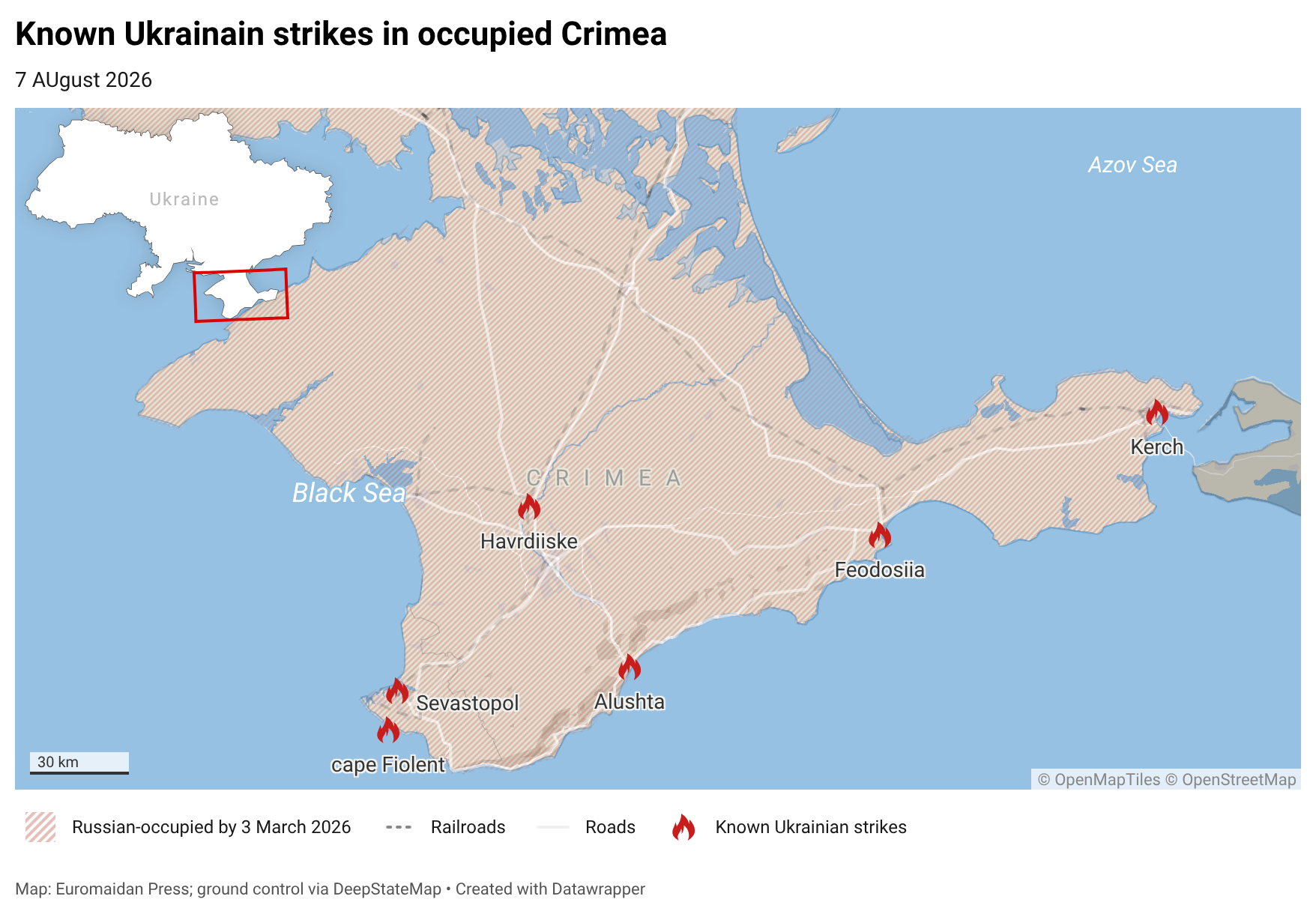
Separately, overnight on 7 August, Ukraine struck at least six locations across occupied Crimea.

Monitoring Telegram channel Krymsky Veter reported explosions and gunfire in Kerch at 02:38. Near Alushta, four strong explosions were heard in the village of Malorichenske close to a large power substation. In Sevastopol, mobile fire groups engaged targets without an air-raid alert, and residents reported a powerful explosion near Cape Fiolent.

two russian radars destroyed crimea one ukrainian sea drone never touched shore · post parol-4 radar interrogator part friend-or-foe identification system seen fpv moments before strike occupied late 2026 video
Explore further

Ukraine’s sea drone that never touched the shore struck two Russian radars in occupied Crimea

The heaviest strikes hit the Hvardiiske military airfield, which Russia uses to launch Shahed attack drones against Ukrainian cities. Hits landed in two waves, from 03:30 to 03:39 and from 04:34 to 04:47. A fuel and lubricants depot caught fire, and small-arms ammunition began detonating, Krymsky Veter reported. Residents described two fire sites visible for kilometers. The Crimean Bridge was temporarily closed during the strikes.

In Feodosia, initial reports of a strike on the oil depot were corrected: the hit likely landed on a concentration of Russian military equipment at the former 13th military compound on the Kerch Highway. Krymsky Veter noted the same compound was struck on 22 June. A vessel also burned at sea off Gelendzhik overnight.

No official confirmation of the strikes' results has been issued. 

❌