❌

Vue normale

  • ✇Euromaidan Press
  • Ukraine keeps finding ways to replace its MiG-29s. It’s running out of MiG-29s to find
    Ukraine has lost another Mikoyan MiG-29 fighter as well as its pilot The Ukrainian MiG fleet is slowly dwindling owing to combat losses and wear and tear The Ukrainian air force is acquiring new Western types to replace the MiGs and other ex-Soviet jets Ukraine has lost another Mikoyan MiG-29 fighter and its pilot. The Thursday shoot-down extends the steady attrition of the Ukrainian air force MiG fleet, potentially drawing down the fleet to its pre-war strength. That means
     

Ukraine keeps finding ways to replace its MiG-29s. It’s running out of MiG-29s to find

Par : David Axe
2 octobre 2026 à 18:09

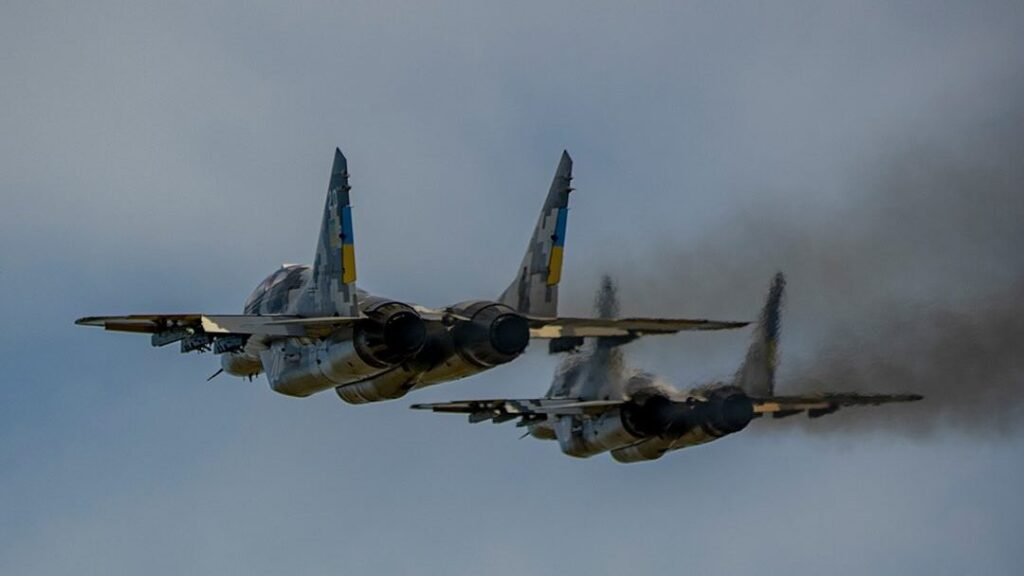
Ukrainian MiG-29s.

  • Ukraine has lost another Mikoyan MiG-29 fighter as well as its pilot
  • The Ukrainian MiG fleet is slowly dwindling owing to combat losses and wear and tear
  • The Ukrainian air force is acquiring new Western types to replace the MiGs and other ex-Soviet jets

Ukraine has lost another Mikoyan MiG-29 fighter and its pilot. The Thursday shoot-down extends the steady attrition of the Ukrainian air force MiG fleet, potentially drawing down the fleet to its pre-war strength.

That means Ukraine may have lost as many of the twin-engine, supersonic MiG-29s as it has received from its allies or restored from surplus stocks since February 2022.

It's an ominous milestone. The Soviet-vintage MiG-29 is no longer the Ukrainian air force's most important fighter. That honorific belongs to the air force's ex-European Lockheed Martin F-16s.

But the MiG-29 is still the air force's second most important fighter—and will remain so through 2027 as Ukraine awaits its first ex-Swedish Saab Gripens, due early next year, and French-made Dassault Rafales, due from 2028. Ukraine sorties MiG-29s for ground attack missions targeting Russian troop concentrations, strikes on Russian air defense systems, and air defense sorties over Ukrainian cities and ports.

Today, October 1, 2026, another Ukrainian defender fell in combat.

Flying a MiG-29 fighter jet, he carried out missile and bomb strikes against Russian occupiers along one of the front-line directions.

During the mission, his aircraft was hit by an enemy missile. The pilot… pic.twitter.com/3DC1VJAiWm

— Ukrainian Air Force (@KpsZSU) October 1, 2026

The air force announced the loss of the MiG-29 and its pilot, Capt. Marat Mambetov, shortly after it occurred on Thursday. Mambetov, 25, was a flight commander in the 40th Tactical Aviation Brigade, known as the "Ghost of Kyiv" brigade. "Flying a MiG-29 fighter jet, [Mambetov] carried out missile and bomb strikes against Russian occupiers along one of the front-line directions," the air force stated. "During the mission, his aircraft was hit by an enemy missile. The pilot ejected, but tragically did not survive."

It's the 37th confirmed combat loss of a Ukrainian MiG-29 since Russia widened its war on Ukraine in February 2022, according to a tally by the Oryx open-source intelligence collective. Oryx has also registered damage to an additional three Ukrainian MiG-29s.

Thirty-seven write-offs, plus the likely grounding of several previously flyable MiG-29s owing to intensive wear and tear since 2022, may have reduced the Ukrainian air force's MiG-29 fleet to around three dozen active jets.

Ukrainian Air Force MiG 29 of the 204th tactical aviation brigade making a low pass. Note the absence of 4 R-73 air to air missiles. And only a pair of R-27 missiles. pic.twitter.com/I07qKxO3Yw

— capt. Wild Bill Kelso (@_wild_billkelso) May 26, 2026

Fighter subtraction

The math is simple. The air force probably had between 30 and 35 MiG-29s in service when Russia attacked in February 2022. As losses cut into the fleet, Poland donated 14 surplus MiGs, Slovakia donated 10, and Azerbaijan reportedly donated three. Meanwhile, Ukrainian engineers tapped a global pipeline of spare parts to reactivate an estimated 20 grounded MiG-29s moldering in hangars at various Ukrainian airfields.

That's as many as 82 MiGs in and, as of Thursday, 37 out owing to Russian action—plus additional jets grounded due to airframe fatigue. The resulting active fleet should number around three dozen planes, around as many as Ukraine had on the eve of the wider war.

There aren't many more old MiGs that Ukraine could obtain to bolster the fleet. Poland still has as many as nine very tired airframes, but Kyiv and Warsaw have consistently failed to negotiate a transfer. There may yet be a few ex-Soviet MiG-29s, grounded for years or even decades, that Ukrainian engineers can restore to flightworthy status. Other than that, options are scarce.
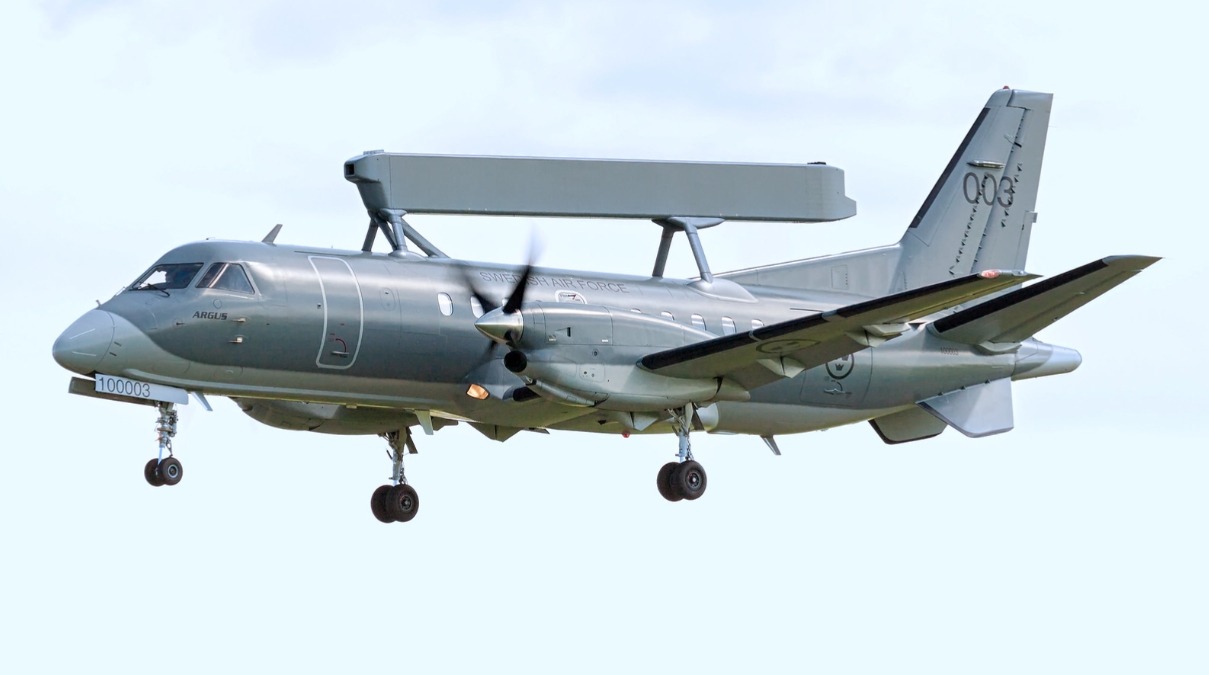
ukraine receive swedish asc 890 early warning aircraft after f-16 modifications airborne control (aew&c) saab 340 news ukrainian reports
Explore further

Ukraine’s Swedish radar planes have flown inside Russian missile range for six months. None has been shot down.

The three dozen MiGs still in the inventory may have to last a little while alongside the few survivors of Ukraine's other Soviet-vintage warplanes, including Sukhoi Su-27s, Sukhoi Su-24s, and Sukhoi Su-25s.

Older Western types—the 80 or so F-16s European allies have pledged, about half delivered, as well as potentially a dozen or so ex-French Dassault Mirage 2000s—are steadily replacing the ex-Soviet jets. (So far, Ukraine has lost five F-16s and one Mirage.) Next year, the transformation of the Ukrainian air force from a largely Soviet-equipped force to a largely Western-equipped force will accelerate when the first of 32 Gripens arrive. Sixteen Rafales are to follow from 2028.

Barring catastrophic combat losses among Western types and assuming Ukraine can maintain and arm these new warplanes, by the end of 2027, the air force may not need its remaining MiGs and Sukhois, which by then could be very tired.

Russian missiles are steadily reducing the MiG and Sukhoi fleets, effectively forcing Ukraine to switch to new types.

Russia repeatedly attacks bridge connecting Kyiv’s two sides across the Dnipro river, disrupting transport across the capital

2 octobre 2026 à 10:34

Damage to Kyiv's Southern Bridge connecting the left and right banks of the city following several Russian drone strikes on 1-2 October, 2026. Photo: Ukraine's State Emergency Service

Russian forces have repeatedly struck Kyiv’s Southern Bridge with drones since 1 October, disrupting one of the capital’s main routes between the left and right banks of the Dnipro.

The strikes are part of a broader intensification of Russian drone attacks on the capital. In recent weeks, Russia has begun launching daily attacks involving jet-powered Geran drones, increasingly disrupting everyday life in Kyiv.

The Southern Bridge is an important road and rail crossing over the Dnipro. It carries road traffic between Kyiv's left and right banks and also forms part of the city's metro network.

The bridge was fully closed to traffic following the latest attacks, while restrictions were also introduced on the Metro and Paton bridges, according to Suspilne. Public transport has been diverted to alternative routes, while the disruptions have caused major traffic congestion across Kyiv.

Update 17:50: Kyiv Mayor Vitali Klitschko said Russian forces have struck the Southern Bridge again on the evening of 2 October. The bridge remains closed to road traffic and metro services following several previous attacks. Emergency services are heading to the site.

Bridge targeted repeatedly

The Southern Bridge came under attack multiple times on 1 October and was targeted again during the overnight attack into 2 October.

Ukrainian President Volodymyr Zelenskyy said Russian forces struck the bridge several times with drones during the night. He said the attacks were part of a larger Russian barrage involving more than 100 attack drones, nearly 50 of them jet-powered Gerans.

The bridge has not been destroyed, but the repeated strikes have forced authorities to limit its use and reorganize traffic across the Dnipro.

Ukrainian analyst Andrii Kovalenko said the Southern Bridge is difficult to destroy with the weapons Russia is using. However, he said such strikes can damage the bridge enough to disrupt its normal operation, while the resulting disruption can also be used to spread panic.

Russia’s repeated strikes on Kyiv’s Southern Bridge are now severely disrupting traffic across the capital.

Major roads are gridlocked, with some people reportedly walking across bridges as traffic comes to a standstill. Photos from Suspilne show the resulting congestion on… pic.twitter.com/7SyYG0WOCO

— Euromaidan Press (@EuromaidanPress) October 2, 2026

Zelenskyy: Russia is targeting bridges and critical infrastructure

Zelenskyy said Russia's intensified attacks are part of a broader effort to disrupt life in Ukrainian cities and damage infrastructure beyond individual military targets.

Citing Ukrainian intelligence and people he said are close to Russian President Vladimir Putin, Zelenskyy claimed Putin said in early September: “Now, there are no rules.” Zelenskyy said Russia had failed to occupy Ukraine and was therefore turning to mass attacks and killings.

“They want to destroy our bridges and, as we understand it, our data centers, internet, mobile networks, hospitals, kindergartens, schools, universities – everything,” Zelenskyy said.

He added that Russia wants to force Ukrainians to leave their cities. “They want people to flee their cities, and we need to do everything to save our people and our cities,” he said.

A key crossing for Kyiv disrupted

The bridge’s closure puts additional pressure on the capital's other bridges. On 2 October, traffic on the Metro Bridge was restricted to one lane toward the right bank, while traffic from the right bank toward the left was restricted on the Paton Bridge.

Several bus routes were diverted to other bridges. Kyiv authorities reported major traffic jams on the city's main roads as the restrictions disrupted normal movement between the two sides of the capital.

Metro service across the Southern Bridge also remains tied to an assessment of the structure. Kyiv Mayor Vitali Klitschko said on Friday the metro can resume crossing the bridge during yellow-level air alerts after experts provide an assessment confirming its condition.

Part of a wider campaign against Kyiv

The bridge strikes came alongside attacks on civilian areas of Kyiv. A Russian drone hit the upper floors of a 25-story residential building in the Darnytskyi district on 2 October, causing a fire on the 24th and 25th floors.

One person was killed and two were injured. The attack also damaged buildings and vehicles in the Holosiivskyi district.

A Russian drone struck a 25-story residential building in Kyiv’s Darnytskyi district this morning.

According to President Volodymyr Zelenskyy, Russia launched more than 100 attack drones at Ukraine overnight, including nearly 50 jet-powered drones.

In Kyiv, the strike caused a… pic.twitter.com/jiGjJeUgVf

— Euromaidan Press (@EuromaidanPress) October 2, 2026

The growing frequency of jet-powered Geran attacks is making the impact of Russian strikes increasingly visible beyond individual damage sites. Repeated attacks on infrastructure such as the Southern Bridge can disrupt transportation and daily routines across the capital even when the targeted structures are not destroyed.

Drones hit Russia’s Volgograd and Samara overnight—fires near a Lukoil refinery, a chemical plant, and likely Europe’s largest oil tank farm in Samara

2 octobre 2026 à 04:47

drones hit russia's volgograd samara overnight—fires near lukoil refinery chemical plant likely europe's largest oil tank farm · post fire area kaustik russia 2 2026 пожежа ймовірно в районі волгоградського

Drones attacked Russia's Volgograd and Samara oblasts overnight on 2 October, sparking fires near an oil refinery, a chemical plant, and likely a major oil-transport hub, Ukrainian and Russian monitoring channels reported. Regional officials acknowledged the attack but not the fires, and the extent of any damage remains unconfirmed.

Explosions and a glow over Volgograd's refinery district

Explosions sounded for a long time in Volgograd itself and around the refinery's industrial zone, Ukrainian Telegram channel Exilenova+ wrote.

Residents reported drones flying over and blasts "in all districts of the city," and complained that no air raid alert sounded, Russian news Telegram channel Astra reported. Its OSINT analysis of eyewitness footage placed the glow near the Lukoil refinery and the neighboring Kaustik chemical plant, though the available videos do not show which facility caught fire.

Volgograd Oblast Governor Andrei Bocharov claimed a "massive drone attack" on the region's industrial infrastructure. He mentioned a fire in an apartment building and one person hospitalized, but no fires at plants.

Lukoil-Volgogradneftepererabotka is one of Russia's largest refineries. It processes 14.8–15.7 million tons of crude a year, about 5% of Russia's refining, and makes gasoline, diesel, jet fuel, fuel oil, and bitumen, according to Astra.

lukoil’s norsi refinery in kstovo, nizhny novgorod oblast
Explore further

Fifth drone-related NORSI shutdown in under five months leaves all major Lukoil refineries offline

Drones have hit the plant repeatedly. In May 2025, strikes damaged its ELOU-AVT-1 and ELOU-AVT-6 primary processing units. A 29 May 2026 strike halted production at the plant, about 500 km east of the war zone, Ukraine's General Staff said. On 31 July, drones set the refinery ablaze again, and Astra reported the AVT-1 and AVT-6 units stopped.

Kaustik sits in Volgograd's southern Krasnoarmeysky district. It is one of the region's leading plants and makes basic chemicals with dual civilian and military use, Astra wrote. The outlet called that output critical to Russia's military industry. The plant runs chlor-alkali production built on salt electrolysis. It makes hydrochloric acid, plastics, synthetic resins, and industrial gases, according to OSINT-Varta. Such products can serve military industry too, including polymer parts and protective coatings for hardware, Militarnyi noted.

Europe's largest tank farm likely on fire near Samara

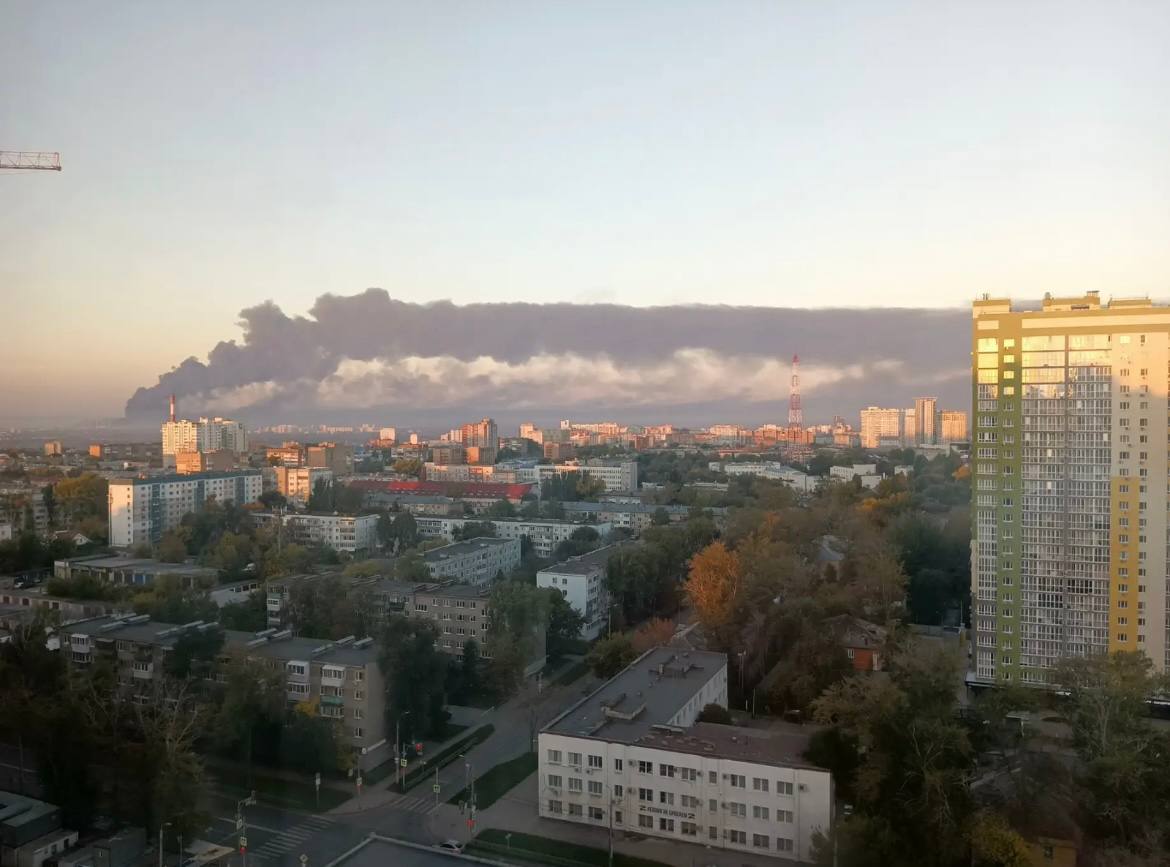
Explosions also rocked Samara, with an especially strong one around 06:30, Astra reported. Its OSINT expert linked reader photos to a fire at the Samara linear production dispatch station in the settlement of Prosvet.

Ukrainian monitoring channel Supernova+ shared video of thick black smoke on the horizon and reported a fire at the station. Exilenova+ reported explosions in Samara followed by a fire.

The station belongs to Transneft, Russia's state pipeline operator. It covers more than 216 hectares and holds 71 tanks with a combined capacity of over 1.6 million m³ of crude. Astra called it Europe's largest tank farm.

Four trunk pipelines converge there, carrying oil from Western Siberia, Tatarstan, Orenburg Oblast, and Kazakhstan. The station blends high- and low-sulfur crude into Urals, Russia's flagship export grade, according to Militarnyi.

Samara authorities did not comment on the fire. Mayor Ivan Noskov stated only that ground public transport was suspended. Samara Oblast Governor Vyacheslav Fedorishchev did not report an attack at all.

The station has been hit before. Operators of the 14th Regiment of Ukraine's Unmanned Systems Forces struck it again overnight on 23 September 2025. On 21 April 2026, drones of the Security Service of Ukraine's Alfa special operations center hit it, reportedly damaging five crude tanks of about 20,000 m³ each.

one refinery night moscow ufa now samara—ukraine working through russia's fuel chain · post smoke plume burning kuibyshev stretching across samara skyline 22 2026 exilenova 5877644049043362820 ukraine news ukrainian reports
Explore further

Ukraine shut down this Samara refinery in June—now its drones are back, and both distillation units are burning again

Ukraine's long-range drones have already pushed Russia's fuel shortages into Central Asia, and Washington has pressed Kyiv to stop, so every hit on processing or export logistics tests how long oil can fund Moscow's war.

❌