❌

Vue normale

  • ✇Euromaidan Press
  • Denmark rushes 50,000 cannon rounds to Ukraine to help F-16s hunt Russia’s advanced jet drones
    Ukraine has received more than 50,000 rounds of 20-mm ammunition from Denmark for the onboard cannons of its F-16 fighter jets, with Ukrainian pilots already using the rounds to intercept Russian jet-powered Geran attack drones, Ukraine’s Defense Ministry said. The accelerated delivery addresses a key need in Ukraine’s air defense as Russia increasingly deploys faster jet-powered drones that challenge conventional interceptors. Ukraine has also relied on F-16 cannons when stocks of air-
     

Denmark rushes 50,000 cannon rounds to Ukraine to help F-16s hunt Russia’s advanced jet drones

23 octobre 2026 à 12:07

A Ukrainian air force F-16.

Ukraine has received more than 50,000 rounds of 20-mm ammunition from Denmark for the onboard cannons of its F-16 fighter jets, with Ukrainian pilots already using the rounds to intercept Russian jet-powered Geran attack drones, Ukraine’s Defense Ministry said.

The accelerated delivery addresses a key need in Ukraine’s air defense as Russia increasingly deploys faster jet-powered drones that challenge conventional interceptors. Ukraine has also relied on F-16 cannons when stocks of air-to-air missiles are limited, making ammunition supplies important to keeping the aircraft effective against incoming aerial threats.

Denmark responds to ammunition request

The Defense Ministry thanked Denmark for responding quickly to Ukraine’s request for additional ammunition, saying the delivery directly strengthens the country’s air defenses and helps protect civilians from Russian aerial attacks.

The delivery follows a broader effort by Ukraine’s European partners to replenish F-16 cannon ammunition. On October 2, it was reported that Spain, Belgium, and Poland were also sending 20-mm rounds for Ukrainian F-16s to counter Russia’s jet-powered drones.

Belgium is also expanding its support for Ukraine’s F-16 fleet. On 16 October, Belgian Prime Minister Bart De Wever pledged to deliver 10 F-16s by the end of 2026, up from three previously planned, and discussed supplying additional ammunition, including 20-mm rounds produced by Belgian defense company FN Herstal.

Jet-powered drones pose a growing challenge

Russia’s faster attack drones are harder to intercept than older, propeller-driven Shahed-type models. Their speed gives air defenders less time to respond and makes them more difficult for many interceptor drones and conventional short-range weapons to catch.

Ukraine’s air-to-air missile shortages have also increased the importance of F-16 cannon ammunition. Ukrainian pilots have sometimes relied on their aircraft’s built-in 20-mm cannon when air-to-air missiles are scarce.
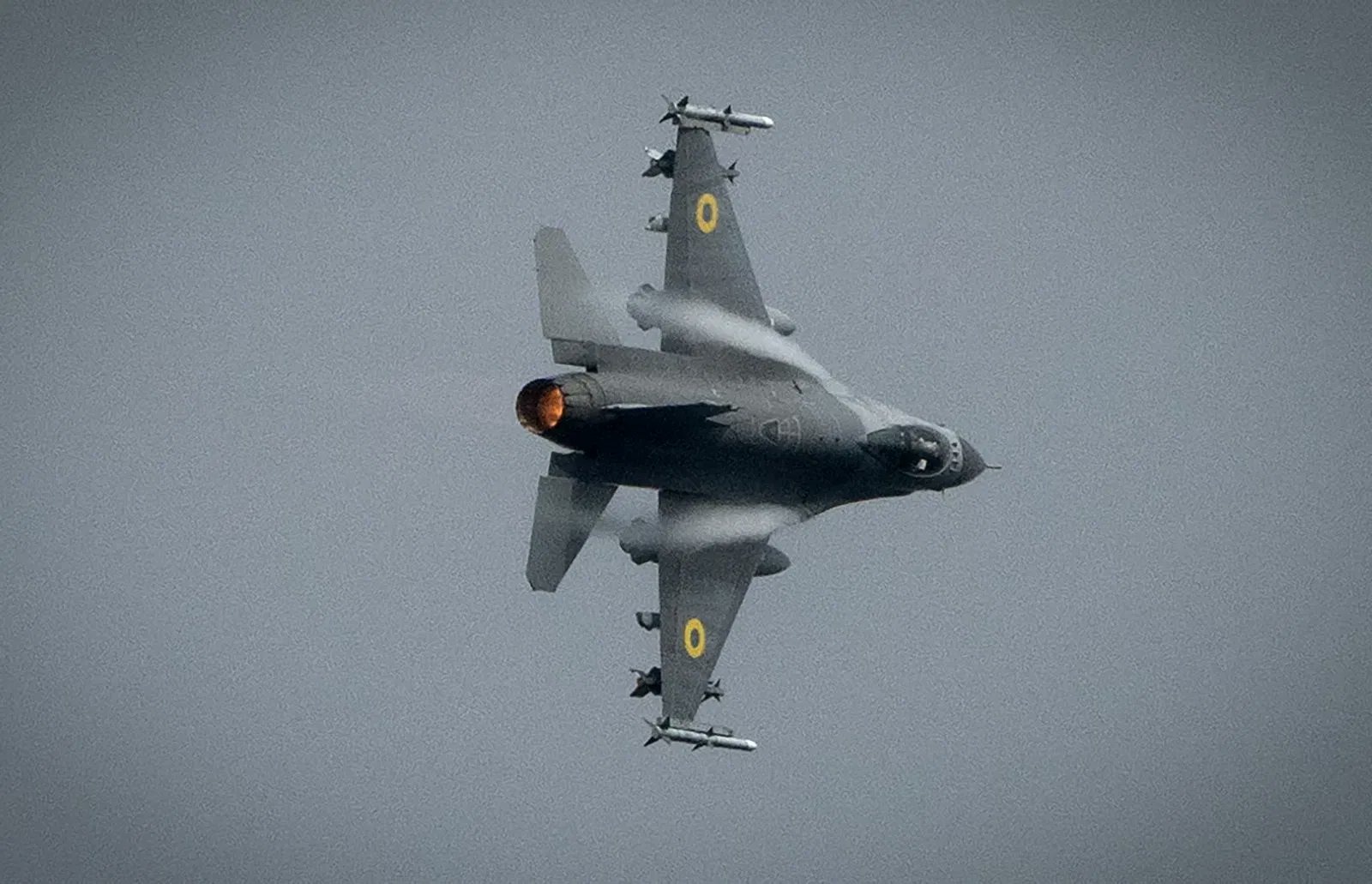
A Ukrainian air force F-16.
Explore further

Ukraine’s F-16s are so short of Western missiles that pilots fall back on jet’s built-in M61A1 Vulcan cannon, which risks killing civilians below

The threat from jet-powered drones is growing. Ukrainian President Volodymyr Zelenskyy said in late September that Ukraine was intercepting about 55% of Russia’s jet-powered drones, compared with more than 90% of older models.

Denmark’s ammunition delivery gives Ukrainian F-16 pilots more rounds to engage these faster targets, as Ukraine works to strengthen its defenses against Russia’s expanding drone campaign.

Russia equips Geran attack drones with image-based navigation using Google map imagery, reducing reliance on satellite navigation that Ukraine can jam, defense adviser warns

11 octobre 2026 à 09:01

Ukrainian defense technology adviser Serhii “Flash” Beskrestnov works near the front line monitoring Russian drone signals. Photo: Serhii “Flash” Beskrestnov

Russia is developing new navigation systems for attack drones and missiles that could make its strikes against Ukrainian cities harder to stop, as Moscow adapts its weapons to counter Ukrainian electronic warfare defenses, Ukrainian defense technology adviser Serhii “Flash” Beskrestnov said.

The shift poses an additional challenge for Ukraine as Russia continues to attack cities and critical infrastructure with drones and missiles. Systems that can navigate without relying on satellite signals may be harder to disrupt electronically, increasing the importance of other defenses, including interception and physical destruction of incoming weapons.

Image-based navigation could make Russian strike drones harder to jam

Beskrestnov, an adviser to the Ukrainian president on defense technology development, said image-based navigation systems would see wider use in 2027, including in medium- and long-range strike drones and inexpensive cruise missiles.

The technology allows drones to navigate by comparing images captured by an onboard camera with stored photographs of the terrain. Even basic navigation can use publicly available satellite or ground imagery from services such as Google, Beskrestnov said.

Unlike satellite navigation, which can be disrupted by electronic warfare, image-based navigation relies on visual recognition of the terrain. This makes drones using the technology more resistant to jamming and could allow them to continue toward their targets even when satellite navigation signals are unavailable.

Russia already uses image-based navigation on attack drones

Beskrestnov said Russian forces were already using the technology on several types of unmanned aircraft, including Molniya, V2U, and Lancet drones.

He also reported that similar systems had recently been identified on the Russian Geran-4 and Geran-5 attack drones, using a flight controller called Susanin.

The Geran series includes Russian attack drones used in strikes against Ukrainian cities and infrastructure. The introduction of image-based navigation could make some variants more difficult for Ukrainian forces to counter using electronic warfare.

Russia adapts its weapons to Ukrainian defenses

The development reflects Russia’s broader effort to adapt its weapons as Ukraine improves its air defenses and electronic warfare capabilities. By reducing reliance on satellite navigation signals, Russian drones can become less vulnerable to one of Ukraine’s key methods of disrupting incoming attacks.

Beskrestnov warned that image-based navigation would expand beyond individual drone models, with broader adoption expected next year across different categories of strike weapons.

Russia repeatedly attacks bridge connecting Kyiv’s two sides across the Dnipro river, disrupting transport across the capital

2 octobre 2026 à 10:34

Damage to Kyiv's Southern Bridge connecting the left and right banks of the city following several Russian drone strikes on 1-2 October, 2026. Photo: Ukraine's State Emergency Service

Russian forces have repeatedly struck Kyiv’s Southern Bridge with drones since 1 October, disrupting one of the capital’s main routes between the left and right banks of the Dnipro.

The strikes are part of a broader intensification of Russian drone attacks on the capital. In recent weeks, Russia has begun launching daily attacks involving jet-powered Geran drones, increasingly disrupting everyday life in Kyiv.

The Southern Bridge is an important road and rail crossing over the Dnipro. It carries road traffic between Kyiv's left and right banks and also forms part of the city's metro network.

The bridge was fully closed to traffic following the latest attacks, while restrictions were also introduced on the Metro and Paton bridges, according to Suspilne. Public transport has been diverted to alternative routes, while the disruptions have caused major traffic congestion across Kyiv.

Update 17:50: Kyiv Mayor Vitali Klitschko said Russian forces have struck the Southern Bridge again on the evening of 2 October. The bridge remains closed to road traffic and metro services following several previous attacks. Emergency services are heading to the site.

Bridge targeted repeatedly

The Southern Bridge came under attack multiple times on 1 October and was targeted again during the overnight attack into 2 October.

Ukrainian President Volodymyr Zelenskyy said Russian forces struck the bridge several times with drones during the night. He said the attacks were part of a larger Russian barrage involving more than 100 attack drones, nearly 50 of them jet-powered Gerans.

The bridge has not been destroyed, but the repeated strikes have forced authorities to limit its use and reorganize traffic across the Dnipro.

Ukrainian analyst Andrii Kovalenko said the Southern Bridge is difficult to destroy with the weapons Russia is using. However, he said such strikes can damage the bridge enough to disrupt its normal operation, while the resulting disruption can also be used to spread panic.

Russia’s repeated strikes on Kyiv’s Southern Bridge are now severely disrupting traffic across the capital.

Major roads are gridlocked, with some people reportedly walking across bridges as traffic comes to a standstill. Photos from Suspilne show the resulting congestion on… pic.twitter.com/7SyYG0WOCO

— Euromaidan Press (@EuromaidanPress) October 2, 2026

Zelenskyy: Russia is targeting bridges and critical infrastructure

Zelenskyy said Russia's intensified attacks are part of a broader effort to disrupt life in Ukrainian cities and damage infrastructure beyond individual military targets.

Citing Ukrainian intelligence and people he said are close to Russian President Vladimir Putin, Zelenskyy claimed Putin said in early September: “Now, there are no rules.” Zelenskyy said Russia had failed to occupy Ukraine and was therefore turning to mass attacks and killings.

“They want to destroy our bridges and, as we understand it, our data centers, internet, mobile networks, hospitals, kindergartens, schools, universities – everything,” Zelenskyy said.

He added that Russia wants to force Ukrainians to leave their cities. “They want people to flee their cities, and we need to do everything to save our people and our cities,” he said.

A key crossing for Kyiv disrupted

The bridge’s closure puts additional pressure on the capital's other bridges. On 2 October, traffic on the Metro Bridge was restricted to one lane toward the right bank, while traffic from the right bank toward the left was restricted on the Paton Bridge.

Several bus routes were diverted to other bridges. Kyiv authorities reported major traffic jams on the city's main roads as the restrictions disrupted normal movement between the two sides of the capital.

Metro service across the Southern Bridge also remains tied to an assessment of the structure. Kyiv Mayor Vitali Klitschko said on Friday the metro can resume crossing the bridge during yellow-level air alerts after experts provide an assessment confirming its condition.

Part of a wider campaign against Kyiv

The bridge strikes came alongside attacks on civilian areas of Kyiv. A Russian drone hit the upper floors of a 25-story residential building in the Darnytskyi district on 2 October, causing a fire on the 24th and 25th floors.

One person was killed and two were injured. The attack also damaged buildings and vehicles in the Holosiivskyi district.

A Russian drone struck a 25-story residential building in Kyiv’s Darnytskyi district this morning.

According to President Volodymyr Zelenskyy, Russia launched more than 100 attack drones at Ukraine overnight, including nearly 50 jet-powered drones.

In Kyiv, the strike caused a… pic.twitter.com/jiGjJeUgVf

— Euromaidan Press (@EuromaidanPress) October 2, 2026

The growing frequency of jet-powered Geran attacks is making the impact of Russian strikes increasingly visible beyond individual damage sites. Repeated attacks on infrastructure such as the Southern Bridge can disrupt transportation and daily routines across the capital even when the targeted structures are not destroyed.

❌