Gov. Mike Braun called on the local utility to “match the urgency” of Gary area residents who have had to endure an outage approaching its second week.
Floods from powerful thunderstorms devastated Gary, where a third of residents live below the poverty line and full restoration isn’t expected until next week.
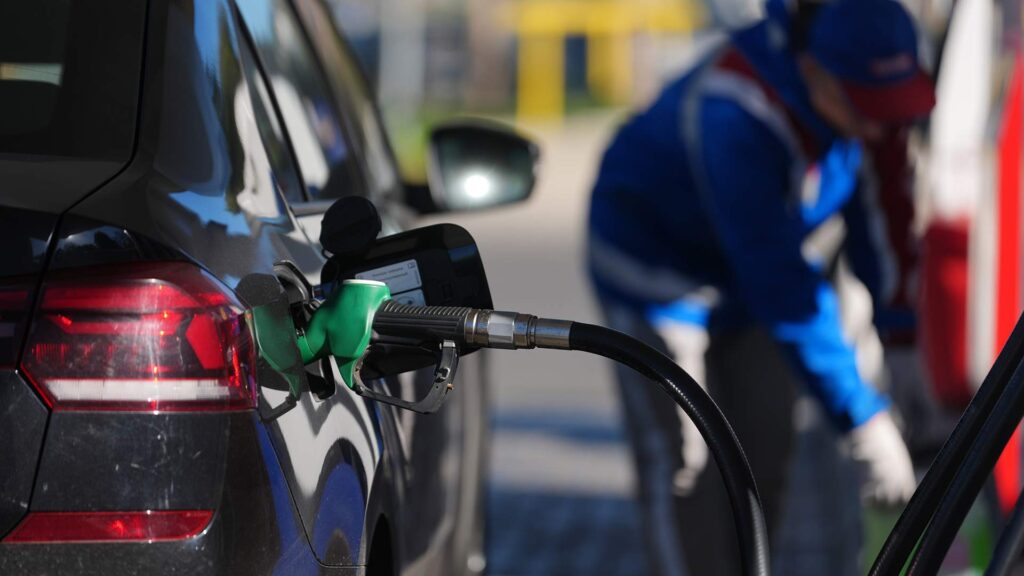
Gasoline prices have risen roughly 10–13% in Tajikistan, Kyrgyzstan, and Uzbekistan as Russia restricts exports after Ukrainian strikes on its refineries, Kazakh economist Aidar Alibayevestimated in a 20 August interview with Current Time. He did not specify the comparison period.
Earlier Ukrainian attacks disrupted Kazakhstan’s crude exports through Russia’s Black Sea ports. Strikes at refineries are creating a different kind of squeeze: Russia has less gasoline available to dependent neighbors. Tajikistan and Kyrgyzstan are seeking other suppliers, while Kazakhstan could face growing pressure if the shortages persist.
Tajikistan has been hit hardest because it depends heavily on Russian fuel and has the region’s most difficult delivery routes, Alibayev said. He estimated gasoline prices there had risen 12–13%. Current Time reported that Tajikistan is exploring supplies from China; Alibayev said it was also turning to Iran.
Kyrgyzstan, which sources more than 90% of its gasoline from Russia, asked its neighbors, Azerbaijan and Kazakhstan, as well as other countries, for help. Current Time reported that a deputy prime minister said its reserves would last about six weeks. Alibayev estimated prices had climbed around 10%, compared with 11–11.5% in Uzbekistan, which he estimated gets half its fuel from Russia.
In Uzbekistan, Alibayev estimated that fuel prices had risen by about 11% and said the country gets about half of its fuel from Russia.
Russia extended its gasoline and diesel export restrictions through 31 January 2027 as shortages mounted. Intergovernmental and humanitarian shipments remain exempt, while diesel producers regain some export rights from 1 September. Current Time also reported that Russian companies had begun buying gasoline from Belarus.
Kazakhstan is better insulated than its neighbors because its refineries in Atyrau, Shymkent, and Pavlodar produce enough fuel to meet most domestic demand, Alibayev noted. Motorists from Russia and neighboring states are crossing its borders to refuel. He attributed Kazakhstan’s price rises mainly to domestic taxes and the end of an export moratorium—not Russia’s shortage alone.
Central Asia looks for routes beyond Russia as war drags on
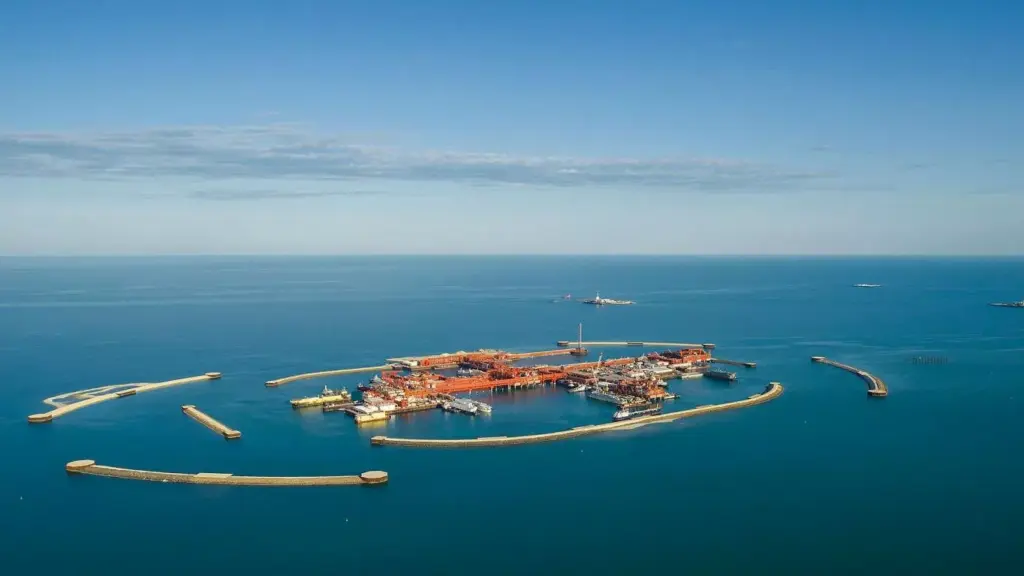
Kashagan oil field near Atyrau. CPC disruptions have prompted Kazakhstan to reroute crude to China. Map: Euromaidan Press / Datawrapper
At an informal summit of Central Asian leaders in Cholpon-Ata in early August, Tajik President Emomali Rahmon proposed building a refinery to serve the whole region. For now, Alibayev said, the decisive factor is how long Russia’s troubles last: the longer Ukraine’s strikes continue, the more they will weigh on prices across Central Asia.
Gasoline was available at 28% of Russian gas stations last week, down from 41% the week before—despite a July government decree that authorized refineries to divert chemicals from industry, including defense production, into fuel, Izvestia reported on 18 August.
The diversion has since triggered motor oil shortages, and, as Kommersant reported, a government commission that met in mid-August to reverse course could not agree on how.
The ISW assessed on 19 August that the diversion is now draining raw materials from industrial supply chains.
Moscow runs dry
Izvestia correspondents checked 21 stations in Moscow and Moscow Oblast on 17 August: only seven sold AI-92, and five sold AI-98. Gazprom Neft has reimposed purchase limits—40 liters at automated pumps, 60 at staffed ones, RBC reported on 19 August.
Russia has meanwhile received a tanker of Indian gasoline in Murmansk, initially priced at 130,000 rubles ($1,550) per ton—nearly double the 73,000-ruble ($870) domestic exchange price, Izvestia reported.
The chemicals in question—benzene, toluene, xylenes, and phenol—are intermediate refinery products used to make rubbers, plastics, and synthetic materials for industry, including defense. A 2 July decree authorized refineries to blend more of them into gasoline as an octane booster. The ISW assessed on 19 August that the diversion is now draining raw materials from industrial supply chains.
Motor oil shows the damage. Prices have risen 15–20% since January, with some products up 40% and imported brands roughly doubling, Kommersant reported on 19 August.
Dmitry Prokofiev, director of external communications at NEFT Research, told the paper that the lower-grade Euro-2 and Euro-3 fuel now at Russian stations wears engines faster and requires oil changes 1.5 to 2 times more frequently.
Drivers forced onto worse gasoline burn through motor oil faster, but the raw materials that would go into producing it are being diverted to make more gasoline.
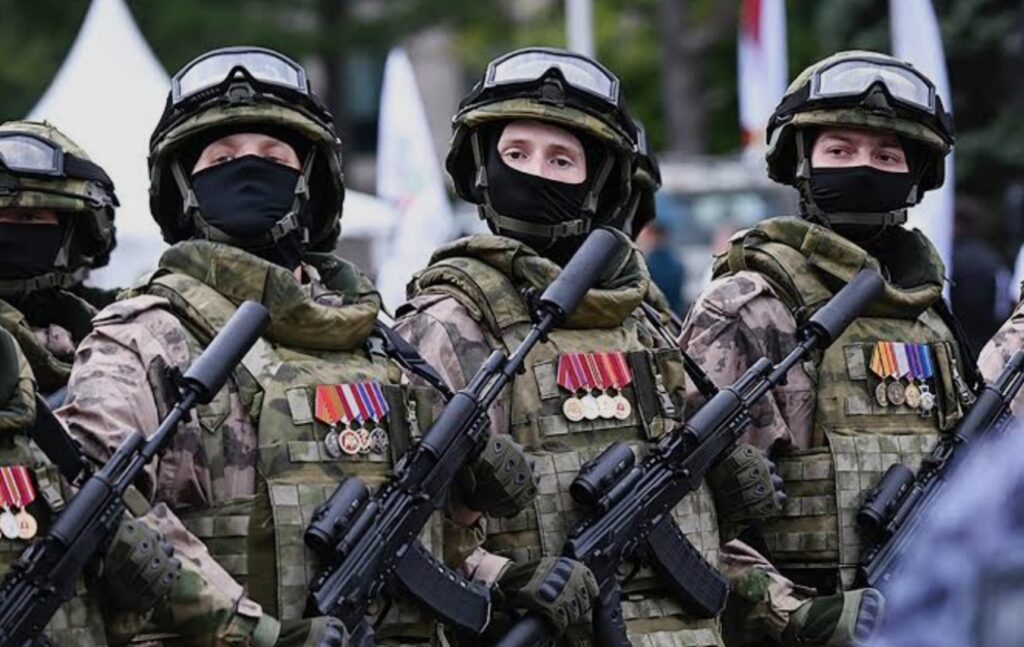
Rosgvardia personnel in combat uniforms march during an event marking the Russian force’s 10th anniversary. Photo: Rosgvardia / rg.ru.
From rationing to Rosgvardia
A Russian insider source cited by ISW claimed on 18 August that Rosgvardia—Russia’s heavily militarized internal security force—has deployed to gas stations in Moscow Oblast.
Rosgvardia personnel have reportedly appeared at no fewer than 13 stations across Russia and occupied Crimea over the summer.
A month ago, the governor of Rostov Oblast did something similar, sending Cossacks and volunteers to gas stations to keep order.
Explore further
Russia’s fuel crisis has moved from the pump to the harvest
Separately, Russia’s legislative commission approved a bill on 18 August authorizing rescue forces under the Ministry of Emergency Situations to use physical force and firearms when nonviolent means prove insufficient, Vedomosti reported.
United Russia deputy Anatoly Vyborny, one of the bill’s co-authors, framed the measure as a counter-drone tool for evacuations. ISW assessed that it also provides legal cover for suppressing domestic unrest—an assessment the institute linked to involuntary mobilization reportedly under consideration after September’s State Duma elections.
Africans have turned to one of their own for fuel as the world’s supplies run low. But they are not the only ones with the continent’s richest man on speed dial.
Entry-level employers are finding it harder—and more expensive—to recruit young men. On Work.ua, one of Ukraine’s largest job platforms, the number of male candidates aged 18 to 22 who responded to vacancies fell 19% between July 2025 and July 2026, Lesia Prymakova told Ukrainska Pravda. The decline reached 29% in hospitality and retail.
At the same time, advertised entry-level pay moved close to Work.ua’s overall median. The median salary for vacancies open to students rose 24%, while pay for jobs requiring no experience increased 23%.
No reliable count shows how many young men remained abroad.
The candidate pool shrank after the government eased wartime travel restrictions for men aged 18 to 22 last summer, following an initiative by President Volodymyr Zelenskyy. The government said the change was intended to discourage families from taking boys abroad before their 18th birthdays, when the previous rules would have prevented them from leaving.
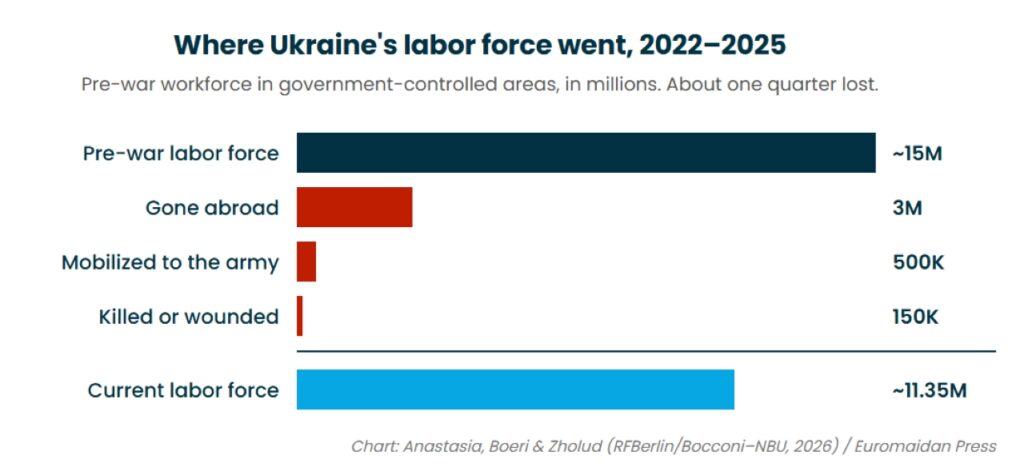
Ukraine’s pre-war labor force has shrunk by about a quarter. Three million went abroad, hundreds of thousands more to the front. What remains is older. Chart: Anastasia, Boeri & Zholud (RFBerlin/Bocconi–NBU, 2026) / Euromaidan Press
Hospitality and retail feel the squeeze
Restaurant owners tied the decline in young applicants directly to the eased travel rules. Sommelier Oleh Kravchenko, who owns Kyiv wine bar Win Bar, said two of his staff, a bartender and a cook, were preparing to leave the country, and that the bar had begun hiring more women, whereas server positions had earlier been held only by men.
He said his payroll had risen 5 to 10% and that he now raised wages at least every six months, even as rent, utilities, and food costs also climbed. Olena Borysova, who owns the GastroFamily group behind the Bilyi Naliv chain, said young applicants had become rare over the past year.
Ukraine’s labor shortage extends far beyond this age group. Ukraine’s full-time workforce fell from 7 million in 2021 to 5.3 million by late 2025, while the National Bank expects the net outflow of workers to continue into 2027.
Explore further
Ukraine’s economy posted its sharpest contraction since the wartime recovery began
Against that backdrop, 48% of companies reported labor shortages in a survey cited by Ukrainska Pravda, without attributing them specifically to the travel change, and Work.ua put the overall median advertised wage up 20% year on year. These are nominal advertised salaries; annual inflation stood at 7.7% in July, so the real increase is smaller.
No one knows how many stayed abroad
No reliable count shows how many young men remained abroad. Social Policy Minister Denys Uliutin cited an estimate from European partners that some 400,000 men aged 18 to 22 left Ukraine between August 2025 and April 2026. However, the estimate does not identify unique individuals or subtract those who later returned, Vasyl Voskoboinyk, head of the NGO Office of Migration Policy, told Ukrainska Pravda.
Voskoboinyk estimated that around 300,000 men in this age group had been working, equivalent to about 2% of Ukraine’s labor force, and said their departures had not caused a broader labor-market collapse.
Available education data show no comparable decline. The Education Ministry recorded a 28% year-on-year rise in university applications, while Kyiv-Mohyla rector Serhiy Kvit said the academy had not seen mass withdrawals. Applications count submissions rather than enrolled or retained students, so the increase indicates continued demand for places rather than a settled outcome.
Voskoboinyk said it was still too early to determine whether the policy had reduced departures among 16- and 17-year-old boys, its stated long-term aim.
Employers widen who they recruit
Employers are recruiting more broadly to fill the gap. Olena Kolesnikova of the Federation of Employers said firms were increasingly willing to hire from groups they had previously overlooked, with 94.4% open to internally displaced people, 91% to veterans, and 88% to people with disabilities.
Keeping young people in Ukraine, she argued, would take more than pay. "The right question is not how to keep young people from leaving, but how to make it worthwhile for a young person to start a career and build a life in Ukraine after they finish studying," she said.
Immigrants have long eased labor shortages on farms and factories in Italy. But churches also need foreign-born priests, like the Rev. Vincent Souly of the Ivory Coast.
The Iran war has depleted U.S. weapons stockpiles, resulting in a significant erosion of firepower. A more drawn-out Iran conflict benefits Moscow and Beijing, some analysts say.
Buildings targeted by airstrikes in Tehran in April. Bombing Iran burned through thousands of multimillion-dollar missiles that contain precision parts from a global web of suppliers and can take years to produce.
South Korea, which has one of the world’s lowest fertility rates, is in the throes of a breakdown in emergency care. It is particularly acute for at-risk newborns.
Ukraine’s wartime business optimism has split in two. In July, the construction sector, funded by state money for roads and damaged infrastructure, remained the country’s most confident, even as service firms slid into outright pessimism, and overall confidence in the economy stopped improving.
The divide is about money. Rebuilding, paid for by the government and its foreign backers, is thriving. The businesses that earn their own keep—transport, hospitality, professional and financial firms—are squeezed by rising costs and a shortage of skilled workers.
Only builders expect to hire; industry and services plan to cut.
Each month, the National Bank of Ukraine asks companies whether they expect business to improve or worsen. In July, there was only barely more expected improvement than decline: a reading of 50.1, where 50 is the dividing line, down from 50.4 in June.
A year earlier, more firms were gloomy than hopeful. As 2025 closed, the divide ran along a different line: retail firms stayed confident while industry shrank under Russian strikes, and the overall mood was still a shade negative.
Explore further
Ukraine’s economy adapts to war, but hits a ceiling money can’t break (INFOGRAPHICS)
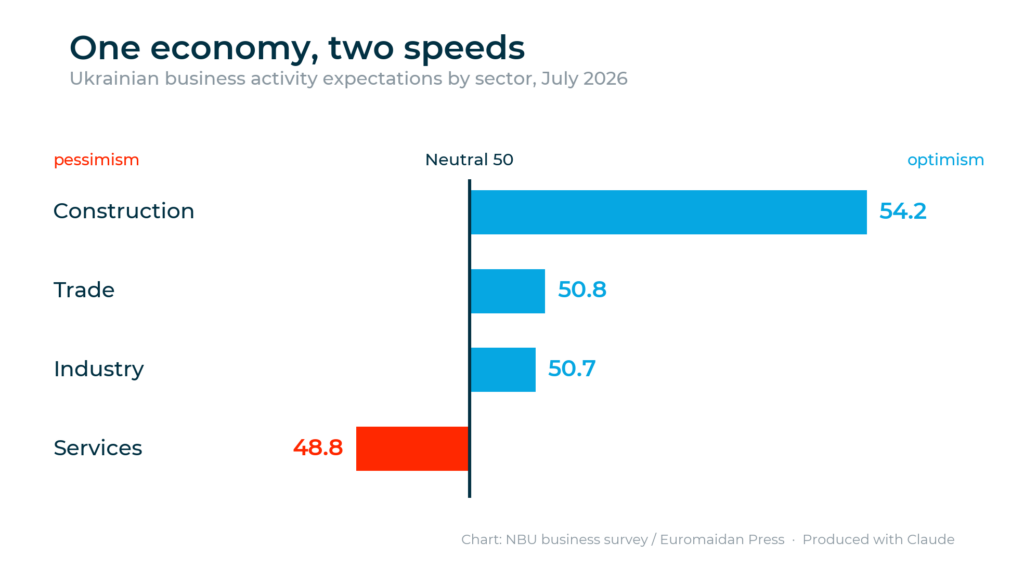
Ukraine’s war economy split cleanly along its funding line in July: construction, paid for by state and foreign rebuilding funds, remained the most confident sector, while services—left to earn their own way—fell into pessimism, the only sector below the neutral 50 mark. Chart: NBU business survey / Euromaidan Press
Where the rebuilding money goes, confidence follows
Construction was far above the line, at 54.2, lifted by financing for road repair and rebuilding—even as the same survey listed intensifying strikes on critical infrastructure among the factors holding activity back.
Industry and trade stayed barely positive. Services alone fell below the line, into pessimism, squeezed by higher costs and too few skilled workers. Only builders expect to hire; industry and services plan to cut.
For Ukraine’s partners, the survey shows where rebuilding money actually reaches. That spending—part-funded by Western aid, which the bank lists as one reason confidence holds up at all—is a preview of the demand that a full postwar rebuild would bring.
In June 2026, Russian strikes on that same industrial base pushed Ukraine into its sharpest wartime contraction since 2023.
The next survey, covering August, is due on the first working day of September.

 Connexion