Vue lecture

Russia’s new jet Shaheds run on turbojets from one Chinese company. It deleted them from its English website

Geran-4" is an evolution of the earlier "Geran-3" model

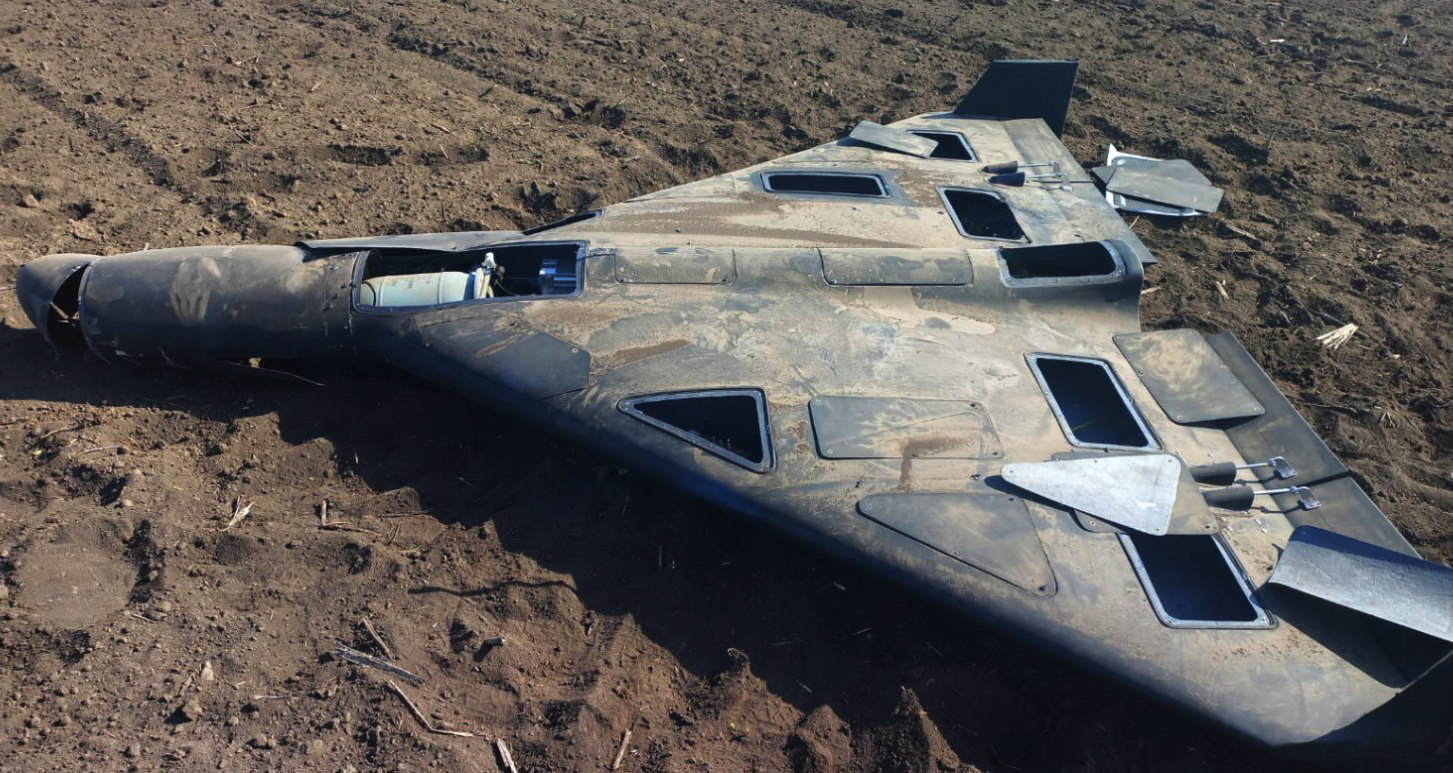
China is helping Russia build a faster Shahed. Russia has begun using upgraded Shahed drones with Chinese-made turbojet engines that fly at speeds close to three times those of earlier versions, the Wall Street Journal reported.

The Shahed jet is designed to beat Ukraine's air defenses. Ukrainian interceptors have downed about 90 percent of the older piston-engine drones, which cruise at roughly 180 kilometers per hour, so Russia switched to the jet-powered Geran-4, which cruises at around 500 kilometers per hour.

The engines come from one Shenzhen firm

The turbojets come from Telefly Telecommunications Equipment, founded in Shenzhen in 2010. The company chiefly makes computer hardware and communications equipment, but also sells its own line of micro-turbojets for drones.

China has long been the main clearinghouse for Shahed parts, including engine components, servomotors, and gyroscopes, the newspaper reported.

The company scrubbed its own website

After Ukraine publicized the discovery of Telefly engines in Russian drones, the turbojet section disappeared from the English-language pages of the company's website. The pages in Chinese and other languages still carry them.

China's foreign ministry, which did not respond either, has previously said it strictly regulates exports of dual-use components and rejects unilateral US sanctions on such trade.

Western parts fade as Chinese parts arrive

Downed Shaheds once carried microcontrollers from Texas Instruments in the US and linear regulators from STMicroelectronics, which the newspaper lists as being based in Switzerland. Over time, the Western components are disappearing even as the drones gain better navigation and attack systems, because US Treasury investigations found nearly all the Western parts were being diverted through Chinese intermediaries, often shell companies in Hong Kong.

Ukrainian government researcher Colonel Oleksandr Zaruba said in June that Shaheds now hold more antennas, modems, and SIM cards to correct their flight paths through local mobile networks, and that the components increasingly come from China.

  •  

Ukraine finds American Nvidia Jetson micro-computer in Russia’s new missile that can’t reportedly tell truck from a bus with children

The image shows a Russian missile. Source: HUR

An American AI computer has turned up inside Russia's newest cruise missile. Ukrainian specialists has found an Nvidia Jetson micro-computer in Russia's new S-71 "Monokhrom" cruise missile, the Defense Ministry's Main Intelligence Directorate (HUR) reports.

S-71M “Monokhrom is the first fully autonomous long-range strike system designed to engage not only stationary but also moving targets. The system is designed to independently decide whether to destroy a target based on threat priorities. A significant problem for such autonomous systems is determining exactly what they are attacking — a military truck or a bus carrying children.

The discovery is the latest evidence that Russia's newest weapons still run on Western technology. Ukraine has already documented hundreds of foreign components in Russian missiles and drones reaching Moscow despite sanctions.

The AI chip is the standout find

The use of the Nvidia Jetson may indicate the application of AI technologies in the missile. This capability would let the weapon process visual or sensor data onboard to identify targets or navigate, functions that depend on exactly the kind of compact AI computing it provides.

The chip sits among many foreign parts. In total, 35 electronic components used by Russia in the missile were identified, making Monokhrom another Russian weapon built substantially from foreign electronics.

The same parts show up across Russia's arsenal

HUR's analysis linked the missile to Russia's wider weapons program. The identified components included parts of a passive radar seeker that Russia has begun installing on Geran-2 drones to detect and strike Ukrainian air-defense systems and radars.

Other finds tied the missile to Russia's newest strike systems. They included a Chinese Honpho TS130C-01 camera from the jet-powered Geran-4 drone and components of the active homing seeker of the Kh-47M2 Kinzhal aeroballistic missile.

The finding sharpens the sanctions case

HUR framed the discovery as an argument for tighter enforcement.

"The discovery of an Nvidia Jetson in a new Russian missile once again demonstrates the need to strengthen sanctions pressure and coordinate the efforts of the civilized world," HUR said.

HUR specialists and Ukrainian research institutions continue to study Russian weapons and trace the origin of their electronic components to strengthen measures to block them.

  •  

Forged end-user certificates through eight countries: how one network kept European tech flowing into Russian missiles

Vienna, the capital of Austria. Credit: UkrInform

Austria has broken up a smuggling network feeding European technology into Russia's missile production. Austria's DSN counterintelligence service has exposed an international scheme that supplied high-tech industrial equipment to defense-industry enterprises linked to the Russian state corporation Rostec, circumventing EU sanctions, Austria's Interior Ministry reported.

The case is one strand of the vast evasion effort keeping Western parts in Russian weapons. Ukraine has documented that Russian missiles like the Iskander still contain hundreds of foreign components reaching Russia through third countries despite sanctions. The Austrian network is one of the channels that made that possible, routing European machinery to Russian arms makers through a web of front companies.

How the network worked

The smugglers hid the real destination behind a chain of countries. To conceal the supply routes, the suspects used a network of companies in Turkiye, the UAE, Hong Kong, Belarus, Kyrgyzstan, South Korea, Poland, and Lithuania, providing European manufacturers with forged end-user certificates claiming the goods would remain in third countries.

The equipment went to Russian weapons production. According to a preliminary investigation, it was used to make engines for cruise missiles and combat aircraft, among other military hardware, according to the ministry.

"It is unacceptable that high-precision European technologies find their way through roundabout paths into the production of cruise missiles and air-defense systems," Interior Ministry State Secretary Jörg Leichtfried said.

The scale and the arrests

The trade ran for years and moved millions. Purchases of industrial goods for Russian military users date back to 2019, and after sanctions tightened, the routes were redirected through third countries, primarily Hong Kong and Turkiye, with confirmed deliveries to Russian defense firms worth nearly $3.9 million since 2022.

The arrests followed searches. On 20 August 2025, police searched four sites and seized about 40 data carriers. On 13 May 2026, they detained a 28-year-old Belarusian citizen, a company director and co-owner, seizing sanctioned CNC machines and tools worth nearly $164,000. The suspect is in custody.

Part of a wider fight

DSN framed the bust as one battle in a continuous effort. The case shows the lengths to which international networks go to circumvent sanctions, DSN director Sylvia Mayer said.

The bust is a rare visible enforcement action against a problem Ukraine names constantly: that Russia's weapons still run on Western technology, reaching its factories through exactly this kind of third-country laundering. Each dismantled network closes one route, but demand keeps opening others.

  •  

Russia lowered its 2030 electronics-independence target from 80% to 59%

russian irtysh server processor

Russia has lowered its benchmark for technological independence. A revised government target now requires domestic hardware to make up 58.7% of state technology projects by 2030—down from the 80% Moscow had long promised—a reduction proposed by Russia’s own Ministry of Industry and Trade and set by a decree signed in July 2026 by Prime Minister Mikhail Mishustin.

Funding collapsed as deadlines slipped

The scale of the retreat was laid out by Ukraine’s Foreign Intelligence Service, which called the downgrade a capitulation to reality. Funding for the flagship state program collapsed roughly fivefold, from $338.4 million in 2024 to $62.6 million in 2026, and the broader electronics-engineering development program faces a $422.7 million shortfall for 2026–2028, the service said.

Several microelectronics-equipment projects were canceled outright, and deadlines for domestic processors and modems have slipped to 2032. The “Irtysh” processor Moscow presented as a homegrown design for critical infrastructure is, by the service’s account, effectively a copy of China’s Loongson chip, and the Kurchatov Institute missed its deadline to build replacements for Intel, Marvell, Broadcom, and Integrated Device Technology parts.

Russian specialists themselves say localizing more than 60% is impossible without domestic production of chips at 28 nanometers and below, which sanctions and the loss of Western tooling put out of reach.

The GRU buys abroad what Russia cannot make

What Russia cannot build, it increasingly smuggles. Estonia’s Foreign Intelligence Service reported in February 2026 that Russian military intelligence—the GRU—takes an active role in acquiring sanctioned dual-use goods, running import-export front companies to route Western and Asian components home.

One such firm, Moscow-registered Neptun Ko, is directed by an identified GRU officer, Aleksandr Matrossov, and moved more than €500,000 ($540,000) worth of critical semiconductors to Russia’s defense industry through a Chinese intermediary in the first year of the full-scale war, the Estonian service found.

yevgeniy pluzhnik in kuala lumpur
Explore further

Russian businessman runs Hong Kong pipeline feeding European electronics to Kremlin’s weapons labs

Every chip Russia’s factories cannot make is one it must source abroad, through the third-country sanctions loopholes that still route Western components into Russian missiles and drones—which is where the practical fight over Russia’s electronics now lies, whatever share Moscow prints as its goal for 2030.

  •  
❌