
Vue lecture

Forged end-user certificates through eight countries: how one network kept European tech flowing into Russian missiles

Vienna, the capital of Austria. Credit: UkrInform

Austria has broken up a smuggling network feeding European technology into Russia's missile production. Austria's DSN counterintelligence service has exposed an international scheme that supplied high-tech industrial equipment to defense-industry enterprises linked to the Russian state corporation Rostec, circumventing EU sanctions, Austria's Interior Ministry reported.

The case is one strand of the vast evasion effort keeping Western parts in Russian weapons. Ukraine has documented that Russian missiles like the Iskander still contain hundreds of foreign components reaching Russia through third countries despite sanctions. The Austrian network is one of the channels that made that possible, routing European machinery to Russian arms makers through a web of front companies.

How the network worked

The smugglers hid the real destination behind a chain of countries. To conceal the supply routes, the suspects used a network of companies in Turkiye, the UAE, Hong Kong, Belarus, Kyrgyzstan, South Korea, Poland, and Lithuania, providing European manufacturers with forged end-user certificates claiming the goods would remain in third countries.

The equipment went to Russian weapons production. According to a preliminary investigation, it was used to make engines for cruise missiles and combat aircraft, among other military hardware, according to the ministry.

"It is unacceptable that high-precision European technologies find their way through roundabout paths into the production of cruise missiles and air-defense systems," Interior Ministry State Secretary Jörg Leichtfried said.

The scale and the arrests

The trade ran for years and moved millions. Purchases of industrial goods for Russian military users date back to 2019, and after sanctions tightened, the routes were redirected through third countries, primarily Hong Kong and Turkiye, with confirmed deliveries to Russian defense firms worth nearly $3.9 million since 2022.

The arrests followed searches. On 20 August 2025, police searched four sites and seized about 40 data carriers. On 13 May 2026, they detained a 28-year-old Belarusian citizen, a company director and co-owner, seizing sanctioned CNC machines and tools worth nearly $164,000. The suspect is in custody.

Part of a wider fight

DSN framed the bust as one battle in a continuous effort. The case shows the lengths to which international networks go to circumvent sanctions, DSN director Sylvia Mayer said.

The bust is a rare visible enforcement action against a problem Ukraine names constantly: that Russia's weapons still run on Western technology, reaching its factories through exactly this kind of third-country laundering. Each dismantled network closes one route, but demand keeps opening others.
  •  

70 ballistic missiles and 12 launchers: Ukraine lines up deep-strike refill from an unlikely supplier

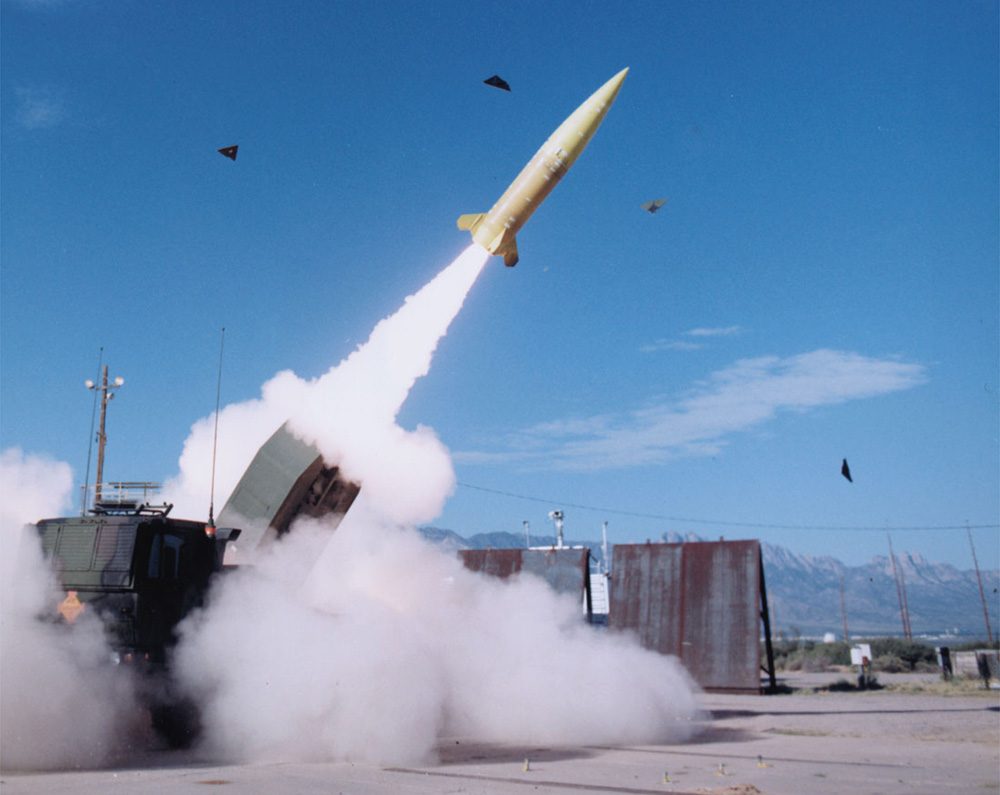
ukraine seeks us approval atacms use kursk offensive missile launch lockheed martin mfc-atacms-block-1a-unitary-02-hjpgpc-adaptive1280medium

Ukraine has agreed to buy a batch of American-made ballistic missiles and rocket launchers from Türkiye, according to Militarnyi. The weapons sit in Turkish stockpiles and still need to clear a routine US review before they ship.

Ukraine's deep strikes run on a scarce, politically gated supply of Western missiles, which it burns through faster than allies' resupply.

What Ukraine is buying

US government paperwork lists 70 M39 ATACMS (Army Tactical Missile System) missiles and 12 M270 rocket launchers, plus tens of thousands of cluster munitions. The M270 is a tracked launcher that fires guided rockets and ATACMS, the heavier sibling of the wheeled HIMARS.

The cluster load adds 2,524 M26 rockets for the M270 launchers and 47,000 M509A1 shells for Ukraine's 2S7 Pion and M110 guns. Both scatter bomblets over a wide area. The deal surfaced in US State Department notifications in the US Congressional Record for 6 August 2026. Türkiye wants to shed older weapons and fund newer systems, the filings say. The shipment moves through Turkish, Bulgarian, and American exporters.

How the sale clears Washington

Explore further

Frontline report: ATACMS returns to battlefield as Ukraine destroys Russian training facility in Voronezh

Because these are US-origin weapons, Washington must sign off first. The filings note that US law forces the State Department to notify Congress once major equipment tops $14 million, or other articles and services top $50 million. There is no approval vote: if neither chamber blocks the sale within 15 days, US consent takes effect automatically. Both chambers sit in recess past that deadline — the House until 31 August 2026, the Senate until 14 September 2026.

What the M39 ATACMS is

The M39 is the original production model of ATACMS, flying about 165 kilometers, or roughly 103 miles—shorter than later versions Ukraine has fired. It steers by laser gyroscopes with no GPS correction, which makes it less precise. Instead, it carries a 560-kilogram cluster warhead of 950 M74 submunitions built to hit troops, unarmored vehicles, and air defenses.

ATACMS, illustrative image. Credit: Wikimedia Commons
Explore further

Ukraine marks invasion anniversary with ATACMS strikes on Russian command and supply lines (MAP)

How Ukraine uses ATACMS

Ukraine has fired ATACMS at Russian command posts, ammunition depots, and air defenses across occupied land and inside Russia. Even occasional launches force Russia to shift air defenses back from the front, easing pressure on Ukrainian troops. That firepower had gone quiet. Ukraine ran through its US-supplied ATACMS months ago, and US approvals came slowly. Buying 70 more through Türkiye lets Ukraine rebuild without waiting on fresh US aid.

  •  
❌