The party, Yabloko, has navigated a delicate balancing act with an increasingly heavy-handed Kremlin, but its pro-peace manifesto turned out to be the red line.
The party, Yabloko, has navigated a delicate balancing act with an increasingly heavy-handed Kremlin, but its pro-peace manifesto turned out to be the red line.
Nikolai Rybakov, right, the Yabloko party’s leader, and his lawyer, second from right, listening to the court decision after a hearing on a lawsuit to bar the party from upcoming parliamentary elections on Monday in Russia’s Supreme Court in Moscow.
An Orthodox archbishop has publicly broken with the Moscow Patriarchate over its blessing of nuclear weapons. The head of the Finnish Orthodox Church, Archbishop Elia, said he is shocked that Russian Patriarch Kirill uses Christian rhetoric to bless nuclear weapons and justify their use, the Finnish broadcaster Yle reported.
The rebuke comes from within Orthodoxy against a patriarch who has sacralized Russia's war. Kirill is considered a close ally of Russian leader Vla
An Orthodox archbishop has publicly broken with the Moscow Patriarchate over its blessing of nuclear weapons. The head of the Finnish Orthodox Church, Archbishop Elia, said he is shocked that Russian Patriarch Kirill uses Christian rhetoric to bless nuclear weapons and justify their use, the Finnish broadcaster Yle reported.
The rebuke comes from within Orthodoxy against a patriarch who has sacralized Russia's war. Kirill is considered a close ally of Russian leader Vladimir Putin, and the Russian Orthodox Church under his leadership openly supports Russia's aggression against Ukraine, calling it a "holy war," per the Institute for the Study of War.
On Saturday, Kirill called Russian nuclear weapons a manifestation of "God's grace" and linked the creation of the Soviet atomic bomb to the prayers of Saint Serafim of Sarov, saying during the divine liturgy that the bomb was created "by God's grace and mercy."
The archbishop says there is no "Orthodox nuclear weapon"
Elia rejected the theology outright. In Orthodox liturgy, the church always prays for peace in the whole world, not for the victory of one country's weapons, he said, and there is no such thing as an "Orthodox nuclear weapon."
The archbishop drew a clear line about the church's role.
"The task of the church is not to bless weapons of mass destruction," Elia said in a statement published on the Finnish Orthodox Church's website.
Invoking a saint of love and humility angers him most
What most disturbed Elia was the act of tying a beloved saint to a nuclear blessing. He was especially angered that the name of Serafim of Sarov was linked to blessing nuclear weapons, calling the association a profound distortion.
Elia contrasted the saint with the patriarch. Serafim "was a man of love, forgiveness, and humility, and essentially embodied everything diametrically opposed to the current patriarch," he said. Serafim of Sarov is one of the most revered saints among Orthodox believers in Russia and beyond, including in Finland.
Patriarch Kirill, the leader of the Russian Orthodox Church (ROC), said during a sermon at the Holy Trinity Seraphim-Diveyevo Convent on 1 August that the Soviet Union's creation of the nuclear bomb was the result of divine intervention.
The Russian Church under Kirill operates in close alignment with the Russian state, and critics describe it as a de facto arm of Kremlin influence abroad. Ukraine's security service, which has investigated him, counts him among Putin's
Patriarch Kirill, the leader of the Russian Orthodox Church (ROC), said during a sermon at the Holy Trinity Seraphim-Diveyevo Convent on 1 August that the Soviet Union's creation of the nuclear bomb was the result of divine intervention.
The Russian Church under Kirill operates in close alignment with the Russian state, and critics describe it as a de facto arm of Kremlin influence abroad. Ukraine's security service, which has investigated him, counts him among Putin's inner circle. Kirill's own ties to the Russian state reach back decades: Swiss media reported in February 2023 that he worked for Soviet intelligence in 1970s Geneva under the code name "Mikhailov" while officially representing the Moscow Patriarchate at the World Council of Churches.
The patriarch delivered the sermon after the Divine Liturgy on the feast marking the uncovering of the relics of the Orthodox saint Seraphim of Sarov. The Russian Orthodox Church and its nuclear-weapons complex have long cast Seraphim as the patron saint of Russia's nuclear arsenal. Kirill credited the bomb's creation to God's mercy and, in particular, to the prayers of the saint, saying it saved the country from "terrible destruction, as a result of which neither the country nor its people could have remained."
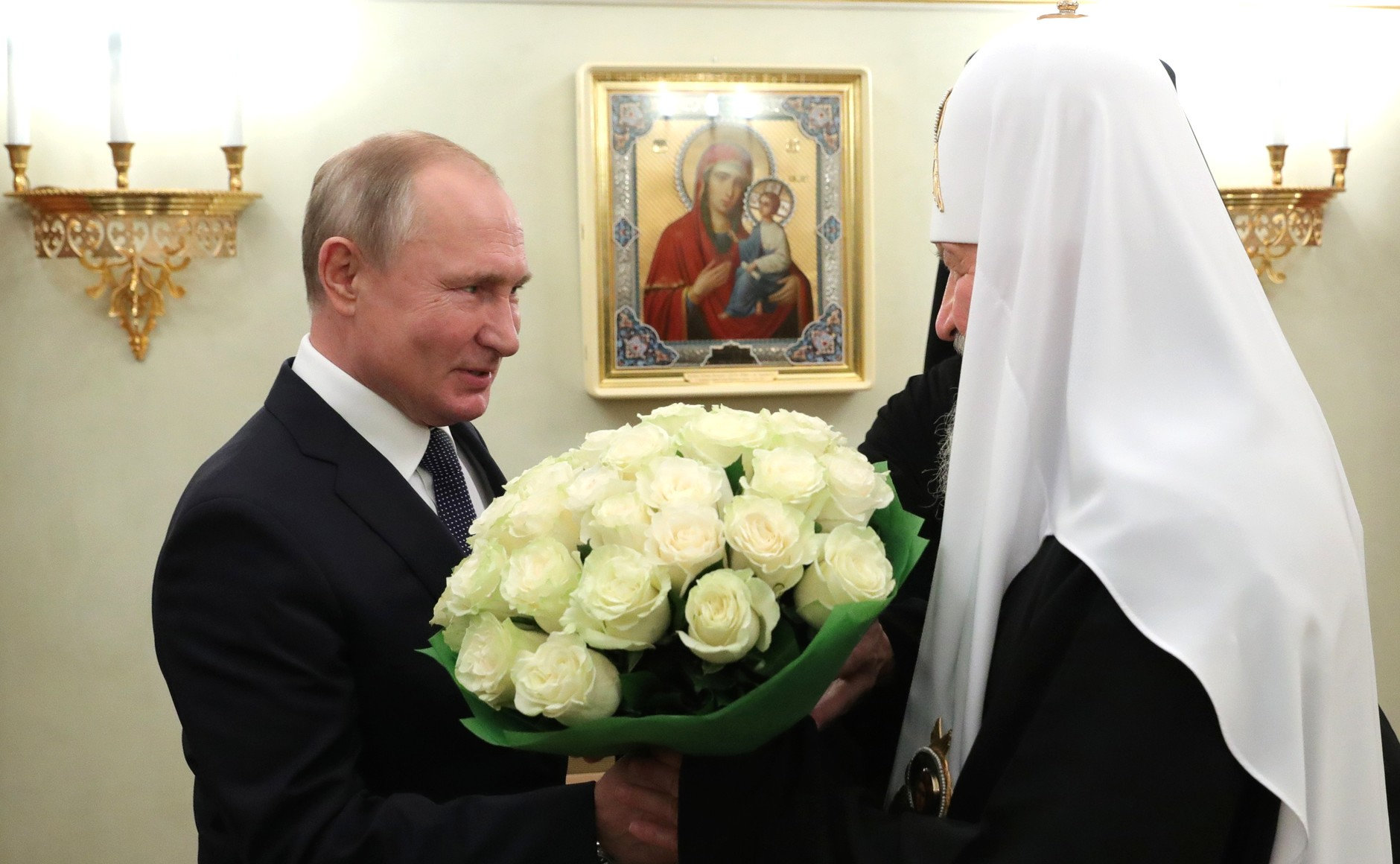
President of Russia Vladimir Putin congratulates Russian Patriarch Kirill on his birthday, 2019. Photo: kremlin.ru
The Soviet nuclear weapons center was built in 1946 in the closed city of Sarov, also known as Arzamas-16, on the grounds of the Dormition Monastery that the Bolsheviks shut in 1927. The Sarov-based design bureau (KB-11, later VNIIEF) developed the Soviet Union's first atomic bomb (RDS-1), its first thermonuclear bomb (RDS-6S), its first two-stage thermonuclear bomb (RDS-37), and later the AN602, better known as the Tsar Bomba. The design of the RDS-1 was largely similar to the American Fat Man bomb, which the United States dropped on the Japanese city of Nagasaki on 9 August 1945.
Sarov is the town where Saint Seraphim lived and prayed, the connection Kirill drew on to cast the weapon's creation as providential:
"I would like to say once again that the Lord truly works miracles. He is the Lord of history, and the life of the entire human race depends on Him. That by His mercy, through Elder Seraphim, the miracle of His presence appeared here, and that it was in this very place that the shield protecting our Motherland was created: all this is not accidental but parts of one whole," Kirill said.
Patriarch supporting aggression
As the church's leader, Kirill has been among the most consistent religious backers of Russia's full-scale invasion — a stance that led Ukraine to sanction him and seven other church figures in August 2022. That November, he justified the possible use of nuclear weapons over a threat to Russia's existence, citing the country's nuclear doctrine, and in November 2023, Ukraine's Security Service (SBU) opened a formal investigation into him over his support for the war.
The EU has been slower to act. Although Ukraine sanctioned Kirill in 2022, some member states still resist doing so: in July 2026, Italy joined Bulgaria in opposing a proposed EU visa ban on him.

 Connexion