❌

Vue normale

Oklahoma Families Faced the Hottest Summer Ever and an Electricity Crisis

18 octobre 2026 à 08:20
Record heat and a rising demand for electricity are closing in on Oklahoma families trying to keep the lights on and the AC running.

Genia Weitz and her husband, Daryl Mason, confined themselves to their living room to try to keep their electricity bill down.
  • ✇404 Media
  • Data Centers Are War Targets Now
    Ukrainian drones hit Russia’s largest data center on Wednesday. This was Ukraine’s fourth strike on Russian data centers in the past week and confirmation of a new reality of war: data centers are valuable enemy assets and they will be targeted.In 2006, British economist Clive Humby declared “data is the new oil,” and big tech adopted the metaphor. Twenty years later, a dark side of the truism has been revealed. If the places where oil is refined are valuable targets in a war then so, too, ar
     

Data Centers Are War Targets Now

15 octobre 2026 à 09:00
Data Centers Are War Targets Now

Ukrainian drones hit Russia’s largest data center on Wednesday. This was Ukraine’s fourth strike on Russian data centers in the past week and confirmation of a new reality of war: data centers are valuable enemy assets and they will be targeted.

In 2006, British economist Clive Humby declared “data is the new oil,” and big tech adopted the metaphor. Twenty years later, a dark side of the truism has been revealed. If the places where oil is refined are valuable targets in a war then so, too, are the places where data is refined. We’ve seen this not just in the Russia-Ukraine war, but also with Iran hitting Amazon Web Services data centers in Dubai in retaliation for America’s strikes on the country. 

Ukrainian President Volodymyr Zelenskyy confirmed strikes on Russian data centers and oil refineries in a post on X and called them a “symmetrical response" to Russian aggression. Here we have oil and data together again, not as a metaphor in an economics lecture, but in the pronouncement of a world leader defending his country. conducting a war.

Three of Ukraine’s strikes hit data centers that belonged to Yandex, Russia’s Google-equivalent, and damaged the company’s supercomputers that housed some of its AI models. The latest attack hit a data center operated by Sberbank, Russia’s largest bank. It’s too early to tell what the effects of the strike on the Sberbank data center will be, but the three strikes on Yandex have disrupted internet and communications across Russia.

An online rumor said that the strikes on Yandex had the effect of taking down Russian bot farms, but this wasn’t true. The effects of the strikes on the civilian population were much more severe. Yandex is ubiquitous in Russia — it has its own app store, payment services, dating services, taxi and bus apps, and email services. The company operates six data centers in Russia and the strikes knocked two of them offline completely. People in Russia have lost access to their email, some of their data is seemingly gone, and taxi and bus apps only work intermittently.

ChrisO_wiki, an anonymous researcher who translates Russian social media posts for the western web, chronicled how the Yandex outages are hitting everyday Russians. “A taxi driver from Yekaterinburg says that after the service disruptions, he can no longer view his order history, and the status of trips is updated with a delay,” ChrisO_wiki said in a post on X and Bluesky. 

“The loss of Yandex's cloud services is also having severe impacts on Russian commercial logistics. Those who work with electronic document management are unable to register incoming goods, severely affecting manufacturers and distributors,” they said in another post.

These attacks are just the latest in a long line of strikes on data centers this year. Russia has been targeting Ukrainian data centers for months and Iran hit AWS data centers in Dubai in March, knocking out digital infrastructure in the Middle East.

Klaudia Klonowska, a researcher who studies the effects of emerging technologies on international law, told 404 Media that attacks on data centers are so new that international law around them is still developing. “You have very limited situations in which they would actually qualify as lawful targets when they're used by the military, and even then, it's very difficult for the attackers to know whether that's happening or not,” Klonowska said.

If the data centers are purely processing military data, then they could be legitimate targets, according to Klonowska. But many, if not most, data centers are dual-use, meaning they house both civilian and military data. In many cases, disrupting daily life seems to be part of the point.

When Russia struck data centers in Ukraine in September, state-backed news agencies claimed it hosted data for Palantir that supported Ukrainian intelligence efforts and was a lawful target. Ukraine denied the allegation. “So you see how difficult, because of the nature of these centers, it's really to pinpoint what is happening with them and who is using them and for what means,” Klonowska said. “Sometimes [Ukraine] mentions that these data centers contribute to Moscow's revenues that then fuel the war machine. But that's not enough to make them lawful targets. Retaliation is not enough under law.”

Klonowska noted that it is civilians who suffer most, not the military, when data centers go offline. “There are questions about proportionality given how widespread the attacks are,” she said. “A lack of internet access for very prolonged periods affects everything. It's all of the civilian services that are being disrupted, which you can imagine also includes things like hospitals, traffic, judicial services, etc. etc.” It’s worth noting that Russia has repeatedly attacked civilian targets in Ukraine, including apartment buildings, public transportation, and hospitals.

According to Klonowska, international and humanitarian law needs to catch up with the issue and that scholars like herself are only just starting to understand the ramifications. “I think there's also another bigger question behind all of this,” she said. “Why have we gotten to the point where we have permitted militaries of various states to use civilian commercial data centers for their military purposes? By potentially using them and relying on them, they have opened them up to the possibility of becoming military targets.”

Disentangling civilian and military data probably won’t take data centers off the target list, but it will make international law more clear on which buildings are legitimate targets. It may also change how data centers processing military data are built. 

“France has recently announced that they have unveiled their underground data center on the outskirts of Paris that will be exclusively for military use,” Klonowska said. “Just as we expect them not to use schools or hospitals or other civilian residential areas to host weapons or other military equipment, we would, I think, increasingly need to mention this in the case of data centers.”

The idea that a data center might be a military target is not lost on the American communities facing construction of them in their backyards. America’s nuclear weapons scientists at Los Alamos National Laboratories (LANL) have partnered with the University of Michigan in an attempt to build a data center in Ypsilanti Township, Michigan. The people and government of the Township aren’t thrilled about it for a number of reasons and the city attorney has said that the data center would be a “high value target” in wars of the future. Los Alamos pushed back on this in a letter to the community in September, around the same time Russia was striking data centers in Ukraine. LANL accused the township attorney of creating “that terminology without basis. It should not be interpreted as evidence of a known, specific, or imminent threat to the facility or the surrounding community,” the letter said. 

“Like other major research facilities, the center would employ appropriate security measures, including controlled access, cameras, and on-site security personnel,” it said. “Los Alamos and U-M would coordinate with local, state, and federal partners on matters related to safety and security.”

It’s easy to see where the people of Ypsilanti Township are coming from. When Ukraine struck three Yandex data centers in Russia over the weekend, its drones slipped past Russia’s air defenses. The idea that a town next to a data center, especially one with ties to America’s nuclear weapons programs, could sustain damage if the data center was ever attacked isn’t unfounded. The data centers smoldering in the world’s war zones proved that the township’s fears aren’t theoretical.

Economic Pain and an Unpopular Trump Put G.O.P. on its Heels With Three Weeks to Go

10 octobre 2026 à 05:01
Inflation has hurt Americans at many levels: Farmers, truckers, consumers. It has also expanded the electoral map into what was safely Republican country just a few months ago.

© Jamie Kelter Davis for The New York Times

Fuel prices have soared throughout the country since President Trump started a war against Iran.

More than 500 drones by Moscow’s count: Kh-101 fuel plant, second Yandex data center, and a far-north refinery hit

9 octobre 2026 à 04:48

more than 500 drones moscow’s count kh-101 fuel plant second yandex data center far-north refinery hit · post smoke over ukhta komi republic after reported drone attack lukoil 9 2026

Drones struck a plant making fuel components for Russia's Kh-101 cruise missiles and a second Yandex data center overnight on 9 October, Russian officials and monitoring channels reported. The same night, fires were reported at a refinery in Russia's far north and an oil depot near Belgorod. Russia claimed it downed more than 500 drones, and Ukraine has not claimed any of the strikes.

Ukraine has spent months hitting refineries and arms suppliers deep inside Russia. Russia, meanwhile, keeps firing Kh-101 cruise missiles at Ukrainian cities, including the one that killed 22 people in Pryluky on 7 October.

The plant behind the Kh-101's fuel

The Redkino Experimental Plant in Tver Oblast came under attack overnight, Ukrainian monitoring channel Exilenova+ reported. It said the plant makes components of Decilin-M, a fuel for Kh-55 and Kh-101 cruise missiles, as well as additives for diesel and aviation kerosene.

Tver Oblast Governor Vitaly Korolev claimed a plant in Redkino caught fire as a drone attack was being repelled. He did not name the plant. No workers were hurt, he said.

The plant also makes ferrocene derivatives, which serve as burn catalysts in solid-fuel rocket motors, Militarnyi reported. The UK sanctioned it in September 2025. Drones attacked it in September 2023 and twice in one night in June 2024, the outlet said.

In February, drones of the Security Service of Ukraine's (SBU) Alpha unit struck the plant, sparking a large fire, SBU sources told Kyiv Post. The Kh-101 is the missile Russia used against Pryluky on 7 October, Ukrainian President Volodymyr Zelenskyy said.

Yandex loses a second data center

Part of Yandex's data center in Kaluga was damaged in the drone attack, and several modules were completely knocked out, the company's press service told Interfax, Russian newspaper Kommersant reported. Some Yandex services may run with interruptions, no one was hurt, and the company is still assessing the damage, Yandex said.

Kaluga Oblast Governor Vladislav Shapsha claimed nine people were injured in the overnight attack on the region. A day earlier, a drone attack forced Yandex to fully shut its data center in Sasovo, Ryazan Oblast.

A refinery in the north, a depot near Belgorod

Locals reported an attack on the Ukhta refinery in the Komi Republic, followed by a fire, Exilenova+ said. The Lukoil-owned plant can process about 4.2 million metric tons of oil a year, making gasoline, diesel, fuel oil, and vacuum gasoil. The extent of the damage is unclear.

An oil depot north of Belgorod was also burning after the night's attack, the channel posted. Belgorod's regional headquarters claimed two people were killed and four injured, including a child, in the Belgorod district.

A large fire also broke out in Pushkino near Moscow, likely at a truck parking lot, Astra reported. The cause is unknown.

Repeated strikes on Redkino target a specialty fuel that Russia's cruise missiles depend on, while two Yandex data centers hit in two nights bring the war to services ordinary Russians use every day.

Drone attack forces Yandex to shut down its data center on the grounds of a sanctioned Russian machine-tool plant

8 octobre 2026 à 08:28

Smoke over Salavat following an attack on the night of October 8.

A drone attack overnight on 8 October caused a fire that hit part of Yandex's data center in Sasovo, Ryazan Oblast, about 580 km from Ukraine, and the site is fully stopped, the Russian tech company told Russian media. The data center sits on the grounds of Sasta, a sanctioned machine-tool plant, Russian outlet Astra said, citing Wikimapia data. Astra's OSINT analyst found from eyewitness footage that the fire hit the plant.

Since late September, Russia has been striking data centers in Kyiv that keep Ukraine's internet and online services running. Now a drone attack has stopped one of the data centers that Russia's largest tech company relies on.

Fires reported at a refinery in Salavat and a machine-tool plant in Sasovo after overnight attacks on 8 October 2026.
Fires reported at a refinery in Salavat and a machine-tool plant in Sasovo after overnight attacks on 8 October 2026. Map: Euromaidan Press

Yandex counts the damage

Yandex warned that some services may be unavailable, while its core services kept running and no one was hurt. Ryazan Oblast Governor Pavel Malkov claimed two drones were downed, a roof caught fire at an enterprise in the Sasovo district, and windows were blown out in several homes.

The power failure took down a wide range of Yandex Cloud infrastructure, including computing capacity, networks, data storage, databases, Kubernetes, cloud services, AI, and security and monitoring systems, Ukrainian outlet ZN.ua reported, citing Exilenova+.

Ukrainian monitoring channel Exilenova+ reported that the plant was hit, without naming an attacker. The channel said Sasta, which claims a place on Russia's register of defense-industry companies, makes computer-controlled machine tools, including five-axis machining centers, and previously supplied the Tactical Missiles Corporation (KTRV) and Roscosmos. The plant's value to the arms industry lies in machines that cut precision parts, not in finished weapons, the channel said.

Citing Exilenova+, Militarnyi reported that Ukraine's Defense Forces hit the plant. It also linked Sasta to Iskander missile supply chains. No source has said whether the plant or the data center was the target, and no Ukrainian official has claimed the Sasovo strike. Sasta has been under US sanctions since November 2023, UK sanctions since February 2024, and Ukrainian sanctions since April 2025, a sanctions database shows.

Salavat: Kyiv reports a hit

Ukrainian forces hit the Gazprom Neftekhim Salavat complex in Bashkortostan, about 1,380 km from the front line, causing a fire, Ukraine's General Staff said. It said the complex processes up to 10 million metric tons of hydrocarbons a year and serves Russia's armed forces. Its key unit, the ELOU-AVT-6 primary oil refining unit launched in 2012, can process 6 million metric tons a year, Militarnyi reported. Astra's analyst placed the fire a few kilometers outside Salavat, possibly near the refinery.

Salavat oil refinery moment of attack pic.twitter.com/bUxuRshSK1

— Exilenova+ (@Exilenova_plus) October 8, 2026

Salavat Mayor Marat Zagidullin claimed that debris from several drones fell in the industrial zone that morning and started a fire.

"The enterprise continues to work," he said.

Astra noted earlier hits on the complex on 24 September 2025, on 14 July 2026, when refining fully stopped, and on 13 August 2026.

Russia's strikes on Ukraine's data centers

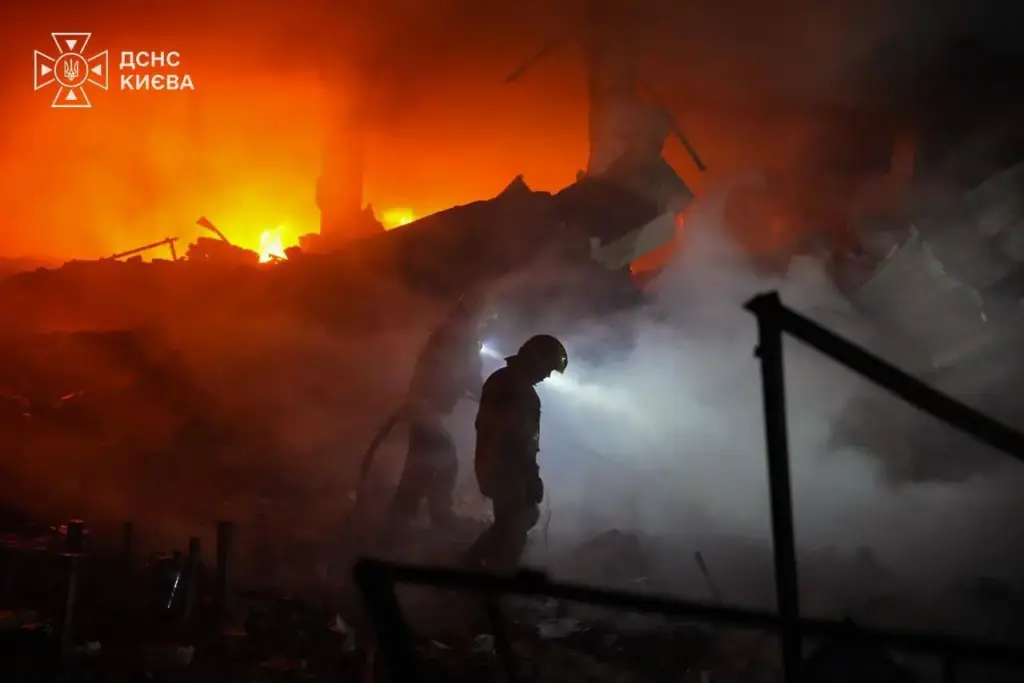
Russia has repeatedly hit data centers in Kyiv since 23 September. Strikes hit the COSMONOVA data center twice, the second time knocking it out, and the Parkovyi data center stopped working completely on 1 October after a series of strikes. In early October, Russia destroyed the dline.ua data center in Kyiv.

“Killing Ukraine’s internet would take nuclear or chemical weapons”—MiroHost founder whose data center Russia just destroyed

25 septembre 2026 à 12:18

kyiv strike

Russian drones and missiles struck Kyiv data centers over 23–24 September, knocking out internet and hosting providers. The Digital Transformation Ministry said about 100,000 subscribers lost service, NV Business reported.

Russia has widened its air campaign from power plants and warehouses to railways, fuel stations, and now digital infrastructure as it tries to grind down the country's ability to function before another war winter.

"You'd have to destroy 70-80% of Kyiv's buildings"

MiroHost founder and Internet Invest Group head Oleksandr Olshanskyi told NV Business the attack destroyed his own data center.

"Most critically important data and systems have been moved abroad or to the cloud," Olshanskyi said. "If an online store stops working, that's unpleasant but not a tragedy."

He called rumors about a full internet blackout or sharp service price hikes baseless.

"Destroying all internet in a simple way is impossible—you'd have to use nuclear or chemical weapons or destroy 70-80% of buildings in Kyiv," he said.

What Russia hit

The strikes damaged a Kyiv data center housing UTELS switching equipment on 23 September. Overnight into 24 September, Russia destroyed equipment of hosting provider CityHost.UA and the data center housing MiroHost. About 95% of MiroHost's clients operate outside Ukraine and were unaffected, he said. Russia also struck the Pavutyna network's data center. Crazy Network said a missile struck Kyiv's central traffic exchange hub, cutting service for its subscribers in Vinnytsia, Kyiv, and Khmelnytskyi Oblast.

Providers KIEVNET, Domonet, FAUST, and Etherlink also reported disruptions. Ukraine's telecom regulator NKEK said on 24 September that providers were completing emergency restoration, and Domonet estimated service would return by 21:00 that evening.

The 23 September strikes killed two people and injured more than 40, and hit a college building in Kyiv while students were on campus, Ukrainian Foreign Minister Andrii Sybiha wrote that evening. Russia targeted major Ukrainian data centers "seeking to disrupt the flow of information," he said. "This is critical civilian infrastructure that ensures people can access life-saving information. It is not a military target."

"More sanctions pressure, more missile interceptors are the only way to stop this terror," Sybiha wrote. "These attacks must not become the new normal."

Panic, not military gain

Olshanskyi said Russia uses these strikes to spread fear, not achieve lasting results.

"The enemy's goal is to cause damage, inflame panic, and heighten nervousness," he said.

His data center's destruction "will not affect the situation at the front in any way," he said.

❌