Vue normale

  • ✇Euromaidan Press
  • How Russia built a jam-proof drone force—and the Chinese supply chain that could still break it
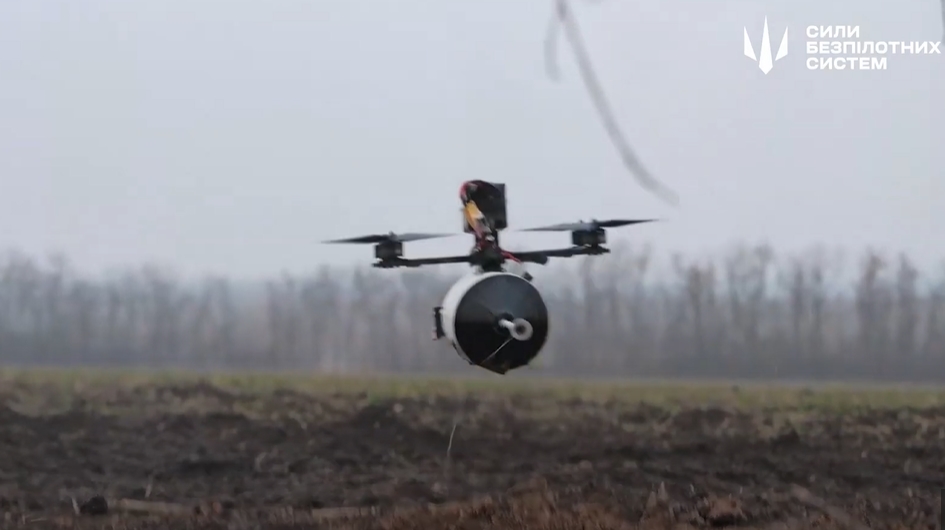
    Ukrainian jamming worked too well: it compelled Russian drone developers to innovate Now many Russian drones communicate via unjammable optical fiber or jam-resistant mesh radio But the Russians can't make all the hardware themselves Instead, they rely on Chinese imports Frustrated by Ukrainian electronic warfare, Russia transformed its drone arsenal to be harder—or impossible—to jam. Most of Russia's tiny first-person-view drones now send and receive s
     

How Russia built a jam-proof drone force—and the Chinese supply chain that could still break it

Par : David Axe
6 août 2026 à 15:51

ukraine develops fiber-optic module fitting all drones integrates inertial navigation silkworm fiber optic drone unmanned systems forces shovkopryad ukraine’s testing universal designed types while firm installs its optical technology have

  • Ukrainian jamming worked too well: it compelled Russian drone developers to innovate
  • Now many Russian drones communicate via unjammable optical fiber or jam-resistant mesh radio
  • But the Russians can't make all the hardware themselves
  • Instead, they rely on Chinese imports

Frustrated by Ukrainian electronic warfare, Russia transformed its drone arsenal to be harder—or impossible—to jam.

Most of Russia's tiny first-person-view drones now send and receive signals via jam-proof fiber optic cable instead of wireless radio. For heavier one-way attack drones that travel too far for fiber optics, the Russians have mostly switched to jam-resistant mesh radio networks made up of many interconnected senders and receivers.

In both cases, China is key. Chinese companies sell Russian companies the optical fibers and mesh modems that the Russians install in their drones. In other words, Beijing is the critical enabler in Moscow's ongoing aerial aggression.

That's the unsurprising yet sobering conclusion that Tatarigami, the founder of the Ukrainian Frontelligence Insight analysis group, reached in a recent investigation.

It's not enough for Ukrainian forces to shoot down or otherwise defend against Russian drones, or to fight back with their own drones. To win the drone war, Ukraine and its allies must "step up pressure on Chinese manufacturers," Tatarigami wrote.

Russia's response to electronic warfare wasn't a single solution. It evolved along two major paths: fiber-optic drones and mesh networks. This thread summarizes Frontelligence Insight analysis based on OSINT data and a report by the Center for Defense Reforms. Thread🧵 pic.twitter.com/k0v0ZeWKYB

— Tatarigami_UA (@Tatarigami_UA) July 30, 2026

As the drone war over Ukraine ramped up in 2022 and 2023, most Russian FPVs were wireless models. And most heavier one-way attack drones navigated via satellite. Both classes of drone could be jammed. A cottage industry of Ukrainian electronic warfare producers sprung up. Each firm offered some variation of a radio noisemaker that can ground or misdirect wireless and satellite-guided drones.

The jamming worked. Combined with kinetic defenses—guns and missiles—and add-on protections such as mesh, cages and netting, the jamming blunted the impact of Russia's drone arsenal. But the Russians adapted. The turning point came in the spring of 2025, when Russia's elite Rubicon Center drone group led the counterattack against Ukrainian troops occupying parts of Kursk Oblast in western Russia.

Rubicon's fiber optic FPVs wreaked havoc on Ukrainian forces in the Kursk salient, damaging or destroying hundreds of trucks and other vehicles in the span of a few weeks. Starving for supplies and in danger of being cut off, the Ukrainians retreated.

But the Russian adaptation was just beginning. The Russians are now launching 10,000 FPVs a day. And in certain key sectors, 60% of the FPVs were fiber optic models, according to Tatarigami. The Ukrainians can shoot down these drones and block them with armor, nets and earthworks. They can also strike at the Russian FPV teams before the Russians can launch their FPVs.

But there's one thing the Ukrainians can't do: they can't jam the drones.

Over the past six months, SBS has been able to narrow the drone usage gap. They started at 1 for every 3 Russian drones in February, after russia spiked to 9K strikes and are running at 1 for every 2 by August. pic.twitter.com/9GWrU0fx4W

— Vitaly (@M0nstas) August 4, 2026

Unjammable drones

Jamming continued to work against many one-way attack drones that must travel hundreds or even thousands of kilometers—too far for optical fiber. Another turning point came in February, when Elon Musk's Starlink bricked Russia's thousands of smuggled and stolen satellite terminals, some of which Russian forces used to control the approximately 5,000 Geran attack drones they launch every month.

The Starlink shutdown compelled Russian developers to accelerate the transformation of the one-way attack drone force. "Russia's second adaptation was mesh networking, routing data through mesh modems to keep communications alive across both short and long-range drones," Tatarigami explained.

It's possible to jam a mesh radio network, but it's hard. Every drone in a given network is a node. It's not enough to jam a few of them; you have to jam all of them.
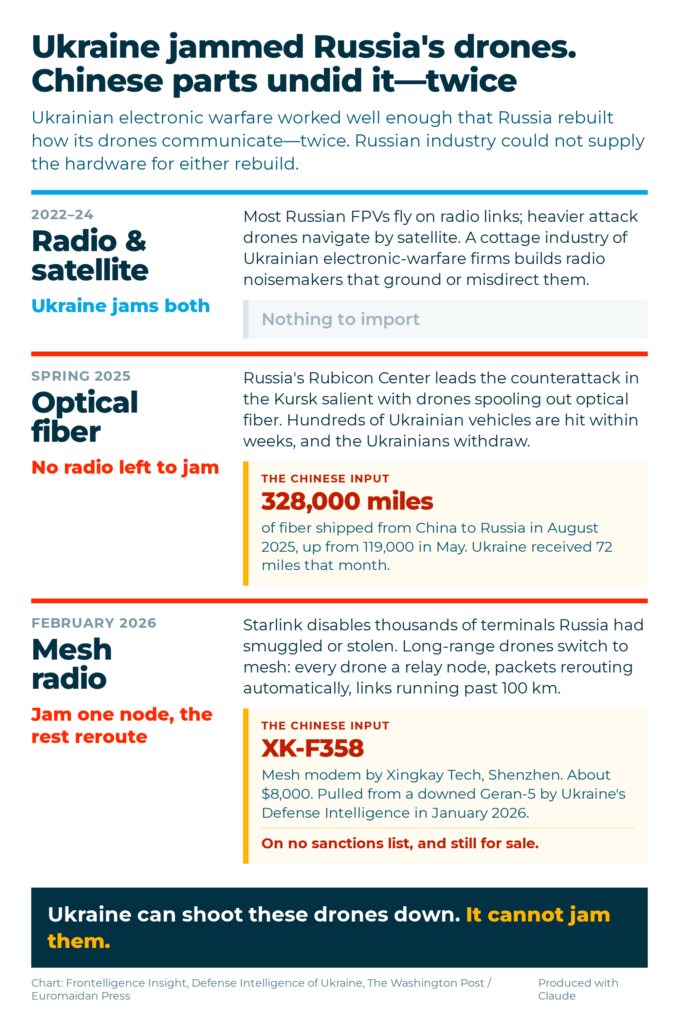
Chart tracking how Russian drones became resistant to Ukrainian jamming in three stages. From 2022 to 2024, Russian FPVs flew on radio links and heavier attack drones navigated by satellite, and Ukrainian electronic warfare could jam both. In spring 2025, Russia's Rubicon Center attacked the Kursk salient with fiber-optic drones that carry no radio signal to jam; China shipped Russia 328,000 miles of optical fiber in August 2025 against 72 miles to Ukraine. In February 2026, after Starlink disabled Russia's smuggled terminals, long-range drones switched to Chinese XK-F358 mesh modems, which carry no sanctions and remain on sale.
Chart: Euromaidan Press

If there's a constraint on Russia's switch to fiber optics and mesh networks, it's that Russian industry can't produce all the necessary hardware. "Unable to meet domestic demand, Russia turned to China," Tatarigami wrote.

The Washington Post reported Chinese optical fiber shipments to Russia growing from 119,000 miles in May 2025 to 328,000 miles that August. China sent Ukraine 72 miles the same month. For mesh networking, the Russians came to depend on XK-F358 modems from China's Shenzhen Xingkai Technology.

Ukraine's overstretched air defenses can't shoot down every Russian attack drone. Ukrainian troops and vehicle crews can't hide from 10,000 Russian FPVs a day. To defeat Russia's jam-proof drones, Ukraine and its allies must cut off the supply of Chinese parts, Tatarigami stressed.

They should extend export controls to modem-makers and producers of optical fiber, reels for the fiber and equipment associated with fiber production. "The recommendation is to expand sanctions beyond individual firms to the entire supply chain," Tatarigami advised.
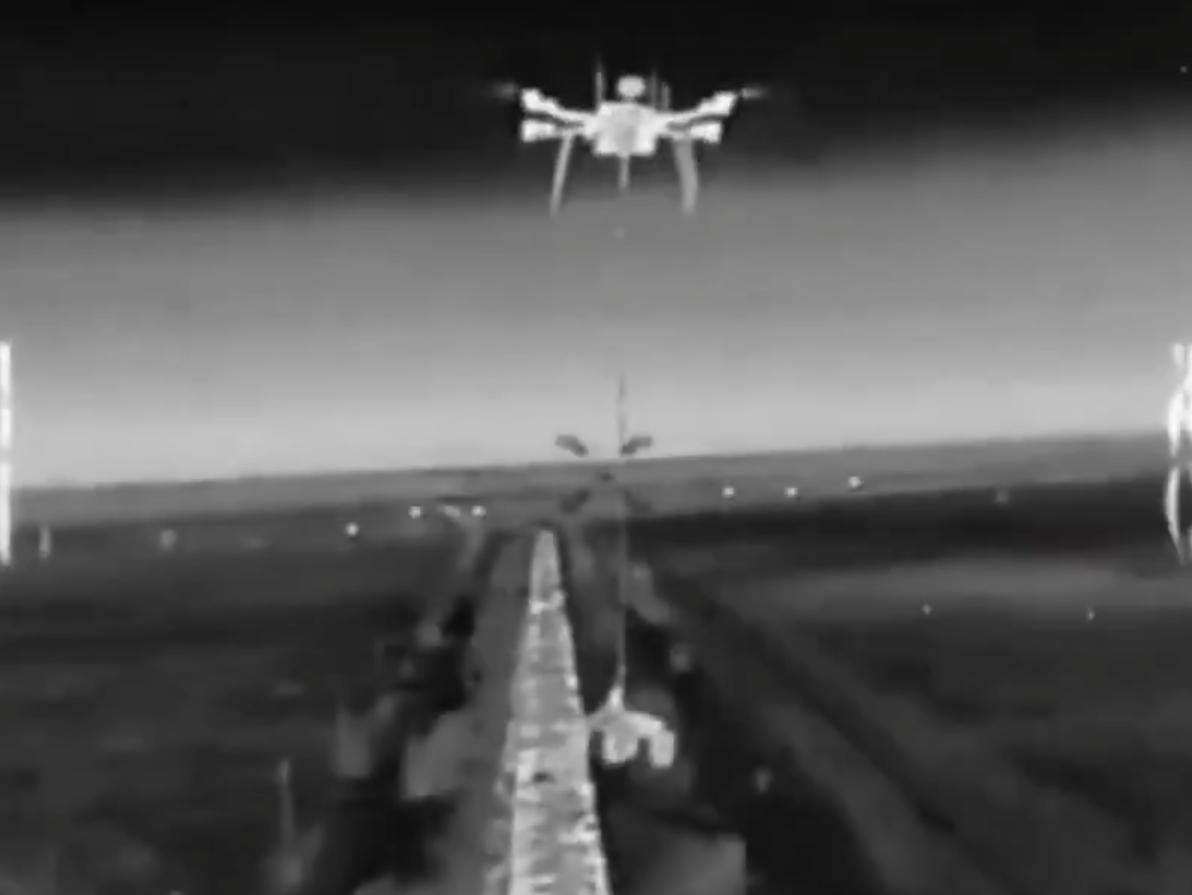
All-robot air assault.
Explore further

Some Ukrainian bomber drones aren’t carrying bombs anymore. They’re carrying robots.

  • ✇Euromaidan Press
  • Ukraine’s new drone is a cousin to America’s stealth bombers. It reaches Ufa in three hours.
    Ukraine has a new deep strike drone The Bravo has an unusual shape for a drone, with a blended wing and body The shape confers greater efficiency, and thus greater range and payload, at certain speeds Ukraine's latest deep strike drone is one of a kind. The Triada Robotics Bravo features a "blended wing body" design that's rarely seen on a drone. The special platform maximizes lift and minimizes drag, helping the drone fly farther for a given speed and payload
     

Ukraine’s new drone is a cousin to America’s stealth bombers. It reaches Ufa in three hours.

Par : David Axe
6 août 2026 à 14:48

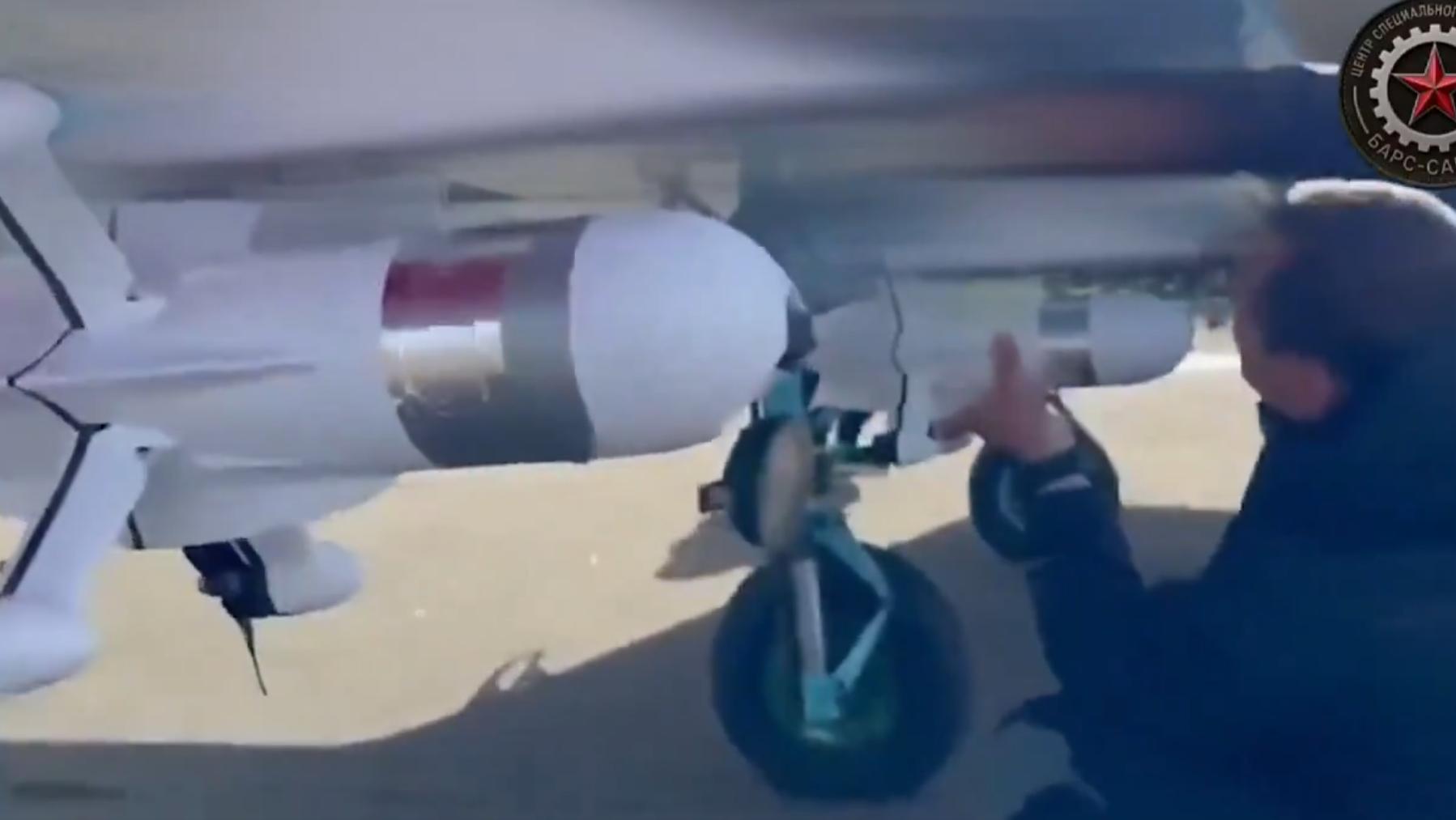
Triada Robotics Bravo

  • Ukraine has a new deep strike drone
  • The Bravo has an unusual shape for a drone, with a blended wing and body
  • The shape confers greater efficiency, and thus greater range and payload, at certain speeds

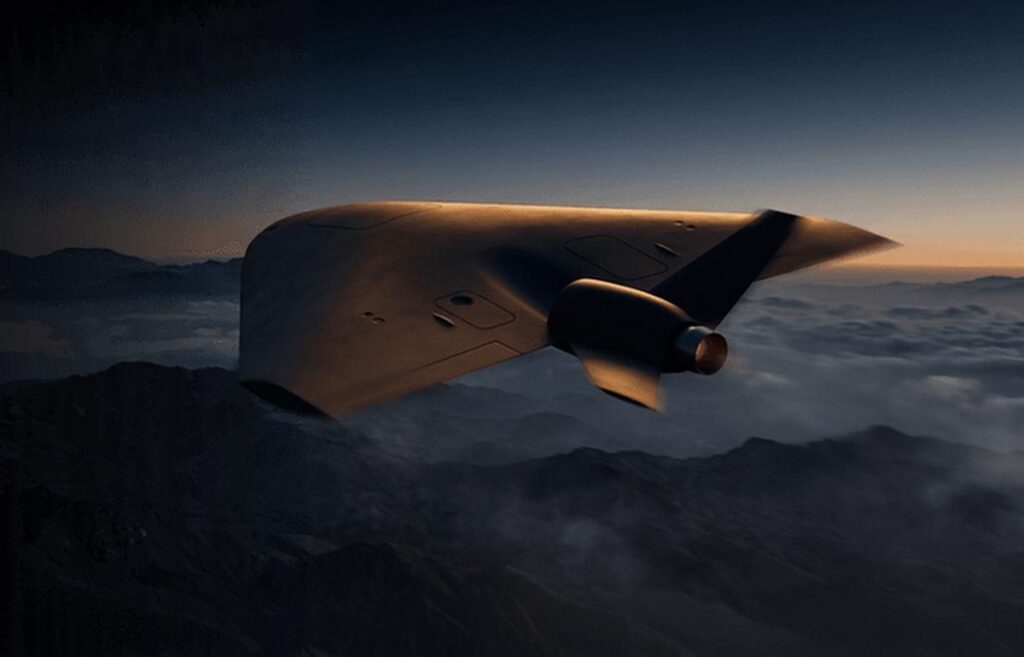
Ukraine's latest deep strike drone is one of a kind. The Triada Robotics Bravo features a "blended wing body" design that's rarely seen on a drone. The special platform maximizes lift and minimizes drag, helping the drone fly farther for a given speed and payload than a conventional "tube and wing" drone can do.

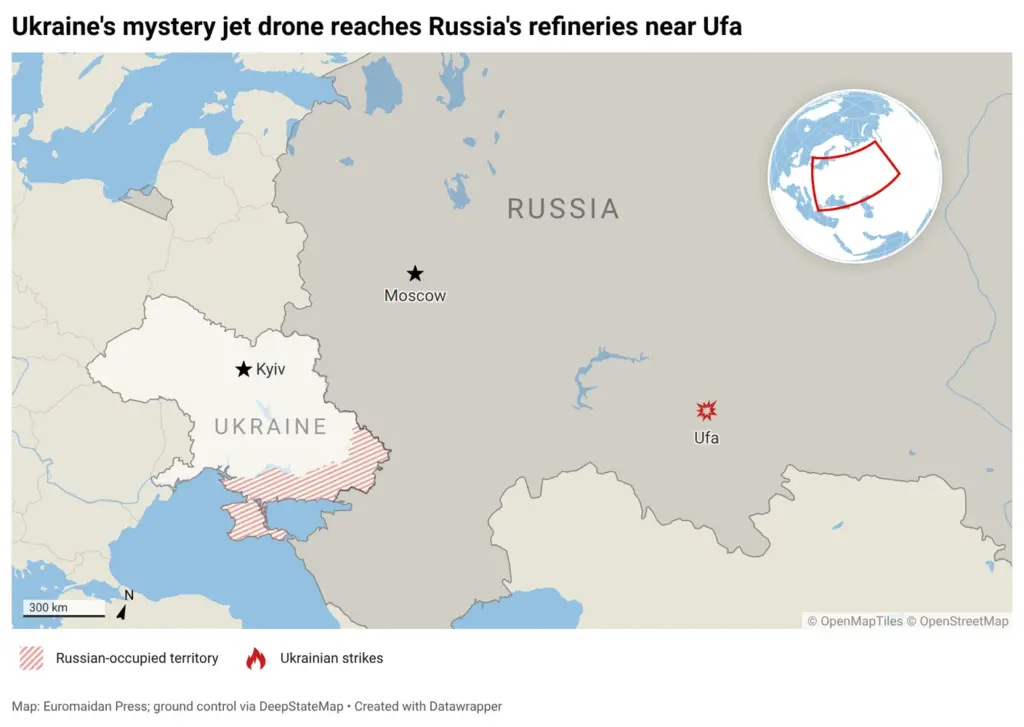
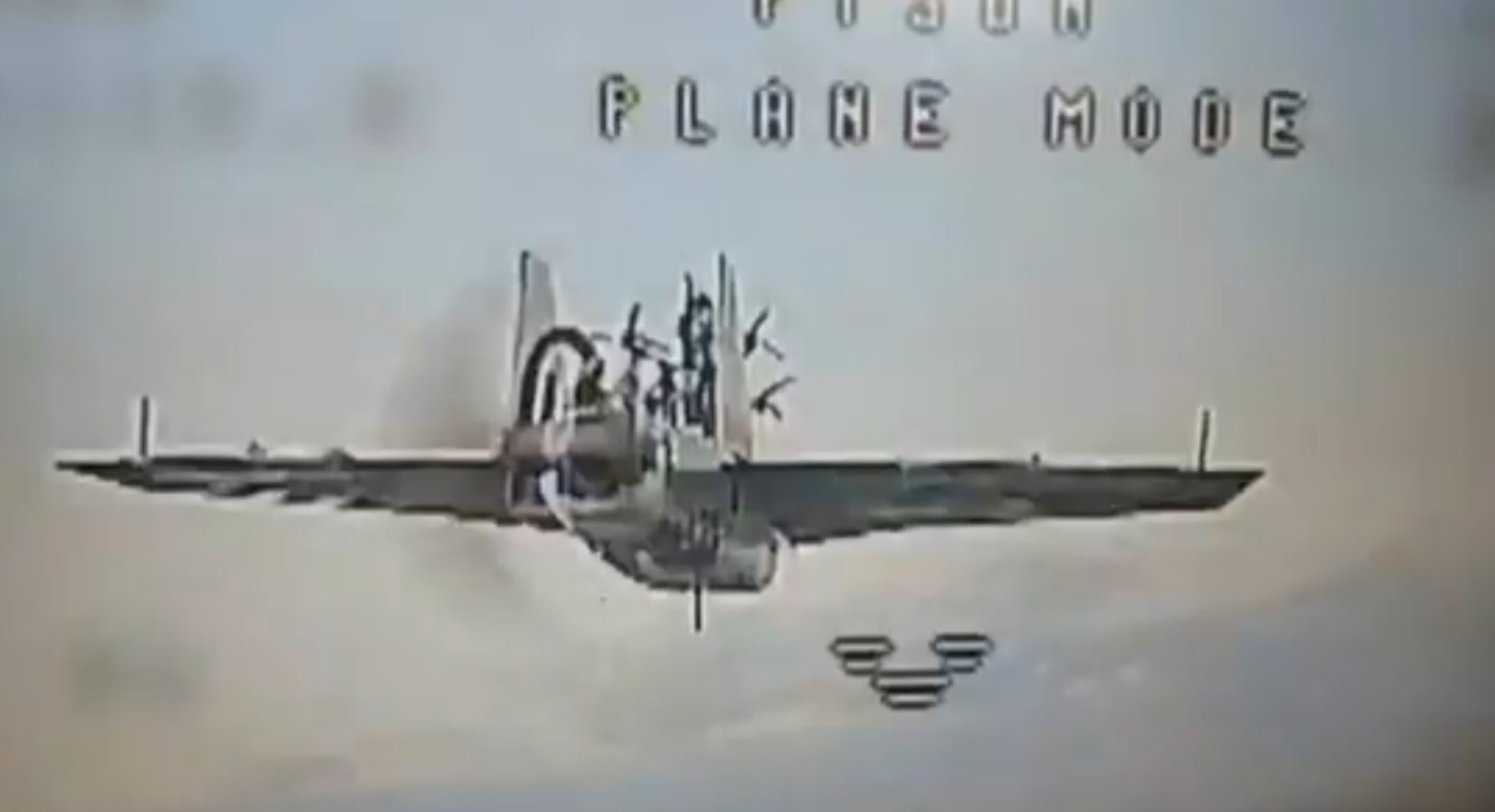
A stubby jet drone appeared fleetingly in a video shot from the ground during a strike on the Ufa refinery cluster in Bashkortostan on 2 August, more than 1,700 km from the Ukrainian border. Ukrainian forces hit the three Bashneft plants at Ufa on 1, 2, and 5 August.

Ukraine's drones hit Bashneft refineris in Ufa
Ukraine's drones hit Bashneft refineries in Ufa. Map: Euromaidan Press

No official body has identified the aircraft in the footage. Online observers compared the silhouette to the American F-117 Nighthawk; the outline is also consistent with the renders Triada publishes of the Bravo. The clip runs a few tenths of a second.

Everything that has reached that deep into Russia until now has been propeller-driven, plodding along at less than 200 km/hr. A jet Bravo cruising at 600 km/hr covers the same 1,700 km in under three hours instead of nine and a half. That is the difference between an air defense network with all morning to work out where a drone is going and one with a couple of hours.

Exactly what the drone in the video was aiming for, and whether it struck its target, is unclear. But that's not stopping Russian observers from panicking. "Shooting down a drone is practically impossible," one Russian blogger moaned.

It's untrue. Motoring along at 600 km/hr—Triada claims around 800 km/hr in the final phase of flight—the jet-propelled Bravo is neither the fastest Ukrainian deep strike munition nor the slowest. If Russian air defenses can take down 950 km/hr Fire Point FP-5 Flamingo cruise missiles, they can take down Bravos, too. Detecting one is a separate question: Triada says the Bravo's composite airframe reduces its radar cross-section.

Arming a Russian gunship with interceptor drones.
Explore further

Russia just copied Ukraine’s cleverest drone hunter

But invulnerability surely wasn't the main goal when Kyiv-based Triada Robotics designed the Bravo over the past couple of years. Efficiency was the objective. Which is probably why the firm chose the blended-wing-body arrangement for the one-way explosive drone, which it lists at around 174,000 euros—roughly $200,000.

The blended shape "provides many different aerodynamic benefits over conventional aircraft design," Oliver Johnson and Sam Dakka wrote in a 2019 article in International Journal of Aviation, Aeronautics and Aerospace.

Most drones, like most manned aircraft, have the same layout: a tube-shaped body and separate wings jutting from the body. These tube-and-wing aircraft are the easiest to conceptualize and the most straightforward to assemble, as the fuselage and wing can be built independently and attached during production.

The problem is drag, especially at the junctures between body and wing. A draggier airframe suffers a range and speed penalty compared to a less draggy airframe.

An unidentified Ukrainian jet-powered drone was filmed during yesterday's attack on Russian territory.

It is believed to be either the Bravo drone developed by Triada Robotics, which reportedly has a range of up to 2,000 km, a 100–200 kg warhead, and a top speed of 650–700 km/h,… pic.twitter.com/3ZtweKwR6t

— OSINTWarfare (@OSINTWarfare) August 3, 2026

Alternative shapes

There are alternatives to tubes and wings. Flying wing aircraft such as the US Air Force's B-2 and B-21 stealth bombers, both built by Northrop Grumman, are all wing—and have neither an identifiable fuselage nor horizontal or vertical stabilizers. They look like boomerangs.

At subsonic speed, that shape is less draggy than a tube and wing shape is, and thus more efficient for long-range flight. At the same time, a flying wing's lack of sharp angles reduces its radar reflectivity. In short, it can be very stealthy and hard to detect on radar.

The downside of a flying wing is that it's unstable and requires sophisticated flight controls to keep it in the air.

A blended wing body shape is a kind of compromise between a flying wing design and a tube and wing design. There's a fuselage and a wing and stabilizers, but the fuselage and wing blend into each other. A blended wing body isn't as stealthy as a flying wing is, but it's easier to control.

A Gerbara in mid-air.
Explore further

Ukraine’s AI drones hammer Russian supply lines. Russia’s $10,000 drone just got the same kit

And it's still less draggy than a tube-and-wing type. "The improvements increase the overall lift to drag ratio providing a higher performance aircraft saving 27% fuel burn per passenger mile that of the modern conventional configuration," Johnson and Dakka wrote.

That benefit is apparent in the Bravo's performance specifications. The drone reportedly ranges 2,000 km with a warhead of 100 to 200 kg and AI-assisted targeting, flying as high as 5,000 m. It's unclear how the Bravo navigates, but it's probably via some combination of satellite and inertial systems.

It's an impressive set of stats. A $50,000, propeller-driven Fire Point FP-1 ranges slightly farther—2,300 km—but the FP-1 cruises at just 180 km/hr and packs a 60-kg warhead. The Bravo is more than three times as fast and carries at least half again as much explosive, and possibly triple, while still flying far enough to reach deep inside Russia.

Yes, the Bravo costs four times as much as the FP-1 does, probably in part because of the jet propulsion, but that could change if Triada Robotics can scale up production. Co-founder Artem Veselov has said the company aims for a first pre-series batch of 100 by the end of the year. For now, the Bravo is a rarity. But it may become much more common in the sky over Russia in the coming months.

  • ✇Euromaidan Press
  • Azerbaijan’s FM visited Irpin, town that stopped Russia’s drive on Kyiv, and offered gas supplies
    Azerbaijan's top diplomat stood in the town that stopped Russia's drive on Kyiv and offered Ukraine help. Foreign Minister Jeyhun Bayramov has visited Irpin in Kyiv Oblast as part of an official visit to Ukraine, Azerbaijan's Foreign Ministry said on X. The visit is a marker of how far Baku has swung toward Kyiv as its relations with Moscow have collapsed. Ukrainian-Azerbaijani ties improved sharply in 2024 and 2025 after a series of aggressive Russian actions, includin
     

Azerbaijan’s FM visited Irpin, town that stopped Russia’s drive on Kyiv, and offered gas supplies

6 août 2026 à 12:06

Foreign Minister of Azerbaijan Bayramov Jeyhun visited Irpin on 6 August 2026. Source: @AzerbaijanMFA

Azerbaijan's top diplomat stood in the town that stopped Russia's drive on Kyiv and offered Ukraine help. Foreign Minister Jeyhun Bayramov has visited Irpin in Kyiv Oblast as part of an official visit to Ukraine, Azerbaijan's Foreign Ministry said on X.

The visit is a marker of how far Baku has swung toward Kyiv as its relations with Moscow have collapsed. Ukrainian-Azerbaijani ties improved sharply in 2024 and 2025 after a series of aggressive Russian actions, including Russian forces shooting down an Azerbaijani airliner near Grozny in December 2024, killing 38, and later raids that killed two Azerbaijani citizens, prompting Baku to openly strengthen ties with Kyiv.

Bayramov chose to visit Irpin, the town that became a legendary bulwark against Russia's 2022 advance on Kyiv, where Russia killed some 300 civilians and left over 70% of housing destroyed before its liberation on 28 March 2022, Ukrainska Pravda reports.

Baku offers gas and energy cooperation

At a joint press conference with Ukrainian Foreign Minister Andrii Sybiha, Bayramov made a specific offer. Azerbaijan is ready to supply gas to Ukraine if needed and to expand cooperation on energy security, including the use of Ukraine's underground gas storage, he said, per Ukrinform.

Energy is the anchor of the relationship. Bayramov called energy cooperation one of the most important areas of economic ties between the countries, noting that Azerbaijan's state oil company, SOCAR, has been present on the Ukrainian market for a decade and has plans for future energy cooperation.

Ukraine's gas storage is an asset

Bayramov called Ukraine's underground gas storage system, the largest in Europe, a very important asset and said an extremely dynamic dialogue is underway between Baku and Kyiv on key elements of energy cooperation.

That storage matters strategically. Ukraine's vast underground capacity offers a route to move Caspian gas into Europe as an alternative to Russian supplies, part of why Russia has bombed Ukraine's southern gas infrastructure. An Azerbaijani offer to use it deepens a partnership Russia has reason to want severed.

  • ✇Euromaidan Press
  • Six explosions, four fires: Ukraine hit one of Russia’s five largest refineries, 700 km from border
    Ukraine reached one of Russia's largest refineries and hit its coast guard in occupied Crimea in one operation. The Security Service of Ukraine (SBU), together with the Defense Forces, struck the Slavneft-YANOS refinery in Yaroslavl, over 700 kilometers from Ukraine's border, the SBU reported. The refinery is a major node in Russia's fuel supply to its capital region. The Yaroslavl refinery is one of the five largest oil-refining enterprises in Russia, with a capacity o
     

Six explosions, four fires: Ukraine hit one of Russia’s five largest refineries, 700 km from border

6 août 2026 à 11:46

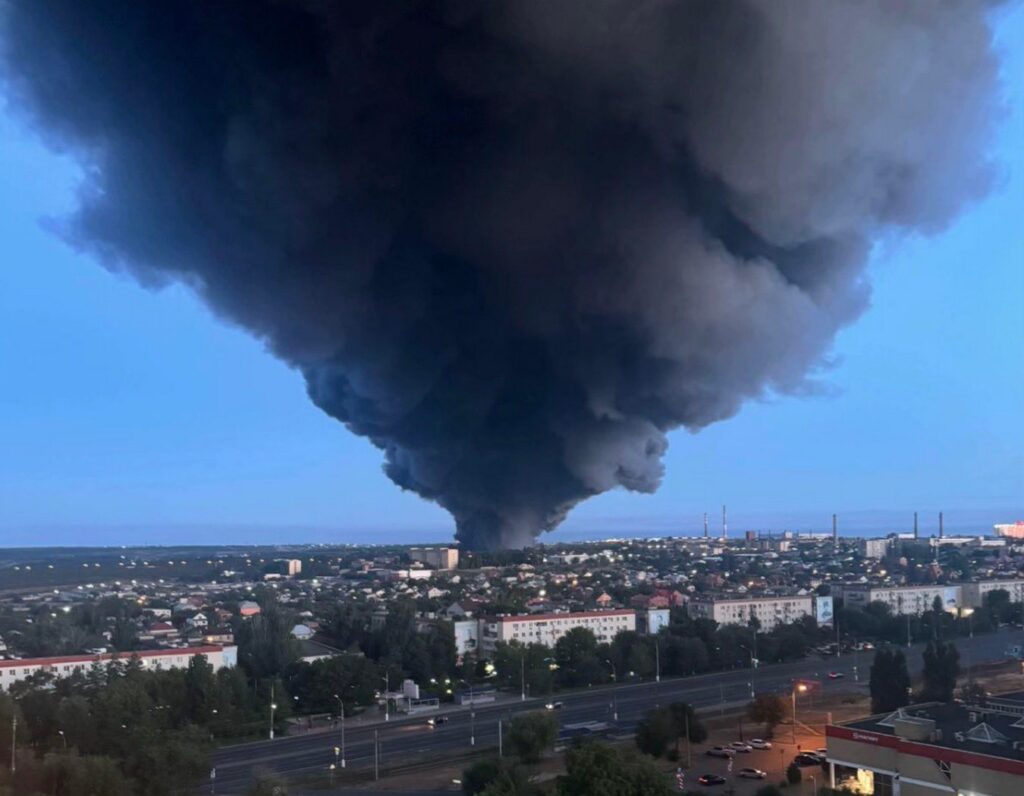
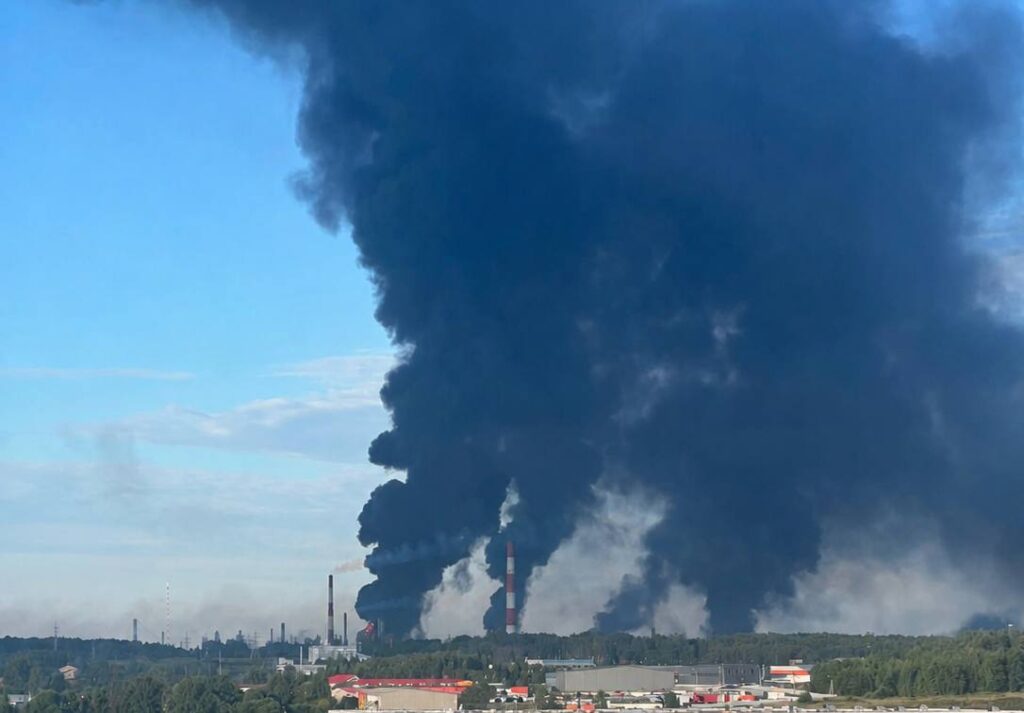
10% russia's refining half siberia's fuel omsk plant just lost its 2500-km protection · post smoke rises over yaroslavl russia after ukrainian drone strike slavneft-yanos refinery 6 2026 supernova+ ukraine

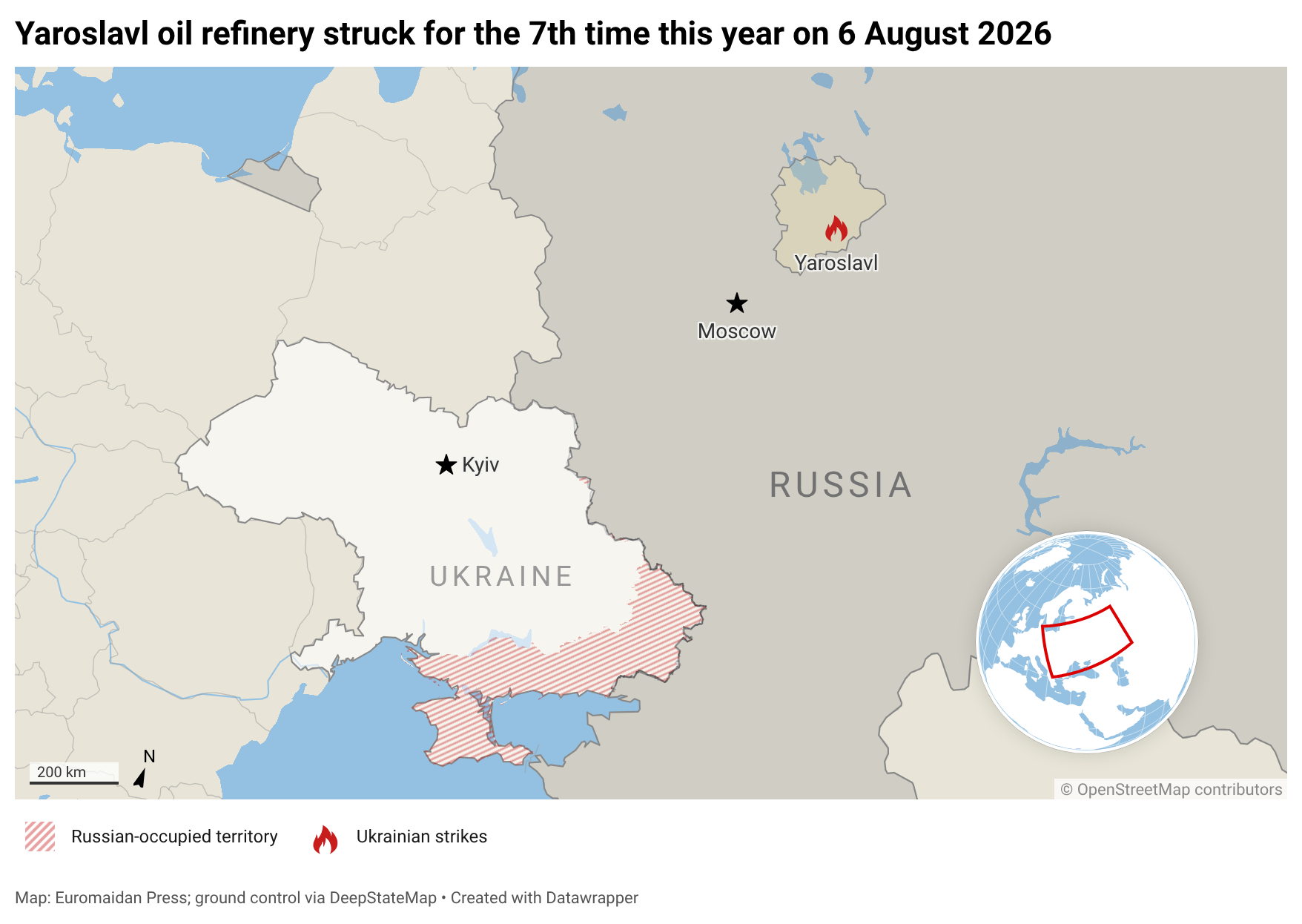
Ukraine reached one of Russia's largest refineries and hit its coast guard in occupied Crimea in one operation. The Security Service of Ukraine (SBU), together with the Defense Forces, struck the Slavneft-YANOS refinery in Yaroslavl, over 700 kilometers from Ukraine's border, the SBU reported.

The refinery is a major node in Russia's fuel supply to its capital region. The Yaroslavl refinery is one of the five largest oil-refining enterprises in Russia, with a capacity of nearly 15 million tons of oil per year, producing gasoline, diesel, aviation kerosene, and other strategically important products for central Russia and the Moscow metropolitan area.

The refinery took multiple hits

The strike set several parts of the plant on fire. At least six explosions were heard on the refinery's grounds, and fires broke out in four different parts of the plant.

The damage hit both storage and processing. According to preliminary information, four crude oil tanks were damaged, resulting in a spill. Two tanks were engulfed in fire, and key processing units were also damaged and set alight. Striking both the tanks that hold the crude and the units that refine it degrades the plant's ability to produce fuel, not just store it.

The Kerch strike hit FSB coast guard ships

The second target was in occupied Crimea. Drone strikes on the port in Kerch damaged two Project 10410 "Svetlyak" patrol ships of the FSB coast guard, the "Balaklava" and the "Kerch".

Hitting the FSB's patrol vessels chips at Russia's ability to guard the waters around occupied Crimea and the Kerch Strait, the same maritime chokepoint Ukraine's shadow-fleet campaign has targeted.

The strikes fit the campaign against Russia's war economy

The operation extends Ukraine's sustained effort to drain Russia's fuel revenue and military logistics. The SBU said it consistently works to reduce Russia's military-economic potential, and that military sites, fuel-and-energy enterprises, and other legitimate targets working for Russia's aggression will keep coming under fire.

  • ✇Euromaidan Press
  • Ukraine’s strikes gave Kazakhstan leverage over Russian retail giant Wildberries
    On 4 August, Kazakhstan’s Trade and Integration Minister, Arman Shakkaliyev, confirmed that Russia’s largest online retailer is building 260,000 square meters of warehousing space in Almaty and Astana.In the same appearance, he told Kazakh shoppers to favor domestic marketplaces instead. Take the construction money, steer the customers away: that is Astana’s answer to a war that has driven Wildberries to look abroad for shelter. Take the construction money, steer the cu
     

Ukraine’s strikes gave Kazakhstan leverage over Russian retail giant Wildberries

6 août 2026 à 10:58

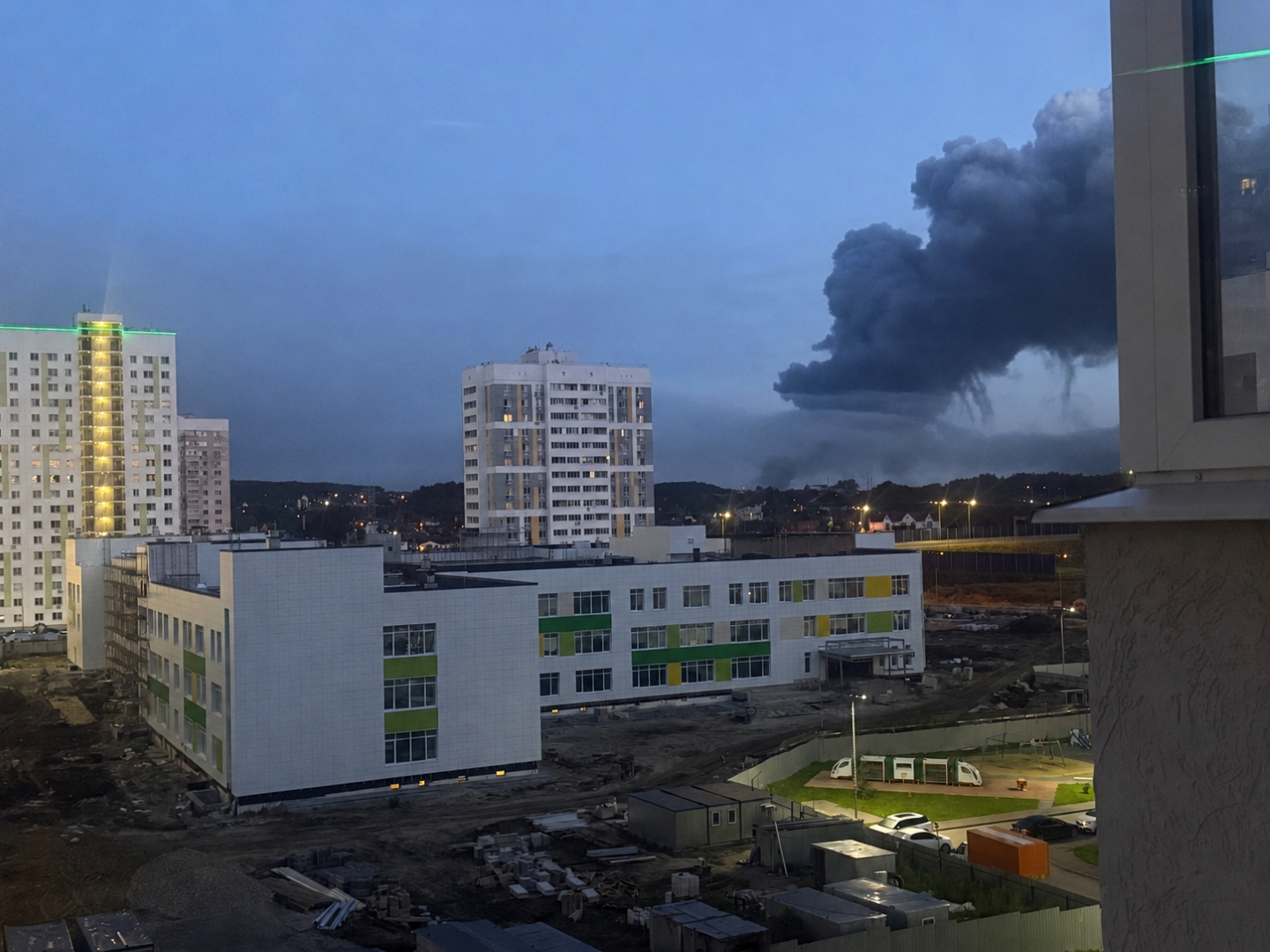
drones hit volgograd kept flying 1100 km tatarstan · post large fire sends up black smoke over russia after ukrainian drone strike wildberries logistics center 31 2026 x/@bayraktar_1love bayraktar_1love hoivgso

On 4 August, Kazakhstan’s Trade and Integration Minister, Arman Shakkaliyev, confirmed that Russia’s largest online retailer is building 260,000 square meters of warehousing space in Almaty and Astana.

In the same appearance, he told Kazakh shoppers to favor domestic marketplaces instead. Take the construction money, steer the customers away: that is Astana’s answer to a war that has driven Wildberries to look abroad for shelter.

Take the construction money, steer the customers away: that contradiction is Astana’s answer.


The warehouses aren’t new—they’ve been under construction for years. And officially, the ministry says, Wildberries hasn’t asked to move its Russian operations to Kazakhstan at all. Astana is drawing a careful line: a Russian company can build here, but it cannot relocate its business here to escape the drones.

The wariness predates the strikes. Kazakhstan already taxes foreign marketplaces at 12% and can block those that fail to register. Of marketplace complaints logged in 2024, 73.7% concerned Wildberries, even as home-grown Kaspi held more than 70% of the market to Wildberries’ 17.2%. Astana was fencing the platform in before the first drone struck.

The bill reaches the neighbors

Kazakh sellers put their losses at roughly 2 billion tenge ($4.2 million) by one count, and the Ecommerce-KZ association estimates more than $2.1 million—neither figure has been confirmed, and the minister has told people not to trust the numbers circulating online.

More than 120,000 Kazakh entrepreneurs were on the platform at the end of 2025, and Wildberries says it is repaying them in stages, working with the ministry and the business chamber Atameken.

Kyrgyzstan is hit harder. Its garment industry leans heavily on Wildberries, and individual producers have lost between 1 million and 100 million soms ($11,400 to $1.14 million) each—enough that Bishkek offered a tax holiday to garment firms through year-end.

What Wildberries wants sheltered is not neutral cargo. Ukraine says it strikes the retailer because the platform is used to trade body armor, drones, and their components that reach Russian forces.

smoke rises from a fire at a wildberries storage in penza, russia, on 30 july 2026
Explore further

Russia can rebuild Wildberries warehouses more easily than it can replace warehouse workers

That leaves Kazakhstan exposed: it has spent the past year tightening dual-use export controls to avoid Western secondary sanctions, and now a company that sells to the Russian military wants to move its logistics onto Kazakh ground.

For now, the shelter barely exists. Wildberries wants to rent about 100,000 square meters—close to every empty warehouse Kazakhstan has—and the complexes it is building will not open until 2027. By then, Astana may have made up its mind about how much of Russia’s retreat it actually wants on its soil.

  • ✇Euromaidan Press
  • The throwaway agents Moscow sent after a Bavarian drone boss arming Ukraine—and how Germany stopped them
    German security services believe Russia was preparing to assassinate the head of a company that supplies drones to Ukraine, according to Die Zeit. Two suspected agents who surveilled him have been arrested, and officials warn the case marks a deadlier turn in Russian operations inside Germany. Russia's shadow campaign against European states has grown from disinformation into drone overflights, arson, and the tracking of people who help Ukraine. Moscow increasingly hire
     

The throwaway agents Moscow sent after a Bavarian drone boss arming Ukraine—and how Germany stopped them

6 août 2026 à 03:54

russia hired desperate hunt german drone-maker boss arms ukraine · post stefan thumann head drone maker donaustahl штефан туманн news ukrainian reports

German security services believe Russia was preparing to assassinate the head of a company that supplies drones to Ukraineaccording to Die Zeit. Two suspected agents who surveilled him have been arrested, and officials warn the case marks a deadlier turn in Russian operations inside Germany.

Russia's shadow campaign against European states has grown from disinformation into drone overflights, arson, and the tracking of people who help Ukraine. Moscow increasingly hires vulnerable people and migrants for the dangerous work.

Surveillance of a drone-maker

Investigators say the target is Stefan Thumann, head of the Bavarian startup Donaustahl, which makes reconnaissance and kamikaze drones for Ukraine. In December 2025, a recruit filmed his home and photographed the nameplate, focusing on the man rather than the company, security services believe. Thumann has been outspoken against Moscow, posting that "Russia doesn't want peace. It wants the destruction of the West."

Two arrests

A foreign intelligence service flagged Thumann as high-risk in December 2025. Bavarian police arrested Serhii N., a former bricklayer from Kharkiv with no intelligence training, then released him before analyzing his phones. The devices later showed contact with Russian intelligence and attempts to trail his father, investigators found. He fled to Spain, and a Romanian woman, Alla S., continued the surveillance. Both were arrested in March 2026, in Spain and North Rhine-Westphalia.

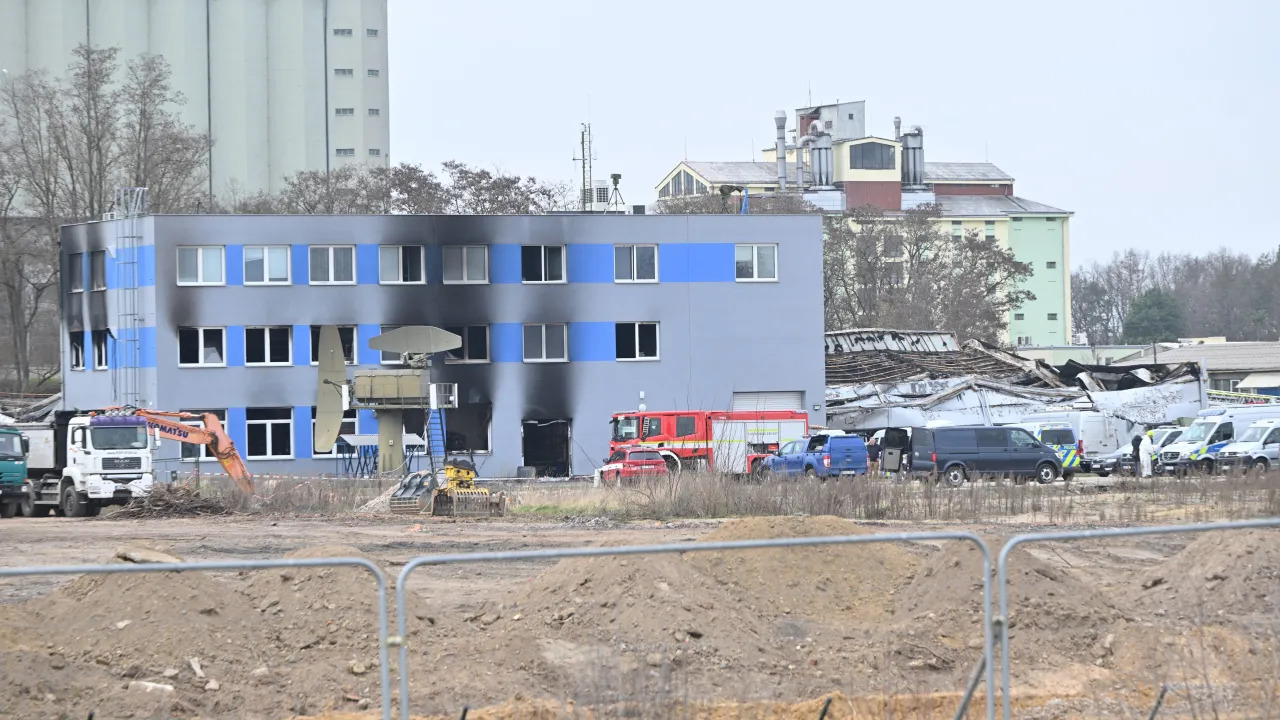
fourth suspect arrested arson attack czech factory made drones thermal optics ukraine · post burned-out building archer company pardubice czechia згорівша будівля компанії в чеському пардубіце фото ct24 police 20
Explore further

Fourth suspect arrested in arson attack on Czech factory that made drones and thermal optics for Ukraine

Russia recruits such disposable agents online, paying people from precarious backgrounds for surveillance, arson, and sabotage, and discarding them afterward. Ukraine's own SBU security service has reported dozens of cases in 2026 of Russia recruiting Ukrainians at home for arson and sabotage, often by forging Ukrainian security summonses to pose as their own government.

The BfV, Germany's domestic intelligence service, classifies the case as a suspected planned assassination. A federal investigating judge was not convinced, so the arrest warrant cites only suspected intelligence-agent activity. Lawyers for both suspects declined to comment.

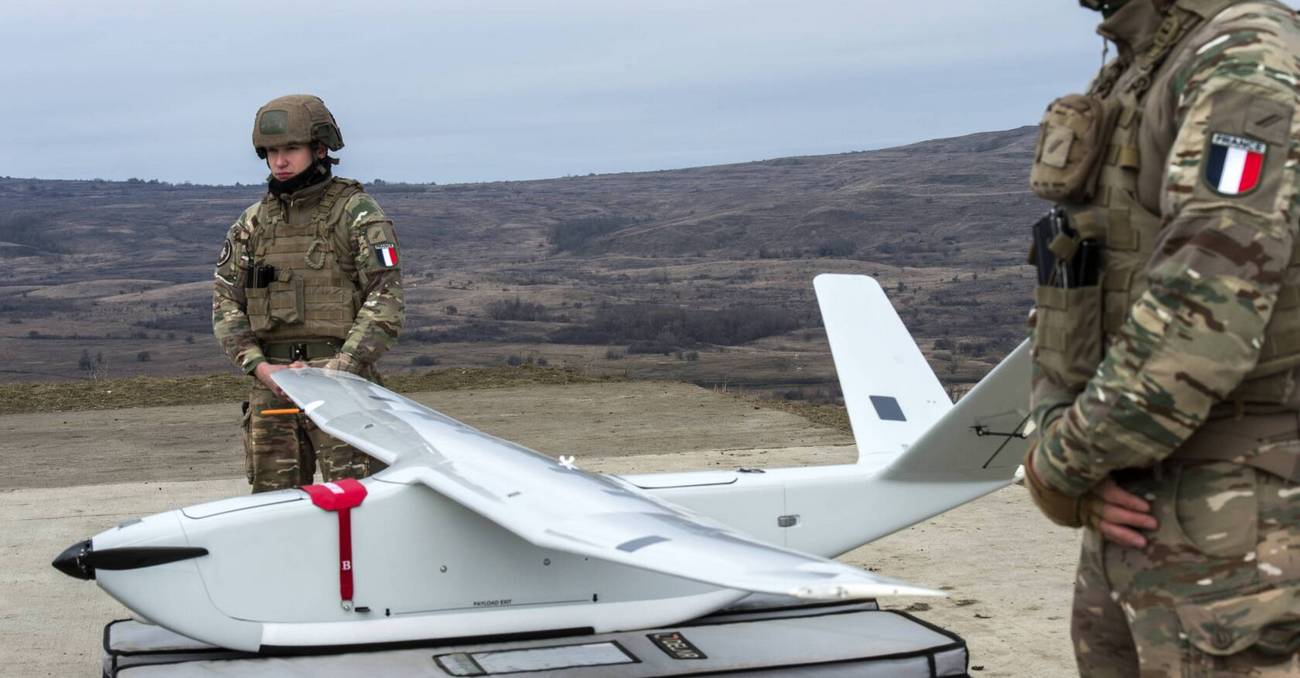
french factory makes drones ukraine firebombed molotov cocktails · post delair dt46 group's best-selling drone during nato exercise romania 9 2026 dt a builds became target sabotage attempt suspected spying
Explore further

A French factory that makes drones for Ukraine was firebombed with Molotov cocktails

A widening threat

A second German arms company is reportedly in Russian intelligence's sights, investigators say. On 11 June, Serbian officers stopped a truck of concealed explosives apparently bound for Bavaria, home to Donaustahl, Quantum Systems, and Helsing. 

The threat has precedent: agents had Rheinmetall chief Armin Papperger watched in 2024, and an FSB killing struck a Georgian exile in Berlin in 2019. It fits a broader Russian sabotage campaign across Europe. 

Thumann, now under guard, still taunts Moscow: 

"You won't break me."

  • ✇Euromaidan Press
  • Seventh time this year: Ukrainian drones torch a top-five Russian refinery in Yaroslavl
    Ukrainian drones struck one of Russia's five largest oil refineries in Yaroslavl on the morning of 6 August, setting off several fires across the site, monitoring channels reported. Open-source analysts placed the blazes on the refinery grounds, while the region's governor claimed his air defenses downed the entire raid. The strike continued a months-long campaign that has pushed Russian oil refining to its lowest level in more than two decades. Ukraine has turned long-
     

Seventh time this year: Ukrainian drones torch a top-five Russian refinery in Yaroslavl

6 août 2026 à 03:43

seventh time year ukrainian drones torch top-five russian refinery yaroslavl · post black smoke billows over slavneft-yanos oil after drone strike russia 6 2026 least 4 fires telegram ukraine context

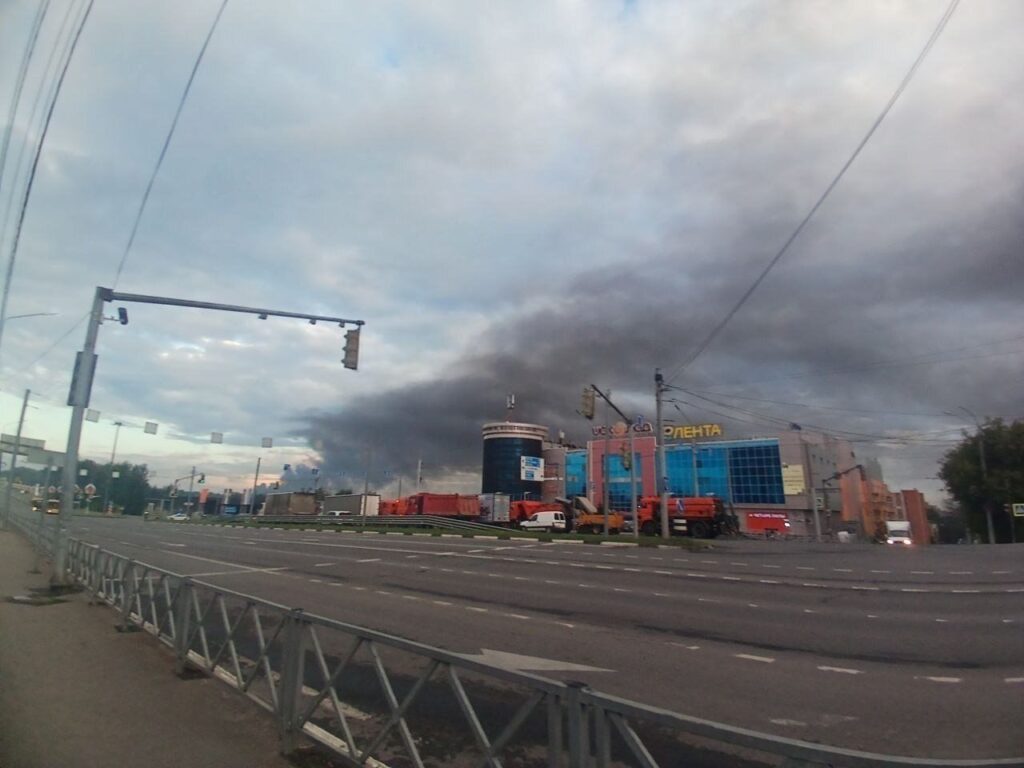
Ukrainian drones struck one of Russia's five largest oil refineries in Yaroslavl on the morning of 6 August, setting off several fires across the site, monitoring channels reported. Open-source analysts placed the blazes on the refinery grounds, while the region's governor claimed his air defenses downed the entire raid. The strike continued a months-long campaign that has pushed Russian oil refining to its lowest level in more than two decades.

Ukraine has turned long-range drones into an economic weapon in 2026, hitting the refineries and export terminals that bankroll Russia's war. The damage has reached ordinary Russians, with fuel shortages spreading from city pumps to farms and buses. A parallel campaign that started last month targets warehouses of Russia's largest online retailer.

Fires break out across the refinery

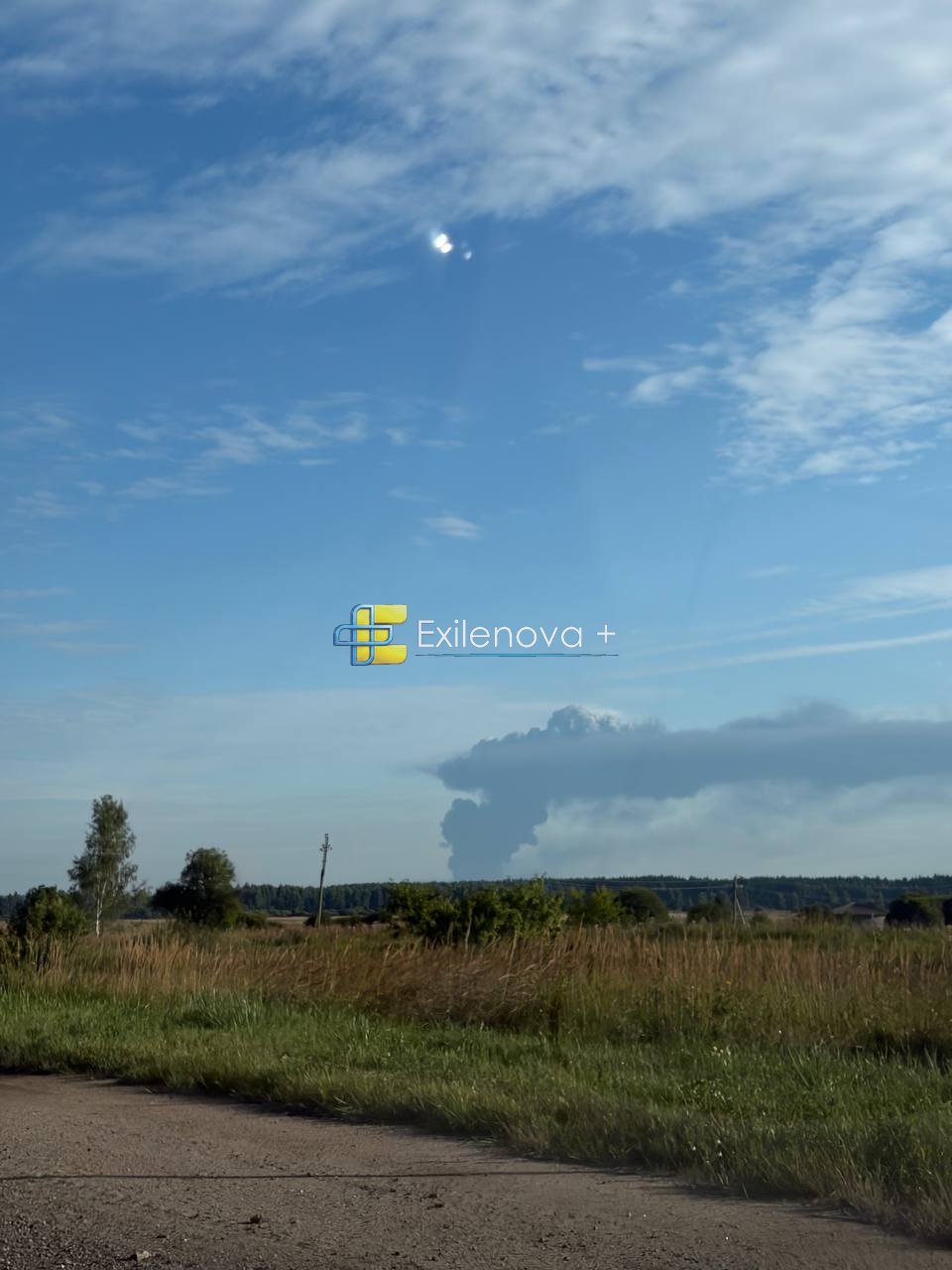
Ukrainian monitoring Telegram channel Exilenova+ first reported the attack around 4:00, later sharing footage that showed thick black smoke rising from several points on the site. Fire Point, the Ukrainian company that builds the FP-1 long-range drone, said Ukraine's Defense Forces hit the plant with the domestically made FP-1s. Open-source analysts geolocated one blaze to the refinery grounds. Astra, a Russian news Telegram channel, reported one fire on the plant's territory and a second it had not yet located.

Ukraine struck another Wildberries warehouse this morning, the 15th such facility hit in just 18 days

Thirteen of those fifteen warehouses have burned so far, a pace that turns Russia's largest online retailer into a recurring target list
📷 Exilenova+ pic.twitter.com/cGOvsmkR6L

— Euromaidan Press (@EuromaidanPress) August 4, 2026

One of Russia's biggest refineries

Slavneft-YANOS, also called the Novo-Yaroslavl refinery, ranks among Russia's five largest and is the biggest in the country's central regions. It processes about 15 million tonnes of crude a year into gasoline, diesel, aviation kerosene, jet fuel, lubricants, and bitumen. Rosneft and Gazprom jointly control 99.7% of its parent company, Slavneft. The plant's fuel feeds central Russian industry, airports, the Northern Railway, and military sites. It sits more than 700 kilometers from Ukraine's border.

Russia claims it downed every drone in the region

Yaroslavl Governor Mikhail Yevraev first reported the region was under drone attack around 3:00 and closed the highway toward Moscow. He later claimed the region had repelled its most massive drone raid, downing all 88 drones with no casualties. Yevraev stated that a detached house burned, windows were shattered in several apartment blocks, and residents' cars were damaged. 

seventh time year ukrainian drones torch top-five russian refinery yaroslavl · post column smoke burning slavneft-yanos seen outside russia 6 2026 exilenova 5161475930520751580 ukraine news reports
A column of smoke from the burning Slavneft-YANOS refinery seen from outside Yaroslavl, Russia, 6 August 2026. Photo: Exilenova+

Russia's Defense Ministry claimed it destroyed 605 drones over several regions overnight.

The plant has burned repeatedly in 2026, catching fire on 28 March, 26 April, 8 and 22 May, and 6 and 16 July before the latest hit. That made 6 August the seventh strike on the refinery this year. In the 16 July attack, an FP-1 struck the plant's tank farm.

Russia's refining in retreat

Ukraine has sharply expanded its FP-1 deep strikes on refineries this year, knocking out around 26 plants. By late July, only eight had fully restarted and at least 11 partly. Seven refineries stayed idle. Russian refining fell to 3.6 million barrels a day, its lowest since May 2002. 

Earlier, Moscow banned fuel exports, boosted gasoline imports from Belarus 25-fold, and turned to India and Morocco. It also let refiners sell Euro-2 gasoline, a grade banned in Russia since 2013, through 1 July 2027.

Drug lab in EU member state, dealers in Ukraine, passenger buses in between: Dual operation seizes $960,000 in drugs across 32 searches

6 août 2026 à 01:48

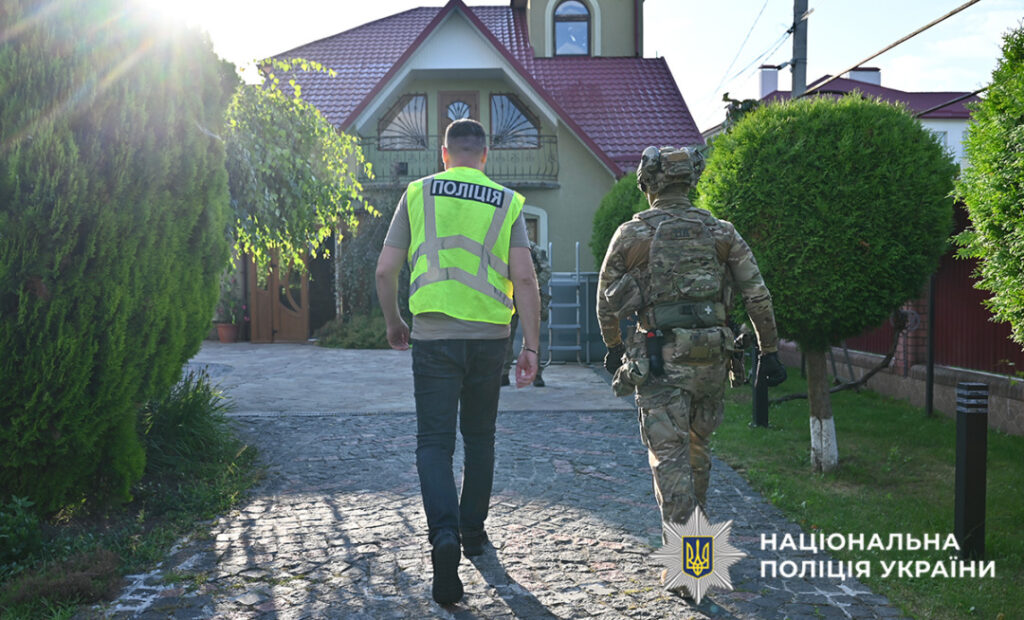
A Ukrainian police officer and Security Service officers during an operation. Source: National Police of Ukraine

Ukrainian and Bulgarian police have taken apart a drug operation that ran from a lab in Bulgaria to dealers in Ukraine. In a large-scale operation, officers dismantled a transnational drug scheme and detained eight people, Ukraine's National Police reported.

The ring ran a full production-to-sale pipeline across two countries. It manufactured psychotropic drugs in an underground lab in Bulgaria for sale in Europe, then smuggled them into Ukraine's Chernivtsi Oblast for distribution, and police seized psychotropic substances and precursors worth $960,000.

The lab was in Bulgaria

The first stage of the operation hit the production end. In the Bulgarian city of Burgas, police detained the scheme's organizer, a 39-year-old native of Chernivtsi, and a 31-year-old lab technician from Ivano-Frankivsk Oblast who directly produced the drugs.

The lab held a substantial stock. During searches, police seized 50 kilograms of psychotropic substances, alpha-PVP, mephedrone, and amphetamine, along with 150 liters of precursors, 200 liters of chemical compounds, and laboratory equipment.

The drugs moved by passenger bus

The smugglers used ordinary cross-border transport to move the product. They carried the psychotropics and precursors across the state border on international passenger buses, carefully hidden among personal belongings and luggage, with other members of the scheme receiving the goods in Chernivtsi Oblast.

The second stage targeted the Ukrainian end. Police exposed six more participants responsible for receiving, packaging, transporting, and selling the smuggled drugs across Ukraine, conducting 32 authorized searches with the support of special forces.

Eight face drug-trafficking charges

The Ukrainian arrests brought the total to eight. Police detained six drug dealers, four men and two women in Chernivtsi Oblast, and served them notices of suspicion for drug offenses under several articles of Ukraine's Criminal Code.

The searches turned up amphetamine, cannabis, packaging materials, cash in Ukrainian and foreign currency, bank cards, phones, and laptops, and police seized three of the suspects' cars worth nearly $43,000. The seized substances were sent for forensic analysis.

❌