Vue normale

  • ✇Euromaidan Press
  • Why does Ukraine need a Bebradron-M drone with no warhead and only 2 kg of payload?
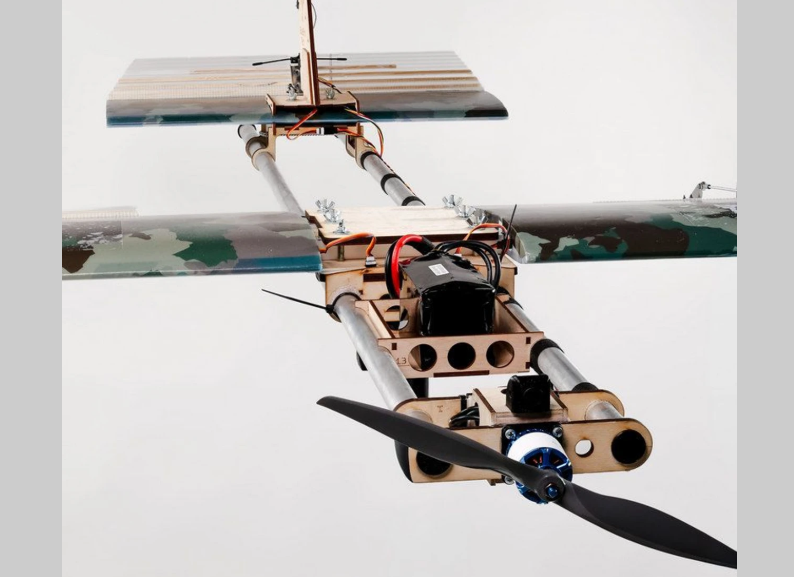
    Ukrainian company BlueBird Tech has unveiled a new version of its fixed-wing “Bebradron” UAV. The new modification has no warhead but can carry a payload of up to 2 kg, Oboronka writes. The Bebradron-M is remotely operated. It has a cruising speed of 70 km/h and a maximum speed of up to 115 km/h. It can fly for up to 25 minutes, has a range of up to 30 km, and operates at altitudes of 200–700 meters. The name Bebradron was not chosen by chance. It comes from the Ukr
     

Why does Ukraine need a Bebradron-M drone with no warhead and only 2 kg of payload?

17 août 2026 à 16:27

Ukrainian company BlueBird Tech has unveiled a new version of its fixed-wing “Bebradron” UAV. Source: Oboronka

Ukrainian company BlueBird Tech has unveiled a new version of its fixed-wing “Bebradron” UAV. The new modification has no warhead but can carry a payload of up to 2 kg, Oboronka writes.

The Bebradron-M is remotely operated. It has a cruising speed of 70 km/h and a maximum speed of up to 115 km/h. It can fly for up to 25 minutes, has a range of up to 30 km, and operates at altitudes of 200–700 meters.

The name Bebradron was not chosen by chance. It comes from the Ukrainian joke from a meme “nyukhai bebru” (“sniff the bebra”), a humorous euphemism hinting at the male genitalia.

What is such a small drone used for?

The specialized version is designed to train pilots and interceptor-drone operators and to practice scenarios for shooting down aerial targets using a real UAV.

The Bebradron-M can also be used to simulate a decoy target during exercises aimed at countering aerial reconnaissance.

The company said foil materials can be applied to the drone’s wings to increase its radar signature. This creates an additional radar return, allowing operators to practice scenarios involving multiple aerial targets.

What does the Bebradron-M lack?

The standard fixed-wing UAV configuration includes a low-light camera, analog video link, 915 MHz control system and a 6S3P battery.

The Bebradron-M, however, lacks cruise control or navigation systems.

Ukraine clears hundreds of new drones for military use in 2026

Since the beginning of 2026, 413 unmanned aerial systems have been approved for use by Ukraine’s Defense Forces. This is more than in 2025 and 2024, according to Ukraine’s Defense Ministry. Almost all of the newly codified drones are Ukrainian-made.

Among them is the Dovbush T40, a drone built to reach the deepest parts of Russia, designed for deep reconnaissance and precision strikes against distant Russian targets.

The Ukrainian company behind MAUL — a robot that hits 70 km/h and survives flipping over — moves toward investment from an $81M US firm

17 août 2026 à 15:45

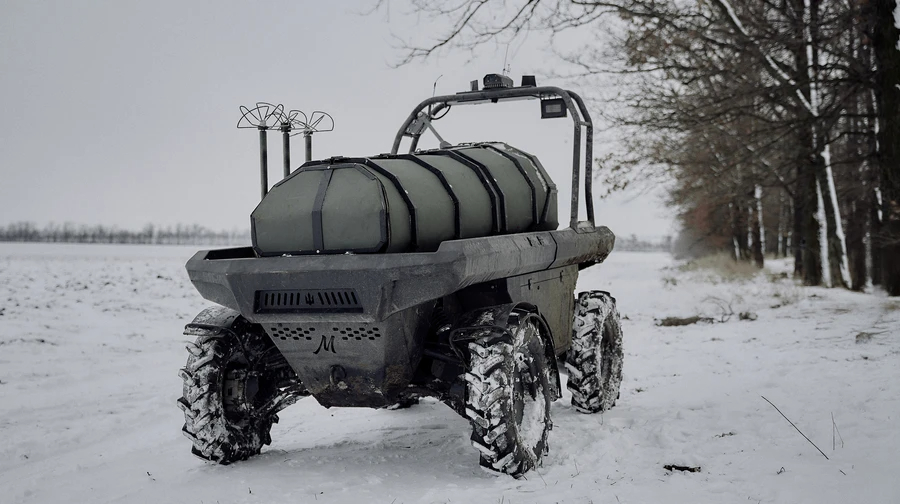
The MAUL unmanned ground vehicle. Source: AIDronesUA

Ukrainian company AIDronesUA and US-based Empery Digital Inc. have signed a document creating the conditions for strategic investment, according to Defender Media. AIDronesUA develops the MAUL unmanned ground vehicle, a casualty evacuation, logistics, and ammunition-delivery platform that was previously presented at the Eurosatory 2026 defense exhibition in Paris.

MAUL is built on an all-terrain vehicle equipped with an internal combustion engine, which offers a significant advantage over electric motors by enabling higher speeds. The drone can travel at up to 70 km/h when a reliable communications link is available. Its engine also allows it to operate in cold weather without the limitations associated with batteries, ArmyInform reports.

MAUL is equipped with four different types of communication links, which can back each other up. The UGV can continue moving even after overturning. Ukrainian military personnel have reported instances in which a vehicle flipped over, returned to its wheels, and continued moving.

Final agreement has not yet been signed

The parties emphasize that, at this stage, this is not a finalized investment agreement. The companies will conduct a feasibility study, financial modeling, and due diligence to assess the potential for future cooperation.

Empery Digital Inc., with which negotiations are underway, has a market capitalization of more than $81 million. The company is involved in the production of electric vehicles and also operates in the digital assets sector, including cryptocurrency.

Access to the US investment market

As part of the due diligence process, Empery Digital plans to assess AIDronesUA's technologies, operations, production requirements, financial needs, regulatory considerations, supply chains, and opportunities for international expansion.

A final agreement can be concluded only after the necessary approvals are obtained, negotiations are finalized, and the relevant documents are signed.

Potential cooperation with the US company could give AIDronesUA access to US investment, international manufacturing expertise, and global markets. The company is also considering integrating Ukrainian-developed technologies into international manufacturing and supply chains.

  • ✇Euromaidan Press
  • World’s largest crypto exchange helped Russia identify and jail a man who donated to Ukraine’s army
    The world’s largest cryptocurrency exchange, Binance, has helped Russia arrest one of its own citizens for supporting the Ukrainian military. Using information provided by the exchange, Russian authorities arrested 49-year-old Russian IT specialist Yuriy Bielenkyi, who was detained in September 2025 and is now being held in a Russian prison awaiting trial, Reuters reports. The information was later included in the criminal case against him. Russian investigators also a
     

World’s largest crypto exchange helped Russia identify and jail a man who donated to Ukraine’s army

17 août 2026 à 15:25

greece blocked gas ban france italy softened entry ban—now brussels tries 1600 companies helping russia's war · post 9 parade moscow 2025 youtube/kremlin grate patriotic warr shitshow ukraine news ukrainian

The world’s largest cryptocurrency exchange, Binance, has helped Russia arrest one of its own citizens for supporting the Ukrainian military. Using information provided by the exchange, Russian authorities arrested 49-year-old Russian IT specialist Yuriy Bielenkyi, who was detained in September 2025 and is now being held in a Russian prison awaiting trial, Reuters reports.

The information was later included in the criminal case against him. Russian investigators also asked Binance to identify other people who had transferred funds to a wallet used to collect donations for Ukrainian soldiers.

What information can be obtained through Binance?

Journalists obtained documents showing that in October 2025, Russian investigators requested Binance’s transaction history for Bielenkyi.

The exchange provided information about transfers to Ukrainian cryptocurrency wallets. Russian law enforcement received not only transaction data but also the user’s personal information, including his date of birth, address, phone number, passport details, a copy of his Russian passport, and his Bulgarian residence permit.

Passing the buck

Crypto-regulation lawyer Mike Bystrov told journalists that Binance was not necessarily required to hand over the data to Russia. If Bielenkyi was registered with Binance as an EU customer, he could have been covered by rules that significantly restrict the transfer of personal data to countries that do not provide an adequate level of data protection.

Binance disagreed. The company said it cooperates with lawful law-enforcement requests in different countries, but that government authorities themselves decide how to use the information they receive.

Meanwhile, the European Data Protection Board, an EU body, declined to comment.

Previous precedents involving Alexei Navalny

Reuters previously reported that in 2021, Binance’s regional head met with representatives of Russia’s financial-monitoring agency, who wanted to help identify customers making Bitcoin donations to Alexei Navalny.

At the time, Binance told Reuters that Russian authorities had never approached the company regarding the anti-Kremlin activist, who died in an Arctic penal colony in 2024.

  • ✇Euromaidan Press
  • Russia’s latest strike on Ukraine’s most important trade route: Togo-flagged civilian ship hit in Odesa
    Russia struck Odesa's port again and hit a foreign civilian ship. Russian forces attacked port infrastructure in Odesa Oblast overnight, damaging a civilian vessel flying the flag of Togo, Oleh Kiper, the head of the regional military administration, reported. The strike hit neutral commercial shipping at a port that Russia has repeatedly attacked. Odesa is Ukraine's main gateway for seaborne trade, and Russia has struck its port infrastructure throughout the war, endan
     

Russia’s latest strike on Ukraine’s most important trade route: Togo-flagged civilian ship hit in Odesa

17 août 2026 à 15:01

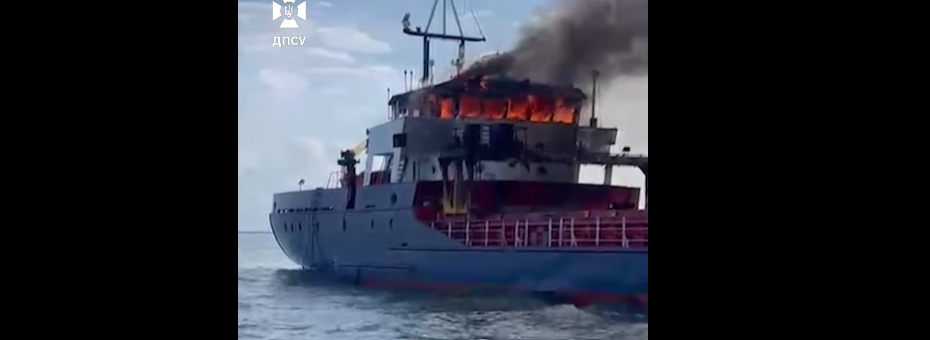
A Russian Shahed drone struck a Palau-flagged vessel carrying corn twice as it left a port in Odesa Oblast, setting it on fire. Source: Ukraine's State Border Guard Service

Russia struck Odesa's port again and hit a foreign civilian ship. Russian forces attacked port infrastructure in Odesa Oblast overnight, damaging a civilian vessel flying the flag of Togo, Oleh Kiper, the head of the regional military administration, reported.

The strike hit neutral commercial shipping at a port that Russia has repeatedly attacked. Odesa is Ukraine's main gateway for seaborne trade, and Russia has struck its port infrastructure throughout the war, endangering the foreign-flagged merchant ships that dock there to move Ukrainian grain and cargo.

Four people were injured

The strike caused casualties among those at the port. Four people were injured, three of them hospitalized and one in serious condition, and all are receiving the necessary medical care, Kiper said.

Fires broke out as a result of the strike and have now been fully extinguished, Kiper said.

The target was Ukraine's trade gateway

Hitting a foreign merchant ship strikes at the heart of Ukraine's economic lifeline. Odesa's ports are how Ukraine ships its grain and imports to the world, and the foreign-flagged vessels that call there are civilian commercial traffic, not military targets.

Earlier, Ukraine’s Agriculture Ministry cut its forecast for agricultural exports in 2026–2027 by 54% after Russia's strikes on the port. The ministry now expects 29.6 million tons of agricultural exports, down from 64.4 million. Its wheat export forecast fell by 53%, from 17.6 million tons to 8.3 million tons.

The scale of the crisis triggered by Russia

In July alone, Russian strikes damaged 28 vessels traveling to or from the ports of Greater Odesa, roughly 11–12% of maritime traffic, killing 21 sailors and injuring 34, according to Andrii Klymenko of the Black Sea Strategic Studies Institute’s monitoring group.

Land and river routes cannot make up the difference. Low water levels are limiting the Danube's capacity, and there is no full substitute for Ukraine’s deep-water ports in the medium term. If the delays continue, he said, Ukraine may have to store an additional 10–12 million metric tons of grain it cannot export.

  • ✇Euromaidan Press
  • $3,032 to kill a soldier on whom Russia spends $65,000: Ukraine’s new system puts a price on every strike
    Ukraine can now measure how cost-effectively it kills, and the math favors it. Every dollar Ukraine's Defense Forces spend on striking a target inflicts several times more losses on Russia, as confirmed by the Mission Control module in the DELTA battle system, Ukraine's Defense Ministry reported. Mission Control, launched six months ago, now processes 50,000 missions a week and over 230,000 reports, allowing Ukraine to track not just what it hits but also what each stri
     

$3,032 to kill a soldier on whom Russia spends $65,000: Ukraine’s new system puts a price on every strike

17 août 2026 à 13:08

The image shows Ukrainian soldiers. Source: Ukraine's General Staff

Ukraine can now measure how cost-effectively it kills, and the math favors it. Every dollar Ukraine's Defense Forces spend on striking a target inflicts several times more losses on Russia, as confirmed by the Mission Control module in the DELTA battle system, Ukraine's Defense Ministry reported.

Mission Control, launched six months ago, now processes 50,000 missions a week and over 230,000 reports, allowing Ukraine to track not just what it hits but also what each strike costs relative to the damage it causes. In June, every dollar Ukraine spent on a strike cost Russia nearly five times as much.

The economics favor Ukraine's strikes

The system prices both sides of every strike. Mission Control records the cost of what Russia loses, ranging from a few hundred dollars for telecommunications equipment to hundreds of thousands of dollars for air-defense systems and other high-value targets.

The June figures show the gap. Hitting one enemy soldier costs Ukraine $3,032, compared with roughly $65,000 that Russia spends to maintain one. Meanwhile, hitting a piece of equipment costs $2,674, and targeting an infrastructure object costs $1,487.

Every mission feeds the next

Mission Control logs each mission to sharpen the next. The military analyzes what worked, what did not, and why to adjust tactics for the next mission rather than blindly repeating mistakes, according to the Defense Ministry.

The data breaks down by mission type and depth. It sorts missions into reconnaissance, strike, logistics, and evacuation, and by range, 20-plus and 50-plus kilometers, showing for each unit what it strikes, how effectively, at what cost, and what economic damage it inflicts, while also tracking which Ukrainian equipment is lost, at what depth, and under what circumstances.

The goal is fewer Ukrainian lives spent

The measurement serves a purpose beyond economics. The Defense Ministry said it continues implementing technologies so each mission makes the next more precise and helps preserve the lives of Ukrainian soldiers, gradually shifting the most dangerous battlefield tasks to robotic systems.

Ukraine hit ground-control station for rare drone that fires Russia’s Banderol, missile hitting 650 km/h with 114-kg warhead

17 août 2026 à 12:23

ISW: Russia deploys ship-based Orion drones as Ukraine cripples Black Sea fleet

Ukraine went after the sites and systems Russia uses to launch and steer its most powerful attack drones. On the night of 17 August 2026, Ukraine's Defense Forces struck a series of important Russian military targets, hitting drone storage, launch, and control infrastructure across occupied Crimea and Kherson Oblast, the General Staff reported.

The strikes target the infrastructure behind Russia's drone attacks, not just the drones themselves. By hitting storage sites, control stations, and relay points, Ukraine degrades Russia's ability to launch and guide the Shaheds, reaching the launch and command nodes rather than intercepting drones one by one in the air.

The Shahed site and the Orion control station

The first strike hit a Shahed base. Ukraine struck a storage, preparation, and launch site for attack drones near Hvardiiske in occupied Crimea, with a fire recorded at the site, the General Staff said.

The second hit the launch platform for one of Russia's newer drone missiles. Ukraine struck the ground-control station of an Orion drone at Novofedorivka in occupied Crimea. The Orion is a large Kronshtadt strike-reconnaissance drone and the aerial launch platform for the jet-powered S8000 "Banderol" cruise missile, which Russia fires from Crimea at Odesa.

It flies at 520-560 km/h cruise speed and up to 650 km/h maximum, has a range up to 500 km, and carries a 114.3-kg fragmentation-high-explosive warhead.

Until Russia developed a ground launcher, the rare Orion, with only nine lost in the whole war, was the only way to fire a Banderol.

The relay points that extend the drones' reach

Ukraine also hit the relays that guide Russian drones. It struck a ground system for controlling Geran and Gerbera attack drones at Olenivka in occupied Crimea, and a communication and power point for a drone relay on the Tendra Spit in Kherson Oblast.

Those relays matter because they extend range. Russia uses ground relay stations to guide its drones farther than a direct signal reaches, so destroying them shortens how deep the Shaheds can be steered into Ukraine. The degree of damage is being clarified.

Ukrainian commander says one French howitzer could have changed the war’s early months, if there’d been more of it

17 août 2026 à 11:13

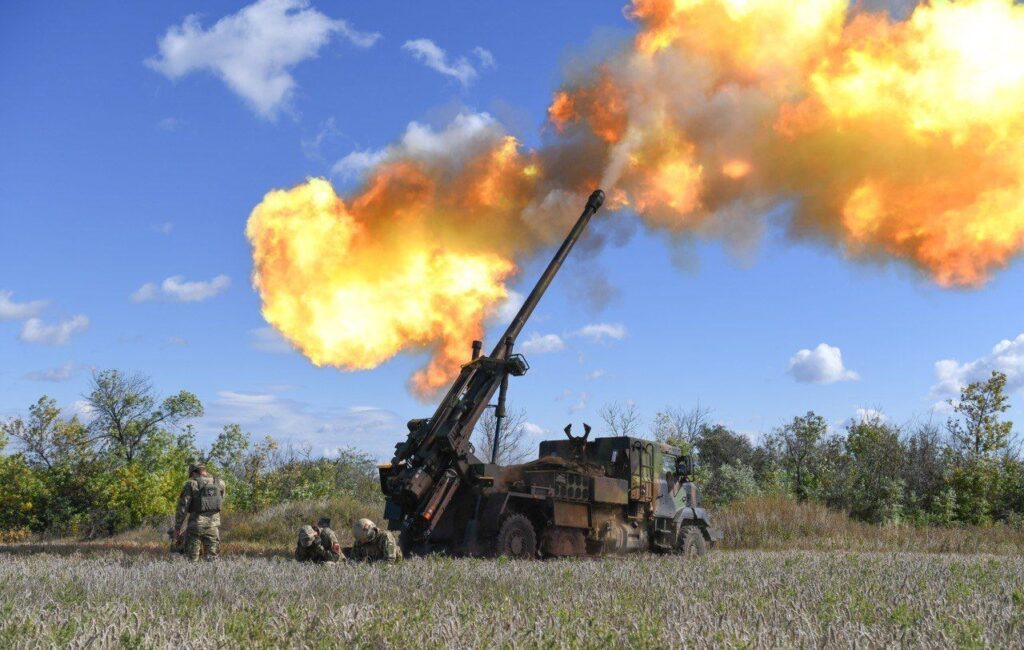
Ukrainian troops fire a CAESAR self-propelled howitzer. Autumn 2022, Ukraine. Photo: ArmyInform

Ukrainian gunners at one of the brigades rate one French howitzer above most of what they field. The French CAESAR self-propelled gun is one of the best in the Ukrainian arsenal, able to fire various munitions with long range and high accuracy, Major Denys Chmykhun of the 148th Separate Artillery Brigade's self-propelled artillery battalion said in an interview with Ukrinform.

The praise is a frontline verdict on the Western artillery that has helped keep Ukraine in the fight. France has supplied Ukraine with CAESAR howitzers throughout the war, and the crews who fire them rate its range and precision highly valuable.

Why the crews rate it

Chmykhun described CAESAR as newer than other guns, and very mobile and maneuverable.

"CAESAR is now one of the best self-propelled systems in service with the Armed Forces of Ukraine," Chmykhun said.

He wished Ukraine had fielded more of them sooner.

"If at the start of the full-scale war, when FPVs and Lancets were not yet used, there had been at least a few CAESAR battalions, it would have seriously affected the front line," the major noted.

The crews learned to repair it themselves

However, the gun's electronics are its weak point, but the crews adapted. The French system has a lot of electronics, and when it produced errors, crew members studied each one using an online translator and fixed them, Chmykhun explained. He added that the howitzer can be temperamental because it is not built for such intense combat.

Rather than pulling a finicky Western system off the line when its software faulted, the crews taught themselves to diagnose and clear the errors.

What it hunts

The CAESAR fires at everything the crews can find. It works against enemy personnel, drone-control points, landing pads, guns, mortars, and artillery, Chmykhun said, wherever its shells can reach.

He took particular satisfaction in counter-battery work. Destroying Russian guns, mostly 152mm, is gratifying because they trouble the Ukrainian infantry who assault, the major said.

"It's great when you hit precisely and understand that this gun is out of action, and somewhere, a field ammunition store starts to detonate. The enemy runs around, panic sets in, and it's pleasant to watch," he added.

This new drone stays aloft for more than day and resists jamming. Ukraine says it can now reach beyond the Urals

17 août 2026 à 10:22

Ukraine's Dovbush T40, a strategic drone that can stay aloft over a day. Source: The Ukrainian Defense Ministry

Ukraine has approved a drone built to reach the deepest parts of Russia. Ukraine's Defense Ministry has codified the domestic Dovbush T40 uncrewed aviation complex, a strategic-level drone for deep reconnaissance and precision strikes on distant Russian targets, the ministry announced.

The drone extends the reach of Ukraine's homegrown deep-strike arsenal to Siberia. With a wingspan of nearly 5 meters, the Dovbush T40 has enough range to hit targets beyond the Urals and in Russian Siberia.

What the drone does

The Dovbush T40 is a multi-role strategic aircraft. It is designed for deep reconnaissance, fire correction, and precision strikes on structures, equipment, and enemy personnel far from the line of contact.

Its endurance is the enabler. More than a day aloft gives it the range to reach targets, letting Ukraine threaten the deep-rear sites, from factories to airfields, that Russia has kept far from the front for safety.

Its advantages over similar drones

The drone offers several edges, the ministry said. It has ultra-low radar visibility, a high-performance engine with electronic fuel injection, and a choice of strike methods, either as a kamikaze drone or by dropping a munition.

It is built to work under jamming. The Dovbush T40 stands out for high resistance to electronic warfare, according to the Defense Ministry, the recurring requirement for any Ukrainian drone meant to fly deep into a contested electromagnetic environment.

It builds on combat-proven predecessors

The drone comes from a maker with a track record. It was built by a Ukrainian enterprise whose Dovbush T20 and Kotyhoroshko drones have operated on the battlefield since 2022 with some of the highest effectiveness ratings.

The T40 is an evolution of a proven system. The medium-range Dovbush T20, used for reconnaissance, real-time artillery correction, and pinpoint strikes, evolved through battlefield feedback into the longer-range, more powerful T40. It joins a fast-growing domestic fleet: since the start of 2026, Ukraine's Defense Ministry has codified 413 uncrewed systems, almost all of which are Ukrainian-made.

Russia’s new drone outruns old Shahed by four times and tracks its target in real time. Its own heat is what lets Ukraine track it back

17 août 2026 à 01:50

Geran-3 jet-powered Russian attack drone.

Russia built a quicker Shahed because Ukraine was good at shooting down the old one, and the new version has weaknesses of its own. The jet-powered Geran-3 outpaces its predecessor but is easier to detect on radar and vulnerable to shoulder-fired missiles, Colonel Artem Skurativskyi of the 7th Rapid Response Corps' air-defense directorate said in an interview with ArmyInform.

Ukraine's combined air defenses raised the interception rate of Geran-2 and Shahed-136 drones to between 80 and 93%, depending on the scale of the attack, and that success is what pushed Russia to develop the jet version.

The jet Shahed outruns the defenses

Speed is the jet model's main advantage.

"Unlike its predecessor with piston engines, the jet modification has a higher flight speed, which significantly complicates air defense's task of destroying them, and also lets them cover large distances much faster," Skurativskyi explained.

The numbers are stark. The Geran-3 can fly from the Belarusian border to Kyiv in 35 minutes, four times faster than the previous version, and its optical-electronic camera module lets an operator guide the loitering munition online, the colonel noted.

Its size and heat are the Achilles' heel

The jet drone's advantages come with real weaknesses. Its large size, a body 3.5 meters long with a 3-meter wingspan, lets radar systems detect it easily over Ukraine, the colonel noted, and its engine gives it away in the thermal band.

That "powerful radiation in the thermal range makes them vulnerable to MANPADS," he added, so the same jet engine that gives the drone its speed also makes it a bright heat target for shoulder-fired missiles.

Russia uses it sparingly, for now

Still, the jet Shahed is not replacing the old one yet. Jet Geran-3 drones make up to 20% of the Shaheds Russia launches, with most strikes still using the Geran-2, the colonel said, though he pointed out that the rising share "indicates a scaling-up of production capacity." Russia sends the jet version against critical infrastructure, energy, and military targets in eastern, southern, and central Ukraine, both hunting targets with the camera module and folding them into massed strikes to overload air defenses.

Ukraine is still adapting.

"Mobile fire groups, which performed excellently in downing Shaheds, are of little effect against the jet modifications because of their high speed," Skurativskyi said.

Even so, he confirmed, troops of the 81st Air Assault Brigade are already downing jet Shaheds with interceptors.

❌