❌

Vue normale

  • ✇Euromaidan Press
  • Seoul backs Ukraine, but sanctioned tankers carried fuel from South Korea to Russia
    Seven tankers made 14 trips from South Korea to Russia's Far East in July and August, carrying more than 176,000 metric tons of fuel, most of it diesel, the Guardian found in a 6 October analysis of port records and ship-tracking data. The UK and EU have sanctioned three of the ships, and one loaded its fuel from another tanker at sea off South Korea instead of at a terminal. Ukrainian strikes have cut Russia's fuel output as Moscow scrambles for supplies, while fuel loaded at South Kor
     

Seoul backs Ukraine, but sanctioned tankers carried fuel from South Korea to Russia

6 octobre 2026 à 11:37

Seven tankers made 14 trips from South Korea to Russia's Far East in July and August, carrying more than 176,000 metric tons of fuel, most of it diesel, the Guardian found in a 6 October analysis of port records and ship-tracking data. The UK and EU have sanctioned three of the ships, and one loaded its fuel from another tanker at sea off South Korea instead of at a terminal.

Ukrainian strikes have cut Russia's fuel output as Moscow scrambles for supplies, while fuel loaded at South Korean ports has flowed to Russia. Loadings began to surge in July, the same month South Korean President Lee Jae-myung pledged $100 million for Ukraine's reconstruction, the Guardian reported. That creates a tension in Seoul's policy toward the war: South Korea has provided Ukraine with humanitarian and non-lethal aid but ruled out sending weapons directly, while the fuel trade appears legal under South Korean law even though three of the tankers are under UK and EU sanctions.

Russia imported 368,000 metric tons of oil products by sea in August, 112,000 of them from South Korea, according to Kpler data analyzed by the Centre for Research on Energy and Clean Air (CREA) and cited by the Guardian. CREA's own August report gives 172,000 metric tons in total, including 18,000 from South Korea. Neither explains the gap.

Where the tankers said they were going

The Layla, a tanker under UK and EU sanctions, made two voyages from Ulsan to Vladivostok, carrying a total of 57,000 metric tons of diesel. It left South Korea on 19 July and 10 August. On the first trip, it told South Korean authorities it was bound for Vladivostok; on the second, it declared Niigata, Japan, but sailed to Vladivostok again.

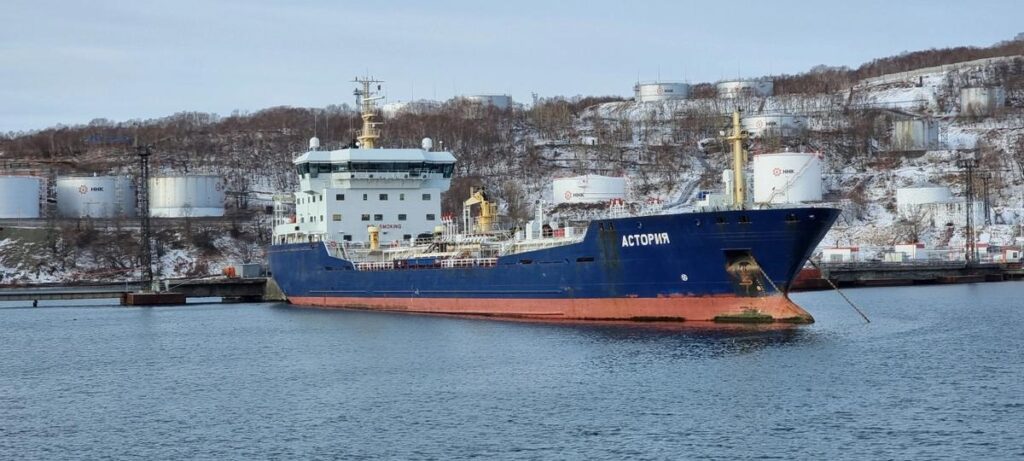
The Astoria, a Russian-flagged tanker under UK, EU, and Australian sanctions, loaded nearly 11,000 metric tons of fuel at Ulsan on 1 August. It declared Japan as its destination but sailed to Vladivostok.

The Chongchon did not berth at a South Korean port. Instead, it took about 26,000 metric tons of fuel from the unsanctioned Celeste I at an anchorage off Yeosu in early August. It declared Singapore as its destination but headed to Vladivostok. The owners and managers of the four tankers did not respond to the Guardian's requests for comment.
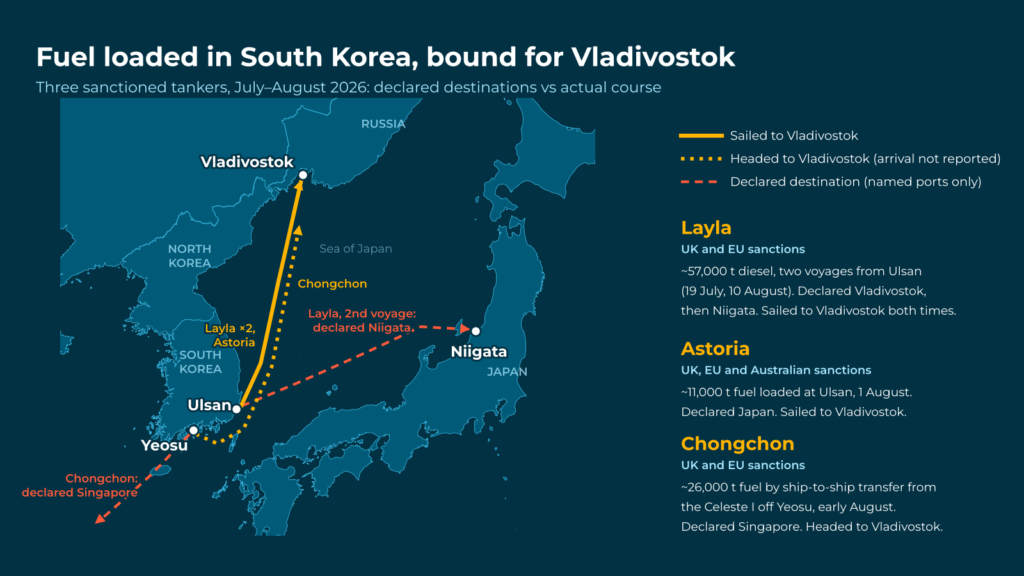
Map of sanctioned tankers' voyages from South Korea to Vladivostok
Source: Guardian analysis of port records and ship-tracking data; sanctions listings: OpenSanctions. Map: Euromaidan Press

Why Russia needs the fuel

Ukrainian drone strikes have severely disrupted Russia's refining capacity, the Guardian reported. In July, Ukraine's General Staff said the strikes had knocked out 42% of Russia's refining capacity, costing the industry billions of dollars.

Russian refinery throughput fell in June to its lowest level in more than 20 years, and diesel output is down nearly 30% from a year earlier, the International Energy Agency said, according to the Guardian.

Russia has also restricted fuel exports to protect domestic supplies, extending its diesel export ban until the end of October; on 2 October, Deputy Prime Minister Alexander Novak said Moscow could consider partially lifting the ban if there was overproduction, according to the Moscow Times.

Responses to the shipments

Seoul's non-lethal aid has included helmets, body armor, and demining vehicles, and in 2023 it pledged $2.3 billion in support, mostly in loans.

Isaac Levi, an analyst at CREA, told the Guardian:

"It is shocking that EU-sanctioned tankers loaded fuel at South Korean ports and carried it to Russia. This undermines the sanctions regime and South Korea's support for Ukraine."

South Korea's Foreign Ministry did not address the shipments or the sanctioned tankers. In a statement, it said the government supports international efforts to help end the war in Ukraine and bring about a peaceful recovery. The ministry said it was strictly enforcing its export controls and had expanded them to cover 1,402 non-strategic items with high potential for diversion to military use. The UK Foreign Office did not answer the Guardian's questions about UK-sanctioned tankers using South Korean ports, saying only that it remains committed to monitoring its sanctions.

Ties between Kyiv and Seoul are also strained over Ukraine's disclosure of its transfer of two North Korean prisoners of war to South Korea, which Seoul said should have remained private.

  • ✇Euromaidan Press
  • Ukraine’s battlefield gains may be pushing Putin to shift focus to early winter strikes, ISW says
    Ukraine's battlefield successes appear to be forcing Russian President Vladimir Putin to reevaluate his theory of victory and shift focus toward long-range strikes to compel Ukraine to surrender, rather than advances on the battlefield, the Institute for the Study of War said on 4 October. Ukrainian President Volodymyr Zelenskyy said Russia used more than 800 jet-powered drones during the week of 27 September to 4 October. Ukraine currently intercepts only 50–60% of jet-powered drones,
     

Ukraine’s battlefield gains may be pushing Putin to shift focus to early winter strikes, ISW says

6 octobre 2026 à 07:57

russian strike in Kyiv

Ukraine's battlefield successes appear to be forcing Russian President Vladimir Putin to reevaluate his theory of victory and shift focus toward long-range strikes to compel Ukraine to surrender, rather than advances on the battlefield, the Institute for the Study of War said on 4 October.

Ukrainian President Volodymyr Zelenskyy said Russia used more than 800 jet-powered drones during the week of 27 September to 4 October. Ukraine currently intercepts only 50–60% of jet-powered drones, leaving it vulnerable to the large number of new drones Russia is deploying.

The late-September start and the campaign's aim

ISW said Russian forces began their winter 2026–27 strike campaign against Ukraine's energy infrastructure in late September and that the campaign is aimed at making civilian life unbearable enough to force Ukraine to capitulate.

Russian forces would step up attacks on military facilities, defense industry sites, and related infrastructure in Kyiv and elsewhere in Ukraine, the Russian Defense Ministry said on 4 October, according to Reuters. The announcement followed Zelenskyy's vow to increase attacks on Russian oil refineries.

The ministry also claimed its recent strikes on Kyiv and other Ukrainian regions were a response to alleged Ukrainian attacks on civilian targets inside Russia. Among the grievances it named were Ukraine's strikes on Leningrad Oblast during the St. Petersburg International Economic Forum in June and alleged strikes on electoral infrastructure in Moscow during the 18–20 September State Duma elections, according to ISW.

ISW called the Russian Defense Ministry's framing of the recent strikes as retaliation for Ukrainian attacks on Russian civilian targets unfounded, saying many of its specific claims are "blatantly false." Russia has provided no evidence that Ukraine targeted electoral infrastructure, and Ukraine's 19–20 September strikes on Moscow targeted oil refineries and warehouses, the think tank said. The Russian strikes "are not an actual response to specific events," it concluded.

The 135 drones, the bridges struck seven times

Overnight on 3–4 October, Russia launched 135 Shahed-type and Gerbera-type drones, while also using decoy drones and Banderol or Dan-T loitering munitions. Ukrainian forces downed 123 drones and two loitering munitions, and strikes hit five locations, according to ISW, which cited the Ukrainian Air Force. Russian forces struck Kyiv's Northern and Southern bridges seven times between 1 and 4 October in an effort to disrupt Ukraine's economy and daily civilian life, ISW said.

Ukraine builds new layers of defense against jet drones

More than 12 .50-caliber machine-gun turrets are already working in Kyiv against jet-powered drones, and eight more will be installed in Kyiv Oblast, Zelenskyy said, Suspilne reported. He added that F-16s help a lot against the drones, according to Ukrinform. Ukraine is set to receive 2,000 Bars interceptor drones through joint production with Germany, RBC-Ukraine reported.

Ballistic missiles may be Russia's next wave

Zelenskyy said Ukraine estimates Russia has up to 700 ballistic missiles in reserve and produces 130–140 a month. He made the remarks at a joint media briefing with German Chancellor Friedrich Merz in Kyiv, Ukrinform reported. Russia is likely stockpiling ballistic and quasi-ballistic missiles for intense strikes after its jet-powered drones lose their current advantage, ISW assessed. ISW also cited an ongoing shortage of Patriot interceptors.

OHCHR has verified some 15,280 civilian casualties in Ukraine in the first eight months of 2026, 55% more than in the same period of 2025, UN High Commissioner for Human Rights Volker Türk said on 2 October.

  • ✇Euromaidan Press
  • Three ambulances hit, a woman killed at home: 25 minutes of Russian drone attacks on Kramatorsk
    Russian FPV drones hit three ambulances and, separately, a residential high-rise in Kramatorsk late on 5 October, the Donetsk Oblast Prosecutor's Office said. The strike on the high-rise killed a woman and injured another, and three medical workers were wounded trying to save their vehicles. Prosecutors have opened war-crimes investigations. Russian drones attack Ukrainian civilians every day, and Ukraine's UN envoy has cited "human safari" and repeat strikes on medics as grounds to str
     

Three ambulances hit, a woman killed at home: 25 minutes of Russian drone attacks on Kramatorsk

6 octobre 2026 à 06:05

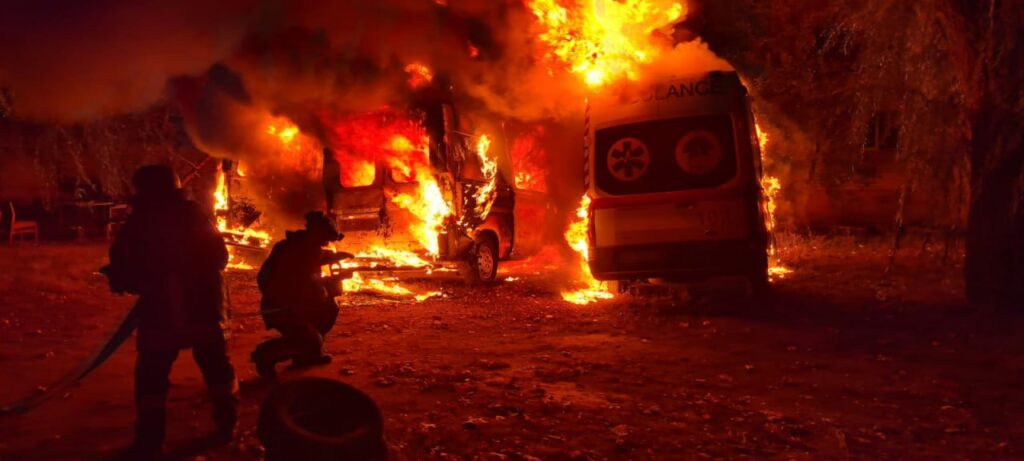
three ambulances burned woman dead 25 minutes russian drone attacks kramatorsk · post firefighters put out burning after fpv strike 5 2026 5343659307821636762 ukraine news ukrainian reports

Russian FPV drones hit three ambulances and, separately, a residential high-rise in Kramatorsk late on 5 October, the Donetsk Oblast Prosecutor's Office said. The strike on the high-rise killed a woman and injured another, and three medical workers were wounded trying to save their vehicles. Prosecutors have opened war-crimes investigations.

Russian drones attack Ukrainian civilians every day, and Ukraine's UN envoy has cited "human safari" and repeat strikes on medics as grounds to strip Moscow of its Security Council seat. Kherson, Nikopol, and Kramatorsk are all cities where drone operators pick civilian targets in real time.

Drones aimed at ambulances

Between 22:00 and 22:25, the Russian army deliberately directed two FPV drones at ambulances parked on a Kramatorsk street, prosecutors said. Three workers of the ambulance service were injured while trying to save the vehicles after the first hit. They suffered blast injuries, shrapnel wounds to the body and limbs, burns, and concussions, and received medical care. Three ambulances were damaged.

FPV drones are flown by an operator watching a live camera feed until the moment of impact. Prosecutors called the strike targeted.

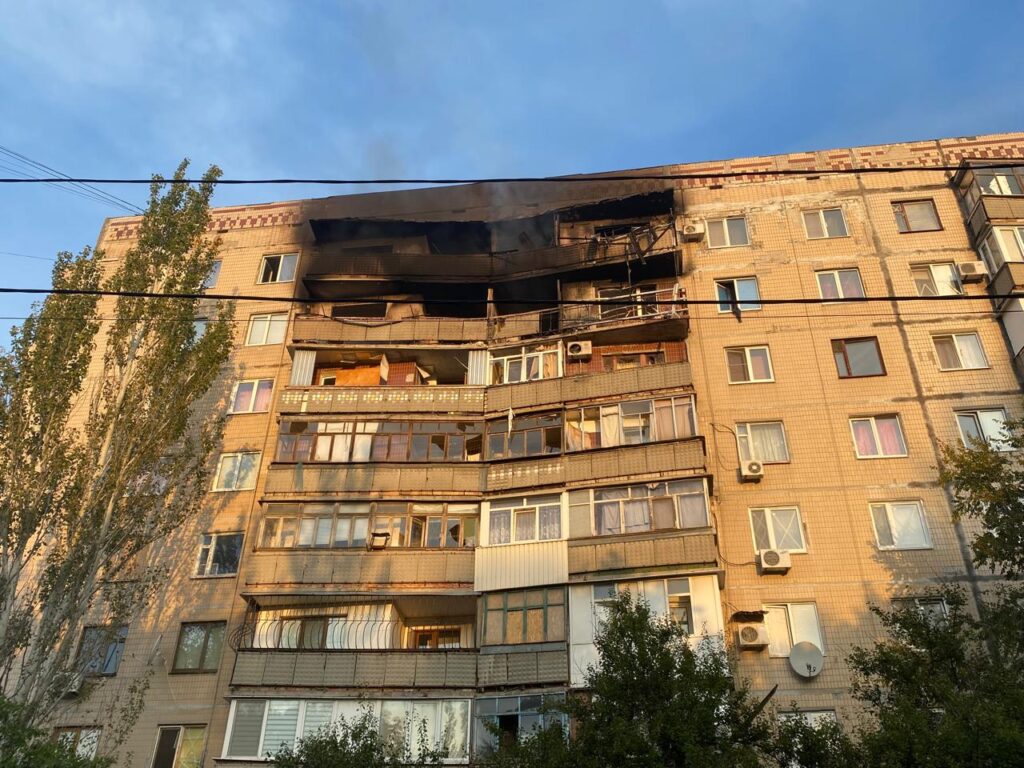
three ambulances burned woman dead 25 minutes russian drone attacks kramatorsk · post residential high-rise damaged strike killed 5 2026 5343659307821636763 ukraine news ukrainian reports
A residential high-rise in Kramatorsk damaged by a Russian drone strike that killed a woman on 5 October 2026. Photo: Donetsk Oblast Prosecutor's Office

A woman killed at home

At 22:10, a Russian drone hit a residential high-rise in the city. A 49-year-old woman was killed. Another resident, a 68-year-old woman, suffered a broken foot, shrapnel wounds to the body and limbs, and a concussion, according to prosecutors. The Kramatorsk district prosecutor's office has opened criminal proceedings over war crimes.

protest Russia hunts targets civilians with drones Do I look like a target stop human safari save kherson
Explore further

Russian drone tears off 68-year-old man’s leg in Kherson’s daily “human safari”

Across Donetsk Oblast, Russian attacks killed three people on 5 October, in Sloviansk, Druzhkivka, and Sukhanivka, and injured 11, Donetsk Oblast head Vadym Filashkin said. His morning tally, posted before the prosecutors' report, did not include the Kramatorsk death.

three ambulances burned woman dead 25 minutes russian drone attacks kramatorsk · post burned-out section residential high-rise after strike 5 2026 5343659307821636764 ukraine news ukrainian reports
A burned-out section of a residential high-rise in Kramatorsk after a Russian drone strike on 5 October 2026. Photo: Donetsk Oblast Prosecutor's Office

Kramatorsk under the drone hunt

Russian drone operators have hunted people in Kramatorsk for months. In June, a Russian pilot chose to kill a man he saw on a city street. Russia strikes the city daily, and in August it dropped eight FAB-250 bombs on Kramatorsk, killing one person and injuring 18.

The same drone hunting of civilians has run for years in Kherson, where Ukraine's Security Service has named 10 Russian servicemen it ties to the "human safari." A UN inquiry has traced the Kherson campaign up the chain of command. In April, ISW found Russians using such tactics across southern Ukraine, including in Nikopol.

Medics have been repeated targets. In March, a Russian FPV drone killed two medics in an ambulance in Kharkiv Oblast, and in February, Russian drones hit an ambulance and a shop there, killing three. In Kyiv, a Russian missile attack damaged a maternity hospital in September.

The tanks that fuel Moscow’s airliners are reported burning after Ukraine’s latest drone raid on the capital region

6 octobre 2026 à 05:14

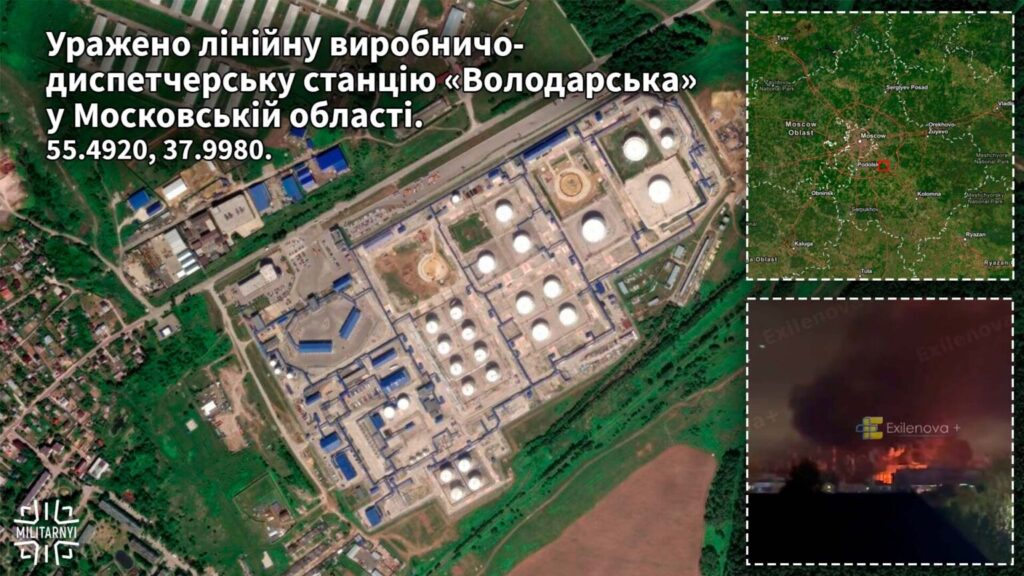
tanks fuel moscow's airliners burning after ukraine's latest drone raid capital region · post fire volodarskaya pipeline station moscow oblast attack 6 2026 video exilenova+ militarnyi пожежа на лпдс володарская

Drones attacked Moscow and Moscow Oblast overnight on 6 October, and a fire broke out at the Volodarskaya pipeline station, the region's largest oil depot, monitoring Telegram channels reported. The station supplies jet fuel to Moscow's main airports. Local authorities did not mention the fire, while claiming to have downed hundreds of drones.

Ukraine's long-range drones have spent years working through Russia's oil industry, and Kyiv says its strikes have now disabled more than half of Russia's refining capacity. The storage and pipeline hubs that move the remaining fuel are what keep the army, the capital, and the export flows supplied.

Fire at the Moscow region's largest fuel depot

Ukrainian monitoring channel Exilenova+ wrote that the Volodarskaya station was burning after the attack, and Ukrainian monitoring channel Supernova+ reported the strike on the depot. Exilenova+ then posted the site's coordinates near the village of Konstantinovo. Supernova+ said a storage tank was on fire, and Exilenova+, citing locals, later wrote that two tanks were burning.

Russian news Telegram channel Astra geolocated a Supernova+ video to Konstantinovo in Ramensky district. The station had not been reported attacked before, Astra said.

tanks fuel moscow's airliners burning after ukraine's latest drone raid capital region · post volodarskaya pipeline station moscow oblast attacked drones 6 2026 its location marked лпдс володарская аналіз мілітарного
The Volodarskaya pipeline station in Moscow Oblast, attacked by drones on 6 October 2026, with its location marked on a map. Graphic: Militarnyi, ESRI map, photo: Exilenova+

The station lies 40 km from central Moscow, Militarnyi reported. Drone alerts in the area began at 23:43 on 5 October. From 03:24, reports came in of Ukrainian Peklo drones flying through Oryol Oblast toward Moscow Oblast, the outlet said. Ukraine's military has not commented on the strike.

Konstantinovo: the Volodarskaya oil products pumping and dispatch station continues to burn. According to local residents, two storage tanks are on fire.

The station, a branch of Transneft–Upper Volga, is directly linked to the Moscow aviation hub’s largest airports. pic.twitter.com/KooKJnV1X6

— Exilenova+ (@Exilenova_plus) October 6, 2026

Early in the night, Exilenova+ claimed a strike on the Moscow refinery in Kapotnya. It later said the footage circulating from there was most likely archival.

Jet fuel for Vnukovo, Domodedovo, and Sheremetyevo

The station has 27 tanks with a combined capacity of about 250,000 m³, according to Militarnyi. It connects to the ring pipeline for petroleum products around Moscow, which carries aviation fuel to Vnukovo, Domodedovo, and Sheremetyevo airports. Russia's state pipeline operator Transneft has said the station can move up to 3 million tonnes of jet fuel, 2.8 million tonnes of diesel, and 1.6 million tonnes of gasoline a year.

Astra gave a lower figure: about 3 million tonnes of petroleum products a year in total, arriving from the Moscow and Ryazan refineries. Supernova+ described Volodarskaya as a branch of Transneft–Upper Volga, as did Militarnyi, while Astra named Transnefteprodukt.

Vladimir Putin voted in the presidential election in Russia
Explore further

Russia has warned its cities about every strike for years. During the heaviest raid yet, on election day, it left the sirens silent

Russia claims hundreds of drones downed

Moscow Mayor Sergei Sobyanin claimed that 650 drones flew toward the Moscow region from the evening of 5 October to the morning of 6 October. Most were downed far from the city, and 105 near Moscow, he claimed, without mentioning any damage. Adding up his later posts, Astra counted at least 718 drones aimed at Moscow. Moscow Oblast Governor Andrei Vorobyov claimed that 185 drones were downed over 16 municipalities. He later called it one of the largest drone attacks and put the toll at two killed and nine injured, with 47 detached houses damaged in seven municipalities.

lukoil’s norsi refinery in kstovo, nizhny novgorod oblast
Explore further

Fifth drone-related NORSI shutdown in under five months leaves all major Lukoil refineries offline

Not the first Transneft site or Moscow fuel target

Ukraine has targeted Russia's pipeline network before. On 2 October, drones set Transneft's Samara station on fire. During Russia's Duma elections on 20 September, a strike reached Moscow's fuel supply. The Moscow refinery fully stopped processing oil after that attack. Days later, Kyiv offered to halt refinery strikes if Russia stopped hitting Ukraine's power grid. Russia has not taken the deal.

  • ✇Euromaidan Press
  • Ukraine’s civilian casualties 55% higher in first eight months than in the same period in 2025, UN says
    The UN Human Rights Office verified some 15,280 civilian casualties in Ukraine during the first eight months of 2026, 55% more than in the same period last year, UN High Commissioner for Human Rights Volker Türk said on 2 October. Türk's statement comes as Russia has begun its Winter 2026-2027 campaign of long-range strikes against Ukrainian energy infrastructure. The Institute for the Study of War (ISW) said Russian forces began the campaign in late September. Damage to energy infrastr
     

Ukraine’s civilian casualties 55% higher in first eight months than in the same period in 2025, UN says

6 octobre 2026 à 04:05

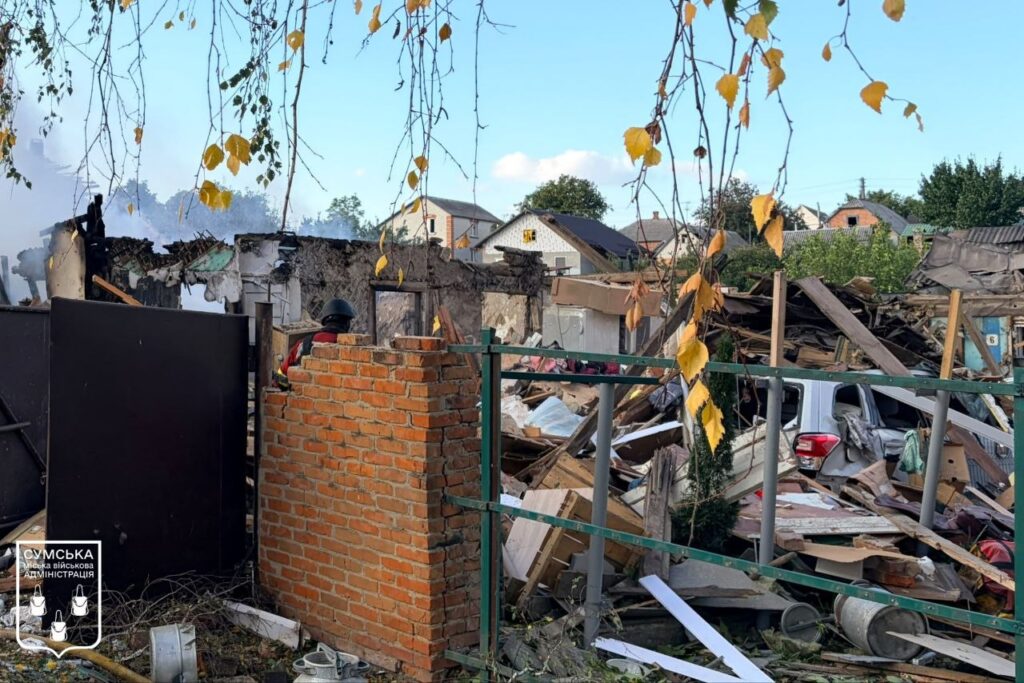
A house in Sumy destroyed in a Russian attack on 29 September.

The UN Human Rights Office verified some 15,280 civilian casualties in Ukraine during the first eight months of 2026, 55% more than in the same period last year, UN High Commissioner for Human Rights Volker Türk said on 2 October.

Türk's statement comes as Russia has begun its Winter 2026-2027 campaign of long-range strikes against Ukrainian energy infrastructure. The Institute for the Study of War (ISW) said Russian forces began the campaign in late September. Damage to energy infrastructure disrupt electricity, heating, and water supplies during the winter, increasing the risks to civilians.

Russian glide bombs killed and injured nearly 2,500 civilians in Donetsk, Kharkiv, Sumy, and Zaporizhzhia oblasts during the first eight months of the year, 62% more than in the same period last year, according to UN figures.

"As winter approaches, Ukrainians fear the worst is yet to come," Türk said.

On 4 October, Russia's Defense Ministry announced that it was intensifying strikes on infrastructure in Kyiv City and Oblast and across Ukraine, according to ISW.

Why Russia is turning to long-range strikes

ISW said Ukraine's 2026 battlefield successes "appear to be forcing" Russian President Vladimir Putin to shift focus from advances on the battlefield toward a winter campaign intended to compel Ukraine to surrender.

A week earlier, ISW assessed that Putin was likely attempting to force Ukraine to capitulate before spring 2027, with his theory of victory heavily relying on cheap, jet-powered Geran-type drones.

A toll rising all year

The 15,280 figure extends a trend the UN has tracked all year. Over the first seven months of 2026, its monitoring mission verified 1,839 civilians killed and 10,638 injured. In September, UN Under-Secretary-General Rosemary DiCarlo told the Security Council that more civilians were killed or injured in the first eight months of 2026 than in all of 2025.

❌