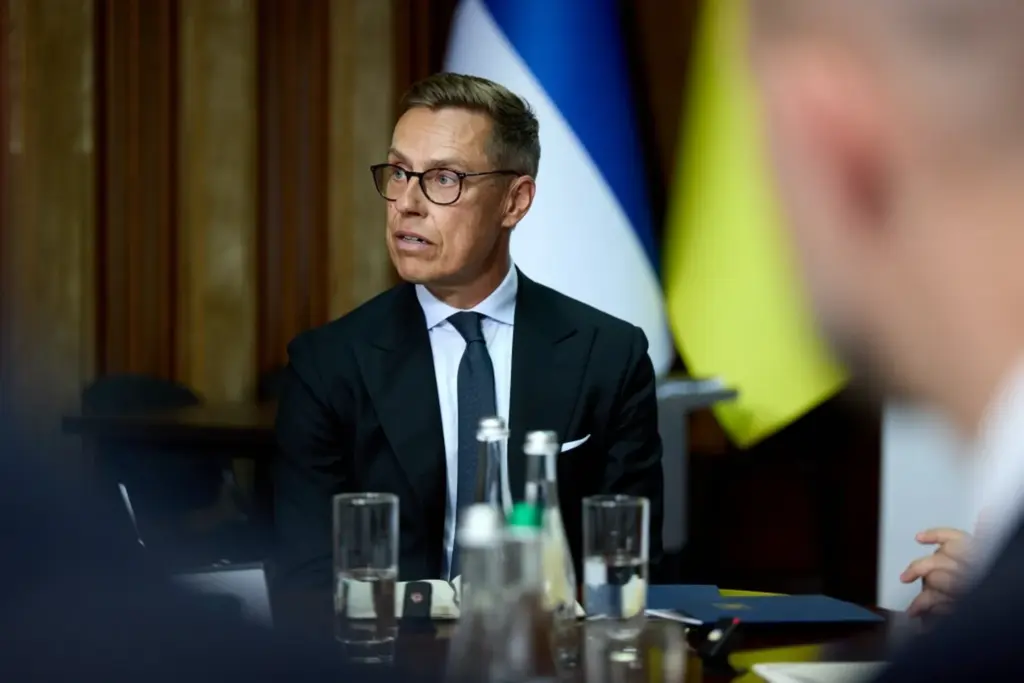
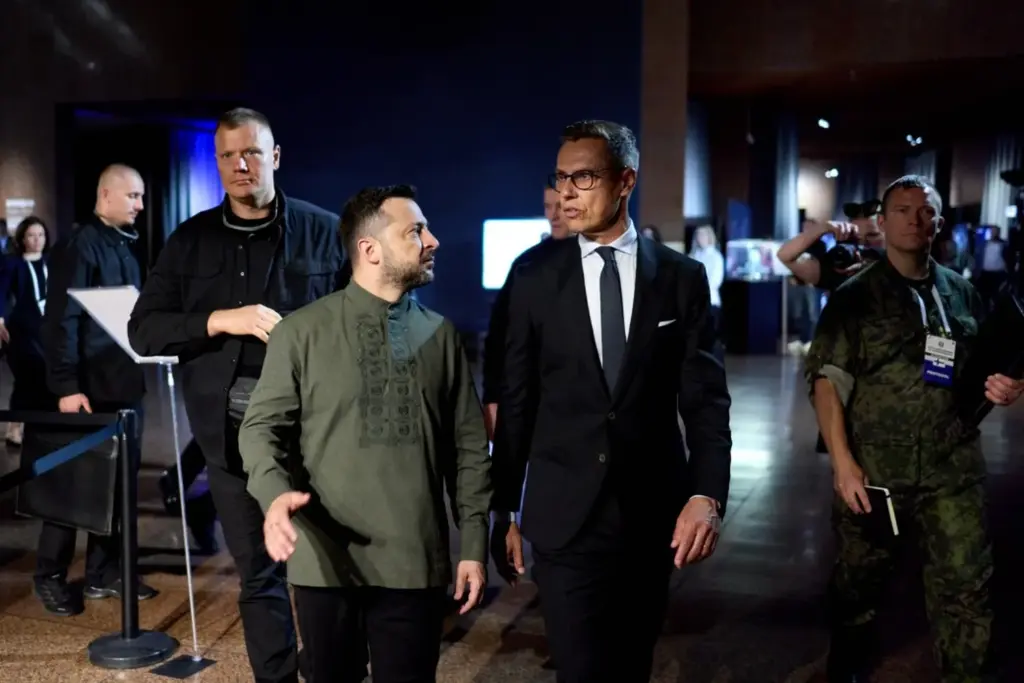
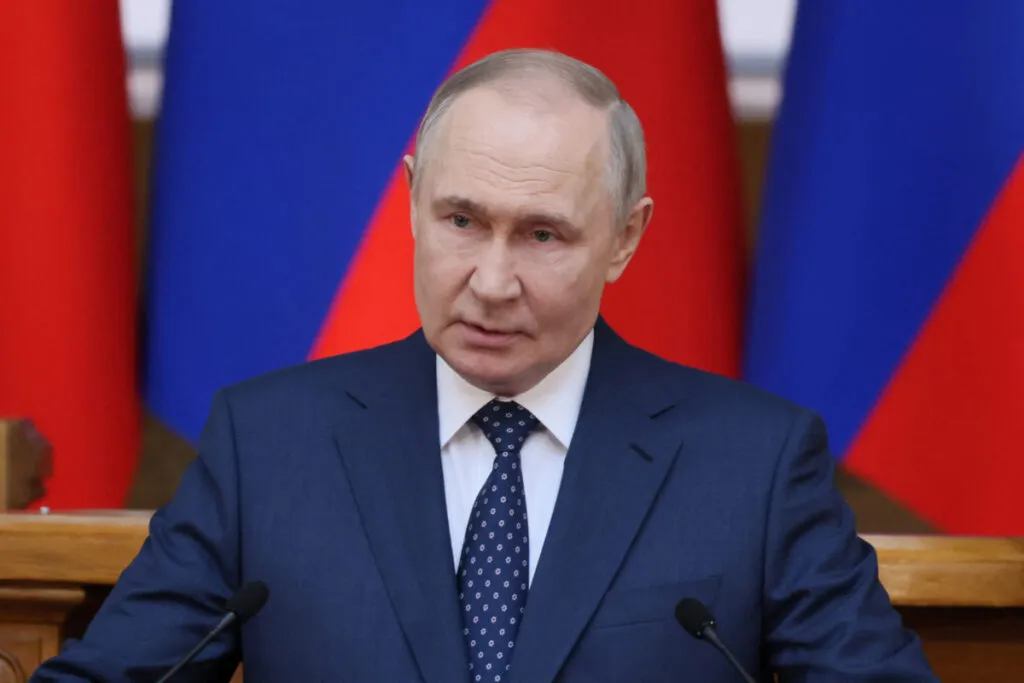
Finnish President Alexander Stubb said Ukraine would receive about 90% of the drones that Finnish companies build under a planned Finland–Ukraine framework agreement, Mi-Ukraina reported on 26 August. Three days earlier in Kyiv, he said the other 10% would stay in Finland.
The planned arrangement follows a broader European shift toward co-production with Ukraine rather than supplying weapons from existing stockpiles. Drones have shaped much of the fighting on both sides
Finnish President Alexander Stubb said Ukraine would receive about 90% of the drones that Finnish companies build under a planned Finland–Ukraine framework agreement, Mi-Ukraina reported on 26 August. Three days earlier in Kyiv, he said the other 10% would stay in Finland.
The planned arrangement follows a broader European shift toward co-production with Ukraine rather than supplying weapons from existing stockpiles. Drones have shaped much of the fighting on both sides since Russia's full-scale invasion in 2022, and Russia has repeatedly struck defense plants inside Ukraine—a Bayraktar plant under construction in Kyiv was hit four times in six months by August 2025—pushing Ukrainian makers to expand production into allied countries, Finland among them.
Asked what still had to be agreed before production could begin, Stubb said nothing did.
"Everything is done. There is a so-called framework agreement on drones that we're working on. It's more about cooperation between states—that is, Zelenskyy and me. And the companies between themselves do what they have to do. I think the doors are already open," Stubb said.
He said the 90/10 ratio is common practice in corporate contracts and that companies would determine the pace of production after finalizing their decisions. Some details could remain classified because of military secrecy, he said.
At a press conference on 23 August after the Nordic-Baltic Eight summit with Ukraine, Stubb had described the deal as still taking shape. He said seven Finnish defense companies interested in cooperation with Ukraine, including on maritime drone production, had traveled to Kyiv with him and that one had already provided production estimates.
"The companies are making actual deals. I'm looking forward to the results, but it seems one of the companies has already provided data on the number of drones that can be produced in Finland. And I think the deal will follow approximately the so-called 90/10 proportion. So 90% of the output is supplied to Ukraine, and 10% stays in Finland," Stubb said, according to Unian.
President of Ukraine Volodymyr Zelenskyy and President of Finland Alexander Stubb took part in a roundtable on Ukrainian-Finnish cooperation in the defense industries, organized with the participation of the Ukrainian Council of Defense Industry. Photo: president.gov.ua
Ukrainian President Volodymyr Zelenskyy said on 23 August that three of the seven Finnish companies present had already signed agreements for joint production, including drones. Yle identified the three as Patria, Insta, and Boomeranger, saying they had signed letters of intent with Ukrainian counterparts. Patria and the Ukrainian company General Chereshnia signed a memorandum of intent to produce defense drones in Finland, Patria announced.
Separately, Ukrainian drone maker Airlogix and Finnish technology company Innokas signed a letter of intent to establish joint drone manufacturing in Finland under Ukraine's "Build with Ukraine" initiative. Ukrainian firm TAF Industries and Finnish company Summa Defence had signed a similar agreement earlier under the same initiative.
Zelenskyy said the cooperation would combine Ukrainian combat experience with Finnish technology. Stubb said Finland already faces hybrid attacks, from undersea cable sabotage to drones, and treats sabotage as a standing risk to the plants, adding that Finland ranks among the largest per-capita suppliers of military equipment to Ukraine.
From support to co-production—and a two-way expertise swap
Stubb said the planned arrangement is not far from Denmark's model of directly financing Ukrainian defense production, according to Yle.
Zelenskyy said the agreements cover drones built in Finland for Ukraine and Europe, expanded maritime unmanned systems, and a plant for ground robotic systems, and Stubb said the documents signed during the visit concerned air, land, and sea.
The Finnish president said in the Mi-Ukraina interview that Europe's relationship with Ukraine has changed since the full-scale invasion. Ukraine once needed European support, while Europe now needs Ukraine's battlefield experience, he said. What Finland learned, by his account: trench warfare is over, a 40-kilometer kill zone means tanks firing at shorter range have no role, and Ukraine holds more data on modern war than the rest of Europe combined.
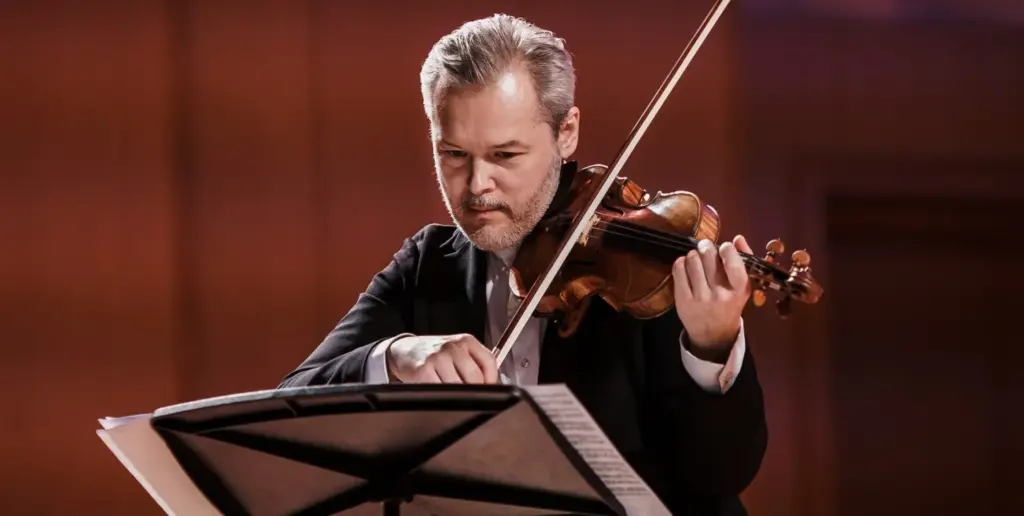
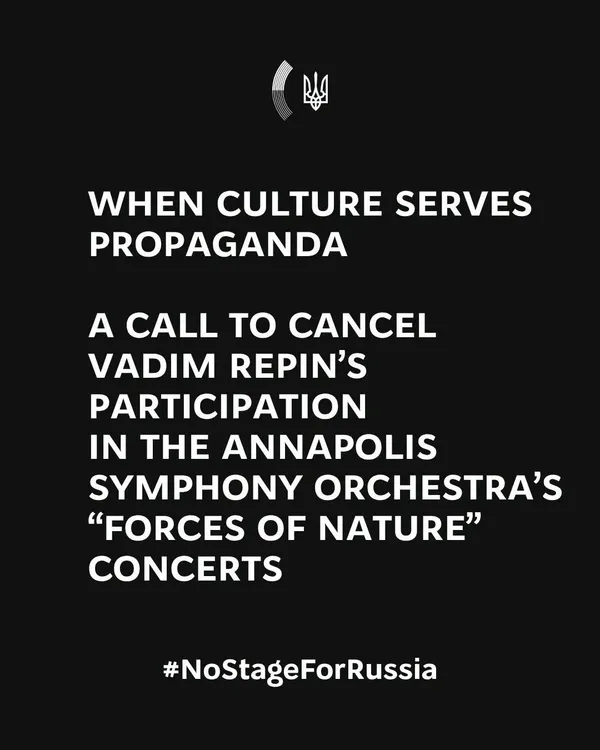
The Embassy of Ukraine in the USA asked the Annapolis Symphony Orchestra (ASO) on 25 August to cancel Russian-born violinist Vadim Repin's participation in its Forces of Nature concerts on 6–7 November at Maryland Hall, citing his involvement in Russian state-sponsored and state-linked cultural initiatives.
Since 2022, Ukrainian diplomats have turned individual concert bookings into an object of foreign policy, arguing that a performer carrying Russian state honors and
The Embassy of Ukraine in the USA asked the Annapolis Symphony Orchestra (ASO) on 25 August to cancel Russian-born violinist Vadim Repin's participation in its Forces of Nature concerts on 6–7 November at Maryland Hall, citing his involvement in Russian state-sponsored and state-linked cultural initiatives.
Since 2022, Ukrainian diplomats have turned individual concert bookings into an object of foreign policy, arguing that a performer carrying Russian state honors and state money brings the state onto the stage with him. Western institutions have answered case by case rather than by policy, so every booking is renegotiated from scratch, and what one venue cancels, another can quietly restore.
The embassy said Repin performed with the State Kremlin Orchestra on 21 February 2024 at a concert the Kremlin Foundation staged for Defender of the Fatherland Day, a Russian military holiday, framed as a tribute to Russia's "great defenders." It said his Vadim Repin Foundation for the Development of the Arts has received substantial funding since the start of the full-scale invasion from Russia's Presidential Fund for Cultural Initiatives, a state-established institution supporting Russia's cultural policy.
The embassy's request comes four years after the Annapolis Symphony dropped Repin from a March 2022 program and staged a tribute to Ukraine in his place—a decision the orchestra said at the time reflected both the war and respect for Repin's apolitical stance and the safety of him and his family.
A graphic from the Ukrainian embassy's appeal to the Annapolis Symphony Orchestra. Image: Embassy of Ukraine in the USA / Facebook
The orchestra has not addressed the reversal directly, but the program notes for the concert argue that Shostakovich wrote the concerto for Ukrainian-born David Oistrakh under Stalinist repression and that it "calls on listeners to reject the politics of revenge and hate while embracing the healing cycle of forgiveness." The embassy is asking ASO to reaffirm what it describes as the solidarity with Ukraine shown in 2022.
"We hope the Annapolis Symphony Orchestra will give these concerns careful consideration and reaffirm the solidarity with Ukraine it demonstrated in 2022, when it withdrew Mr. Repin from its program and replaced his performance with a musical tribute to Ukraine," the embassy said.
In March 2022, days after Russia's full-scale invasion began, ASO replaced Repin's planned appearance. The orchestra's then-executive director, Edgar Herrera, told WTOP that the decision was not only a response to the war but also "out of respect to Repin's apolitical stance and concerns for the safety of himself and his family."
The embassy noted that Germany's Mannheim Philharmonic, the Hungarian National Philharmonic, and Florida's Palm Beach Symphony have all reconsidered working with Repin this year, and that Palm Beach canceled his performance in March. Mannheim dropped a February concert after a request from Ukraine's embassy in Berlin, and the Hungarian orchestra replaced him at its Budapest season opening in June. A Change.org petition launched in June by Ukrainian Cultural Front DC had already called on ASO to cancel the November concerts.
Neither ASO nor Repin has commented publicly on the embassy's request.
Ukrainian investigators recovered an unencrypted American AI module from a Russian Molniya drone that killed three civilians near a Zaporizhzhia gas station on 6 July, and read the code that guided its targeting, the New York Times reported. No human operator made the final call.
Commercially sold AI boards have been turning up inside Russian strike weapons for more than a year, and autonomy is the direction both armies are moving in. What changed is the evidence rather
Ukrainian investigators recovered an unencrypted American AI module from a Russian Molniya drone that killed three civilians near a Zaporizhzhia gas station on 6 July, and read the code that guided its targeting, the New York Times reported. No human operator made the final call.
Commercially sold AI boards have been turning up inside Russian strike weapons for more than a year, and autonomy is the direction both armies are moving in. What changed is the evidence rather than the technology. Until now, autonomy had to be inferred from what a wreck lacked—an antenna, a radio trace.
Tetiana Bubynets, a 19-year-old accounting student at Zaporizhzhia National University, was declared dead at a hospital, one of her professors said. Oleksii Svirin, 41, and Roman Karpii, 48, later died of their injuries. The drone had attempted to navigate around an apartment building toward the gas station's propane tanks but struck a wall and detonated near people sheltering there.
What investigators found in the wreckage
The wreckage contained an Nvidia Jetson Orin minicomputer, an off-the-shelf AI module that costs a few hundred dollars. The chip was not encrypted. Ukrainian officials said they could read the terrain imagery loaded for visual navigation and the object-detection code that defined what the drone was trained to target, NYT reported. The drone carried no radio antennas and was flying in a wave of approximately six, none of them transmitting. A missing antenna alone would not prove self-targeting—a drone flying a preprogrammed route needs no antenna either, but it would have no use for an Nvidia chip.
Human operators had programmed the drone to fly toward the gas station and set the general target area before launch. Once near the site, the onboard system identified and selected the specific object—most likely propane tanks it had been trained to recognize—on its own, drone experts and military officials said. Vadym Kushnikov, a drone expert at the Kharkiv Aviation Institute, described the drone as "a preprogrammed tool trained in virtual reality to track specific objects," NYT reported.
Russian Molniya kamikaze drones. Photos from Russian sources via Militarnyi
Where else the Nvidia module has turned up
Kateryna Bondar, a senior fellow at the Wadhwani AI Center at the Center for Strategic and International Studies in Washington, told NYT that no earlier Russian strike by a self-targeting drone has been documented killing civilians, which would make 6 July the first such case on record. She called the Nvidia module "the best proof" that Russia was experimenting with autonomous AI.
The Jetson Orin is not new to the battlefield. The module is made by the American chipmaker Nvidia. Ukraine's sanctions on Russia's AI drone supply networks, imposed in August 2025, hit Russian, Chinese, and Belarusian drone developers and component suppliers—not Nvidia.
Ukrainian intelligence first identified the module in the V2U autonomous strike drone in June 2025, mounted in a Chinese Leetop A203 minicomputer. It has since reported Jetson-based AI modules in Russia's Lancet and Klin drones—the Klin an older Jetson TX2—and, most recently, in the S-71 Monokhrom cruise missile.
In those cases, the finding was the hardware, and what Ukrainian intelligence inferred from it. This time, the code itself was legible.
Nvidia confirmed to NYT that the photographed board was a Jetson Orin. The company said the minicomputer is a consumer-grade product "sold to students, developers and start-ups for a wide range of beneficial applications," that it does not sell the computer in Russia, and that it is widely available through resellers.
Zaporizhzhia as testing ground
Russia began test flights of AI-guided Molniya drones in May, and had begun testing self-targeting systems in the V2U several months earlier, some of those for last-mile guidance only, Ukrainian air defense experts told NYT. Local air defense officials said Russia has been aiming at civilian objects—pumps and propane tanks at gas stations—along with military recruitment centers while trying out autonomous drones in Zaporizhzhia. Why those targets were chosen for the tests is not clear.
Gas stations have been under sustained attack independently of the AI trials. Russia has destroyed approximately 200 across Ukraine since spring, around 50 in June alone, by UNITED24 Media's count.
In Zaporizhzhia, gas stations now prop plastic sheeting at odd angles around propane tanks to confuse the drones' image recognition, and Ukraine has turned to shooting down drones that electronic warfare cannot jam.
The European Commission approved €6.1 billion ($7.12 billion) in new defense procurement for Ukraine on 24 August, covering air and missile defense systems, missiles, ammunition, and radars. European Commission President Ursula von der Leyen announced the decision as Ukraine marked its Independence Day.
Russia's intensifying missile campaign has outpaced what Ukraine's partners can supply, and Europe is now financing the systems its own industry can build while the scar
The European Commission approved €6.1 billion ($7.12 billion) in new defense procurement for Ukraine on 24 August, covering air and missile defense systems, missiles, ammunition, and radars. European Commission President Ursula von der Leyenannounced the decision as Ukraine marked its Independence Day.
Russia's intensifying missile campaign has outpaced what Ukraine's partners can supply, and Europe is now financing the systems its own industry can build while the scarcest interceptors stay in American hands.
How the €90 billion loan pays out
The funding is part of the EU's €90 billion ($105 billion) Ukraine Support Loan for 2026-27, with €60 billion allocated to defense and €30 billion for budgetary support. The new package comes on top of €16 billion in previously approved defense procurement. Reuters put the disbursed total at €8.35 billion.
On 30 June, the European Commission disbursed €3.9 billion as the first payment under a first tranche of around €6 billion dedicated to drone procurement. On 15 July, it disbursed €1.1 billion, and on 30 July another €3.47 billion for drones, missiles, air defense, and Gripen fighter jets. The Commission's own three defense-window payments add to €8.47 billion.
Most of the buying will be from EU defense companies, and the Commission said deliveries will mean drawing down stockpiles, reprioritizing orders, and raising production. Under the mechanism, Ukraine submits signed contracts with defense companies, and the Commission reviews them before releasing funds.
Interceptor deliveries are falling as strikes rise
Air defense is among Ukraine’s most urgent military needs as Russia steps up its aerial campaign. The European Commission said Ukraine faced 376 missile strikes in July alone.
Kyiv has repeatedly warned of shortages of interceptors, particularly for ballistic missiles. The shortfall traces to Washington: since the United States went to war with Iran, it faces its own Patriot shortage and has resisted releasing large numbers to Ukraine.
Ukrainian President Volodymyr Zelenskyy released figures ahead of the Independence Day meeting that show the scale: Ukraine received 675 Patriot interceptors in 2023 and 364 in 2025, while 264 are projected for 2026, against a request for at least 300 for the winter, according to Kyiv Post.
Allies gather in Kyiv with missiles on the table
The announcement coincided with a hybrid meeting of the Coalition of the Willing in Kyiv. British Prime Minister Andy Burnham, German Chancellor Friedrich Merz, and French President Emmanuel Macron co-chaired the meeting, with Macron joining by videoconference, the Élysée Palace said. European Council President António Costa also took part, and NATO was represented by Deputy Secretary General Radmila Šekerinska.
Britain agreed to let defense firm MBDA release classified information on UK components of the long-range SCALP missile so Ukraine and France can set up local assembly lines, the UK government said. The EU decision followed Norway's pledge on 23 August to provide Ukraine with about $9 billion in support in 2027, including military, humanitarian, and financial assistance. Nordic and Baltic leaders announced the pledge during a visit to Kyiv.
Ukraine is asking Elon Musk to let it arm deep-strike drones with his Starlink network and turn them on Russian ballistic-missile launchers far inside Russia, the Financial Times reported. The plan needs Musk's approval — and US President Donald Trump was cool to the idea when Ukrainian President Volodymyr Zelenskyy raised it at the White House on 28 July, with people present expecting Musk to refuse.
Kyiv is chasing the workaround because its air defenses are stretched
Ukraine is asking Elon Musk to let it arm deep-strike drones with his Starlink network and turn them on Russian ballistic-missile launchers far inside Russia, the Financial Times reported. The plan needs Musk's approval — and US President Donald Trump was cool to the idea when Ukrainian President Volodymyr Zelenskyy raised it at the White House on 28 July, with people present expecting Musk to refuse.
Kyiv is chasing the workaround because its air defenses are stretched: Russia keeps escalating its missile and drone strikes, and Ukraine is running low on the Patriot interceptors that are its only dependable answer to Russian ballistic missiles. As Russia builds more missiles and drones, Ukraine's interceptor needs run into the hundreds before the year is out.
At the meeting, FT reported, Zelenskyy pressed Trump to lobby Musk for permission to fly Starlink-linked drones across the Russian border. He capped the pitch at 200 km into Russia — far enough to reach launch sites, command posts, and other targets — on the calculation that a shallower limit might make Musk likelier to agree.
Starlink could extend Ukrainian drone strikes
Riding SpaceX's satellites, Starlink drones hold a steadier link to their pilots at long range than ordinary radio allows, and they shrug off the jamming that grounds other drones. The drones have already shown their worth in the fighting at home, and Vienna-based military analyst Franz-Stefan Gady said that across the border they "could be very useful in hunting" Russian launchers, FT wrote.
Kyiv's best channel to Musk has also just closed: Zelenskyy recently fired his defense minister, Mykhailo Fedorov, who had a direct line to the billionaire.
Mykhailo Fedorov during a June interview, a month before his dismissal, in which he described leaks and private-company influence inside the defense ministry. Photo: screenshot from PRESSING / Army-Media of Ukraine's Defense Forces
Speaking to a Ukrainian podcast on 6 August, Fedorov said that even with a channel to Musk still open after his firing, he had made no progress on cross-border Starlink use—"a difficult task right now."
Explore further
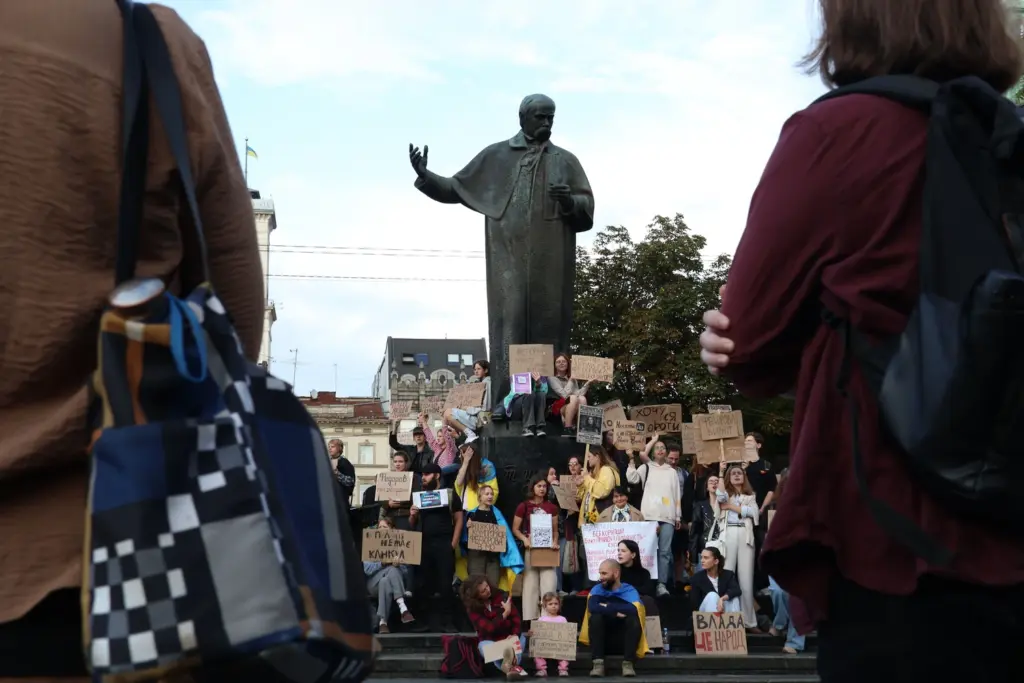
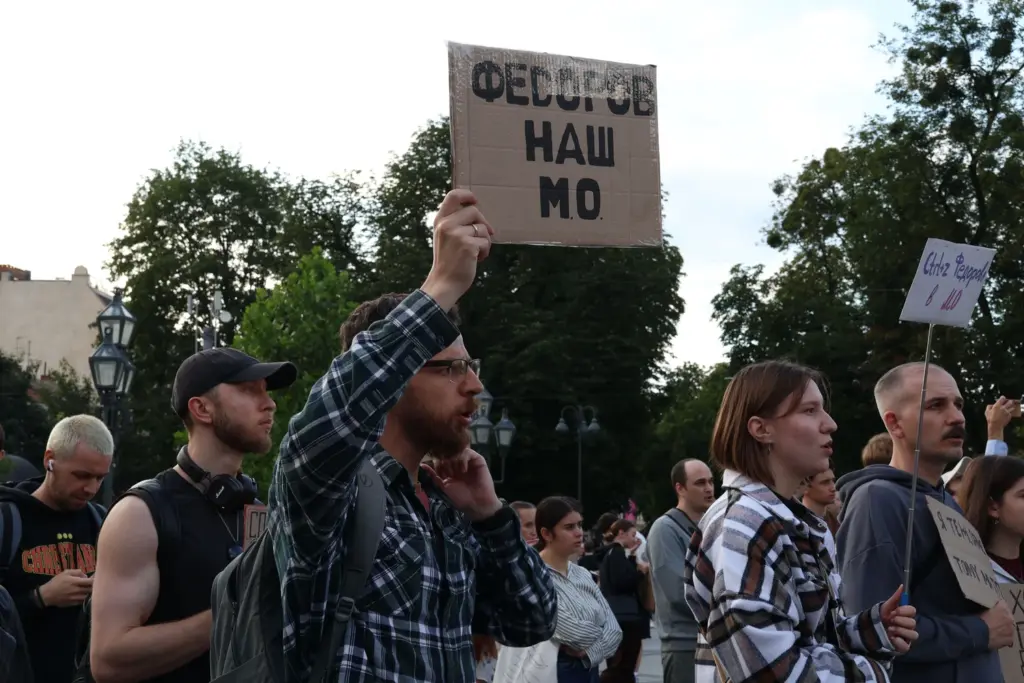
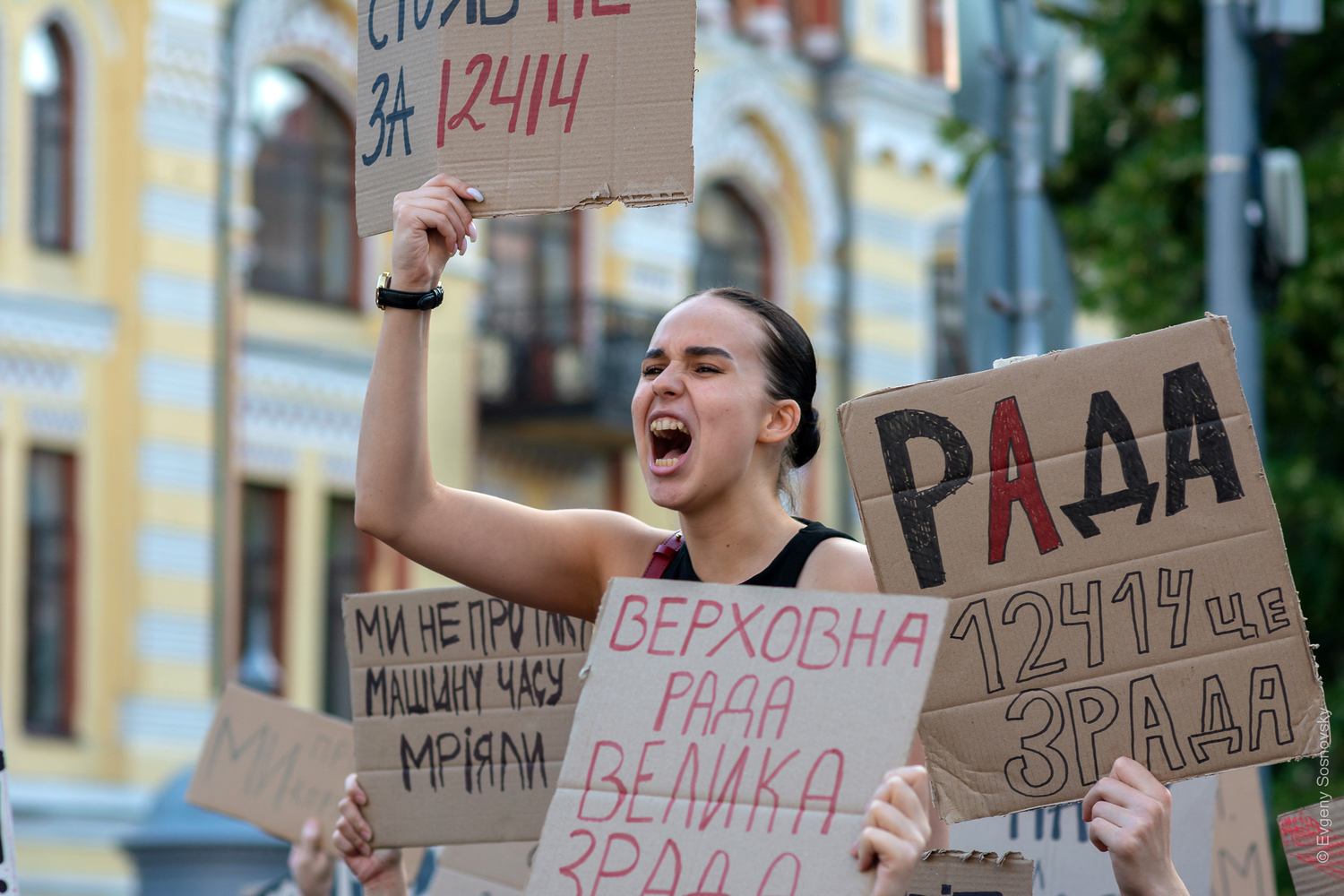
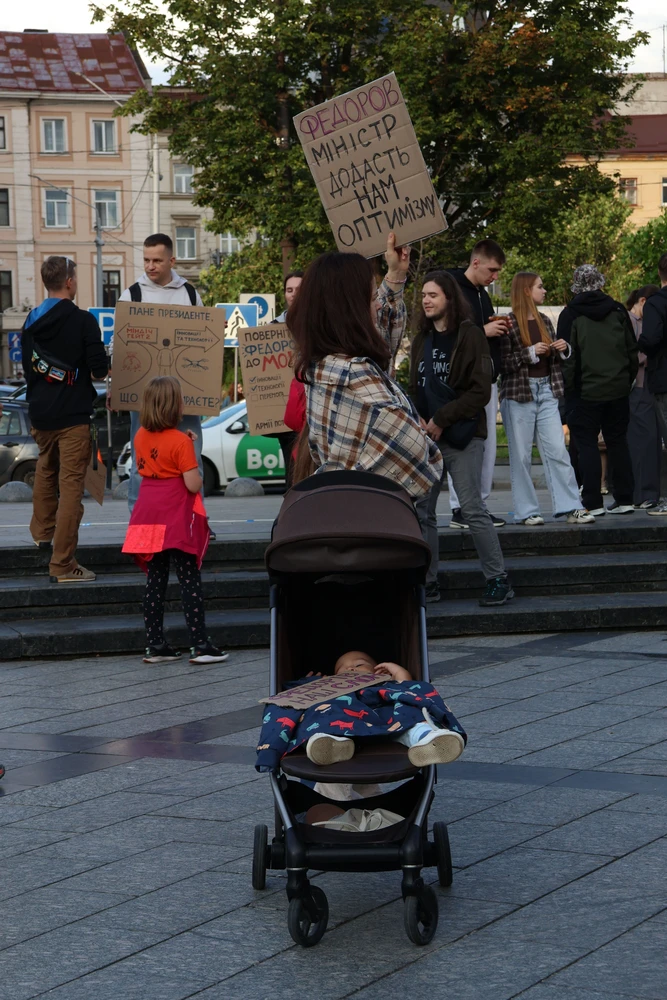
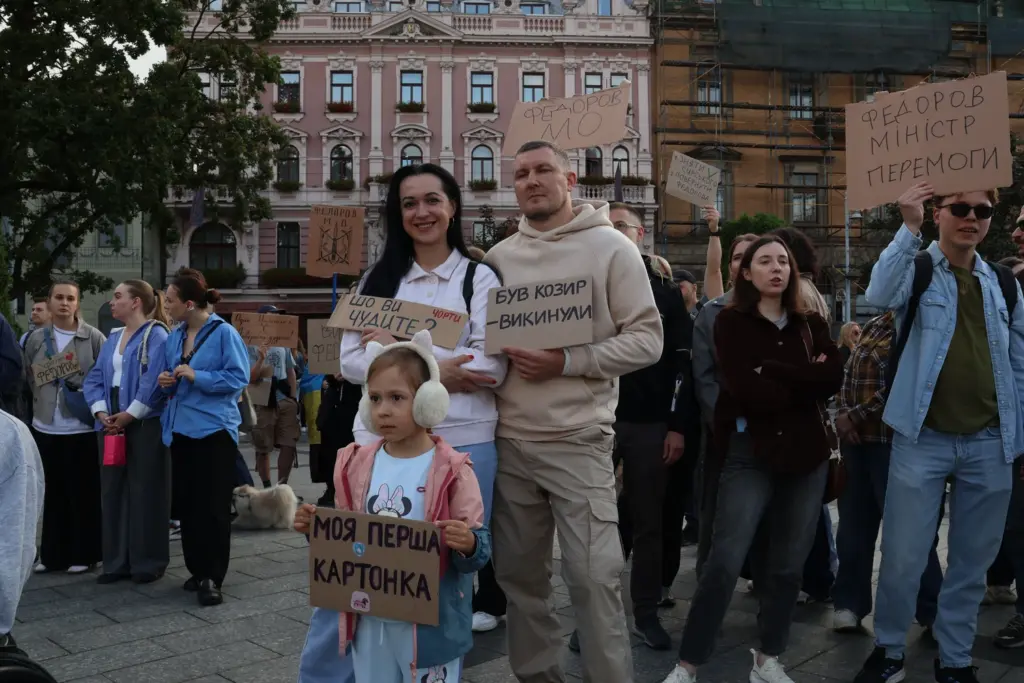
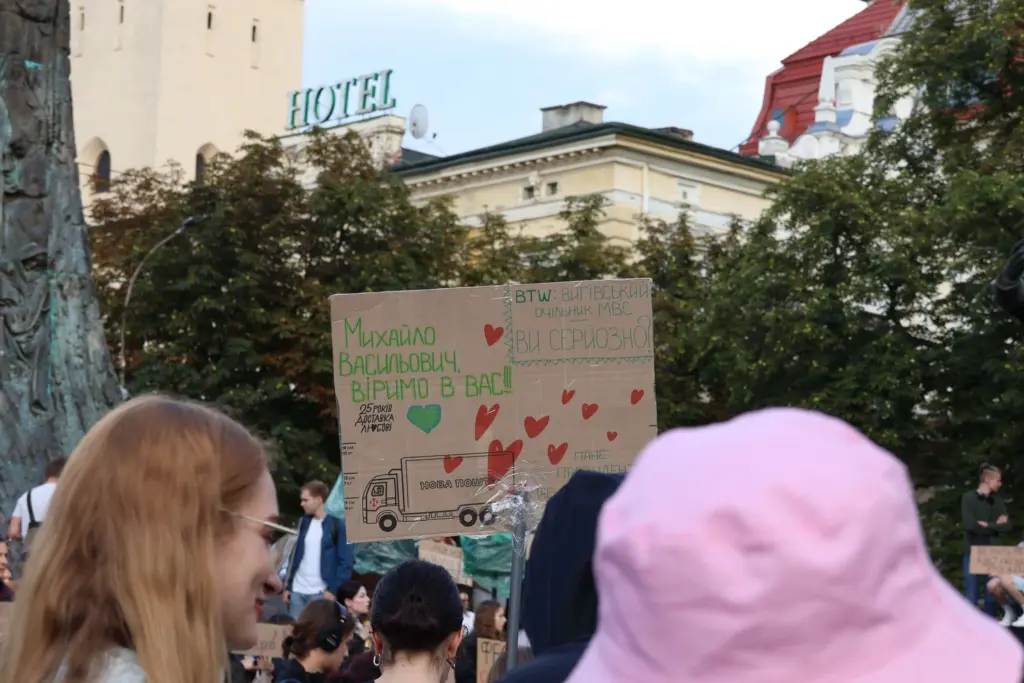
The Fedorov protesters lost. But they backed a man for what he built, not what he promised—and that may be new in Ukraine.
Musk’s Starlink decisions have affected both sides in the Russo-Ukrainian war
Musk has backed Ukraine's heavy dependence on Starlink for military command and comms. In 2022, Musk declined to extend Starlink coverage for Ukrainian troops mid-operation near occupied Crimea, citing his fear of triggering a nuclear escalation.
He has also acted against Moscow: in February, at Fedorov's direct request, Musk shut down the Starlink terminals that Russian forces had been operating illicitly against Ukraine.
Now, Musk answered Fedorov's Monday post with a line about "trying to do the right thing" and wanting peace — and said nothing about the Starlink ask.
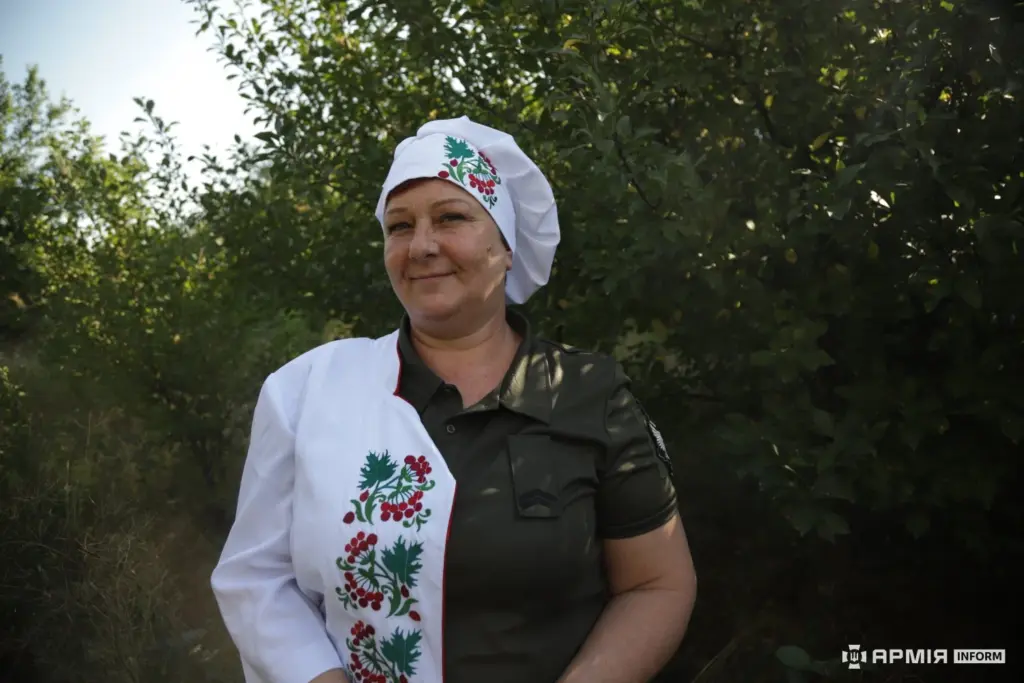
Mariia's working day starts at 4:30 a.m. A cook with the reconnaissance battalion of Ukraine's 40th Artillery Brigade, she has cooked for as many as 860 soldiers at once—borsch at military scale, and the steady work of keeping a brigade fed—Army Inform writes in a profile of her service.
Mariia's seven years in uniform put a human scale on a war that began in 2014: one working life spent feeding soldiers.
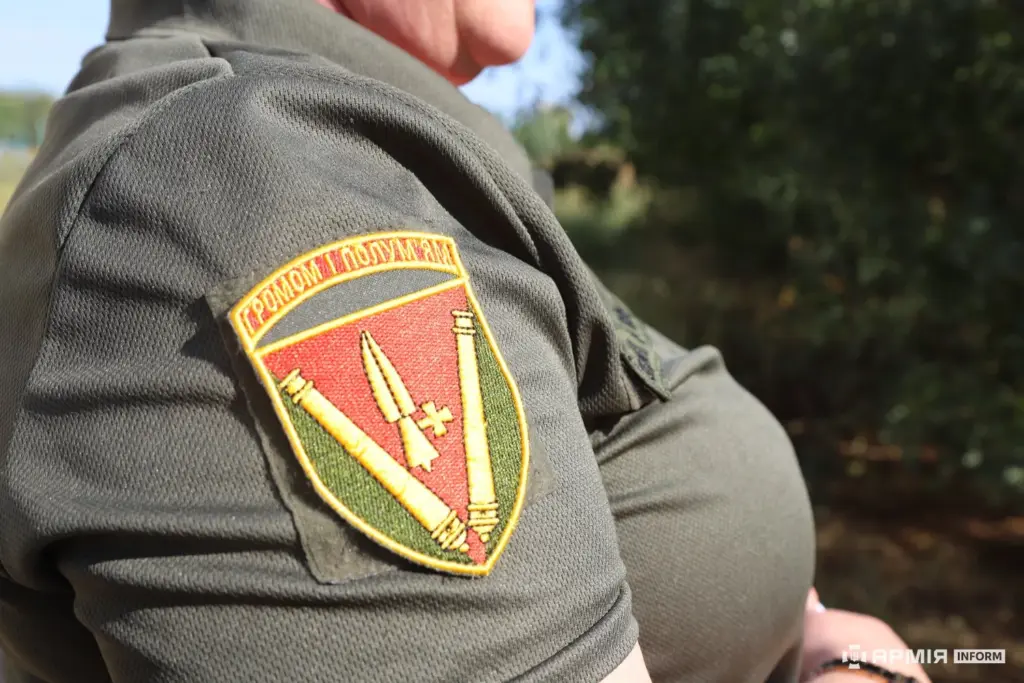
The sleeve insignia of Ukraine's 40th Separate Artillery Briga
Mariia's working day starts at 4:30 a.m. A cook with the reconnaissance battalion of Ukraine's 40th Artillery Brigade, she has cooked for as many as 860 soldiers at once—borsch at military scale, and the steady work of keeping a brigade fed—Army Inform writes in a profile of her service.
Mariia's seven years in uniform put a human scale on a war that began in 2014: one working life spent feeding soldiers.
The sleeve insignia of Ukraine's 40th Separate Artillery Brigade, whose motto reads "With thunder and flame." Photo: Taras Peretiatko / Army Inform
Mariia's path to that kitchen began long before the full-scale invasion. She wanted to enlist in 2014, when Russia's war in the Donbas started, and joined the army in 2019, she told Army Inform. Her first posting took her to Popasna, in the east, where she served for eight months. Russia's full-scale invasion, in February 2022, caught her unit in Kharkiv Oblast.
One moment from the first weeks of the invasion has stayed with her, she told Army Inform: in March 2022, an elderly couple who assumed the soldiers had nothing gave them what little they had themselves—ten eggs and four cigarettes. She has kept cooking in the years since.
Ukraine’s military-pay system, in force since 1 June, includes bonuses for taking enemy servicemembers prisoner and for confirmed kills in small-arms or hand-to-hand combat, the Defense Ministry explained on 20 August.
The capture reward is divided among the troops involved, while the kill bonus requires video confirmation.
Under the Defense Ministry’s payment rules, the capture reward is divided among the troops involved, while the kill bonus requires video confirma
Ukraine’s military-pay system, in force since 1 June, includes bonuses for taking enemy servicemembers prisoner and for confirmed kills in small-arms or hand-to-hand combat, the Defense Ministry explained on 20 August.
The capture reward is divided among the troops involved, while the kill bonus requires video confirmation.
Under the Defense Ministry’s payment rules, the capture reward is divided among the troops involved, while the kill bonus requires video confirmation. Both are paid by order of a unit commander and fall outside the monthly limit on other combat bonuses.
How the new payments work
Oksana Liekontseva, a senior Defense Ministry official, said the highest additional payments go to troops carrying out assault operations on the line of contact or inside Russian defenses. Lower rates apply to restoring Ukrainian positions or operating farther from the front.
The zonal and assault payments depend on the time spent on each mission and require documentary confirmation. Base salaries and existing combat payments remain unchanged, while eligible personnel who do not receive combat payments can receive a smaller supplement.
The overhaul is part of a broader military reformPresident Volodymyr Zelenskyy announced in May, combining higher frontline pay with new fixed-term contracts.
Combat medic and writer Yaryna Chornohuz has argued that bonuses cannot substitute for adequate base pay and predictable service terms, particularly for troops who have already served for years.
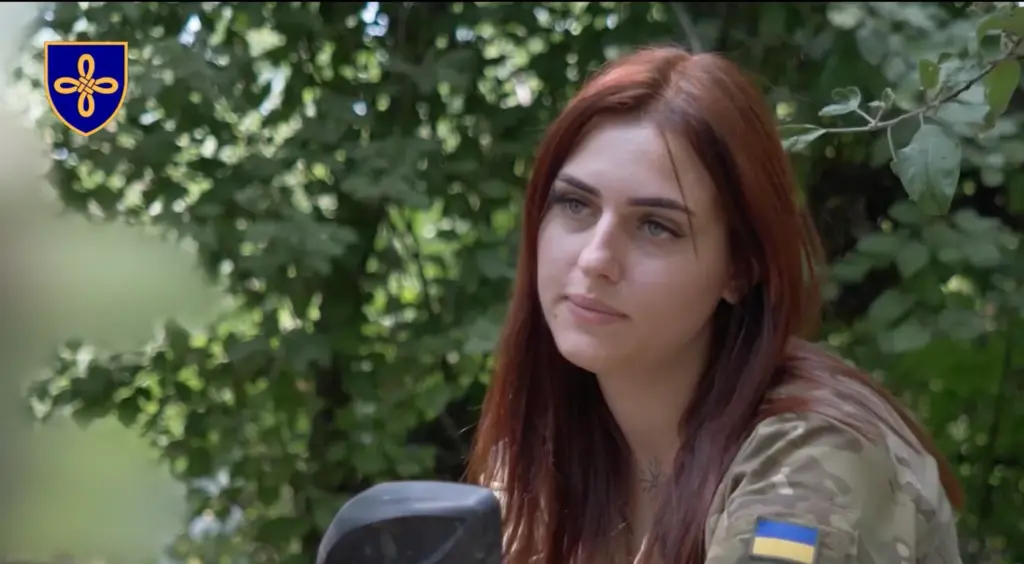
Khrystyna, 22, joined Ukraine's 159th Separate Mechanized Brigade after finding the unit on social media and leaving her contact details — a recruiter called her back and offered her the "18–24" contract, she said in a video published on the brigade's Facebook page.
Roughly one-third of candidates at Ground Forces recruitment centers in early 2026 chose positions as drone pilots or operators, according to the Ministry of Defense. About 80,000 Ukrainian service personne
Khrystyna, 22, joined Ukraine's 159th Separate Mechanized Brigade after finding the unit on social media and leaving her contact details — a recruiter called her back and offered her the "18–24" contract, she said in a video published on the brigade's Facebook page.
Roughly one-third of candidates at Ground Forces recruitment centers in early 2026 chose positions as drone pilots or operators, according to the Ministry of Defense. About 80,000 Ukrainian service personnel participate in drone operations in some capacity, according to official Armed Forces statements.
Before enlisting, she worked as an administrator, a waitress, and a sushi chef. After signing, she completed professional training that included drone operation and combat sorties.
"I always believe that the 159th is the elite," she said, adding that what she liked most about military life was the people in her unit.
Screenshot from video: 159th Separate Mechanized Brigade / Facebook
"18–24" program details
The "18–24" program, launched on 11 February 2025, offers one-year voluntary contracts to Ukrainians aged 18 to 24 who are not yet subject to conscription. Recruits receive a UAH 1 million (about $22,400) bonus, monthly pay of up to UAH 120,000 ($2,700), a zero-interest mortgage, and free medical care.
A drone operator track added in July 2025 extends the commitment to two years and includes up to 45 days of basic training and up to 60 days of professional drone training.
Uptake has been slow—only around 500 recruits had joined by December 2025, United24 Media reported.
The Unmanned Systems Forces—established in June 2024 as the world's first military branch dedicated to unmanned systems—number about 15,000.
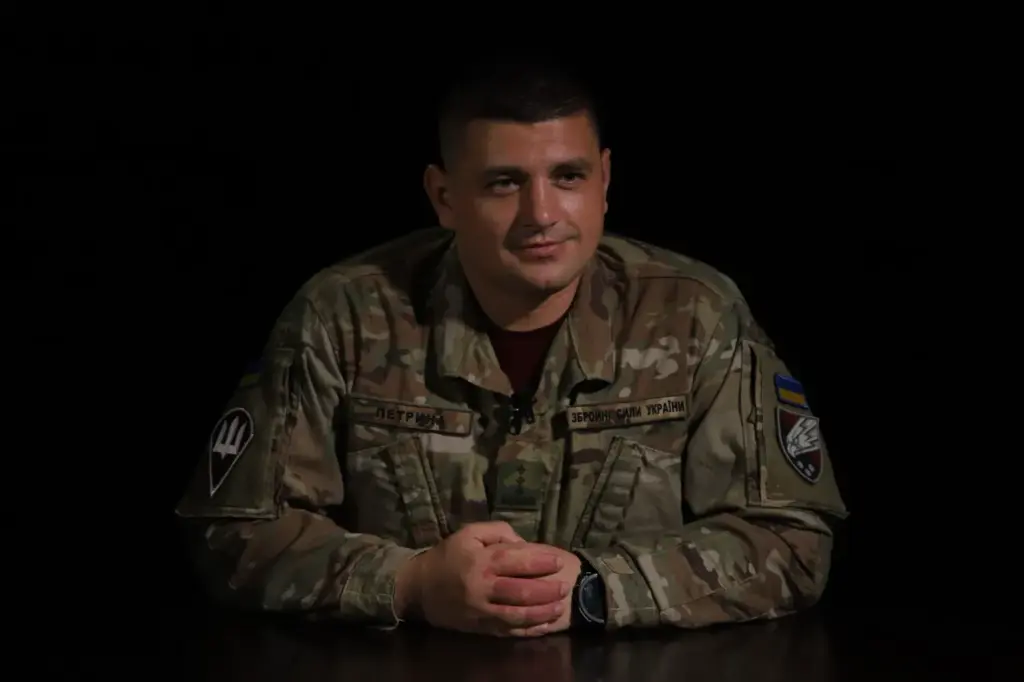
In an interview with Army Inform, Colonel Illia Petryna, commander of the 25th Separate Sicheslav Airborne Brigade, said the brigade created a ground-robotics company as a pilot unit and that it was among the first Ukrainian brigades to organize ground robots this way.
The company was initially created to test how the systems could work in combat. They are now being used for different battlefield tasks, Petryna said. Some robots carry supplies. Others are used for evacu
In an interview with Army Inform, Colonel Illia Petryna, commander of the 25th Separate Sicheslav Airborne Brigade, said the brigade created a ground-robotics company as a pilot unit and that it was among the first Ukrainian brigades to organize ground robots this way.
The company was initially created to test how the systems could work in combat. They are now being used for different battlefield tasks, Petryna said. Some robots carry supplies. Others are used for evacuation or provide fire support.
The move is part of Ukraine's broader effort to build dedicated units around ground robots. In February 2025, Ukraine's Defense Ministry said the military was forming units focused on unmanned ground systems after testing that had begun in summer 2024. The systems were already being used for logistics, fire strikes, and evacuating wounded soldiers.
Ukraine has since continued expanding their use. By March 2026, 167 units were using ground robots, up from 67 in November 2025. More than 9,000 combat and logistical missions were conducted with unmanned ground vehicles (UGVs) that month, according to the Defense Ministry.
Learning from the battlefield
The 25th's robotic company also gives soldiers a way to test systems and report problems directly to manufacturers.
“Cooperation with manufacturers is the basis,” Petryna said. “They draw information from us about what is needed now, what is relevant at the front.”
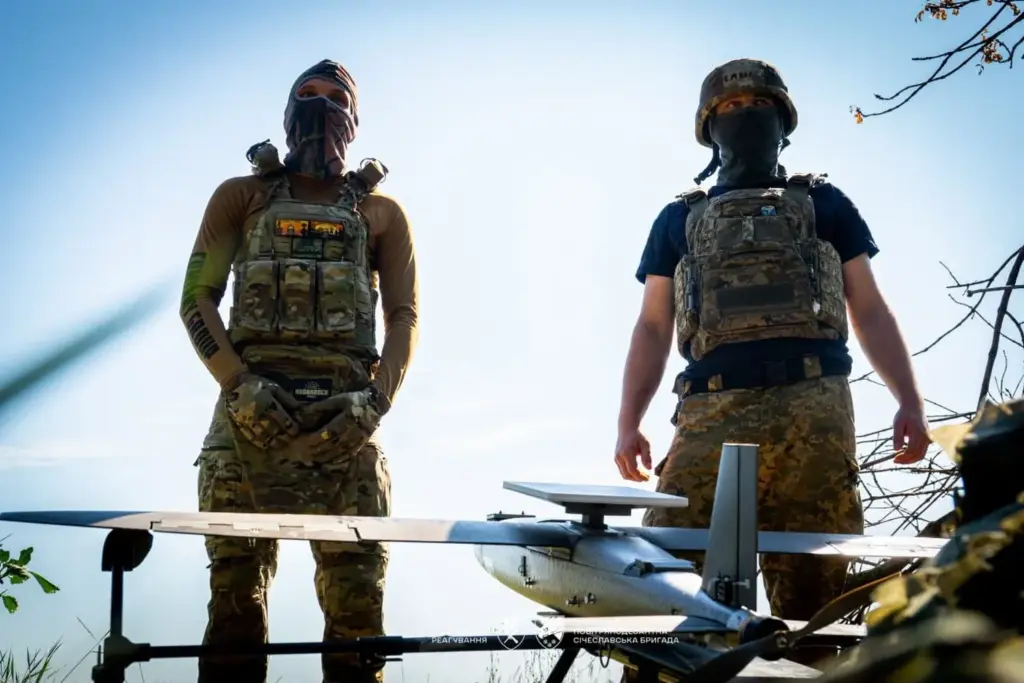
Two soldiers of the 25th Separate Sicheslav Airborne Brigade stand beside a fixed-wing reconnaissance drone. Photo: 25th Separate Airborne Brigade / Army Inform
Soldiers use the machines in combat, identify what does not work, and pass that information back to manufacturers. The next versions can then be adapted to conditions at the front.
That creates a direct feedback loop between the battlefield and the companies developing the technology.
Petryna sees that constant adaptation as necessary because the technology and tactics of the war keep changing.
“Probably, right now, no statute in the world fits how this war is being fought,” he said. “The war has changed fundamentally.”
For the 25th, the robotic company is one way to keep adapting as the battlefield changes.
The crew flies with the Black Sky unmanned-systems battalion of the National Guard's 3rd Operational Purpose Brigade Spartan. The commander, callsign Arti, said the crew's middle-strike drones can strike Russian military vehicles as close as 50 and as far as 150 kilometers behind the front line, mostly trucks and passenger cars, Army Inform reported.
The war now reaches deep into the Russian rear, where strike drones hit vehicles once safe from the front. Every Russian
The crew flies with the Black Sky unmanned-systems battalion of the National Guard's 3rd Operational Purpose Brigade Spartan. The commander, callsign Arti, said the crew's middle-strike drones can strike Russian military vehicles as close as 50 and as far as 150 kilometers behind the front line, mostly trucks and passenger cars, Army Inform reported.
The war now reaches deep into the Russian rear, where strike drones hit vehicles once safe from the front. Every Russian vehicle this crew burns is a blow to the invasion's logistics, leaving fewer supplies and fewer troops able to reach Russian positions. (edited)
Arti said the drones' main advantages are their range, speed, and stealth, while navigator Schultz, another crew callsign, said they are particularly effective 50–60 kilometers from the line of contact.
How the crew works
The four-person crew includes a pilot, navigator, technician and sapper. Arti joined the military intending to fly drones and first served as a second pilot on another crew before moving to middle-strike aircraft.
Schultz was mobilized in September 2024 and spent nearly a year and a half flying Mavic drones for reconnaissance, dropping munitions and delivering supplies to Ukrainian troops. That experience helped him transition to middle-strike drones.
“I navigate the terrain and give the pilot the course to fly,” Schultz said. “I already know the areas where enemy vehicles may move and where they may stage near the treelines.”
Photo: Daria Moskalets/ Army Inform
Schultz said Russian forces have become increasingly reluctant to move vehicles close to the front line after repeated Ukrainian strikes.
"At 50 to 60 kilometers from the [frontline] they're quite effective. Right on the line we won't find anyone now — nobody drives there anymore, because our guys worked them over for so long. The occupiers are already afraid to drive closer. It knocks out all the enemy's logistics," he said.
Schultz said this can mean fewer supplies and personnel reaching Russian positions.
He recalled the first time he watched one of the crew’s strikes in real time. Reconnaissance operators tracked a vehicle carrying Russian personnel while the drone crew moved in to attack.
Photo: Daria Moskalets/ Army Inform
“We saw it ourselves—we saw how we hit it, how everything exploded and burned,” he said.
The crew began flying middle-strike drones only a few months ago.
“We’re a young crew. There’s still a lot ahead,” Schultz said.
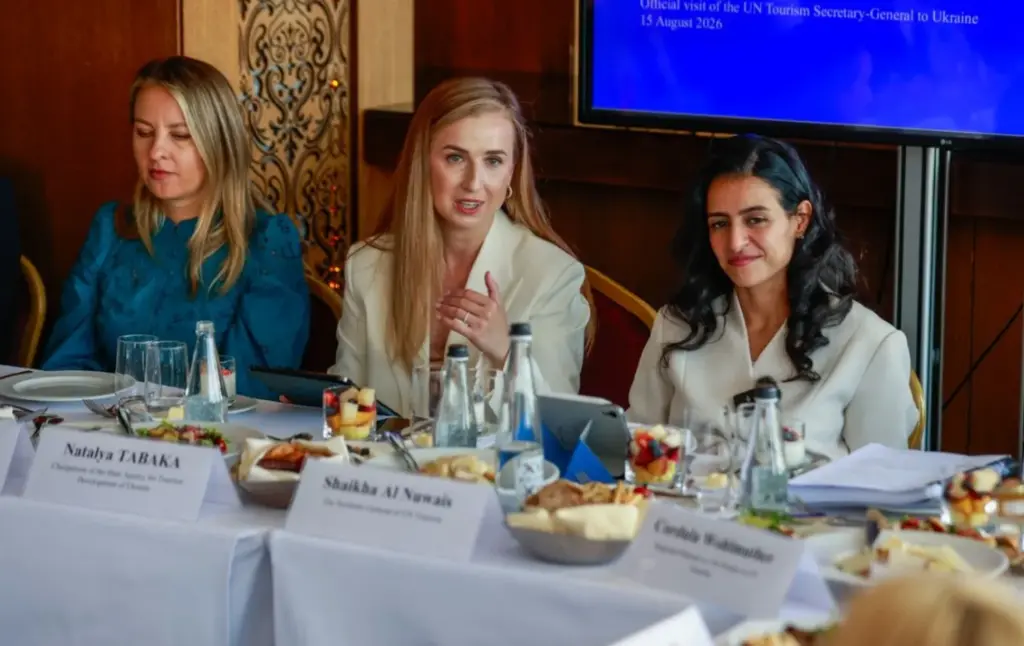
The head of UN Tourism, Shaikha Al Nowais, named medical tourism and Ukraine's IT sector as the country's strongest cards for winning back foreign visitors after the war, at a Kyiv briefing. Ukraine already holds everything a tourism economy needs, she said, from culture and landscapes to cuisine. Al Nowais, the first woman to lead the organization in its history, was making the first visit by a UN Tourism chief to Ukraine in a decade.
A UN specialized agency publicly t
The head of UN Tourism, Shaikha Al Nowais, named medical tourism and Ukraine's IT sector as the country's strongest cards for winning back foreign visitors after the war, at a Kyiv briefing. Ukraine already holds everything a tourism economy needs, she said, from culture and landscapes to cuisine. Al Nowais, the first woman to lead the organization in its history, was making the first visit by a UN Tourism chief to Ukraine in a decade.
A UN specialized agency publicly treated Ukraine as a future destination rather than a war zone, as Kyiv tries to anchor its reconstruction to sectors that can earn hard currency and bring people back to emptied regions. Both sectors she named were among Ukraine's stronger performers before 2022.
Before the invasion, Ukraine was receiving about 13 million visitors a year, with tourism worth roughly 3 to 4 percent of GDP, RBC-Ukraine reported citing the numbers mentioned at the briefing.
"Bringing all stakeholders in the tourism process together with the state under one umbrella could unlock great potential," Al Nowais said.
A medical tourism hub before the war
Before Russia's full-scale invasion, Ukraine had a reputation as an affordable place for fertility treatment and surrogacy, dentistry, laser eye surgery, and cosmetic procedures, the US-based Medical Tourism Association said. Prices often ran a fraction of Western European ones. In the late 2010s, the country's medical tourism association counted tens of thousands of foreign patients a year. Because that trade rests on clinics and specialists rather than rebuilt infrastructure, Al Nowais said it could bounce back fairly quickly once the war ends.
A tech sector that grew through the war
Ukraine's IT exports reached about $6.8 billion in 2021, close to a tenth of all the country's exports, and the industry has been one of the few to keep growing through the war. The same ecosystem produced the Diia app, a state-services platform installed by more than a third of Ukrainian adults before the invasion, along with globally used products such as Grammarly and GitLab. A sector that has shown it can ship and scale under bombardment is, on Al Nowais's logic, well placed to build the booking, logistics and guide services a returning tourism market will need.
Ukraine's Acting Foreign Minister Andrii Sybiha met her in Kyiv on 15 August 2026 to discuss tourism's place in reconstruction, and UN Tourism agreed to provide 500 scholarships for Ukrainians to study at its Online Academy, 200 of them reserved for veterans, with Kyiv setting the rest of the allocation.
Entry-level employers are finding it harder—and more expensive—to recruit young men. On Work.ua, one of Ukraine’s largest job platforms, the number of male candidates aged 18 to 22 who responded to vacancies fell 19% between July 2025 and July 2026, Lesia Prymakova told Ukrainska Pravda. The decline reached 29% in hospitality and retail.
At the same time, advertised entry-level pay moved close to Work.ua’s overall median. The median salary for vacancies open to students
Entry-level employers are finding it harder—and more expensive—to recruit young men. On Work.ua, one of Ukraine’s largest job platforms, the number of male candidates aged 18 to 22 who responded to vacancies fell 19% between July 2025 and July 2026, Lesia Prymakova told Ukrainska Pravda. The decline reached 29% in hospitality and retail.
At the same time, advertised entry-level pay moved close to Work.ua’s overall median. The median salary for vacancies open to students rose 24%, while pay for jobs requiring no experience increased 23%.
No reliable count shows how many young men remained abroad.
The candidate pool shrank after the government eased wartime travel restrictions for men aged 18 to 22 last summer, following an initiative by President Volodymyr Zelenskyy. The government said the change was intended to discourage families from taking boys abroad before their 18th birthdays, when the previous rules would have prevented them from leaving.
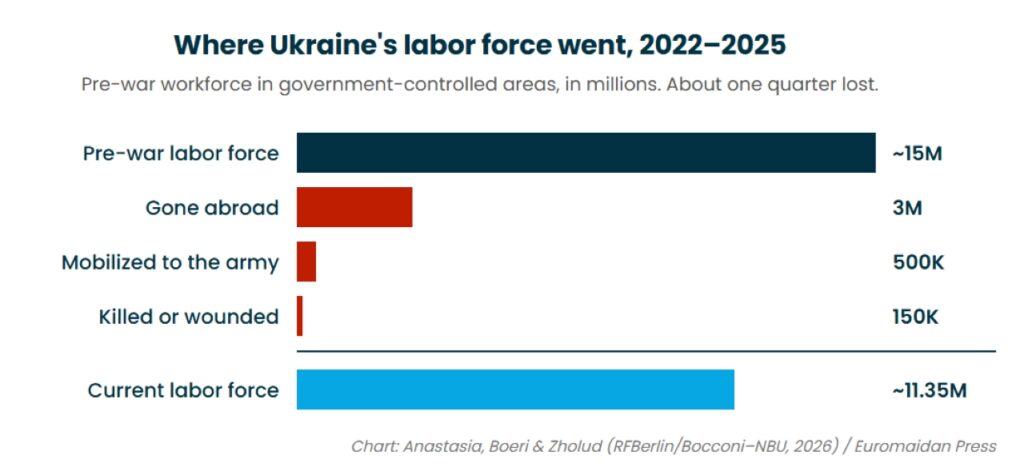
Ukraine’s pre-war labor force has shrunk by about a quarter. Three million went abroad, hundreds of thousands more to the front. What remains is older. Chart: Anastasia, Boeri & Zholud (RFBerlin/Bocconi–NBU, 2026) / Euromaidan Press
Hospitality and retail feel the squeeze
Restaurant owners tied the decline in young applicants directly to the eased travel rules. Sommelier Oleh Kravchenko, who owns Kyiv wine bar Win Bar, said two of his staff, a bartender and a cook, were preparing to leave the country, and that the bar had begun hiring more women, whereas server positions had earlier been held only by men.
He said his payroll had risen 5 to 10% and that he now raised wages at least every six months, even as rent, utilities, and food costs also climbed. Olena Borysova, who owns the GastroFamily group behind the Bilyi Naliv chain, said young applicants had become rare over the past year.
Ukraine’s labor shortage extends far beyond this age group. Ukraine’s full-time workforce fell from 7 million in 2021 to 5.3 million by late 2025, while the National Bank expects the net outflow of workers to continue into 2027.
Explore further
Ukraine’s economy posted its sharpest contraction since the wartime recovery began
Against that backdrop, 48% of companies reported labor shortages in a survey cited by Ukrainska Pravda, without attributing them specifically to the travel change, and Work.ua put the overall median advertised wage up 20% year on year. These are nominal advertised salaries; annual inflation stood at 7.7% in July, so the real increase is smaller.
No one knows how many stayed abroad
No reliable count shows how many young men remained abroad. Social Policy Minister Denys Uliutin cited an estimate from European partners that some 400,000 men aged 18 to 22 left Ukraine between August 2025 and April 2026. However, the estimate does not identify unique individuals or subtract those who later returned, Vasyl Voskoboinyk, head of the NGO Office of Migration Policy, told Ukrainska Pravda.
Voskoboinyk estimated that around 300,000 men in this age group had been working, equivalent to about 2% of Ukraine’s labor force, and said their departures had not caused a broader labor-market collapse.
Available education data show no comparable decline. The Education Ministry recorded a 28% year-on-year rise in university applications, while Kyiv-Mohyla rector Serhiy Kvit said the academy had not seen mass withdrawals. Applications count submissions rather than enrolled or retained students, so the increase indicates continued demand for places rather than a settled outcome.
Voskoboinyk said it was still too early to determine whether the policy had reduced departures among 16- and 17-year-old boys, its stated long-term aim.
Employers widen who they recruit
Employers are recruiting more broadly to fill the gap. Olena Kolesnikova of the Federation of Employers said firms were increasingly willing to hire from groups they had previously overlooked, with 94.4% open to internally displaced people, 91% to veterans, and 88% to people with disabilities.
Keeping young people in Ukraine, she argued, would take more than pay. "The right question is not how to keep young people from leaving, but how to make it worthwhile for a young person to start a career and build a life in Ukraine after they finish studying," she said.
Russia struck facilities of Ukraine's state-owned Naftogaz Group 13 times over the past week, hitting several regions with drones and missiles, the company reported on 17 August. Gas extraction infrastructure was among the targets, and one asset was hit several times. Naftogaz said the strikes seriously damaged equipment and production capacity and cut part of its output. No employees were injured this time.
The strikes are part of a systematic Russian drone and missile
Russia struck facilities of Ukraine's state-owned Naftogaz Group 13 times over the past week, hitting several regions with drones and missiles, the company reported on 17 August. Gas extraction infrastructure was among the targets, and one asset was hit several times. Naftogaz said the strikes seriously damaged equipment and production capacity and cut part of its output. No employees were injured this time.
The strikes are part of a systematic Russian drone and missile campaign against Ukraine's oil and gas production, intensifying as winter approaches. Naftogaz has now counted 293 strikes on its facilities since the start of 2026.
Acting Naftogaz CEO Serhii Fedorenko has said the strikes are meant to inflict maximum damage on Ukraine's infrastructure ahead of the heating season. The company said Russian attacks destroyed 37 sites in its network during the first seven months of 2026, 32 Ukrnafta filling stations and five Ukrhazvydobuvannia complexes.
The strikes carry a human cost too: EP has reported 312 workers killed across the group since 2022. In what Naftogaz called its largest strike on gas production infrastructure, Russia fired 35 missiles and 60 drones at facilities in the Kharkiv and Poltava regions in October 2025.
Russia's long war on Ukraine's energy grid
Russia has bombed Ukraine's power and heating systems through every winter of its full-scale invasion. Each year the strikes have grown heavier. Then-Energy Minister Denys Shmyhal said last winter's attacks damaged or destroyed roughly 80% of Ukraine's energy system. Across 2025, Russia hit energy sites more than 600 times, damaging all 15 of the country's thermal plants. The strikes have forced repeated nationwide blackouts and cut heat to homes in sub-zero cold.
That previous campaign failed to collapse the grid, so Moscow now eyes Ukraine's water systems as its next winter target. Heading into the coming winter, Ukraine received about three times fewerair-defense missilesin the first half of 2026 than a year earlier. Kyiv is answering with its own deep strikes on Russian refineries and military plants. For civilians, the pattern means another winter of cold homes, rationed power, and threatened water supplies.
A Russian drone knocked out the robot sent to evacuate two wounded Ukrainian assault troops. Their company commander went in himself. He drove into the kill zone in an unarmored pickup truck, without body armor, and carried them out.
The Joint Forces Group released the footage on 16 August 2026. It identified the commander as Vladyslav Polskyi of the 475th Separate Assault Regiment (Code 9.2).
The two soldiers had captured Russian positions and were pulling back whe
A Russian drone knocked out the robot sent to evacuate two wounded Ukrainian assault troops. Their company commander went in himself. He drove into the kill zone in an unarmored pickup truck, without body armor, and carried them out.
The Joint Forces Group released the footage on 16 August 2026. It identified the commander as Vladyslav Polskyi of the 475th Separate Assault Regiment (Code 9.2).
The two soldiers had captured Russian positions and were pulling back when Russian Molniya drones hit them, the group said. Both were seriously wounded and could not move on their own. A ground robot was sent to pull them out. A second drone hit it, and it stopped in the open, leaving the men exposed.
A company commander just drove straight into drone fire to save his men with no body and no hesitation
Vladyslav Polskyi from an assault company of the 475th "Code 9.2" regiment saw that his soldiers were hit by Russia's "Molniya" drones, and a robotic evacuation platform sent… pic.twitter.com/ib6B6TbgQD
The group framed the rescue as the reason the regiment's soldiers take on the hardest assaults when others hold back: they know their commanders do not hide behind them, and will give everything to save every one of their men.
In June, Ukrainian ground robots ran nearly 17,000 supply and evacuation runs, taking on the exposed trips that used to get crews killed. Ukraine now fields some 25,000 combat robots. Their main limit, a presidential adviser says, is not hardware but staying connected under jamming, and a new Ukrainian antenna is meant to help. But no antenna stops what happened here. A drone hit the evacuation robot and knocked it out.
When the robot failed, the risk it was built to absorb fell back on the commander.
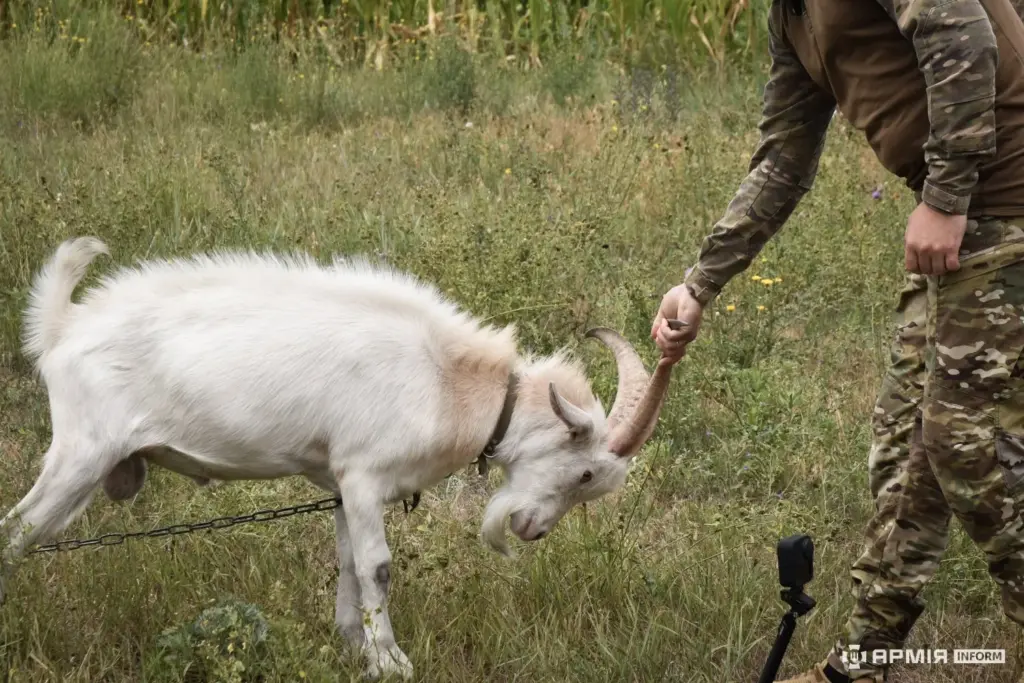
Borka arrived as a kid about a year and a half ago, carried in by one of the men and left at the door of the unit's house in Donetsk Oblast, the battalion's chief sergeant, who uses the callsign Sheva, told ArmyInform, the Ukrainian defense ministry's information agency. Someone suggested keeping him, someone else joked about meat, and no one followed through. He has stayed ever since, through several redeployments and near-daily Russian drone activity. On one occasion, a
Borka arrived as a kid about a year and a half ago, carried in by one of the men and left at the door of the unit's house in Donetsk Oblast, the battalion's chief sergeant, who uses the callsign Sheva, told ArmyInform, the Ukrainian defense ministry's information agency. Someone suggested keeping him, someone else joked about meat, and no one followed through. He has stayed ever since, through several redeployments and near-daily Russian drone activity. On one occasion, a Russian FPV drone exploded near the position. The soldiers relocated in a hurry, then realized they had left Borka behind and went back for him, Sheva recalled.
Borka is one of many animals Ukrainian troops have taken in and pulled out of front-line areas during Russia's war against Ukraine. Sheva casts the care as a deliberate contrast. "They are our lesser brethren. We are responsible for those we have tamed. We are not like the Russians," he said, adding that comrades have evacuated dogs, cats, and once even a cow from wrecked settlements.
Photo: Daria Moskalets / ArmyInform.
Sheva, who volunteered with friends at the start of Russia's full-scale invasion and has fought on the Zaporizhzhia, Kharkiv, and Donetsk fronts, says Borka is no easy houseguest. Whoever feeds him is his favorite, and whoever is late feeding him, Sheva included, risks a headbutt. He once snapped his tether and walked straight into the house where the soldiers were resting, to their general shock. To burn off his energy, the unit built him a training station out of a stump with an old helmet hung on it, and in winter they put up a small insulated shelter that he keeps demolishing, and they keep repairing. They trade chocolate bars for hay and straw, and tell his story to people who then pitch in with food.
The plan is, eventually, to find Borka a permanent home in good hands. "No one is going to send Borka for meat," Sheva said. On the front, he added, any small distraction has value: a cat purring on your lap settles you, and Borka does something different. "He's the kind of guy who keeps us all on our toes."
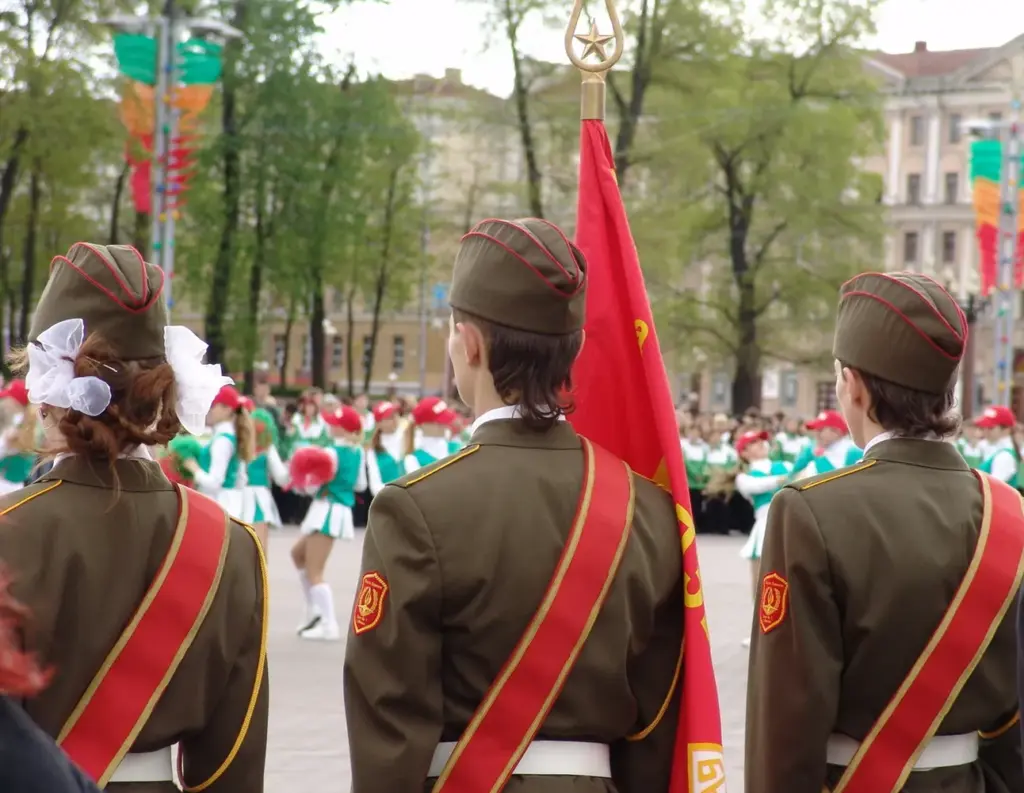
Starting in September, Belarusian 10th-graders will be split by gender for new practical training: boys will take a 10-hour drone-piloting course, girls an expanded tactical medicine block, Deputy Education Minister Alyaksandr Kadlubai said, according to BelTA. The changes fall under the "pre-conscription and medical training" classes already taught in Belarusian schools.
The update fits a broader pattern of militarizing education in Belarus since the 2020 protests and
Starting in September, Belarusian 10th-graders will be split by gender for new practical training: boys will take a 10-hour drone-piloting course, girls an expanded tactical medicine block, Deputy Education Minister Alyaksandr Kadlubai said, according to BelTA. The changes fall under the "pre-conscription and medical training" classes already taught in Belarusian schools.
The update fits a broader pattern of militarizing education in Belarus since the 2020 protests and Alyaksandr Lukashenka's subsequent crackdown. Military-patriotic clubs, formalized under a 2022 presidential decree, have spread through Belarusian schools, sending children as young as elementary school age through weapons training and field exercises. This year, Radio Svoboda says that 10-day military field camps have become mandatory for 10th-graders, and kindergartens have opened groups with a military-patriotic focus.
Kadlubai singled out cooperation with a Minsk-based military unit, No. 5448, home to a police brigade of the interior troops, saying the ministry aims to "scale this experience across the whole of Belarus."
"We've strengthened the practical component," Kadlubai said. "We've shifted the balance toward practical classes and increased their volume."
While Belarus drills its own children, Russia indoctrinates Ukraine's
Belarus is not a neutral bystander to Russia's war. Alyaksandr Lukashenka's government let Russian forces stage the February 2022 invasion from Belarusian soil, and Kyiv says it keeps expanding the logistics routes, training grounds, and artillery positions Russia could use for future operations.
And what its ally teaches at home, Russia imposes by force on Ukrainian children under occupation. From 1 September 2026, occupation authorities roll out a curriculum built around loyalty to the Russian state — a compulsory Russian "identity" subject, a split-off military-training course, and behavior graded from the second grade as "exemplary," "acceptable," or "unacceptable." It already reaches more than 582,000 children in nearly 2,000 schools.
Russia's economy grew 1.3% in the second quarter of 2026, the state news agency TASS reported on 12 August, citing preliminary estimates from the state statistics agency Rosstat — a figure that, if accurate, would end a slump that had opened the year with the country's first quarterly contraction since 2023.
And it comes from a state agency months after Putin dressed down his economic team in April and demanded "concrete measures" to restore growth — the print then beat
Russia's economy grew 1.3% in the second quarter of 2026, the state news agency TASS reported on 12 August, citing preliminary estimates from the state statistics agency Rosstat — a figure that, if accurate, would end a slump that had opened the year with the country's first quarterly contraction since 2023.
And it comes from a state agency months after Putin dressed down his economic team in April and demanded "concrete measures" to restore growth — the print then beat the government's own economists in exactly the direction he wanted.
The quarter may have brought a real if shallow rebound, or the state's statisticians may have produced the figure the president wanted. Either way it matters, because Russia's economy is what pays for its war, and its strength sets the ceiling on how long the Kremlin can keep fighting.
Barely growing all year
Even taken straight, the rebound is thinner than it looks. The first quarter had closed 0.2% down, and across the whole first half of the year output rose just 0.6%, half of last year's pace and close to seven times slower than the wartime boom of 2023 and 2024. The quarterly figure jumped. The underlying trend barely moved.
The weakness had been building for over a year. War spending drove the 2023–24 boom and overheated the economy; to curb the resulting inflation, the central bank raised its key rate to 21%, choking lending and investment. It has cut rates since, to 14% in July, but money is still tight and inflation is rising again as Ukrainian strikes push up fuel prices.
Growth the war paid for
As The Moscow Times set out, reviewing the data and the economists reading it, most of the quarter's growth rested on one-off factors: more working days than a year earlier, a temporary oil-revenue spike during the Iran war, and a budget that lifted spending 16%, a third of it on the army and weapons. The split underneath is the tell.
Military plants kept raising output; civilian industry kept shrinking, down 3.2% from a year earlier by the Center for Macroeconomic Analysis and Short-Term Forecasting (CMASF), a Russian forecasting institute, according to its estimate.
Rosstat also billed the quarter as its strongest in six, and said it had beaten the forecasts of both the economy ministry, which had projected 0.9%, and the central bank, which saw 0.8%.
Few expect it to last
Russia will "remain in a state of stagnation" for the foreseeable future, said Liam Peach of Capital Economics, citing high interest rates and the fuel crisis.
Ukraine's long-range drones are adding to the strain. Their strikes have cut Russian oil refining to its lowest level in more than two decades, draining fuel supply and pushing prices up at home, and forcing Moscow, an oil giant, to import gasoline from as far as Morocco.
President of Ukraine Volodymyr Zelenskyy announced the results on 12 August after a briefing from Commander-in-Chief Mykhailo Drapatyi, Chief of the General Staff Ihor Skybiuk, and Airborne Assault Forces Commander Oleh Apostol.
Kyiv says the operation recaptured 745 km² and 26 villages across Dnipropetrovsk, Donetsk, and Zaporizhzhia oblasts. The Airborne Assault Forces and attached units carried it out. The goal was to stop Russian forces from advancing further and pu
President of Ukraine Volodymyr Zelenskyy announced the results on 12 August after a briefing from Commander-in-Chief Mykhailo Drapatyi, Chief of the General Staff Ihor Skybiuk, and Airborne Assault Forces Commander Oleh Apostol.
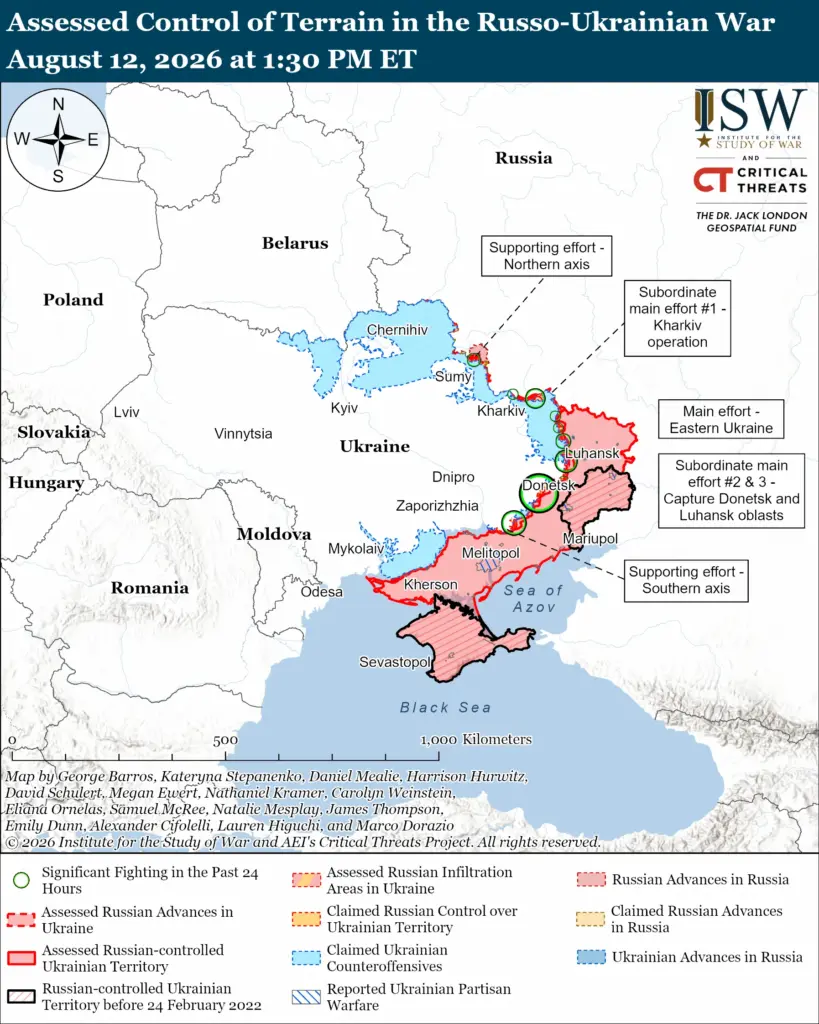
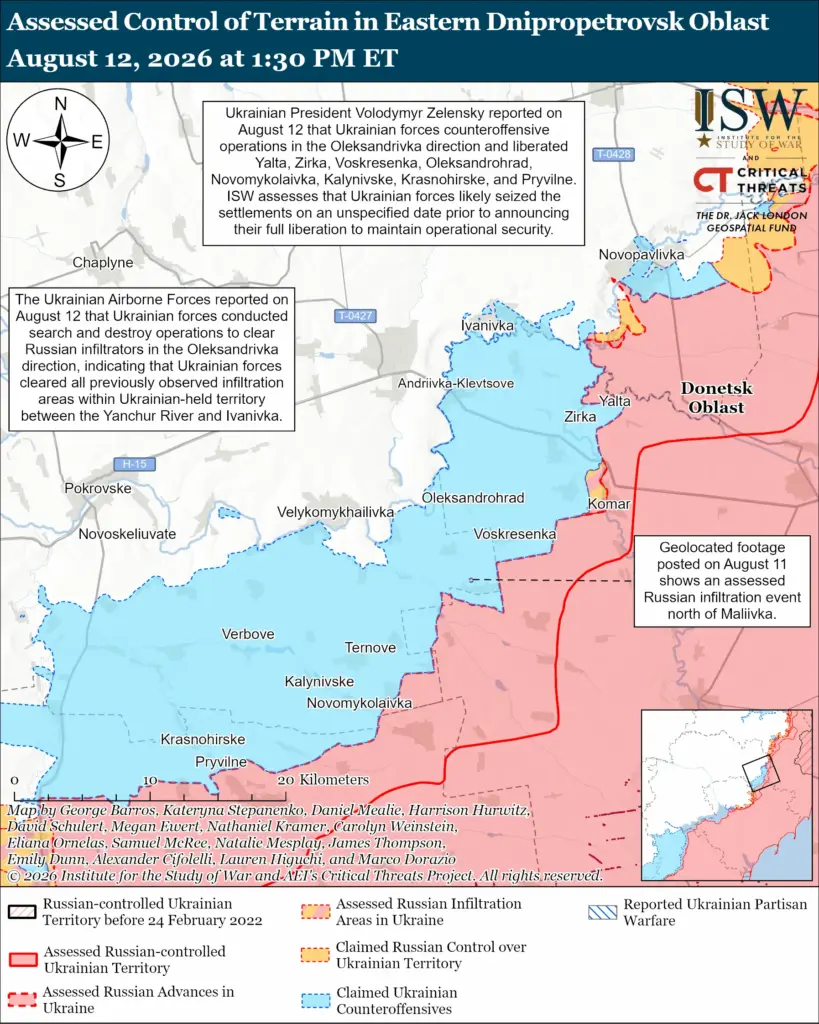
Kyiv says the operation recaptured 745 km² and 26 villages across Dnipropetrovsk, Donetsk, and Zaporizhzhia oblasts. The Airborne Assault Forces and attached units carried it out. The goal was to stop Russian forces from advancing further and push them beyond the administrative border of Dnipropetrovsk Oblast. The President's Office put Russian losses at at least 9,550 killed and over 6,600 wounded. Ukrainian forces are continuing to build on the gains. The operation also added to Ukraine's prisoner exchange pool.
Since its 2023 counteroffensive stalled, Ukraine has mostly defended while Russia grinds forward, making any sustained Ukrainian advance rare. With Western aid uncertain and its own troops stretched, Ukraine rarely gets to trade defense for offense on its own land.
A reversal Russia paid for across the front
Ukraine has spent most of the past year on the defensive. The Oleksandrivka counteroffensive broke that pattern. For over six months, Ukrainian forces pushed forward rather than holding ground, and they did it in Ukraine's own Dnipropetrovsk Oblast, not on Russian territory.
The operation also hurt Russia elsewhere. Every unit Moscow sent to defend in the Oleksandrivka direction was a unit it could not use to attack other parts of the front, the US-based think tank ISW assessed. Russian recruitment is declining, which makes that tradeoff harder to absorb.
The numbers across the whole frontline tell the same story. Between late January and 12 August, Russian forces seized roughly 383 km² but lost about 234 km², according to ISW. The net Russian gain was far smaller than in previous seasons.
Map: 2026 Institute for the Study of War and AEI's Critical Threats Project
How Ukraine clawed the ground back
The counteroffensive began on 29 January, according to ISW. Texty reported it ran in two stages: January to May and May to August. It was one of two mutually reinforcing Ukrainian drives in the Oleksandrivka and Huliaipole directions. Both aimed to push Russia from Dnipropetrovsk Oblast and disrupt preparations for Russia's 2026 offensive.
Kyiv says the following 26 villages were liberated: Tolstoi, Novokhatske, Hrushivske, Zirka, Zelenyi Hai, Piddubne, Myrne, Tsehelne, Pryvillia, Zlahoda, Krasnohirske, Pryvilne, Novohryhorivka, Stepove, Kalynivske, Berezove, Novomykolaivka, Voskresenka, Oleksandrohrad, Yalta, Rybne, Maliivka, Sichneve, Ternove, Novoheorhiivka, and Zaporizke. The settlements span all three oblasts.
Where Kyiv's map and ISW's diverge
ISW described the results as evidence that Ukrainian forces can still carry out significant tactical advances and bring back limited mechanized maneuver on parts of the frontline.
It assessed that the success was likely the result of several factors working together: better Ukrainian operational planning, a campaign to suppress and destroy Russian air defenses, deeper strikes against Russian supply lines, Ukraine's advantage in tactical drones, and the 01 February Starlink cutoff that hit Russian forces in Ukraine.
Geolocated footage from 11 August showed Ukrainian forces holding positions southeast of Ternuvate and Vozdvyzhivka. Russian sources had claimed advances in those areas. ISW assessed those claims were likely largely exaggerated.
ISW's own mapping recorded roughly 627 km² of Ukrainian gains across the Oleksandrivka and northern Huliaipole directions combined. Even that two-direction total falls below Kyiv's 745 km² for the Oleksandrivka direction alone. ISW noted its conservative methodology likely underestimates Ukrainian advances.
The Airborne Assault Forces Command added that some flag-raisings over liberated villages were done at a "safe distance" from actual positions for operational security. This suggests forces had moved beyond the settlements they publicly named.
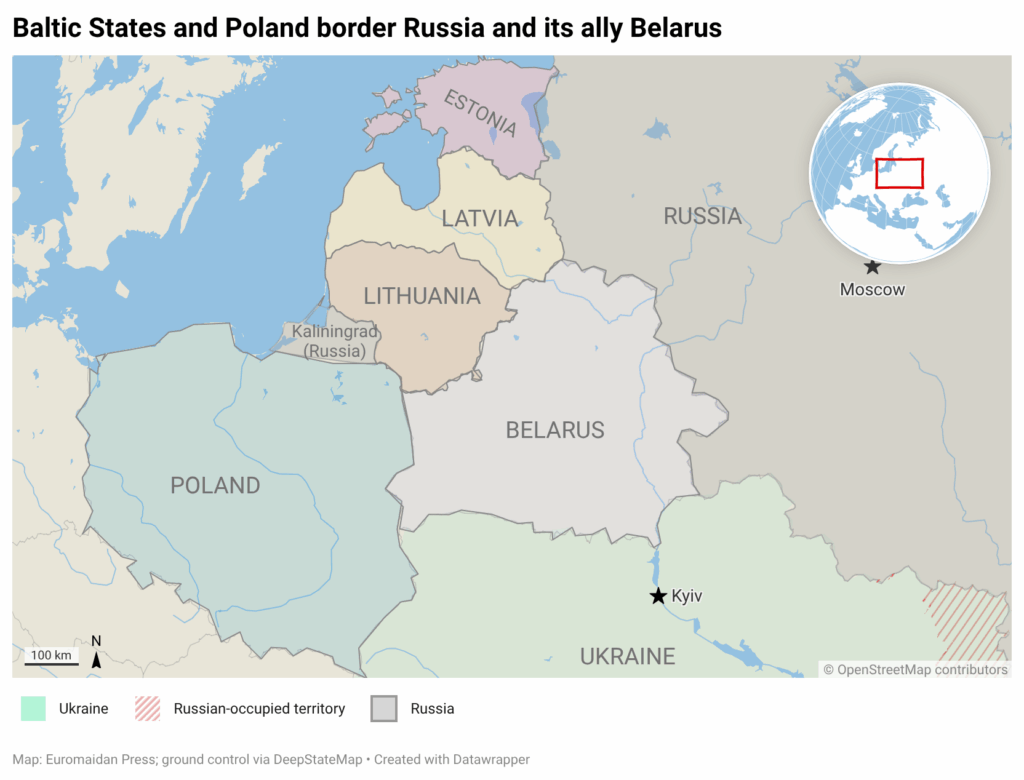
Lithuania's government approved an expanded plan on 12 August to fortify its borders with Russia and Belarus against a possible attack, LRT reports. Lithuania, a Baltic state and NATO member, sits wedged between Russia's Kaliningrad exclave and Belarus. The decision opens a new counter-mobility belt reaching inland from the border, a 20-meter strip that widens to 150 meters where the army marks out areas for operations.
The buildout answers a fear that has gripped the B
Lithuania's government approved an expanded plan on 12 August to fortify its borders with Russia and Belarus against a possible attack, LRT reports. Lithuania, a Baltic state and NATO member, sits wedged between Russia's Kaliningrad exclave and Belarus. The decision opens a new counter-mobility belt reaching inland from the border, a 20-meter strip that widens to 150 meters where the army marks out areas for operations.
The buildout answers a fear that has gripped the Baltics since Russia's full-scale invasion of Ukraine in 2022: that a Russia left unchecked in Ukraine could turn on them next. Western intelligence agencies have warned for years that Moscow could eventually threaten NATO itself, and former CIA director David Petraeus has singled out Lithuania as the likeliest first target, pinned between Kaliningrad and Belarus and sitting beside the Suwałki Gap, the thin land corridor that is NATO's only overland route to the Baltic states.
The decision raises the number of engineering parks, storage depots for obstacles like concrete blocks and roadblocks, from 27 to 50, and gives that work until the end of 2028, more than three years past the original April 2025 target. The state rail company LTG Infra is to store the equipment. The changes could cost an extra €50 million ($58 million) from the State Defense Fund between 2026 and 2030.
The Baltic region. Map: Euromaidan Press
Of the Baltic states and Poland fortifying their eastern borders, Lithuania is the most at risk yet the least fortified, according to a satellite review by open-source analyst Clément Molin, even as Belarus keeps testing that border with engineered migrant crossings. The plan is Lithuania's share of the Baltic Defense Line, the joint barrier it launched in 2024 with Latvia and Estonia, alongside Poland's parallel East Shield.
The design comes straight from Ukraine. Lithuania began building counter-mobility parks in 2023, drawing on Russia's war against Ukraine, and much of what it is now putting into the ground, the swamps, ditches, and obstacle fields, was tested first on Ukrainian battlefields, where mud, water, and simple barriers have repeatedly stalled armored advances.
The restored swamps should make some ground impassable to heavy military vehicles within a few years, the Defense Ministry says, with that work due by the end of 2030. Plans for defensive ditches and streams in the Marijampolė municipality were dropped, and the ministry found better sites in the Vilkaviškis and Šakiai districts. Deadlines for obstacles on roads and bridge approaches, and for fitting bridges with holders for explosives, were also moved to the end of 2028.
"Military counter-mobility is an important part of Lithuania's defence preparedness," Deputy Defense Minister Tomas Mikelkevičius said. "We seek to make the best possible use of Lithuania's terrain and engineering measures to impede an adversary's movement if necessary and create more favorable conditions for our armed forces to operate."
Lithuania approved its first counter-mobility plan in July 2024. The plan's original 2024 estimate put the full system at around €600 million ($690 million) over the decade.
Russia's pressure on the Baltic borders
The buildout lands amid steady friction along NATO's eastern edge. Latvia has absorbed the bulk of the migrant crossings funneled from Belarus, and this week found its first used smuggling tunnel under the border. Estonia has switched on the first sensors of a planned drone wall along its Russian frontier and is reallocating €500 million ($575 million) toward air defense and long-range strike. Russia, for its part, has shut seven rail crossings with Latvia, Estonia, and Finland without explanation.
The fortification drive is a bet on time. Estonia's military chief has set a two-year clock, warning Russia could be combat-ready again by 2027, and ISW analysts assessed in May that Moscow was manufacturing pretexts for aggression against the Baltics. Poland's parallel East Shield, meanwhile, has gone up far slower than promised, leaving the region's defenses still thin where the threat is judged greatest.
By the State Border Guard Service of Ukraine's account, Mykhailo, one of its soldiers, deployed to the forest in October 2024 with the rapid-response border commandant unit Shkval and held off Russian assaults while fortifying the ground under constant drone attack.
Holding a position like that on a static, drone-saturated front takes endurance as much as firepower. A unit has to supply itself, down to digging its own water under fire. The Serebryanskyi forest, on the b
By the State Border Guard Service of Ukraine's account, Mykhailo, one of its soldiers, deployed to the forest in October 2024 with the rapid-response border commandant unit Shkval and held off Russian assaults while fortifying the ground under constant drone attack.
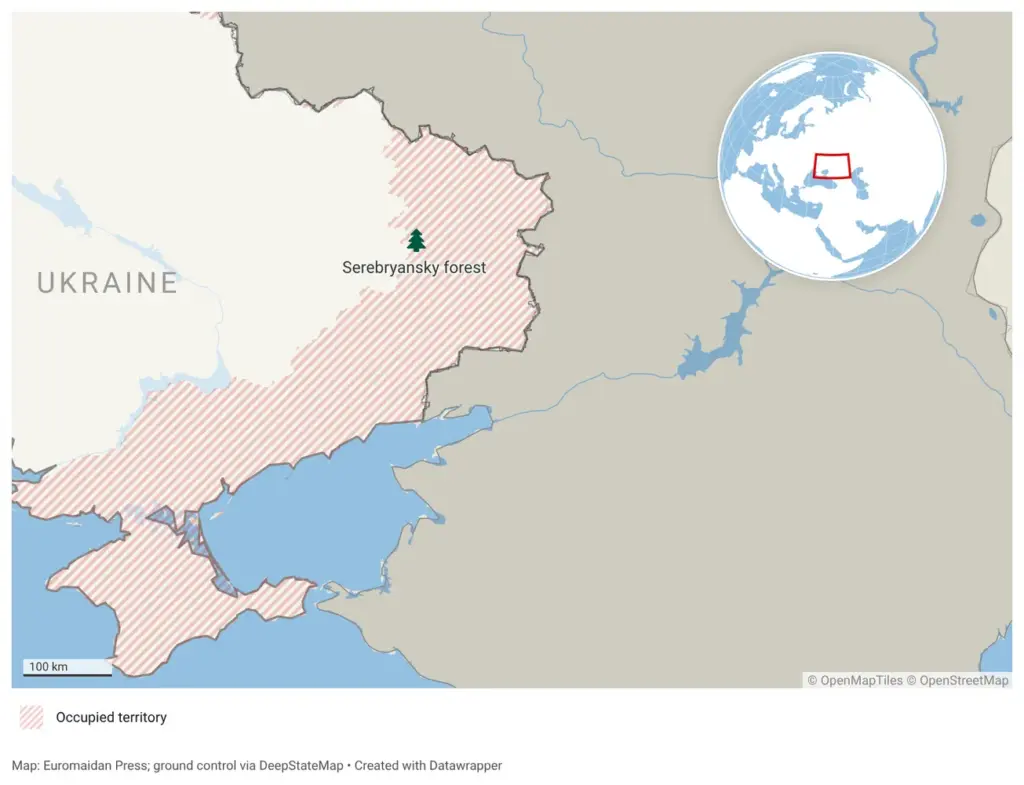
Holding a position like that on a static, drone-saturated front takes endurance as much as firepower. A unit has to supply itself, down to digging its own water under fire. The Serebryanskyi forest, on the border of Luhansk and Donetsk oblasts, has been contested since 2022. Euromaidan Press has previously reported on Ukrainian storming operations in the forest and on Azov's account of driving Russian forces from some positions there in 2024.
Map: Euromaidan Press; ground control via DeepStateMap • Created with Datawrapper
Mykhailo worked abroad in construction after his studies, then signed a contract with the State Border Guard Service in 2020. He served first at the Nismychi unit, then at Belz, where he worked as a district inspector, before the October 2024 rotation with Shkval put him on the positions for 115 days.
"Logistics were not easy. Drones delivered the food, and we also had to supply the positions with water. So we even dug our own well, to have our own water and to be able to bring in more food," Mykhailo recalled.
Serebrianskyi forest, Luhansk region, Ukraine. Photo: State Environmental Inspectorate in Luhansk region
He returns repeatedly to the men around him. When his own endurance ran out, he said, it was his brothers-in-arms who kept him in place.
"Your brothers-in-arms motivate you. When I said I couldn't take it anymore, they said: 'Sit tight. Together to the end.' And so we all sat there together to the end," he said.
Mykhailo is motivated by his family, which he considers his greatest incentive to defend Ukraine.
Drone operators from Ukraine's Presidential Brigade mounted a captured AK with a 45-round magazine on a heavy drone using a neodymium magnet from a hard drive, rope, and tape. They connected the trigger to a remote electronic mechanism and fired the weapon at Russian positions. The soldiers on the receiving end fled, according to a video the brigade published on Facebook on 11 August 2026.
Ukrainian units have been turning whatever they capture or are given into weapons
Drone operators from Ukraine's Presidential Brigade mounted a captured AK with a 45-round magazine on a heavy drone using a neodymium magnet from a hard drive, rope, and tape. They connected the trigger to a remote electronic mechanism and fired the weapon at Russian positions. The soldiers on the receiving end fled, according to a video the brigade published on Facebook on 11 August 2026.
Ukrainian units have been turning whatever they capture or are given into weapons throughout Russia's ongoing full-scale invasion.
The pilot behind the idea, callsign Joker, said it came after his unit received a heavy drone called Queen of Hornets from volunteers and started looking for a way to attach a weapon beneath it.
"I once took apart a hard drive and remembered the neodymium magnet inside. A fellow soldier said, 'I have a small one, but it's very powerful.' We tried lifting the rifle, and it worked," he said in the video.
A Ukrainian drone pilot turned a captured AK and a magnet from a broken hard drive into a flying gun
He anchored the rifle under a heavy drone with the magnet, rope, and tape, then wired the trigger to fire by remote. Early flights swung like a pendulum until he steadied… pic.twitter.com/xjQekIMBBP
In the brigade's account, the first flights were rough: the rifle swung beneath the drone like a pendulum, making the aircraft nearly uncontrollable. The pilots eventually adapted.
The weapon scared more than it hit, Joker said.
"When a drone flies up to you and starts shooting an assault rifle at close range, it really hits your nerves. They ran pretty fast," he said.
The crew then began experimenting with heavier weapons, including grenade launchers. According to the pilot, during one combat deployment, the crew confirmed at least one Russian soldier killed.
The brigade said its units continue looking for unconventional ways to strengthen their drones' combat capabilities at the front.
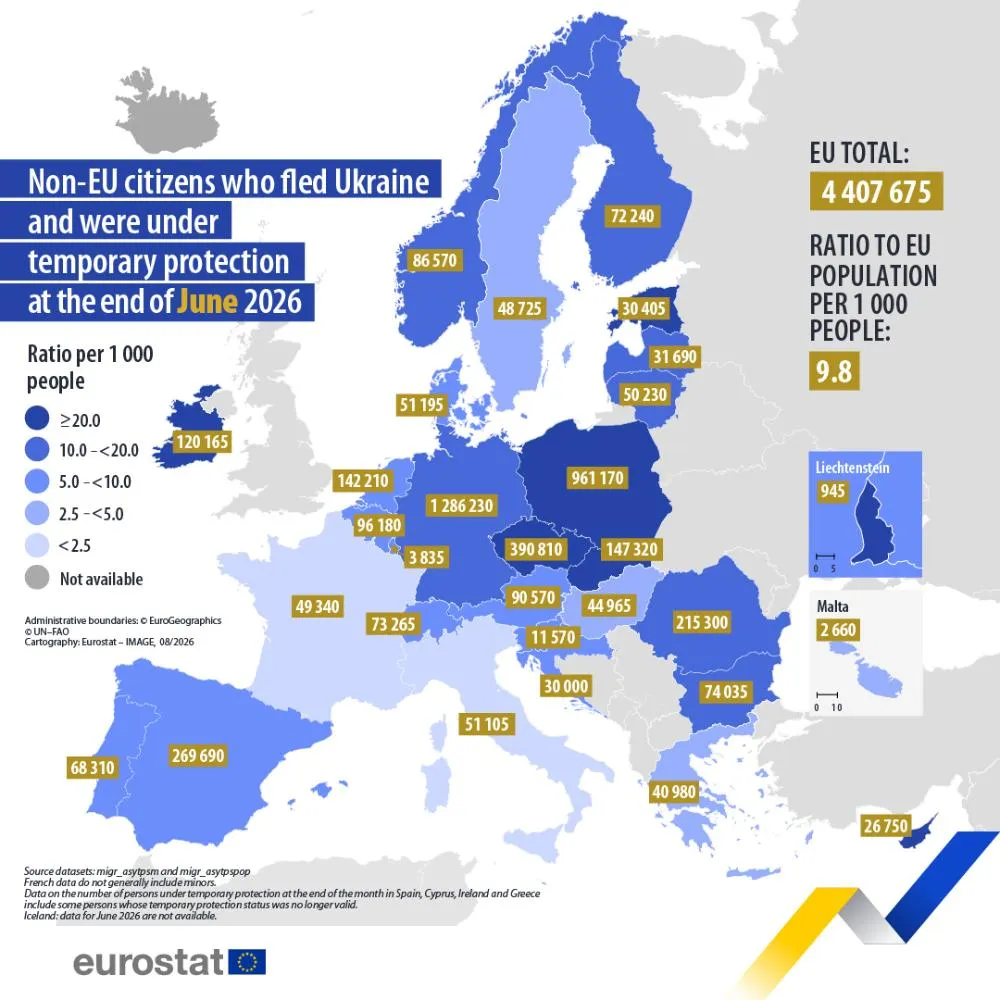
The number of Ukrainian citizens holding temporary protection status in EU countries reached 4.41 million as of 30 June 2026, the highest since the mechanism was activated in March 2022, according to data published by Eurostat on 11 August. The total rose by 24,380 (+0.6%) from the previous month.
The displacement is one dimension of the broader demographic damage that Russia's war is inflicting on Ukraine. The country's population has contracted from over 41 million be
The number of Ukrainian citizens holding temporary protection status in EU countries reached 4.41 million as of 30 June 2026, the highest since the mechanism was activated in March 2022, according to data published by Eurostat on 11 August. The total rose by 24,380 (+0.6%) from the previous month.
The displacement is one dimension of the broader demographic damage that Russia's war is inflicting on Ukraine. The country's population has contracted from over 41 million before the full-scale invasion to roughly 31 million, driven by displacement, war casualties, and a fertility rate that has collapsed to among the lowest in the world. Only 23% of Ukrainian women refugees with children say they plan to return, even if the war ends.
The figure has been edging upward since mid-2023. It crossed 4 million in September 2023, reached 4.2 million by October 2024, and has now hit a new high. New decisions granting protection are now falling: EU countries issued 155,640 in the first quarter of 2026, down 17% from the previous quarter, and 2025's annual total was 14% below 2024's — even as the overall number of people already holding the status keeps rising.
The numbers suggest an accumulation effect: fewer people are leaving the system than are entering it. Cumulatively, EU countries have issued 7.1 million temporary protection decisions since March 2022, meaning roughly 2.7 million of those decisions are no longer active — as people returned to Ukraine, moved on, switched to other residence statuses, or were deregistered.
Germany hosted the most beneficiaries at about 1.29 million (29.2% of the EU total), followed by Poland with roughly 961,000 (21.8%) and Czechia with about 391,000 (8.9%).
Relative to population, the ranking shifts. Czechia recorded 35.8 beneficiaries per thousand residents, followed by Slovakia (27.2) and Cyprus (26.8), against an EU average of 9.8 per thousand.
Protection numbers rose in 24 of 27 EU countries. Italy posted the largest absolute increase (+4,115, or +8.8%), followed by Czechia (+3,835) and Germany (+2,960). Poland was the only country with a significant decrease (-6,335, or -0.7%). Belgium and Ireland posted negligible declines.
The EU just extended shelter for Ukrainians to 2028—with a new catch for military-age men
Ukrainian citizens accounted for over 98.5% of all beneficiaries. Adult women made up 43.4%, adult men 27%, and minors nearly a third (29.6%). The share of adult men has risen from 23% in October 2024, around the time Czech Interior Minister Lubomír Metnar's government pushed for the new military-compliance condition adopted by the Council in August.
The EU's temporary protection mechanism, activated in March 2022, has been renewed annually since. The most recent extension, a Council decision that took effect on 5 August, prolonged the framework to March 2028 while adding a new condition: Ukrainian men of military age applying for the first time must now prove they have met their mobilization obligations, including through Ukraine's Reserve+ app. The June data predates that rule, making it a baseline for measuring its impact.
Ukraine's Security Service (SBU) said on 10 August 2026 that it had detained three more people suspected of illegally registering Starlink satellite terminals for Russian forces, and had blocked two separate schemes for putting hostile terminals onto Ukraine's verification list.
The arrests are the latest in a months-long pattern. After Ukraine and SpaceX cut off smuggled Starlink terminals and required every device to be verified, the SBU says, Russia turned to paying
Ukraine's Security Service (SBU) said on 10 August 2026 that it had detained three more people suspected of illegally registering Starlink satellite terminals for Russian forces, and had blocked two separate schemes for putting hostile terminals onto Ukraine's verification list.
The arrests are the latest in a months-long pattern. After Ukraine and SpaceX cut off smuggled Starlink terminals and required every device to be verified, the SBU says, Russia turned to paying financially desperate Ukrainians to register hostile terminals under real Ukrainian identities, laundering them onto the whitelist meant to keep them out. Each case the service has announced follows the same script: a recruit found through Telegram, a terminal signed up in their own name, then pressure to pull in others.
In Dnipro, according to the service, counterintelligence exposed a woman who had done Russia's bidding in exchange for money to buy drugs. She registered one terminal in her own name, the SBU said, then drew in acquaintances, also looking for money for a "dose," to register more.
Photo: SBU
In Zhytomyr, according to the service, a local unemployed woman registered one terminal in her own name, then brought in a male acquaintance, and the two moved to what the SBU called "serial" activation at post offices, using front persons who handed over their personal data for a cut of the payment.
Photo: SBU
The SBU described all three suspects as drug-dependent people who had gone looking for quick money in Telegram channels, the same recruitment funnel it has flagged in earlier cases. The service said it had documented the suspects' activity, detained them at their homes, and blocked every terminal registered through the two schemes.
Investigators served the three with notices of suspicion under two articles of Ukraine's Criminal Code: Article 114-1, obstructing the lawful activity of the Armed Forces and other military formations during a special period, applied together with the prior-conspiracy provision of Article 28, and Article 111-2, aiding the aggressor state. The SBU said the suspects face eight to 12 years in prison. These are allegations, and none of the three has been convicted.
The SBU's regional directorates in Dnipropetrovsk and Zhytomyr oblasts ran the operations with the National Police, overseen by the regional prosecutors.
In February, the SBU detained a couple in Odesa Oblast who, it said, had agreed to register terminals for Russia at $30 each and planned to pull in a local resident who uses drugs to help.
In late June, the service reported eight suspected agents who registered terminals in their own names, passed the credentials to Russian handlers, and were told to recruit as many additional people as possible.
On 24 July, the SBU said it had broken up a network in Kyiv that used fake Ukrainian passports and an unwitting postal worker to activate 76 terminals for Russia's FSB security service, a case that drew high treason charges under martial law and the threat of life imprisonment.
On 25 July, the service detained a man in Dnipro suspected of registering more than 1,000 terminals, the largest single scheme reported so far.
Why Starlink matters
Starlink, operated by SpaceX, has become one of the most important communications systems on the modern battlefield, providing fast, reliable satellite internet that is difficult to jam.
Ukraine has relied extensively on the network throughout Russia's full-scale invasion to maintain communications between military units and support drone operations.
Russian forces have also sought access to the system, but their use has been significantly constrained. In cooperation with SpaceX, Ukraine has introduced verification measures and whitelisted legitimate users operating on Ukrainian territory, limiting Russian access and forcing Moscow to seek alternative communications systems.
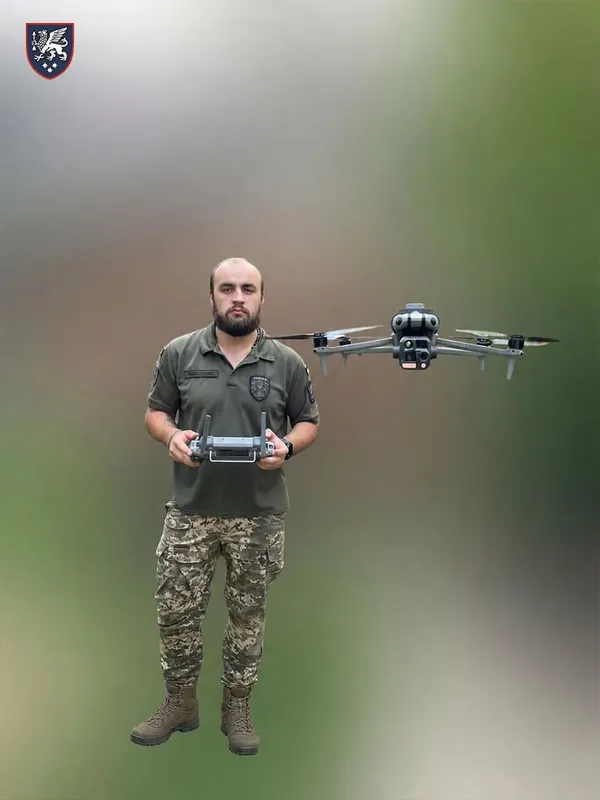
Fedir's four and a half years compress a shift the Ukrainian military has been living through since the invasion. Ukraine's forces have moved from Soviet-era systems, through Western precision weapons, to a homegrown drone war that now shapes the front line more than any single piece of hardware. Soldiers have had to relearn their job every year, mastering whatever technology arrives next, because the side that adapts faster survives. Fedir's story shows how fast that
Fedir's four and a half years compress a shift the Ukrainian military has been living through since the invasion. Ukraine's forces have moved from Soviet-era systems, through Western precision weapons, to a homegrown drone war that now shapes the front line more than any single piece of hardware. Soldiers have had to relearn their job every year, mastering whatever technology arrives next, because the side that adapts faster survives. Fedir's story shows how fast that reinvention has come, and what it costs the people carrying it out.
"We give battle, boys — this is war," battalion commander Mykhailo Myronenko told the men. Fedir, a former construction worker, was on combat duty with a Lviv air defense brigade, and his job was diesel: keeping the generators running so the S-300 launchers never lost power. On the busiest days, he says, the unit fired eight to ten times.
In 2024, the war upgraded around him. He retrained on the IRIS-T SLS, a German air defense system, and moved from generators to the launch itself. "Three missiles. Three targets down," he says of his first launches on Western hardware.
"I was standing in snow mixed with mud, and I understood I was really useful to my Ukraine," said Fedir.
Fedir "Dancer". Photo: Lviv Anti-Aircraft Missile Brigade named after Ivan Vyhovskyi
Then he left. The IRIS-T sits well back from the front, and Fedir gave it up to fly drones, because he wanted to see the results of his work up close, through his own camera rather than on someone else's screen. He flew his first missions in Sumy Oblast, moving onto position in the dark with the headlights off. Through the camera, he saw his first Russian soldier walking a trench.
Drone operators are the eyes of the front, and among the most hunted people on it for exactly that reason. The task that matters most, he says, comes after the flight: not bringing a "tail" home, not letting an enemy drone track the path back to your shelter. One day, he says, it went wrong. A Russian FPV drone found their group, a comrade made cover shouting "FPV," and the blast was followed by artillery meant to finish them off. Fedir took a serious concussion, spent a few days in a hospital, and went back. "I was desperate to return. Because this is my war," he said.
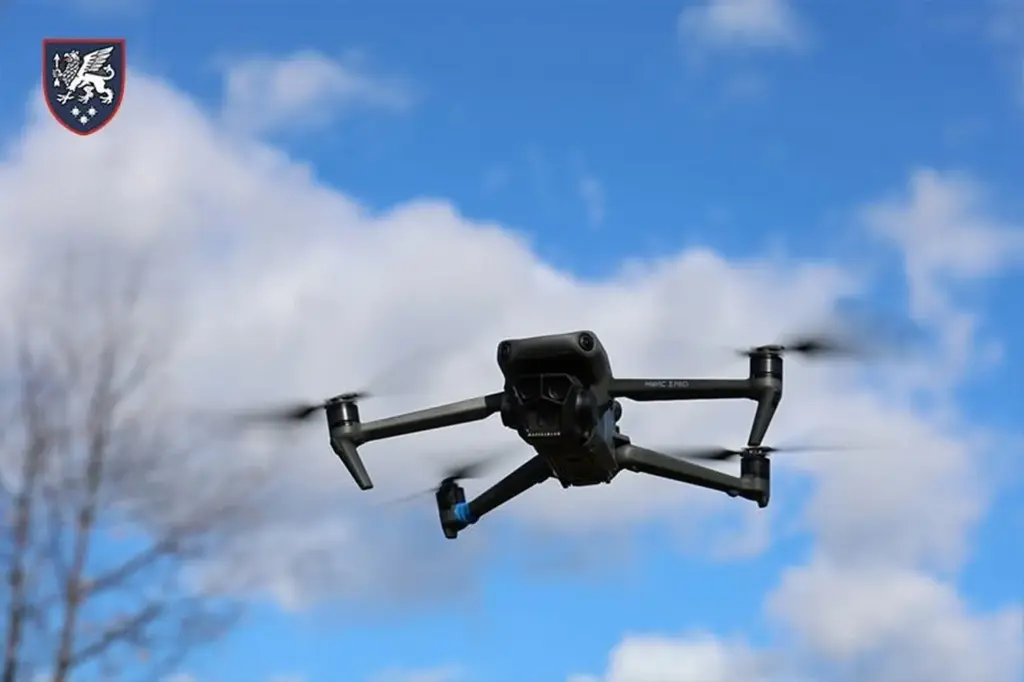
DJI Mavic 3 Pro. Photo: Lviv Anti-Aircraft Missile Brigade named after Ivan Vyhovskyi
The callsign came by chance, from the work. When the jamming is heaviest, and he is fighting to hold the link to his drone against Russian electronic warfare, he starts to move at the controls, a small involuntary dance. His comrades named him Dancer.
His rotation has ended, and he could go back to the IRIS-T. He has chosen to stay on the zero line. After the war, he says, he wants the ordinary things: a family, and the peace to build again.
From 1 September 2026, schoolchildren in Russian-occupied areas of Ukraine will study under a reworked curriculum built around loyalty to the Russian state, the Yellow Ribbon resistance movement reported on Telegram, a change separately confirmed by the Crimean Tatar Resource Center.
Taken together, the changes work to strip a generation of Ukrainian children of their national identity — children who did not choose to be schooled under Russia's war against their country
From 1 September 2026, schoolchildren in Russian-occupied areas of Ukraine will study under a reworked curriculum built around loyalty to the Russian state, the Yellow Ribbon resistance movement reported on Telegram, a change separately confirmed by the Crimean Tatar Resource Center.
Taken together, the changes work to strip a generation of Ukrainian children of their national identity — children who did not choose to be schooled under Russia's war against their country.
The overhaul bundles three separate mechanisms into a single school year. Occupation authorities are introducing a new subject called "Spiritual and Moral Culture of Russia." They are splitting the existing course "Fundamentals of Security and Defense of the Motherland" into two tracks, life safety and basic military training, deepening a militarization of occupied schooling that Euromaidan Press has documented. And for pupils in grades 2 through 8, a three-tier behavior assessment is being added, graded as "exemplary," "acceptable," or "unacceptable." Together, Yellow Ribbon said, the changes are turning schools in the occupied territories into "a tool of the ideological and military indoctrination of children."
The new identity subject is aimed at children in grades 5 to 7, roughly ages 10 to 13, and is built on so-called traditional Russian values, with Russian Orthodox Church representatives drawn into the teaching in occupied Crimea and Sevastopol. The Almenda Center of Civil Education has documented the subject's territory-wide rollout. It puts the reach of the imposed Russian curriculum as a whole at more than 582,000 children in nearly 2,000 schools. The subject mirrors a class Russia is rolling out in its own schools, now applied to Ukrainian children in territory it holds by force. The new three-tier behavior grading adds a compliance layer to a system that the OSCE expert mission found is already enforced through "pervasive coercion," applying pressure to children, parents, and teachers alike.
An unlawful campaign
International humanitarian law bars an occupying power from indoctrinating and militarizing the children under its control. In July 2026, an independent expert mission established under the OSCE's Moscow Mechanism, invoked by 41 of the organization's 57 participating states, reported to the OSCE Permanent Council that Russia's transformation of the education system in the occupied territories breaches international law, naming Article 43 of the Hague Regulations and Article 50 of the Fourth Geneva Convention.
The experts described a coordinated, state-level system spanning schools, youth organizations, religious institutions, and security agencies, built to strip Ukrainian children of their identity from kindergarten age through high school. The "Fundamentals of Security and Defense of the Motherland" course, now being split to carve out a dedicated military track, has been compulsory in schools in occupied territory since the 2024/25 academic year.
Explore further
Russia sends children from occupied Ukraine to North Korean re-education camps, human rights expert tells US Senate
The in-place indoctrination forms one arm of a wider effort to erase Ukrainian identity. The other is deportation. In March 2023, the International Criminal Court issued arrest warrants for Russian President Vladimir Putin and his children's rights commissioner, Maria Lvova-Belova, over the unlawful transfer of Ukrainian children. As of June 2026, according to the OSCE mission, Ukraine's Ministry of Justice had recorded 20,610 children as deported or forcibly transferred, and Ukrainian authorities reported just 2,264 returned.
Ukraine's own tally is likely an undercount: Yale researchers put the total closer to 35,000, and Ukrainian officials have estimated the real figure runs into the hundreds of thousands. In a resolution of 8 May 2025, the European Parliament declared that Russia's forcible transfer and deportation of Ukrainian children meets the legal definition of genocide, part of a "genocidal strategy" to erase Ukrainian identity.
The Dance of Freedom tour, featuring young Ukrainian gymnast Oleksandra Paskal, has carried her from Paris to Tokyo, Akhmetov Foundation reported. Behind it lie a seaside home reduced to rubble, 15 days in a coma, and a place among the more than 3,200 children Russia's war has killed or wounded.
Russia has spent the war striking the cities where Ukrainian families live, turning apartment blocks and holiday coasts into places where children are wounded far from any front
The Dance of Freedom tour, featuring young Ukrainian gymnast Oleksandra Paskal, has carried her from Paris to Tokyo, Akhmetov Foundation reported. Behind it lie a seaside home reduced to rubble, 15 days in a coma, and a place among the more than 3,200 children Russia's war has killed or wounded.
Russia has spent the war striking the cities where Ukrainian families live, turning apartment blocks and holiday coasts into places where children are wounded far from any front line. For every Ukrainian child whose recovery becomes a story the world follows, many more carry injuries and losses that never surface beyond a case file.
In May 2022, three months into Russia's full-scale invasion, a missile struck a home in Zatoka, a resort village on the coast of Ukraine's Odesa oblast. No air-raid siren sounded in the neighborhood, the family says. Beneath the collapsed concrete lay Oleksandra Paskal, six years old, her leg pinned under a slab.
Her mother, Maria, lost consciousness in the blast. Maria later recounted the scene to the Museum of Civilian Voices. She described what she saw when she came to: a heavy concrete slab lying across her daughter's leg, the girl's arm dislocated with the bone exposed, a finger hanging loose, her head badly bruised. Neighbors helped lift the slab. Sasha, as the family calls her, spent 15 days in intensive care in a medically induced coma. Doctors first feared a severe head injury. Then they found that blood had stopped circulating to her left leg. They amputated.
Sasha Paskal on Rizatdinova Cup 2025. Photo: NV/Maksym Pidopryhora
Four years later, Oleksandra is 10 and a competitive rhythmic gymnast performing on five continents.
Her case is at once singular and representative. In the fifth year of Russia's full-scale war, the fighting is still killing and wounding Ukrainian children, even as global attention fades. Oleksandra survived and found a stage; most children harmed by the war never have their stories told beyond Ukraine. The distance between the scale of that harm and the world's diminishing notice is what her tour is built to close.
The return took roughly seven months.
She learned to walk with a prosthesis, returned to the gym, and won her first post-amputation competition in Chornomorsk.
In 2025, President Volodymyr Zelenskyy and First Lady Olena Zelenska awarded her the "Future of Ukraine" honor. Earlier this year, she took gold at Carla's Rhythmic Cup, an international competition in Romania, where she competes against children without disabilities.
The performances abroad are part of the Dance of Freedom tour, an initiative of the Rinat Akhmetov Foundation in partnership with the football club Shakhtar Donetsk, timed to the 35th anniversary of Ukraine's independence on 24 August. Over two weeks, Oleksandra performed her routine in Paris, in New York's Times Square, in Rio de Janeiro, in Nairobi, and finally in Tokyo. In New York, she met the boxer Oleksandr Usyk, visited Ukraine's mission to the United Nations, and stood beneath the Statue of Liberty.
For Oleksandra, the travel is partly an escape. "I'm really happy to travel because it's an opportunity to distract myself from what's going on in Ukraine," she said. Her mother frames it as a purpose.
"She's so strong and motivated," Maria said. "Although she's very young, she's a role model for many people with similar circumstances. We never pushed her. What she's doing comes from her."
Oleksandra Paskal. Photo: Viktoria Efremova
Oleksandra's story is singular, but the injury that shaped it is not. According to UNICEF, more than 3,200 Ukrainian children have been killed or wounded since Russia launched its full-scale invasion on 24 February 2022. These are UN-verified casualties, a count that captures only the cases investigators have been able to confirm, so the real toll is almost certainly higher. Almost 2.6 million, more than a third of the country's children, remain displaced. More than 1,700 schools and other educational facilities have been damaged or destroyed. Every stop on the tour, her mother says, is meant to hold that reality before an international audience.
Oleksandra's own ambitions run past the tour. She wants to compete at the Paralympics in Brisbane in 2032 and win gold if rhythmic gymnastics is included in the program. In New York, Usyk gave her a method: write down that you are an Olympic champion, and read it every day. When they met, Zelenskyy gave her a sentence to carry: never give up and move forward.
Friday evening, 19:00, they met again. The crowd wasn't uniform: students, pensioners, whole families who'd come with small children, couples. A five-year-old girl in fluffy earmuffs held her own cardboard protest sign. A few soldiers among them. Several hundred people, loose across the steps beneath the Shevchenko monument, the poet's bronze hand open above them.
The mood was quiet, more communion than fury, people just standing together in the fading light. The signs
Friday evening, 19:00, they met again. The crowd wasn't uniform: students, pensioners, whole families who'd come with small children, couples. A five-year-old girl in fluffy earmuffs held her own cardboard protest sign. A few soldiers among them. Several hundred people, loose across the steps beneath the Shevchenko monument, the poet's bronze hand open above them.
The mood was quiet, more communion than fury, people just standing together in the fading light. The signs were as diverse as the attendees. One sign, in green marker with a row of red hearts, read "Mykhailo Vasyliovych, we believe in you!!!" Another, block letters on brown card: "Fedorov is our Minister of Defense." A third, held high near the scaffolding: "Fedorov, minister of victory." The child's placard read simply: "My first placard."
"Fedorov is our defense minister!" Protesters demand Mykhailo Fedorov is reinstated as defense minister in Lviv. Photo: Solomia Stanovych
Protests like this have been ongoing in cities across Ukraine since 16 July, amid President Zelenskyy's Cabinet shakeup that had the popular defense minister fired. Participants want Mykhailo Fedorov reinstated and say they will stay until their demand is granted.
Fedorov is not a career soldier: he built Ukraine's Diia digital-state platform and, as digital-transformation minister, drove the drone-procurement push that turned cheap unmanned systems into the country's most-used weapon against Russia's invasion. To the people on the square he is the man who stands for winning the war with technology rather than with bodies—and his removal, after barely six months at the ministry, landed as that bet being called off.
A year ago the same kind of crowd defended institutions: the anti-corruption bureau and prosecutor's office, when the government moved to strip their independence. This time the placards carry one man's surname. The instrument is the same; what it is pointed at has narrowed from a rule to a person.
That 2025 anti-corruption protest
They came. They cussed. They won.
What a passerby would not have guessed is that no one on the square could say who had called it. The rally assembles by loudspeaker and group chat—a woman with a megaphone naming the next time to gather, a Telegram channel filling in the rest.
Kyiv-based Zinaida Averina, who helped launch last year's anti-corruption protests, says this wave has no single leader or even a single group of organizers: each local initiative, she wrote, plugs in and syncs "small pieces" into one shared wave. In the middle of a full-scale war, in roughly twenty cities, Ukrainians are holding open-ended nightly rallies that no party organized and no leader directs.
The demand, and the reason behind it
"Fedorov the minister will give us optimism" says the sign of this protester amid a Lviv crowd demanding Mykhailo Fedorov is reinstated as defense minister. Photo: Solomia Stanovych
Protesters in Lviv began the open-ended rallies on 24 July. "The main demand is the appointment of Fedorov as minister of defense," said Dmytro, 24, who described the dismissal as a violation of a social contract. "This has become a systemic problem when the entire Cabinet of Ministers is dismissed without any explanation given to us."
The crowds made two demands: remove Oleksandr Syrskyi as commander-in-chief, and bring Fedorov back. The first was met within days—Syrskyi was dismissed and replaced by the more popular Mykhailo Drapatyi. The second was refused.
Iryna, 23, said she felt a violation of reciprocity between citizen and state. "Through documentation, taxes, and declarations, we are always accountable to the state, but the state is not as accountable to us as it should be," she said. She had chosen to stay in Ukraine when she could have left abroad as a refugee, she said, and wanted transparency in how personnel decisions are made.
What almost no Gen-Z on the square could say precisely was what, exactly, was being done wrong—only that something was. It is the same barometer that worked a year ago: most of the anti-corruption protesters could not have explained what the bureau adjudicates, but they knew corruption was being shielded, and they acted the only way they knew.
Explore further
“They removed the auditor, not the thieves”: why Ukrainians are protesting Zelenskyy’s reshuffle
Blogger-driven outrage and media bombshells
"My first cardboard" says the sign of the girl. "Fedorov is the minister of victory" says another. Protesters demand Mykhailo Fedorov is reinstated as defense minister in Lviv. Photo: Solomia Stanovych
In many countries, the media struggle to get Gen Zs interested in politics. In Ukraine, bloggers fill that niche. Media activist and volunteer Serhii Sternenko has spent the protest days explaining the firing to a Gen-Z audience—one stream making the case against Syrskyi drew more than 842,000 views.
What they sense, and what Sternenko names for them, is an old-army culture—"sovok," in the protest's own shorthand—of loyalty over competence and lives spent cheaply, against the newer Ukraine Fedorov stood for. Fedorov, in this telling, was pushed out for trying to change it.
The sensing rests on something real. In late June the outlet Babel published a two-month investigation into the 425th "Skelia" assault regiment, reporting at least 25 non-combat deaths of recruits in training over roughly six months—a toll that has since risen past 30 as more families came forward—with accounts of beatings and torture and official causes recorded as illness. State investigators, police, the military prosecutor and the ombudsman have opened proceedings, and the regiment's commander has been suspended. Syrskyi has called it a shameful situation and blamed individual offenders. Sternenko calls it a systemic pattern—a characterization the investigations have not established.
Why the protests went open-ended
The escalation on 24 July followed the president's decision not to nominate Fedorov. "As long as necessary, we will keep coming out until the government hears us," said Yevheniia Kupriienko, 23.
Andrii, 23, rated the government's transparency at one out of ten and said protesters want parliament to act as an independent institution rather than a rubber stamp: "decisions cannot be made by one person in the country without any commentary or communication with the people."
The man at the center of it describes something more tangled than the chant. In an interview on 29 July, Fedorov said the main reason for his removal was not the clash with Syrskyi at all. Reshaping defense procurement and tenders, he said, "stepped on the interests of many people and companies," after which pressure on his team built through the spring. He called the government's collapse a possible "screen" for his dismissal, and said he never fought for the post and would have gone quietly had someone simply explained why.
Explore further
The Syrskyi feud was not it: why Ukraine really dropped its drone-war minister
Even the adulation makes him uneasy. His wife, Anastasia, called the frenzy around him a "sick cult of personality." The crowd chanted his name at a Kyiv music festival anyway, his face on the big screen. The man the movement is built around, and the person closest to him, are both declining the icon it has made of him.
Andrii said he had come to stand up for the voices of Ukraine's soldiers. One serviceman passing by did not recognize himself in that description. "I know neither Drapatyi nor Fedorov. I can talk about my company commander or battalion commander," he said. He questioned how civilians, and young women in particular, could judge how senior officials are appointed, and said of the leadership: "They have big brains, they know what they are doing."
His doubt is not only his. It is the worry named this week by the philosopher Volodymyr Yermolenko, president of PEN Ukraine: that the tech dream the protesters chant for is real but incomplete, and that there is no alternative to massive military mobilization. "Without technology we won't win the war, but with technology alone we won't win it either. We still need people," he said. A street that senses correctly that something is wrong, in his account, is a reliable alarm—not a mechanism for choosing who runs the war.
Yet other soldiers support the protests. Veteran Dmytro Koziatynskyi, one of the Kyiv protest initiators, sparked a march "for dialogue in reform" held on vul. Khreshchatyk on 31 July. He demands Zelenskyy give Fedorov a year to conduct reforms and then "make decisions based on results."
The predictable counter-narratives have arrived too: claims that the rallies are paid, which Fedorov himself has rejected. Ukraine's disinformation center has also flagged Russian attempts to exploit the moment abroad. None of it touches the crowds on Ukraine's own squares.
Is this Euromaidan?
"Mykhailo Vasyliovych, we believe in you!" Protesters demand Mykhailo Fedorov is reinstated as defense minister in Lviv. Photo: Solomia Stanovych
The comparison to the Euromaidan Revolution, in which the Russian-aligned president Yanukovych fled in the winter of 2014 after three months of protests against a rejected EU Association agreement, comes up constantly, and the protesters do not agree on it. One participant argued the mechanism is the same even if the scale is not: "No matter who the president is, if he doesn't listen, that was Yanukovych's mistake."
The serviceman rejected the comparison entirely. In 2013 the choice was between the European Union and Russia, and Russia's response to that choice produced the war Ukraine is now fighting. The present situation—a fired minister—is a different matter entirely, he said.
Halyna, 88, who watched the Euromaidan Revolution from Lviv while her son was in Kyiv, said the two are not comparable in intensity. "In 2013, the Euromaidan was such that I can't even describe it to you," she said. "Well, now the protests are not like that. People are just relaxing."
She supports them anyway. People are tired of lies and tired of a war Russia forced on them, she said, and the worst of it is that young people are dying with no end in sight. She wants to live long enough to see Ukraine at peace and left alone. Whether the rallies continue, she did not know. "I think the clock is ticking."
Explore further
Ukraine’s defense minister explained how the country buys weapons—after he was sacked

 Connexion