Après des tentatives avortées à New York et à Londres, Shein sera coté à la Bourse de Hong Kong à partir du 1er septembre, ce qui devrait lui permettre de lever jusqu'à 1,5 milliard d'euros. Le géant de l'ultra-fast-fashion, critiqué pour son impact environnemental, espère ainsi financer ses capacités technologiques et renforcer sa présence internationale.
Après des tentatives avortées à New York et à Londres, Shein sera coté à la Bourse de Hong Kong à partir du 1er septembre, ce qui devrait lui permettre de lever jusqu'à 1,5 milliard d'euros. Le géant de l'ultra-fast-fashion, critiqué pour son impact environnemental, espère ainsi financer ses capacités technologiques et renforcer sa présence internationale.
Russia's TOS-1A thermobaric rocket launcher is uniquely devastating, but also uniquely vulnerable
Its flame-spreading rockets reach just 6,000 m, which puts a launcher inside the reach of Ukraine's tiny explosive drones
Ukrainian forces have destroyed, damaged or captured 36 TOS-1As—and Russia is now building them with factory anti-drone armor
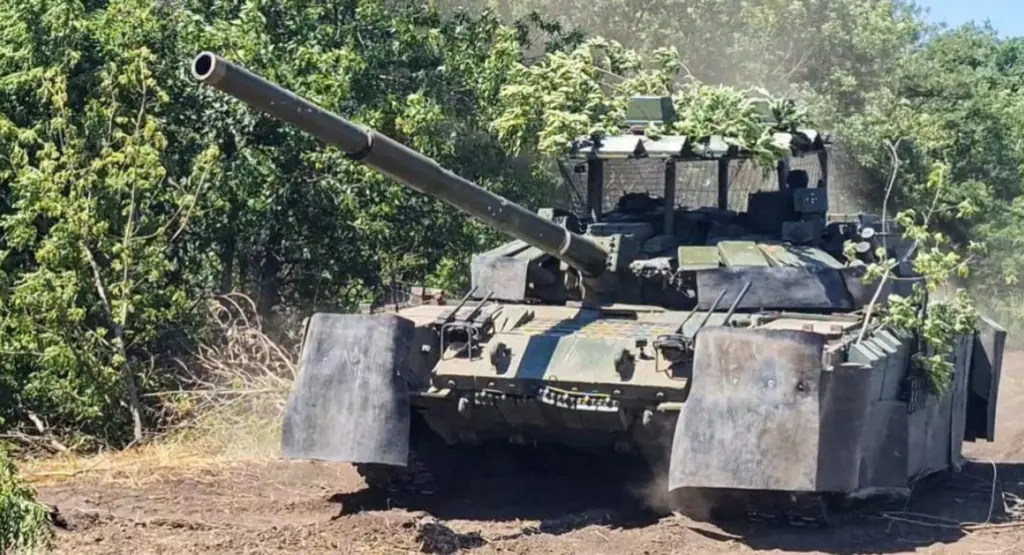
Russia is now building its TOS-1A thermobaric rocket launchers with factory armor wrapped around the rocket tubes. The
Russia's TOS-1A thermobaric rocket launcher is uniquely devastating, but also uniquely vulnerable
Its flame-spreading rockets reach just 6,000 m, which puts a launcher inside the reach of Ukraine's tiny explosive drones
Ukrainian forces have destroyed, damaged or captured 36 TOS-1As—and Russia is now building them with factory anti-drone armor
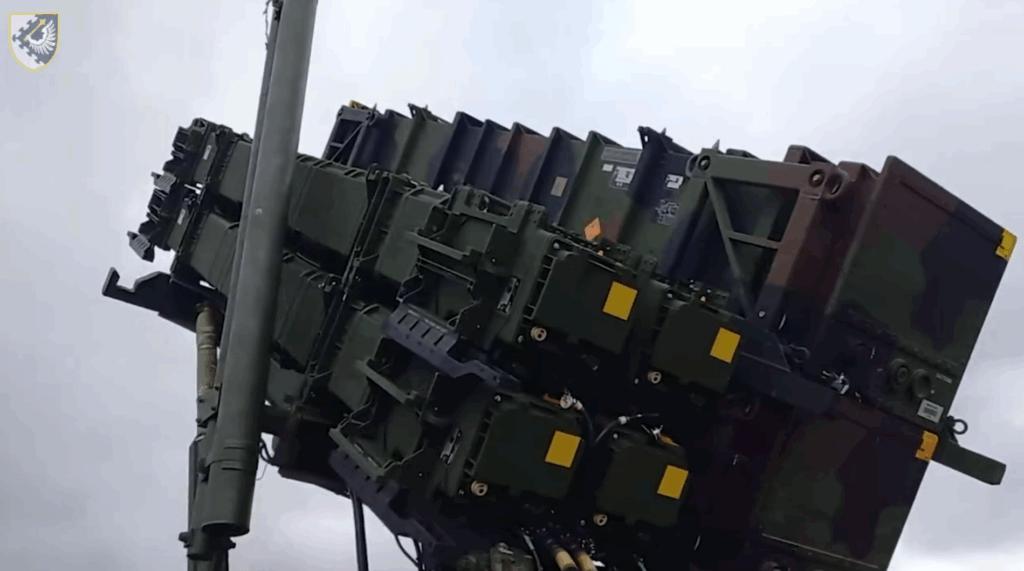
Russia is now building its TOS-1A thermobaric rocket launchers with factory armor wrapped around the rocket tubes. The tracked TOS-1A and its flame-producing 220-mm rockets are a powerful and terrifying weapon. But the launcher is also extremely vulnerable to Ukraine's drones and artillery. The add-on armor may be the only way the launchers can survive.
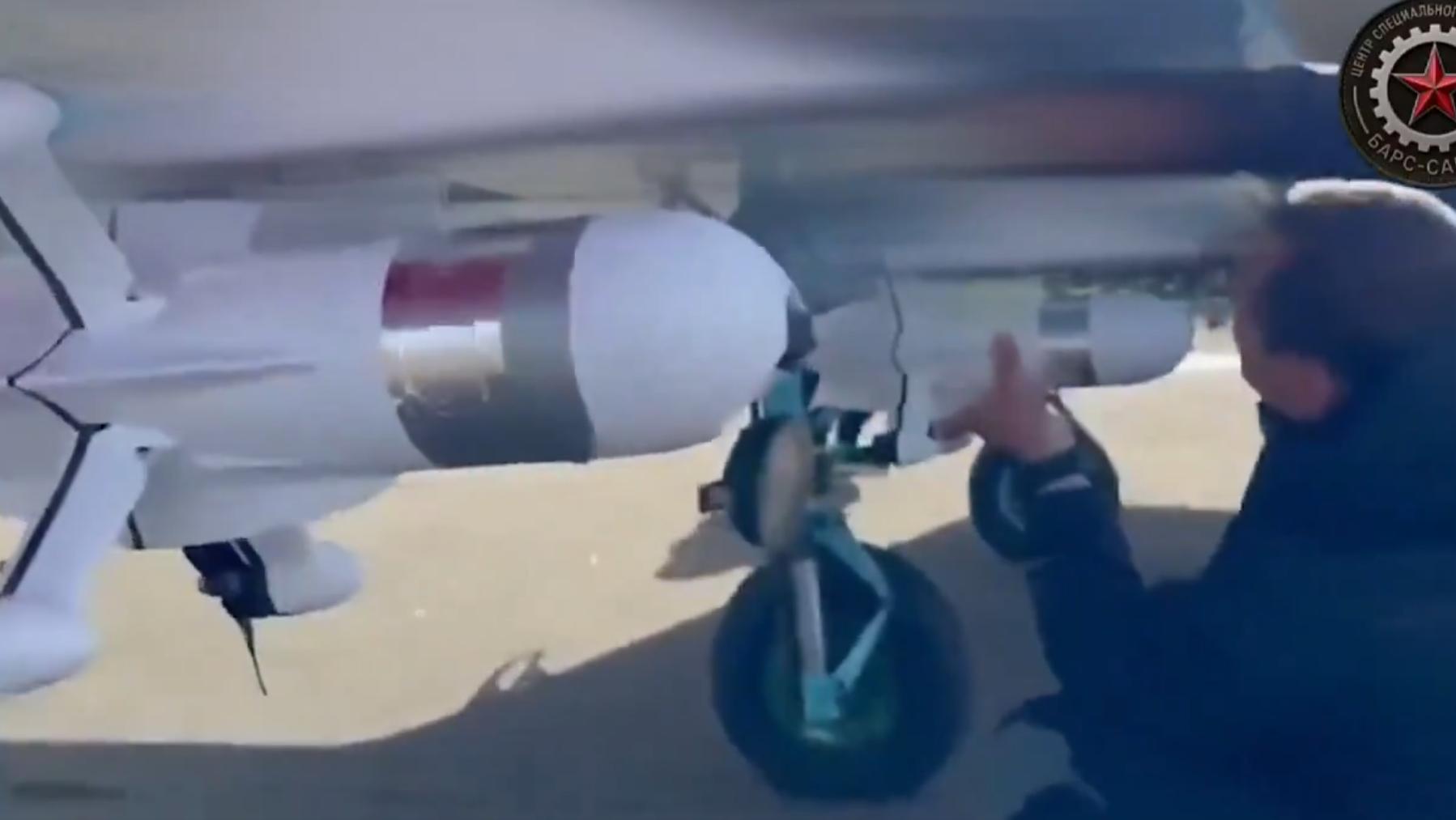
The TOS-1A is a T-72 with the turret swapped out for 24 thermobaric rockets, and the newest ones arrive inside a welded steel shell that lifts open when the tubes elevate. Russia is armoring the launcher the way it armors the tanks it's built from. What happens when the armor fails is not the same.
The TOS-1A adds a 24-round launcher onto the hull of a T-72 tank. The system's MO.1.01.04M rocket travels as far as 6,000 m with a payload of fuel that, once ignited, burns as hot as 3,000 degrees Celsius. The fuel can spread across the ground and into buildings and bunkers, allowing even a single TOS-1A to scorch a wide area.
It's not for no reason that the TOS-1A is one of Russia's preferred siege weapons. TOS-1As rolled into action early in Russia's wider war on Ukraine. In one of their first actions, in May 2022, TOS-1As staged on hilltops overlooking the city of Lyman, in eastern Ukraine's Donetsk Oblast, rained fire down on the front-line city. A few days later, Russian troops temporarily occupied Lyman.
Thinking back to May 2022. Watching Russian TOS-1 heavy thermobaric artillery devastate Lyman from the hill across the Siversky Donets. May 23 - the full assault would be launched a day or two later. pic.twitter.com/PPEyMukZGO
The best day the TOS-1A ever had came at Bakhmut. In early April 2023, Russian crews fired across the Bakhmutka River at entrenched Ukrainian positions and opened a 300-m gap in the line, US Army analysts later reconstructed. Wagner mercenaries poured through and covered 1.25 km in a single day. At Pavlivka, thermobaric fire breached the Ukrainian line and the settlement eventually fell—though it took five months and cost Russia two wrecked naval infantry brigades.
With its origins firmly in the 1970s, the TOS-1A was designed for a different era, however. An era where rocket launchers could, with a little support, safely approach to within a few kilometers of the enemy. Artillery is an ever-present danger, of course. But artillery can be suppressed—usually by other artillery.
The era of relative safety for the TOS-1A ended as tiny explosive drones began filling the sky over Ukraine in 2023. Even the tiniest of these tiny drones has the range to hit a TOS-1A before the TOS-1A can get into position to fire its rockets. Worse, the TOS-1A's thermobaric rockets are extremely volatile—and tend to explode in massive fireballs when struck.
"Nasty weapons—and also great targets" for anti-tank missiles and other munitions, is how Czech analyst Jakub Janovsky described the TOS-1A in the war's opening days, before the drones even arrived.
The launcher has a weather problem, too. Its rockets carry an oxidizer premix, which means crews can't fire them in the rain or from high ground.
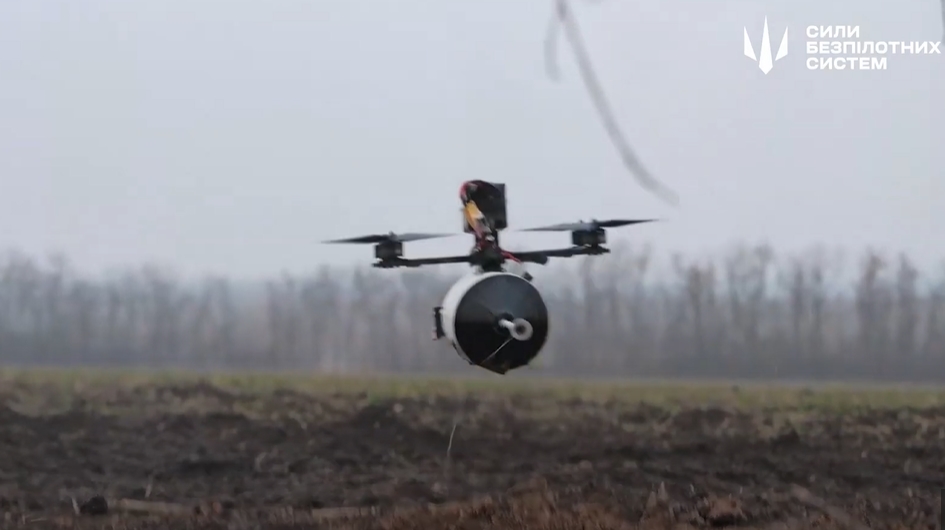
A Russian TOS-1 thermobaric rocket launcher was completely destroyed by the Unmanned Systems Forces today. After getting hit, the TOS-1 cooked off and burnt down. pic.twitter.com/zQievlm5Vx
The Russians started losing TOS-1As almost immediately. Retreating from Kyiv Oblast on 1 April 2022, they left behind at least three launchers—two of them knocked out by Ukrainian Stugna-P missiles, one captured intact. Then the losses began piling up.
Today, 54 months into the wider war, the Ukrainians have destroyed, damaged or captured no fewer than 36 TOS-1As. 27 of them burned. Ukrainian crews turned at least one captured launcher on its former operators, firing it near Kreminna during the 2023 counteroffensive.
The losses are a problem for the Russians. US Army analysts estimated Russia's prewar TOS-1A fleet at 48 launchers, only a portion of which ever went to Ukraine. Documented losses now stand at 36, and Oryx counts only what it can see in a photograph. How much of that gap Russian factories have refilled isn't public.
What the losses did not do was change the war. For all its ferocity, the TOS-1A has had little to no effect on the conflict's outcome, US Army analysts concluded—and they name the short reach as the reason. A weapon that has to park within 6,000 m of the enemy is a weapon the enemy can find.
Armor, not range
The Russians got to work improving the TOS-1A and building more copies. The Omsk transport machinery plant, Omsktransmash, has turned out fresh batches for the defense ministry in September 2022, November 2022, November 2024 and again in November 2025, its parent concern Uralvagonzavod announcing each handover. It's unclear just how many replacement launchers the Russians acquired, but it's safe to assume they number in the dozens.
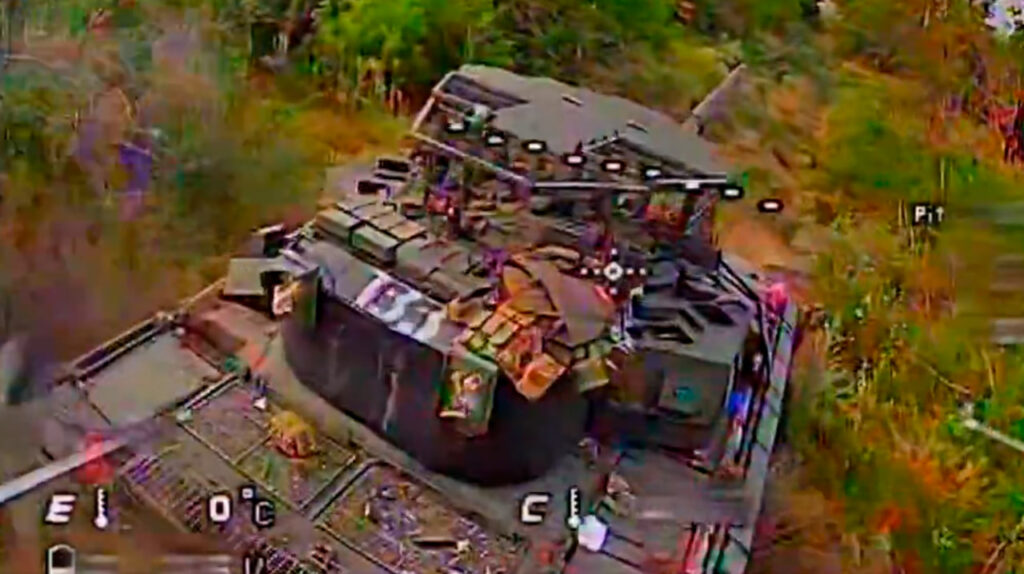
They also changed how they use the thing. Russian units now move single launchers up to the line under covering artillery fire rather than travelling in groups, reducing the likelihood of detection, the same US Army analysts reported. And the latest copies are up-armored against drones, with a shell of additional armor protecting the 24 launch tubes and their highly flammable rockets.
That isn't a brand-new idea. An earlier drone-protection variant was showcased in April 2024, and a different, serially produced kit went onto the batch shipped in November 2025. What circulated this month is fresh footage of the up-armored TOS-1As working out at a training range in Russia's Saratov Oblast.
Footage of Multiple Russian TOS-1A Obr.2022 at a Training Ground in the Saratov Region - Summer 2026 pic.twitter.com/LAOAVraai1
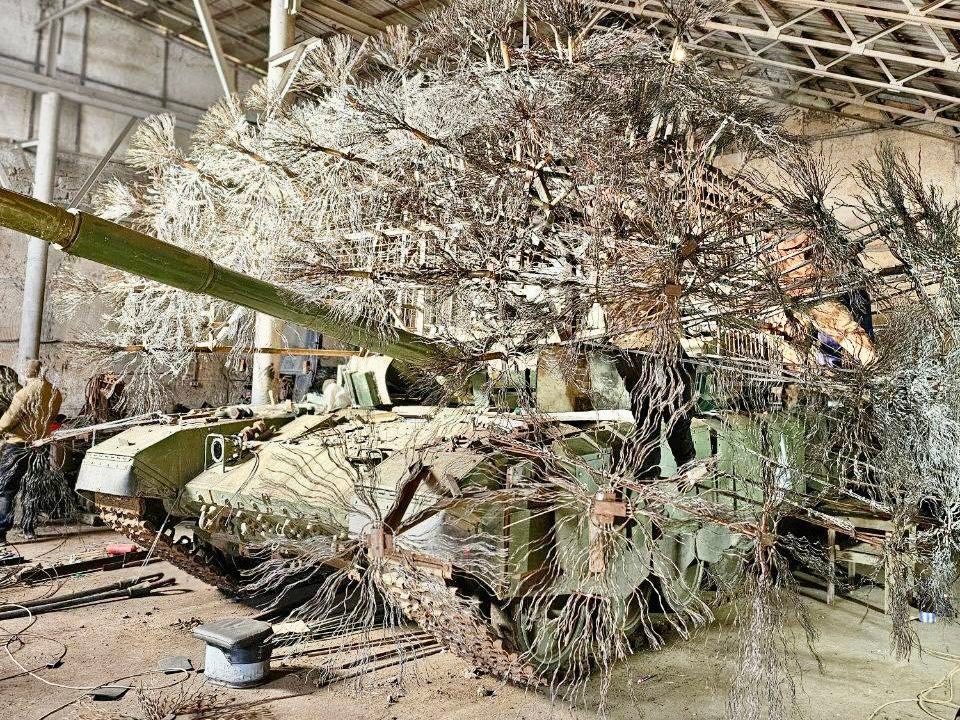
The add-on armor is apparently factory-standard at this point, and it's a purpose-built enclosure rather than the improvised slat and mesh Russian regiments tend to weld onto their tanks before sending them across the drone-patrolled gray zone. The function is the same: put something between the drone and the thing that matters.
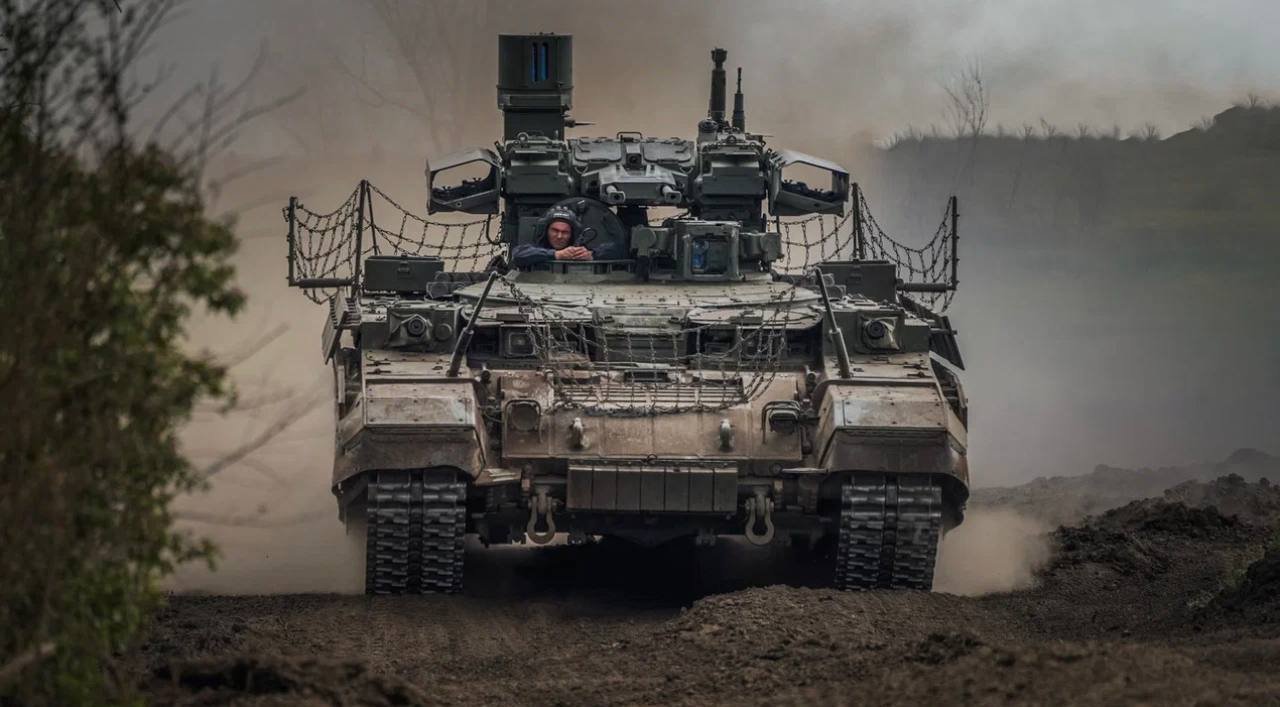
The best up-armored "turtle tanks" have been known to absorb dozens or even scores of drone impacts. A TOS-1A crew should hope the launcher's new armor is equally tough. After all, the consequence of a turtle tank losing its shell and taking a direct drone hit is often immobilization: the tank throws a wheel or a track or loses power and simply can't move anymore.
Explore further
Russia has thousands of tanks it can’t risk. One drone shield decides whether they roll
Armor is the cheap answer, and it isn't the real one. The real one is a launcher that doesn't have to park 6,000 m from a Ukrainian drone operator.
Uralvagonzavod says a modernized TOS-1A on a T-80 chassis is nearing the end of trials, with better accuracy, more automation and a longer reach. How much longer, the company hasn't said. Analyst Alexey Tarasov expects a new launch module able to take longer-range rockets, perhaps carrying the system to roughly the 15 to 20 km of the wheeled TOS-2. Until then, the crews get a steel box.
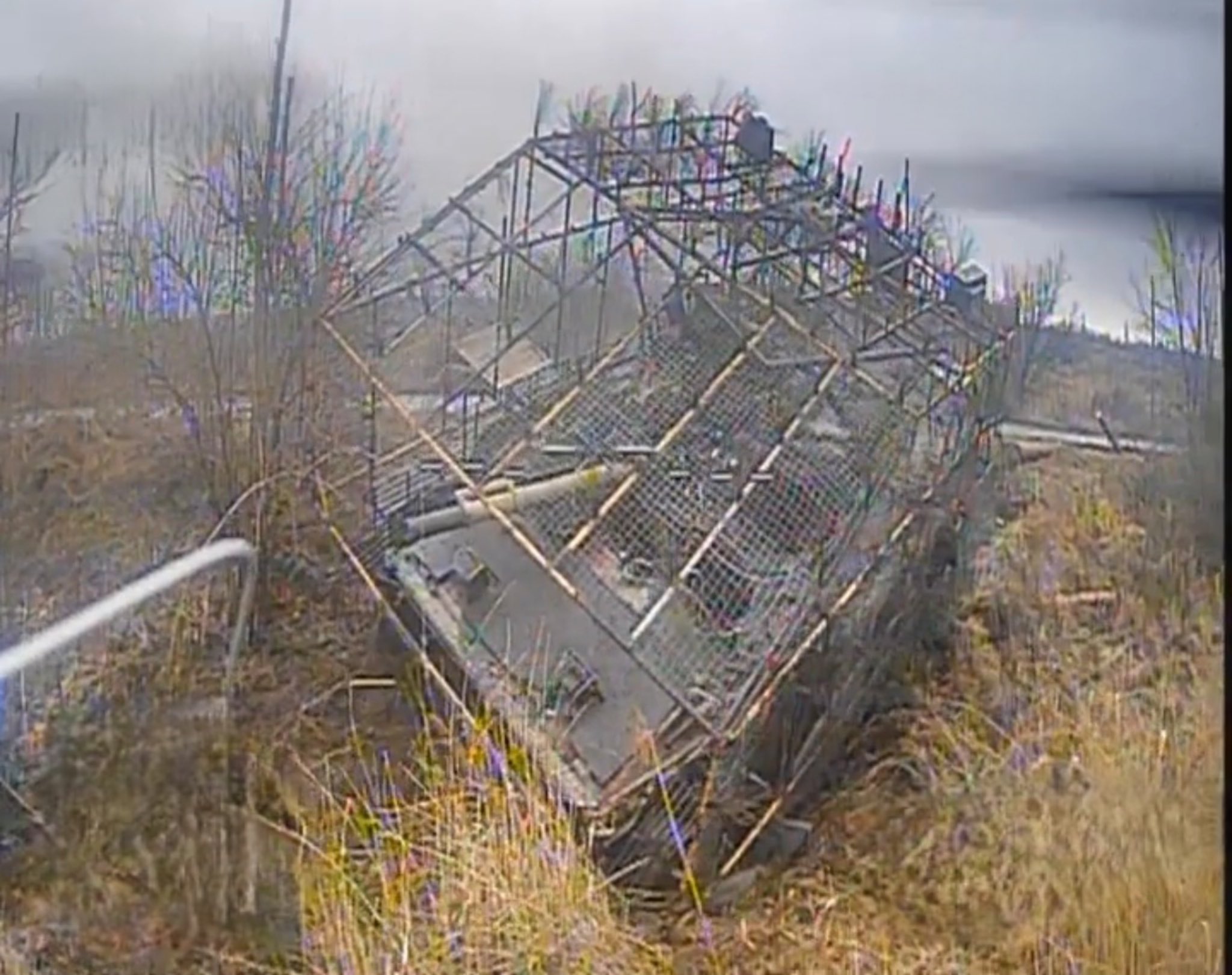
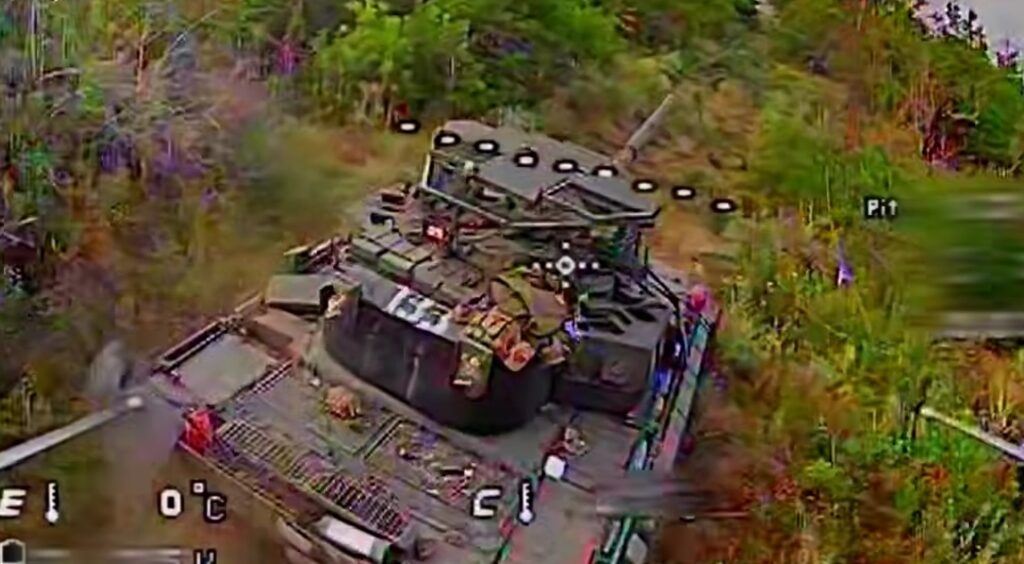
It had better hold. The earlier, cruder answer didn't: a TOS-1A wearing a field-built metal cage burned anyway when a Ukrainian FPV drone found it. And if a TOS-1A's armor fails, the next drone hit could trigger 24 rockets each weighing 217 kg and packed with concentrated fuel that's primed to explode.
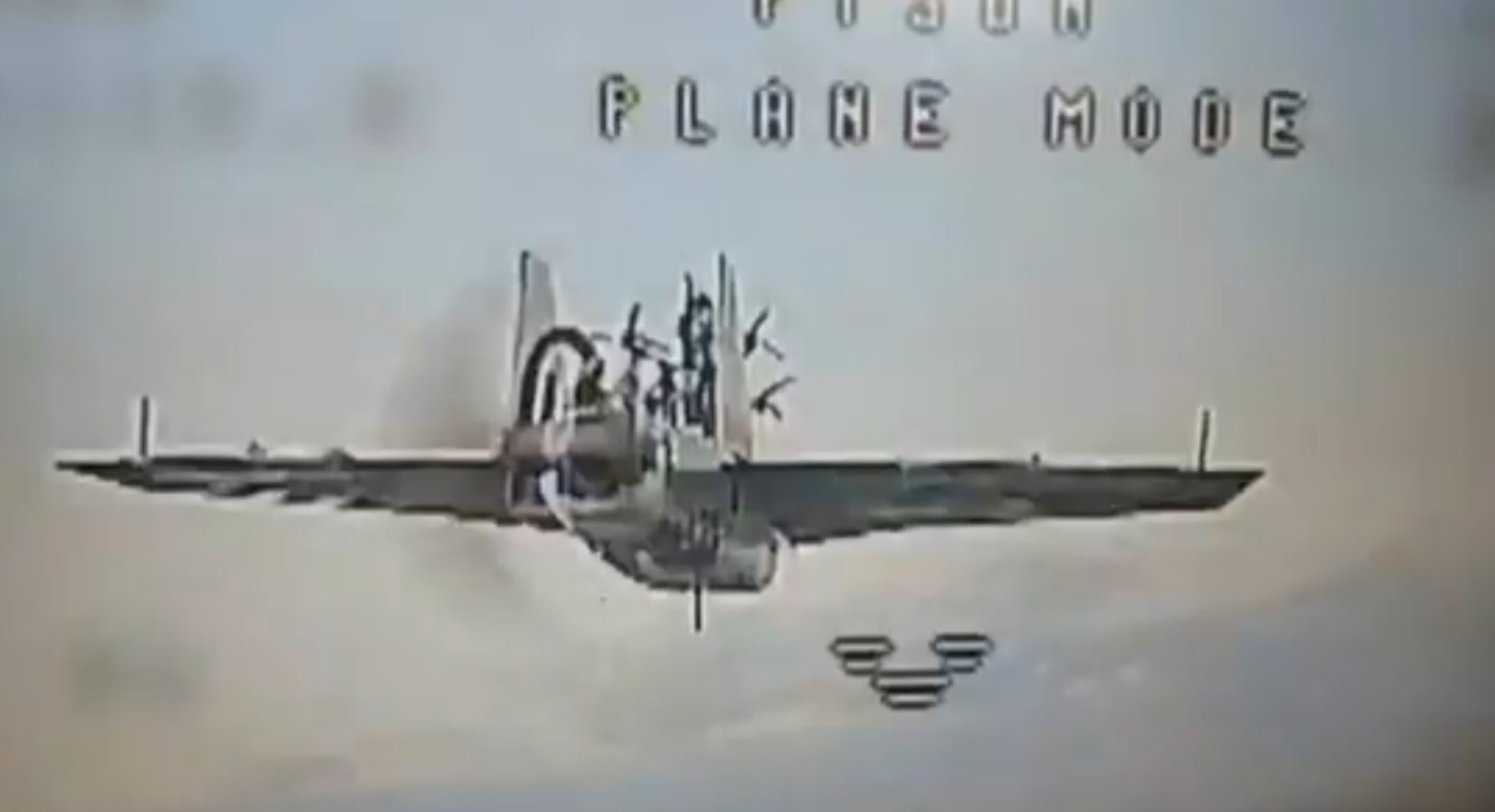
The Ukrainian military from the 92nd separate assault brigade destroyed the Russian 220-mm heavy flamethrower system TOS-1A "Solntsepek" using an FPV kamikaze drone pic.twitter.com/wEBz2H1T5y
Un robot chinois a battu samedi le record du 100 mètres de la légende jamaïcaine Usain Bolt, lors de la cérémonie d'ouverture des World Robot Gams à Pékin. Des dizaines d'humanoïdes sans visages et leurs opérateurs humains ont participé à des épreuves allant de l'athlétisme à la boxe, en passant par le football et les arts martiaux.
Un robot chinois a battu samedi le record du 100 mètres de la légende jamaïcaine Usain Bolt, lors de la cérémonie d'ouverture des World Robot Gams à Pékin. Des dizaines d'humanoïdes sans visages et leurs opérateurs humains ont participé à des épreuves allant de l'athlétisme à la boxe, en passant par le football et les arts martiaux.
Retour sur les temps forts de l'actualité de la semaine et les images les plus marquantes : des frappes de drones russes mortelles en Ukraine, la spationaute Sophie Adenot réalise une sortie dans l'espace, des incendies en Belgique et en Europe, ou le retour triomphal au Cameroun des championnes d'Afrique.
Retour sur les temps forts de l'actualité de la semaine et les images les plus marquantes : des frappes de drones russes mortelles en Ukraine, la spationaute Sophie Adenot réalise une sortie dans l'espace, des incendies en Belgique et en Europe, ou le retour triomphal au Cameroun des championnes d'Afrique.
Kyiv held the UNITED24 MODE Summit 2026, dedicated to the results of four years of work by UNITED24, the president’s fundraising platform. The event came two days before Ukraine's Independence Day.
Since its launch in 2022, the initiative has raised nearly $4 billion to support Ukraine. The platform has become an important fundraising tool, bringing together millions of donors from 145 countries.
The largest contributions through UNITED24 have come from the US, Germ
Kyiv held the UNITED24 MODE Summit 2026, dedicated to the results of four years of work by UNITED24, the president’s fundraising platform. The event came two days before Ukraine's Independence Day.
Since its launch in 2022, the initiative has raised nearly $4 billion to support Ukraine. The platform has become an important fundraising tool, bringing together millions of donors from 145 countries.
The largest contributions through UNITED24 have come from the US, Germany, France, Canada, Australia, Switzerland, Sweden, the Netherlands, Finland, Denmark, Austria, Italy, Norway, Belgium, Ireland, Japan, Poland, Lithuania, Türkiye, Singapore, Paraguay, El Salvador, and Guinea-Bissau.
Zelenskyy awarded Vikings star
During the event, Ukrainian President Volodymyr Zelenskyy awarded several prominent UNITED24 ambassadors, volunteers, and philanthropists for their significant support of Ukraine.
Liev Schreiber, the American actor and director, received the Order of Merit. Katheryn Winnick, the Canadian actress best known for Vikings, received the Order of Princess Olga, 3rd Class. Both of them are UNITED24 ambassadors, according to Ukraine's Presidential Office.
Ballistic missile developer attended event
The main topic of the summit was the further development of Ukrainian defense technologies — from creating new solutions to serial production, scaling, and international cooperation, ArmyInform reports.
The discussion featured Fire Point CEO Iryna Terekh, STARK Ukraine COO Maksym Cherkis, and Brave1 head Andrii Hrytseniuk.
Fire Point is the company that is working on the development of the first Ukrainian ballistic missiles.
Behind buying military equipment, platform helped healing Ukrainians
Overall, donors and philanthropists have also contributed to the purchase of medical equipment.
During this period, more than 117,000 medical devices and pieces of equipment were purchased for a total of more than $51.6 million, according to Ukraine's Health Ministry. These included:
Ambulances: 247 vehicles worth $15.0 million.
Armored evacuation vehicles for military medics: 43 vehicles worth $10.6 million.
Anesthesia machines: 83 units worth $2.6 million.
Neurosurgical microscopes: 10 units worth $2.1 million.
C-arm X-ray systems: 39 units worth $3.1 million.
What are platform's next tasks
The panel was moderated by Hanna Hvozdiar, an adviser to Ukraine’s defense minister, who outlined the state’s key priorities for developing Ukraine’s defense technology sector. She said Ukrainian Defense Tech had already demonstrated its ability to respond extremely quickly to the challenges of war.
Over the past several years, a new industry has effectively emerged in Ukraine, in which a battlefield need can be turned into a technological solution several times faster than in the traditional defense industry.
“The next task is to preserve this speed, scale up the strongest developments, and turn the technological advantage Ukraine is creating today into a long-term strength of the state,” she said.
Particular attention was also paid to Ukraine’s technological independence, including the development of its own critical technologies and component base alongside deeper international partnerships.
“Ukraine continues to develop cooperation with Ukrainian manufacturers, the technology community, and international partners so that promising developments can be scaled up faster,” the Defense Ministry said.
Participants left message to Russians on wings of drone
At the summit, Fire Point presented its FP-1 long-range drone, whose wings were signed with messages to Russians by summit participants, according to UNN.
Foreign Minister Andrii Sybiha also left his message to Russians on the wings of the FP-1.
“The farther our special long-range ‘sanctions’ fly, the closer peace and our victory come,” he wrote.
A Ukrainian company is building a thermal camera sharp enough to spot targets far beyond what its drones can see now. Ukrainian firm Oko Camera is developing the Oko HD, with a 1280×1024 sensor, company representatives told the defense outlet Oboronka at DALO Industry Days 2026, Scandinavia's largest defense industry exhibition, in Herning, Oboronka writes.
The camera's sensor has four times as many pixels as the company's previous lines, extending the range at which ta
A Ukrainian company is building a thermal camera sharp enough to spot targets far beyond what its drones can see now. Ukrainian firm Oko Camera is developing the Oko HD, with a 1280×1024 sensor, company representatives told the defense outlet Oboronka at DALO Industry Days 2026, Scandinavia's largest defense industry exhibition, in Herning, Oboronka writes.
The camera's sensor has four times as many pixels as the company's previous lines, extending the range at which targets can be detected and recognized, directly affecting how far the drone or robot fitted with it can spot a target.
HD long-wave infrared cameras are rare on the global market and, the company says, are not currently available in Ukraine at all.
The sensor is built for long-range detection
One of the camera's main tasks is observing objects at great distances, and the higher-resolution sensor should let it detect and recognize targets from farther away, though the company has not disclosed the specific range, Oko Camera said.
Its type is what makes it uncommon.
"LWIR cameras, that is, long-wave infrared cameras with HD resolution, are not common on the world market," the company's partnerships manager said.
In Ukraine, they essentially do not yet exist, giving a drone or robotic system fitted with one a longer detection range than current domestic options allow.
It is aimed at production in 2027
The Oko HD is still a prototype. The company plans to make its first working samples by the end of 2026 and hand them to clients who have already requested the cameras, Oko Camera said.
It is meant to be both affordable and capable. The company expects the Oko HD to become one of the most accessible thermal HD cameras on the world market, and after testing confirms its specifications, plans to launch it into production in 2027.
China’s regulator ordered changes after vehicle occupants sometimes had difficulty exiting electric cars, an issue that has led to lawsuits against Tesla in the United States.
China’s regulator ordered changes after vehicle occupants sometimes had difficulty exiting electric cars, an issue that has led to lawsuits against Tesla in the United States.
La Française Sophie Adenot va de nouveau sortir mardi de la Station spatiale internationale (ISS) en compagnie de l’Américain Anil Menon, annonce la Nasa. Elle va poursuivre le remplacement d'une antenne défectueuse, pour lequel elle a déjà passé plus de six heures dans l’espace.
La Française Sophie Adenot va de nouveau sortir mardi de la Station spatiale internationale (ISS) en compagnie de l’Américain Anil Menon, annonce la Nasa. Elle va poursuivre le remplacement d'une antenne défectueuse, pour lequel elle a déjà passé plus de six heures dans l’espace.
🎧 Édition du 21 aout 2026 :– L’Australie veut faire payer les plateformes– ChatGPT s’intègre à Messages sur Mac– Google personnalise davantage ses actualités– Meta lance Pocket et ses mini-jeux IA– Apple Music étiquettera les contenus IA « 120 secondes de Tech », un regard sur le quotidien de l’actualité numérique proposé par Bruno Guglielminetti Présenté par Micrologic.ca […]
🎧 Édition du 21 aout 2026 :– L’Australie veut faire payer les plateformes– ChatGPT s’intègre à Messages sur Mac– Google personnalise davantage ses actualités– Meta lance Pocket et ses mini-jeux IA– Apple Music étiquettera les contenus IA « 120 secondes de Tech », un regard sur le quotidien de l’actualité numérique proposé par Bruno Guglielminetti Présenté par Micrologic.ca […]
🎧 Édition du 20 aout 2026 :– Google prépare ses premiers Googlebook– Gemini veut séduire les étudiants– Meta AI débarque sur Mac– Amazon accélère ses livraisons par drone– Spotify Running arrive sur Android « 120 secondes de Tech », un regard sur le quotidien de l’actualité numérique proposé par Bruno Guglielminetti Présenté par Micrologic.ca ================ Pour recevoir directement […]
🎧 Édition du 20 aout 2026 :– Google prépare ses premiers Googlebook– Gemini veut séduire les étudiants– Meta AI débarque sur Mac– Amazon accélère ses livraisons par drone– Spotify Running arrive sur Android « 120 secondes de Tech », un regard sur le quotidien de l’actualité numérique proposé par Bruno Guglielminetti Présenté par Micrologic.ca ================ Pour recevoir directement […]
La mission robotique de sauvetage du télescope Swift, qui perd régulièrement en altitude et est condamné à brûler dans l'atmosphère terrestre, est un échec. Le robot de la start-up Katalyst "n'attrapera ni ne propulsera" le télescope en raison d'un "problème persistant de contrôle d'altitude", a déploré mercredi la Nasa.
La mission robotique de sauvetage du télescope Swift, qui perd régulièrement en altitude et est condamné à brûler dans l'atmosphère terrestre, est un échec. Le robot de la start-up Katalyst "n'attrapera ni ne propulsera" le télescope en raison d'un "problème persistant de contrôle d'altitude", a déploré mercredi la Nasa.
La dette du Trésor américain atteint désormais 40 047 milliards de dollars, un seuil franchi pour la première fois, selon des chiffres rendus publics mercredi par le gouvernement des États-Unis. La hausse est plus rapide que prévu, en raison notamment de la hausse des emprunts et des intérêts payés.
La dette du Trésor américain atteint désormais 40 047 milliards de dollars, un seuil franchi pour la première fois, selon des chiffres rendus publics mercredi par le gouvernement des États-Unis. La hausse est plus rapide que prévu, en raison notamment de la hausse des emprunts et des intérêts payés.
As more Russian missiles rain down on Ukrainian cities, one munition is curiously absent
The Mach-10 Kinzhal, an air-launched ballistic missile, has been missing in action for months now
Ukrainian intelligence says the Kremlin halted production in April because the missile kept missing by 30 meters
Russia's Kinzhal air-launched ballistic missile, a version of the ground-launched Iskander, travels as far as 2,000 km at a claimed 10 times the speed of sound whil
As more Russian missiles rain down on Ukrainian cities, one munition is curiously absent
The Mach-10 Kinzhal, an air-launched ballistic missile, has been missing in action for months now
Ukrainian intelligence says the Kremlin halted production in April because the missile kept missing by 30 meters
Russia's Kinzhal air-launched ballistic missile, a version of the ground-launched Iskander, travels as far as 2,000 km at a claimed 10 times the speed of sound while packing a 500-kg warhead. It was one of a clutch of purported super-weapons that Russian Pres. Vladimir Putin revealed in a dramatic announcement in 2018.
Launched in mid-air by specially modified Mikoyan MiG-31 interceptors in order to boost its speed and range, the Kinzhal is, in theory, a powerful deep strike munition capable of blasting right through all but the best and rarest air defenses.
In a recent interview, Deputy Chief of Ukraine’s Defence Intelligence Major General Vadym Skibitskyi made a series of interesting claims about Russian missile and drone production rates.
According to him, Russia is producing the following missiles at these rates:
In practice, it kept missing. Russia stopped building the $4.5-million missile in April, Maj. Gen. Vadym Skibitskyi, Ukraine's deputy chief of defense intelligence, told RBC-Ukraine—and the rocket fuel and components that had gone into Kinzhals now go into Iskanders, sea-launched Kalibr cruise missiles, and air-launched Kh-101 cruise missiles instead.
A missile of this class needs to land within five to seven meters of its aim point to be worth firing. The Kinzhal, according to Skibitskyi, lands within 30 meters or more. "We can hardly recall a single instance where this missile hit the target precisely," he said. Satellite imagery of the Ukrainian air base at Starokostiantyniv, a favorite Kinzhal target, shows the craters ringing the airfield rather than sitting on it.
Russian voenkors publishes satellite images from the Starokostiantyniv area!
The photo shows craters from missiles that did not reach their targets. In some cases, the Kinzhals' deviation was up to 144 meters. pic.twitter.com/qvameRj5t8
The Kolomna Machine Building Design Bureau reportedly contracted 44 Kinzhals in 2024 and 144 in 2025, Militarnyi reported from Russian defense ministry documents. The line climbed for two years and then stopped dead.
The Kinzhal isn't the only munition reportedly getting the ax. The Kremlin is also halting production of the Kh-32 air-launched cruise missile, which Russian engineers repeatedly failed to improve before the program was sent back for further work. "This would explain why Russia has not launched any Kinzhals for multiple months, and very few Kh-32s," AMK Mapping noted.
At least one analyst anticipated this development years ago. Way back in 2022, then-CNA analyst Michael Kofman wrote that he didn't "understand the interest in Russian use of Kinzhal. There's nothing special or particularly exciting about this system." It is, according to Kofman, just an Iskander but with a more complicated and expensive launch method.
It may have taken the Russians a few years to come to the same conclusion. The last Kinzhal strike might have been on 14 May, when the Russians launched three Kinzhals as part of a wider strike on Ukrainian cities involving 731 missiles and drones.
The purported Kinzhal shutdown, if true, could orphan the boutique fleet of around two dozen MiG-31K/I interceptors whose main role is to haul a Kinzhal to high altitude before launch. The Kinzhal carriers account for around 20% of the wider MiG-31 fleet, whose main mission is air defense over the vast Russian interior.
The MiGs may end up as victims of ruthless efficiency-seeking. If Skibitskyi is right, the Kremlin simply can't afford to keep every munition in production as it seeks to escalate its bombardment of Ukrainian cities amid growing economic losses from Ukrainian deep strikes targeting Russian strategic industries.
It's possible the only way the Russians can boost production of their best deep strike munitions is to cut production of the underperforming ones. According to the pro-Ukrainian Conflict Intelligence Team, the savings in fuel, components, and funds from the suspended Kinzhal and Kh-32 assembly lines "were redirected to other types of missiles."
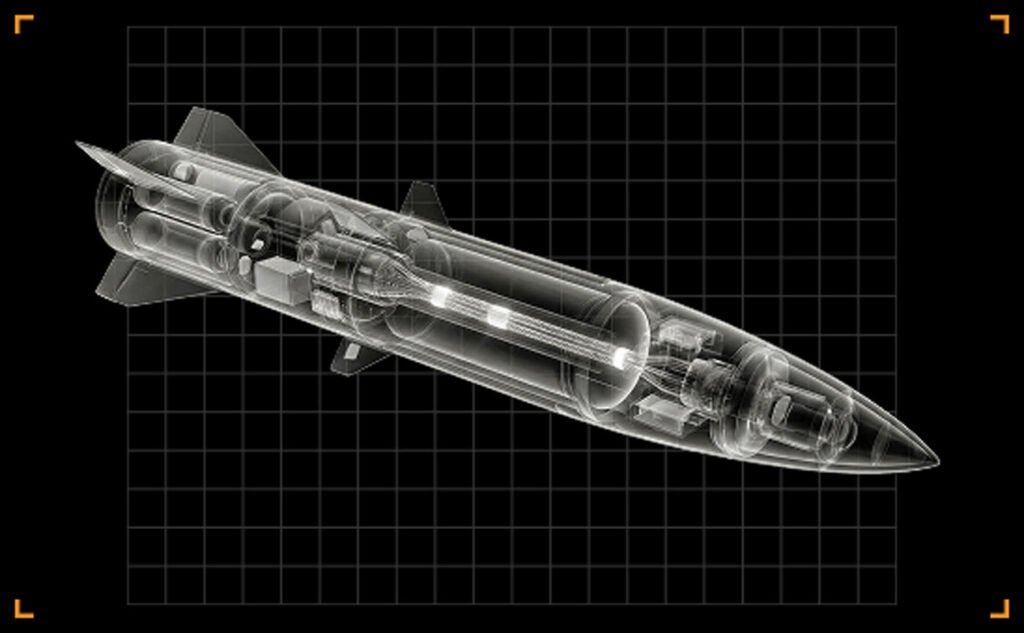
A cutaway rendering of a Russian Kinzhal hypersonic missile, as shown on Ukraine's TrophyLab platform. Illustrative image: TrophyLab/Ukraine's Defense Ministry
Production winners and losers
That's how, in July, Russia reportedly produced 65 Iskanders, surpassing its target of 60 by nearly 10%. Meanwhile, production of Kh-101s reached 140% of the monthly target. Kalibr production 111%. Across its main missile lines, Russian industry is running at 110 to 120% of plan. Certain Russian munitions may soon disappear from the sky over Ukraine, if they haven't already. But only because more copies of better munitions are taking their place.
Ironically, the Kinzhals and their carriers are fading away at the same time Ukraine's own deep strike forces may have landed their most powerful blow against the aerial hypersonic strike force. On 15 August, a barrage of Ukrainian drones and cruise missiles struck a range of targets deep inside Russia.
Explore further
Ukraine’s new Tu-95 killer is a $48,000 copy of a drone China refused to sell
Among the targets was Savasleyka air base, in Nizhny Novgorod around 785 km from Ukraine. "Direct hits and fires reported," WarTranslated noted.
Among other aircraft, Savasleyka air base hosts some of the MiG-31Ks that carry Kinzhal missiles. Or once carried them, if Skibitskyi is correct and the missile has fallen out of use. It's unclear whether the attack on Savasleyka damaged or destroyed any MiG-31s.
Even if the Kinzhal launchers burned to the ground, it may be too late to matter. The Russians may have rendered the planes and their missiles irrelevant before the Ukrainians could drone them.
🎧 Édition du 19 aout 2026 :– Meta accusée d’avoir ciblé les jeunes– OpenAI lance ChatGPT pour adolescents– Proton Mail classe maintenant vos courriels– Tesla prépare le Cybercab sans volant– Québec s’inquiète des voitures connectées « 120 secondes de Tech », un regard sur le quotidien de l’actualité numérique proposé par Bruno Guglielminetti Présenté par Micrologic.ca ================ Pour […]
🎧 Édition du 19 aout 2026 :– Meta accusée d’avoir ciblé les jeunes– OpenAI lance ChatGPT pour adolescents– Proton Mail classe maintenant vos courriels– Tesla prépare le Cybercab sans volant– Québec s’inquiète des voitures connectées « 120 secondes de Tech », un regard sur le quotidien de l’actualité numérique proposé par Bruno Guglielminetti Présenté par Micrologic.ca ================ Pour […]
🎧 Édition du 18 aout 2026 :– YouTube change le calcul des vues– Uber Eats mise sur la livraison par drone– Le filigrane de Claude fait controverse– Airbnb ajoute la location de voitures– Sony sous pression sur les jeux numériques « 120 secondes de Tech », un regard sur le quotidien de l’actualité numérique proposé par Bruno Guglielminetti […]
🎧 Édition du 18 aout 2026 :– YouTube change le calcul des vues– Uber Eats mise sur la livraison par drone– Le filigrane de Claude fait controverse– Airbnb ajoute la location de voitures– Sony sous pression sur les jeux numériques « 120 secondes de Tech », un regard sur le quotidien de l’actualité numérique proposé par Bruno Guglielminetti […]
Russia's new Arena-M anti-drone shield can shoot down FPVs—but tanks still burn
One fielded Arena-M reportedly carried 12 charges. Ukrainian crews used 15 to 20 drones per tank in one assault
More rounds could help—if ammunition is really the binding constraint
Russian forces may have finally found a way to protect their tanks from Ukrainian first-person-view drones. And it's not the usual add-on armor applications that have defined mechanized combat in Ukrain
Russia's new Arena-M anti-drone shield can shoot down FPVs—but tanks still burn
One fielded Arena-M reportedly carried 12 charges. Ukrainian crews used 15 to 20 drones per tank in one assault
More rounds could help—if ammunition is really the binding constraint
Russian forces may have finally found a way to protect their tanks from Ukrainian first-person-view drones. And it's not the usual add-on armor applications that have defined mechanized combat in Ukraine since the early months of Russia's wider war.
No, the Russians have begun deploying tanks fitted with the Arena-M active protection system (APS), which detects incoming FPVs and automatically fires a small projectile at them. The first few assaults by Arena-M-equipped tanks ended in defeat for the Russians, but limited combat footage shows the system can destroy incoming FPVs.
At least one Arena-M did work against FPVs—it just did not work long enough to save the tank. Observer Andrei_bt stressed that a reported 12-round loadout "does not match modern realities." Footage published on 7 August showed Ukrainian FPVs attacking an Arena-M-equipped T-72B3M near occupied Volodymyrivka, though the Institute for the Study of War assessed that it likely showed the late-July mechanized assault. Ukrainian drone operator Dmytro Putiata reported that one Arena-M shot down seven FPVs before Ukrainian forces destroyed the tank.
That is a smaller problem than the one the Russians had a month ago, and it is why the burned-out tanks along the road in Donetsk Oblast are not the whole story. Russia has spent three years accumulating tanks it cannot safely send anywhere—thousands of them, rebuilt and parked for want of a defense against $500 drones. An Arena-M that does not run dry halfway to the objective is the thing that would let those tanks out of the yard.
The good news for Russian mechanized forces is that developers now know Arena-M needs a bigger ammo loadout. The bad news is that packing more projectiles into the system could prove extremely difficult. The main problem: adding any further bulk to the turret-mounted projectile launchers could block a tank's engine compartment, preventing access for maintenance.
Explore further
Russia’s tanks are back after a year in hiding. Thursday was a massacre.
If there's a workaround, it may involve redesigning the Arena-M to fire smaller but more numerous projectiles.
Ammunition may not even be the binding constraint. Ukrainian aviation expert Anatolii Khrapchynskyi put the Arena-M's engagement range at 20 to 30 meters and its detection range at around 50—numbers that leave very little time against a drone diving from above, however many charges are in the launchers.
The Institute for the Study of War, for its part, assesses that the Arena-M alone is currently insufficient to protect Russian mechanized assaults from Ukrainian drones because the system can be saturated, though it raises the cost and effort required of Ukrainian forces.
An Arena-M with more rounds could be the development Russian commanders were waiting for as they continue stockpiling new and refurbished tanks and fighting vehicles. Doubling down on production of T-90 and T-72 tanks, the Kremlin has more than made good its combat losses in the first 54 months of the wider war.
Tank-led assaults have been rare in the last year of fighting as Russian forces have pivoted to infantry-led infiltration tactics. That may change as infantry losses deepen and commanders gain confidence in the Arena-M to protect tanks from drone attack.
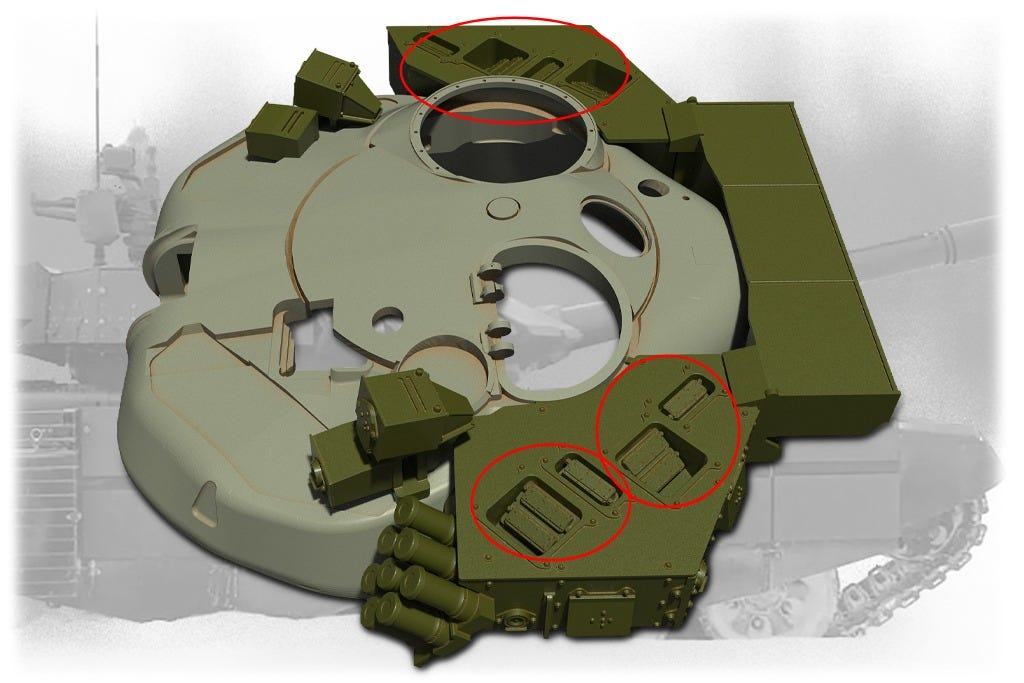
The Arena-M design, with projectile launchers circled. Kolomna Engineering Design Bureau art
Combat debut
The Arena-M, designed by the Kolomna Engineering Design Bureau, uses Doppler radar to spot incoming rockets, missiles, and drones, and counter-munitions meant to shred a threat shortly before impact. The concept is old: the Soviets fitted the Drozd system to modernized T-55ADs in the 1980s, and Russian designers have been chasing active protection since their tanks were mauled in Chechnya.
Three decades on, the Russian government daily Rossiyskaya Gazeta conceded on 7 August that there is still no generalized battlefield data on how the Arena-M performs, and that its potential against threats attacking from above needs further study.
Anti-Drone Armor Evolution
Evolution of Russia's anti-drone protection of tanks
From crude cages to shooting back—four years of trial and error
2022
Cope cage
Metal slats or mesh bolted over turrets to block incoming FPV drones
Spring 2023
Turtle tank
Entire vehicles wrapped in drone-blocking metal shells
Spring 2025
Porcupine
Hundreds of thick rebar spines welded to cope cages and shells
Autumn 2025
Hedgehog & dandelion
Thousands of thin aluminum hairs; branching stalks with Kevlar mesh
July 2026
Arena-M
Radar-cued charges shoot drones down instead of blocking them—reported fielded loadout: 12 rounds
Chart: Euromaidan Press
The system had its major combat debut in Ukraine on and around 23 July, over several days of Russian mechanized attacks in the Dobropillia sector of eastern Ukraine's Donetsk Oblast. The Russian Center Group of Forces rolled a large mechanized assault group along the road through the village of Pankivka, roughly 36 km southwest of Kramatorsk and its twin free city of Sloviansk.
Ukrainian drones spotted the tanks coming, and attacked. When the smoke and dust cleared, the Russians had lost at least nine tanks. Reportedly seven of them were T-72B3A models with Arena-M installations.
The losses belie the Arena-M's effectiveness. The protection systems shot down drone after drone, and only stopped shooting down drones when they ran out of projectiles. "In general, it took from 15 to 20 FPV drones to destroy a tank," Ukrainian drone operator Dmytro Putiatareported.
While some of the best-protected turtle, porcupine, and hedgehog tanks have been able to withstand more than 20 FPVs before being immobilized, the add-on metal plates and bars that comprise turtle, porcupine, and hedgehog installations are extremely heavy—and tend to ruin a tank's transmission, weigh on its mobility, and prevent it from rotating its turret and aiming its main gun.
Explore further
Russia took the cages off its newest tanks. The new Arena-M shield bought them a few minutes.
In other words, the add-on armor prevents tanks from fighting like tanks—using their speed and firepower to close with and destroy the enemy.
The Arena-M installation is bulky but it's not heavy. With Arena-M, a tank can defend itself from drones without sacrificing its mobility. If an Arena-M had, say, 24 rounds instead of just 12, an attacking tank might be able to fend off drones long enough to reach its objective across the disputed gray zone.
But only barely. "15 to 20 FPV drones to destroy a tank is a perfectly viable rate," Czech analyst Jakub Janovsky noted in a comment on Putiata's social media. "At those numbers, Russia could throw its entire [armored fighting vehicle] fleet at the Ukrainian front line over a few months without achieving much more than creating a future low-grade iron ore deposit."
What if the Russians could fit 36 rounds in an upgraded Arena-M installation? Would that be enough?
No one knows for sure until they try. What we do know is that "the Russian military is learning and is experimenting in how to employ armor on a drone-saturated battlefield," explained Rob Lee, an analyst with the Foreign Policy Research Institute in Philadelphia. "The Arena-M APS demonstrated effectiveness and will likely be improved."
And those improvements could unlock those thousands of tanks the Russians have parked for want of drone defenses.
Explore further
Russia mastered drone-proofing its tanks—Ukraine is copying its tricks
Ukraine can now measure how cost-effectively it kills, and the math favors it. Every dollar Ukraine's Defense Forces spend on striking a target inflicts several times more losses on Russia, as confirmed by the Mission Control module in the DELTA battle system, Ukraine's Defense Ministry reported.
Mission Control, launched six months ago, now processes 50,000 missions a week and over 230,000 reports, allowing Ukraine to track not just what it hits but also what each stri
Ukraine can now measure how cost-effectively it kills, and the math favors it. Every dollar Ukraine's Defense Forces spend on striking a target inflicts several times more losses on Russia, as confirmed by the Mission Control module in the DELTA battle system, Ukraine's Defense Ministry reported.
Mission Control, launched six months ago, now processes 50,000 missions a week and over 230,000 reports, allowing Ukraine to track not just what it hits but also what each strike costs relative to the damage it causes. In June, every dollar Ukraine spent on a strike cost Russia nearly five times as much.
The economics favor Ukraine's strikes
The system prices both sides of every strike. Mission Control records the cost of what Russia loses, ranging from a few hundred dollars for telecommunications equipment to hundreds of thousands of dollars for air-defense systems and other high-value targets.
The June figures show the gap. Hitting one enemy soldier costs Ukraine $3,032, compared with roughly $65,000 that Russia spends to maintain one. Meanwhile, hitting a piece of equipment costs $2,674, and targeting an infrastructure object costs $1,487.
Every mission feeds the next
Mission Control logs each mission to sharpen the next. The military analyzes what worked, what did not, and why to adjust tactics for the next mission rather than blindly repeating mistakes, according to the Defense Ministry.
The data breaks down by mission type and depth. It sorts missions into reconnaissance, strike, logistics, and evacuation, and by range, 20-plus and 50-plus kilometers, showing for each unit what it strikes, how effectively, at what cost, and what economic damage it inflicts, while also tracking which Ukrainian equipment is lost, at what depth, and under what circumstances.
The goal is fewer Ukrainian lives spent
The measurement serves a purpose beyond economics. The Defense Ministry said it continues implementing technologies so each mission makes the next more precise and helps preserve the lives of Ukrainian soldiers, gradually shifting the most dangerous battlefield tasks to robotic systems.
🎧 Édition du 17 aout 2026 :– La France bloque l’interdiction aux moins de 15 ans– Evooo1Bot infecte des appareils connectés– Apple ouvre la réservation de publicités dans Plans– ChatGPT lance Computer History sur Mac– Google permet de retirer le filigrane visible de Gemini « 120 secondes de Tech », un regard sur le quotidien de l’actualité numérique […]
🎧 Édition du 17 aout 2026 :– La France bloque l’interdiction aux moins de 15 ans– Evooo1Bot infecte des appareils connectés– Apple ouvre la réservation de publicités dans Plans– ChatGPT lance Computer History sur Mac– Google permet de retirer le filigrane visible de Gemini « 120 secondes de Tech », un regard sur le quotidien de l’actualité numérique […]
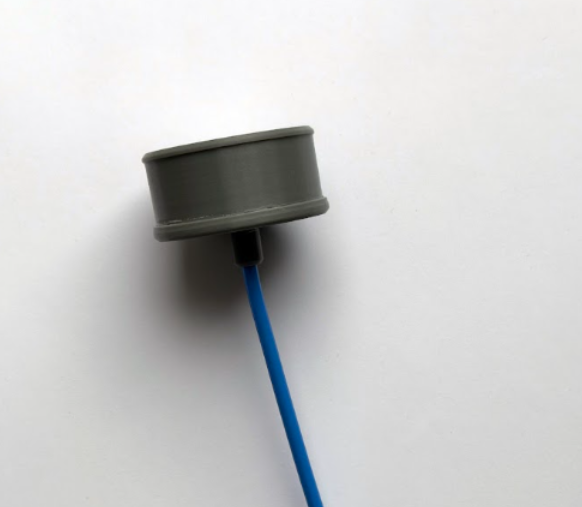
A Ukrainian company has built a tiny antenna to solve one of the drone war's hardest problems: staying connected. Ukraine's BlueBird Tech has unveiled the CLOVER 5.8 GHz antenna, a 25-gram device for transmitting and receiving radio signals, according to RBC-Ukraine.
The antenna addresses the connectivity problem at the center of Ukraine's drone war. Keeping drones linked to their operators under heavy jamming is one of the war's persistent technical challenges, and the
A Ukrainian company has built a tiny antenna to solve one of the drone war's hardest problems: staying connected. Ukraine's BlueBird Tech has unveiled the CLOVER 5.8 GHz antenna, a 25-gram device for transmitting and receiving radio signals, according to RBC-Ukraine.
The antenna addresses the connectivity problem at the center of Ukraine's drone war. Keeping drones linked to their operators under heavy jamming is one of the war's persistent technical challenges, and the CLOVER is one Ukrainian company's answer.
Previously, Serhii “Flash” Beskrestnov, an adviser to the Ukrainian president, confirmed that the main problem for Ukrainian forces operating some 25,000 combat robots is not hardware limitations but connectivity restrictions.
The design is built to hold a link in motion
The antenna's shape is engineered for stability. Due to its clover design, circular polarization, and omnidirectional radiation pattern, the antenna works even in dynamic conditions.
Weight is decisive for a drone. At 25 grams, the CLOVER adds almost nothing to a small aircraft, leaving weight for payload, battery, or range, which matters for the small FPV drones that do much of the fighting, where a reliable signal and low weight are both at a premium.
It works on drones and ground robots
The antenna is not only for flying drones. It can be installed and used on ground robotic systems as well as FPV drones, and extended to the uncrewed ground vehicles that Ukraine increasingly uses for logistics and evacuation, which face the same connectivity challenge.
In June, Ukrainian ground robots ran nearly 17,000 supply and evacuation missions. Every one of those runs depends on the robot holding a signal, the problem the CLOVER is built to address.
It is built for quick integration. Despite its compact size, the CLOVER covers a wide 4.9-6.1 GHz range and comes with an SMA male connector and an RG402 cable, allowing it to integrate quickly into drone-detection tools, radio-monitoring complexes, and measurement equipment. It is compatible with the main systems on the market.
🎧 Édition du 14 aout 2026 :– Meta ferme 750 000 comptes en Australie– Google lance son Pixel Tag– Microsoft commence à unifier Copilot– Instagram change de logo– X ouvre davantage son algorithme « 120 secondes de Tech », un regard sur le quotidien de l’actualité numérique proposé par Bruno Guglielminetti Présenté par Micrologic.ca ================ Pour recevoir directement […]
🎧 Édition du 14 aout 2026 :– Meta ferme 750 000 comptes en Australie– Google lance son Pixel Tag– Microsoft commence à unifier Copilot– Instagram change de logo– X ouvre davantage son algorithme « 120 secondes de Tech », un regard sur le quotidien de l’actualité numérique proposé par Bruno Guglielminetti Présenté par Micrologic.ca ================ Pour recevoir directement […]
Ukraine's state security service has its own special attack drone
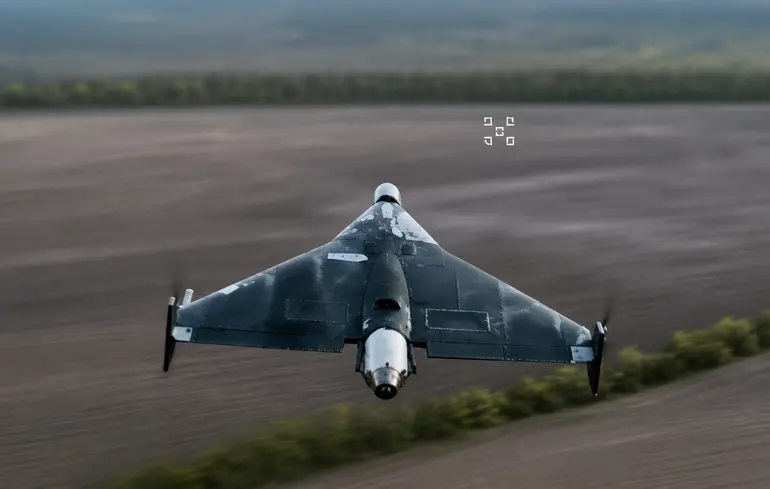
The MICH 2000 is a highly evolved copy of a Chinese drone China refused to sell
There are at least eight versions of the 2,000-km drone, from $48,000
On 16 July, one-way attack drones from the Ukrainian state security service—the vaunted SBU—motored 800 km to strike Engels-2 air base in western Russia. At the time, there were reportedly five bombers on the ground at the base: four Tupolev Tu-22M
Ukraine's state security service has its own special attack drone
The MICH 2000 is a highly evolved copy of a Chinese drone China refused to sell
There are at least eight versions of the 2,000-km drone, from $48,000
On 16 July, one-way attack drones from the Ukrainian state security service—the vaunted SBU—motored 800 km to strike Engels-2 air base in western Russia. At the time, there were reportedly five bombers on the ground at the base: four Tupolev Tu-22Ms and a single Tupolev Tu-95.
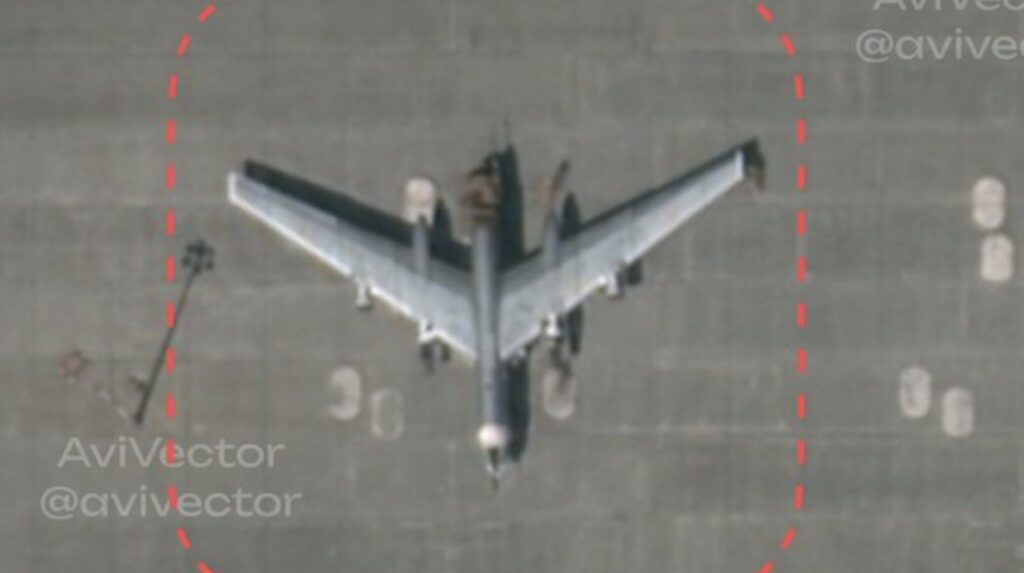
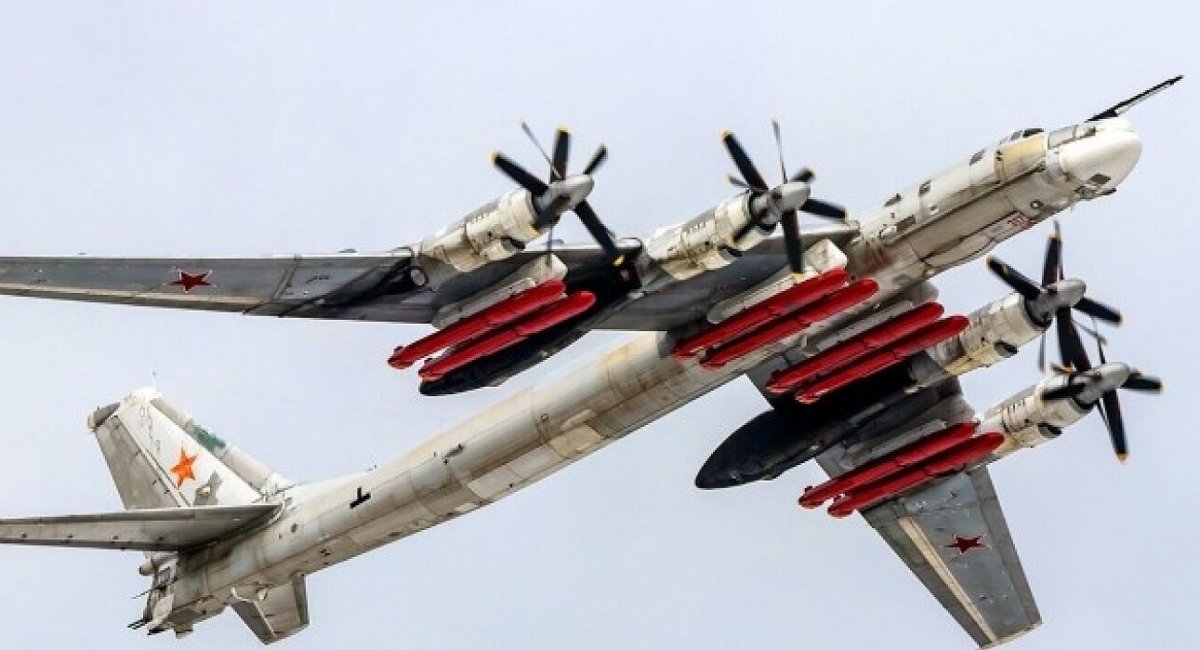
The drones struck the four-engine, propeller-driven Tu-95. "According to preliminary data, the plane suffered critical damage," the SBU claimed. "It completely tore off the tail part." That particular aircraft, the SBU added, had been used systematically to launch massed missile strikes on Ukraine. Satellite imagery later confirmed the bomber's destruction.
The destroyed Tu-95. Satellite imagery via AviVector.
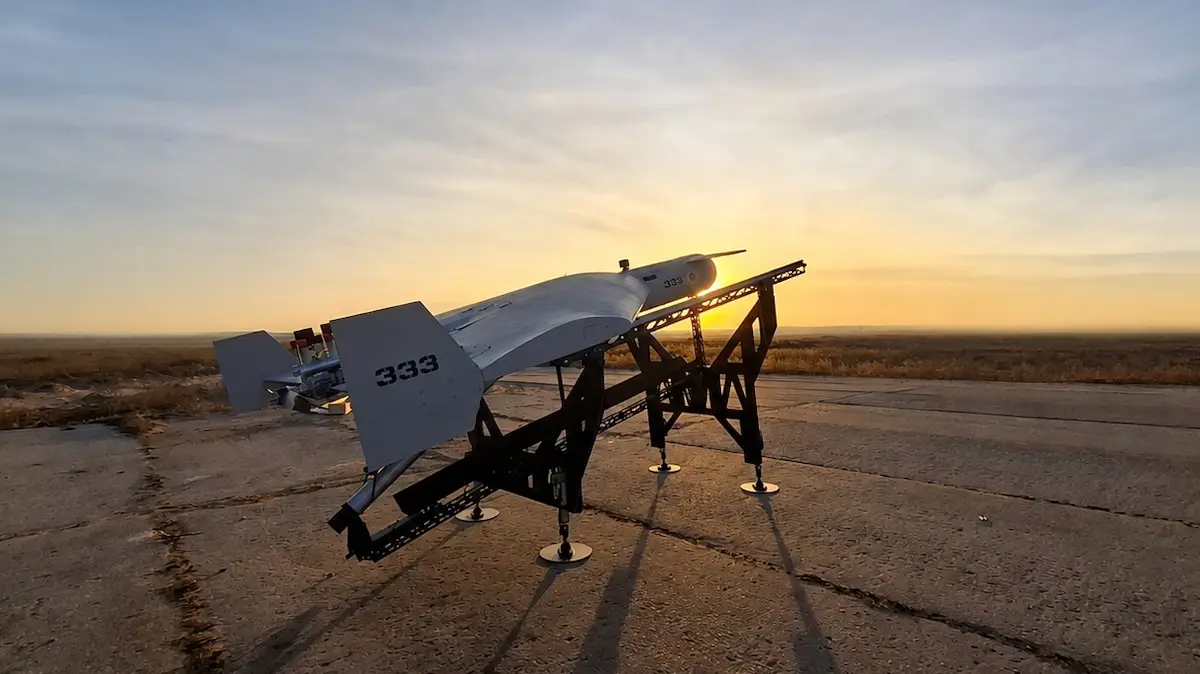
Nearly a month later, we finally know which drone type the SBU flung at Engels-2 and its parked bombers. They were MICH 2000s—Ukrainian aircraft that began as copies of the Chinese ZTK-150, built after Beijing stopped selling. Ukrainian website Oboronka, which visited the factory, broke the news. "Today, the Mich' is no longer just a Chinese plane, but a drone that is exclusively used by the SBU Special Operations Center 'Alpha.'"
According to Oboronka, whose report was agreed in advance with the manufacturer and the SBU, the MICH 2000 flies as far as 2,000 km with a warhead weighing 25 to 60 kg. "The list of targets hit by this drone is updated every week," Oboronka noted. They include Russian ports, military and industrial sites around Moscow and Engels-2.
The Engels-2 raid might be the most immediately impactful. After the 16 July raid, the Russians may be down to 43 Tu-95s, only a dozen of which are usually active at any given time.
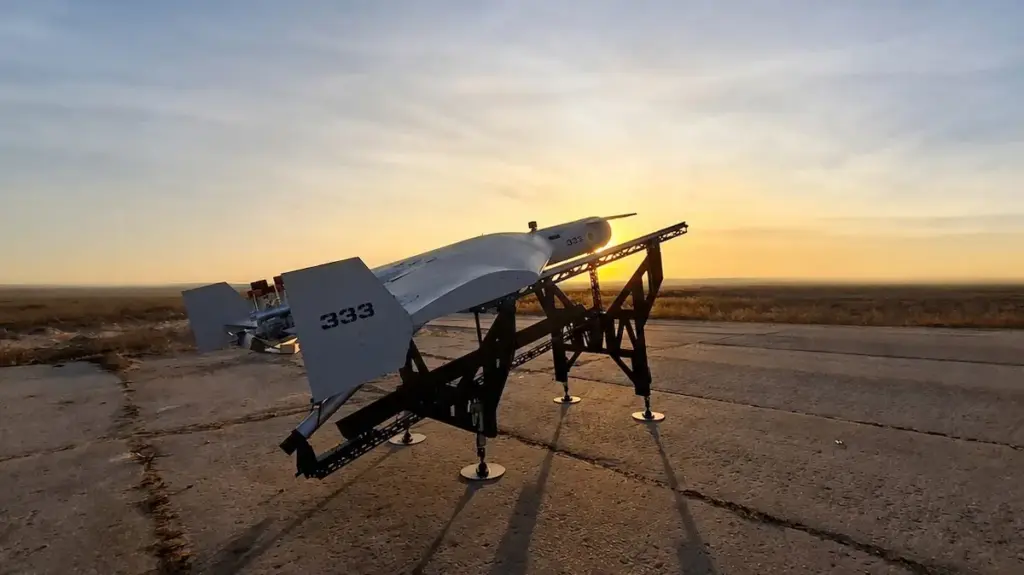
The mysterious Shahed like Ukrainian drone that has been repeatedly spotted during strikes deep inside Russia finally has a name: MICH 2000.
The MICH 2000 started as someone else's drone. In the summer of 2023, Beijing restricted exports of the civilian aircraft Ukrainian units had been buying and converting into deep-strike munitions. At the end of that year, a team of Ukrainian developers flew to China to buy some anyway.
At the factory, they found dozens of ZTK-150s coming off the line—Shahed lookalikes distinguished mainly by a pair of forward canards. The Chinese intermediaries floated selling the production technology outright, and Ukrainian commanders liked the idea. But when the team came back ready to buy, the factory's management refused.
The intermediaries wanted the deal anyway. They offered to assemble the drones somewhere without export restrictions—and to train Ukrainian pilots. The team took the training. "We came there to teach pilots to fly Chinese drones," one member told Oboronka. "And in parallel with the training we photographed everything that was there. Everything from the production process to the arrangement of the shelves and cabinets." They flew home with trained pilots and eight Chinese drones.
Two years later, the Ukrainian version costs $48,000 in its basic configuration. The Chinese original costs $50,000. And according to the manufacturer, almost nothing of the Chinese drone survives in the MICH 2000 now except its outline.
Whittling down the bomber fleet
Ukrainian drones are slowly chipping away at the Tu-95 fleet. A 2022 drone raid badly damaged one of the lumbering turboprop bombers at Engels-2, potentially leaving no more than 51 intact Tu-95s in the Russian air force inventory at the time. Smuggling tiny explosive drones across Russia in trucks on 1 June, 2025, the SBU hit at least seven more Tu-95s as well as four Tu-22Ms, among other aircraft.
The 16 July raid is the more recent Ukrainian effort to shrink the Russian bomber force, but it surely won't be the last. The Russians' roughly 120 bombers—Tu-95s, Tu-22Ms and Tupolev Tu-160s—launch the cruise missiles that routinely blast Ukrainian cities and power plants.
Struggling to intercept all Russian deep strike munitions in the target zone, in part owing to a deepening shortage of the best air defense missiles, Ukrainian forces increasingly aim to prevent the Russian munitions from even launching—by smashing munitions factories or, yes, destroying irreplaceable bombers. Of the three Russian bomber types, just one—the Tu-160—is still in production, albeit at a rate of barely just one every year or two.
Explore further
Ukraine kills bomber inside Russia. Soviet Union stopped building them decades ago — so this one is gone for good
Expect more MICH 2000 raids. The type's anonymous builder churns out 6,000 MICH 2000s a year but aims to boost output to 10,000 a year. And the firm customizes the drones to suit particular missions.
According to Oboronka, there are eight main versions. "Fighters can choose what kind of communication they need: analog, digital or Starlink. They can choose the warhead, the size of the fuel tank, the possibility of additional guidance." The navigation system can be made more jam-proof by adding additional jam-resistant controlled reception pattern antennas.
Explore further
Russia has figured out how to stop Ukraine’s most powerful missile
Drone strikes by MICH 2000s and other drone types aren't the only ways Ukrainian forces are trying to blunt Russian attacks on Ukrainian cities and power plants. Ukrainian drone teams are also trying to take out the last five warships in the battered Russian Black Sea Fleet that can fire Kalibr cruise missiles.
On 11 August, drones struck at least three of the ships in the port of Novorossiysk in southern Russia. The frigates Admiral Essen and Admiral Makarov and the corvette Bykov all suffered visible damage.
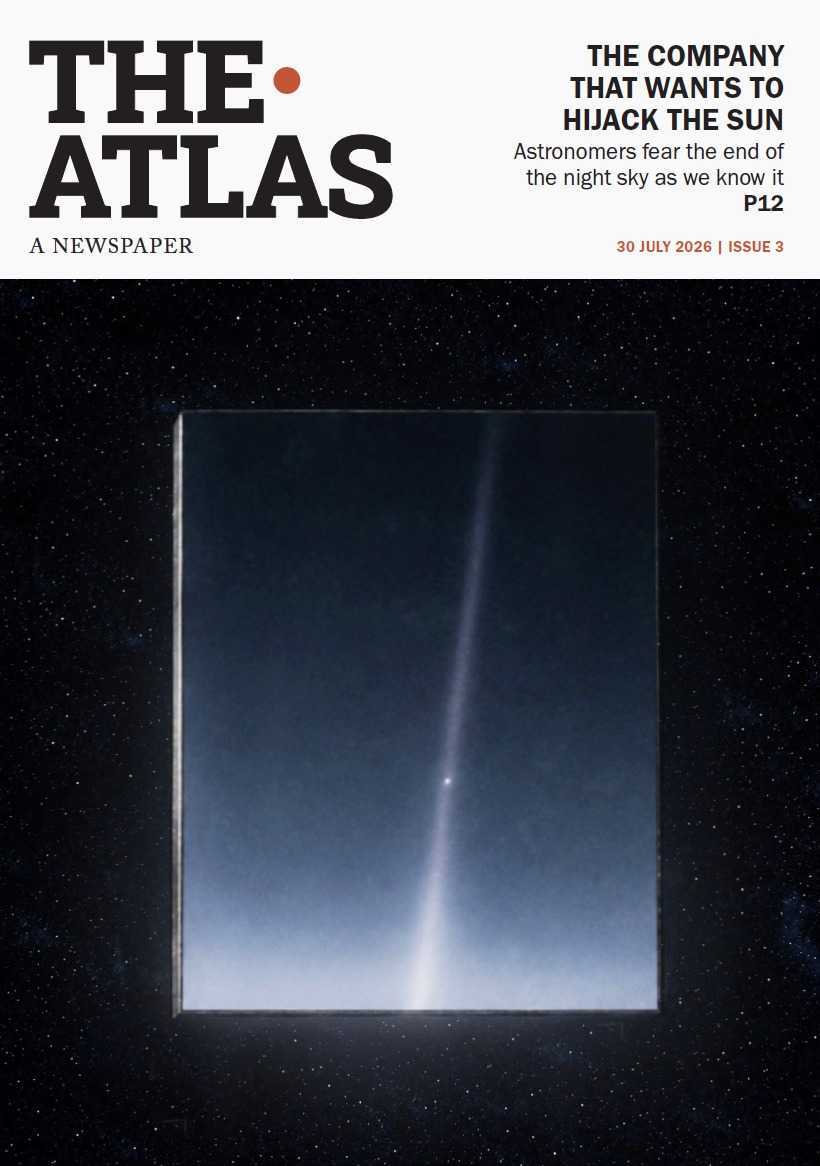
Astronomy, our window into the rest of the universe, happens in the dark. Planets, stars and galaxies – all the mysteries of the cosmos – only reveal themselves at night. But the night sky may be getting much brighter, thanks to an American company with a plan to conquer darkness itself by sending 50,000 giant mirrors into space.
What you are reading first appeared as a cover story for The Atlas, our new global publication with The Continent. Sign up here to get the next edition delivered to
Astronomy, our window into the rest of the universe, happens in the dark. Planets, stars and galaxies – all the mysteries of the cosmos – only reveal themselves at night. But the night sky may be getting much brighter, thanks to an American company with a plan to conquer darkness itself by sending 50,000 giant mirrors into space.
What you are reading first appeared as a cover story for The Atlas, our new global publication with The Continent. Sign up here to get the next edition delivered to your inbox on August 27.
Astronomers are panicking.
It is an “existential threat” to optical astronomy, says the European Southern Observatory. A “disastrous” idea that will “permanently scar” the night sky, according to the Royal Astronomical Society. The American Astronomical Society told Nature it “would probably mean the end of ground-based astronomy, or optical astronomy, at least.”
Sthabile Kolwa agrees. “It will take away a very crucial part of our civilization,” she tells The Atlas. Kolwa, a senior lecturer in astronomy at the University of South Africa, studies the life cycles of galaxies, but today her concerns are more immediate. “It might come to this, that we just have to find them in the parking lot and say, ‘Hey, what are you guys doing? You’re going to ruin science for us.’ ”
Like Uber, but for the sun
The parking lot in question is in Hawthorne, California, outside the headquarters of Reflect Orbital. They call themselves The Sunlight Company. The start-up is celebrating: Earlier this month, the United States Federal Communications Commission (FCC) approved the launch of Eärendil-1, likely in a few months time.
This satellite, named for a character in JRR Tolkien’s The Silmarillion, will unfurl an 18m x 18m mirror in low Earth orbit. It’s designed to reflect sunlight onto the dark side of the earth, lighting a 5km2 patch of land with the strength of four full moons.
It is a proof of concept.
By 2035, Reflect Orbital wants 50,000 of its mirrors in space, delivering illumination “comparable to daylight” on demand to paying customers (“sunlight is the new oil,” says chief executive Ben Nowack). The company says this will allow solar panels to generate clean energy overnight; provide “safer, evenly-lit streets” to cities that pay for it; and keep construction sites and farms working 24/7.
There will be an app, of course, offering “sunlight as a service” – lighting up the night will be as easy as ordering an Uber.
Clean, renewable energy is at the heart of the company’s vision, a spokesperson told The Atlas in a statement. Reflect Orbital declined to respond to specific queries and said it is in constant dialogue with astronomers, scientists and environmental researchers to mitigate the impact of the light pollution: “We are able to dim the brightness of the service and turn it off at any stage. We control where the light shines when serving an authorised customer. Most people and most places will never see this light. It is precise, targeted and customers will require permits to receive the service.”
Circadian arrhythmia
A new research paper, published in May, challenges Reflect Orbital’s position. Its author, the European Southern Observatory’s Oliver Hainault, concluded that the company’s 50,000 satellites would increase the background brightness of the sky by 300% – even when their mirrors are pointed somewhere else. This, coupled with a proposal from Elon Musk’s SpaceX to build vast data centres in space, would go “beyond the limit” of what astronomy can withstand.
What that means, in practice, is that the images from ground-based telescopes will be dramatically less useful, marred by streaks of light from passing satellites. The most distant light sources won’t be visible at all.
This will obscure evidence of other galaxies, hinder research into black holes and other cosmic phenomena, and potentially prevent early warnings of asteroid approaches. Cutting-edge astronomy will only be possible from space-based telescopes like the James Webb and the Hubble – access to which is already massively oversubscribed, and subject to political interference.
The night sky will look different to the naked eye, too. “The next time you’re away from urban light pollution, spend some time outdoors after dark and enjoy the view of the Milky Way and the constellations that have inspired awe since humankind woke to consciousness. Chances are those views are not here to stay forever,” wrote journalist Tereza Pultarova for Space.com.
Anna Jibladze
Running out of space
The night sky is already a lot brighter than it was 150 years ago, when light bulbs started to become commonplace. According to Dark Sky International, a US-based nonprofit that advocates against light pollution, 80% of Earth’s human population already lives under some form of sky glow, most of which is generated on land. This has forced astronomers to seek out “dark sky places,” like the Atacama Desert in Chile or the Upper Karoo in South Africa, for their telescopes.
Humans can adapt to less darkness. But it is much harder for animals and ecosystems that have evolved alongside predictable rhythms of day and night. Nocturnal predators lose the ability to hunt; sea turtle babies can’t find their way to the sea; migratory birds are thrown hopelessly off course; and moths expend all their energy helplessly chasing artificial light sources.
“It’s almost like we are on a mission to obliterate natural darkness from earth,” said Ruskin Hartley, Dark Sky’s chief executive. “And now rather than do it street by street and bulb by bulb, let’s do it from space.”
Space is, in theory, protected by the Outer Space Treaty, a 1967 agreement signed by 110 countries, including all the major space superpowers. It states that “space is the province of all mankind." But that’s not what’s actually happening, Hartley argues. “In the US, it’s the most wealthy, most powerful individuals who are gobbling up as much of that orbital space as they can before someone else can get that opportunity” – with China, Russia and Europe all scrambling too for a greater presence in low Earth orbit.
“Who gets to choose that we light up the night sky? Who gets to make that decision?” Ruskin asks. In the US, it is the FCC’s job to decide what satellites are allowed in space. But it has said that assessing the impact of light pollution or environmental damage is not within its remit. Instead, it wants to slash regulation so American companies can take advantage of the “space industrial revolution.”
And Reflect Orbital has rich and powerful backers. Earlier this year, it secured a $1.5-million contract from the US air force, hinting at possible military applications for its mirrors. Last year, it raised $20-million from three venture capital firms, including Sequoia Capital, one of the biggest investors in Silicon Valley. Sequoia also owns a multibillion-dollar stake in SpaceX, which has its own plans for low earth orbit.
There are already more than 10,000 Starlink satellites up there, giving Elon Musk unprecedented influence over global communications. The company wants to launch one million more satellites over the next few years to build a network of space-based data centres. In addition to the light pollution, astronomers worry the potential for collisions will increase dramatically, as will risks to the ozone layer.
A brighter future
On her blog Higher Dimensions, the astronomy professor Janna Levin contemplates our brighter future. “It is quite possible that the hot glow of the swarm of data satellites will saturate the night, washing out the stars from our perspective on Earth. We’ll look up into the sky and instead of Zeus transformed into a swan outlined in a constellation of a few stars, the machine gods will literally loom above us, glowing with radiant heat, making declarations, predicting the weather, forecasting then determining our fate.”
Kolwa, the South African astronomy lecturer, offers a different metaphor: that of empires “colonizing low Earth orbit.” This was an ambition of one of the most infamous imperialists of them all, Cecil John Rhodes, who said that he looked up at the stars and thought: “I would annex the planets if I could; I often think of that. It makes me sad to see them so clear and yet so far.”
But it hasn’t been colonized just yet.
“I’m still trying to figure out what we can do, what responsibility we have as scientists,” says Kolwa. “How could we engage our communities to stand up to these corporations and say no? We must keep our night skies dark, as dark as possible.”
🎧 Édition du 13 aout 2026 :– Google lance la gamme Pixel 11– Les tribunaux bannissent les lunettes Meta– Sonos préparerait les Ace Ultra– Deux câbles sous-marins touchés en Australie « 120 secondes de Tech », un regard sur le quotidien de l’actualité numérique proposé par Bruno Guglielminetti Présenté par Micrologic.ca ================ Pour recevoir directement ce podcast, abonnez-voussur […]
🎧 Édition du 13 aout 2026 :– Google lance la gamme Pixel 11– Les tribunaux bannissent les lunettes Meta– Sonos préparerait les Ace Ultra– Deux câbles sous-marins touchés en Australie « 120 secondes de Tech », un regard sur le quotidien de l’actualité numérique proposé par Bruno Guglielminetti Présenté par Micrologic.ca ================ Pour recevoir directement ce podcast, abonnez-voussur […]
Russia has found a way to defeat Ukraine's Flamingo cruise missiles
Russian air force A-50U radar planes see the missiles coming
One mapper counts 10 of the last 11 Flamingos shot down
Russia has been shooting down most of Ukraine's best long-range cruise missiles as fast as Ukraine can launch them. Just one or two of the $500,000 Fire Point FP-5 Flamingo missiles have hit their targets in recent weeks.
That means Russian air defenses are working for now.
Russia has found a way to defeat Ukraine's Flamingo cruise missiles
Russian air force A-50U radar planes see the missiles coming
One mapper counts 10 of the last 11 Flamingos shot down
Russia has been shooting down most of Ukraine's best long-range cruise missiles as fast as Ukraine can launch them. Just one or two of the $500,000 Fire Point FP-5 Flamingo missiles have hit their targets in recent weeks.
That means Russian air defenses are working for now. Whether they'll continue to work is the critical question for Ukrainian strike planners.
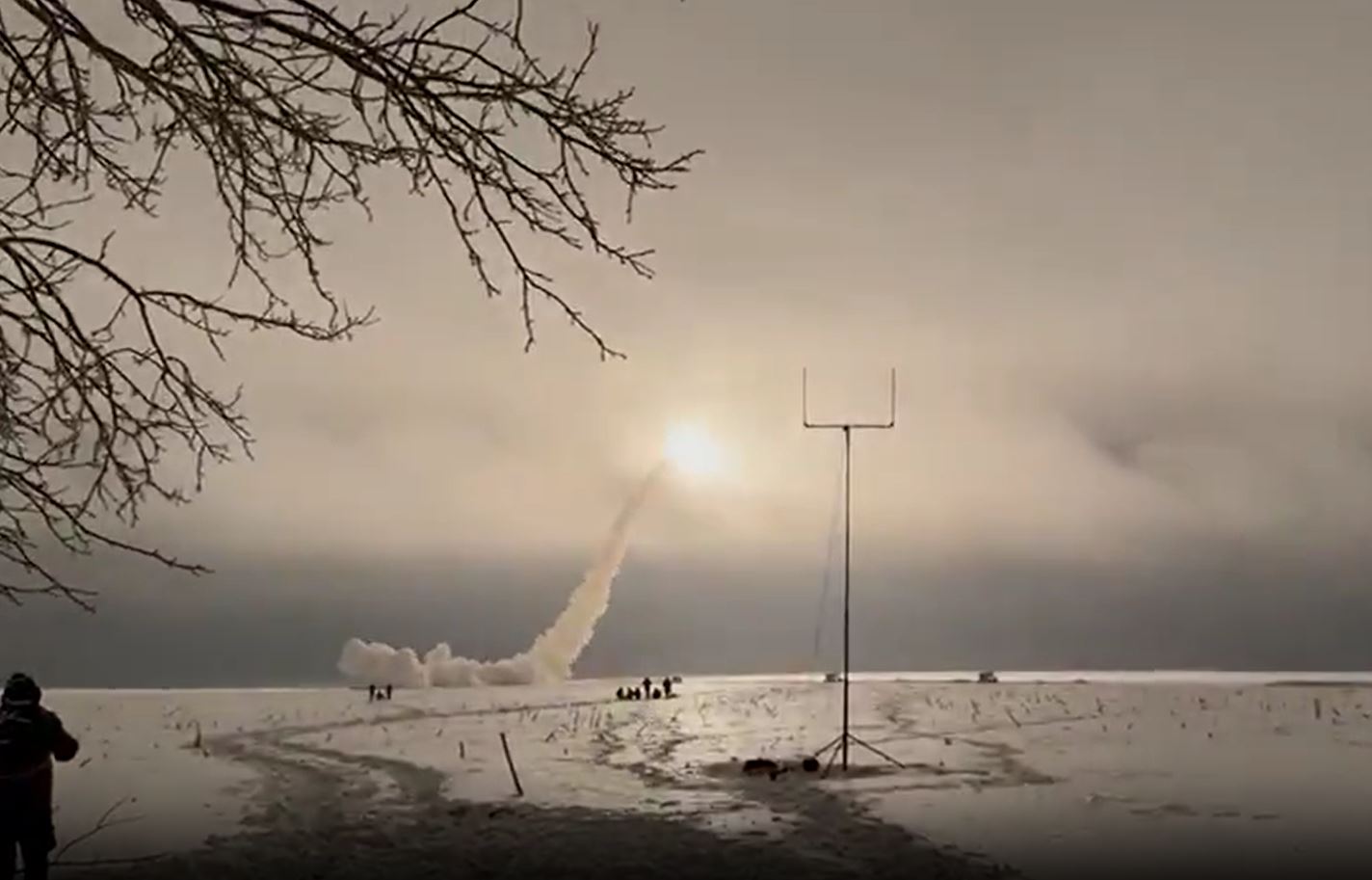
Under the cover of darkness on 6 August, the Ukrainian army's 19th Missile Brigade launched at least three of the six-ton, jet-propelled Flamingos toward Tyumen Oblast in western Siberia. The missiles traveled around 2,500 km before disappearing, according to mapper AMK Mapping.
The apparent shoot-downs capped a difficult week for Ukraine's deep strike campaign. AMK Mapping claimed the Russians shot down 10 of 11 launched Flamingos since 1 July. That count is one mapper's, based on open-source tracking, and no official Ukrainian or Russian figures exist to check it against.
Approximate flight route of the 5 Ukrainian FP-5 Flamingo cruise missiles.
They disappeared over Tyumen Oblast, likely after being shot down once again by Russian air defence.
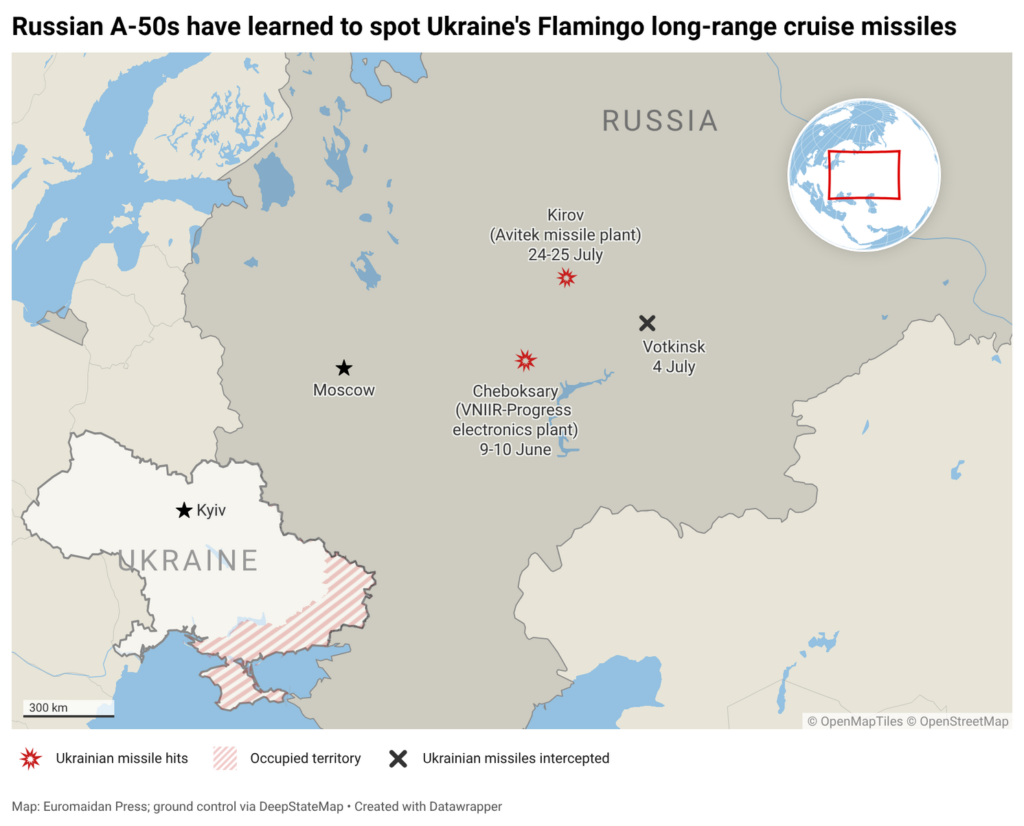
The mapper may be off by one. Between 24 and 25 July, at least one Flamingo struck the Vyatka Machine-Building Enterprise Avitek missile plant in Kirov Oblast 1,300 km from the border with Ukraine. Michael Bohnert, an analyst with the RAND think tank in California, concluded that two Flamingos hit the plant, causing visible damage.
Map: Euromaidan Press
It was a potentially powerful blow. Among other things, Avitek produces parts for the Tor medium-range surface-to-air missile system. Slowing Tor production "will have the most impact," Bohnert explained. And the Ukrainian system that a Tor slowdown might benefit the most is ... the Flamingo.
After all, the Tor is one of the air defense systems the Russians could use to shoot down Flamingos. "Any slow-down in the production of these could greatly improve the prospects of FP-5 performance over time," Bohnert noted.
Ukrainian Firepoint FP-5 Flamingo missiles just smashed the Avitek plant in Kirov, Russia (July 24 and 25) — and the biggest hit is to SA-15 Tor production.
Here are the facts and why it matters
On July 24th and 25th, Ukrainian Firepoint FP-5 Flamingo Missiles hot the Vyatka… pic.twitter.com/Ii8VsJCumi
At present, however, it seems that the Flamingo's biggest problem is in the air, not on the ground. Russia is shooting down most of the incoming FP-5s because it has eyes in the sky.
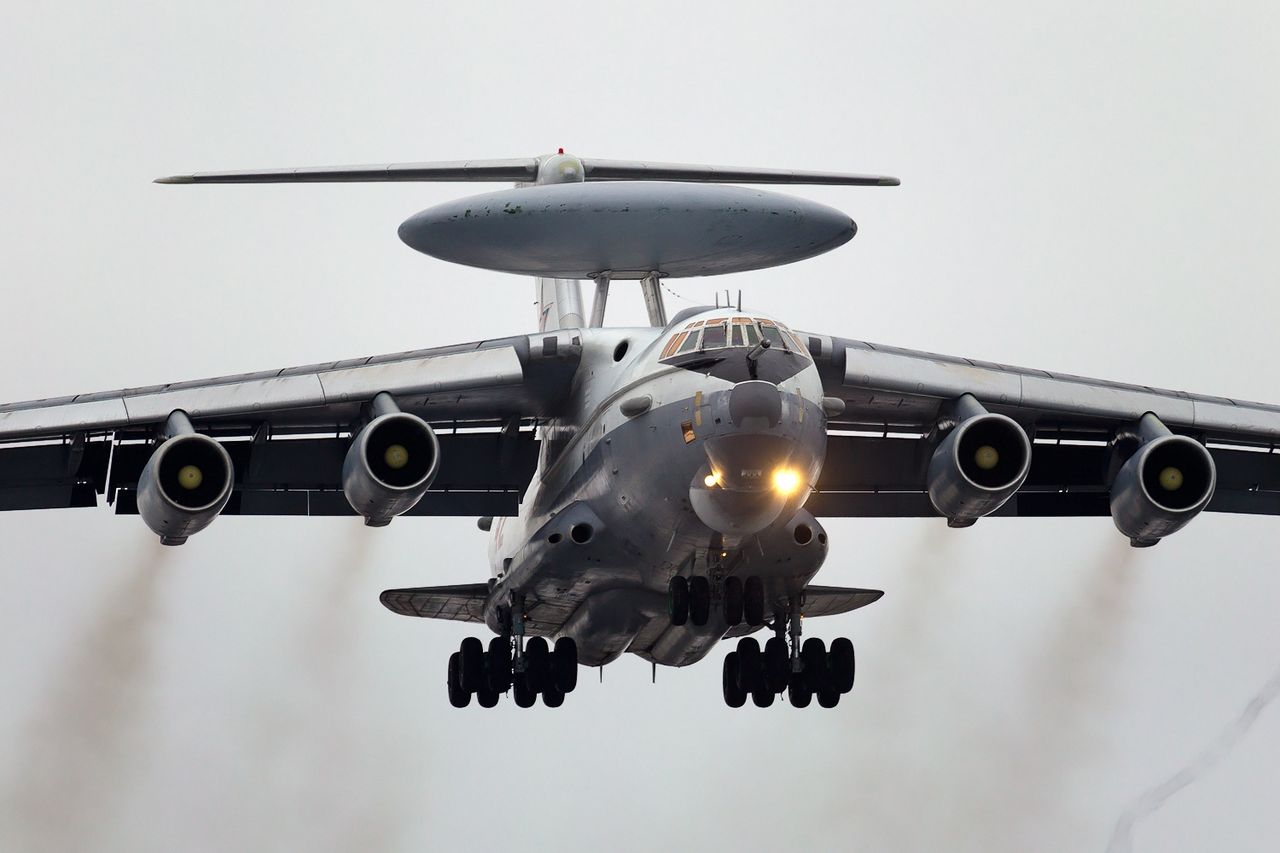
The Russian air force's fleet of lumbering Beriev A-50U radar early-warning planes now has one mission and one mission only: the A-50Us with their fuselage-mounted radars patrol over the likeliest flight paths for Flamingos motoring into the Russian interior to strike strategic industries.
The A-50Us are effective in the role. As recently as June, more Flamingos were getting through Russian defenses. Between 9 and 10 June, the 19th Missile Brigade launched five Flamingos at the VNIIR-Progress electronics plant in Cheboksary, in western Russia, 960 km from the Ukraine border.
Two missiles struck the plant, punching right through anti-drone protections and inflicting major blast and fire damage with their 1,150-kg warheads, the biggest on any Ukrainian deep strike munition.
Russia adapted fast. On 4 July, an A-50U helped missile batteries on the ground spot and shoot down five FP-5s flying toward Votkinsk, 1,360 km from Ukraine. From its perch thousands of feet in the air, the A-50U has a much longer detection range against low targets than any radar on the ground can manage.
Explore further
To catch Ukraine’s cruise missiles, Russia is risking the scarce A-50 radar planes it has no way to rebuild
Targeting A-50Us on the ground and in the air in a series of drone and missile ambushes, the Ukrainians have destroyed two A-50Us and damaged at least two others, reducing the fleet to no more than five. Russia has no way to build replacements. But those five planes are now fully committed to the anti-Flamingo fight.
On 7 July, the Russians reportedly launched four of the irreplaceable planes at the same time in order to coordinate the Flamingo shoot-downs. Now, almost all Flamingos go down in flames before they reach their targets.
Ukraine isn't powerless. Fire Point has been working hard to improve the Flamingo and make it harder to shoot down. Perhaps most importantly, it seems the company tweaked the missile's altimeter in order to help it fly lower. The lower a missile flies, the better chance it has of hiding among the radar clutter created by surrounding terrain.
But if a lower-flying Flamingo is harder to shoot down, the improvement hasn't yet registered in the statistics. For now, Russia has figured out how to take out almost all of Ukraine's heaviest deep-strike missiles.
Russia wants its tanks moving again after two years of Ukrainian drones freezing its armored assaults, the Institute for the Study of War (ISW) reported. Its main bet is a tank-mounted system that fires interceptors at incoming drones. The system worked on at least one tank, but Russia lost it anyway.
Since 2022, cheap Ukrainian FPV drones have turned the open approach to any position into ground where armor rarely survives, forcing Russia into slow, infantry-led as
Russia wants its tanks moving again after two years of Ukrainian drones freezing its armored assaults, the Institute for the Study of War (ISW) reported. Its main bet is a tank-mounted system that fires interceptors at incoming drones. The system worked on at least one tank, but Russia lost it anyway.
Since 2022, cheap Ukrainian FPV drones have turned the open approach to any position into ground where armor rarely survives, forcing Russia into slow, infantry-led assaults and years of experiments to armor its tanks against drones.
The shield shot down some drones. Ukraine still killed the tank.
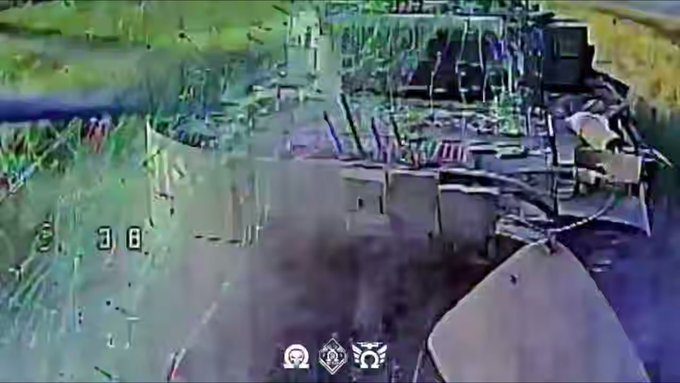
In early August, footage surfaced of Ukrainian drones destroying a Russian tank fitted with the Arena-M active protection system in the Dobropillia sector of Donetsk Oblast. Militarnyi identified the vehicle as a T-72B3A, side number 133, and Militarnyi reported that Ukraine's Security Service (SBU) released the clip. ISW geolocated the footage near occupied Volodymyrivka, east of Dobropillia.
Explore further
Russia took the cages off its newest tanks. The new Arena-M shield bought them a few minutes.
Dmytro Putiata, a Ukrainian combat drone specialist who posts as kriegsforscherD, spoke with the unit involved. On that tank, Arena-M shot down seven drones before its magazine ran dry, he said.
"Unfortunately, it works," Putiata wrote.
It still wasn't enough. Ukrainian crews finished the tank off with more drones. It took 15 to 20 first-person-view (FPV) drones to kill each vehicle, Putiata said. Footage shows the tank moving with its interceptor cells empty. It was the first time the Arena-M was credited with shooting drones down in combat.
Russia keeps sending tanks into that ground for a reason
Russian forces are experimenting with new technology to restore mechanized maneuver and break out of positional warfare—the static, trench-like fighting that has defined the front, ISW reported. They are fitting tanks with active protection systems to help armor survive in the "kill zone," the open ground where drones and other weapons destroy almost anything that moves.
Explore further
Russia’s weirdest armored vehicle was built to fight infantry. The infantry stopped coming
ISW judged that Arena-M alone cannot shield Russian assaults from the drones, let alone the rest of Ukraine's weapons. Russian commanders have largely kept tanks off the roads because drones kill them faster than factories rebuild them. In these assaults, the tank's job is less to fight than to survive long enough to drop infantry closer to Ukrainian lines. Russia will likely keep trying to restore maneuver even after its late-July mechanized assault in the Dobropillia sector failed, ISW added.
Why Russia wants the shield: the cages don't let tanks fight
The bolt-on armor carries a cost. Cope cages and "turtle" shells weigh tanks down and often jam the turret so the main gun can't aim. That trade-off is part of why Russia wants Arena-M: protection without the bulk, so a tank can still move and shoot. Russia recently sent tanks stripped of the welded cages, carrying the shield instead.
Moment of impact of the T-72B3M tank “133,” equipped with the Arena active protection system and empty countermeasure launcher cells. Screenshot from an SBU video.
Arena-M is not new. Active protection systems like it were first built to stop anti-tank missiles, and Russia adapted this one to catch drones. The system's lineage dates back to the late Soviet era, and Russian industry has for years claimed mass deployment that never came. Designers worked on fitting it to T-72B3 and T-90M tanks since at least 2019, yet only single vehicles turned up by 2024—some used to shoot a propaganda film rather than fight.
🎧 Édition du 11 aout 2026 :– Zuckerberg défend la superintelligence personnelle– Meta lance Muse Glimmer en local– Ford ajoute un assistant IA aux véhicules– Google ouvre le Play Store aux boutiques concurrentes– Spotify teste le saut des pubs dans les podcasts « 120 secondes de Tech », un regard sur le quotidien de l’actualité numérique proposé par […]
🎧 Édition du 11 aout 2026 :– Zuckerberg défend la superintelligence personnelle– Meta lance Muse Glimmer en local– Ford ajoute un assistant IA aux véhicules– Google ouvre le Play Store aux boutiques concurrentes– Spotify teste le saut des pubs dans les podcasts « 120 secondes de Tech », un regard sur le quotidien de l’actualité numérique proposé par […]
🎧 Édition du 10 aout 2026 :– OneDrive Photos s’installe automatiquement– Cloudflare lance Kitesurf pour agents IA– Astra inquiète OpenAI en cybersécurité– Sony prépare la fin des jeux PS5 sur disque « 120 secondes de Tech », un regard sur le quotidien de l’actualité numérique proposé par Bruno Guglielminetti Découvrez Micrologic.ca ================ Pour recevoir directement ce podcast, abonnez-voussur […]
🎧 Édition du 10 aout 2026 :– OneDrive Photos s’installe automatiquement– Cloudflare lance Kitesurf pour agents IA– Astra inquiète OpenAI en cybersécurité– Sony prépare la fin des jeux PS5 sur disque « 120 secondes de Tech », un regard sur le quotidien de l’actualité numérique proposé par Bruno Guglielminetti Découvrez Micrologic.ca ================ Pour recevoir directement ce podcast, abonnez-voussur […]
🎧 Édition du 7 aout 2026 :– OpenAI bonifie ChatGPT avec GPT-5.6– Adobe intègre plus de 70 outils à ChatGPT– Google déploie « Demander à Maps » dans 160 pays– Suno veut mieux identifier la musique créée par IA– Rockstar dévoilera un nouvel aperçu de GTA VI « 120 secondes de Tech », un regard sur le quotidien […]
🎧 Édition du 7 aout 2026 :– OpenAI bonifie ChatGPT avec GPT-5.6– Adobe intègre plus de 70 outils à ChatGPT– Google déploie « Demander à Maps » dans 160 pays– Suno veut mieux identifier la musique créée par IA– Rockstar dévoilera un nouvel aperçu de GTA VI « 120 secondes de Tech », un regard sur le quotidien […]
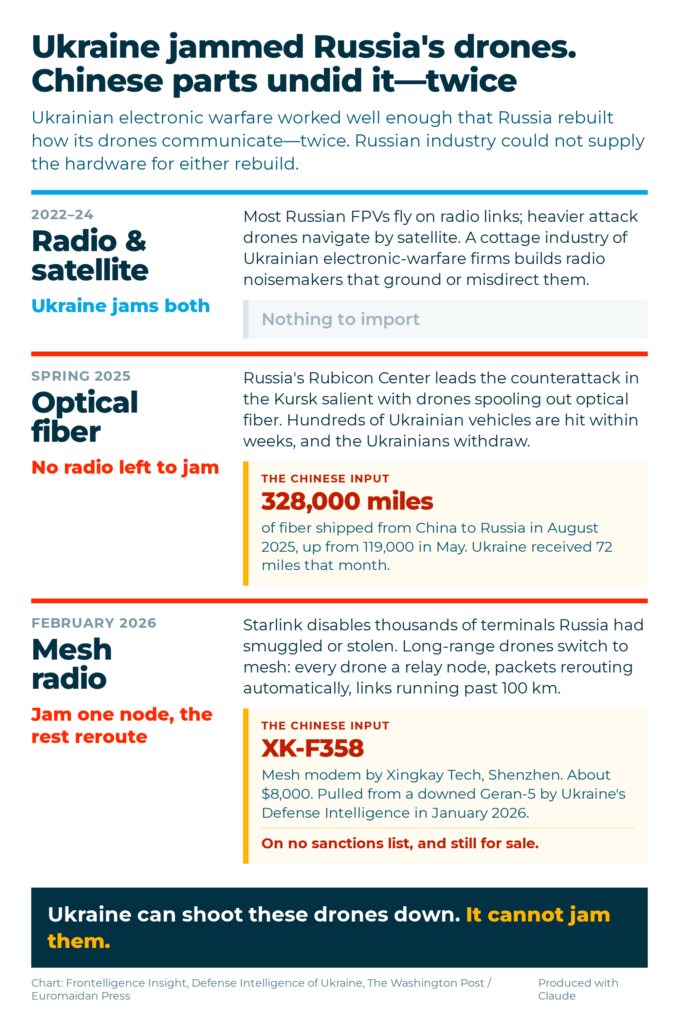
Ukrainian jamming worked too well: it compelled Russian drone developers to innovate
Now many Russian drones communicate via unjammable optical fiber or jam-resistant mesh radio
But the Russians can't make all the hardware themselves
Instead, they rely on Chinese imports
Frustrated by Ukrainian electronic warfare, Russia transformed its drone arsenal to be harder—or impossible—to jam.
Most of Russia's tiny first-person-view drones now send and receive s
Ukrainian jamming worked too well: it compelled Russian drone developers to innovate
Now many Russian drones communicate via unjammable optical fiber or jam-resistant mesh radio
But the Russians can't make all the hardware themselves
Instead, they rely on Chinese imports
Frustrated by Ukrainian electronic warfare, Russia transformed its drone arsenal to be harder—or impossible—to jam.
Most of Russia's tiny first-person-view drones now send and receive signals via jam-proof fiber optic cable instead of wireless radio. For heavier one-way attack drones that travel too far for fiber optics, the Russians have mostly switched to jam-resistant mesh radio networks made up of many interconnected senders and receivers.
In both cases, China is key. Chinese companies sell Russian companies the optical fibers and mesh modems that the Russians install in their drones. In other words, Beijing is the critical enabler in Moscow's ongoing aerial aggression.
That's the unsurprising yet sobering conclusion that Tatarigami, the founder of the Ukrainian Frontelligence Insight analysis group, reached in a recent investigation.
It's not enough for Ukrainian forces to shoot down or otherwise defend against Russian drones, or to fight back with their own drones. To win the drone war, Ukraine and its allies must "step up pressure on Chinese manufacturers," Tatarigami wrote.
Russia's response to electronic warfare wasn't a single solution. It evolved along two major paths: fiber-optic drones and mesh networks. This thread summarizes Frontelligence Insight analysis based on OSINT data and a report by the Center for Defense Reforms. Threadpic.twitter.com/k0v0ZeWKYB
As the drone war over Ukraine ramped up in 2022 and 2023, most Russian FPVs were wireless models. And most heavier one-way attack drones navigated via satellite. Both classes of drone could be jammed. A cottage industry of Ukrainian electronic warfare producers sprung up. Each firm offered some variation of a radio noisemaker that can ground or misdirect wireless and satellite-guided drones.
The jamming worked. Combined with kinetic defenses—guns and missiles—and add-on protections such as mesh, cages and netting, the jamming blunted the impact of Russia's drone arsenal. But the Russians adapted. The turning point came in the spring of 2025, when Russia's elite Rubicon Center drone group led the counterattack against Ukrainian troops occupying parts of Kursk Oblast in western Russia.
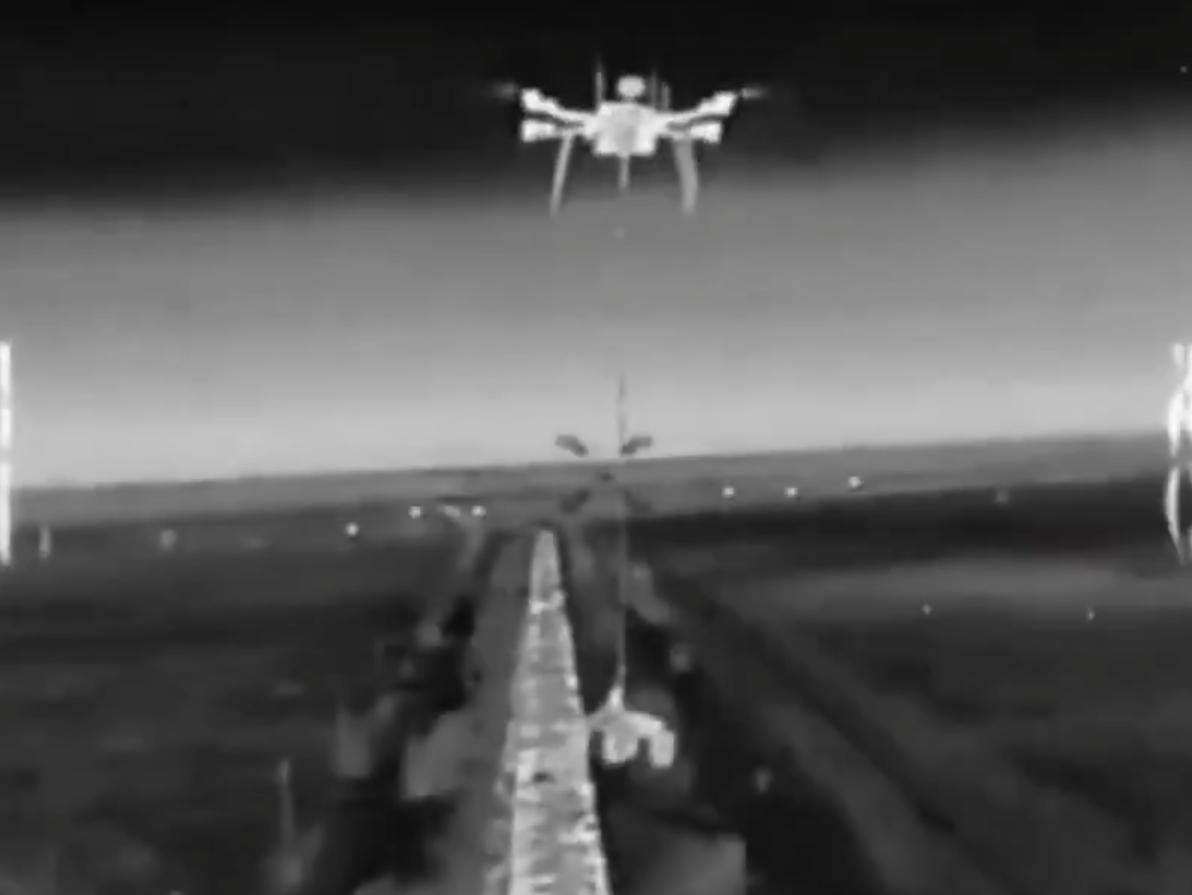
Rubicon's fiber optic FPVs wreaked havoc on Ukrainian forces in the Kursk salient, damaging or destroying hundreds of trucks and other vehicles in the span of a few weeks. Starving for supplies and in danger of being cut off, the Ukrainians retreated.
But the Russian adaptation was just beginning. The Russians are now launching 10,000 FPVs a day. And in certain key sectors, 60% of the FPVs were fiber optic models, according to Tatarigami. The Ukrainians can shoot down these drones and block them with armor, nets and earthworks. They can also strike at the Russian FPV teams before the Russians can launch their FPVs.
But there's one thing the Ukrainians can't do: they can't jam the drones.
Over the past six months, SBS has been able to narrow the drone usage gap. They started at 1 for every 3 Russian drones in February, after russia spiked to 9K strikes and are running at 1 for every 2 by August. pic.twitter.com/9GWrU0fx4W
Jamming continued to work against many one-way attack drones that must travel hundreds or even thousands of kilometers—too far for optical fiber. Another turning point came in February, when Elon Musk's Starlink bricked Russia's thousands of smuggled and stolen satellite terminals, some of which Russian forces used to control the approximately 5,000 Geran attack drones they launch every month.
The Starlink shutdown compelled Russian developers to accelerate the transformation of the one-way attack drone force. "Russia's second adaptation was mesh networking, routing data through mesh modems to keep communications alive across both short and long-range drones," Tatarigami explained.
It's possible to jam a mesh radio network, but it's hard. Every drone in a given network is a node. It's not enough to jam a few of them; you have to jam all of them.
Chart: Euromaidan Press
If there's a constraint on Russia's switch to fiber optics and mesh networks, it's that Russian industry can't produce all the necessary hardware. "Unable to meet domestic demand, Russia turned to China," Tatarigami wrote.
The Washington Postreported Chinese optical fiber shipments to Russia growing from 119,000 miles in May 2025 to 328,000 miles that August. China sent Ukraine 72 miles the same month. For mesh networking, the Russians came to depend on XK-F358 modems from China's Shenzhen Xingkai Technology.
Ukraine's overstretched air defenses can't shoot down every Russian attack drone. Ukrainian troops and vehicle crews can't hide from 10,000 Russian FPVs a day. To defeat Russia's jam-proof drones, Ukraine and its allies must cut off the supply of Chinese parts, Tatarigami stressed.
They should extend export controls to modem-makers and producers of optical fiber, reels for the fiber and equipment associated with fiber production. "The recommendation is to expand sanctions beyond individual firms to the entire supply chain," Tatarigami advised.
Ukraine has a new deep strike drone
The Bravo has an unusual shape for a drone, with a blended wing and body
The shape confers greater efficiency, and thus greater range and payload, at certain speeds
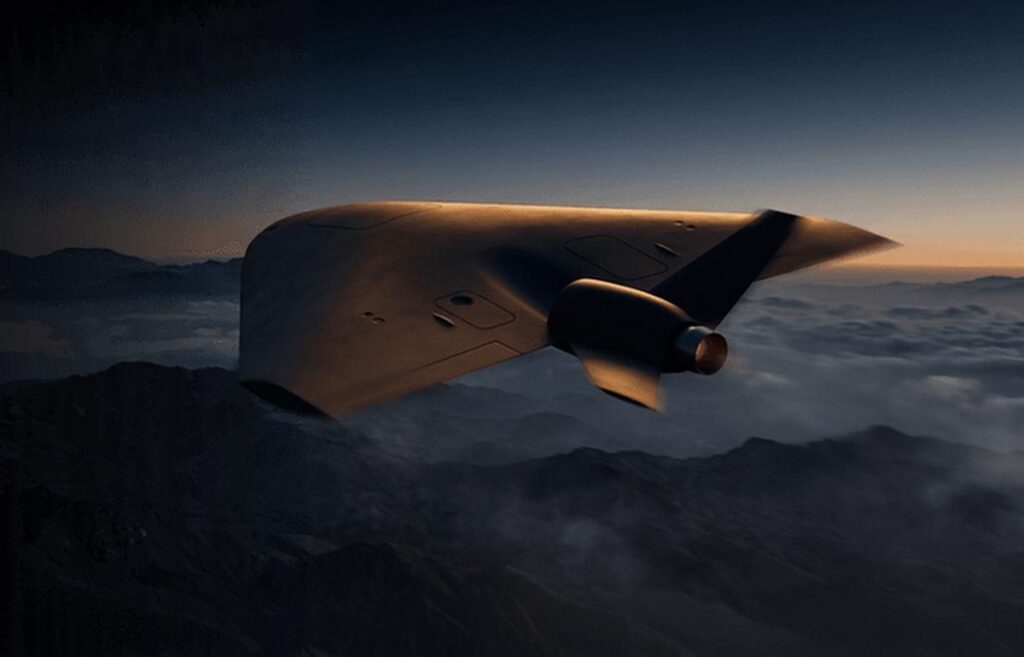
Ukraine's latest deep strike drone is one of a kind. The Triada Robotics Bravo features a "blended wing body" design that's rarely seen on a drone. The special platform maximizes lift and minimizes drag, helping the drone fly farther for a given speed and payload
The Bravo has an unusual shape for a drone, with a blended wing and body
The shape confers greater efficiency, and thus greater range and payload, at certain speeds
Ukraine's latest deep strike drone is one of a kind. The Triada Robotics Bravo features a "blended wing body" design that's rarely seen on a drone. The special platform maximizes lift and minimizes drag, helping the drone fly farther for a given speed and payload than a conventional "tube and wing" drone can do.
A stubby jet drone appeared fleetingly in a video shot from the ground during a strike on the Ufa refinery cluster in Bashkortostan on 2 August, more than 1,700 km from the Ukrainian border. Ukrainian forces hit the three Bashneft plants at Ufa on 1, 2, and 5 August.
Ukraine's drones hit Bashneft refineries in Ufa. Map: Euromaidan Press
No official body has identified the aircraft in the footage. Online observers compared the silhouette to the American F-117 Nighthawk; the outline is also consistent with the renders Triada publishes of the Bravo. The clip runs a few tenths of a second.
Everything that has reached that deep into Russia until now has been propeller-driven, plodding along at less than 200 km/hr. A jet Bravo cruising at 600 km/hr covers the same 1,700 km in under three hours instead of nine and a half. That is the difference between an air defense network with all morning to work out where a drone is going and one with a couple of hours.
Exactly what the drone in the video was aiming for, and whether it struck its target, is unclear. But that's not stopping Russian observers from panicking. "Shooting down a drone is practically impossible," one Russian blogger moaned.
It's untrue. Motoring along at 600 km/hr—Triada claims around 800 km/hr in the final phase of flight—the jet-propelled Bravo is neither the fastest Ukrainian deep strike munition nor the slowest. If Russian air defenses can take down 950 km/hr Fire Point FP-5 Flamingo cruise missiles, they can take down Bravos, too. Detecting one is a separate question: Triada says the Bravo's composite airframe reduces its radar cross-section.
Explore further
Russia just copied Ukraine’s cleverest drone hunter
But invulnerability surely wasn't the main goal when Kyiv-based Triada Robotics designed the Bravo over the past couple of years. Efficiency was the objective. Which is probably why the firm chose the blended-wing-body arrangement for the one-way explosive drone, which it lists at around 174,000 euros—roughly $200,000.
The blended shape "provides many different aerodynamic benefits over conventional aircraft design," Oliver Johnson and Sam Dakka wrote in a 2019 article in International Journal of Aviation, Aeronautics and Aerospace.
Most drones, like most manned aircraft, have the same layout: a tube-shaped body and separate wings jutting from the body. These tube-and-wing aircraft are the easiest to conceptualize and the most straightforward to assemble, as the fuselage and wing can be built independently and attached during production.
The problem is drag, especially at the junctures between body and wing. A draggier airframe suffers a range and speed penalty compared to a less draggy airframe.
An unidentified Ukrainian jet-powered drone was filmed during yesterday's attack on Russian territory.
It is believed to be either the Bravo drone developed by Triada Robotics, which reportedly has a range of up to 2,000 km, a 100–200 kg warhead, and a top speed of 650–700 km/h,… pic.twitter.com/3ZtweKwR6t
There are alternatives to tubes and wings. Flying wing aircraft such as the US Air Force's B-2 and B-21 stealth bombers, both built by Northrop Grumman, are all wing—and have neither an identifiable fuselage nor horizontal or vertical stabilizers. They look like boomerangs.
At subsonic speed, that shape is less draggy than a tube and wing shape is, and thus more efficient for long-range flight. At the same time, a flying wing's lack of sharp angles reduces its radar reflectivity. In short, it can be very stealthy and hard to detect on radar.
The downside of a flying wing is that it's unstable and requires sophisticated flight controls to keep it in the air.
A blended wing body shape is a kind of compromise between a flying wing design and a tube and wing design. There's a fuselage and a wing and stabilizers, but the fuselage and wing blend into each other. A blended wing body isn't as stealthy as a flying wing is, but it's easier to control.
Explore further
Ukraine’s AI drones hammer Russian supply lines. Russia’s $10,000 drone just got the same kit
And it's still less draggy than a tube-and-wing type. "The improvements increase the overall lift to drag ratio providing a higher performance aircraft saving 27% fuel burn per passenger mile that of the modern conventional configuration," Johnson and Dakka wrote.
That benefit is apparent in the Bravo's performance specifications. The drone reportedly ranges 2,000 km with a warhead of 100 to 200 kg and AI-assisted targeting, flying as high as 5,000 m. It's unclear how the Bravo navigates, but it's probably via some combination of satellite and inertial systems.
It's an impressive set of stats. A $50,000, propeller-driven Fire Point FP-1 ranges slightly farther—2,300 km—but the FP-1 cruises at just 180 km/hr and packs a 60-kg warhead. The Bravo is more than three times as fast and carries at least half again as much explosive, and possibly triple, while still flying far enough to reach deep inside Russia.
Yes, the Bravo costs four times as much as the FP-1 does, probably in part because of the jet propulsion, but that could change if Triada Robotics can scale up production. Co-founder Artem Veselov has said the company aims for a first pre-series batch of 100 by the end of the year. For now, the Bravo is a rarity. But it may become much more common in the sky over Russia in the coming months.
🎧 Édition du 6 aout 2026 :– Google Assistant disparaît d’Android le 4 septembre– BMW affiche une publicité dans ses véhicules– OnePlus n’a plus de téléphones à vendre en Amérique du Nord– Disney ouvre ses personnages aux créateurs TikTok– Mauvais conseil pour refroidir les téléphones « 120 secondes de Tech », un regard sur le quotidien de l’actualité […]
🎧 Édition du 6 aout 2026 :– Google Assistant disparaît d’Android le 4 septembre– BMW affiche une publicité dans ses véhicules– OnePlus n’a plus de téléphones à vendre en Amérique du Nord– Disney ouvre ses personnages aux créateurs TikTok– Mauvais conseil pour refroidir les téléphones « 120 secondes de Tech », un regard sur le quotidien de l’actualité […]
🎧 Édition du 5 aout 2026 :– Samsung bat un record avec ses téléphones pliables– Fitbit synchronise enfin ses données avec Apple Santé– Apple prépare un copier-coller entre iPhone et Windows– Spotify dépasse les 300 millions d’abonnés payants– La prochaine Xbox miserait sur la rétrocompatibilité totale « 120 secondes de Tech », un regard sur le quotidien de […]
🎧 Édition du 5 aout 2026 :– Samsung bat un record avec ses téléphones pliables– Fitbit synchronise enfin ses données avec Apple Santé– Apple prépare un copier-coller entre iPhone et Windows– Spotify dépasse les 300 millions d’abonnés payants– La prochaine Xbox miserait sur la rétrocompatibilité totale « 120 secondes de Tech », un regard sur le quotidien de […]
Ukrainian industry is working hard on new ballistic missiles
Lobbing ballistics at Moscow and other Russian cities, Ukrainian forces would force Russian commanders to choose
The choice: deploy their best S-400 air defense batteries to defend against ballistics, or keep aiming them at Ukrainian cities
It's possible Ukrainian forces launched a new type of ballistic missile at Moscow on 1 July. The apparent Ukrainian missile, which air defenses reportedly shot do
Ukrainian industry is working hard on new ballistic missiles
Lobbing ballistics at Moscow and other Russian cities, Ukrainian forces would force Russian commanders to choose
The choice: deploy their best S-400 air defense batteries to defend against ballistics, or keep aiming them at Ukrainian cities
It's possible Ukrainian forces launched a new type of ballistic missile at Moscow on 1 July. The apparent Ukrainian missile, which air defenses reportedly shot down over the Russian capital, is a harbinger of things to come.
Ukraine is developing several new ballistic missiles with the range to reach Moscow, 500 km from the border with Ukraine. If and when they begin raining down on Russian cities, gas facilities, factories and refineries, Russia may have to change the way it fights.
The Russians might have to aim their best S-400 air defense batteries into the sky, instead of aiming them at the ground. For Ukraine, that could mean some respite from relentless Russian missile strikes. After all, S-400s doubling as surface-to-surface munitions are in the mix most nights when Russia bombards Ukraine.
"Ballistic missiles force a different problem on Russia," wrote Michael Bohnert, an analyst for California think tank RAND.
The coming shift comes down to speed. Where one-way attack drones and many cruise missiles are slow—often motoring along at just a few hundred kilometers an hour—and are thus fairly easy to shoot down, ballistic missiles are fast.
Explore further
Ukraine’s ballistic missile may have reached Moscow. The damage wasn’t the point.
They're all supersonic, traveling at least the speed of sound. Heavier ballistic missiles may even be hypersonic. That is, capable of reaching five times the speed of sound.
The same air defenses that swat down incoming drones can't stop ballistic missiles. Only the best air defenses stand any chance of hitting an incoming ballistic missile. Ukraine's main defense against Russian ballistic missiles is its six or so US-made Patriot batteries; for Russia, the main defense against the coming Ukrainian ballistics will be the roughly 50 S-400 batteries.
Keenly aware of the deep strike dynamics, the Russians are pivoting away from easy-to-kill drones toward hard-to-kill ballistics. This is a serious problem for Ukrainian air defenses, which are desperately short of missiles for their Patriot batteries owing to the Americans' reluctance to sell or donate missiles. US forces are struggling with their own air defense shortfalls resulting from the on-again, off-again war with Iran.
In one wave of Russian attacks on 6 July, Ukrainian air defenses shot down 326 out of 351 incoming Geran drones and 37 of 39 incoming subsonic cruise missiles. But the Russians also launched six supersonic anti-ship missiles and 23 ballistic missiles. Every single one got through, wreaking havoc across Kyiv. At least 22 people died in the capital and the surrounding oblast, and 90 more were injured.
A Patriot MIM-104 air defense system in service with a unit of Air Defense Forces West, 10 April 2026. Photo: Air Command West, Ukrainian Air Force
Deep strike disparity
At present, Ukraine can't match these strikes. Yes, the Ukrainians can launch lots of one-way attack drones. In fact, far more drones than Russia can launch. And the Ukrainians also have a reliable subsonic cruise missile in the form of the Fire Point FP-5. But Ukraine doesn't yet have a fully operational ballistic missile in the class of the Russian Iskander or S-400 (in its surface strike mode).
That's about to change, of course. The apparent 1 July ballistic missile strike targeting Moscow was just a preview of a wider Ukrainian campaign. Fire Point co-founder and chief engineer Denys Shtilierman has circulated what he claimed was test footage of a new ballistic missile, possibly the 855-km FP-9, and hinted that strikes on Russian soil could begin soon.
Soon has a season attached to it now. Fire Point CEO Iryna Terekh told The War Zone the company is casting the FP-9's solid-fuel engine—4.6 tons of propellant, more than four times what the smaller FP-7 carries—and that everything else on the missile is finished. "It's the last touch on the engine, and we are ready to start," she said, putting the first test launch in the autumn. Shtilierman told interviewer Dmytro Gordon on 27 July that strikes on Russia could begin as early as this autumn, too.
If FP-9s begin bombarding Moscow, Russian commanders might not have the luxury of using many, or any, of their S-400s for surface strikes.
Explore further
A $50 computer just flew Russia’s newest jet drone into a Ukrainian grain ship—and jamming couldn’t stop it
Every month, Russian industry produces approximately 40 missiles for S-400s batteries. If Ukraine can fling a few dozen FP-9s or similar missiles at Russian targets every month, Russia would have to devote its entire S-400 capability to air defense just to blunt the bombardment. After all, it usually takes several missiles in the class of a Patriot or S-400 to hit one incoming ballistic missile.
"Russia would have to choose," Bohnert wrote. Either "keep using the S-400 as a strike weapon and accept that hardened targets get hit, or return the system to its designed air-defense role."
If the Russians choose protection, they'll have somewhat fewer ballistic missiles to fling at Kyiv and other Ukrainian cities. That should take some pressure off Ukraine's own overstretched air defenses.
🎧 Édition du 4 aout 2026 :– Sony défend l’avenir tout numérique de la PlayStation 5– Starlink pousse un pionnier du satellite à la faillite– Bluesky veut bâtir un réseau social ouvert à grande échelle– DuckDuckGo lance des lunettes… sans technologie– Apple préparerait de nouveaux AirPods Pro– Une fuite révèle le Lenovo Googlebook 15 « 120 secondes […]
🎧 Édition du 4 aout 2026 :– Sony défend l’avenir tout numérique de la PlayStation 5– Starlink pousse un pionnier du satellite à la faillite– Bluesky veut bâtir un réseau social ouvert à grande échelle– DuckDuckGo lance des lunettes… sans technologie– Apple préparerait de nouveaux AirPods Pro– Une fuite révèle le Lenovo Googlebook 15 « 120 secondes […]
🎧 Édition du 3 aout 2026 :– L’Europe impose plus de transparence sur l’IA– Microsoft met en garde contre les Wi-Fi publics– Google élargit Gemini Spark– Google suspend Nano Banana dans Google Earth– Les jeunes Australiens toujours sur les réseaux sociaux « 120 secondes de Tech », un regard sur le quotidien de l’actualité numérique proposé par Bruno […]
🎧 Édition du 3 aout 2026 :– L’Europe impose plus de transparence sur l’IA– Microsoft met en garde contre les Wi-Fi publics– Google élargit Gemini Spark– Google suspend Nano Banana dans Google Earth– Les jeunes Australiens toujours sur les réseaux sociaux « 120 secondes de Tech », un regard sur le quotidien de l’actualité numérique proposé par Bruno […]
🎧 Édition du 31 juillet 2026 :– Gemini devient un assistant vocal sur Mac– LinkedIn cible le contenu IA médiocre– Google Earth accueille Nano Banana– Waymo ajoute Gemini à ses robotaxis– Microsoft prépare une super application Copilot « 120 secondes de Tech », un regard sur le quotidien de l’actualité numérique proposé par Bruno Guglielminetti Le partenaire de […]
🎧 Édition du 31 juillet 2026 :– Gemini devient un assistant vocal sur Mac– LinkedIn cible le contenu IA médiocre– Google Earth accueille Nano Banana– Waymo ajoute Gemini à ses robotaxis– Microsoft prépare une super application Copilot « 120 secondes de Tech », un regard sur le quotidien de l’actualité numérique proposé par Bruno Guglielminetti Le partenaire de […]
🎧 Édition du 30 juillet 2026 :– 1 200 experts réclament un ralentissement de l’IA– DoorDash obtient le feu vert pour ses drones– Les travailleurs consultent l’IA avant leurs collègues– Gemini arrive dans Google Docs– YouTube gagne des vues, perd l’attention « 120 secondes de Tech », un regard sur le quotidien de l’actualité numérique proposé par Bruno […]
🎧 Édition du 30 juillet 2026 :– 1 200 experts réclament un ralentissement de l’IA– DoorDash obtient le feu vert pour ses drones– Les travailleurs consultent l’IA avant leurs collègues– Gemini arrive dans Google Docs– YouTube gagne des vues, perd l’attention « 120 secondes de Tech », un regard sur le quotidien de l’actualité numérique proposé par Bruno […]
Grammarly, a company with Ukrainian roots, announced its intent to acquire AI email writing app Superhuman as part of its expansion into an AI productivity platform, the company said in a press release on July 1. Grammarly is the most valuable company with Ukrainian roots, reaching $13 billion valuation as of 2021. Grammarly was founded in 2009 in Kyiv by Oleksii Shevchenko, Maksym Lytvyn, and Dmytro Lider.According to Grammarly's press release, email is Grammarly's top use case, with the platfo
Grammarly, a company with Ukrainian roots, announced its intent to acquire AI email writing app Superhuman as part of its expansion into an AI productivity platform, the company said in a press release on July 1.
Grammarly is the most valuable company with Ukrainian roots, reaching $13 billion valuation as of 2021. Grammarly was founded in 2009 in Kyiv by Oleksii Shevchenko, Maksym Lytvyn, and Dmytro Lider.
According to Grammarly's press release, email is Grammarly's top use case, with the platform editing over 50 million emails weekly.
Superhuman is an AI email application that the company says helps users respond to emails faster and reduces time spent on email communications.
Users are already sending and responding to 72% more emails per hour after using Superhuman compared to the previous period, according to Grammarly.
"This is the future we've been building toward since day one: AI that works where people work, not where companies want them to work," said Shishir Mehrotra, Grammarly's CEO.
The acquisition follows Grammarly's recent purchase of Coda, a productivity tool company. The combined platforms will allow users to work with multiple AI agents for different tasks within email communications.
Grammarly says that its service is used daily by over 40 million users, generating annual revenue of more than $700 million for the company.
Russia has the capacity to launch as many as 500 Iranian-designed Shahed attack drones at Ukraine in a single attack, but doing so on a daily basis is not possible, Ukraine's military intelligence chief Kyrylo Budanov said on July 2, according to Suspilne.In recent weeks, Russia has intensified its drone assaults on Ukrainian cities, often launching hundreds in a single day. The largest aerial attack since the start of the full-scale invasion occurred overnight on June 29, when Moscow launched 4
Russia has the capacity to launch as many as 500 Iranian-designed Shahed attack drones at Ukraine in a single attack, but doing so on a daily basis is not possible, Ukraine's military intelligence chief Kyrylo Budanov said on July 2, according to Suspilne.
In recent weeks, Russia has intensified its drone assaults on Ukrainian cities, often launching hundreds in a single day. The largest aerial attack since the start of the full-scale invasion occurred overnight on June 29, when Moscow launched 477 drones and 60 missiles across Ukraine.
"Launching 450–500 Shaheds every day — it's just not realistic," said Budanov during a ceremony recognizing five Ukrainian intelligence achievements in the national record book, according to public broadcaster Suspilne.
"But unfortunately, they do have the ability to do it periodically. They can realistically launch up to 500 in one strike," Budanov added.
Budanov also said Russia is upgrading the capabilities of the Shahed-type drones by improving their CRPA (Controlled Reception Pattern Antenna) systems, which protect the drones from GPS jamming. He noted that Russian engineers are now producing 16-channel CRPA antennas, which are harder to counter electronically.
Russian drones launched against Ukraine by month (Nizar al-Rifai/The Kyiv Independent)
"These antennas are currently produced in Russia, but the engineer who developed this CRPA antenna was here in Ukraine," Budanov said.
"Back in the early 2000s, no one here needed it, so the engineer moved to Russia. One (of the two engineers involved in the development) has already died under unclear circumstances. The other is still alive, though probably not for long."
Russia has used thousands of Shahed-type drones throughout its full-scale invasion to strike Ukrainian cities and infrastructure, often in large overnight waves. Ukrainian air defenses have adapted over time but face growing challenges as Moscow improves drone resilience and electronic warfare capabilities.
President Volodymyr Zelensky said that Moscow has launched 28,743 Shahed-type drones at Ukraine since the start of Russia's full-scale invasion.
Budanov also said Russia has made unsuccessful attempts to develop its own naval drones. The last known effort came in early June, when experimental models detonated before reaching Ukrainian territorial waters, he said.
"They didn't achieve results. Based on our information, they were heading toward the city of Yuzhne, searching for targets," he said.
Ukraine has been using domestically developed Magura naval drones to target Russian military assets in the Black Sea, keeping much of Russia's fleet pinned in port.
Despite their small size, the unmanned surface vessels have proven effective, including in a May 2 operation when Ukraine's military intelligence used Magura-7 drones armed with air-to-air missiles to shoot down two Russian Su-30 fighter jets near Novorossiysk. It was the first recorded instance of fighter jets being downed by naval drones.
The Defense Ministry has approved the Ukrainian-made ground-based robotics complex "Murakha" ("Ant") for combat operations, the ministry announced on June 28. Since 2024, Ukraine has been scaling up robotics development in hopes that mass production of unmanned ground vehicles (UGVs) will "minimize human involvement on the battlefield." The Murakha is a tracked robotic platform designed to support front-line units working under challenging conditions, such as under enemy artillery and in heavily
The Defense Ministry has approved the Ukrainian-made ground-based robotics complex "Murakha" ("Ant") for combat operations, the ministry announced on June 28.
Since 2024, Ukraine has been scaling up robotics development in hopes that mass production of unmanned ground vehicles (UGVs) will "minimize human involvement on the battlefield."
The Murakha is a tracked robotic platform designed to support front-line units working under challenging conditions, such as under enemy artillery and in heavily mined terrain, the Defense Ministry said.
Its larger size makes it one of Ukraine's leading UGVs in terms of load capacity. The Murakha can reportedly carry over half a ton of weight across dozens of kilometers. It can also cross difficult terrain and shallow water.
According to the Defense Ministry, the Murakha's multiple control channels allow it to function successfully even in areas of the battlefield where Russian electronic warfare (EW) systems are operating.
Mobile robots are capable of performing several tasks on the battlefield, including offensive and defensive activities, evacuation of the wounded, logistical support for units, and mining and demining.
In April, the Defense Ministry unveiled the D-21-12R UGV, a ground-based robot equipped with a machine gun.
The European Commission has proposed that Ukraine join the European Union's mobile roaming area starting January 1, 2026, providing Ukrainian users the ability to make phone calls, texts, and use mobile data in the bloc's 27 countries at no extra charge. "We want Ukrainian citizens to stay connected to their loved ones across the EU, as well as in their home country. That's why we propose that Ukraine join our roaming family," European Commission President Ursula von der Leyen said in a statemen
The European Commission has proposed that Ukraine join the European Union's mobile roaming area starting January 1, 2026, providing Ukrainian users the ability to make phone calls, texts, and use mobile data in the bloc's 27 countries at no extra charge.
"We want Ukrainian citizens to stay connected to their loved ones across the EU, as well as in their home country. That's why we propose that Ukraine join our roaming family," European Commission President Ursula von der Leyen said in a statement.
The proposal, first announced on June 16, will serve as a means of integration into the European Union's "Roam like at Home" provision in affect between all EU nations. The proposed change will impact the over four million Ukrainian refugees living in the EU.
Ukraine's full integration in the roaming provisions will replace voluntary measures that "allowed for roaming without surcharges and affordable international calls for EU and Ukrainian citizens abroad," according to the European Commission. The current measure will extend to December 31, 2025, ahead of the planned integration.
If approved, Ukraine will become the only country outside of the EU to join the bloc's "Roam like at Home" policy.
The move, which awaits European Council approval, comes as Ukraine continues to implement reforms in pursuing membership in the European Union.
Ukraine applied for EU membership at the onset of Russia's full-scale invasion in 2022. The country has made quick progress, achieving candidate status within months, with the initial negotiations formally launching in June 2024.
Since the start of 2025, Ukraine has opened three negotiation clusters under Poland's rotating presidency.
Poland lead the EU Council's presidency until June, and Denmark will take over the role in July. Ukraine aims to open the remaining three negotiation clusters in the second half of 2025 under the Danish chairmanship, the President Volodymyr Zelensky said.
There are six accession negotiation clusters, consisting of several individual chapters. Negotiations prepare a candidate country to become an EU member.
The EU’s Commissioner for Enlargement, Oliver Varhelyi, said that Ukraine could potentially join the bloc by 2029 if it successfully implements necessary reforms.

 Connexion

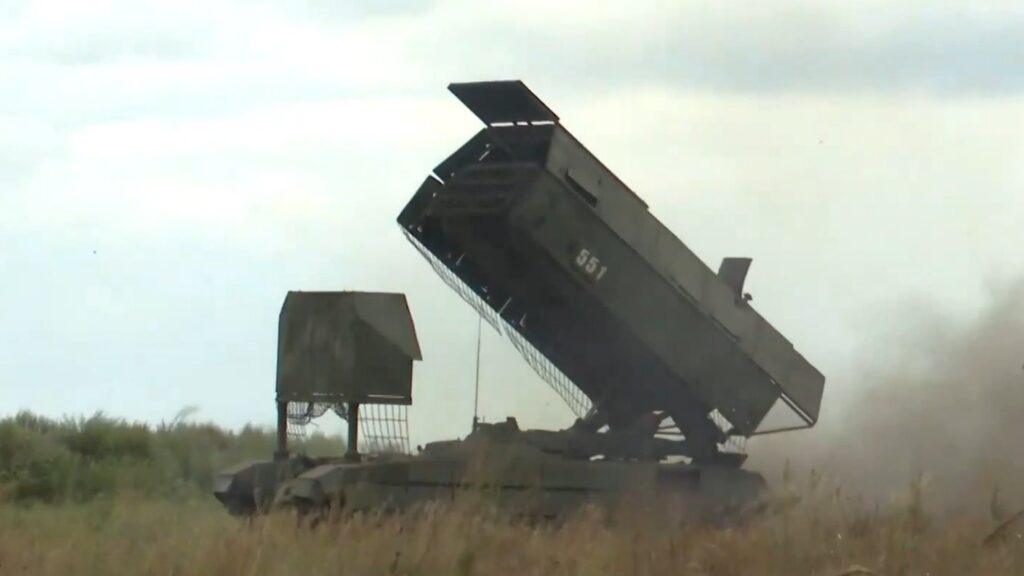

 The
The  Ukrainian military from the 92nd separate assault brigade destroyed the
  Russian 220-mm heavy flamethrower system TOS-1A "Solntsepek" using an FPV kamikaze drone
  MilitaryNewsUA

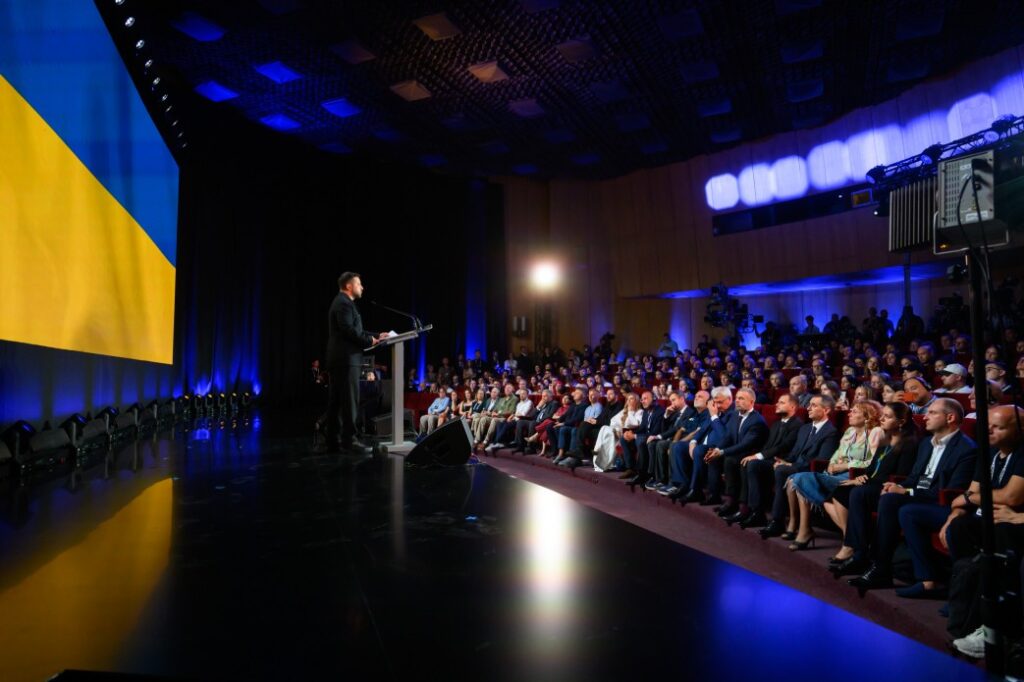
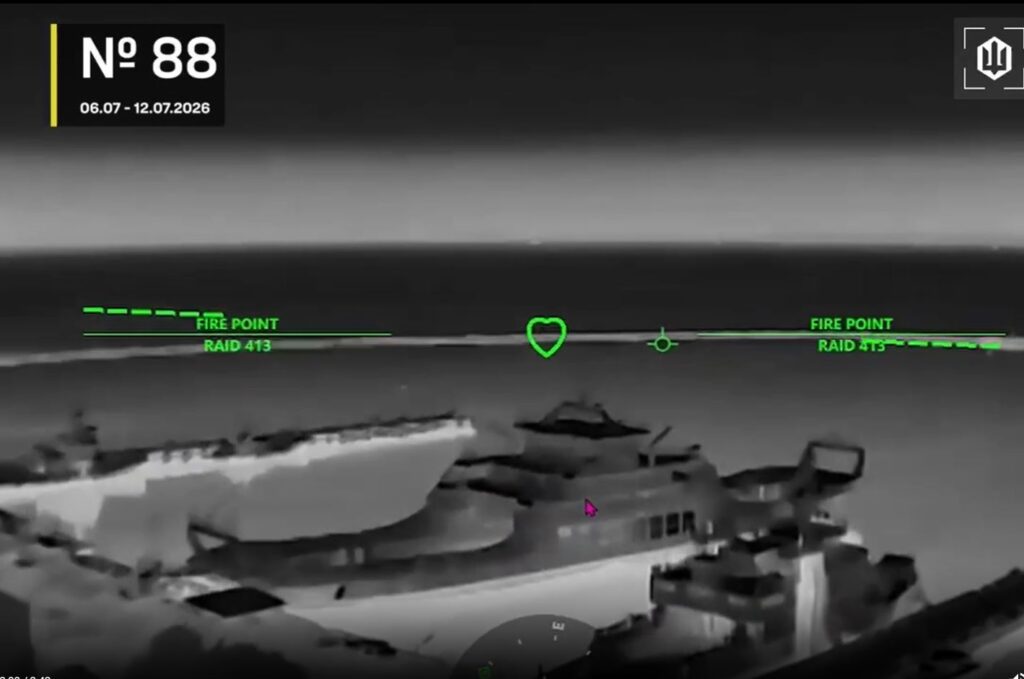


 (@AMK_Mapping_)
  Russian voenkors publishes satellite images from the Starokostiantyniv area!
 The photo shows craters from missiles that did not reach their targets. In some cases, the Kinzhals' deviation was up to 144 meters.
  (@Maks_NAFO_FELLA)