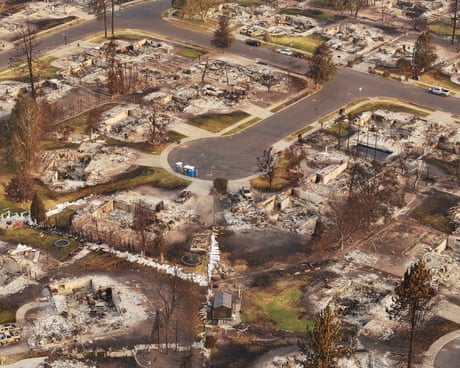
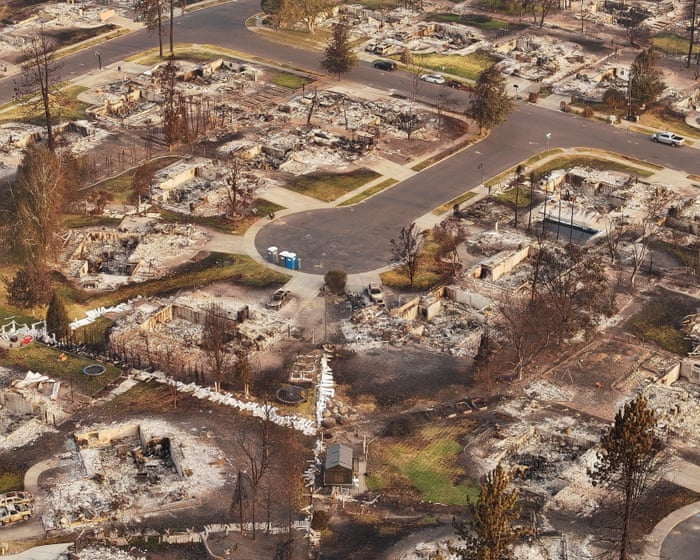
Nearly 600 days after the devastating 2025 fires, thousands of Los Angeles residents are still waiting for more than $15bn in federal funds to rebuild their communities
As thousands of residents in Spokane, Washington, begin to grapple with a long recovery after a destructive set of blazes that consumed hundreds of homes in the state’s second most populated city this month, victims of the Los Angeles firestorm broke a grim record – they have faced the longest delay in modern history for federal aid.
Nearly 600 days since a historic firestorm roared into communities across Los Angeles, reducing more than 16,000 structures to ash and toxic debris, the Trump administration has failed to appropriate more than $15bn in long-term recovery funds that are crucial to rebuilding. The delay in supplying the badly needed funds is months longer than the last record set when victims of the Maui fires had to wait 500 days to receive the support, LAist noted this week.
Climber, stuck on 6in ridge, had veered off treacherous path and ‘any fall would almost certainly be fatal’
An ill-fated move left a man stranded on a 6in ledge over 10,000ft off the ground for hours in California’s Sierra Nevada mountain range, before a volunteer rescue team came to his aid.
The climber, who has not been publicly identified, had been scaling the Mendenhall couloir, a gully on the face of Laurel mountain, with a friend on Saturday.
A wind farm turbine off the coast of Block Island, R.I., in 2023. California was an early adopter of wind power, but offshore wind farms have so far been developed only on the East Coast.
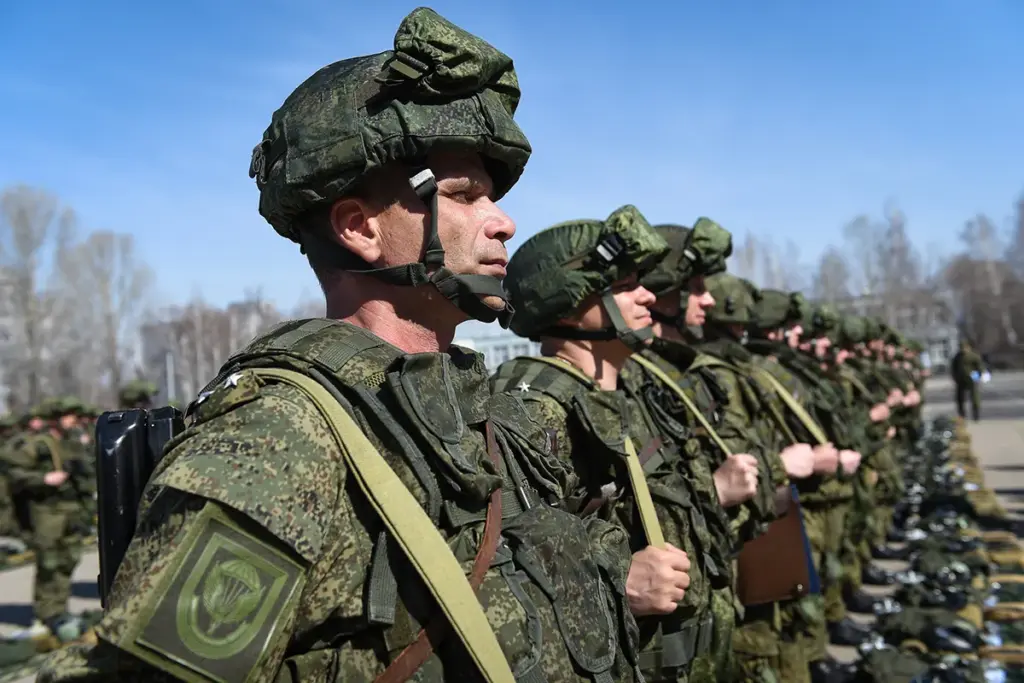
Russia is looking for its next foreign recruits in Indonesia, Kyiv says. Ukraine's Foreign Intelligence Service reports that it has obtained documents on at least eight Indonesian citizens recruited into the Russian occupation army.
Russia has recruited at least 27,000 foreign nationals from more than 130 countries since February 2022, a joint report by the International Federation for Human Rights and Truth Hounds found in April, separate from roughly 14,000 North Korean troops. Up to 20% of these fighters do not survive the first four months.
The scheme runs on false promises
"The scheme by which Moscow seeks foreign cannon fodder has already been tested on dozens of other countries," the Foreign Intelligence Service said.
Recruiters offer high pay, non-combat work, fast-tracked Russian citizenship, and social guarantees, drawing in people who often have no idea where they are actually being sent, the service said. The same model worked earlier on citizens of Nepal, Cuba, Kenya, and India, and most ended up on the front line without training, with some dying in the first weeks.
Recruitment fills three needs at once
Each foreigner serves several functions for the Kremlin, the service said. A recruit fills a personnel gap at the front and doubles as propaganda about supposed global support for the war.
The third driver is domestic. Discontent over the economy, the war, and plans for a new wave of mobilization has cut the number of Russians willing to sign contracts, bringing dissatisfaction to 69 percent.
The pattern is widening by design
Indonesia is the latest example of Russia's system to fight with its hands of foreign mercenaries.
"Indonesia, the world's largest Muslim country with a population of over 280 million, has joined the list of countries that have become the Kremlin's latest market for cheap human labor for the war," the service said.
A Ukrainian ground robot used to run 12-15 missions. Near Kupiansk, it now survives three or four. The lifespan is collapsing under the denser Russian FPV drone and mining fire, Andrii Kopach, call sign "Matematyk", who commands a ground-robot unit in the "Lava" unmanned regiment of the "Khartia" corps, told Oboronka.
Ground robots have become a daily part of the front in Ukraine. Ukrainian units ran 16,676 logistics, strike, and evacuation missions with them in June, up 122 percent since January, and the military has contracted more than 22,000 for 2026, nearly double the 2025 total. That scale runs into a wall at the front, where Russia now assigns FPV crews, including fiber-optic drones, specifically to kill the robots.
The lifespan keeps shrinking
The pace of technological change is the core problem, Matematyk said. Ukrainian makers keep improving the platforms, but cannot always keep pace with how quickly the fighting evolves.
A machine may last only three or four missions now, as in Kharkiv Oblast, where it was eight or nine before and 12 to 15 earlier still, he said. Mining, Russian fiber-optic activity, FPV activity, and a targeted focus on countering robots all drive the decline.
Speed is the missing requirement
Most robots at the front are technologically outdated in speed and suspension, Matematyk said. Current figures of 10 to 15 kilometers per hour no longer allow a machine to cross logistics routes safely.
He put the problem in an image. Gun-armed combat robots, he said, are "Persian elephants", fearsome but so slow to reach the objective that "a couple of centuries" pass first. What the army needs are "Arabian steeds" that gallop in, do the job, and gallop back.
AI defense is in development
Ukrainian troops are working with Brave1 and the Digital Transformation Ministry on AI-based active-protection systems that could autonomously detect and neutralize enemy FPVs, Matematyk said. The approaches vary, from a camera to a mini-radar to a camera paired with sound.
The countermeasures could be net launchers, or for fast machines, shotgun blasts and shrapnel, he said. The detection and response are trained on models built from the data his unit has logged over previous years. Ukraine still holds a quality edge over Russian robots through better Starlink-based communications and decentralized robot groups in its units, he added.
There is little sign that public exhaustion, economic headwinds or increased Ukrainian strikes are changing the Russian leader’s view that he will eventually achieve victory.
The proposed land swap would allow easy access to the crown jewel of the national park system. Democrats and former Park Service officials are incensed.
Nevada-based Kingsbarn Realty Capital seeks to acquire land to construct private road to development outside park
The Trump administration is reportedly pushing to give a parcel of land inside Yosemite, the country’s first national park and one of its most popular, to a Nevada-based private developer.
Staff with the National Park Service have been exploring how the agency can give a quarter-mile parcel to a company operated by Kingsbarn Realty Capital, the news outlet Notus reported on Friday, citing agency documents and unnamed sources “directly familiar with discussions”.
In July, most of Ukraine’s grain left through its Black Sea ports. From 1 to 26 August, after Russian attacks sharply reduced ship traffic, Ukraine exported just 1.42 million tons of agricultural products—about a third of its potential volume. Rail and the Danube carried about 600,000 tons each, Agriculture Minister Taras Vysotskyi said.
The locomotives carrying that cargo are now among Russia’s main targets.
Ukraine now expects to export 38–40 million tons of grain in the 2026/27 season, down from 43 million before the attacks intensified, Agriculture Minister Taras Vysotskyi told Reuters. Agricultural products generated more than half of the country’s export revenue last year.
By 24 August, the total number of damaged locomotives had risen to 492.
Russia now sends camera-equipped drones to search for trains and redirects others toward rolling stock that their operators spot in flight. The campaign is no longer confined to fixed targets such as stations, bridges, and substations.
Ukraine’s railways keep running. Damaged lines often reopen within hours, while buses carry passengers around closed sections. With far fewer ships calling at the ports, each damaged locomotive leaves the railway less room to absorb the next disruption.
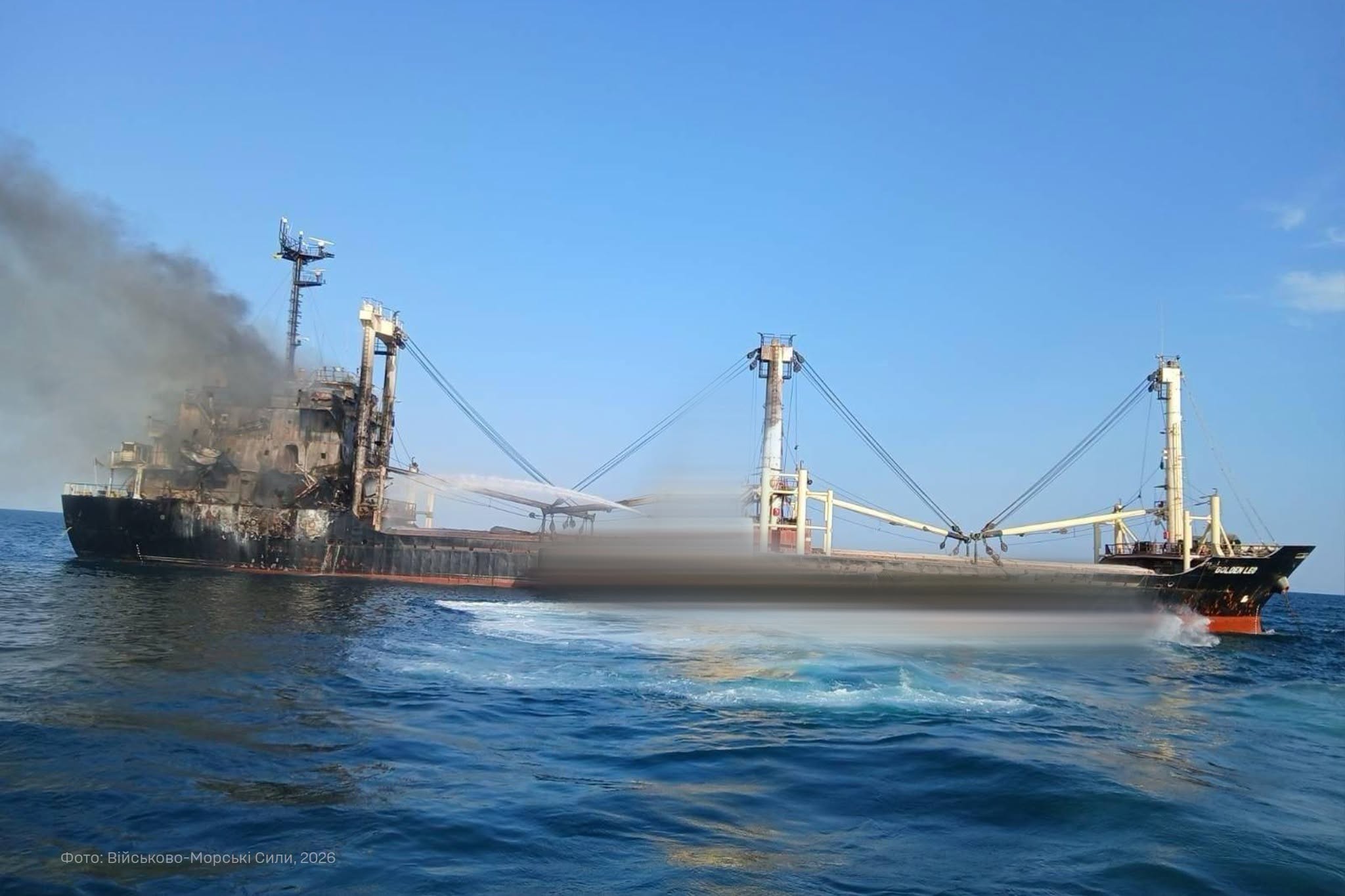
The civilian bulk carrier GOLDEN LEO ablaze after Russian missiles hit it as it left Odesa with a cargo of corn, in the Black Sea, 19 July 2026. Photo: Ukraine’s Navy
Export traffic moves inland
Before the current wave of strikes, the ports of Greater Odesa handled about 80% of Ukraine’s agricultural exports. Rail’s share then rose sharply, but the railway did not carry more grain: Ukrzaliznytsia said 461,000 tons went by rail during the first 25 days of August—67% less than in July and 77% below the corresponding period last year, according to figures reported by Rail.insider. Rail had taken a larger share of a collapsing export flow.
Traffic through the Black Sea corridor collapsed after a series of attacks on civilian vessels in July. One of the deadliest strikes was on the bulk carrier Golden Leo on 19 July, killing 10 people, including a Ukrainian maritime pilot. The ship later sank. On 22 July, for the first time since the sea corridor opened, not a single vessel entered the Odesa ports.
Explore further
Ten dead as Russia strikes a Turkish-owned bulk carrier off Odesa
In July, 169 ships entered, but only 7 did so during the first 11 days of August, the Ukrainian Sea Ports Authority told Kyiv Post. By 24 August, traffic had partly recovered. Three or four ships were entering and leaving the ports of Odesa each day. However, cargo volumes remained three to four times lower than before the intensified attacks, President Volodymyr Zelenskyy pointed out.
Maerskand Hapag-Lloyd suspended feeder services to Greater Odesa in late July and early August, with Maersk rerouting imports to Constanța.
The attacks changed the calculations of shipowners and insurers, even though the ports remained formally open. The late-August recovery shows that Russia did not impose a total blockade, but commercial traffic remained far below its previous capacity.
Ukraine normally moves 4 to 4.5 million tons of farm goods a month; the National Bank of Ukraine estimated in July that alternative routes could initially carry about 2.5 million tons a month. That leaves part of the usual flow with nowhere to go this year—about $2.5 billion in export revenue delayed from the second half of 2026 to the first half of 2027.
The Agriculture Ministry estimates that elevators and grain warehouses with nearly 59 million tons of capacity could be full by early November, leaving an 11-million-ton storage shortfall by the end of autumn.
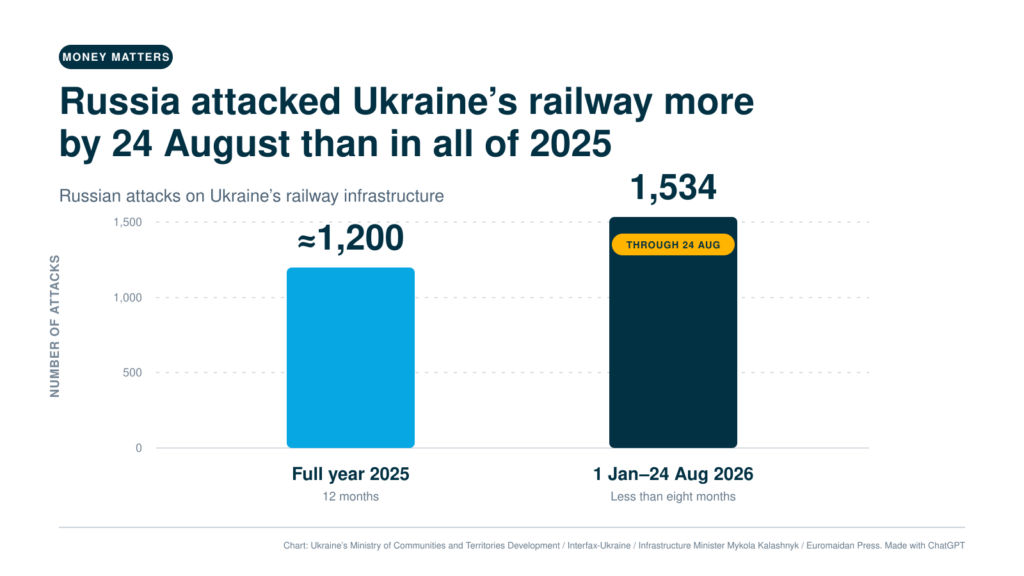
Russian attacks on Ukraine’s railway infrastructure reached 1,534 by 24 August 2026—already exceeding the 1,200 recorded in all of 2025. Chart: Ukraine’s Ministry of Communities and Territories Development / Interfax-Ukraine / Infrastructure Minister Mykola Kalashnyk / Euromaidan Press. Made with ChatGPT.
Russia turned the drones on the trains
Russia is going after locomotives to cut the export corridors that tie the industrial regions around Kryvyi Rih, Zaporizhzhia, and the east to Odesa’s ports and the western border, Ukrzaliznytsia CEO Oleksandr Pertsovskyi told Reuters in June. He also described the method: Russia is using drones with video cameras and remote control, which allow operators to hit rolling stock in real time.
The climb is in the quarterly data: nine locomotives hit in the first half of 2025, 119 in the second, and 81 in the first quarter of 2026.By 15 August, Pertsovskyi put the figure at more than 250 damaged in the previous six months.
In the first quarter alone, Russia struck the railway 541 times, about half its total for all of 2025, damaging 1,718 objects across the network. By 24 August, the number of attacks on railway infrastructure in 2026 had reached 1,534, Infrastructure Minister Mykola Kalashnyk said.
On 19 July, Russia’s Defense Ministry acknowledged a Geran-4 Seeker drone had struck a locomotive hauling Ukrainian military equipment near Volniansk in Zaporizhzhia Oblast the previous day, and released strike footage.
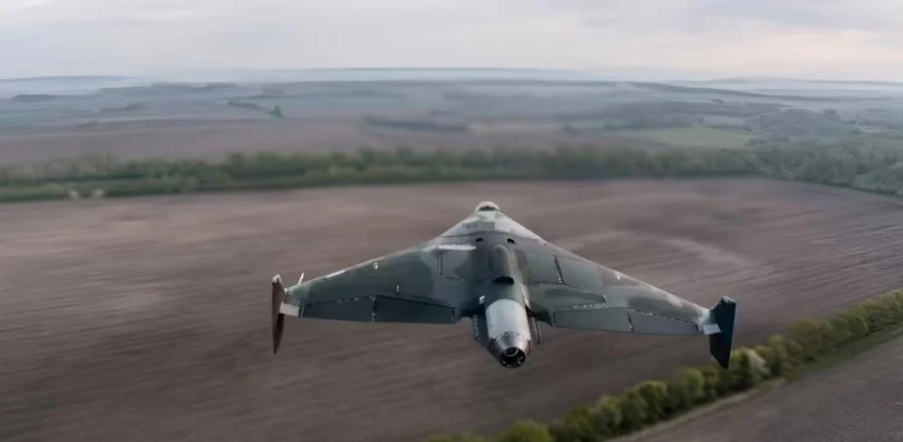
The Geran-4 Seeker sends video to an operator searching for targets. Once the operator selects one, onboard software guides the final approach. Russia says it has used the system against ships near Chornomorsk, but public evidence does not show how many locomotive strikes involved Seeker; moving trains can also be hit by hand-flown drones redirected in flight.
Explore further
A $50 computer just flew Russia’s newest jet drone into a Ukrainian grain ship—and jamming couldn’t stop it
Russia's new "Geran-4 Siker" Shahed variant uses machine-vision AI for targeting. Source: Warhronika
Jammers cannot protect every train
Ukraine has fitted trains with jammers, which Ukrainian drone and electronic-warfare specialist Serhii “Flash” Beskrestnovsays have protected a significant number of trains. But Russian drones use different frequency bands, so each train needs several systems, and even those cannot provide complete protection.
“Whatever we do, drones will periodically hit trains in the frontline zone,” Beskrestnov wrote in March. “As, unfortunately, they will hit buses and civilian cars.”
Seeker is not the only way to hit a moving train. Russian operators have repeatedly redirected hand-flown drones after spotting trains below, Beskrestnov wrote in April. He said military airspace data allows railway dispatchers to change schedules or evacuate passengers when necessary, and that several hundred trains had been moved out of danger.
The cost is not only rolling stock. On 13 August, a jet-powered Shahed struck the locomotive of the Odesa–Dnipro passenger train at Buialyk station in Odesa Oblast, killing the driver, Ivan Shevchyk, and his assistant, Vasyl Morozov, both of the Znamianka locomotive depot.
The monitoring team had flagged the drone and ordered a stop; the train was entering the station so its 340 passengers, 67 of them children, could get off. All of them were evacuated unhurt. “A sharp maneuver by a jet Shahed is a matter of minutes, and the locomotive crew did not have enough time to come to a full stop and evacuate themselves,” Pertsovskyi wrote.
Prosecutors opened proceedings under Article 438 of the criminal code, violation of the laws and customs of war, causing death.
Two days later, Ukrzaliznytsia changed its rules, increasing the distance at which a train is halted and evacuated when a threat appears—a decision Pertsovskyi tied to the growing number of jet drones. Eight railway workers had been killed in the preceding weeks, at Lozova and Erastivka stations and on the train at Buialyk.
Ukraine is going after the equipment that makes the operator’s link work. On 13 and 14 August, Ukrainian forces struck two ground-based relay stations near Zaliznyi Port in Kherson Oblast that transmit control signals between Russian operators and Geran and Gerbera drones, extending their range and steadying the connection, along with five UAV command posts.
Such relays extend the operator-controlled phase of Geran and Gerbera attacks, including variants that may switch to onboard guidance for the final approach.
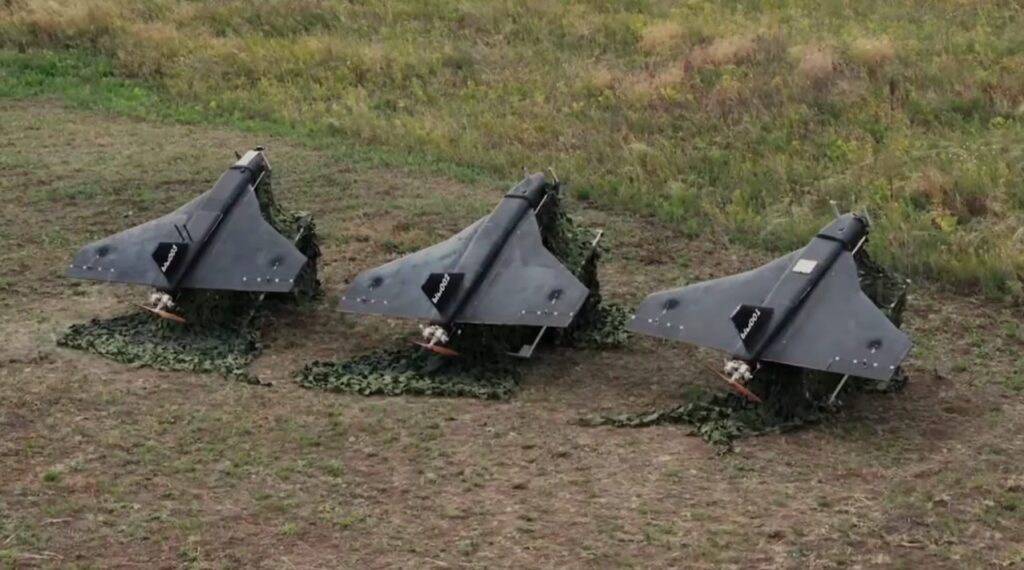
Russia's Gerbera drones. Photo: Gastello Design Bureau
Delays reveal resilience—and attrition
Russia has not carved the railway into islands. When seven drone strikes hit a junction between Dnipro and Zaporizhzhia in a single day on 30 January, wrecking locomotives, wagons, and track, trains were rerouted through Dnipro, and evening passengers were put on buses.
Freight was moving again within a day; passenger service stayed cut longer, judged too dangerous for civilians, Le Monde reported. Track and power lines are repaired quickly, and a diesel engine can stand in where electric traction is out of service.
The cost lands on the rolling stock. A locomotive is harder to replace than track, and some of that loss is already permanent. By April, around 50 of more than 300 locomotives hit since the full-scale invasion had been destroyed beyond repair, Deputy Communities Minister Oleksii Balesta said. By 24 August, the total number of damaged locomotives had risen to 492, Infrastructure Minister Mykola Kalashnyk said.
New locomotives will arrive slowly. The first machines from a 55-locomotive order placed with French producer Alstom through a World Bank tender are due in early 2027 for certification, with the full batch expected by May 2029.
Burned grain truck at an open parking lot in Odesa Oblast following a Russian drone strike overnight on 2 November 2025. Photo: Suspilne Odesa
Rail cannot replace the sea
Even undamaged, the railway could not move as much export cargo across the EU border as the ports did by sea. The EU lines are slower, more expensive, and interrupted by a change in track gauge at the border. The Danube is running too low this summer to float full barges, and road haulage was never more than a sliver of Ukraine’s bulk grain.
The strain reaches past agriculture. Ferrexpo stopped seaborne iron ore pellet exports, the Southern Mining and Processing Plant in Kryvyi Rih cut back, and Ukrzaliznytsia throttled some cargo runs to the Odesa port stations, according to Ukrainian industry reports.
The shortfall does not stay inside Ukraine. Egypt, Algeria, and Indonesia together bought about 8.7 million tons of Ukraine’s wheat last season—roughly 62% of the total, with Egypt alone taking more than a quarter.
A long closure of the deep-water ports would send those import-dependent buyers hunting elsewhere: the trade analytics firm ASAP Agri puts Ukraine’s 2026/27 wheat exports at 5 to 10 million tons if the blockade holds, with buyers like Bangladesh turning to Indian wheat instead.
Ukraine is responding with air defenses around key rail nodes, dispersed locomotives, and repair kits pre-positioned for fast fixes, and its transport ministry has taken a railway-resilience plan to NATO, built on early warning and centralized recovery management.
Russia drove most ships from the sea route, leaving Ukraine more dependent on constrained alternatives, and has been hitting the locomotives serving its rail corridors—more than 250 damaged in six months, some beyond repair. But the railway still functions.
X2 ride at Magic Mountain has been closed for a month after one rider experienced brain compression and another remains in coma
An infamous Six Flags Magic Mountain rollercoaster, long favored by intrepid theme park goers, has been closed for more than a month after two people say they experienced brain injuries after riding it, according to a new CNN investigation.
The X2 rollercoaster sends riders plummeting and twisting hundreds of feet, reaching up to 76mph (about 122km/h) as the seats rotate 360 degrees. On the southern California theme park’s website, it’s advertised as a rite of passage for daredevils.
Anti-vaxxers are spreading conspiracy theories after two recent measles-associated deaths in Pennsylvania
Anti-vaccine activists are trying to track down the families of two people, including at least one newborn, who died after contracting measles in Pennsylvania, as Governor Josh Shapiro tangles with Robert F Kennedy Jr over his “inaccurate and misleading claims”.
Kennedy, the secretary of the US Department of Health and Human Services (HHS), suggested late on Wednesday that the deaths in the state may have been “fabricated” after a Republican coroner – an elected political office in Lancaster county – claimed one of the measles-associated deaths was unrelated to the virus, although the given cause would be consistent with measles.
Bulgaria will add seven minehunter ships to its navy under two agreements with Belgium and the Netherlands, Reuters reported. Parliament cleared the acquisition on 26 August, and the vessels are meant for a sea where mines have drifted since Russia invaded Ukraine. They will work within a three-country task force whose mission widened this summer beyond mine clearance.
Russia's invasion turned the Black Sea into hostile water for civilian shipping: mines drift out of the fighting, strikes fall on port after port, and grain leaves through whatever routes are still open. Mine clearance is the slow work that keeps those lanes usable at all, and every hull committed to it widens the area the navies bordering that sea can actually cover.
What parliament approved
Three of the hulls come through a sale the Netherlands agreed with Sofia, and they carry the gear for locating mines and mine-like objects and blowing them up. The remaining four arrive under a three-way handover deal signed by the two donor countries and the recipient, according to Reuters.
Before the three sale ships change hands, the Dutch will put their systems back in working order and raise how much they can do at sea. The bill for the yard work on all seven, up to the level the alliance requires, falls to the buyer. Alongside the ships, a signed memorandum provides for training the crews and supplying spares and extra kit.
Ukrainian minehunters Mariupol and Melitopol. Both ships are named after Ukrainian cities that Russia now occupies. Credit: ArmyInform
Belgium and the Netherlands, together with the UK, handed Ukraine five mine countermeasure vessels in April, described at the time as the core of a future large-scale Black Sea clearance operation.
A task force that grew
Bulgaria, Romania, and Türkiye signed the agreement creating a joint Mine Countermeasures Task Group in January 2024, and the group began work that summer. Three other states hold coastline on the same sea: Georgia, Russia, and Ukraine.
"Bulgaria is part of the mine countermeasures group established together with our colleagues from Türkiye and Romania, and it is working in excellent coordination to clear the maritime areas of the three countries," Bulgarian Defense Minister Dimitar Stoyanov said.
At a NATO summit in July, the three agreed to expand the force so it also protects critical infrastructure. Romania's national defense strategy had already flagged risks to Black Sea infrastructure.
Moldova will invest in air defense after repeated Russian drone incursions, Moldovan President Maia Sandu said, RFE/RL reported. She spoke at the country's independence celebrations on 27 August alongside the Ukrainian and Romanian presidents, hours after another group of drones entered Moldovan airspace during Russian strikes on Ukraine. The Institute for the Study of War (ISW) says the crossings show Putin continuing to normalize the threat that Russia's strikes on western Ukraine pose to European states.
Russia's drones and missiles have worked the southwestern edge of Ukraine all summer, hitting the Danube ports and later the crossings that tie the region to the European Union, and the machines regularly stray past the borders—aerial drones into the airspace next door, sea drones into Black Sea waters and onto the beaches. Romania's fighter jets and Bulgaria's navy now destroy what reaches them, while a neutral country with no alliance behind it and no way to shoot anything down is assembling that capability.
"We cannot be intimidated"
Russian drones have violated the airspace of Moldova and Romania dozens of times, Sandu noted. She met Romanian President Nicușor Dan and Ukrainian President Volodymyr Zelenskyy in Chișinău for the anniversary.
"And today, on the eve of our holiday, Russian drones invaded our airspace with the obvious aim of intimidating us. And now I want to say clearly, in the presence of our friends—we cannot be intimidated. We are investing in air defense in order to have the capability to protect our people and infrastructure," she said.
Sandu also called on every country of the free world to help Ukraine, and specifically to strengthen its air defense before winter. While Ukraine fights in the east, she said, Moldova can sleep calmly. Russian drones have breached Moldovan airspace repeatedly before this month.
Ukrainian President Volodymyr Zelenskyy, Moldovan President Maia Sandu, and Romanian President Nicușor Dan at a joint press conference in Chișinău, Moldova, 27 August 2026. Photo: Moldova 1
Five drones from the Ukrainian border
Moldova's Defense Ministry reported five unidentified drones entering Moldovan airspace from various points along the border area with Ukraine in Odesa Oblast early on 27 August, the day after a single drone crossed the border and left minutes later. The five crossings ran from 03:56 to 06:02, and each drone flew over the country briefly before turning back toward Ukraine, following Russian air attacks there, the ministry said.
ISW says these incidents show that Putin continues to normalize the threat that Russia's strike campaign against the westernmost parts of Ukraine poses to European states, including Moldova and eastern NATO members. The crossings also show the Kremlin accepting the risk that its war can damage other states.
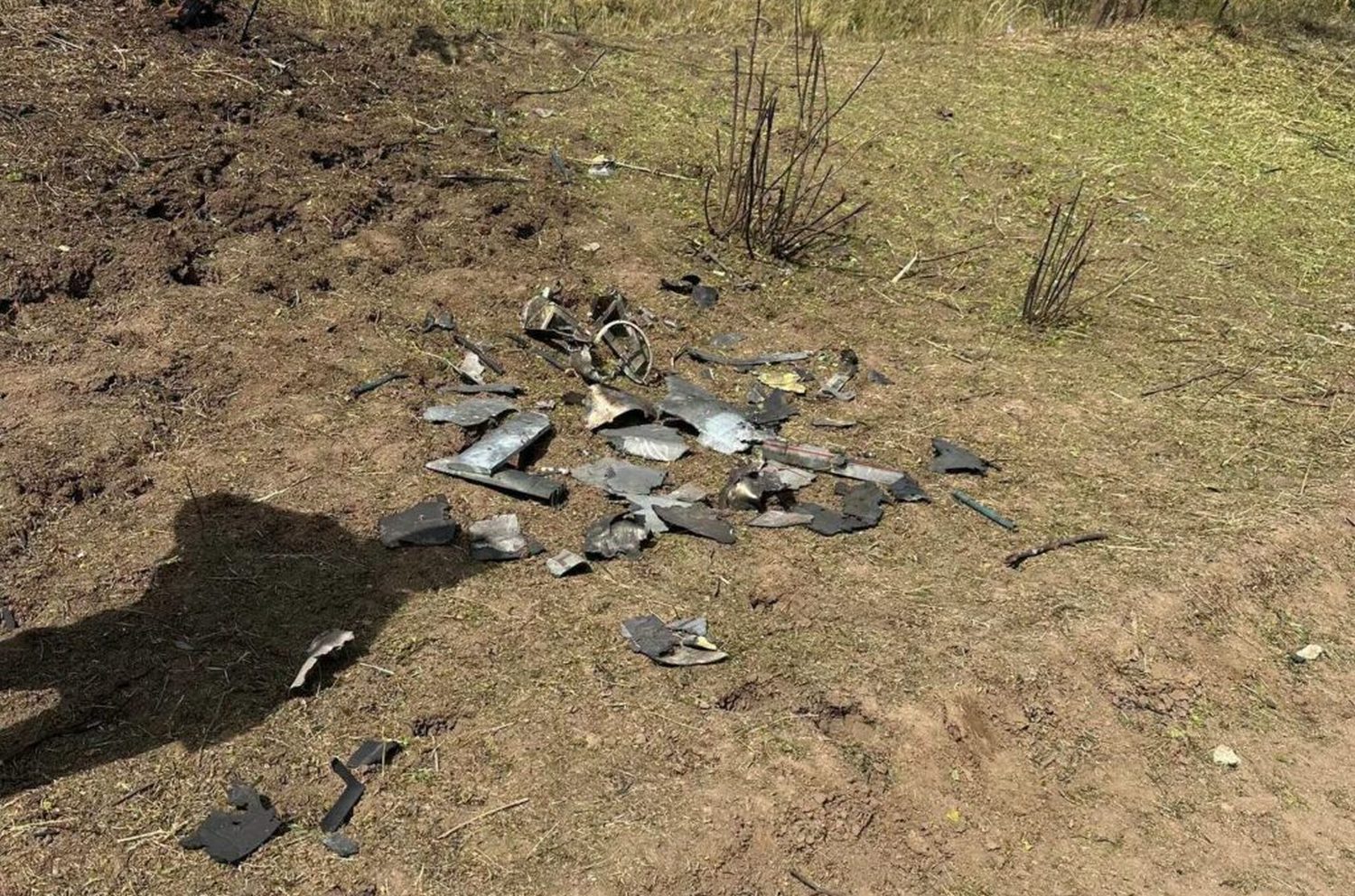
Fragments police preliminarily identified as parts of a combat drone, recovered near Crocmaz in Moldova's Ștefan Vodă district, 9 August 2026. Photo: Consiliul Raional Ștefan Vodă/Facebook
Moldova is not in NATO or the EU, and it is a neutral state. Russian drones have crossed its airspace illegally around 70 times since the start of the full-scale war, Moldova's National Army says. Defense Minister Anatolie Nosatîi called the situation extremely serious after one incursion this month halted air traffic over the country for 15 minutes, and said the army needs modernizing.
Romania shoots, Bulgaria clears up
Unlike Moldova, the NATO members in the region act on what reaches them. Romania intercepts what crosses in, and Bulgaria destroys what drifts to its coast:
26 June: Bulgaria's navy destroyed a drifting drone seven nautical miles off Kranevo.
21 July: Bulgarian, Romanian, and Turkish ships destroyed a drifting drone 21 nautical miles off Ahtopol.
24–26 July: Romanian F-16s downed three drones, the country's first shootdowns at home.
Early August: Romanian jets scrambled before Ukraine shot the drone down.
16 August: a Spanish F/A-18 downed a drone north of Galați, the fourth over Romania this year, the Defense Ministry said.
20 August: a Romanian F-16 destroyed an explosive-laden sea drone with its cannon near an offshore gas platform. President Nicușor Dan blamed Russia.
22 August: two more drone wrecks turned up on Bulgarian beaches, one of them a Russian decoy without a warhead.
The announcement has sent panic through a community that fled its country’s brutal military rule, civil war, religious persecution or some combination of the three.
Rohingya refugees in front of the office of the United Nations High Commissioner for Refugees in Kuala Lumpur after being evicted from their home in July.
The site once paired news and scores with distinctive voices. Its overhaul under Sinclair Media is the latest sign that serious tennis writing in the US is becoming endangered
A few weeks ago, as I often do, I went to the Tennis.com site to get an update about a match and to check out the commentary from my fellow tennis journalists. I was taken aback when, instead of the usual colorful graphics and info, I was greeted with a rudimentary-looking homepage that displayed only scores and rankings.
At first I thought it was a glitch of some sort. But sadly, no. As it turns out, Tennis.com, originally the online site of Tennis Magazine, is under a complete overhaul and will no longer be the home of esteemed writers such as Steve Tignor and Pete Bodo, robbing fans of unique and personal takes on the sport. It appears the longest running American tennis-specific publication is no longer alive in any form.
Three employees of Stars and Stripes, a government-funded news service, allege they were fired after reporting on USS Abraham Lincoln
Three journalists who were fired by the Pentagon from a US government-funded news outlet sued the Department of Defense in federal court on Thursday, arguing their dismissals were illegal and violated their first amendment rights to free speech.
The three journalists were all employees of Stars and Stripes, which their court filing calls “the U.S. military’s independent news source since the Civil War with a long history of editorial independence, free from news management or censorship by military command”.
Racing against the darkness, rescuers in California on Saturday saved a man who had become stranded on a ledge perched atop a soaring peak on the Sierra Nevada.
The US senator for Georgia Jon Ossoff, a Democrat, has slammed a “disgraceful and disqualifying” report that a former staffer for his Trump-backed Republican challenger Mike Collins shared images online of a swastika and depicting himself in Ku Klux Klan robes.
It is the latest instance of someone in Collins’s orbit facing scrutiny over racist or white nationalist conduct. Ossoff called the report “stunning” and said it “should shock the conscience of every Georgian”.
John Ratcliffe, the C.I.A. director, delivered an urgent message to Aleksandr V. Bortnikov, the head of Russia’s F.S.B. intelligence service this week in a secret visit to Moscow.
Mosquito traps had been placed at Frankfurt Airport, and any insects caught would be analyzed to find out about their species and origins, a spokesman for the airport’s operator said.
One wonders when, if ever, a US broadcast can win the same plaudits presenting the English league with a more American voice
There they were again, signaling with their unchanging faces and voices and their unchanging studio backdrop that another Premier League season had begun. On Friday afternoon, and again on Saturday and Sunday morning, Rebecca Lowe welcomed American viewers to what is somehow already the 14th season of the world’s most popular sporting circuit to air on NBC.
She was flanked, as ever, by her merry band of pundits, her gang of fellow British expats. The Robbies and the other ones. Also, Tim Howard as the token American, albeit one who spent 13 seasons of his goalkeeping career in the Premier League, deemed sufficiently English by osmosis to join the crew.
Leander Schaerlaeckens is the author of The Long Game: U.S. Men’s Soccer and Its Savage, Four-Decade Journey to the Top, or Thereabouts, which is out now. He teaches at Marist University.
Judge ruled Jeanine John Taele, discovered with firearm days before Trump visit, was unfit to face felony charge
A judge in California has suspended criminal proceedings against a man found with a loaded gun near Donald Trump’s golf course in Los Angeles, and instead ordered him to undergo a mental health evaluation.
Jeanine John Taele, 38, of Downey, California, was arrested for weapons violations days before the president spoke at a 5 August Republican fundraiser at the Trump National Golf Club in Rancho Palos Verdes.
Nigerian soldiers took part in a search-and-rescue exercise at the Maiduguri Air Force Base earlier this month. Nigerian forces worked with the American military to kill one of the Islamic State’s highest-ranking leaders.
A general during the Balkan wars of the 1990s, he was convicted in the killing of some 8,000 Muslims at Srebrenica, Europe’s deadliest massacre since World War II.
As the US president struggles to end his war with Iran, and with his approval ratings hitting the lowest levels of his second term, he has in recent weeks posted a series of AI-generated images of himself alongside key historical American figures.
Ryan Mackenzie, running for re-election, is accused of ‘fabricating’ a career in the real estate industry
The Republican congressman Ryan Mackenzie has been accused of embellishing his résumé with private sector experience in real estate sales amid an acrimonious showdown over his Pennsylvania seat.
Mackenzie, who has previously been accused of lying about his age on Tinder, “was a real estate salesperson licensed in PA”, according to his LinkedIn profile, and biographies have consistently listed it has his former profession.
Télé-Québec amorce un virage important pour tenter de renouer avec les jeunes Québécois. À l’occasion de son lancement de programmation, le diffuseur public a présenté une stratégie qui dépasse largement la télévision traditionnelle : placer les adolescents au cœur de ses décisions, renforcer sa présence dans les environnements numériques qu’ils fréquentent et utiliser l’intelligence artificielle […]
On Wednesday, Trump officially signed a proclamation on Wednesday that suspends higher tariffs on 300,000 metric tons of foreign beef imports for 90 days. This comes after backlash to the proposal – designed to lower grocery costs for Americans in the run-up to the November midterms.
Several Republicans – in states with sizable cattle farming industries – have criticized the policy, saying it is a short term solution that will stymie ranchers’ ability to rebuild their herds.
Four leading livestock and agricultural organizations also wrote a letter to the president on Wednesday urging him to reverse course.
“Flooding the market with discounted foreign beef is not the way to rebuild the American cattle herd, strengthen food security, or lower grocery bills in a lasting way,” the groups wrote.
Donald Trump will begin his day in Washington, before traveling to Houston, Texas where he’ll headline a Republican National Commitee (RNC) fundraiser, and help boost Ken Paxton — the state’s attorney general and Republican nominee for Senate.
A reminder that Paxton beat long serving Senator John Cornyn in the GOP primary earlier this year after receiving Trump’s endorsement. Paxton is set to face Democratic state lawmaker James Talarico in November.
The success of progressive candidates in the United States is inspiring leftists abroad struggling under pressure from the Trump administration and its allies.
Analysts say that weeks of Houthi attacks on Saudi targets have brought the kingdom and the Iranian-backed militia to the brink of full-blown conflict, and could open a new front in the Iran war.
A demonstration in Sanaa, Yemen’s capital, in support of the Houthi militia last month. The Houthis, who control northern Yemen on Saudi Arabia’s southern border, are supported by Iran.
The race was at its peak when American riders were regularly challenging for titles. Its return could help prompt a revival
After a decade-long absence, the beloved Philadelphia International Cycling Classic is set to return this weekend, with some of the world’s best bike-racing teams taking to the famous circuit around the city’s leafy Art Museum, Manayunk, and Roxborough areas on Sunday.
The race is one of just a handful of events on American soil sanctioned by UCI, cycling’s international governing body, and will feature squads such as EF Education EasyPost, Lidl-Trek, Lotto-Intermarché, and Jayco AlUla in the men’s race, and powerhouses CANYON//SRAM zondacrypto and Human Powered Health in the women’s event. It is classified as a 1.1 race, meaning it’s two levels below the top-flight WorldTour, whose races include the Tour de France, Paris-Roubaix, and Liège-Bastogne-Liège.
The Philadelphia Cycling Classic will be livestreamed on Channel 6 ABC, with the women’s race kicking off at 8.30am Eastern. The men will follow at 12.30pm. Of course, you could always trek to Philly and become part of the party yourself. I highly recommend snagging a spot somewhere along The Wall.
The authorities reported hundreds of people missing and at least 160 people killed in the border region of Nepal and Tibet, where an avalanche of mud, water, ice and rocks smashed down.
The agency’s top spokesman is among those on leave, according to two Trump administration officials. The agency said three people faced a misconduct investigation.
A 15-year-old using social media apps in Australia in July, more than half a year after the country had implemented a ban on children under 16 using many platforms.
Victoria Hicks, mother of Alexandra Hicks, told reporters that she feels 'justice is possible' after Meta settled in its US trial over teen addiction. On 26 August in a Oakland, California, federal courtroom, Meta agreed to establish safeguards for teenagers and pay up to $17bn. Dozens of US states had accused the tech giant of addicting and harming children with dangerous products
Donald Trump has downplayed a visit to Moscow by the CIA director, John Ratcliffe, as “semi-routine” after he turned up in the Russian capital unannounced, triggering a wave of speculation about the reasons for his trip.
Ratcliffe was reported to have flown to Moscow on a government transport plane on Tuesday in a rare visit after taking off from the Andrews air force base in Maryland.
The order came amid a spate of legal challenges, including one by Democratic state attorneys general, that could still result in the rules being blocked.
Under its new plan, the Postal Service would not deliver mail ballots in states that do not share voter data with the agency and would deliver only ballots that meet certain criteria.
Dean Roy, 15, will appear on the ballot in November as a third-party candidate. He said his generation’s concerns, like affordability and climate change, have been ignored for too long.
In this episode of Guardian Australia’s US politics podcast Decoding America, co-hosts Jonathan Yerushalmy and Reged Ahmad explore why datacentres in the US have provoked such anger – and whether that could harm Republicans in the midterms given Donald Trump is such a supporter of the growing industry.
They also look at why the US and Canada are fighting over tariffs. The Canadian prime minister, Mark Carney, is pushing back and both countries could be on the cusp of a full-blown trade war.
Finally: why does the Trump administration’s secretary of transportation, Sean Duffy, have his very own YouTube show – and is he the only one?
Zymire Hughes scared more than a dozen people while wearing a Chucky-style mask, the authorities said. He is being held in jail while awaiting extradition to Pennsylvania.
CIA Director John Ratcliffe visited Moscow on 25 August, becoming the first known serving CIA chief to travel to the Russian capital since November 2021, The Washington Post reported.
The CIA and White House did not publicly explain the mission.
The Kremlin said the unannounced trip involved “contacts between security services” but did not identify whom Ratcliffe met or what they discussed. Dmitry Peskov told Interfax that Ratcliffe did not meet with Russian President Vladimir Putin. The CIA and White House did not publicly explain the mission.
Expert raises possibility of a warning mission
Washington also asked Ukraine not to attack Moscow or St. Petersburg during the visit, Ukrainian sources told Suspilne. Kyiv was told that a senior US delegation was traveling to Russia, although officials were not initially told that Ratcliffe would be part of it.
“It is difficult to speculate because there is essentially no information,” Tartu researcher Vladimir Sazonov, an associate professor who studies Russian state ideology and information warfare, told Euromaidan Press.
Ratcliffe may have carried a warning, as William Burns did in 2021, Sazonov said. It could have concerned a possible new Russian mobilization after September’s State Duma elections or Moscow’s escalating hybrid operations against NATO.
Stalled Ukraine diplomacy and Russia’s relationship with Iran were other possible subjects. None has been confirmed.
Explore further
Russo-Ukrainian War. Day 175: Another explosion in Crimea
The last CIA visit came before Russia invaded
A US Air Force C-17 flew from Joint Base Andrews outside Washington to Riga, and then Moscow, according to flight data analyzed by The Washington Post. The aircraft remained at Vnukovo Airport for about eight and a half hours before returning to Latvia. The newspaper also verified footage of a diplomatic motorcade traveling through central Moscow.
The career diplomat and former ambassador to Russia, the CIA Director, William Burns/ Source: Getty Images
Ratcliffe’s visit was the first by a CIA director since Burns traveled to Moscow in November 2021 with evidence that Russia was preparing a major attack on Ukraine.
During that visit, Burns spoke with Putin by telephone from the Kremlin because the Russian president was in Sochi. Russia launched its full-scale invasion less than four months later.
Sazonov also raised the possibility that Ratcliffe discussed Americans detained in Russia. The CIA participated in previous negotiations that freed journalists Evan Gershkovich and Alsu Kurmasheva, and former US Marine Paul Whelan, RFE/RL documented CIA involvement.
“If we do not know the answers, all we can do is ask the relevant questions,” Sazonov added.
Slovak police foiled a planned arson attack on a drone factory in the country's east, the force said on 25 August. Investigators charged three foreigners with preparing the attack on commission and seized incendiary material and equipment at the scene. The plant belongs to the Ukrainian drone maker Skyeton, Militarnyi reported.
Russia's war has an arm inside Europe that usually works without missiles against Ukraine supporters — agents and recruited locals, carrying out arsons, parcel fires, flying an explosive drone at a Ukrainian cargo plane in Germany, plotting against arms-industry figures — and the point of hiring strangers to light fires is that a burned production hall costs Moscow nothing it can be held to account for.
Had the attack in Slovakia gone ahead, it risked a large fire, danger to life and health, and damage on a large scale, police stated. About 70 employees could have been in the building at the time, by preliminary estimates. Property inside the production hall is worth tens of millions of euros, according to the findings so far.
Officers seized a larger quantity of incendiary mixture, along with tools, mobile phones, an action camera, and a hand-made plan. The police Criminalistics and Expertise Institute gave a preliminary finding that the substance was a mixture of gasoline and polystyrene, commonly called napalm. Slovakia's anti-crime unit ÚBOK, part of the Police Presidium, identified the people preparing the attack and stopped it. Nobody was hurt and no property was damaged, police said.
Items seized during the operation, and one of the detained men, eastern Slovakia, August 2026. Photo: Police of the Slovak Republic
The charges, and where the three were detained
An ÚBOK investigator charged the three foreigners with preparing a particularly serious crime of general endangerment, committed as co-perpetrators on order. Officers detained two of them in Slovakia, and the investigator moved to have both taken into custody. German authorities detained the third on a European arrest warrant. The investigation continues, and the legal classification of the men's actions may still change.
Explore further
About 50 grams of suspected military explosive lay in a German field 10 days after the attempt on Ukraine’s plane
The plant, and a company Russia has already hit
Slovakia, a NATO and EU member, borders Ukraine on its eastern edge. Skyeton builds the Raybird, a fixed-wing reconnaissance drone that has served with Ukraine's Armed Forces since 2018 and stays airborne for up to 28 hours. The company began production in Slovakia in 2024, and more than €10 million in foreign investment went into the plant, one of several sites Ukrainian firms opened abroad to cut the risk of Russian attacks.
That risk is not theoretical. Russia destroyed Skyeton's Kyiv office in May, and the company said it had already spread production capacity across Ukraine and abroad in anticipation.
A Skyeton representative told Militarnyi:
"The recent attempt on our production in Slovakia is another sign that Ukrainian arms makers are already a bone in their throat, which means we are on the right path."
2024
WSJ: Russian sabotage groups suspected for arson attack on plant producing air defense systems for Ukraine
Arson against Ukraine's defense partners in Europe
Companies working for Ukraine have been hit across several countries this year and earlier.
In March, suspects who claimed a pro-Palestinian motive set fire to the Pardubice production of Archer, a Ukrainian maker of thermal imaging sights, destroying nearly all of the company's capacity in Czechia.
Estonia opened a Russian-link investigation this month into a suspected arson at a military robot maker supplying Ukraine, and Lithuania charged six people in January over an attempt to burn a factory that supplied radio-wave scanners.
A powerful explosion of undetermined cause hit EMCO, one of Bulgaria's largest private arms makers, which produces artillery ammunition for Ukraine, on 10 August.
The Syrian Democratic Forces, a Kurdish-led armed group that has lost territory and authority in recent months, will integrate with the country’s military.
Members of the Syrian Democratic Forces, a Kurdish-led militia that was long seen as a key American ally in Syria in the fight against the Islamic State.

 Connexion