Vue normale

  • ✇Euromaidan Press
  • Glide bomb then infiltrate. This is Russia’s new way of war.
    In 2022, Russians fired artillery then advanced in vehicles Four years later, they launch glide bombs then advance as small teams of infantry Ukrainian drones stand in their way, and that's why drone operators are the main targets of Russian firepower before and during the advance On Monday, a small team of Russian infiltrators reportedly slipped 10 km behind the line of contact between Russian and Ukrainian troops just north of Kostiantynivka in eastern Ukrai
     

Glide bomb then infiltrate. This is Russia’s new way of war.

Par : David Axe
26 août 2026 à 17:16

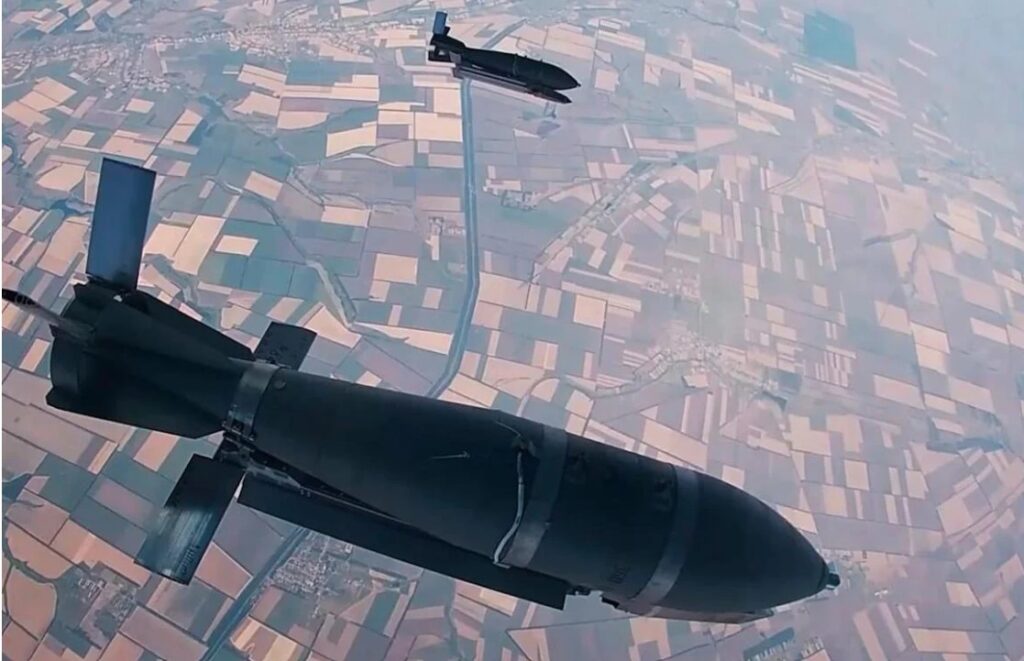
Glide bombs drop away from a Russian jet.

  • In 2022, Russians fired artillery then advanced in vehicles
  • Four years later, they launch glide bombs then advance as small teams of infantry
  • Ukrainian drones stand in their way, and that's why drone operators are the main targets of Russian firepower before and during the advance

On Monday, a small team of Russian infiltrators reportedly slipped 10 km behind the line of contact between Russian and Ukrainian troops just north of Kostiantynivka in eastern Ukraine's Donetsk Oblast.

Sneaking into the town of Druzhkivka, 10 km north of Kostiantynivka along the H20 highway, the Russians reportedly ambushed, captured and executed a group of three or four unarmed Ukrainian drone operators.

It's possible the drone operators had just arrived in Druzhkivka when the Russians appeared. According to analyst and mapper AMK Mapping, Ukrainian drone operators pulled out of the village of Oleksijevo-Druzhkivka—which lies between Kostiantynivka and Druzhkivka—owing to the increasing threat from Russian KAB glide bombs. "It's likely that Russian forces monitored the withdrawals of Ukrainian drone operators and sent in [an infiltration group] after the new position was identified," AMK Mapping concluded.

The atrocity underscores the Russian military's new approach to ground warfare as Russia's wider war on Ukraine grinds through its 54th month. An army that once counted on its own artillery to suppress enemy artillery in order to allow mechanized forces to advance now uses precision bombs, small cruise missiles, tiny drones, and, yes, some artillery to suppress the Ukrainian drone teams that represent the main obstacle to a swift Russian advance.

Yesterday, a group of Russian DRGs was able to infiltrate from Kostyantynivka for at least 10 km behind Ukrainian lines, and kill 3-4 Ukrainian drone operators in the city of Druzhkivka. The drone operators were unarmed in their positions at the time of the ambush, not expecting… pic.twitter.com/KNxN0JelwL

— AMK Mapping 🇳🇿 (@AMK_Mapping_) August 25, 2026

And when the Russian firepower manages to suppress Ukrainian drone operators, allowing small teams of infantry to advance, the infantry's objective is often to take out the same drone operators whose suppression was a necessary pre-condition of any successful assault.

In short, the Ukrainians largely defend with drones. That means the Russians are fixated on first striking the drone teams in order to prevent them from launching their tiny lethal robots—and then, when they can, assaulting the drone teams' positions in order to capture or kill them. Or capture then kill them, as reportedly happened in Druzhkivka.

The Russians have learned the hard way that they can't advance without first finding and attacking Ukrainian drone operators. That hard experience has driven a profound transformation of the Russian way of war in just the last few years.
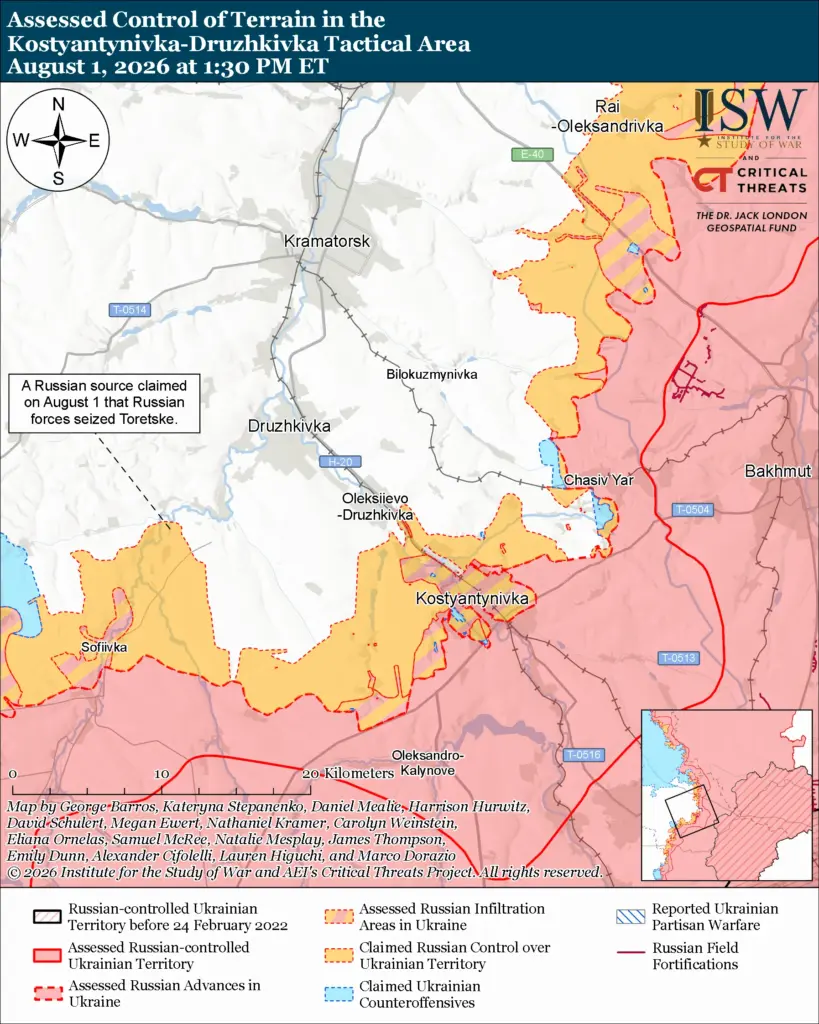
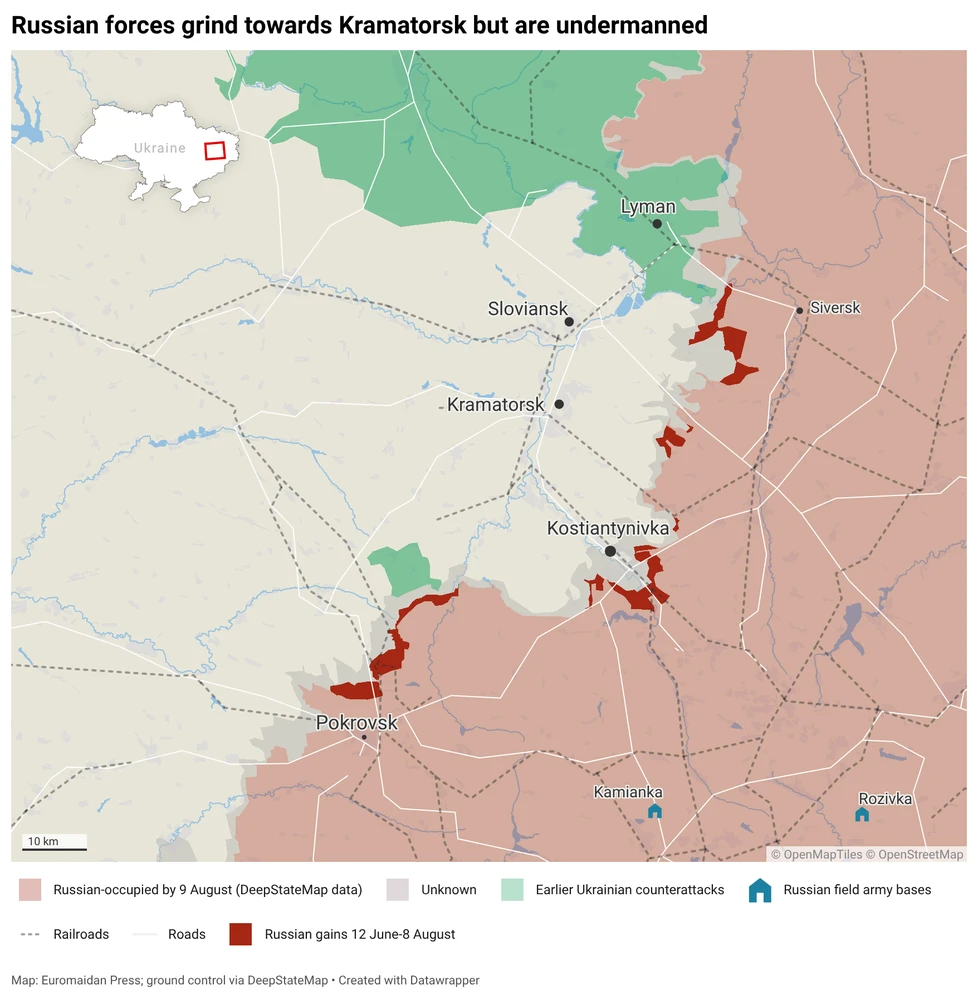
isw russia's long push toward sloviansk gains ground ukraine counterattacks · post kostyantynivka-druzhkivka-tactical-area-august-1-2026 news ukrainian reports
Map: ISW.

Precision suppression

As 2025 wore into 2026, Ukrainian forces finally deployed enough $500 drones to effectively halt any sustained Russian advance along the 1,200-km gray zone stretching across eastern and southern Ukraine. Between February and July, the Russians captured around 260 sq km of Ukrainian soil, according to a tally by the Black Bird Group. That's barely a fifth as much ground as they seized in the same six months in 2025.

Realizing they couldn't just fire an artillery barrage and then roll out the tanks the way they used to, the Russians have mostly parked their thousands of armored vehicles. Now they advance in small teams of lightly equipped infantry that, Russian commanders reason, stand a better chance of avoiding detecting and destruction by drones.

"Broadly speaking, current Russian military theory appears to emphasize restoring the ability to maneuver," Sidharth Kaushal and Sam Cranny-Evans wrote in a new study for the Royal United Services Institute in London. But the infantry infiltrators who do most of the maneuvering these days don't march out without support. A lot of it.

In the early months of the wider war in 2022 and 2023, the Russians counted on artillery—lots of artillery—to support the maneuver forces. But massed artillery is just as exposed to drone attack as massed tanks are, so Russian fire support has had to evolve, too.

Today, the Russians still fire artillery from fewer but more spread-out guns. But they also launch their own drones, small cruise missiles, and—perhaps most important—KAB glide bombs to force Ukrainian defenders, including drone teams, into their dugouts before the infantry dash across the gray zone. "Russian theorists appear to see the solution in highly mobile units designed to exploit lower-risk tunnels created by
precision strike," Kaushal and Cranny-Evans explained.

https://twitter.com/kriegsforscherD/status/2091923015604850800/

It's explosive choreography requiring careful communication between the infantry, the artillery, drone teams and the air force. "Sustaining momentum in the face of adversary precision strike is a considerable challenge," Kaushal and Cranny-Evans wrote. But a necessary one as the Russian military "contemplates how it can break the current positional deadlock" in Ukraine "and avoid future ones."

But when it works, it works to catastrophic effect for Ukrainian defenders. As those unfortunate, murdered drone operators found out.

The suppress-then-advance method, but with precision munitions and small teams of infiltrators, works for both sides, of course. The Ukrainians can do it, too—and they recently did in some unspecified sector of the gray zone.
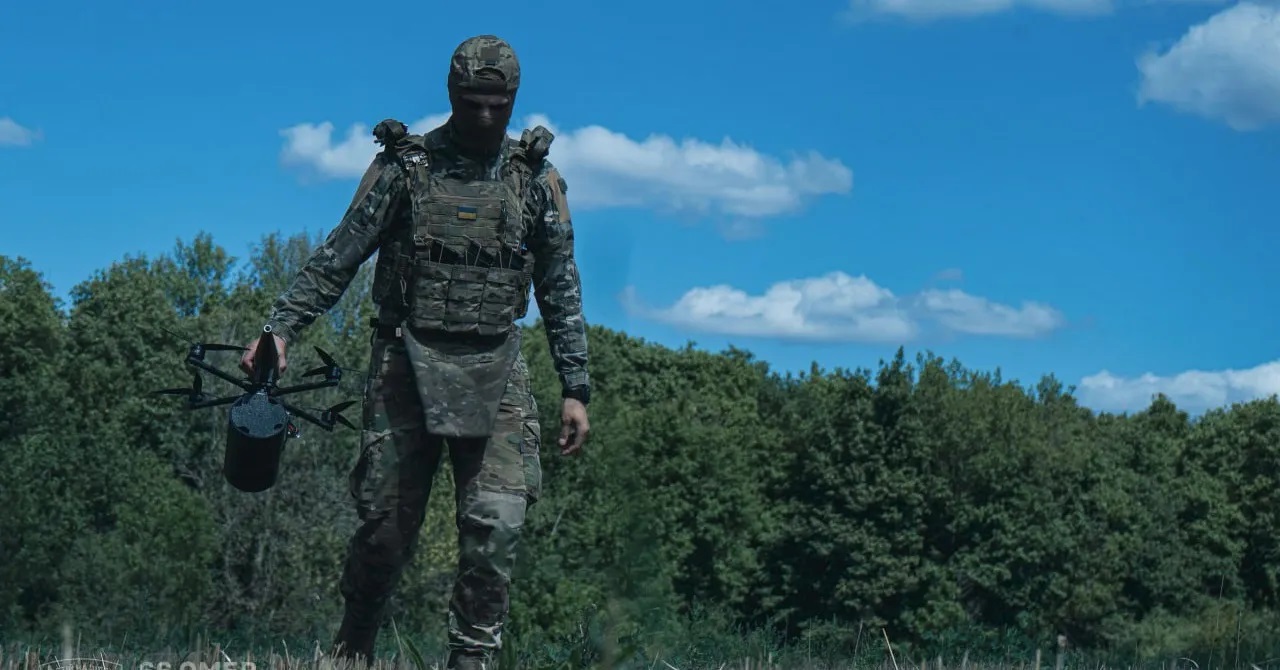
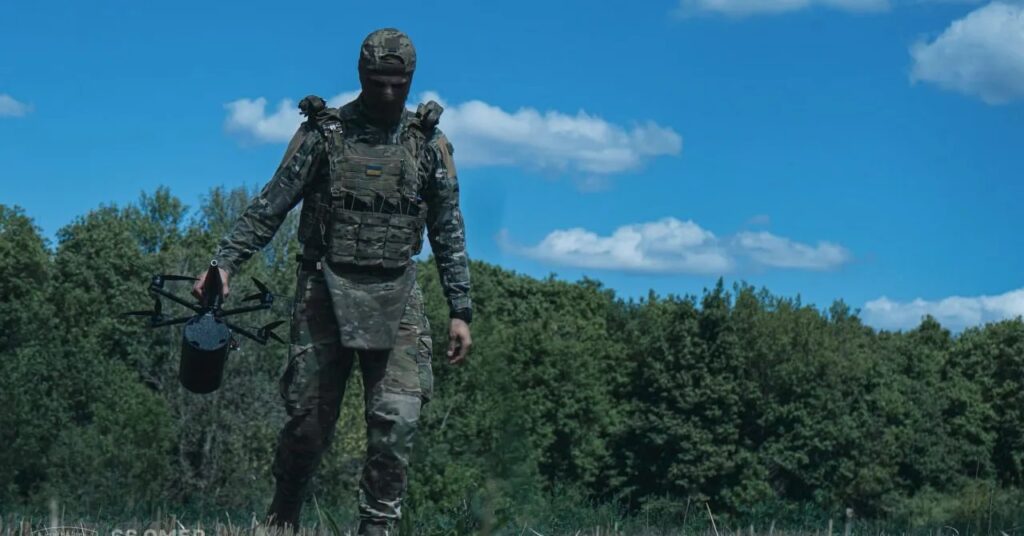
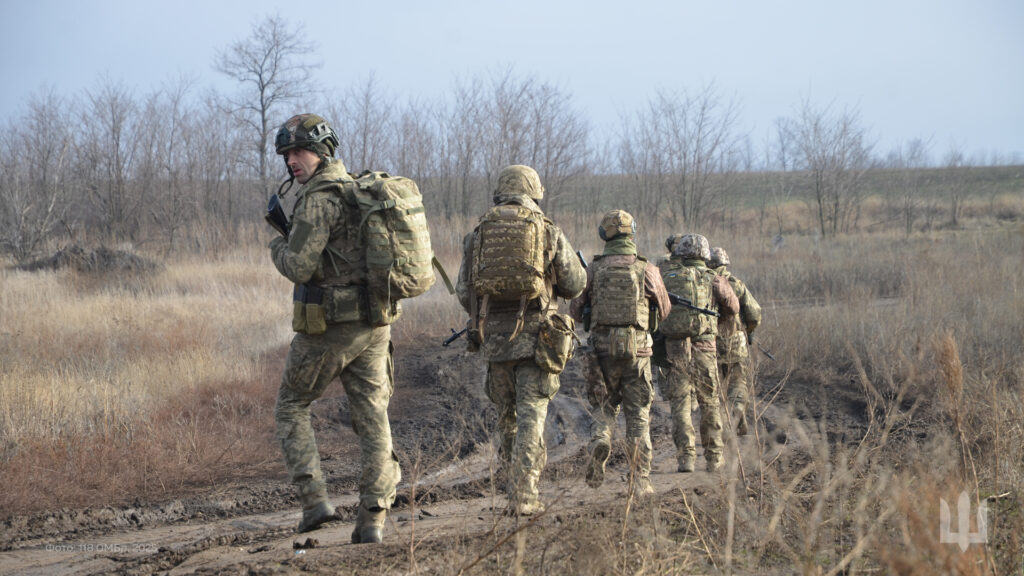
A Ukrainian soldier carries an FPV drone.
Explore further

Ukraine’s secret counteroffensive takes the pressure off Sloviansk

On the same day the Russians executed those drone operators, fellow Ukrainian drone pilot Dmytro Putiata reported a small Ukrainian mechanized advance. "At one of the direction at the front line, one of the Ukrainian brigades used four [infantry fighting vehicles] during the attack," Putiata wrote. "They have managed to break through up to three km; dismounted infantry and all of the vehicles managed to retreat."

They break through with the help of friendly drones units that suppressed Russian troops along the assault route, Putiata explained. "How did they manage not to be targeted by drones? The battlefield was prepared for that."

  • ✇Euromaidan Press
  • Ukraine’s secret counteroffensive is more successful than we thought
    Ukraine's quiet counteroffensive north of Lyman has produced dramatic results since April Now two Russian regiments are in danger of encirclement Escape is still likely for the Russians, but their retreat buys time for the Ukrainian defenders of Lyman and nearby Sloviansk Ukraine secret eastern counteroffensive seems to have been even more successful than some observers reported. It's possible that, in the sector just north of the town of Lyman in eastern Ukra
     

Ukraine’s secret counteroffensive is more successful than we thought

Par : David Axe
26 août 2026 à 17:15

  • Ukraine's quiet counteroffensive north of Lyman has produced dramatic results since April
  • Now two Russian regiments are in danger of encirclement
  • Escape is still likely for the Russians, but their retreat buys time for the Ukrainian defenders of Lyman and nearby Sloviansk

Ukraine secret eastern counteroffensive seems to have been even more successful than some observers reported. It's possible that, in the sector just north of the town of Lyman in eastern Ukraine's Donetsk Oblast, the Ukrainian 3rd Army Corps is just a few kilometers short of encircling two Russian regiments.

That doesn't mean the Russian units can't escape. After all, there isn't a contiguous line of Ukrainian forces—nor a contiguous line of Russian forces for that matter—anywhere along the 1,200-km disputed gray zone that threads across eastern and southern Ukraine.

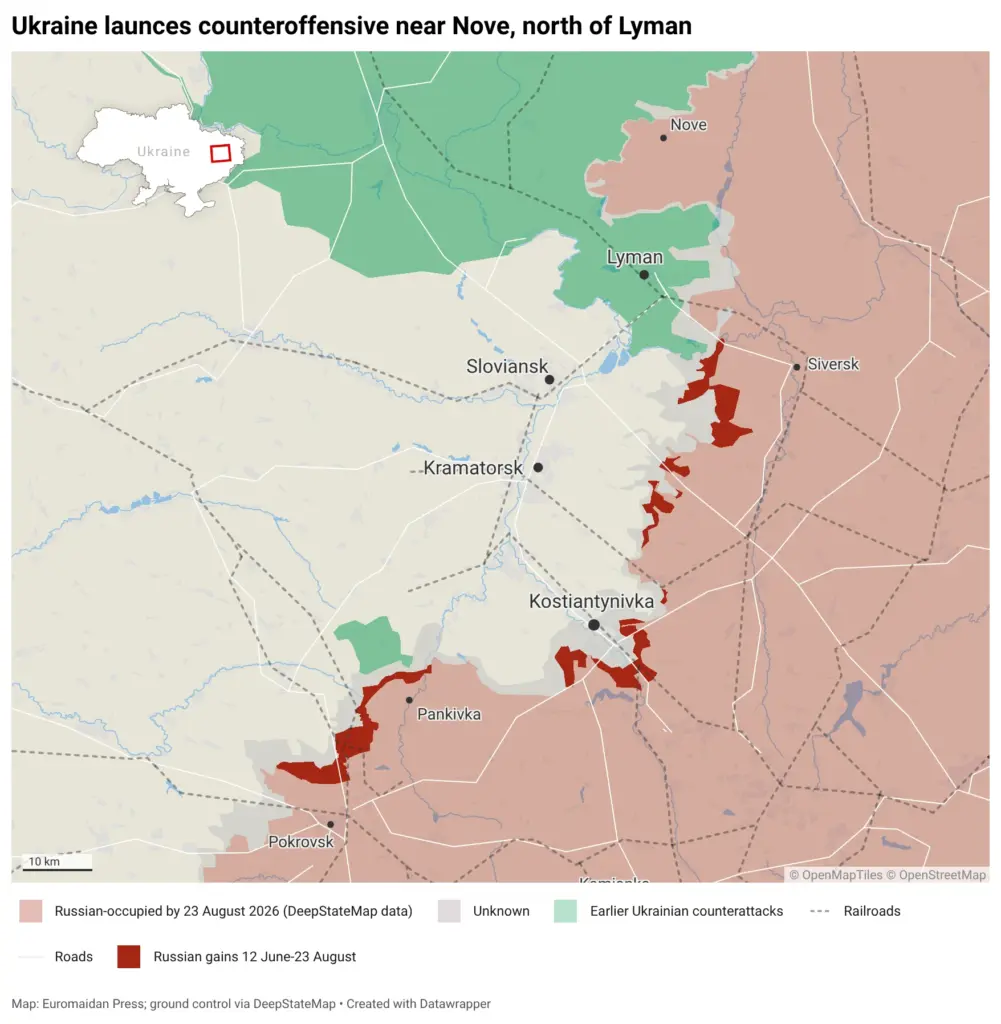
Situation near Nove as of 23 August
Situation near Nove as of 23 August. Map: Euromaidan Press

But the closing pincer around elements of the Russian 2nd and 144th Motor Rifle Divisions could strain the Russians' logistics and compel the Russians to reconsolidate in order to preserve their combat power—by retreating east. That would take a lot of pressure off Lyman and, by extension, also take a lot of pressure off Sloviansk and Kramatorsk, the last two big free cities in Donetsk.

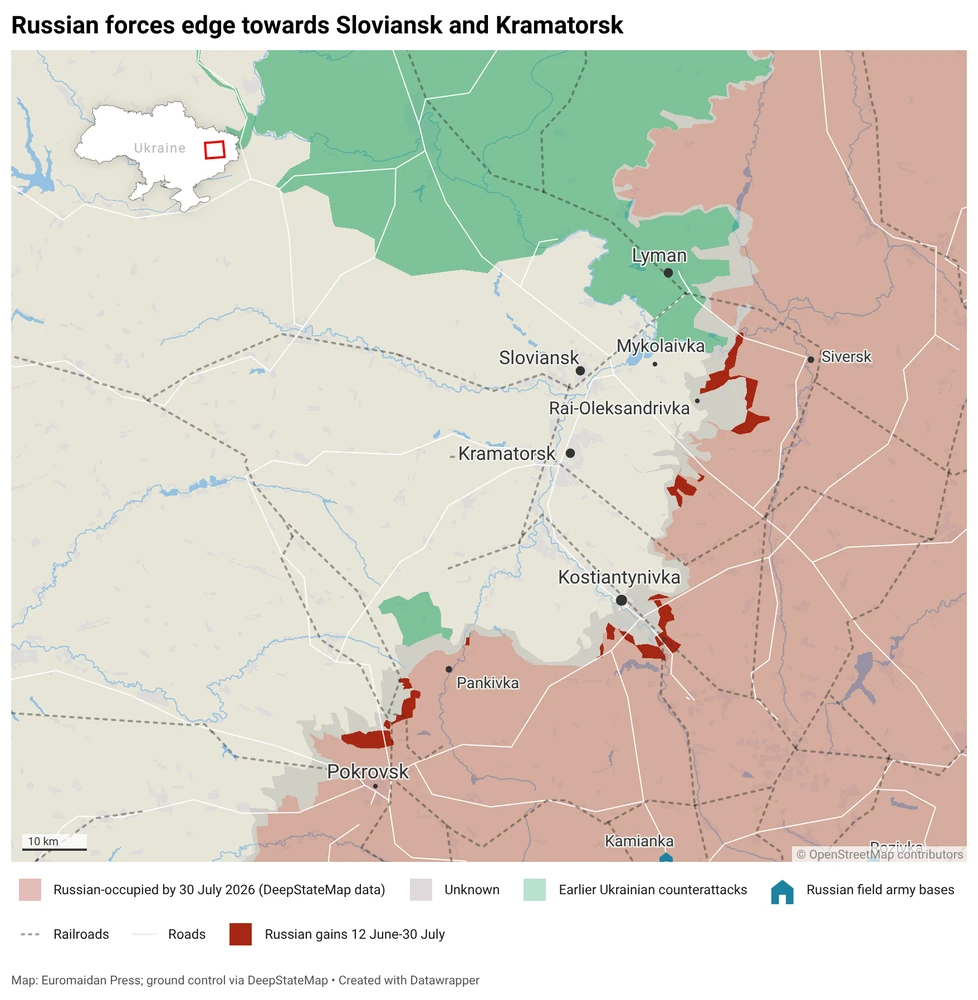
Lyman, which lies 15 km northeast of Sloviansk—the northernmost of the free cities—is the main obstacle between at least six Russian regiments and Sloviansk. The Russians have been inching toward Sloviansk and Kramatorsk from several directions for months now, racing against the coming winter to position forces for a possible siege of the twin cities next year. Winter in Ukraine punishes any attacker by depriving them of the leafy tree canopy that can conceal infiltrating troops during warmer months.

According to the most recent map from analyst and mapper Thorkill, one of the more reliable observers of unit-level action in Ukraine, the Ukrainian 3rd Assault Brigade is just a few kilometers away from linking up with the 60th Mechanized Brigade in or around the village of Kolodyazi.

Sytuacja w rejonie Nowego (Łyman), część II.

Jednym z odcinków frontu w Donbasie, na którym wojska ukraińskie prowadzą obecnie działania zaczepne, jest rejon Kateryniwka - Nowe – Zełena Dolyna, na północ od Łymanu. Od połowy maja 2026 r. pozycje rosyjskiej 144 Dywizji Strzelców… pic.twitter.com/AIvInwHGX3

— Thorkill (@Thorkill65) August 25, 2026

Galloping advance

If true, that means the 3rd Assault Brigade and adjacent units from the 3rd Army Corps have carried out one of the more successful Ukrainian counteroffensives in memory. In April they first exploited gaps in Russian defenses north of the village of Nove. In May and June they advanced toward the village. In July they captured it.

After that, the attacking Ukrainians kept pushing south into the right flank of a 10-km-by-10-km salient that advancing Russian regiments created as they maneuvered around Lyman from the north, aiming to surround the town instead of directly assaulting it on their way toward Sloviansk.

Leaving their flank exposed, the Russians trying to encircle Lyman found themselves at risk of encirclement, instead. If the 3rd Assault Brigade or 60th Mechanized Brigade—together possessing thousands of troops, on paper—can march through Kolodyazi, they will have closed a ring of loose Ukrainian control around at least two Russian regiments, also with potentially thousands of troops.

Emphasis on loose control. Again, there aren't enough Ukrainian forces on the ground north of Lyman to prevent any "encircled" Russians from retreating back to the east. But that retreat would represent a major victory for the Ukrainian defenders north and east of Sloviansk. "The fall of this salient [north of Lyman] would significantly delay the fall of Lyman," analyst and mapper AMK Mapping predicted.

Situational update on the Lyman direction:

The Ukrainian counterattacks north of Lyman are now entering their fourth month, as they come closer and closer to cutting off the Russian salient. Two pincers have been formed, which are both dangerously close to cutting the Russians… pic.twitter.com/mu2kZ4S3Jv

— AMK Mapping 🇳🇿 (@AMK_Mapping_) August 26, 2026

No one expects the Russians to halt their offensive toward Sloviansk and Kramatorsk. But in potentially taking two steps forward and one step back in their northerly march on the free cities, the Russians sacrifice time. Time the Ukrainians can use to stiffen their defenses in Sloviansk and Kramatorsk and evacuate more of the tens of thousands of civilians who remain in the cities despite the constant danger from Russian drones and bombs.

The possible extent of the Ukrainian gains north of Lyman—a 10-km march since April—is impressive given Russia's overall advantage in manpower and firepower in the east. Equally impressive is the operational security, or OPSEC, that cloaked the offensive until now. Sure, there were a few videos of action around Nove that hinted at a major Ukrainian action.

But the units involved exercised surprising discipline, and prevented too much information from leaking. "Someone in the 3rd Corps responsible for [OPSEC] is actually trying to do their job diligently and has quite effectively cut off information," Thorkill noted. The secrecy may have facilitated the Ukrainian advance by delaying any sense of panic among the Russian commanders who are responsible for reinforcing the Lyman salient, but who also tend to ignore bad news as long as possible because they know it could reflect poorly on them.

News of the counteroffensive is now available for all to see, even if official Ukrainian sources have yet to confirm it. That may mean time is running out for the 3rd Army Corps to close its pincer before the Russians retreat or reinforce. AMK Mapping has already seen some evidence of a "partial withdrawal from the most vulnerable positions in the salient.

A 53rd Mechanized Brigade trooper.
Explore further

Can Ukrainian forces save Sloviansk and Kramatorsk?

  • ✇Euromaidan Press
  • Ukraine’s secret counteroffensive takes the pressure off Sloviansk
    Without much fanfare, Ukrainian forces have been counterattacking north of Lyman in eastern Ukraine's Donetsk Oblast The Ukrainian advance takes some pressure off the free city of Sloviansk, just 20 km to the southwest The problem is: the Russians are advancing toward Sloviansk and Kramatorsk from several other directions Russian forces are fighting against time to close a pincer around the last free cities in eastern Ukraine. The deadline: the coming winter,
     

Ukraine’s secret counteroffensive takes the pressure off Sloviansk

Par : David Axe
25 août 2026 à 07:51

A Ukrainian soldier carries an FPV drone.

  • Without much fanfare, Ukrainian forces have been counterattacking north of Lyman in eastern Ukraine's Donetsk Oblast
  • The Ukrainian advance takes some pressure off the free city of Sloviansk, just 20 km to the southwest
  • The problem is: the Russians are advancing toward Sloviansk and Kramatorsk from several other directions

Russian forces are fighting against time to close a pincer around the last free cities in eastern Ukraine. The deadline: the coming winter, which will strip the leaves from the trees and leave any attacking force exposed to overhead surveillance and attack.

But in one key sector, Ukrainian forces are spoiling the coordinated Russian operation to partially surround Sloviansk and neighboring Kramatorsk. With admirable operational security, or OPSEC, a clutch of Ukrainian brigades under the 3rd Army Corps hasn't just blunted the advance of the Russian Center Group of Forces—it has pushed the Russians back.

This Ukrainian counterattack along the axis through the town of Lyman, ongoing since May, has largely escaped widespread notice. Yes, there is some scant video evidence of Ukrainian attacks. And yes, a few analysts have adjusted their maps to account for apparent Ukrainian advances, especially in the direction of Nove, a Russian-occupied village 15 km north of Lyman, which itself lies 15 km north of Sloviansk.

Ukrainian 🇺🇦 forces have been conducting for weeks two unnoticed counter-attacks in two directions of the frontline.
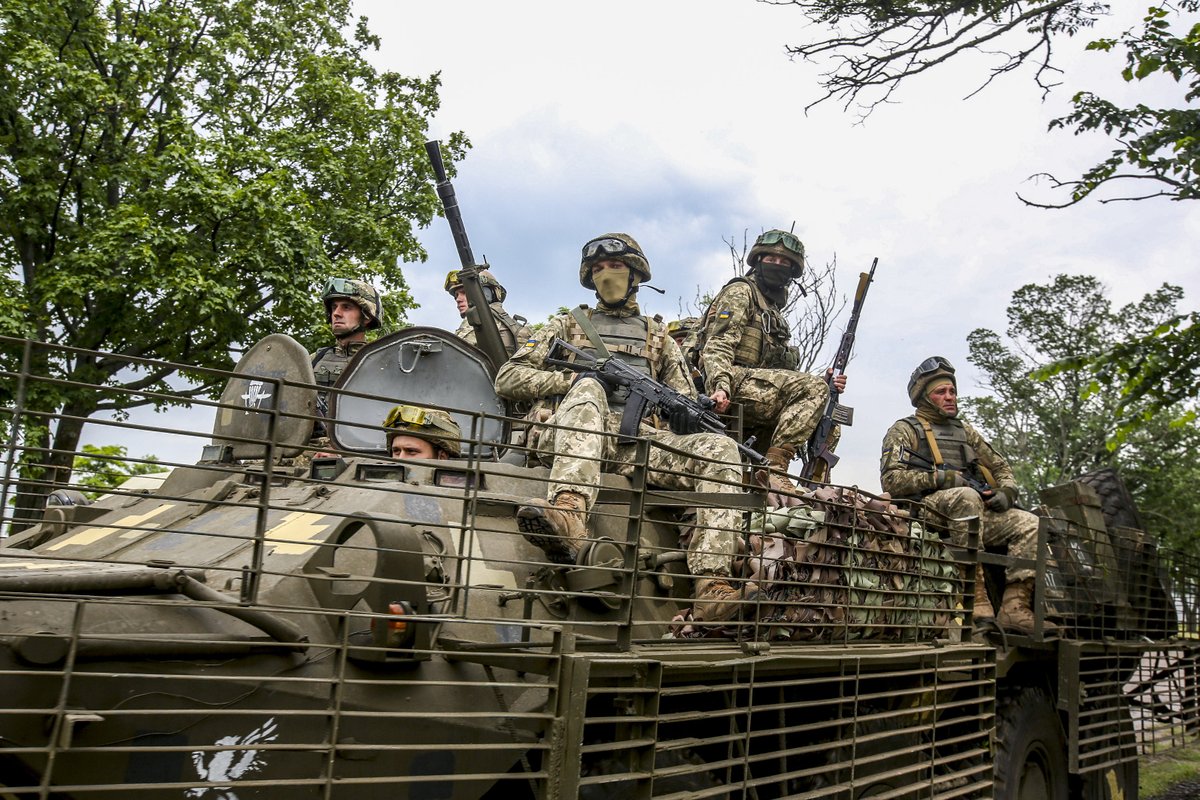
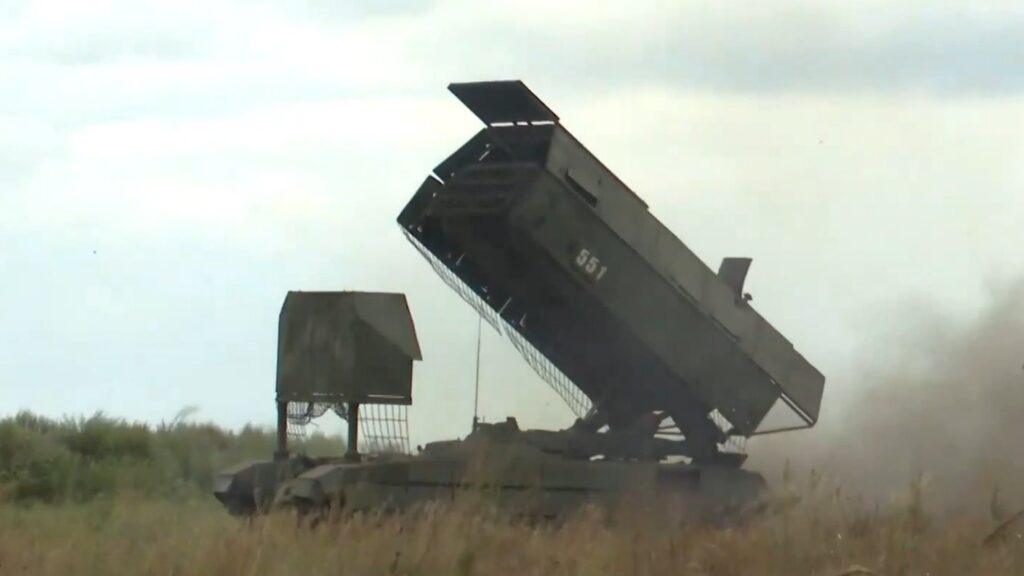
With barely any geolocation, the Ukrainians kept a good level of OPSEC and the russians have been reluctant to publish videos from these areas.

In the Ivanivka… pic.twitter.com/hNJy4YhkxG

— Clément Molin (@clement_molin) June 10, 2026

But for the most part, Ukrainian and Russian sources have avoided talking about Lyman. "The Ukrainians kept a good level of OPSEC and the Russians have been reluctant to publish videos from these areas" depicting their retreats, analyst and mapper Clément Molin noted in June, just a few weeks after the Ukrainians attacked toward Nove.

Molin, for one, expects the OPSEC to lift in the coming days. "By the end of the month, we should have an official update on the good results of a Ukrainian offensive that has largely remained secret," he wrote on Monday.

Situation near Nove as of 23 August
Situation near Nove as of 23 August. Map: Euromaidan Press

April offensive

The Ukrainians' limited counteroffensive around Lyman apparently kicked off on in mid-April. One of the first attacks that left any real evidence occurred on 22 May, when a small Ukrainian mechanized force—perhaps from the 60th or 66th Mechanized Brigade, the 77th Air Assault Brigade, or the Presidential Brigade—attacked in armored trucks and M-113, Stryker, and BTR-4 armored personnel carriers. Heavy bomber drones flew top cover.

The Russian 144th Motor Rifle Division fought back with its own drones. Interceptor drones took aim at the bombers. First-person-view and heavy bomber drones blasted at least one BTR-4, hitting it before and after it dropped off its infantry passengers. Drones struck some of the disembarked Ukrainian infantry.

How many Ukrainian troops survived and entrenched in new positions on 22 May is unclear. Regardless, the Ukrainian 3rd Army Corps wasn't done with Nove. Attacks continued. And sometime after the 22 May assault on Nove, "the Ukrainians managed to consolidate their gains," Molin concluded after scrutinizing a few videos and some satellite imagery.

By early July, Ukrainian forces had succeeded in "operationally encircl[ing] the Russian forces defending the village of Nove," according to analyst and mapper Thorkill. "Fierce fighting is currently underway to expel the Russians from that locality," Thorkill reported at the time.

Sytuacja w rejonie Nowego (Łyman).

Jednym z odcinków frontu w Donbasie, na którym wojska ukraińskie prowadzą obecnie działania zaczepne, jest rejon wsi: Nowe – Zełena Dolyna, na północ od Łymanu. Od połowy maja 2026 r. pozycje rosyjskiej 144 Dywizji Strzelców Zmotoryzowanych… pic.twitter.com/2EJQgz4eps

— Thorkill (@Thorkill65) July 8, 2026

The aim of the Ukrainian counterattacks is obvious. The 3rd Army Corps intends to put pressure on the northern right flank of 10 km-by-10-km salient jutting into the battleground north of Lyman. The Russian 144th Motor Rifle Division has been pouring troops into the salient, clearly intending to surround and isolate Lyman instead of directly assaulting it—all in order to clear a path toward Sloviansk.

Salients are risky for both sides, however. The farther the Russians extend their Lyman salient, the more exposed they are on their flanks. The Ukrainians know this. And even if the 3rd Army Corps can't fully cut across the salient in order to surround the Russians inside of it, the corps can at least take advantage of the salient's exposed flanks.

Capturing Nove, on the very northern edge of the salient, could allow the Ukrainians to bring to bear more artillery and drones on the Russians south of Nove. The 3rd Army Corps doesn't have to fully encircle the Russian troops closest to Lyman in order to hammer them with withering firepower.

Soldiers of Ukraine's 79th Air Assault Brigade.
Explore further

Ukraine’s quiet counteroffensive took 745 square km. Russia’s dead Starlink is how

Just how successful the 3rd Army Corps has been in its local counteroffensive could become clearer very soon. That won't spell lasting relief for Sloviansk and Kramatorsk, however. Fighting against the clock as summer begins turning into fall and then winter, the Russians are slowly advancing toward the twin cities from several directions.

The siege of Kramatorsk and Sloviansk is coming. Perhaps not this year, but surely by 2027. To fully safeguard the twin cities, the Ukrainians would need to duplicate their success north of Lyman along several other directions.

That's a big ask of a Ukrainian force that's overall still outnumbered and outgunned.

Russia’s thermobaric launchers used to just drive up and fire. Now they move one at a time, in steel boxes built to stop Ukrainian drones

Par : David Axe
23 août 2026 à 12:53

A new up-armored TOS-1A.

  • Russia's TOS-1A thermobaric rocket launcher is uniquely devastating, but also uniquely vulnerable
  • Its flame-spreading rockets reach just 6,000 m, which puts a launcher inside the reach of Ukraine's tiny explosive drones
  • Ukrainian forces have destroyed, damaged or captured 36 TOS-1As—and Russia is now building them with factory anti-drone armor

Russia is now building its TOS-1A thermobaric rocket launchers with factory armor wrapped around the rocket tubes. The tracked TOS-1A and its flame-producing 220-mm rockets are a powerful and terrifying weapon. But the launcher is also extremely vulnerable to Ukraine's drones and artillery. The add-on armor may be the only way the launchers can survive.

The TOS-1A is a T-72 with the turret swapped out for 24 thermobaric rockets, and the newest ones arrive inside a welded steel shell that lifts open when the tubes elevate. Russia is armoring the launcher the way it armors the tanks it's built from. What happens when the armor fails is not the same.

The TOS-1A adds a 24-round launcher onto the hull of a T-72 tank. The system's MO.1.01.04M rocket travels as far as 6,000 m with a payload of fuel that, once ignited, burns as hot as 3,000 degrees Celsius. The fuel can spread across the ground and into buildings and bunkers, allowing even a single TOS-1A to scorch a wide area.

It's not for no reason that the TOS-1A is one of Russia's preferred siege weapons. TOS-1As rolled into action early in Russia's wider war on Ukraine. In one of their first actions, in May 2022, TOS-1As staged on hilltops overlooking the city of Lyman, in eastern Ukraine's Donetsk Oblast, rained fire down on the front-line city. A few days later, Russian troops temporarily occupied Lyman.

Thinking back to May 2022. Watching Russian TOS-1 heavy thermobaric artillery devastate Lyman from the hill across the Siversky Donets. May 23 - the full assault would be launched a day or two later. pic.twitter.com/PPEyMukZGO

— Neil Hauer (@NeilPHauer) July 3, 2026

The best day the TOS-1A ever had came at Bakhmut. In early April 2023, Russian crews fired across the Bakhmutka River at entrenched Ukrainian positions and opened a 300-m gap in the line, US Army analysts later reconstructed. Wagner mercenaries poured through and covered 1.25 km in a single day. At Pavlivka, thermobaric fire breached the Ukrainian line and the settlement eventually fell—though it took five months and cost Russia two wrecked naval infantry brigades.

With its origins firmly in the 1970s, the TOS-1A was designed for a different era, however. An era where rocket launchers could, with a little support, safely approach to within a few kilometers of the enemy. Artillery is an ever-present danger, of course. But artillery can be suppressed—usually by other artillery.

The era of relative safety for the TOS-1A ended as tiny explosive drones began filling the sky over Ukraine in 2023. Even the tiniest of these tiny drones has the range to hit a TOS-1A before the TOS-1A can get into position to fire its rockets. Worse, the TOS-1A's thermobaric rockets are extremely volatile—and tend to explode in massive fireballs when struck.

"Nasty weapons—and also great targets" for anti-tank missiles and other munitions, is how Czech analyst Jakub Janovsky described the TOS-1A in the war's opening days, before the drones even arrived.

The launcher has a weather problem, too. Its rockets carry an oxidizer premix, which means crews can't fire them in the rain or from high ground.

A Russian TOS-1 thermobaric rocket launcher was completely destroyed by the Unmanned Systems Forces today. After getting hit, the TOS-1 cooked off and burnt down. pic.twitter.com/zQievlm5Vx

— Woofers (@NotWoofers) April 18, 2026

Deep losses

The Russians started losing TOS-1As almost immediately. Retreating from Kyiv Oblast on 1 April 2022, they left behind at least three launchers—two of them knocked out by Ukrainian Stugna-P missiles, one captured intact. Then the losses began piling up.

Today, 54 months into the wider war, the Ukrainians have destroyed, damaged or captured no fewer than 36 TOS-1As. 27 of them burned. Ukrainian crews turned at least one captured launcher on its former operators, firing it near Kreminna during the 2023 counteroffensive.

The losses are a problem for the Russians. US Army analysts estimated Russia's prewar TOS-1A fleet at 48 launchers, only a portion of which ever went to Ukraine. Documented losses now stand at 36, and Oryx counts only what it can see in a photograph. How much of that gap Russian factories have refilled isn't public.

What the losses did not do was change the war. For all its ferocity, the TOS-1A has had little to no effect on the conflict's outcome, US Army analysts concluded—and they name the short reach as the reason. A weapon that has to park within 6,000 m of the enemy is a weapon the enemy can find.

Armor, not range

The Russians got to work improving the TOS-1A and building more copies. The Omsk transport machinery plant, Omsktransmash, has turned out fresh batches for the defense ministry in September 2022, November 2022, November 2024 and again in November 2025, its parent concern Uralvagonzavod announcing each handover. It's unclear just how many replacement launchers the Russians acquired, but it's safe to assume they number in the dozens.

They also changed how they use the thing. Russian units now move single launchers up to the line under covering artillery fire rather than travelling in groups, reducing the likelihood of detection, the same US Army analysts reported. And the latest copies are up-armored against drones, with a shell of additional armor protecting the 24 launch tubes and their highly flammable rockets.

That isn't a brand-new idea. An earlier drone-protection variant was showcased in April 2024, and a different, serially produced kit went onto the batch shipped in November 2025. What circulated this month is fresh footage of the up-armored TOS-1As working out at a training range in Russia's Saratov Oblast.

Footage of Multiple Russian TOS-1A Obr.2022 at a Training Ground in the Saratov Region - Summer 2026 pic.twitter.com/LAOAVraai1

— Wilson (@WillKnowler) August 9, 2026

The add-on armor is apparently factory-standard at this point, and it's a purpose-built enclosure rather than the improvised slat and mesh Russian regiments tend to weld onto their tanks before sending them across the drone-patrolled gray zone. The function is the same: put something between the drone and the thing that matters.

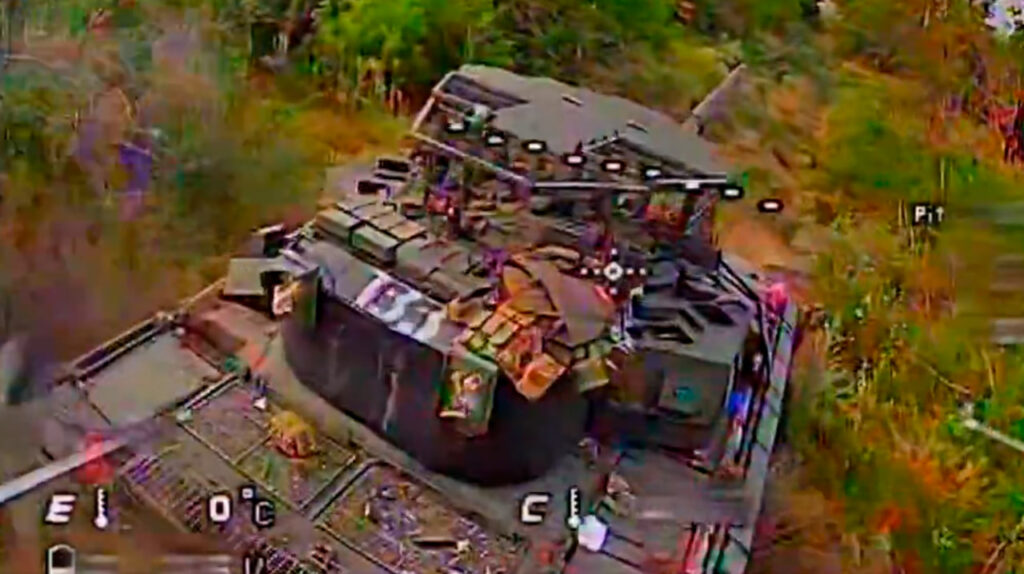
The best up-armored "turtle tanks" have been known to absorb dozens or even scores of drone impacts. A TOS-1A crew should hope the launcher's new armor is equally tough. After all, the consequence of a turtle tank losing its shell and taking a direct drone hit is often immobilization: the tank throws a wheel or a track or loses power and simply can't move anymore.

An Arena-M tank right before a drone strike.
Explore further

Russia has thousands of tanks it can’t risk. One drone shield decides whether they roll

Armor is the cheap answer, and it isn't the real one. The real one is a launcher that doesn't have to park 6,000 m from a Ukrainian drone operator.

Uralvagonzavod says a modernized TOS-1A on a T-80 chassis is nearing the end of trials, with better accuracy, more automation and a longer reach. How much longer, the company hasn't said. Analyst Alexey Tarasov expects a new launch module able to take longer-range rockets, perhaps carrying the system to roughly the 15 to 20 km of the wheeled TOS-2. Until then, the crews get a steel box.

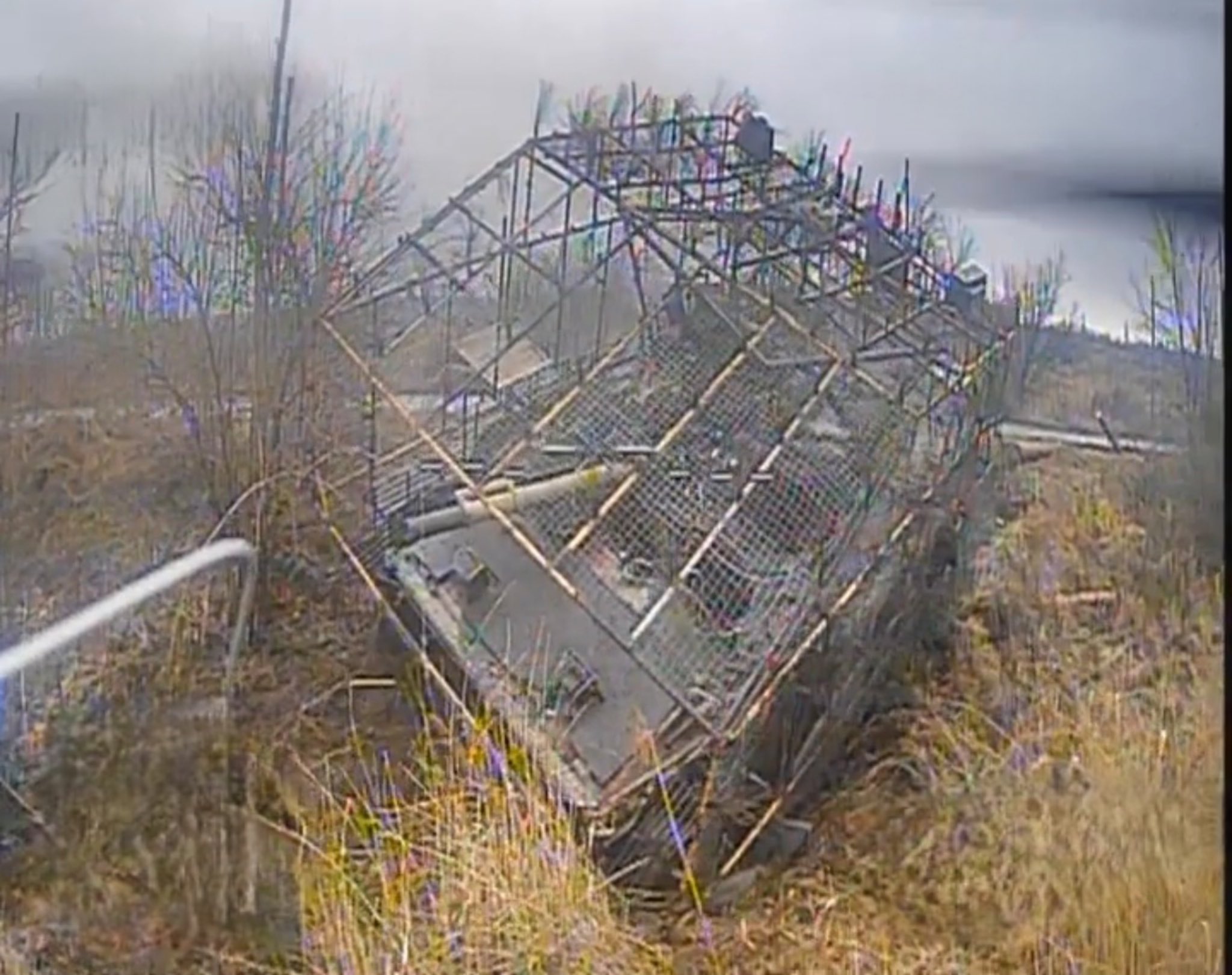
It had better hold. The earlier, cruder answer didn't: a TOS-1A wearing a field-built metal cage burned anyway when a Ukrainian FPV drone found it. And if a TOS-1A's armor fails, the next drone hit could trigger 24 rockets each weighing 217 kg and packed with concentrated fuel that's primed to explode.

⚡The 🇺🇦Ukrainian military from the 92nd separate assault brigade destroyed the 🇷🇺Russian 220-mm heavy flamethrower system TOS-1A "Solntsepek" using an FPV kamikaze drone pic.twitter.com/wEBz2H1T5y

🪖MilitaryNewsUA🇺🇦 (@front_ukrainian) September 2, 2023

  • ✇Euromaidan Press
  • Ukraine finally hit three Russian Kalibr ships on 12 August. On the 19th, an untouched one hit Kyiv
    After months of trying, Ukrainian forces may have finally hit some of the Russian Black Sea Fleet's Kalibr missile-armed warships The 2,500-km Kalibr is often in the mix when Russian forces bombard Ukrainian cities Hitting any Kalibr shooter is a win for Ukraine, but Russia still has no less than four intact Kalibr-compatible ships on the Black Sea The Russian navy still has enough missile-armed warships in its battered Black Sea Fleet to sustain Kalibr cruise
     

Ukraine finally hit three Russian Kalibr ships on 12 August. On the 19th, an untouched one hit Kyiv

Par : David Axe
21 août 2026 à 17:41

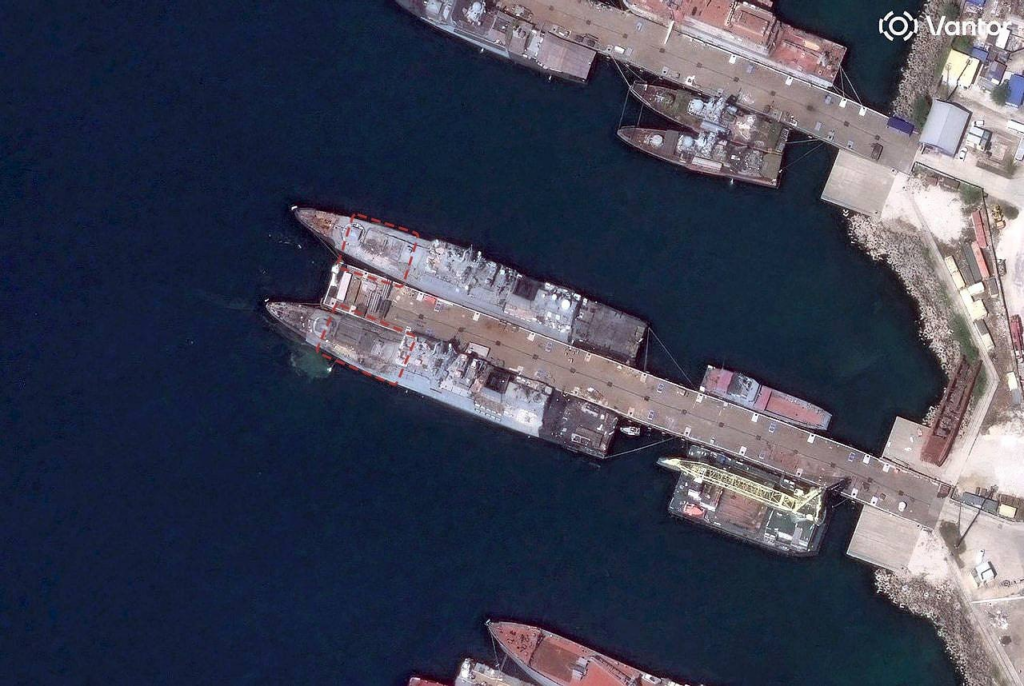
Possible damage to two frigates in Novorossiysk.

  • After months of trying, Ukrainian forces may have finally hit some of the Russian Black Sea Fleet's Kalibr missile-armed warships
  • The 2,500-km Kalibr is often in the mix when Russian forces bombard Ukrainian cities
  • Hitting any Kalibr shooter is a win for Ukraine, but Russia still has no less than four intact Kalibr-compatible ships on the Black Sea

The Russian navy still has enough missile-armed warships in its battered Black Sea Fleet to sustain Kalibr cruise missile attacks on Ukrainian cities, if recent launches are any indication.

Overnight on 19 August, an unscathed Russian corvette lobbed eight Kalibrs at Ukraine. Seven were intercepted. The eighth struck the Antonov Aircraft Plant in Kyiv, according to the open-source monitor OSINT Warfare, in an attack that killed 15 overall. Ukrainian commanders had hoped that wouldn't be possible. A week earlier, they thought they had knocked the Kalibr shooters out of the fight.

Overnight on 12 August, Ukrainian drones and missiles targeted the Black Sea Fleet's main anchorage in Novorossiysk in southern Russia. Russians on the ground recorded fireballs billowing into the night sky, seemingly indicating significant damage to the port or its moored warships, potentially including the Black Sea Fleet's seven or eight surviving frigates, corvettes, and submarines that are compatible with the 2,500-km Kalibr.

The Ukrainian general staff in Kyiv claimed its forces had struck three Kalibr carriers—the frigates Admiral Makarov and Admiral Essen and a Buyan-M corvette—as well as a lightly armed guard ship. But the uncertainty was, and still is, high. Even the general staff stressed its munitions had inflicted "varying degrees" of damage "according to preliminary information."

"Information is being clarified," the general staff stressed.

Footage shows eight 3M14 Kalibr cruise missiles being launched from a Buyan-M-class corvette at the Novorossiysk Naval Base in Russia’s Krasnodar Krai. https://t.co/fiQ0qhUhZ0 pic.twitter.com/GShALhfh4a

— OSINTWarfare (@OSINTWarfare) August 19, 2026

When the sun rose over the following days, commercial satellites snapped high-resolution photos of Novorossiysk, helping analysts assess damage from the 12 August strikes. The photos were hard to interpret. Yes, there were dark patches on the hulls of the two frigates and single corvette, but the discoloration didn't necessarily indicate drone or missile damage—to say nothing of confirming serious damage.

The pro-Ukraine Conflict Intelligence Team concluded Admiral Makarov and Admiral Essen "sustained damage in the area of their launchers," potentially impacting the ships' ability to fire Kalibrs.

A later battle-damage assessment by OSINT account Absolutely Reliable Source said both frigates had suffered critical damage. It assessed that direct hits on Admiral Essen destroyed its eight-cell 3S14 vertical launch system for Kalibr missiles, while strikes on Admiral Makarov caused an internal detonation and burned out its 3S14 launch cells. The account said both ships had lost their strike capability and would require extensive repairs.

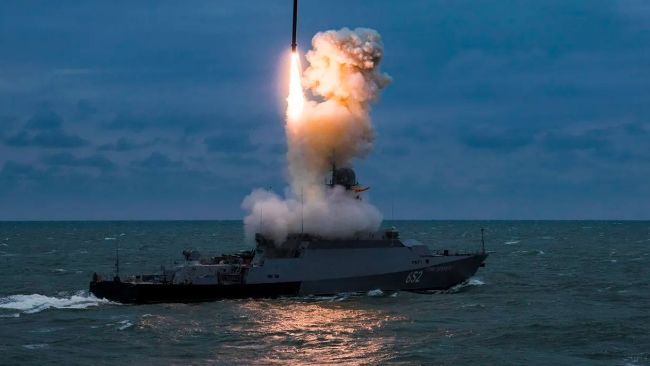
A Kalibr cruise missile launching from a Russian warship in the Black Sea
Launch of a Kalibr cruise missile from a Russian warship. Photo: Russian MoD

Uncertainty

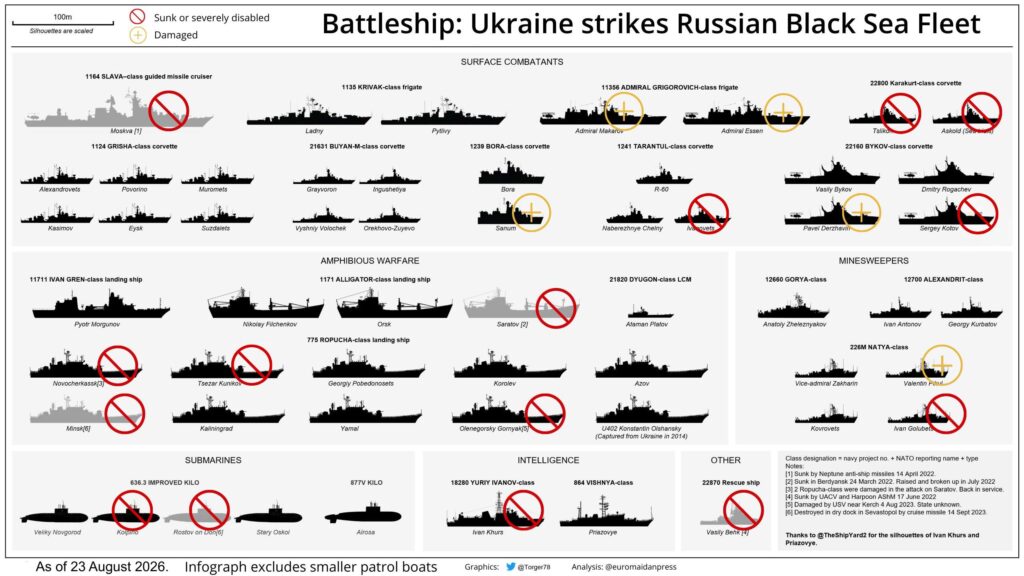
Caution was prudent. In the first three years of Russia's wider war on Ukraine, Ukrainian forces succeeded in destroying or damaging around two dozen of the roughly 85 large ships in the Black Sea Fleet. Perhaps most notably, a pair of Ukrainian Neptune cruise missiles holed and sank the Russian missile cruiser Moskva in April 2022.

Russian Black Sea Fleet battleship warship destroyed Ukraine
Russian Black Sea Fleet warships destroyed or damaged by Ukraine. Infographic by Euromaidan Press, based on Torger78 on X

But the strikes mostly missed the Kalibr carriers. Yes, the Ukrainians took out a Kalibr-armed Improved Kilo-class submarine in September 2023 and a Karakurt-class corvette, also armed with Kalibrs, in November 2023. But that left at least seven Kalibr shooters in the Black Sea Fleet. Eight if the Russians have managed to repair the Improved Kilo that apparently suffered some damage from a Ukrainian one-way unmanned attack submarine back in December.

It wasn't for a lack of trying that Ukrainian forces failed to eliminate, or even seriously dent, the Black Sea Fleet's Kalibr capacity prior to the 12 August raid on Novorossiysk. On 22 May, Fire Point FP-1 drones operated by the Ukrainian 414th Separate Unmanned Strike Aviation System Brigade motored the roughly 430 km to Novorossiysk and spotted a warship moored to a pier.

all 20+ russian kinzhal hypersonic missiles targeting kyiv intercepted patriot since may 2023 russia's mig-31k aircraft carrying missile illustrative mounted mig-31
Explore further

Putin’s Mach-10 wonder weapon misses by 30 meters. Russia stopped building it in April.

The 414th Brigade believed it was Admiral Essen—and also believed it may have hit the ship. "The frigate Admiral Essen … entered the strike zone," the brigade crowed. "Damage level unknown."

In fact, it seems the ship the propeller-driven FP-1 barreled toward, and potentially struck with its warhead, wasn't Admiral Essen. The vessel in the FP-1's video feed, relayed via satellite or a mesh radio network, appeared to be a derelict Krivak-class frigate. Not Admiral Essen.

It was yet another near miss. Earlier, on 6 April, FP-1s dove down on Admiral Makarov. The Ukrainian Unmanned Systems Forces posted footage from the FP-1s' forward-facing thermal cameras that indicated the drones got close to Admiral Makarov. But the footage didn't point to an obvious hit.

Overhead satellite imagery from later on 6 April seemingly told a more complete story. The drones may have left a scorch mark on the frigate's bow, but there was no sign of structural damage. If the 12 August raid really did inflict meaningful damage on Admiral Makarov and Admiral Essen and a Buyan-M, it represented a profound reversal for Ukrainian forces. After trying and trying again for months, they'd finally hit some of the ships that really mattered among the survivors of the Black Sea Fleet.

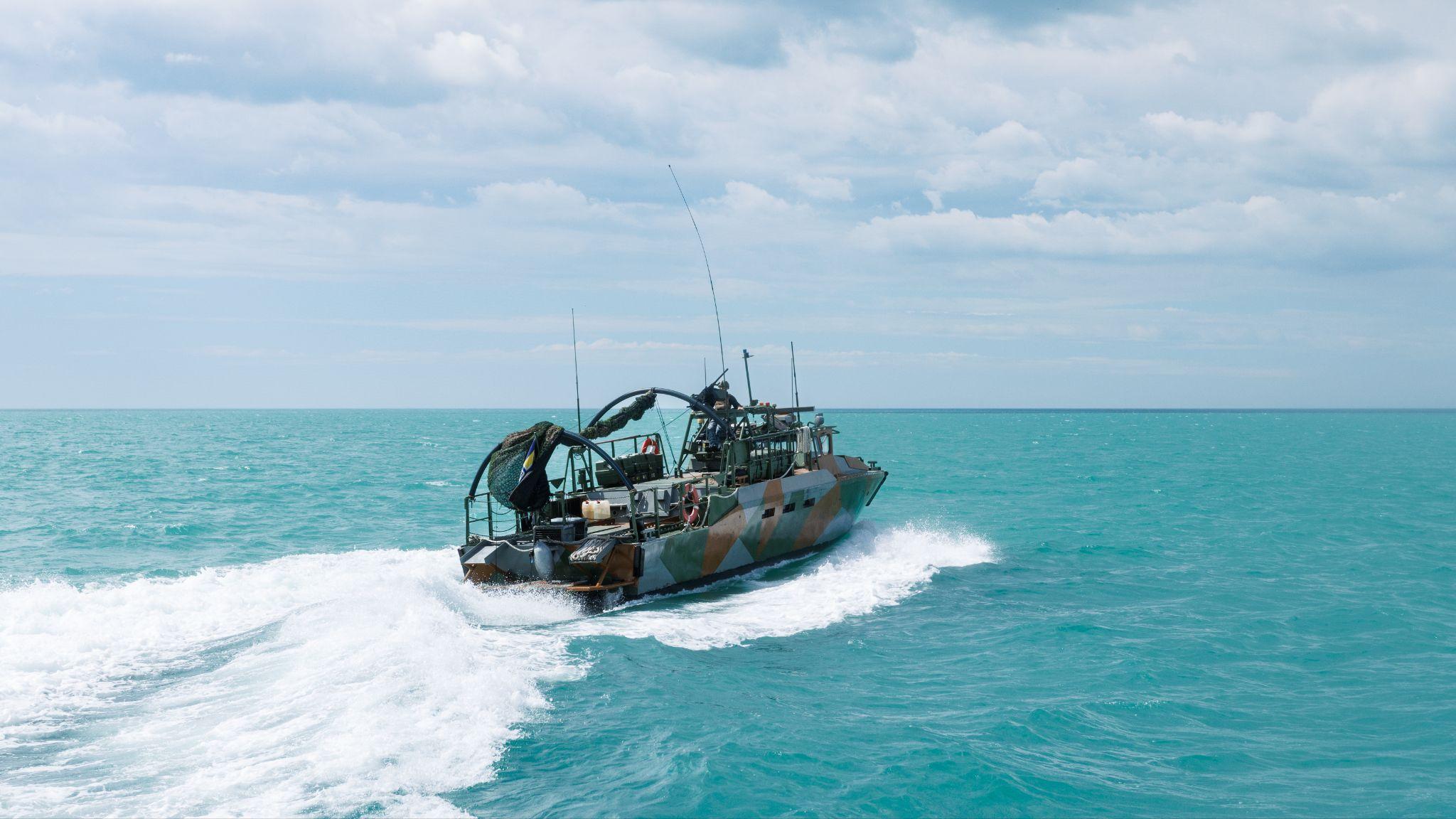
Ukrainian Navy CB90 assault boats sailing Black Sea patrol operations coastal defense against Russian drones
Explore further

Ukraine may have just lost its first Swedish assault boat—to a Russian jet drone

The problem for the Ukrainians is that, even if three Kalibr shooters are temporarily out of the fight, there are still four, possibly five, Kalibr shooters left. And that's enough to sustain frequent attacks on Ukrainian cities. A single Buyan-M corvette can fire eight Kalibrs at a time. And eight, as it turns out, is a typical number of Kalibrs in the mix when Russian air, sea, and ground forces launch their combined drone and missile barrages.

The Black Sea Fleet reminded everyone of that uncomfortable fact overnight on 19 August. A Buyan-M corvette at Novorossiysk fired eight Kalibrs—exactly one magazine—into a barrage that also carried Onyx and Zircon missiles, Iskander-M and KN-23 ballistic missiles, three dozen air-launched cruise missiles, and 168 drones. Ukrainian air defenses stopped seven of the eight Kalibrs. They could not stop the ballistic missiles, and the eighth Kalibr got through to the Antonov plant, which had already been hit that night by Iskanders and Zircons.

If the attack on 12 August actually did eliminate or even just temporarily sideline three Kalibr carriers, it still represents a partial victory for Ukraine. It's likely no fewer than four shooters remain. And given how long it took Ukrainian deep strike forces to maybe damage Admiral Makarov and Admiral Essen and that Buyan-M, the Black Sea Fleet may be able to continue blasting away at Ukrainian cities for many months to come.

  • ✇Euromaidan Press
  • Russia is trying to get its guns within range of Zaporizhzhia. First it has to take a prison
    Russian forces want their guns within range of Zaporizhzhia City A series of strongpoints stand in the way, including an old prison Moscow announced it had captured the prison village nine months ago. It had not After months of failed assaults, the Russians surrounded the village first—and this month came back to storm it Ukraine's southeastern counteroffensive has rolled back Russian advances at the intersections of Zaporizhzhia, Dnipropetrovsk, and Donets
     

Russia is trying to get its guns within range of Zaporizhzhia. First it has to take a prison

Par : David Axe
19 août 2026 à 18:17

118th Mechanized Brigade troopers.

  • Russian forces want their guns within range of Zaporizhzhia City
  • A series of strongpoints stand in the way, including an old prison
  • Moscow announced it had captured the prison village nine months ago. It had not
  • After months of failed assaults, the Russians surrounded the village first—and this month came back to storm it

Ukraine's southeastern counteroffensive has rolled back Russian advances at the intersections of Zaporizhzhia, Dnipropetrovsk, and Donetsk Oblasts. The Ukrainian attacks set back, by months if not years, the Russian plan for marching on Zaporizhzhia City from the northeast.

But there's a shorter path for the Russians: the southern approach through the town of Orikhiv, around 50 km from Zaporizhzhia City. And the Russians may not need to travel all of it. The stated Russian objective on this axis, according to the Institute for the Study of War, is to advance within tube artillery range of Zaporizhzhia City—which means getting to within 20 or 30 km of a regional capital, not capturing it. That is what Russian forces did to Kharkiv.

The route is short but hard. And for three years, it has been blocked at its first obstacle by the ruins of a prison.

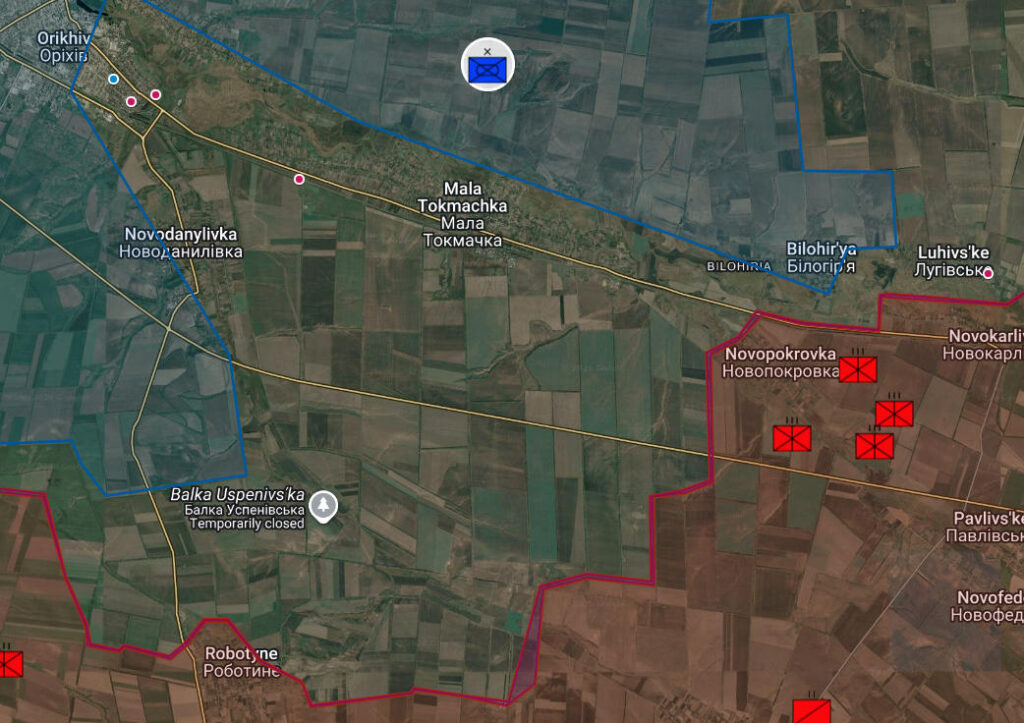
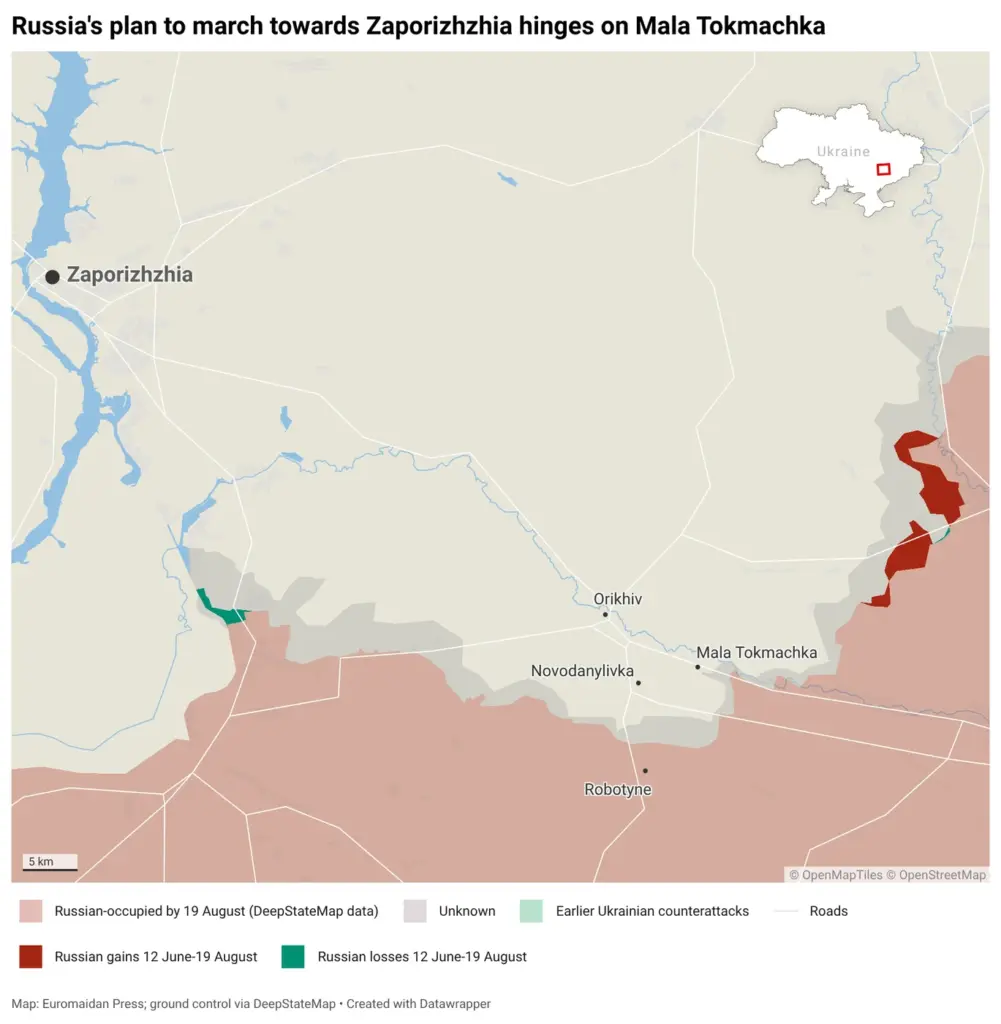
The first obstacle for the Russians is the village of Mala Tokmachka. In particular, the thickly built ruins of a former prison, which function as an interlocking series of bunkers for the Ukrainian 118th Mechanized Brigade. The second obstacle is Orikhiv itself, which sits astride all the passable roads leading to Zaporizhzhia City.

The Russian Defense Ministry announced the capture of Mala Tokmachka on 16 November 2025. Ukrainian government sources still had the village under Ukrainian control in April 2026. Russian milblogger Boris Rozhin's repeated claims that the village was nearly cleared became, in Meduza's account, the most popular Russian military meme of the first half of 2026—shorthand for the distance between what the Russian army announces and what it holds.

Observer Thorkill has watched closely as Russian forces have probed for weaknesses in Ukrainian defenses between the disputed gray zone and Zaporizhzhia City—and found very few.

Sytuacja w rejonie Orichiwa (Zaporoże).

W okolicach połowy czerwca 2026 r. ograniczone działania zaczepne rus 35 Armii w rejonie Orichiwa nabrały większego rozmachu. Jej 71 Pułk Strzelców Zmot ze składu 42 Dywizji rozpoczął natarcie w rejonie wsi Novodaniliwka w pasie obrony ukr… pic.twitter.com/kBPvFVlF6P

— Thorkill (@Thorkill65) August 17, 2026

The Russian army's 270th Motor Rifle Regiment, which is part of the 42nd Motor Rifle Division, has been trying to advance through Mala Tokmachka "for many months," Thorkill noted. But the Russian attacks "have always faltered against the strongly fortified strongpoint in the complex of ruins of the former prison buildings."

If the Russians can't capture Orikhiv, they can't get their artillery within range of Zaporizhzhia City. But they can't capture Orikhiv if they don't first capture Mala Tokmachka. And they can't take Mala Tokmachka if they don't overrun the old prison.

Map of the Orikhiv and Mala Tokmachka axis in Zaporizhzhia Oblast
The Orikhiv-Mala Tokmachka axis. Ukraine Control Map

Surround first, storm later

Frustrated in their attempts to directly assault the prison, the Russians took a different approach in early July. Borrowing tactics that have worked for Russian field armies all along the 1,200-km gray zone, the Russians set out to cut off Mala Tokmachka and starve its garrison before trying again to capture the prison complex.

The geography lends itself to this approach. The Russians control the village of Robotyne, 10 km south of Orikhiv, as well as the road leading north from Robotyne through the village of Novodanylivka, which lies just south of the Mala Tokmachka-Orikhiv conglomeration.

Russia's plan to march towards Zaporizhzhia hinges on Mala Tokmachka
Map: Euromaidan Press. Deepstatemap does not yet show Novodanylivka as captured or in the gray zone

If the conglomeration has a soft underbelly, it's Novodanylivka. And in a series of actions in early July, the 71st Motorized Rifle Regiment pushed enough small infiltration groups into Novodanylivka to take the village from the 118th Mechanized Brigade. In capturing Novodanylivka, the Russians "drove a narrow wedge into the Ukrainian defense," according to Thorkill.

The wedge was not the end of the plan. It was the preparation for it. With Novodanylivka in Russian hands and the supply route between Orikhiv and Mala Tokmachka under threat, the Russians came back to the assault.

Five days in August

In the five days to 17 August, Russian forces "massively stepped up their assault operations towards Orikhiv from several different directions, resulting in a partial collapse of Ukrainian defences," mapper AMK Mapping reported. The mapper counted a Russian gain of around 26 sq km across the sector.

Situation on the Orikhiv direction, Zaporizhzhia Oblast:

Over the last five days, Russian forces have massively stepped up their assault operations towards Orikhiv from several different directions, resulting in a partial collapse of Ukrainian defences.

In the southwest,… pic.twitter.com/uWynOf3Mb5

— AMK Mapping 🇳🇿 (@AMK_Mapping_) August 17, 2026

The Russians re-established control over the eastern part of Mala Tokmachka and began infiltrating the northern part. Several groups crossed north over the Kinska River and are now attacking Ukrainian trench fortifications on the tactical heights beyond. "If they are able to consolidate," AMK Mapping wrote, "a defense of Mala Tokmachka by Ukraine will become nearly impossible." To the northeast, Russian forces broke through north of Bilohirya, putting the Ukrainian troops there at risk of being cut off.

The Polish Centre for Eastern Studies reached a similar reading on 18 August, reporting that Russian assault sub-units had begun to replace the sabotage and reconnaissance groups, that the battle for the eastern part of Orikhiv appeared to have begun, and that the eastern part of Mala Tokmachka was most likely under Russian control.

Heavy fighting continues for the prison complex and the residential streets around it. "The goal of the offensive operations by the Russian 42nd Motorized Rifle Division is not, for the time being, the capture of Orikhiv," Thorkill wrote, "but rather the elimination of the presence of Ukrainian soldiers in the Mala Tokmachka area."

If the Russians can squeeze the Ukrainians out of Mala Tokmachka, they could pivot toward Orikhiv without worrying about Ukrainian positions at their rear. And they would be one strongpoint closer to putting a regional capital of several hundred thousand people under daily artillery fire.

A Ukrainian drone right before it strikes a Russian soldier near Lyman.
Explore further

Russian troops inch toward Lyman. Drones keep delaying the plan.

  • ✇Euromaidan Press
  • Putin’s Mach-10 wonder weapon misses by 30 meters. Russia stopped building it in April.
    As more Russian missiles rain down on Ukrainian cities, one munition is curiously absent The Mach-10 Kinzhal, an air-launched ballistic missile, has been missing in action for months now Ukrainian intelligence says the Kremlin halted production in April because the missile kept missing by 30 meters Russia's Kinzhal air-launched ballistic missile, a version of the ground-launched Iskander, travels as far as 2,000 km at a claimed 10 times the speed of sound whil
     

Putin’s Mach-10 wonder weapon misses by 30 meters. Russia stopped building it in April.

Par : David Axe
19 août 2026 à 08:14

all 20+ russian kinzhal hypersonic missiles targeting kyiv intercepted patriot since may 2023 russia's mig-31k aircraft carrying missile illustrative mounted mig-31

  • As more Russian missiles rain down on Ukrainian cities, one munition is curiously absent
  • The Mach-10 Kinzhal, an air-launched ballistic missile, has been missing in action for months now
  • Ukrainian intelligence says the Kremlin halted production in April because the missile kept missing by 30 meters

Russia's Kinzhal air-launched ballistic missile, a version of the ground-launched Iskander, travels as far as 2,000 km at a claimed 10 times the speed of sound while packing a 500-kg warhead. It was one of a clutch of purported super-weapons that Russian Pres. Vladimir Putin revealed in a dramatic announcement in 2018.

Launched in mid-air by specially modified Mikoyan MiG-31 interceptors in order to boost its speed and range, the Kinzhal is, in theory, a powerful deep strike munition capable of blasting right through all but the best and rarest air defenses.

In a recent interview, Deputy Chief of Ukraine’s Defence Intelligence Major General Vadym Skibitskyi made a series of interesting claims about Russian missile and drone production rates.

According to him, Russia is producing the following missiles at these rates:

- Iskander-M…

— AMK Mapping 🇳🇿 (@AMK_Mapping_) August 11, 2026

In practice, it kept missing. Russia stopped building the $4.5-million missile in April, Maj. Gen. Vadym Skibitskyi, Ukraine's deputy chief of defense intelligence, told RBC-Ukraine—and the rocket fuel and components that had gone into Kinzhals now go into Iskanders, sea-launched Kalibr cruise missiles, and air-launched Kh-101 cruise missiles instead.

A missile of this class needs to land within five to seven meters of its aim point to be worth firing. The Kinzhal, according to Skibitskyi, lands within 30 meters or more. "We can hardly recall a single instance where this missile hit the target precisely," he said. Satellite imagery of the Ukrainian air base at Starokostiantyniv, a favorite Kinzhal target, shows the craters ringing the airfield rather than sitting on it.

‼ Russian voenkors publishes satellite images from the Starokostiantyniv area!

🚀⚠ The photo shows craters from missiles that did not reach their targets. In some cases, the Kinzhals' deviation was up to 144 meters. pic.twitter.com/qvameRj5t8

— MAKS 26 🇺🇦👀 (@Maks_NAFO_FELLA) November 10, 2025

The Kolomna Machine Building Design Bureau reportedly contracted 44 Kinzhals in 2024 and 144 in 2025, Militarnyi reported from Russian defense ministry documents. The line climbed for two years and then stopped dead.

The Kinzhal isn't the only munition reportedly getting the ax. The Kremlin is also halting production of the Kh-32 air-launched cruise missile, which Russian engineers repeatedly failed to improve before the program was sent back for further work. "This would explain why Russia has not launched any Kinzhals for multiple months, and very few Kh-32s," AMK Mapping noted.

At least one analyst anticipated this development years ago. Way back in 2022, then-CNA analyst Michael Kofman wrote that he didn't "understand the interest in Russian use of Kinzhal. There's nothing special or particularly exciting about this system." It is, according to Kofman, just an Iskander but with a more complicated and expensive launch method.

It may have taken the Russians a few years to come to the same conclusion. The last Kinzhal strike might have been on 14 May, when the Russians launched three Kinzhals as part of a wider strike on Ukrainian cities involving 731 missiles and drones.

The purported Kinzhal shutdown, if true, could orphan the boutique fleet of around two dozen MiG-31K/I interceptors whose main role is to haul a Kinzhal to high altitude before launch. The Kinzhal carriers account for around 20% of the wider MiG-31 fleet, whose main mission is air defense over the vast Russian interior.

The MiGs may end up as victims of ruthless efficiency-seeking. If Skibitskyi is right, the Kremlin simply can't afford to keep every munition in production as it seeks to escalate its bombardment of Ukrainian cities amid growing economic losses from Ukrainian deep strikes targeting Russian strategic industries.

It's possible the only way the Russians can boost production of their best deep strike munitions is to cut production of the underperforming ones. According to the pro-Ukrainian Conflict Intelligence Team, the savings in fuel, components, and funds from the suspended Kinzhal and Kh-32 assembly lines "were redirected to other types of missiles."

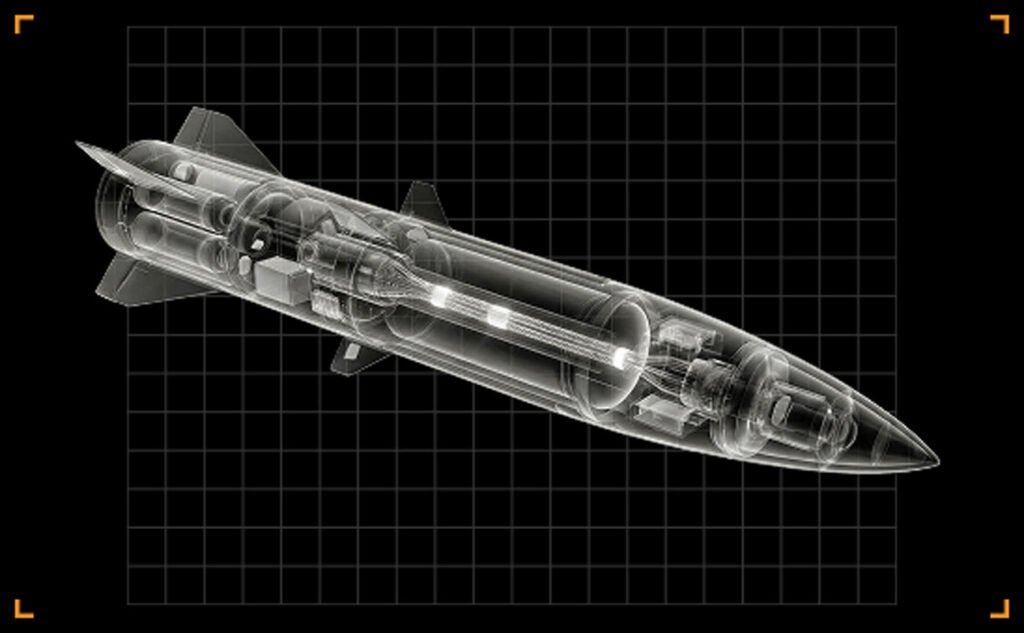
Cutaway rendering of a Russian Kinzhal hypersonic missile shown on Ukraine's TrophyLab platform
A cutaway rendering of a Russian Kinzhal hypersonic missile, as shown on Ukraine's TrophyLab platform. Illustrative image: TrophyLab/Ukraine's Defense Ministry

Production winners and losers

That's how, in July, Russia reportedly produced 65 Iskanders, surpassing its target of 60 by nearly 10%. Meanwhile, production of Kh-101s reached 140% of the monthly target. Kalibr production 111%. Across its main missile lines, Russian industry is running at 110 to 120% of plan. Certain Russian munitions may soon disappear from the sky over Ukraine, if they haven't already. But only because more copies of better munitions are taking their place.

Ironically, the Kinzhals and their carriers are fading away at the same time Ukraine's own deep strike forces may have landed their most powerful blow against the aerial hypersonic strike force. On 15 August, a barrage of Ukrainian drones and cruise missiles struck a range of targets deep inside Russia.

The MICH 2000 drone can fly up to 2,000 km and carry a warhead weighing up to 60kg. Photo courtesy of the manufacturer
Explore further

Ukraine’s new Tu-95 killer is a $48,000 copy of a drone China refused to sell

Among the targets was Savasleyka air base, in Nizhny Novgorod around 785 km from Ukraine. "Direct hits and fires reported," WarTranslated noted.

Among other aircraft, Savasleyka air base hosts some of the MiG-31Ks that carry Kinzhal missiles. Or once carried them, if Skibitskyi is correct and the missile has fallen out of use. It's unclear whether the attack on Savasleyka damaged or destroyed any MiG-31s.

Even if the Kinzhal launchers burned to the ground, it may be too late to matter. The Russians may have rendered the planes and their missiles irrelevant before the Ukrainians could drone them.

  • ✇Euromaidan Press
  • Russia has thousands of tanks it can’t risk. One drone shield decides whether they roll
    Russia's new Arena-M anti-drone shield can shoot down FPVs—but tanks still burn One fielded Arena-M reportedly carried 12 charges. Ukrainian crews used 15 to 20 drones per tank in one assault More rounds could help—if ammunition is really the binding constraint Russian forces may have finally found a way to protect their tanks from Ukrainian first-person-view drones. And it's not the usual add-on armor applications that have defined mechanized combat in Ukrain
     

Russia has thousands of tanks it can’t risk. One drone shield decides whether they roll

Par : David Axe
17 août 2026 à 14:15

An Arena-M tank right before a drone strike.

  • Russia's new Arena-M anti-drone shield can shoot down FPVs—but tanks still burn
  • One fielded Arena-M reportedly carried 12 charges. Ukrainian crews used 15 to 20 drones per tank in one assault
  • More rounds could help—if ammunition is really the binding constraint

Russian forces may have finally found a way to protect their tanks from Ukrainian first-person-view drones. And it's not the usual add-on armor applications that have defined mechanized combat in Ukraine since the early months of Russia's wider war.

No, the Russians have begun deploying tanks fitted with the Arena-M active protection system (APS), which detects incoming FPVs and automatically fires a small projectile at them. The first few assaults by Arena-M-equipped tanks ended in defeat for the Russians, but limited combat footage shows the system can destroy incoming FPVs.

At least one Arena-M did work against FPVs—it just did not work long enough to save the tank. Observer Andrei_bt stressed that a reported 12-round loadout "does not match modern realities." Footage published on 7 August showed Ukrainian FPVs attacking an Arena-M-equipped T-72B3M near occupied Volodymyrivka, though the Institute for the Study of War assessed that it likely showed the late-July mechanized assault. Ukrainian drone operator Dmytro Putiata reported that one Arena-M shot down seven FPVs before Ukrainian forces destroyed the tank.

That is a smaller problem than the one the Russians had a month ago, and it is why the burned-out tanks along the road in Donetsk Oblast are not the whole story. Russia has spent three years accumulating tanks it cannot safely send anywhere—thousands of them, rebuilt and parked for want of a defense against $500 drones. An Arena-M that does not run dry halfway to the objective is the thing that would let those tanks out of the yard.

The good news for Russian mechanized forces is that developers now know Arena-M needs a bigger ammo loadout. The bad news is that packing more projectiles into the system could prove extremely difficult. The main problem: adding any further bulk to the turret-mounted projectile launchers could block a tank's engine compartment, preventing access for maintenance.

A Ukrainian drone targets a Russian vehicle during a 19 March clash around Lyman.
Explore further

Russia’s tanks are back after a year in hiding. Thursday was a massacre.

If there's a workaround, it may involve redesigning the Arena-M to fire smaller but more numerous projectiles.

Ammunition may not even be the binding constraint. Ukrainian aviation expert Anatolii Khrapchynskyi put the Arena-M's engagement range at 20 to 30 meters and its detection range at around 50—numbers that leave very little time against a drone diving from above, however many charges are in the launchers.

The Institute for the Study of War, for its part, assesses that the Arena-M alone is currently insufficient to protect Russian mechanized assaults from Ukrainian drones because the system can be saturated, though it raises the cost and effort required of Ukrainian forces.

An Arena-M with more rounds could be the development Russian commanders were waiting for as they continue stockpiling new and refurbished tanks and fighting vehicles. Doubling down on production of T-90 and T-72 tanks, the Kremlin has more than made good its combat losses in the first 54 months of the wider war.

Tank-led assaults have been rare in the last year of fighting as Russian forces have pivoted to infantry-led infiltration tactics. That may change as infantry losses deepen and commanders gain confidence in the Arena-M to protect tanks from drone attack.

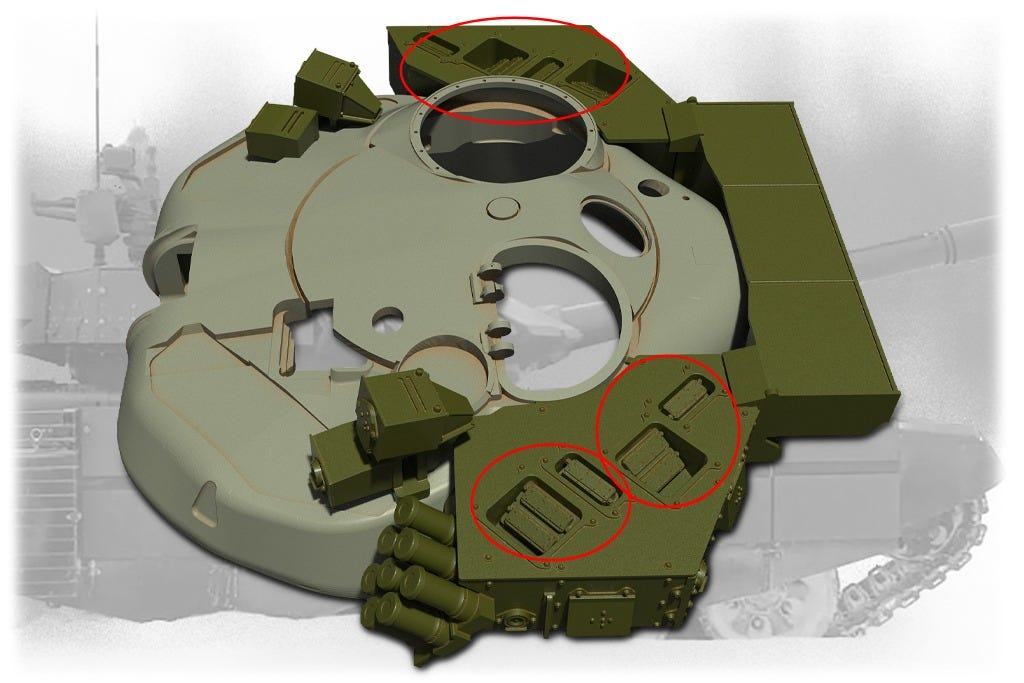
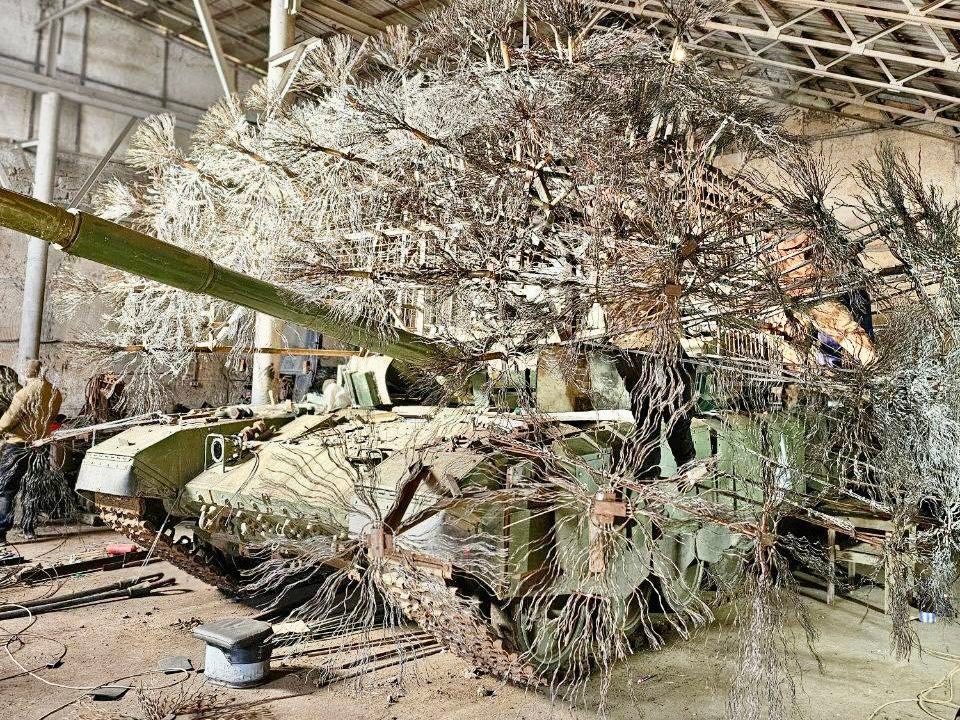
Diagram of the Russian Arena-M active protection system showing the projectile launchers ringed around a tank turret
The Arena-M design, with projectile launchers circled. Kolomna Engineering Design Bureau art

Combat debut

The Arena-M, designed by the Kolomna Engineering Design Bureau, uses Doppler radar to spot incoming rockets, missiles, and drones, and counter-munitions meant to shred a threat shortly before impact. The concept is old: the Soviets fitted the Drozd system to modernized T-55ADs in the 1980s, and Russian designers have been chasing active protection since their tanks were mauled in Chechnya.

Three decades on, the Russian government daily Rossiyskaya Gazeta conceded on 7 August that there is still no generalized battlefield data on how the Arena-M performs, and that its potential against threats attacking from above needs further study.

Anti-Drone Armor Evolution
Evolution of Russia's anti-drone protection of tanks
From crude cages to shooting back—four years of trial and error
Russian tank with cope cage anti-drone armor, 2022
2022
Cope cage
Metal slats or mesh bolted over turrets to block incoming FPV drones
Russian turtle tank wrapped in metal shell, 2023
Spring 2023
Turtle tank
Entire vehicles wrapped in drone-blocking metal shells
Russian porcupine tank with rebar spines welded on armor, 2025
Spring 2025
Porcupine
Hundreds of thick rebar spines welded to cope cages and shells
Russian dandelion tank with branching aluminum hairs and Kevlar mesh, 2025
Autumn 2025
Hedgehog & dandelion
Thousands of thin aluminum hairs; branching stalks with Kevlar mesh
Russian T-72B3A fitted with the Arena-M active protection system
July 2026
Arena-M
Radar-cued charges shoot drones down instead of blocking them—reported fielded loadout: 12 rounds
Chart: Euromaidan Press

The system had its major combat debut in Ukraine on and around 23 July, over several days of Russian mechanized attacks in the Dobropillia sector of eastern Ukraine's Donetsk Oblast. The Russian Center Group of Forces rolled a large mechanized assault group along the road through the village of Pankivka, roughly 36 km southwest of Kramatorsk and its twin free city of Sloviansk.

Ukrainian drones spotted the tanks coming, and attacked. When the smoke and dust cleared, the Russians had lost at least nine tanks. Reportedly seven of them were T-72B3A models with Arena-M installations.

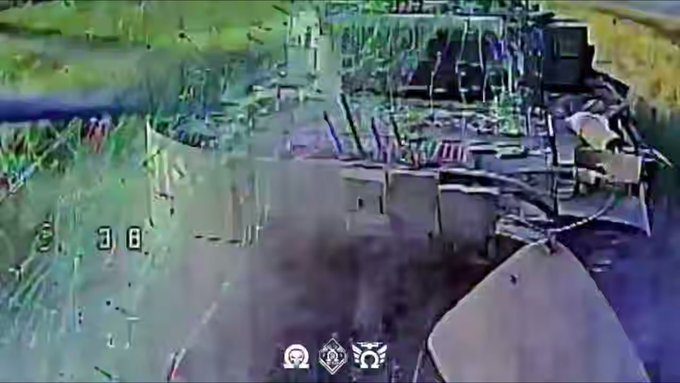
The losses belie the Arena-M's effectiveness. The protection systems shot down drone after drone, and only stopped shooting down drones when they ran out of projectiles. "In general, it took from 15 to 20 FPV drones to destroy a tank," Ukrainian drone operator Dmytro Putiata reported.

While some of the best-protected turtle, porcupine, and hedgehog tanks have been able to withstand more than 20 FPVs before being immobilized, the add-on metal plates and bars that comprise turtle, porcupine, and hedgehog installations are extremely heavy—and tend to ruin a tank's transmission, weigh on its mobility, and prevent it from rotating its turret and aiming its main gun.

A T-72B3A the moment before a Ukrainian drone strikes.
Explore further

Russia took the cages off its newest tanks. The new Arena-M shield bought them a few minutes.

In other words, the add-on armor prevents tanks from fighting like tanks—using their speed and firepower to close with and destroy the enemy.

The Arena-M installation is bulky but it's not heavy. With Arena-M, a tank can defend itself from drones without sacrificing its mobility. If an Arena-M had, say, 24 rounds instead of just 12, an attacking tank might be able to fend off drones long enough to reach its objective across the disputed gray zone.

But only barely. "15 to 20 FPV drones to destroy a tank is a perfectly viable rate," Czech analyst Jakub Janovsky noted in a comment on Putiata's social media. "At those numbers, Russia could throw its entire [armored fighting vehicle] fleet at the Ukrainian front line over a few months without achieving much more than creating a future low-grade iron ore deposit."

What if the Russians could fit 36 rounds in an upgraded Arena-M installation? Would that be enough?

No one knows for sure until they try. What we do know is that "the Russian military is learning and is experimenting in how to employ armor on a drone-saturated battlefield," explained Rob Lee, an analyst with the Foreign Policy Research Institute in Philadelphia. "The Arena-M APS demonstrated effectiveness and will likely be improved."

And those improvements could unlock those thousands of tanks the Russians have parked for want of drone defenses.

A Russian T-90 dandelion tank.
Explore further

Russia mastered drone-proofing its tanks—Ukraine is copying its tricks

  • ✇Euromaidan Press
  • Ukraine may have just lost its first Swedish assault boat—to a Russian jet drone
    Sweden and its neighbors gave Ukraine the fast assault boats that carry raiders to Russian-held beaches Russia is now hunting those boats with Geran-4 jet drones One of the two boats hit this month may be the first CB-90 Ukraine has lost On or around 12 August, a Russian Geran-4 attack drone found a Ukrainian navy CB-90 in the waters off the Kinburn Spit and attacked it. Three days later, another Geran-4 went after a Ukrainian tugboat in the same waters. If th
     

Ukraine may have just lost its first Swedish assault boat—to a Russian jet drone

Par : David Axe
17 août 2026 à 08:48

Ukrainian Navy CB90 assault boats sailing Black Sea patrol operations coastal defense against Russian drones

  • Sweden and its neighbors gave Ukraine the fast assault boats that carry raiders to Russian-held beaches
  • Russia is now hunting those boats with Geran-4 jet drones
  • One of the two boats hit this month may be the first CB-90 Ukraine has lost

On or around 12 August, a Russian Geran-4 attack drone found a Ukrainian navy CB-90 in the waters off the Kinburn Spit and attacked it. Three days later, another Geran-4 went after a Ukrainian tugboat in the same waters. If the CB-90 sank, it may be the first one the Ukrainian navy has lost.

The CB-90 is a Swedish design and a Swedish gift, and it is the reason Ukraine can raid the spit at all. Fifteen meters long, armored against small arms, gun-armed and capable of around 40 knots, it can put 21 troops—or a ton of machinery—onto a hostile beach and be gone before the defenders react. Sweden has supplied most of the more than 38 in Ukrainian service; Norway, the Netherlands and the Ukrainian billionaire Rinat Akhmetov's Steel Front initiative supplied the rest. Swedish instructors trained the crews.

Russia has now answered Ukraine's raids, and it is aiming at the boats rather than the raiders. The Geran-4s doing the hunting are jet-propelled, AI-assisted and fast enough to outrun most of what Ukraine can shoot back with. If the campaign continues, it could close the approach that has made the raids possible.

What that approach makes possible is worth spelling out. In July, unmanned boats belonging to the Ukrainian Territorial Defense Forces landed at least one gun-armed unmanned ground vehicle on the Kinburn Spit, the westernmost Russian outpost in occupied Ukraine. As aerial drones watched, the UGV opened fire on a nearby Russian installation. No Ukrainian was anywhere near the beach.

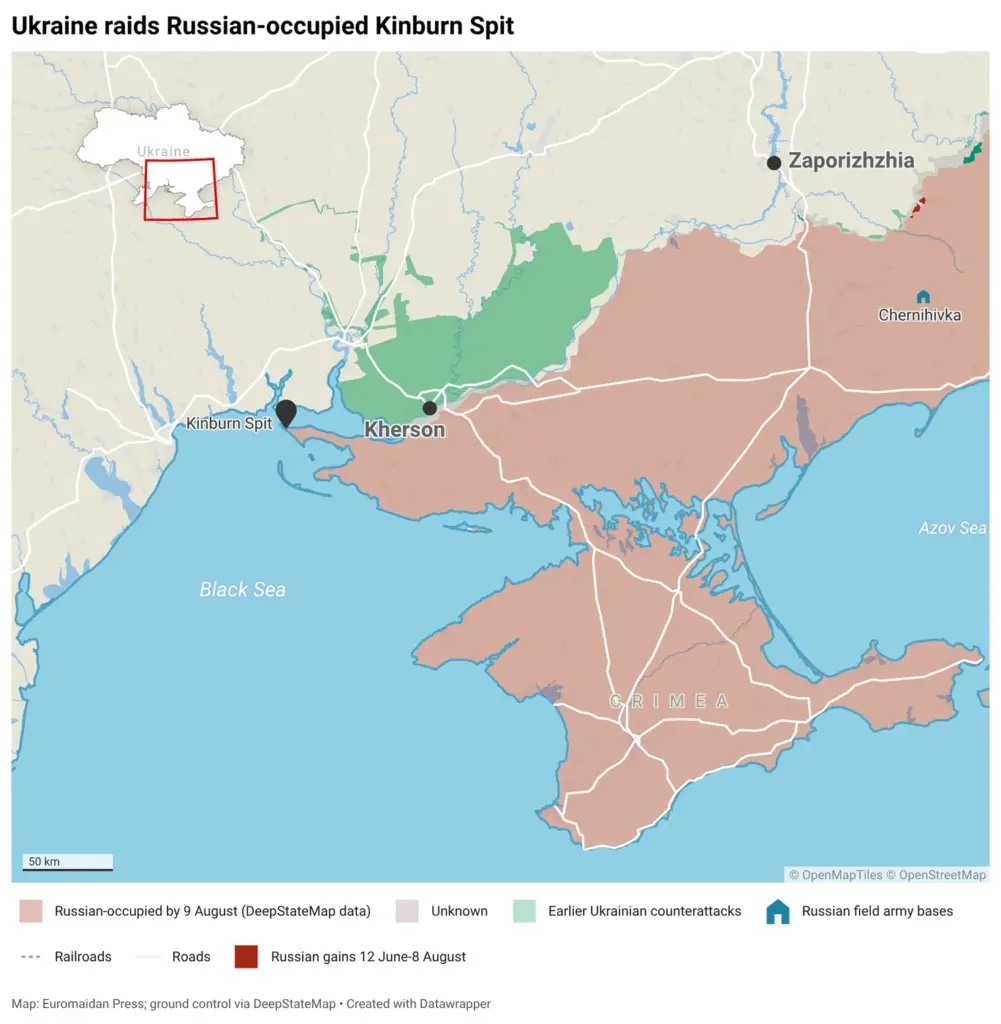
Russian forces on the Kinburn Spit can monitor Ukrainian maritime traffic, making the narrow sandy spit a key outpost in the ongoing battle for the Black Sea's most important sea lanes. Ukrainian forces are determined to dislodge Russian forces from the spit. The Russians are determined to cling to their sandy outpost.

Минобороны России опубликовало видео поражения украинского патрульного катера CB-90 беспилотным летательным аппаратом «Герань-4 сикер» близ Очакова 12 августа 2026 года.

📷Геопривязка (https://t.co/oFm8LyBAdt) pic.twitter.com/SgQnTRerm9

— Lost Armour (@lostarmour) August 12, 2026

The Geran attacks are helping. The 12 August Geran raid targeted the CB-90. The 15 August Geran raid targeted the tugboat. It's unclear how much damage the Gerans inflicted, but it's worth noting that the CB-90 is just 15 m long; a tugboat might be slightly longer. A Geran's warhead weighs as much as 90 kg—probably enough to sink such a small vessel or burn it down to the keel.

The Ukrainian navy has only a few large warships, and they're all donated minehunters that have been waiting out the current wider war in the relative safety of European waters. The bulk of the Ukrainian fleet is made up of small patrol boats, auxiliaries such as tugs, and several types of unmanned surface vessels. These vessels defend waterways and ports and, more rarely, support offensive operations.

A Russian Gerbera drone struck a tugboat of the Ukrainian Navy in the Dniprovska Gulf, opposite Russian positions on the Kinburn Spit. pic.twitter.com/Arnwts6BEL

— AMK Mapping 🇳🇿 (@AMK_Mapping_) August 15, 2026

Spit raids

The July robot landing was one episode in a long Ukrainian raiding campaign along the spit—the kind of operation the Geran-4s are now trying to spoil.

Location of Kinburn Spit. Map: Euromaidan Press

The Geran strikes on Ukrainian boats could blunt these raids and help the Russians maintain their tenuous hold on the Kinburn Spit. The Russian strikes are part of a wider maritime campaign. Shortly after Ukrainian drone units began targeting the unregistered cargo ships and tankers belonging to Russia's shadow fleet, Russian drone and missile units retaliated—with devastating attacks on Ukrainian ports and the ships sailing to and from these ports in support of Ukraine's lucrative grain exports.

The Ukrainian attacks on the shadow fleet damaged hundreds of ships and effectively ground Russian Black Sea trade to a halt. But Russian attacks on Ukrainian ports effectively ground Ukrainian Black Sea trade to a halt, too.

The MICH 2000 drone can fly up to 2,000 km and carry a warhead weighing up to 60kg. Photo courtesy of the manufacturer
Explore further

Ukraine’s new Tu-95 killer is a $48,000 copy of a drone China refused to sell

The new jet-propelled Geran-4s with their AI-assisted targeting were central to the effort. Their 500 km/h top speed makes them hard to shoot down. And the AI makes jamming far less useful than it used to be: the operator locks the drone onto a target, and from there the machine vision flies the attack, holding the lock even if Ukrainian electronic warfare severs the radio link in the final seconds.

That makes the CB-90s valuable targets. Armed with guns and armored against enemy small arms fire, they're perfect for raiding far-flung enemy outposts such as those on the Kinburn Spit. But they're vulnerable to drone attack—and each one is irreplaceable in the sense that matters, since Ukraine cannot build them and has to wait for the next donation.

Ukrainian forces aren't powerless to stop the Russians from spoiling Ukrainian raids on the spit. Geran-4s might be too fast for Ukrainian gun teams, armed light aircraft, and cheap interceptor drones, but they're not too fast for supersonic Ukrainian air force MiG-29 fighters.

Several of the MiGs patrol over the western Black Sea. One crashed recently, but others remain.

  • ✇Euromaidan Press
  • Ukraine’s quiet counteroffensive took 745 square km. Russia’s dead Starlink is how
    In six months of unheralded advances, Ukrainian forces liberated a wide stretch of the southeast The collapse of Russian communications turned a local push into a six-month advance Now the Russians may mobilize yet again, so the Ukrainians are digging in and consolidating their gains The scale of Ukrainian forces' counteroffensive in southeastern Ukraine early this year is finally becoming clear. In six months of maneuver starting on 29 January, a clutch of Uk
     

Ukraine’s quiet counteroffensive took 745 square km. Russia’s dead Starlink is how

Par : David Axe
14 août 2026 à 16:07

Soldiers of Ukraine's 79th Air Assault Brigade.

  • In six months of unheralded advances, Ukrainian forces liberated a wide stretch of the southeast
  • The collapse of Russian communications turned a local push into a six-month advance
  • Now the Russians may mobilize yet again, so the Ukrainians are digging in and consolidating their gains

The scale of Ukrainian forces' counteroffensive in southeastern Ukraine early this year is finally becoming clear. In six months of maneuver starting on 29 January, a clutch of Ukrainian units, including the 78th, 79th, 80th, 82nd, and 95th Air Assault Brigades and the 1st and 425th Assault Regiments—tens of thousands of troops, in all—marched through gaps in Russian defenses and, according to Ukrainian officials, liberated around 745 square km and 26 settlements. Mostly in Dnipropetrovsk Oblast but also in neighboring Zaporizhzhia and Donetsk Oblasts.

That is Kyiv's own accounting, and it is the high end. The Institute for the Study of War, which maps control from geolocated imagery, put the figure at roughly 627 square km across the Oleksandrivka direction and the northern Hulyaipole direction—while noting its own conservative method probably undercounts. Either number describes the largest Ukrainian territorial gain since 2023.

The Ukrainian gains helped to offset Russian gains around the last few free cities in eastern Ukraine's Donetsk Oblast. Between the start of February and the end of July, Russian regiments captured a net total of just 260 square km of Ukrainian soil, according to a tally by the Black Bird Group. It would've been more than 1,000 square km if those air assault and assault units hadn't been busy clearing the Russians from a wide swathe of the southeast.

According to our data, in July the net gains of the Russian armed forces in Ukraine were approximately 106km².

This is the fastest Russian advance since January, but their gains remain extremely limited. In July of 2025 the Russians captured nearly 5 times as much territory.

1/ pic.twitter.com/02931eDLk0

— Black Bird Group (@Black_BirdGroup) August 4, 2026

The Ukrainian counteroffensive kicked off on 29 January. Three days later, Elon Musk's Starlink bricked Russia's thousands of smuggled and stolen satellite terminals. Practically overnight, the Russians lost their best method for controlling small drones and guiding assault units across the disputed gray zone. Drones couldn't fly. Troops couldn't navigate.

Ukrainian commanders surely knew their communications advantage wouldn't last: the Russians would eventually adapt with new methods of command and control. Seizing the opportunity, Ukrainian paratroopers and assault troops pressed the attack. And in stark contrast to the usual assault tactics for both sides, the Ukrainians attacked in tanks and other armored vehicles, counting on the Russians' connectivity problems to clear a path for heavy forces.

The blackout was not the only thing working in Ukraine's favor. ISW credits the gains to five reinforcing factors: better operational planning, a campaign to suppress and destroy Russian air defenses, deeper strikes on Russian logistics, Ukrainian drone superiority at the tactical level—and the Starlink cutoff. But the cutoff is the one that arrived all at once, and it arrived just as Ukrainian armor was starting to move.

As expected, @Deepstate_UA and other Ukrainian 🇺🇦 media outlets followed on the liberation of multiple villages

Despite many "analysts" doubting OPSEC, not too much information filtered from this offensive. Thus, let's get back inside to understand what happened

🧵THREAD🧵⬇ pic.twitter.com/Sy2cYxiZy3

— Clément Molin (@clement_molin) August 12, 2026

Mechanized assaults

Not all the vehicles got through. The assault troops lost one up-armored M-1 Abrams tank in early February. But by March, other assault forces M-1s were engaging Russian troops at point-blank range with their 120-mm main guns. After clearing a few disputed villages along a 45-km front between Dobropillya and Zelenyi Hai, the Ukrainians focused their maneuver and firepower on Komar, 12 km southeast of Zelenyi Hai.

The Ukrainians "started a slow and quiet offensive, with very few videos and small teams, during April and May," mapper Clément Molin recalled. The strict information security obscured the Ukrainian moves for all but the closest observers, allowing Ukrainian commanders to press their attacks without drawing too much attention—and risking a Russian countercounteroffensive.

By summer, the Ukrainians were within mortar range of Komar. Embarrassed Russian commanders resorted to sending out small teams on virtual suicide missions to plant Russian flags in disputed territory. The flags could create the impression of Russian control on terrain that, in fact, neither side controlled. "Russia is trying to intoxicate us with flag videos, which are meant to hide the real situation to both us and their command," Molin wrote.

The reality was that the Ukrainians had gained ground. A lot of it.

A Ukrainian drone right before it strikes a Russian soldier near Lyman.
Explore further

Russian troops inch toward Lyman. Drones keep delaying the plan.

Announcing the results on 12 August, Ukrainian officials also claimed 9,550 Russian troops killed and more than 6,600 wounded—figures no independent body has verified. Former commander in chief Oleksandr Syrskyi, who planned the operation, said it proved the Ukrainian army "is capable not only of steadfastly holding its defences, but also of launching offensives, seizing the initiative, and liberating Ukrainian land."

But the momentum was unsustainable. As the Russians gradually restored command and control through the summer, the Ukrainians encountered more resistance. Now the gray zone is stabilizing again. Observer Moklasen predicted new Ukrainian commander in chief Maj. Gen. Mykhailo Drapatyi will order his corps and brigade commanders "to dig in positions, consolidate and strengthen more army corps" instead of continuing to attack.

After all, the Russians are pushing hard in Donetsk, and the resources the Ukrainians had devoted to the southeastern counteroffensive could boost the defensive effort in the east. Moreover, there are worrying signs the Kremlin may attempt another mobilization soon, potentially surging hundreds of thousands of fresh troops into Ukraine.

The Ukrainians may soon prioritize holding over attacking.

  • ✇Euromaidan Press
  • Ukraine’s new Tu-95 killer is a $48,000 copy of a drone China refused to sell
    Ukraine's state security service has its own special attack drone The MICH 2000 is a highly evolved copy of a Chinese drone China refused to sell There are at least eight versions of the 2,000-km drone, from $48,000 On 16 July, one-way attack drones from the Ukrainian state security service—the vaunted SBU—motored 800 km to strike Engels-2 air base in western Russia. At the time, there were reportedly five bombers on the ground at the base: four Tupolev Tu-22M
     

Ukraine’s new Tu-95 killer is a $48,000 copy of a drone China refused to sell

Par : David Axe
13 août 2026 à 13:01

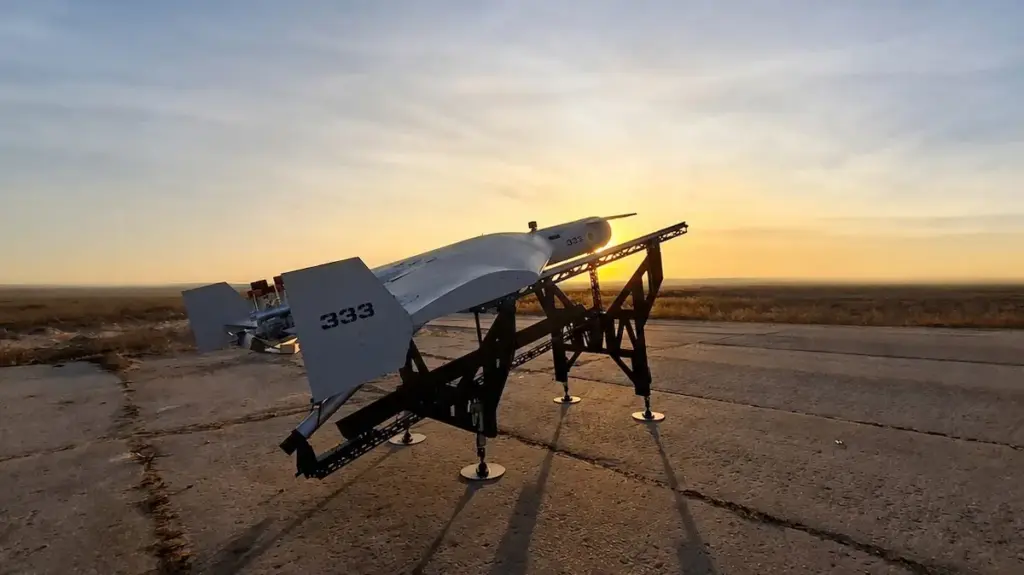
The MICH 2000 drone can fly up to 2,000 km and carry a warhead weighing up to 60kg. Photo courtesy of the manufacturer

  • Ukraine's state security service has its own special attack drone
  • The MICH 2000 is a highly evolved copy of a Chinese drone China refused to sell
  • There are at least eight versions of the 2,000-km drone, from $48,000

On 16 July, one-way attack drones from the Ukrainian state security service—the vaunted SBU—motored 800 km to strike Engels-2 air base in western Russia. At the time, there were reportedly five bombers on the ground at the base: four Tupolev Tu-22Ms and a single Tupolev Tu-95.

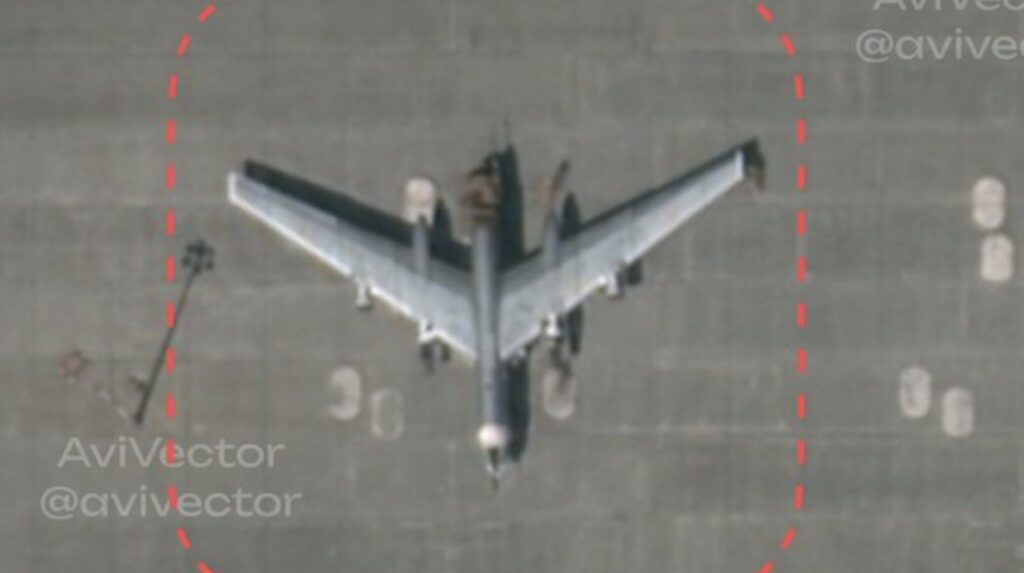
The drones struck the four-engine, propeller-driven Tu-95. "According to preliminary data, the plane suffered critical damage," the SBU claimed. "It completely tore off the tail part." That particular aircraft, the SBU added, had been used systematically to launch massed missile strikes on Ukraine. Satellite imagery later confirmed the bomber's destruction.

The destroyed Tu-95.
The destroyed Tu-95. Satellite imagery via AviVector.

Nearly a month later, we finally know which drone type the SBU flung at Engels-2 and its parked bombers. They were MICH 2000s—Ukrainian aircraft that began as copies of the Chinese ZTK-150, built after Beijing stopped selling. Ukrainian website Oboronka, which visited the factory, broke the news. "Today, the Mich' is no longer just a Chinese plane, but a drone that is exclusively used by the SBU Special Operations Center 'Alpha.'"

According to Oboronka, whose report was agreed in advance with the manufacturer and the SBU, the MICH 2000 flies as far as 2,000 km with a warhead weighing 25 to 60 kg. "The list of targets hit by this drone is updated every week," Oboronka noted. They include Russian ports, military and industrial sites around Moscow and Engels-2.

The Engels-2 raid might be the most immediately impactful. After the 16 July raid, the Russians may be down to 43 Tu-95s, only a dozen of which are usually active at any given time.

The mysterious Shahed like Ukrainian drone that has been repeatedly spotted during strikes deep inside Russia finally has a name: MICH 2000.

Until now, almost nothing was publicly known about it. The drone is used exclusively by the SBU’s Alpha unit, can fly up to 2,000 km and… https://t.co/yUHIXEjvLl pic.twitter.com/HT59LiigrI

— Special Kherson Cat 🐈🇺🇦 (@bayraktar_1love) August 12, 2026

The plane that came from China

The MICH 2000 started as someone else's drone. In the summer of 2023, Beijing restricted exports of the civilian aircraft Ukrainian units had been buying and converting into deep-strike munitions. At the end of that year, a team of Ukrainian developers flew to China to buy some anyway.

At the factory, they found dozens of ZTK-150s coming off the line—Shahed lookalikes distinguished mainly by a pair of forward canards. The Chinese intermediaries floated selling the production technology outright, and Ukrainian commanders liked the idea. But when the team came back ready to buy, the factory's management refused.

The intermediaries wanted the deal anyway. They offered to assemble the drones somewhere without export restrictions—and to train Ukrainian pilots. The team took the training. "We came there to teach pilots to fly Chinese drones," one member told Oboronka. "And in parallel with the training we photographed everything that was there. Everything from the production process to the arrangement of the shelves and cabinets." They flew home with trained pilots and eight Chinese drones.

Two years later, the Ukrainian version costs $48,000 in its basic configuration. The Chinese original costs $50,000. And according to the manufacturer, almost nothing of the Chinese drone survives in the MICH 2000 now except its outline.

Whittling down the bomber fleet

Ukrainian drones are slowly chipping away at the Tu-95 fleet. A 2022 drone raid badly damaged one of the lumbering turboprop bombers at Engels-2, potentially leaving no more than 51 intact Tu-95s in the Russian air force inventory at the time. Smuggling tiny explosive drones across Russia in trucks on 1 June, 2025, the SBU hit at least seven more Tu-95s as well as four Tu-22Ms, among other aircraft.

The 16 July raid is the more recent Ukrainian effort to shrink the Russian bomber force, but it surely won't be the last. The Russians' roughly 120 bombers—Tu-95s, Tu-22Ms and Tupolev Tu-160s—launch the cruise missiles that routinely blast Ukrainian cities and power plants.

Struggling to intercept all Russian deep strike munitions in the target zone, in part owing to a deepening shortage of the best air defense missiles, Ukrainian forces increasingly aim to prevent the Russian munitions from even launching—by smashing munitions factories or, yes, destroying irreplaceable bombers. Of the three Russian bomber types, just one—the Tu-160—is still in production, albeit at a rate of barely just one every year or two.

Russian strategic bomber TU-95 carrying Kh-101 missiles. Source: Defense Express
Explore further

Ukraine kills bomber inside Russia. Soviet Union stopped building them decades ago — so this one is gone for good

Expect more MICH 2000 raids. The type's anonymous builder churns out 6,000 MICH 2000s a year but aims to boost output to 10,000 a year. And the firm customizes the drones to suit particular missions.

According to Oboronka, there are eight main versions. "Fighters can choose what kind of communication they need: analog, digital or Starlink. They can choose the warhead, the size of the fuel tank, the possibility of additional guidance." The navigation system can be made more jam-proof by adding additional jam-resistant controlled reception pattern antennas.

flamingo vs oreshnik ukraine's genstaff now details damage russia's launch site · post fp-5 cruise missile targeting kapustin yar test range ukraine confirmed ballistic infrastructure previous strikes astrakhan oblast intermediate-range
Explore further

Russia has figured out how to stop Ukraine’s most powerful missile

Drone strikes by MICH 2000s and other drone types aren't the only ways Ukrainian forces are trying to blunt Russian attacks on Ukrainian cities and power plants. Ukrainian drone teams are also trying to take out the last five warships in the battered Russian Black Sea Fleet that can fire Kalibr cruise missiles.

On 11 August, drones struck at least three of the ships in the port of Novorossiysk in southern Russia. The frigates Admiral Essen and Admiral Makarov and the corvette Bykov all suffered visible damage.

  • ✇Euromaidan Press
  • Russia has figured out how to stop Ukraine’s most powerful missile
    Russia has found a way to defeat Ukraine's Flamingo cruise missiles Russian air force A-50U radar planes see the missiles coming One mapper counts 10 of the last 11 Flamingos shot down Russia has been shooting down most of Ukraine's best long-range cruise missiles as fast as Ukraine can launch them. Just one or two of the $500,000 Fire Point FP-5 Flamingo missiles have hit their targets in recent weeks. That means Russian air defenses are working for now.
     

Russia has figured out how to stop Ukraine’s most powerful missile

Par : David Axe
12 août 2026 à 16:29

flamingo vs oreshnik ukraine's genstaff now details damage russia's launch site · post fp-5 cruise missile targeting kapustin yar test range ukraine confirmed ballistic infrastructure previous strikes astrakhan oblast intermediate-range

  • Russia has found a way to defeat Ukraine's Flamingo cruise missiles
  • Russian air force A-50U radar planes see the missiles coming
  • One mapper counts 10 of the last 11 Flamingos shot down

Russia has been shooting down most of Ukraine's best long-range cruise missiles as fast as Ukraine can launch them. Just one or two of the $500,000 Fire Point FP-5 Flamingo missiles have hit their targets in recent weeks.

That means Russian air defenses are working for now. Whether they'll continue to work is the critical question for Ukrainian strike planners.

Under the cover of darkness on 6 August, the Ukrainian army's 19th Missile Brigade launched at least three of the six-ton, jet-propelled Flamingos toward Tyumen Oblast in western Siberia. The missiles traveled around 2,500 km before disappearing, according to mapper AMK Mapping.

The apparent shoot-downs capped a difficult week for Ukraine's deep strike campaign. AMK Mapping claimed the Russians shot down 10 of 11 launched Flamingos since 1 July. That count is one mapper's, based on open-source tracking, and no official Ukrainian or Russian figures exist to check it against.

Approximate flight route of the 5 Ukrainian FP-5 Flamingo cruise missiles.

They disappeared over Tyumen Oblast, likely after being shot down once again by Russian air defence.

Once again, the missiles followed the path of major rivers at low altitude in order to complicate… https://t.co/8xbymN3dap pic.twitter.com/Rc17wrQI1X

— AMK Mapping 🇳🇿 (@AMK_Mapping_) August 6, 2026

The mapper may be off by one. Between 24 and 25 July, at least one Flamingo struck the Vyatka Machine-Building Enterprise Avitek missile plant in Kirov Oblast 1,300 km from the border with Ukraine. Michael Bohnert, an analyst with the RAND think tank in California, concluded that two Flamingos hit the plant, causing visible damage.

A map of locations where Ukraine has struck with long-range Flamingo missiles and where they were intercepted
Map: Euromaidan Press

It was a potentially powerful blow. Among other things, Avitek produces parts for the Tor medium-range surface-to-air missile system. Slowing Tor production "will have the most impact," Bohnert explained. And the Ukrainian system that a Tor slowdown might benefit the most is ... the Flamingo.

After all, the Tor is one of the air defense systems the Russians could use to shoot down Flamingos. "Any slow-down in the production of these could greatly improve the prospects of FP-5 performance over time," Bohnert noted.

Ukrainian Firepoint FP-5 Flamingo missiles just smashed the Avitek plant in Kirov, Russia (July 24 and 25) — and the biggest hit is to SA-15 Tor production.

Here are the facts and why it matters

On July 24th and 25th, Ukrainian Firepoint FP-5 Flamingo Missiles hot the Vyatka… pic.twitter.com/Ii8VsJCumi

— Michael Bohnert (@mbohnert) July 26, 2026

Aerial defenses

At present, however, it seems that the Flamingo's biggest problem is in the air, not on the ground. Russia is shooting down most of the incoming FP-5s because it has eyes in the sky.

The Russian air force's fleet of lumbering Beriev A-50U radar early-warning planes now has one mission and one mission only: the A-50Us with their fuselage-mounted radars patrol over the likeliest flight paths for Flamingos motoring into the Russian interior to strike strategic industries.

The A-50Us are effective in the role. As recently as June, more Flamingos were getting through Russian defenses. Between 9 and 10 June, the 19th Missile Brigade launched five Flamingos at the VNIIR-Progress electronics plant in Cheboksary, in western Russia, 960 km from the Ukraine border.

Two missiles struck the plant, punching right through anti-drone protections and inflicting major blast and fire damage with their 1,150-kg warheads, the biggest on any Ukrainian deep strike munition.

Russia adapted fast. On 4 July, an A-50U helped missile batteries on the ground spot and shoot down five FP-5s flying toward Votkinsk, 1,360 km from Ukraine. From its perch thousands of feet in the air, the A-50U has a much longer detection range against low targets than any radar on the ground can manage.

A Russian A-50U.
Explore further

To catch Ukraine’s cruise missiles, Russia is risking the scarce A-50 radar planes it has no way to rebuild

Targeting A-50Us on the ground and in the air in a series of drone and missile ambushes, the Ukrainians have destroyed two A-50Us and damaged at least two others, reducing the fleet to no more than five. Russia has no way to build replacements. But those five planes are now fully committed to the anti-Flamingo fight.

On 7 July, the Russians reportedly launched four of the irreplaceable planes at the same time in order to coordinate the Flamingo shoot-downs. Now, almost all Flamingos go down in flames before they reach their targets.

Ukraine isn't powerless. Fire Point has been working hard to improve the Flamingo and make it harder to shoot down. Perhaps most importantly, it seems the company tweaked the missile's altimeter in order to help it fly lower. The lower a missile flies, the better chance it has of hiding among the radar clutter created by surrounding terrain.

But if a lower-flying Flamingo is harder to shoot down, the improvement hasn't yet registered in the statistics. For now, Russia has figured out how to take out almost all of Ukraine's heaviest deep-strike missiles.

A Russian A-50U.
Explore further

Russia is running out of its best eyes in the sky

  • ✇Euromaidan Press
  • Russia squeezes the flanks, then infiltrates the middle. Around Kramatorsk, it can’t do both
    Russian forces use the same strategy over and over to capture Ukrainian cities Surround on the flanks, infiltrate in the middle But that strategy requires doing both at once, and Russia lacks the infantry Around Kramatorsk, every Ukrainian unit that holds forces a shuffle that stalls something else Russian troops are slowly marching toward and around Kramatorsk and Sloviansk, the last two big free cities in eastern Ukraine's Donetsk Oblast. The Russians
     

Russia squeezes the flanks, then infiltrates the middle. Around Kramatorsk, it can’t do both

Par : David Axe
10 août 2026 à 17:24

Soldiers of the 93rd Separate Mechanized Brigade’s Fox Crew prepare for a logistics run near the Kramatorsk–Kostiantynivka road in Donetsk Oblast. The unit, once focused on anti-tank warfare, now uses strike drones to disrupt Russian supply lines. Credit: 93rd Separate Mechanized Brigade / Fox Crew.

  • Russian forces use the same strategy over and over to capture Ukrainian cities
  • Surround on the flanks, infiltrate in the middle
  • But that strategy requires doing both at once, and Russia lacks the infantry
  • Around Kramatorsk, every Ukrainian unit that holds forces a shuffle that stalls something else

Russian troops are slowly marching toward and around Kramatorsk and Sloviansk, the last two big free cities in eastern Ukraine's Donetsk Oblast.

The Russians have a standard playbook for taking a Ukrainian city, and running it means doing two things at the same time. Along the nearly 100-km Kramatorsk front, they don't have the infantry to do both at once. Every time a Ukrainian brigade holds somewhere, the Russians have to move men to cover it—and something stalls somewhere else.

That strategy is simple in concept but difficult in practice. The idea is for Russian forces to advance along a city's under-protected flanks in order to put pressure on the main supply lines of the city's garrison. As the flank attacks squeeze the garrison's logistics, Russian infiltrators slip into the city, hoping to create a lodgement for follow-on forces.

The final assault through that lodgement comes late in the campaign, after the Ukrainians are already weakened by a lack of supplies.

Structural Deterrence

Russian offensive planning at the operational level remains disciplined on paper: groupings are sequenced, axes are assigned, objectives are staggered. What the discipline is not is well-manned. I read the shift to two- and three-man infiltration teams on… https://t.co/Py1GbXM9aR

— Vitaly (@M0nstas) July 24, 2026

The strategy only works when the troops on the flanks and those in the middle work together. The former squeezes. The latter infiltrates. The problem for the Russian Center Group of Forces on the Kramatorsk front is that it's not squeezing and infiltrating at the same time. That delays the overall Russian advance and buys time for Ukrainian forces to dig in, reinforce, and hope for a miracle.

"Russian offensive planning at the operational level remains disciplined," mapper and analyst Vitaly explained. But only "on paper," Vitaly added. "Groupings are sequenced, axes are assigned, objectives are staggered."

"What the discipline is not is well-manned," the mapper wrote.

Vitaly reads one recent Russian adaptation as evidence of the shortfall rather than of cleverness. "I read the shift to two- and three-man infiltration teams on motorcycles and ATVs as less a sign of tactical innovation than of a manpower deficit that organization is straining to hide," he wrote.

Russian forces advance towards Kramatorsk and Sloviansk, making inroads in the last 2 months
Map: Euromaidan Press

Manpower shortages

Ukraine's manpower problems are well-known. Fewer observers appreciate that Russia struggles, too. Yes, the Russians still recruit around 30,000 fresh troops every month. In theory, that's enough new manpower to replace monthly losses.

But replacing casualties is not the same as resourcing a strategy. Ukraine's commander-in-chief Oleksandr Syrskyi put the Russian force in Ukraine at 721,300 at the end of June—a gain of only around 11,000 since late 2025, against Russian losses he estimated at 30,000 to 35,000 a month. Contract recruitment collapsed in the spring, falling by a third year on year, and Ukraine's foreign intelligence service counted 195,000 contract recruits by early July against an annual target of 409,000.

A Russian general, speaking anonymously to the investigative outlet IStories, put the requirement more starkly. To capture the rest of the Ukrainian-held Donbas, he said Russia would need to replace at least 55,000 to 60,000 casualties every month—roughly double what it recruits. That figure rests on a single unnamed source and should be weighed accordingly. But it describes the same gap Vitaly sees on the map.

When a Ukrainian brigade defeats one attack anywhere along the Kramatorsk front, it may compel Russian regiments to shuffle troops between units in order to quickly replace the losses. The shuffle may sap the combat power of a flanking or infiltration unit working along some other section of the front.

A weak flanking unit may not be able to keep up the pressure on enemy supply lines, perhaps imperiling the adjacent infiltration unit as it probes for the gaps in Ukrainian defenses that the flankers were supposed to help create. By the same token, weak infiltrators may find gaps in Ukrainian defenses, but fail to secure a lodgement—effectively wasting the efforts of the adjacent flankers.

A drone operator from the 81st Air Mobile Brigade.
Explore further

Russia is assaulting the gateway to Sloviansk. Ukraine’s 81st Brigade is holding it nearly alone

"That gap keeps producing the same effect," Vitaly explained. The Ukrainian armed forces' "ability to hold separate sections of the front independently forces Russian formations to compensate for each other's failures, and that compensation creates new stalls."

Vitaly gave a name to the effect, and was careful about what he was not claiming. "I call it structural deterrence—not deterrence in the conventional sense, and not a doctrine, but the byproduct of asking an undermanned army to keep a sequenced plan on schedule."

A byproduct is not a defense, and it holds only as long as the Ukrainians can keep producing it. That requires synchronization of their own. Supplies and reinforcements must arrive when and where they're most badly needed. Air and artillery support should shift from sector to sector depending on the urgency of the local garrisons' needs.

All that is to say, the lack of synchronization that has slowed the Russians' march on Kramatorsk could eventually speed up the Russians' march—if and when the Ukrainians are the ones struggling to synchronize.

It's worth noting that the Russians aren't advancing fast toward Kramatorsk and Sloviansk, but they are advancing—especially from the northeast.

The Russians may not be perfectly synchronized. But they're clearly synchronized enough to grind toward the last free cities in Donetsk. Just very, very slowly.

A 53rd Mechanized Brigade trooper.
Explore further

Can Ukrainian forces save Sloviansk and Kramatorsk?

  • ✇Euromaidan Press
  • Russia is assaulting the gateway to Sloviansk. Ukraine’s 81st Brigade is holding it nearly alone
    Russian forces are creeping into Mykolaivka, the gateway to Sloviansk The Ukrainian 81st Airmobile Brigade is defending the town nearly alone Reinforcements would have to cross a canal under Russian fire—but so would the Russians, later For years, Russian troops probed the Ukrainian garrison at Mykolaivka in eastern Ukraine's Donetsk Oblast, sending in small teams of infiltrators for the defenders to hunt down. On 29 July, they stopped probing. "The Russians h
     

Russia is assaulting the gateway to Sloviansk. Ukraine’s 81st Brigade is holding it nearly alone

Par : David Axe
6 août 2026 à 19:06

A drone operator from the 81st Air Mobile Brigade.

  • Russian forces are creeping into Mykolaivka, the gateway to Sloviansk
  • The Ukrainian 81st Airmobile Brigade is defending the town nearly alone
  • Reinforcements would have to cross a canal under Russian fire—but so would the Russians, later

For years, Russian troops probed the Ukrainian garrison at Mykolaivka in eastern Ukraine's Donetsk Oblast, sending in small teams of infiltrators for the defenders to hunt down. On 29 July, they stopped probing. "The Russians have begun an assault on Mykolaivka from the east," observer Thorkill reported, citing the local Ukrainian Telegram channel nikolaevka_online.

Russian assault groups are attacking the apartment blocks along the town's eastern edge. Mykolaivka sits 8 km east of Sloviansk, one of just two big free cities in Donetsk Oblast, and taking it is the precondition for any Russian siege of the city. "The situation is deteriorating," nikolaevka_online warned.

Mykolaivka is "the eastern gateway to Sloviansk," according to mapper Clément Molin. The Russian offensive in Donetsk aims to lay siege to and ultimately capture Sloviansk and neighboring Kramatorsk, which together are still home to nearly 100,000 people despite hundreds of thousands of others having fled.

For months, the situation on the Sloviansk front has been deteriorating

The new Chief of the General Staff of the Ukrainian 🇺🇦Army, Mykhailo Drapaty, must respond as the first Russian 🇷🇺 units have reached approximately 10 km east of Sloviansk and Kramatorsk.

Since the fall of… pic.twitter.com/qnQ3WwB3PT

— Clément Molin (@clement_molin) July 28, 2026

A Ukrainian garrison anchored by the 81st Airmobile Brigade has defended Mykolaivka for years. But the garrison has been struggling to interdict every team of Russian infiltrators—and now the infiltrators have company.

The sector is an exception to a mostly frozen front. Russian troops captured 106 square km of Ukrainian territory in July, according to the Blackbird Group—the fastest Russian advance since January, but a fifth of what the Russians seized in July 2025. Blackbird reads the figure as evidence Russia has largely exhausted its offensive options; in June, Russian forces lost 9 square km on net. The slow average along the 1,200 km gray zone belies much faster movement in a handful of sectors, and east of Sloviansk is one of them.

Expect a long, hard fight in and around the ruins of Mykolaivka. "It is highly unlikely that the battle for Sloviansk will begin this year, not least because the fighting in Mykolaivka is likely to be prolonged," Molin explained.

According to our data, in July the net gains of the Russian armed forces in Ukraine were approximately 106km².

This is the fastest Russian advance since January, but their gains remain extremely limited. In July of 2025 the Russians captured nearly 5 times as much territory.

1/ pic.twitter.com/02931eDLk0

— Black Bird Group (@Black_BirdGroup) August 4, 2026

Tough terrain

The geography is difficult for both the defenders and the attackers. The Donets Canal, which abuts Mykolaivka on the west, "aids the Ukrainian defense just as much as it facilitates the Russian offensive," Molin noted. To reinforce the 81st Airmobile Brigade in and around Mykolaivka, Ukrainian troops must cross the canal while under Russian fire. "Massing troops there is a highly complex undertaking," Molin warned.

Sloviansk kramatorsk mykolaivka map
Map: Euromaidan Press

But the Russian army will face the same challenge if and when it marches through Mykolaivka. "Crossing the canal, particularly around the Sloviansk power plant and its network of waterways, will come at a very high cost, especially given the extensive fortifications the Ukrainians have built in the area over recent months," according to Molin.

In other words, the 81st Airmobile Brigade has fallback positions on the near side of the Donets Canal. If the brigade can't hold Mykolaivka, maybe it can hold the canal—and delay if not halt further Russian advances toward Sloviansk.

The Ukrainians would prefer to hold in Mykolaivka, of course. But it's looking increasingly dire. The Russians appear to be accumulating in the seasonal homes, or "dachas," on the northeastern outskirts of Mykolaivka. "It is difficult to say at this point how many Russian soldiers have infiltrated there," Thorkill wrote. "However, their very presence has forced the command of the 81st Air Assault Brigade—responsible for the city's defense—to secure with patrols."

A 53rd Mechanized Brigade trooper.
Explore further

Can Ukrainian forces save Sloviansk and Kramatorsk?

The Ukrainian brigade is trying to build a wall of infantry and drones between the dachas and a key road intersection that can carry defenders and attackers across central Mykolaivka.

But the 81st Airmobile Brigade is outnumbered, probably badly so. For the first two years of the wider war, the brigade could count on help from the 54th Mechanized Brigade, which clung to the 81st Airmobile Brigade's right flank.

While the 54th Mechanized Brigade still registers on many maps of the gray zone, in fact it's barely there. "Various snippets of information indicate that the 54th Mechanized Brigade—longtime right-flank neighbor of the 81st Brigade—was completely withdrawn from the front between June and July 2024 and sent to the deep rear," Thorkill wrote. East of Sloviansk, "only its drone group remained."

"The unit had long been a brigade in name only," Thorkill noted. So the 81st Airmobile Brigade fights mostly alone, for now—defending the gateway to Sloviansk.

  • ✇Euromaidan Press
  • How Russia built a jam-proof drone force—and the Chinese supply chain that could still break it
    Ukrainian jamming worked too well: it compelled Russian drone developers to innovate Now many Russian drones communicate via unjammable optical fiber or jam-resistant mesh radio But the Russians can't make all the hardware themselves Instead, they rely on Chinese imports Frustrated by Ukrainian electronic warfare, Russia transformed its drone arsenal to be harder—or impossible—to jam. Most of Russia's tiny first-person-view drones now send and receive s
     

How Russia built a jam-proof drone force—and the Chinese supply chain that could still break it

Par : David Axe
6 août 2026 à 15:51

ukraine develops fiber-optic module fitting all drones integrates inertial navigation silkworm fiber optic drone unmanned systems forces shovkopryad ukraine’s testing universal designed types while firm installs its optical technology have

  • Ukrainian jamming worked too well: it compelled Russian drone developers to innovate
  • Now many Russian drones communicate via unjammable optical fiber or jam-resistant mesh radio
  • But the Russians can't make all the hardware themselves
  • Instead, they rely on Chinese imports

Frustrated by Ukrainian electronic warfare, Russia transformed its drone arsenal to be harder—or impossible—to jam.

Most of Russia's tiny first-person-view drones now send and receive signals via jam-proof fiber optic cable instead of wireless radio. For heavier one-way attack drones that travel too far for fiber optics, the Russians have mostly switched to jam-resistant mesh radio networks made up of many interconnected senders and receivers.

In both cases, China is key. Chinese companies sell Russian companies the optical fibers and mesh modems that the Russians install in their drones. In other words, Beijing is the critical enabler in Moscow's ongoing aerial aggression.

That's the unsurprising yet sobering conclusion that Tatarigami, the founder of the Ukrainian Frontelligence Insight analysis group, reached in a recent investigation.

It's not enough for Ukrainian forces to shoot down or otherwise defend against Russian drones, or to fight back with their own drones. To win the drone war, Ukraine and its allies must "step up pressure on Chinese manufacturers," Tatarigami wrote.

Russia's response to electronic warfare wasn't a single solution. It evolved along two major paths: fiber-optic drones and mesh networks. This thread summarizes Frontelligence Insight analysis based on OSINT data and a report by the Center for Defense Reforms. Thread🧵 pic.twitter.com/k0v0ZeWKYB

— Tatarigami_UA (@Tatarigami_UA) July 30, 2026

As the drone war over Ukraine ramped up in 2022 and 2023, most Russian FPVs were wireless models. And most heavier one-way attack drones navigated via satellite. Both classes of drone could be jammed. A cottage industry of Ukrainian electronic warfare producers sprung up. Each firm offered some variation of a radio noisemaker that can ground or misdirect wireless and satellite-guided drones.

The jamming worked. Combined with kinetic defenses—guns and missiles—and add-on protections such as mesh, cages and netting, the jamming blunted the impact of Russia's drone arsenal. But the Russians adapted. The turning point came in the spring of 2025, when Russia's elite Rubicon Center drone group led the counterattack against Ukrainian troops occupying parts of Kursk Oblast in western Russia.

Rubicon's fiber optic FPVs wreaked havoc on Ukrainian forces in the Kursk salient, damaging or destroying hundreds of trucks and other vehicles in the span of a few weeks. Starving for supplies and in danger of being cut off, the Ukrainians retreated.

But the Russian adaptation was just beginning. The Russians are now launching 10,000 FPVs a day. And in certain key sectors, 60% of the FPVs were fiber optic models, according to Tatarigami. The Ukrainians can shoot down these drones and block them with armor, nets and earthworks. They can also strike at the Russian FPV teams before the Russians can launch their FPVs.

But there's one thing the Ukrainians can't do: they can't jam the drones.

Over the past six months, SBS has been able to narrow the drone usage gap. They started at 1 for every 3 Russian drones in February, after russia spiked to 9K strikes and are running at 1 for every 2 by August. pic.twitter.com/9GWrU0fx4W

— Vitaly (@M0nstas) August 4, 2026

Unjammable drones

Jamming continued to work against many one-way attack drones that must travel hundreds or even thousands of kilometers—too far for optical fiber. Another turning point came in February, when Elon Musk's Starlink bricked Russia's thousands of smuggled and stolen satellite terminals, some of which Russian forces used to control the approximately 5,000 Geran attack drones they launch every month.

The Starlink shutdown compelled Russian developers to accelerate the transformation of the one-way attack drone force. "Russia's second adaptation was mesh networking, routing data through mesh modems to keep communications alive across both short and long-range drones," Tatarigami explained.

It's possible to jam a mesh radio network, but it's hard. Every drone in a given network is a node. It's not enough to jam a few of them; you have to jam all of them.

Chart tracking how Russian drones became resistant to Ukrainian jamming in three stages. From 2022 to 2024, Russian FPVs flew on radio links and heavier attack drones navigated by satellite, and Ukrainian electronic warfare could jam both. In spring 2025, Russia's Rubicon Center attacked the Kursk salient with fiber-optic drones that carry no radio signal to jam; China shipped Russia 328,000 miles of optical fiber in August 2025 against 72 miles to Ukraine. In February 2026, after Starlink disabled Russia's smuggled terminals, long-range drones switched to Chinese XK-F358 mesh modems, which carry no sanctions and remain on sale.
Chart: Euromaidan Press

If there's a constraint on Russia's switch to fiber optics and mesh networks, it's that Russian industry can't produce all the necessary hardware. "Unable to meet domestic demand, Russia turned to China," Tatarigami wrote.

The Washington Post reported Chinese optical fiber shipments to Russia growing from 119,000 miles in May 2025 to 328,000 miles that August. China sent Ukraine 72 miles the same month. For mesh networking, the Russians came to depend on XK-F358 modems from China's Shenzhen Xingkai Technology.

Ukraine's overstretched air defenses can't shoot down every Russian attack drone. Ukrainian troops and vehicle crews can't hide from 10,000 Russian FPVs a day. To defeat Russia's jam-proof drones, Ukraine and its allies must cut off the supply of Chinese parts, Tatarigami stressed.

They should extend export controls to modem-makers and producers of optical fiber, reels for the fiber and equipment associated with fiber production. "The recommendation is to expand sanctions beyond individual firms to the entire supply chain," Tatarigami advised.

All-robot air assault.
Explore further

Some Ukrainian bomber drones aren’t carrying bombs anymore. They’re carrying robots.

  • ✇Euromaidan Press
  • Ukraine’s new drone is a cousin to America’s stealth bombers. It reaches Ufa in three hours.
    Ukraine has a new deep strike drone The Bravo has an unusual shape for a drone, with a blended wing and body The shape confers greater efficiency, and thus greater range and payload, at certain speeds Ukraine's latest deep strike drone is one of a kind. The Triada Robotics Bravo features a "blended wing body" design that's rarely seen on a drone. The special platform maximizes lift and minimizes drag, helping the drone fly farther for a given speed and payload
     

Ukraine’s new drone is a cousin to America’s stealth bombers. It reaches Ufa in three hours.

Par : David Axe
6 août 2026 à 14:48

Triada Robotics Bravo

  • Ukraine has a new deep strike drone
  • The Bravo has an unusual shape for a drone, with a blended wing and body
  • The shape confers greater efficiency, and thus greater range and payload, at certain speeds

Ukraine's latest deep strike drone is one of a kind. The Triada Robotics Bravo features a "blended wing body" design that's rarely seen on a drone. The special platform maximizes lift and minimizes drag, helping the drone fly farther for a given speed and payload than a conventional "tube and wing" drone can do.

A stubby jet drone appeared fleetingly in a video shot from the ground during a strike on the Ufa refinery cluster in Bashkortostan on 2 August, more than 1,700 km from the Ukrainian border. Ukrainian forces hit the three Bashneft plants at Ufa on 1, 2, and 5 August.

Ukraine's drones hit Bashneft refineris in Ufa
Ukraine's drones hit Bashneft refineries in Ufa. Map: Euromaidan Press

No official body has identified the aircraft in the footage. Online observers compared the silhouette to the American F-117 Nighthawk; the outline is also consistent with the renders Triada publishes of the Bravo. The clip runs a few tenths of a second.

Everything that has reached that deep into Russia until now has been propeller-driven, plodding along at less than 200 km/hr. A jet Bravo cruising at 600 km/hr covers the same 1,700 km in under three hours instead of nine and a half. That is the difference between an air defense network with all morning to work out where a drone is going and one with a couple of hours.

Exactly what the drone in the video was aiming for, and whether it struck its target, is unclear. But that's not stopping Russian observers from panicking. "Shooting down a drone is practically impossible," one Russian blogger moaned.

It's untrue. Motoring along at 600 km/hr—Triada claims around 800 km/hr in the final phase of flight—the jet-propelled Bravo is neither the fastest Ukrainian deep strike munition nor the slowest. If Russian air defenses can take down 950 km/hr Fire Point FP-5 Flamingo cruise missiles, they can take down Bravos, too. Detecting one is a separate question: Triada says the Bravo's composite airframe reduces its radar cross-section.

Arming a Russian gunship with interceptor drones.
Explore further

Russia just copied Ukraine’s cleverest drone hunter

But invulnerability surely wasn't the main goal when Kyiv-based Triada Robotics designed the Bravo over the past couple of years. Efficiency was the objective. Which is probably why the firm chose the blended-wing-body arrangement for the one-way explosive drone, which it lists at around 174,000 euros—roughly $200,000.

The blended shape "provides many different aerodynamic benefits over conventional aircraft design," Oliver Johnson and Sam Dakka wrote in a 2019 article in International Journal of Aviation, Aeronautics and Aerospace.

Most drones, like most manned aircraft, have the same layout: a tube-shaped body and separate wings jutting from the body. These tube-and-wing aircraft are the easiest to conceptualize and the most straightforward to assemble, as the fuselage and wing can be built independently and attached during production.

The problem is drag, especially at the junctures between body and wing. A draggier airframe suffers a range and speed penalty compared to a less draggy airframe.

An unidentified Ukrainian jet-powered drone was filmed during yesterday's attack on Russian territory.

It is believed to be either the Bravo drone developed by Triada Robotics, which reportedly has a range of up to 2,000 km, a 100–200 kg warhead, and a top speed of 650–700 km/h,… pic.twitter.com/3ZtweKwR6t

— OSINTWarfare (@OSINTWarfare) August 3, 2026

Alternative shapes

There are alternatives to tubes and wings. Flying wing aircraft such as the US Air Force's B-2 and B-21 stealth bombers, both built by Northrop Grumman, are all wing—and have neither an identifiable fuselage nor horizontal or vertical stabilizers. They look like boomerangs.

At subsonic speed, that shape is less draggy than a tube and wing shape is, and thus more efficient for long-range flight. At the same time, a flying wing's lack of sharp angles reduces its radar reflectivity. In short, it can be very stealthy and hard to detect on radar.

The downside of a flying wing is that it's unstable and requires sophisticated flight controls to keep it in the air.

A blended wing body shape is a kind of compromise between a flying wing design and a tube and wing design. There's a fuselage and a wing and stabilizers, but the fuselage and wing blend into each other. A blended wing body isn't as stealthy as a flying wing is, but it's easier to control.

A Gerbara in mid-air.
Explore further

Ukraine’s AI drones hammer Russian supply lines. Russia’s $10,000 drone just got the same kit

And it's still less draggy than a tube-and-wing type. "The improvements increase the overall lift to drag ratio providing a higher performance aircraft saving 27% fuel burn per passenger mile that of the modern conventional configuration," Johnson and Dakka wrote.

That benefit is apparent in the Bravo's performance specifications. The drone reportedly ranges 2,000 km with a warhead of 100 to 200 kg and AI-assisted targeting, flying as high as 5,000 m. It's unclear how the Bravo navigates, but it's probably via some combination of satellite and inertial systems.

It's an impressive set of stats. A $50,000, propeller-driven Fire Point FP-1 ranges slightly farther—2,300 km—but the FP-1 cruises at just 180 km/hr and packs a 60-kg warhead. The Bravo is more than three times as fast and carries at least half again as much explosive, and possibly triple, while still flying far enough to reach deep inside Russia.

Yes, the Bravo costs four times as much as the FP-1 does, probably in part because of the jet propulsion, but that could change if Triada Robotics can scale up production. Co-founder Artem Veselov has said the company aims for a first pre-series batch of 100 by the end of the year. For now, the Bravo is a rarity. But it may become much more common in the sky over Russia in the coming months.

  • ✇Euromaidan Press
  • Ukraine’s new ballistic missiles would make Russia choose: bomb Kyiv or defend Moscow
    Ukrainian industry is working hard on new ballistic missiles Lobbing ballistics at Moscow and other Russian cities, Ukrainian forces would force Russian commanders to choose The choice: deploy their best S-400 air defense batteries to defend against ballistics, or keep aiming them at Ukrainian cities It's possible Ukrainian forces launched a new type of ballistic missile at Moscow on 1 July. The apparent Ukrainian missile, which air defenses reportedly shot do
     

Ukraine’s new ballistic missiles would make Russia choose: bomb Kyiv or defend Moscow

Par : David Axe
4 août 2026 à 20:01

russia's arctic bases sit near-naked air defenses vanish guard moscow refineries burning inland · post s-400 defense missile launcher vehicles 2018 file sergei malgavko/tass rferl ukraine news ukrainian reports

  • Ukrainian industry is working hard on new ballistic missiles
  • Lobbing ballistics at Moscow and other Russian cities, Ukrainian forces would force Russian commanders to choose
  • The choice: deploy their best S-400 air defense batteries to defend against ballistics, or keep aiming them at Ukrainian cities

It's possible Ukrainian forces launched a new type of ballistic missile at Moscow on 1 July. The apparent Ukrainian missile, which air defenses reportedly shot down over the Russian capital, is a harbinger of things to come.

Ukraine is developing several new ballistic missiles with the range to reach Moscow, 500 km from the border with Ukraine. If and when they begin raining down on Russian cities, gas facilities, factories and refineries, Russia may have to change the way it fights.

The Russians might have to aim their best S-400 air defense batteries into the sky, instead of aiming them at the ground. For Ukraine, that could mean some respite from relentless Russian missile strikes. After all, S-400s doubling as surface-to-surface munitions are in the mix most nights when Russia bombards Ukraine.

"Ballistic missiles force a different problem on Russia," wrote Michael Bohnert, an analyst for California think tank RAND.

The coming shift comes down to speed. Where one-way attack drones and many cruise missiles are slow—often motoring along at just a few hundred kilometers an hour—and are thus fairly easy to shoot down, ballistic missiles are fast.

FP-9.
Explore further

Ukraine’s ballistic missile may have reached Moscow. The damage wasn’t the point.

They're all supersonic, traveling at least the speed of sound. Heavier ballistic missiles may even be hypersonic. That is, capable of reaching five times the speed of sound.

The same air defenses that swat down incoming drones can't stop ballistic missiles. Only the best air defenses stand any chance of hitting an incoming ballistic missile. Ukraine's main defense against Russian ballistic missiles is its six or so US-made Patriot batteries; for Russia, the main defense against the coming Ukrainian ballistics will be the roughly 50 S-400 batteries.

Keenly aware of the deep strike dynamics, the Russians are pivoting away from easy-to-kill drones toward hard-to-kill ballistics. This is a serious problem for Ukrainian air defenses, which are desperately short of missiles for their Patriot batteries owing to the Americans' reluctance to sell or donate missiles. US forces are struggling with their own air defense shortfalls resulting from the on-again, off-again war with Iran.

In one wave of Russian attacks on 6 July, Ukrainian air defenses shot down 326 out of 351 incoming Geran drones and 37 of 39 incoming subsonic cruise missiles. But the Russians also launched six supersonic anti-ship missiles and 23 ballistic missiles. Every single one got through, wreaking havoc across Kyiv. At least 22 people died in the capital and the surrounding oblast, and 90 more were injured.

A Ukrainian Patriot MIM-104 air defense system in the field
A Patriot MIM-104 air defense system in service with a unit of Air Defense Forces West, 10 April 2026. Photo: Air Command West, Ukrainian Air Force

Deep strike disparity

At present, Ukraine can't match these strikes. Yes, the Ukrainians can launch lots of one-way attack drones. In fact, far more drones than Russia can launch. And the Ukrainians also have a reliable subsonic cruise missile in the form of the Fire Point FP-5. But Ukraine doesn't yet have a fully operational ballistic missile in the class of the Russian Iskander or S-400 (in its surface strike mode).

That's about to change, of course. The apparent 1 July ballistic missile strike targeting Moscow was just a preview of a wider Ukrainian campaign. Fire Point co-founder and chief engineer Denys Shtilierman has circulated what he claimed was test footage of a new ballistic missile, possibly the 855-km FP-9, and hinted that strikes on Russian soil could begin soon.

Soon has a season attached to it now. Fire Point CEO Iryna Terekh told The War Zone the company is casting the FP-9's solid-fuel engine—4.6 tons of propellant, more than four times what the smaller FP-7 carries—and that everything else on the missile is finished. "It's the last touch on the engine, and we are ready to start," she said, putting the first test launch in the autumn. Shtilierman told interviewer Dmytro Gordon on 27 July that strikes on Russia could begin as early as this autumn, too.

If FP-9s begin bombarding Moscow, Russian commanders might not have the luxury of using many, or any, of their S-400s for surface strikes.

Geran 4 Shahed seeker
Explore further

A $50 computer just flew Russia’s newest jet drone into a Ukrainian grain ship—and jamming couldn’t stop it

Every month, Russian industry produces approximately 40 missiles for S-400s batteries. If Ukraine can fling a few dozen FP-9s or similar missiles at Russian targets every month, Russia would have to devote its entire S-400 capability to air defense just to blunt the bombardment. After all, it usually takes several missiles in the class of a Patriot or S-400 to hit one incoming ballistic missile.

"Russia would have to choose," Bohnert wrote. Either "keep using the S-400 as a strike weapon and accept that hardened targets get hit, or return the system to its designed air-defense role."

If the Russians choose protection, they'll have somewhat fewer ballistic missiles to fling at Kyiv and other Ukrainian cities. That should take some pressure off Ukraine's own overstretched air defenses.

  • ✇Euromaidan Press
  • Can Ukrainian forces save Sloviansk and Kramatorsk?
    Russian forces are creeping toward Sloviansk and Kramatorsk from the north It could be months before the Russians can lay siege to Sloviansk, but it's unclear Ukrainian forces can stop them Russian bombardment of the supply lines leading to and through the twin cities complicates the Ukrainian defense A doomed Russian tank assault on 22 July along the southern approaches to the twin cities of Kramatorsk and Sloviansk, the last big free cities in eastern Uk
     

Can Ukrainian forces save Sloviansk and Kramatorsk?

Par : David Axe
3 août 2026 à 17:33

A 53rd Mechanized Brigade trooper.

  • Russian forces are creeping toward Sloviansk and Kramatorsk from the north
  • It could be months before the Russians can lay siege to Sloviansk, but it's unclear Ukrainian forces can stop them
  • Russian bombardment of the supply lines leading to and through the twin cities complicates the Ukrainian defense

    A doomed Russian tank assault on 22 July along the southern approaches to the twin cities of Kramatorsk and Sloviansk, the last big free cities in eastern Ukraine’s Donetsk Oblast, was ultimately a sideshow. The Russians’ main effort, in their long and bloody campaign to capture all of Donetsk, is playing out in the north, not the south. 

    The front northeast of Sloviansk “has been the most successful for the Russian army throughout 2026,” mapper Clément Molin noted

    Russian encroachment on Sloviansk and Kramatorsk, the last free cities in Donbas. Map by Euromaidan Press
    Russian encroachment on Sloviansk and Kramatorsk, the last free cities in Donbas. Map by Euromaidan Press

    The bad news for Ukraine is that its forces in the area—parts of six brigades including the 53rd, 54th and 63rd Mechanized Brigades and the 81st Air Mobile Brigade and the 117th and 120th Territorial Defense Brigades—are “insufficient,” according to Molin. 

    Worse, relentless Russian bombardment of the roads and paths leading to and through Sloviansk means the Ukrainians may struggle to sustain any additional brigades in the area. Assuming there are any free brigades, of course.

    For months, the situation on the Sloviansk front has been deteriorating

    The new Chief of the General Staff of the Ukrainian 🇺🇦Army, Mykhailo Drapaty, must respond as the first Russian 🇷🇺 units have reached approximately 10 km east of Sloviansk and Kramatorsk.

    Since the fall of… pic.twitter.com/qnQ3WwB3PT

    — Clément Molin (@clement_molin) July 28, 2026

    The bombardment is intensifying. On 31 July, a Russian warplane struck the Sloviansk Chemical Plant, deep inside the city, with a 1,500-kg KAB-1500 precision glide bomb. “The city has come under increasingly heavy attacks in recent days,” AMK Mapping noted.

    But the same difficult terrain, crisscrossed by the Donets Canal and dense Ukrainian fortifications, complicates Russian attacks. There are few protected approaches toward Sloviansk from the Russians’ main bases in the ruins of Siversk, 31 km to the east. And one big town town stands between the Russians and the free city: Mykolaivka.

    And the Ukrainians are bombarding Russian supply lines with the same intensity that the Russians are bombarding Ukrainian supply line. It’s for those reasons that Molin expects the Russians to eventually lay siege to Sloviansk and neighboring Kramatorsk from the northeast.

    But not anytime soon. “It is highly unlikely that the battle for Sloviansk will begin this year, not least because the fighting in Mykolaivka is likely to be prolonged,” Molin predicted.

    Russia attacked the Slovyansk Chemical Plant with a KAB-1500 glide-bomb a short time ago.

    The city has come under increasingly heavy attacks in recent days. pic.twitter.com/2v0ZBzCBcW

    — AMK Mapping 🇳🇿 (@AMK_Mapping_) July 31, 2026

    Crawling advance

    The slow pace of the Russian advance belies the worsening conditions in Sloviansk and Kramatorsk. Out of a combined pre-war population of around 440,000, just 90,000 people remain in the twin cities. The other 350,000 have fled.  

    As the cities slowly empty, all eyes turn to the tiny village of Rai-Oleksandrivka, 14 km east of Sloviansk. “This small village, seemingly insignificant at first glance, is actually of strategic importance, as the surrounding high ground overlooks the city of Sloviansk,” Molin explained. 

    “In recent weeks, Russian forces have been consolidating their hold on the village and the surrounding heights, even though Ukrainian troops still maintain positions in many areas,” Molin wrote. 

    A T-72B3A the moment before a Ukrainian drone strikes.
    Explore further

    Russia took the cages off its newest tanks. The new Arena-M shield bought them a few minutes.

    Russian forces are already relentlessly bombarding Ukrainian supply lines in the area with air-launched glide bombs. As Russian ground forces advance closer to Sloviansk and consolidate along key heights such as those around Rai-Oleksandrivka, they can begin aiming more tube artillery at the same supply lines, compounding the Ukrainians’ logistical problems. 

    The coming battle is neither won nor lost yet. But time is running out for Ukrainian forces to reset the battlefield in their favor. 

    If the Ukrainian command can prioritize the front, and push enough supplies to front-line positions, it might yet save Sloviansk and Kramatorsk. As Ukrainian Pres. Volodymyr Zelensky completes his reshuffle of key civilian and military leaders and a new command, that command’s attention “must shift to the Donbas,” Molin stressed.

    ❌