❌

Vue normale

  • ✇Euromaidan Press
  • Russia’s mass drone attacks on Ukraine have a goal—likely Ukraine’s capitulation by spring 2027, ISW says
    Russia is likely attempting to force Ukraine to capitulate by spring 2027 through a large-scale campaign of long-range strikes, the Institute for the Study of War (ISW) said in its 27 September report. Russian President Vladimir Putin's new theory of victory relies heavily on the mass use of jet-powered drones and ballistic missiles against Ukraine, the institute assesses. Russia keeps shifting to faster jet-powered drones that Ukraine's defenses struggle to stop, forcing it to spend sc
     

Russia’s mass drone attacks on Ukraine have a goal—likely Ukraine’s capitulation by spring 2027, ISW says

28 septembre 2026 à 14:40

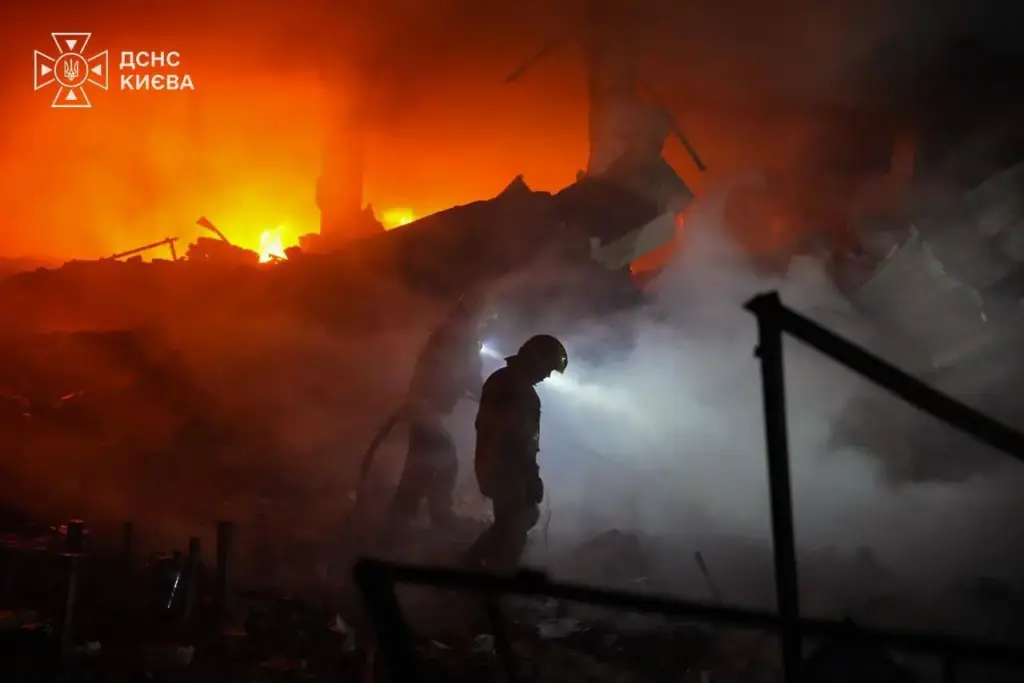
kyiv strike

Russia is likely attempting to force Ukraine to capitulate by spring 2027 through a large-scale campaign of long-range strikes, the Institute for the Study of War (ISW) said in its 27 September report. Russian President Vladimir Putin's new theory of victory relies heavily on the mass use of jet-powered drones and ballistic missiles against Ukraine, the institute assesses.

Russia keeps shifting to faster jet-powered drones that Ukraine's defenses struggle to stop, forcing it to spend scarce missiles on them. Russia's use of jet-powered drones rose eightfold from June to August, with Moscow launching around 7,700 such drones since their initial deployment, Ukrainian Air Force spokesperson Yurii Ihnat said on 23 September. But Putin likely does not expect the campaign to last indefinitely, and he may hold off on a new mobilization until he sees whether the strikes work, ISW assesses.

Putin's modified theory of victory

Putin's modified theory of victory largely depends on Russia's ability to mass-launch cheap jet-powered Gerans that get through Ukrainian defenses often enough, the institute notes.

Even a Kremlin-linked Russian milblogger claimed on 27 September that the Russian strategy, which relies heavily on long-range strikes, is costly and cannot continue indefinitely, not least because Ukraine is hitting Russia harder too, according to the analysis.

At the same time, Putin stated on 25 September that Ukraine "must feel" Russia's "retaliatory" strikes. ISW assesses that this suggests he intends to intensify Russia's strike campaign in winter, as he has in previous winters.

The aftermath of the Russian attack on Kyiv, Ukraine, 27 December 2025. Photo: National Police

If Putin is counting on Ukraine to break and capitulate this winter, he may be ignoring what the campaign will cost Russia over time, the institute notes. This strategy also counts on Ukraine's shortage of Patriot interceptors against ballistic missiles, and on the country's power grid and other vital systems giving way under months of strikes.

Until that approach runs out, Putin is unlikely to back down on his demands or agree to real ceasefire talks, ISW assesses.

Ukrainian interceptors could disrupt Russia's plan

A Kremlin-linked Russian milblogger claimed on 27 September that Russian forces launched predominantly jet-powered Geran-5 drones at Odesa, Mykolaiv, and Kyiv during the night of 26–27 September. According to the blogger, Russia's diverse arsenal of strike weapons and Ukraine's shortage of air defense assets allow Russian forces to maintain the current pace of strikes and expand the range of targets, ISW writes in its analysis.

At the same time, Ukrainian President Volodymyr Zelenskyy said on 26 September that Ukraine's interception rate for jet-powered Shahed drones currently stands at 55%. Of more than 2,730 such drones Russia had launched in September by then, Ukrainian forces had downed or suppressed more than 1,500, he added.

Geran-5 (Above) and Geran-4 (Below)
Jet-powered drones Geran-5 (above) and Geran-4 (below). Image: TurDef

Ukraine is testing interceptor drone prototypes in combat conditions, Ukrainian Presidential Office head Kyrylo Budanov told Novyny.LIVE on 27 September. The mass deployment of interceptors capable of shooting down jet-powered Gerans could begin within several months, he added. Ukrainian companies have already successfully tested several interceptor drones capable of intercepting Russian jet-powered drones in field conditions, the institute notes.

At the same time, it remains unclear whether Ukraine will be able to scale up its interceptor program quickly enough and achieve sufficient success to disrupt the intensification of Russia's campaign during the winter, ISW notes.

Why Putin may hold off on a new mobilization

Expanding Russia's arsenal of strike weapons is cheaper than carrying out a second mobilization economically, militarily, and socially, a Kremlin-linked Russian milblogger cited by the institute claimed.

Putin may put off large-scale forced mobilization until he sees whether the strikes deliver, ISW assesses, though his officials have been laying the groundwork for it despite Kremlin denials. Still, the need to replace Russia's enormous battlefield losses could push him to order such a mobilization as early as this fall, ISW notes, as Ukrainian and other sources have repeatedly reported he is preparing to do.

They say Dobropillia is encircled, but they are actually 10+ km away: ISW publishes map disproving Russia’s claim

25 septembre 2026 à 10:10

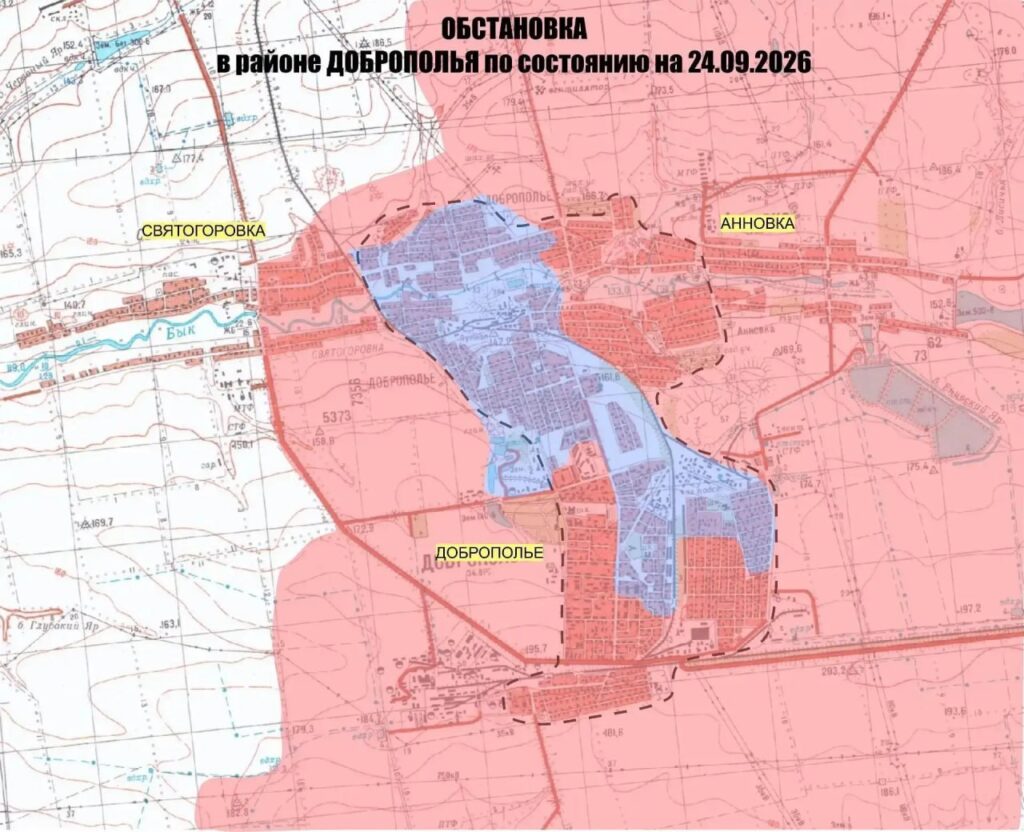
A map showing the territories around Dobropillia that Russia claims to have captured (purple) and analysts’ assessment that Russian forces are 10.2 kilometers from the southeastern outskirts of Dobropillia. Map: Institute for the Study of War

The Institute for the Study of War (ISW) published a map in its analytical report on 24 September that contrasts the claimed Russian encirclement with the location of Russian forces as assessed by the experts. Based on the evidence observed by ISW, the nearest area where Russian forces are present is 10.2 kilometers from the southeastern outskirts of Dobropillia.

Russia has been spreading disinformation about its successes around Dobropillia as part of what ISW calls a cognitive warfare effort to portray Ukrainian defenses as on the verge of collapse. Russia's Defense Ministry published a map claiming the city was surrounded. ISW's own map challenges it. The Ukrainian military says the city remains under its control.

Russian Defense Ministry claims it is already destroying encircled Ukrainian troops in Dobropillia and moving further

Units of Russia's Center Grouping of Forces continue combat operations against encircled Ukrainian forces in the Dobropillia area of Donetsk Oblast while simultaneously advancing toward Oleksandrivka, the Russian Defense Ministry claimed. ISW analysts, meanwhile, said they have not observed evidence supporting Russia's claim that the city is encircled. They also noted that Ukrainian officials "directly refute" the claim.

A Russian map showing the complete encirclement of Dobropillia. ISW and the Ukrainian Armed Forces reject this claim. Map: Russian Defense Ministry

ISW observed evidence that Russian infiltrators, small groups, were operating east and northeast of Dobropillia on 19 and 20 September. The institute did not assess that these infiltrators had consolidated their positions.

Ukrainian forces maintain positions south and northeast of Dobropillia, military observer Kostiantyn Mashovets said on 20 September, according to ISW.

Russian forces have not made major gains in the Dobropillia direction, the chief of staff of an artillery reconnaissance battalion said on 22 September, according to the institute. On the same day, a Russian milblogger described the "alleged Russian encirclement of Dobropillia" as potentially meaning not the direct presence of infantry, but only the establishment of fire control over Ukrainian logistics, including roads west of Dobropillia and toward Sviatohorivka, according to ISW.

ISW noted that Russia's pervasive military culture of lying—what Russian milbloggers themselves call "beautiful reports"—has degraded the Defense Ministry's own ability to understand the battlefield and enabled inflated claims like the Dobropillia encirclement.

Russia uses this disinformation as a "diversion"

In its statement, the Russian Defense Ministry itself described Dobropillia as a "strongly fortified settlement" whose seizure would threaten key Ukrainian supply lines running from Dnipropetrovsk Oblast toward the Fortress Belt—the Sloviansk-Kramatorsk-Druzhkivka urban agglomeration.

Russia has recently renewed its attempts to break through toward Dobropillia.

Third Army Corps Commander Andrii Biletskyi said that Russian forces sought to bypass the fortified cities through Dobropillia and link up with troops advancing from north of Lyman, rather than launch a direct assault. ISW noted on 16 September that the Vivaldi operation disrupted Russia's two-pronged plan. In its 24 September report, ISW said Russia's claims about Dobropillia were partly intended to divert attention from Ukraine's elimination of the Russian salient north of Lyman, which has likely forced Russia's command to rethink its wider encirclement plans.

ISW connects drone crashes in Moldova and Romania, a Starlink fire in Poland, and a Berlin airport shutdown into one Russian pattern

25 septembre 2026 à 09:11

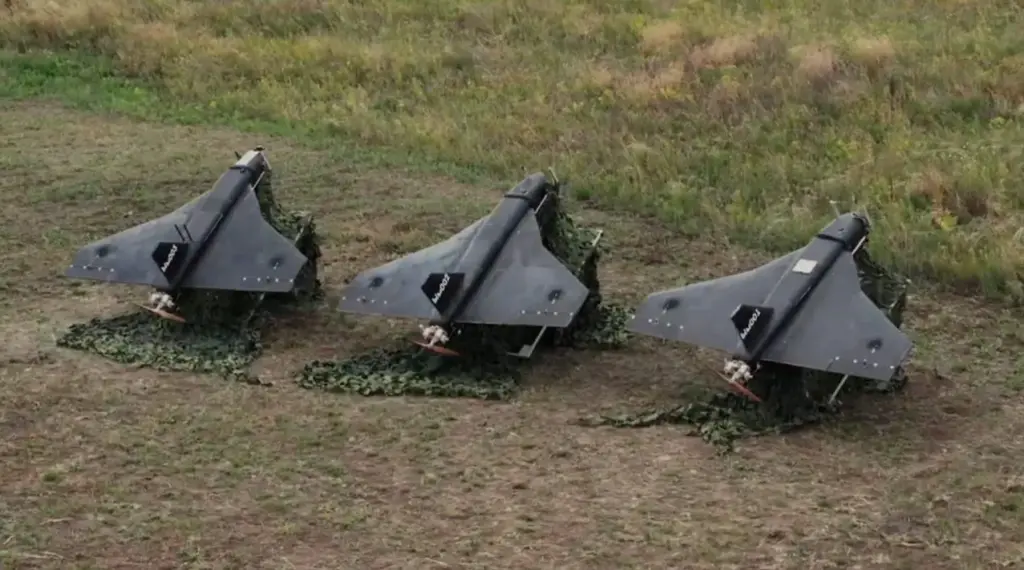
Three gray, triangular-wing drones sit on camouflage netting in a grassy field.

Several recent incidents across Europe were conducted by Russia or are likely attributable to Russia, ISW assessed in its 24 September report, though authorities have not officially linked the Polish and German incidents to Moscow.

Russia's full-scale war against Ukraine has expanded into a parallel campaign of provocations against European defense and logistical infrastructure. The Kremlin is using drones, arson, and undersea cable sabotage to degrade Europe's will and ability to support Ukraine, while deliberately intensifying the frequency of airspace violations to erode the boundary between hybrid and kinetic war.

Drones over Moldova and Romania

Four Russian drones flew over Bukovyna and targeted an energy facility and border crossings with Moldova and Romania, Chernivtsi Oblast Military Administration head Ruslan Osypenko reported. Ukrainian forces shot down three. The fourth flew toward Suceava County in northeastern Romania.

isw drone incursions sabotage intelligence warnings across europe coincidences—they russian operations · post two gerbera crash sites moldova romania 24 2026 two-russian-drones-crashed-in-moldova-and-romania-on-september-24-2026-scaled ukraine news ukrainian reports
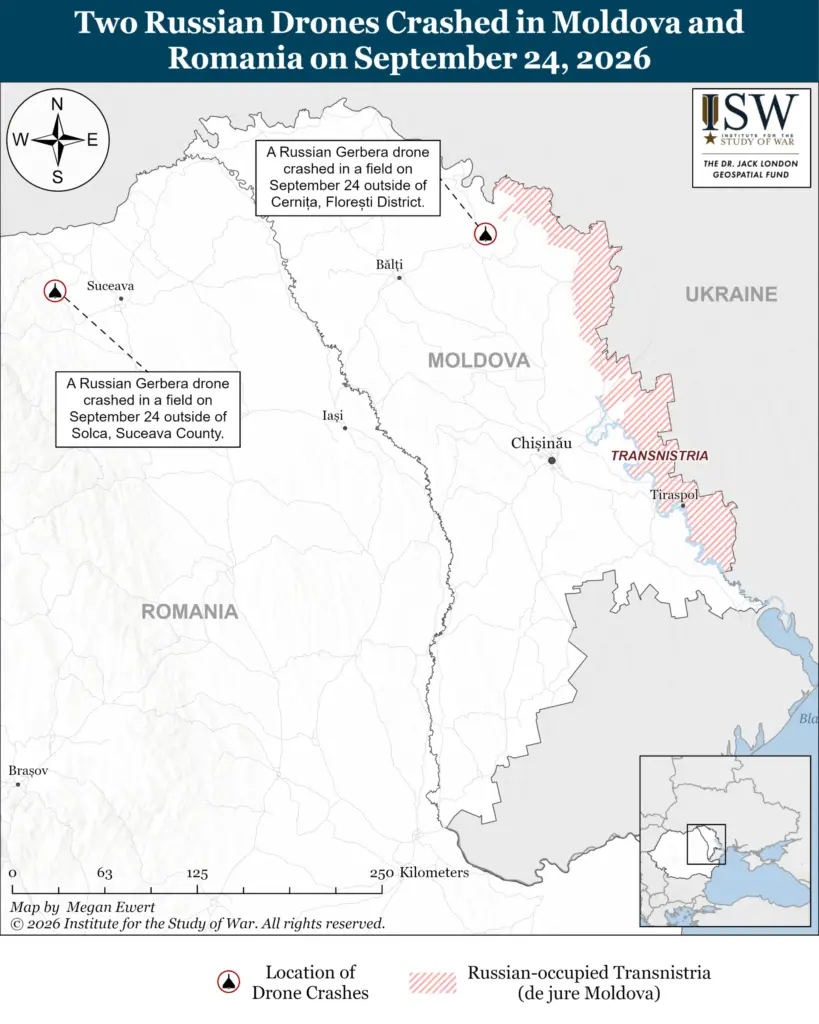
ISW map showing two Russian Gerbera drone crash sites in Moldova and Romania on 24 September 2026. Map: ISW

A drone crashed in Cernița, Florești district, Moldova—preliminarily identified as a Russian Gerbera type, the first such device found in the country. It carried an onboard camera, hit a tree, and exploded, Moldovan police said. Romania's Defense Ministry reported a second aerial vehicle entered Romanian airspace for four minutes and crashed near Solca in the same border region; geolocated footage confirmed it was also a Gerbera, ISW noted. Poland evacuated the Hrubieszów and Dorohusk border crossings for 30 minutes, Prime Minister Donald Tusk said. Three countries were put on alert by a single night of Russian strikes.

"Intentional and accidental Russian drone incursions into NATO and Moldovan airspaces are likely part of the Kremlin's efforts to normalize airspace violations by intensifying their frequency," ISW assessed.

Sabotage in Poland and Germany

A fire engulfed the power system and backup generator at a Starlink ground station in Wola Krobowska, central Poland, on the evening of 23 September. Deputy Prime Minister Krzysztof Gawkowski confirmed it was sabotage aimed at cutting internet access, including for Ukraine's military. Authorities have not identified who was responsible, but the act aligns with Russia's "new" doctrine of attacks, Gawkowski said. The station is now operating normally.

German authorities suspended operations at Berlin-Brandenburg airport for 45 minutes the same evening after staff reported a drone sighting, Die Zeit reported. Federal police could not confirm it. ISW assessed both incidents fit Russia's wider pattern of sabotage against European defense assets, though neither has been officially attributed to Russia.

Scattered debris and a scorched patch of ground in a cornfield beneath a cloudy sky.
Explore further

Russian attack puts three countries on alert as drones enter Moldova and Romania

Western intelligence warnings

A Lithuanian Defense Ministry source reported on 23 September that Russia could launch Gerbera drones from a shipping container in the Mediterranean against Spain, France, and Italy. Danish Defense Intelligence assessed on 24 September that Russia will intensify its hybrid war in coming months, including destructive cyber attacks and sabotage carrying a high risk of casualties, and that there is a low but growing risk of a limited Russian military attack on a NATO border state. It sees no indications of an outright invasion. The CIA reportedly warned Poland that Russia may sabotage underwater cables to disrupt its banking system, according to Newsweek Polska journalists.

NATO tracked and confronted Russian submersibles rehearsing deployment of a new cable-disabling weapon near Svalbard in spring 2026—no cables were damaged, but the operation demonstrated Moscow's intent, Reuters reported. Shadow fleet vessels likely served as drone-launch platforms for incursions into NATO airspace, ISW noted.

"The increasing frequency of such warnings suggests that Western intelligence agencies are picking up indicators that the Kremlin is looking to diversify its platforms and means for conducting attacks against NATO and European states and is considering conducting such attacks," ISW assessed.

ISW said it has not yet seen evidence that Russia has conducted the attacks the warnings describe.

Denmark's assessment—that a limited Russian military strike on a NATO border state could come in the coming months—suggests the boundary between hybrid provocations and military action is narrower than European policy has assumed. ISW's synthesis reframes what governments have treated as separate incidents into one campaign.

"Intentional and accidental Russian drone incursions into NATO and Moldovan airspaces are likely part of the Kremlin's efforts to normalize airspace violations by intensifying their frequency," ISW assessed.
"The increasing frequency of such warnings suggests that Western intelligence agencies are picking up indicators that the Kremlin is looking to diversify its platforms and means for conducting attacks against NATO and European states and is considering conducting such attacks," ISW assessed.
❌