❌

Vue normale

Ballon d'or 2026 : la course aux (faux) classements fuités sur les réseaux sociaux

26 octobre 2026 à 16:49
C'est l'un des secrets les mieux gardés du monde du football : le nom du vainqueur du Ballon d'Or. Pourtant, sur les réseaux sociaux, de nombreux internautes prétendent connaitre son identité, issue de prétendues fuites. Décryptage de Jules Boiteau dans Info Intox.

Musk warns military use of Starlink could spark space war. Kyiv’s ex-disinformation chief says he’s building alibi after Starshield scandal

25 octobre 2026 à 17:35

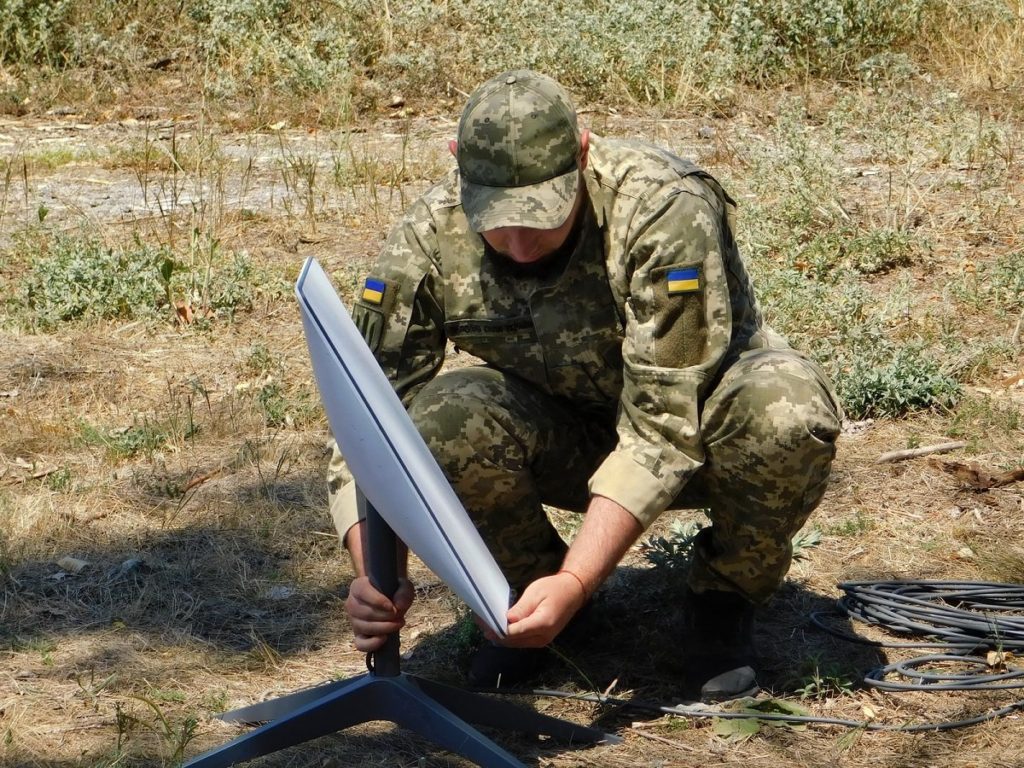
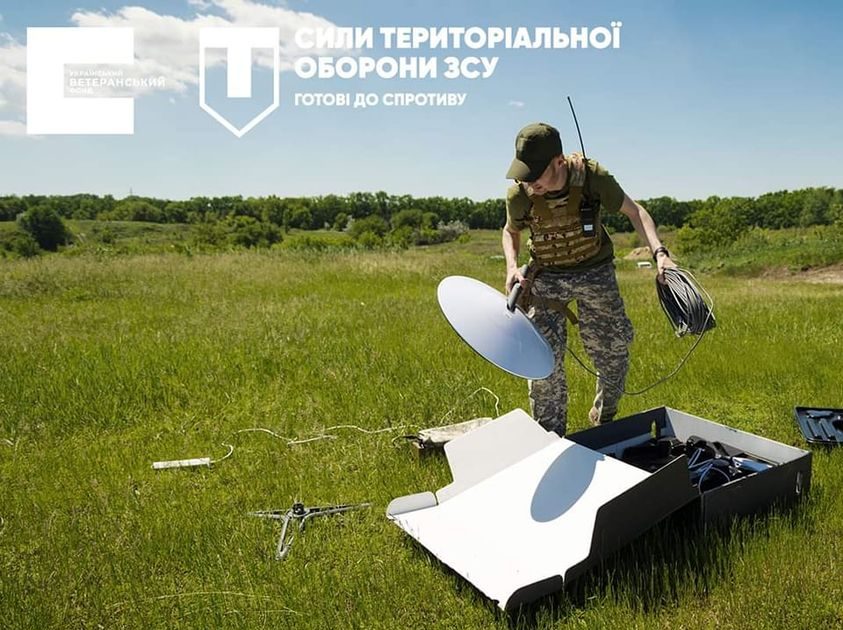
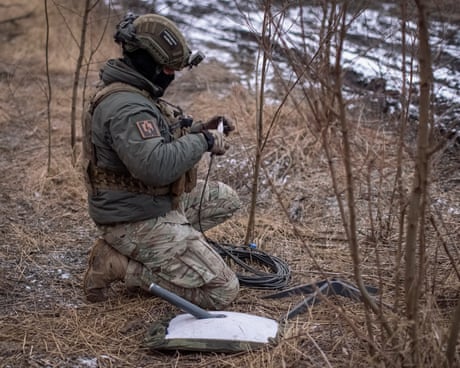
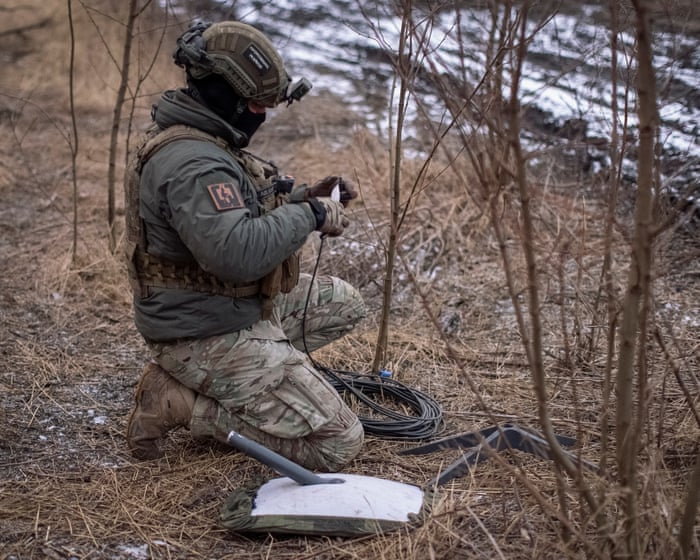
A Ukrainian soldier installs a Starlink terminal

SpaceX founder Elon Musk says that if Ukraine fires through Starlink, Russia would be entitled to shoot the network down. That is why Starlink must remain a civilian operation and cannot be used for outright offensive strikes that would put its very existence at risk.

The warning lands in the middle of a fight over Musk’s own hand on that network. Weeks ago, his company unexpectedly throttled the service Ukraine’s drones depend on amid US President Donald Trump diesel deal with Russia, which led to the disruption of a few operations on the front.

The US Treasury authorized the sale, delivery, offloading, and import of Russian-origin diesel fuel, effectively suspending sanctions on that trade until 7 April 2027, the Office of Foreign Assets Control (OFAC) said on its website on 9 October.

The diesel deal combining intelligence halt and military Starlink, with pressure on Ukraine to make a quick peace deal, has angered both Democrats and Republicans ahead of the US elections on 3 November, where Democrats could win.

Meanwhile, a Ukrainian official interprets Musk's talk of strikes as an attempt to build an alibi before a possible investigation into that decision.

A civilian network, or a target

Musk was responding to a post warning that if Starlink shifted from a civilian network into a military system, Russia could treat it as a target for retaliation, and that destroying satellites in orbit could scatter enough debris to make space unusable for years or centuries.

“An adversary blowing up Starlink satellites would create a domino effect of destruction that would generate a vast field of debris, making space unusable," he writes.

When the shield and the warnings failed together

Overnight into 14 October, SpaceX quietly capped the speed of Starshield, the military version Ukraine’s drones run on, without telling Kyiv. Ukrainian units said the limit broke a series of missions, with connections dropping mid-flight and leaving drones hard to control.

At the same time, President Volodymyr Zelenskyy said Ukraine relies on the network for air defense, not attack, to intercept the Russian drones Moscow sends to its cities, and that once the speed was cut, his forces could no longer stop some of them as effectively as before.

Simultaneously, Ukraine's other American lifeline also went dark: for about three days, the US stopped passing the intelligence that warns of Russian ballistic launches. On 12 October, Russian ballistic missiles hit Kyiv before the air-raid alert reached people, with no advance data from partners. In a strike during that window, three people were killed in the capital, the sirens sounding only after the blasts.

A Ukrainian official sees alibi-building

Meanwhile, Andrii Kovalenko, the ex-head of Ukraine’s Center for Countering Disinformation, read Musk’s statement as self-protection rather than physics

“Musk, having taken responsibility for the restrictions on Starlink and Starshield for Ukraine, is now trying to build himself an alibi before a possible investigation into that decision,” he wrote.

He said that regardless of who was behind the idea of restricting Starlink and Starshield access for Ukraine, it represents a strategic setback for the US in the long run, as it risks portraying the country as an unreliable partner that may fail to honor its commitments.

"Europe purchases around 60% of its imported weapons from the US. Trust in the US as a security guarantor directly supports sales for American defense companies. Moves like this only undermine that trust and encourage European countries to develop their own systems," he said.

The US has sent a message that its guarantees may not be reliable and that even paid-for services can be subject to political decisions, Kovalenko stressed.

  • ✇affordance.info
  • Bismillah ils ont tenté d’éteindre les lumières. Black-Out pour les Black Blocs ?
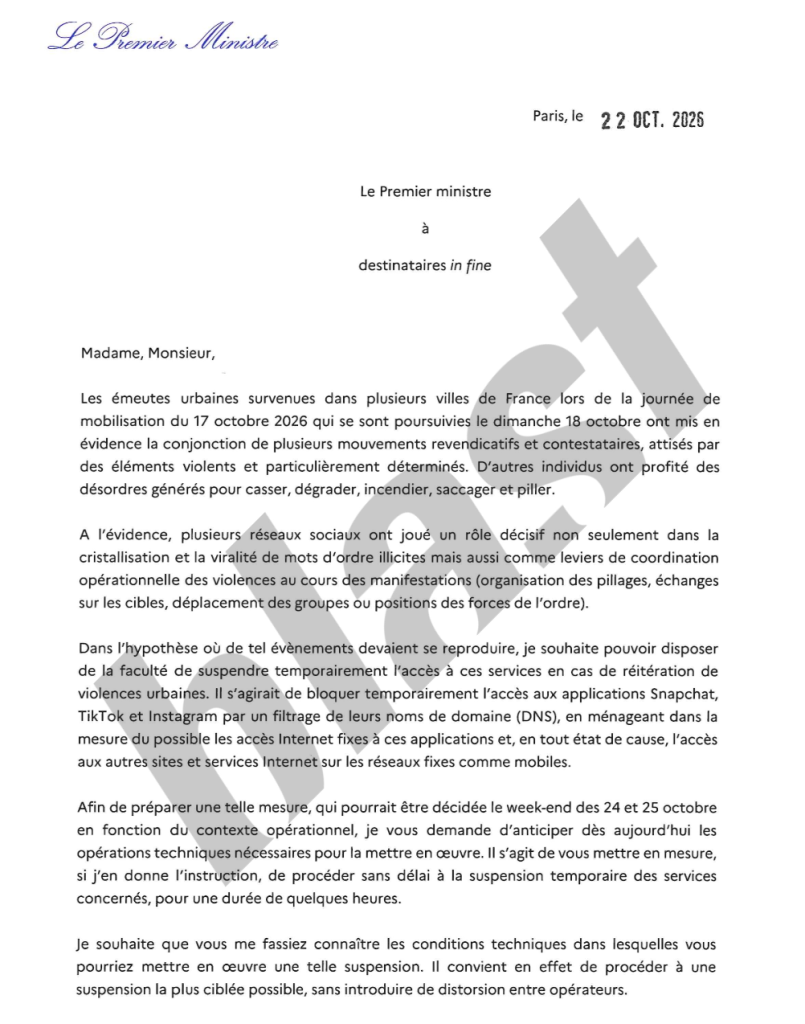
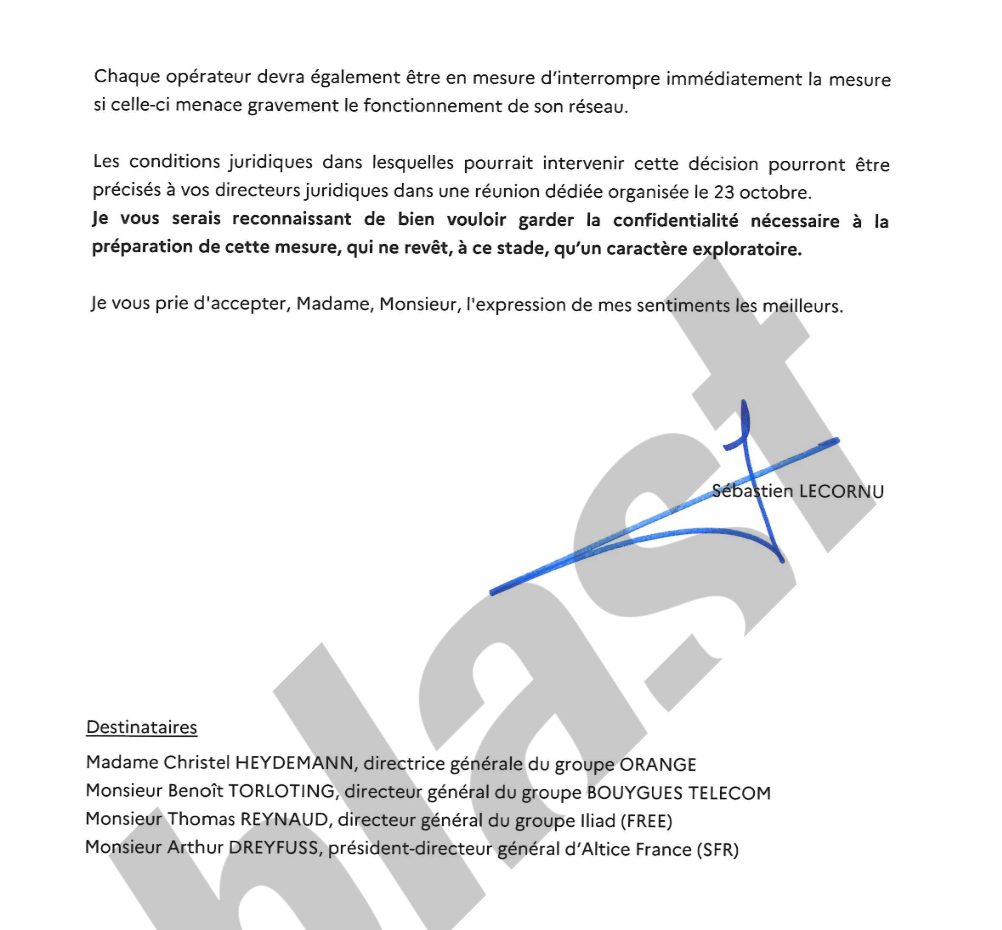
    C’est une révélation de Yanis Mhamdi pour Blast, Emmanuel Macron (via Sébastien Lecornu) a demandé aux opérateurs internet de préparer une coupure des réseaux sociaux dans l’inquiétude des appels à manifester du 24 Octobre et après le fiasco total des semaines précédentes. Black-Out pour les Black Blocs. Cette lettre révélée par Blast, la voici.   Avant de revenir sur cette lettre, je vous invite à relire mon article du 20 Octobre sur le rôle des médias sociaux dans les mouvements idoines. Je
     

Bismillah ils ont tenté d’éteindre les lumières. Black-Out pour les Black Blocs ?

25 octobre 2026 à 13:52

C’est une révélation de Yanis Mhamdi pour Blast, Emmanuel Macron (via Sébastien Lecornu) a demandé aux opérateurs internet de préparer une coupure des réseaux sociaux dans l’inquiétude des appels à manifester du 24 Octobre et après le fiasco total des semaines précédentes.

Black-Out pour les Black Blocs.

Cette lettre révélée par Blast, la voici.


Avant de revenir sur cette lettre, je vous invite à relire mon article du 20 Octobre sur le rôle des médias sociaux dans les mouvements idoines. Je le mobiliserai souvent pour expliquer cette nouvelle escalade dans la panique politique actuelle.

C’est fait ? Alors on y va.

Le gouvernement sollicite donc une suspension de l’accès aux plateformes Snapchat, Tiktok et Instagram (Yanis Mhamdi sur Blast précise que « Le réseau social X/Twitter a été ajouté après l’envoi de la lettre.« ) Pas Facebook, pas Whatsapp, pas Youtube, pas toutes les autres. « Juste » Snapchat, Tiktok et Instagram (et X). C’est donc bien la jeunesse qui est visée directement au regard de la sociologie des plateformes concernées.

Le gouvernement négocie directement la possibilité d’un black-out avec les opérateurs d’accès (Orange, Bouygues, Free et SFR). Lecornu parle de suspension « temporaire« , « pour une durée de quelques heures« , « ciblée » et qui puisse être « immédiatement interrompue. »

En parallèle, le gouvernement négocie aussi directement avec les plateformes (cf l’enquête de Marine Protais dans La Tribune) sur plusieurs points, notamment la possibilité de récupérer des images et vidéos. Le gouvernement lancera d’ailleurs dans la foulée sa propre plateforme de délation pour collecter lesdites images et vidéos. Ce qui vient par ailleurs questionner tout le discours sécuritaire autour de la multiplication exponentielle et des investissements massifs en caméras de vidéo-surveillance …


Toujours selon l’enquête de Marine Protais dans La Tribune, le gouvernement aurait également demandé aux plateformes de médias sociaux d’activer et d’altérer un certain nombre de leurs fonctions de modération et de viralisation pour invisibiliser certains hashtags ou mots-clés, pour retirer plus rapidement certains contenus sans attendre de signalements le réclamant, pour supprimer la saisie automatique renvoyant sur certains hashtags ou certains contenus jugés incitatifs, et pour ajouter de la latence pendant les « live » et enfin pour que les fonctionnalités de géolocalisation puissent être temporairement supprimées.

Résultat ? Du côté des opérateurs c’est une fin de non-recevoir, et du côté des plateformes (de ce que l’on en sait en tout cas), c’est service minimum (Tiktok aurait indiqué avoir mobilisé une Task Force pour retirer plus rapidement certains contenus) ou plus globalement … une autre fin de non-recevoir.

Quelle est la limite entre une gestion de crise circonstancielle
et une bascule structurelle dans un régime autoritaire ?

Vous me direz que j’exagère. Je vous répondrai alors par un souvenir récent, qui date de mai 2024 et où le gouvernement alors dirigé par Gabriel Attal prenait la décision d’interdire l’accès à Tiktok en Nouvelle-Calédonie lors des mouvements de jeunesse et des débordements et violences qui ont suivi. A l’époque, il n’y avait qu’un seul opérateur de téléphonie et d’internet sur le territoire de Nouvelle-Calédonie, ce qui avait « facilité » la mise en oeuvre de ce black-out.

Le 1er avril 2025, saisi pour se prononcer sur la légalité du blocage de TikTok en Nouvelle-Calédonie, le Conseil d’Etat précisait les trois conditions dans lesquelles le gouvernement (via le Président ou le Premier ministre) pourrait légalement interrompre (provisoirement) l’accès à un réseau social en cas (uniquement) de « circonstances exceptionnelles » :

  1. « que cette interdiction soit indispensable pour faire face à des événements d’une particulière gravité,
  2. qu’aucun moyen technique ne permette de prendre immédiatement des mesures alternatives moins attentatoires aux droits et libertés,
  3. et que l’interruption soit prise pour une durée limitée nécessaire à la recherche et la mise en place de ces mesures alternatives. »

Et de conclure que l’interdiction de Tiktok « ne respectait pas l’ensemble de ces conditions » et était donc totalement illégale.

Dans l’actuelle crise, les trois conditions sont-elles réunies ? Nul ne le sait car les deux premiers principes définis par le Conseil d’Etat sont d’appréciation relative. Qu’est-ce qui définit une « extrême gravité » ? Un nombre de manifestants ? Des atteintes aux biens ? Aux personnes ? L’étendue sur le territoire national ? La proximité des événements avec des lieux de pouvoir ? Et si le gouvernement commence par poser comme prémisse « l’évidence » d’une responsabilité des réseaux sociaux pour acter des mesures attentatoires aux libertés, qui pour lui porter contradiction ? Mais Lecornu a – en partie – retenu la leçon de la sortie de route d’Attal et il joue donc essentiellement sur le point 3 de la limitation temporelle dans la demande qu’il fait aux opérateurs. Rien n’est pourtant réglé pour autant, loin s’en faut.

D’autant qu’y compris sur la forme, c’est un régime discrétionnaire de la décision qui est avancé par Lecornu : « Les opérateurs réclament un acte signé, daté, motivé, publié, et Orange insiste sur la nécessité d’un arrêté. Le gouvernement estime qu’une instruction individuelle à chaque opérateur suffirait, sans publication au Journal officiel. Il envisageait un communiqué une trentaine de minutes avant l’activation, prévue vers 14 h le 24 octobre, sans divulguer les conditions techniques sensibles. »

 Par-delà les évidences.

Avant de poursuivre l’analyse je veux revenir sur, ce qui dans le courrier de Lecornu est la cause qui lui paraît justifier cette demande de black-out.


« À l’évidence plusieurs réseaux sociaux ont joué un rôle décisif non seulement dans la cristallisation et la viralité de mots d’ordres illicites, mais aussi comme leviers de coordination opérationnelle des violences au cours des manifestations. » 


À l’évidence ? Mais de quelle évidence parle-t-on ici ? L’évidence de l’analyse de services de police et de renseignement intérieur pourtant incapables de dimensionner correctement la réponse en nombre et en doctrine du « maintien de l’ordre » ? L’évidence d’un pouvoir pathologiquement malade d’un rapport à la technique qui oscille entre l’irénisme d’un solutionnisme construit sur le fantasme d’une start-up nation et « en même temps » la crainte irraisonnée de cette technique entre les mains d’une jeunesse pour qui elle ne serait que mortifère et à qui il faudrait donc interdire à la fois le messager (les téléphones portables) et le message (les réseaux et médias sociaux) ?

Nous sommes en plein dans ce que je vous expliquais dans mon article du début de la semaine sur l’utilisation des réseaux et médias sociaux dans les mouvements lycéens et dans les mouvements sociaux en général. Je le redis une centième fois. Les médias sociaux (et internet et le web avant eux) facilitent l’organisation des révolutions et des mouvements sociaux en général, mais ils en compromettent aussi la victoire car :

  • soit les gouvernements vont s’y attaquer pour retourner ou bloquer le mouvement,
  • soit la dynamique virale propre de ces réseaux et médias sociaux finira par n’en montrer que les images les plus délétères dans l’opinion (biais de négativité algorithmique),
  • soit les (autres) médias en alliés souvent objectifs des gouvernements ou de leur agenda, fabriqueront une circulation médiatique d’extraits et de discours qui sera uniquement à charge contre cette économie de la viralité pour promouvoir et justifier leur propre économie de la citation et tenter d’effacer leur propre fascination première pour le « Riot Porn« .

Bref, comme l’écrivait encore récemment Fred Turner dans « Politique des machines » : « L’une des plus grandes ironies de notre situation actuelle est que les modes de communication qui permettent aujourd’hui aux autoritaires d’exercer leur pouvoir ont d’abord été imaginés pour les vaincre. » 

La bascule d’une tentative de black-out gouvernementale à l’endroit des réseaux sociaux est la première phase et la première pierre de ce nouveau cycle déterministe. Il est singulier que la France n’y échappe pas davantage que d’autres pays aux régimes clairement illibéraux ou explicitement autoritaires. Pour de bon cette fois …


Bismillah ils ont voulu couper la lumière.

Plus de 20 ans que je travaille sur ces questions, et plus de 15 ans au moins qu’avec d’autres nous avons montré, démontré, théorisé et expliqué, dans des revues scientifiques, dans des livres, dans des médias, devant des commissions d’enquête à l’assemblée, que oui il fallait en effet casser les chaînes de contamination virale pour lutter contre la haine en ligne. Et oui l’ensemble des plateformes sociales savent précisément comment le faire et ont les moyens de le faire. Cela aussi cela fait plus de 10 ans qu’on le sait et que cela a été posé y compris devant des assemblées élues grâce au courage de lanceurs et lanceuses d’alerte qui ont permis de le documenter de manière absolument certaine. Il faut donc les mettre devant leurs manquements à chacune de leurs responsabilités, mais puisque cela fait au moins 10 ans que l’on essaie sans succès, nous avons aussi la certitude que l’on n’y parviendra que si et seulement si on arrive enfin a définitivement changer leur statut d’hébergeur par défaut en un statut d’éditeur par défaut (allez ici relire la quatrième partie de cet article qui vous démontre qu’il est aberrant que cette question commence à peine à être posée alors qu’il y a 10 ans qu’elle devrait être tranchée).

Riot Porn et désinformation continue.

Maintenant si l’on s’alarme du rôle qu’ils jouent et que l’on censure les médias sociaux, même temporairement, même pour des circonstances exceptionnelles, même uniquement ceux de la jeunesse, il ne faut pas oublier deux choses.

La première c’est ce que l’on nomme « l’effet cliquet » dans l’histoire des technologies de contrôle : il est des pas en avant sur lesquels il devient impossible de revenir en arrière.

Et la seconde c’est l’éléphant dans la pièce qui est incarné par les chaînes d’extrême-droite de désinformation continue.

Parce que si l’on pose comme prémisse, « qu’à l’évidence plusieurs réseaux sociaux ont joué un rôle décisif non seulement dans la cristallisation et la viralité de mots d’ordres illicites, mais aussi comme leviers de coordination opérationnelle des violences au cours des manifestations » alors … alors … alors il faut poser aussi « qu’à l’évidence plusieurs chaînes d’information continue ont joué un rôle décisif non seulement dans la cristallisation et la viralité de mots d’ordres illicites, mais aussi comme leviers de coordination opérationnelle des violences au cours des manifestations. » Et que lorsque ces chaînes d’information continue stigmatisent en permanence les populations françaises issues de l’immigration comme la source de l’ensemble de nos maux, leur responsabilité éditoriale est directement engagée dans des tueries comme celle qui s’est déroulée à Trappes il y a quelques jours.

Qu’absolument personne, à commencer par le gouvernement si prompt à tenter de bloquer les réseaux sociaux, q’u’absolument personne ne pose cette question dans le champ social et médiatique « mainstream » comme une urgence première, en dit malheureusement beaucoup sur l’état des forces politiques en présence.

Parce que si l’on ne questionne que le rôle des réseaux sociaux sans jamais en faire de même pour les chaînes d’information continue qui ont légitimé l’ensemble des discours racistes, xénophobes et insurrectionnels y compris en normalisant les paroles de groupuscules identitaires et néo-nazis jusqu’ici relégués à la fange confidentielle et aux marges délictuelles d’où ils ne seraient jamais sorti sans les invitations qui leurs ont été faites sur les plateaux télé, alors on manque à tous ses devoirs et on passe à côté de l’essentiel du problème.

Et il faut à chaque fois se pincer et se pincer de plus en plus fort. Ce week-end encore, pendant que le gouvernement Lecornu négociait avec les opérateurs télécom pour un black-out des réseaux sociaux, la chaîne Cnews diffusait et commentait en boucle des images de violences, d’interventions policières et de groupuscules (black blocs) dans la ville de Paris … qui étaient en fait des images de mobilisations en Albanie, a Tirana, et zoomait longuement, très longuement sur un jeune homme portant un kufi. France Info à son tour reprendra ses images mais expliquera cette fois qu’il s’agit de manifestation à Lyon …

Prise la main dans le sac à complotisme et à désinformation, CNews plaidera rapidement « une erreur de régie » (sic), tout en continuant d’assurer que de toute façon ces images « auraient aussi bien pu être tournées en France » (sic). Qu’importe le réel après tout, quand seule compte la tenue d’un agenda de haine. Une haine et une désinformation qui bien plus que celle des réseaux sociaux fait un nombre considérable de vues, et qui surtout entraîne des passages à l’acte racistes, homophobes, criminels. Pas un seul « black bloc », pas un seul « émeutier » ne s’est rendu coupable de meurtre. A Trappes un homme a visé et tué à l’arme lourde pour un mobile raciste d’autres hommes, femmes et enfants, armé idéologiquement du seul motif de la litanie du discours médiatique de cette chaîne et de ses « proxys ». Il a tué Pengo Bossio Wangi parce qu’il était noir de peau. Praud, Le Bret, Tégner et les autres battent chaque jour et chaque mois des records d’audience qu’un réseau social n’atteindra jamais. Ils ne sont ni journalistes, ni éditorialistes : ils sont des agents d’influence au service d’un agenda du chaos qui n’a pour seul but que de placer l’extrême-droite au pouvoir. Et ils ont en partie atteint leur objectif qui est que chaque meurtre raciste n’occupe pas plus d’une journée d’antenne. Regardez leur succès. La tuerie raciste de Trappes est presque déjà effacée.

Cette chaîne a donné la parole à des représentants de groupuscules néo-nazis présentés comme autant de « simples » chroniqueurs et choniqueuses, cette chaîne ne tient pas son antenne et est sous le coup de multiples condamnations pour de multiples dérapages, cette chaîne ment et désinforme de manière continue et systémique. Il est fou, il est sidérant, il est démocratiquement inconcevable que cette chaîne bénéficie encore d’une autorisation d’émettre. S’il est un black-out et un seul à ordonner pour préserver la concorde républicaine, c’est en effet celui de cette chaîne et de ses proxys. Voilà à quoi le gouvernement de Sébastien Lecornu devrait en priorité s’attacher. Il est idiot de vouloir couper les réseaux sociaux. Il est stupide de prétendre qu’ils sont la cause des violences. Il est coupable et criminel de continuer de laisser émettre CNews sur une fréquence publique dans une démocratie.

Tant que nous n’aurons pas compris que le premier problème de notre république n’est pas d’interdire les réseaux sociaux aux moins de 15 ans mais plutôt d’interdire CNews à tout citoyen en âge de voter, alors nous ne préparerons rien d’autre que des avenirs sombres.

  • ✇US news | The Guardian
  • US military gives Elon Musk’s SpaceX access to sensitive tracking data
    This gives the company an advantage in tracking objects in orbit, raising national security concerns and fears of greater control over the space industryThe US military has given Elon Musk’s SpaceX access to restricted space tracking data, raising a new round of questions about whether the Trump administration is attempting to hand over traffic control in Earth’s orbit to a controversial donor.The access also raises new national security questions, industry observers say. Continue reading...
     

US military gives Elon Musk’s SpaceX access to sensitive tracking data

25 octobre 2026 à 08:00

This gives the company an advantage in tracking objects in orbit, raising national security concerns and fears of greater control over the space industry

The US military has given Elon Musk’s SpaceX access to restricted space tracking data, raising a new round of questions about whether the Trump administration is attempting to hand over traffic control in Earth’s orbit to a controversial donor.

The access also raises new national security questions, industry observers say.

Continue reading...

© Photograph: Justin Sullivan/Getty Images

© Photograph: Justin Sullivan/Getty Images

© Photograph: Justin Sullivan/Getty Images

Full speed returned to Ukraine’s satellite links on Saturday morning. “We simply enforced our terms,” Musk claims after blaming Washington for 10 days

25 octobre 2026 à 04:03

STING S interceptor

Ukraine's military satellite links work at full speed again after a cap that hobbled its drones, Ukraine's Defense Ministry said on 24 October. Hours later, SpaceX owner Elon Musk, who earlier pointed at Washington, said his company had enforced its own rules. A Ukrainian presidential adviser and a drone volunteer replied that civilian Starlink could not fly such missions.

Ukraine holds off Russia with American tools it doesn't control, so any pause decided abroad, like stalled Patriot deliveries or the Starlink cap, opens gaps in its defense. With no stated rule on what Ukraine's forces may do, the next cutoff could again come unannounced and unexplained.

Kyiv records full speed again

The ministry recorded stable connections above 400 km/h (250 mph). Before, Kyiv said, links on Starlink and its military version, Starshield, cut out above 161 km/h (100 mph).

Ukrainian President Volodymyr Zelenskyy said the restoration began overnight. "The speeds are now where they need to be," he said, citing defense against jet-powered Shahed drones. He thanked US lawmakers, the media, the State Department, and the US President, but not Musk or SpaceX.

A Ukrainian soldier installs a Starlink terminal
A Ukrainian soldier installs a Starlink terminal. Illustrative photo: Armed Forces of Ukraine

Musk: "That loophole was closed last week"

Musk replied "Correct" to an X user who called Starlink "not a weapons system." "Ukraine military violated Starlink terms of service and used it for offensive drone strikes to kill people. That loophole was closed last week," he wrote.

Correct.

Using Starlink, a civilian commercial service, for offensive drone strikes to kill people has never been allowed, nor should it be.

Starshield, a different system, is controlled by the US government. What they decide to do is up to them.

Ukraine military violated… https://t.co/ZXBB8bYfPn

— Elon Musk (@elonmusk) October 24, 2026

He called Starshield "a different system" the US government controls, and warned: "Were Starlink to be turned off, the Ukrainian front line would collapse immediately. This is NOT a threat, it is simply a statement of fact."

Musk named no evidence, cases, or time frames. Overnight, he answered a headline on the US financial blog ZeroHedge saying he "admits" SpaceX throttled Starlink.

"We simply enforced our terms of service when they were bypassed. There has been no change to our terms of service," Musk wrote.

musk, trump
Explore further

Who capped Ukraine’s Starlink? “Ultimately POTUS,” Musk said. Ultimately Musk, reports now say

When the cap hit on 14 October, Musk wrote that the US government owns and controls Starshield and that the US military and "ultimately POTUS" decide any limits. US President Donald Trump, who credited Musk with the fix while Kyiv still saw the cap, said on 24 October he had spoken to Musk about Ukraine but gave no details.

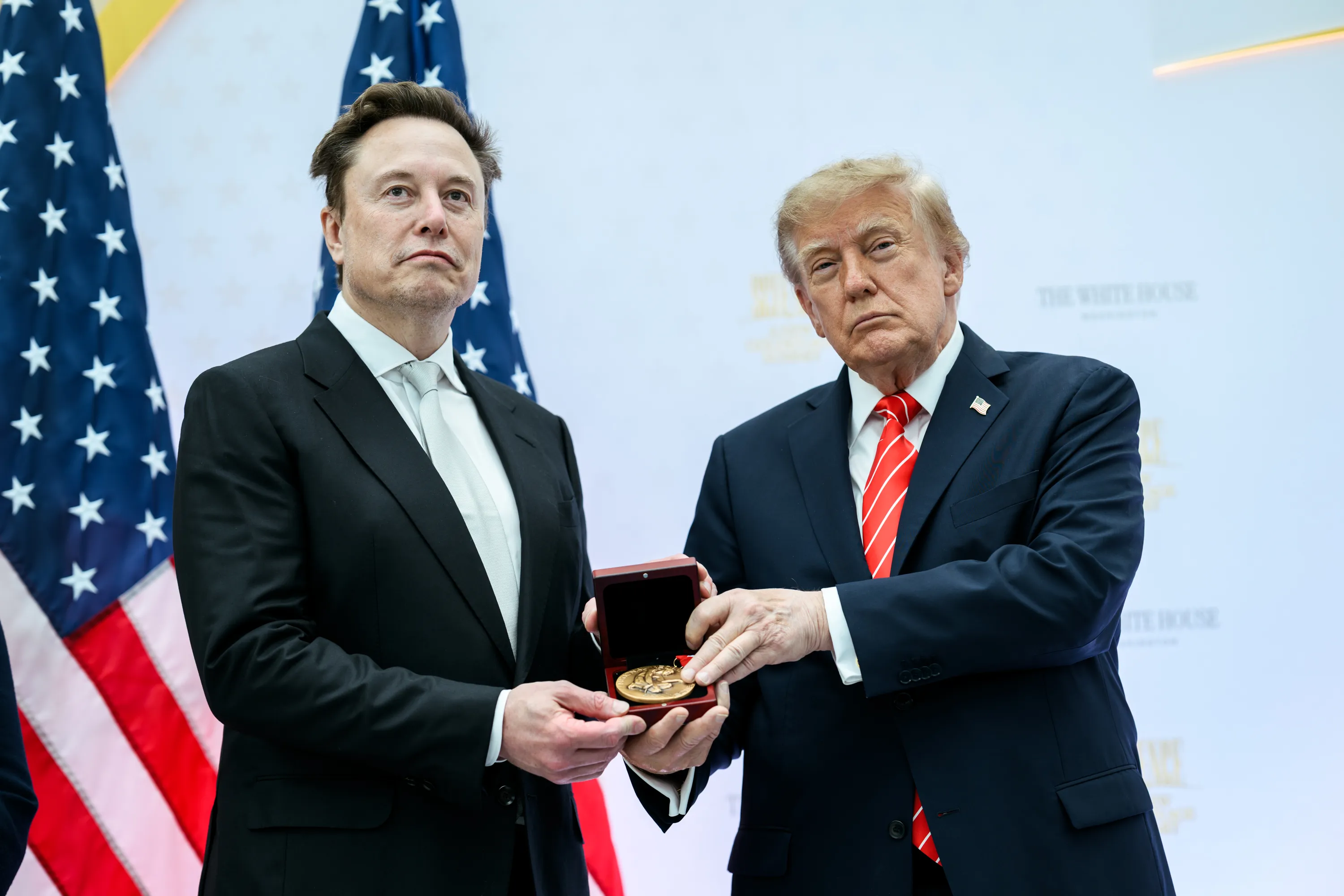
US President Donald Trump and Elon Musk in the Oval Office on 11 February 2025
US President Donald Trump and Elon Musk in the Oval Office on 11 February 2025. Photo: White House / Daniel Torok

Ukrainians note contradiction to reality

Ukrainian presidential adviser on defense technology Serhii Beskrestnov, known by the callsign Flash, wrote:

"It is very strange that Elon Musk doesn't know about the restrictions on Starlink operations in Ukraine."

Since winter 2026, every Starlink terminal over Ukraine, occupied areas included, has been limited to 70–90 km/h (43–56 mph), he said, and over Russia, Starlink does not work. "So we PHYSICALLY CANNOT USE COMMERCIAL STARLINK for deep strikes and mid-range strikes," Beskrestnov wrote. Deep strikes hit targets far inside Russia, mid-range ones targets closer to the front.

Ukrainian activist and drone fundraiser Serhii Sternenko called Musk's claim untrue. He said Ukraine introduced whitelists of terminals in February, and any terminal used on the move had to be listed and connected to Starshield.

"So using civilian Starlink for drone missions was technically impossible. All drone missions that needed satellite communication could be carried out only with Starshield," Sternenko added.

European governments help pay for Ukraine's Starlink service. Germany funds it under a contract that runs until April 2027. Polish Foreign Minister Radosław Sikorski, whose country pays around $50 million a year for the service, said on 23 October: "Mixing business with politics usually ends badly, especially when we talk about Elon Musk."

  • ✇US news | The Guardian
  • Ukraine’s military says Starlink satellite connection stable after recent restrictions
    But Elon Musk, whose company SpaceX owns Starlink, accuses Ukrainian military of violating ⁠the company’s termsUkraine’s military has a “stable connection to Starlink”, the Ukrainian government said, 10 days after its ability to use the satellite communications system was suddenly restricted.But hours after the announcement, SpaceX CEO Elon Musk, whose company owns Starlink, accused the Ukrainian military of violating ⁠the company’s terms. Neither Musk nor the US government, which operates Stars
     

Ukraine’s military says Starlink satellite connection stable after recent restrictions

24 octobre 2026 à 17:25

But Elon Musk, whose company SpaceX owns Starlink, accuses Ukrainian military of violating ⁠the company’s terms

Ukraine’s military has a “stable connection to Starlink”, the Ukrainian government said, 10 days after its ability to use the satellite communications system was suddenly restricted.

But hours after the announcement, SpaceX CEO Elon Musk, whose company owns Starlink, accused the Ukrainian military of violating ⁠the company’s terms. Neither Musk nor the US government, which operates Starshield using Starlink technology, took responsibility for imposing the curbs.

Continue reading...

© Photograph: Sergey Dolzhenko/EPA

© Photograph: Sergey Dolzhenko/EPA

© Photograph: Sergey Dolzhenko/EPA

  • ✇#MonCarnet
  • La Grèce interdit les réseaux sociaux aux moins de 15 ans dès janvier 2027
    La Grèce vient de franchir une nouvelle étape dans l’encadrement des réseaux sociaux chez les jeunes. Le Parlement grec a adopté, vendredi 23 octobre, une loi interdisant l’accès aux plateformes sociales aux enfants de moins de 15 ans. Cette mesure, qui entrera en vigueur le 1er janvier 2027, vise à protéger la santé mentale, le […]
     

La Grèce interdit les réseaux sociaux aux moins de 15 ans dès janvier 2027

23 octobre 2026 à 08:31
La Grèce vient de franchir une nouvelle étape dans l’encadrement des réseaux sociaux chez les jeunes. Le Parlement grec a adopté, vendredi 23 octobre, une loi interdisant l’accès aux plateformes sociales aux enfants de moins de 15 ans. Cette mesure, qui entrera en vigueur le 1er janvier 2027, vise à protéger la santé mentale, le […]

The Starlink hot potato: Musk points to Trump, Trump points to nobody, then credits Musk with the fix. The speed limit stays

23 octobre 2026 à 06:53

US President Donald Trump and Elon Musk in the Oval Office on 11 February 2025

US President Donald Trump said Elon Musk had restored Ukraine’s Starshield speeds, but the restrictions remained in place on 23 October, according to Ukrainian officials.

The cap, in place since 14 October, has disrupted interceptor drone missions against jet-powered Shaheds flying above 400 km/h for more than a week. On 16 October, Trump told reporters that, from what he understood, nothing had changed with the service. His latest claim that Musk restored it appears to acknowledge the restriction, even as he denies ordering it.

Ukraine says restrictions remain

“At the moment, there is no confirmation that the restrictions have been lifted,” a Defense Ministry official told LIGA.net on the morning of 23 October. The official said connections continued to drop at above 161 km/h.

Presidential adviser Serhii Beskrestnov wrote on Telegram on 23 October that no lifting had been recorded. He said occasional operation above the limit could result from SpaceX algorithms or usage conditions.

A day earlier, President Volodymyr Zelenskyy said US Secretary of State Marco Rubio had promised to return with information in “48 plus hours,” according to his remarks to reporters in Kyiv. A Ukrainian official separately told The Kyiv Independent that reports of restored speeds were “all false.”

A senior European official told the Associated Press that the cap remained at about 160 km/h and that Ukraine had no clear explanation of who ordered it or why.

Conflicting reports of a lift

Trump said Musk had restored the speeds but declined to clarify whether he had contacted him.

“I guess the bottom line, he put it back,” Trump said.

Meanwhile, AP reported that the Wall Street Journal said Musk had agreed to lift the restrictions. The Ukrainian drone and mapping channel Kartohraf posted on the evening of 22 October that the cap had been lifted. The Economist’s Oliver Carroll said that frontline drone commanders thought it had likely been lifted but were still testing, according to his post on X.

Who ordered the cap?

The order came from inside the White House, according to a Reuters report on 15 October. Days later, the Wall Street Journal reported that Musk ordered the slowdown. Rubio denied White House involvement, and Defense Secretary Pete Hegseth said on 20 October that the US had not ordered the restriction. Meanwhile, Democratic Senator Richard Blumenthal announced an inquiry into how the service was slowed, AP reported.

Ukraine’s gains in Donetsk Oblast rely on drones the cap slows

The 3rd Army Corps’ Operation Vivaldi retook ground north of Lyman in Donetsk Oblast with drones, many of which rely on Starlink or Starshield, and those gains could erode if the cap stays.

At the same time, Radio Svoboda reported that Ukraine needs a limit of at least 450 km/h and that Germany pays for the service under a contract running until April 2027.

Donald Trump a-t-il vraiment salué dans le vide, révélant une démence sénile ?

22 octobre 2026 à 17:13
À l'approche des élections de mi-mandat aux États-Unis, des images prétendent montrer le président américain Donald Trump saluant le vide avant de monter dans son hélicoptère Marine One. Pour certains, l'image serait la preuve d'un déclin cognitif du président américain âgé de 80 ans. En réalité, d'autres angles de vue révèlent que Donald Trump saluait des ouvriers qui travaillaient sur sa future salle de bal. Néanmoins, cet emballement révèle des inquiétudes plus générales sur la santé des présidents.

Ukrainian OSINT analyst: Russia’s Yandex data center in Sasovo burned out inside, though its roof shows almost no significant holes

22 octobre 2026 à 09:17

Cloud-free satellite image of the damaged Yandex data center in Sasovo, Ryazan Oblast, posted 22 October 2026

Russian tech giant Yandex's data center in Sasovo burned out from the inside, a Ukrainian OSINT analyst wrote on 22 October. On cloud-free satellite images, he saw almost no significant holes in its roof. Ukrainian drones hit the site overnight on 8 October.

Sasovo was the first strike on a data center in Russia. It came two weeks after Russia destroyed data centers in Kyiv. Drones then hit Yandex sites in Vladimir and Kaluga, a Sber data center, and a VK data center near St. Petersburg, which VK acknowledged. In occupied Donbas, monitoring channels reported hits on buildings housing telecom operators.

What the analyst sees

The analyst, who goes by Harbuz, runs the Ukrainian OSINT channel Dnipro Osint. His roof reading comes from the images. His interior claim comes from what he called available information: he wrote that a fire broke out inside and put part of the equipment out of action.

Cloud-free satellite image of the damaged Yandex data center in Sasovo, Ryazan Oblast, posted 22 October 2026
Cloud-free satellite image of the damaged Yandex data center in Sasovo, Ryazan Oblast, posted 22 October 2026. Image: Dnipro Osint

In an earlier post, Harbuz wrote that a third of the data center had burned out. In the new one, he writes that the building burned out from the inside. He does not say whether he revised the earlier figure.

Russian outlet Agentstvo studied Airbus images from 12 October. It found damage on about a third of the building. Unlike Harbuz, though, Agentstvo described a blackened western roof with damage resembling holes.

What Yandex says

On 8 October, Yandex stated that the attack caused a fire and forced it to suspend operations at the site, which hosts tens of thousands of servers, Reuters reported. Yandex Cloud and the Disk and Documents services that run on it ran with major disruptions that morning, Russian outlet The Bell reported.

Later that day, the company stated: "The scale of the damage to the infrastructure is still being assessed. For the moment, we cannot confirm whether it is possible to restore the data centre equipment in Sasovo." Two of Yandex's three supercomputers, used to develop its AI model, are housed there.

The same day, journalists asked Ukrainian President Volodymyr Zelenskyy whether Ukraine was targeting Russian data centers. He did not refer specifically to the Yandex strike, Reuters noted, but said: "We always respond in mirror-like fashion."

  • ✇Le Devoir
  • Sa place à table
    Il y a du talent dans le cabinet St-Pierre Plamondon; il faudra aussi de la discipline et de la collaboration.
     

Ben Gvir déporte un Gazaoui vers un Paris dévasté ... et généré par IA

21 octobre 2026 à 17:19
Itamar Ben Gvir, ministre israélien de la Sécurité nationale, a partagé sur X une vidéo générée par IA où il prend les traits d'un génie, accédant au "voeu" d'un Gazaoui en le déportant par magie vers un Paris en ruines après les manifestations du 17 octobre. Une provocation qui a déclenché une joute en ligne avec le Quai d'Orsay, et qui illustre l'omniprésence de l'IA dans la campagne électorale israélienne à l'aube du scrutin du 27 octobre.

In Oslo, US pushes Zelenskyy toward deal with Russia again. Day later, in same city, Norway discusses arming Ukraine with more NASAMS missiles

21 octobre 2026 à 12:50

Ukrainian President Volodymyr Zelenskyy in Oslo, on 21 October 2026. Source: Facebook/Zelenskyy

As Washington leans on Ukraine to make a deal with Russia amid its diesel agreement ahead of the US elections, its European partners are meeting to keep it armed against deadly weapons.

President Volodymyr Zelenskyy said he met Kongsberg CEO Eirik Lie and Norwegian Defense Minister Tore Sandvik in Oslo on 21 October to discuss more NASAMS air defenses, a day after meeting US presidential envoy Steve Witkoff in the same city.

Washington has spent the past two weeks easing pressure on Russia and leaning on Kyiv, with a diesel deal, throttled Starlink, and talk of cutting intelligence, while Ukraine’s European partners move in the other direction. Russia pounds Ukrainian cities almost nightly, and the Norwegian-made NASAMS is one of the systems holding that barrage off critical infrastructure.

Kongsberg opened an office in Ukraine in 2025. Its NASAMS uses the AIM-120 AMRAAM missile built by the US defense giant RTX, the same firm behind the Patriot launchers that are Ukraine’s only means of downing Russian ballistic and hypersonic missiles. The same missile is also used in F-16s.

“They effectively protect our people and critical infrastructure from Russian missile and drone attacks virtually every day,” Zelenskyy said.

He added that Ukraine is counting on additional defense support packages next month.

A European shield Ukraine wants tested this year

The visit also advanced a joint missile-defense project. Norway is actively involved in FREYJA, a European anti-ballistic missile program that Ukraine is helping to build.

“There are already first results in creating individual elements of the system. Today we determined where we can and must speed up to reach testing by the end of this year,” Zelenskyy said.

FREYJA now draws in 10 countries and is built around an interceptor missile designed to stop ballistic threats, a capability Europe largely lacks against Russia’s fastest weapons.

A push for satellites as Starlink falters

Zelenskyy also raised satellite communications amid the scandal over speed limitations on Elon Musk’s military Starlink service that disrupted a series of front-line missions.

“We discussed in detail the start of work on new satellite-communication capabilities for our soldiers,” the president said, adding that Kyiv would bring in partners able to support them.

The push comes after SpaceX throttled the StarShield military package Ukrainian drones use. Ukraine’s 7th Air Assault Corps said the connection began dropping as drones moved at speed, negatively affecting their missions.

  • ✇Euromaidan Press
  • Starlink slowdown makes Ukraine’s Shahed-hunting drone maker rethink air-launched interceptors
    Ukrainian drone maker Wild Hornets is rethinking projects it is currently working on, including launching interceptors from aerial platforms, because of limits on SpaceX’s Starlink satellite internet. Spokesman Mike Orliuk told The War Zone (TWZ) this on 20 October. The company builds Sting interceptors, which it says destroyed over 15,000 Shaheds and Gerberas, a cheaper Shahed lookalike, in a year. Orliuk said Sting’s current operations are unaffected. The stakes rise as Russia shifts
     

Starlink slowdown makes Ukraine’s Shahed-hunting drone maker rethink air-launched interceptors

21 octobre 2026 à 07:36

STING S interceptor

Ukrainian drone maker Wild Hornets is rethinking projects it is currently working on, including launching interceptors from aerial platforms, because of limits on SpaceX’s Starlink satellite internet. Spokesman Mike Orliuk told The War Zone (TWZ) this on 20 October. The company builds Sting interceptors, which it says destroyed over 15,000 Shaheds and Gerberas, a cheaper Shahed lookalike, in a year. Orliuk said Sting’s current operations are unaffected.

The stakes rise as Russia shifts to faster drones. Ukrainian defense technology adviser Serhii Beskrestnov counted more than 2,500 jet-powered Gerans, Russia’s version of the Shahed, in August. President of Ukraine Volodymyr Zelenskyy said on 16 October that these drones fly faster than 400 km/h. He added that some Ukrainian interceptors chasing them work through Starlink. When the link was slowed, Ukraine could not intercept some of them, he said.

How Sting stays connected

“Our own communications system provides the basic connection to our interceptors,” Orliuk said. The company’s remote-control technology can draw on various internet sources, he added, though the military often uses Starlink. Even then, the terminal does not need to move at high speed. It only links the command center to a ground station, which Orliuk compared to a cell tower.

“For these needs, everything is operating normally with Starlink at the moment,” he said.

An air-launch project under review

“Some drones carry a terminal on board and need to fly at high speed with it,” Orliuk said. “In such cases, Starlink’s limitations make their operation impossible.”

That is why the company is rethinking the air-launch project. Wild Hornets has made no clear decision yet but will test alternatives, Orliuk said. He declined to describe them.

“I believe, in any case, depending on a single solution is very risky,” he said.

The Starlink logo on a smartphone screen.
Explore further

Musk pointed at the US military over Ukraine’s satellite limits. Now a US official says the administration had nothing to do with them

Other firms share the concern

Orliuk said he has spoken with other companies that rely far more on Starlink and have expressed concerns. He pointed to growing interest in Europe’s Eutelsat network, though “creating something like Starlink won’t be easy.”

Who ordered the slowdown remains unclear. The order to slow Ukraine’s Starshield service came from inside the White House, two US officials and a Western official said. A US official told TWZ the president never made such a request. US Secretary of State Marco Rubio said on 17 October that the slowdown had “nothing to do with the White House” and called “a report on that” “categorically false,” without saying which report he meant.

  • ✇Euromaidan Press
  • Who capped Ukraine’s Starlink? “Ultimately POTUS,” Musk said. Ultimately Musk, reports now say
    Elon Musk ordered the speed cap on Starshield, the military version of SpaceX’s Starlink network that Ukraine’s drones rely on, The Wall Street Journal reported on 20 October. Earlier, Musk said that such limits are decided by the US military and “ultimately POTUS.” Speaking to reporters in Eau Claire, Wisconsin, on 20 October, according to WSJ, US Defense Secretary Pete Hegseth said, “We haven’t made any directives or anything like that,” CBS News reported. For a week, no one with a ha
     

Who capped Ukraine’s Starlink? “Ultimately POTUS,” Musk said. Ultimately Musk, reports now say

21 octobre 2026 à 07:16

musk, trump

Elon Musk ordered the speed cap on Starshield, the military version of SpaceX’s Starlink network that Ukraine’s drones rely on, The Wall Street Journal reported on 20 October. Earlier, Musk said that such limits are decided by the US military and “ultimately POTUS.” Speaking to reporters in Eau Claire, Wisconsin, on 20 October, according to WSJ, US Defense Secretary Pete Hegseth said, “We haven’t made any directives or anything like that,” CBS News reported.

For a week, no one with a hand on the system said the decision was theirs. Musk pointed to the US military and the president, and Trump said he did not know who it was. Meanwhile, Ukrainian officials said the cap has hampered the drones they use to intercept Russian Shaheds and to strike Russian forces in occupied territory. Kyiv says the cap remains in place, and at about 160 km/h it makes intercepting jet-powered drones and missiles that fly about twice as fast virtually impossible.

Musk spoke with administration officials, including Trump, before the cap, a source says

Musk capped the speeds at which Ukrainian hardware could stay connected to the network, people familiar with the matter told WSJ. The slowdown, which began on 14 October, left some of Ukraine’s strike and interceptor drones virtually useless, WSJ said.

WSJ’s sources differ on Trump’s role. Some US officials said Musk acted on his own and that Trump did not specifically order any retribution against Ukraine. One person said Musk spoke with several senior administration officials, Trump among them, before imposing the cap. Two people said Musk and Trump discussed the decision by phone soon after the slowdown became public.

During the uproar, SpaceX representatives called White House counterparts. They asked for a shared message that the company and the administration had coordinated before Musk’s directive, the people said. The White House ran an informal inquiry into who ordered the slowdown, WSJ said.

Musk held several conversations with administration officials before the order to understand the president’s thinking, CBS reported, citing sources. He dislikes his company being seen as profiting from the war, and it is unclear how his order was carried out, CBS said.

Hegseth points to Starlink’s terms of service

Hegseth said the US had not pulled anything back. He said Starlink “has the option” to make decisions under its terms of service, and that from the Pentagon’s view nothing had changed, CBS reported.

Speaking to reporters as he left the White House on 16 October, Trump said he did not think either he or Musk was responsible, The Telegraph reported. On 19 October, he said, “I don’t know who it was, but I’d like to find out.”

Last week, a bipartisan group of senators asked the Pentagon’s inspector general to investigate whether officials “directed” or “authorized” changes to Starlink and Starshield services and intelligence sharing affecting Ukraine.

Earlier reports pointed at the White House

On 15 October, Reuters reported that the order came from inside the White House. The officials said Pentagon leaders received a message that the Starshield service for Ukraine’s military needed to be slowed, but did not say who made the decision or who carried it out. A senior US official said “No such request was ever made by the president.”

On 16 October, The Telegraph reported, citing four sources, that Musk approached Trump with the idea of the speed limits. One of the sources said Trump agreed.

Analysts and Kyiv say the cap is still in place

Michael Kofman, a war analyst at the Carnegie Endowment, said, according to WSJ, that Ukrainian strike and interceptor drones remain limited to 160 km/h. He said actual connections run below 130 km/h, which still hampers strikes and air defense.

On 20 October, Ukraine’s top diplomat in Washington, Denys Sienik, said Kyiv was still waiting for answers from the Pentagon and SpaceX, WSJ reported.

17 octobre : les commerces et lieux de culte juifs, ciblés par les manifestants ?

20 octobre 2026 à 17:42
Après les violences et pillages survenus le 17 octobre à Marseille, des publications virales affirment que les tous les commerces détenus par des personnes de confession juive ont été ciblés, au contraire de ceux des musulmans. Une autre rumeur attribue l'intrusion dans une synagogue parisienne aux manifestants. En réalité, ces affirmations sont sans fondement, et ont été démenties à la fois par les autorités et les représentants de la communauté juive.

  • ✇affordance.info
  • Réseaux sociaux et mouvements sociaux. Des lycées à l’Elysée.
    Depuis la fin de la semaine dernière j’ai passé plusieurs heures au téléphone avec plusieurs médias et journalistes au sujet des mouvements sociaux en cours et de la place et du rôle des réseaux / médias sociaux. Alors je vais tenter de poser ici, ce qui me semble essentiel dans ces échanges et qui (faute de place et de diverses contraintes que par ailleurs je comprends parfaitement) se trouvera trop souvent résumé et expurgé jusqu’à ne plus vouloir dire grand chose. D’abord je précise que je pr
     

Réseaux sociaux et mouvements sociaux. Des lycées à l’Elysée.

20 octobre 2026 à 13:50

Depuis la fin de la semaine dernière j’ai passé plusieurs heures au téléphone avec plusieurs médias et journalistes au sujet des mouvements sociaux en cours et de la place et du rôle des réseaux / médias sociaux. Alors je vais tenter de poser ici, ce qui me semble essentiel dans ces échanges et qui (faute de place et de diverses contraintes que par ailleurs je comprends parfaitement) se trouvera trop souvent résumé et expurgé jusqu’à ne plus vouloir dire grand chose.

D’abord je précise que je préfère parler de « médias sociaux » plutôt que de « réseaux sociaux ». Et ce car la fonctionnalité de mise en contact de profils – le côté réseau social donc – est de même niveau d’importance que la capacité d’accéder à des productions médias ou d’en devenir un soi-même – de média – au travers de logiques d’influence.

Allez on y va.

Alors quel est le rôle de ces fameux médias sociaux dans les mobilisations en cours ?

Il s’agit en fait de trois rôles.

D’abord une fonction d’organisation (en amont et en temps réel) qui passe par les « grands » médias sociaux au travers d’un filtre générationnel (dans les mouvements lycéens on est plutôt sur Snapchat et TikTok, dans les mouvements étudiants sur TikTok et Insta, etc.) mais aussi, pour cette fonction d’organisation, par tout l’éventail des messageries sociales : celles intégrées aux plateformes (DM Insta par exemple) ou celles externalisées et dédiées (Whatsapp, Telegram, Signal principalement).

Ensuite une fonction d’appartenance : partager une vidéo, une image, un post, c’est acquérir du capital social. Simple, basique.

Enfin une fonction de documentation. Documenter le réel, « son » réel, et le faire dans la perspective d’une archive sociale personnelle que l’on valorisera plus tard (un peu à lamanière des Dump sur Instagram) mais aussi avec la conscience un peu plus diffuse que ces éléments de documentation seront repris, dans d’autres espaces, médiatiques, et dans d’autres temporalités, sociales.

Autre question récurrente : est-ce que c’est la faute des réseaux sociaux ?

Est-ce que les réseaux sociaux génèrent les dérapages, les violences, les saccages, etc. ? Alors non. Juste non. NON. Il n’y a absolument aucune étude scientifique qui montre un lien de causalité directe, à l’échelle individuelle, entre des réseaux (médias) sociaux et des mouvements sociaux. Aucune.

A l’exception de cas très circonscrits et spécifiques de radicalisations dans des milieux religieux (catholiques comme islamiques) où l’on a pu observer des profils s’étant principalement radicalisés (jamais exclusivement) via l’usage des médias sociaux, jamais un média social, jamais un réseau social n’a transformé un catho de droite traditionaliste en punk à chien anarchiste. Jamais. Et jamais non plus il n’a transformé un manifestant lycéen pacifiste en pilleur ou en black block. Les gens qui ont pillé et volé et agressé avaient la volonté et l’intention de le faire et l’auraient fait y compris si l’on vivait dans un monde sans aucun réseau social. Pareil pour celles et ceux qui partaient avec l’intention de manifester pacifiquement et joyeusement qui l’auraient également fait dans un monde totalement déconnecté.

Et si quelqu’un prétend l’inverse, vous pouvez lui piller sa grand-mère (je plaisante).

Alors il peut y avoir, par contre, des liens de corrélation, ça oui. A l’échelle individuelle comme à l’échelle collective. Les médias sociaux altèrent notre espace-temps communicationnel et à ce titre ils peuvent par exemple prolonger des colères au-delà du temps de la seule journée de manifestation. Ils peuvent aussi entretenir des sentiments de proximité avec des événements se tenant loin de notre géographie sociale directe. Ils peuvent enfin, sur le temps long (et j’insiste bien sur le temps long), accompagner des parcours ou des trajectoires militantes singulières, parce que sur le temps long ils « jouent » de leurs fonctions d’organisation, d’appartenance et de documentation sans cesse réactivable. Mais une bonne fois pour toutes, nonobstant les vociférations de plateau et les assertions péremptoires de personnalités en disette d’agenda autant que de réponses politiques, une bonne fois pour toutes jamais « les réseaux – médias – sociaux » n’ont transformé un manifestant pacifique et tranquille en pilleur pulsionnel.

Et non, ce n’est pas parce que l’on voit des pilleurs qui partagent des vidéos de leur butin que ça donne à des manifestants des envies de piller aussi subites que des envies de pisser. La « mimesis de la violence » (je crois que c’est Attal qui a utilisé cette expression) n’est pas un putain de fichier excel dans lequel tu mets des gens dans la colonne 1, des images violentes dans la colonne 2, et où ta colonne 3 ne contient plus que des gens violents. Par ailleurs, à chaque fois qu’un représentant politique ou qu’un expert de plateau télé vous parle du rôle supposément causal que joueraient « les réseaux sociaux », souvenez-vous bien que ce faisant il omet surtout d’évoquer le rôle – toujours pas causal mais bien plus éminent – que jouent les médias d’information dits « classiques » (coucou Pascal Praud, Cyril Hanouna et la team Bolloré et les chaînes d’info continue). Et ils évitent aussi de vous parler … des causes de ces manifestations et des solutions politiques qui existent.

Mais alors de quoi est-on absolument certain concernant le rôle des ces réseaux et médias sociaux ?

Ah bé voilà la bonne question 🙂 Alors de quatre ou cinq choses, pas plus. C’est déjà pas mal ceci dit. Mais vraiment j’insiste, pas plus. Et comment en est-on certain ? Et bien parce que depuis les printemps arabes, depuis le mouvement des gilets jaunes, depuis la campagne du Brexit et le scandale Cambridge Analytica, depuis l’envahissement du Capitole et les deux élections de Trump, et depuis tout un tas d’autres révolutions et mouvements sociaux dans tout un tas de pays (démocraties ou non), il y a des universitaires qui font le taff et ont permis d’isoler un certain nombre d’invariants. Invariants que voici.

Premièrement, Internet (et donc aujourd’hui les réseaux sociaux) a facilité l’organisation des révolutions (et des mouvements sociaux en général).

Mais que, deuxièmement, il en a aussi presque toujours  compromis la victoire. C’est pas moi qui le dit (et le démontre) mais l’une des chercheuses de premier plan sur ces sujets, Zeinep Tufekci. Ici dans sa conférence TED, et surtout dans ses articles et livres dont le toujours formidable « Twitter et les gaz lacrymogènes. »

Oui au début d’un mouvement, bien sûr que ça aide. Mais oui ensuite et vers la fin, ça finit toujours soit par se retourner soit par s’éteindre si les relais de la mobilisation des corps ne suivent pas ou ne suivent plus. Ce n’est pas pour rien que l’on parle de « mouvement » social. Un algorithme ne bouge pas, ne se déplace pas, ne fait pas barrage de son code.

Troisièmement, les médias sociaux sont des « milieux », c’est à dire des biotopes partageant des fonctionnalités et des modes d’organisations communs (en gros les principes majeurs de viralisation algorithmique) et ils sont surtout des espaces éditorialisés. Avec là encore une règle simple : moins l’éditorialisation est ostensible (c’est à dire plus on vous explique que c’est « l’algorithme » qui choisit ce que vous voyez) et plus elle est majeure et prégnante dans l’ensemble des usages que l’on peut avoir d’une plateforme sociale (récréatifs, informatifs, etc.)

Quatrièmement, les chiffres de la viralité ne disent jamais rien des intentions de la viralisation. Je m’explique. On parle beaucoup (notamment via une étude Visibrain très reprise sur plein de plateaux), des chiffres hallucinants en nombre de vues et de partages de certains contenus. Plusieurs millions, dizaines ou même centaines de millions. Les chiffres sont en effet très impressionnant. Même si l’on sait que pour TikTok par exemple, ça monte très vite sans aucune forme de rationalité, et que l’on sait aussi par ailleurs que toutes les plateformes ont menti, mentent et mentiront encore sur les chiffres réels « d’engagement ». Mais Ok, les chiffres sont en effet impressionnants. Ils sont d’ailleurs … aussi faits pour ça. Mais ces chiffres ne disent absolument rien des motifs de partage : il y a des partages d’adhésion, des partages de condamnation et de désaccord, des partages de mise à distance, des partages « leurre » (qui visent à laisser croire que l’on adhère ou que l’on condamne mais qu’en tout cas on n’est pas indifférent), des partages de moquerie, etc. Pour une vidéo de pillage partagée 400 000 fois, combien de ces partages ont été faits pour la dénoncer, pour s’en indigner ? Qui pose cette question sur les plateaux actuels qui ne parlent que de la violence et du rôle de Tiktok et des autres ? Personne. Absolument personne.

Cinquièmement, accrochez-vous bien mais, internet, les algorithmes et les médias sociaux sont … de droite. Oui oui. De droite. Et d’une droite très conservatrice et très réactionnaire. Très. Bah oui. Alors bien sûr dit comme ça cela peut paraître un peu contre-intuitif puisqu’à longueur de journée médiatique on nous explique que ce serait de la faute de LFI (bah non), de l’ultra-gauche, et que tous ces casseurs et militants en ligne seraient majoritairement « degôch ». Mais ce devrait être assez simple de vous en convaincre : allez lire par exemple mon article de 2021 dans lequel je vous expliquais et démontrais que « oui, les algorithmes – et les médias sociaux – sont de droite. » Et je le faisais en m’appuyant – notamment – sur les travaux universitaires de Jen Schradie dans son ouvrage « The Revolution That Wasn’t : How Digital Activism Favors Conservatives » (2019) qu’elle résumait elle-même ainsi (lisez attentivement ce qui arrive, notamment ce que je souligne) :

« J’ai étudié l’activisme en ligne d’une trentaine de groupes, de tous bords politiques, qui militaient à propos d’une question locale en Caroline du Nord, et j’ai découvert que les groupes les plus à droite étaient les plus actifs en ligne. Il y a trois raisons à cela : les différences sociales, le niveau d’organisation des groupes et l’idéologie. D’abord, les classes plus aisées sont plus présentes en ligne que les classes populaires. Elles disposent de meilleures organisations, plus accoutumées à la bureaucratie. Enfin, les conservateurs, comme les membres du Tea Party, ont un message plus simple et abordent moins de sujets que les groupes de gauche. Ils ont l’impression que les médias mainstream ne relaient pas assez leur parole, ce qui les incite d’autant plus à se doter de leurs propres instruments de communication. L’idéal de liberté se partage plus facilement sur les réseaux sociaux que celui d’égalité. Au vu du contexte actuel, je pense donc que le discours de droite sera d’autant plus dominant sur les réseaux pendant la pandémie. »


Alors certes (et heureusement quand même) il existe bien sûr des espaces numériques militants de gauche et de gauche radicale, mais ils sont, à l’échelle de la dynamique comme de la sociologie actuelle des plateformes sociales, immensément minoritaires.

J’en viens au point Pascal Praud de cet article (c’est un peu comme un point Godwin, ça ne fait pas avancer le débat mais putain ça détend). Pascal écoute-moi bien. Les casseurs, les pilleurs, les vermines, les racailles qui cassent et se prennent en photo avec leur butin : ce sont des pratiques de droite. Oui mon Pascalou. Ces racailles sont du même camp que toi. La droite. Parce que jamais un gauchiste radicalisé n’ira piller autre chose que des symboles républicains ; il enfilera un gilet jaune à une Marianne, il barbouillera le portrait de Macron, mais il ne s’appropriera pas le travail de quelqu’un d’autre, parce que pour la racaille de gauche Pascalou, l’idéal d’égalité demeurera toujours supérieur à l’idéal de liberté, il n’ira jamais à peine rentré revendre et remettre en marché le fruit de son larcin, et le « servez-vous et les mains invisibles du marché et des assurance feront le reste » bah ça, c’est de droite mon Pascalou. Fin du point Pacal Praud. Je suis détendu (un peu). Je redeviens sérieux.

One more thing.

Vous avez vu ? Un mouvement lycéen. Qui s’organise, se documente, et qui produit de l’émancipation politique, ou en tout cas de la culture politique ; dans les manifs, dans les blocus, dans les battle d’aura. Ces jeunes citoyens et citoyennes dans la rue avec leurs revendications tellement raisonnables, tellement lucides, tellement politiques. Vous avez vu ? Bien. Et maintenant souvenez-vous. Souvenez-vous des dernières annonces et projets gouvernementaux d’il y a quelques semaines, quelques mois. Il s’agissait d’interdire les réseaux sociaux aux moins de 15 ans. Il s’agissait d’interdire les téléphones portables y compris aux lycéens et lycéennes au sein même de leurs lycées. Et on se demandait – certains en tout cas – si derrière ces archaïques pulsions d’interdiction, sociétalement irrationnelles et inapliquables en droit, on se demandait s’il n’y avait pas autre chose, si ce n’était pas l’éternel retour du vieux rêve des gouvernements conservateurs : celui d’un pays, d’une jeunesse, celui d’une classe qui se tient sage. Parce que c’est en effet notre leur projet. Quelle formidable réponse de cette jeunesse. Quelle formidable leçon. Et pour le reste …


 

  • ✇Euromaidan Press
  • Rubio thinks Starlink is fixed. Kyiv says it still cuts out above 161 km/h
    Ukrainian President Volodymyr Zelenskyy said on 20 October that he had spoken with US Secretary of State Marco Rubio about ballistic missile interceptors, early warning of Russian launches, and “the situation with Starlink/Starshield, which needs to be restored,” he wrote on X. He thanked Rubio for “his readiness to help and his clear position” and said they would speak again soon. A day earlier, he had told US senators how each of those supplies had stalled. This comes as the US presse
     

Rubio thinks Starlink is fixed. Kyiv says it still cuts out above 161 km/h

20 octobre 2026 à 10:27

rubio

Ukrainian President Volodymyr Zelenskyy said on 20 October that he had spoken with US Secretary of State Marco Rubio about ballistic missile interceptors, early warning of Russian launches, and “the situation with Starlink/Starshield, which needs to be restored,” he wrote on X. He thanked Rubio for “his readiness to help and his clear position” and said they would speak again soon. A day earlier, he had told US senators how each of those supplies had stalled.

This comes as the US presses Kyiv to stop its strikes on Russian oil refineries, which Trump has blamed for high fuel prices at home, and Zelenskyy counts the Starlink slowdown among the steps he says look like an effort to push Ukraine to capitulate. Ukraine’s interceptor drones depend on the service to hunt Russia’s jet-powered Shaheds, and Kyiv says they now lose the link at speeds too low to catch them. The call appears not to have settled whether that cap is gone. If it stays, Ukrainian cities could face Russia’s drone waves this winter with one fewer means to stop them, as Russia keeps striking the grid.

On 17 October, Rubio told reporters that nobody in the US ordered Starlink slowed, that the slowdown “wasn’t deliberate,” and that “my understanding is it’s been restored.” He drew a line between the two services. Ukraine’s drones, he said, ran on commercial Starlink, while Starshield, the military version, is not available to Ukraine. Kyiv has asked for it to carry out strikes deep inside Russia, and that request is under discussion, he said.

The next day, Zelenskyy told Bloomberg that Starlink in Ukraine cuts out above 161 km/h, and Kyiv says its Starshield terminals are capped as well. His post after the call still says the service needs to be restored.

Reuters’ sources point to the White House. Washington denies it

The order to slow Starshield came from inside the White House, Reuters reported, citing two US officials and a Western official. They described it as the Starshield service for the Ukrainian military, the version Rubio says Ukraine does not have. A senior Ukrainian official told Reuters that Kyiv had been told it was a White House decision. A senior US official told the agency the president never made such a request, and the White House did not answer whether other officials had. Rubio called a report that the White House ordered Starlink slowed “categorically false.”

Missile warnings and Patriots are also in dispute

Overnight on 18–19 October, Ukraine got no partner warning before the first of two Russian ballistic waves, Air Force spokesman Yurii Ihnat said on the national telethon. That came hours after Zelenskyy said US warnings had resumed. On 19 October, Rubio pushed back against suggestions of a pause in US intelligence sharing, AFP reported.

Zelenskyy also told Bloomberg the US sends only 12 Patriot interceptors a month and has authorized only part of those “we have paid for” under PURL. Ukrainian officials told the Kyiv Independent that Defense Secretary Pete Hegseth has not signed the contracts. A US government official called those claims “not true.”

No warning, capped Starlink, unsigned Patriots: Zelenskyy lists US holds to senators as Kyiv reads them as pressure

20 octobre 2026 à 07:07

Ukrainian President Volodymyr Zelenskyy during a video call with US senators on 19 October 2026.

Ukraine got no early warning from its partners of the first wave of Russian ballistic missiles on the night of 18–19 October, President Volodymyr Zelenskyy told US senators on 19 October. He also said Starlink and Starshield terminals still stop working above certain speeds on parts of the front, and that Washington has explained neither problem. In the same video call, according to a transcript obtained by Axios, he said US Defense Secretary Pete Hegseth is not signing off on deliveries of Patriot interceptors and AIM-9X missiles for NASAMS that NATO countries have already paid for.

This comes as the US presses Kyiv to stop its strikes on Russian oil refineries, which Trump has blamed for high fuel prices at home. Washington supplies both the early launch warnings and the Patriot interceptors Ukraine needs against Russian ballistic missiles, and Zelenskyy says both are now failing at once, as Russia keeps firing ballistic missiles at Ukraine’s grid ahead of winter. If neither the warnings nor the interceptors come through, Ukrainian cities would face winter strikes with less notice and fewer means to stop them.

On the morning of 20 October, Zelenskyy wrote that he had spoken with US Secretary of State Marco Rubio about interceptors against ballistic missiles, early warning of Russian ballistic attacks, and restoring Starlink and Starshield. He thanked Rubio for his readiness to help and his clear position, and said they had agreed to speak again soon. He did not say whether anything had been resolved.

Patriots paid for, not signed

“We have almost no Patriot interceptors left from the US partners,” Zelenskyy told the senators.

Hegseth “has the contracts for Patriot missiles on his desk,” a Ukrainian official told the Kyiv Independent, adding that allies had already paid for them. Another senior official called the batch “significant.” One of the main channels for Ukraine’s Patriot supply is NATO’s PURL mechanism, under which allies fund purchases of US weapons for Ukraine, a senior Ukrainian military official told the outlet.

On 19 October, Zelenskyy wrote that some types of vital supplies were being delayed at the US Department of War, as the Trump administration also calls the Pentagon. He added that some political agreements had not been carried out at the working level.

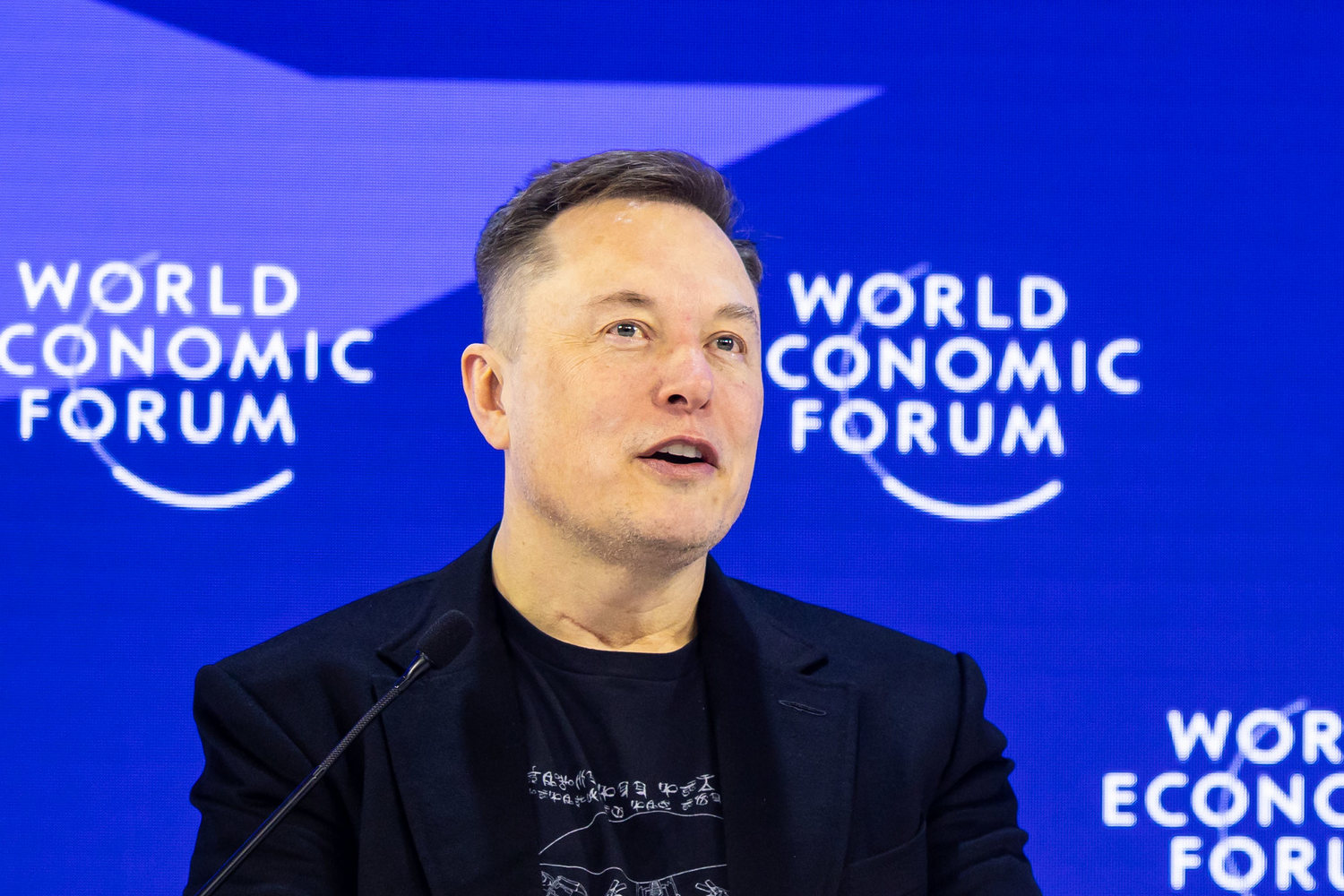
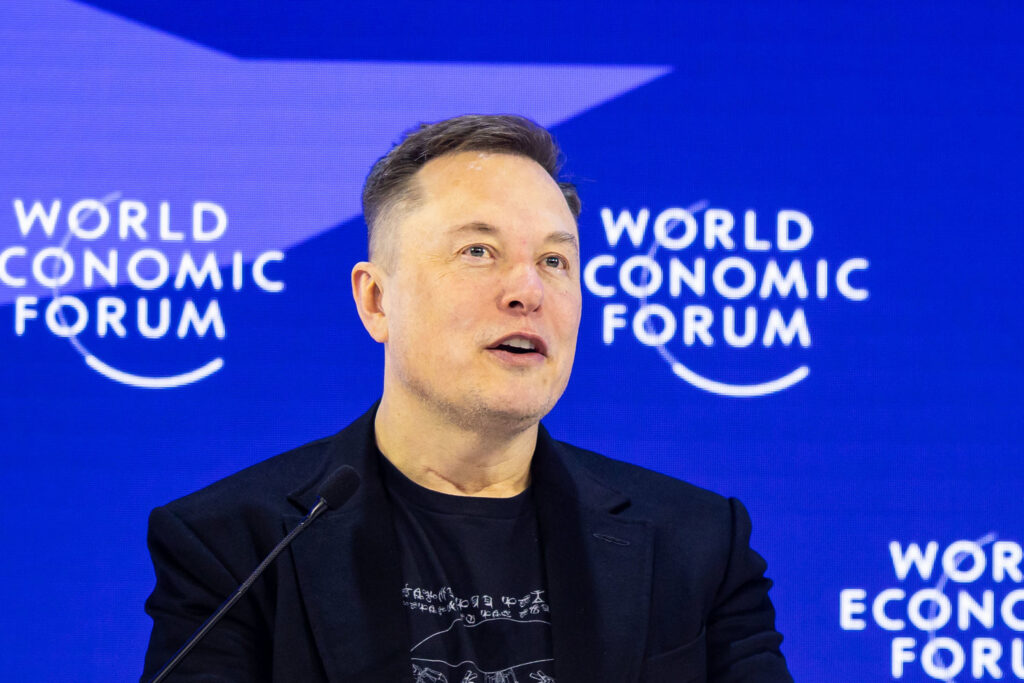
kyiv asking musk let strike inside russia its best line gone · post elon 2026 world economic forum / ciaran mccrickard wef ukraine news ukrainian reports
Explore further

Musk pushed Trump to slow Starlink in Ukraine, weakening air defenses as Russian drones attacked cities – The Telegraph

A NATO official told the Kyiv Independent that PURL deliveries, including air defense, were continuing. Another said some shipments could face delays, but that political reasons were unlikely to explain them. A US government official called Ukraine’s claims “not true.” The Pentagon did not respond to the outlet.

No warning for Kyiv hours after Zelenskyy said US alerts were back

On 18 October, Zelenskyy said on NBC that US warnings of ballistic launches had resumed after three days without them. That night, Russia launched two ballistic waves at Ukraine, and information from partners did not arrive before the first, Air Force spokesperson Yurii Ihnat said. Zelenskyy told the senators Ukraine had not received US warnings on three occasions in the past week. “We have received no clear explanation from Washington,” he said.

“All of this suggests that some political decision has been made to slow down support for us,” Zelenskyy said.

Zelenskyy offered a 30-day pause on refinery strikes for Patriots

Zelenskyy told the senators he had offered US envoys Steve Witkoff and Jared Kushner a 30-day halt on strikes against Russian refineries. In return, the US would supply Patriot interceptors to cover that period. He said the envoys had shown no openness to the idea.

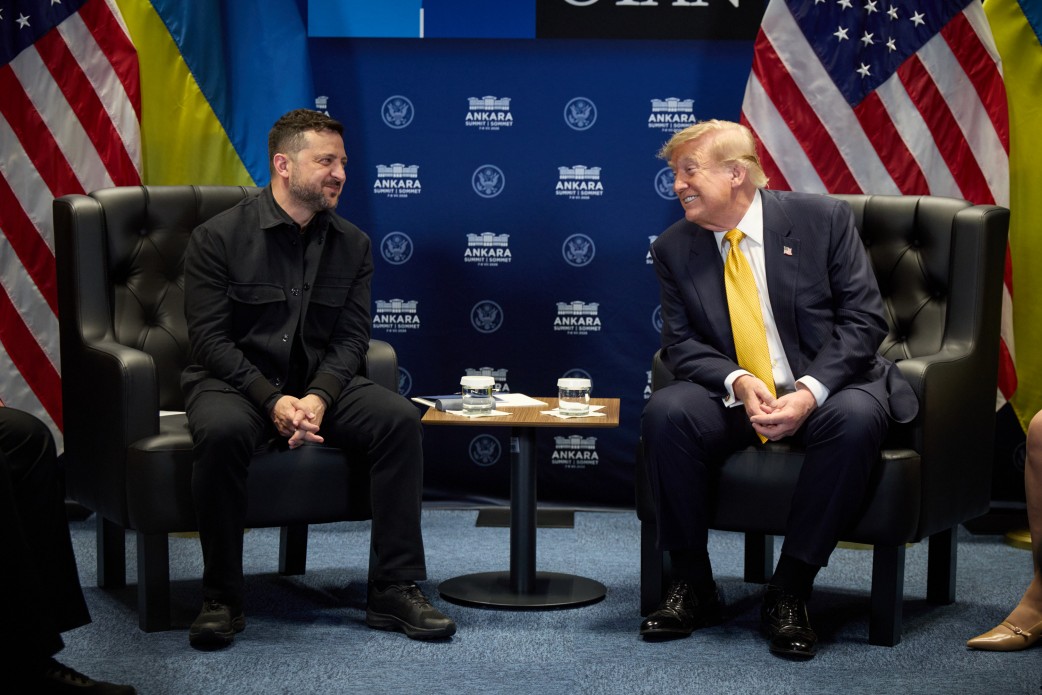
again trump presses zelenskyy stop russian refinery strikes · post ukrainian president volodymyr meets donald ankara türkiye 8 2026 presidentgovua ukraine news reports
Explore further

Trump calls Ukraine’s renewed refinery strikes “a disgrace” after Russia’s 39-missile strike on its energy sites

On 20 October, Norway announced talks in Oslo that day between Zelenskyy, Norwegian Prime Minister Jonas Gahr Støre, and Finnish President Alexander Stubb, with Witkoff attending in person and Kushner by video.

Senators back Kyiv. Trump says intelligence still flows

Senator Thom Tillis said he and his colleagues remain committed to standing with Ukraine and its European allies, while Senator Richard Blumenthal wrote that bipartisan support was “clear and unequivocal” and would be expressed “in upcoming action.”

US President Donald Trump told reporters on 19 October that Washington is still sharing intelligence with Ukraine and that he did not know who ordered the throttling of Starlink, Axios reported.

“Zelensky doesn’t know what he is talking about,” Trump said.

Two Germans charged in absentia over Bulgaria’s Starlink fire, one of three recent attacks on satellite links Ukraine relies on against Russia

20 octobre 2026 à 04:02

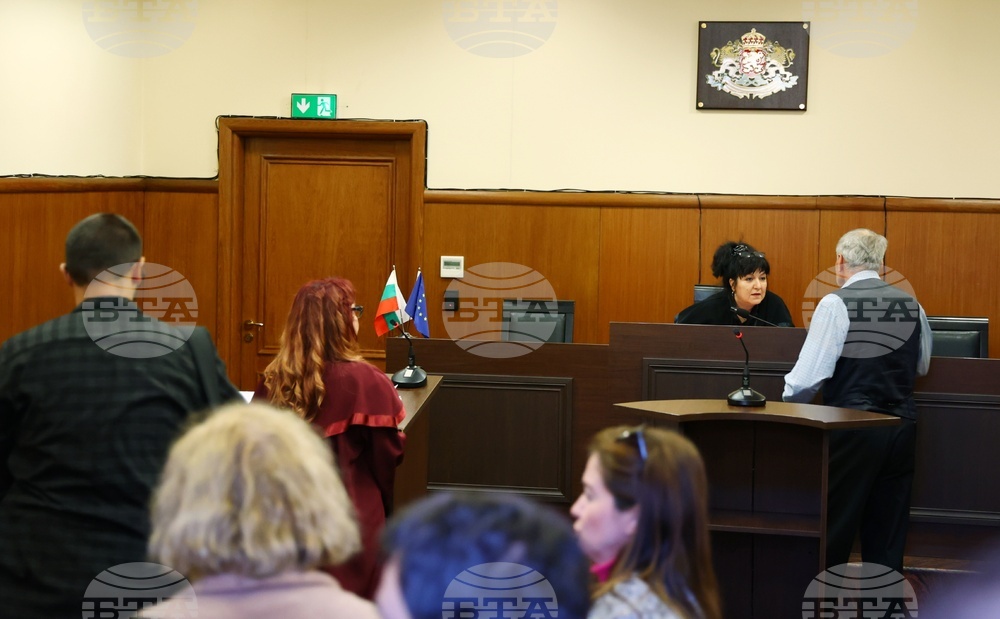
two germans charged absentia over bulgaria’s starlink fire latest attack satellite links ukraine relies against russia · post sofia city court reviews prosecution’s request european arrest warrants german nationals wanted

A Sofia court has cleared European arrest warrants for two 19-year-old Germans charged with setting fire to Starlink antennas south of the Bulgarian capital, a court spokeswoman told dpa. Prosecutors named the pair in court, but both had already left Bulgaria. The case adds Bulgaria to a run of attacks on Starlink sites in Europe, which Poland and Lithuania have linked to Russia.

While Russia presses its assault along the front and strikes Ukraine’s cities, Starlink keeps Ukraine’s drone units and front-line troops connected, and Poland pays about $50 million a year for its terminals. The network’s ground links in Europe are now a target in their own right, and ISW has linked the Polish fire to a wider Russian pattern of sabotage. Each attack on a ground station hits a network whose speed caps already disrupted Ukraine’s drone missions this month.

Two names, a few hours in Bulgaria

Prosecutors identified the suspects as Zeka Islam and Tirpan Beytullah, Bulgaria’s state news agency BTA reported, noting the names may be misspelled. Their whereabouts are unknown, according to German authorities cited by the agency. They were charged in absentia on 14 October and face three to 12 years in prison if convicted.

According to the indictment, the two crossed from Serbia at the Kalotina checkpoint at 17:37 on 9 October and told border officers they were tourists. At about 22:25, wearing gloves and masks, they allegedly set fire to antennas at the Plana teleport, a satellite ground station near the village of Plana. They drove back into Serbia through the same checkpoint at 23:55.

Three antennas burned completely, two were partly damaged, and three more were affected, prosecutors say. The pair traveled in a Volkswagen with German plates, and a national warrant followed two days after the charges, ZDF reported.

kyiv asking musk let strike inside russia its best line gone · post elon 2026 world economic forum / ciaran mccrickard wef ukraine news ukrainian reports
Explore further

Musk pushed Trump to slow Starlink in Ukraine, weakening air defenses as Russian drones attacked cities – The Telegraph

The court-appointed lawyers argued that investigators had pinned down the vehicle, not the men in it. The court rejected those objections, finding reasonable grounds to suspect the pair. The lawyers said they would appeal. The ruling can be challenged within three days.

A Starlink antenna
A Starlink antenna. Illustrative photo: Christoph Soeder/dpa

An opposition MP made the fire public three days later

The fire became public only on 12 October, when opposition MP Ivaylo Mirchev of Democratic Bulgaria posted about it on Facebook. He said 11 antennas had been set on fire, more than prosecutors later counted.

In parliament two days later, Prime Minister Rumen Radev asked the head of the State Agency for National Security (DANS) not to reveal details, saying disclosure could harm the investigation. DANS head Plamen Tonchev told lawmakers he believes the fire was sabotage and that more such attacks cannot be ruled out, dpa reported.

The White House, seen from Lafayette Square. File photo, June 2024.
Explore further

White House ordered limits on Ukraine’s military satellite service — Reuters. Who made the decision remains unclear

After the ruling, Mirchev wrote that Radev personally owes the public an explanation of what has been achieved, BTA reported.

Bulgaria’s case joins attacks Poland and Lithuania tie to Russia

Bulgaria has not said who might be behind the fire. Authorities in Poland and Lithuania have linked similar recent arsons on Starlink equipment to Russia.

In September, fire hit a Starlink ground station south of Warsaw, and Germany later detained two suspects. On 18 October, Lithuania’s prime minister said intruders had tried to burn a company’s Starlink antennas used by Ukraine, calling it part of Russia’s hybrid war. Moscow claims such accusations are baseless, Reuters reported.

17 octobre : un couple d'octogénaires agressé et dépouillé à Paris ?

19 octobre 2026 à 17:37
Depuis les manifestations du 17 octobre à Paris, des clichés montrant un couple de personnes âgées en sous-vêtements, prétendument dépouillé par des manifestants, cumulent des millions de vues sur les réseaux sociaux. Relayées par des comptes proches de l’extrême droite, ces photos présentent pourtant toutes les anomalies caractéristiques d’une génération par intelligence artificielle. Pour l'instant, les autorités n'ont aucune trace de cette prétendue agression.

  • ✇#MonCarnet
  • Meta recule sur la collecte de contenus Web, mais les éditeurs restent méfiants
    Meta fait marche arrière après avoir provoqué une vive inquiétude dans le monde des médias. L’entreprise derrière Facebook, Instagram et WhatsApp a retiré de ses nouvelles conditions commerciales une formulation qui semblait l’autoriser à collecter massivement des contenus sur les sites Web de ses clients professionnels, notamment les éditeurs de presse, pour entraîner ses modèles […]
     

Meta recule sur la collecte de contenus Web, mais les éditeurs restent méfiants

19 octobre 2026 à 13:13
Meta fait marche arrière après avoir provoqué une vive inquiétude dans le monde des médias. L’entreprise derrière Facebook, Instagram et WhatsApp a retiré de ses nouvelles conditions commerciales une formulation qui semblait l’autoriser à collecter massivement des contenus sur les sites Web de ses clients professionnels, notamment les éditeurs de presse, pour entraîner ses modèles […]

Ballistic missile warnings are back, but the Starlink cap stays, Zelenskyy says: Ukraine’s two US lifelines, one restored

18 octobre 2026 à 12:28

warnings back starlink cap isn’t zelenskyy says ukraine’s two lifelines one restored · post ukrainian president volodymyr interview nbc’s meet press aired 18 2026 ukraine news reports

The US has resumed sharing intelligence on Russian ballistic missile launches with Ukraine after a pause of several days, Ukrainian President Volodymyr Zelenskyy told NBC News on 18 October. The blackout fell on days when Russia was firing ballistic missiles at Ukraine. Limits on the Starlink satellite service that Ukraine’s forces rely on remain in place, he said.

Russia has leaned on ballistic missiles in this month’s strikes on Ukraine’s grid, firing 39 in a single attack, and Ukraine is short of interceptors to stop them. Washington has used its support as leverage, reportedly telling Kyiv to spare Russian refineries or lose US intelligence and arms.

Three days without warnings

The sharing had been blocked for some period of time before it was restored, Zelenskyy said on Meet the Press.

“We are very thankful for this. Now it works,” he said.

Ukraine gets other intelligence from Europeans and dozens of other partners, he explained. But only the United States has the data that tells Kyiv when Russia launches ballistic missiles.

“We didn’t get it during ballistic attacks during three days,” Zelenskyy said.

A timely warning gives Ukraine’s air defenses extra minutes to prepare and lets authorities alert civilians, Liga noted. Late on 12 October, Russian ballistic missiles hit Kyiv before the air-raid alert reached people, with no advance data on launches from Russian territory. The next day, US President Donald Trump said Washington was still sharing intelligence. Two days later, Zelenskyy said Kyiv had received no US warnings of incoming ballistic missiles while it paused its strikes on Russian refineries at Washington’s request. That pause followed the energy ceasefire Trump declared on 11 October, which Russia never confirmed.

The White House in Washington DC, USA. Illustrative image: Wikimedia Commons.
Explore further

“He thinks Ukraine is a weak link and that it needs to be squeezed into giving in”: diplomat on why Trump pressures Kyiv, not Moscow

Starlink still capped, Kyiv says

Starshield, the military version of Starlink, still cuts out above 161 km/h, Zelenskyy said, too slow for Ukraine’s interceptor drones to catch Russia’s jet-powered Shahed-type drones. NBC News, which aired the interview, separately reported that Starlink services had resumed at normal speed. He said Ukraine’s generals and government believe the order came from the US government and SpaceX carried it out, though he did not know who exactly made the call. Ukraine had instead asked SpaceX and Trump to open Starlink over Russia so it could hit ballistic missile launchers, he said.

“If [Trump] will personally decide to lift this decision, it will immediately work as it was before,” he said.

US Treasury Secretary Scott Bessent, who appeared on the same show, called Zelenskyy’s charge “very reckless” and said Trump and Secretary of State Marco Rubio had denied any administration role. Asked about the break in intelligence sharing, he said he did not know anything about it but that Zelenskyy should be “very careful about making statements like this that aren’t true.” Reuters had reported, citing three officials, that White House officials ordered the Pentagon to limit the service.

Asked whether Ukraine could win without the United States, Zelenskyy said it would be very difficult.

“But if the United States will support Putin, I mean, it’s unbelievable, it’s tragedy. It’s historic mistake and big tragedy,” he said.

He also said his team had received word that US negotiators wanted to meet, and that he had offered to meet in Brussels or London, hoping the US team would be ready this week.

The warnings are back, but they stopped once without explanation. Ukraine’s defense against Russia’s missiles still runs through decisions made in the US.

  • ✇#MonCarnet
  • No Kings : Meta accusé de censure en pleine journée de mobilisation contre Trump
    Alors que des milliers d’Américains manifestaient samedi 17 octobre contre l’administration Trump, une controverse a éclaté sur les réseaux sociaux. Meta, la société mère de Facebook et d’Instagram, a suspendu le principal compte Instagram du mouvement No Kings, précisément au moment où les organisateurs tentaient de mobiliser leurs sympathisants. Un incident que l’entreprise attribue à […]
     

No Kings : Meta accusé de censure en pleine journée de mobilisation contre Trump

18 octobre 2026 à 09:15
Alors que des milliers d’Américains manifestaient samedi 17 octobre contre l’administration Trump, une controverse a éclaté sur les réseaux sociaux. Meta, la société mère de Facebook et d’Instagram, a suspendu le principal compte Instagram du mouvement No Kings, précisément au moment où les organisateurs tentaient de mobiliser leurs sympathisants. Un incident que l’entreprise attribue à […]

Congressional Staff Open Letters Containing Suspicious Substances

16 octobre 2026 à 22:00
The incidents, the first of which was reported on Thursday, came as election officials have reported a growing number of threats directed at them.

© Tierney L. Cross for The New York Times

Members of Congress Reported receiving letters containing suspicious substances on Friday.

EU fast-tracks merger of three European firms into one SpaceX rival. It wants to end reliance on US satellites that failed Ukraine this week

16 octobre 2026 à 09:23

Satellites are the new frontline in space and strategy. Photo: Depositphotos

The EU plans to fast-track antitrust approval for Project Bromo, a satellite venture meant to cut Europe's reliance on American space technology, Bloomberg reports. The news comes days after the White House ordered the Pentagon to slow Starshield, the military-grade Starlink service Ukraine's forces use, according to Reuters.

Project Bromo would merge the satellite businesses of Italy’s Leonardo and France’s Airbus and Thales into one company. Bloomberg calls it the bloc’s answer to SpaceX, and the EU sees it as a regional giant able to compete with US and Chinese rivals.

European Commission President Ursula von der Leyen has backed the project, Eunews reports.

“These are the types of industrial champions we need if Europe is to lead in the space economy of tomorrow,” she said at an international space summit in Paris last month, citing Bromo by name.

A year of quiet groundwork before the filing

Over the past year, the partners and EU officials have worked through potential competition concerns so they can be resolved before a formal application, according to Bloomberg. The companies have not yet applied, but Brussels expects them to in the coming weeks.

For large deals, regulators usually hold such preliminary talks to flag obstacles early. If the companies offer concessions, such as selling some assets, the deal could clear after a first-phase review of a little over a month. If competition concerns remain, the Commission could open an in-depth probe lasting several months.

The caveat behind the SpaceX-rival label

A fast review is not a free pass. Competition Commissioner Teresa Ribera has warned that the project cannot expect one, and unions and suppliers have raised concerns about jobs and competition, Bloomberg reports. Von der Leyen’s public backing drew criticism from some members of the European Parliament.

Her support “doesn’t mean we are not going to apply and to enforce our own regulation,” Ribera told Bloomberg TV.

Why it matters to Ukraine

The push is part of a wider European scramble for space autonomy. Ukraine wants to build a satellite system of its own that no single company controls.

This week showed why. After the Starshield order, the military-grade terminals stopped working on fast-moving objects, and now work only at speeds of up to 160 kph, a person in Ukraine’s Defense Ministry told Reuters. Ukrainian officials said the restrictions complicated strike missions against Russian forces and logistics in occupied territory and slowed the interceptor drones that shoot down Shaheds.

White House ordered limits on Ukraine’s military satellite service — Reuters. Who made the decision remains unclear

16 octobre 2026 à 07:44

The White House, seen from Lafayette Square. File photo, June 2024.

White House officials instructed Pentagon leaders to limit Starshield, SpaceX’s military-grade satellite service used by Ukrainian forces, Reuters reported on 15 October, citing three officials. The report came a day after a senior US official told Axios the Trump administration had nothing to do with the alleged Starlink restrictions.

Ukrainian forces rely on US-controlled satellite technology for battlefield operations and for intercepting Russian drones aimed at Ukrainian cities, so the latest restrictions have raised questions about how reliably they can depend on it.

    Senior US official denies president requested restrictions

    Asked about the order, a senior US official replied, “No such request was ever made by the president.” The White House did not respond to questions about whether other administration officials might have made the request.

    Ukrainian officials contacted the White House, State Department and Pentagon on 13 and 14 October and were told it was a White House decision

    European allies question Starlink restrictions

    European officials raised concerns about the restrictions. German Foreign Minister Johann Wadephul criticized the throttling and said Ukraine must continue to receive full support, Spiegel reported on 15 October. Wadephul said Germany had questions for the US, noting that Germany finances part of the Starlink technology used in Ukraine.

    On 16 October, UK Defense Secretary Wes Streeting said US Defense Secretary Pete Hegseth had assured him in a face-to-face meeting that Starlink was back up and running, the Guardian reported. However, a Ukrainian Defense Ministry source said that military-grade terminals were working in motion again, but only at speeds of up to 160 km/h.

    New data-speed restrictions disrupted drone missions

    The military Starshield package previously had no data-speed restrictions, Ukraine’s 7th Rapid Response Corps told Novynarnia. Ukrainian officials said that after the restrictions were imposed, terminals disconnected when drones exceeded 160 km/h and sometimes at 80 km/h.

    The Corps also reported 10–20-second connection drops at 110–120 km/h on the Huliaipole front, which made drones harder to control. One unit had to cancel some missions.

    The restrictions came as US President Donald Trump pressed Kyiv to stop striking Russian oil refineries, blaming them for soaring energy prices ahead of November’s midterm elections. Ukraine suspects SpaceX imposed the restrictions to pressure Kyiv over the refinery strikes, but that motive has not been confirmed.

    Trump calls Ukraine’s renewed refinery strikes “a disgrace” after Russia’s 39-missile strike on its energy sites

    16 octobre 2026 à 07:09

    again trump presses zelenskyy stop russian refinery strikes · post ukrainian president volodymyr meets donald ankara türkiye 8 2026 presidentgovua ukraine news reports

    US President Donald Trump called Ukraine’s renewed strikes on Russian oil refineries a disgrace in an interview with Newsmax and questioned President Volodymyr Zelenskyy’s will to settle the war on 15 October. His statements came after he made a deal with Russian President Vladimir Putin to allow Russian diesel back into the US ahead of the mid-term elections in the US.

    Kyiv says its long-range strikes have knocked out more than half of Russia's refining capacity, one of the few levers it controls on Moscow's war income, according to Ukraine's Defense Ministry. This is part of efforts to reduce the aggressor's capabilities to launch assaults, including the latest, during which four Russian regions fired 39 Iskander-M, North Korean KN-23, hypersonic Zircon, and supersonic anti-ship cruise Oniks missiles, Zelenskyy said.

    Trump criticizes Zelenskyy over oil prices while remaining silent on Russian strikes

    Earlier, Zelenskyy said that Ukraine stopped refinery strikes for three days to meet US wishes after Trump announced an “energy ceasefire” on 11 October. At the same time, Russia struck a Kharkiv heat-and-power plant within hours of the announcement, he emphasized.

    Meanwhile, in the interview with Newsmax, Trump said Zelenskyy is only pushing world oil prices higher.

    “Well, I think that’s a disgrace,” he said.

    He added that Ukraine has other options: “There are a lot of targets that you can hit.”

    At the same time, Trump didn't say a word about Russian strikes on Ukraine's civilian buildings and power infrastructure ahead of the winter.

    Trump compares Zelenskyy to a circus showman

    The US leader said he is “not a big fan” of Zelenskyy. He claimed both sides “would like to see it end,” but that he finds Zelenskyy “more difficult to deal with than Putin.”

    Kremlin welcomes Trump National Security Strategy as aligned with Russian vision on Ukraine
    Explore further

    US weighs relief for sanctioned shadow fleet tankers, days after freeing Russian diesel

    He also said that he believes the depletion of US ammunition stockpiles is linked to the aid provided to Ukraine under the Biden administration, rather than the war with Iran.

    Ukraine has repeatedly offered to help the US counter Iranian drones during the operation. The New York Times reported that a Ukrainian team departed the day after the US made such a request.

    Nevertheless, despite Kyiv’s offers and actions, Trump once again compared Zelenskyy to P. T. Barnum, the 19th-century American circus showman, saying that he received a tremendous number of Patriots and Tomahawks.

    However, there is no public confirmation that Tomahawk missiles were transferred to Ukraine during the Biden administration.

    After Trump, Musk tells Ukraine’s president to go. Zelenskyy says he won’t resign and will never accept Ukrainian land as Russian

    15 octobre 2026 à 08:49

    musk tells ukraine’s president go zelenskyy says won’t resign never accept ukrainian land russian · post volodymyr during interview piers morgan recorded visit britain 14 2026 video uncensored / ukraine

    Tech billionaire Elon Musk wrote on X on 15 October: “And so the slaughter continues … Time for Zelensky to go.” Four days earlier, he had posted that Zelenskyy had gone too far, after US President Donald Trump said it was time for Ukraine to get a new president. Asked by Morgan on 14 October whether he would resign, Zelenskyy said he would not: “It’s my responsibility.”

    Musk’s post comes as Washington squeezes Kyiv instead of Moscow: Ukraine’s military satellite links slowed, US missile warnings went missing, and the US threatened to cut intelligence unless Kyiv stops hitting Russian refineries.

    Land and elections

    Zelenskyy said elections could not be held under constant Russian attack: “From the point of security, you can’t do elections.”

    Of any future president, he said: “I’m sure the new man or woman will defend our country.” He also reminded Trump that Crimea and parts of Donbas were already occupied when he took office, under another president, long before the full-scale invasion.

    “I’m a realist, and I understand that people are more important than one kilometer or two kilometers. It’s not about kilometers. It’s about land and homes,” he told Morgan.

    Zelenskyy has said Ukraine is ready for elections if a full 60-day ceasefire is in place. Numerous sources told The Atlantic that Trump sees Zelenskyy as the main obstacle to a peace deal and related business deals with Russia. One Trump adviser said he is also an obstacle to Trump’s hopes for the Nobel Peace Prize.

    Starlink

    Ukrainian forces reported restrictions on Starshield, the SpaceX satellite system they use for battlefield communications and drone operations, and Zelenskyy warned the decision would cost lives. On 14 October, Musk said Starshield is owned and controlled by the US government, which sets its limits, and that commercial Starlink cannot be used for offensive military action. Zelenskyy told the FT he did not know whether the decision was SpaceX’s or the US government’s, adding: “I think it’s about SpaceX.” A senior US official told Axios the Trump administration had nothing to do with the restrictions.

    Intelligence and refineries

    On two consecutive nights, air raid alerts in Kyiv sounded only after Russian ballistic missiles were already approaching or striking the capital. Zelenskyy said Ukraine received no warning from partners of the launches on 12 and 13 October, which hit civilian infrastructure and a major power plant. A Ukrainian official told CNN the loss of intelligence “will give Russians a real leverage on a frontline.” A European official questioned Washington’s explanation that weather caused the gaps in missile warnings. Trump denied halting intelligence sharing.

    Washington had warned it could suspend intelligence sharing if Ukraine kept striking Russian refineries, Axios reported. A US official disputed that any explicit threat was made. Sources told CNN the US had also threatened to halt European purchases of US weapons for Ukraine. Zelenskyy told the FT the warning came through military channels.

    To lower energy costs before next month’s midterm elections, Trump has pressed Kyiv to stop refinery strikes, CNN reported. Zelenskyy said he felt betrayed after Trump announced a diesel supply deal with Russia. On 14 October in London, he told the FT that Ukraine would resume strikes on Russian oil refineries.

    Musk pointed at the US military over Ukraine’s satellite limits. Now a US official says the administration had nothing to do with them

    15 octobre 2026 à 06:43

    The Starlink logo on a smartphone screen.

    Ukrainian officials contacted the White House, CIA, and Pentagon after the restrictions, which Ukraine says affected both Starlink and Starshield, Axios reported on 14 October. A senior US official told Axios the Trump administration had nothing to do with the restrictions. On the same day, Elon Musk said on X that Starshield systems are owned and controlled by the US government, and that any speed or usage limits are decided by the US military and ultimately the president.

    The restrictions could affect Ukraine’s ability to intercept Russian attack drones and carry out mid-range strikes against Russian forces and military targets in occupied Ukrainian territories. A speed cap of 160 km/h was insufficient to intercept some jet-powered drones, an unnamed Ukrainian official told Axios. Ukrainian officials told Axios they suspect SpaceX imposed the restrictions to pressure Kyiv to accept US President Donald Trump’s demand to stop striking Russian oil refineries, though the motive remains unconfirmed. But Starlink does not work inside Russia, and the drones attacking Russian oil facilities use other communications systems, according to Reuters.

    What Musk and the White House said

    Musk did not directly address the throttling, Axios noted. Starlink, he wrote, “is a commercial service owned and controlled by SpaceX,” limited to civilian or defensive use.

    White House officials told the Ukrainians they don’t have control over SpaceX, two sources told Axios. One said the administration would reach out to SpaceX to figure out what happened. The White House did not immediately respond to Axios’s request for comment.

    How the cap disrupted drone missions

    Presidential adviser Serhii Beskrestnov said on 14 October that SpaceX had imposed a 160 km/h limit on Starshield’s “military package” overnight without warning. Ukraine’s 7th Rapid Reaction Corps said mid-range strike drones must reach high speed quickly and that an unstable connection “will make it impossible to launch such aircraft or use them as intended.” One unit on the Huliaipole front had to cancel some missions, the corps told Novynarnia.

    ukraine goes back hitting russian oil after its trump-forced pause left kyiv without warnings incoming ballistic missiles · post ukrainian president volodymyr zelenskyy during interview piers morgan london 14 2026
    Explore further

    Ukraine is going back to hitting Russian oil after its Trump-pressured pause, during which Kyiv got no US warnings of incoming ballistic missiles

    Ukrainian officials told Axios the system turned off when drones exceeded 160 km/h, and sometimes 80 km/h, before service was partially restored on 14 October. The Defense Ministry said SpaceX continues to restrict Starlink to 160 km/h and that it remains in communication “with partners and SpaceX regarding stable service conditions and the prevention of sudden restrictions,” Axios reported.

    A diesel deal

    The restrictions followed Trump’s 9 October deal with Russian President Vladimir Putin easing sanctions on Russian diesel. A day later, Trump told reporters: “We said you could do whatever you want to Russia, don’t hit the refineries,” the Kyiv Independent reported.

    Ukraine is going back to hitting Russian oil after its Trump-pressured pause, during which Kyiv got no US warnings of incoming ballistic missiles

    15 octobre 2026 à 03:25

    ukraine goes back hitting russian oil after its trump-forced pause left kyiv without warnings incoming ballistic missiles · post ukrainian president volodymyr zelenskyy during interview piers morgan london 14 2026

    Ukraine will resume strikes on Russian oil refineries, ending a three-day pause it held at Washington’s request, Ukrainian President Volodymyr Zelenskyy told the Financial Times in an interview published on 15 October. Russia kept bombing Ukraine’s energy system throughout the pause, while Kyiv lost US missile warnings and its Starlink service slowed. Zelenskyy said Ukraine would halt energy strikes again only in exchange for more US air defense.

    Ukraine's deep-strike campaign targets the Russian oil industry, which fuels Russia's army in Ukraine and earns the export revenue funding the war. Striking the plants that turn Russian crude into fuel, 12 of them hit in September alone, is one of the few levers Kyiv controls on Moscow’s war income. US President Donald Trump has blamed those strikes for higher US fuel prices, which most analysts attribute to the Iran war, and Washington has threatened to withhold intelligence, and reportedly weapons, unless Kyiv gives it up. Each step Washington takes toward Moscow, from fuel waivers to talk of frozen assets, widens the gap Europe and Ukraine must fill, while Russia gains revenue and time to keep striking.

    A pause that bought nothing

    Zelenskyy said he stopped the refinery strikes for three days to meet US wishes, but Russia kept hitting Ukraine’s energy infrastructure and killing civilians. During the pause, Ukraine received no US warnings of ballistic missile launches, he said. Starlink also slowed across the country, hampering front-line operations and mid-range strikes on Russian military targets, he added.

    Russia used those days to fire 39 ballistic missiles and more than 120 drones at Ukraine’s grid overnight into 14 October, leaving at least 600,000 people without power. “We hold energy ceasefire from our side,” Zelenskyy told Piers Morgan on 14 October. Of the Starlink slowdown, he added: “I’m sure that they knew what they did.”

    The price of another pause

    Ukraine could again stop hitting Russian energy only if it receives more US interceptors for its Patriot systems, Zelenskyy told the FT. He warned that a halt could simply invite more US-Russia deals that feed Russia’s war machine, and predicted the next one would involve gas.

    kyiv asking musk let strike inside russia its best line gone · post elon 2026 world economic forum / ciaran mccrickard wef ukraine news ukrainian reports
    Explore further

    “Starshield systems are owned and controlled by the US government”: Musk says Trump, not SpaceX, is behind cut hitting Ukraine

    US intelligence officials had warned Ukraine’s embassy in Washington that a new strike on Russia’s energy facilities would end all intelligence sharing at once, The Washington Post reported, citing a person familiar with the matter. Washington has not fully cut it off, but the threat stands, the person said. Trump said on 13 October that the US was still sharing intelligence.

    Washington’s other moves toward Moscow

    A senior US official told Axios the administration had nothing to do with the Starlink limits, which Elon Musk had blamed on the US military. The administration is also considering easing sanctions on shadow fleet tankers, which have carried oil from Russia, Iran, and Venezuela, so the blacklisted vessels could haul non-sanctioned cargo, a US official told Reuters. The US Energy Department said the move would not help Russia ship its oil or fuel.

    Washington eased sanctions on Russian oil this spring, after which Russia’s oil income jumped $890 million in a week, and it extended that waiver despite telling allies it would not. US envoys also proposed unfreezing part of Russia’s frozen assets to lure Moscow back to talks, an idea European officials rejected, the Financial Times reported.

    “Starshield systems are owned and controlled by the US government”: Musk says Trump, not SpaceX, is behind cut hitting Ukraine

    14 octobre 2026 à 15:52

    kyiv asking musk let strike inside russia its best line gone · post elon 2026 world economic forum / ciaran mccrickard wef ukraine news ukrainian reports

    SpaceX chief Elon Musk says the version of Starlink that Ukraine’s military uses, StarShield, is owned and controlled by the US government rather than by his company. His claims come amid a storm over Ukrainian reports that a speed cut had broken their frontline operations.

    Ukraine’s drones and air defenses rely on Starlink to steer and strike, so a limit on the network hits combat directly. Ukrainian troops reported that overnight into 14 October, the faster military package they depend on was throttled, halting a series of missions. Musk’s answer shifts the decision and the blame from SpaceX to the US government and, ultimately, to the president.

    “Any limits on speed or usage are decided by the US military and ultimately POTUS. StarShield systems are owned and controlled by the US government,” Musk says.

    He draws a line between the two services. Ordinary Starlink is a commercial product owned by SpaceX, limited to civilian or defensive use and not for offensive military action, which he called inappropriate for a commercial company.

    Their conversation took place the same week that Washington pressured Kyiv over its strikes on Russian oil refineries amid US President Donald Trump's diesel deal with Moscow.

    The exchange that forced Musk to answer

    The statement followed a direct appeal. Former Defense Minister Mykhailo Fedorov told Musk on X that Starlink connectivity at speeds of up to 160 km/h was being restored, and pressed for more.

    “Removing StarShield’s speed limit entirely is now critical for Ukraine’s defense. Thank you, Elon Musk. We hope for your continued support,” Fedorov wrote, framing the cap as a direct constraint on the war.

    The faster package Ukraine cannot do without

    The ordinary Starlink Mini mounted on drones is capped at about 160 km/h, which is too slow for some missions, so faster flight requires access to the military version, StarShield, Ukrainska Pravda notes. Ukraine has used StarShield since 2024.

    • ✇US news | The Guardian
    • SpaceX rocket launch causes stunning ‘jellyfish cloud’ visible off US east coast
      Expanding plume of fuel exhaust crystalized in the sky and reflected sunlight off frozen particles after Florida launchA SpaceX rocket provided a stunning pre-dawn display over Florida as a egiant, luminescent “jellyfish cloud” spread for miles, caused by an expanding plume of fuel exhaust crystalizing in the sky and reflecting sunlight off the frozen particles.The phenomenon occurred shortly after Tuesday’s 6.33am ET launch of the Falcon 9 rocket carrying cargo to the International Space Statio
       

    SpaceX rocket launch causes stunning ‘jellyfish cloud’ visible off US east coast

    14 octobre 2026 à 14:15

    Expanding plume of fuel exhaust crystalized in the sky and reflected sunlight off frozen particles after Florida launch

    A SpaceX rocket provided a stunning pre-dawn display over Florida as a egiant, luminescent “jellyfish cloud” spread for miles, caused by an expanding plume of fuel exhaust crystalizing in the sky and reflecting sunlight off the frozen particles.

    The phenomenon occurred shortly after Tuesday’s 6.33am ET launch of the Falcon 9 rocket carrying cargo to the International Space Station.

    Continue reading...

    © Photograph: Paul Hennessy/SOPA Images/Shutterstock

    © Photograph: Paul Hennessy/SOPA Images/Shutterstock

    © Photograph: Paul Hennessy/SOPA Images/Shutterstock

    “Trump and Musk must be held accountable”: US senator warns Starlink network failing over Ukraine could cripple its shield against Russian missiles and drones

    14 octobre 2026 à 13:53

    geran-2 (shahed-136) drone belarusian markings service military belta militarnyi російський безпілотник герань 2

    US Senator Richard Blumenthal, a co-author of the Russia sanctions law named after Lindsey Graham, has issued a sharp statement on the latest developments in Ukraine. He says that President Donald Trump and SpaceX chief Elon Musk should be held accountable for reported Starlink failures that could cripple Ukraine’s defense.

    On 14 October, Ukraine’s military reported a Starlink disruption that halted its operations. It happened at the same time the country’s air defense stopped receiving intelligence on a Russian ballistic strike that killed three people in Kyiv. Both failures came right after the US struck a diesel deal with Russia, letting low volumes of fuel into global markets and America while pressure grew on Ukraine to stop hitting the Russian oil refineries that raise the cost of the war.

    "Reports of Starlink failing in Ukraine are deeply alarming— potentially crippling air defense against Russia’s murderous missiles & drones. Trump & Musk must be held accountable," he says.

    When the network falters, the war feels it

    The alarm rests on how completely Ukraine leans on the system. SpaceX has reportedly throttled the StarShield military package Ukrainian drones use, with connections dropping once the drones move at speed, and breaking a series of missions.

    Ukraine neither owns nor controls Starlink, and the latest limits revived long-running fears that its battlefield lifeline can be dialed down from outside the country.

    Blumenthal’s demand sits inside a broader revolt in Congress. A bipartisan group of 12 senators wrote Trump on 13 October urging him to rescind his deal letting Russian diesel back to market, calling the Treasury’s General License No. 135 a gift to Moscow that should be withdrawn.

    They pressed him instead to use the Graham-Leach-Bliley Act he signed in September to squeeze Russia and its enablers, above all, China.

    "If there's one lesson from Trump's mindless warmongering, it's that we need to break our dependence on foreign imports of fossil fuels & embrace alternate sources of energy," he said.

    “Trump was looking for any opportunity to undermine our defense capabilities,” top Ukrainian volunteer, who supplied 291,502 FPV drones to front, says of sudden Starlink limit

    14 octobre 2026 à 11:22

    Elon Musk: “Starlink will never turn off for Ukraine”

    One of Ukraine’s most prominent drone volunteers, Serhii Sternenko, says that Starlink terminals have been restricted overnight, with connectivity beginning to drop out at speeds exceeding 160 km/h. As a result, several critical missions were disrupted.

    Sternenko heads a charitable foundation that has purchased 291,502 FPV drones, which have helped the Ukrainian military shoot down more than 12,954 aerial targets. He has also served as an adviser within the team of former Defense Minister Mykhailo Fedorov.

    Sternenko suggests that SpaceX may have introduced the restrictions at the request of the Trump administration. He adds that Ukraine had refrained from striking Russian oil refineries and energy infrastructure in recent days, as Trump had requested.

    “But Trump was looking for any opportunity to undermine our defense capabilities, and he did so despite the fact that we had complied with his demands,” Sternenko says.

    The limit landed the same night Russian ballistic missiles struck Kyiv’s Desnianskyi district, killing three women and injuring 24, including a seven-year-old girl.

    Rescuers evacuated people covered in blood

    The strike on a nine-story residential building set it ablaze, burning out apartments from the first floor to the ninth, with rescuers pulling bloodied residents from the flames and leaving survivors without power, water, or gas, according to Suspilne.

    During the night’s first ballistic launches, partners did not alert Ukraine, but for the three later waves the warnings did come through, Air Force communications chief Yurii Ihnat says. The cause of the first lapse is still being established, per Radio Free Europe/Radio Liberty.

    The early warnings help Ukrainian civilians quickly find a place to hide from such strikes, leaving up to 3 minutes to do so. Without it, people are left entirely helpless in the face of the aggression.

    Further Starlink restrictions have reportedly been introduced

    Later, Sternenko wrote that reports were "coming in from military personnel that restrictions on the use of Starlink satellite communications terminals for our operations have just been tightened.

    "The speed at which the connection starts dropping out is now 60–70 km/h,” he added.

    NATO country that pays for Kyiv’s Starlink warns Musk as his cap breaks Ukraine’s drone missions: “As your European customers, we are watching you”

    14 octobre 2026 à 10:21

    Starlink terminal.

    Poland’s Foreign Minister Radoslaw Sikorski has publicly criticized SpaceX chief Elon Musk over the latest disruptions in Starlink's operation in Ukraine. Poland is the largest supplier of Ukraine’s terminals, having provided about 29,500, roughly half the network. It also has a Starlink ground station in Wola Krobowska that provides connectivity for much of Central and Eastern Europe, including Ukraine, RMF24 reports.

    On 13 October, SpaceX imposed a 100 mph (160 km/h) speed limit on the StarShield military package that Ukrainian forces use, disrupting drone missions without warning. Poland, which pays about $50 million a year for Ukraine’s Starlink terminals, told Musk it is watching.

    “Hey, @elonmusk, big man, are you playing politics with your products again? As your European customers, we are watching you,” Sikorski wrote on X.

    The “big man” jab echoed their 2025 clash, when Musk told Sikorski to “be quiet, small man” after the minister noted that Warsaw, not SpaceX as charity, pays for the service.

    Be quiet, small man.

    You pay a tiny fraction of the cost.

    And there is no substitute for Starlink.

    — Elon Musk (@elonmusk) March 9, 2025

    Meanwhile, presidential adviser Serhii “Flash” Beskrestnov said that this could not be a coincidence and was most likely tied to the current political situation.

    When a drone outruns its own signal

    The cap bites exactly where Ukraine’s drones do their work. The StarShield package had previously carried no data speed limit, and the change directly affected drones that use Starlink to steer in flight, the 7th Air Assault Corps said.

    “During flights, the connection could drop for 10 to 20 seconds at speeds of just 110 to 120 kilometers per hour. The drones kept moving, but these interruptions made them harder to control,” the corps said, describing problems that now start well below the new ceiling.

    A dependence Kyiv has feared for years. The limit revives an old worry. Ukraine neither owns nor controls Starlink, and the restriction follows fresh fears of a shutdown after Musk backed US President Donald Trump’s call for Zelenskyy to resign.

    • ✇#MonCarnet
    • Facebook permet désormais de parler à son algorithme pour choisir ce qu’on veut voir
      Et si, plutôt que de laisser Facebook décider de ce qui apparaît dans votre fil d’actualité, vous pouviez simplement lui expliquer ce que vous souhaitez voir ? C’est précisément ce que propose Meta avec une nouvelle fonction baptisée « Votre algorithme » (Your Algorithm). Annoncée hier, cette nouveauté permet aux utilisateurs de communiquer directement leurs […]
       

    Facebook permet désormais de parler à son algorithme pour choisir ce qu’on veut voir

    14 octobre 2026 à 07:37
    Et si, plutôt que de laisser Facebook décider de ce qui apparaît dans votre fil d’actualité, vous pouviez simplement lui expliquer ce que vous souhaitez voir ? C’est précisément ce que propose Meta avec une nouvelle fonction baptisée « Votre algorithme » (Your Algorithm). Annoncée hier, cette nouveauté permet aux utilisateurs de communiquer directement leurs […]

    New Starlink restrictions disrupt Ukrainian drone missions. Kyiv adviser says move is tied to “political situation”

    14 octobre 2026 à 05:29

    Starlink

    Ukraine’s presidential adviser Serhii Beskrestnov said SpaceX had imposed a 100 mph (160 km/h) speed limit on its military Starshield service overnight into 14 October, disrupting several missions without warning Ukraine’s defense forces.

    Ukraine’s forces use Starlink-connected drones to strike Russian positions and logistics, including targets behind the front line. Unlike earlier restrictions introduced at Kyiv’s request to stop Russian forces from exploiting Starlink, the latest change reportedly targets the military Starshield service and was imposed without warning Ukraine’s military.

    What the new restriction covers

    Beskrestnov wrote that the restriction applies to the “military package” of Starshield services. He said the move “obviously cannot be a coincidence” and was connected with the “current political situation,” but did not explain what he meant.

    Activist Serhii Sternenko, a former adviser to Ukraine’s defense minister, reported that connections began disappearing at speeds above 160 km/h. He suggested SpaceX had acted at the Trump administration’s request but provided no evidence. Starlink does not work inside Russia, and the drones hitting Russia’s oil industry use other means of communication, Reuters noted. Sternenko added that the ordinary satellite terminals were still working.

    Later on 14 October, Sternenko wrote that, according to military reports, restrictions had been tightened further, with connections starting to drop at 60–70 km/h. Beskrestnov later warned that the restriction also hits Starlink-linked interceptor drones, which he called Ukraine’s most effective current defense against jet-powered Shaheds.

    Front-line units report dropped connections

    Ukraine’s 7th Rapid Reaction Corps confirmed the disruptions in a statement to Reuters. The corps’ press service told Novynarnia that its units on the Huliaipole front began experiencing problems overnight. The corps said the change affected drones controlled through Starlink in flight and concerned Starshield’s data-transmission speed, which it said had previously been unrestricted.

    The corps said connections could disappear for 10–20 seconds at movement speeds of 110–120 km/h, complicating drone control. Flying slower creates its own risk, it said, because “slower targets become more vulnerable to being hit by the enemy.”

    Some high-speed drones, particularly mid-range strike models, must reach high speed quickly, the corps said. An unstable connection “will make it impossible to launch such aircraft or use them as intended.” Since the start of the day, one unmanned systems unit on the Huliaipole front had to cancel some missions because of connection problems, the corps said.

    Earlier limits came at Kyiv’s request

    In late January, SpaceX began restricting Starlink in Ukraine at Kyiv’s request after Russian forces started mounting terminals on strike drones. After Russian drones struck a passenger train in Kharkiv Oblast on 27 January, Beskrestnov, then an adviser to the defense minister, suggested one of them may have been controlled via Starlink. In early February, Ukraine introduced a whitelist under which only registered terminals could continue operating. Beskrestnov called the earlier countermeasures “temporary” and “emergency.”

    SpaceX had not publicly commented on the restriction, and Ukraine’s Defense Ministry was looking into its cause, Radio Svoboda reported. Polish Foreign Minister Radosław Sikorski asked Elon Musk on X whether he was “playing politics with your products again,” adding: “As your European customers, we are watching you.”

    • ✇US news | The Guardian
    • Netflix’s Mike Tyson docuseries offers an incomplete portrait of a troubling figure | Andrew Lawrence
      The once heroic boxer showcases a frankness in this compelling new series but also an unwillingness to take accountability for his darkest momentsMike Tyson never envisioned old age. And yet here he still is, having outlived his parents, Brooklynites of ill repute who died when he was a teenager, and the Brownsville tough guys who teased him for being scrawny and having a lisp. Here he is after doing hard time for rape in his prime, winning and losing great fortunes and battling addiction to dri
       

    Netflix’s Mike Tyson docuseries offers an incomplete portrait of a troubling figure | Andrew Lawrence

    14 octobre 2026 à 05:00

    The once heroic boxer showcases a frankness in this compelling new series but also an unwillingness to take accountability for his darkest moments

    Mike Tyson never envisioned old age. And yet here he still is, having outlived his parents, Brooklynites of ill repute who died when he was a teenager, and the Brownsville tough guys who teased him for being scrawny and having a lisp. Here he is after doing hard time for rape in his prime, winning and losing great fortunes and battling addiction to drink, drugs and fame. Here he still is, 60 years old and a grandfather now, mixing it up with Jake Paul in the ring, opening up to manosphere-adjacent podcasters, bobbing into an impromptu White House press briefing – Māori face-tattoo unmistakably in the frame – while on a DC visit to buck up his old pal as his party faces a bleak midterm forecast. “I don’t have to exist,” the champ says in Tyson, the latest four-part vanity project on his turbulent life and times. “Some reason, something allowed me to exist.”

    In his heyday, Tyson was a mesmerizing sporting event unto himself – the ruthless knockout machine who struck fear into opponents at first sight, felled them in seconds and looked back on the carnage with cool nonchalance. His darkest episodes – the combustive relationship with actor Robin Givens, the six-year prison sentence for rape, biting off Evander Holyfield’s ear – only deepened the public fascination with him, adding to the lore of boxing’s baddest man. In the winter of his life, Tyson’s self-reflection, so deep it tips into self-parody, is the enthralling spectacle now. And if generations of Black comedians have proved anything, it’s that the appetite for Mike Tyson impersonations is inexhaustible.

    Continue reading...

    © Photograph: Netflix

    © Photograph: Netflix

    © Photograph: Netflix

    • ✇US news | The Guardian
    • Ukrainian military’s access to Starlink satellite internet suddenly restricted
      Launch of Russian ballistic missiles on Ukraine, with no US warning, coincides with outage of Starlink managed by Musk’s SpaceXUkraine’s military has suddenly had its access to Starlink satellite internet terminals restricted as the Trump administration has increased pressure on Ukraine to halt long-range strikes on Russia’s oil industry immediately.The terminals, which are produced by Elon Musk’s SpaceX but managed by the US government, are a key component of Ukraine’s military operations and t
       

    Ukrainian military’s access to Starlink satellite internet suddenly restricted

    14 octobre 2026 à 12:18

    Launch of Russian ballistic missiles on Ukraine, with no US warning, coincides with outage of Starlink managed by Musk’s SpaceX

    Ukraine’s military has suddenly had its access to Starlink satellite internet terminals restricted as the Trump administration has increased pressure on Ukraine to halt long-range strikes on Russia’s oil industry immediately.

    The terminals, which are produced by Elon Musk’s SpaceX but managed by the US government, are a key component of Ukraine’s military operations and the sudden restrictions on the terminals travelling at high speeds on Tuesday evening led to the failure of several combat missions, said an adviser on military technology to Ukraine’s president, Volodymyr Zelenskyy.

    Continue reading...

    © Photograph: Reuters

    © Photograph: Reuters

    © Photograph: Reuters

    Russia-linked bot networks kept their weekly rhythm after drone strikes on three Yandex data centers—disinformation monitor LetsData

    14 octobre 2026 à 03:03

    Collage by Euromaidan Press

    The claim that strikes on Russian tech giant Yandex thinned out social media bots finds no support in the networks tracked by Ukrainian disinformation-monitoring company LetsData, co-founder Ksenia Iliuk told Euromaidan Press on 13 October. She cautioned that the strikes may still have affected networks outside the company’s view.

    At the Warsaw Security Forum, Lithuania’s prime minister suggested allies should ask Ukraine to strike more Russian data centers because that might help protect European elections from foreign interference. Bot networks are one tool of that interference, so whether the strikes mute them carries weight well beyond Ukraine.

    No drop in the networks LetsData tracks

    Drones hit Yandex data centers in Sasovo and Vladimir between 8 and 11 October. Ukrainian drone maker Fire Point said its FP-1 drones struck Yandex’s Kaluga site in between. On 12 October, Ukrainian President Volodymyr Zelenskyy told the Warsaw Security Forum that once Ukraine’s response reached Yandex, social media had fewer bots.

    more than 500 drones moscow’s count kh-101 fuel plant second yandex data center far-north refinery hit · post smoke over ukhta komi republic after reported drone attack lukoil 9 2026
    Explore further

    More than 500 drones by Moscow’s count: Kh-101 fuel plant, second Yandex data center, and a far-north refinery hit

    LetsData checked X and Facebook, where bot networks usually stand out clearly, Iliuk said. Its analysts looked at networks attributed to Russia’s influence ecosystem. Among them are groups of X accounts spreading domains from what she called a new wave of Doppelgänger, a Russian campaign that clones real news sites.

    Those networks look unaffected, Iliuk said. None of them has stopped posting or broken its usual rhythm, she added. Some are slightly less active, but LetsData’s analysts say that is typical for them. The networks run on a weekly cycle, and the check fell in the part of the week when they post less.

    A network that jumped from Germany to Ukraine

    LetsData worked with two samples. One covers accounts that systematically target Ukraine, Moldova, and Armenia. The other covers bot networks the company has followed for some time that keep changing their target audience, so they have no fixed country.

    ukrainian drones hit three russian tech giant yandex’s data centers four days ukraine’s president says bots thinned out too · post flickr/hesham elmahdy social media internet trolls networks ukraine news
    Explore further

    Ukrainian drones hit three of Russian tech giant Yandex’s data centers in four days. Ukraine’s president says the bots thinned out too

    About two weeks ago, one network from that second sample wrote about elections in Germany and spread fake Die Welt sites, she said. It now posts about mobilization in Ukraine and shares a fake site of Ukrinform, Ukraine’s state news agency.

    What the check can’t see

    The company can compare only within networks whose usual behavior it knows, Iliuk said. Checking the whole internet is impossible because the scale is colossal, she said. A Cloudflare chart that circulated as evidence counted automated web requests from Yandex’s network, including its search crawlers, not social media posts, Cybernews reported.

    So the networks LetsData follows show no impact, Iliuk said. That does not mean the strikes had no effect at all, she noted. They may have shown up in networks the company isn’t tracking now. LetsData will keep watching and report other signals if they appear.

    • ✇Euromaidan Press
    • Frozen assets, embargoes, entry bans: Ukraine names the pressure it wants the EU to put on Moscow
      Ukraine wants the EU to force Moscow into a ceasefire with frozen Russian assets, trade and transit embargoes, maritime bans, and entry bans, Ukrainian Foreign Minister Andrii Sybiha wrote on X after the EU Foreign Affairs Council in Luxembourg on 12 October 2026. He also welcomed new EU sanctions listings adopted that day and progress in Ukraine’s EU accession talks. Kyiv has spent this month laying out truce formats it would accept while awaiting Russia’s position on talks, and the le
       

    Frozen assets, embargoes, entry bans: Ukraine names the pressure it wants the EU to put on Moscow

    13 octobre 2026 à 12:20

    ukraine's defenses against jet drones aren't built up yet its f-16s getting more rounds meantime · post ukrainian foreign minister andrii sybiha сибіга andrij 7ca21 ukraine news reports

    Ukraine wants the EU to force Moscow into a ceasefire with frozen Russian assets, trade and transit embargoes, maritime bans, and entry bans, Ukrainian Foreign Minister Andrii Sybiha wrote on X after the EU Foreign Affairs Council in Luxembourg on 12 October 2026. He also welcomed new EU sanctions listings adopted that day and progress in Ukraine’s EU accession talks.

    Kyiv has spent this month laying out truce formats it would accept while awaiting Russia’s position on talks, and the levers it is pressing the EU to use include frozen Russian assets that EU leaders failed to agree on tapping last December.

    The pressure Kyiv wants from the EU

    Sybiha called it “devastating pressure.” He also wants Russian combatants and their families barred from the EU, maximum visa restrictions, and Russia’s isolation in culture and sports.

    I was pleased to attend the EU Foreign Affairs Council today.

    It is time for Europe to define its strong role. Our future and our security are in our hands.

    Now is the time for real European pressure on Moscow. Not half-measures, but devastating pressure: frozen assets, trade… pic.twitter.com/AnI8h6HXbs

    — Andrii Sybiha 🇺🇦 (@andrii_sybiha) October 12, 2026

    His post named three types of ceasefire—energy, food security, and a full ceasefire—without saying whether Kyiv would accept them separately. Earlier this month, he told journalists Ukraine was ready for an energy and Black Sea ceasefire “but only in such a combination.”

    New sanctions listings and two more accession clusters

    The minister welcomed the EU’s 12 October adoption of new sanctions listings against Russia—the largest single expansion of the bloc’s blacklist. EU ambassadors agreed on the 1,646 names on 7 October. They include 1,569 tied to Russia’s military industry and 77 to its so-called State Duma elections. The listings are separate from the EU’s 22nd sanctions package, which the EU has yet to adopt.

    He also welcomed the EU’s “green light” for opening two more clusters in Ukraine’s EU accession talks: Internal Market, and Competitiveness and Inclusive Growth. The formal opening was scheduled for an intergovernmental conference on 13 October.

    Front-line briefing and aid requests

    Sybiha said he briefed European colleagues on the front-line situation, Russia’s plans, and ways to deprive it of its advantages, and that he passed partners specific requests for aid. He reaffirmed Ukraine’s commitment to reforms.

    A Trump Loyalist, a Turkish Investor and a Battle for Wealth and Influence

    13 octobre 2026 à 13:42
    A Turkish businessman once allied with the Maduro regime has tied the knot with President Trump’s former personal lawyer, Alina Habba, at the same time he is seeking to retain a big contract in Venezuela.

    © Todd Heisler/The New York Times

    Delcy Rodríguez, the interim president of Venezuela, at the Miraflores Palace in May.

    EU blacklists 1,569 Russian arms suppliers and their bosses in its biggest sanctions round ever, as Trump eases up on Moscow

    12 octobre 2026 à 10:58

    trade banks energy crypto—the eu keeps its full russia economic sanctions wall standing 2027 · post flags member states headquarters council european union brussels belgium 17 2025 getty images/thierry monasse

    The EU adopted its largest-ever round of sanctions listings on 12 October, targeting the suppliers behind Russia’s war industry, the Council of the EU announced. The bloc acted as Russia keeps killing Ukrainian civilians every day, while US President Donald Trump eases sanctions on Russian diesel.

    Russia’s planned winter campaign against Ukraine’s infrastructure depends on arms factories fed by a web of component suppliers and on oil revenue that still flows despite Ukraine’s refinery strikes, so every supplier cut off from that web raises the cost of waging it. As Washington eases off, Europe’s own pressure has a gap: its ports still take record volumes of Russian Arctic gas, and a full ban on long-term contracts starts only in 2027.

    Missile suppliers top the list

    More than half of the new listings hit the supply chain for ballistic missiles that Russia “uses to kill Ukrainian civilians every day,” EU foreign policy chief Kaja Kallas said in the statement. Russian attacks killed more than 150 people in the past week, Ukrainian President Volodymyr Zelenskyy said on 11 October.

    The list names 826 Russian companies, mid-level firms the Council calls the “core” of Russia’s arms industry, with at least €20 billion in yearly turnover, and 743 people who run them. They make parts for missiles, drones, and military aircraft, from semiconductors and radars to explosives and navigation systems. Their assets are frozen, EU firms may not finance them, and the executives may not enter the EU.

    Foreign ministers ratified a deal EU envoys reached on 7 October. Ukraine’s sanctions commissioner Vladyslav Vlasiuk said 60% of the listings came from Ukrainian proposals.

    Ministers reject the diesel deal

    EU foreign ministers in Luxembourg vowed to keep the sanctions despite Trump’s diesel deal with Russian President Vladimir Putin, Euronews reported. Kallas addressed Washington directly as she arrived.

    “The US is our biggest ally, but our message is clear: if we want to end this war, the only way we can do this is (by) putting more pressure on Russia,” Kallas said.

    Irish Foreign Minister Helen McEntee called the deal “concerning,” and Lithuanian Foreign Minister Kęstutis Budrys said it was “not the European way.” Kallas warned that an energy truce covering only refineries would favor Russia, since Ukraine has one refinery and Russia “plenty.”

    Trump announced the diesel deal on 9 October, and the US Treasury waived sanctions on Russian diesel until April 2027. Zelenskyy said the EU would provide about €3 billion more in military aid this week.

    Washington presses Kyiv

    Trump expects Ukraine to stop hitting Russian refineries under his proposed energy ceasefire, a White House official told Axios. Zelenskyy said Kyiv would halt such strikes if Moscow did the same. On 10 October, Trump told reporters it was time for Ukraine to get a new president. Germany’s foreign minister, Britain’s defense secretary, and a senior lawmaker from Chancellor Friedrich Merz’s party backed Zelenskyy, while the Kremlin sided with Trump.

    Zelenskyy offered to hold elections after a 60-day ceasefire, and Kallas said elections are impossible while the war goes on. The Institute for the Study of War assessed that Russia exploits Ukraine’s legal ban on wartime elections to drag out the war.

    ❌