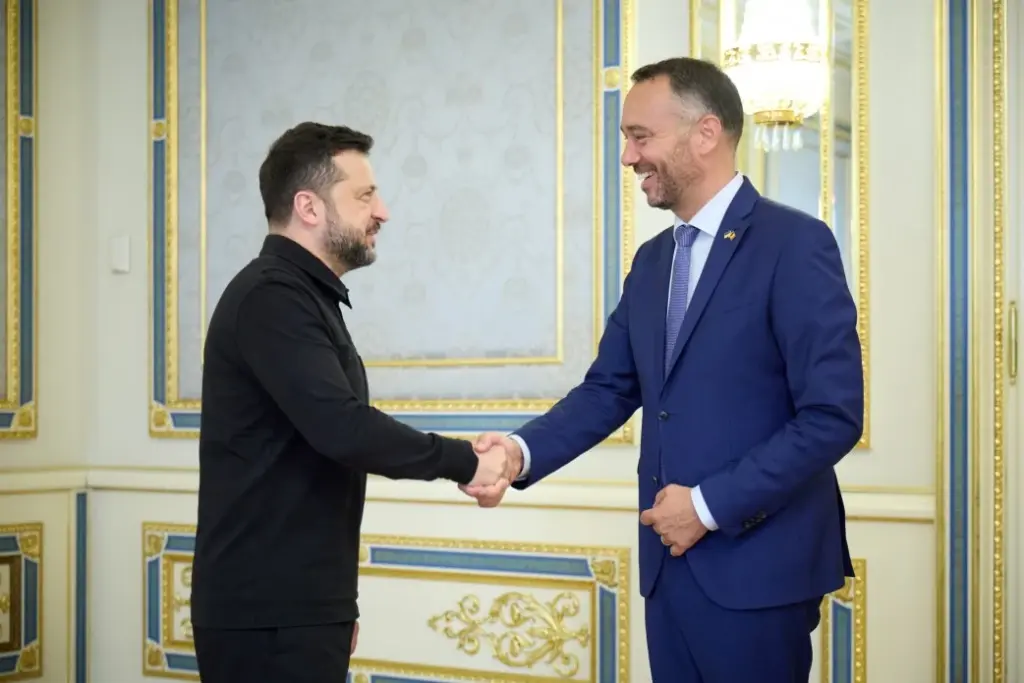
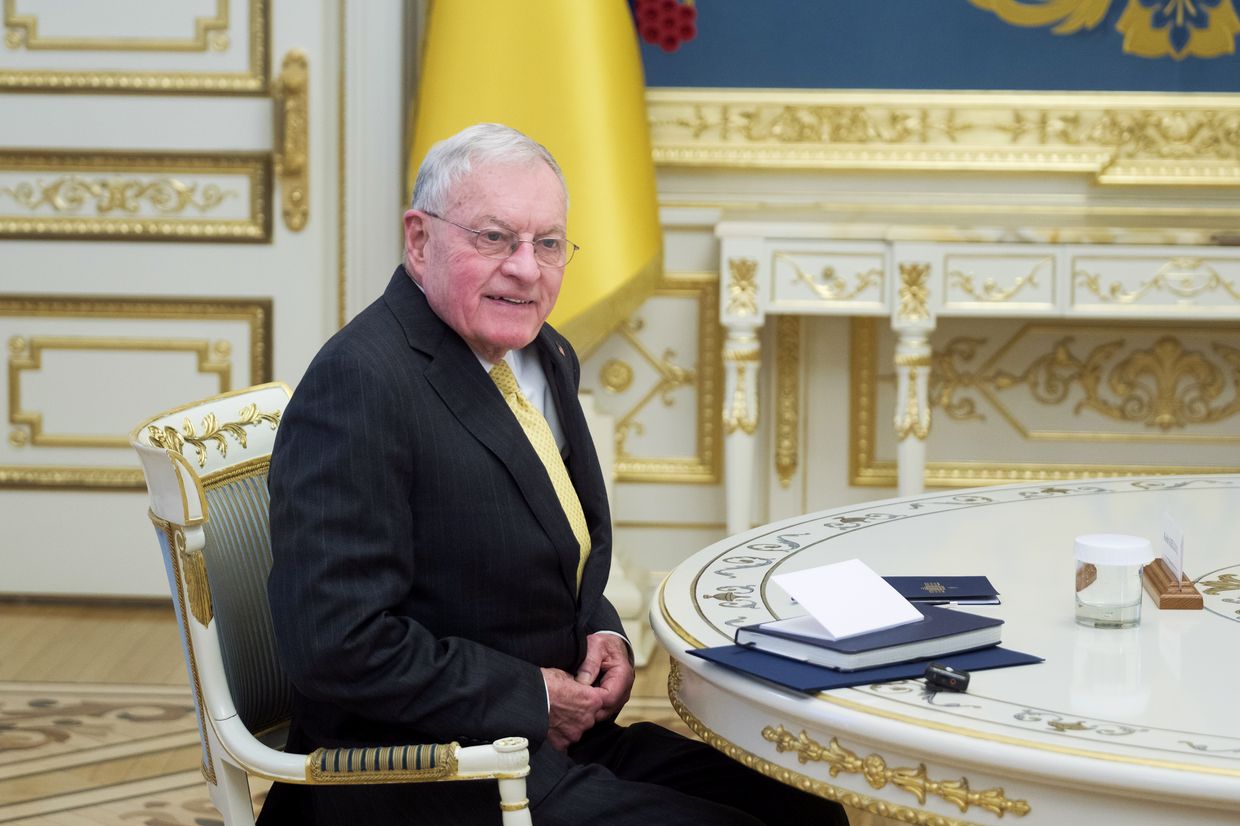
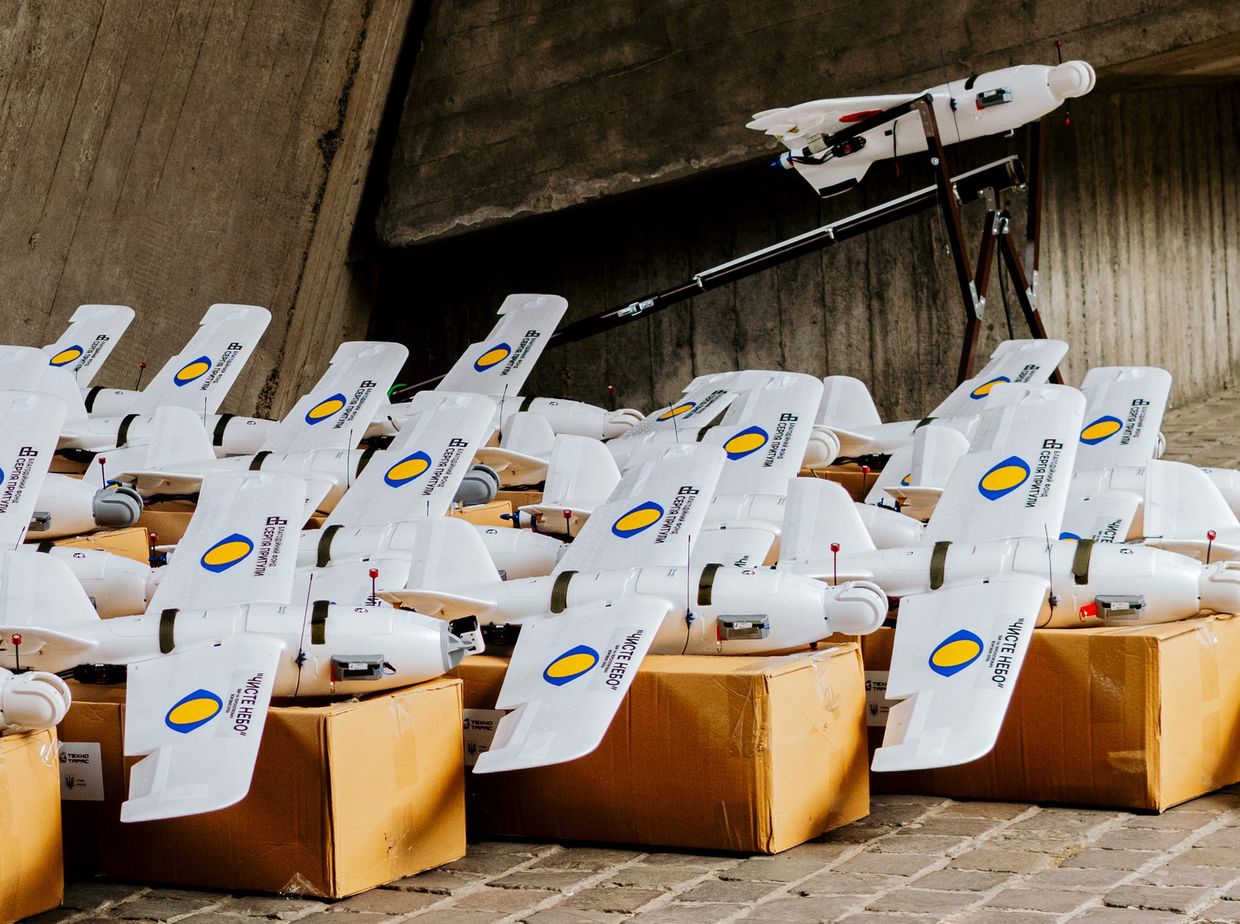
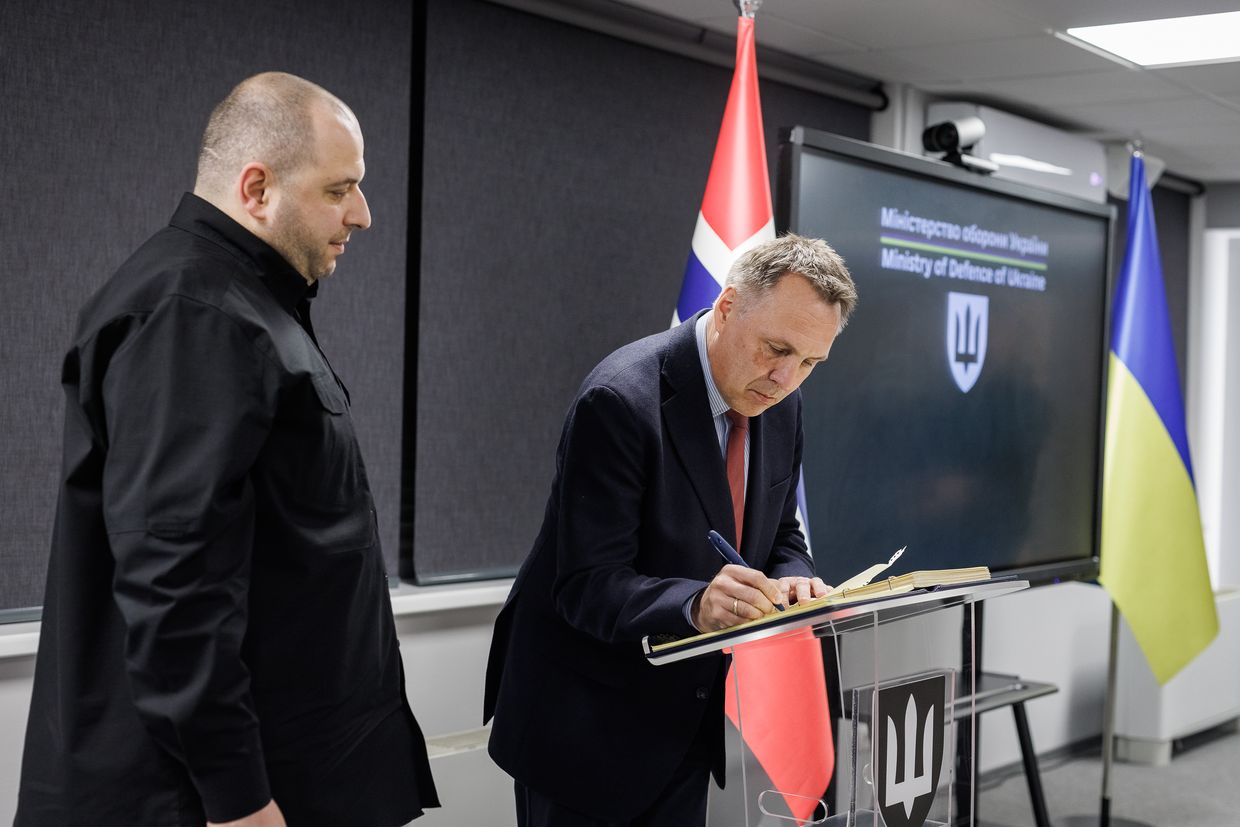
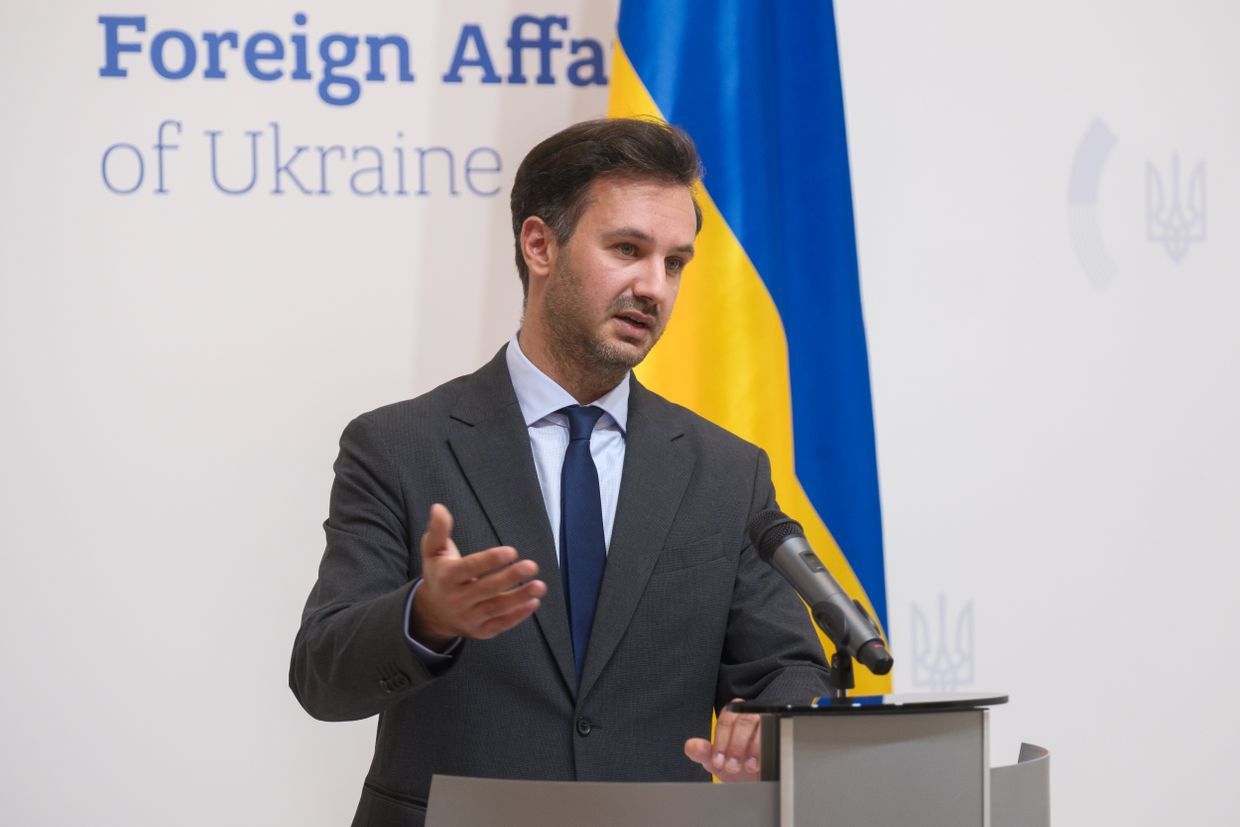
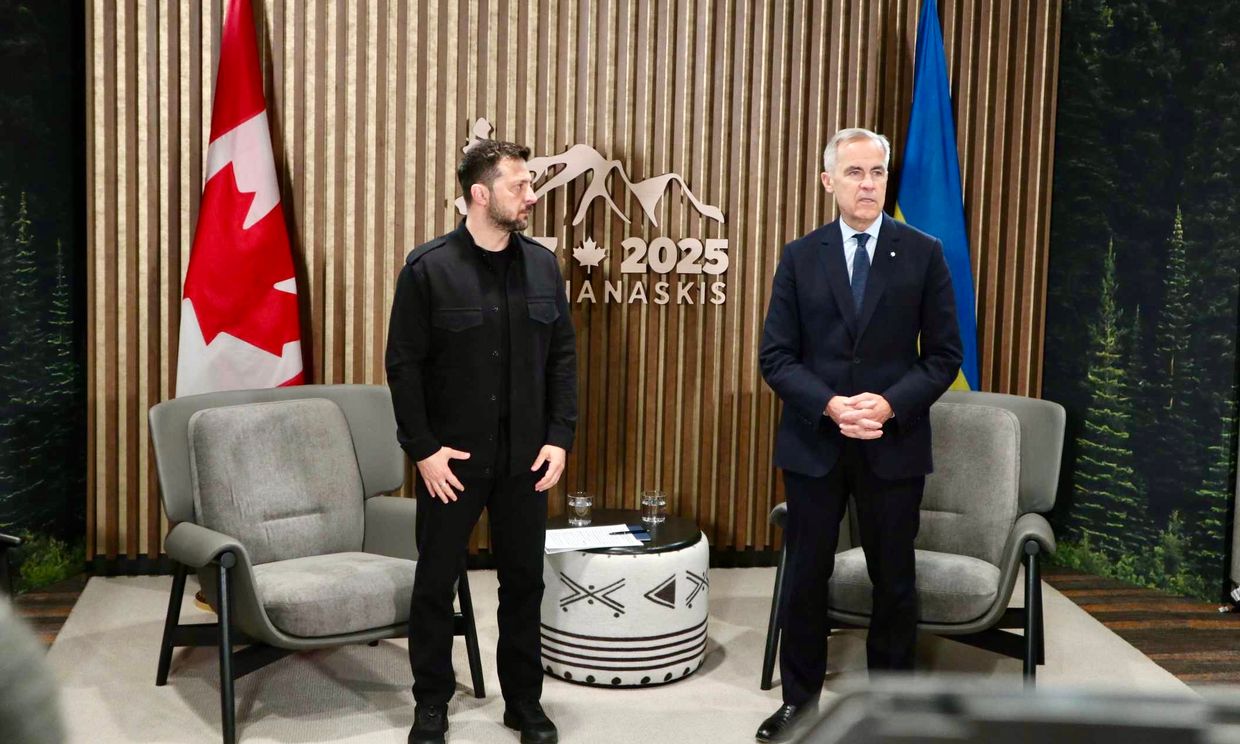
Ukraine and Belgium are drawing up a bilateral agreement to deepen cooperation on drones, President Volodymyr Zelenskyy said after meeting Belgian Foreign Minister Maxime Prévot in Kyiv on 18 August. The two also discussed strengthening Ukraine's air power and shielding it from Russian attacks.
Cheap drones now decide much of the fighting, and Kyiv has turned years of learning to fly and defeat them into leverage—trading that edge for weapons and money with a lengthenin
Ukraine and Belgium are drawing up a bilateral agreement to deepen cooperation on drones, President Volodymyr Zelenskyy said after meeting Belgian Foreign Minister Maxime Prévot in Kyiv on 18 August. The two also discussed strengthening Ukraine's air power and shielding it from Russian attacks.
Cheap drones now decide much of the fighting, and Kyiv has turned years of learning to fly and defeat them into leverage—trading that edge for weapons and money with a lengthening line of Western partners.
A new deal takes shape
Teams on both sides are now writing the text of the Drone Deal and weighing possible dates to sign it, ArmyInform reported. Ukraine is ready to share its own expertise in unmanned systems with partners, Zelenskyy said.
Defense ran through the meeting, with both sides focused on strengthening Ukraine's combat aviation and defending its skies.
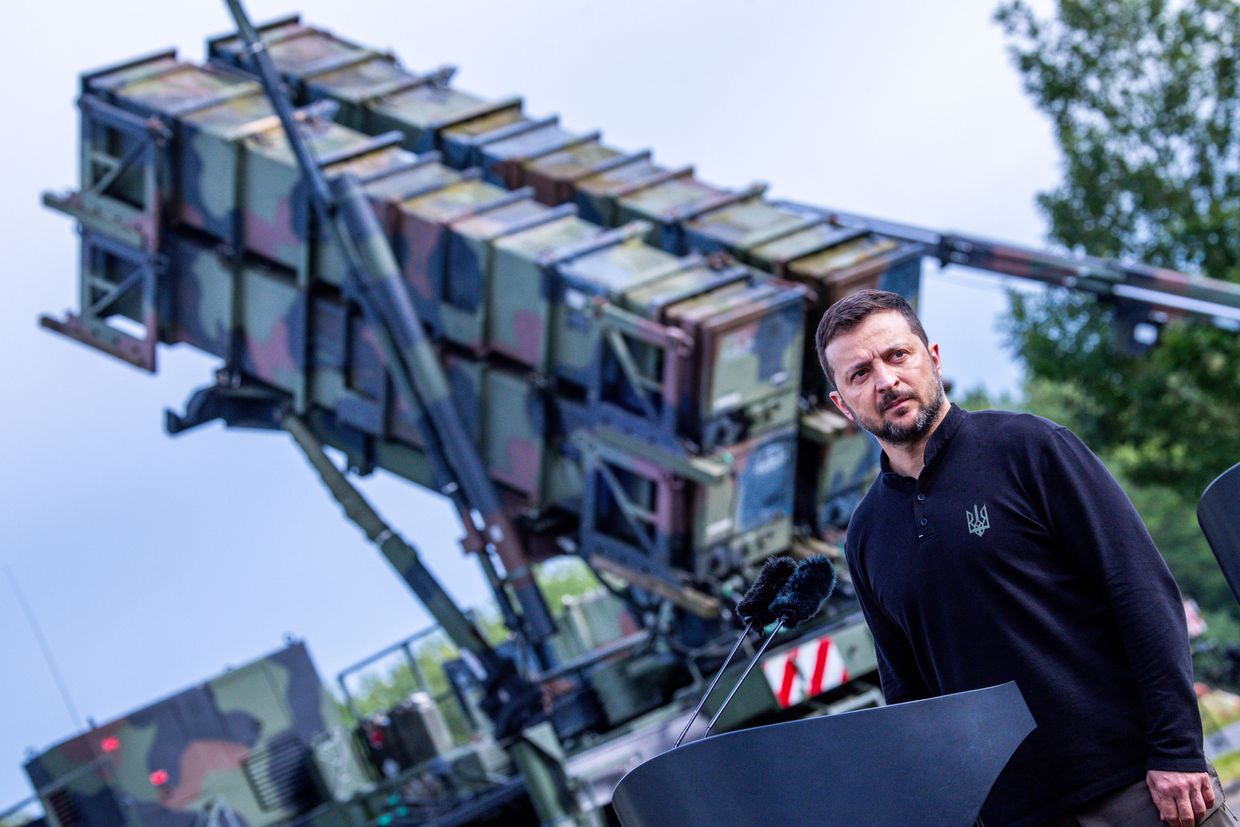
"I expect that we will be able to implement what we discussed, and there will be more protection from Russian strikes," Zelenskyy said.
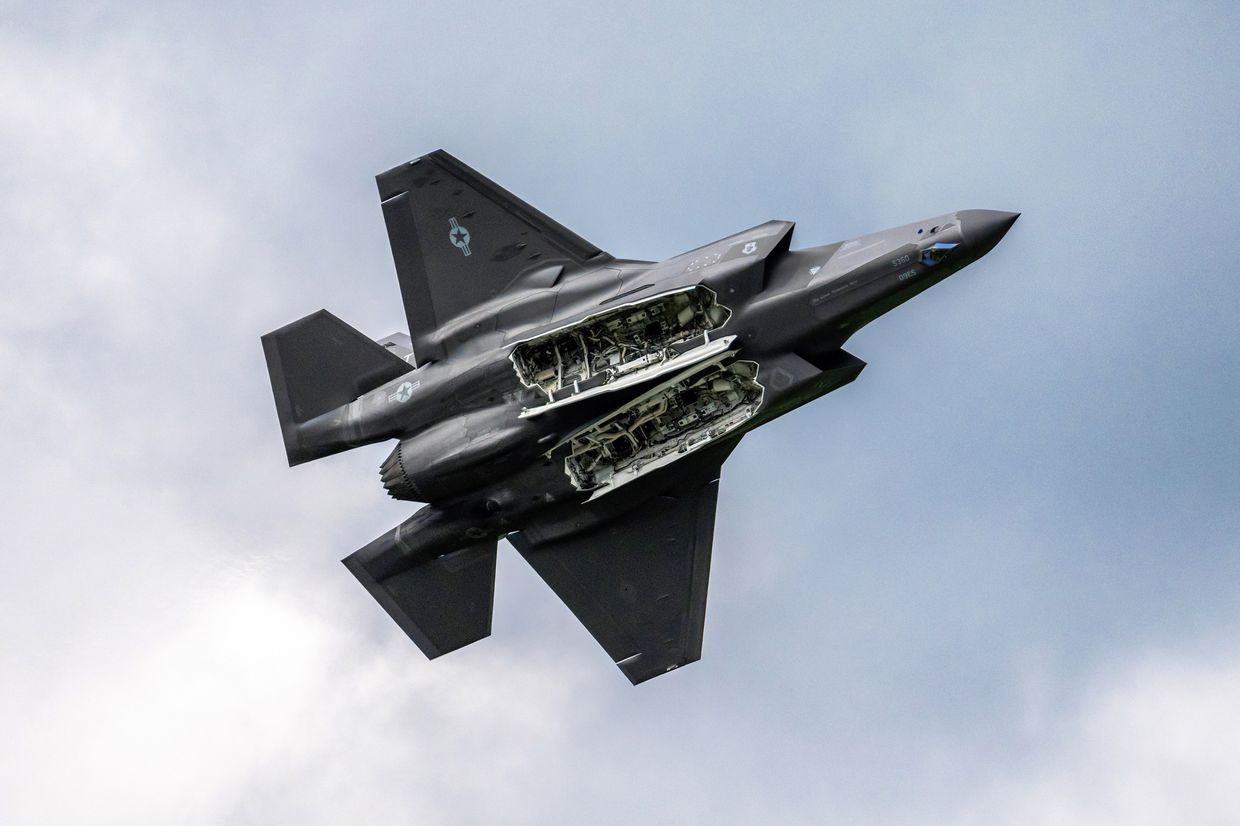
Belgium has promised 30 F-16 fighter jets—the largest F-16 pledge from any single country—though none have reached Ukraine yet, with deliveries tied to Belgium's own switch to newer aircraft.
Explore further
“First time”: Ukrainian troops joined Belgium’s National Day parade in Brussels
Belgium's deeper backing
Zelenskyy thanked Belgium for more than $1.28 billion in support this year, covering defense and civilian needs alike, and for backing Ukraine's move toward the European Union. The military share flows from a standing pledge: since 2025, Belgium has committed to at least $1.16 billion in defense aid a year.
A 2024 security pact locked in that relationship, making a small Western European country one of Ukraine's steadier partners. Belgian firms also service the F-16s Ukraine already flies, the jets delivered by other partners in the coalition.
The Trump administration’s ‘America first’ approach has contributed to the scale of the crisis now unfolding in one of the world’s poorest countriesFor months health experts have warned that the scale of the Ebola outbreak in the Democratic Republic of the Congo (DRC) could surpass the one that swept west Africa in 2014-16. This week, the authorities in the DRC announced that a grim milestone has already been passed: at least 2,325 people have died from the virus, making it the deadliest of the
The Trump administration’s ‘America first’ approach has contributed to the scale of the crisis now unfolding in one of the world’s poorest countries
For months health experts have warned that the scale of the Ebola outbreak in the Democratic Republic of the Congo (DRC) could surpass the one that swept west Africa in 2014-16. This week, the authorities in the DRC announced that a grim milestone has already been passed: at least 2,325 people have died from the virus, making it the deadliest of the country’s 17 outbreaks and the fastest-growing in history.
There is no effective vaccine against Bundibugyo – a rare strain of the virus that spread fatally undetected during the spring, often being misdiagnosed as malaria or typhoid. In contrast to neighbouring Uganda, which succeeded in eliminating an outbreak, multiple factors are combining to let the disease rip through the DRC. The worst-affected region is contested by armed groups, and a context of population displacement and chronic insecurity has made monitoring and surveillance more difficult. Ebola treatment centres have been attacked as a result of misinformation and community distrust.
In Chocó, a remote region, “pain, hunger and homelessness await” survivors of last week’s earthquake, the governor said. Shakira visited to help draw awareness.
In Chocó, a remote region, “pain, hunger and homelessness await” survivors of last week’s earthquake, the governor said. Shakira visited to help draw awareness.
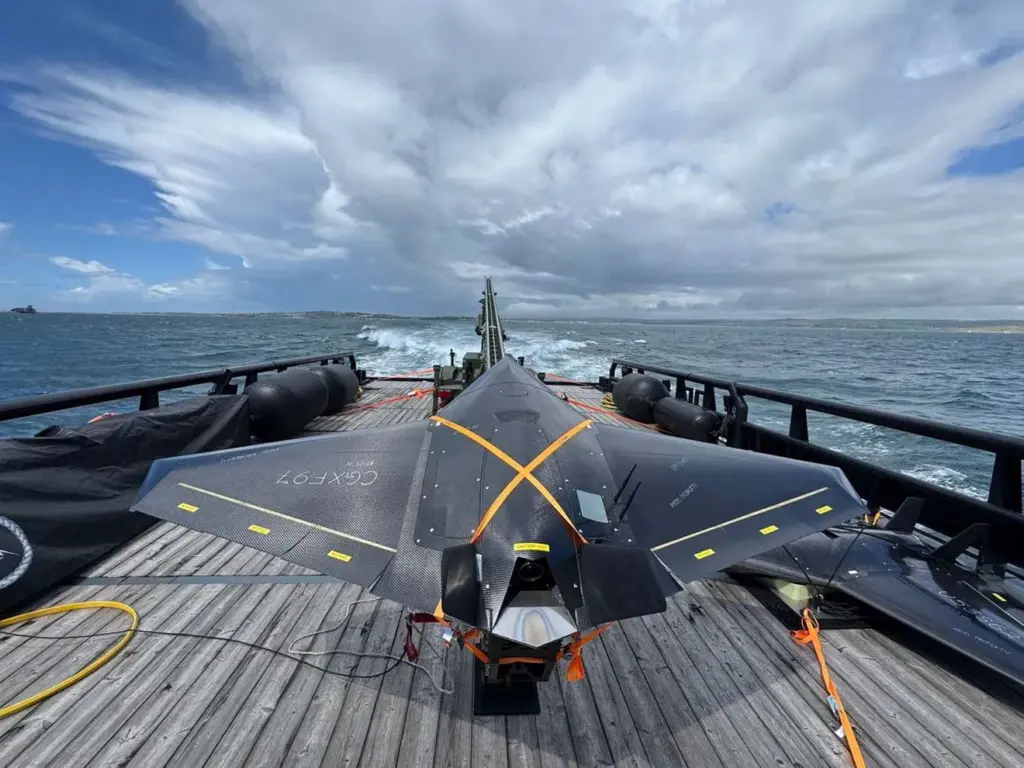
Ukrainian forces have used British drones to attack targets inside Russia for the first time, adding two UK-built systems to Kyiv’s arsenal, The Sunday Times reported on 15 August, citing Ukrainian military sources. The newspaper explicitly identified oil refineries in Volgograd and Yaroslavl among the targets struck during the previous six months.
Ukraine still relies mainly on domestically produced drones. But the British systems give Kyiv cheaper weapons that can be
Ukrainian forces have used British drones to attack targets inside Russia for the first time, adding two UK-built systems to Kyiv’s arsenal, The Sunday Timesreported on 15 August, citing Ukrainian military sources. The newspaper explicitly identified oil refineries in Volgograd and Yaroslavl among the targets struck during the previous six months.
Ukraine still relies mainly on domestically produced drones. But the British systems give Kyiv cheaper weapons that can be replenished and launched in volume. They help sustain Kyiv's attacks on Russian oil, logistics, and military targets without running down limited stocks of Western long-range missiles.
The Sunday Times called this a new phase in UK–Ukraine military cooperation. A senior British defense source said the deployments showed London was “not nervous anymore” about Russian pressure.
What British support adds to Ukraine’s homegrown drone force
Britain has supplied Ukraine with two systems with very different ranges. The Nyan, a jet-powered one-way attack drone made by BAE Systems subsidiary Callen-Lenz, can travel more than 150 miles. The second is catapult-launched and has a range above 600 miles; The Sunday Times withheld its manufacturer’s name on security grounds.
Long-range drones typically cost £50,000 to £100,000, compared with more than £750,000 to replace a Storm Shadow missile, the newspaper said. They can also be stockpiled and launched in swarms, helping Ukraine strain Russian air defenses without exhausting finite missile stocks.
The drones extend wider British support. In June, the UK announced funding for 150,000 Ukrainian-produced drones by the end of 2026. Ukrainian forces have also deployed British Rapid Ranger systems against Russian Shaheds and used UK-supplied Storm Shadows inside Russia, protecting Ukraine at home while widening its options across the border.
Ukraine’s deep-strike campaign reaches 52 Russian regions
Across Ukraine’s overall campaign, The Sunday Times reported almost 700 successful deep strikes between January and June. They reached 52 Russian regions and caused more than £35 billion (about $47.3 billion) in economic damage.
A senior Ukrainian military source said the British systems were proving successful. “When we launch them, we always say Slava Ukraini and God save the King,” the source told The Sunday Times.
Former UK Air Marshal Greg Bagwell predicted Moscow would “sabre rattle” and potentially declare British factories legitimate targets. Other defense sources warned of intensified cyberattacks or espionage against the UK.
In an interview, Afghanistan’s foreign minister called on the U.S. to reopen its embassy and invest in the country — a near-impossible sell for now, analysts and former diplomats say.
In an interview, Afghanistan’s foreign minister called on the U.S. to reopen its embassy and invest in the country — a near-impossible sell for now, analysts and former diplomats say.
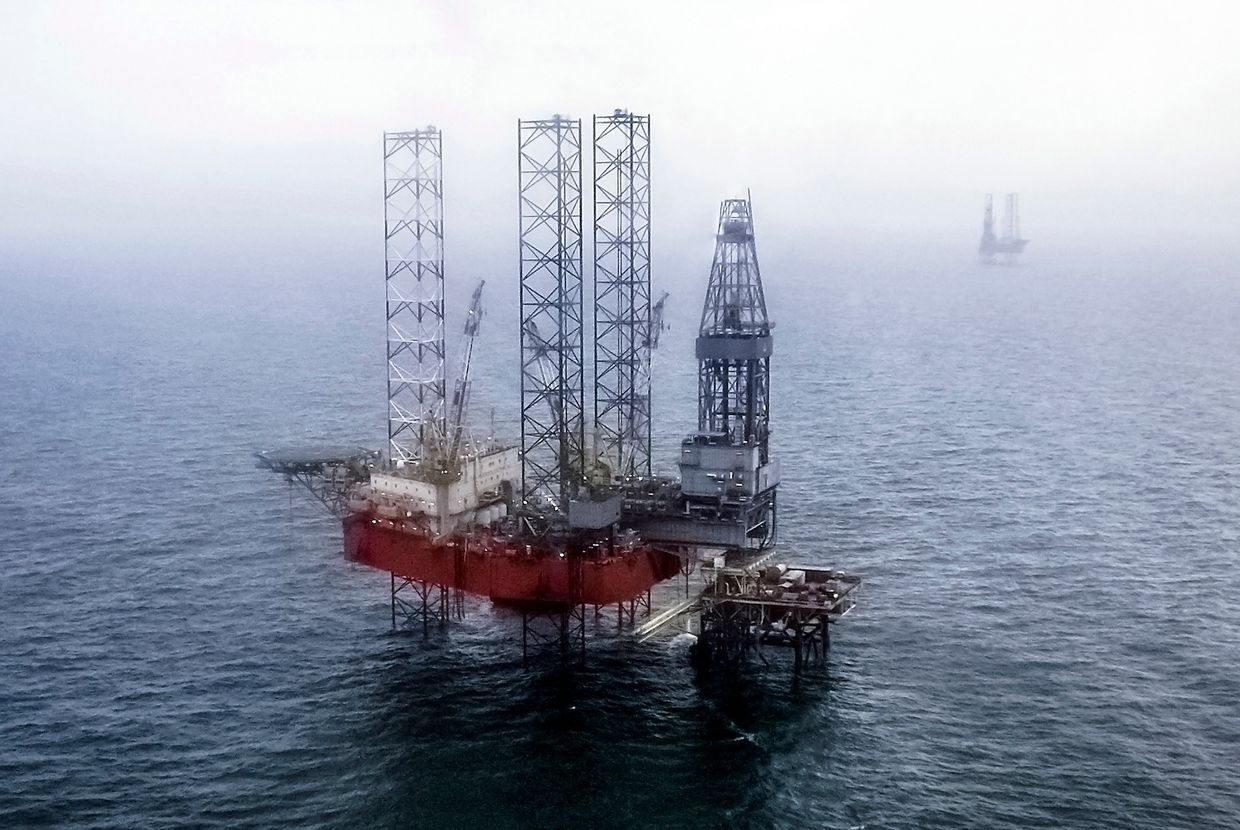
Finland will provide €28.5 million ($33.2 million) to support new power generation in Ukraine, with Finnish company Wärtsilä selected to supply the equipment, Finland’s Ministry of Foreign Affairs said on 13 August.
Ukraine’s power system has been repeatedly damaged by Russian attacks, leaving the country facing each winter with reduced generation capacity and a heightened risk of electricity and heating disruptions. Strengthening distributed generation is therefore a k
Finland will provide €28.5 million ($33.2 million) to support new power generation in Ukraine, with Finnish company Wärtsilä selected to supply the equipment, Finland’s Ministry of Foreign Affairs said on 13 August.
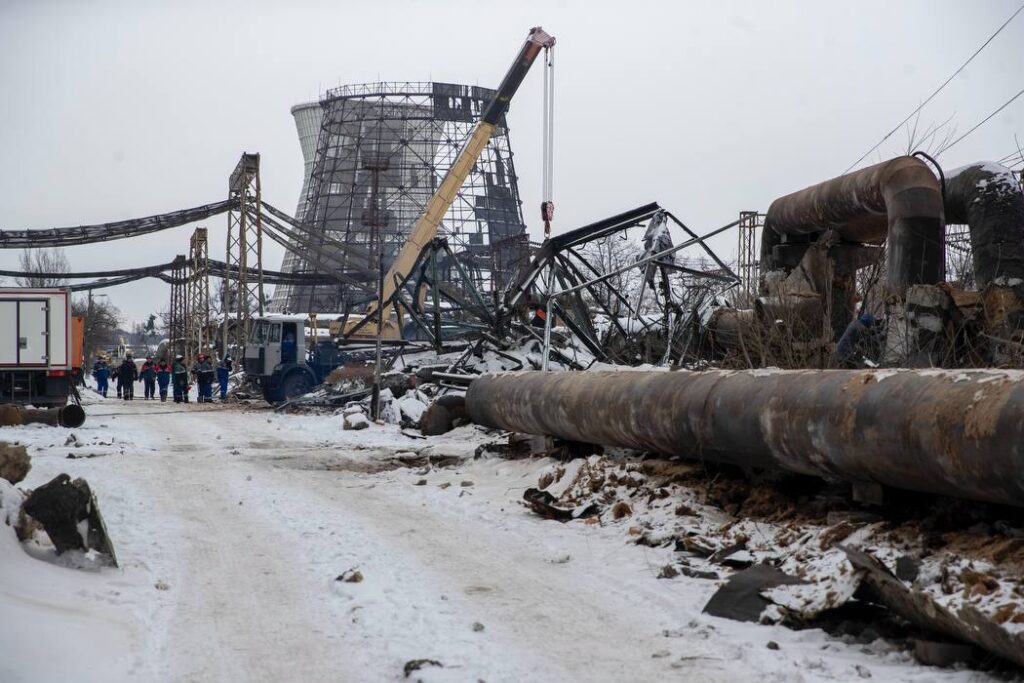
Ukraine’s power system has been repeatedly damaged by Russian attacks, leaving the country facing each winter with reduced generation capacity and a heightened risk of electricity and heating disruptions. Strengthening distributed generation is therefore a key part of keeping essential services running when further strikes hit the energy grid, as they are expected to do ahead of the 2026-27 winter season.
The total value of the power plant technology is €46.5 million, with Ukraine covering the remaining cost. The plants will be manufactured in Vaasa, Finland, with the Ministry saying it will support Finnish jobs and exports while adding generation capacity to Ukraine’s war-damaged energy system.
Power generation for Ukraine’s winter
Ukraine’s state energy company Ukrnafta is purchasing the power plants to strengthen electricity production, with the need particularly acute ahead of another winter under Russian attacks.
“Reliable energy production is vital, particularly in winter months, when Russian strikes on energy infrastructure have made day-to-day life in Ukraine difficult,” Finland’s Ministry of Foreign Affairs said.
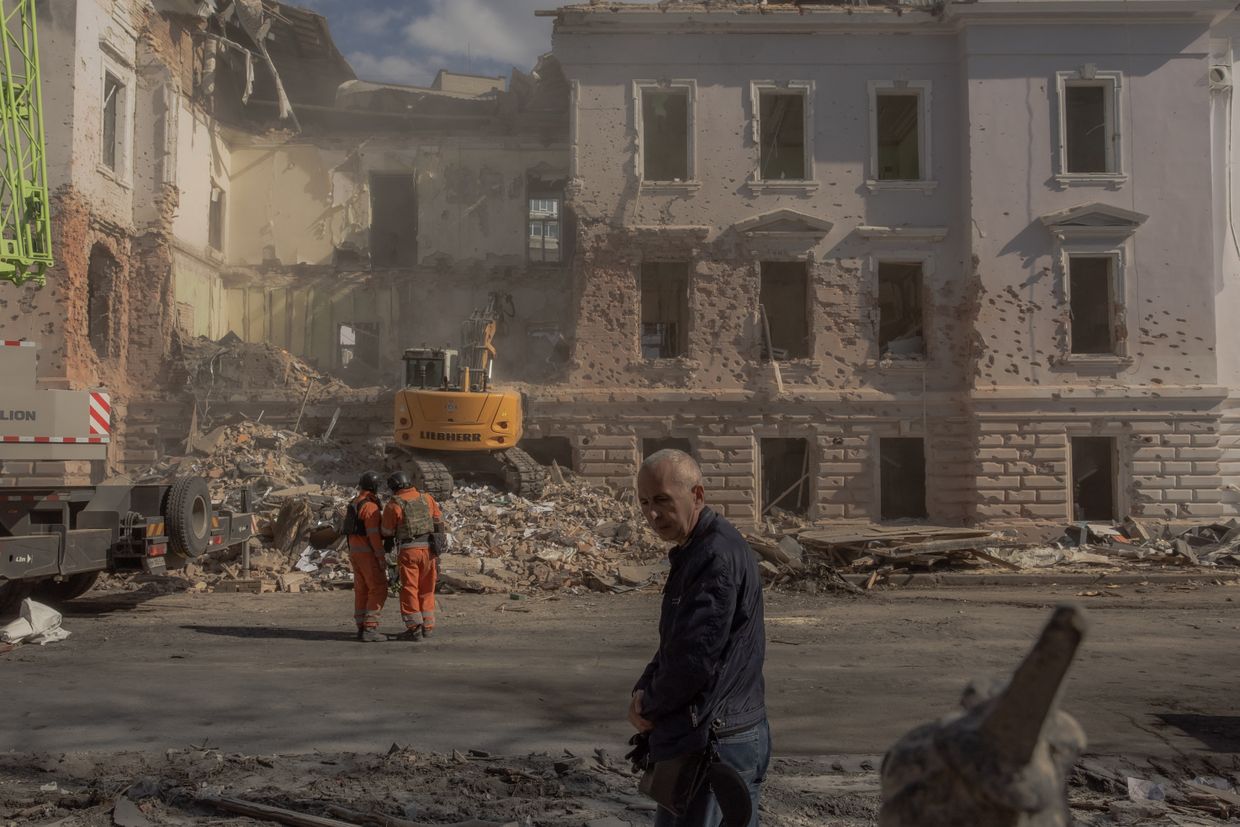
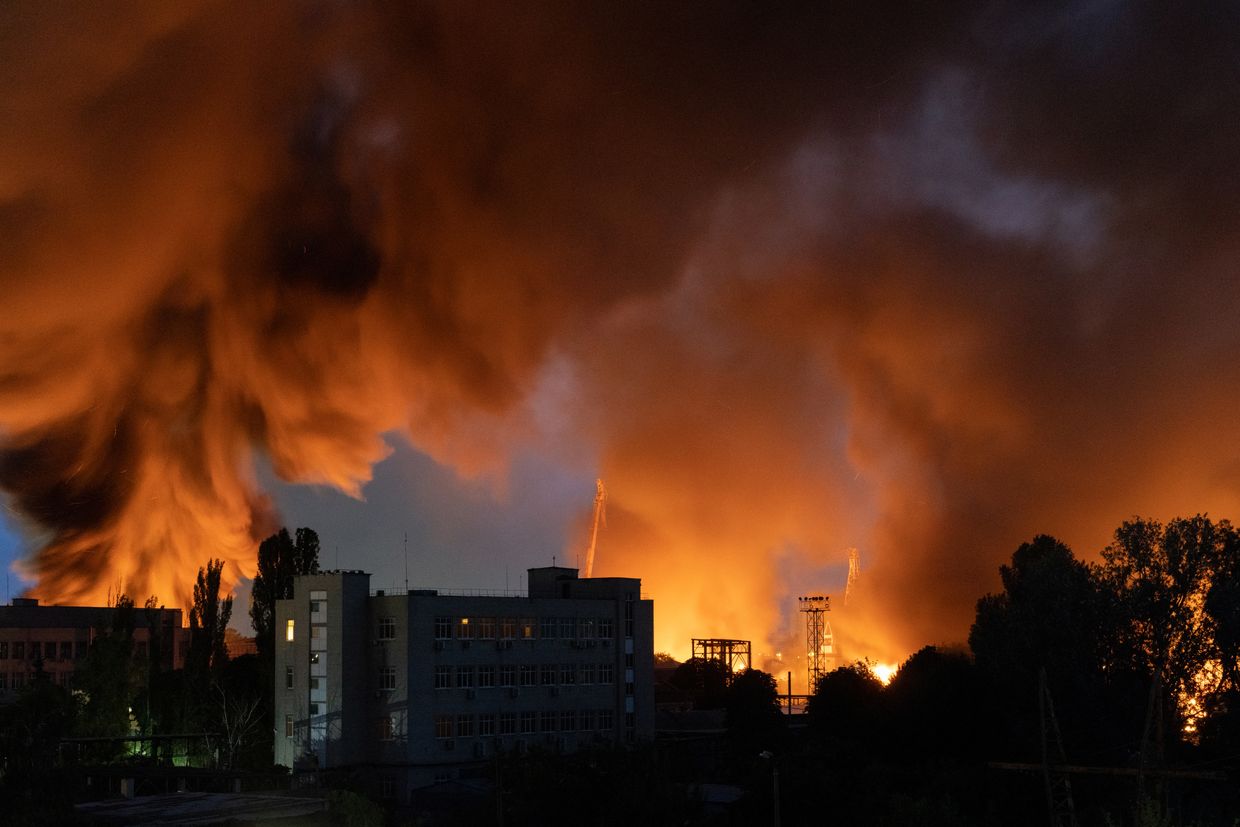
Russia has repeatedly targeted Ukraine’s electricity generation, transmission, gas, and heating infrastructure since the full-scale invasion. The attacks have caused widespread blackouts and damaged or destroyed large parts of Ukraine’s generation capacity.
Previous winters have shown the consequences. Russian strikes have repeatedly caused rolling blackouts, while damage to heating infrastructure has threatened access to heat and water during freezing weather.
Explore further
Behind the black windows: How Kyiv survives a winter in the dark
Ukrainian officials have warned that the coming winter could be more difficult than previous ones, as Russia is expected to again target Ukraine’s energy, heating, and water infrastructure. Russia has already intensified attacks on Ukrainian civilians and civilian infrastructure this summer, raising concerns that the campaign against essential services could escalate further during the winter months.
Finnish technology heads to Ukraine
Wärtsilä Finland Oy will manufacture the power plants in Vaasa.
Finnish Foreign Trade and Development Minister Ville Tavio said the project combines support for Ukraine with Finland’s energy-sector expertise.
“Finland has world class energy sector expertise that can benefit Ukraine’s reconstruction efforts,” Tavio said. “I am pleased that Finnish technology and Finnish workers are playing a part in strengthening the security of Ukraine’s energy supply.”
How Finland is financing the project
The €28.5 million Finnish contribution comes through the Finland–Ukraine Investment Facility, which supports public investments in Ukraine using Finnish technology, expertise, and services.
Finland’s funding will cover the interest costs and capital of the investment loan Ukraine will take out for the project. Finnish export credit agency Finnvera is providing a 100% export guarantee for the loan.
The project combines immediate energy support for Ukraine with Finnish financing, technology, and manufacturing capacity.
Human Rights Watch is asking the US Congress to block Türkiye from transferring tens of thousands of decades-old cluster munitions to Ukraine. The State Department had earlier told Congress it is prepared to authorize the deal, which Ukraine wants to strengthen its firepower against the Russian invasion.
The move would restrict Ukraine's weapons supply but not Russia's, because Kyiv depends on partners who can block a transfer while Moscow answers to no one and continu
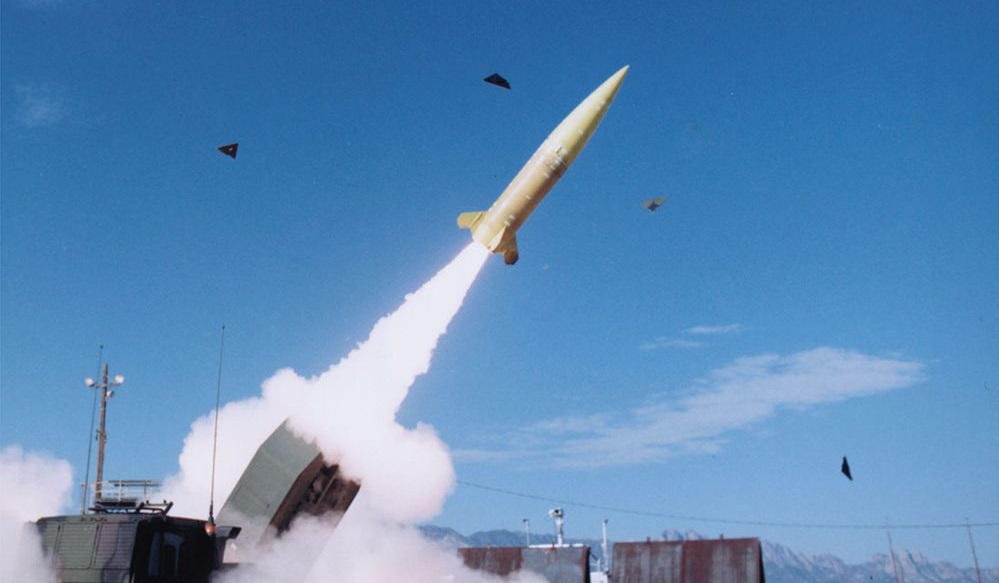
Human Rights Watch is asking the US Congress to block Türkiye from transferring tens of thousands of decades-old cluster munitions to Ukraine. The State Department had earlier told Congress it is prepared to authorize the deal, which Ukraine wants to strengthen its firepower against the Russian invasion.
The move would restrict Ukraine's weapons supply but not Russia's, because Kyiv depends on partners who can block a transfer while Moscow answers to no one and continues to strike Ukrainian residential neighborhoods every day.
What Türkiye wants to send
Türkiye has requested US permission to retransfer to Ukraine tens of thousands of cluster munition rockets, missiles, and artillery shells held in its stockpiles for decades. The package covers Türkiye's entire inventory of 12 M270 rocket launchers and three types of cluster munitions: 70 M39 ATACMS ballistic missiles, 2,524 M26 rockets, and 47,000 M509A1 203mm artillery shells, according to the State Department transmittal sheets.
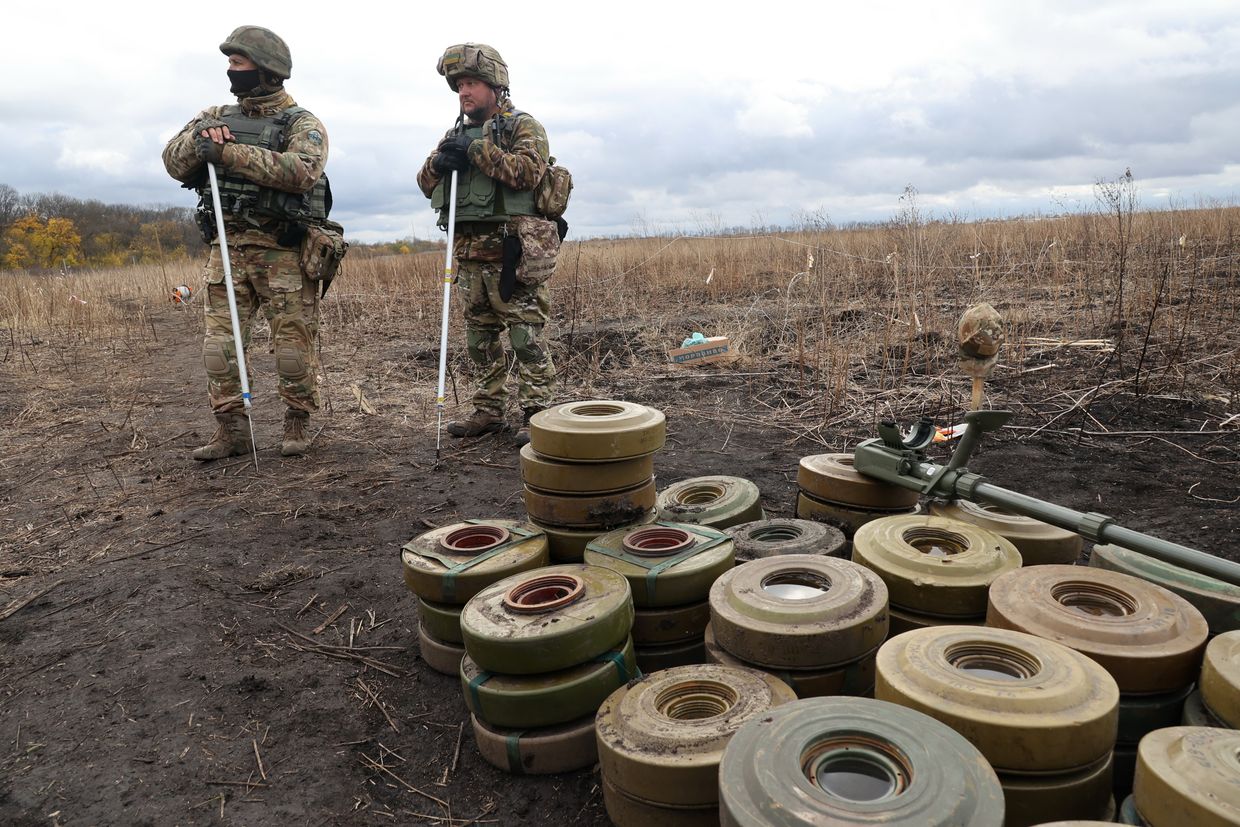
The deal is valued at $256 million. Together, the rounds hold more than 10 million explosive bomblets, Human Rights Watch said, produced in part by Türkiye under US licenses first issued in 1987. The US removed the M509A1 shells from service in 1994, when the howitzers that fired them retired, according to HRW.
Cluster munitions scatter small bomblets across a wide area, and some fail to explode on impact, leaving hazards that can maim civilians long after fighting ends.
Ukraine, for its part, gave Washington written assurances not to fire earlier US-supplied cluster rounds in civilian-populated urban areas, and US officials said Kyiv had kept to its use constraints.
Explore further
HRW’s allegations that Ukraine used banned mines are outrageous and play into Russia’s hands – human rights activists
What Washington says
A senior State Department official notified Congress that it is prepared to authorize the transfer, in documents printed in the Congressional Record on 6 August. Türkiye wants to shed older stock and focus its money on modern systems, the official said. Ukraine wants the munitions to bolster its fire support as it resists the invasion, the official added, noting that Ukraine already fields the same or nearly identical rounds. Congress can review the deal and pass a resolution of disapproval to block it.
Human Rights Watch argues the age and unreliability of the weapons make them a foreseeable hazard to civilians. Human Rights Watch deputy Washington director Nicole Widdersheim said the more-than-30-year-old munitions are inaccurate and prone to failure, and that their impact on civilians drove 112 countries to ban the weapon under the Convention on Cluster Munitions.
Explore further
Human Rights Watch published map of Ukraine without Crimea – UNIAN
The same group has documented Russia's cluster attacks since 2022
Human Rights Watch opposes the weapon for all sides and has tracked Russia's use of it throughout the war. It documented repeated Russian cluster strikes since 2022, called a Russian attack on Lyman a possible war crime, and logged further strikes on civilians in its World Report chapters on Ukraine.
In each case, the group called on Russia to stop firing the weapon. On the Türkiye deal, it is asking Congress for something more concrete — to kill the transfer before the munitions reach Ukraine.
It’s a great betrayal: poor communities neglected while multimillionaires peddle a global Maga agenda. How is that America first?“THE CORRUPTION IS AT LEVELS RARELY SEEN BEFORE,” Donald Trump posted on Truth Social in February 2025. He was not referring to his own administration, but to the US Agency for International Development (USAID). “CLOSE IT DOWN!” the president added.Just a few hours later USAID was in effect closed down, with most of the staff placed on indefinite administration leave.
It’s a great betrayal: poor communities neglected while multimillionaires peddle a global Maga agenda. How is that America first?
“THE CORRUPTION IS AT LEVELS RARELY SEEN BEFORE,” Donald Trump posted on Truth Social in February 2025. He was not referring to his own administration, but to the US Agency for International Development (USAID). “CLOSE IT DOWN!” the president added.
Just a few hours later USAID was in effect closed down, with most of the staff placed on indefinite administration leave. This was framed as part of Trump’s “America first” agenda. USAID, the Trump administration and his sycophants in the rightwing media had argued, was wasting taxpayers’ hard-earned money on ridiculous projects abroad instead of improving life at home. In the lead-up to the shuttering of USAID, for example, one of the most shameless lies about the agency, repeated without any evidence by the likes of Fox News, was that it was spending millions on condoms for Gaza.
President Hakainde Hichilema was elected five years ago, promising to protect civil liberties in his copper-rich African nation. Now, he’s accused of trampling on them.
President Hakainde Hichilema was elected five years ago, promising to protect civil liberties in his copper-rich African nation. Now, he’s accused of trampling on them.
“We heard them screaming,” said one rescuer in Cali, where emergency workers and volunteers are racing against time to find the living trapped in the rubble.
“We heard them screaming,” said one rescuer in Cali, where emergency workers and volunteers are racing against time to find the living trapped in the rubble.
Firefighters rescuing Diana Marcela Troncoso from a collapsed building in Cali, Colombia, on Tuesday, more than 24 hours after a powerful earthquake struck the western part of the country.
South Korea is keeping lethal aid to Ukraine off the table while continuing humanitarian and reconstruction support, Yonhap reported on 10 August. The outlet cited a senior South Korean Foreign Ministry official.
South Korea’s response maintains its established policy of providing humanitarian and nonlethal support to Ukraine, but not direct weapons. Seoul previously helped move artillery shells to Ukraine through the United States. While South Korea arms NATO members
South Korea is keeping lethal aid to Ukraine off the table while continuing humanitarian and reconstruction support, Yonhap reported on 10 August. The outlet cited a senior South Korean Foreign Ministry official.
South Korea’s response maintains its established policy of providing humanitarian and nonlethal support to Ukraine, but not direct weapons. Seoul previously helped move artillery shells to Ukraine through the United States. While South Korea arms NATO members with K2 tanks and K9 howitzers to free up older kit for the Ukrainian front, it still draws the line at any direct transfer to Kyiv. Seoul rejects Ukraine’s purchase requests as North Korea sends Russia ammunition and troops in exchange for money and military technology.
South Korean law bars direct exports of lethal weapons to countries in active conflict, a rule rooted in constitutional principles and Seoul's wariness of antagonizing Moscow and Beijing while managing the threat from the North.
Ukraine is seeking South Korean interceptor missiles for its air defenses. The official neither addressed the request specifically nor formally rejected it:
“South Korea’s supply of defense materials to any country has always been carried out in accordance with domestic law,” the official said. Seoul will continue to support Ukraine’s recovery through assistance in energy, infrastructure, healthcare, and education.
The official also declined to confirm whether Seoul and Kyiv were discussing military support. However, he said Moscow-Pyongyang military cooperation “is directly related to our security and violates the United Nations resolutions” and should stop immediately.
Seoul’s indirect aid stopped short of direct arms transfers
In 2023, Seoul transferred hundreds of thousands of 155 mm shells to the United States under a confidential arrangement. Washington then arranged for them to reach Ukraine, The Wall Street Journal reported.
South Korean exports have also helped NATO members replace weapons sent to Kyiv. Poland bought South Korean K2 tanks and K9 howitzers while transferring older tanks and Polish-built Krab artillery systems to Ukraine.
Yet Seoul rejected Ukraine’s request to buy air-defense systems, radars, and artillery propellant in November 2024. In February 2026, it still limited support to humanitarian and nonlethal aid while considering NATO’s request to help purchase US weapons for Ukraine.
North Korean deployments bring the war closer to Seoul
Ukrainian President Volodymyr Zelenskyy said a decision had been made to deploy 30,000–50,000 more North Koreans to Russia. He warned that they would gain modern combat experience and Russian technology that could later threaten Asian countries. Kyiv wants South Korean air defenses and has offered cooperation on drones.
The South Korean official cited by Yonhap declined to confirm either the reported deployment or Zelenskyy’s statement that Ukrainian and South Korean diplomats were discussing possible cooperation.
North Korea is already believed to have sent approximately 20,000 combat troops and military engineers to Russia’s Kursk region, according to Yonhap. Pyongyang has earned as much as $22 billion from arming Russia, helping it finance conventional and nuclear forces.
The Japanese outlet Kyodo News reported in November 2025 that North Korea had transferred about 6.5 million rocket and artillery munitions in exchange for Russian air-defense, space, and nuclear technologies. Moscow and Pyongyang’s 2024 mutual defense pact formalized the expanding military relationship.
Ukrainian President Volodymyr Zelenskyy made his first official visit to Serbia, meeting Serbian President Aleksandar Vučić in Belgrade on 8 August 2026, according to Ukraine's Presidential Office. The two agreed to deepen trade and energy cooperation, and Serbia pledged fresh humanitarian aid and help rebuilding a war-hit Ukrainian city.
The visit drew attention because Serbia remains one of the few European states still close to Moscow. At the same time, Serbia is its
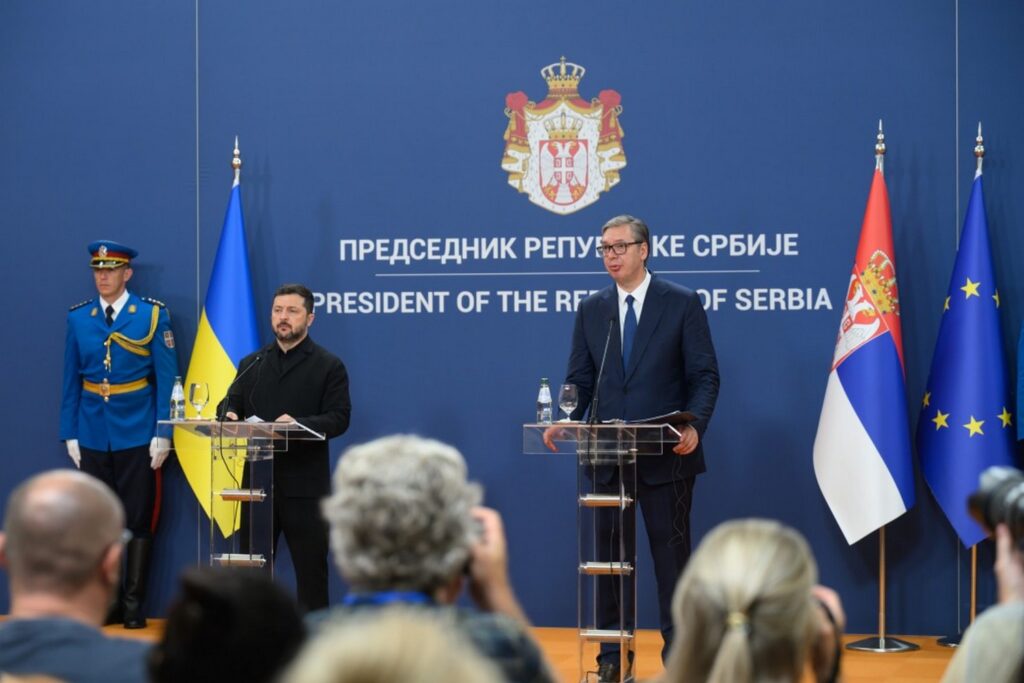
Ukrainian President Volodymyr Zelenskyy made his first official visit to Serbia, meeting Serbian President Aleksandar Vučić in Belgrade on 8 August 2026, according to Ukraine's Presidential Office. The two agreed to deepen trade and energy cooperation, and Serbia pledged fresh humanitarian aid and help rebuilding a war-hit Ukrainian city.
The visit drew attention because Serbia remains one of the few European states still close to Moscow. At the same time, Serbia is itself seeking EU membership and backs Ukraine with financial and humanitarian aid, though it provides no direct military support.
Much of the Western Balkans has spent years in the EU's waiting room, a gap Moscow has long worked to hold open through energy leverage and cultural ties. The visit comes amid Russia's ongoing full-scale invasion of Ukraine, while Moscow keeps trying to undermine support for Ukraine in Europe.
A first visit, and a message to two capitals
Zelenskyy arrived in Belgrade on Friday, 7 August, and the next day received an honor guard welcome, then met Vučić at the Presidential Palace. It was his first official trip to Serbia since he became president in 2019. Ukraine's First Lady had made her own first trip to Belgrade in May 2024.
Serbia is a candidate for accession to the EU, and so is Ukraine. Belgrade also keeps close ties with Moscow and still refuses to sanction it, relying on Russia for most of its energy. Thus the reception sent a signal to both Brussels and Moscow.
Vučić said Serbia upholds the UN Charter and the territorial integrity of every UN member, including Ukraine. At the joint news conference, Zelenskyy tied that to Crimea belonging to Ukraine, and he said Ukraine's stance against recognizing Kosovo's unilateral independence stays unchanged. Russia has occupied the Crimean peninsula since 2014.
Explore further
Serbia’s Vučić says Russian-owned Serbian refinery to fire up again mid-month
Aid for the winter and a city to rebuild
Zelenskyy thanked Serbia for a new humanitarian package in the medical and energy sectors, his office said. Belgrade offered to help rebuild one war-damaged Ukrainian city, which neither side named. The two leaders discussed the coming winter, when Ukraine's power system faces heavy Russian strikes. Serbia has sent Ukraine generators and financial support before.
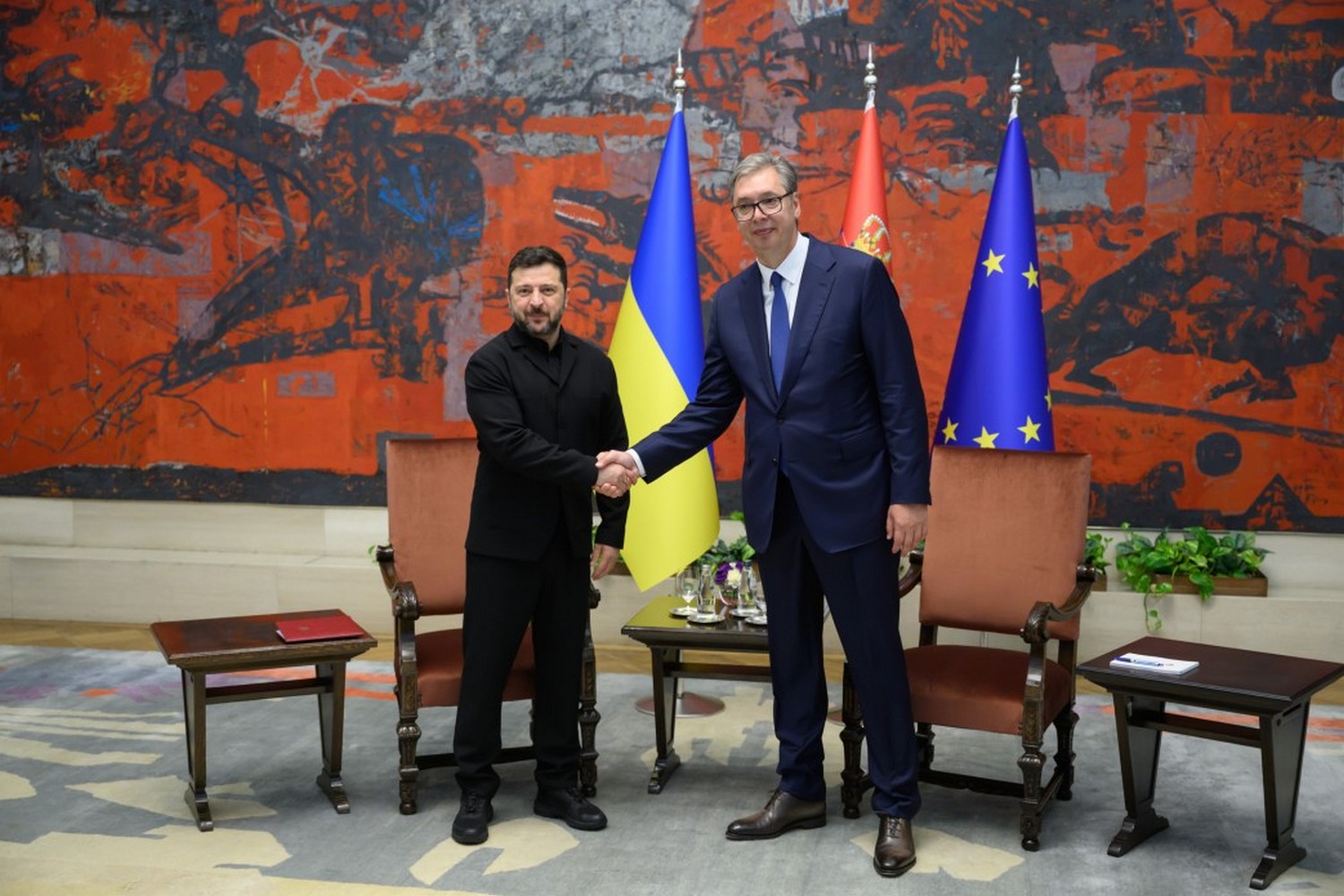
Ukrainian President Volodymyr Zelenskyy (left) and Serbian President Aleksandar Vučić shake hands in Belgrade, 8 August 2026. Photo: president.gov.ua
The leaders discussed infrastructure, ports, railways, and food security, and Serbia showed interest in Ukraine's railway experience. They want to finalize a free-trade agreement between the two countries by the end of 2026. Trade reached about $346 million in the first half of 2026, after $442 million for all of last year, according to Zelenskyy's office. In the presidents' presence, Ukraine's food-safety service and Serbia's agriculture ministry signed a cooperation memorandum on animal health and food safety.
Explore further
Serbian President: Serbia accidentally supported European resolution on Ukraine at the UN
An EU path, and Vučić's doubts
Zelenskyy noted that Ukraine would welcome a faster EU path for Serbia. Vučić said Serbia backs Ukraine's European course and will not block it, but he doubted Serbia could join soon, "for many political reasons."
He said not everyone in the EU views membership for Ukraine or the Western Balkans positively.
"For us they'll find Croats, Bulgarians, Dutch, and for Ukraine they'll find someone else," he said, suggesting that for any candidate, some existing EU member can always be found to object to its accession.
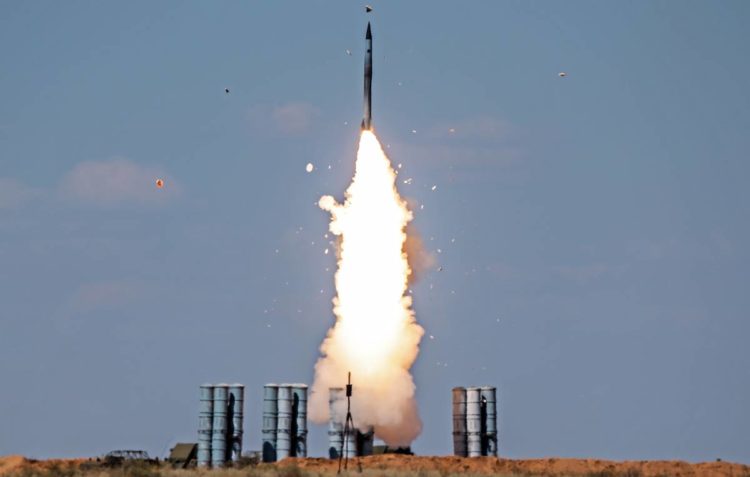
The United States and Ukraine are working together to put fresh missiles into Ukraine's aging Soviet-era S-300 air defenses, retired US Army colonel Robert Hamilton told PBS NewsHour. These long-range systems shoot down aircraft, but the missiles that feed them have been depleted. The effort—retrofitting old rounds or building a newer variant—would revive launchers Ukraine already owns.
Ukraine's air defense runs on a shrinking supply of interceptors, with Russian b
The United States and Ukraine are working together to put fresh missiles into Ukraine's aging Soviet-era S-300 air defenses, retired US Army colonel Robert Hamilton told PBS NewsHour. These long-range systems shoot down aircraft, but the missiles that feed them have been depleted. The effort—retrofitting old rounds or building a newer variant—would revive launchers Ukraine already owns.
Ukraine's air defense runs on a shrinking supply of interceptors, with Russian ballistic and drone strikes outpacing what allies can ship. The chokepoint is production capacity, not willingness—and Hamilton frames the S-300 rebuild as one of the slower-burn fixes that ease the strain on scarce Western systems rather than replace them.
A working system near the end of 2026
Hamilton, who heads the Delphi Global Research Center, said the joint effort should come online near the end of 2026 and could turn out "100 or a couple of hundred" anti-aircraft missiles a year. He described the work as an effort to "essentially retrofit or upgrade the old S-300 missiles or a newer variant of the S-300" and give the system better capabilities.
Explore further
Ukraine drones hit Crimea’s S-300/S-400 near Kerch—and knocked out power across four occupied territories overnight
In September 2024, then-US Defense Secretary Lloyd Austin announced at the Ramstein contact group that Washington, in partnership with several European companies, was working with Ukraine to "design and build a substitute" for the Soviet S-300 and the R-27 air-to-air missile used by fighter jets. He never spelled out what that substitute would be.
Why Ukraine's S-300s ran law
When Russia launched its full-scale invasion in 2022, Ukraine held roughly 25-30 S-300PT/PS battalions in varying states of readiness. As the missiles ran out, Kyiv came to lean on Western air defense systems and interceptors while Russia keeps launching mass strikes.
Explore further
“Very good results” – Wave of Ukrainian strikes across Russia and Caspian Sea overnight target warships, air defenses, logistics
Anything Ukraine can build or rebuild on its own soil is a supply that no foreign stockpile or political fight can cut off.
That same logic is pushing Kyiv toward co-producing Patriots with US firms and fielding its own ballistic interceptor—a race to turn air defense into a domestic industry before the next winter of strikes.
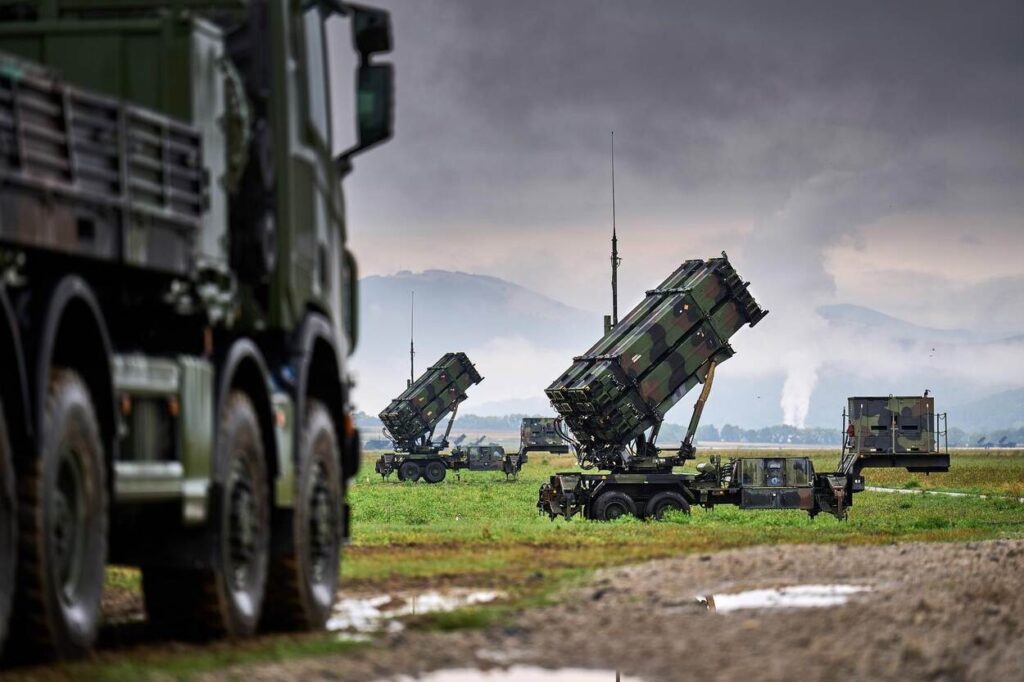
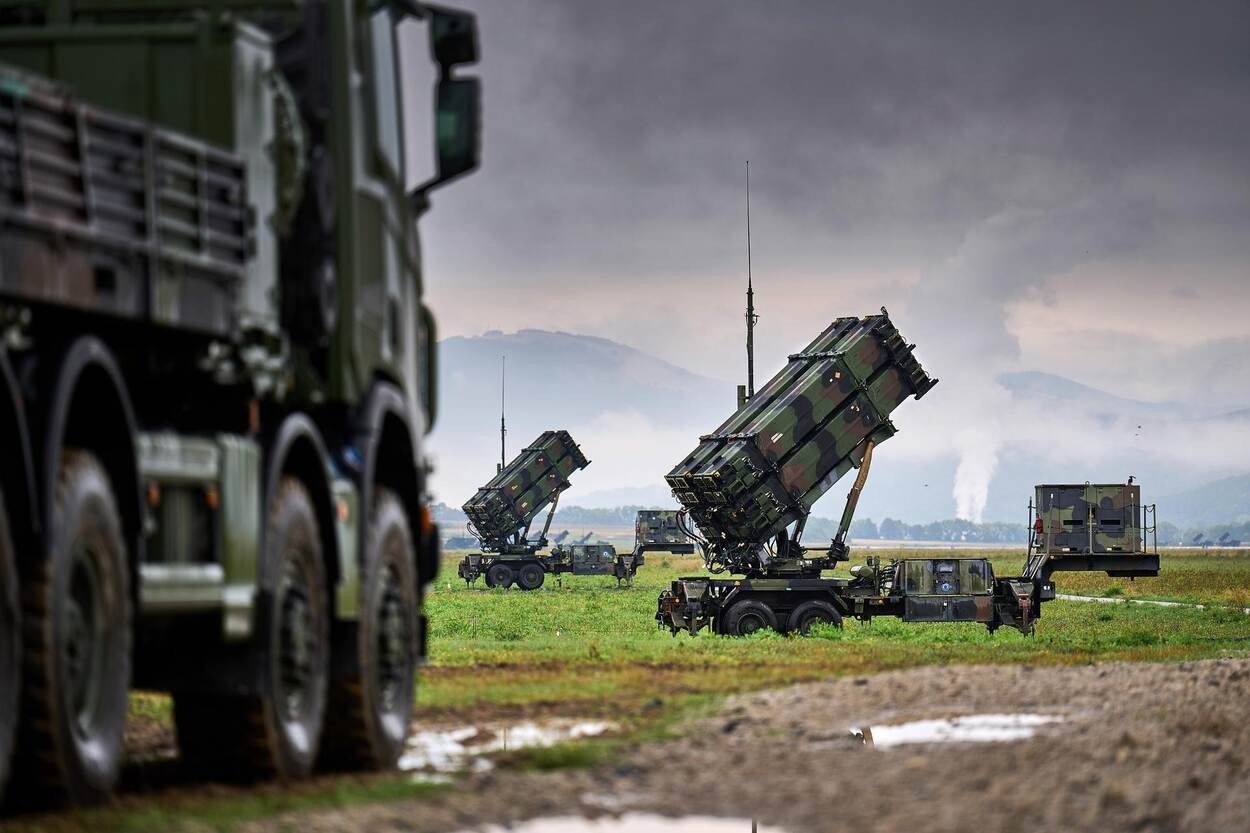
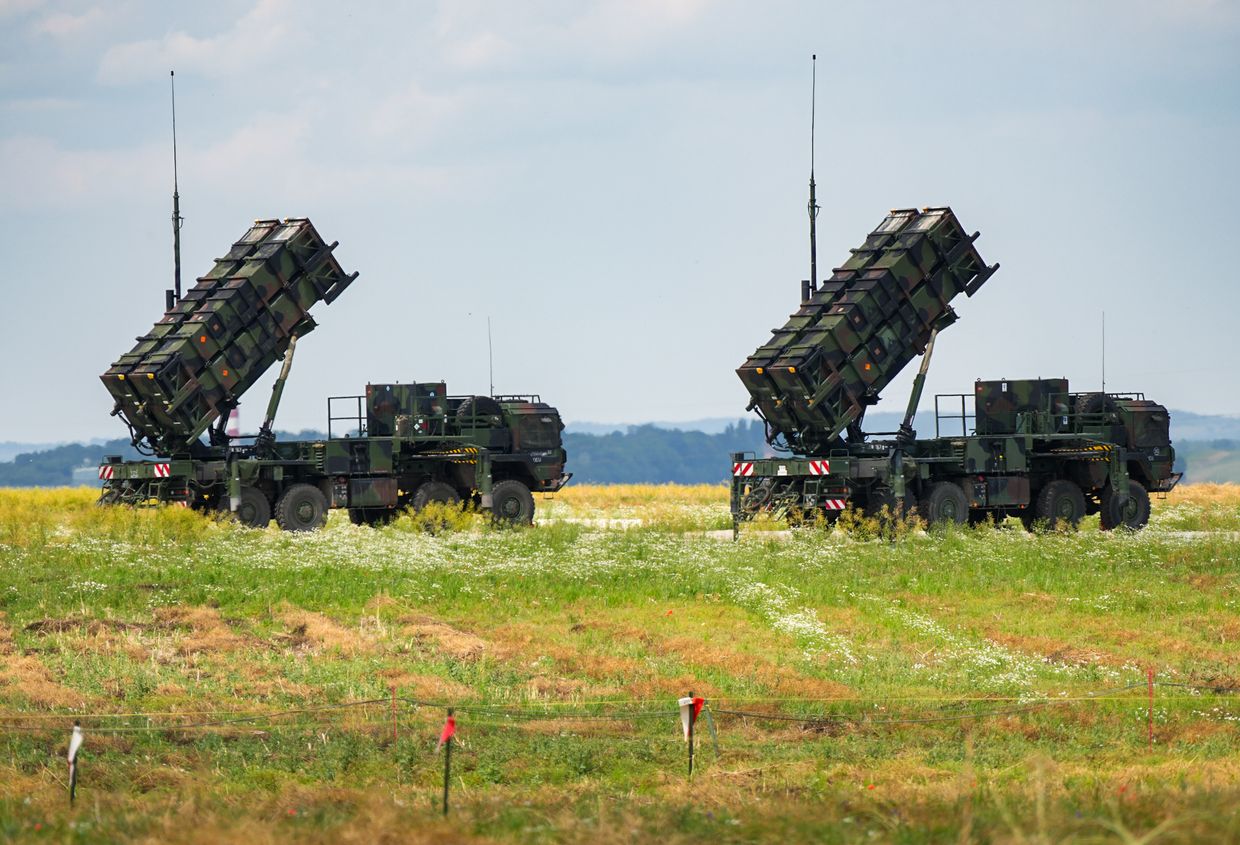
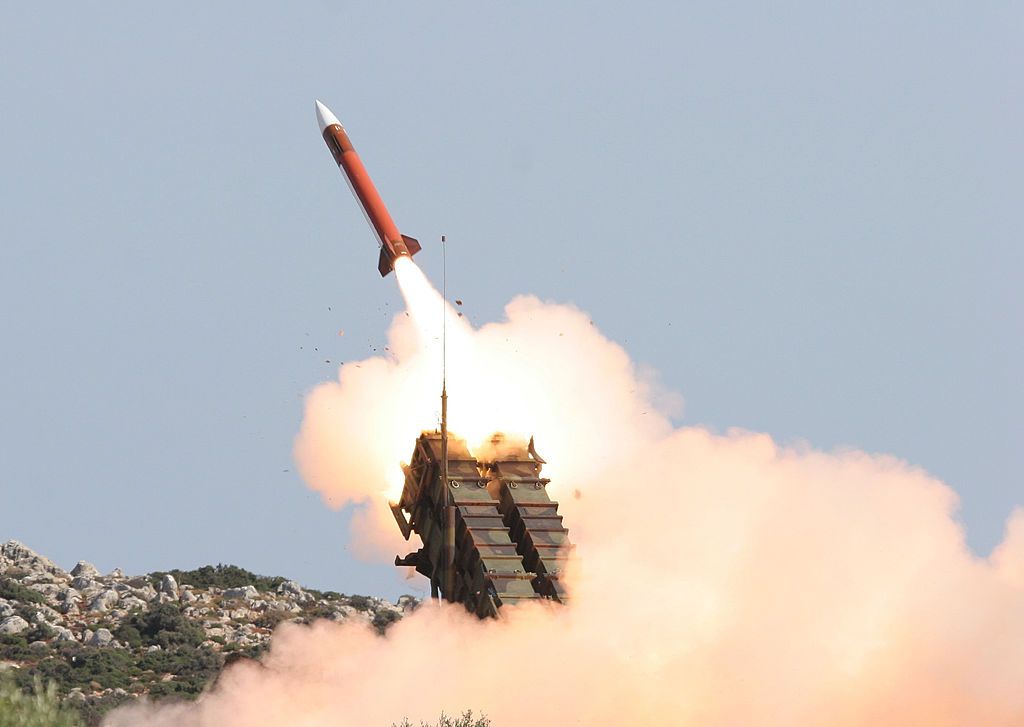
US negotiators have quietly kept a deal to let Ukraine help build Patriot interceptor missiles alive, even after US President Donald Trump publicly cast doubt on it, Reuters reported. Four people familiar with the talks said Washington never ordered them stopped. Ukraine, running low on air defenses, urgently wants the missiles to blunt Russia's growing ballistic strikes.
Russian daily drone attacks forced Kyiv to chase air defense from every direction at once, includin
US negotiators have quietly kept a deal to let Ukraine help build Patriot interceptor missiles alive, even after US President Donald Trump publicly cast doubt on it, Reuters reported. Four people familiar with the talks said Washington never ordered them stopped. Ukraine, running low on air defenses, urgently wants the missiles to blunt Russia's growing ballistic strikes.
Russian daily drone attacks forced Kyiv to chase air defense from every direction at once, including home-grown interceptors. But this year, Moscow has increasingly turned to ballistic missiles, the hardest weapons for Ukraine to stop. US-supplied PAC-3 interceptors fired by Patriot systems are among the few weapons that can reliably shoot them down, and Ukraine has now run out.
President Donald Trump greets Ukraine's President Volodymyr Zelenskyy at his Mar-a-Lago club, Sunday, Dec. 28, 2025, in Palm Beach, Fla. AP Photo/Alex Brandon/Eastnews
The talks Trump seemed to kill
Last week, Trump appeared to reverse course, telling reporters the US had not agreed to let Ukraine build Patriots and must be "very careful about letting somebody build them."
According to Reuters, two sources tied that to a tense White House meeting with Zelenskyy. Yet the negotiations pressed on.
"No order was given to halt the discussions," one source said, adding that talks continued with US arms makers and military officials.
Matthew Whitaker, Washington's envoy to NATO, is leading the drive for a deal. He visited Kyiv last month to weigh options with Ukrainian officials and weapons executives. His spokesperson framed the trip around drone collaboration that would benefit US forces, without naming the Patriot plan.
A senior administration official told Reuters that any agreement must protect US technology.
Reuters: The Patriot deal Trump denied is quietly still alive
What Ukraine could build
The options include making Patriot components in Ukraine and shipping them to Germany for final assembly, the sources said. A US official called that the most feasible route. Germany already produces an older Patriot model, and the advanced PAC-3, the newest Patriot interceptor, is expected to follow.
Ukraine could instead join an existing US-European Patriot program, or build a cheaper version of the PAC-3.
It might also tap Lockheed Martin's new lower-cost interceptor, the PAC-3 ACE, unveiled last month.
A promise made, then pulled back
During a meeting with Zelenskyy in Ankara last month, Trump said the US would license Ukraine to make PAC-3s. His later reversal caught many off guard, including Zelenskyy. In a follow-up call, US Vice President JD Vance assured him that deals between presidents would hold, one source said.
Explore further
Reuters: The Patriot deal Trump denied is quietly still alive
Ukraine's clock is running
Even with a deal, Ukraine would not receive newly built interceptors for a year or more. So Kyiv is urging allies to hand over some of theirs and exploring swaps to get missiles sooner.
Earlier, Zelenskyy warned that Ukraine had run out of Patriots. That day, it intercepted just one of 27 ballistic missiles Russia fired.
Global stocks of high-end interceptors have shrunk since the Iran war, with Patriots once bound for Ukraine diverted to US forces and Gulf allies.
The government turned to the world to respond to twin quakes. But years of shrinking budgets and political repression weakened its ability to rescue countless people trapped in rubble.
The government turned to the world to respond to twin quakes. But years of shrinking budgets and political repression weakened its ability to rescue countless people trapped in rubble.
Dozens of volunteers and family members searched for survivors in a building at a public housing complex in Caraballeda, La Guaira state, that collapsed during back-to-back earthquakes on June 24.
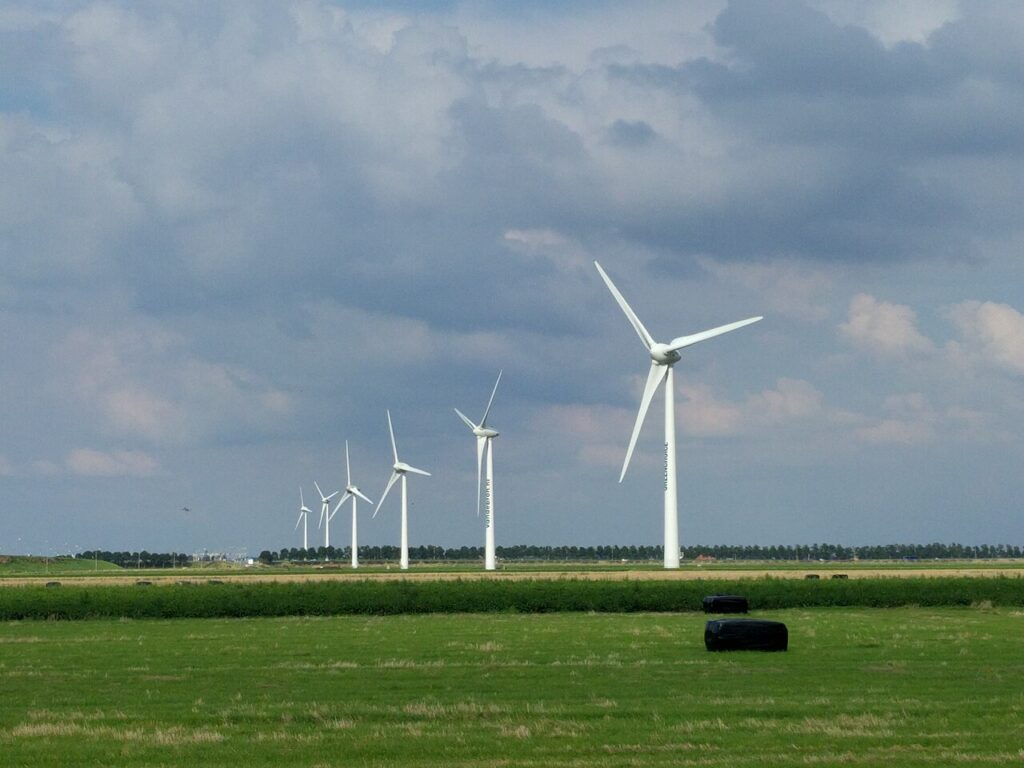
A Russian drone clipped one of Serhii’s wind turbines; his crew repaired the blade and carried on. He runs an oil-pressing plant in southern Ukraine, where the grid gives him about two hours of power and then 10 without. The turbine is one of six he has bought—Dutch machines, pulled from wind farms in the Netherlands for being too small, and shipped east.In the Netherlands, a turbine like that is barely worth the paperwork. Over a blacked-out Ukrainian factory, it is worth
A Russian drone clipped one of Serhii’s wind turbines; his crew repaired the blade and carried on. He runs an oil-pressing plant in southern Ukraine, where the grid gives him about two hours of power and then 10 without. The turbine is one of six he has bought—Dutch machines, pulled from wind farms in the Netherlands for being too small, and shipped east.
In the Netherlands, a turbine like that is barely worth the paperwork. Over a blacked-out Ukrainian factory, it is worth shipping across a continent. That gap is turning into a market.
There is an active world market for refurbished wind turbines.
Bert van der Lingen
The market has formed largely on its own. Buyers like Serhii got their turbines through what Bert van der Lingen, vice-chairman of the Dutch wind association NedZero, calls “free market conditions”—private deals, one at a time—ahead of the Dutch government program meant to organize the trade, “Renewed Energy for Ukraine,” which began only in December 2025 and is still in start-up.
NedZero wrote to Euromaidan Press to correct an earlier report, drawn from the Dutch daily De Telegraaf, that called the turbines worn out. They are not.
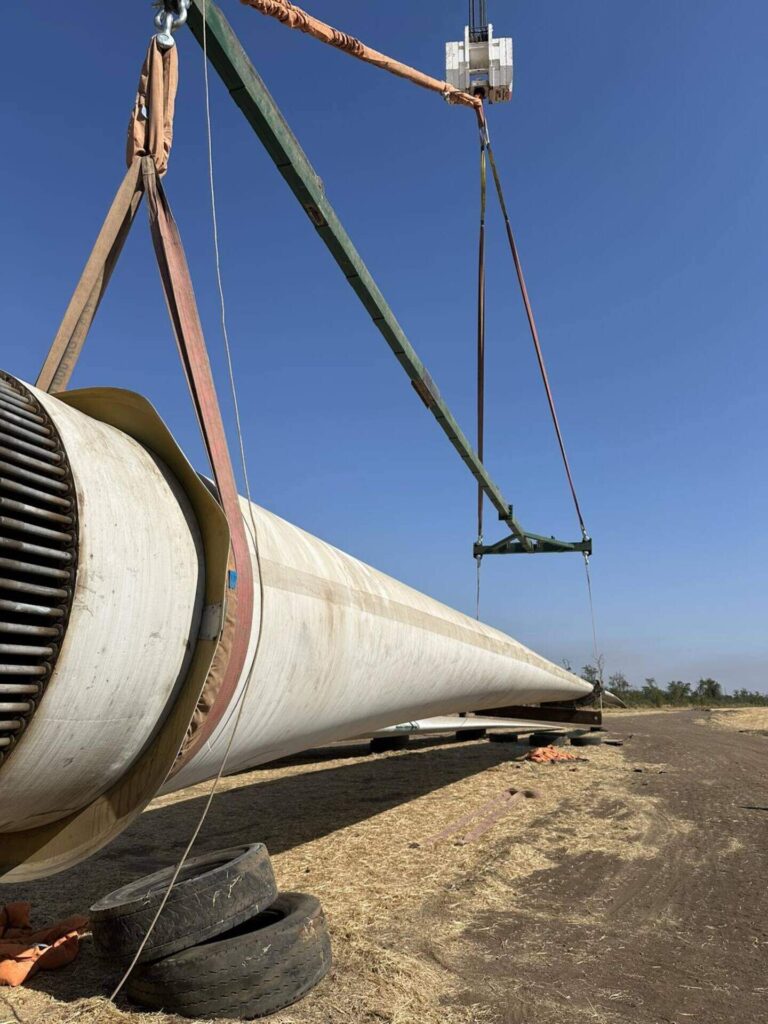
A machine comes down in the Netherlands only because a newer model on the same spot would earn five or six times as much. The old one still works. Stripped, inspected, and fitted with new bearings and a rebuilt gearbox, it has “fifteen to twenty years of technical life remaining.”
“This is a story we want to see grow,” van der Lingen added, “and getting the baseline right helps that.”
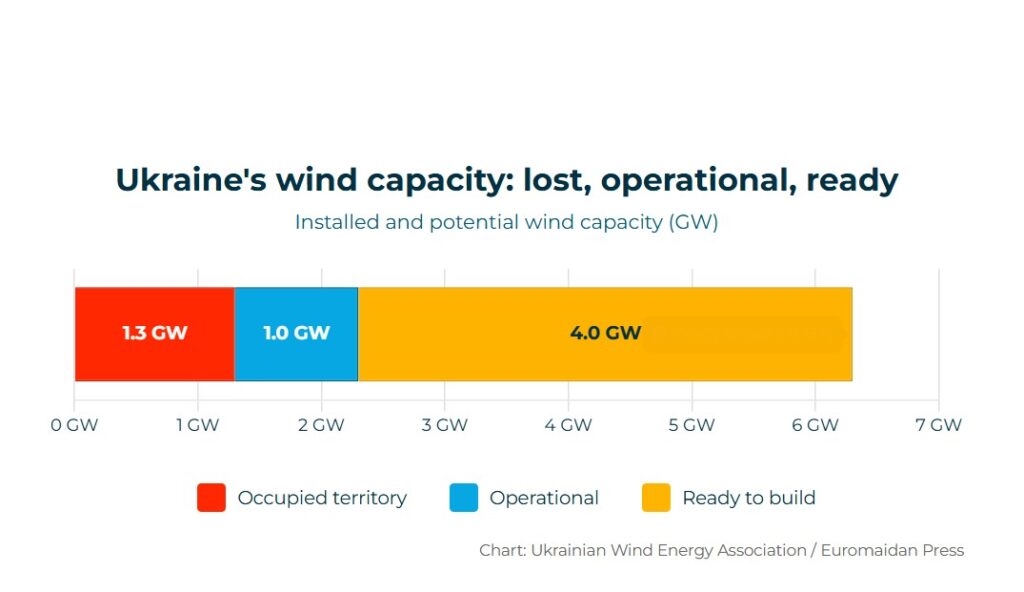
Russian occupation trapped 1.3 GW of Ukraine’s pre-war wind capacity in occupied territory. Just 1.0 GW remains operational. But seven wind farms with a combined capacity of 4 GW have all permits and grid connections in place. The bottleneck is in the market access. Chart: Ukrainian Wind Energy Association / Euromaidan Press
Why blacked-out Ukraine wants Europe’s spares
Ukraine is one buyer in a market that predates the war. “There is an active world market for refurbished wind turbines,” van der Lingen notes: Dutch machines freed up by repowering already spin from Poland and the Baltics to Jordan, Kenya, and Chile, sold with maintenance records and spare parts to match.
The supply is thin, and slow to move. By NedZero’s own survey, 486 Dutch turbines are due to come down over the decade to 2035—a floor, it says, since not every producer answered—and only a portion will be shipped anywhere, fewer still to Ukraine. A market like this gets built one deal at a time.
A crane lifts a wind turbine into place. Photo: De Telegraaf
What makes Ukraine the eager buyer is what Russia has done to its lights. Four winters of strikes have destroyed or damaged more than 80% of the country’s power-generating capacity, by the energy ministry’s own count—its big Soviet-built plants are so few and so concentrated that one missile can darken a whole region.
Kyiv’s answer is to scatter generation so widely that no single strike can repeat the trick, an approach the ministry describes as “energy cells.” One refurbished turbine beside one factory is that doctrine at its smallest scale.
Explore further
Wind farms are harder to destroy—so why won’t Ukraine let them scale? (INFOGRAPHICS)
Small, slow, and off the books
Money is the bottleneck. Development banks lend in amounts far too large for a handful of turbines—support from the big institutions starts at around €10 million ($11 million)—so small orders have to be bundled into projects large enough to finance. How many turbines reach Ukraine, the association says, depends on whether that bundling comes together.
Then there is the wiring. A turbine only makes power when the wind blows, not when the factory needs it. And most are built to shut down automatically when the grid fails, so a blackout silences them too—exactly when the factory needs them most—unless they are rewired, with batteries, to run on their own. That is what the microgrids are for.
NedZero cannot say how many Dutch turbines are already working in Ukraine. It has no consolidated count of what its country’s firms have delivered, nor of the megawatts they have added to the grid, and offers only to go and count them. What is coming free is on the books; what is already turning above a Ukrainian factory, holding its lights while the grid is dark, is not.
The amount is still far below what the U.S. spent previously on humanitarian and health aid, but resumes the flow of money for key efforts to fight malnutrition and disease.
The amount is still far below what the U.S. spent previously on humanitarian and health aid, but resumes the flow of money for key efforts to fight malnutrition and disease.
U.S. President Donald Trump is considering sending Ukraine an additional Patriot air defense system, a move that would mark his administration's first major weapons transfer to Kyiv, the Wall Street Journal (WSJ) reported on July 8, citing two defense officials. The report is the latest in a series of contradictory messages from the Trump White House in recent days regarding military aid to Ukraine. While the Pentagon on July 2 announced a halt in weapons shipments to Kyiv due to dwindling U.S.
U.S. President Donald Trump is considering sending Ukraine an additional Patriot air defense system, a move that would mark his administration's first major weapons transfer to Kyiv, the Wall Street Journal (WSJ) reported on July 8, citing two defense officials.
The report is the latest in a series of contradictory messages from the Trump White House in recent days regarding military aid to Ukraine. While the Pentagon on July 2 announced a halt in weapons shipments to Kyiv due to dwindling U.S. stockpiles, Trump later claimed he wasn't responsible for the decision and wanted to send more weapons to Ukraine.
A U.S. defense official told the WSJ that Trump has asked the Pentagon to look into options for supplying Ukraine with more arms, including a Patriot air defense system. Officials are also reportedly exploring whether other nations can send Patriots to Kyiv.
The claim dovetails with recent media reports about the administration's plans to bolster Ukraine's air defenses. Axios reported on July 8 that the White House is pursuing a plan to have Germany sell another Patriot battery to Ukraine, with the U.S. and European allies splitting the cost of the purchase. Sources told the outlet that Trump also pledged to send 10 Patriot interceptor missiles to Kyiv.
If the U.S. provides Ukraine with an additional Patriot system, it would mark the first time Trump has approved a major military aid package to Kyiv that wasn't previously greenlighted by former U.S. President Joe Biden.
Washington has thus far provided Kyiv with three Patriots, a former Pentagon official told the WSJ. Germany has also sent three, while a group of European countries provided one. According to the official, not all systems are in use at the same time due to maintenance issues.
The U.S.-made air defense systems are in high demand around the world. Each system consists of two or three launchers, a radar, a command and control element, and interceptor missiles. Patriot missiles are also in short supply globally: Ukraine faces an urgent need for the munitions amid increased Russian aerial attacks, and the Guardian reported on July 8 that even the U.S. has only 25% of the interceptors required by its defense readiness plans.
According to one of the officials who spoke to the WSJ, the U.S. military would be able to supply an additional Patriot to Ukraine if ordered by the White House.
The European Commission is discussing with EU member states various options to cover Ukraine's budget deficit for next year, which could range from $8 billion to $19 billion, the Financial Times reported on July 8.International partners have provided Ukraine with over $39 billion for its wartime economy so far this year, Prime Minister Denys Shmyhal announced.The financial hole in Ukraine's budget is linked to reduced U.S. support and the lack of prospects for a swift ceasefire with Russia that
The European Commission is discussing with EU member states various options to cover Ukraine's budget deficit for next year, which could range from $8 billion to $19 billion, the Financial Times reported on July 8.
International partners have provided Ukraine with over $39 billion for its wartime economy so far this year, Prime Minister Denys Shmyhal announced.
The financial hole in Ukraine's budget is linked to reduced U.S. support and the lack of prospects for a swift ceasefire with Russia that Europe had hoped for, the Financial Times reported.
A senior EU official told the publication that many of Ukraine's partners had previously counted on a peace deal in 2025, but are now forced to revise their funding plans.
This includes the European Commission, which has already adjusted spending from Ukraine-related funding streams.
Without support from Western partners, Kyiv would face a budget deficit of $19 billion in 2026, according to the Financial Times. However, even if additional international financing for the wartime economy can be secured, a gap of at least $8 billion would remain.
To support Ukraine's budget, Europe is considering providing military aid in the form of off-budget grants that would be recorded separately as external transfers but would count toward NATO member countries' national defense spending targets.
One EU diplomat told the Financial Times that military support for Ukraine is viewed as a contribution to the defense of all of Europe.
In a document for G7 countries reviewed by Financial Times, Kyiv proposed that European allies co-finance Ukrainian forces, framing this as a service to strengthen continental security.
Other support options under discussion include potentially accelerating payments from the existing $50 billion G7 loan program and reinvesting frozen Russian assets in higher-yield financial instruments that the EU allocated to help service the debt.
According to the Financial Times, two sources confirmed that the commission planned to discuss these options with EU finance ministers on July 8.
The funding issue will also be raised at the Ukraine Recovery Conference in Rome on July 10-11, dedicated to Ukraine's reconstruction needs. European Commission President Ursula von der Leyen will attend the event.
U.S. President Donald Trump told President Volodymyr Zelensky during a phone call on July 4 that he was not responsible for the suspension of U.S. arms shipments to Ukraine, The Wall Street Journal (WSJ) reported on July 7, citing unnamed sources familiar with the matter.The suspension of aid, which includes Patriot air defense missiles and precision-guided munitions, has drawn criticism from Kyiv amid an intensifying Russian aerial campaign that has killed and injured hundreds of civilians in r
U.S. President Donald Trump told President Volodymyr Zelensky during a phone call on July 4 that he was not responsible for the suspension of U.S. arms shipments to Ukraine, The Wall Street Journal (WSJ) reported on July 7, citing unnamed sources familiar with the matter.
The suspension of aid, which includes Patriot air defense missiles and precision-guided munitions, has drawn criticism from Kyiv amid an intensifying Russian aerial campaign that has killed and injured hundreds of civilians in recent weeks.
According to WSJ, Trump told the Ukrainian president that he had ordered a review of Pentagon munitions stockpiles following last month's U.S. strikes on Iran's nuclear sites, but he did not direct the military to halt weapons deliveries.
NBC News reported on July 4 that Defense Secretary Pete Hegseth unilaterally halted the shipment to Ukraine on July 2, despite internal Pentagon assessments showing the aid would not compromise U.S. military readiness.
According to Politico, U.S. Special Envoy Keith Kellogg and Defense Minister Rustem Umerov are scheduled to meet in Rome later this week to discuss restarting U.S. military aid to Ukraine.
Trump did not acknowledge a halt in U.S. weapons shipments to Ukraine. On July 7, he said the U.S. would provide Ukraine with "more weapons," pointing to the scale of Russia's attacks.
"They have to be able to defend themselves, they're getting hit very hard now," Trump told reporters alongside a U.S. and Israeli delegation at the White House.
The comments follow Trump's July 3 call with Russian President Vladimir Putin, after which he said he was "very disappointed" with the Kremlin's continued refusal to end hostilities.
The following day, Trump and Zelensky spoke by phone in what the U.S. president described as a "very strategic" conversation focused on Ukraine's need for air defenses.
Two rounds of direct talks between Russia and Ukraine held in Istanbul in May and June led only to prisoner exchanges, with no breakthrough on ending hostilities. Moscow has maintained maximalist conditions while rejecting calls for an unconditional ceasefire.
U.S. Special Envoy Keith Kellogg and Defense Minister Rustem Umerov are set to meet at the Ukraine Recovery Conference in Rome later this week to discuss the resumption of U.S. military assistance to Ukraine, Politico reported on July 7.Following the talks between Kellogg and Umerov in Rome, Politico reported that more meetings are set to take place in Kyiv over the next two weeks.The United States halted weapons shipments to Ukraine amid a capability review, the White House and Pentagon previou
U.S. Special Envoy Keith Kellogg and Defense Minister Rustem Umerov are set to meet at the Ukraine Recovery Conference in Rome later this week to discuss the resumption of U.S. military assistance to Ukraine, Politico reported on July 7.
Following the talks between Kellogg and Umerov in Rome, Politico reported that more meetings are set to take place in Kyiv over the next two weeks.
The United States halted weapons shipments to Ukraine amid a capability review, the White House and Pentagon previously confirmed, with U.S. President Donald Trump on July 3 denying the pause.
Days later, Trump said that the United States would provide Ukraine with additional shipments of weapons amid intensified Russian attacks.
"We're gonna send some more weapons we have to them, they have to be able to defend themselves, they're getting hit very hard now," Trump said on July 7.
The halted U.S. military assistance to Ukraine could be resumed following planned high-level meetings at the conference, two people familiar with the matter told Politico.
A Kyiv meeting between Kellogg and Umerov following the Ukraine Recovery Conference was planned before the U.S. halted military assistance to Ukraine.
Kellogg's spokesperson Morgan Murphy said the meeting was "set up before news of the arms pause came to light last week."
Ukraine would like to promptly resume supplies of air defense and precision munitions, while the U.S. has signalled that the delivery of armored vehicles and engineering equipment may resume soon, the two sources said.
Pentagon spokesperson Sean Parnell confirmed on July 2 that some military assistance to Ukraine has been halted as the U.S. Defense Department conducts a review of foreign aiddeliveries.
"This capability review... is being conducted to ensure U.S. military aid aligns with our defense priorities... We see this as a common-sense, pragmatic step towards having a framework to evaluate what munitions are sent and where," Parnell said.
Despite the Pentagon announcement, Trump did not acknowledge a halt in U.S. weapons shipments to Ukraine.
"Why did you pause weapons shipments to Ukraine?" a reporter asked Trump as the U.S. president prepared to board Air Force One on July 3.
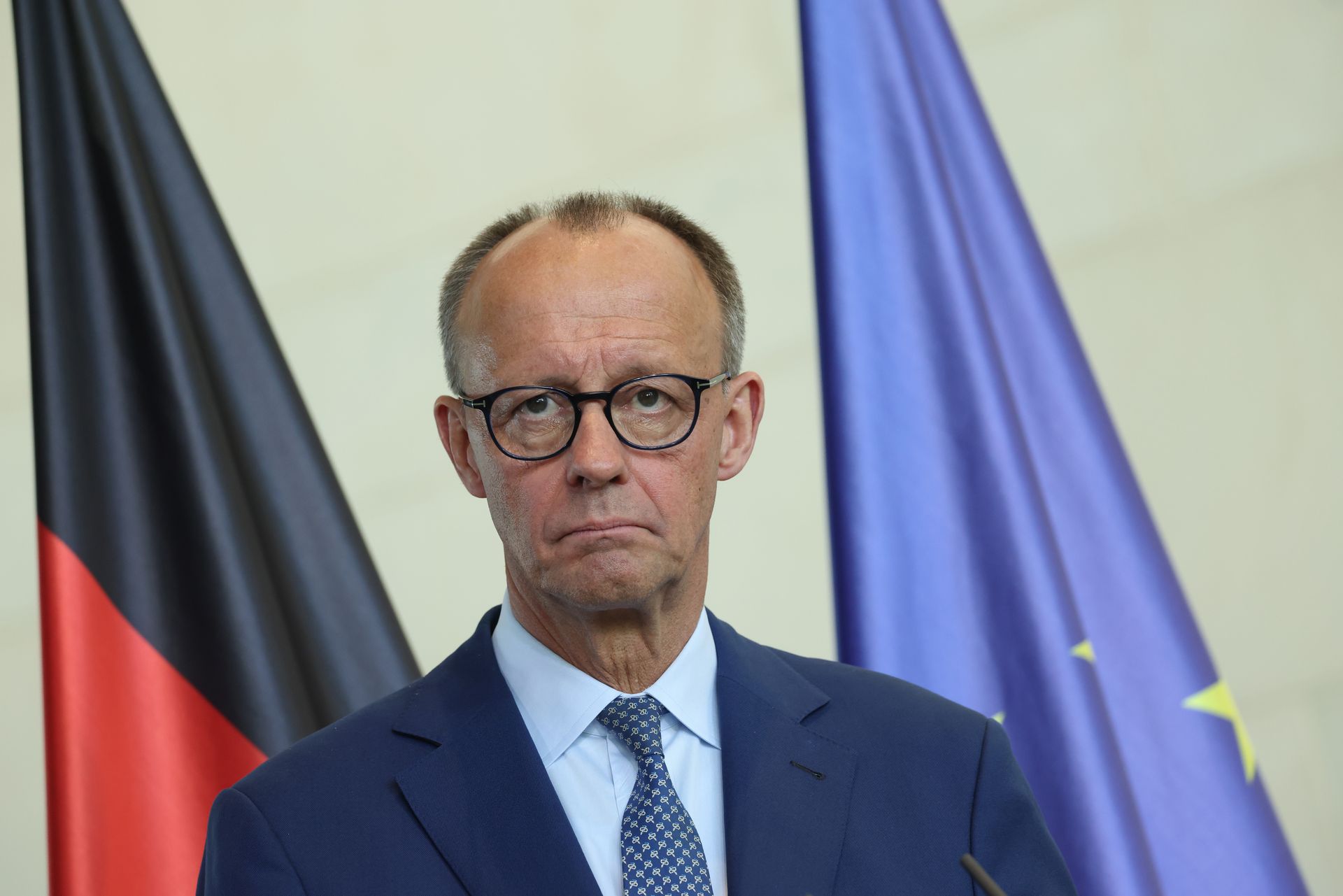
Four Alliance 90/Greens party members have sent an open letter to German Chancellor Friedrich Merz calling for a significant increase in military aid to Ukraine, Bild reported on July 5, citing a copy of the document.The news comes as Russia’s expanded drone production has enabled Moscow to launch as many as 500 drones in a single night against Ukraine on multiple occasions each week.The letter's authors — Robin Wagener, Sara Nanni, Sebastian Schafer, and Anton Hofreiter — demanded that certain
Four Alliance 90/Greens party members have sent an open letter to German Chancellor Friedrich Merz calling for a significant increase in military aid to Ukraine, Bild reported on July 5, citing a copy of the document.
The news comes as Russia’s expanded drone production has enabled Moscow to launch as many as 500 drones in a single night against Ukraine on multiple occasions each week.
The letter's authors — Robin Wagener, Sara Nanni, Sebastian Schafer, and Anton Hofreiter — demanded that certain budget items be adjusted, particularly regarding support for Ukraine. They believe that the planned increase in Germany's defense funding for Kyiv from $8.4 billion in 2024 to $9.8 billion in 2025 is insufficient, according to Bild.
The signatories emphasized the need to strengthen Ukraine's air defense systems urgently.
"Without further air defense and assured supplies, Russian dictatorship over Ukraine becomes more likely," the letter read.
The lawmakers also noted that the situation has deteriorated as Russia continues to carry out large-scale attacks on Ukraine, and the United States, for its part, has partially suspended its military aid.
The signatories reminded Merz that, thanks to the Greens party's support in the previous Bundestag, assistance to Ukraine had significantly increased.
Before becoming chancellor, Merz, elected for the CDU/CSU conservative alliance, signaled he could overturn the ban of his predecessor, Social Democrat Olaf Scholz, on delivering Taurus to Ukraine.
The Taurus is a powerful cruise missile capable of striking targets at a distance of 500 kilometers (300 miles), more than the long-range capabilities Ukraine received from other partners.
However, the German government has not approved sending Taurus missiles to Ukraine so far.
Ukraine has been using U.S.-made ATACMS for over a year, and U.K.-French Storm Shadow/SCALP for more than two, initially being allowed to deploy them only against Russian targets on Ukrainian territory.
Only in late 2024, the Biden administration and other allies eased the restrictions, allowing Ukraine to use long-range missiles against Russian military targets on Russian territory.
U.S. Defense Secretary Pete Hegseth unilaterally halted a weapons shipment to Ukraine on July 2 despite internal military assessments showing the aid would not compromise American military readiness, NBC News reported on July 4, citing three U.S. officials.The pause in aid, which included critical air defense systems and ammunition, reportedly caught the State Department, members of Congress, Ukraine, and key European allies off guard.Ukraine suffered one of the largest attacks on July 4, with P
U.S. Defense Secretary Pete Hegseth unilaterally halted a weapons shipment to Ukraine on July 2 despite internal military assessments showing the aid would not compromise American military readiness, NBC News reported on July 4, citing three U.S. officials.
The pause in aid, which included critical air defense systems and ammunition, reportedly caught the State Department, members of Congress, Ukraine, and key European allies off guard.
Ukraine suffered one of the largest attacks on July 4, with President Volodymyr Zelensky calling for more air defense to protect civilians in the cities. The attack on Kyiv killed one person and injured 23 more.
A senior U.S. military review had concluded that while some munitions stockpiles, including precision weapons, were low, they had not fallen below critical thresholds, according to NBC. Despite this, Hegseth opted to stop the shipment. This is reportedly his third such move since February.
"We are not at any lower point, stockpile-wise, than we’ve been in the three-and-a-half years of the Ukraine conflict," Congressman Adam Smith the top Democrat on the House Armed Services Committee, said. Smith, who said his staff reviewed the Pentagon's figures, called the justification "disingenuous."
The shipment reportedly included dozens of Patriot interceptors, 155 mm artillery rounds, Hellfire missiles, guided missile systems (GMLRS), Stinger and AIM air-to-air missiles, and grenade launchers.
Two sources told NBC that some of the weapons had already been loaded onto trucks in Poland when the halt was ordered.
Zelensky recently called Patriot systems "real defenders of life," since Patriot missile systems are the best air defense in Ukraine's arsenal. They are considered to be the most effective measure against Russian ballistic missiles like Iskander and Kinzhal.
Pentagon spokesman Sean Parnell described earlier the decision as part of a broader "capability review" to ensure U.S. forces remain equipped.
The halt has initiated debate over the future of U.S. support for Ukraine.
Lawmakers from both parties, including Republican Congressman Michael McCaul, expressed frustration at the lack of advance notice. "Now is the time to show Putin we mean business," McCaul wrote on X.
Republican Congressman Joe Wilson also reacted to the halt, warning of its consequences amid Russia's ongoing strikes.
"As Americans begin to enjoy the sounds of fireworks in celebration of our Nation's Independence, war criminal (Russian President Vladimir) Putin, who is losing his pathetic war, resorts to scorched earth tactics across Ukrainian cities that predate Moscow's existence," Wilson wrote.
Wilson said he is "confident the Department of Defense will advance President Trump’s objectives stated at The Hague to send additional air defense and approved weapons to help stop this absolute depravity, as allies have and must continue doing at a rapid pace."
Republican Congressman Brian Fitzpatrick has requested an emergency White House briefing, warning the decision could cost lives.
Trump has denied that the U.S. paused shipments on July 3, contradicting both Pentagon confirmation and reporting.
"We haven't," Trump told a reporter. "We're giving weapons." He also claimed the Biden administration had "emptied out our whole country" and insisted Washington must prioritize its own defense.
U.S. President Donald Trump brushed off a reporter's question on July 3 about pausing weapons deliveries to Ukraine, claiming Washington is "giving weapons" to Kyiv. The Pentagon previously confirmed that the U.S. has already halted some military aid shipments to Ukraine in order to conduct what it calls a "capability review" of its own stockpiles. "Why did you pause weapons shipments to Ukraine?" a reporter asked Trump as the president prepared to board Air Force One."We haven't," Trump replied
U.S. President Donald Trump brushed off a reporter's question on July 3 about pausing weapons deliveries to Ukraine, claiming Washington is "giving weapons" to Kyiv.
The Pentagon previously confirmed that the U.S. has already halted some military aid shipments to Ukraine in order to conduct what it calls a "capability review" of its own stockpiles.
"Why did you pause weapons shipments to Ukraine?" a reporter asked Trump as the president prepared to board Air Force One.
Trump then offered a contradictory answer, saying the U.S. is "trying to help" Ukraine while also claiming that former U.S. President Joe Biden depleted the country's weapons stocks with military aid to Kyiv and that Washington must defend its own interests.
"But we've given so many weapons — but we are giving weapons, and we're working with (Ukraine), we're trying to help them," Trump said.
"But we haven't... You know, Biden emptied out our whole country giving them weapons and we have to make sure that we have enough for ourselves."
Trump then asked the reporter which media outlet he represented.
Reports that the U.S. had suddenly paused some weapons shipments — including deliveries of desperately needed air defense missiles — left officials in Kyiv scrambling for answers. Trump's response provides little clarity and even less reassurance to Ukrainians facing increasingly deadly Russian missile attacks night after night.
The decision to halt the shipments "was made to put America's interests first following a (U.S. Defense Department) review of our nation's military support and assistance to other countries across the globe," White House Deputy Press Secretary Anna Kelly said in a statement after Politico broke the story on July 1.
The Washington Post later reported that a shipment of U.S. weapons, including advanced air defense systems and precision missiles, was halted in Poland where it was awaiting delivery to Ukraine.
U.S. State Department Spokesperson Tammy Bruce, like Trump, insisted that the U.S. was not pulling support from Ukraine.
"This is not — I will reinforce this — this is not a cessation of us assisting Ukraine or of providing weapons," Bruce told reporters at a briefing.
"This is one event in one situation, and we'll discuss what else comes up in the future. But be wary of painting too broad a brush there."
Trump's remarks about the weapons shipments followed an update on his July 3 phone call with Russian President Vladimir Putin.
"We had a call. It was a pretty long call. We talked about a lot of things," he said.
U.S. weapons already in Poland en route to Ukraine have been halted, including advanced air defense systems and precision missiles, the Wall Street Journal reported on July 2.The Pentagon confirmed the halt in a July 2 briefing, citing an ongoing "capability review" aimed at ensuring U.S. military assistance "aligns with its strategic defense priorities."The shipment in Poland includes over two dozen PAC-3 Patriot missiles, more than two dozen Stinger air-defense systems, Hellfire air-to-ground
U.S. weapons already in Poland en route to Ukraine have been halted, including advanced air defense systems and precision missiles, the Wall Street Journal reported on July 2.
The Pentagon confirmed the halt in a July 2 briefing, citing an ongoing "capability review" aimed at ensuring U.S. military assistance "aligns with its strategic defense priorities."
The shipment in Poland includes over two dozen PAC-3 Patriot missiles, more than two dozen Stinger air-defense systems, Hellfire air-to-ground missiles, and over 90 AIM air-to-air missiles intended for use with Ukraine's F-16 fighter jets, according to U.S. administration and congressional officials cited by the Wall Street Journal.
"We see this as a common-sense, pragmatic step towards having a framework to evaluate what munitions are sent and where," Pentagon spokesperson Sean Parnell said.
The decision has sparked backlash from both sides of the political aisle in Washington. Republican Rep. Brian Fitzpatrick, co-chair of the Congressional Ukraine Caucus, called the pause "unacceptable," while Democratic Senator Richard Blumenthal labeled it "fallacious and maybe even disingenuous."
The pause comes at a critical moment for Ukraine, which faces intensified Russian missile and drone strikes. On June 29, Russia launched the largest aerial assault against Ukraine since the start of its full-scale invasion in February 2022, targeting civilian infrastructure and cities far beyond the frontline.
NATO Secretary General Mark Rutte, speaking on July 2, emphasized the urgency of continued Western support for Kyiv. "I totally understand that the U.S. always has to make sure its interests are covered," he said. "But in the short term, Ukraine cannot do without all the support it can get."
The Pentagon has not provided a timeline for when the held-back shipments might resume.
Pentagon spokesperson Sean Parnell confirmed on July 2 that some military assistance to Ukraine has been halted as the U.S. Defense Department conducts a review of foreign aid deliveries."This capability review... is being conducted to ensure U.S. military aid aligns with our defense priorities... We see this as a common-sense, pragmatic step towards having a framework to evaluate what munitions are sent and where," Parnell said.The White House earlier confirmed the pause in shipments, citing a
Pentagon spokesperson Sean Parnell confirmed on July 2 that some military assistance to Ukraine has been halted as the U.S. Defense Department conducts a review of foreign aid deliveries.
"This capability review... is being conducted to ensure U.S. military aid aligns with our defense priorities... We see this as a common-sense, pragmatic step towards having a framework to evaluate what munitions are sent and where," Parnell said.
The White House earlier confirmed the pause in shipments, citing a broader reassessment of U.S. military stockpiles amid media reports of the halt in military assistance.
The weapons reportedly being held back include two dozen Patriot air defense missiles, over two dozen Stinger air-defense systems, precision artillery rounds, Hellfire missiles, drones, and more than 90 AIM air-to-air missiles launched from F-16 fighter jets.
New U.S. military aid packages have not been approved since U.S. President Donald Trump was inaugurated in January, raising concern among Ukraine's allies.
"Ultimately, our job here at the Department of Defense is to pursue the president's 'America First' agenda and make sure that we achieve peace through strength throughout the world," Parnell said at a Pentagon press briefing.
The U.S. Defense Department will not provide updates on the timeline and quantity or type of munitions provided to Ukraine, he added.
"What we've done here at the Department of Defense is create a framework to analyze what munitions we're sending (and) where," Parnell said.
A bipartisan group of U.S. lawmakers has voiced their opposition to the decision to halt military aid shipments to Ukraine.
"We must build up our own Defense Industrial Base here in the U.S. while simultaneously providing the needed assistance to our allies who are defending their freedom from brutal invading dictators. To not do both is unacceptable," Republican Rep. Brian Fitzpatrick, the co-chair of the Congressional Ukraine Caucus, said.
Democratic Senator Richard Blumenthal, a member of the Senate Armed Services Committee, described the military aid pause as "fallacious and maybe even disingenuous."
NATO Secretary General Mark Rutte said on July 2 that he understands the White House's need to safeguard its own defense capabilities, but underscored that Ukraine urgently requires sustained support.
"I totally understand that the U.S. always has to make sure its interests are covered... When it comes to Ukraine, in the short term, Ukraine cannot do without all the support it can get," Rutte said.
The Washington Post reported that the military aid was already in Poland, being prepared for delivery to Ukraine.
The Trump administration's decision to halt deliveries of key military aid to Ukraine has caught European partners off guard and prompted urgent requests for clarification, Bloomberg reported on July 2, citing unnamed sources.The pause affects the delivery of several weapons critical to Ukraine's defense, including Patriot air defense missiles, precision-guided artillery shells, Hellfire missiles, and munitions for F-16 fighter jets. The White House confirmed the hold, describing it as part of a
The Trump administration's decision to halt deliveries of key military aid to Ukraine has caught European partners off guard and prompted urgent requests for clarification, Bloomberg reported on July 2, citing unnamed sources.
The pause affects the delivery of several weapons critical to Ukraine's defense, including Patriot air defense missiles, precision-guided artillery shells, Hellfire missiles, and munitions for F-16 fighter jets.
The White House confirmed the hold, describing it as part of a broader reassessment of U.S. military stockpiles. Since U.S. President Donald Trump took office in January, the U.S. has not approved any new military aid packages for Ukraine.
According to Bloomberg, some European allies hope the Trump administration will soften or reverse the decision. The timing of the pause has raised particular concern as Ukraine faces one of the most intense waves of Russian missile and drone attacks since the start of the war.
In his evening address on July 2, President Volodymyr Zelensky said Ukrainian and U.S. officials are working through the aid issue at a "working level," including discussions on critical air defense support.
Ukraine's Defense Ministry said it has not received any formal notification of delays or cancellations but has requested urgent consultations with U.S. defense officials.
The Foreign Ministry also summoned U.S. Charge d'Affaires John Ginkel, warning that "any hesitation" in military support would encourage further Russian aggression.
The Kremlin welcomed the decision, with spokesperson Dmitry Peskov saying, "The fewer weapons that are supplied to Ukraine, the closer the end of the (war)."
NATO Secretary General Mark Rutte expressed understanding of Washington's desire to safeguard its stockpiles but said that "Ukraine cannot do without all the support it can get."
U.S. Defense Secretary Pete Hegseth previously signaled a shift in policy, indicating that future defense budgets would prioritize domestic needs over military support for Ukraine.
NATO Secretary General Mark Rutte said on July 2 that he understands Washington's need to safeguard its own defense needs, but emphasized that Ukraine urgently requires sustained Western support."I totally understand that the U.S. always has to make sure its interests are covered," Rutte told Fox News. "When it comes to Ukraine, in the short term, Ukraine cannot do without all the support it can get."His remarks come as the U.S. Defense Department has halted deliveries of key weapons systems pre
NATO Secretary General Mark Rutte said on July 2 that he understands Washington's need to safeguard its own defense needs, but emphasized that Ukraine urgently requires sustained Western support.
"I totally understand that the U.S. always has to make sure its interests are covered," Rutte told Fox News. "When it comes to Ukraine, in the short term, Ukraine cannot do without all the support it can get."
His remarks come as the U.S. Defense Department has halted deliveries of key weapons systems previously promised to Kyiv, including Patriot missiles, precision-guided artillery shells, Hellfire missiles, and munitions compatible with F-16 fighter jets.
The White House confirmed the pause in shipments, citing a broader reassessment of U.S. military stockpiles. No new U.S. military aid packages have been approved since U.S. President Donald Trump took office in January.
"I understand the U.S. has to take care of its stockpiles, and at the same time, we have to allow for some flexibility here," Rutte said. "Europeans, in the meantime, are really stepping up."
During last week's NATO summit in The Hague, Trump and President Volodymyr Zelensky met behind closed doors. Rutte described the conversation as "a very good discussion, particularly focusing on air defense systems."
The reporting of paused deliveries comes as Ukraine faces one of the heaviest barrages of Russian drone and missile strikes since the start of the full-scale invasion.
Ukraine's Defense Ministry responded by saying it has not received formal notification of delays or cancellations and has requested urgent consultations with U.S. defense officials.
The Foreign Ministry summoned U.S. Charge d'Affaires John Ginkel the same day, warning that any hesitation in maintaining Ukraine's defense capabilities would embolden Russia.
The Kremlin welcomed the halt in arms shipments, saying it brings the war closer to an war.
"The fewer weapons that are supplied to Ukraine, the closer the end of the (war)," Kremlin spokesperson Dmitry Peskov said in response to the information.
U.S. Defense Secretary Pete Hegseth has previously indicated that the upcoming defense budget will scale back long-term military support for Ukraine, reflecting a shift in Washington's priorities.
The United States' reported decision to suspend some arms deliveries to Ukraine could help bring Russia's war in Ukraine to an end, the Kremlin said on July 2, according to Russian state-controlled media."The fewer weapons that are supplied to Ukraine, the closer the end of the... (Russia-Ukraine war)," Kremlin spokesperson Dmitry Peskov told reporters.Peskov's comments came after Politico reported that the U.S. Defense Department has paused shipments of key air defense and precision munitions t
The United States' reported decision to suspend some arms deliveries to Ukraine could help bring Russia's war in Ukraine to an end, the Kremlin said on July 2, according to Russian state-controlled media.
"The fewer weapons that are supplied to Ukraine, the closer the end of the... (Russia-Ukraine war)," Kremlin spokesperson Dmitry Peskov told reporters.
Peskov's comments came after Politico reported that the U.S. Defense Department has paused shipments of key air defense and precision munitions to Ukraine over concerns about declining U.S. stockpiles.
Among the withheld items are Patriot air defense missiles, precision artillery rounds, Hellfire missiles, and other munitions used by Ukraine's F-16 fighter jets.
Ukraine's Foreign Ministry summoned U.S. Charge d'Affaires John Ginkel on July 2 to voice concern over the reported pause in weapons shipments.
Deputy Foreign Minister Mariana Betsa warned during the meeting that "any delay or hesitation in supporting Ukraine's defense capabilities will only encourage Russia to continue war and terror, rather than pursue peace."
According to Politico, Pentagon policy chief Elbridge Colby ordered the halt in June following a review of U.S. ammunition levels. The White House confirmed the decision, saying it was part of a broader reassessment of American military aid to foreign partners.
"(The decision) was made to put America's interests first following a DOD review of our nation's military support and assistance to other countries across the globe," White House Deputy Press Secretary Anna Kelly said in a statement.
The move comes as Ukraine faces intensifying Russian attacks. In June, Russia launched a record 5,337 Shahed-type attack drones at Ukrainian targets, the highest monthly total since the start of the full-scale invasion in February 2022.
The U.S. has not approved any new military aid packages after U.S. President Donald Trump took office in January. Defense Secretary Pete Hegseth has also signaled that future U.S. defense budgets will reduce the scale of assistance to Ukraine.
At a NATO summit in The Hague in late June, Trump said Washington was considering whether it could help provide more Patriot missiles to Kyiv but emphasized that U.S. and Israeli needs take precedence.
"They are very hard to get. We need them too," Trump said after meeting with President Volodymyr Zelensky.
The Kremlin has long argued that Western arms shipments to Ukraine only prolong the conflict and raise the risk of escalation, while continuing to attack Ukrainian cities and advance on the battlefield.
The Ukrainian Foreign Ministry told U.S. Charge d'Affaires John Ginkel that any delays in U.S. military aid would only prolong the war, the Foreign Ministry said on July 2 after the Pentagon reportedly paused some weapons shipments.Ginkel met Deputy Foreign Minister Mariana Betsa at the request of Ukraine's chief diplomat, Andrii Sybiha. During the meeting, the Ukrainian side warned that "any delay or hesitation in supporting Ukraine's defense capabilities will only encourage Russia to continue
The Ukrainian Foreign Ministry told U.S. Charge d'Affaires John Ginkel that any delays in U.S. military aid would only prolong the war, the Foreign Ministry said on July 2 after the Pentagon reportedly paused some weapons shipments.
Ginkel met Deputy Foreign Minister Mariana Betsa at the request of Ukraine's chief diplomat, Andrii Sybiha.
During the meeting, the Ukrainian side warned that "any delay or hesitation in supporting Ukraine's defense capabilities will only encourage Russia to continue war and terror, rather than pursue peace."
The meeting came amid reporting in the U.S. media that the U.S. Defense Department had paused some of the previously allocated shipments of weapons to Kyiv as part of a review. Among the withheld items are Patriot air defense missiles, precision artillery rounds, Hellfire missiles, and other munitions used by Ukraine's F-16 fighter jets.
White House spokesperson Anna Kelly later confirmed the move, saying that the decision "was made to put America's interests first following a (Defense Department) review of our nation's military support and assistance to other countries across the globe."
The Ukrainian Foreign Ministry did not explicitly confirm the pause in its statement. According to the ministry's readout, Betsa underscored Ukraine's gratitude for U.S. aid and stressed the critical importance of continued deliveries, namely air defenses.
Separately, parliamentary defense committee member Fedir Venislavskyi told RBK-Ukraine that Ukraine has not received an official confirmation of the suspension.
"Any restrictions on the supply of those resources that are very important to us are undoubtedly negative," Venislavskyi said, adding that Ukraine nevertheless has some "reserve capacities."
In the conversation with Ginkel, Betsa also stressed that Russia continues to reject a U.S.-proposed ceasefire that Kyiv agreed to during talks in Jeddah on March 11 and only intensifies its aerial attacks and ground offensives against Ukraine.
"Ukraine supports peace efforts and supports the U.S. calls for an immediate end to the killings and the war, stressing the need to compel Russia to seek peace," the Foreign Ministry said in a statement.
"Under these circumstances, strengthening Ukraine's defense capabilities and ramping up coordinated transatlantic pressure on Russia are critically important."
The aid pause comes in a critical moment as Russia is ramping up its aerial strikes across Ukraine and intensifying offensive operations along the front line. In June, Russia launched a record 5,337 Shahed-type attack drones at Ukrainian targets, the highest monthly total since the start of the full-scale invasion in February 2022.
The Trump administration has yet to approve any new major aid package for Ukraine and revealed plans to reduce military assistance in next year's budget. The pause comes despite U.S. President Donald Trump recently signaling support for further Patriot supplies to Kyiv.
USAID officially stopped implementing foreign assistance as of July 1, as the Trump administration seeks to realign international aid with its policies, U.S. Secretary of State Marco Rubio announced."Foreign assistance programs that align with administration policies — and which advance American interests — will be administered by the State Department," Rubio said in a statement on Substack.The Trump administration has set its sights on the U.S.'s chief foreign aid agency, accusing it — despite
USAID officially stopped implementing foreign assistance as of July 1, as the Trump administration seeks to realign international aid with its policies, U.S. Secretary of State Marco Rubio announced.
"Foreign assistance programs that align with administration policies — and which advance American interests — will be administered by the State Department," Rubio said in a statement on Substack.
The Trump administration has set its sights on the U.S.'s chief foreign aid agency, accusing it — despite little evidence — of fraud and of promoting a "liberal" or "leftist" agenda. Roughly 83% of USAID's programs, or around 5,200 contracts, were terminated in March, and thousands of workers were laid off.
Founded in 1961, USAID has played a crucial role in humanitarian relief worldwide and has overseen thousands of programs supporting democracy-building, human rights, and economic development.
"USAID had decades and a near-infinite taxpayer budget to advance American influence, promote economic development worldwide, and allow billions to stand on their own two feet," Rubio said.
"Beyond creating a globe-spanning NGO industrial complex at taxpayer expense, USAID has little to show since the end of the Cold War."
Contradicting Rubio's comments, experts and former U.S. officials have criticized the decision and pointed to potentially devastating humanitarian consequences. Research by The Lancet estimated that USAID funding cuts could result in 14 million deaths by 2030, including 4.5 million children younger than 5.
"We will not apologize for recognizing America's longstanding commitment to life-saving humanitarian aid and promotion of economic development abroad must be in furtherance of an America First foreign policy," Rubio said.
The chief U.S. diplomat presented the step as part of President Donald Trump's broader policies aimed at requiring international allies and partners to pay a greater share for projects around the world.
"Americans should not pay taxes to fund failed governments in faraway lands. Moving forward, our assistance will be targeted and time limited. We will favor those nations that have demonstrated both the ability and willingness to help themselves," Rubio said.
Since the start of Russia’s full-scale invasion, USAID has provided $2.6 billion in humanitarian aid to Ukraine, as well as $5 billion in development assistance and more than $30 billion in direct budget support to Kyiv.
The U.S. Defense Department (DOD) has halted shipments of some air defense missiles and other weapons previously promised to Kyiv out of concerns over the size of U.S. stockpiles, Politico reported on July 1, citing sources familiar with the matter. The suspension comes as Ukraine faces a shortage of air defense munitions along with increasingly intense and deadly Russian bombardments. In June 2025, Russia launched 5,337 Shahed-type drones at Ukraine, shattering its previous monthly record. Pent
The U.S. Defense Department (DOD) has halted shipments of some air defense missiles and other weapons previously promised to Kyiv out of concerns over the size of U.S. stockpiles, Politico reported on July 1, citing sources familiar with the matter.
The suspension comes as Ukraine faces a shortage of air defense munitions along with increasingly intense and deadly Russian bombardments. In June 2025, Russia launched 5,337 Shahed-type drones at Ukraine, shattering its previous monthly record.
Pentagon policy chief Elbridge Colby made the decision to pause the aid deliveries after conducting a review of U.S. munitions stocks, three sources told Politico. Colby was reportedly concerned about dwindling levels of artillery rounds, air defense missiles, and precision munitions.
Among the items being held back from Ukraine are Patriot air defense missiles, precision artillery rounds, Hellfire missiles, drones, and other missiles that Ukraine launches from F-16 fighter jets.
Colby made the decision in June, amid a surge in Russian mass aerial attacks against Ukraine. The White House later confirmed the pause.
The Pentagon's decision "was made to put America's interests first following a DOD review of our nation's military support and assistance to other countries across the globe," White House Deputy Press Secretary Anna Kelly said in a statement issued after Politico published the story.
"The strength of the United States Armed Forces remains unquestioned — just ask Iran," she said.
Since his inauguration in January, U.S. President Donald Trump has not approved any additional military aid packages for Ukraine. Defense Secretary Pete Hegseth also announced recently that the U.S. will reduce the total aid it sends to Ukraine in its upcoming defense budget.
At the NATO summit in The Hague in late June, Trump said he would "see" if the U.S. could supply Kyiv with additional missiles for its Patriot systems.
"They (Ukraine) do want to have the anti missiles, as they call them, the Patriots, and we're going to see if we can make some available," he said after meeting with President Volodymyr Zelensky.
"They are very hard to get. We need them too. We are supplying them for Israel, and they are very effective."
But according to a source who spoke to Politico, plans to reduce and redirect air defense munitions and other weapons for Ukraine have been in the works for months. The administration is looking to redirect artillery shells, tank shells, and air defense systems to Israel or back to Washington.
"They have proposed repeatedly since March to pause the shipments," the person said.
Colby, the reported architect of the decision, has previously advocated for reducing U.S. military assistance to Ukraine to prioritize deterrence efforts in Asia.
Ukraine received approximately $500 million from the International Monetary Fund (IMF), marking the ninth tranche under the Extended Fund Facility program, the Finance Ministry announced in a press release on July 1.The EFF Program has allocated $15.5 billion to Ukraine in budget support over a four-year period. The program has now delivered $10.6 billion to Ukraine since it began in 2023."In total, during the full-scale war, $13.3 billion in financial assistance from the Fund has been received
Ukraine received approximately $500 million from the International Monetary Fund (IMF), marking the ninth tranche under the Extended Fund Facility program, the Finance Ministry announced in a press release on July 1.
The EFF Program has allocated $15.5 billion to Ukraine in budget support over a four-year period. The program has now delivered $10.6 billion to Ukraine since it began in 2023.
"In total, during the full-scale war, $13.3 billion in financial assistance from the Fund has been received by the state budget," Finance Minister Serhii Marchenko said in a press release.
According to the IMF, Ukraine successfully met all quantitative performance criteria through March 2025, including the prior action to submit a detailed reform plan for the State Customs Service (SCS).
First Deputy Managing Director of the IMF, Gita Gopinath, said that Ukraine must continue anti-corruption reforms, including appointing a new head of the Economic Security Bureau and strengthening money laundering rules.
The IMF kept its 2025 growth forecast for Ukraine at 2-3%, as improved electricity supply is balanced by reduced gas output and weaker agricultural exports.
The international body expects inflation to reach 9% by year-end and recommended that Ukraine's central bank maintain tight monetary policy, warning it should "stand ready for further tightening" if inflationary expectations worsen.
"The economy has remained resilient, but the war is weighing on the outlook, with growth tempered by labor market strains and damage to energy infrastructure," Gopinath said in a statement.
The next program review is scheduled for mid-September 2025, with an IMF mission expected to visit Ukraine in August to assess progress on reform commitments.
Norway will send F-35 fighter jets to Poland in the fall to protect the Rzeszow-Yasenka airport, one of the key transportation hubs for NATO military aid to Ukraine, Norwegian Defense Ministry announced on June 30.The news came as Russia has escalated attacks against Ukrainian cities over the past weeks, launching record 400-500 unmanned aerial vehicles (UAVs) per night.Norway is thus strengthening its contribution to NATO's air and missile defense, while the main goal of the mission is to suppo
Norway will send F-35 fighter jets to Poland in the fall to protect the Rzeszow-Yasenka airport, one of the key transportation hubs for NATO military aid to Ukraine, Norwegian Defense Ministry announced on June 30.
The news came as Russia has escalated attacks against Ukrainian cities over the past weeks, launching record 400-500 unmanned aerial vehicles (UAVs) per night.
Norway is thus strengthening its contribution to NATO's air and missile defense, while the main goal of the mission is to support the protection of Polish airspace and a key logistics center for assistance to Ukraine, the statement read.
"This is a vital contribution. We are helping ensure that support to Ukraine reaches its destination, and that Ukraine can continue its fight for freedom," Norwegian Defense Minister Tore Sandvik said.
The Rzeszow-Jasionka airport is located less than 100 kilometers (62 miles) from the Ukrainian border and transports a significant percentage of Western materiel bound for the front lines in Ukraine. Polish Prime Minister Donald Tusk said that 90% of aid for Ukraine was going through the airport in Rzeszow as of Novermber 2024.
It is also a main stopover point for foreign leadership traveling to Kyiv on official visits.
In January, German Defense Minister Boris Pistorius announced that Berlin will deploy the promised Patriot air defenses around the Polish airport to protect it.
Around 150 pro-Palestinian activists have broken into a storage facility and damaged military equipment intended for Ukraine, the Belgian news outlet 7sur7 reported on June 26.The facility belongs to OIP Land Systems, a company that produces military equipment for Ukraine. The activists reportedly thought the equipment would be supplied to Israel.The activists, who were wearing white overalls and masks, took part in the Stop Arming Israel campaign. The protests seek to pressure Belgian authoriti
Around 150 pro-Palestinian activists have broken into a storage facility and damaged military equipment intended for Ukraine, the Belgian news outlet 7sur7 reported on June 26.
The facility belongs to OIP Land Systems, a company that produces military equipment for Ukraine. The activists reportedly thought the equipment would be supplied to Israel.
The activists, who were wearing white overalls and masks, took part in the Stop Arming Israel campaign. The protests seek to pressure Belgian authorities to maintain the military embargo against Israel and impose sanctions on it.
The protesters, armed with hammers and grinders, first entered the company's offices, where they smashed computers, and then broke into the hangars, where they severely damaged some vehicles, Freddy Versluys, CEO of OIP Land Systems, said.
Since the beginning of the Russian invasion, the company has supplied the Ukrainian army with about 260 armored vehicles. The damage caused by the activists' actions is estimated at $1.1 million, according to 7sur7.
"A further delivery has now been delayed by at least a month. That's all these Hamas sympathizers will have achieved with their action," Versluys said.
The company was reportedly targeted by pro-Palestinian protesters because Elbit Systems, an Israeli defense company, owns it.
Protesters believe that Elbit supplies 85% of the drones and most of the ground military equipment used by the Israel Defense Forces, 7sur7 reported.
Yet, the OIP Land Systems CEO claimed that his company has not produced defense systems for Israel for over 20 years.
OIP Land Systems has provided defense products to Ukraine on several occasions, including Leopard 1 tanks, which are manufactured at the Tournai plant.
The Dutch Defense Ministry will finance the production of 20 Ermine ground vehicles for Ukraine, German defense manufacturer Rheinmetall announced on June 25.The contract, signed during the NATO summit in The Hague, marks the first order for the new-generation tactical platform. Ukraine will become the first country in the world to receive the Ermine.The Ermine, developed by Rheinmetall Defence Nederland, is designed primarily for front-line evacuation missions.The light buggies provide fast, ma
The Dutch Defense Ministry will finance the production of 20 Ermine ground vehicles for Ukraine, German defense manufacturer Rheinmetall announced on June 25.
The contract, signed during the NATO summit in The Hague, marks the first order for the new-generation tactical platform. Ukraine will become the first country in the world to receive the Ermine.
The Ermine, developed by Rheinmetall Defence Nederland, is designed primarily for front-line evacuation missions.
The light buggies provide fast, maneuverable transport for wounded personnel in combat zones. Rheinmetall said the deliveries are expected to begin in 2026.
According to Rheinmetall, the Ermine is a "lightweight tactical system that combines the robustness of a diesel unit with many advantages of an electric drive."
It's a modular system that comes in four configurations — 4x4 quad, 4x4/6x6 buggy, or Unmanned Ground Vehicle (UGV).
The Ermine combines a diesel engine with an electric motor that allows for what Rheinmetall describes as "Silent Move & Silent Watch," and has a range of up 1,200 kilometers, and can carry up to a tonne.
"The electrical powertrain makes the Ermine almost silent. It is capable of driving up to 50 km silently through heavy terrain and up to 100 km on the road," the company said.
"The system offers its users significant tactical advantages in avoiding enemy reconnaissance."
The electrical engine can even provide charging points for soldiers out in the field.
An Ermine ground vehicle developed by Rheinmetall Defence Nederland mainly for front-line evacuation missions (Rheinmetall)
On June 24, Dutch Prime Minister Dick Schoof presented a new military aid package for Ukraine, including 100 drone radar systems, front-line vehicles, and 80 million euros (over $90 million) for the drone initiative.
The NATO summit concluded on June 25 with a joint pledge by member states to raise defense spending to 5% of GDP by 2035. The updated target reflects shifting priorities within the Alliance as the war in Ukraine drags into its fourth year.
Unlike in previous years, the 2025 summit communique did not include an explicit condemnation of Russia's invasion. Still, the final statement reaffirmed support for Ukraine and said assistance to its defense industry will count toward the new spending benchmark.
President Volodymyr Zelensky met with U.S. President Donald Trump during the summit, where the two leaders discussed battlefield developments, Kyiv's need for additional air defense systems, and the potential for co-production of drones.
"They (Ukraine) do want to have the anti-missiles, as they call them, the Patriots, and we're going to see if we can make some available," Trump said. "They are very hard to get. We need them too. We are supplying them for Israel, and they are very effective."
Trump's remarks signal a potential boost to Ukraine's air defense capabilities, which have come under increasing strain amid intensifying Russian attacks.
Editor's note: This story was updated with comments made by NATO Secretary General Mark Rutte.NATO member states have agreed to a new defense spending benchmark, committing to allocate 5% of their gross domestic product annually to defense and security-related expenditures by 2035, according to a joint statement released on June 25 by alliance leaders meeting in the Netherlands.The decision marks a significant increase from the current 2% guideline and reflects the alliance's response to the pus
Editor's note: This story was updated with comments made by NATO Secretary General Mark Rutte.
NATO member states have agreed to a new defense spending benchmark, committing to allocate 5% of their gross domestic product annually to defense and security-related expenditures by 2035, according to a joint statement released on June 25 by alliance leaders meeting in the Netherlands.
The decision marks a significant increase from the current 2% guideline and reflects the alliance's response to the push from the U.S. and growing security threats, particularly the long-term challenge posed by Russia.
"We remain united and steadfast in our resolve to protect our one billion citizens," the statement reads. "Allies commit to invest 5% of GDP annually on core defense requirements as well as defense and security related spending."
"The decision we make today makes NATO much stronger. It also makes NATO a much fairer alliance, with Europe and Canada stepping up," NATO Secretary General Mark Rutte said during a briefing on June 25.
Unlike in previous years, this year's NATO statement does not include a direct condemnation of Russia's actions, unlike the communique issued during the 2024 NATO summit in Washington, which explicitly condemned Russia's full-scale invasion of Ukraine.
But the leaders reaffirmed support for Ukraine, stating that direct contributions to Ukraine's defense and industrial capacity will be counted toward the 5% total.
When asked by a journalist whether the current trajectory of military aid from allies could help Ukraine "not only survive but win the war," Rutte said he is "optimistic."
"You can safely assume that the trajectory in the first almost six months now is really north of last year's," he said. "By the end of the year, it will end up north over $50 billion, which was pledged in 2024. I'm optimistic about that, but I won't make a concrete prediction."
He emphasized the importance of sustained and long-term support.
"We have to make sure Ukraine can stay in the fight, that it has what it needs... But we're also working to secure peace deal or a long-term ceasefire. And then we have to make sure that Ukraine has what it needs to prevent (Russian President) Vladimir Putin from effort ever trying this again in the future,” Rutte said.
Rutte added that part of the strategy includes supporting Ukraine's defense industrial base, which has an estimated $35 billion in spare capacity.
Rutte emphasized that NATO's immediate priority is to "keep (Ukraine) in the fight," noting that support includes "training, delivering military equipment, but also various streams of money going into Ukraine" to help it defend itself and lay the groundwork for a future peace deal or long-term ceasefire.
Politico earlier reported that the narrowed focus of the NATO summit in The Hague was designed to appease U.S. President Donald Trump.
"(Trump) has to get credit for the 5% — that's why we're having the summit," one unnamed European defense official told Politico.
Under the new framework, at least 3.5% of GDP will be directed toward core defense needs, including NATO capability targets, with the remaining 1.5% covering civil preparedness, infrastructure protection, innovation, and the defense industrial base.
Allies will submit annual plans outlining a credible path to reach the targets, with a mid-term review scheduled for 2029.
Trump has consistently accused NATO members of underfunding their militaries, pushing for raising defense spending target to 5% of GDP.
In 2024, only 23 alliance members met the 2% target, according to NATO estimates. Poland was ahead of all members with 4.12% of GDP allocated to defense, followed by Estonia (3.43%) and the U.S. (3.38%).
Rutte previously said on June 17 that all NATO countries are on track to meet the 2% threshold in 2025.
Norway will invest $400 million in Ukraine's defense industry to support drone and air defense missile production, President Volodymyr Zelensky said in his nightly address on June 22.The announcement followed a visit to Ukraine by Norwegian Defense Minister Tore Onshuus Sandvik."Today, Norway’s Minister of Defense visited Ukraine. A decision has been reached to invest $400 million in our production – new funding, primarily for drones," Zelensky said.Zelensky added that the two countries are also
Norway will invest $400 million in Ukraine's defense industry to support drone and air defense missile production, President Volodymyr Zelensky said in his nightly address on June 22.
The announcement followed a visit to Ukraine by Norwegian Defense Minister Tore Onshuus Sandvik.
"Today, Norway’s Minister of Defense visited Ukraine. A decision has been reached to invest $400 million in our production – new funding, primarily for drones," Zelensky said.
Zelensky added that the two countries are also working together to establish joint air defense production inside Ukraine.
"We are working together to create all the necessary conditions to produce air defense systems in Ukraine — jointly with partners, jointly with Norway," Zelensky said.
He added that Norway's largest defense company – Kongsberg Defence & Aerospace – has already opened an office in Ukraine as part of the cooperation.
"We are expediting all processes to the maximum extent," Zelensky said.
On X, Norway's defense ministry confirmed that Kongsberg has signed agreement with a major Ukrainian company to jointly develop and produce missiles for air defense systems in Ukraine.
The collaboration will focus on producing missiles for the National Advanced Surface-to-Air Missile System, or NASAMS.
"The Norwegian NASAMS system saves lives in Ukraine every day, and is crucial in protecting critical infrastructure. That is why it is important for the Norwegian Government to finance this development of cheaper missiles for the NASAMS system in Ukraine," said Minister Sandvik.
The announcement marks deepening ties between Kyiv and Oslo as Ukraine seeks to expand its domestic defense industry amid Russia’s ongoing full-scale invasion and reduced military aid from the United States.
The European Union is developing a plan to generate more revenue for Ukraine by shifting nearly 200 billion euros ($215 billion) in frozen Russian assets into higher-yield, riskier investments, Politico reported on June 19, citing unnamed sources.The assets, largely held by Belgium-based clearinghouse Euroclear, have been immobilized since 2022 under EU sanctions imposed following Russia's full-scale invasion of Ukraine. Under the current framework, the funds are invested conservatively with the
The European Union is developing a plan to generate more revenue for Ukraine by shifting nearly 200 billion euros ($215 billion) in frozen Russian assets into higher-yield, riskier investments, Politico reported on June 19, citing unnamed sources.
The assets, largely held by Belgium-based clearinghouse Euroclear, have been immobilized since 2022 under EU sanctions imposed following Russia's full-scale invasion of Ukraine.
Under the current framework, the funds are invested conservatively with the Belgian central bank, generating low but steady returns. In 2024, this approach yielded around 4 billion euros ($4.3 billion) in windfall profits, which the EU allocated to help service a G7-backed 45-billion-euro loan for Ukraine (around $50 billion).
Now, with that loan largely disbursed and concerns mounting over future financing, especially amid signals from U.S. President Donald Trump that American support could be scaled back, EU officials are under pressure to find new funding streams.
According to Politico, the proposed plan would redirect the frozen Russian assets into a special investment fund under EU control, allowing for higher returns without confiscating the assets — a move designed to sidestep legal and political opposition.
As part of the current G7-led funding framework, Ukraine has already received 7 billion euros ($8 billion) from the EU under the Extraordinary Revenue Acceleration (ERA) initiative, which uses profits from frozen Russian sovereign assets to fund loans.
Prime Minister Denys Shmyhal confirmed on June 13 that a fifth tranche of 1 billion euros ($1.1 billion) had been disbursed to support Ukraine's state budget. The ERA mechanism, part of the broader $50 billion G7 program, aims to ensure stable financing for Kyiv while making Russia shoulder the cost of its aggression.
According to Politico, finance ministers from all 27 EU countries are expected to debate the idea during an informal dinner in Luxembourg on June 19.
Poland, which currently holds the Council of the EU's rotating presidency, emphasized the urgency of the discussions, writing in an invitation letter seen by Politico that "further steps regarding the sanctions regime" and the potential use of frozen Russian assets "must be addressed."
The European Commission has also been holding informal consultations with a group of member states, including France, Germany, Italy, and Estonia, to explore legal options for keeping the Russian assets frozen in case Hungary exercises its veto power during the semiannual sanctions renewal process. So far, no workaround has been finalized.
Hungarian Prime Minister Viktor Orban has repeatedly threatened to block sanctions extensions as a gesture of goodwill toward Moscow, raising concerns the assets could be unfrozen and returned to Russia by default.
By now, much of the EU's 50-billion-euro ($57 billion) Ukraine Facility, agreed in 2023 and intended to last through 2027, has already been spent. The bloc's broader 1.2-trillion-euro ($1.37 billion) budget is stretched thin, and any additional top-ups would also require unanimous support.
The Slovak police sought to detain ex-Defense Minister Jaroslav Nad over alleged misconduct during the donation of ammunition to Ukraine in 2022, the Slovak newspaper Dennik N reported on June 18, citing two undisclosed sources.According to his social media, Nad is currently vacationing in Canada. The Slovak police reportedly also seek to detain a former Defense Ministry official and have detained an ex-head of the Konstrukta Defense state company in a move denounced by Nad's opposition Democrat
The Slovak police sought to detain ex-Defense Minister Jaroslav Nad over alleged misconduct during the donation of ammunition to Ukraine in 2022, the Slovak newspaper Dennik N reported on June 18, citing two undisclosed sources.
According to his social media, Nad is currently vacationing in Canada. The Slovak police reportedly also seek to detain a former Defense Ministry official and have detained an ex-head of the Konstrukta Defense state company in a move denounced by Nad's opposition Democrats party as politically motivated.
The police operation reportedly concerns 120 mm rounds that Slovakia donated to Ukraine at the onset of Russia's full-scale invasion in 2022. The Slovak Defense Ministry allegedly initially sold the obsolete ammunition to a private company, only to later purchase it through Konstrukta Defense for a higher price for swift deliveries to the war-torn nation.
Nad was the defense minister between 2020 and 2023, during which time Slovakia decisively supported Ukraine against Russian aggression and provided substantial military aid.
Bratislava's foreign policy radically shifted after the election victory of left-nationalist Robert Fico in September 2023, who halted military aid from Slovak military stocks, adopted more hostile rhetoric toward Kyiv, and sought close energy ties with Russia.
Nad dismissed the allegations as a "theater," portraying it as the government's attempt to distract the public from internal problems.
"Today's theater didn't shock or upset me in the slightest," Nad said on Facebook.
"I'll keep reminding myself of how proud I am of the support we gave to Ukraine. I'd make the same decision again — without hesitation."
Fico has long criticized Western military aid to Ukraine and the defense assistance provided to Kyiv under the previous Slovak government. In a separate case last year, Slovak Defense Minister Robert Kalinak denounced last year a decision to send MiG-29 jets to Ukraine as "treason."
Ukraine's Foreign Ministry on June 18 brushed off Moscow's demands for Kyiv to destroy or dismantle Western-supplied weapons as a condition for a ceasefire, saying it shows disregard for U.S. peace efforts."Russian officials make new absurd demands almost every day. Total inadequacy," Ukrainian Foreign Ministry spokesperson Heorhii Tykhyi said on X."Moscow shows complete disregard for the United States' efforts to end the war."Russian Deputy Foreign Minister Alexander Grushko raised the demand i
Ukraine's Foreign Ministry on June 18 brushed off Moscow's demands for Kyiv to destroy or dismantle Western-supplied weapons as a condition for a ceasefire, saying it shows disregard for U.S. peace efforts.
"Russian officials make new absurd demands almost every day. Total inadequacy," Ukrainian Foreign Ministry spokesperson Heorhii Tykhyi said on X.
"Moscow shows complete disregard for the United States' efforts to end the war."
Russian Deputy Foreign Minister Alexander Grushko raised the demand in an interview with the state-run newspaper Izvestia earlier this week.
"All these surpluses must be destroyed. All international algorithms are known. They must be reduced, disposed of, and guaranteed," Grushko said.
The Kremlin has previously demanded a complete halt on Western military aid to Ukraine as a key condition for a truce. Kyiv and its European partners have rejected this, instead urging increased military assistance to the war-torn country.
The demand reflects Moscow's growing list of maximalist conditions presented in its so-called "peace memorandum" during negotiations with Ukraine in Istanbul on June 2.
While the recent peace talks ended with an agreement on major prisoner exchanges and repatriation of fallen soldiers, they have failed to achieve a breakthrough in the peace talks.
U.S. President Donald Trump, who initially pledged to broker peace in Ukraine within 24 hours of taking office, has become increasingly disengaged in the effort. He has also been reluctant to apply pressure on Moscow to push it to a ceasefire deal despite repeatedly threatening additional sanctions.
President Volodymyr Zelensky said on June 17 that the G7 summit had produced concrete results for Ukraine, including increased military support, new tranches of aid using frozen Russian assets, and additional sanctions targeting the sources of Russia’s war effort."It is important that our partners are ready not only to support our defense now, but also to rebuild Ukraine together after the war ends. I thank everyone who helps us fight Russian aggression and who, together with Ukraine, is buildin
President Volodymyr Zelensky said on June 17 that the G7 summit had produced concrete results for Ukraine, including increased military support, new tranches of aid using frozen Russian assets, and additional sanctions targeting the sources of Russia’s war effort.
"It is important that our partners are ready not only to support our defense now, but also to rebuild Ukraine together after the war ends. I thank everyone who helps us fight Russian aggression and who, together with Ukraine, is building a strong security architecture for the future," he added in a Telegram post.
Canadian Prime Minister Mark Carney announced a new support package for Ukraine earlier in the day, including two billion Canadian dollars ($1.5 billion USD) in military aid and over two billion Canadian dollars ($1.6 billion USD) loan for reconstruction. The package also includes funding for drones, ammunition, armoured vehicles, and new sanctions targeting Russia’s energy revenues and sanctions evasion.
U.K. Prime Minister Keir Starmer also announced a set of measures aimed at increasing pressure on Russian President Vladimir Putin, who continues to reject calls for an unconditional ceasefire in Ukraine. "The 30 targets strike across Russia’s financial, military and energy sectors in response to Putin’s continued aggression," reads the U.K. government statement. The new sanctions also "crack down further on Putin’s shadow fleet," targeting 20 of his oil tankers.
Starmer added that he "strongly" supports tightening the price cap on Russian crude oil to further cut into the Kremlin’s energy revenues.
The G7 nations, however, struggled to present a unified stance on the war in Ukraine after U.S. President Donald Trump voiced support for Russian President Vladimir Putin and called for Russia to be readmitted to the group. Russia was expelled from what was then the G8 after its 2014 invasion of Crimea.
Trump left the summit a day early to address the Israel-Iran conflict from Washington, departing without meeting Zelensky, who had hoped for a one-on-one conversation to press for stronger sanctions against Russia.
Zelensky had already cut his own visit to Canada short on June 17 and was preparing to return to Kyiv while G7 talks were still underway. He had been scheduled to travel to Calgary for events and a press conference with the Ukrainian diaspora, a source told a Kyiv Independent journalist on the ground, but those plans were canceled following a deadly Russian missile strike on Kyiv and changes to the summit agenda.
Zelensky later said he told G7 leaders that "diplomacy is now in a state of crisis" and urged allies to continue pressing Trump "to use his real influence" to help end the war.
Canadian Prime Minister Mark Carney announced a sweeping new support package for Ukraine on June 17, during a bilateral meeting with President Volodymyr Zelensky on the final day of the G7 summit in Kananaskis, Alberta.The measures include two billion Canadian dollars ($1.5 billion USD) in military funding and new sanctions aimed at restricting Russia’s energy revenues and evasion tactics."To be absolutely clear, this support will be unwavering until we get a just peace for Ukraine and the Ukrai
Canadian Prime Minister Mark Carney announced a sweeping new support package for Ukraine on June 17, during a bilateral meeting with President Volodymyr Zelensky on the final day of the G7 summit in Kananaskis, Alberta.
The measures include two billion Canadian dollars ($1.5 billion USD) in military funding and new sanctions aimed at restricting Russia’s energy revenues and evasion tactics.
"To be absolutely clear, this support will be unwavering until we get a just peace for Ukraine and the Ukrainian people," Carney was quoted as saying.
The aid package includes funding for drones, ammunition, and armoured vehicles, as well as a $2.3-billion loan to support the reconstruction of Ukrainian infrastructure damaged by Russian attacks. Zelensky, who was invited to the summit by Carney, thanked the prime minister for his support, noting that Ukraine had just endured one of the largest missile attacks since the start of the full-scale invasion, killing 14 and injuring 117 people in Kyiv.
The new sanctions target 77 individuals and 39 entities, including 15 people involved in Russia’s so-called “shadow fleet,” three financial firms facilitating war-related transactions, and 14 entities tied to the development of quantum technologies with possible military use. Canada also upgraded its sanctions against Russian oil and gas giant Surgutneftegas.
Canada’s announcement came alongside similar measures from the U.K., which sanctioned individuals and entities connected to Russian finance, energy, and military operations, including 20 shadow fleet vessels and two U.K.-based individuals accused of exporting high-tech electronics to Russia.
Moscow will insist that Ukraine dismantle and destroy all Western-supplied weapons as part of any ceasefire deal, Russian Deputy Foreign Minister Alexander Grushko said in an interview with the state-run newspaper Izvestia published June 16. "All these surpluses must be destroyed. All international algorithms are known. They must be reduced, disposed of, and guaranteed," Grushko said, without offering specifics.The remarks reflect Moscow's growing list of maximalist demands presented in its so-c
Moscow will insist that Ukraine dismantle and destroy all Western-supplied weapons as part of any ceasefire deal, Russian Deputy Foreign Minister Alexander Grushko said in an interview with the state-run newspaper Izvestia published June 16.
"All these surpluses must be destroyed. All international algorithms are known. They must be reduced, disposed of, and guaranteed," Grushko said, without offering specifics.
The remarks reflect Moscow's growing list of maximalist demands presented in its so-called "peace memorandum" during recent negotiations with Ukraine in Istanbul on June 2.
The document calls for Ukraine to recognize Russia's annexation of Crimea and four partially occupied regions — Kherson, Donetsk, Zaporizhzhia, and Luhansk — and demands full Ukrainian troop withdrawal and demobilization.
Grushko argued that Western weapons aid threatens not only Russia but also Europe, warning that arms could end up on black markets.
"It's crazy how reckless some politicians are, still flooding the market with weapons," he said.
There is no credible evidence that Kyiv has diverted Western weapons or fueled arms trafficking — a narrative promoted by Russian propaganda to undermine support for Kyiv.
Independent oversight by partner states and institutions has consistently found that Ukraine uses Western weapons to defend itself against Russia's full-scale invasion.
Moscow's proposals would further prevent Ukraine from joining NATO or military alliances, prohibit its armed forces' redeployment, and stop all Western military aid and intelligence sharing.
President Volodymyr Zelensky has rejected Moscow's demands, saying the Russian delegation admitted in Istanbul that their "memorandum" is an ultimatum Ukraine cannot accept.
"They even told our delegation: we know that our memorandum is an ultimatum, and you will not accept it," he said in a June 10 interview with Hungarian outlet Valasz Online.
In contrast, Ukraine's proposal focused on humanitarian measures, including a prisoner exchange, the return of abducted children, and securing the right to join the EU and NATO.
Kyiv has also called for using frozen Russian assets to pay for reconstruction and linking any sanctions relief to a verified ceasefire.
Despite two rounds of talks in May and June, no political breakthrough has been reached. Moscow continues to reject calls for an unconditional ceasefire, while Ukraine presses for an end to hostilities.
U.S. President Donald Trump has reportedly shown frustration over Russia's refusal to compromise, yet he has refrained from imposing new sanctions.
The Security Service of Ukraine (SBU) has arrested two individuals in Kyiv accused of attempting to extort $200,000 from a European defense company, potentially jeopardizing the delivery of electronic warfare (EW) systems to Ukraine's military, the SBU reported on June 14.The suspects allegedly demanded the payment in exchange for facilitating the successful testing and adoption of five radio electronic warfare systems provided to Ukraine at no cost, according to statements released by the SBU a
The Security Service of Ukraine (SBU) has arrested two individuals in Kyiv accused of attempting to extort $200,000 from a European defense company, potentially jeopardizing the delivery of electronic warfare (EW) systems to Ukraine's military, the SBU reported on June 14.
The suspects allegedly demanded the payment in exchange for facilitating the successful testing and adoption of five radio electronic warfare systems provided to Ukraine at no cost, according to statements released by the SBU and the Prosecutor General's Office.
The devices, supplied by a private foreign manufacturer, were financed by Ukraine's international partners. The producer had already delivered five systems to Ukraine, with additional contracts possible if the equipment performed well in combat conditions, the SBU said.
According to investigators, the suspects falsely claimed to have influence within Ukraine's Defense Ministry and promised to use their connections to ensure positive evaluations of the equipment.
"Under the guise of having contacts within the ministry, the men demanded $200,000 from the company in exchange for ensuring no obstacles during official trials of the equipment," the Prosecutor General's Office said in a statement.
Both men have been formally charged under Ukraine's Criminal Code for alleged obstruction of the Armed Forces and receiving unlawful benefits through influence peddling. The charges carry a possible sentence of up to eight years in prison and asset confiscation.
The arrests were made as part of a broader investigation led by the SBU and conducted under the procedural oversight of the Specialized Defense Prosecutor's Office. Authorities say the investigation is ongoing to identify all individuals involved.
Ukraine continues to rely heavily on international military assistance as it defends against Russia's full-scale invasion, now in its fourth year. Ukraine uses EW systems during Russian attacks on its cities and on the front line.
Kyiv and its Western partners launched an electronic warfare coalition in April, which consists of 11 countries and comes on top of other eight Western coalitions to support Ukraine. Other similar initiatives include an artillery coalition, a fighter jet coalition, and a demining coalition, organized within the framework of the Ramsteinformat.

 Connexion