Vue lecture

Up to 60 railcars: Belarus wires a border base to take in military trains

An illustrative image. Railway tracks

Belarus is fitting a new base near its border with Ukraine to receive heavy military hardware by rail, according to Radio Svaboda, the Belarus service of Radio Free Europe/Radio Liberty. On paper it is a training ground—but the leaked design documents describe a site built to unload trainloads of vehicles. The work is moving ahead even as Belarusian commanders have begun saying there is no real threat from the West.

Belarus keeps adding permanent military infrastructure on its Ukrainian frontier even as its own commanders now drop the Western-threat case behind it.

A rail line sized for military trains

Construction is under way near the village of Yakimaŭka in Homiel Oblast, the part of Belarus that runs along Ukraine's northern edge. Radio Svaboda reported that the new rail infrastructure is designed to receive military trains. The finding rests on project documents obtained by a community of Belarusian railway workers.

The papers describe a separate access track sized for up to 60 railcars and a cargo platform with a ramp for unloading wheeled and tracked vehicles. A state military-design institute, Vaenpraekt, is listed as the client.

A base for a new assault brigade

The papers pin the range only to Homiel Oblast, but Radio Svaboda links it to a wider military complex built near Homiel since late 2023. That complex is the planned home of the 37th separate air-assault brigade of Belarus's Special Operations Forces. Cadastral maps split it into an eastern "military town" and a western "training-tactical field."

Alyaksandr Lukashenka's government created the brigade in 2025 to strengthen the country's southern sector, ostensibly against a threat from Ukraine. Part of the military town was reported finished in June 2026, and crews have since moved to the rail tracks.

Belarus drops its own threat talk

For months, Belarusian officials have claimed the West was preparing to attack. In June 2026, the Minister of Defense of Belarus Viktar Khrenin pressed the line at a meeting of defense ministers from the Russia-led Collective Security Treaty Organization (CSTO) in Moscow, and again at an "anti-fascist congress" in Minsk, where he accused Europeans of a "Nazi mentality."

Khrenin told Lukashenka the situation around Belarus was calm, with no sign that neighbors were preparing to act. On 16 August, the commander of Belarus's air force and air defense, Andrei Lukyanovich, said there was no external threat and that operational contacts with Latvia, Lithuania, and Poland were ongoing.

  •  

Biggest Magura sea drone doesn’t ram ships. It carries other drones and stays out seven days

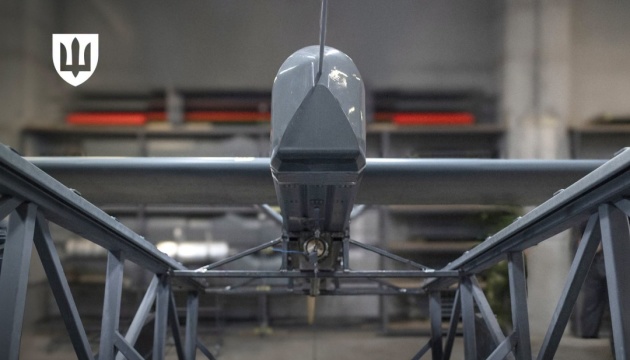
MV11 from the MAGURA family

Ukraine has unveiled the largest robot boat in its Magura sea-drone family, and this one is built to carry and launch other drones instead of ramming enemy ships, the company UFORCE told Militarnyi. UFORCE showed the new V11 during Ukraine's Independence Day drone parade, signaling a move from single-use attack craft toward a floating base at sea.

Ukraine has fought its Black Sea war with throwaway robot boats—cheap, one-way, built to hit a ship and go down with it. Shifting toward reusable platforms that keep other machines running far from any coast marks a different bet.

A floating base, not a battering ram

The V11 is the biggest drone in its class. Earlier, Magura boats were made to hit warships. This one is a transport platform that carries other unmanned systems and gear. Its main feature is the ability to launch a larger number of unmanned systems straight from its deck, turning one boat into a mobile base for them. The company refers to the drone as both the V11 and the MV11.

australia spending billions drones — ukraine says can make money count new ukrainian maritime magura v7 (left) older v5 2025 militarnyi has offered share its combat-tested drone technology battlefield expertise
Explore further

American defense company Red Cat announces serial production of copy of Ukraine’s Magura V7 and says it’s their own development

What the V11 can do

UFORCE says the drone carries up to 2,200 kg (about 4,850 pounds) and can stay at sea for up to seven days. The company built it for reconnaissance, surveillance, support of landing operations, and resupplying fuel and equipment to other naval drones.

"It is a platform that provides multi-domain capability: one carrier that carries and launches other unmanned systems far from shore for operations across all domains," said Oleh Rogynskyy, CEO of UFORCE.

He said the investment the company attracts works for Ukraine's Defense Forces.

From strikes to a US production line

UFORCE's design and engineering office in Portugal developed the V11, drawing on international investment and aiming at the needs of Ukraine's Defense Forces. Its work there was first reported in September 2025.

meet magura w6 ukraine's latest threat russian warships drone funded pumb bank being presented hur 2025 5398010383781982294 ukrainian military intelligence has received new-generation maritime part its continued efforts challenge naval
Explore further

Meet the Magura W6: Ukraine’s latest threat to Russian warships

In July, the company and the US firm ReconCraft signed a memorandum for the licensed production of Magura naval drones in the US. Ukraine's Magura boats have forced Russia's Black Sea Fleet back to safer ports, and some versions have even shot down Russian fighter jets.

  •  

Russia’s attack drones now jam the cheap interceptors sent to kill them

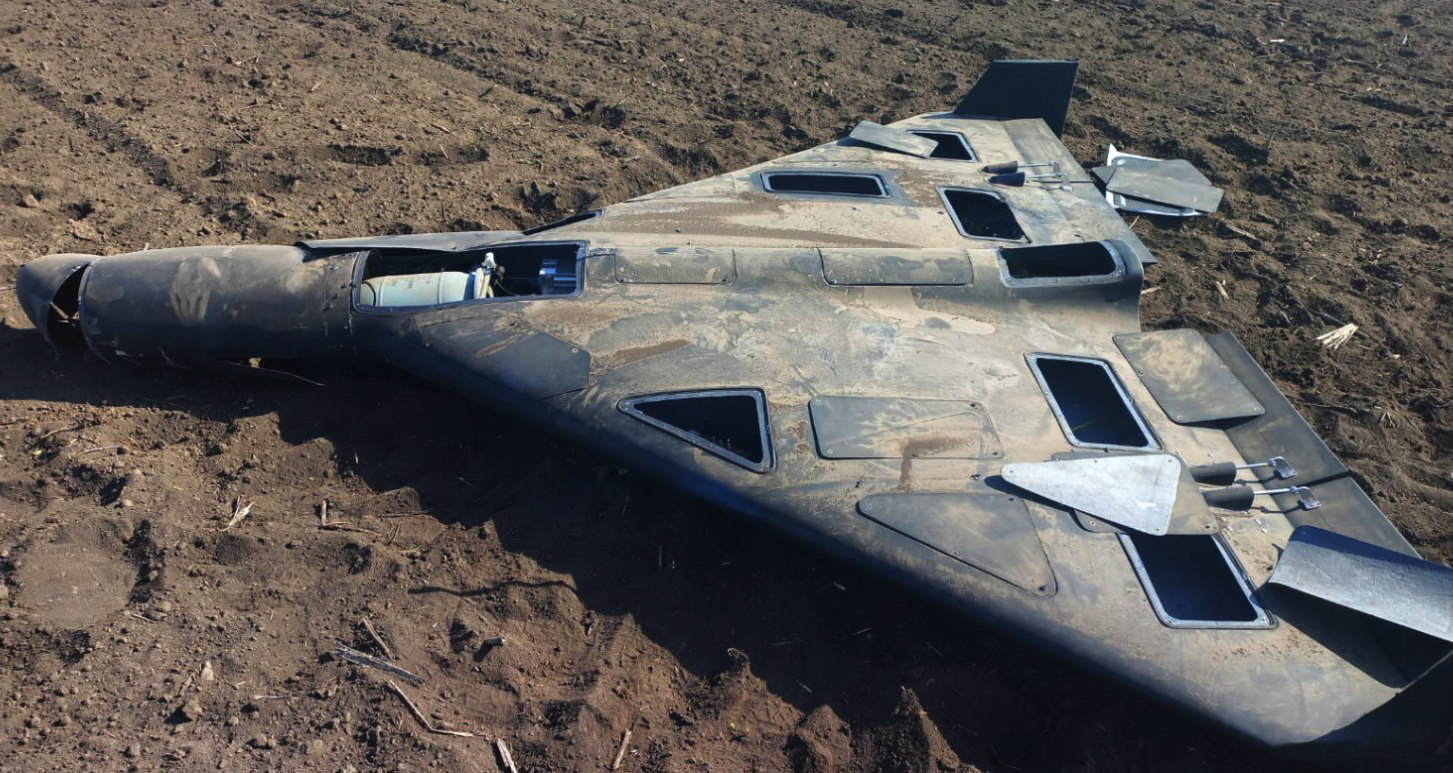
Electronic warfare equipment from Shahed drones.

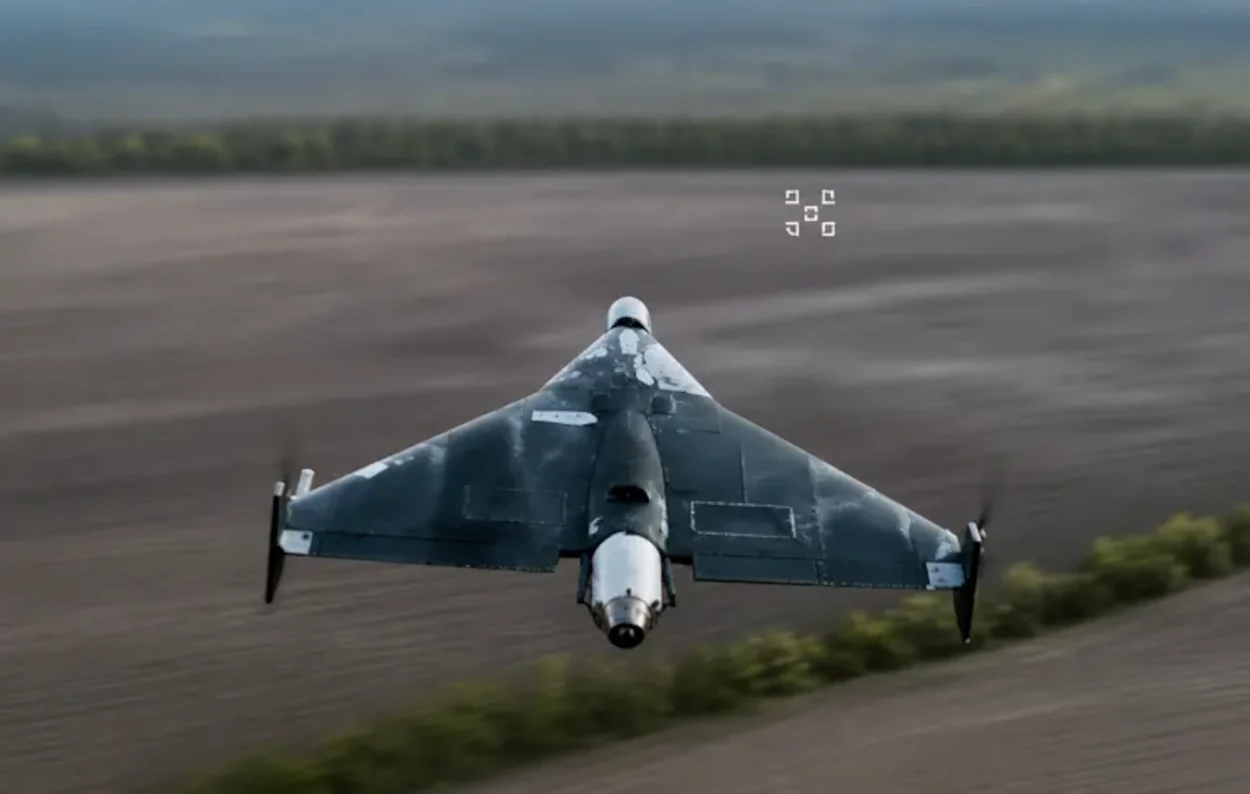
Ukraine's cheap interceptor drones have been knocking Russia's nightly attackers out of the sky, so Russia has now bolted a jammer onto some of its own drones to blind them, according to Serhii "Flash" Beskrestnov, an adviser to Ukraine's President on defense technology. He examined the system, found in drone wreckage, and mapped how it strikes back at the interceptor sent to hunt it.

Russia batters Ukrainian cities with long-range drones most nights, and Ukraine has leaned on a cheap shield—drones costing a few thousand dollars—instead of burning through far pricier missiles. Anything that dulls that shield pushes the cost of defending the sky back up.

A jammer that waits for the interceptor

The unit rides on a Geran, Russia's version of the Iranian Shahed one-way drone. It listens for the video signal an approaching Ukrainian interceptor beams back to its pilot. Its receiver reads the interceptor's working frequency, then orders a transmitter to bury that same channel in noise, Beskrestnov found.

A Ukrainian Hornet drone spots another Hornet. Photo: Ukraine's 1st Azov Corps
Explore further

How Ukraine uses AI to guide long-range drone strikes through electronic warfare and deep into Russian-controlled rear areas

By his first estimate, the jammer's signal runs about five times stronger than the interceptor's video link—enough to wipe the picture and any chance of steering the drone onto its target.

Seconds decide it

In Beskrestnov's account, the system detected a test transmitter and switched on jamming after about three seconds, and the feed cut out. The device stays nearly idle until a hunter comes close, then jumps to full power to smother the signal. It targets the ordinary analog video band around 5.8 gigahertz that many cheap interceptors still use.

Possible answers, include interceptors with terminal-guidance homing for the final stretch of flight, digital communication links, or transmitters set to non-standard frequencies.

“two targets ammo one drone” how ukrainian drone crew hunts russian transport behind front line · post arti schultz daria moskalets/ armiyainform ukraine news reports
Explore further

“Two targets and ammo with one drone”: How a Ukrainian drone crew hunts Russian transport behind the front line

An old problem for Russia's drones

Russia has tried again and again to keep its one-way drones alive against Ukraine's defenses, including wiring jammers into some Shaheds earlier this year. Spending weight and power to protect a drone from a far cheaper interceptor shows how well those cheap drones work.

  •  

Russia grinds up the eastern approach to Sloviansk after its northeastern push stalled

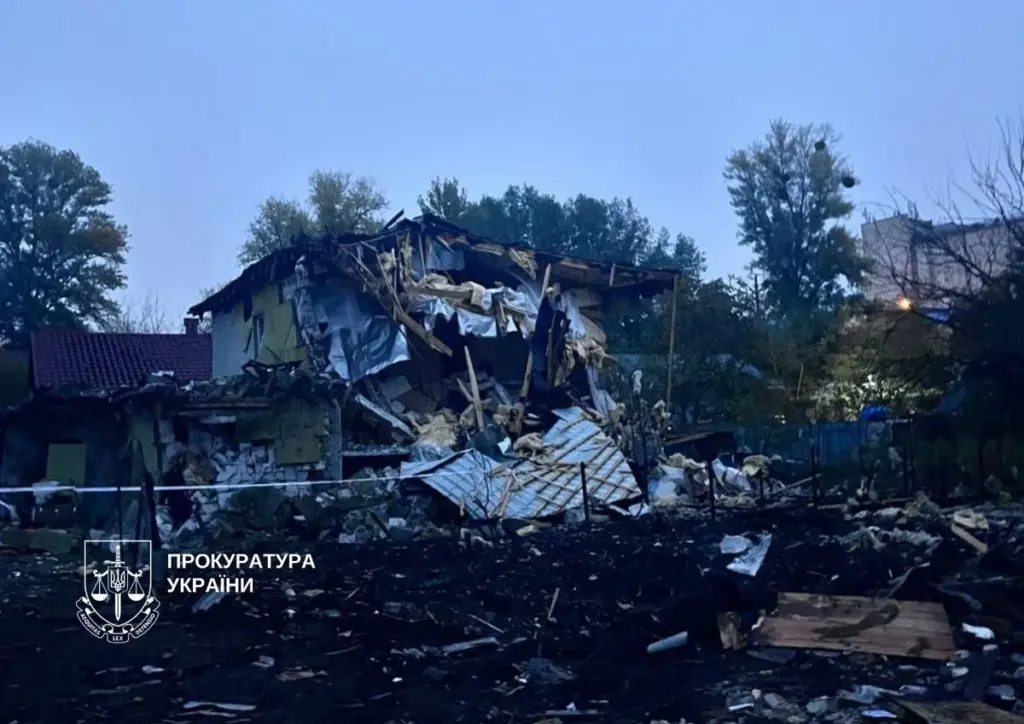
The aftermath of the destruction following one of the strikes in Sloviansk

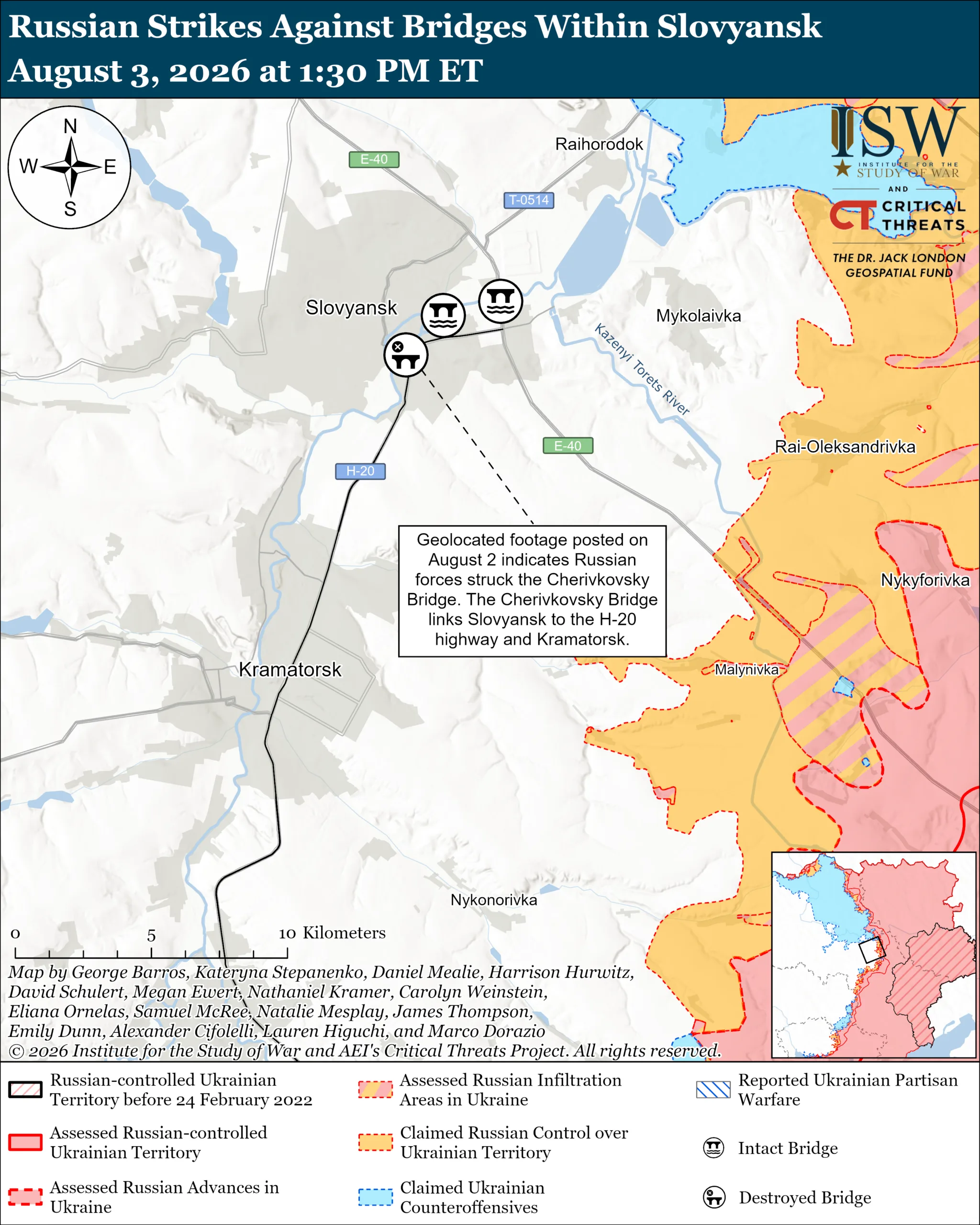
Russian forces have gained ground on the eastern approaches to Sloviansk and continue to prioritize an eastern route toward the city, according to the Institute for the Study of War (ISW). Their earlier push from the northeast had bogged down, and Russia now aims to set up a future assault on one of the last major cities Ukraine still holds in Donetsk Oblast. A quick move on the city itself remains extremely unlikely, ISW said.

Russia's 2026 summer campaign in the east has advanced through field edges and small villages rather than the breakthroughs the Kremlin keeps promising, the grinding pattern that has defined the fighting across Donetsk Oblast for years.

Destroyed Kostiantynivka
Explore further

Kostiantynivka: Why one city in Donbas matters so much that Putin lies about having captured it

The eastern approach

Ukrainian military observer Kostiantyn Mashovets reported that Russian forward units are advancing across several tactical areas at once in the Sloviansk direction. He said the command of Russia's 3rd Combined Arms Army rushes assault infantry forward right after each successful infiltration. Russian troops reached the southeastern edge of Pyskunivka, east of Sloviansk, from the east and northeast, moving off positions they had seized on the southern bank of the Siverskyi Donets, Mashovets said. Zakitne lies northeast of Pyskunivka and Kryva Luka southeast of it, and ISW read the advance as evidence Russia has consolidated positions in both.

They also infiltrated the southern and southeastern outskirts of Mykolaivka from western Rai-Oleksandrivka. ISW assessed that Russia is running a dual effort to connect its units near Kryva Luka with those at Rai-Oleksandrivka, so it can assault Mykolaivka from dominant terrain to the east and south at once. Mashovets added that other Russian groups slipped through three settlements along the E-40 Bakhmut-Sloviansk highway, trying to hold the western bank of the Siverskyi Donets-Donbas Canal and reach the river just east of the city.

ISW observed reports on 23 August that Ukrainian forces repelled a Russian infiltration attempt in Mykolaivka.

Oleksandr Borodin, spokesperson for Ukraine's 3rd Army Corps, said the Lyman direction falls in his corps' zone and that Russia's goal there is to half-encircle the Sloviansk-Kramatorsk agglomeration from the flank—first securing bridgeheads across the rivers, then cutting logistics. He called those plans unrealistic:

"We have quite serious defensive positions there and have been preparing for a long time. The capabilities they currently have to try to accomplish this task are insufficient even to come close to achieving such a goal."

Why Moscow switched directions

Russia prioritized attacking Sloviansk from the northeast through Lyman when it opened its spring-summer 2026 offensive, but that effort has largely stalled. The Siverskyi Donets River, which loops north and northeast of the city, together with a web of canals, handed Ukrainian defenders a natural moat. So Russian commanders now treat Mykolaivka as a key prize. Taking it would let them strike west toward Sloviansk from the east, skirting the water obstacles that blocked the northeastern route.

Soldiers of the 93rd Separate Mechanized Brigade’s Fox Crew prepare for a logistics run near the Kramatorsk–Kostiantynivka road in Donetsk Oblast. The unit, once focused on anti-tank warfare, now uses strike drones to disrupt Russian supply lines. Credit: 93rd Separate Mechanized Brigade / Fox Crew.
Explore further

Ukrainian intelligence units will not help: Analyst warns that once Russia breaks into Sloviansk and Kramatorsk, reinforcing them only delays inevitable

A slow road into the Fortress Belt

Sloviansk anchors the northern end of Ukraine's Fortress Belt, a chain of fortified cities that has blunted Russian advances in Donetsk Oblast since 2014. ISW cautioned that Russian forces are extremely unlikely to make fast gains west of Mykolaivka, since they still need to seize several more settlements first.

Ukraine's President Volodymyr Zelenskyy said on 23 August that Putin has ordered his army to seize all of Donetsk Oblast by 31 December. By ISW's count, it is the 15th such deadline since 2022, and Russia has missed every one that has come due.

Zelenskyy put Russia's frontline casualties this year at around 267,000, including about 155,000 killed, and said 70% to 80% of them fall in the Kostiantynivka direction. Russia holds about 79.89% of Donetsk Oblast, by ISW's count, and Zelenskyy said the Kremlin is preparing to mobilize around 300,000 men after the 18–20 September State Duma elections, partly to reinforce Donetsk and Luhansk oblasts.

  •  

No GPS, no landmarks—how Ukraine’s drones hunt Russian spy drones far out over the Black Sea

Ukraine sea drone USV machine gun naval

Ukraine is building a sea-facing layer of air defense along its southern coast, Kyrylo Liukov, head of the unmanned technologies department at the Serhii Prytula Foundation, wrote in a column for RBC-Ukraine. Winged interceptors now reach the Russian spy drones that guide strikes in the south.

Russia's nightly drone strikes on Ukrainian cities have turned air defense into a race to close every corridor Russia can fly through, over land first and now over the open sea. Kyiv does it with cheap interceptors rather than costly missiles, and keeps having to chase Russian workarounds. The sea was the stretch air defense could not reach, and it is where Russia keeps the spotters that make its Shahed swarms steerable.

Land and sea are two different fights

Defending the sky over land and over open water are two different problems, Liukov wrote. Multirotor copters are fast and simple to launch near the coast, but past roughly 25 km offshore, a multirotor is almost useless. Russia builds its mission routes so that drones cross dozens of kilometers over sea before they turn toward Ukrainian targets. Fixed-wing drones close the gap. Built like gliders, they loiter for over an hour and hold a link at 40 km and beyond, helped by an open radio horizon that land's terrain and buildings deny them.

Recon drones are the priority target for a reason. Beyond spotting and confirming hits, they work as relays in a MESH network for a group of strike drones. In that setup, Russian crews can steer Shaheds by hand right up to the moment of impact, Liukov wrote.

Southern units recently set three distance records with foundation-supplied interceptors. The 18th aviation commandant's office of Air Command South downed a Russian Orlan-30 reconnaissance drone 110 km out. It used a Wovkulaka Spitfire interceptor, the longest kill on record for that system.

The 12th Separate Special Purpose Center set the other two, flying a system from the miltech company TechnoTaras: an Orlan downed at 86 km, and a 145 km hunt measured from the takeoff point that held a stable digital link the whole way, Liukov wrote. That leaves Russia's drones exposed much farther from shore than its planners assume, he added—and if such results become routine, Russia has to pull its transit routes farther out still.

The Maiachnia beacon line

A less obvious problem was navigation, not shooting. A drone flying without GPS steers by landmarks, and over open sea, there are none. Late last year, the foundation, the 12th Separate Special Purpose Center, and TechnoTaras launched a project called Maiachnia. It strings radio beacons on the Skyline system along the coast from Ochakiv to Izmail. The beacons work on their own and keep backup power, tied to a central network that operators can adjust remotely. An operator can then track the drone even under GPS jamming, bad weather, or a temporary loss of link, and bring it home. More than five southern units now fly the foundation's winged drones.
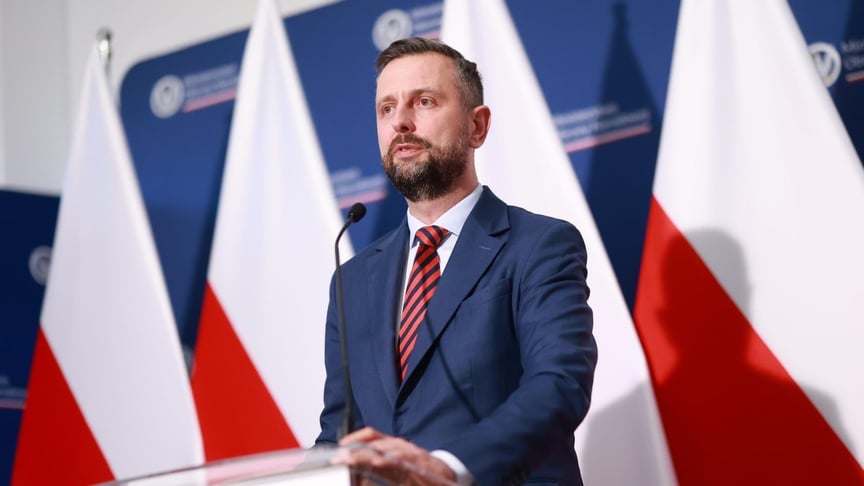
The real stakes sit offshore—the southern ports and the Black Sea grain corridor that Russian drones threaten and that land-based copters can barely reach. Keeping Russian drones farther offshore would buy room there. But Russia is scaling up a faster, jet-powered Shahed, and the interceptor answer to it is early—so the offshore edge just won will have to be defended again.

  •  

Italy’s largest arms maker had no plans for a Ukraine factory—a year later, it has a Kyiv subsidiary

Kronos Grand Mobile HP radar station

Italian defense giant Leonardo has quietly registered a research subsidiary in Kyiv, planting a direct corporate flag in Ukraine's wartime defense ecosystem, Euractiv reported. The move reverses the company's previous public stance against opening operations in Ukraine.

European defense firms are quickly embedding inside Ukraine's defense industry, as Ukraine's wartime manufacturing base has become a draw rather than a risk for Western capital.

Kyiv-based R&D company

Leonardo Ukraine appeared in Ukraine's business register on 20 May, but the company disclosed the step only in its H1 2026 financial report at the end of July. The subsidiary's share capital stands at about $125,000. Leonardo International wholly owns it.

"We have completed the legal process to begin operations. The new company will be used to work in this region," a Leonardo spokesperson said.

The subsidiary will focus on R&D covering communications and navigation systems, software, IT services, and electronic and optical technologies. The step brings Leonardo closer to Ukraine's drone and missile industry, which has expanded rapidly during the war.

Italian-flag
Explore further

Italy wants continental defense alliance, including Ukraine. Kyiv already out-produces all of NATO on drones

From no factory to a Kyiv office

Just over a year ago, then-CEO Roberto Cingolani said that Leonardo had no plans to open a factory in Ukraine, as Reuters reported. At the same time, Cingolani pledged to test Leonardo's Michelangelo Dome air defense system in Ukraine. The Italian government did not reappoint him in April 2026. Lorenzo Mariani took over as CEO in May.

The subsidiary is not a factory. But it gives Mariani a registered legal presence inside Ukraine's defense innovation ecosystem, positioned near the drone and electronic warfare sectors Leonardo wants to tap.

Explore further

Yes, Italy is arming Ukraine — here’s what military aid data shows

Leonardo is not the first major European defense firm to set up inside Ukraine. Germany's Quantum Systems established three joint ventures and made the country its second-largest international base. Rheinmetall is building an ammunition plant there. Ukrainian defense companies, in turn, have opened production facilities across Europe.

  •  

Bradley IFVs won battles in Ukraine. The parts to keep them running went out of production

The M2A4E1 Bradley variant at Saco, Maine.

The US Army Contracting Command—Detroit Arsenal has published a market survey seeking companies that can supply components for M2A2 ODS-SA Bradley infantry fighting vehicles (IFVs) headed to Ukraine—parts that original manufacturers have stopped making. The posting asks for firms with immediate access to the components or a realistic plan to restart their production, Militarnyi reported.

Maintaining Western armored vehicles in active combat has strained repair chains throughout the war, with licensing requirements and long lead times slowing restoration of battle-damaged equipment. When components go out of production entirely, the problem shifts from delayed repairs to no repairs at all.

Parts nobody makes

The survey targets components affected by what the command calls an aging manufacturing base. Original suppliers have discontinued production of multiple subsystems, including turret drive control units, transmission control modules, heater mounts, ammunition chutes, specialized Dialight Corp lens assemblies, and other structural, electrical, and mechanical parts unique to the M2A2 ODS-SA.

The Ukrainian Army's Bradley IFV.
The Ukrainian Army's Bradley IFV. Photo: Ukraine's General Staff

The posting is not a tender and does not guarantee a contract. Its stated goal is to identify companies that can either deliver the parts now or credibly restart production.

Restoring and sustaining Bradleys for Ukraine

The parts shortage creates a two-stage problem. Before Bradleys can be shipped to Ukraine, the US military refurbishes them at its depots—restoring each vehicle to combat-ready condition under a standard called Fully Mission Capable + Safety. Without the discontinued components, that refurbishment stalls.

Driver of an M-2 Bradley.
Explore further

Ukraine’s M-2 Bradleys engage Russian infantry at point-blank range

The same parts are also needed to keep Bradleys already fighting in Ukraine on the road. The posting specifies that field servicing must proceed without delays caused by parts shortages—meaning the crisis affects both the pipeline into Ukraine and the fleet already there.

Potential contractors must demonstrate repair and technical validation capabilities, supply chain management, and the ability to quickly resume manufacturing of parts that no longer have a producer. The command requires a detailed transition plan with a timeline from contract signing to the delivery of the first restored vehicle.

The US also plans to involve the future contractor in training Ukrainian military mechanics. The contractor would develop courses, manuals, and provide specialized tools and equipment—including instruction on armored recovery vehicles.

Explore further

Chile secretly sells 30 Marder IFVs to Germany in likely Ukraine ring exchange

The 25-mm cannon, stops T-72s, if the turret still turns

The M2 Bradley carries infantry into combat and mounts a 25-mm M242 Bushmaster cannon that fires up to 500 rounds per minute and can defeat Russian light armored vehicles and the side and rear armor of main battle tanks. The US has supplied more than 200 Bradleys to Ukraine under the previous administration, with combat losses mounting across multiple frontline sectors.

Separately, the US Army presented XM30 infantry fighting vehicle candidates at the Michigan Defense Expo 2026—the program is eventually designed to replace the Bradley.

  •  

Belgium lines up a “drone deal” to tap Ukraine’s war-tested know-how

Volodymyr Zelenskyy, President of Ukraine, and Maxime Prévot, Belgium’s Deputy Prime Minister and Minister of Foreign Affairs, European Affairs, and Development Cooperation

Ukraine and Belgium are drawing up a bilateral agreement to deepen cooperation on drones, President Volodymyr Zelenskyy said after meeting Belgian Foreign Minister Maxime Prévot in Kyiv on 18 August. The two also discussed strengthening Ukraine's air power and shielding it from Russian attacks.

Cheap drones now decide much of the fighting, and Kyiv has turned years of learning to fly and defeat them into leverage—trading that edge for weapons and money with a lengthening line of Western partners.

A new deal takes shape

Teams on both sides are now writing the text of the Drone Deal and weighing possible dates to sign it, ArmyInform reported. Ukraine is ready to share its own expertise in unmanned systems with partners, Zelenskyy said.

Defense ran through the meeting, with both sides focused on strengthening Ukraine's combat aviation and defending its skies.

"I expect that we will be able to implement what we discussed, and there will be more protection from Russian strikes," Zelenskyy said.

Belgium has promised 30 F-16 fighter jets—the largest F-16 pledge from any single country—though none have reached Ukraine yet, with deliveries tied to Belgium's own switch to newer aircraft.

For the first time, Ukrainian soldiers marched among the foreign troops in Brussels on 21 July 2026. Source: Freedom
Explore further

“First time”: Ukrainian troops joined Belgium’s National Day parade in Brussels

Belgium's deeper backing

Zelenskyy thanked Belgium for more than $1.28 billion in support this year, covering defense and civilian needs alike, and for backing Ukraine's move toward the European Union. The military share flows from a standing pledge: since 2025, Belgium has committed to at least $1.16 billion in defense aid a year.

A 2024 security pact locked in that relationship, making a small Western European country one of Ukraine's steadier partners. Belgian firms also service the F-16s Ukraine already flies, the jets delivered by other partners in the coalition.

  •  

1.2 million weapons in a year: Inside Ukraine’s Amazon-for-arms that ships to the frontline in 24 hours

A Ukrainian drone operator.

Ukraine's weapons marketplace DOT-Chain Defense has compressed delivery times from months to weeks after one year of operation, the country's Defense Ministry reported. For the fastest product categories—electronic warfare gear, ground robots, interceptor drones—orders now reach units within 24 hours.

Ukraine's war against Russia's invasion has pushed Kyiv to rebuild military procurement from the ground up, trading slow bureaucratic pipelines for digital platforms where frontline units pick and receive their own weapons faster than Western militaries have managed. Domestic manufacturers now make 90% of newly authorized systems.

Fastest deliveries measured in hours

The Defense Ministry and the Defense Procurement Agency DOT have jointly driven the acceleration, according to the ministry's statement.

"Delivery times for drones and other systems have shrunk from months to a matter of weeks, and often to days," the ministry said.

Beyond that general compression, several categories saw delivery within a single day. Electronic warfare systems, ground robotic platforms, reconnaissance and bomber drones, interceptor drones, and FPV drones on both fiber-optic and radio control all reached units within 24 hours. Ammunition for unmanned systems arrived within six days.

Four-image collage showing drone wreckage found on Romania’s coast and in nearby waters, including wing fragments, an engine and propeller, and exposed electronics.
Explore further

Russian drone attacks on Ukraine’s Danube ports hit recent high, Romania says

Over the first year, the platform shipped more than 1.2 million drones and other systems. Units now choose from 1,181 products made by 300 domestic manufacturers.

How the marketplace works

DOT-Chain Defense supplements centralized state supply rather than replacing it, the ministry noted. Combat units use allocated funds to browse and order the equipment they need for their section of the front. The marketplace handles contracts, payments, and delivery.

The platform's drone constructor tool lets units customize drone configurations before ordering. A dedicated training course on using the marketplace recently launched inside the Army+ mobile app.

ukraine timed its huliaipole operation around weather — worked here's why won't happen again soon · post ukrainian soldier 92nd assault battalion machine gun 2026 armed forces infantry frontline operations
Explore further

US copies Ukraine: Washington launches Amazon-backed UAVs marketplace, inspired by Kyiv’s Brave1 Market and DOT-Chain Defense

Broader procurement picture

The one-year milestone caps a period of rapid scaling across Ukraine's defense procurement. The country contracted about $8 billion worth of drones in the first half of 2026—double the same period last year, according to the Defense Ministry.

More than 400 combat units now shop for weapons through the marketplace's companion Brave1 Market program using points earned for confirmed battlefield activity. Washington modeled its own Unmanned Aircraft Systems Marketplace on the Ukrainian original earlier this year.

  •  

NATO army bought Russian missiles and now it can’t give them away

A Russia's S-400 air defense system launchers.

The US plan to sell Türkiye F-35 stealth fighter jets has stalled, blocked by a Russian missile system Ankara bought years ago, Semafor reported. Lawmakers in Washington won't clear the deal while Türkiye keeps the hardware. The lone buyer in talks hasn't budged, and destroying the system is now on the table.

Russia has long used arms exports to pull buyers into its orbit, and the war it started raised the price of those ties—leaving governments that bought Russian air defense to clash with the supplier that sold it.

The Russian system is in the way

US sanctions law bars Türkiye from the F-35 program while it retains the Russian S-400, Semafor reported. That system is a long-range air defense, built to shoot down planes and missiles. Ankara already paid for six of the jets. They have sat in the United States since Washington expelled Türkiye from the F-35 program in 2019. US President Donald Trump announced plans to sell the jets more than a month ago, and nothing has moved since.

türkiye wants send ukraine old us-made cluster munitions—one human rights group fighting stop · post atacms missile launch lockheed martin news ukrainian reports
Explore further

Türkiye wants to send Ukraine old US-made cluster munitions—one human rights group is fighting to stop it

No buyer, no easy exit

One way out is to sell the S-400 to another country. Türkiye reportedly opened talks with the United Arab Emirates (UAE) last month, but they don't appear to have progressed. American lawmakers insist Ankara must give up the system entirely first.

Republican Senator Rick Scott told Semafor that Türkiye shouldn't get the jets unless it becomes a true partner—"so if they have the S-400, they cannot have the F-35." Senate Foreign Relations Committee Chairman Jim Risch, a longtime opponent, said the process is "at a standstill."

A Russia's S-400 air defense system launchers.
Explore further

Erdoğan asks Putin to take back Russian S-400 SAM systems in move to win Trump’s favor

Israel and Congress are the live block

The sharper obstacle sits in Washington, Semafor reported. A vote to sell would pit Israel against a NATO ally, and many of Trump's own allies want the S-400 scrapped completely. Israeli Prime Minister Benjamin Netanyahu warned the jets could "destroy the power balance in the Middle East." The outlet said AIPAC, the leading pro-Israel lobby in Washington, is pressing Congress to keep the block.

Selling it still runs through Moscow

Any resale carries its own catch: Russia must approve the transfer of the S-400, giving the Kremlin a reason to block it. The only option that bypasses Moscow is to disable or destroy the system outright. Türkiye earlier tried to return the systems to Moscow, hoping to thaw relations with Washington. It didn't work.

The Trump administration says Ankara hasn't met all the conditions to buy the jets, and the State Department wants the S-400 issue settled with guarantees first.

  •  

Latvian public broadcaster opens new charity drive for Ukraine’s wounded

Latvian flag, illustrative image. Photo via Eastnews.ua.

Latvia's public broadcaster opened a new fundraising drive on 17 August to pay for the rehabilitation of wounded Ukrainian soldiers, LSM reported. The effort is timed to Ukraine's Independence Day on 24 August. Donations run through the charity Ziedot.lv.

Russia's invasion has produced a generation of wounded and traumatized Ukrainians whose recovery will outlast the war. The state already counts more than a million registered veterans, a number that climbs every month.

A new channel for Ukraine's wounded

The drive, called "Together with Ukraine in Thought and Deed!", runs from 17 August to 13 September 2026. Latvian Public Media (LSM) organized it with Ziedot.lv and the Ukrainian Embassy in Latvia. It is dedicated to rehabilitation. Organizers said every euro goes to that goal. Latvians can give online through Ziedot.lv, or by calling a national donation line charged at €5 including VAT.

"Fighting for the security of us all"

The campaign's ambassador is Odita Krenberga, an LSM journalist who has reported from the Ukrainian front line. She said only seconds separated her from death or serious injury, and that many others never got that chance. Russia has taken hundreds of thousands of lives and wounded even more, she said, calling it a painful injustice. Ukrainians, she added, are fighting "for the security of us all, for a safe Europe."

Wounds that take years to heal

Rūta Dimanta, who heads Ziedot.lv, said "the wounds of war take a long time to heal." They are not only physical, she said, but also the pain of loss, helplessness, and injustice. Soldiers must live with the deaths of comrades and the pain in their souls. The money cannot erase that, but it can fund recovery in Ukraine and Latvia, allowing them to carry on with their lives.

Latvia keeps giving

Since the war began, LSM and Ziedot.lv have raised more than €2 million across earlier appeals. The two partners have already sent Ukraine a locally built naval drone, and Latvia has funneled millions to front-line oblasts on the Russian border. Latvia has also pledged 0.25% of its GDP a year to Ukraine's defense—a bigger share than most larger allies give.

  •  

Ukraine still hands Kremlin opponents back to Russia—even now

Chechen volunteers fighting on Ukraine’s side during training.

Ukraine condemns Russia for jailing people on fabricated terrorism charges. Yet, its own security services keep sending Kremlin opponents back to Moscow, human rights defender Borys Zakharov said in an interview with Ukrainian outlet Texty.org.ua.

The handovers are not a relic of a friendlier past. They slowed after Russia's full-scale invasion in 2022, then resumed; the transfers now run through third countries, Zakharov says, and at least one has ridden the prisoner swaps that bring Ukraine's captured soldiers home. Ukraine is returning the exact people who bet their lives on it; at the moment, it presents itself to the world as the rule-of-law side of this war.

A double standard, few in Kyiv discuss

Zakharov directs the charitable foundation Human and Law, which defends people fleeing authoritarian states. Russia prosecutes captured Ukrainians on invented terrorism charges, and Kyiv rightly calls it a sham. But when Chechens, Ingush, and other North Caucasians ask Ukraine for protection, officials sometimes brand them criminals and send them back—men who often fled two brutal Chechen wars and the crackdowns after them, and some of whom later fought Russia in volunteer units.

"We say: yes, they are criminals. We hand them over to Russia to die," Zakharov said.

International law forbids this. The principle of non-refoulement bars any state from returning a person to a country where they face death, persecution, or torture. Zakharov says Ukraine's migration authorities often skip that risk assessment entirely.
The cases the West never heard about

Take Timur Tumgoev, an Ingush volunteer fighter whom Ukraine extradited in September 2018. A Russian court sentenced him to 18 years on terrorism charges, his defenders call fabricated. Zakharov says he was tortured so badly that he can barely move.

Timur Tumgoev
Timur Tumgoev. Photo: North Caucasus Service

Others escaped by luck. Ukraine nearly removed Zelimkhan Belkharoev, a wrestler, in 2016 despite an emergency order from the European Court of Human Rights, Zakharov says; a deputy justice minister intervened in time. Adam Osmayev, a Chechen battalion commander whose wife Amina Okueva was killed in a 2017 assassination attempt, was saved the same way years earlier.

Why did it not stop after 2022

The war did not end the handovers—it rerouted them. Direct extraditions paused; the transfers now run through Belarus, Moldova, and Turkiye, Zakharov says.

Russia hunts kills protest targets civilians with drones stop human safari save kherson
Explore further
Russia hunted civilians by drone in Kherson. Victims are suing the US firm they say helped connect the attackers

Zakharov says Zaur Shogentsukov, a Kabardian who crossed from Belarus to join Ukraine's forces, allegedly failed a polygraph test with the Security Service of Ukraine (SBU) and was pushed back into Belarus under a readmission deal. His tortured body later came back to his family in Nalchik, he says.

Alexey Gerasimov, a student from Russia's Chuvash region who reportedly backed his homeland's independence, slipped into Ukraine in 2024 to join the Sibir Battalion, a unit of Russian volunteers. He ended up in one of the large prisoner exchanges that followed the May 2025 Istanbul talks, and Ukraine delivered him to Russia, where he now faces terrorism charges—the independent Russian outlet Verstka reported in an investigation carried by Novaya Gazeta Europe.

Ella Skybenko, the Eastern Europe and Central Asia Senior Researcher at the Business & Human Rights Resource Centre, at the B4Ukraine. Source: B4Ukraine
Explore further

Russia stops war only for one reason — and Ukrainians feel betrayed that Europe won’t act on it: Human rights expert names it

The most recent case is still unfolding. Aslan Khakimov, a Russian engineer who fled the Federal Security Service (FSB) in 2015 and spent years building robots for Ukraine's army, has sat in a migration facility since April 2026, accused of financing terrorism and facing deportation.

The most recent case is still unfolding. Aslan Khakimov, a Russian engineer who fled the Federal Security Service (FSB) in 2015 and spent years building ground robotic systems for Ukraine's army, entered on forged documents and lived for a decade under a false identity, Ruslan Puptaiev—the illegal stay Ukraine's migration service cites for the deportation order it issued in April 2026. Russia has separately convicted him in absentia of terrorism, a charge his defenders call fabricated. His supporters argue that returning him would be a death sentence.

Ukraine's services frame these as wartime security decisions, and infiltration is a genuine risk. But non-refoulement admits no wartime exception: even a proven spy is not a country's to send to his death.

The money question

Zakharov offers a blunter explanation for at least some cases: money. In the Tumgoev handover, he says, the man's family was quietly invited to outbid Moscow—to top the sum Russian handlers allegedly pay SBU officers for each person delivered.

"Totalitarian regimes spare no money persecuting their opponents," he said.

Ukraine's security service has not confirmed his account, and the allegation rests solely on his testimony.

Russia, for its part, has already shown its games in these exchanges, at times swapping in people with no link to the war. As Kyiv negotiates ever-larger exchanges to free its own soldiers, the same machinery can carry the Russians and Caucasians who fought for Ukraine the other way — a propaganda gift to Moscow and a warning to the next would-be defector that Ukraine's protection may not hold. For a state that anchors its whole cause in the rule of law, that is a debt that keeps compounding.

  •  

Armor can barely reach Ukraine’s front now—so robots drive and soldiers walk

A Russian tank destroyed in Kharkiv Oblast, Ukraine

Drones have pushed armored vehicles off the roads to Ukraine's front line, a Ukrainian brigade commander told RBC-Ukraine. Denys Perch, who commands the 107th Territorial Defense Brigade, says the drone-saturated belt has grown so deep that pickups no longer reach forward positions. The one enemy weapon his jammers can't touch is the fiber-optic drone.

The war has become a contest over who can pull people off the battlefield fastest, as cheap drones make any human movement near the front a target. Ukraine keeps out-inventing Russia at the front, but Russia copies each advance and floods the line with it at state scale.

When armor becomes the target

Until recently, armored vehicles still drove supplies to logistics hubs near the front. That is now almost impossible. Perch says that when a large, armored machine appears, Russian forces treat it as a prize target and swarm it with dozens of drones and munitions. Perch would sooner park his armor than seat soldiers inside it.

A Ravlyk UGV from Ukrainian Unmanned Technologies displayed at Eurosatory 2026, here mounting twin anti-tank launchers from Ukroboronprom. (Photo: Ukrainian Unmanned Technologies)
Explore further

This Ukrainian UGV, beloved by Ukrainian intel, is now winning over NATO countries and global defense giants

A kill zone that keeps widening

On the busiest sectors, Perch says, the kill zone—the drone-ruled strip around the contact line—now runs 15 to 20 kilometers deep. Some positions take three days to reach on foot. Where troops once drove most of the way and walked the last stretch, they now walk it all.

Robots take the drive

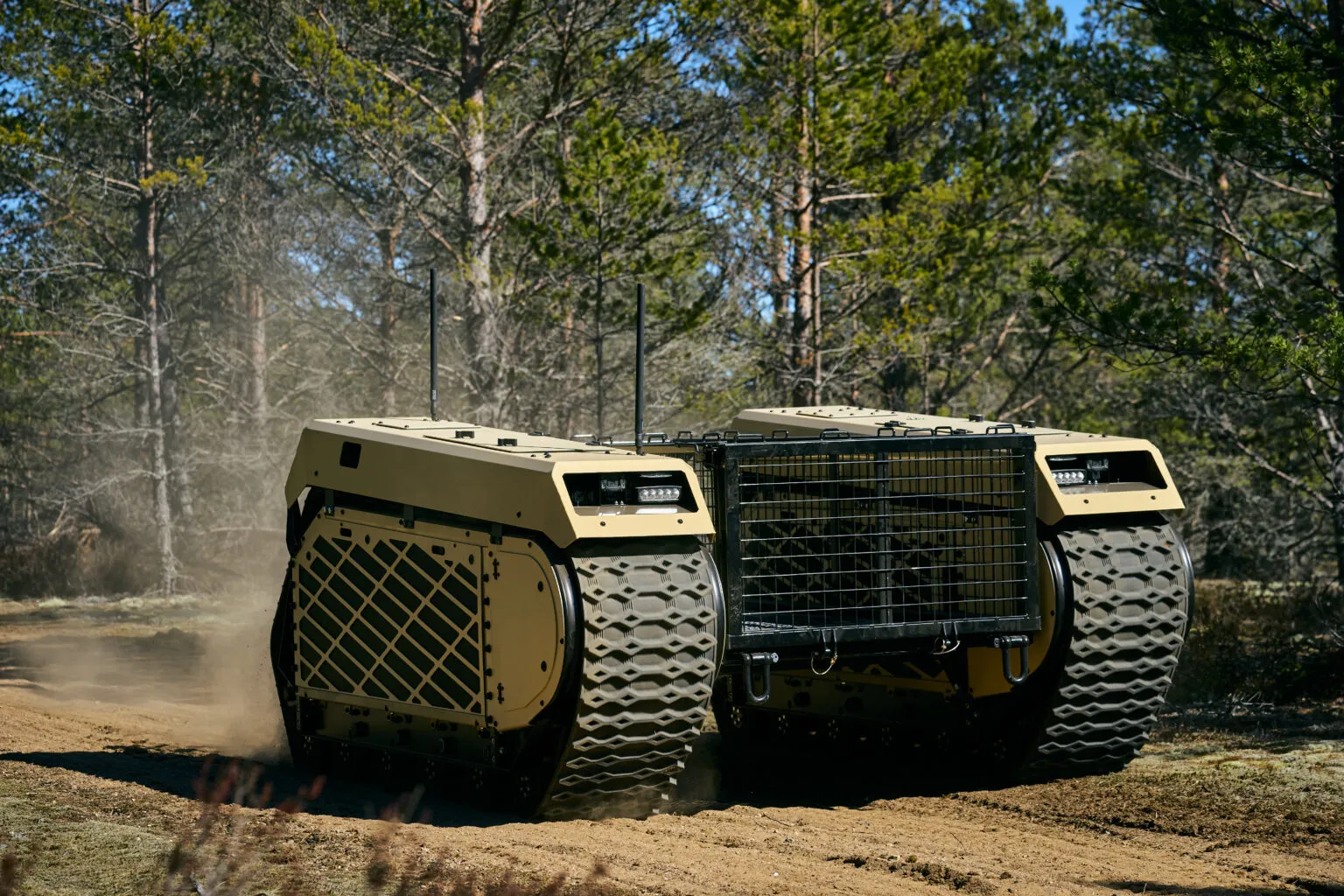
Under Perch, the brigade climbed, by his account, from around 22nd to third among Ukraine's Territorial Defense forces on the military's strike-results leaderboard, the home-guard units now fighting on the front. Ground robots—unmanned ground vehicles (UGVs)—do the work that armor cannot. They haul supplies and evacuate the wounded, though the robot often can't be brought back. His brigade runs over 1,500 logistics missions a month by heavy bomber drones alone, and still more by first-person-view (FPV) drones and robots. Russia hunts those bombers, he says, with interceptors that scramble the moment they hear one take off, so his crews mix high and low flight to slip past. Perch expects robots to move from supply runs into combat, hitting Russian troops in their rear.

A ground robotic system. The Ukrainian Defense Ministry
Explore further

Ukraine wants robots doing 100% of frontline logistics. In June, they ran nearly 17,000 supply and evacuation runs

The drone his jammers can't touch

Both armies now field fiber-optic drones—machines guided by a hair-thin glass thread instead of radio. No signal means nothing to jam. Ukraine learned to block radio and digital drones, cutting their controls and video, Perch said. The glass-fiber ones his electronic warfare cannot reach, because there is no radio link to attack. His brigade still has no counter to them, Perch said, and he wants a technical fix that stops them.

  •  

Ukraine’s drones crushed a US armored brigade in a war game in Germany

British defense firm to maintain UK-donated artillery in Ukraine under new deal

Ukrainian drone operators overwhelmed US Army troops at a training exercise in Germany this year, the Wall Street Journal reported. The drill showed how far American forces still trail on the cheap front-line drones that dominate Russia's war on Ukraine, despite billions in Pentagon spending.

Drones now decide who moves and who dies along Ukraine's front, and Western armies are scrambling to master a way of fighting Kyiv rewrote under fire—some even copying its tools and procurement wholesale.

The dust gave them away

The exercise, Combined Resolve, ran in April and May. Around 3,500 US personnel, mostly from the 3rd Armored Brigade Combat Team, tried to seize a position defended by an opposing force reinforced with Ukrainian drone troops of the 412th Regiment of Unmanned Systems Forces, or Nemesis. The Ukrainian operators "eliminated" the attacking armored brigade, US officials briefed on the drill told the Journal.

Heavy vehicles kicked up dust that reconnaissance drones caught at once. Explosive-dropping and first-person-view drones, flown straight into their targets, did the rest. Kills came so fast that US vehicles had to be "re-spawned" as fresh units to keep the drill running, a US official told the Journal.

Ukrainian soldiers from the 12th Special Forces Brigade "Azov". Source: Azov
Explore further

For first time, NATO ally built its entire military exercises around Ukrainian Azov Brigade lessons

Years of fighting Russia made the difference

Ukrainian crews have fought Russia for nearly four and a half years, repairing and adapting drones on the move, while US operators have never had to fix and arm them under fire, one person present told the Journal. Midway through, the Ukrainians switched sides and coached the Americans on attacking with drones. Eliot Cohen of the Center for Strategic and International Studies said mastering drones is now vital for the US military, and that so far it has not.

Not everyone agrees on why. Some US officers say drones dominate only because the front barely moves, and that maneuver warfare would revive the tank, the Journal noted. Ukraine's former commander-in-chief, Valerii Zaluzhnyi, argues drones have frozen maneuver for now, the reason the eastern front barely shifts.

Not the first Western army to lose

It keeps happening. Ukrainian drone teams beat British, Estonian, and other NATO troops, including Americans, at a Baltic exercise in May 2025, and outdid Swedish-led NATO forces this spring, the Journal reported. Back in 2023, a US officer training Ukrainians realized the lesson ran the other way.

What Washington is doing about it

The Trump administration, despite friction with Kyiv, has been reaching out to Ukraine, the Journal reported. It is testing Ukrainian drones it may buy, and used counter-drone tools proven in this war to defend its troops against Iran's drones. Defense Secretary Pete Hegseth said in May that he was sending more Americans to study drone warfare in Ukraine. By Washington's own reckoning, no US maker can match Ukraine's combat-forged drones.

  •  

Newer drones haven’t dethroned the FPV, and Russia fears our bomber drones, Ukrainian commander says

A Ukrainian soldier with a drone on the frontline. Photo: General Staff via Facebook

Ukraine's first-person-view (FPV) drones are not being displaced by newer unmanned systems, a Ukrainian officer told Ukrinform. They remain a central tool for precision strikes, while Ukrainian forces claim a separate advantage in larger bomber drones.

Unmanned systems have become a defining weapon of Russia's war against Ukraine, and both sides race to out-innovate each other, a contest in which a cheap UAV can down a platform costing dozens of times more.

FPVs remain central

"Since FPVs appeared in service, they have become a leading means of precision engagement. This trend will continue," said Captain Anton Bobrovskyi, who commands a company training unmanned-systems specialists at the 199th Training Center of the Air Assault Forces.

Bobrovskyi conceded that Russia also uses drones effectively and that Ukraine learns from it, but said Ukraine keeps a lead in one category: bomber drones.

The Russian Sokol-I anti-drone UAV. Source: The 57th Separate Motorized Infantry Brigade
Explore further

Ukrainian drone that downed Russia’s rarest spy UAV just bagged its anti-drone interceptor too

Ukraine's bomber-drone advantage

Russian forces fear Ukrainian bomber drones, according to Bobrovskyi. He said Ukraine outmatches Russia many times over in such systems, and that Russian troops who encounter one often do not know what to do with it.

The distinction matters because bomber drones work differently from single-use FPVs. Rather than flying into a target and exploding, larger bomber drones carry and release munitions, then fly on. Euromaidan Press has documented the growing role of these systems, including reusable platforms capable of returning to base after dropping their payloads. Developers have also adapted them to fly through Russian electronic warfare, with upgraded Vampire drones built to resist jamming.

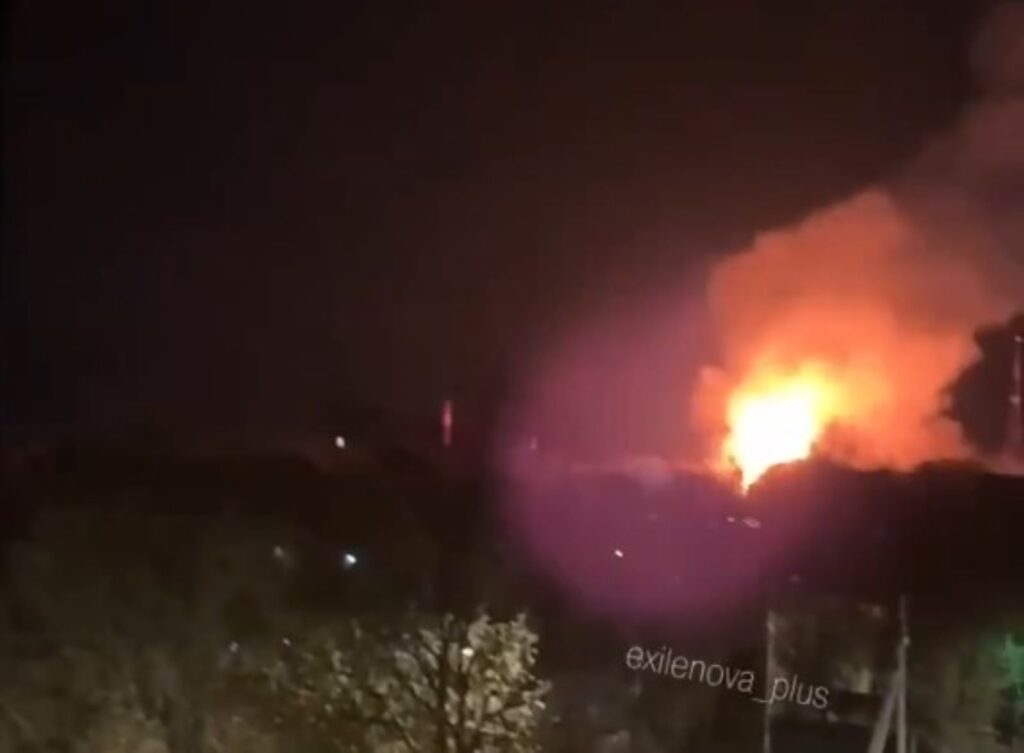
sea drones jet neptune missiles hit one russian port single night · post fire burns novorossiysk early hours 12 2026 пожежа у новоросійську ніч проти серпня фото exilenova+ ukraine news
Explore further

Sea drones, jet drones, and Neptune missiles hit one Russian port in a single night

Bobrovskyi said Ukraine's advantage does not mean Russia lacks comparable technology. Instead, he argued that Ukrainian forces and society initiated many of the current battlefield drone trends and have kept the initiative in using them.

Each new drone class draws a countermeasure, so the side that keeps iterating fastest holds the battlefield initiative. How long Ukraine's bomber-drone edge lasts will depend on its ability to keep protecting and upgrading those platforms.

  •  

Russia’s jam-resistant drones run on a Chinese modem no one has sanctioned

The radio that makes Russia's strike drones resistant to Ukrainian jamming is a Chinese-made part sold openly, and the company that makes it has escaped the sanctions hitting the rest of the drone supply chain, the OSINT group Frontelligence Insight found. The part, a mesh radio modem, has been pulled from downed Russian drones even as Western and Ukrainian sanctions expanded to cover the engines, navigation, motors, cameras, and chips around it.

Russia's war on Ukraine now runs on drones built largely from Chinese parts—a flow China keeps open to Moscow while restricting the same goods to Kyiv.

The part that isn't on any list

The modem is the XK-F358 mesh radio made by Shenzhen Xingkai Technology Co., Ltd. of Guangdong. It sells openly online. The company's Made-in-China storefront lists it at $8,100 to $9,000 apiece, and Serhii "Flash" Beskrestnov previously put the price near $7,000.

Ukraine and its partners have sanctioned Chinese suppliers of drone engines, navigation receivers, motors, cameras, and chips—one Ukrainian round aimed explicitly at parts for drones built to bypass electronic warfare—but not the radios.

A Ukrainian Security Service officer at the crash site of a Russian drone containing uranium. Source: The SBU
Explore further

Ukraine finds uranium in six more Russian drones. Their radiation readings ran up to 80 times background

Recovered from downed drones, and hard to jam

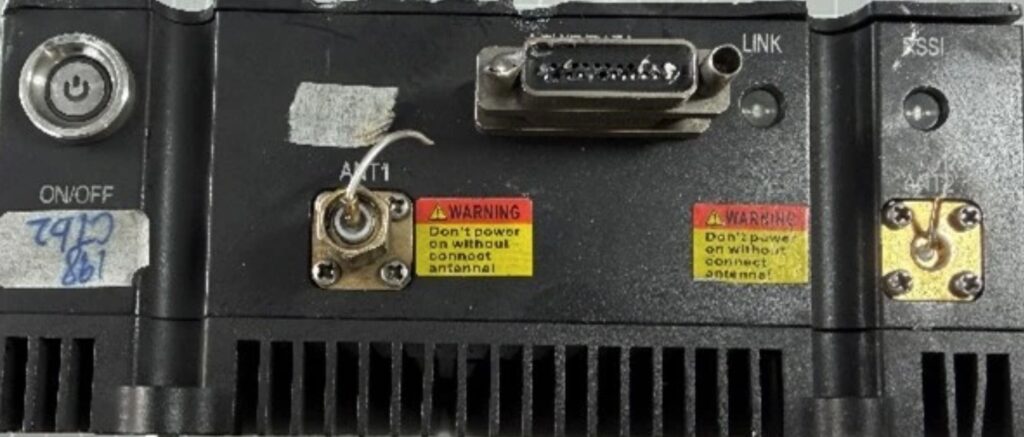
Ukraine's Defense Intelligence photographed an XK-F358 recovered from a downed Geran-5, and Beskrestnov photographed another taken from a Gerbera, Militarnyi reported on 19 January 2026.

Russia's response to electronic warfare wasn't a single solution. It evolved along two major paths: fiber-optic drones and mesh networks. This thread summarizes Frontelligence Insight analysis based on OSINT data and a report by the Center for Defense Reforms. Thread🧵 pic.twitter.com/k0v0ZeWKYB

— Tatarigami_UA (@Tatarigami_UA) July 30, 2026

The modem uses COFDM modulation and a mesh design in which each unit relays traffic for the rest, so packets reroute automatically when a node drops.

The same modem also turns up under a second name—HX-50, in a more industrial variant—and its use is no experiment: it spread onto Russia's Shahed-136/Geran-2 strike drones from July 2025 and reached serial integration by early September.

Mesh Network XK-F358 modem from the Geran-5 drone
Mesh Network XK-F358 modem from the Geran-5 drone. Photo: Defense Intelligence of Ukraine

The network keeps working after losing roughly 80% of its nodes and can link drones across more than 100 kilometers, or up to 600 in relay chains, according to Beskrestnov, a Ukrainian defense adviser who has examined the recovered units. That is why conventional jamming struggles against it: an attacker has to suppress every node at once rather than break a single link.

What sanctions cover, and what they skip

Ukraine's National Security and Defense Council (NSDC) has sanctioned Chinese makers of navigation receivers, motors, cameras, and chips. The US Treasury designated Xiamen Limbach and Redlepus in October 2024, the EU added Shenzhen Minghuaxin in June 2026. No maker of radio or data-link modems appears among them.

None of the four sanctions regimes that have pursued Russia's Chinese drone suppliers—the US, EU, UK, and Ukraine—lists Shenzhen Xingkai, a direct check of each register by Euromaidan Press confirms.

tehran
Explore further

US sanctions 13 Iran-Belarus-China entities supplying Iran’s IRGC. That’s three of four “Axis of Upheaval” states

The gap cuts both ways. Ukrainian battalion commanders and industry sources put the share of parts in a standard Ukrainian FPV drone—batteries, motor magnets, fiber-optic cable—at up to 65% Chinese-made, and Ukraine buys from Shenzhen too.

Cutting one supplier, then the next

Tatarigami, who founded Frontelligence Insight, argues the fix is to extend controls beyond individual firms to the entire chain—down to the optical fiber, the reels it ships on, and the machines that make it. Fiber-optic drones already make up about 60% of Russian FPVs in key sectors, Euromaidan Press reports. The record on firm-by-firm designation is discouraging: after Washington hit Xiamen Limbach, Beijing Xichao took over the engine shipments, Reuters found, and Kupol's Garpiya order climbed from 2,000 drones in 2024 to more than 6,000 this year. But among all component categories in a Geran drone, the one that enables jam-resistant control is the only one absent from the registers.

The image shows a fragment of a Russian drone Geran-4 in Kyiv Oblast. Source: Serhii "Flash" Beskrestnov
Explore further

“They hit what was in parking lot”: Russian drone operator adapted strike on Ukraine’s largest online retailer’s warehouse in real time

What controls can reach, and what they can't

Xingkai also markets the modem for civilian work—mining, firefighting, maritime. And as the Xichao case shows, cutting off one company rarely halts the flow.

China's foreign ministry claims it knew nothing of the parts exports, says it controls dual-use goods under its own law, and rejects sanctions it calls baseless.

The harder problem is that the same civilian electronics feeding Russia also stock Ukraine's drone lines, so any workable control has to reach named military buyers without severing the dual-use trade Kyiv still needs. And sanctions may not decide this contest at all: Ukraine is already testing electronic-warfare methods built to break the very mesh networks these radios create.

  •  

Russia’s tank shield shot down seven drones—Ukraine destroyed the tank anyway

T-72B3A tank equipped with the Arena-M active protection system (APS). Photo: iz.ru/Dmitry Astrakhan

Russia wants its tanks moving again after two years of Ukrainian drones freezing its armored assaults, the Institute for the Study of War (ISW) reported. Its main bet is a tank-mounted system that fires interceptors at incoming drones. The system worked on at least one tank, but Russia lost it anyway.

Since 2022, cheap Ukrainian FPV drones have turned the open approach to any position into ground where armor rarely survives, forcing Russia into slow, infantry-led assaults and years of experiments to armor its tanks against drones.

The shield shot down some drones. Ukraine still killed the tank.

In early August, footage surfaced of Ukrainian drones destroying a Russian tank fitted with the Arena-M active protection system in the Dobropillia sector of Donetsk Oblast. Militarnyi identified the vehicle as a T-72B3A, side number 133, and Militarnyi reported that Ukraine's Security Service (SBU) released the clip. ISW geolocated the footage near occupied Volodymyrivka, east of Dobropillia.

A T-72B3A the moment before a Ukrainian drone strikes.
Explore further

Russia took the cages off its newest tanks. The new Arena-M shield bought them a few minutes.

Dmytro Putiata, a Ukrainian combat drone specialist who posts as kriegsforscherD, spoke with the unit involved. On that tank, Arena-M shot down seven drones before its magazine ran dry, he said.

"Unfortunately, it works," Putiata wrote.

It still wasn't enough. Ukrainian crews finished the tank off with more drones. It took 15 to 20 first-person-view (FPV) drones to kill each vehicle, Putiata said. Footage shows the tank moving with its interceptor cells empty. It was the first time the Arena-M was credited with shooting drones down in combat.

Russia keeps sending tanks into that ground for a reason

Russian forces are experimenting with new technology to restore mechanized maneuver and break out of positional warfare—the static, trench-like fighting that has defined the front, ISW reported. They are fitting tanks with active protection systems to help armor survive in the "kill zone," the open ground where drones and other weapons destroy almost anything that moves.

A BMP-T in 2026.
Explore further

Russia’s weirdest armored vehicle was built to fight infantry. The infantry stopped coming

ISW judged that Arena-M alone cannot shield Russian assaults from the drones, let alone the rest of Ukraine's weapons. Russian commanders have largely kept tanks off the roads because drones kill them faster than factories rebuild them. In these assaults, the tank's job is less to fight than to survive long enough to drop infantry closer to Ukrainian lines. Russia will likely keep trying to restore maneuver even after its late-July mechanized assault in the Dobropillia sector failed, ISW added.

Why Russia wants the shield: the cages don't let tanks fight

The bolt-on armor carries a cost. Cope cages and "turtle" shells weigh tanks down and often jam the turret so the main gun can't aim. That trade-off is part of why Russia wants Arena-M: protection without the bulk, so a tank can still move and shoot. Russia recently sent tanks stripped of the welded cages, carrying the shield instead.

Moment of impact of the T-72B3M tank “133,” equipped with the Arena active protection system and empty countermeasure launcher cells.
Moment of impact of the T-72B3M tank “133,” equipped with the Arena active protection system and empty countermeasure launcher cells. Screenshot from an SBU video.

Arena-M is not new. Active protection systems like it were first built to stop anti-tank missiles, and Russia adapted this one to catch drones. The system's lineage dates back to the late Soviet era, and Russian industry has for years claimed mass deployment that never came. Designers worked on fitting it to T-72B3 and T-90M tanks since at least 2019, yet only single vehicles turned up by 2024—some used to shoot a propaganda film rather than fight.

  •  

A $300 FPV downs a $20,000 bomber drone. Ukraine tests an EW shield for it

ukraine tests ew system protect $20000 bomber drones $300 fpvs · post vladyslav “vitamin” electronic warfare specialist serving 141st separate mechanized brigade kirichenko3 news ukrainian reports

Ukraine is testing a new electronic-warfare solution to protect heavy bomber drones and unmanned ground vehicles (UGVs) from cheaper FPV drones. The project has reached field testing, with several prototypes sent to military units, RBC-Ukraine reports.

Ukraine's war has become a laboratory for the economics of unmanned combat, where a mass-produced quadcopter can take down platforms that cost dozens of times more, forcing both volunteer foundations and defense firms to look for asymmetric answers on the electronic side of the front.

$20,000 bomber vs. $300 drone

The gap runs more than 60-to-1. Liuba Shypovych, head of the Dignitas foundation, told RBC-Ukraine that a heavy bomber can cost around $20,000, while an FPV drone capable of damaging or destroying it can cost about $300. Shypovych said the bombers are particularly vulnerable because they are relatively slow and less maneuverable than smaller FPVs, and that shootdowns are becoming increasingly frequent.

ukraine tests ew system protect $20000 bomber drones $300 fpvs · post vladyslav “vitamin” electronic warfare specialist serving 141st separate mechanized brigade kirichenko3 news ukrainian reports
Explore further

A $300 FPV downs a $20,000 bomber drone. Ukraine tests an EW shield for it

Yet Ukraine cannot simply stop using the larger drones. According to Shypovych, they are used to deliver water, food, and ammunition to positions that are difficult or impossible to reach by ground. The military therefore approached Dignitas with a request to protect the platforms, and the team is working on the task together with the company Aura.

The jammer has a problem of its own

Equipping a heavy bomber with electronic warfare creates an unusual technical problem. The bomber needs a communications link with its operator, but the same EW system designed to disrupt an incoming enemy FPV could also interfere with that control channel. The problem extends to UGVs, including platforms used to evacuate wounded soldiers. Shypovych said the goal is to develop EW that can counter hostile drones without cutting the Ukrainian platform's own communications.

A Danish Air Force F-16BM combat trainer aircraft during a training flight. Photo via mil.in.ua
Explore further

NATO shot down drone over Latvia. Russia’s electronic warfare sent it there

From the test range to the first units

Dignitas and Aura are testing the systems at training grounds and have already sent several samples to military units. Shypovych expects the solution to be ready in roughly two months.

The effort comes as Ukraine rapidly expands its use of unmanned ground systems. Kyiv has set a target to contract at least 50,000 UGVs, with robots already taking on logistics and evacuation tasks in high-risk zones. Ukrainian forces have already received 1,028 UGVs through the DOT-Chain Defense marketplace, with the systems handling logistics, evacuation, mine-laying, and combat. Ukrainian Vampire bombers have also been upgraded to shrug off Russian jamming and even hunt the jammers themselves.

  •  

70 ballistic missiles and 12 launchers: Ukraine lines up deep-strike refill from an unlikely supplier

ukraine seeks us approval atacms use kursk offensive missile launch lockheed martin mfc-atacms-block-1a-unitary-02-hjpgpc-adaptive1280medium

Ukraine has agreed to buy a batch of American-made ballistic missiles and rocket launchers from Türkiye, according to Militarnyi. The weapons sit in Turkish stockpiles and still need to clear a routine US review before they ship.

Ukraine's deep strikes run on a scarce, politically gated supply of Western missiles, which it burns through faster than allies' resupply.

What Ukraine is buying

US government paperwork lists 70 M39 ATACMS (Army Tactical Missile System) missiles and 12 M270 rocket launchers, plus tens of thousands of cluster munitions. The M270 is a tracked launcher that fires guided rockets and ATACMS, the heavier sibling of the wheeled HIMARS.

The cluster load adds 2,524 M26 rockets for the M270 launchers and 47,000 M509A1 shells for Ukraine's 2S7 Pion and M110 guns. Both scatter bomblets over a wide area. The deal surfaced in US State Department notifications in the US Congressional Record for 6 August 2026. Türkiye wants to shed older weapons and fund newer systems, the filings say. The shipment moves through Turkish, Bulgarian, and American exporters.

How the sale clears Washington

Explore further

Frontline report: ATACMS returns to battlefield as Ukraine destroys Russian training facility in Voronezh

Because these are US-origin weapons, Washington must sign off first. The filings note that US law forces the State Department to notify Congress once major equipment tops $14 million, or other articles and services top $50 million. There is no approval vote: if neither chamber blocks the sale within 15 days, US consent takes effect automatically. Both chambers sit in recess past that deadline — the House until 31 August 2026, the Senate until 14 September 2026.

What the M39 ATACMS is

The M39 is the original production model of ATACMS, flying about 165 kilometers, or roughly 103 miles—shorter than later versions Ukraine has fired. It steers by laser gyroscopes with no GPS correction, which makes it less precise. Instead, it carries a 560-kilogram cluster warhead of 950 M74 submunitions built to hit troops, unarmored vehicles, and air defenses.

ATACMS, illustrative image. Credit: Wikimedia Commons
Explore further

Ukraine marks invasion anniversary with ATACMS strikes on Russian command and supply lines (MAP)

How Ukraine uses ATACMS

Ukraine has fired ATACMS at Russian command posts, ammunition depots, and air defenses across occupied land and inside Russia. Even occasional launches force Russia to shift air defenses back from the front, easing pressure on Ukrainian troops. That firepower had gone quiet. Ukraine ran through its US-supplied ATACMS months ago, and US approvals came slowly. Buying 70 more through Türkiye lets Ukraine rebuild without waiting on fresh US aid.

  •  

Ukraine’s Soviet S-300 air defenses ran low—now the US and Ukraine are working to revive their missiles

s-300 missile launch ground battery

The United States and Ukraine are working together to put fresh missiles into Ukraine's aging Soviet-era S-300 air defenses, retired US Army colonel Robert Hamilton told PBS NewsHour. These long-range systems shoot down aircraft, but the missiles that feed them have been depleted. The effort—retrofitting old rounds or building a newer variant—would revive launchers Ukraine already owns.

Ukraine's air defense runs on a shrinking supply of interceptors, with Russian ballistic and drone strikes outpacing what allies can ship. The chokepoint is production capacity, not willingness—and Hamilton frames the S-300 rebuild as one of the slower-burn fixes that ease the strain on scarce Western systems rather than replace them.

A working system near the end of 2026

Hamilton, who heads the Delphi Global Research Center, said the joint effort should come online near the end of 2026 and could turn out "100 or a couple of hundred" anti-aircraft missiles a year. He described the work as an effort to "essentially retrofit or upgrade the old S-300 missiles or a newer variant of the S-300" and give the system better capabilities.

blackouts donetsk
Explore further

Ukraine drones hit Crimea’s S-300/S-400 near Kerch—and knocked out power across four occupied territories overnight

In September 2024, then-US Defense Secretary Lloyd Austin announced at the Ramstein contact group that Washington, in partnership with several European companies, was working with Ukraine to "design and build a substitute" for the Soviet S-300 and the R-27 air-to-air missile used by fighter jets. He never spelled out what that substitute would be.

Why Ukraine's S-300s ran law

When Russia launched its full-scale invasion in 2022, Ukraine held roughly 25-30 S-300PT/PS battalions in varying states of readiness. As the missiles ran out, Kyiv came to lean on Western air defense systems and interceptors while Russia keeps launching mass strikes.

Smoke billows over Kirov, Russia, following a reported Ukrainian strike on the Avitek defense plant, 25 July 2026. Photo: Exilenova+
Explore further

“Very good results” – Wave of Ukrainian strikes across Russia and Caspian Sea overnight target warships, air defenses, logistics

Anything Ukraine can build or rebuild on its own soil is a supply that no foreign stockpile or political fight can cut off.

That same logic is pushing Kyiv toward co-producing Patriots with US firms and fielding its own ballistic interceptor—a race to turn air defense into a domestic industry before the next winter of strikes.

  •  

Russia’s planes probed NATO’s eastern flank so often this July that scrambles jumped more than 250%

A Russian Su-30SM multirole fighter jet

NATO scrambled fighter jets to intercept Russian planes far more often over its eastern flank this July than a year earlier, the alliance's Allied Joint Force Command in Brunssum announced on 5 August. Each scramble is a launch to intercept an unidentified aircraft. The command linked the surge to Russian military planes repeatedly probing the edges of allied airspace.

Russian pressure on NATO's eastern edge has built for years, but this summer the alliance changed how it answers: it gave pilots authority that includes destroying "objects that pose a threat," ending a peacetime escort format that had held since 2004. More probing now meets a harder line.

The Numbers Don't Lie !
Compare July 25 with July 26 and the picture is impossible to ignore: Alpha Scrambles along @NATO's Eastern Flank increased by more than 250%.
The reason? Russian 🇷🇺 military aircraft repeatedly flew close to NATO airspace without a flight plan and… pic.twitter.com/YEPlddV8ST

— NATO Allied Joint Force Command Brunssum - JFCBS (@NATOJFCBS) August 5, 2026

Compared with July 2025, these scrambles rose by more than 250%, the command said.

"Russian military aircraft repeatedly flew close to NATO airspace without a flight plan and transponder signal, leaving our fighters to launch, intercept, and identify them," it added.

Polish jets keep meeting Russian spy planes over the Baltic

The report landed amid a run of intercepts near the Baltic Sea. Poland's Defense Ministry, under Minister Władysław Kosiniak-Kamysz, reported its fighters intercepted a Russian Il-20 reconnaissance plane on 4 August, 56 kilometers northwest of Koszalin in West Pomeranian Voivodeship.

A Russian Su-30SM multirole fighter jet
Explore further

NATO fighters intercept six Russian military aircraft over the Baltic in a single day

A day earlier, the minister reported, Polish crews had caught another Russian reconnaissance aircraft over the Baltic near Łeba, its transponder off. Allied pilots have run similar missions for months: French and Swedish jets met six Russian aircraft over the Baltic in a single day in June, and crews scrambled through last fall to track flights between mainland Russia and the Kaliningrad exclave.

What are the surge forces on the alliance

Every unannounced flight burns allied flight hours and holds interceptors on standby. NATO members have already fired on Russian drones crossing their skies this summer, and the more often crewed planes go dark near the border, the higher the odds a close encounter escalates. The odds of a close encounter that escalates.

  •  

US rebuilt full intelligence sharing with Ukraine—and Kyiv strikes deep inside Russia hit harder 

Zelenskyy trump

The United States has rebuilt intelligence sharing with Ukraine—the flow of satellite data, targeting, and attack warnings—to its pre-freeze peak, according to Politico. That restored flow now sharpens Kyiv's long-range strikes inside Russia, and senators from both parties say it has strengthened Ukraine. The White House says President Donald Trump stays focused on ending the war.

Russia funds its invasion largely with oil money, and Ukraine has spent the past year burning that revenue at the source, sending drones against refineries far behind the front. Foreign backing has wavered across the war, and every US pledge now carries the question of whether it will hold.

The freeze that started with a White House blowup

The cutoff came after Trump and Ukrainian President Volodymyr Zelenskyy clashed in the Oval Office on 28 February 2025. Days later, the White House froze weapons and intelligence to push Kyiv toward talks. It did not last. Washington restored the flow within about a week, after US-Ukraine talks in Saudi Arabia.

Russian plane IL-96-300
Explore further

Intelligence: Russia’s civil aviation deteriorates under sanctions, forcing it to dismantle even new aircraft to obtain spare parts

What changed on the battlefield

Senator Mark Warner, the top Democrat on the Senate Intelligence Committee, said the renewed sharing has improved Ukraine's position.

"Everybody loves a winner and looks like Ukraine has turned the tide," said Republican Senator John Cornyn.

Better data, deadlier strikes

"Those strikes were supercharged," and became "significantly more effective when imbued with intelligence from the Americans," said George Barros of the Institute for the Study of War.

He tied the drone strikes on Russian energy sites to a plan to raise the war's cost for Moscow.

Stephen Sestanovich of the Council on Foreign Relations said Ukrainian officials give Washington confident reads on what is happening in Moscow, not just inside the Kremlin. Warner said no one in the US defense establishment, himself included, expected Ukraine to reach this point a year ago.

ten dead russia strikes turkish-owned bulk carrier off odesa · post civilian golden leo ablaze after russian missiles hit left cargo corn black sea 19 2026 ukraine's navy struck foreign-flagged
Explore further

Some Ukrainian farmers sell wheat below cost as Black Sea disruption stops ore operations

What the 2025 blackout cost

Euromaidan Press reported that losing the feed let Russian troops claw back territory in Russia's Kursk Oblast and left thousands of Ukrainians at risk of encirclement.

"As a result of this pause, there are hundreds of dead Ukrainians," one Ukrainian officer told.

Why the renewed backing is hard to unwind

The restored flow binds Washington to Ukraine's deep-strike campaign, making the tie harder for any ceasefire to sever. Agreement across party lines suggests the backing could outlast the next swing in American politics.

  •  

American tank missiles, an Israeli radar, a Dutch truck—Ukraine welded them into one drone-killer

The STASH air defense system mounted on a truck chassis. Ukraine, August 2026

Ukraine has publicly shown off a homemade air-defense weapon that turns American anti-tank missiles into a drone-killer, The Defence Blog reported. The launcher stacks spare parts from three countries onto an ordinary military truck. It hands Ukraine a cheaper way to knock down the Russian attack drones that hit its cities.

Ukraine has become a proving ground for cheap air defense, forced there by a Russian bombing campaign that leans on mass and low cost. Then what works over Ukrainian cities is increasingly getting copied abroad.

Three countries' parts, one Ukrainian drone-killer

Ukraine's 302nd Anti-Aircraft Missile Brigade released an official video of the weapon, called STASH. Clips had leaked online for months, but this is the first time the military has shown it openly.

High-quality images of another variant of Ukraine's STASH short-range air defense system, this time mounted on a DAF YA 4442 truck and operated by the 302nd Anti-Aircraft Missile Brigade.

The STASH system can carry up to four AGM-114L Longbow Hellfire missiles for engaging UAVs.… pic.twitter.com/ewCiLHoJlj

— OSINTWarfare (@OSINTWarfare) August 3, 2026

The build is a patchwork. The missile is American. The radar comes from RADA, an Israeli maker of defense electronics. The truck is a Dutch DAF, a type that the Netherlands has long supplied to Ukraine. Crews bolted them together into a single launcher.

Why a tank missile now hunts drones

The missile at the core is the Hellfire, built to punch through tanks and armored vehicles when fired from helicopters. Ukraine repurposed it to shoot things out of the sky instead.

Ukraine's mobile gun team. Photo: Ukraine's Air Force via Facebook
Explore further

Ukraine’s private air defense has quadrupled since spring: businesses are now shooting down Shaheds over their own sites

Not just any Hellfire, though. This is the radar-guided Longbow version (AGM-114L), not the common laser-guided one. After launch, the missile picks out its target and stays on it without further help from the crew. The crew does not have to keep pointing anything at the drone. They can fire without staying locked in place to guide the missile. The Israeli radar spots small, low-flying drones that slip past standard air-defense sets.

What it can and can't do

The weapon reaches about 10 kilometers (6.2 miles). That makes it a short-range system, built to guard one specific site rather than cover wide stretches of sky the way Patriot batteries do.

The STASH air defense system mounted on a truck chassis. Ukraine, August 2026
The STASH air defense system mounted on a truck chassis. Ukraine, August 2026. Screenshot from a video by the 302nd Anti-Aircraft Missile Brigade.

It is built to stop Russia's Shahed and Geran attack drones—including the newer jet-powered versions that now fly too fast for Ukraine's cheap interceptor drones to chase down. What it cannot reach are Russia's cruise and ballistic missiles, which travel much faster still.

The cost math behind the welding

A single Patriot interceptor runs into the millions of dollars. A Shahed-type drone sets Russia back just a few tens of thousands of dollars, and it launches them in swarms of hundreds during a single night. Trading costly missiles for cheap drones is a losing exchange, and it drains Ukraine's limited stock of interceptors.

STASH is how Ukraine tries to rebalance those numbers. It leans on anti-tank missiles that are cheaper and more available than purpose-built interceptors, carried on plain trucks rather than the permanent emplacements a full battery demands. Ukraine has been chasing cheaper ways to stop drones for a while now.

antónio costa, volodymyr zelenskyy and ursula von der leyen in kyiv on 24 february 2026
Explore further

EU releases another €3.47 billion for Ukraine’s “urgent needs” – drones, missiles, air defense, and Gripen jets

Not the first improvisation

STASH is not brand-new. It draws its missile and radar from a prior system, Tempest, built by the American contractor V2X and reportedly already flying with Ukraine's Air Force. Footage of Tempest downing drones at night surfaced in January 2026. STASH appears to strip that idea down, swapping the buggy-style chassis for a simpler truck or trailer launcher—less mobile, but cheaper to run and better for guarding fixed sites.

Ukraine has welded mismatched gear together like this before, pairing donated missiles with whatever launchers and trucks it can find.

  •  

Mystery drone resembling America’s F-117 stealth jet filmed over a Russian refinery

mystery drone resembling america's f-117 stealth jet filmed over russian refinery · post struck oil ufa area russia 2 2026 exilenova+ video ukraine news ukrainian reports

Footage from a recent Ukrainian strike on a Russian oil refinery captured an unidentified drone resembling the US F-117 Nighthawk stealth jet, though on a far smaller, drone-sized scale, according to RBC-Ukraine. Online observers suspect a new Ukrainian jet-powered strike drone, or a test of an allied foreign one, but no official body has confirmed what the aircraft is. If the guesses hold, Ukraine may be fielding a faster, longer-reaching class of weapon for hitting targets deep inside Russia.

Ukraine has spent the past year turning Russia's interior into contested space, sending long-range drones ever deeper toward the oil, defense, and logistics sites the Kremlin once treated as untouchable. Each new type that surfaces marks another step from short-range drones toward missile-like machines.

An unfamiliar silhouette over the refinery


The drone appeared during a 2 August Ukrainian drone strike on a refinery near Ufa, more than 1,300 kilometers from the Ukrainian border. The clip shows an aircraft shaped unlike most Ukrainian long-range drones, likely powered by a jet engine. The open-source monitoring channel Clash Report, which first shared the footage, believes it may be the Bravo drone or a modified version.

drones flew 1300 km russia’s ufa—then struck bashneft refineries · post black smoke rises over oil refinery ufa bashkortostan after ukrainian drone strike 25 2026 5325714827084766386 ukraine news reports
Explore further

Drones flew 1,300 km to Russia’s Ufa—then struck Bashneft refineries

What the Bravo could do, and why it would matter


If the aircraft is indeed a Triada Robotics product, the company describes Bravo as a single-use, jet-powered drone intended for long-range strike missions. According to the developer, its range exceeds 2,000 km (about 1,240 miles)—enough to reach much of the refinery and defense-industrial infrastructure Russia keeps far from the front lines.

👍⚡ Mysterious Jet Drone Attacks Ufa

During the attack on the oil refinery in the Ufa area on July 2nd, an unidentified drone was spotted, resembling the American F-117 in shape. Theoretically, it could be the Bravo Deep-Strike UAV Platform from Triada Robotics, but there is no… pic.twitter.com/LnplWeRAul

— Gianl1974 (@Gianl1974) August 4, 2026

Triada Robotics says the drone cruises at about 600 km/h and can accelerate to roughly 800 km/h (around 500 mph) during the final phase of flight. The company also lists a warhead weighing more than 100 kg (220 lb), a payload that could threaten facilities such as fuel depots or refineries.


The developer pitches it as a cheaper stand-in for a cruise missile—long-range reach at a fraction of the cost—so Ukraine could fly more strikes at distant targets.

Flames at Russia's Saratov Oil Refinery after reported Ukrainian drone strike, 2 August 2026. Screenshot from video: Exilenova+
Explore further

Oil refinery, strategic airbase, and drone facilities: Overnight strikes hit key pillars of Russia’s war effort

Why observers compare it to the F-117

The comparison rests on the drone's silhouette. Watchers noted its outline echoes the F-117 Nighthawk, the US jet built with radar-evading shaping. A similar shape, though, does not prove full stealth. Such geometry can also sharpen aerodynamics or dodge only certain radar types. Even so, the aircraft's identity stays unconfirmed, and its edge rests on the maker's claims rather than proven use.

  •  

Belarus is forming its fourth airborne brigade 40 km from Ukraine, with a permanent base set for 2027

Belarusian troops at the joint military exercises with Russia

Belarus is expanding its military footprint on the Ukrainian border again, standing up a new brigade near the frontier, the commander of its Special Operations Forces said on state television. President Lukashenka insists the buildup is defensive and that Belarus will not be dragged into the war.

Russia has long treated Belarusian soil as a forward base and pressure point—a way to rattle Ukraine's north and NATO's eastern edge without spending its own overstretched army, sustained through drills, troop moves, and nuclear signaling.

A new brigade taking shape

The unit is the 37th separate air-assault brigade under Belarus's Special Operations Forces—its fourth such airborne brigade. It will be based near the city of Homiel, just across from Ukraine's Chernihiv Oblast and about 40 km from the frontier. The permanent move to that base is set for 2027. Colonel Aliaksandr Ilyukevich, who commands the Special Operations Forces, laid out the plan on Belarus's Defense Ministry VoenTV channel on 2 August, Militarnyi reported.

By his account, one battalion is already formed, with a second due this year alongside reconnaissance, air-defense, and artillery units. Ilyukevich had first described that battalion back in February on another Belarusian state channel. His August appearance restated it and attached the unit's new 37th designation.

Why the northern buildup still costs Ukraine

Belarus has never put its own soldiers into Ukraine. It did hand Russia the launchpad for the 2022 drive on Kyiv, though, and it has kept the border militarized ever since—even hosting Russian hardware such as the drone relay stations Kyiv later pressed Minsk to pull.

belarus's exiled opposition hands ukraine 30-page file how minsk being readied war · post belarusian ruler alyaksandr lukashenka (the only person civilian clothing center) chairs meeting military security surrounded uniformed
Explore further

Belarus’s exiled opposition hands Ukraine a 30-page file on how Minsk is being readied for war

A standing brigade on the frontier still does not add up to an imminent invasion. The Institute for the Study of War (ISW) still judges a Belarusian ground assault very unlikely. However, every new unit in the north ties down Ukrainian troops and air defenses that Kyiv needs elsewhere, and it gifts Russia a threat it can activate without firing a shot—the same hybrid playbook Minsk runs against EU neighbors, funneling migrants toward Latvia.

  •  

To catch Ukraine’s cruise missiles, Russia is risking the scarce A-50 radar planes it has no way to rebuild

A Russian A-50U.

Russia has shifted its scarce fleet of A-50U airborne radar aircraft to near-daily operations, according to an analysis by Ukrainian OSINT channel Cyberboroshno. After barely flying against Ukraine for most of June, the aircraft are now patrolling almost nightly to detect Ukrainian drones, operating from airfields deep inside Russia and, on 7 July, four were airborne at once—almost the country's entire combat-ready fleet.

The shift reflects how Ukraine's expanding deep-strike campaign is forcing Russia to rely more heavily on one of its scarcest military assets. Wartime losses and sanctions have left Moscow with only a handful of combat-ready A-50Us and no quick way to replace them, making each aircraft increasingly valuable even as Russia depends on them to detect incoming cruise missiles beyond the reach of its ground-based air defenses.

From barely flying to daily duty

For most of June, Russia hardly sent its A-50U airborne radar planes up against Ukraine, according to Cyberboroshno. Its analysts studied more than 1,600 reports between 4 June and 2 August. Early in that window, the only real activity involved a repaired aircraft, tail number Red 47, returning to service.

A Russian A-50U.
A Russian A-50U. Photo via Wikimedia Commons(Maxim Maksimov)

That changed on 23 June, when one plane began patrolling over Russia's interior above Ulyanovsk and Samara oblasts, mostly at night. Those flights continued for the rest of the period, roughly 60 sorties in all. Basing later shifted deeper into the rear, from Ivanovo and Ulyanovsk to airfields near Perm, Orenburg, and Chelyabinsk. On 7 July, Russia put four A-50U planes in the air at once—close to its entire combat-ready fleet.

Ukraine's missiles are what's driving the surge

Russia's ground defenses struggle to catch Ukraine's long-range cruise missiles, so airborne radar helps spot them early. On 4 July, Cyberboroshno said an A-50U played a decisive role in helping repel one such Ukrainian missile strike.

A Russian A-50U.
Explore further

Drones destroy what Russia can’t rebuild: Sole plant repairing A-50 early-warning planes

Why every one of these planes matters

The A-50U is Russia's flying radar—an airborne command post that scans the sky for hundreds of kilometers and guides fighters and missiles. Ukraine shot one down over the Sea of Azov on 14 January 2024, and says it downed the second over Russia's Krasnodar Krai on 23 February 2024. 

Russia entered its all-out war with fewer than ten of these aircraft in service, and the only plant that builds and maintains them has since slid into deep losses, with a strike destroying the prototype of the successor meant to replace them. A single A-50U can track aircraft and cruise missiles out to 700 km. Every sortie forced by Ukraine’s attacks eats into the aircraft’s limited flight life and risks a plane Russia cannot replace.

  •  
❌